← All TWiT.tv Shows (Audio)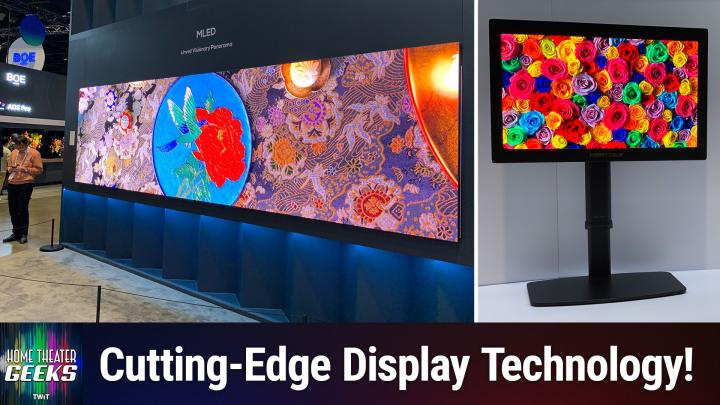
All TWiT.tv Shows (Audio)
Home Theater Geeks 486: SID Display Week 2025
00:32:57
A trip to the annual display geekfest!
Loading summary
Transcript44 lines
- [00:00]
Scott Wilkins Robinson
In this episode of Home Theater Geeks, I talk about my visit to display week 2025. So stay tuned.
- [00:08]
Unknown Sponsor Voice
This episode brought to you by Red Canary. When cybersecurity threats hit fast, you need an MDR partner that moves faster. Red Canary delivers 24.7expert MDR support, total visibility and actionable insights. Plus it helps you detect four times more threats so you can stay ahead with without burning out. Red Canary clears the noise and has your back every hour, every incident. Get the backup you deserve. Visit redcanary.com difference to learn more.
- [00:38]
Zoe Saldana
Hi Zoe Saldana. Welcome to T Mobile. Here's your new iPhone 16 Pro on us.
- [00:42]
Unknown Customer
Thanks. And here's my old phone to trade in.
- [00:44]
Zoe Saldana
You don't need to trade in. When you switch to T Mobile, we'll give you a new iPhone 16 Pro. Plus we'll help you pay off your old Phone up to 800 bucks and you still get to keep it.
- [00:53]
Unknown Customer
There's always a trade in.
- [00:55]
Zoe Saldana
Not right now. @ T Mobile.
- [00:56]
Unknown Customer
I feel like I have to give you something in return for karma.
- [00:58]
Zoe Saldana
That's okay.
- [00:59]
Unknown Customer
I don't really have much in my purse. Oh, let's see. Hand sanitizer. It's lavender.
- [01:04]
Zoe Saldana
I'm good.
- [01:04]
Unknown Customer
Seriously, Let me check this pocket. Oh, mints.
- [01:08]
Zoe Saldana
Really, I'm fine.
- [01:09]
Unknown Customer
Oh, I have raisins. I'm a mom. Wait, wait one sec. I've got cupcakes in the car.
- [01:13]
Unknown T-Mobile Representative
It's our best iPhone offer ever. Switch to T Mobile. Get a new iPhone 16 Pro with Apple intelligence on us. No trade in needed. We'll even pay off your phone up.
- [01:22]
Unknown Voice
To 800 bucks with 24 monthly bill credits. New line $100 plus a month on experience beyond Finance Agreement 999.99 and qualify imported for well plus tax and $10 connection charge. Pay off via virtual prepaid card. Allow 15 days credits and balance due if you pay off early or Cancel.
- [01:37]
Richard Karn
See T mobile.com hi, I'm Richard Karn and you may have seen me on TV talking about the world's number one expandable garden hose. Well, the brand new pocket hose Copperhead with pocket pivot is here and it's a total game changer. Old fashioned hoses get kinks and creases at the spigot, but the Copperhead's pocket pivot swivels 360 degrees for full water flow and freedom to water with ease all around your home. When you're all done, this rust proof anti burst hose shrinks back down to pocket size for effortless handling and tidy storage. Plus your super light and ultra durable Pocket hose Copperhead is backed with a 10 year warranty. What could be better than that? I'll tell you what an exciting radio exclusive offer just for you for a limited time. You can get a free pocket pivot and their 10 pattern sprayer with the purchase of any size Copperhead hose. Just text water to 64,000. That's water to 64,000 for your two free gifts with purchase W A T E R to 64,000 by texting 64,000.
- [02:33]
Unknown Voice
You agree to receive recurring automated marketing messages from Pocket Host. Message and data rates may apply. No purchase required. Terms apply. Available at pockethost.com terms.
- [02:41]
Unknown Sponsor Voice
Podcasts you love.
- [02:43]
Unknown Customer
From people you trust.
- [02:45]
Unknown Sponsor Voice
This is Twit.
- [02:57]
Scott Wilkins Robinson
Hey there, Scott Wilkins Robinson here, the home theater geek. In this episode I talk about my visit to the Display Week 2025 convention hosted by the Society for Information Display. Every year the greatest video technologists assemble for Display Week and it's a real geek fest for those of us who are into display technology. And I mean it gets deep. There are papers and there's a display floor, a show floor where all the manufacturers show their latest technologies and there were some really cool ones there. This year I'm going to start with a technology called RGB led, which I talked about just a couple episodes ago in episode 484. This is a technology in which instead of a blue backlight or a white backlight in an LCD TV, the LEDs in the backlight are actually full red, green and blue LEDs in mini LEDs primarily, and they form a lower resolution full color image of what's on the screen. That light then passes through the LCD layer which forms a much higher resolution image of the same thing. So there were a couple of them at Display Week that I actually got to see. First one that I'm going to show you is from TCL's research and development arm called TCL CSOT or CSOT and they showed this RGB LED backlit LCD TV which was 98 inches tall, 16 by 9, 3840 by 2160 normal UHD resolution. They claimed it had 95% of the BT 2020 color gamut, which is very, very big. They also claimed it had 178 degree viewing angle, which, you know, I am I took this picture off angle and it does look really, really good. So they're doing something to improve the viewing angle of LCD TVs. Also there was another company there that doesn't have a consumer arm. They're just an OEM an original equipment manufacturer that supply panels to other companies, a Chinese company called boe. And they were showing something really interesting, which they called Field Sequential RGB. And so it's RGB LED. It has RGB Red, Green and Blue mini LEDs in the backlight, but they're flashed sequentially, so only the reds fire first, and then only the greens and then only the blues. They're separated in time. This allows even higher brightness and lower power consumption. Even more interesting, no color filters are required. You don't need color filters if the red, green and blue are being flashed separately, which also means you could have three times the number of pixels on the screen or a lot more brightness. Take your pick. Now, the LCDs, the shutters that actually turn on and off or have a dimmer on them that allow more or less light through each one. They need to be super fast, faster than normal. So that's one thing to think about in these. This demo unit you can see here was 85 inches UHD resolution, 2000 nits of peak brightness with a contrast ratio of 8000 to 1, which is okay, it's not as good as OLED, but. And they said they claim 92% of the BT 2020 color gamut, the field rate, that is the rate at which the red, green and blue LEDs were flashing sequentially, was 240 Hz, which, which gives you a full frame rate of 80 Hz, which is not standard. They had some special material that they were showing at that rate. And one thing I noticed right away, I could easily see what's called the rainbow effect. If you've ever watched a DLP projector, a single chip DLP projector, you may have seen what's called the rainbow effect, because a single chip DLP works the same way. It shows all the red pixels first and then all the green pixels and then all the blue pixels in a very fast rotation. And if you have an image that, say, a bright light on a dark background and you move your eyes around, which everybody does to one degree or another, it's a natural thing. It looks like that bright light is being followed by a rainbow because of the red, green and blue happening sequentially. The same thing happened on this set, which I found very interesting. I don't think it's really going to go anywhere, to tell you the truth. I would rather have all of them firing at the same time and use color filters. It was also very difficult to get that, to get that photograph because, you know, taking a picture with a digital camera was Sometimes the picture came out looking really weird color wise. So not that that's really a concern when you're watching tv, but it, it did, it was kind of interesting. Anyway, I thought that was something to show you. Now I talked about LG and their G5 OLED TV in episode 483 they have started a new technology called primary RGB Tandem which is a different structure of OLED materials. I didn't get a photo of the, of this at Display week, but they did have it there and they had it side by side with the G4 which was last year's model which used the older structure and its picture was in fact brighter. So, you know, I think this new, this new OLED technology, primary RGB Tandem, is a good development in the world of oled. And I would take a look at that. They also introduced another new technology which is not in any commercial product yet. It's called Hybrid Tandem oled. And in this case you have two layers of blue OLED material. One of them is fluorescent and one of them is phosphorescent. Both of them are excited under UV light or blue light. And the fluorescent is excited just as long as, as the light is on. And when the light turns off, it stops glowing instantly. Whereas phosphorescent blue material, it maintains its glow for a little while. And at first I thought, well, how is that useful? Because if the blue is going to linger, it's going to lag and stay on even after the light turns off. That's going to screw up the image royally. But I learned that the phosphorescent blue only lasts a few microseconds, so it's not really going to be a problem for the image. What it gains you is decreased power consumption. It's much more efficient, so you don't need to hit it with as much light. And it, and it, it works much better that way. It doesn't require as much power. In this image we see a side by side photo of two 13 inch prototypes. They are 2752 by 2064 pixels, which is 264 pixels per inch, generating a maximum peak brightness of 600 nits. And you can't really, they had power meters next to each of these and you can't really see them in this picture. But I took a closer look and the one on the left, which is conventional oled is consuming 318 watts according to that power meter. The hybrid on the right is consuming 248, so quite a bit less. And that's the Point of this hybrid tandem oled, will we see it in a, in a real product? Probably in a year or two, if it turns out to be economically feasible to, to manufacture. So one of the biggest advantages or the biggest developments in display technology over the last few years has been quantum dots. I've talked about that a lot on the show and one of the primary companies involved in the manufacture of quantum dots themselves is Nanisys. And they were at the show and they showed once again their roadmap to quantum dot development. And here it is, at the top is what we currently have mostly QDEF quantum dot enhancement film, which is basically placed. It's a film that's placed in front of a blue backlight. And the film is impregnated with red and green quantum dots. So when the blue light hits it, the red quantum dots re emit red photons and the green ones re emit green photons. Some of the blue light gets through without hitting a quantum dot. And when you combine blue, green and red, you get white. In this image you can see the QDEF and the XQ def, which is just the enhancement film incorporated into the diffuser plate, which is part of an LCD TV structure. And there were examples of that all over the show and there are tons of them on the market. I've talked about it on a variety of shows here on home theater geeks. What I was more interested in was the next one down called qdcc Quantum dot color conversion. This is what QD OLED is. We can see this. Here's an example of the Samsung QD OLED. Last year's on the left, this year's on the right. It's a form of quantum dot color conversion where blue OLED material shines into a little tiny cell of green quantum dots and they convert the blue into green and another tiny cell subpixel of red quantum dots and they reconvert the blue into red. And then there's a clear cell where the blue from the blue OLED just shines straight through. And once again you get red, green and blue and you can form a full color image. These are the sub pixels of each Pixel in the OLED. Now, in the case of the Samsung scene here, 2024 claimed a peak brightness of 3,000 nits. 2025, 4,000 nits. So they're just refining and improving this technology, which they've had for a couple years. Sony has had it for a couple years. And so that was, that's part of qdcc. One thing I Hadn't seen before in the color conversion was shown by a company called Innolux and they had a 100 inch, 101 inch micro LED display. So these are MIC microscopic LEDs that are emitting their own light. But to get red, green and blue, well, red and green anyway, they actually in coded the inside of the LED itself with red or green quantum dots. So that gives you direct emission from the micro LEDs. And instead of having to make red or green LEDs by other means, you can use them, make them with quantum dots. And that is a new thing and that could really be good. I didn't get any of the specs on this one. Unfortunately. This is the only photo that I didn't take of the ones I'm showing you today. This was taken by my good friend Jeff Urich at Nanisys. He was stuck at his booth most of the time, but he did get around the show a little bit and he saw, you know, a bunch of things that quantum dots were being used in, all of which concern him and his company greatly. So, but, but I wanted to show you this picture because it's the first example I know of of quantum dot color conversion in a micro LED display. And I think, I would imagine it's going to allow it to be brighter and more pure in color and have less problems with that phosphors give you, which is how, how micro LEDs and other LEDs can be made to show other colors. And I'm going to show you more about that in a little bit, so stick around for that.
- [17:19]
Unknown Sponsor Voice
This episode brought to you by Red Canary. When cybersecurity threats hit fast, you need an MDR partner that moves faster. Red Canary delivers 24.7expert MDR support, total visibility and actionable insights. Plus it helps you detect four times more threats so you can stay ahead without burning out. Red Canary clears the noise and has your back every hour, every incident. Get the backup you deserve. Visit redcanary.com difference to learn more.
- [17:49]
Unknown Voice
When the Moore family dished cable Internet and switched to Zigly fiber, they got so much more. Mr. Moore got more upload speed for next level gaming and live streaming to the masses. With reliable service. Mrs. Moore is no longer her family's IT guru, leaving her more time to stream games into overtime.
- [18:04]
Scott Wilkins Robinson
Let's go.
- [18:04]
Unknown Voice
And young Mason Moore got more done quickly uploading HD product demos and video conferencing. Without freesight, the numbers look good.
- [18:11]
Scott Wilkins Robinson
Brad, you're on mute.
- [18:13]
Unknown Voice
Switch from cable Internet to Zibli Fiber and get more of what you love for $65 less per month than cable@ziplyfiber.com.
- [18:20]
Scott Wilkins Robinson
Okay, in the roadmap that we showed you before, the ultimate goal is called QDEL or electroluminescent, in which quantum dots give off color not when stimulated by light, but when stimulated by electricity. This would make them similar to OLED in that they would be emitting light directly under electrical stimulation like OLED material does not when hit by light and color converting, as we saw in the last couple of examples. This is the holy grail. And we don't have any commercial products yet, but for the last couple years we've seen examples of prototypes from companies like Samsung Display, which is the R and D arm of Samsung, which also has Samsung consumer electronics from which we buy TVs. So here's a picture of their, what they call ELQD, electroluminescent quantum dots. This thing is 18.2 inches diagonally, 3200 by 1800 pixels, 400 nits peak brightness with what they claim is 86% of BT 2020 color gamut and like. And it doesn't use color filters, interestingly enough. So there's no. It's very efficient, which means it should be able to get brighter than that. 400 nits isn't that bright. But this is a prototype. They're still working on it. It's a very difficult technology to make. And so. And it looked fabulous. I mean it looks, the colors are gorgeous. This company boe, which I showed you an example, their field sequential RGB LED also showed a quantum dot electroluminescent display. This one's only 7.9 inches, but it's 3840 by 2160. It's full UHD at 8 inches diagonally, which means a, a pixel density of 560 pixels per inch, which is really, really dense. They claim over 90% BT 2020 and a contrast ratio of 10 million to one. Now, it's a small thing. It's, you know, more of a tablet size thing than a TV size thing. But again, it's a prototype. They're just, they're working on this technology. Okay. Back in the Nanosys booth, they had a couple of really nice demos, one of which was looking at QD OLED in a monitor versus woled. Woled is the more conventional oled which has a red, green and blue subpixel and a white sub pixel to allow it to increase its brightness. And that works fine, but it has other drawbacks. And quantum dots solve those drawbacks with the Quantum dot color conversion. So they had a picture or they had two monitors next to each other. And I didn't get a picture of the monitors, but here's the info card anyway. And you can see they were using a Samsung Odyssey G8 monitor, which is a QD OLED, and another monitor which was a WOLED, the conventional OLED. And they were both the same size, they both had the same resolution, the same single luminance gamut, that is the colors that could be reproduced at a given luminance, probably a medium luminance and the same peak luminance, roughly of a thousand nits in the case of the WLED976. Okay, so roughly the same. However, look at this diagram. The bottom right of each of these segments, you see another kind of a weird color multicolored shape. That multicolored shape with a bunch of lines in it is a new type of depiction of color volume. That is, how does the color reproduce at different brightness levels. This is something called gamut rings, and it's way too much to get into right now. I'm going to do another show just on this because it's really, really cool. And it's a new thing that has recently come out. It's now implemented in Calman calibration software. But basically what it shows you is on the top, the Odyssey G8. You see colors throughout the entire diagram. And when you look at the bottom, the WOLED monitor, you see the colors kind of, kind of poop out as you get towards the edges of the display of this depiction and it goes to gray. Basically, the center of this diagram is the darkest light output, the lowest light output, and the outside edge is the highest light output. So the WOLED monitor, as you get brighter and brighter and brighter, the colors become less and less saturated until they finally disappear. And so you'll notice the DCI P3, it's a little hard to see here. Color Gamut, they're calling it. I would call it color volume is 98% in the QD OLED and it's only 51.8% in the WOLED. So what there's. What that's saying is that the WOLED can't keep colors saturated all the way to the highest brightness, whereas a QD OLED can, which is why QD OLED is such a much better technology than the woled. Also, in the Nanisys booth was another really cool demo, and I actually took some video of it. So I want to show you that they were both related to Quantum Dots versus Phosphors. And the point of these demos was to show that certain phosphors have a problem called lag, which means that when you, you stimulate them with light, they glow. And when you turn off the light, they continue to glow. This is not unlike the hybrid oled, but instead of glowing, continuing to glow for microseconds, they glow for milliseconds. So here's this, this video. And this is a film, and the left side of the film is phosphors and the right side is quantum dots. And notice the spot of light, that's actually a blue light that's shining on this white material. And on the left side you have phosphorus. And you notice the red, the red thing, the red sort of splotch that's following that light. That is the phosphor lag of the red phosphor called KSF is the name of that particular red phosphor. And you'll notice no lag on the left side of this, of the image because that's quantum dots. So the spot of white light that you're seeing is actually blue and it's shining on these films. And on the left you have phosphors, red and green phosphors that combine with the blue light that's reflecting off this, this film to give you a white spot. You can see the blue halo around it. And in the right side you have red and green quantum dots. So that was a pretty cool image demonstration of how red phosphors really lag. And if you have a bright image on the screen and it's moving around really fast, you could easily see that red lag if you have a phosphor based display. The other video I wanted to show you was a two monitors next to each other, one phosphor based kfs, KSF phosphor based, and one QDEF quantum dot film. And here we have white lines being scrolled back and forth. And you see, you can see some, again, some red and even some green trailing in the KSF phosphor image that you don't see in the QDEF image. And they showed that also in this image down below, which I can show you in a photograph that, that I took of that image, which is a real time image of what's happening in that display in that test pattern of the white bars moving back and forth. So on the left you have the phosphor based display and the, the lights actually come on at zero milliseconds and the backlight and this is an LCD tv, LED TV or monitor. And they stay on for a little while and they then they turn off. But notice after they turn off, the red line continues. And that's the red phosphor decaying. And even before the frame turns on, the LEDs turn on. You get a little bit of red before they come on. That's the decay from the previous frame. Now you notice also these two little bumps on either side of the main bump in the center. Those are during the black frame insertion. Right? So in black frame insertion you insert a black frame between the, the active frames. And the reason is to improve motion blur. But even though the LCD LCD panel is off, the shutters are closed, the backlight flashes and you. And a still little bit of light gets through, which is why LCD TVs are never going to reach as deep black as OLED. But you notice on the right there are no red trailing little trails after the actual, the actual pulse of light or even before, because LED quantum dots rather do not have any lag or any afterglow, if you will. They just don't. Which is one reason why quantum dots are so much better than phosphors when it comes to, when it comes to displays. So these were all very interesting demonstrations at Nanisys and I want to thank Jeff for being such a great host there at his booth and showing me all around. Ok, last thing to talk about is micro led. We saw one earlier from Intelux which was using quantum dot color conversion, but there were other conventional micro LEDs on display. One in particular I thought was pretty cool was on the outside of the TCL CSOC booth. This is 219 inches wide. Now, since micro LEDs are tiles, they're small tiles, roughly a foot square, more or less. You can put together as many of them as you want into almost any shape. And so they put together this 219 inch wide 36 by 9 display which had 5760 by 1440 pixels and a pixel pitch, that is the distance between individual pixels at just over 0.9 millimeter. And they claimed a contrast ratio of a million to one. The other one that I took a picture of was from a company called Vistar. That one is 88 inches peak brightness up to 2000 nits. Contrast ratio they said was 26,000 to one and a smaller pixel pitch of 0.5 millimeter, half a millimeter, which they claimed covered over 99% of DCI P3 color gamut. And it looked beautiful. It just looked great. Micro LED I think is going to be a, is a great display technology and will make its way into the consumer market to some degree. It's still so expensive then. The reason, one of the reasons for that is that the placement of the micro LEDs has to be perfect. There can be no flaw. And so the failure rate in manufacturing is pretty high still. It's sort of the ultimate in display technology and it's, it's already being used on things like news sets and in movie and TV production. Really, really big ones used as virtual sets instead of green screen. They put these things behind the actors and it looks like where they're supposed to be. So this is another technology to look at. And it was certainly there at Display Week 2025, which was really great fun. I don't normally go to, to consumer or trade shows much anymore, but this one was close by and Jeff was there, my friend, and I wanted to go see him and I wanted to see these new technologies because I am after all, a home theater geek. So hope you enjoyed the the trip along with me to Sid Display Week 2025. Now if you have a question for me, you can send it right along to htgwit tv. I like to answer those questions here on the show and I will do so as often as I can. And as you know, all of Twitch shows are now on YouTube for free but with advertising. If you want to go ad free, join the club, go to TWIT TV Club Twit and join up to see all the shows ad free and the and get the ability to come into the Discord channel and talk tech with all the geeks. Until next time, geek out. Hey home theater geek fans. I'm here to let you know that I'm going to do a special show on Wednesday, June 25, right after Intelligent Machines. So if you're in the chat room for that show, stick around because I'm going to be answering questions live from the chat room room. All home theater related of course, nothing else. But if you got a home theater question for me and you're in the chat room, that's the time to ask it because I'll be watching the chat room and answering those questions as best I can. So I hope you'll join us.
- [35:05]
Unknown Sponsor Voice
From Silicon Valley boardrooms to tomorrow's AI breakthroughs, if you need to keep up to date with tech, you need TWiT TV. At TWiT, we are tech experts who understand what's happening and can keep you in the loop. And we do it in a thoughtful informed and fun way. Start your Sundays with this Week in Tech, a roundtable of tech journalists and people in the know with a rundown of the week's most important tech news. But that's not all. All week long you can stay ahead of security threats with Steve Gibson and Security Now. Keep up on all things Apple with MacBreak Weekly. Listen to the most informed Microsoft experts in the world with Paul Thurat and Richard Campbell on Windows Weekly. Our flagship shows feature tech's most respected voices, giving you the insight you need to understand and benefit from the changing world of technology. We give you analysis you won't find anywhere else so you can make smarter business decisions and take advantage of the technologies transforming your world. Whether you're a CEO, IT professional, or simply passionate about technology, TWiT's network of shows gives you the edge you need in today's digital landscape. Don't miss a minute. Subscribe to TWiT TV today.
- [36:28]
Zoe Saldana
Hi Zoe Saldana. Welcome to T Mobile. Here's your new iPhone 16 Pro on us.
- [36:32]
Unknown Customer
Thanks. And here's my old phone to trade in.
- [36:35]
Zoe Saldana
You don't need a trade in when you switch to T Mobile will give you a new iPhone 16 Pro. Plus we'll help you pay off your old Phone up to 800 bucks and you still get to keep it.
- [36:44]
Unknown Customer
There's always a trade in.
- [36:45]
Zoe Saldana
Not right now. @ T Mobile.
- [36:46]
Unknown Customer
I feel like I have to give you something in return for karma.
- [36:48]
Zoe Saldana
That's okay.
- [36:50]
Unknown Customer
I don't really have much in my purse. Oh, let's see. Hand sanitizer. It's lavender.
- [36:54]
Zoe Saldana
I'm good. Seriously.
- [36:56]
Unknown Customer
Let me check this pocket. Oh, mints.
- [36:58]
Zoe Saldana
Really, I'm fine.
- [36:59]
Unknown Customer
Oh, I have raisins. I'm a mom. Wait, wait one sec. I've got cupcakes in the car.
- [37:04]
Unknown T-Mobile Representative
It's our best iPhone offer ever. Switch to T Mobile. Get a new iPhone 16 Pro with Apple Intelligence on us. No trade in needed. We'll even pay off your phone up.
- [37:12]
Unknown Voice
To 800 bucks with 24 monthly bill credits. New line 100 plus a month on experience beyond Finance Agreement 999.99 and qualifying ported for well qualified plus tax and $10 connection charge payout via virtual prepaid card. Allow 15 days credits and amounts due if you pay off early or cancel. See T mobile dot com.