← All TWiT.tv Shows (Audio)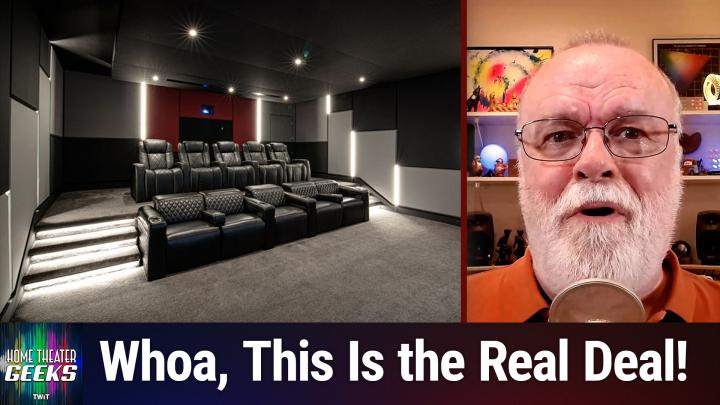
All TWiT.tv Shows (Audio)
Home Theater Geeks 489: The End Game Theater
02:36:11
Home Theater of the Month!
Loading summary
Transcript4 lines
- [00:01]
A
In this episode of Home Theater Geeks, I profile another home theater built by Patrick Williams, who I profiled a few episodes ago with his Force Theater Star wars theme. Not so this time. Stay tuned.
- [00:16]
B
Today's show is brought to you by Progressive Insurance. Do you ever think about switching insurance companies to see if you could save some cash? Progressive makes it easy to see if you could save when you bundle your home and auto policies. Try it@progressive progressive.com progressive casualty insurance company and affiliates. Potential savings will vary. Not available in all states. Podcasts you love from people you trust. This is Twit.
- [00:59]
A
Hey there Scott Wilkinson here, the home theater geek. In episode 481, I profiled a home theater built by Patrick Williams that was in honor of May 4th Star Wars Day. And his theater was definitely Star wars themed. It was called the Force. Well, Patrick has since moved and built a new house in Springfield, Missouri and built a new home theater. Had has nothing to do with Star wars, but he wanted everything about it to outperform what he had done before. Well, that's a tall order because what he had built in the Force was quite good. But I have to say this one's even better. I profiled it on AVS forum and we'll put the link in the show notes to that article so you can see even more detail than what I'm going to present here. But I wanted to share it with you because it's really, really good. As I said, his primary goal was to make it bigger and better. For one thing, he had seven seats in the force and he wanted at least 10 in this one. So the room had to be bigger and he also needed it to be so that no seat was too close to a wall or the back or super close to a speaker. So the room had to be even bigger. So of course since this was also a custom build along with the house which was built from the ground up, he had to start with a plan. And the plan came from Quest Acoustical Interiors company that developed the layout and here we see it, very detailed drawing. The planning and design happened just prior, he says, to the release of CEDIA's recommended practice for immersive audio systems which is called RP22. But it was the draft was out and he based they based the theater on those principles. The people at the company were Sean Byrne and Sharon Thayer and they designed the theater and Gary lemay, president of Quest AI performed the pre build acoustical analysis. So this is no holds barred folks. This is the real deal. Okay, so once he had the plan, it was time to start building. And here's the concrete shell. You know, it's so great when you can start with exactly the right dimensions and build the room really from scratch. I mean, here it is from scratch. Next step of course was framing. And we see a picture of the framing and the space is really, really big. So this is not going to be a small theater by any means. In the next picture you can see the framing with some of the siding up. And he wrote in where most of the speakers would be. And he wanted to put in more speaker channels than he had in the force for greater immersion and then the ability to really recreate the theatrical immersive spatial experience. Although his really was going to be clearer and more detailed than most commercial cinemas. He said I also wanted to give a bit more violence in the low end without distorting. And the way to accompany that accomplish that was to use a Trinov altitude 16 surround process with QSC power amps. These are professional power amps for the main channels and JTR amps for the subs. JTR being the company that actually built the subs. And he also noted that with such a much larger room he was going to need a larger screen and that was going to require a projector capable of lighting it up. But he didn't want the blacks to suffer. So of course he went with a JVC projector. In his case the DLA NZ 9 which is their top of the line projector. And it's a light cannon, but still preserves blacks beautifully. JVC is, is the champion of blacks in projectors. The screen is a Stuart Studio Tech 130G4 which has a gain of 1.3. So almost close to unity. 15ft wide with 2.35 to 1 aspect ratio. So full cinema aspect ratio and Giant. And he also uses a video processor called the MAD VR Envy Extreme, which is a wonderful video processor and a panamorph anamorphic lens to stretch the image to 16 by 9. Okay. In the next graphic we can see something that is done in most high end home theaters which is called hat channels. So these metal bars that are across the framing are used to hang the drywall which have clips on the drywall so that it's isolated from the framing and from the rest of the house. The sound isolation was really important to him, as was a dedicated heating, ventilation and air conditioning system. H Vac. In fact, the room was engineered as a room within a room to maximize sound isolation and soundproofing. And the theater had a dedicated H VAC system that controlled the temperature and contained the sound without leaking into the rest of the house. In the next image, we can see the riser taking shape. And it's a very large riser. It's going to fit five, five seats in it that are not close to any walls or speakers. And the next picture we see he covered all the walls with fabric. And these, these pieces right here, these wooden pieces on top of the drywall are for that purpose. They're going to hang the fabric on these pieces of wood channels, whatever you want to call them. And in the next picture, we can see the acoustic treatments that are going to be behind that fabric. They're all provided by Quest AI and there are some diffusers and some absorbers and some hybrid type things. Again, the acoustical analysis was very carefully done to optimize the sound of the room. They use double 5 inch, 58 inch drywall with green glue behind between the ceiling joists and all the walls. They use the IB1 clips and hat channels for the walls and ceiling, R19 insulation in all cavities, a floating floor and a mixture of sand and sawdust in the stage and flexed ducting in for the H vac for the supplies and returns in the theater and projector room. In the next graphic, we can see that the screen wall and the ceiling are acoustically treated as well. There's no stone left unturned here. In the next graphic, we can see the fabric in the walls, which he said was the most difficult thing in the, in the entire build. And you can see it's kind of beveled on the edges, on these sides, the edges of this, of each panel, which gives it a real 3D look. Beautiful in fact, but not easy to install at all. So in the next graphic, we can see the front screen wall with the two JTR captivator subwoofers in addition to the Ascendo LCR speakers. This model of Ascendo is called the 12 Ascendo. The six on wall and wedge speakers were used for the surrounds and overhead speakers. So he went Ascendo all the way around with the JTR subwoofers. That's again, that's a speaker company you might not have heard of, but very, very high end. Interestingly, he put two more subs in the back of the room, but he tried to find a place to put them and he found a place behind the rear seats. In the next graphic, we can see that they're actually in the floor covered by metal grates to protect the drivers. And so he has two in the front and two in the back, which is an excellent way to. To manage your low frequency bass. And especially with that Trinov processor, you can do some really, really nice things. The, the equipment rack in the next picture is, is also very impressive. We have three, three views of it. Lots of techno spaghetti. And that Taurus on the right is the. The power supply. Basically from a company called Taurus Power. It's a balanced power system. Now, the room has some unusual elements, as most theaters do. The theater is two feet lower than the rest of the basement to achieve the desired ceiling height. The plan had originally called for it being three feet lower, but then they hit a lot of limestone that required something called a rock breaker. And as he said, you got to compromise somewhere. I'm sure that would have been really expensive and lot, a lot of work to. To go a foot into the bedrock. So he didn't do that. So finally we look at the room itself as it's finished and what a gorgeous room. I mean, wow, it's so beautiful. He didn't want to do another themed theater like the Death Star. He said he wanted something that mimicked an IMAX feel. And the goal was to conceal the speakers behind fabric, which he did, and having the projector room to house all the components so that's separate from the theater. He wanted to eliminate any distractions that pulled you out of the experience. And they made sure to use dark, darker colors near the screen to improve the contrast, which the JVC already does a great job at, but they wanted to make it as good as it could be. He said the colors we ended up with are a callback to the original NES console. Black and charcoal gray with red accents. Also notice these LED strip lights, which are not floor to ceiling, but just different. Different heights and different lengths. It's a beautiful effect. In the next graphic, we can see the. That he got his wish for 10 seats. And they're really, really nice with stairs leading to the. To the riser. I mean, this is. The whole thing is just so beautiful. The next one we see again, another picture of the front. The seats. And the front row seats are from a company called Seatcraft. They're the Diamante FX recliners with retracting headrests. This is pretty interesting. So if you want headrests often block the sound that's coming from behind you in from getting to your ears properly. So you can retract them in that case and not worry about that. The rear row, the second row is 5ht design Waveland required recliners. They don't have the reclining headrests, but the money seat, if you will, is in the front row, so that's fine. Patrick did a lot of work, a lot of the work himself. He built and installed the speaker boxes. He cut and installed the acoustic treatment material. He did an awful lot of it himself, and that saved him some money, although this was still not a cheap build. In fact, he said the MSRP of all the gear was around $250,000, but he was able to get it for around 155. He shopped for deals, bought used equipment where he could. Still, it's a lot of money. Construction and labor were an additional 40 to $45,000, and that's even with him doing a lot of the work himself. He called it the end game theater. And he said it's not a marvel reference. It's not a reference to Avengers endgame movie, but rather a play on words for two reasons he says. First, the gear is end game, at least for us. I'm sure he doesn't want to buy any more gear. Although anybody who's a home theater geek knows there is no cure for upgrade ITIs. Second, he's a gamer and he. The design reminds him of something from a video game. So that's, that's why he ended up calling it the end game. So one last picture of, of the final. Of the final room to show you here. It's. It's really a beauty. Here's the view from the seats and it's. I would love to watch a movie in there. It's hard to imagine that Patrick could have improved on the Forest theater, but he really did. He really, really did. And he's sure to enjoy it for many years to come. It truly is an end game. I have a feeling if he buys another house and builds another theater, where can he go from here? Who knows? But for the moment, I'm sure he is happily ensconced. Well done, Patrick. Now, if you have a question for me, you can send it right along to htg. I love answering questions here on the show and I will do so as often as I can. And as you know, all of Twitch shows are on YouTube now for free, but with ads. If you want to go ad free, join the club. Go to Twit TV Club Twit to join up today. Until next time, geek out.
- [17:01]
B
Hey, buddy, are you a geek? Are you a tech enthusiast? Then I would love to invite you to join a tech community like no other. You can gain exclusive access to our incomparable quality tech content with Club Twit as a member. You'll Enjoy all Twitt TV shows ad free, plus access private video feeds for insider shows like iOS Today, home theater Geeks, and so much more. Dive into the Members only Twit plus bonus feed for behind the scenes content, club discussions and special events. But here's the best Join our incredible Discord community to watch live show productions, chat with hosts, and participate in exclusive members only activities. It's your backstage pass to the world of twit. Whether you're a tech enthusiast or a lifelong learner, Club Twit elevates your knowledge while entertaining your interests. Get two weeks free when you sign up now and unlock unparalleled access at TWiT TV. Club TWiT. That's TWiT TV Club TWiT. And from the bottom of my heart, thank you and welcome to the.