← All TWiT.tv Shows (Audio)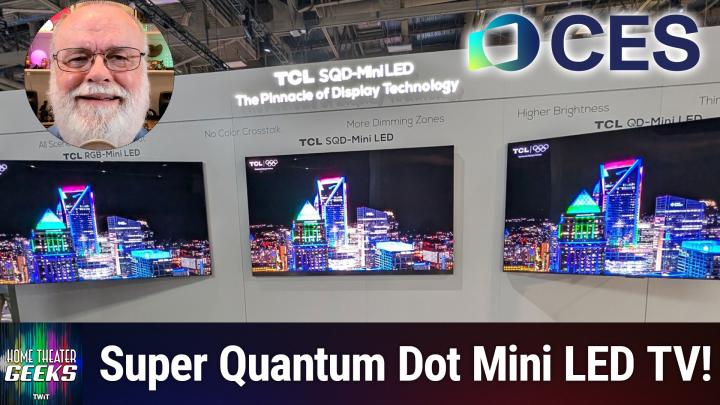
All TWiT.tv Shows (Audio)
Home Theater Geeks 515: CES 2026 Part 2
00:24:14
New TVs From TCL, LG, Samsung, Sharp, & More!
Loading summary
Transcript9 lines
- [00:01]
Scott Wilkinson
New Year Same extra value meals at McDonald's. So now get two snack wraps plus fries and a medium soft drink for just $8 for a limited time only. Prices and participation may vary. Prices may be higher in Hawaii, Alaska and California. And for delivery in this episode of Home Theater Geeks, I continue my coverage of CES 2026, so stay tuned. Podcasts you love from people you trust. This is. Hey there, Scott Wilkinson here, the home theater geek. In this episode, I'm going to continue covering CES 2026 without my good friend Mike Heiss. He joined me for part one, and he was going to join me for parts two and three because he actually went to the show and I didn't, but circumstances prevailed and he had to split. So I'm really sorry to to miss him on this show. I will endeavor to carry on without him. He left me a lot of great notes and some great pictures too, so we'll take a look at those. And I thank Mike for being on part one, and sorry to miss you on parts two and three, but you'll be back, no doubt about it. So this week I wanted to cover video news other than mini and micro RGB LED backlit LCD TVs, which was the subject of part one. And it was the big video story of CES 2026. So if that sounds a little confusing or you want to know more about that, go back and check out the previous episode. This time we're going to go with maybe a little more conventional video news. And I do want to apologize to Mike for one thing. I would have said this to his face had he been here, which is we were talking about a Hisense product which was actually a direct view LED set. The only one we talked about last episode in which Hisense added a yellow sub pixel and Mike made the point of, oh, well, that's been done before. Sharp did that. And I said, oh, I thought it was Phillips. And he said, well, memory fades as you get older, blah, blah blah. Turns out he was right and I was wrong. And I want to make that clear. It was the Sharp Quatron, made famous by the commercials that they did many years ago now with George Takei. Oh my. So Mike was right. He. He had remembered correctly, I had remembered incorrectly, proving that memory does in fact fade with age, but you can always recover it. Anyway, let's get to the news of CES 2026 TV news part two. I'd say the big news in that regard was the TCL X11L, which uses a advanced form of Quantum dots that they call sqd super quantum dot. It's a mini LED backlit LCD TV. It's not RGB as we talked about in the last episod. It is a more conventional, what's called quantum dot enhancement film backlight. So the backlight LEDs are blue. That blue light passes through a film impregnated with quantum dots, both red and green. The blue light stimulates the red and green quantum dots to glow. And some of the blue light passes through without hitting a quantum dot. And so you get red, green and blue added together equals white. And then that passes through the LCD layer and which has color filters, Red, green and blue color filters. And that forms the picture. They claim it has 20,000 dimming zones and a peak brightness of 10,000 nits, which is the maximum peak brightness that is defined for high dynamic range. And we've, I don't think there has been a commercial display or a consumer display, I should say that reaches that peak brightness. So that is the maximum that you can do with HDR. Now clearly the whole screen isn't going to be 10,000 nits. You'd be blinded you but but specular highlights, the tiny little reflections off of chrome in the sun and that sort of thing can now in fact reach 10,000 nits. And that is quite, quite stunning. It also implements Dolby Vision 2 Max, which I talked about in Home Theater Geeks episode 503. So if you want to learn more About Dolby Vision 2, go check out that, that episode. Okay, so what a super quantum dot, really all it means is tighter control of the size of the quantum dot. Now the size of the quantum dot determines the color or the wavelength that it emits when it's hit with blue light. And Nanosys, the company that makes the quantum dots for most TV manufacturers, was able to refine their technique to go from a plus or minus 2 nanometer peak wavelength to a plus or minus 1 nanometer peak wavelength. It actually makes a visible difference. Now the size difference between a 520 nanometer quantum dot and a 521 nanometer green quantum dot is less than 0.008 nanometer, which is less than a tenth the width of a hydrogen atom. So we're talking some serious precision here. And Nanisys was able to do what TCL asked and make these quantum dots more precise and thus have better control of the color. It also has a, a new LCD panel with wide color viewing, high static contrast up to 7,000 to 1 and a nice anti reflective screen. So With a combination of Super Quantum Dots, SQD and Ultra color filters. They refine their color filters as well and, and advanced color purity algorithm in the processing. They claim 100% of BT 2020 color gamut coverage. Now this is not true. This is marketing hype and we talked about this, Mike and I, in the last episode. So I want you to go back and check that out. Because it's physically impossible to, to actually reach full coverage of BT 2020 color without using lasers. No LCD TV can do it. It's physically impossible. Some of the manufacturers at CES were claiming more than 100% BT 2020, which is also clearly impossible even with lasers. So you take that with a, with a grain of salt and it did increase the color space that they were able to address, but it's not really 100 BT 2020. Also interesting that they're using Bang and Olufsen audio in this thing, which is a trend that I've started to see in, in higher end TVs. There. They are cooperating with high end audio makers to put their audio into the TVs. Now how good can it be with a TV that's only an eighth of an inch deep, which this one is? I mean, there's no room for sound to resonate in there. Well, what can I tell you it's coming from. It's coming in three sizes. 75 inch, 85 inch and 95 inch, 75 inches. $7,000. The 85 inch is $8,000 and the 98 is $10,000. So you know, we're talking high end here, but it should look great. I do remember Mike saying in particular that this TV looked fantastic and it was one of the only opportunities at the show to see several different technologies next to each other, which we can see in graphic 2AMike took this picture on the show floor and you can see here there's a TCL RGB mini led, which is the technology we talked about last time. In the middle is the SQD Mini led which is the one we're talking about now. And then in the right is their more conventional non super qd, but regular QD Mini LED tv. And so, you know, showgoers including Mike, were able to see the difference. And he said the SQD just looked fantastic, which I'm not surprised. One other thing that Jeff Urich, our friend from Nanisys sent me was a graphic to show the difference in spectrum. Remember we were talking about SQD having a narrower spectrum. And so here we can see RGB Mini LED in gray which is this new technology versus the QD Mini LED Spectra, I think of the sqd and as you can see, that's in white and it has higher peaks. It has a slightly lower wavelength in the red. The wavelengths in the blue and green are about the same, but it's brighter. So there is an advantage to doing it the old fashioned way, shall we say. Anyway, just thought I'd show you that. Okay, Next up is LG and they had RGB mini or micro LED backlit LCD TVs. We talked about that last episode. But they also had their OLEDs. They were all in on OLED as usual and rightly so. The big announcement I think was the W6, which is their OLED wallpaper TV. It's 9 millimeters thick, this screen, and it's wireless except for power. It uses a one sort of a wireless box where you connect your devices and sends that wirelessly to the tv. You still have to plug the TV in so when you mount it on the wall you, you know, need to put a outlet there. And it uses their new primary RGB tandem OLED structure. Their new processor, it's three, almost four times brighter than last year's W series. So that's, that's, it's going to be impressive TV, no doubt. They also introduced the C6 and G6 OLEDs which are just this, this, this year's models. The 6 indicates 2026 in case you didn't catch that. They also use this primary RGB tandem OLED structure in the G6 anyway. And the larger C6, 77 and 83 inches regular WO led the smaller sizes. The G6 claims up to 4500 nits of peak brightness in a 3% window. So OLEDs are getting brighter all the time. 4500 nits is a lot. Now one thing SAM or LG, sorry, showed at CDN and they weren't the only ones, was the concept of the art tv. Now Samsung's been doing this for years with the frame. LG got into the picture this year with the Gallery art tv, which is really art to display on your tv. And you can, you can get all sorts of art for the W6, the G6, the LX7. Their service called LG Gallery plus has 4, 500 more than 4,500 pieces of curated art content. So that was another big announcement by lg.
- [14:01]
Mint Mobile Announcer
Well, the holidays have come and gone once again, but if you've forgotten to get that special someone in your life a gift, well, Mint Mobile is extremely extending their holiday offer. Of half off unlimited wireless. So here's the idea. You get it now, you call it an early present for next year.
- [14:16]
Scott Wilkinson
What do you have to lose?
- [14:18]
Mint Mobile Announcer
Give it a try@mintmobile.com Switch limited time.
- [14:22]
Mint Mobile Terms Announcer
50 off regular price for new customers. Upfront payment required 45 for 3 months, $90 for 6 month or 180 for 12 month plan taxes and fees. Extra speeds may slow after 50 gigabytes per month when network is busy. See terms.
- [14:33]
Scott Wilkinson
So next we come to Samsung and they made a big push for AI. All the companies did. Mike and I talked about this last week. AI was everywhere in the processing and in the user interface experience, content recommendations, that sort of thing and interacting with your tv. Samsung went all in on this with their vision. AI as an everyday utility. So you know that's, it's gonna, it's common whether we like it or not. And Samsung's all in on it. They had several models of TV there. I was unable to get any good pictures. So I will just tell you about them. The S95H is their latest QD OLED and for the first time you have the option of operating it with the wireless One Connect box. So like the LG W6, the Samsung S95H can be done wirelessly with this extra box, but it costs extra, comes with the LG. They claimed that the S95H is 35% brighter than last year and it has eight HDMI inputs. So I don't think I've ever heard of a TV with eight HDMI inputs and with such an expensive tv. I'm not sure why, because you would normally have a source device like this wireless one connect box to connect things to and send them that way. I'm not quite sure. They also introduced the step down oled called the S90H H being for 20, 26. Some sizes of that will be QD OLED, others will be regular OLED. And the S85H is the step down from that. They had a couple of Neo QLEDs, quantum dot enhancement film, blue backlight, LCD TVs they called Neo QLED up to 100 inches, probably 55, 65, 75, 85 as well. So you know they had plenty of stuff there too. Interestingly, Sharp was back. I was talking about Sharp a little earlier and how they had put a yellow sub pixel in their quatron set. I don't think they had those at ces but they did have their Aquos QLED smart TV with new interface, a new operating system called Zumo which is A joint venture between Sharp and Comcast and Charter, which I thought was kind of interesting. It'll be available in 50, 55, 65, 75, 85 inches. And according to the press materials, it's available now. So. Welcome back Sharp. Another couple of quick mentions here. Amazon is rebranding its house brand of TV to Ember, which I guess is a smoldering fire. TV Louvre is back. A German manufacturer. They were here many years ago and they, they had some TVs at CES. According to Mike, some of them have concrete back panels. What? That doesn't make any sense to me. I thought we lost heavy TVs decades ago, but for some reason they have concrete back panels. If Mike was here, he could probably tell us why. A couple other quick things to mention. Company called Silox. Silvox has a frameless outdoor TV 110 inches with 5,000 nits of peak brightness, which is really what you need to be outside. No prices that I know of, but I'm sure it ain't cheap. Mike wanted to mention a company called Dream D R E A M E with their Aura TV which is a 4K mini LED TV sizes 55 to 85 inches. Just another, another company coming into the, into the market. I don't know if you remember last year Mike mentioned a company called Displace which had a wireless tv, a truly wireless TV with active suction cups on the back. And it was actually, it actually ran on batteries so you didn't have to plug it in. And all the signals came from a transmitter box. Suction cup based Wall Mount TV. So they had their new Pro TV 2,6500 bucks. It's an AI native TV with a natural language, voice interaction and gesture control, which is kind of interesting. And it's an OLED TV6 the 65 inch anyway with 8 to 10 hours of battery life at peak brightness. So with a suction mount, that suction mount system can handle up to 300 pounds. They also offered a, a snap on sound bar that you could add to it. And then they had interestingly what they called the Displace hub, which is $2,000. It's basically a wall mount. You can mount any TV onto it. And it uses that active suction cup technology to keep that TV on the wall. No drilling into walls. It's battery powered. How you get the power to the TV, I'm not 100% sure. Maybe you plug it into the, to this gizmo and its battery provides power to the tv. Mike told me that when its battery is losing its charge, it sort of gracious, gracefully allows the TV to slip down the wall which is good because if it were to lose power and the TV crashed to the ground, that would not be good. There were a few projectors at the show as well. CES is not known as a big projector show, but there were a few. Hisense for example had the XR10, the PX4 Pro and the C2. The XR10 boasts 6,000 lumens with an 8,000 to 1 contrast ratio with a dynamic iris, lots of lens shift and optical zoom which makes placement really good. Samsung also had their next generation of freestyle compact projector, 430 lumens, but it's very compact and portable and it has AI powered screen optimization. Another company called xgimi X G I M I showed the Titan Noir Max with a dynamic iris, a re engineered DMD which is DLP imaging chip and what they claim is a native contrast of 10,000 to 1. So X Jimmy's been getting some good, good press, so I expect good things from this. Then another company, Chinese company that gets really good press and wins shootouts and so on is a company called 4Movie1Word. They introduced a couple of things. I don't have a picture of them. One is called the XMing chapter one which is a LCD liquid cooled projector with 2000 lumen output. And they had two others in the XMing line, the page two and the episode two which are both LCD projectors. And perhaps more interesting for home theater geeks, the four Movie Theater Premium which is, which is the one I think that won the last shootout. It's a UST ultra short throw projector so you put it right up against the wall. Uses three lasers for illumination, red, green and blue:3001 contrast ratio, B&W sound, Dolby Atmos, DTS X. I mean it's. That's pretty high end. So that is what we have for other video news at CES 2026 in the next episode I'll wrap up some of the stuff that was in the audio sphere and there was some stuff. So I look forward to sharing that with you next time. Now if you have any questions for me, please send them along to HTG and I'll answer as many as I can right here on the show. And if you have a home theater that you're proud of and you want to share it with our audience, send me a few pics and a little bit of description to htgwit TV and maybe we'll feature it on the show. Until next time, geek out.
- [24:31]
Leo Laporte
Hey everybody. Leo Laporte here with a quick reminder. There are just a few more days to take our annual survey. Your feedback guides the future of TWiT. You can find it on our website TWiT TV Survey 26. Take it before the end of the month. Tell us what you think. We'd love to hear from you. Thanks in advance.
- [25:00]
Scott Wilkinson
Hablas espanol Spritz du dzoich Com Dunos.
- [25:03]
Babbel Announcer
If you used Babbel, you would Babbel's conversation based techniques teaches you useful words and phrases to get you speaking quickly about the things you actually talk about in the real world. With lessons handcrafted by over 200 language experts and voiced by real native speakers, Babbel is like having a private tutor in your pocket. Start speaking with Babbel today. Get up to 55% off your Babbel subscription right now at Babbel.com Spotify spelled B A B-B-E-L.com Spotify rules and restrictions may apply.