← All TWiT.tv Shows (Audio)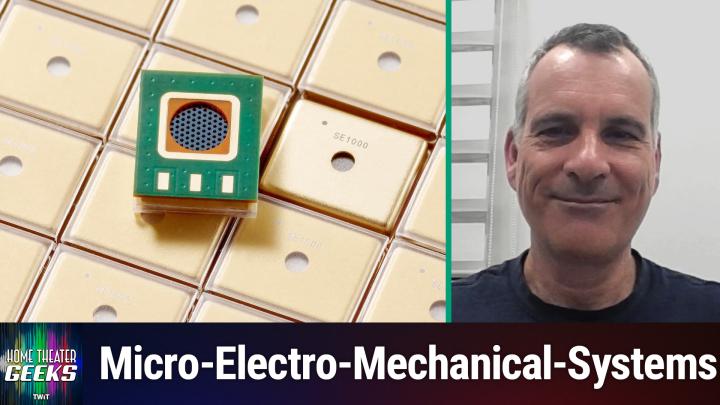
All TWiT.tv Shows (Audio)
Home Theater Geeks 518: MEMS Speaker Technology
00:57:58
A Different Type of Speaker Driver
Loading summary
Transcript114 lines
- [00:00]
Priceline Narrator
We all have that dream trip we've been wishing we could go on. But too often, life or usually price gets in the way. That's why Priceline is here to help you turn your dream trip into reality. With up to 60% off hotels and up to 50% off flights, you can book everything you need for your next adventure. Don't just dream about that next trip, book it with Priceline. Download the Priceline app or visit priceline.com and book your next trip Today.
- [00:27]
Moti Margalit
Go to your happy price.
- [00:29]
Celsius Energy Drink Narrator
Priceline 5am I'm up with a crisp Celsius energy drink running 12 miles today. Grab a green juice, quick change and head to work. Meetings, workshops One more Celsius. No slowing down. Working late, but obviously still meeting the girls for a little dancing. Celsius Live Fit. Go grab a cold, refreshing Celsius at your local retailer or locate now@celsius.com.
- [00:56]
TaxAct Narrator
Tax act is here anytime you want to easily file your taxes. Tax act is here for the early birds who like to knock them out as soon as the season opens, and for the procrastinators who like to wait until the very last minute. Tax act is also here for the midlers who file right in the middle of tax season. No one ever talks about the midlers, but TaxAct sees you and TaxAct respects you. Tax act let's get them over with.
- [01:25]
Scott Wilkinson
In this episode of Home Theater Geeks, I chat with Moti Margalit, CEO and co founder of Sonic Edge, about a new speaker transducer technology. So stay tuned.
- [01:40]
Moti Margalit
Podcasts you love from people you trust. This is Twit.
- [01:56]
Scott Wilkinson
Hey there, Scott Wilkinson here, the home Theater geek. In this episode, I'm going to chat with Moti Margalit, CEO and co founder of Sonic Edge, a company that's doing some really interesting stuff with a new speaker technology. Hey Moti, welcome to the show.
- [02:18]
Moti Margalit
Thanks Scott. It's a pleasure being here.
- [02:21]
Scott Wilkinson
I'm so glad to have you on. I first learned about your company and your research in a press release for ces, which was just last month. I didn't get to go and meet you there, but I'm so glad to get a chance to talk with you here.
- [02:40]
Moti Margalit
I'm glad to for that opportunity.
- [02:44]
Scott Wilkinson
So we're talking about speaker technology, which for the most part hasn't really changed in what, a hundred years OR so?
- [02:54]
Moti Margalit
Even 150.
- [02:56]
Scott Wilkinson
Even 150 years. Let's start with. Give us a brief overview of sort of conventional speaker technology.
- [03:06]
Moti Margalit
Sure. So there's some debate who really invented the speakers. But Alexander Graham Bell is typically credited with it 150 years ago. And basically the technology has stayed the same. You have a membrane moving, pushing air, generating sound pressure, which travels at the speed of sound, reaches our ears, and we register that as audio. And that technology is basically the same technology if it's loud speakers in your living room or very small speakers fitting into your earphone or hearing aid. And when you try to make a speaker small, you run into multiple physical problems because of this structure that that speakers are all about. My partner Ari, who co founded with me the company he uses hearing aids. And the common complaint of people using hearing aids is that it's better than nothing. But they don't really hear well. They don't hear well in crowds, they don't hear well in noisy environments, and they can't really enjoy music from that. We started thinking about making really small speaker.
- [04:19]
Scott Wilkinson
Yeah, really small, in fact. And so what you did was come up with or use a technology that's been around for a while called M E M S, or mems, which stands for micro electromechanical system. So give us a overview of what this technology is about.
- [04:44]
Moti Margalit
Sure. So MEMS is a technology that's been around for, I would say, nearly 50 years now. We all know about silicon technology, computer chips, all the electronic chips around us. And in silicon technology, you basically make transistors and other electronic circuits. In silicon MEMs, microelectromechanical systems, is basically making mechanical structures in the silicon. So instead of having transistors, you have, for example, membranes, you can have different kind of structures. And these devices make, for example, accelerometers, used in the crash detection in cars to deploy airbags, used in your cell phone to detect various motions. Other uses of men's technology is for microphones. So, so in your cell phone, you would have four MEMS microphones, basically picking up the voice and translating that into electronics. So MEMS is a technology where you make a mechanical structure, typically combine it with some electronic pickup or electronic actuation, and then have an interface between the electronic world and the mechanical and the physical world.
- [06:04]
Scott Wilkinson
The mechanical parts are super tiny, right?
- [06:09]
Moti Margalit
Yes. That's why they're called microelectromechanical systems. So the size of these structures is typically, let's say, smaller than the width of a hair. So you're looking at structures which are very small and can provide various types of functionality.
- [06:31]
Scott Wilkinson
And so how does this get applied to a speaker driver or transducer?
- [06:40]
Moti Margalit
So actually, MEMS by itself is not enough like we said, MEMS technology has been around for 50 years. And back in 2000 or so, a company called Knowles basically developed the MEMS microphone. So a MEMS microphone is a membrane which when it sees pressure changes, it vibrates and then translates those vibrations into electronics. Now, from the minute that people invented the men's microphones, and Today, you know, 8 billion of these men's microphones are being used every year in cell phones, cars, laptops, basically everywhere. So from the minute the MEMS microphone was invented, people were trying to make a MEMS speaker, because the same way that a microphone picks up changes in the air pressure, speaker generates those changes in the air pressure. But it turns out that making a MEMS speaker was a very big challenge. The reason for that is that the two things that are important for a speaker are basically impossible to do in a MEMS structure. A speaker needs one, to move a lot, and two, it needs to have a very low resonant frequency. If you consider, let's say, your subwoofer, the resonant frequency, the frequency which moves the most is something like 50 hertz. A standard speaker in an earphone has a resonance of about 300 Hz. So you are looking to make a structure which is basically made of silicon and a very tough material, and you want it both to move a lot and you want it to be very compliant, easy to move, just like paper or plastic. And that thing really didn't work out. So back in 2015, the first men's speakers arrived on the scene. But because of these physical limitations, those speakers were really limited just to the high frequencies. They were tweeters. They were good for making 8kHz, 9kHz, high frequencies, and not what is called the full range speaker. So something that can start from very low frequencies, going up all the way up to high frequencies. These tweeters, they saw limited market success and they were used in a hybrid solution. So you took a standard speaker, you combined it with this tweeter, and you put everything into an earphone, which makes for a complicated, expensive system. But the goal was to enhance the bandwidth of a typical earphone. Again, coming back to, why not make a small speaker? If you look at your earphone, the speakers there are typically somewhere between 10 to 12 millimeters in diameter. They have, like I said, a low resonant frequency. So they're pretty good on low frequencies, but then they typically taper off at the high frequencies. Around 8 to 10 kilohertz, even the really high end speakers start to taper off. And this means that when you're looking, listening to music, when you're trying to really have a hi fi quality with earphones, you don't get the same experience as you would in real life. Or if you are looking at the high end stereo or high end headphones, which give you a frequency response all the way up to 20 and in some cases high of kilohertz.
- [10:23]
Scott Wilkinson
So there was a limitation to these mems, early MEMS speakers. And so you and your partner decided to try and address those issues, Right?
- [10:36]
Moti Margalit
Exactly. So it was not enough just to try to make a MEMS speaker. We really needed to go back to first principles and try to understand how to use the MEMS technology to make speakers. And like I said, we went back to first principles and asked ourselves what can we do with a really small speaker? So the same way that the subwoofer is large, it's tweeter is a much smaller speaker. If we're looking at really small speakers, basically the width of a hair, as we can easily make in many structures, the best thing this speaker can do is generate ultrasound. What is ultrasound? So the same way that you have sound, and that's varying high and low pressure in air, traveling at speed of sound at rates up to 20 kilohertz, 20,000 times 20,000 cycles a second, that's sound. Ultrasound is anything above it. And the smaller the speaker, the higher the ultrasound needs to be at. We work at 400,000 cycles a second, that's the ultrasound we work at.
- [11:47]
Scott Wilkinson
Wow, 400 kilohertz.
- [11:50]
Moti Margalit
Exactly those frequencies we can't hear anything. You know, even bats would be challenged to enjoy that kind of music.
- [12:00]
Scott Wilkinson
Bat earphones. I like it.
- [12:03]
Moti Margalit
So we need somehow to take that ultrasound and make it into sound. In electronics we call that modulation or demodulation. The same way that AM radio is operating at high frequency RF waves. But then you demodulated at the radio to generate audio frequencies from those radio frequencies. So in essence we were trying to make a demodulator which would work in the acoustic domain. And that was really the basis of our invention. A speaker that is generating ultrasound and then transforming that ultrasound into sound by demodulation, the way we actually built it. And remember, everything in our structures is tiny. We have on the one hand a small membrane generating the ultrasound. And then the ultrasound goes through an acoustic channel which we can open and close the acoustic channel. Now consider an acoustic channel. If I block my mouse, you can't hear me. So the same way we block and unblock the speaker you can think of that. I mean, keep in mind, we are saying that ultrasound is high and low pressures coming out very quickly. So we have all the high and low pressures. We just need to time them. What the modulator does is pick the right pressure at the right time. And by doing that, we generate sound from ultrasound. So that's really.
- [13:42]
Scott Wilkinson
Sorry, you generate sound in the audible range from ultrasound, which is outside the audible range.
- [13:49]
Moti Margalit
Yeah, exactly. So, but by remodulation, we generate the sound.
- [13:54]
Scott Wilkinson
Yeah. So I want to show people a couple of pictures of the MEMS driver that you have developed. Here's one we're looking at. This is basically a chip. It's difficult to get size from this picture, but it's basically a little computer chip. Right.
- [14:12]
Moti Margalit
It's a mechanical chip.
- [14:13]
Scott Wilkinson
Mechanical chip.
- [14:15]
Moti Margalit
No, no transistors in it. But it has a lot of these membranes. It has something like a thousand of these very small membranes which generate the ultrasound. And then.
- [14:29]
Scott Wilkinson
And the next picture, I think, has a little bit more size. What is this? This is one of your chips or one of your transducers. What is it sitting on?
- [14:39]
Moti Margalit
So it's. What you can see is basically the both sides of the transducer. On the one side, you will have the electrical contacts. Those are the three gold pads on the bottom.
- [14:51]
Scott Wilkinson
Yep.
- [14:52]
Moti Margalit
The audio is coming from that grid in the middle of the square.
- [14:59]
Scott Wilkinson
Yep.
- [15:00]
Moti Margalit
And from the top side, we also have a audio output. You know, the same way that the speaker has sound coming out from both sides, so that that hole is another acoustic aperture. So what you're seeing is the chip from both sides.
- [15:19]
Scott Wilkinson
Oh, I see. I see. Okay. And. And so all of these squares are. Are just multiple copies of this chip.
- [15:29]
Moti Margalit
Exactly.
- [15:30]
Scott Wilkinson
I see. Okay. Got it.
- [15:31]
Venmo Stash Narrator
With Venmo stache a taco in one hand and ordering a ride in the other means you're stacking cash back. Nice. Get up to 5% cash back with Venmo stash on your favorite brands when you pay with your Venmo debit card. From takeout to ride shares, entertainment and more, pick a bundle with your go tos and start earning cash back at those brands. Earn more cash when you do more with stash. Venmo stash terms and exclusions apply. Max 100 cash back per month. See terms at Venmo. Me terms.
- [16:04]
Scott Wilkinson
Okay, so let's talk about this modulation from ultrasound to the audible range. How. How did. How is this accomplished exactly?
- [16:19]
Moti Margalit
So as I. Basically, the ultrasound has all the pressures we need. It's high pressures, low pressures. The problem is they're coming out too quickly. They're coming out at an ultrasound rate at 400 kilohertz. Audio is much lower frequency. So basically what we need is to choose the right pressure at the right time. And we do that by having this acoustic gate. So the same way that I'm picturing, you know, blocking my mouse, when I blocked my mouse, the ultrasound, the audio is attenuated, the ultrasound is attenuated. So by blocking, I prevent the output of the time varying pressures. I pick just the right pressure at the right time. So in comes 400 kilohertz. Out of the modulator comes 1 kilohertz or 2 kilohertz or high quality music.
- [17:22]
Scott Wilkinson
We have a graphic that sort of illustrates this a little bit. Number three.
- [17:29]
Moti Margalit
Exactly. So what you can see here on the bottom is the ultrasound speaker that is moving F1. The frequency of movement is, let's say, 400 kilohertz. The ultrasound travels through that aperture that you see in the middle membrane. What's depicted in the green line in the middle, it moves through that aperture and then it comes out at the position between what's called the modulator and the middle membrane. So the ultrasound will basically flow out in that point. The modulator is moving at the second frequency at f2. Now imagine the modulator is moving down all the way to the middle membrane. So it is basically blocking that aperture. When it's blocking the aperture, no ultrasound goes through. So you have zero pressure at the output. When the modulator is fully open, the ultrasound will go through. Whatever pressure the ultrasound provides will, will be coming out at that time. In principle, what we have is that the ultrasound frequency is, let's say, 400 kilohertz. The modulator frequency would be 401 kilohertz, and the output of this would be a 1 kilohertz signal. So what you get is the frequency difference between the modulator and the ultrasound speaker comes out as an audio signal.
- [18:59]
Scott Wilkinson
So really what we're talking about is the difference between the frequency of the ultrasonic transducer and the frequency of the modulator, which are both in the ultrasonic range, but the difference between them is what's important. That gives you the actual audible range, right?
- [19:17]
Moti Margalit
Exactly.
- [19:19]
Scott Wilkinson
So is the, is the ultrasonic transducer, the MEMS transducer, is that vibrating at, in, in a complex waveform or is it the modulation that's changing in a complex waveform way? Do you understand my question?
- [19:42]
Moti Margalit
I understand your question, but let me, with your permission, digress for a second. Because before we address the modulation part of it, I want to highlight something which actually took me about two years to come up with a good explanation. Because my original background is actually in lasers and electro optics. And when I started tinkering with audio and I came to people and did the demo and generated sound from this concept, I said, okay, this is interesting. But then they started asking me, okay, but in audio you need to move air, right? You have big membranes, they move, air is moving. How can you move air efficiently with such tiny membranes? And it took me a while to find a good answer. But that answer really hits on the big difference of this speaker and any other speaker. Our structure is not only in ultrasound and demodulator structure. Looking at it physically from a slightly different perspective, what we have here is a very high speed pump. Consider what we call the speaker is pushing air. It's pushing air against the modulation element. When the modulation element is open, air is pushed and moved out of the speaker. When the modulation element is closed, the air will not be pushed further. Remember, we are working at 400,000 times a second. So the timing between the movement of the membrane and the movement of the modulator determines essentially if air is being pushed forward or if it's being pulled back. And what we want to do is move air. So a standard speaker, let's say working at one kilohertz a thousand times a second, is moving a membrane, pushing air 1,000 times a second, pushing and pulling back the air. Our speaker is working at 400,000 times a second, and we can efficiently determine if air is pressure is being built up just by the timing between the two membranes. So essentially we're replacing the membrane, the size of the membrane, with the speed of the air pump. So in principle, we have 400 times the advantage because we're working at 400 times higher frequency than the standard speaker. So we can make the speaker smaller, we can make the movement of those tiny membranes much less, but you're still moving more air than a comparable speaker. So replacing size for speed is really the key, why we can make a much smaller speaker. And this also holds the key to how we actually go about generating sound from this device. I'll do another transgression, but maybe you have heard of the class D amplifier. The amplifier, it's essentially an electronic device that instead of just taking your current or voltage and multiplying, works at a very high frequency. So it, instead of just multiplying the number of pulses you actually generate in a short interval of time, determine if you're going to have a high voltage voltage or a much lower voltage. The high, the large number of pulses is going through a low pass filter, and that is driving your standard speaker. Why do I make this analogy? Because you can also think of our device as a acoustic class D amplifier.
- [23:48]
Scott Wilkinson
Wow, that's cool.
- [23:51]
Moti Margalit
Exactly. So we are generating sound pulses and our ear is the low pass filter. It is getting rid of all those ultrasound signals and just picking up the low frequency content, which is the audio we're generating.
- [24:07]
Scott Wilkinson
Got it, Got it. The analogy to a class D amplifier is very good. I hadn't thought of that before. That's great. And that also then relates to the question that I had, which is, music is not just at a single frequency. It's at a bunch of frequencies at once. At the same time. It's a complex waveform. And so I'm trying to. I guess then the relationship between the ultrasonic transducer and the modulator can be a complex waveform.
- [24:46]
Moti Margalit
It can be, but it doesn't need to be. Keep in mind the analogy I made earlier that this is a mixer. So in principle, if I feed the speaker with an audio signal A multiplied by a carrier, by ultrasonic carrier. So I have a times cosine vibrating at a high frequency at 400 kilohertz that goes to our ultrasound speaker. The modulator, or demodulator is basically, its role is to take out the A from that equation. So if the demodulator is now also operating at the same cosine, it's the same frequency as I used in the speaker. I basically have a times cosine times cosine. And cosine times cosine actually is one plus sine squared. So we have the A going out of the system, we hear it. And we also have other elements which are high frequency elements which we don't hear because we, we simply don't register anything above 20 kilohertz. So it's not such a complex signal that needs to be generated. Okay.
- [26:05]
Scott Wilkinson
All right. Well, we got into a little math there. And I'm sorry for those of you who aren't mathematically inclined, but that's just a little piece. Now, two of the graphics that you sent me are showing an acoustic model and an electrical model of the system. Here's the acoustic model and here's the electrical model. And if you could just touch a little bit on these and tell us what, what we're looking at.
- [26:38]
Moti Margalit
Okay, so what we see here is basically our structure, the membranes, top and bottom membranes, vibrate when they vibrate, they move air, which exists in the middle cavity. They generate pressure, and that pressure pushes out the air through the two air channels. Now, imagine the top membrane moving up and the bottom membrane also moving up. The top air channel will be much larger than the bottom air channel. So when the pressure is generated in the middle cavity, the most of the air will flow out from the top air channel. Because it is larger, the acoustic impedance there is lower. So it will simply flow out there and much less air will flow out from the bottom channel. That means we are generating more flow in the top. Conversely, if we have the opposite situation, more air will flow at the bottom. And you can see that the size of the air channels is really defined by the movement of the membrane. That is what is causing the parametric effect, the demodulation effect that we expect. Another way to look at this structure, if you can go to the next slide. This is what is called a lumped element acoustic representation. Basically, we are translating the acoustic structure into a comparable electrical structure. The arrows, the green and yellow circles with arrows in them, they represent the membranes. What does a membrane do? It generates airflow. And in the lamped element representation, the airflow is equivalent to current. So these are current sources which change according to the movement of the membrane. The cavity is what is represented as a capacitor, because a cavity has very similar functionality as a capacitor. When current flows into a capacitor, we have voltage. Voltage is the pressure, and like I said, airflow is the current. So air flows into a cavity. We have a buildup of pressure, and in the electrical representation, current flows into the capacitor. We have buildup of voltage. The voltage is then divided between two impedances. We have the impedance for the top ZT and the impedance for the bottom zb.
- [29:24]
Scott Wilkinson
Sorry, just one second. The language and accent difference. I think in English you would mean impedance.
- [29:35]
Moti Margalit
Impedance. Yes. Thank you very much. Okay.
- [29:38]
Scott Wilkinson
Just want to make sure everybody understands.
- [29:41]
Moti Margalit
No, sure. Thanks for that. So the impedance basically changes in time. Those acoustic channels that are changing are changing the acoustic impedance. Impedance. And those are represented by those arrows over the. The two top and bottom impedance.
- [30:04]
Scott Wilkinson
Yes.
- [30:06]
Moti Margalit
And the ratio between them is what determines if we have current or it's comparable airflow going out from the top or going out from the bottom. If you plug in the movement of the membrane into this electrical structure, what you find is exactly what I mentioned earlier. If one is working at 400 kilohertz, the other at 401 kilohertz. The output of this circuit will be a current moving at 1 kilohertz.
- [30:45]
Scott Wilkinson
Right.
- [30:45]
Moti Margalit
Current moving at 1 kilohertz is the equivalent of an acoustic wave at 1 kilohertz.
- [30:54]
Scott Wilkinson
Yes, very good, very good. There's also an, there's another circuit diagram I wanted to show people and we're getting pretty geeky here, but hey, it's home theater geeks. That's the name of the show. So let's get geeky. The, the next diagram is a circuit diagram more specific. Tell us what we're looking at here.
- [31:17]
Moti Margalit
Okay, so this circuit diagram is basically another way of, of looking at the speaker. The, the top circuit diagram is how you would typically represent a standard speaker, the same technology for the last 150 years. And what you can see here is basically three circles. The first circle from the left, that is the electrical circuit. So essentially that describes how the input voltage, ui, the input voltage to the, to the speaker is translated. In the second circuit, it is translated to mechanical movement. So the circle in the second in the middle is basically a circuit describing the mechanical movement of the speaker. And the circuit on the left, on the right hand side is how that membrane, the mechanical movement of the membrane is, is then translated into an acoustic signal. So these three circles represent the three areas in which a speaker works, electrical to mechanical to acoustic. And these parameters are defined by the parameters of the speaker. This of course is rather complex and this is the reason that you actually need to invest a lot in the design of speakers of the cabinets and of the acoustics around them. Our device, as I mentioned earlier, is a pump. A pump generates airflow. And what we try to represent in the bottom picture is that the input signal, which is the audio signal, is simply translated into airflow. There's no complex dynamics which are determined by any of the acoustics around the speakers. Those tiny membranes, you can think of them as a digital speaker. They simply translate one to one. Whatever you put in, they put out. That is why we can get very good quality audio from these speakers. Very consistent and very scalable.
- [33:47]
Scott Wilkinson
It's, it's, it's quite amazing actually how this works. Now in addition to, to the transducer itself, it needs to be attached to something which I believe you call an acoustic coupler. Right.
- [34:11]
Moti Margalit
So our initial, the technology we have developed, we start with earphones. That's the low hanging food. I mean it's a huge market and we bring a lot of benefits. But the earphone basically is attached into the ear or around the ear. And the ear has specific acoustics which we need to mimic the coupler. You can think of it as an ear simulator. It has the same acoustic response as the ear. So that when we develop our speaker or when we develop an earphone using our speaker, we basically use a coupler to mimic the ear and optimize the performance for the earphones.
- [34:59]
Scott Wilkinson
I see, so the coupler, the coupler is actually in the development process.
- [35:06]
Moti Margalit
Exactly.
- [35:06]
Scott Wilkinson
And it's, it's, it's simulating what happens when that speaker gets put in an ear canal.
- [35:14]
Moti Margalit
Exactly.
- [35:15]
Scott Wilkinson
Okay, all right, I got it. Now, your white paper, you mentioned this before and I wanted to get an explanation for this. Your white paper mentioned two different models or methods of analysis. One is called a finite element and one is called lumped element. And I don't know what lumped element is. Can you explain that? And finite element analysis?
- [35:41]
Moti Margalit
Sure. So lumped element is basically what we described earlier. That means taking the analogy of acoustics and translating it into electrical circuitry. Because people have invested so much in the simulation of electricity electrical circuitry, it is very, let's say whatever we do in electronics, we can do in acoustics. So we said airflow is the current source. Impedance. Impedance is a resistor or volume is a capacitor. A channel is an inductor. So we have all these analogies and these are lumped elements. So instead of having, let's say, a long tube, we have just one electronic component which resembles the same functionality as the long tube. So that is why it's called lumber element. And it's a good way to make a high level assessment of an acoustic circuit. And like I showed earlier, that is the common way that you would analyze a speaker. However, with the, you know, this was good in the 40s and is used still today. But as the, the performance of computers becomes more accessible and we can do more and more simulations. A finite element model is a real physical description of the physics around the, the speaker. So it can be around the speaker, it can be the acoustic channels, and then it takes into account phenomena which is not always fully described in the lumped element. The lumped element is an average look. It does not, for example, take into account effects like viscous effects, which means that if you have air moving in a narrow channel, whatever the air in contact with the channel itself will not move. The air in the middle moves. So the airflow in a channel is not the same velocity across the cross section.
- [37:57]
Scott Wilkinson
Got it.
- [37:58]
Moti Margalit
The lumped element, you would say, ah, it's the same.
- [38:02]
Scott Wilkinson
It's close enough.
- [38:03]
Moti Margalit
It's close enough. You know, engineering, it's close enough. But if you want really to, to look into more details and to do a better simulation and a better design, then you do a finite element. And in recent years, many tools have gone into that. And in some of the graphs that you see in the white paper, you can see that, for example, for low frequency, lamped element is good enough. But when you go to higher frequencies, you're missing out characteristics that only appear in the more detailed simulations.
- [38:37]
Scott Wilkinson
Right. For example, so here's a frequency response chart that shows the lumped element estimation and the finite element estimation. And they're roughly the same in the low frequencies all the way up to. Looks like 5 kilohertz or so. Yeah. And then they diverge.
- [39:03]
Moti Margalit
Exactly.
- [39:04]
Scott Wilkinson
And you see these really sharp peaks in the FEM finite element model, which I, I ass. I assume is a more accurate representation of what's going on. Right.
- [39:16]
Moti Margalit
Indeed. What you see here. And again, this is the, the coupler model. The coupler. This is again a question of history. In the past, the original couplers were good for up to 8kHz. Why you didn't really need the small speakers to work above the audio for telephones, you know, the wired telephones. For those who remember those early phones, 4khz was all you needed. And the couples were designed for those. As the micro speakers became better and better and you really wanted to reproduce a better quality sound, you needed couplers that go to higher frequencies. And the coupler that is simulated here is one of the older couplers. And that coupler is trying to mimic the ear canals with mechanical structures made of metal. The ear is made, of course, of bone and skin. So the ear damps those high frequency resonances, while the coupler basically has a very high resonance embedded in it. So this is an artificial thing. It is not something that would be reproduced in the ear.
- [40:45]
Scott Wilkinson
I was going to ask about that. I was going to say, wow, that would probably sound very harsh. But it's not something to worry about.
- [40:52]
Moti Margalit
Huh? It's not something, it's a artifact. It's not something that is real. But what I would highlight is really the fact that above a certain frequency, in this case, like you said, 6, 7 kilohertz, you see that the finite element basically says that the acoustic signal does not drop off as we expect from the lumped element. We. But frazza has a more flat response, and that response actually goes up to very high frequencies. 20, 3040 kilohertz. This specific design, you can see that it has two of these peaks, one at around 400 kilohertz, 300 kilohertz and another slightly above 1 kilohertz. And these are again we introduce these acoustic resonances for various reasons. This is just a demonstration that even though our speaker is based on totally new physics, we can well represent it within the existing models of acoustic design. So both for the lamped element and for the finite element, we represent our speaker as a current source and then it simply gets you the acoustic output of an acoustic signal driven with this current source.
- [42:18]
Eczema Treatment Narrator
Eczema is unpredictable, but you can flare less with epglis, a once monthly treatment for moderate to severe eczema after an initial four month or longer dosing phase. About four in ten people taking Eblis achieved itch relief and clear or almost clear skin at 16 weeks. And most of those people maintained skin that's still more clear at one year with monthly dosing.
- [42:38]
Eczema Medication Narrator
MGLIS Lebricizumab, LBKZ, a 250mg per 2ml injection, is a prescription medicine used to treat adults and children 12 years of age and older who weigh at least 88 pounds or 40 kilograms with moderate to severe eczema, also called atopic dermatitis, that is not well controlled with prescription therapies used on the skin or topicals, or who cannot use topical therapies. EBGLIS can be used with or without topical corticosteroids. Don't use if you're allergic to ebglis. Allergic reactions can occur that can be severe. Eye problems can occur. Tell your doctor if you have New Orleans worsening eye problems. You should not receive a live vaccine when treated with Eglis. Before starting fglis, tell your doctor if you have a parasitic infection.
- [43:12]
Eczema Treatment Narrator
Ask your doctor about fglis and visit eglis.lily.com or call 1-800-lilyrx or 1-800-545-5979.
- [43:22]
Scott Wilkinson
So my next question is this the you have two white papers. One of them is explaining the technology and it's it's very good. And the other one is talking about concerns with modulated ultrasound and how to how to address them. What are these concerns?
- [43:48]
Moti Margalit
So if you go to literature the there are limitations on the acoustic output. These limitations start from the workplace, from machinery. Even when you play music, you have a label. Don't play the music too loud. Or if you go to a concert because loud music will damage your hearing. It Turns out it's not just the sound that you can hear, but also the ultrasound, but typically the lower frequency ultrasound. So 20 kilohertz, 40 kilohertz, 50 kilohertz. People have reported feeling dizzy, feeling, having headaches, and even there are some reports of temporary hearing loss when subjected to ultrasound. As a result, there are regulations on the use of ultrasound or the exposure to ultrasound, the same that are regulations on, on exposures to noise. So if you're working in a noisy environment, you're supposed to wear hearing protectors to protect your hearing. The regulations on ultrasound, they are in place and basically they limit or express concern about ultrasound up to frequencies of 100 kilohertz. Beyond the 100 kilohertz, the ultrasound that is emitted has no impact on the ear. Okay, so our ear has elements in it that are sensitive to either the basic tone or the undertones of ultrasound up to 100 kilohertz. Beyond that, all the literature that exists today says there is no problem with hearing of ultrasound. However, above 100 kilohertz and much higher frequencies, we have another source of ultrasound in the world, and that is the medical ultrasound can be for various diagnostics, testing and imaging, imaging, bone healing. So ultrasound is not a new thing in the world. You know, even in cars, like the sensors around your cars use ultrasound to make sure that you're not hitting something else. So above 100 kilohertz, the limitations are mainly on the amount of energy the ultrasound has, because if the energy is very, very high, like for example, in extreme cases of medical imaging, maybe you will heat up heat by temperature because the ultrasound is absorbed in the skin and you may cause some heating up. We're talking about many watts of ultrasound. There are treatments where use ultrasound, for example, for gallbladder, for other applications, those are very powerful ultrasound. In comparison, our ultrasound is 400 kilohertz. So it's totally safe from a health, from a hearing perspective and from a power perspective, it is four orders of magnitude. So we're talking about microwatts. This is less power than you have in your, let's say, Bluetooth or wi Fi connection, much less than you having them. And as a result, those, you know, you don't hate anything up, there's really no danger. Having said all that, we understand there is a concern. You know, it's a new notion people have. Some people still have concerns over the electromagnetic radiation we're exposed to. And as a result, we published a second white paper where we demonstrated that very simple existing solutions which are Used for protection of acoustic devices. Basically, in your earphones today, there is an acoustic mesh protecting the speaker and microphone from your sweat, in the ear from other dust and other contaminants. And what we basically demonstrated is that acoustic mesh attenuates the ultrasound. So if you want, if you have, let's say our customers, our company is making earphones and their customers are of course, the consumers. If there is concern about ultrasound, you can apply one or more layers of this acoustic mesh and get rid of the ultrasound to whatever level you desire. So even though these speakers work by a totally new principle, they do emit ultrasounds. These ultrasounds are totally benign. Very low power, very high frequency, no issue whatsoever. But if there is any cause for concern, you apply a mesh, which in any case you would apply to protect against water and the humidity, and then you also get rid of the ultrasound completely. And that was the purpose of that second white paper.
- [49:11]
Scott Wilkinson
Got it. We have a couple of graphics to show. I'm going to skip over a couple here to number 11. So here we have the resistance and the impedance of the mesh in. In. In the. That you were talking about, the acoustic mesh. And then the next one shows the frequency response when you add that. And the comparison chart is with and without the re. The resistive or the. Yeah, the. The mesh. Isn't that right, Modi?
- [49:44]
Moti Margalit
Yeah. What, what you can see is the. The mesh also actually smoothes out. So the design of this, this is an earphone. And basically we introduce in the earphone a tube and the tube has a resonance. And that is what you see the peak around 4 kilohertz in the graph on the left.
- [50:10]
Scott Wilkinson
Yeah.
- [50:12]
Moti Margalit
When we introduce the mesh, the mesh actually smooths out that resonance. And that is what you see on the right hand side. The peak is gone. But you can see that aside from removing the peak. And that actually is important because like you said earlier, these peaks make for house sounds. And then it's how to actually equalize them. So we get rid of that peak, but we still have the nice frequency response at the higher frequencies. And what we are trying to impress here is that actually there is no acoustic loss as a result of that. Introducing that mesh, we get rid of the peak, which is something we would want to do anyhow. But there is no loss at the low or high frequencies. Which means that even though we're introducing this acoustic mesh, even though we are reducing the ultrasound, there's no negative impact on the audio.
- [51:18]
Scott Wilkinson
On the audio output.
- [51:20]
Moti Margalit
Yeah.
- [51:20]
Scott Wilkinson
I believe the other pictures we have show Some attenuation as a function of mesh thickness. So as you get thicker and thicker, you get more attenuation, which makes total sense.
- [51:34]
Moti Margalit
But actually what are showing here is the attenuation of the ultrasound portion. Ah. So this is actually what we want to show, that even for a relatively thin mesh, like 0.3 micron mesh, we're getting 30dB of attenuation. So 30dB 20dB means 10 times less attenuation. If we have 30dB, that's like 32 times lower ultrasound. Right. So if you have any concerns about the ultrasound, apply a 0.3 millimeter mesh and you are going to get rid of times 30 of the ultrasound.
- [52:17]
Scott Wilkinson
So again, that's to address any concerns that somebody might have about ultrasound getting through.
- [52:25]
Moti Margalit
Yeah, exactly.
- [52:30]
Scott Wilkinson
Okay, well, at ces, you introduced or you announced, I should say that you have a partnership with semiconductor manufacturer. I assume that that is in order to ramp up your production capabilities and doing. Doing your technology at scale. Right.
- [52:58]
Moti Margalit
So actually that we did not announce. Let me digress for a second, please. So MEMS microelectromechanical systems are manufactured in a semiconductor fab, in a silicon fab, much like an electronic chip is manufactured.
- [53:17]
Scott Wilkinson
Yeah.
- [53:18]
Moti Margalit
So we as a company are what's called fabless. We don't have our own billion dollar manufacturing facility, but rather we do the design, we do simulations and then we manufacture them at a manufacturing partner. We receive the parts, we test them, and we ship to customers. We have in place a manufacturing partner. This is a very high volume MEMS fab, which can manufacture hundreds of millions of of MEMS speakers a year. And that is work that's been going on for the last two years. And we are ramping up to production in 2026.
- [54:00]
Scott Wilkinson
Got it.
- [54:01]
Moti Margalit
In addition to the MEMS speaker, we have an amplifier, basically something that receives an audio signal and translates that audio signal into the special drive signals which need for our speaker. That is a standard electronic chip manufactured in a standard electronic fab. And that again is something that we have up and running and providing to customers.
- [54:28]
Scott Wilkinson
So what was the announcement at CES then?
- [54:30]
Moti Margalit
Exactly. So when you look at an earphone, our electronic amplifier is connected to to the brains of the earphone. The earphone brains has a Bluetooth connection to the outside world. It is connected to microphones, it does audio processing, it can do transparency mode, anc. All the functionality that you want from your earphone is done in that brains. And those. There are a couple of companies making those brains as well as some companies making them themselves. And then It's a question of how our amplifier integrates with this, the brains of the earphone. And the announcement that we made is that we actually have a very close cooperation with one of the companies making these brains. And that enables us to embed some of our code into that brains of the earphone. What does that give it? Actually when we look at the system perspective, by doing that, we are moving some of the processing from our chip which is not optimized for processing, to a chip which is well optimized to processing. So we achieve performance gains on power reduction. We, we reduce the overall system power and we remove a very important aspect, which is latency. That means how long it takes from a signal to move through the audio chain. Latency is the critical aspect, which means how good you can make noise cancellation. Because when you not cancel noise, you're really having a feedback loop. Yes, smaller latency, much better noise cancellation border bandwidth without all the artifacts. So by having this partnership in place, we can then offer to our customers, the earphone manufacturers, a much better solution. Less power, lower latency, better noise cancellation and some other features. So that was the partnership that we announced. Unfortunately, I can't share the name of that partner partner at present. But the goal is to basically build up an ecosystem that supports modulated ultrasound in the most native way. And by doing that, we ensure that modulated ultrasounds are not only competitive, but they can actually offer much better performance across additional parameters compared to a standard speaker. So if you look at what's the advantage of our speakers, first and foremost, they're smaller. That means you can make total different earphones, something that actually fits into the ear much more comfortable because the acoustic interface can be much smaller. People complain that earphones are too large, they don't fit well into the ear canal. That completely goes away with our speaker. Our speaker can work through very narrow acoustic channels and, and it's much more comfortable fit into the ear sound is much better. We have better low frequencies, we have better high frequencies. So a single speaker actually gives you a premium sound quality, a full range speaker. And then we don't have any vibrations. So that makes it both more comfortable, but also has benefits on the assembly of the speaker into the earphone, the, the isolation of the speaker from the microphones and other components. In terms of power, we are competitive with the existing earphones. But then when we offload the power to this other, the brains of the system, we can actually be better than a comparable speaker. In the same essence, when we offload that, we have better latency, we have better noise cancellation performance, and we have a tighter integration of the system and ultimately better performance across many parameters.
- [58:53]
Scott Wilkinson
Well, that all sounds fabulous. My final question is when are we going to see product? When can consumers buy such a thing?
- [59:02]
Moti Margalit
So that's an excellent question. And the simple answer is that when you look at our sales cycle, our customers require six to 12 months from the introduction of our speakers until they have earphones with our speakers out in the market. I would expect by 2H27, we'll see earphones in the market with our speakers.
- [59:31]
Scott Wilkinson
Well, I certainly look forward to that. This is a fascinating technology and I really appreciate you being on the show to help explain it to us. Thanks so much.
- [59:43]
Moti Margalit
Thank you very much for having me. It was a pleasure.
- [59:45]
Scott Wilkinson
Yeah. Great. So if you want more information about the Sonic Edge MEMS speaker, you can go to their website SonicEdge IO, and there's a lot of great information there where you can learn more about this MEMS speaker technology. Modi, thanks again so much for being here.
- [60:16]
Moti Margalit
Thank you very much for having me.
- [60:18]
Scott Wilkinson
Now, if you have a question for me, send it along to HTGWIT TV and I'll answer as many as I can right here on the show. And if you have a home theater that you're proud of, send me some pics. Maybe we'll feature it right here on Home Theater Geeks. Until next time, geek out.