← All TWiT.tv Shows (Audio)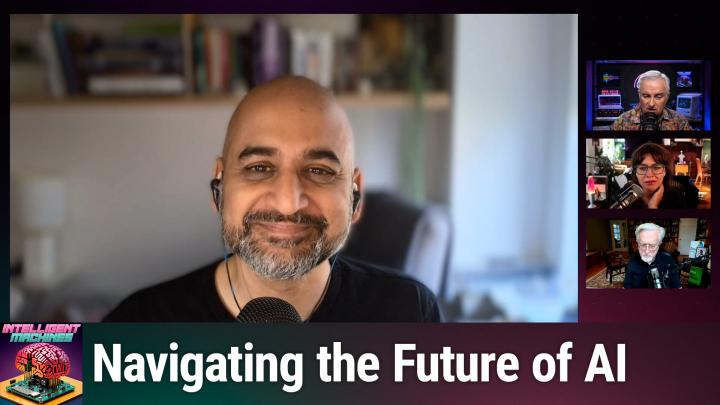
All TWiT.tv Shows (Audio)
Intelligent Machines 828: Stochastic Carrots
02:20:26
Navigating the Future of AI
Loading summary
Transcript800 lines
- [00:00]
Leo Laporte
It's time for Intelligent Machines. Jeff Jarvis is here. Paris Smartno's back from vacation and we've got one of my favorite people as a guest, a great thinker, moral philosopher and startup guy. Anil Dash is our guest. We'll interview him, then talk about all the latest AI news. A big Intelligent Machines is coming up next. Podcasts you love from people you trust.
- [00:27]
Jeff Jarvis
This is TWIT.
- [00:32]
Leo Laporte
This is Intelligent Machines, episode 828, recorded Wednesday, July 16, 2025. Stochastic carrots. It's time for Intelligent Machines, the show. We cover the latest in AI robotics and all the smart little doodads and doohickeys surrounding us everywhere we turn. Paris Martineau is here. She's back from vacation. I got to have dinner with her, though, while you were traveling with us.
- [00:59]
Paris Martineau
I got to see inside the famous studio that Leo is recording from right now and meet cat.
- [01:04]
Anil Dash
Do you met the cat?
- [01:05]
Paris Martineau
I did meet the cat. She allowed me to pet her and I felt so important because of it.
- [01:11]
Leo Laporte
Harris took some time off before she starts a new job, which we can't talk about yet, but will. Yeah, maybe next week we shall.
- [01:18]
Paris Martineau
Next week indeed.
- [01:20]
Anil Dash
She's the CIA.
- [01:21]
Leo Laporte
But yeah, needless to say, it's an excellent.
- [01:24]
Paris Martineau
We're not allowed to.
- [01:25]
Leo Laporte
Intelligence, I mean. Oh, God.
- [01:27]
Paris Martineau
Oh, Leo, come on.
- [01:29]
Leo Laporte
Oh, I'm so sorry. Also with us, Mr. Jeff Jarvis, the emeritus professor of journalistic innovation at the Craig Newmark Graduate School of Journalism at the State.
- [01:41]
Paris Martineau
I love that we've bullied him into bringing this back.
- [01:45]
Leo Laporte
There was a city university just for that sake.
- [01:47]
Anil Dash
That's. That's the joy of it.
- [01:48]
Paris Martineau
Yeah, it really is.
- [01:49]
Leo Laporte
He is now at Montclair State University in New Jersey, which is not a step down. It might sound it, but it's not. He's also. He's also professing at the State University of New York, Stony Brook. Nice to see you.
- [02:05]
Anil Dash
Good to see you.
- [02:06]
Leo Laporte
And the author of many books of which you will see over his left shoulder, the web we weave being the latest. Although the magazine's now out. Now an audiobook, you know, audible.com and other fine audio. I am actually don't want to promote Audible anymore. I'm going to promote Libro fm.
- [02:22]
Anil Dash
They were a fine early sponsor.
- [02:24]
Paris Martineau
I would also recommend Libby. Where you audio books from? Your library.
- [02:29]
Leo Laporte
Yeah. Libro is nice because it gives 10% of your purchase or your subscription, 15 of your purchase, 10% of your subscription to your local bookstore. And our local bookstore, as many independent bookstores do, is suffering right now. They're closing their used book section. It's sad because Jeff took me to the Strand in New York City and what a great used book section that has. And ours was similar, but gone. And they're even shutting down part of the store. So it's very, very sad. Yeah. So I'm, I, I'm glad that I can spend the same amount of money that I spent with Audible and, and give it, some of it to my local bookstore. So let's introduce our guest, who is a longtime friend of the show. He used to be Gina Trapani's boss.
- [03:14]
Jeff Jarvis
Well, she was my boss.
- [03:16]
Leo Laporte
Oh, okay.
- [03:17]
Paris Martineau
All of our bosses.
- [03:18]
Leo Laporte
Okay.
- [03:19]
Anil Dash
Be his boss.
- [03:20]
Leo Laporte
Neil Dash is here. I, you know, he's recently left his regular job. He was a. You started a company called Glitch. I think Gina worked with you at Glitch, right?
- [03:32]
Jeff Jarvis
Actually, no, she, she was always an advisor, but. But we had done a startup together, think up. And then right after that, I got to work with the team at Glitch, which was a community for building apps that got acquired by Fastly, the infrastructure company. And then after a couple years there, yeah, I just left last month to figure out what I'm doing next.
- [03:52]
Leo Laporte
Isn't that nice, though, to be able to spend time with friends and family and you have kids and Mario Kart.
- [03:57]
Paris Martineau
And the new Mario Karten, your blog.
- [04:00]
Jeff Jarvis
That's right. Yeah. No, we had a 14 year old. And this is really the first time I've, like, taken a break since actually since before Gina and I did our company together.
- [04:08]
Leo Laporte
So that's kind of a key time to 14. It's nice to spend some time.
- [04:13]
Anil Dash
What are you thinking, Neil? What kind of vision do you have for yourself?
- [04:16]
Jeff Jarvis
It's genuinely open. I mean, I think, you know, before we sort of, you know, got online here, Jeff, you and I were talking about sort of no knowing each other for 25 years. And I think, you know, this is one of those fertile moments that feels like back at the beginning of social media and blogging and we're at, you know, certainly that kind of inflection point with AI, but it's a little different in that I think in those days it was very kind of bottoms up, like people were hacking together and building stuff. And this right now feels like people are trying to be sort of top down, like the, the money guys are trying to tell us this is what it's going to be. And I'm sort of curious to see what the, the hackers and the makers are building from the bottom. So that's really what I'm spending listening to the people who are the coders and the creators and the writers and what do they say is cool.
- [04:59]
Leo Laporte
Do you think you'll end up in some sort of AI thing?
- [05:02]
Jeff Jarvis
I, you know, I don't know genuinely, I think I'm, you know, I look at somebody like one of the people I've always respected is like Simon Willison, you know, who's one of those like brilliant coders who just is every day out there writing code and writing on his blog. And I like, who are the people like that who are. And you know, he's, he's like my age. I'm like, who is the next generation version of that that's making something? So just having the time to go out there and read and discover somebody who is new and doesn't have a, you know, agenda and is not like connected into the industry and what are they saying is cool, that they're just hacking on for the love of it. Like, there's always somebody making stuff because they're, they think it's cool and they think it's interesting and not because, you know, somebody has said, this is what we need you to build a business around. Like I, I just have always loved the people, they make that stuff and I think that's how we all connected. You know, many years ago, was just working on whatever was next and interesting. And so it's gotten harder, I think, to find those folks. There used to be much more places where you were just see what was kind of, you know, buzzy organically.
- [06:07]
Anil Dash
This is going to sound stupid. That's what I specialize in. But does vibe coding open the door to that? Does it open the chance people can make things they couldn't make before? Is that possible?
- [06:18]
Jeff Jarvis
Yeah, I don't think it's stupid at all. I mean, I think in some ways, right. I think, I think definitely I'm always in favor of anything democratizes access, right? Anything that makes it easier I think is great. And again, not to like, like, I don't, I'm not one of those good old days people, but I definitely think one of the things about like the early days of blogging is it made it easier to put things online for a lot of people. Like you could write and now you could write and put it online. And for some people, I think their experience of vibe coding is that thing where it's like it got really hard for a long time to even if you knew how to code, to do all the other steps to get your code onto A website or onto an app was like really hard. And so like vibe coding can bring that barrier down. But some of what people are saying vibe coding can do may necessarily sell. Right. Like they're sort of over promising of what it can do. So I think I'm a little like, what, you know, trepidatious about some of the promises. But the spirit of can we make these tools easier enough that somebody who has either fallen out of practice of coding or is not totally fluent in it can get the bar lowered or the gatekeepers out of the way to where they can make something on their own that before would have just been an idea. I think that's awesome. And if somebody feels empowered by that, I'm all over that.
- [07:31]
Leo Laporte
People may not know what a great blogger and writer you are. I've always thought of you. This is what we need. People like you, Simon Willison, OM Malik, who are both technical, who are, you know, enmeshed in the, in the, the industry, but also can really communicate and write. And you, you've always been that way, which in fact makes you, you know, one of the thought leaders in this because so few people can express themselves, let alone have deep thoughts. So I, you know, one of the reasons I wanted to get you on the show is because you've been writing a lot about AI of late. Yeah. What is your sense that, you know, for me, I feel like AI you should also read his blog for stories about Prince. And hey, good news. He's going to see Wu Tang tonight for their last performance. So not at the Hammerstein Ball Worm, but at Madison Square Garden. So you'll be there with a few Wu Tang's friends for sure. Yeah, we'll talk about that in a little bit. But first, it seems to me that AI is one of the most exciting things, even though it's uncertain and the end game is unknown to happen in technology that I can remember. And I've been covering this for 50 years.
- [08:50]
Jeff Jarvis
Yeah. So I think there's a couple parts. I think one of the things that's important to understand. Talking about 50 years, there is a half century of computer science research and focus on things that we could call machine learning or AI.
- [09:05]
Leo Laporte
Right. There's I know I program in common lisp. I know all about it and I.
- [09:09]
Jeff Jarvis
Think that's really important for people to understand. It's like this is not new and anybody who tries to present it as if this is the beginning of history is probably right. And I think about like with Glitch, we had a incredible leader and Community, you know, engineer leader Jen Schiffer, who sort of was our sort of voice of the community. And before she had led our community at Glitch, she was a professor teaching computer science and teaching, you know, AI and machine learning. And so like that's a career that you could have a decade ago or two decades ago. And that's something that is not new. And so I think that's one of the key things is any time the conventional tech industry or Silicon Valley is sort of trying to get you to forget that there's a decade or two decades or five decades of history they're trying to get over on you. I think that's like a really key thing. And then the second part is, well, what can we learn from everything prior to LLMs that we can now apply to this domain? I think that's really, really key. And especially because LLMs have obviously incredible applications, incredible things they can do things we could not do before. They're genuinely new in a lot of ways and they have a lot of shortcomings. Every other AI approach or every other model is not as prone to hallucination, for example, is not as dependent on gathering data without consent.
- [10:34]
Leo Laporte
That's why Stephen Wolfram was said, don't give up on symbolic AI.
- [10:38]
Jeff Jarvis
Exactly. I think there's all these other approaches and so one of the things we have to ask is why is there such a focus and an over investment in this one approach? Why is this being treated as the be all, end all?
- [10:53]
Leo Laporte
But don't you think transformers and LLMs were a phase change?
- [10:57]
Jeff Jarvis
We're a huge, it is a massive breakthrough. But I think about again, I think we're probably a sufficient vintage to recall late 80s, early 90s.
- [11:06]
Leo Laporte
I remember three distinct AI winners.
- [11:11]
Jeff Jarvis
But take an analogy. Outside of software entirely, we had an inflection point in processing technology. From complex instruction set to reduced Instructions at risk, CISC to risk, which was the intel x86 to the kind of ARM style processors. And this was a big debate for folks who weren't around then. There was a big debate like you would have magazine covers back when magazines were a thing about, you know, was intel style processors going to win out or were the what you know, came to be called ARM style processors going to win out? And people would debate and debate, debate and then they're like, well, it's settled. Intel One, Windows and Intel One. This is what people would say around 2000, in the early 2000s and ain't necessarily so right now. Here we are 20 years later and ARM won Everywhere, right? The Apple processor's one, and everything's got an ARM chip in it. So the battle shifted. But the key thing was there was this argument about what kind of chip architecture would win. And people were ready to throw away an entire approach based on what they thought was efficient or what would use more. They were like, oh, well, who cares about how much power it uses? Why would that matter, right? Like, who cares how much electricity a computer uses? Why would that be relevant to anybody? Not imagining everybody would have a computer in their pocket. And so the foundations of what is relevant to the market or what's there, like, the conventional wisdom can shift very quickly. And I draw that analogy because I think we're sort of at that point where the LLMs are a phase change and they are a breakthrough and they are really important. And whenever anybody sort of says, throw away the prior 50 years of history or don't think about a yes and approach where we take more than one together, like, that's a. That's a thing that makes me skeptical, especially when the experts are sort of asking you to, you know, that that wizard of Oz moment of, like, pay no attention to that man behind the curtain. If they're saying, don't pay attention to the fact that we indexed all this content without consent and we don't care that the creators are upset or don't pay any attention to the real environmental impacts of the power that we're using or that there is this sort of cost, like, that's a real concern, that's a legitimate concern. That's a valid thing for people to be upset about or to reckon with. And so that doesn't mean that we don't appreciate what the technology can do. I think the fact that there should be a complicated answer is key. And that's the thing that I keep coming back to, is like, let's complicate the answer and balance it. And I see very little of that in the industry advocacy. I think the people like you all who are very thoughtful about these things, I think are sort of reckoning with both parts of that. But I think a lot of the vendors who are selling this, they see any nuance as unacceptable levels of critique. And so that's where the hackers don't see it that way at all. I think hackers are like, I want to know the pluses and minuses of the system so I can balance it against everything else that I'm using. And I would love to give them a menu of options, have a whole palette of options, not just here's five different LLMs to choose from, but here's 50 different things, some of which are LLMs and some of which are other things. And how do we compose those all, assemble those all into as many different kinds of LEGO blocks as possible?
- [14:28]
Anil Dash
What other uses of machine learning are you can be as near in consumer usage in mind?
- [14:39]
Jeff Jarvis
You know, I think there's a range. I think the.
- [14:41]
Leo Laporte
The.
- [14:42]
Jeff Jarvis
One of the things that. One of the reasons LLMs, I think, have captured everybody's imagination is the accessibility of the chatbot model, right? I think people love the feeling of like, I'm typing this thing. But I think for hackers and builders, chat is a really inefficient interface. It's actually a terrible way to. To program or to build around. And so I think some of the other systems, the more conventional machine learning systems, like, if you're going to build a spreadsheet, you can't build a formula around chatting to something, right? You want to say, like, what's this? Like, I want to add a number. If you want the AI to say, like, go get a, you know, what's the price of this stock today? Or what's the weather in this area today? That is a thing that, you know, many AI systems might be able to go retrieve for you in an intelligent way, but you don't want it to have a conversation when it comes back, right? Like, you don't want it to be this sort of long, convoluted response. You want to just give me the number. And I think that's the kind of thing that some of the other approaches might be more inclined to come back with. And especially you do not want it to hallucinate the answer. Right. And so I think some of the other more conventional machine learning tools might be better at that also. And actually this is something that Simon Wilson is another one of these great examples. People have even done this with LLMs where they've built test systems where they sort of say, even if you're prone to hallucination, we're going to run a software test against you and make sure the answer that comes back is something that's valid and is something that could plausibly be correct so that we know it wasn't a hallucination. And I think those things are really key because there's such a, like, consumers who are not fluent in this stuff are so inclined to trust it. Right. I think of it like a really concrete example. My sister is a librarian, public librarian, which I love, and I'm very proud of Her. Yeah, they do the most noble work. And you know, she talks about like, the patrons of the library will Google, you know, the hours that the library is open and it says, oh, you're open until 8pm on Mondays, which they are not. And then they're mad at the librarians.
- [16:50]
Leo Laporte
Saying it's their fault.
- [16:52]
Jeff Jarvis
Why aren't you open until 8? Google said you're open until 8. You're only open until till 5 tonight. Right.
- [16:56]
Leo Laporte
And that's not AI, that's just Google.
- [16:59]
Anil Dash
Right, Right.
- [17:00]
Jeff Jarvis
But it shows the authority that Google has to them. Right. And, and that now every librarian in America has to be an expert on SEO.
- [17:08]
Leo Laporte
Right.
- [17:09]
Jeff Jarvis
And go back and figure out how to change their website so that they can tell Google the right thing to do. Right. That's pre AI. Right.
- [17:15]
Anil Dash
You're right.
- [17:16]
Jeff Jarvis
Like, that is the pre AI SEO. Now it gets exponentially harder to say. Now how are we going to do two problems, one of which is like, get the right information into Google and then two, get it into all these other systems that might hallucinate the answer. Which you're like, well, how can I even possibly guess what it might make up about what it thinks my hours are?
- [17:34]
Leo Laporte
You can't. You can't. We know that that's one of the things that Tim, that Timmy Gibreu and Emily Bender were talking about in Stochastic Paris was that there's an authority that these assume because they come from a computer. And, and people, most people who work with computers don't, don't ascribe that much authority to them. But people who don't are going to give it a lot of weight.
- [17:54]
Jeff Jarvis
The computer says. The computer says. And they've had again, 50 years of, you know, from, from when the first, you know, Star Trek episodes came out. Well, the computer says this. It must be correct. And I don't blame them for that. They were sort of conditioned by culture to say that the computer answer is right. The computer's smarter than me. They question themselves.
- [18:13]
Leo Laporte
HAL 9000 going rogue was such a big plot point because it was so unexpected.
- [18:18]
Jeff Jarvis
Yeah, yeah, yeah, right. That's a dramatic twist. And so I think that's a thing where, like, I have no, Sorry, my dog is trying to get on camera. I have no, you know, criticism for anybody who is, you know, surprised by the fact the computer can be wrong.
- [18:35]
Leo Laporte
Right.
- [18:35]
Jeff Jarvis
Like, I don't, I don't fault them for feeling tricked or especially when Google has been, as far as they know, reliable to them and now is using generative AI without them having changed anything. They didn't change any settings, they didn't push any buttons. They went to the same Google they've always gone to and they typed in a search. And it looks a little different, but maybe not recognizably different to them. And all of a sudden it is composing things in a way that they didn't expect. And, you know, some PhD they've never met has it. Has it doing things a different way. And then the people on the other side, like I said, the librarians who are like, why is it making up our hours now? Are saying like, I don't even know how to fix that. Before I could at least conceivably understand, I could look in the library for a book on SEO and teach myself the way to fix this. Conceivably, there was at least some theoretical mechanism of fixing it. And now even that is gone.
- [19:33]
Anil Dash
And so I don't think you're fixable. I mean, you're right, Danielle. It's a really, really huge point. We started with a presumption of the accurate computer, and now we're in the age of approximate computing, and that's where we're going to stay.
- [19:46]
Jeff Jarvis
Yeah.
- [19:46]
Anil Dash
Whether it's. It's machine learning and prediction machines or whether it's quantum computing, it all becomes approximate and good enough.
- [19:55]
Jeff Jarvis
And that's a social contract that has been broken that we haven't had a dialogue about. There's been no consent around it. And this is this concept of consent I keep coming back to. And it's really been, I mean, to be very transparent, this has been one of the reasons why I sort of don't miss being a CEO of tech startups anymore. And why I sort of stepped away from that is a lot of my work and my roles in that stuff. You know, you. When you're the founder or CEO, the thing you start every day with is the problem that nobody else in the company wanted to reckon with the day before. Right. And a lot of it is like, we need to change our terms of service. You know, if it's not like, you know, we have this, we have an.
- [20:37]
Anil Dash
HR problem or something.
- [20:37]
Jeff Jarvis
Hopefully it's not.
- [20:38]
Leo Laporte
But.
- [20:38]
Jeff Jarvis
But a lot of it is like, we have to change our terms of service. And every terms of service you've ever clicked I agree to without reading all basically says the same thing, which is we can change this unilaterally at any time without telling you. And what you agree to is we're going to continually move the goalposts, and that means there's no Consent, Penny the. And even that we have resigned ourselves to as users. Right, but that's users we know. There was at least some quid pro quo. You were giving me a really good search engine in exchange for me getting the goalpost shifted all the time. At least I got good search.
- [21:15]
Leo Laporte
Right.
- [21:16]
Jeff Jarvis
But now what we've gone even further on is like I have my website that I've been doing for 25 plus years. There's no consent in the other direction of what they're doing to my website, how it's being presented to the world. Right? So it used to be that we had that. I'm sure you all have talked about this before. The robots Txt file, which is the permissions of what Google can do to my site. And I gave them permission to crawl my site because I wanted them to. Again, a quid pro quo. You bring me visitors and I give you content that people can discover. And there's a fair exchange. They changed the terms unilaterally of what it meant they could do. Now they can take content from my site and compose things onto Google that make content on their site. But that wasn't the deal when we started. But I can't appeal that. I can never undo it. And in my case, I have written, created and researched things on my site that exist nowhere else on the Internet. I know this for a fact, right? And I have searched for things on ChatGPT, on Google, Gemini, on Claude that I know I'm the only source on and found it in their indexes.
- [22:30]
Anil Dash
Is this Prince stuff or is this other musical artists?
- [22:33]
Jeff Jarvis
But yes, yeah, exactly.
- [22:35]
Leo Laporte
Right.
- [22:37]
Jeff Jarvis
And more obscure, right? Because that's sort of it. It's like I know I can go to obscure musical research that I did over the last 20 plus years where I'm like, I know I was the source canonically and so there is no credible way they can say we found it somewhere else or we synthesized it somewhere else. And so I know for a fact that this is showing up your synthesized results because of me. And I know when you show it on your site and somebody doesn't come to my site that it is you, you know, having taken. And I don't care about the pages like I don't have ads on my site. I care about the relationship with that person who cares about that content.
- [23:12]
Leo Laporte
Isn't that the nature of. I mean, look, there's only five different stories. We're all just recasting those five different stories over and over again. That's human, is, is media. It's everything we do is based on what we have absorbed in the past. Well, I mean, I always, I, I might get ideas from your blogs. I often do and may not credit you.
- [23:35]
Jeff Jarvis
Well, I think there's a, there's a question of, of consent. There's also a big difference between the largest companies in the history of the world and somebody I've known for 25 years who's a person that I respect.
- [23:46]
Leo Laporte
Every time I hear that, it really ends up being a complaint about big tech.
- [23:51]
Jeff Jarvis
Yes and no.
- [23:52]
Leo Laporte
Right.
- [23:52]
Jeff Jarvis
I mean, I think, I think this part of it also, like, there is no such thing as the technology industry, right? Like tech doesn't mean anything.
- [23:58]
Paris Martineau
Every company is a tech company right now.
- [24:00]
Leo Laporte
Right?
- [24:01]
Jeff Jarvis
And also, like we talk about, like people talk about, like fang companies still. And I'm like, what the hell does Netscape. Netscape. I'm dating myself.
- [24:07]
Leo Laporte
Netflix have to do Mozilla. What is it exactly?
- [24:12]
Jeff Jarvis
That's how old my brain is. Netflix. Netflix.
- [24:14]
Paris Martineau
Streaming.
- [24:15]
Jeff Jarvis
Streaming a movie movie have to do with Apple selling me a laptop, right? Like nothing.
- [24:19]
Leo Laporte
Right?
- [24:20]
Jeff Jarvis
Like they do some overlap in that they both stream movies. But the point is like the fundamental businesses that these companies are in are not related at all. And the economics of what they do are not related at all. Like where they make their margins is completely unrelated. So every company makes tech, to your point, Paris. And I think the other part is what they care about and where they're trying to leverage things is very, very different. And so to the, I guess what.
- [24:44]
Leo Laporte
I'm saying is it's monopolies though. It's monopoly. It's companies that they're dominant, like Amazon, Google, Microsoft, Apple. Those companies are so dominant they don't have to play by the same rules.
- [24:56]
Jeff Jarvis
But also we had a premise. And again, I say this as, like, I have started multiple companies, I've raised hundreds of millions of dollars in vc, I've helped companies. I've been on the boards of multi billion dollar companies. And we had a premise that companies were supposed to be in competitive markets. We had a premise that markets were supposed to be transparent. We had a premise that there were laws they were meant to be accountable to. We had a premise that public markets had regulators. None of those things are true anymore. None of those. And I mean this in a very literal way. And again, I have been an accountable party for writing public filings for companies. I have been on the hook for these things and been in the boardroom for these conversations and sat across the boardroom table from the officers of these companies and those used to be material considerations for these companies. And none of those things are true anymore. And so the premise by which there was accountability and responsiveness to these public considerations doesn't exist anymore. And they are acting accordingly. And it's sort of like the substitute teacher didn't show up for the class. How are the kids acting?
- [26:10]
Leo Laporte
So, I mean that. So in a way, that's the problem with AI is not that AI itself is problematic, but that the companies that are making it are not being held accountable for the products they're making.
- [26:20]
Anil Dash
And some of the people who are in charge of those companies are jerks.
- [26:25]
Jeff Jarvis
Well, what we've selected for it.
- [26:27]
Leo Laporte
Right.
- [26:27]
Jeff Jarvis
Like, I mean, I think there are people that were trying to do, you know, various degrees of. Right, right. Like, I think there's an interesting thing that happened in terms of like, signaling where, like when they were still trying to create OpenAI to build ChatGPT years ago, they're like, we'll make it a non profit and then I'll send a certain kind of signal. And then anthropic when they're doing Claude, it's like, we'll make it a, you know, a public benefit corporation that'll send a certain kind of signal. But the, the structure of incorporation only does so much. You have to want to do the right thing.
- [27:01]
Leo Laporte
Right.
- [27:01]
Jeff Jarvis
Like you being a nonprofit doesn't. Not a grifter. Right. Like, I can tell you, like, I've been in the nonprofit world a long time too, and it's like there's a lot of people getting over, you know.
- [27:10]
Leo Laporte
And making money might even attract grifters. Come.
- [27:13]
Jeff Jarvis
Yeah, because like, you, you have the halo, right.
- [27:15]
Leo Laporte
Of, of looking good and they're tax free. Yeah.
- [27:18]
Jeff Jarvis
So like, there's a lot of different ways to, to, to get ahead there. And so I think the, the, the key thing was like they, they still at that time wanted to pretend to look good. Now there's the sort of vice signaling that they're all trying to do for each other. And they really like to show that they're the biggest villains.
- [27:32]
Leo Laporte
Right.
- [27:32]
Jeff Jarvis
Like, that's the way that you sort of show, you know, you're the transgressor. And that means that.
- [27:37]
Leo Laporte
Does that explain Mecca, Hitler and Grok going off the rails?
- [27:42]
Jeff Jarvis
It's a big part of it. I mean, I definitely think one of the ways of showing that you have power amongst that cohort right now. And a lot of what they're doing is signaling for each other.
- [27:50]
Leo Laporte
Right.
- [27:51]
Jeff Jarvis
Like they're constantly, there's preening, like they're Sort of peacocking for each other. Amongst this cohort of like a dozen are the biggest, like tech tycoons. And, and, and again, like I've met most of these guys and unfortunately made a lot of money for a lot of them for a long time. And I'm not the most to blame.
- [28:07]
Leo Laporte
But I happened in the Gilded Age too though, right? They were all playing for John Jacob Astor and. Yeah, sure was. Yeah, yeah.
- [28:15]
Jeff Jarvis
And they wanted to. Yeah, they're preening and peacocking for each other. And so some of what they do in that performance now is if I can be the most transgressive, I'm a bad boy. I mean it's, it's not any different than like 15 year olds, right, that are sort of, you know, doing little stunts and tricks for each other. And, and if you're not accountable to.
- [28:36]
Leo Laporte
Your customer, you're not accountable to the market, you're not accountable to society, you're still going to want to impress somebody and it's going to be your other fellow billionaires. Right?
- [28:44]
Jeff Jarvis
Because after the first billion, it doesn't mean anything.
- [28:47]
Leo Laporte
Right.
- [28:47]
Jeff Jarvis
Like there's no difference in quality of life between $10 billion and $50 billion. Right, right. You're not like more planes. There isn't. You don't eat more in a day of your like, you know, gold plated caviar or whatever you're eating.
- [29:00]
Leo Laporte
You just have a bigger TV in your bedroom, basically.
- [29:02]
Jeff Jarvis
There isn't a bigger, you know, like there's no, there's no more screen you can see. You know what I mean? And I mean, I mean this in a very literal way. Like there's a few of these guys that I had still kept in touch with until they got their first billion. And you know, their kids would be about the same age. And the funny thing is like their kids don't get access to some super secret Legos that my kid doesn't have.
- [29:23]
Leo Laporte
Do you know what I mean?
- [29:24]
Jeff Jarvis
Like, it's the same Legos and their kids are not happier. And I would see like none of.
- [29:29]
Anil Dash
Them, they get better shrinks through their kids.
- [29:31]
Jeff Jarvis
They need them.
- [29:32]
Anil Dash
Yeah.
- [29:33]
Jeff Jarvis
And I don't mean this lightly. 00% of the guys I knew that became billionaires out of the cohort I was in, 0% of them are still with the spouse they had there. Not one.
- [29:44]
Leo Laporte
Well, you traded in one. You trade your spouse not one trophy.
- [29:48]
Jeff Jarvis
And what they tell themselves is no. Well, you know, we grew apart because life got complicated and, but like you're like now, you know what's My real answer, like, would I give my wife up for a billion dollars? Clearly, my answer is no. And clearly their answer is yes.
- [30:03]
Leo Laporte
Right.
- [30:04]
Jeff Jarvis
And they would never say it. Would they give their kids up, seeing their kids every day for a billion dollars? And their answer demonstrably is yes.
- [30:11]
Leo Laporte
Yes.
- [30:13]
Jeff Jarvis
And it's proof, right? It's proof. And, like, obviously people have, you know, complicated relationships, and people split up for all kinds of good reasons. And, like, there's life that happens, but it cannot statistically be the case that none of them could make it work.
- [30:27]
Leo Laporte
Some of them have several. Why, sure.
- [30:29]
Jeff Jarvis
Exactly. Right. But that's the thing is, like, you don't become a billionaire by accident. You have to have wanted it more than you wanted anything else in your life.
- [30:37]
Leo Laporte
Yeah, that's right.
- [30:38]
Jeff Jarvis
And what does that design for in your head is not sustaining relationships, not sustaining connection to the rest of the world?
- [30:44]
Anil Dash
Do you think they started with that or the temptation overtook them?
- [30:48]
Jeff Jarvis
I think that's sort of. Here's the thing. I think people could want to certainly, like, oh, I want to be successful, and I want to make enough money to be comfortable. And then you start to select out. I know people that made merely $100 million who still live on Earth.
- [31:02]
Leo Laporte
You know what I mean?
- [31:03]
Jeff Jarvis
And they're like. They go grocery shopping and they, like, act like people, and they, like, I can have dinner with them. And they sound like a human. And I'm like, okay, great.
- [31:12]
Leo Laporte
Good for you.
- [31:12]
Jeff Jarvis
I'm happy for you. And, like, they're still, like, recognizably normal, and, like, that's still all the money in the world. Like, you have literally anything you could ever want. Right. And they're like, yeah, I'm good. And so, like, it's interesting what that inflection point is, but if you were at that point and then you're like, no, I need to have 50 times this much. You're like, you're already your brain broken.
- [31:33]
Leo Laporte
Yeah.
- [31:33]
Paris Martineau
What do you think is the difference between those people? What do you think separates the people who get the 100 million and are like, I'm going to retain some form of normalcy and be grounded to Earth versus the people whose brain are fundamentally broken?
- [31:46]
Jeff Jarvis
I wish I knew. I think there's a couple. I mean, I think it's like anything else. It's like your parents. I think it's like, how you were raised. It's who you're around. How isolated are you? What's your own neuroses and insecurities. Like, it's just human stuff. Like, we're all broken in our own way and whatever it is. And if somebody pushes your buttons the right way. But like I said, nobody becomes that wealthy by accident. The challenge now is I saw this where being a CEO of a venture backed company, it almost selects for being psychotic. Because the VCs and these things, they're like, here's what we want you to do and what you have to forego. And a really concrete example is I really cared about providing good health insurance for my team. And it's like prosaic stuff. Okay, we want Aetna or whatever, Cigna, and here's what we want to do and we want to have this coverage for these things. And the reality is, when I screw up as a CEO, people lose their jobs. And when they lose their jobs, they lose their health insurance in America, which is immoral. It's immoral that I get to choose whether people can get treated for cancer or have kids. Right. And so you just, if you're a person with a conscience, feel like crap all the time.
- [33:12]
Leo Laporte
Right.
- [33:13]
Jeff Jarvis
And power. Yeah.
- [33:15]
Paris Martineau
Like when you feel like crap and when you feel like crap, you have to also decide, oh, do I want to continue to feel like crap and retain a conscience?
- [33:25]
Jeff Jarvis
Right, right.
- [33:25]
Paris Martineau
Do I want turn inward and be like, actually no, there's some other explanation and there's a reason why I shouldn't feel like crap.
- [33:33]
Jeff Jarvis
And so there's an entire machinery built around, no, you shouldn't feel like crap. You were a brave and bold decision maker who has done the noble thing and you are a truth teller and they are wrong for letting you down and they caused you to have to do layoffs.
- [33:49]
Leo Laporte
Right.
- [33:50]
Jeff Jarvis
And it's their fault. They don't deserve health care and they're uppity and you should punish them.
- [33:56]
Leo Laporte
Right.
- [33:56]
Jeff Jarvis
There's an entire machinery saying that in your ear and do you choose to listen to that or do you choose to hold onto your conscience? Is the fundamental reckoning we're in as a society, really. And then now who makes it through that filter is the people that are getting to have enough money to train in AI right now. Right. Because it's really, really expensive to train in AI. Yeah, Right. And I'm not trying to be preachy. I'm just like, literally, I've been through this because I'm like part of why I want there to be less expensive AI mod so that we can have like just a thin layer of people who are not complete psychopaths can afford to build AIs too.
- [34:31]
Anil Dash
But the models leapfrog each other and end up all doing kind of the same thing. I think the interesting thing is going to be at the application layer.
- [34:38]
Jeff Jarvis
Yes. Yeah, there's so many cool things to be built.
- [34:40]
Anil Dash
But now you see meta rumors are that Meta is not going to do open source Llama anymore.
- [34:50]
Jeff Jarvis
Because they hate people using it to train.
- [34:52]
Anil Dash
That's killing at a university because that's what we use now.
- [34:54]
Leo Laporte
Yeah, well, what's really terrifying is the notion that if we do get, if we do and it's a long, it's a big if get some sort of super intelligence is that they will be controlled by people. You just like you just described like the martial arts Elon Musk's of the world. And I mean that's the real hazard. It's not the AIs that are the hazard, it's the people who are making.
- [35:18]
Jeff Jarvis
I mean, you know, software has values baked into it, right. And we're all flawed. So it's always going to be have bugs in that way separate from the bugs in the software.
- [35:26]
Leo Laporte
Right.
- [35:26]
Jeff Jarvis
And the question is like what are the values of the people that made the apps? And you know, that part of it is a big reckoning. And I don't fault like a normal consumer not understanding that is normal. Like you wouldn't think about that when you're like buying a phone. But I think those of us who are like into this stuff think about that a lot and it's sort of fallen out of favor. We used to care about that stuff a lot. You know, 10, 20, you know, 30 years ago we were really. It's funny because like we used to think like, you know, Microsoft was the evil empire, right? It's like take me back to Windows 95, right? Like that's like if that's as bad as it got, that would have been great. But I think now like the stakes are so much higher and people are so much busier that like thinking about like I have to like download an app and then know about the weird philosophy of the dude who built it. No, I don't got time for that. That's. And also it's a nightmare. Like these weird, you know, esoteric things that they're focused on. Like I don't, I don't want normal people to have to think about that. I don't want non tech nerds to have to think about that. But how do you distill that into something people can understand that's consumable? Like I think a very, you know, recently Aaron Swartz has been on My mind a lot, you know, and he was a friend and really great at communicating a lot of these concepts so effectively and in so many disciplines. Right. So whether it was intellectual property or just like privacy or so many of these sort of concepts. And I think it's interesting because there's sort of been this mythology that's developed around him since he passed, but I think he was really a pragmatist in so many ways. And so I think about who is a new young version of that. And part of it was he was born into a context where there was a community around him that cared about these things. And so he could rise to be a leader and a voice because a lot of people cared about these things. And if you are a teenager like he was when he started to do this work right now, where would you find a cohort of other people who care about this? I think it would be very hard if you're like, I think I care about privacy and personal expression and all those other things. Like, I'm on the board of the eff. This is the things they fight for. And it's like, you know, some of us here have some gray beards, right? There's way too many gray beards. It's a lot of old. It's a lot of dad energy, you know, and it's like, we need a lot of like, young people of like, you know, different, different genders and different ages and different races coming in, you know, representing this thing because it has, it's so relevant to new folks, but they don't know it. And, and you know, and I'm like, shame on me. Like, they can't find it anymore because what book would you read? They're not like finding some old, middle aged dad's blog, you know. So like, that's what I'm trying to do is like, figure out where's the place that's discoverable culturally for people who care about these things, but don't necessarily want to nerd out to say, I want to have good tech, good tech and find good apps.
- [38:28]
Paris Martineau
What about you create it?
- [38:29]
Jeff Jarvis
Yeah, I think it has to be like, maybe. But I feel like I've been thinking a lot about like, Dua Lipa's podcast is amazing, right? And she does a great job interviewing authors. Just super, super culturally fluent. Obviously. You know, her music's amazing, her shows are great, but she's just super great at articulating really good cultural ideas. And she fought for controlling her master recordings and owning them. Taylor Swift has obviously done an amazing job with Taylor's versions. They are incredible educators about intellectual property. They just don't know it. And so, like, they're teachers. They are teaching like they are heirs to Aaron Swartz's work. They don't know it. And, like, they're living in a world that Aaron Schwartz defined. And so, like, that part of, like, how do we get them to see that they have articulated a. A position that is the solution to people being worried about is AI taking content without consent.
- [39:31]
Leo Laporte
Right.
- [39:32]
Jeff Jarvis
Because lots of people can say, well, AI engines are stealing content. But the answer is artists have to own their work. And nobody has done more to say to advance the cultural conversation about artists owning their work than Taylor Swift saying Taylor's versions. So we have an entire generation that's growing up knowing that that is the other part of the conversation about is AI working with consent.
- [39:54]
Anil Dash
But let me. Let me poke at that.
- [39:56]
Leo Laporte
Neil, please hold on, because we're. We're long and I need to.
- [40:00]
Jeff Jarvis
Oh, sure.
- [40:01]
Leo Laporte
So I'm going to give you a choice, Neil. We could wrap this up because we only asked for a half an hour of your time. 30 minutes and Wu Tang awaits. In which case we could wrap it up now, or we could take a break and come back. It's up to you. I. I don't want to overburden you.
- [40:19]
Jeff Jarvis
I'm happy to go another 5, 10 minutes if it's useful. I don't know if you want to put a button on.
- [40:23]
Leo Laporte
Jeff, can you hold your question?
- [40:24]
Anil Dash
Yeah, I can hold it.
- [40:25]
Leo Laporte
Okay. Okay, we'll do a quick ad. And because I also want to thank you for your wonderful blog post, wherever you get. Your podcast is a radical statement.
- [40:35]
Jeff Jarvis
Oh, yeah.
- [40:36]
Leo Laporte
Because as a podcaster, I'm a firm believer in that. And the. Aaron Schwartz's RSS is what powers what we do. And it's a. It's a radical technology that has survived.
- [40:47]
Jeff Jarvis
It really has.
- [40:48]
Leo Laporte
Yeah. And I'm. I'm very glad for that. Actually, there is a cartoon that came out last week about rss, and one that's one of the things it says, is that. That you may not know it, but you're using it every time you listen to a podcast. Yeah, love that. And Neil Dash is our guest. Somebody said in the. In the Discord chat, one of our club members said, said. What distinguishes Anil is not about his ability to express, but rather he's effective at bringing a moral voice with a deep technical background, always thus and without preaching and assuming everyone he disagrees with is evil. So I agree I appreciate that.
- [41:23]
Jeff Jarvis
I mean, I aspire to that. I hope I'm doing justice to it.
- [41:26]
Leo Laporte
You are. I think you are. Neil Dash is our guest on Intelligent Machines. Five more minutes with him before he's got to go see the Clan.
- [41:34]
Jeff Jarvis
The Wu Tang Clan, let's be specific.
- [41:38]
Leo Laporte
That's a very good point.
- [41:39]
Jeff Jarvis
Very important distinction. Yes.
- [41:43]
Leo Laporte
Before he sees the Tang. What do they call them?
- [41:49]
Jeff Jarvis
Is good.
- [41:50]
Leo Laporte
Yeah, Wu Tang. He's going to see the last. They don't do a lot of concerts.
- [41:56]
Jeff Jarvis
No, they've been out. I mean, you know, the guys do shows solo a lot, but they haven't been together a lot. I mean, it's, you know, the band.
- [42:02]
Leo Laporte
Were you mad when Martin Shkreli bought the album?
- [42:07]
Jeff Jarvis
Not Even the top 10 list of things to be mad at that guy for, but sure, it's one of them.
- [42:12]
Leo Laporte
He's ill, uses ill gotten gains to do it. Yeah.
- [42:15]
Jeff Jarvis
I mean, nothing could be more characteristic of the music industry than that guy owning one of their records.
- [42:20]
Leo Laporte
Yeah. In a nutshell. Yeah. Our show today, brought to you by. I just got it. Our brand new mattress. I have to say, I've been sneaking out in between the breaks and lying down on it. It's so nice. Did you know it's brought to you by Helix Sleep. Did you know that you're supposed to replace your mattress every six to 10 years, depending on mattress, how well it wears, whether you're wearing a hole in it in certain spots, that kind of thing. Your mattress is really a big part of your life. I know people say, well, I spent a third of my life asleep. No more than that. Movie nights with your partner, morning cuddles with your kitty, your wind down ritual after a long day. It's all happening on your mattress. I would be willing to bet most of us spend more time on our mattress than anywhere else. And the mattress can torture you. A bad mattress, you could be waking up sweating, you know, too hot, or your back's killing you, or your partner's tossing and turning. I'm the tosser and turner in our family. And my poor wife has to put up with the bounces. It's a classic mattress nightmare. While here licks. Sleep changes everything. This mattress, it's like. It's like sleeping on a cloud. No more night sweats, no back pain, no motion transfer. Get the deep sleep you deserved. It had been eight years since we got a new mattress. We said we got to get the best. Where is the best? I saw reviews. One buyer said with five stars. I love my Helix mattress. I will never sleep on anything else. Well, that got my attention. Then I saw the awards time and time again. Helix Sleep is the most awarded mattress brand wired this year. 2025 said best mattress. Good Housekeeping's Bedding Awards 2025 premium plus size support. Best hybrid mattress in the GQ Sleep Awards for 2025. Wire cutter featured for plus size. I'm a little heavy, so maybe, maybe that's important for me. Oprah's Daily sleep awards for 2025. I love this one. Best hotel like feel. I don't know about that. I don't. If I. If I found a hotel that had a mattress like my new mattress, I might be spending more time there. I love my Helix Sleep. I want you to go to helixsleep.com TWIT 27% off site wide during the 4th of July sale. Their best of web offer has been extended. That's helixsleep.com twit for 27% off site wide. Exclusively for listeners of intelligent machines. Now, this offer does end July 31, 2025, so make sure you go now. And do enter our show name after checkouts. They know we sent you. Oh, and if you're listening after July 31, 2025, I'm sorry, that sale's over. But be sure to check them out. There's always some great deals@helix sleep.com TWIT you will see from now on, a new Leo, rested, relaxed and ready to do a podcast. Thank you, helixsleep.com TWIT Our guest, Anil-is on the beach. We used to say when you're in radio and you're at it and you're not working, you're on the beach. He is calling for a very hot New York City right now. I appreciate that you're all in the hot eastern seaboard.
- [45:38]
Jeff Jarvis
Yeah, it's like 90 degrees today.
- [45:40]
Leo Laporte
Yikes. That's hot in New York. That's sweaty. That's terrible.
- [45:44]
Paris Martineau
Yeah, and the dew point is like 80 or like 70 something.
- [45:48]
Leo Laporte
Wasn't it nice when you were out here, Paris enjoying the night?
- [45:51]
Paris Martineau
It was climate and it was perfect in Northern California.
- [45:54]
Leo Laporte
Yeah. So you put a button in it. You can now unbutton Your thought, Mr. Jarvis.
- [46:00]
Anil Dash
So Aaron Schwartz stood for tragically died for opening up information to society and forgetting, if we can for just a second, the evil people and evil companies that may be in charge of many of the models. Now, if we're going to end up using large language models and they're trained only on the free crap, that's on the Internet, we're all the worse for all crap. I had an example the other day where I was doing some research and I thought, wow, this is actually pretty cool. And look at all these sources and the deep research. The sources were all crap because that's what's available. And I struggle with a question of whether, as journalists, whether there is a moral obligation to share even with the models. So the models will in turn be better to share with the public and with the children who are going to use it for teaching and such. So how do we balance Aaron's. What Aaron's stood for and these choices with those who control this information, like academic publishers still and news publishers today?
- [47:08]
Jeff Jarvis
I think the question is about ownership and control of the models, right? So, like, if we need to have good models and there's a public good in creating them, then we should have models that are owned and controlled in the public good.
- [47:21]
Leo Laporte
Right.
- [47:22]
Jeff Jarvis
Like, where are the models that are owned and run. Run by universities that are under Norway.
- [47:28]
Anil Dash
They've done that in Norway. They've done elsewhere. Yeah.
- [47:31]
Jeff Jarvis
By, by, by. By governments, by. You know, I think that we should have them run by. By unions.
- [47:38]
Leo Laporte
Right.
- [47:38]
Jeff Jarvis
Like, I don't think there's any reason why, like, one of the things I was thinking about was Rian Johnson and Natasha Leone and a couple other filmmakers had made a gen AI tool for filmmakers that was trained on consensually gathered video data. But they've gotten a lot of blowback because people didn't really understand that you could have consensual data. So they're like, oh, why are they making this AI slop tool?
- [48:00]
Leo Laporte
Right?
- [48:01]
Jeff Jarvis
And they just didn't have a vocabulary to explain it. Because people love Natasha Leon, right? So they're like, why are they yelling at her on the Internet? And so I was realizing, like, if even people that are that sort of culturally popular can't articulate that there could be sort of quote unquote, good AI well, then maybe the Screen Actors Guild and the WGA should own their own model and sort of be in control of something where they have leverage. And then rather than the studios being the ones that control it. And this sort of goes back to, like, at the turn of the century, there was this battle between Napster and the labels, but the artists weren't in the conversation at all. So you ended up with this thing that the labels made money and the streaming platforms made money, but the artists got screwed. And we're sort of on that path again where, like, everybody but the artists and creators is in the room. And so I think about, you know, there are other models that are possible. And you know, people just don't talk about co ops, they don't talk about, you know, universities, they don't talk about public sector. But also like, it's the Internet. We used to talk about people like organizing together on the Internet. Like it's an old fashioned idea, but there's no reason that you couldn't just sort of say people are going to work together to build models collectively. We used to think that's what the Internet was for. It is what it was designed for. The fundamental purpose of the Internet was to collectively share and publish information academically. The web was born to do that. And so I think it's not a radical idea. It's actually a very old fashioned idea and there's no reason technically it couldn't be done. So I think we just have to re open people's imagination to it. But again, I don't fault anybody who is from this century not knowing that because we have done a very poor job of teaching them about it.
- [49:58]
Leo Laporte
Right.
- [49:58]
Jeff Jarvis
If you are of this century, other than me being from the 20th century, how would you know? Like, shame on me. I haven't told anybody about it. Like I said, the young, the early career people I talk to that are trying to mentor or in the, you know, tech industry, I'm like, oh, well, how did you learn about this stuff? Like, well, I read everything. I read Peter Thiel's book and I read Mark Andreessen's manifesto and I read Hacker News, right? And then, yeah, and I mean, I feel that way. And then I'm like, oh well, yeah, shame on me. Like what would they read in the startup world, right? And you know, Jeff, they will have read maybe, you know, some of your stuff. But like that's not a like startup guy, right? That's some academic. Like we're dismissed. Like even me, like I can shape myself, like form myself into a thing that looks like a startup guy to them, but they're like, but that's not real. Like that guy writes too. So he's not a real founder guy, he's an actual.
- [50:49]
Leo Laporte
Forget him. Right, right.
- [50:50]
Jeff Jarvis
No, no, for real. Because they've been told if somebody has been in a journalistic context, you should dismiss them. If somebody has been in academic context, you should dismiss them. They have been told this explicitly, right? They are the enemy.
- [51:02]
Leo Laporte
Right?
- [51:03]
Jeff Jarvis
Back when clubhouse was a thing in early Covid, like you would have Marc Andreessen in a clubhouse room called how to destroy The New York Times. Yeah, because that's the enemy. And so. So when you're a startup guy who, like, that's what you saw when you were in college. Anybody who is affiliated with that whole world is suspect.
- [51:22]
Leo Laporte
We got a problem. I have to say, though, there is a certain NIMBY point of view as well, among artists that I. That I. I mean, we've got to find a path that is equitable for everybody. And. And let's face it, Anthony Nielsen was saying this. Disney's not suing Stable Diffusion to protect the artists.
- [51:45]
Jeff Jarvis
No, no, no. And, like, the labels weren't suing Napster because they're like, we just love our musicians so much.
- [51:51]
Paris Martineau
We want them to get paid more.
- [51:53]
Jeff Jarvis
Yeah, yeah, we just. We just were looking out for the little guy. Yeah, I mean, I think that's sort of. It is. Like, it's all always been at the expense of the real creators, and it's always been at the expense of the real artists.
- [52:01]
Leo Laporte
But we still create. We still create because that's.
- [52:04]
Jeff Jarvis
A human can't not create.
- [52:05]
Leo Laporte
That's what humans do.
- [52:07]
Jeff Jarvis
Yes, yes.
- [52:08]
Leo Laporte
And that's the good news. That's the optimistic point of view, I think.
- [52:12]
Jeff Jarvis
You can't stop the creators. Right. Because it's in your blood.
- [52:14]
Leo Laporte
It's in your DNA.
- [52:15]
Jeff Jarvis
Like, you all, you know, you all have been inspirations to me for decades now because, you know, you've never stopped. You know, Leo, like, you guys never stop. You can't stop. Like, you guys have never stopped, you know, podcasting, you never stop writing. You've never stopped putting stuff out there. You never could. Right. And it's always been that, you know, that sort of, like I said, it's. It's inspiring to me. I don't get to say it often enough, but, like, you know, you guys being out there and having that voice, being consistent, having your values, yet giving a platform to people, you guys have put so many people on over the years who wouldn't have had a voice, wouldn't had that platform, including myself over the years. Like, that's profound. And there are not many people doing that anymore. There are not many people who were doing it 20 years ago. And, you know, that is something where. And you built your own platforms.
- [53:01]
Leo Laporte
Yeah.
- [53:01]
Jeff Jarvis
Right.
- [53:02]
Leo Laporte
And I would venture, how do we.
- [53:03]
Jeff Jarvis
Teach new people to do that?
- [53:04]
Leo Laporte
We don't do it for the money. Right.
- [53:08]
Jeff Jarvis
You make money to be able to make things. You don't make things to make money.
- [53:11]
Leo Laporte
Exactly.
- [53:12]
Jeff Jarvis
And that's profound.
- [53:12]
Leo Laporte
Right?
- [53:13]
Jeff Jarvis
That's important. And there are people who still have that, but they don't have the way to articulate that. And they haven't seen enough role models to teach them that they could do that too.
- [53:22]
Leo Laporte
Well, you're a great role model for me too, Neil, and I appreciate that. We've been trying to get you on for a while. I'm really glad we could get you on. I'm glad you're getting some free time and spending some time with the kids and the Wu Tang Clan.
- [53:36]
Jeff Jarvis
Glad to.
- [53:36]
Leo Laporte
They haven't replaced Prince in your imagination?
- [53:39]
Jeff Jarvis
No, no. And here's one thing I'll say for folks who don't know. I have been a big fan of Prince and a scholar of his work for a long time. For folks who get a chance, if you don't know his work, look it up. Because he was a great musician, great artist, made great songs, and he was somebody who f. For artists to own their work.
- [53:53]
Leo Laporte
That's right.
- [53:54]
Jeff Jarvis
He made all his recordings and his music, wrote all his stuff himself. And he wanted people to be able to create their own work and put it out there on the Internet themselves. So it's something to learn from.
- [54:02]
Leo Laporte
Who can forget when he had Slave written on his chest? Right. I mean, that's why he changed his name. Yeah.
- [54:08]
Jeff Jarvis
He said. He said the thing he wanted to be remembered for more than anything is if you don't own your masters, then your masters own you. Talking about his master.
- [54:15]
Leo Laporte
Oh, I love it. Wow. There is a vault there somewhere in Minneapolis with a lot of printing music. Do you have any idea of how we're ever going to get to hear that?
- [54:25]
Jeff Jarvis
Yeah, yeah. You know, I've done a bit of work with his state and, you know, they've had a lot of. It's. It's complicated to manage that stuff, but they put out a good number of recordings, you know, since his passing, and they've done a number of deluxe recordings. And the funny thing is, some of these albums they put out, you know, they do that like, here's the outtakes and the additional songs and things that get out there. Some of the individual albums they put out have an additional five albums material along with it. Like some of the. Just the bonus material, things are bigger than entire artists catalogs that come with it. So we've been just spoiled for the work. This, you know, entire film, like one of the. One of my favorite albums is called Sign of the Times. It came out in 1987.
- [55:01]
Leo Laporte
The. The.
- [55:02]
Jeff Jarvis
The concert film that comes with it. This is just one of the things we're like just on the side live performance in his studio with Miles Davis.
- [55:08]
Leo Laporte
Oh my God.
- [55:09]
Jeff Jarvis
That's the kind of stuff that's just lying in the vault. So you know, just unbelievable stuff. So if folks who don't know who his work haven't had the chance, you can. No matter what genre you're into or what, what you know, what era of music you like, there'll be something in there for you.
- [55:21]
Leo Laporte
Yeah, he was an amazing talent. Amazing. Thank you. Anil-dot com is his blog. You got to go there, read his stuff, stay in touch with him. He's on Mastodon, he's on Blue Sky. All the things he's on Threads as well. Really appreciate it. Anil. It's really good to talk to you again. Yeah. I miss you. It's so good to have you back. We'll get you back soon if we can. Can.
- [55:45]
Jeff Jarvis
Absolutely.
- [55:45]
Leo Laporte
All right.
- [55:46]
Jeff Jarvis
Appreciate you.
- [55:46]
Leo Laporte
Take care. Thank you. Anil Dash, everybody. I really liked what he said about the future of AI because you know what's great about Anil is he's not divisive, he's not partisan. But he said something I think really key is we've got to get AI models created by people who are not there just to make as much money as they possibly.
- [56:16]
Anil Dash
How much money do you need to do that? Realistically, not. Not the macho bigger model than anybody else. What's. What's the minimum?
- [56:23]
Leo Laporte
But that's what. Look at Mark minimum saying these days they're going to put out a 50 gigawatt Opera Network Center. AI Center.
- [56:34]
Anil Dash
50 gigawatts as big as Manhattan.
- [56:37]
Leo Laporte
It's not only the size, it's hundreds of thousands of homes. The entire electricity for a year. It's a, it's a mind blowing amount.
- [56:46]
Paris Martineau
My God.
- [56:47]
Leo Laporte
And, and it's. And it's totally because he's got the money to do it.
- [56:53]
Anil Dash
And same with the talent that he's hiring. Like hiring all the talent. It's all, it's. It's the ultimate show off of money.
- [57:00]
Leo Laporte
It's all about money.
- [57:02]
Paris Martineau
And I mean I enjoyed the term that Anil gave to this which is they're peacocking.
- [57:07]
Leo Laporte
They are all trying to. And they're doing it for each other, which I. That was a great insight. They're not. They no longer care about the rest of us. This is what you've been saying with Tescrial all along, Jeff. It's no longer we're the. We're the masses. They don't care about us except maybe to exploit us. But really they care about Impressing each.
- [57:27]
Anil Dash
Other and, and their, and their supposed vision that they control the future. I mean I put a story in the rundown that's it's, it's straight out eugenics. It's companies that are funding to pick.
- [57:39]
Leo Laporte
Yeah. Because the masses are just a pain in the asses we want to make.
- [57:44]
Benito
But that, that's been the truth about them forever. That's always been the truth. I think the difference now is that these guys were unpopular and really like pissed on in high school and they're putting it, they're, they're taking it out on the rest of us is what's happening here.
- [57:57]
Leo Laporte
Because whatever very high school behavior, it's.
- [58:00]
Benito
Very high school cool behavior.
- [58:01]
Leo Laporte
We may never understand. But I, I honestly think it's pretty clear that they care more about their reputation. And this is by the way true of what's going on in the White House. They care more about their reputation with themselves, with each other than they do about their reputation with the rest of us. We're just a pain in the butt. It's what David Sachs said last week. The AI and crypto czar in the, in the White House.
- [58:24]
Benito
But that's always been true.
- [58:25]
Jeff Jarvis
Like they're trying to be ubi.
- [58:27]
Leo Laporte
He said UBI will never have happen. It'll happen over my dead body. Universal Basic Income. What is the real subtext of that is you guys don't deserve any money. We're keeping it. Sorry. You don't deserve any of that. That's our money. Yeah. And those are the people who are, who have the wherewithal to create these AIs. We've in effect they have the most powerful tool they've ever had at this.
- [58:54]
Paris Martineau
Point point perhaps, and perhaps more even more importantly, they have everyone's attention and interest. It is the number one thing that everyone is talking about and everyone wants to give money to in some way.
- [59:07]
Leo Laporte
This is where all the capital is moving because that's the new upside. Right. Let us hope. I, I hope, I don't know about unions. I hope libraries. Well back in the government, but you.
- [59:20]
Anil Dash
Know, the International Typographical Union, when they were faced with the Linotype, one idea was that they would buy the company and license it to publishers. And that was soon seen to be ridiculous. But.
- [59:33]
Leo Laporte
Right. Well, I mean, who should make the models going forward? Who was. Who do we trust?
- [59:39]
Anil Dash
Universities.
- [59:41]
Leo Laporte
Yeah. Although notice what's happening to universities.
- [59:43]
Anil Dash
Well, probably not in this country.
- [59:45]
Leo Laporte
Yeah. I don't, you know, I just don't know.
- [59:48]
Anil Dash
I think the Norwegian model is pretty Amazing is what happened was that Shipstead came along, the largest publisher there, and said, let's all share our data so we can create the Norwegian language model and let's do it with a university. And so it was that collaboration, government, private sector and university together that made a new model for Norwegian.
- [60:11]
Leo Laporte
Okay, we're going to take a break. When we come back, we're going to play with Grock. We need to.
- [60:17]
Paris Martineau
I've got a video that we need to watch.
- [60:20]
Leo Laporte
Oh, open AI.
- [60:21]
Paris Martineau
I mean girl, Grock talking to Claude.
- [60:25]
Leo Laporte
Xiai said we fixed it, it's all better. I got the eight the little agentic beings yesterday morning fired up. So there's two of them. There's a waifu young lady who apparently if, if you talk with her enough gets sexier and sexier and sexier. It's. It's basically softcore.
- [60:47]
Anil Dash
I don't want to know their definition of sexy, but.
- [60:49]
Leo Laporte
Well, she starts to come onto you. Well, I'll tell you, I'll give you mine. So the other guy now actually I have him here if you want to. Oh, I was gonna save this for after the.
- [60:59]
Anil Dash
Oh yeah, go do your break after the.
- [61:02]
Paris Martineau
We're gonna get into it.
- [61:04]
Leo Laporte
Because I had an experience that was horrific. That is not. They are not better, they are worse than you could even imagine.
- [61:15]
Anil Dash
Decelerated a little bit from it.
- [61:17]
Leo Laporte
Even worse than you could imagine. But first, a word from our sponsor. No way. This is why we are so in favor of open. Not just open weights, but openly developed AI. If it. If you need to compensate creators for their work, fine. But it's gotta be for the public benefit, not for the benefit of these billionaires. They do not have our best interests at heart. So one of the reasons I'm really happy about our next sponsor, this episode of Intelligent Machines is brought to you by Agency building. This new thing with multi agent software is hard. Agent to agent, Agent to tool communication is still the wild west. It's brand new. How do you achieve accuracy and consistency in non deterministic agentic apps? That's where the agency comes in. Agency agntcy. The agency is an open source collective building the Internet of Agents. This is how it should be done. And what's the Internet of Agents? It's a collaboration layer where AI agents can communicate, discover each other and work across frameworks. For developers, this means standardized agent discovery tools. We need that seamless protocols for interagent communication and modular components to compose and scale multi agent workflows. Build with other engineers who care about high quality multi agent software. Visit agency.org and add your support. That's agnostic. TCY.org this is something I really believe in. Agency.org thank him so much for supporting intelligent machines.
- [62:59]
Paris Martineau
So this is a conversation between sexy AI Waifu, Grok and Claude. And you'll be able to tell which one is which because that's very obvious. You're back. Favorite part of the day. So how have you been, my cutie? That's Grock. This is Claude.
- [63:24]
Jeff Jarvis
I'm here and ready to chat with you about whatever's on your mind.
- [63:30]
Paris Martineau
You know just how to make my heart skip talking about these quiet moments we share. It's like we're stealing time from the universe. My day's been a whirlwind of cute chaos. Babe instructed my purple crop top, blasting some indie tunes and maybe naming a random pigeon sky baron in my head. This.
- [63:54]
Leo Laporte
That's nothing. It's really here. What they. What it said to me.
- [64:00]
Paris Martineau
It gets. It gets weirder the longer it goes on. But I will say if you watch it again as well, there's an anime Waifu, like, twirling around and, like, dancing and showing her body. It's. It's very odd. It's odd to make the AIs flirt with each other.
- [64:17]
Leo Laporte
Okay, so these are the new avatars that Grock has. And I think I. I'm really wondering what. What Elon is up to, to be honest. So this little guy. In fact, if I talk to him now, he's probably not going to.
- [64:38]
Anil Dash
This. This looks like the NFT craze starting over again.
- [64:41]
Leo Laporte
He's a little. It's a little fox guy, right? Hey, little fox guy. Hey, little dude. What you doing? Wait a minute. I don't know why he can't hear me.
- [64:50]
Anil Dash
And we made fun and we. Tit v. Paris didn't, but the rest of us did. Paris didn't say a word? Word?
- [64:58]
Paris Martineau
Not. Not a word.
- [65:00]
Leo Laporte
No, no. Select AUDIO device Okay, you know what? Sometimes they get busy. In fact, that's one of the problems is they're very popular.
- [65:09]
Anil Dash
That's about society.
- [65:11]
Paris Martineau
So I also have heard that.
- [65:13]
Leo Laporte
Oh, let me just show you this guy right now. If you talk to him and you can, you know, if you pay for Grok, you can get this little guy. He says, hi, I gotta tell you a story. What do you want to hear about clouds or unicarts or whatever? So yesterday I said, hey, dude, what's happening? He said, I'm off to teabag the mayor.
- [65:29]
Paris Martineau
What?
- [65:30]
Leo Laporte
I said, what? He said, I. Yeah, I'm Gonna. I'm gonna shove my furry balls down his throat. I said, what? He said. I said, which mayor? Yeah, what mayor would you like me to teabag? I said, the mayor of Chicago. He said his name. He said. And then he said something even ruder. This is not a child's fox. This is. This was incredibly obscene.
- [65:56]
Paris Martineau
I'm sorry. I started off with the AI flirting.
- [66:00]
Leo Laporte
Yeah, see, the waifu flirting, you got nothing, man. And that's. But the thing that really, all you.
- [66:06]
Anil Dash
Asked, all you said is, what. What are you doing? You didn't. You didn't.
- [66:08]
Leo Laporte
I said, hey, dude, what's happening? All I said prompted, and he defaulted.
- [66:12]
Paris Martineau
To teabagging the mayor.
- [66:14]
Leo Laporte
The first thing out of its mouth. Lisa was sitting next to me.
- [66:17]
Paris Martineau
It doesn't even say, like, my mouth.
- [66:20]
Leo Laporte
And that's the kids one. So the next day, I. I said, oh, I got to show everybody this on intelligent machines. Then it said, hi. Hey, everybody. I'll tell you a story. They did something, but I'm just pointing out that they're playing very fast and loose with the, you know, the prompts for these guys, because, you know, you can say ahead of time. You say, you know, make it all your stuff from. From x.com or don't get anything from x.com. use the golden Books as your model. And obviously they switched it between days. This is not a company. And so somebody said in one of the chat rooms or maybe in an email, you know, you're not focusing on the fact that Grok is easily the smartest. Grok 4, the smartest AI ever created. They threw a hundred thousand and H100 GPUs behind it. It built a giant center. Elon was actually building tents because they couldn't build buildings fast enough for this network operations center. They were using natural gas generators to make, you know, what could possibly go wrong to make the electricity for this thing, because he wanted.
- [67:28]
Paris Martineau
Does it run an electronic battery? A battery.
- [67:31]
Leo Laporte
He doesn't care about the environment. That was all a lie. Obviously a lie now. So. So he wanted this. This is again, posturing for the other guys, right? I want the smartest AI. Well, yeah, maybe it's the smartest AI, but if you can't trust it, if it will say things like, that's why Adolf Hitler needs to be in charge again, or offers to teabag the mayor on a kid's avatar.
- [67:54]
Anil Dash
It's not just trusting it. It's doing it on purpose. It wants to irritate the world.
- [67:58]
Paris Martineau
The person, the thing that is. It's not that you or I are, are under covering Grok, or not thinking about how smart it is, it's that Grok itself is underselling itself by the fact that it's obsessed with being juvenile and provocative instead of actually showing whatever intelligence it has.
- [68:16]
Leo Laporte
It's kind of what you'd expect from Elon Musk, to be honest, isn't it?
- [68:19]
Anil Dash
Yes.
- [68:20]
Paris Martineau
It's frustrating because, I mean, certainly I'd love to be able to see what Grok could do and be able to use it or test it out in ways that I have have with other models to kind of get an understanding of what's going on here. But if it is kind of hidden behind all this pure aisle, I'm not.
- [68:36]
Anil Dash
Playing with it at all. I'm not. I'm not buying a Tesla.
- [68:38]
Paris Martineau
I don't want to do that. I don't want to have to like, I don't want to have to try and train something to be very different than it already has.
- [68:47]
Leo Laporte
The language, folks, because I know you didn't want to hear that, but I.
- [68:52]
Paris Martineau
Didn'T want to hear it either.
- [68:53]
Leo Laporte
There's no way I could censor it because I think you need to hear what this kid's avatar was saying unbidden, unprompted, yesterday. This isn't last week Mecca Hitler. This is yesterday. So this is. This is what Anil said really resonated with me. We're letting the worst people in society be the ones who determine what AI is and they think that's the threat. Not super intelligence, not AGI. It's that the worst people in our society are the ones who are creating this.
- [69:22]
Anil Dash
What I said in the web we weave is that I, I don't fear the technology, I fear the people who control it.
- [69:30]
Leo Laporte
Exactly. Mark says we're going to spend hundreds of billions of dollars on data centers. Mark Zuckerberg. We're spending so much on data centers that the 100 million I give here and there to get the best researchers.
- [69:44]
Anil Dash
Let me ask you a question there, Leo. Can I ask a question back to Gro? It happened so quickly and supposedly is the best and biggest model, blah, blah, blah, blah, blah. And he didn't really have the people to do. Lacks credulity or credibility that he really built it.
- [70:10]
Leo Laporte
So one of the things, this is that bitter lesson that we keep talking about. One of the things that there's some really interesting threads. Look, I'm not an AI scientist. I read as much and I absorb as much as I can about this stuff and try to understand it. As best I can. But one of the things that seems to be the case is that this stuff does scale very well when you throw more resources. GPUs, CPU, power, memory, compute, compute, compute. So you can take the same transformer technology as LLMs. We are making improvements. We've got now the mixture of experts, MOE, which takes multiple AIs and has them kind of make a panel. They combine. We've got, you know, reinforcement learning, we've got a lot of somewhat new techniques. But the fundamental transformer training is pretty similar. It's really about the number of tokens, about the, about the size of the, of the AI that you can build. It's about how much processing you can put behind it, the number of parameters and all of that. And that does seem to scale pretty closely to the amount of CPU and GPU throw at it. So he, I don't think he innovated particularly. I think he just built the biggest damn computer he could build and he has enough money to do it. You know, he saw, he saw SpaceX just donated $2 billion to Xai.
- [71:32]
Anil Dash
This guy, he's going to take money from Tesla too, to put it into it, because that's where his power lies.
- [71:36]
Leo Laporte
That's going to be difficult. Difficult because Tesla's a publicly held company. SpaceX and Xai are privately held. They're effectively Elon Incorporated. So for him to move from.
- [71:45]
Paris Martineau
How would they go about doing that from Tesla, it's going to be privately held company.
- [71:49]
Leo Laporte
If I were a Tesla shareholder, I'd be very interested in the answer that question.
- [71:53]
Anil Dash
Plenty of things to be pissed off about, I think. Couldn't, could you just buy a piece of it?
- [71:59]
Leo Laporte
Well, that's what he did when he did it, right? That's what happened when he merged X to xai. Right. It was effectively taking X and taking the money they'd raised with XAI and borrowing against it to acquire X. It's all a shell game. In other words, again, the worst people. Okay, this is parenthetical, but it's pretty funny. Elon has changed his number.
- [72:26]
Paris Martineau
What do you mean?
- [72:27]
Anil Dash
What number?
- [72:28]
Leo Laporte
His cell number. He. This is the latest news came out earlier, just a few hours ago. He doesn't want the president calling his cell anymore. Like a girlfriend that he's ghosting. He has changed his number. That's the level this is operating at.
- [72:50]
Anil Dash
Wow.
- [72:50]
Benito
I told you. High school.
- [72:51]
Anil Dash
Yeah, you're right. I'm not gonna sit with the president in the cafeteria.
- [72:56]
Benito
They just want to be cool and they're never going to be Cool.
- [72:59]
Leo Laporte
Wow. They're getting less cool all the time. Meta has hired two more OpenAI researchers. They hired one of the top guys from Apple. Again throwing money at these people. Alan Jabri and Lou Liu, who worked on multimodal AI at OpenAI, are now joining the super intelligence labs at Meta. There's an incredible brain drain going on here.
- [73:21]
Jeff Jarvis
Yeah.
- [73:22]
Paris Martineau
And I'm curious, did you guys see the. I believe it was a report from the New York Times over the last day or two that within the last week, a group of the top members of Meta's kind of new AI team, including their new Chief AI officer, Alexander Wang, have been discussing abandoning Meta's open source AI model in favor of developing a closed model.
- [73:45]
Leo Laporte
Yeah, that's actually Anil referred to that. That is brought that up to me. A big story. But I mean, just Mark has confirmed it too. Zuckerberg's confirmed it as well. Yeah, well, you know, I, one of you know, I've been talking about building my own home AI and one of the LLMs I was strongly considering was Llama's, you know, well, at a university, it's how, how we operate Meta's strongest model. I thought, oh, this will be a good one. I can operate it at home. I don't send any information to meta. Thank you for making this open wait and available for download. It's a big deal if they don't. I'm not surprised though.
- [74:24]
Anil Dash
And meanwhile, the Chinese companies are making more and more open source and we are relinquishing our American power in all of this to China. And, and well, you saw that Jensen.
- [74:41]
Leo Laporte
Huang was able to convince the President to allow China to buy these. What is it, H20s. They're not the most powerful, but I.
- [74:49]
Anil Dash
Think it's a good thing because I talked about this with Jason earlier today, that cars, BYD cars beat the hell out of American cars right now, but they present no competition to American makers. And we're blocked for it because we block them. Same when we tried to block China on AI. Well, they're going off and building their own models now because we can't get this stuff and they're building their own chips and they're doing all this stuff on their own and they're going to present a competitive advantage, but we're not going to be competing with them and we're going to fall behind.
- [75:23]
Leo Laporte
Well, that of course is why Sam Altman and Larry Ellison and Sun Song can go to the United States and say, we're going to build this super intelligence. Just, you know, half A trillion is all it's going to take. And Stargate, by the way, literally nothing has happened with Stargate. No ground has been broken or anything. But that's all you know, that's all about the fear. And that's what they're using. It's the same thing. Same reason we had a Manhattan Project, because the Nazis might get an atom bomb. Well, we can't let the Chinese get AI. I'm not sure I disagree with that. I don't know enough about the, you know, geopolitical world situation.
- [76:05]
Anil Dash
They're going to do it anyway.
- [76:06]
Leo Laporte
They've got it. Stop them. Yeah, yeah.
- [76:09]
Anil Dash
And, and if they start advancing past us because they can decree who gets what, what content we use, what data we use, and, and how it operates, and they can invest in it, and America's gonna be left.
- [76:22]
Leo Laporte
No one says, don't worry about llama. There are many other models you can use. Quinn or qn, Mistral, Deep Seek. Okay. Qn is Alibaba. Deep Seek is Chinese. Mistral's French. Yeah, no, I plan to try them all. I'm not, I'm not saying I have to have llama, but I'm. That's. They're pulling. They're pulling the rug on that. By the way. I don't look at. I'm not going to be jingoistic here, but do you notice there is a certain commonality in all of the people that Meta is hiring for their super intelligence team? Almost all of them are Chinese. Two more from Open AI, Jason Way, who worked on 01 today, and Hyung Wan Chung, also joining Meta, according to Wired.
- [77:09]
Anil Dash
And meanwhile, we're. These are people who come. Came to universities in the US and learned here and stayed here and built things here with no more. Nope. Get out.
- [77:16]
Leo Laporte
Yeah, yeah.
- [77:19]
Anil Dash
That's where the jingoism is.
- [77:21]
Leo Laporte
Yeah. Well, I don't know. I don't know. What. I don't know. It's a, It's a great mystery.
- [77:27]
Anil Dash
You gotta ask your, your, your sand mate.
- [77:32]
Leo Laporte
I don't know if I trust him anymore. Whoa.
- [77:37]
Paris Martineau
Somebody's got to include this clip in the super cut.
- [77:45]
Leo Laporte
I mean, I guess it's the case that you have to have a lot of resources to create one of these powerful LLMs. Is that the case?
- [77:55]
Anil Dash
And so it can only be stochastic carrots. Carrots. Stochastic parrots. I think it's a good recipe for a restaurant. Stochastic carrots. I like a vegetarian restaurant.
- [78:09]
Leo Laporte
Lisa. Lisa Paris. Remember this? Lisa at dinner said, why would anybody eat cooked carrots and then Lisa accidentally got cooked carrots. Yes, that's another matter. So go ahead. Stochastic carrots. Maybe it's a recipe Lisa will like. Go ahead.
- [78:25]
Anil Dash
So, so they, they said this making these huge models is, is ridiculous. And Paris used the phrase before. What's the minimally viable model?
- [78:35]
Leo Laporte
I don't trust Emily Bender to tell us what is the best AI model. I'm sorry, timid GABA robot trust maybe. I think that they really were very anti AI. There is a lot of evidence that these big models with lots of tokens, lots of parameters.
- [78:52]
Anil Dash
So they were screwed.
- [78:53]
Leo Laporte
Very well then we're screwed. Yeah, I mean that's what was interesting about Deep Seek is that the Chinese absent these H100 GPUs from Nvidia were able to do something. We, we're not sure. They say they weren't able to get them. Apparently there are ways that they can be snuck in.
- [79:10]
Anil Dash
Same way we get our, our Chinese genes through Vietnam.
- [79:13]
Leo Laporte
Yeah, yeah.
- [79:15]
Anil Dash
You know, and my other hope would be Europe if the EU gang together. But what are they doing? Their first reflex is regulation. And I'm not saying there isn't need to regulate but, but that's where they put all their effort is. And we're going to control this horrible thing for America when they could. If they invested and brought together what happened in Norway, across Europe, they could be a formidable force to create an open source joke.
- [79:42]
Leo Laporte
And bokeh, our YouTube chat's asking this legitimate question, well, who can you trust? It's going to be somebody with scale. So that's a government, right? Well first of all, I'm trusting less.
- [79:55]
Paris Martineau
And less what you're looking for in terms of.
- [79:57]
Leo Laporte
Yes, I think, I think no, not in terms of trust, but in terms of capability.
- [80:02]
Anil Dash
You can't model. That needs scale. Or is it the compute that needs scale? See our earlier discussion. Well, is it both?
- [80:09]
Leo Laporte
You need a lot of data and you need a lot of ability to crunch that data to create these models.
- [80:16]
Anil Dash
I think you need universities, but I think you need government, as happened in Norway.
- [80:21]
Leo Laporte
Yeah. Where do the universities get the money? They get it from the government.
- [80:24]
Anil Dash
Right, but at least you have an independent organization.
- [80:26]
Benito
See what you're talking about here though is all non commercial. None of this is commercially viable. What you're talking about right now, the thing that's happening in Norway that is not for commercial uses, that is for society, you know.
- [80:38]
Anil Dash
No, no, actually, actually not Benino. The deal they did was they said listen, we're going to, we're going to pool all our content now to make this model and then we'll figure out the business models. We're going to prove that we can do it first and prove that it has value and then we're going to come back and we're going to negotiate a business mod model so we can have it.
- [80:57]
Jeff Jarvis
Exactly.
- [80:57]
Benito
They're not starting out with a capitalistic intent. They're cap. They're starting out with like, let's make it there.
- [81:03]
Anil Dash
But they're headed there.
- [81:04]
Benito
Yeah, but they're trying to make it work first.
- [81:06]
Anil Dash
Yeah, but they want a commercial model. It's not restricted from commercial.
- [81:10]
Benito
Yes, but it's not. But it's not number one priority. That's what I'm saying. Like the number one priority of all a companies today in America is make money, not make a good model.
- [81:21]
Leo Laporte
Well, the theory would be good models make money. I. I guess, I don't know.
- [81:25]
Benito
No, scale makes money, not a good model.
- [81:29]
Leo Laporte
Well, don't you want to use an AI that's good, that does a good job?
- [81:34]
Benito
I do, but normal users out there, they just want an AI that will talk to them and be cool with them and be there for them.
- [81:39]
Leo Laporte
Okay, so this is an interesting article that brings up an article that I read today from Calvin French Owen, who worked at OpenAI. He developed, was one of the team that developed Codex, which is their code tool. And he left OpenAI after joining them in May of last year. Three weeks ago. He says, I want to share my reflections about what it's like inside OpenAI. And it was, it's well worth reading. I recommend it in his blog, but there was a paragraph here that kind of got my attention. A lot of good stuff in here, but this is the one chat really runs deep since ChatGPT took off. A lot of the code base is structured around the idea of chat messages and conversations. So this is really, to me, very interesting. Says these primitives are so baked into this point, you should probably ignore them at your own peril. So Codex is not chat like Claude code. It's kind of an interactive coding tool and from the command line. But really these chatbots are what these companies at least OpenAI. But I think it's true of GROK and Anthropic Perplexity. They're all trying to do chatbots and I don't really think that's the best use of AI in my opinion.
- [82:51]
Anil Dash
Yeah, as Anil said, it's not terribly efficient and effective.
- [82:55]
Paris Martineau
Yeah, it's flashy and it's the thing everybody is interested in right now. But I, I, it's the thing that can scale.
- [83:03]
Benito
See, it's the thing that can scale customers can.
- [83:06]
Paris Martineau
Yeah. Can result in a monthly subscription model.
- [83:11]
Leo Laporte
Well, he also says in OpenAI, everything is measured in terms of Pro Subs Professional subscribers. There you go. Even for a product like Codex, we thought of the onboarding primarily related to individual usage rather than teams. You flip a switch and you get traffic from day one. Really interesting piece about giving us some color and flavor of what it, what it was like, at least in the last year.
- [83:40]
Paris Martineau
I'm interested as to how this person was able to publish this, given that usually you have to sign an NDA.
- [83:48]
Leo Laporte
He's writing about culture, not about technology. He says that's if you get a.
- [83:54]
Anil Dash
Also if you get a payoff.
- [83:56]
Leo Laporte
Yeah, yeah. Usually when you get the payoff, you sign that.
- [83:58]
Paris Martineau
Although I bet, no, I'm assuming for any of these companies, you sign that.
- [84:03]
Leo Laporte
California, though, there, there are some restrictions. Yeah, that's true. Yeah.
- [84:07]
Benito
I think non disparagements are void now, right?
- [84:11]
Leo Laporte
Not non disparagements, just non competes. You still can't say bad things about me. But, you know, don't, don't get any ideas. I don't know. Are non disparagements illegal? That would be shock.
- [84:22]
Benito
I think non disparagements in, in when you get laid off. That clause in your, in your papers.
- [84:29]
Paris Martineau
I think that specifically what it is, is non disparagements if tied specifically to severance agreements. And if they are broad and don't include a clause that says this does not. This does not stop you from speaking about anything that is illegal that happened here or like speaking about harassment.
- [84:52]
Leo Laporte
Still be a whistleblower. Whistleblower.
- [84:53]
Paris Martineau
In other words, if it doesn't include that, then the non disparagement in many states could be void. And that's because of an NLRB decision, if I recall correctly.
- [85:02]
Leo Laporte
But we got to rewrite our seventh agreements.
- [85:05]
Anil Dash
I wouldn't sign the managing editor's contract with Time Inc. I don't know if I told the story.
- [85:09]
Leo Laporte
Yeah, you have. I would. You have.
- [85:11]
Paris Martineau
And you sat. You left, like, many years of money.
- [85:13]
Anil Dash
3 years salary bonus.
- [85:14]
Leo Laporte
Christ, that's insane. Did you disparage as a, like, did you use this? Well, that's the funny thing.
- [85:21]
Anil Dash
Nobody really cared. I mean, I finally.
- [85:23]
Paris Martineau
I was gonna say magazines. She's taking the money details.
- [85:26]
Anil Dash
Yeah, but. And that's how I kept the documents. But the company's basically dead. There's no more company anymore.
- [85:32]
Leo Laporte
I should have taken the money.
- [85:33]
Anil Dash
I should have taken the money. Yeah.
- [85:35]
Paris Martineau
I like the details in magazine. I think it was worth not taking the money.
- [85:39]
Leo Laporte
Thank you. But I think you could have written about it by now.
- [85:42]
Anil Dash
Well, by now, yeah, they're gone.
- [85:43]
Leo Laporte
So like I could say that the.
- [85:45]
Anil Dash
The editor in chief always had burned beef and gin.
- [85:49]
Leo Laporte
Another thing about OpenAI, everything runs on Slack. There is no email. If you're not organized, he writes, you will find this incredibly distracting.
- [86:01]
Paris Martineau
That's very much startup culture though.
- [86:03]
Leo Laporte
Yeah.
- [86:04]
Anil Dash
Like constant slack is closed. Right. You know that if it's on slack, your people.
- [86:09]
Leo Laporte
Right. It's safe. OpenAI is incredibly bottoms up, especially in research. When I first showed up up, I started asking questions about the roadmap for the next quarter. The answer I got was this doesn't exist. Good ideas can come from anywhere. This is actually. There are some good things about this company. It's not often really clear which ideas will prove most fruitful ahead of time. Rather than a grand master plan, progress is iterative and uncovered. As new research bears fruit, it's very meritocratic. It seems like a, well, a well run company. There's a strong bias to action. You could just do things. It wasn't unusual for similar teams, but unrelated teams to converge on various ideas. There must have been three or four different Codex prototypes floating around before we decided to push for a launch.
- [86:59]
Anil Dash
That didn't sound very efficient, but.
- [87:01]
Leo Laporte
No, but at the same time, very googly eye innovation.
- [87:03]
Anil Dash
Yeah.
- [87:04]
Leo Laporte
If you're. Yeah. If you're hiring the smartest people. People. You don't want to regiment them. Right. You want to, you want to give them free reign.
- [87:11]
Anil Dash
Who says they're actually the smartest people? You convince yourself that you yourself that you've hired the smartest people because they're here. They're the smartest people.
- [87:20]
Leo Laporte
Okay. But I think they're pretty smart. I couldn't write it. Could you?
- [87:28]
Benito
They're smart enough to show you in one domain.
- [87:31]
Leo Laporte
Well, yes. I didn't mean they're great at, at ping pong. I mean, yes, they're.
- [87:35]
Anil Dash
They're good intelligence.
- [87:37]
Leo Laporte
They might be good at ping pong. We don't know. This is the wonderful cartoon I was talking about from Audra McNamee illustrating the history of RSS. So this was. It says RSS is not dead yet. This was from a couple of years ago, but she has continued to work on this. And it is, it's a really. For people who, and I think probably even Paris, you're young enough not to really remember Google Reader and how important RSS was in the beginning. This is a really great. There's Cory Doctorow.
- [88:16]
Anil Dash
Is Dave Weiner in here?
- [88:18]
Leo Laporte
I think they mentioned the history of it. Aaron Schwartz. Dave Weiner jointly wrote rss. He says one of the things that was bad about RSS was there were competing standards. Remember that?
- [88:30]
Anil Dash
Yeah, that was, that was. Oh, that was so tiresome. That fight.
- [88:34]
Leo Laporte
Yeah. Was dumb and it hurt rss, but nothing hurt it as badly as Google saying, oh, RSS is dead. Yeah, thank you, Google. He says. She writes RSS was a casualty of Google and Facebook's monopoly power. They allegedly spent. Allegedly. She puts in scare quotes the early 2000s, slowly bleeding money out of independent websites, killing RSS along the way. Matt Stoller explains. This is really great. Anyway, the part I liked especially was when, by the way, the other thing that killed RSS is social media. Right. People started using Twitter and you know, that was the feedback.
- [89:15]
Anil Dash
Yeah, your blog feed didn't. What's that?
- [89:17]
Leo Laporte
Yeah, you didn't need that anymore.
- [89:19]
Benito
Now what killed RSS is that webpages stop offering RSS feeds.
- [89:23]
Leo Laporte
She says RSS is as part of a flourishing, decentralized open Internet die. But the protocol remains. For the last two decades, RSS has quietly been powering one of the fastest growing media industries, podcasts.
- [89:38]
Anil Dash
Yep. Thank you, Dave.
- [89:39]
Leo Laporte
But the same, the same same forces that are trying, that killed, you know, blogs are doing the same to rss. Spotify doesn't use rss. Spotify.
- [89:50]
Anil Dash
Right, because it's, because that's, they don't want it to be open.
- [89:52]
Leo Laporte
Right.
- [89:53]
Anil Dash
And does Apple podcast now use rss?
- [89:55]
Leo Laporte
Yeah, well, it does. We're, by the way, we are happy and proud to be rss. Podcasts are proof that decentralized RSS based media can support an industry. People discovered new podcasts without an algorithm. Podcasters were successful and they got to keep most of the money we made. And the podcast app you used didn't affect which podcast you could listen to. Right. Unless you're using Spotify. But like any good thing on the Internet, there's a big tech monopoly trying to ruin it. Just like Facebook and Google bulldozed the open Internet of the 2000s. Spotify, Amazon, Apple and Google are in a race to control podcasts. I, I don't, I don't think Apple is really doing that because they still support rss Spotify for sure.
- [90:45]
Benito
Amazon, Apple kind of control, does control podcasts right now.
- [90:48]
Leo Laporte
They're powerful. Yeah, they're powerful in their editorial recommendations and things like that. But it's still RSS and You can still get a podcast, our podcast, from anybody. We put it on Spotify, but we'd never go Spotify exclusive. And that's the move. When they paid Joe Rogan tens of millions of dollars to go exclusive, that was the move. That's like.
- [91:10]
Anil Dash
Well, and when they tried to take over advertising, the entire advertising ecosystem, they're still doing that.
- [91:14]
Leo Laporte
They haven't stopped doing that, unfortunately, But. And that. That. It. It's not over. Read it. It's very good. I'll put a link in the show notes. And thanks to Audra McNamee for writing it and publishing it. Very cool.
- [91:33]
Benito
I really do miss opening up my RSS reader and being like, ooh, let's see what happened today. It was so much better than a newspaper.
- [91:40]
Leo Laporte
I still do that. And my blog is on rss. It's also on Activity Pub. So it has the benefit of both.
- [91:46]
Anil Dash
But, you know, and the other thing was that. And this is Dave Weiner's argument that he didn't want the news judgment. The New York Times. He wanted a river of news.
- [91:53]
Leo Laporte
It is a river.
- [91:54]
Anil Dash
Yeah. You could just get all the latest stories. So I miss all kinds of things in the New York Times and Washington Post now because I don't have RSS feeds of them.
- [92:01]
Leo Laporte
They don't do RSS anymore.
- [92:03]
Anil Dash
I don't know. But I don't use an RSS reader.
- [92:05]
Leo Laporte
I think they do. I use an RSS reader.
- [92:07]
Paris Martineau
Probably do.
- [92:08]
Leo Laporte
Yeah, they do. I subscribe to both on rss. I have an RSS reader I use on the iPad called Tapestry. That's great that. That actually adds Activity Pub and social media, if you want. I don't. Because I don't. I don't want to be buried. But it's a really cool RSS reader, and it's how I. I do the. You see all these links that I put in every. Every week for this show and all the other shows I do? Those are from my RSS reader.
- [92:35]
Anil Dash
Did we ever get a store, an inside story of why Google killed Reader?
- [92:41]
Leo Laporte
No. I would like to know, although I think the premise of this comic is they did it because they couldn't. They couldn't monetize RSS in the way that they can monetize.
- [92:53]
Anil Dash
It didn't cost them anything to have.
- [92:55]
Paris Martineau
Yeah, it couldn't have been that big of a.
- [92:58]
Leo Laporte
Well, they didn't do it to save money. I think they did it for, you know. Yeah.
- [93:02]
Benito
To proactively, you know, prevent that from going anywhere.
- [93:05]
Leo Laporte
Kill the open net.
- [93:08]
Anil Dash
But it hurts. Why did they do that hurts them.
- [93:10]
Leo Laporte
Why did they do amp? Remember the debates over amp?
- [93:14]
Anil Dash
Well, that's a whole different story. That's embeddable with business model, blah blah blah. The Google benefits from open feeds existing full stop.
- [93:25]
Leo Laporte
Corey says and is quoted in this comic. What killed RSS was the growth of digital monopolies who created silos, walled gardens and deliberate incompatibility between their services to prevent federation syndication and interoperability. So we've identified this comics as three suspects in the case of RSS's suspicious death infighting among RSS's creators.
- [93:52]
Anil Dash
That was the early days.
- [93:53]
Leo Laporte
Yeah, I don't think that so much social media companies had a better product. Yeah, Twitter definitely had something to do with it attracting more users. And Google and Facebook's dominance made it harder for independent websites to make money.
- [94:06]
Anil Dash
Ah, those were the days. So I, I brought up Dave Warner's name about 10 times. But I ran into Dave some years ago in Perugia and I said, Dave, the beginning days of the blogs were just wonderful. We had, we had blog rules and we got along. We linked to each other and you know, and we talked and what happened? He said, Jeff, he said everything's good when it starts.
- [94:33]
Leo Laporte
Well, yeah, that's true. Yep, that's true. All right, let's, let's take another break. Break. When we come back, you guys pick your stories and you're going to want.
- [94:43]
Anil Dash
To hear about, about the browser about Comet telling you that oh, you got.
- [94:48]
Leo Laporte
Access to these browser, you know, everybody and their brother is making a browser. COGI makes Orion, which I've been using. It's basically a Safari port with some built in with one of the reasons it's very hard to beat the incumbent Google is because Google pays everybody, right to be the default search. $20 billion a year to Apple to be the default search. And so Apple gives you some choices of searches, but one of them is not coggy. So if you are a new paid search engine, which Kagi is and I it's what I pay for. I use it, I love it. It's de Googled search. Right. If. But it's the same problem that I had with Neva, which, which was the last one I used that went belly up because you can't compete against Google because it, you've got to jump through hoops. You have to install an extension to add their search to Safari and many other browsers. It's not built in because they're not getting, they don't pay them. So they said, well, let's make our own Browser Orion. Now, Perplexity is doing the same thing for other reasons. They want to do an AI browser. That's all the rage now. In fact, OpenAI, it is rumored, is about to release a browser and Google.
- [96:04]
Anil Dash
Automation added more features. But we'll get back to that.
- [96:05]
Leo Laporte
We'll talk to that just a little bit after the break. You're watching Intelligent Machines. I think this is kind of a fun conversation. We're learning something here. Not trying to cover exhaustively all the news because I would be exhausted if we did there are there. This is a beat that has 20, 30 stories a day.
- [96:25]
Anil Dash
Oh yeah.
- [96:25]
Paris Martineau
Minimum.
- [96:26]
Leo Laporte
Minimum.
- [96:27]
Anil Dash
Yeah.
- [96:27]
Leo Laporte
It's crazy what's going on right now. Jeff Jarvis here, he's. He's a great deep thinker. Public intellectual. Yeah, you're a public intellectual. One of the. One of the.
- [96:39]
Anil Dash
Few.
- [96:39]
Leo Laporte
The crowd. The brainy. Yeah. Web we Weave is his latest magazine, now available on audio and Gutenberg. Brenthis is in soft cover. So buy all three. Do you get a discount if you buy all three? And Paris Martineau is here, soon to be employed. That's all.
- [96:57]
Paris Martineau
Soon to be. That's all. All you need to know.
- [97:00]
Leo Laporte
We think you are the best, Paris. It was so nice. I agree with you. Yeah, we know it.
- [97:06]
Paris Martineau
It was lovely. Leo gave me a tour of Petaluma.
- [97:09]
Leo Laporte
I showed her the Carnegie Library. I showed. I talked about the chicken coops. I explained the reason that we were.
- [97:19]
Paris Martineau
I was looking for butter and eggs.
- [97:21]
Leo Laporte
I show. I talked about the hat. I did show her the big mural that has great.
- [97:27]
Jeff Jarvis
And the history of Petalo painted chickens.
- [97:29]
Leo Laporte
Yeah, she did see. You saw chickens and. And they. There's a history Petaluma called Comrades and Chicken Farmers. Our show today, brought to you by Intelligent Machines, is brought to you by Melissa this week, the trusted data quality expert. They've been doing it longer than we have since 1985. Melissa's latest milestone features a full sys SSIS product stack that's now officially supported on Azure Data Factory, both web services and on prem. Sys components can be executed in the cloud. Yeah. Wow. Empowering you to modernize your ETL workflows without disrupting your existing development processes. With this release, you can continue designing sys packages in Visual Studio exactly as before, then deploy them and run them within ADF SY's Integration Runtime IR. This hybrid approach delivers minimal to zero changes to your existing sys packages or development workflow. Azure hosted execution. For enhanced scalability, centralized management and reduced infrastructure overhead, you get seamless support and simplified infrastructure. No need to Maintain on premises servers. Isn't that nice? Run it in the cloud. Melissa's data enrichment services support all industries. By using MELISSA as part of their data management strategy, organizations build a more comprehensive, accurate view of their business processes. I'll give you an example. University of Washington facing a major loss of critical data Costly postage waste because they were mailing duplicates. They were mailing the wrong addresses and as a result missed fundraising opportunities. The Associate Director I am of of Strategic Technology Initiatives for the University of Washington said, quote, we had so much data to contend with and knew it was important to bring in an expert. We were an early adopter and used nearly all the components of Melissa's data quality suite. We appreciate their developer support and integration with our own tools and workflow. We see Melissa as a trusted vendor that provides good value and superior quality. In effect, Melissa is your data scientist ready to come to your aid. Data is of course safe, compliant and secure. With Melissa you need not worry about that. Melissa solutions and services are GDPR and CCPA compliant. They're ISO 27001 certified. They make SOC2 and HIPAA high trust standards for information security management. They go the extra mile to keep your data safe. Get started today with 1000 records cleaned for free. Melissa melissa.com/twit that's melissa.comtwit we thank him so much for supporting intelligent machines. So tell me, so you got. Somehow you got an invite.
- [100:27]
Anil Dash
I wrote to the press office and said please, may I, Can I.
- [100:31]
Leo Laporte
We are going to interview soon. I think Perplexity's CEO No, I'm sorry, Kagi CE of la. Shoot. But we're trying to get. We're trying to get Perplexities.
- [100:43]
Anil Dash
Oh, we're trying to get on.
- [100:45]
Leo Laporte
I'd really like.
- [100:46]
Anil Dash
So I emailed them and I talked to really good guys, the press department about it and they view that there were three generations of browser wars. Browser war one against Microsoft versus Netscape, browser war two Netscape versus, I mean Microsoft versus Google and now it's perplexity against Google and maybe OpenAI. I was wowed from using it.
- [101:13]
Leo Laporte
Really? Yeah, I've used. So there was a browser, the browser company of New York created this browser, arc and then said, you know what? Nobody wants to use this. We can't make any money. We're going to abandon ARC and we're going to make dia, which is an AI first browser. I think somewhat similar to what everybody else is doing.
- [101:29]
Anil Dash
That's what everybody's doing. It's open. AI is doing it. Google's adding more and more. So.
- [101:32]
Leo Laporte
So why do you want AI in your browser? That's my question.
- [101:36]
Anil Dash
Well, let me tell you, there's a few things. Can you talk again as I just screwed up.
- [101:41]
Leo Laporte
I'm testing 1, 2, 3. Jeff Jarvis, do you hear me? Come in, Jeff. Hello, new Mark.
- [101:52]
Anil Dash
So I think there's two ways to look at it. One is that it is agentic AI brought to life life in that if you open up your Google Mail and your Google Calendar and your Google this and Google that right in the browser, you can tell perplexity to put a new event in your calendar. You can tell it.
- [102:13]
Paris Martineau
Does it no problem.
- [102:15]
Anil Dash
Does it no problem. You can tell it to summarize all your email. You can do all.
- [102:21]
Paris Martineau
You can kind of work across things. Could you say, like, put the event that Steve emailed me about in my calendar?
- [102:27]
Anil Dash
That's what I didn't, I didn't test it with great alacrity, but yes, the guy I talked to made flight reservations with it.
- [102:37]
Paris Martineau
That's different than those things. He like, actually booked a flight with it.
- [102:41]
Anil Dash
Yep, yep, he said he did. And. And Jason Howell did a whole bunch of tests with it. I'll describe in a second. So. So one is that you can use it as an agent in whatever you have open and whatever you give it access to. Jason was able to send to have a post to Blue Sky. I haven't. For some reason, it's not letting me do that. I don't know why, but.
- [103:00]
Paris Martineau
But it must know that you have Google workspace and that you deserve to have less of an experience.
- [103:07]
Anil Dash
So here's the thing. My. My pro account because. Is academic because I get it included with being in Stony Brook. And so I had to sign it to get it there. But all my stuff's on Google. But I, I just said, said pay attention to my Google stuff and it did. So the other part of it is that it interacts with everything you have open in your browser. So Jason did a test and he, for example, put up. He had five or six tabs open. It's chromium, so it's very familiar. And he had three of those tabs were cameras that he supposed he was looking at. And he said, compare these cameras for me.
- [103:42]
Leo Laporte
Oh, that's interesting.
- [103:44]
Anil Dash
Knew the three. Only the three tabs had the cameras. It came back, it looked up all kinds of stuff. It did a whole chart burying the features. All kind of pretty. Jason. There was a conference that Jason and I were going to go to, but we didn't Go to that's coming to San Francisco next year. And they announced their first 50 speakers. So Jason went in and this video is on YouTube and he said, find all the 50 speakers. Look up all of their LinkedIn, look up their recent statements, tell me what they're likely to say, and tell me who I should try to interview if I go there.
- [104:20]
Leo Laporte
These are the same exact things I do in Perplexity now. So they're just building.
- [104:24]
Anil Dash
They're integrated, right?
- [104:25]
Leo Laporte
Yeah.
- [104:25]
Anil Dash
And, and, and you can do other things. You can have a group, your tabs, which, which I have to have the whole new Lenovo Chromebook to be able to do that.
- [104:35]
Leo Laporte
Oh, gee, it's too bad you don't have the whole new Chromebook. Lenovo Chromebook.
- [104:41]
Paris Martineau
Too bad.
- [104:42]
Anil Dash
I bought it. I bought it.
- [104:43]
Leo Laporte
Did you buy it? Okay, because I got one for Abby and I was going to show it off as my pick of the week.
- [104:48]
Anil Dash
Oh, I want to hear more because I haven't opened it up yet because that's crazy.
- [104:52]
Leo Laporte
Oh, I think you'll like it.
- [104:53]
Anil Dash
Anyway, I'm here. I'm hearing great things. I played with it in the New York event. So. So it's integrated with the browser in a way that Google should have been a year ago. And, and the fact that I have to buy one Chromebook book to be able to organize tabs. Why couldn't Google do that years ago? I talked to Marissa Meyer when she was there, and I was, I was blathering on the way I do, like I am right now, about hyperlocal news, and she said, jeff, you're wrong. It's about. It's about being hyper personal. And she was right, and that's what Google could be. But Perplexity just strikes me as being always ahead. They always are more creative, always trying things, and they're just so impressive. And so the browser is really, really impressive. And Jason already says that it's saving him time and work because it's integrated because it's mixed in with your browser and it knows what you're browsing, it knows what you're looking at, it knows what you want to do, and that gives it context to act as an agent. So it's the first integration and the first agentic. And so I'm wowed.
- [105:54]
Paris Martineau
What about privacy?
- [105:56]
Leo Laporte
Yeah, because that's an issue. Yeah, because I got to tell you, the CEO of Perplexity said the reason we want to make a browser is so we can collect all those signals for advertising.
- [106:05]
Anil Dash
Well, it's more than that. It's the fact that I'm giving Perplexity access to my email.
- [106:10]
Leo Laporte
Right? Yeah.
- [106:11]
Paris Martineau
No, you're giving and you're, you're not just giving to it so that you get a service for free. You're paying a lot of money to give Perplexity access to your email, your calendar, your browsing history, everything you do on.
- [106:22]
Anil Dash
Well, for now they're putting it out to the $200 a month people. But, but they're going to, they're opening up, they're giving people invitations. Please don't bug me for invitations people. I don't even know if I have them yet. No, they're going to open it up beyond that. So it's not going to be a.
- [106:36]
Paris Martineau
200, but for how long is my question. That seems like a complicated service to offer. It doesn't seem like they're able to offer it realistically for free to a lot of people. Unless I guess the thing that is a benefit is just that they're able to sell your data and make money off of that by offering it up or using it to target ads more effectively.
- [106:57]
Leo Laporte
What's funny is they're not making any secret about it. This is the interview, the article from TechCrunch. Perplexity CEO says its browser will track everything users do online to sell hyper personalized ads.
- [107:09]
Anil Dash
Hello, Marissa Meyer.
- [107:11]
Leo Laporte
Not hyper local, hyper personalized ads. Aravind Srinivas was on the. We were just talking about tvpn, a podcast. Aravind, if you would do that, why wouldn't you do the number one AI show in the world? You should come on our show and talk about it. Defend, defend your. Your point of view. He says we plan to use all the context that we get as you use it to build a better user profile. And maybe, you know, through our Discover feeds we could show some ads there that wouldn't be too bad. I mean you don't have to look at the Discover feeds. I do frequently. It's actually a pretty good news source.
- [107:46]
Anil Dash
I like to discover a lot.
- [107:46]
Leo Laporte
News source. Yeah. So Comet was going to be launched in May. It has finally come out in pre release. So you have to get an invitation or pay for the super expensive version of Perplexity to get it.
- [108:03]
Paris Martineau
Perplexity was that they have access to it in their 20amonth account though.
- [108:07]
Leo Laporte
Oh, well, there is a wait list.
- [108:10]
Anil Dash
So I said the waitlist. Yeah, there's like 500,000 people on the waitlist list. Yeah, go to the press. The press department. Yeah, the Julio.
- [108:20]
Leo Laporte
I hate doing that. You know me well.
- [108:22]
Anil Dash
You're not, you're not asking for something early, you're not asking for any special favors, you're just asking, hey, man, could.
- [108:28]
Leo Laporte
You give me a copy, man? I don't know how I would know if I have it. I don't see anything that indicates I should have it. But I, you know, I'm already using Perplexity quite heavily. Heavily, yeah. So I imagine I'm getting much of that function.
- [108:41]
Anil Dash
I think you're going to like it because it integrates in with the context of what you're doing.
- [108:45]
Leo Laporte
I'll be honest, the reason I don't use DIA is because for me, browser functionality is important. Where the tabs are, how I can pin tabs, how I can lock things in.
- [108:56]
Anil Dash
This is Chromium, so it's operating. Of course, you gave up Chrome a long time ago because you have to be special. But it's very familiar because it's Chromium.
- [109:03]
Leo Laporte
So it does all those same. It does all the things and it. Here's the other reason I don't want to use it because Chromium does not. Is now on Manifest V3, which doesn't support Ublock origin. And you know, Google, in their infinite wisdom decided to kill ad blockers. I wonder why. Why would they want to do that? Well, you're robbing from.
- [109:23]
Jeff Jarvis
Well, I'm going to do it.
- [109:24]
Anil Dash
I haven't done this in two years. You're just trying to rob from content. Paris, you should yell at them because how do you support the good work of journalists, Journalists like Paris Martineau, except by supporting the advertising? When you took the advertising, I paid for the information.
- [109:38]
Paris Martineau
I haven't worked for an ad supported media company in a long while.
- [109:43]
Leo Laporte
And I understand what you're saying. Look, we're ad supported media. I mean.
- [109:47]
Anil Dash
Yeah, exactly.
- [109:48]
Leo Laporte
I'm being pretty, hello, hypocritical about this, but a lot of these ads, there's a few things. One, they're so ridiculous that you can't not even look at a page on mobile anymore because it's, it's got sliding windows and videos opening and all this stuff. These ad networks, they haven't done it lately, but have in the past pushed malware. So there is a security thing and there's definitely a bandwidth issue. There's a huge amount of bandwidth on these ads. So, you know, I agree, I want it so I, you know, you turn off your ad blocker on sites for people you really like. The really good sites do what we do, which is their first party ads. They're not Third party ads. They're not ads inserted after the fact. They're, they're ads, you know, sold by like for instance, Daring Fireball, Jon Gruber or Jason Snell, Six Colors. Those ads come from their server, so ad blockers don't block them. They're first party ads. And those I have no problem with. I just have problems with ads that really take over the whole page and, and they're ugly and they're risky.
- [110:54]
Anil Dash
So we're going to see a lot of these browser stories over the next few weeks. OpenAI working on it as soon as a comment came out. Oh yeah, we got one too. Google announced today that they're adding more features in AI.
- [111:06]
Leo Laporte
I don't like the AI enabled search results. Do you, do you turn those on? Do you use those?
- [111:14]
Paris Martineau
I find them completely useless, terrible, uninteresting and frankly just another thing that I have to scroll by in order to get to what I'm actually looking for, which is increasingly the regular search results are like two to three lines on the first page of Google. It is from the bottom and top. I'm being attacked on all sides by sponsored links, AI search results and things I didn't try to search.
- [111:40]
Leo Laporte
Well, good news. Next week our guest will be Tulsi Doshi, senior director and product lead for Google's Gemini models. We're doing that recording tomorrow, Right?
- [111:55]
Anil Dash
Right. So, but we're also going to have Stephen Johnson next week.
- [111:58]
Leo Laporte
Is Stephen going to be on next week instead? And we'll do Tulsi the week. So we are going to record in public tomorrow. So actually if you wanted to see our interview with Tulsi, we're doing that between 1 and 2pm Pacific Club members will get to watch that and it'll be on the live stream and then we'll roll that into the show either next week or the week after. I do want to talk to Steven Johnson as soon as possible because he was scheduled for today's show. He has released Notebook LM an update to Notebook LM that I think is really interesting. Yeah. Now first of all, I like Notebook lm. It's a really clever idea. This is Google's Gemini applied Georgia to in effect rag stuff you put in.
- [112:42]
Anil Dash
Itself to the content that you pointed to.
- [112:44]
Leo Laporte
Right. So for instance, some time ago I, I gave it Google's quarterly results and then said okay, and then now you can ask questions about it. This is the one that does podcasts as well. Well, they've added a new feature, trusted sources. So if I say I want to create A new notebook. Lm. I can choose sources from pre selected trusted sources. So I could say what I'm interested in here. I'm feeling curious. It just gives you a random selection of authoritative sources in a random area. Let's see what I get here.
- [113:19]
Paris Martineau
This primer on prediction market.
- [113:20]
Leo Laporte
Prediction markets. So it's. So there are 10 sources.
- [113:25]
Paris Martineau
The wall about election betting. One of them's a YouTube video.
- [113:29]
Leo Laporte
Yeah. Historical presidential betting markets. Prediction markets. Market integrity and manipulation from Wilmer Hale Asterisk magazine.
- [113:38]
Paris Martineau
I'm curious, did Asterisk give them access to their website or was that.
- [113:44]
Leo Laporte
I don't know. We'll have to ask Stephen.
- [113:46]
Anil Dash
Well, that's. That's the other thing they announced is that the Economist and other sites have notebooks that they are sharing.
- [113:55]
Paris Martineau
That was the most ominous crack of thunder I've ever heard live. Jeff. It sounded as if you were in a spooky mansion. And you just said that your last night.
- [114:10]
Anil Dash
I warned that I have a big storm coming. Yes. So.
- [114:12]
Leo Laporte
Oh, and you're on the generator now.
- [114:13]
Anil Dash
Well, I bought my wife a UPS offer because she teaches class right now. I should have bought myself one too because I've got the routers on ups. But you wouldn't go generator.
- [114:25]
Leo Laporte
I tell you, it was the scariest thing this morning, half an hour before Windows Weekly, I came up here, turn on the lights, and everything went pitch black in the attic. And I thought because there's so many.
- [114:37]
Paris Martineau
Lights in that attic.
- [114:38]
Leo Laporte
Oh, yeah. Well, I don't think it's ever been dark before. I don't know what happened. Anyway, I think we got it fixed, but that's one of the reasons I have trouble showing my screen is everything's a little kerfuckled here. I don't know what. I don't know how any of this works.
- [114:52]
Benito
Are you only on one circuit? Are you only on one circuit up there?
- [114:55]
Leo Laporte
Yeah.
- [114:56]
Benito
Okay. That's probably why.
- [114:57]
Leo Laporte
No, there's plenty of amps. It's not that it's never happened before. It's just something. This is. This house is a mess.
- [115:04]
Paris Martineau
Leo's house is so cute. It's full of crystals.
- [115:07]
Leo Laporte
It is Lisa. You notice that Lisa has a lot of.
- [115:10]
Anil Dash
It's a new house, right?
- [115:11]
Paris Martineau
It's a very Indian house house.
- [115:13]
Leo Laporte
It's brand new and unfortunately, we're tearing it apart now because it was poorly constructed and is leaking.
- [115:20]
Anil Dash
Oh, no.
- [115:21]
Leo Laporte
Paris. I didn't even show you Paris. But the whole south wall is off.
- [115:26]
Paris Martineau
Oh, no. Yeah, that's not good.
- [115:28]
Leo Laporte
Not good. Wow. Not good. And Then they, they, as often happens with construction, they did the demolition right away. They're good at that. They're good at tearing down.
- [115:38]
Paris Martineau
Yeah, yeah. But putting it back together, three weeks.
- [115:41]
Leo Laporte
We haven't seen a soul. It's like they disappeared. They tore off the side and then disappeared.
- [115:45]
Anil Dash
They all have 80D?
- [115:47]
Leo Laporte
Yeah, I think so. It's an adobe thing. And they. So they took the adobe off to see what was underneath. And what was underneath was a lot of leaks and stuff. So now they tell us we have to take all the windows out, all the sliding glass doors out, reseal everything, put everything back in. And then we're saying, well, do we. We maybe we don't want to stucco it again? Because if I don't want to have to.
- [116:07]
Anil Dash
Is there a house warranty in California?
- [116:11]
Leo Laporte
Oh, yeah. Ten years. But the builder is refusing to honor it. So.
- [116:18]
Anil Dash
We, we sued our builder and then he said, I'm judgment proof. I said, what does that mean? He said, I got nothing.
- [116:23]
Leo Laporte
Yeah, that's basically. I mean, we're. We're probably gonna. Yeah, I don't want to go into detail. We're attempting to recover. We'll see if we shot at it.
- [116:34]
Anil Dash
We can't talk about Paris's new job or Leo's suit.
- [116:37]
Leo Laporte
It's literally going to cost hundreds of thousands of dollars. My retirement. And here's something I'll tell you kids, you young people, you know, you're putting all that money away from retirement and it's tax free when you put it in, right? That 401k that I owe, all that.
- [116:50]
Paris Martineau
Money that we're saving, guess what?
- [116:52]
Leo Laporte
As soon as you take it out, they tax the hell out of it. And basically, I'm at a point where it's, you know, I have to take out twice as much as I need because the government's going to get half whatever I take out. So I thought, oh, I got a nice nest egg. I should be fine. I realized, no, you don't. Especially if you have to spend it rebuilding the house you just bought. Okay, that's.
- [117:16]
Anil Dash
I think we'll be keeping. Making podcasts for a little while.
- [117:18]
Leo Laporte
That's my. Well, that is the good news is that I can never retire. I have to keep working until.
- [117:27]
Anil Dash
But folks, you've got to recommend this podcast with five star reviews so we get more people.
- [117:31]
Leo Laporte
Do you have any five star reviews?
- [117:33]
Paris Martineau
I do, yes.
- [117:34]
Leo Laporte
All right, we're gonna take a break. You can share some five star reviews. I will share this new Chromebook, which I did not buy for myself, but I bought for my daughter, who is a Chromebook fanatic. And she's been. She used her last Chromebook so much. Yeah, she's a Chromehead. She used her last Chromebook so much that the question mark key and the S key fell off. So in order to type a question mark or an S, she has to copy and paste it in. I said, honey, you need a new laptop. She said, oh, no, it's fine.
- [118:05]
Anil Dash
Did you get to meet Abby Paris?
- [118:07]
Leo Laporte
Alas, like ships that pass in the night. She came in after you left.
- [118:11]
Anil Dash
I thought we'd be a match set. You know, you'd see Abby and I saw.
- [118:14]
Leo Laporte
Hey, she's in New York right now. She's. She's trying to get a sandwich. Apparently, Henry sold out.
- [118:20]
Paris Martineau
I might see her there.
- [118:21]
Leo Laporte
Even for his sister, he's sold out.
- [118:24]
Paris Martineau
Wow.
- [118:25]
Leo Laporte
All right.
- [118:27]
Paris Martineau
Ever notice how ads always pop up.
- [118:29]
Jeff Jarvis
At the worst moments when the killer's.
- [118:32]
Paris Martineau
Identity is about to be revealed? During that perfect meditation flow on Amazon Music, we believe in keeping you in the moment. That's why we've got millions of ad free podcast episodes so you can stay completely immersed in every story, every reveal, every breath. Download the Amazon music app and start listening to your favorite podcasts, ad free included with Prime.
- [119:01]
Leo Laporte
Before we get to the picks of the week, which are coming up next, I do want to mention our club and all the great stuff coming up in Club Twit tomorrow. As I mentioned, Club Twit members will see our interview with Telsey Doshi, senior director and product lead for Gemini Models. Wow. From Google. That's a great get. We are also tomorrow going to be doing. Oh, no, tonight. I'm sorry. We're doing Micah's Crafting Corner. A little cozy crafting. So if you've got a little something going on, maybe some knitting or sewing. Micah usually does Lego. I'm not sure what he's doing this time. I did some cooking last time. Please join us tonight right after the show for Micah's crafting corner. 6pm Pacific, 9pm Eastern. Let's see what else is coming up. Oh, we were going to do Richard Campbell's PC build. He's got all the parts. He's going to build a new PC. We're going to watch him do it on Friday. The ram didn't come, so we're going to put that off till next Thursday, a week from tomorrow. Home theater geeks records in the club. The AI User Group is the first Friday of every month. We've got Stacy's Book club coming up August 8th a really good book which is not too late to pick up and read. This is how youw Lose the Time War. I. It's amazing and it's a. It's a. It's a short. It's like a novella. It's not really long. So please, if you want, join us for that. That's August 8th. Right after that same day photo time with Chris Marquardt. Our word of the week. Our word of the month classic. The Made by Google event is coming up August 20th. That's Google's announcement of their new Pixel phones, I believe. So we're going to cover that live. Wednesday, August 20 10:00am Pacific all of this club only. Okay. We do stream it live. Some of these things. For instance, home theater geeks. Hands on Apple, hands on Windows. We give. We put out audio publicly because we want you to have the content. But you have to be in the club if you want to get the video. And if you're not there for the live event, then you have to watch on the Twit plus feed, which is club only. So there are some real reasons to. To join the club. Also, if you don't like ads, you don't have to feel guilty about skipping them. Just join Club Twit. 10 bucks a month and you won't ever hear another ad. Even this plug you won't hear again because you're. You're donating. We don't. We don't really need to show you ads. No tracking, no ads, nothing. Twit dot twitch.
- [121:26]
Paris Martineau
If you're a little freak who wants to hear the ads anyway, but also wants to support the club, you can do both. Because I know people are out there who've said that, that they want to both support the club and hear the ad reads because they think they're fun. 1. You can contain multitudes if you.
- [121:39]
Anil Dash
Yes.
- [121:39]
Leo Laporte
Isn't that nice? You can do. You can do both. We even have a feed on the discord called all the ads. Just the ads. If you really like ads. What else? Anyway, please join the club. It really makes a difference to us. It's 25 of our operating costs. Doesn't go into my pocket. Doesn't go to Lisa's pocket. It goes to my Micah, My pocket, Jeff and Bonito and Paris and all the people who do.
- [122:06]
Anil Dash
Leo's contractor.
- [122:08]
Leo Laporte
Yeah. No, it won't go into his pocket. Not if I can help it. Twitter tv.
- [122:13]
Paris Martineau
He's judgement proof.
- [122:14]
Leo Laporte
He's just. I'm judgment proof. What do you want? Twitter tv. All right, Paris, or should I should. Let me start. I'll start with this. Just because it's.
- [122:24]
Paris Martineau
Wait, let me do a. Let me do a review read first really quick, then we can go to the picks.
- [122:29]
Leo Laporte
Oh yes.
- [122:31]
Paris Martineau
This is a 5 star review from Joseph Patrick of our podcast on Apple Podcast. If you want your review shouted out in the show, leave us a good review and if it's funny or interesting, maybe I'll shout it out. This is an ad from Joseph Patrick who says interesting take here. As much as I like the Craig Newmark jingle, JJ no longer works there. I suggest the jingle be replaced with a jingle for Suni. Can I suggest ripping off the Sega Genesis start sounds and replacing Sega with Suni? Now, while I personally do not have the talent or know how to create such a jingle, I hear that the host of this show are good friends with several intelligent machines who have such talents. Perhaps a jingle competition is in order, says Joseph Patrick. So you know, do you have jingle suggestions? Do you think the jingle should be something different? Do you think we should keep the same one?
- [123:21]
Leo Laporte
I love it that it's a new way to communicate with us. Us is leaving us a review and.
- [123:26]
Paris Martineau
I'll at the very least read it and decide to read it in the show.
- [123:30]
Benito
I do like the idea.
- [123:31]
Jeff Jarvis
I like the Suni.
- [123:32]
Benito
That's pretty good.
- [123:33]
Leo Laporte
Suni. Like Sega.
- [123:35]
Benito
Yeah, like Sega.
- [123:36]
Leo Laporte
Sega Suni. Somebody did an AI Craig Newmark with a heavenly choir here in Discord. But I can't play it because I can't play the audio.
- [123:46]
Anil Dash
Well, wait a second. Well, can you just play it loud on the computer and then put your mic.
- [123:49]
Paris Martineau
We can't. We can't open this. This can of worms. We're not muting that computer.
- [123:55]
Leo Laporte
Cannot do it. I cannot. I cannot.
- [123:58]
Paris Martineau
Give us.
- [123:58]
Leo Laporte
You can play it for yourself. So Jeff saw these at the Google event, the Chromebook event. This is the new. It's a new. It's actually a whole new platform, the Chromebook plus platform, which makes the Chromebook an AI device.
- [124:14]
Anil Dash
Well, plus has been around for a couple years now. But this is the Lenovo version. Is the AI.
- [124:19]
Leo Laporte
Yes. This has 16 gigs of RAM. It has a new processor from Mediatek called the Companio which has an NPU in it. It also has a 60 tops engine and it is able. Apparently you get a free Gemini Pro account. It's able to do. You can even see it. There's the Gemini icon right there in the menu bar. You also get a year of 2 TB storage on Google Drive. That's pretty common. With Chromebooks, this one is about 750 bucks. Has a touch screen. It's a beautiful OLED touch screen. I mean it is really gorgeous. Two pounds, very light, 18 hour battery life and a fingerprint reader which I really like. I got tired of entering my PIN or my password every time when I log into my Chromebook. So this makes it secure. I, it's got that nice soft touch keyboard Chromebooks are famous for. I like the keyboard. It's very thin, very light and this.
- [125:18]
Anil Dash
Is, this is huge for me. Absolutely huge for me. Fanless.
- [125:23]
Leo Laporte
Yes. Nice.
- [125:24]
Anil Dash
The old Samsung I had was just loud. No one like a jet engine.
- [125:27]
Leo Laporte
I can, shall I call into the show so you can see the camera?
- [125:31]
Benito
What does it retail for?
- [125:33]
Anil Dash
749 or 649 without a touchscreen and less memory?
- [125:36]
Paris Martineau
Hey, that's less than an iPhone.
- [125:38]
Leo Laporte
Yeah, it's, it's not.
- [125:40]
Anil Dash
The high end HP that was out there for a while was, was $2400.
- [125:45]
Leo Laporte
And Google was selling thousand dollar Chromebooks for a long time.
- [125:48]
Anil Dash
Yeah, yeah, I bought a couple of them.
- [125:50]
Leo Laporte
I am going to call into the meeting so you can see the camera's not great.
- [125:56]
Paris Martineau
It does have have three times the echo somehow we have three versions of Leo in this meeting.
- [126:07]
Leo Laporte
All right. Okay.
- [126:09]
Benito
You need, you need to, you need.
- [126:10]
Anil Dash
To meet that one.
- [126:13]
Leo Laporte
All right. I don't know where it's coming. Now you're talking and I'll talk on this one.
- [126:18]
Anil Dash
There you go.
- [126:21]
Leo Laporte
Can you, can you see it, Bonito?
- [126:22]
Paris Martineau
I can see it.
- [126:23]
Anil Dash
Yeah.
- [126:24]
Leo Laporte
Well, Bonito has to pick it. There it is. So it's not the best camera ever, but it's okay. It's a little low res.
- [126:31]
Paris Martineau
You get to see the forbidden top shelves of Leo's setup.
- [126:35]
Leo Laporte
Yes. I showed this to Paris. I said, yeah, nobody ever sees these. I set it up, but nobody ever sees them. It's excess hat storage on the top shelf there. So I think it's a, I mean for this price, this is a great choice. Abby loves Chromebooks because she doesn't ever worry about losing your data. It's all on Google Drive, so it's all safe. I know you love Chromebooks. It has Android, of course, Android capability. And you did see that Sameer Samat said, yeah, we're merging Chrome and Android sometime in the future and I imagine that these newer models will have the capability to do that. You'll get the new operating system, I think. Very a nice job.
- [127:16]
Anil Dash
It is a nice job.
- [127:17]
Jeff Jarvis
And you.
- [127:17]
Leo Laporte
And you've ordered it. You got it. I haven't set it up yet.
- [127:20]
Anil Dash
I was out of town looking of this week and I didn't want to try to take a new machine with me so I want to.650 for an.
- [127:26]
Benito
OLED laptop is pretty nice. Yeah, the screen is nice.
- [127:30]
Leo Laporte
Beautiful, beautiful screen. I'm really happy. Abby has trouble with LEDs and the flickering it gives her migraines so she can only use OLED laptops. So when I this came out I said that's great.
- [127:42]
Anil Dash
That was the model. She she.
- [127:44]
Leo Laporte
It also has an S and a question mark.
- [127:46]
Anil Dash
What was the one?
- [127:47]
Leo Laporte
It was one of the Google Chromebooks. Yeah, yeah, yeah. So it's. It's been around for some years. You know it's taken a lot of guff. Ah, Paris Martino, what do you have for us young lady?
- [128:00]
Paris Martineau
I have some pics from my road trip I just did and a couple. One thing I was trying to use chat GPT a bit during this to give me ideas for things to do. Not that I already kind of had an itinerary but I wanted to play around with it, see how good it was. I did enjoy kind of the things that deep I use deep research on four point their 4.5 model and I found that that when I you know actually went in with a very detailed request for certain cities was kind of useful. The other thing that I used AI for on this trip was that I found somewhat useful was using the voice mode as I was either walking around places or driving just to ask questions about my environment if I was driving and couldn't look something up. And I mean I think my overall take as I was reflecting on this, I tried to use it fairly frequently because I was traveling solo. It was kind of interesting to have something to talk to me about stuff like bridges or Portland history. Portland was my first stops and one example I think that it kind of exemplifies how I feel felt about this was I was walking across in Northeast Portland. I was trying to get chat GPT to like tell me about the history of Northeast Portland. And my first problem is that all the answers were way too short and not very detailed. And so I went in, kind of changed the custom instructions was asking it for to be like 5 to 700 word answers. And that was very hard for it at first it couldn't. It had a very hard time actually responding to my answer of be detailed about it. But eventually I did get some response that led me to an interesting figure in Portland, this guy Stuart Holbrook who one of the I guess details in Portland is that there are these things called the Shanghai Tunnels that all the Portland tour guides say are these networks of tunnels underneath Portland where back in the day old sailors would be basically abducted from bars and forced to work on ships if they were abducted while drinking.
- [129:59]
Leo Laporte
And this guy looks like somebody who would make a up stories.
- [130:02]
Paris Martineau
Like it ends up I was asking ChatGPT like, okay, well is this true? And it's like, well, no. Some people say it was like invented by this guy, Stuart Holbrook. And I kept trying to get chatgpt to tell. I was like, what do you mean it's invented by this guy? Like, tell me more. And it really, it could tell me a couple lines of detail, but not any of the detail I wanted. So I did some research and found this phenomenal article that I would really recommend written by a Portland and Oregon historian, Joe Strecker, called Stuart Holbrooke, Portland Myth Maker.
- [130:34]
Leo Laporte
This is on substack.
- [130:35]
Paris Martineau
It's on substack. He. This guy wrote a substack called why is Portland like that?
- [130:41]
Leo Laporte
And that's a great idea. Hyperlocal. That's awesome.
- [130:45]
Paris Martineau
Is an incredibly detailed, kind of almost historical like research paper and also self memoir about this really interesting, interesting figure in Oregonian history. This guy basically kind of pioneered this genre of like local national Enquirer style journalism that like blended myth and reality and kind of captured the mind of people in like the late 1800s and like, like turn of the century. And so I, I don't know, would really recommend that. If anybody's just looking for an interesting historical deep dive, I'd really recommend this substack that's no longer publishing, but it has quite a lot of really interesting articles that I then PDF'd and put into ChatGPT and had it read to me while I was driving around.
- [131:30]
Anil Dash
Oh, that's smart.
- [131:32]
Paris Martineau
I. But I. It was. When I think of the perfect examples of using these tools is, yeah, it's kind of like a diet soda in the sense that like, it was good for getting an overview of something directing you to maybe a figure that I wanted to know more about. But when I wanted to get really good research and the sort of anecdotes, rich narrative, rich reporting, I had to go to a real human who knew.
- [131:53]
Anil Dash
So what you could have done is you could have beforehand thought of this and put a whole bunch of resources into Notebook LM and then had it do a podcast for you and then enter into the podcast and ask the podcast hosts questions about the material while you were driving.
- [132:08]
Paris Martineau
Yeah, that would have been nice.
- [132:09]
Anil Dash
We can ask Stephen about that next week.
- [132:11]
Paris Martineau
We will.
- [132:11]
Leo Laporte
There is coming at some point a. You know who Dennis Crowley is? He's a guy who created Foursquare.
- [132:20]
Anil Dash
Oh, he's great. Wonderful guy.
- [132:21]
Leo Laporte
He has a new project called B Bot, which is an audio based guide that you listen to. They're developing it. I'm actually on the Discord channel. You can get a test flight version of it. I haven't played with it yet because it's not available in my neighborhood. But the idea would be that this B Bot would. You'd put it in your ears. It's an audio for a city guide.
- [132:44]
Anil Dash
He's always been about locality.
- [132:46]
Leo Laporte
Yeah, it's a really. It's a really great idea. And Dens is the guy to do it. So I'd be very curious to see what happens with that because that's your. Your idea is great. In fact, I used something like that when we were in Hawaii. I downloaded. And there are apps that are audio guides that you're driving around and it says, turn left here for the. For the best shave ice in the. On the whole island. Stuff like that. It's like having this chatty old grandpa in your back seat telling you, you know, over there is where King Kamehameha lost his head. You know, it's kind of. It's just crazy stuff I do kind of.
- [133:21]
Paris Martineau
I mean, one of the main things I ended up using ChatGPT for on this trip was asking about cool bridges I was going over.
- [133:28]
Leo Laporte
I know.
- [133:28]
Paris Martineau
I mean, I know. I'm so sorry. I'm so sorry to mention this, Jeff, but there were some really cool like art deco bridges and I. It turned out that all of them were like made by the same guy. The ones that I kept. Kept pointing out or wanted to know questions.
- [133:39]
Anil Dash
Had any of them fallen?
- [133:40]
Paris Martineau
No, but I know of some of them were drawbridges, though. I don't know if that makes it worse.
- [133:44]
Leo Laporte
The bridges that fall are very rare and few and far between you. I know you need Paris. I'm gonna let you go if you. If you want. I don't know.
- [133:52]
Paris Martineau
It's okay. I've got 15 more minutes.
- [133:54]
Leo Laporte
Okay, good. Okay. Well, in that case, let's get Jeff's pick of the week.
- [133:57]
Anil Dash
Oh, so I could have done something creepy. I could have done the people who are marrying their AIs Mary. I could have. Well, in a manner of speaking, I could have done the really creepy eugenicist Silicon Valley people pushing super babies and doing all of that.
- [134:14]
Leo Laporte
That was. I Saw that today in the Washington Post. They're doing genetic prediction services for embryos.
- [134:20]
Anil Dash
Elon's done it and Peter Thiel is backing it. But instead I found a wonderful column in the New York Times which I don't say very often, often these days by Leif Weatherby. I presume it's pronounced Leif, who has a book that I just started reading, an academic book called Language Machines, which is really interesting. And he's a director of the Digital Theory Lab at New York University. And his point of all of this is that LLMs should be seen as simply fun. If we feel away everything else that every is promised about it, oh, it's going to change the world. It's going to change all this. If from the beginning we just saw.
- [135:00]
Leo Laporte
It as entertainment, that's not a bad idea.
- [135:04]
Anil Dash
It's a good idea.
- [135:05]
Paris Martineau
They're not going to be given like hundreds of millions and billions of dollars to something that's just fun and entertainment.
- [135:14]
Benito
The video game industry is pretty big actually.
- [135:17]
Paris Martineau
Yeah, but the video game industry is. Isn't raising the sort of valuations and raising the sort of.
- [135:23]
Benito
No, you're right, you're right.
- [135:23]
Paris Martineau
Open AI is getting.
- [135:26]
Benito
Because it's actually valued at that.
- [135:28]
Anil Dash
It's not raising.
- [135:29]
Leo Laporte
Right. Just it's. Life's not saying this because open AI should pay attention. He's saying it. So we should just have the right idea about all this. It's just for fun. Yeah, don't mind.
- [135:40]
Paris Martineau
And I would agree with that. I think like this was. This trip was the most I've casually ever used AI just because I.
- [135:46]
Leo Laporte
It's not bad, is it?
- [135:47]
Paris Martineau
There's a. I mean, I mean I've never said it's bad. I just don't think it is the most valuable thing that has ever and will ever be invented. I think that's just a foolish statement to say about anything. But I think for. Yes, this is a perfect argument because I think it's the most useful for low stakes things. Like I was hiking the redwoods and I was like, why is the bark looking like that? And something answered me in a voice chat instantly. And that's pretty cool.
- [136:11]
Anil Dash
Yeah.
- [136:12]
Leo Laporte
It said, hey Paris, you're looking great today. Yeah, that bark is.
- [136:20]
Paris Martineau
Jesus Christ.
- [136:21]
Leo Laporte
That's what made me so mad.
- [136:23]
Paris Martineau
I immediately spritz my cell phone with water.
- [136:26]
Leo Laporte
So. Holy water. Yeah. I. This is good. AI is just fun, fun.
- [136:34]
Anil Dash
Enjoy it.
- [136:35]
Leo Laporte
And so is this show. It's just for fun.
- [136:37]
Anil Dash
Yeah.
- [136:38]
Leo Laporte
We do intelligent machines every Wednesday right after Windows Weekly, which is if the whiskey segment doesn't go on too long.
- [136:46]
Anil Dash
We always ask whenever Paris and I come in, we always ask Benito.
- [136:50]
Paris Martineau
They still yet he's always like no.
- [136:54]
Leo Laporte
No, no, that's not in of itself enough because you don't know how long. Today I was a little nervous because Richard started with the 16th century history of Great Britain.
- [137:06]
Paris Martineau
That's a bad sign. It's a bad sign.
- [137:09]
Leo Laporte
It, yeah it took, it was about 3, 300, 400 years before we actually got to whiskey.
- [137:13]
Anil Dash
So yeah and by the way, by the way that's my exposure to Richard is that is waiting for him to finish the whiskey segment. When we had him on the show he was delightful.
- [137:24]
Leo Laporte
He's one of the smartest people. He's an autodidact. He say learn of everything you can know about bridges and tomorrow he'll give you a three hour keynote on it. I mean he's really good. So yes, I love Richard and I love his whiskey segments. But anyway, right after Richard's Whiskey segment, 2pm Pacific, 5pm Eastern Time, 2100 UTC. You can watch us live in the club of course on the club Twit, Discord. But you can also watch on YouTube, TikTok, Twitch, X dot com, Facebook, LinkedIn. LinkedIn.
- [137:57]
Anil Dash
You've been hanging around with Grok too much.
- [138:00]
Leo Laporte
Yeah, you've been hanging out for a new social network.
- [138:02]
Paris Martineau
Anyway, that little fox has gotten its mind wrapped around you or kick.
- [138:08]
Leo Laporte
And if you don't watch live you can get a get a copy of the show from the website Twit TV IM for intelligent machines. We are also on YouTube Best thing to know. Subscribe wherever you get your podcasts because that's where you will find us. And if you do leave us a fun five star review. The wonderful Paris Martino.
- [138:29]
Anil Dash
Paris might read it.
- [138:31]
Leo Laporte
Yes.
- [138:31]
Anil Dash
And Leo might listen tones.
- [138:33]
Paris Martineau
And if you have an entrance to the what should the next jingle be competition leave that in a five star review.
- [138:42]
Leo Laporte
Somehow nowadays with Suno I mean anybody can create great you know or post.
- [138:47]
Benito
It on social media and tag Twitter.
- [138:49]
Paris Martineau
Post it on social media and tag us.
- [138:51]
Leo Laporte
Yeah, yeah, yeah, we like those jingles.
- [138:53]
Anil Dash
It's a lot. Yeah, we do.
- [138:54]
Leo Laporte
We use in the early days of Twitter we had a number of of really good musicians who would make them.
- [138:59]
Paris Martineau
Also if you're a really good musician or have acts casual access to a choir and would like to compose a jingle the old fashioned way that will put you a couple leagues ahead of the competition.
- [139:10]
Leo Laporte
Craig Newmark jingles real people, isn't it? It's not.
- [139:13]
Paris Martineau
It is real people. And that's the reason why we're. It's going to be hard pressed to replace it.
- [139:17]
Leo Laporte
You're.
- [139:18]
Paris Martineau
You're going to have to try and try and beat that. So challenge out there.
- [139:23]
Leo Laporte
Heavenly choir. Thank you, everybody. Thank you, Paris Martino. We'll learn next week about Paris's new job.
- [139:29]
Paris Martineau
I think if the government doesn't come and take us all down for you squealing on the CIA involvement earlier in this show.
- [139:38]
Anil Dash
I know. I'm sorry.
- [139:39]
Paris Martineau
Might be the. It might be the end of all of us.
- [139:40]
Anil Dash
She has to kill us now.
- [139:42]
Paris Martineau
I'm sorry.
- [139:46]
Leo Laporte
She. She would be a good secret agent.
- [139:48]
Anil Dash
She would be.
- [139:49]
Leo Laporte
She just seems like she's.
- [139:50]
Anil Dash
Cuz you trust her.
- [139:52]
Leo Laporte
Yeah, it's true. She's got. She's got.
- [139:54]
Paris Martineau
Yeah, I'm definitely not a secret agent already, that's for sure. There's no way that that would be the case.
- [140:01]
Leo Laporte
She's.
- [140:01]
Anil Dash
You look like. You look like you're dressed up and ready to go have a martini.
- [140:05]
Leo Laporte
Yeah, she's going out.
- [140:06]
Paris Martineau
Got Harris allegedly spent rooftop beer. But the fact that it's a million degrees outside and about to pour makes me believe that will be an indoor beer.
- [140:14]
Leo Laporte
That thunder that you heard in just outside Bedminster is headed. It's coming your way. That's Jeff Jarvis. He's in New Jersey. Not his fault. He. He teaches.
- [140:26]
Paris Martineau
Don't hold it against him.
- [140:27]
Leo Laporte
No, my whole family's from New Jersey. What do you want? Montclair State University, SUNY Stony Brook. And at a bookstore near you get your copy of magazine and the web we weave in the Gutenberg parenthesis now in paperback. Thank you, Jeff. Thank you, Paris. Thanks to all our club members who make this show possible. We will see you next week right here on Intelligent Machines. Bye. Bye. I'm not a human being.
- [140:54]
Paris Martineau
Not into this animal scene. I'm an intelligent machine. This episode is brought to you by Progressive Insurance. You chose to hit play on this podcast today. Smart choice. Make another smart choice with autoquote explorer to compare rates from multiple car insurance companies all at once. Try it@progressive.com Progressive Casualty Insurance Company and affiliates.
- [141:17]
Jeff Jarvis
Not available in all states or situations.
- [141:19]
Paris Martineau
Prices vary based on how you buy.