← All TWiT.tv Shows (Audio)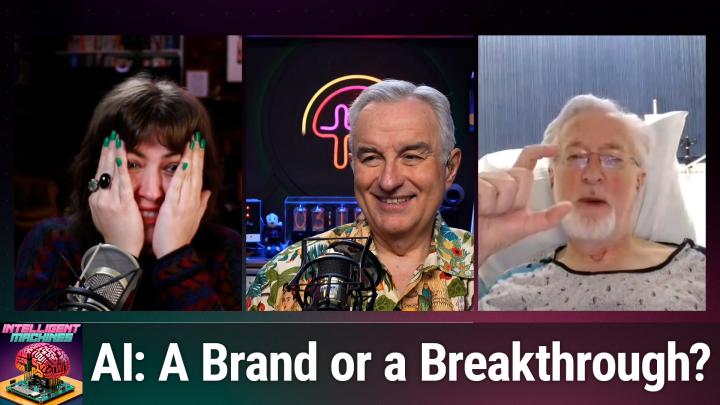
All TWiT.tv Shows (Audio)
Intelligent Machines 854: Welcome to the Pitt
02:17:49
AI: A Brand or a Breakthrough?
Loading summary
Transcript632 lines
- [00:00]
Leo Laporte
It's time for Intelligent Machines. Paris Martineau is here. Jeff Jarvis is here. We didn't expect this. He's joining us from his hospital bed because he was so excited about our interview this week. We talked to Thomas Haig, the author of a new history of AI Intelligent machines. From the Pit is next.
- [00:24]
Thomas Haigh
Podcasts you love from people you trust. This is twit.
- [00:33]
Leo Laporte
This is Intelligent Machines with Paris Martineau and Jeff Jarvis. Episode 854, recorded Wednesday, January 21, 2026. Welcome to the Pit. It's time for Intelligent Machines, the show. We cover the latest in AI robotics and all the smart doodads all around you in your home these days. Soon, someday we'll be doing this show and a humanoid robot will creep up behind me and brain me. Probably. Say hello to our wonderful Paris Martineau from Consumer Reports, where she's an investigative reporter.
- [01:07]
Thomas Haigh
Hello.
- [01:09]
Paris Martineau
I will be sad the day a robot brains you, but I will respect the robot's authority. Regardless.
- [01:16]
Leo Laporte
I will have earned it. No doubt. The robot may be remotely controlled by one Paris Martineau. We're not sure.
- [01:23]
Paris Martineau
We don't know.
- [01:25]
Leo Laporte
It could be. Now, this is a little weird. I'm going to have to set this up. We did not expect Jeff Jarvis to be here today because Jeff.
- [01:33]
Paris Martineau
In fact, we expected the opposite because that's the only thing that would make sense given what you're about to say.
- [01:40]
Leo Laporte
Absolutely. He had. Took a tumble. He talked about it last week. He injured his coccyx. And you don't have to look that up. It's a part of his body near the nether regions and by making a bed, apparently, which bed fought back. But then as a result, he got checked up and it turned out he had other issues. Joining us now from the hospital, from his hospital bed. I don't believe this. Not Mike Elgin. Jeff Charvis. Hello, Jeff. Are you okay?
- [02:17]
Jeff Jarvis
Hello there, guy.
- [02:19]
Leo Laporte
You had a fever.
- [02:20]
Jeff Jarvis
What was physical therapy?
- [02:21]
Leo Laporte
Your fever was like 105 or so, 3.8.
- [02:24]
Paris Martineau
I'm saying you're not allowed to be here. We're allowing you to be here only because you seem to really want to for a little bit for our interview. But afterwards, we're gonna cast you off to go on forced bed rest.
- [02:37]
Leo Laporte
This is.
- [02:38]
Jeff Jarvis
That's all I've been doing. So it turns out I had compression fracture in my L3.
- [02:45]
Leo Laporte
Oh, well, everybody, that's not your coccyx. Yes.
- [02:48]
Jeff Jarvis
No, that's not. That's not. And then I finally went to see urgent care on Thursday after the Sunday accident.
- [02:54]
Thomas Haigh
Yikes.
- [02:55]
Jeff Jarvis
And I had a fever, and it was a little mysterious. And on Friday, it got much worse. The pain got wildly bad, horribly bad. Saturday, I could not get out of bed. I fell out of bed. Old men. And was carried by ambulance on a stretcher to the hospital here in Morristown. And they tested and tested and tested and tested. And I'm very fortunate because they found a staph infection.
- [03:24]
Leo Laporte
Oh, yikes.
- [03:24]
Jeff Jarvis
Which can lead to sepsis, which can kill you. And so I'm on lots of antibiotics through the IV and physical therapy and all kinds of other things, so I'm glad to be here.
- [03:41]
Leo Laporte
But worst nightmare, she thinks if I'm gonna work with two old guys, they're gonna start talking about their.
- [03:48]
Paris Martineau
No, I'm just saying. I'm just sitting here thinking, jeff, I'm glad that you're safe. I'm glad that you're here talking with us.
- [03:55]
Jeff Jarvis
This is pretty weird.
- [03:56]
Paris Martineau
So I'm most of all. Is this the first time in Twitter history that someone has joined the podcast from a hospital bed?
- [04:04]
Leo Laporte
Oh, most definitely. This is.
- [04:06]
Jeff Jarvis
Is it the first time in podcast history?
- [04:08]
Leo Laporte
It might.
- [04:09]
Jeff Jarvis
Hospital bed. Well, because it's so foolish. So. So the other. So I have been pushing for Thomas Haig to come on. You'll meet him in a moment to be our guest. And I felt awful that I was really fascinated by his work. I got to know him at the Computer History Museum event on the pioneers of desktop publishing, which was key to my next book, Hot Type. And so I thought I'd just call in to say hello. And then Elgin now has an emergency, so he can't be here.
- [04:42]
Leo Laporte
So we're glad you're here.
- [04:43]
Jeff Jarvis
I'm here for a while.
- [04:44]
Leo Laporte
Yeah. Well, let me introduce. And you introduced us to Thomas Haig. He's a historian of computing, which is kind of for both of us. Jeff and I, we're both fans of history. Kind of catnip. He's written many books. You'll find them at his website, tomandmaria.com tom. Including a new history of modern computing, ENIAC in action, exploring the early digital. And his newest book is all about AI, the history of AI. Thomas, welcome to Intelligent Machines, the Brand that Wouldn't Die. I think that's a provocative title because you say AI is really a marketing term. Yes, we know it is now when Sam Altman utters from Sam Altman's lips. For sure. But it's a marketing term with quite a kind of ancient history. Tell us about. Well, who first coined the term AI?
- [05:46]
Thomas Haigh
Well, the term was invented by John McCarthy in 1955 to attach to a proposal to the Rockefeller foundation to get money to have a summer school and invite his friends to Dartmouth College.
- [06:03]
Leo Laporte
In fact, a very famous conference of the first AI conference.
- [06:07]
Thomas Haigh
Yeah. And it wasn't the first time people had talked about computers and thought there'd been a conference in Paris some years earlier. In fact, the idea that computers are like brains is as old as the electronic computer was something that was informing John von Neumann as he was developing modern computer architecture. But the specific phrase artificial intelligence has got that very exact time and purpose. It was invented. And my argument in the book is that it's functioned effectively for the most part with a large period of the AI winter when it went out of fashion as a means to market and sell things. That's not to say that it's not real. I mean, one of the things that I try and stress in the introduction to the book is that this is not to insult AI and say that it's not real, that it doesn't produce technologies that are worthwhile or work, but it does. And you can consider any academic discipline through the lens of being a brand. So you can think of physics as a brand or biology. But I think within computer science, if you compare artificial intelligence to other subfields like communication, databases, graphics, there's been a lot more historical change over time in what kind of approaches the AI brand has been associated with than there has been in those areas. So I think while you can consider anything as a brand, I think it's unusually informative when you consider the history of AI to bring to the forefront its brand like qualities.
- [07:52]
Leo Laporte
Well, and also the way you name something informs how you think about it. And so I'm not. It's a little chicken and egg, maybe. We always thought about computers as kind of artificial brains, but as soon as you put the word artificial intelligence in the language, now that's what you're defining.
- [08:11]
Paris Martineau
Really, it makes the whole endeavor much loftier than cybernetics.
- [08:15]
Leo Laporte
A mechanical brain. Yeah. Here's a picture, by the way, from the book the Artificial Intelligence the History of a Brand of that first summer Dartmouth concert. Claude Shannon is there, Marvin Minsky and John mccarthy himself. How close to what we now think of as AI was this 1955 conception of AI? Is it something completely different or is it a reasonable precursor for what we have today?
- [08:46]
Thomas Haigh
Well, in some ways the 1955 conception of AI was closer to what we have today than the 1975 or the 1985 conception of AI was.
- [08:57]
Leo Laporte
The dates of the other AI winters? Yes, there have been many.
- [09:03]
Thomas Haigh
Well, that's actually something I claim in the book, that we've only had the one. Maybe we'll talk about that as well.
- [09:10]
Leo Laporte
Yeah, let's talk about that.
- [09:12]
Thomas Haigh
Early on, AI was defined essentially as getting computers to do some kinds of things that currently only humans can do. So they didn't try and define exactly what was meant by intelligence. And from some viewpoints computers have always been superhuman. Even back then they could carry out numerical calculations far quicker than any human. So there was never a precise kind of definition. But the original idea was that with clever programming we can get computers to do a whole bunch of things that they can't currently do that in humans we associate with intelligence. And famously the initial proponents of AI in the early 60s through to about 1970 made some extremely aggressive predictions that within 10 years or so, some of them even shorter time spans, computers would basically be able to do anything that humans could in terms of intellectual work.
- [10:10]
Paris Martineau
Now where have I heard that sort of over promising before?
- [10:15]
Thomas Haigh
So I start that by talking about the modern day hype and then going back and saying there's a real continuity in some of the promises that were made. That's a connection back to the beginning, the specific technologies. At the very beginning they were interested in neural net type approaches and in symbolic manipulation approaches. So this is back in the late 50s into the early 60s. By the end of the 60s, as AI matured as a field within computer science, associated particularly with labs at Stanford, MIT and Carnegie Mellon, they redefined the scope of what was included in it to push out neural networks. Neural network development continued, but it didn't continue under the umbrella of the AI brand. It was called pattern recognition, then it was called machine learning and then deep learning. That I think is a pretty good example of how there's not stability over time in terms of the specific technologies and approaches that people have meant when they say AI.
- [11:19]
Leo Laporte
Yeah, in fact it was that decision to follow symbolic AI versus neural networks that kind of did lead to those AI winters or single winter. By the way. I was just, I was reading in your book about the general problem solver and I had to pull out Peter Norvig's 1992 book about artificial intelligence programming in which in one of the very first chapters we write the gps, the general problem solver. And it's incredibly primitive compared to. But it's a symbolic AI. I guess the best way to describe it would be kind of a bunch of if then statements. Right. It's a very logical deterministic kind of thing, very different from the AI we know today. So you said something interesting, that there's only been one AI winter. So was it one long winter?
- [12:13]
Thomas Haigh
Well, I mean, if you go to Wikipedia or just Google AI history, you'll probably find some website that's been set up by a company that wants to sell you something and has pulled together some information without caring enormously about the historical specifics. But the received wisdom has become that I did well in the 60s, then it did badly in the mid and late 70s. It did well again in the 80s around expert systems. And the first time that AI is really having startups and venture capital and industrial enthusiasm in the 80s, and that's absolutely true. And then it does badly in the 90s and early 2000s before it revives around neural networks. And the part of that I disagree with is I think AI was doing pretty well in the 70s outside some very specific factors around DARPA, which had been funding research, its change in mission after the Vietnam War, that led to MIT and McCarthy's sale lab at Stanford not getting the same kind of very easy money that they had before. So I think there was a kind of localized frost around two or three labs in the US and Edinburgh in the uk, and those labs really dominated the field. So the people who wrote memoirs and gave speeches at AI conferences and so on were given the experience of people who've been in a position essentially of enormous privilege previously getting large amounts of money without having to do formal proposals or worry about milestones or deliverables or peer review, and found themselves, you know, in diminished circumstances. But if you do, you know, the good historian thing and look a little bit more broadly at metrics like the number of members in artificial intelligence associations, which at that point in the 70s, primarily special interest group of the association for Computing Machinery, or you look outside those elite labs, the number of people going to conferences, you look at the spread of AI internationally. I mean, this period of the late 70s when conventional wisdom says there was a major cutback in the field, is when the national AI associations in European countries and the Soviet Union first get founded. It's the first regular AI meeting. And even at Stanford, I think it's a. It's a real split screen thing, because on the one hand, McCarthy's lab is struggling to get the same amount of funding from darpa. On the other hand, Ed Feigenbaum's teams around expert systems are doing really great. So I asked Feigenbaum, did he think the 70s were a period of retrenchment? He said, no, the 70s was great. They kept giving me more money. Everything was coming together. So I think it's an example where a very specific historical perspective from a handful of elite lab leaders and their grad students has really warped our understanding of what was going on with AI in the 70s.
- [15:22]
Paris Martineau
I'm curious, Neil, how did you get. Oh, go ahead, Jeff.
- [15:28]
Leo Laporte
You're the one in the hospital bed. Jeff, I think normally I would let Paris go, but no, you gotta.
- [15:33]
Paris Martineau
You simply have to.
- [15:36]
Jeff Jarvis
When you zoom in from a hospital.
- [15:38]
Paris Martineau
Bed, you get to ask the questions.
- [15:41]
Leo Laporte
Oh, good. Oh, good, a new bag.
- [15:43]
Paris Martineau
We're gonna ask. I'm gonna have 75 questions for you, Jeff, once we finish this interview, but go ahead. For right now, I just want to.
- [15:51]
Jeff Jarvis
React to what Thomas said, Leo, because you've long said that there were two AI winners. And I'm curious how you first came across the idea that AI had the first winner and what your reaction is to Thomas's very good analysis.
- [16:02]
Leo Laporte
Well, I think it's. I guess it's how you define a winner. I mean, it sounds like.
- [16:07]
Jeff Jarvis
Well, it's how you define AI, too.
- [16:08]
Leo Laporte
Yeah, it sounds like, you know, Feigenbaum was happy because he was getting money. Does that mean it's a successful enterprise? I think when I think of the terms AI winners, I think of it and again, not having lived through it, I don't know, but I think of it that there were periods of great optimism which were followed by disappointment because the AI techniques that they were espousing, like GPS or symbolic logic, whatever, didn't really. Expert systems, didn't really deliver. Did Feigenbaum believe that it was delivering or he was just getting money?
- [16:52]
Thomas Haigh
He still believes that expert systems work. He's got a story he likes to tell. For example, with the diagnosis of heart conditions that they. The idea with expert systems was somewhat coming out of the difficulty of building general purpose intelligence, which had not at all progressed according to the optimistic predictions of the 60s. So by the semitist, the idea was, you think, you know, experts need to be smarter, but maybe actually because they have very specific domain knowledge, it's easier to simulate a high level international expert than it is to simulate basic common sense. And Feigenbaum likes to tell stories of working with an expert in diagnosing heart conditions and asking some questions, eliciting the knowledge, expressing it in rules that would then go into the lisp based inference engine, and then running that against some test cases, seeing where it went wrong, going back to the expert saying, why didn't it reach the right condition here. And then the expert says, oh, well, what I forgot to say is in these circumstances, actually you do this other thing. And he claimed that once you got to a couple hundred rules, you pretty much could represent any kind of expert knowledge. And then they did tests where they would take the systems for medical diagnosis and other kinds of expertise, run them against test problems, show the same test problems to a panel of experts, and they would claim that the systems in those very narrow areas could outperform what the experts could do, or at least what a mid level expert could do. So the logic would be, if you've got something can diagnose blood infections much better than the typical doctor, then that will be something that would be worth rolling out and there's a real market for it. And a lot of the 80s AI boom was very specifically an expert systems boom, because the logic for that was maybe we haven't solved the problems of general intelligence, we certainly haven't achieved superhuman intelligence, but we can make systems that are economically viable and can pay for themselves by taking expert knowledge and making it portable and putting it in a little software box. And that's also one of the reasons I said earlier that in some ways the modern discourse about AI has got more to do with the very early days discourse of rapidly achieving general purpose human intelligence versus the ideas that came in the 70s and 80s, where the rest of it was much more about, let's not even talk about the Turing Test, but let's just say there are ways that we can make computers more economically valuable by encoding knowledge and using it to help them perform better.
- [19:43]
Leo Laporte
So a different goal meant that it wasn't winter because they were achieving that particular goal of an ecosystem.
- [19:51]
Thomas Haigh
I mean, winters and summers have conventionally been expressed in terms of funding for AI, and of course that's downstream for belief in AI. So they go together. So the original.
- [20:03]
Leo Laporte
So we're in a glorious summer right now, aren't we?
- [20:06]
Paris Martineau
We're in a very endless summer, it seems. I'm curious though, why do you think that the industry is attached and has remained attached to this notion of the 70s being a first AI winter? What do you think explains that and what do you think it says kind of about that as a narrative device for the industry?
- [20:27]
Thomas Haigh
Yeah, well, it's such a pervasive narrative. Initially I assumed it must be true and then I went back and just did some fairly low hanging fruit things like looking at memberships in the associations or seeing when AI spread overseas. And then I was like, oh, the other thing I just did is a Google Ngram is a great tool for seeing how much people are talking about things. I've got some of those in the book. If you do Google Ngram for artificial intelligence, there is steady growth in the 70s and then a real peak in the 80s. And you do definitely see the real AI winter of the 90s in the Google Ngram and in participation at conferences and in those kinds of metrics. You don't see any kind of broad based drop off for AI in the 70s. The other thing, the phrase AI winter, you can date very precisely.
- [21:20]
Leo Laporte
We have the end gram, by the way, Benito, if you pull that up.
- [21:22]
Thomas Haigh
Yeah. To a 1984 panel at the American association for the Advancement of AI. And they're worried. Basically the 84 is real boom times. They're getting lots of money. People are being lured away from completing their PhDs by industry jobs. In many ways, everything is going great. The conference is feeling more like a trade show than an academic venue. But some of them are saying, I don't trust this. I think maybe we're overhyping it. This is all going to end in tears. And at that point, people are worried about a nuclear winter. So the idea of a winter, there's fallout, the sun gets blocked out, everything dies. Now, of course, you might say losing funding for AI is not quite the same as everything dying, but that was the analogy. And if you look at the quote that they have there about what's going to happen, it pretty much precisely defines what happens four or five years later. Companies cut their AI groups. The government, which had been funding something called the Strategic Computer Initiative, cuts back, autonomous vehicles fail to roll, and the end of that square, that's a line I really like about everybody, like stops calling whatever they're doing AI and finds a different name for it, which. Which pretty much is what happened. But the funny thing is, at that 1984 thing, you can read the transcript of the panel discussion and it's something like 10 pages, single spaced. Nobody says, oh, this thing we're talking about, hypothetically, we just had one of those a couple of years ago. Right. So there's no sense in 1984 that there'd been an AI winter just a few years earlier. Where it seems to come from is a 1990s book by. What's that? Creviet, who had been trained in AI at MIT. And he's basically reporting the folk wisdom of MIT, that the late 70s was a hard time when people had more difficulty getting money. And that is blown up into this claim that there was an enormous international, broadly based cutback in AI research in the 70s. So I think it comes again to. There was a pretty much a cartel of labs in the 70s into the 80s that got to set the entire agenda for AI, and that was Stanford, MIT, Carnegie Mellon and SRI, which was at that point largely detached from Stanford. And so the people who, I mean, I looked at, I found seven AI textbooks from the 70s, they had eight authors. All eight of those people had a PhD from one of those places. They really were the people who were being invited to give keynote speeches, who were writing memoirs, whose recollections were passed down to their grad students. And those people were in those specific places where AI funding had been extremely easy and lavish in the 60s and was less so in the 70s. And I think just the folk wisdom of AI has been turned into this historical claim of a broad based slowdown without anyone actually attempting to look for evidence of whether it's true or not.
- [24:39]
Leo Laporte
How much of it has a Cold War as well. I mean, this is an era where we were in a battle with the Soviet Union for military supremacy. And I think that there was some. You mentioned arpa, you mentioned the nuclear winter. Is some of this informed by the Cold War?
- [25:03]
Thomas Haigh
All of it, really. I mean, why? The period where AI is getting going in the 50s is an incredible period for the growth of science. And it's a wonderful time to be like a smart, young, geeky, science oriented guy because there are institutions like the RAND Corporation, the incredible amount of federal funding that is flowing to MIT and Stanford. I mean, it's not a coincidence that AI develops primarily at MIT and Stanford, because those two institutions are far ahead of anywhere else in terms of the amount of federal money they have simultaneously.
- [25:43]
Leo Laporte
With the Internet as well. Right. I mean, this is sort of the Internet development as well, right?
- [25:47]
Thomas Haigh
Yeah. The same ARPA office that is funding AI in the 60s at Stanford and MIT in particular is the office that is funding the arpanet.
- [25:58]
Leo Laporte
Yeah.
- [25:59]
Thomas Haigh
So it's part of the same vision for interactive computing as something that can do revolutionary things.
- [26:08]
Leo Laporte
One of the reasons people think. I'm sorry, Jeff, go ahead. There's a little lag.
- [26:12]
Jeff Jarvis
What did ARPA want out of AI at the time?
- [26:14]
Thomas Haigh
Well, ARPA didn't fund a specific AI program until the 70s when it had a large project on speech understanding. So in the 60s there wasn't a separate AI pool of money existing at Arpa, so it was bundled in with other things. So at MIT there was a giant thing called Project Mac. And depending on who you asked, Mac could mean man and computer or machine aided cognition. And that went with the vision of J.C.R. licklider, the inaugural director of that piece of ARPA, who had a vision of computer human symbiosis. So it was more like the idea of an interactive tool that can make humans smarter was the actual driving vision versus specifically the AI dream of producing intelligence that was autonomous and existed aside from and could do its own things in the world. But time sharing was a big piece of that because previously computers had worked on a batch processing basis. You would give your program in a piece of paper, get punched onto cards, they'd run through the machine, you'd get the results back, which usually would be error messages saying you made a mistake in the code, maybe a day later. AI type visions and this idea of the computer being an interactive tool both depended on finding a technology that could let the computer to respond to you instantly so you could have an interactive dialogue with it. So John McCarthy, who came up with the term AI and also founded the lab at Stanford, was previously at mit and he was the strongest proponent for this idea of time sharing which MIT pioneered for making computers access interactive. So in the 60s ARPA was funding this bundle of things that included graphics, time sharing, networking, the provision of computer facilities, really out of a general sense that computer would be much more powerful if they could be interactive tools versus purely batch process things that people didn't interact with directly. And they were absolutely right about that. Even if the specific AI pieces of that agenda didn't deliver on what people like Marvin Minsky at MIT and John McCarthy hoped they would.
- [28:46]
Leo Laporte
We're talking with Thomas Hagee's, the author of Artificial Intelligence the History of a Brand. This is the pyramid of the Strategic Computing Initiative round, round about that time. I think it's a little bit into the 70s of the plan, right?
- [29:03]
Thomas Haigh
Yeah. So that's the 80s when 80s really, when AI funding gets generous again in the minds of the people at MIT and Stanford. It's also, I mean it's the era of Reagan, it's the era of the Strategic Defense Initiative. So there's a general interest in spending money in ways that will improve US national security. With the revival of Cold War after the detente era in the late 70s. And the pitch there is basically around what I'd mentioned previously with expert systems. So Edward Feigenbaum at Stanford, who came up with the idea of expert systems, also was very effective in helping to scare American politicians about the danger of Japan getting ahead in expert systems and AI. So Japan had something called the fifth Generation initiative and that was used in the US and in Europe to convince governments that they needed to fund AI and expert systems to avoid. It's a period where people had seen one industry after another crumble in the face of Japanese competition and they were worried that the Japanese were coming for American strengths in computing, which obviously was a scary thing and could leapfrog ahead to the next generation of intelligent computers unless Congress was prepared to put a bunch of money into AI and expert systems. But the point with that pyramid is the argument was we already we know how to make an intelligent computer, but the problem is we can't fire off enough rules every second to achieve intelligence. So we don't just need money for expert systems, we need money for parallel computing. This was the area was just talking to some people in Germany about an exhibition they're doing about the connection machines built by the MIT affiliated firm Thinking Machines. So in that era it made a lot of sense to brand a supercomputing company as being about intelligence because DARPA had a lot of money to spend and on this cluster of intelligent machines and enabling technologies. So the government spent in a big way on improving microelectronic chip manufacturing type technologies. They spent on parallel computing so that you could get more rules fired off every second they spent on expert systems. And the way that they spent a lot on autonomous vehicles. That is really where Carnegie Mellon built up its strength in autonomous vehicles, which feeds through to the modern day.
- [31:41]
Leo Laporte
Remember the grand DARPA challenge? Yeah, yeah.
- [31:44]
Thomas Haigh
And what they found really was the architecture and underlying tech side of that went pretty well. But unfortunately, even when you scaled up the computing power available, the AI technologies just didn't do what people were hoping. They fell by the websites roadside somewhat.
- [32:08]
Leo Laporte
You quite literally, in the case of the DARPA Grand Challenge, you quote YALE Professor Drew McDermott at a panel called the Dark Ages of AI. This is around 1984, warning of a feeling of deep unease that excessively high expectations for AI. See if this sounds familiar. Will eventually result in disaster. To sketch a worst case scenario, he said, suppose that five years from now, the Strategic Computing Initiative collapses miserably as autonomous vehicles fail to roll. The fifth generation turns out not to go anywhere. The Japanese government immediately gets out of computing. Every startup company fails. Texas Instruments and Schlumberger and all the other companies lose interest. We've been talking about an AI bust for a long time and then the.
- [32:55]
Thomas Haigh
Line about everyone finds a different name for whatever is that they're doing. So in the boom Time everyone who did anything that could plausibly be called A would call it AI. And the scope of AI grew a lot. And then in the AI winter, I mean, this is.
- [33:11]
Leo Laporte
Here's the Engram where they changed the name to Expert Systems.
- [33:18]
Paris Martineau
Yeah, just a little control replacement.
- [33:21]
Thomas Haigh
And there's an interesting relationship there from some viewpoints. For some people, they would think of expert systems as one approach within AI, but it also in some ways function as a rival brand because AI by the 80s already had this taint of habits, having over promised and under delivered for a long time. And expert systems sounded more technical and.
- [33:41]
Leo Laporte
Respectable and maybe less ambitious to some degree.
- [33:46]
Jeff Jarvis
Right.
- [33:46]
Leo Laporte
We're not trying to build a consciousness, just we want to answer some questions.
- [33:50]
Jeff Jarvis
Right.
- [33:51]
Thomas Haigh
And you see this in many areas, including for example, if you look at AI textbooks by the 80s, they are not discussing the Turing Test. They are not making the claim that all this is about achieving human or superhuman intelligence. They're making the claim that this is a respectable body of techniques that work, that rely on knowledge, that make computers go more effectively.
- [34:13]
Leo Laporte
Well, there's so many great characters in this, including Marvin Minsky and some other histories of AI that we've talked about on this show. Marvin Minsky is painted a little bit as a villain, as the guy who was so convinced that neural networks couldn't possibly work that he steered AI away from what was ultimately the technique we're using today. Do you see him as the villain in this?
- [34:41]
Thomas Haigh
I try and get some kind of historical distance there, although one of the comments from the reviewers for the press was that I'm taking my animus against modern day big tech and projecting it back to be too harsh on those guys in the past. I don't think I am. I am in many ways stressing that what they were doing is something quite different from what happened now. I mean, I think you have to deal historically with the. That none of this worked. And I was trained in the early 90s as a computer science student. I took maybe five AI courses. I learned these techniques in the AI courses the same way I learned a bridge solver.
- [35:18]
Leo Laporte
Right, in Prologue.
- [35:19]
Thomas Haigh
Yeah, yeah, the same way. I did graphics and I did databases and I did architecture. And you write these simple exercises with these toy problems and you do the same thing in AI. But the difference is the techniques I learned in the AI classes couldn't scale up. They only ever worked on these incredibly small toy problems. And the techniques in the other classes were simplified versions of the techniques that really did work for technologies that existed in the world. So when you're talking about 20th century symbolic AI, I think you need to be clear up front. The things they were doing didn't work. They produced all kinds of byproducts in terms of interactive computing and technologies and parallel computing. So I'm not saying that the money was a bad investment, but it was the byproducts that went out in the world to be useful. They did not succeed in achieving their core goals. And I think that is clear enough at this point. You can get away a bit from thinking, well, this guy was a hero because he favored this good approach that I think the field should have adopted, and this other guy is a villain because he did this. I mean, nothing any of them tried to do would have worked. And there are many reasons for that. I mean, there's the whole problem with the fundamental difficulty of taking a purely symbolic approach. There's tacit knowledge, all the things that the skeptics and the philosophers were complaining about all along, but there's also just the complete lack of computing power that's available.
- [36:58]
Leo Laporte
That's, that's kind of the underlying thing of all of this is they were trying to do parallel computing and time sharing and it's all been solved. That was the bitter lesson, wasn't it? It's all been solved by just massive compute.
- [37:11]
Thomas Haigh
Well, I mean, they did other things too. But if you look at the revival of neural nets, the place where neural nets were bought back and worked was Bell Labs, Jan Lecan in particular, with a system that was able to differentiate pretty reliably between the 10 dig and read zip codes and in a related application to read the routing numbers on checks that were written by hand. So by the 80s, and this wasn't just computing power. I mean, they also. The whole thing, Hinton and his buddies and the back propagation algorithm and various conceptual advances that underpinned the revival of neural Networks in the 80s. But, but with the biggest computers that were available in the 80s, reliably distinguishing between 10 digits was pretty much all you could get. So it's not that there was some other path that could have been taken in the 60s, 70s, 80s to make AI work. I think just fundamentally you have to accept that they had some ideas that maybe seems reasonable. I don't want to say that it was ridiculous to even explore them. They certainly, for example, showed that the forms of logic that you might learn in a philosophy class are going to help you solve problems and think more rationally. Just fundamentally don't work when you're trying to apply them. On a large scale, and they had all kinds of advantages and byproducts that were produced along the way. But I think, again, we've just got enough historical distance now that I don't want to say, say Minsky was bad and McCarthy was good, or McCarthy was good and Minsky was bad. They were really smart people that had a bunch of interesting ideas to try and address, a challenge that it's clear in hindsight was fundamentally insurmountable, given the technology available, the capabilities.
- [39:16]
Leo Laporte
You do say that Minsky confessed to being the devil who killed interest in neural networks for a generation. But Seymour Papert was the guy who really pushed this notion. I like your more nuanced view that it isn't this kind of. We took a wrong turn and it went downhill. And then we finally, oh, it's machine learning. We got the right. It is a continuum, and it's a continuum that's informed by a lot of different ideas and capabilities that got us to where we are today. Now, you said something interesting. You're not a fan of big tech today.
- [39:52]
Thomas Haigh
Yeah, I mean, that's in the opening. I don't think that puts me in a minority.
- [39:58]
Leo Laporte
No, it does not.
- [40:01]
Thomas Haigh
So I start out in the introduction with a snapshot of the world in 2024 and the AI hype there. And then at the end, I've just been drafting some extra material to put into the book with the revisions. So I'm trying to cover engitification and the way that the enormous cost and resource needs of these systems mean that there's only a handful of big tech firms that can afford to develop, which are underpinned by monopoly profits from doing all the bad things that you're all extremely familiar with. So I'm not a booster of modern AI or big tech, but I don't have any particularly original critiques for that. I think the originality that I have in the book is taking 20th century AI seriously and going pretty thoroughly through time about what the AI brand has meant over the decades since it was originated. So the last two chapters are the Neural network revival, which I, you know, mostly what I know about that, to be honest, comes from podcasts and journalists and things like that. I'm not trying to explain to the world how ChatGPT works and so on, but I'm trying to know enough about that to say what is the same and what is different between these modern day AI branded technologies and the ones that were dominant in the 20th century.
- [41:24]
Leo Laporte
You mentioned that your book.
- [41:26]
Paris Martineau
I think Jeff's trying. Yeah, we should let Jeff.
- [41:29]
Thomas Haigh
I want to hit Jeff. Sorry, Leo.
- [41:35]
Jeff Jarvis
Right off. What you just said did. It's a weird general question I'm gonna ask is two parts. Do you think in the end the people involved in AI over the years and now would say that the use of the brand AI was beneficial or detrimental.
- [41:54]
Thomas Haigh
To their careers.
- [41:57]
Jeff Jarvis
To the field, to their careers, to the society, whatever you like.
- [42:04]
Thomas Haigh
It's an interesting question. I mean, Feigenbaum, for example, deliberately, I think, came up with the expert systems brand as an alternative to AI. Minsky and McCarthy, I think through their whole lives remain true believers, particularly McCarthy, I think, who came to see himself as something of a dinosaur. I just was reading some archived emails from him that are preserved at a website called saildart, which is taken from the backup tapes of the Stanford AI Lab timesharing system. So it's a wonderful opportunity to be a bit of a fly on the wall. And it's clear that by the. He saw himself as working on basic AI and logic, which had fallen from favor for applications oriented work, and pretty much just in his mind plugging away doing the same kinds of things he'd been doing since the 50s. If you want to know what those people thought, the best source is probably the 50th anniversary reunion conference that they had at Dartmouth. And in those days they're basically saying, yes, we still believe it's going to pay off in the end. We still believe in symbolic AI. We think it's going to be a great thing, but it's not going to happen in our lifetimes. The thing that we thought was 10 years away is maybe 50 years away. So the ideas for where what we'd now call AGI would be accomplished. That was probably 2000, I think that was 2008, the reunion around that time. That's probably a low point for belief in the near term potential for human, like, intelligence.
- [43:45]
Jeff Jarvis
Let me ask you a follow up, if I may. Real quickly there on the New Books Network where I heard you talking about your next book, which is a wonderful wonky podcast network for academic books.
- [43:59]
Leo Laporte
You.
- [43:59]
Jeff Jarvis
Said that you could see a case for people wanting to flee the brand of AI and try to rename it again in the coming year or so. Yeah, you think that the language foretells the fate or reputation of the field, of problems in it. How do you see that going?
- [44:22]
Thomas Haigh
All right, so the context for this is the technologies that we now call AI are fundamentally around neural networks, mostly around generative AI, within that, mostly around large language models. And those technologies as they were being developed in the early 2000s, were not called AI because they'd been pushed out of the AI field. And I think also to an extent, because they didn't want the baggage always that came with the AI brand. Those things were called machine learning, deep learning, pattern recognition. And something really dramatic has happened in the last 10, 12 years that essentially the people who'd been taking this other technological approach that existed outside AI as a brand and existed outside the elite AI labs basically stormed the castle, raised their flag and said, we're AI. Now when you say AI, this is what you mean, not the symbolic AI. A question is why did the machine learning community sees the AI brand for itself after having kept a distance from it for many years? I think the argument of that is fundamentally around the science fiction narrative associations of AI. They reclaimed the brand. I've got a quote in the book from an AI researcher who says the exact day on which he became an AI researcher and not a machine learning researcher was when they went to the NIPS conference for the neural net stuff. And Mark Zuckerberg was there in the presidential suite having recently hired Yann Lecun and was offering people lots of money to come to his group at Facebook which was called AI. And then obviously the DeepMind people, I mean, Shane Legg really heavily promoted the concept of AGI and OpenAI DeepMind. Those other guys really had a revival of this early AI sense that this was something that was going to produce human and then superhuman intelligence with the whole singularity thing in the near future. And that is also why so many trillions of dollars have been flowing into it. So I think they switched the name of the thing from the more technical wonkish machine learning to the attention grabbing AI very specifically because they wanted to make a number of claims that seem plausible to us because we've been conditioned by science fiction. So one of those is that AI is going to be this superhuman general purpose thing. Another one is that it's something that is going to happen really quickly. So if you look at science fiction stories like say Heinlein's Moon is a Harsh Mistress or the Terminator stories, AI just happens, right? One day a computer gets big enough and it suddenly becomes self aware. And that obviously happens because the authors had no idea how you could make a self aware computer. So they're just, well, whatever, it just happened, okay, deal with it. So we're also primed to believe that AI is something that can just happen very quickly and unexpectedly without actually needing much work. Once you've got A big enough tech platform. And also, of course, in most stories where AI exists, it's the most important thing in the world. And you get the whole doomer versus accelerationist thing because in some AI stories it's basically a metaphor for slavery. And of course the robots exist purely in order to be oppressed and rebel. And in other stories it's basically the Pinocchio story of the boy that wants to become real, et cetera. But I think it's exactly the science fiction promises that are implicit in the brand of AI which began in science, but during the AI winter, really survived much more strongly in science fiction than it did in computer science that led to them reappropriating the brand. So back to the prediction that I made. It seems that there is pretty much no margin for error in the promises that have been made for AI. Every leader of every major AI company has got a personal timeline for achieving AGI and the promise that the singularity is going to happen sometime soon after that and we're all going to techno heaven or techno hell. But either way, the rapture is coming. There's not much margin for error in that. And it seems to be much more like that. AI is going to be like other technologies. It's kind of going to be. It's producing tangible tools that do some things really well. And I don't think those tools are going away. But the question is, is bundling together all these different technologies like image recognition and text generation and autonomous vehicles into this one thing called AI and making these future premises for it going to work. And I think if the overall superhuman intelligence thing doesn't pan out, or even if the technology works, but the business bubble bursts because historically, even with something like the Internet, as you're aware, the Internet wasn't a flash in the pan thing. The Internet was really important, but the dot com stock bubble still burst. So even in a scenario like that, I think the brand will become tainted again like it did in the AI winter of the 90s. And, and in the 90s, for example, if the 90s is the period where continuous speech recognition really becomes an important thing. So you've got technologies like Dragon, naturally speaking, and they don't call those things AI, they call them speech recognition, because AI is out of fashion, but speech recognition is in. And very recently, actually the company that bought the company that bought the company, the bought Dragon, was bought by Microsoft. It was nuanced and it was rebranded back to being AI as Microsoft's big play in AI for healthcare. But speech recognition spent like 30 years not being AI. So I think we may get something similar that people come up with these much more specific brands for the technologies that actually work. But the benefits of being associated with this big science fiction narrative around AI phase, when people are like, oh, it's been three years. Where's the stuff you promised us would be three years away? The stock market bubble bursts. Nvidia is no longer the world's biggest company, et cetera, et cetera. And people try and distance themselves from that and go back to the idea of having much more specific brands associated with the techs that work brand wise. I like to say it works a bit like a fashion brand, like Chanel. Right. So, you know, Chanel makes really good fragrance and they have good lipsticks, they have the Runway stuff, and then they brand extend into handbags and watches and so on. And it's not like the things that are good about the Chanel Watch are the same things that are good about the number five fragrance. But the brand, like, unites these disparate things and gives you this sense that they all are sharing qualities with each other in some more intangible kind of way.
- [52:12]
Leo Laporte
We've been talking to Thomas Haig. He's professor and chair of the History department at the University of Wisconsin, Milwaukee. Now, I'm confused about the title of the book. The galley that I have is different. Have you decided on a title yet?
- [52:25]
Thomas Haigh
Yeah, so that's. That's with the press. So, yeah, the one you've got says Artificial Intelligence Colon, the History of a Brand, which is a good title, except there's going to be a million books called Artificial Intelligence Colon. And if you only search on the main title, no one will find it. So we're thinking to use a title that I'd been using for talks that I've given, which is the Brand that Wouldn't Die, A History of Artificial Intelligence. And then you've got a main title you can actually find.
- [52:54]
Leo Laporte
Brilliant. It'll be from the MIT Press anyway, and it's sometime soon. Yes or no?
- [52:59]
Thomas Haigh
Well, hopefully it took them a while.
- [53:02]
Paris Martineau
Got to figure out that name first defined soon.
- [53:06]
Jeff Jarvis
Academic Publishing.
- [53:07]
Thomas Haigh
Well, I mean, I still like to hope for by the end of 2026. That would depend on the press being willing to move a little bit faster than usual. But they do want to give it some trade distribution and, you know, a relatively high profile.
- [53:21]
Leo Laporte
So it's tricky because AI is moving so fast. It's hard to write that final chapter.
- [53:28]
Thomas Haigh
Yes.
- [53:29]
Jeff Jarvis
Well, the advantage of history, though, Leo.
- [53:31]
Leo Laporte
Well. Well, okay.
- [53:33]
Thomas Haigh
Yeah. And the earlier chapters, those are written in stone. They're going to stay way more current. It's always a problem trying to come up to the present but obviously if I give someone a book on AI and it doesn't get to ChatGPT, they're probably going to want their money back. So the current stuff needs to be there. But mostly just so that I can draw parallels between the earlier history versus claiming that I have the definitive of unique understanding of the modern day tech.
- [54:01]
Leo Laporte
Well, and it's just fascinating story and it's so many interesting characters and you draw some nice pictures. I didn't realize that Marvin Minsky was a comedian as well as a brilliant thinker, things like that. Thomas Haig, thank you so much for joining us. His website, tomanmaria.com Tom has a lot of great stuff on it, including references to his earlier books which were really important in the field. Still are. Eniac in Action is the definitive history of one of the very first modern computers. He's also the co author with Paul Ceruzi of the New History of Modern Computing which is also a modern classic. So if you're interested, I know most of you are in this stuff, this is a great place to start. Yeah.
- [54:49]
Jeff Jarvis
What do you look at next on what's the next pursuit?
- [54:52]
Thomas Haigh
Oh well, after the AI book is out I want to get back to actually what my dissertation was about, which is the history of computers in corporate management throughout the 20th century. So it's, you know, in a way the prehistory of big data.
- [55:14]
Leo Laporte
Yeah. I think about the episode in Mad Men when this Madison Avenue agency in the early 60s gets their first computer and it's on its own floor and they, they have the priesthood and it's. But, but. And they're able to do things with that computer that you could probably do in about a 60th of a second on your phone today. But for them it was a big revolution. Yeah, I think that's fascinating. And we've come so far so fast. I can't think of another technology that has made this kind of advancement in just a matter of a few decades, which also makes it quite interesting and the cultural impact of it, which we're really seeing with AI. Thomas, thank you so much for joining us. I appreciate it.
- [55:54]
Jeff Jarvis
Thank you Thomas, thank you. Great to meet you.
- [55:56]
Thomas Haigh
Oh you too. And I feel honored that you have made it from your hospital bed.
- [56:01]
Leo Laporte
That is, this is really an interview for the ages. Thank you Thomas. Have a great day. Thank you. Take care. We'll continue with Intelligent Machines in a moment.
- [56:14]
Paris Martineau
I need to ask so many questions about this.
- [56:16]
Leo Laporte
Oh man. We'll get to the hospital bit. Yeah, let me do an ad. A little behind because.
- [56:21]
Paris Martineau
All right, Jeff, you gotta, you gotta hang with us for five more minutes.
- [56:26]
Leo Laporte
Can you make it another? You know, I think I can make.
- [56:29]
Jeff Jarvis
It an hour, but that'll probably be better.
- [56:30]
Leo Laporte
Oh, we'll wrap it up in an hour. That's perfect. Okay.
- [56:33]
Paris Martineau
All right.
- [56:34]
Leo Laporte
We'll continue with intelligent machines in a moment. Our show today, brought to you by Bitwarden, the leader in passwords, pass keys and secret management. I tell you what, I couldn't live without Bitwarden. Bitwarden is consistently ranked number one in user satisfaction by G2 and software reviews. Over 10 million users across 180 countries, more than 50,000 businesses. I think, you know, you should know if you watch this show or any of our shows that having a password manager is kind of fundamental to your personal security. You can't possibly remember, you know, hundreds of passwords or store hundreds of pass keys. You need something that'll do it, something that'll do it with strong encryption, ideally open source encryption so you can verify it's doing it right. You need something because otherwise you're going to come up with easy passwords that you can remember, probably going to reuse passwords. Now you're smart enough not to do that, but I think many of if you're running a business, many of your employees are probably doing those things you know better to do, like reusing passwords. That's why you got to have Bit Warden. Bitwarden makes it easy for you to encourage your employees to do the right thing. They will love Bit Warden and Bitwarden will help you. For instance, their new access intelligence for businesses. Organizations can use Bitwarden to detect weak, reused or exposed credentials. Immediately guide remediation. This is something Bitwarden does really well, even with individuals. I just was on a site and said, you know what you need to replace that password. It helps you replace risky passwords with strong unique ones, which closes probably the number one security gap in business today. Credentials still probably the top cause of breaches. But with access intelligence from Bit Warden, they become visible, they become prioritized and they are corrected before exploitation can occur. Bitwarden though, something for everybody. If you are, and I know many of you are doing your home lab, you have a personal projects you might be interested in. Bitwarden Lite. Bitwarden Lite is a lightweight self hosted password manager built for those home labs, those Personal projects for environments that want quick setup with minimal overhead. Maybe that's you. Bitwarden, of course, no matter where you're using it, at home, at work is enhanced with real time vault health alerts and those password coaching features that help users identify weakness, reused or exposed credentials and take immediate action to strengthen their security. One of the ways Bitwarden helps you is by helping you move off of the password manager built in your browser. It's so easy, right? And oftentimes, I think especially less sophisticated users, they turn on the password manager in their browser and they kind of live there. But it's not the most convenient and it's not the most secure. Good news, when you install Bitwarden, it'll say, ah, you want me to move your passwords from Chrome, Edge, Brave, Opera, Vivaldi? I'll do it directly. It directly imports the credentials from the browser into the encrypted vault without that separate intermediate plain text export, which is much more secure. It helps reduce exposure. It's a really brilliant idea. I wish Everybody did this. G2 winner 2025 reports that Bitwarden continues to hold strong as number one in every enterprise category for six, six straight quarters. It's easy to move to Bitwarden. I did it. Steve Gibson did it a few years ago. Couldn't have been simpler. Within a few minutes, we're up and running with Bit Warden. I've never looked back. It is the way to protect yourself. And because it's open source GPL licensed, you can review the code yourself if you want. It's on GitHub. It's also regularly audited by third party experts and they meet SOC2 type 2 GDPR HIPAA CCPA standards. They're ISO 270012002 certified. So it's absolutely secure. Get started today with Bitwarden's free trial of a teams or enterprise plan. Get started for free across all devices as an individual user. Bitwarden.com TWIT bitwarden.com TWIT I couldn't recommend it more highly. It's. Everybody should be using Bitwarden. I hope you would. And make sure you use that address so they know you saw it here. Bitwarden.com TWIT thank you, Bitwarden. Okay, okay. You can ask all those questions now of Mr. Jarvis. Don't tire him out. Oh, that's cool. Now they give you a little readout, okay?
- [61:09]
Paris Martineau
Some context for anybody who's just listening instead of looking. Jeff is in a hospital bed showing us his heart Rate. I will also say something about the lighting in the hospital bed. I assume it's not set for podcasting. Something about it makes it look kind of AI generated.
- [61:28]
Leo Laporte
No. I thought he was in heaven for the first time.
- [61:31]
Paris Martineau
I was gonna say now the lights are off, and it does look like you're on the verge of death. Before, it was the sort of unnatural lighting that it does.
- [61:39]
Leo Laporte
Look at that.
- [61:40]
Paris Martineau
It feels heavenly.
- [61:42]
Thomas Haigh
He's in a cloud or two.
- [61:44]
Jeff Jarvis
I think one or two. This is one.
- [61:49]
Paris Martineau
One. I'm saying we like Jeff.
- [61:52]
Leo Laporte
We all are. Light mode. Now, do you.
- [61:54]
Paris Martineau
Have you spoken to any of the employees of the hospital about the fact that you're podcasting right now? Because I'd like to know from them how many people they've seen.
- [62:03]
Leo Laporte
I think your doctor would tell you to stop. I really do.
- [62:08]
Jeff Jarvis
I told the wonderful nurse. So I don't know if you can hear this beeping in the background. No, it's my. Oh, you can. Oh, good. It's. It's my iv, so they're. They're pumping tons of antibiotics into me.
- [62:19]
Leo Laporte
Oh, God.
- [62:20]
Jeff Jarvis
And the. The device is very persnickety. If it gets one bubble in line, and no, a bubble won't kill you, but it still. It stops, and then it beeps, and then the poor staff has to come in. So I explained to her to flick it. I'm gonna be on a podcast. She looked like, okay.
- [62:34]
Paris Martineau
She didn't. She didn't blink. Did her response suggest to you that this has happened before?
- [62:39]
Leo Laporte
I think so. I think podcasts are everywhere.
- [62:43]
Paris Martineau
I thought the other week when we had somebody podcasting in from the airport in Las Vegas, that that was strange, but.
- [62:51]
Leo Laporte
Oh, we're just beginning. Paris.
- [62:53]
Jeff Jarvis
Yeah.
- [62:54]
Leo Laporte
Don't you go in the hospital? Yeah.
- [62:57]
Jeff Jarvis
Well, how long have you been in the hospital? I want to give compliments to Morristown Hospital in New Jersey. And God bless the science.
- [63:05]
Paris Martineau
I mean, God bless the science.
- [63:08]
Jeff Jarvis
And I thought that my. My. My pain in my lumbar fracture got drastically worse. And as of Saturday, I could not get out of bed. I could not move. It was. It was awful. And I was also getting a fever. And so the presumption was these things were connected. And so the spinal dart doctor was involved in all that, was trying to look at all the clues of what could be. But he said, I don't see people getting a lumbar fracture and getting an infection. 27 years, I've never seen that. Doesn't happen. The infectious disease doctor, who's also wonderful, said, well, yeah, we could but, yeah, it's a little weird. But then went through this huge amount of testing, CT scan, obviously, X ray, mri, and there was this wonderful little moment of science where they did a blood culture to see what's growing in my blood. And the, this, the infectious diseases doctor came in the other morning and he said, it's growing, it's growing.
- [64:14]
Paris Martineau
That's not what you want to hear from an infectious disease expert.
- [64:18]
Jeff Jarvis
But he said, you know, we know what it is. It's a staph infection. So they know how to treat it. They know what happens happen. But. But the amazing thing is that if I had not gotten the injury, I probably would not have gone to urgent care and interned the hospital as soon as I did. And this could have, well within half day or a couple days have gone into something far, far, far worse and fatal. So in that sense, I'm lucky.
- [64:44]
Leo Laporte
Yeah.
- [64:44]
Jeff Jarvis
But, yeah, so it's all I acknowledge. This is weird. People are defended by the sight of my decolletage. By the way, I think this is.
- [64:54]
Leo Laporte
The first time you've been on the.
- [64:55]
Paris Martineau
Podcast and not wear Ingall black.
- [64:59]
Jeff Jarvis
I know, yes.
- [65:00]
Leo Laporte
Did you ask him, do you have anything in black?
- [65:04]
Jeff Jarvis
This is, this is a standard issue gown. You don't want to walk.
- [65:08]
Leo Laporte
I believe I know exactly what it looks like from the back. You know, you're actually in a. You're in an auspicious place. I remember, as you know, Paris boys really like history. And I remember from watching, I remember from watching Ken Burns Revolutionary War documentary that Morristown was where George Washington quartered his troops during that cold, cold winter. And it is where he got them inoculated for smallpox because smallpox was devastating the continental army. And they didn't want to do it at first because it's a live inoculation and you get very sick, but then if you recover, you don't get smallpox. So you are in a good. You're in a place that's been a medical center for 300 years. Indeed years. Yeah. When you said Morristown, I, I went, oh, yeah. Oh, yeah, Morristown, Yeah.
- [66:05]
Jeff Jarvis
Mile away between 10th, a mile away from the Washington headquarters. You know, one of many Washington headquarters in the country.
- [66:11]
Leo Laporte
He slept there. He actually slept in your room, I think. But that's.
- [66:15]
Thomas Haigh
Yeah.
- [66:16]
Paris Martineau
Hollowed ground.
- [66:19]
Leo Laporte
So have you been following.
- [66:22]
Paris Martineau
You were saying, what have you.
- [66:23]
Leo Laporte
I was going to start with. I know what you're going to say. Maybe we should talk about AI.
- [66:26]
Paris Martineau
I was like, I guess we should talk about the news. It feels a little inappropriate. Well, Jeff, you can leave. Leo And I can do this.
- [66:35]
Leo Laporte
We can handle this alone. No, no, we. I don't want him to leave.
- [66:38]
Paris Martineau
I mean, if you want to be here, you are welcome to.
- [66:42]
Leo Laporte
I'm just going to watch the Price is Right. I mean, come on.
- [66:44]
Paris Martineau
I'm saying for the record, we're not not forcing him to podcast.
- [66:50]
Jeff Jarvis
I'm stuck with broadcast tv.
- [66:52]
Leo Laporte
That's right.
- [66:52]
Paris Martineau
You love broadcast tv, Jeff.
- [66:55]
Jeff Jarvis
Not anymore. No, no, no. And, and by the way, Paris, another thing that you are too young to know, I'm sure, is that back in the day, if you went in the hospital, you had to pay cash to a lady every day to watch the television.
- [67:08]
Thomas Haigh
Wow.
- [67:09]
Leo Laporte
I didn't. I didn't even know that.
- [67:10]
Paris Martineau
You didn't know that?
- [67:11]
Jeff Jarvis
Yeah.
- [67:11]
Leo Laporte
Oh, yeah, the TV lady would come by with her hand out.
- [67:15]
Jeff Jarvis
Yes.
- [67:16]
Paris Martineau
And if you didn't give her cash.
- [67:17]
Jeff Jarvis
She'D realize she didn't watch the tv. She didn't watch the TV you didn't get to watch.
- [67:22]
Leo Laporte
Now you just bring your iPad and you can watch anything you want. Including Ken Burns Revolution. I'm sure because you are a fan of the Goss that you were following what happened at Mira Marathi's startup, Thinking Machines. This week.
- [67:39]
Jeff Jarvis
They're explain this to us, would you?
- [67:41]
Thomas Haigh
A lot.
- [67:42]
Leo Laporte
It was a lot. In fact, we don't really know what happened. Remember that Mira Moradi, who was the president of OpenAI? In fact, briefly, when Sam Altman was ousted, she was running the place, left to form her own company. Thinking Machines raised billions of dollars. I don't know what the valuation is, but it was a huge raise on basically nothing. Right, right on. On the reputation of the founders. But there were some big defections that have shaken investors this week. So I'll. I don't know where I should start here. Two of the co founders, Barrett Zof and Luke Metz, have left and rejoined OpenAI.
- [68:30]
Paris Martineau
Yep.
- [68:31]
Leo Laporte
The CEO of Applications Fiji. Simo shared the news in a memo to staff, but that information was quickly followed by an all hands meeting which Miramoradi said, well, what really happened is that Zoff had a relationship with another, with a underling aptly named in Thinking Machines and was fired. Which he said, no, no, I wasn't fired till I told them I'm leaving.
- [69:07]
Paris Martineau
I wasn't fired. I quit.
- [69:09]
Leo Laporte
I quit. The VP of Research had also recently left. And a third Thinking Machine staffer, Sam Schoenholtz, is also rejoining OpenAI. So four big names are gone. Andrew Tullock left. You may remember this back in the fall to go to Meta. So I think one of the things.
- [69:34]
Paris Martineau
That'S interesting about this is that OpenAI said that they do, quote, do not share Amir Moradi's ethical concerns about SAF, which is pretty convenient to be OpenAI. But I think that also is a bit of a through line we've seen with regards to the reinstatement of Sam Altman. And kind of everything that's come since is it seems to be be more about collecting talent than looking too closely at any of this drama.
- [70:00]
Leo Laporte
When the startup first began, they were valued at $12 billion. They were in the midst of talks which probably are not going well now to raise more than $4 billion at a $50 billion valuation. They have but one product. It's called Tinker and it's a fine.
- [70:20]
Paris Martineau
Tuning platform, whatever that means.
- [70:22]
Leo Laporte
I hope they're planning also Taylor, Soldier, Soldier and Spy as their successing succeeding Tinker allows developers to customize AI models.
- [70:31]
Jeff Jarvis
Simply Bell would be nice.
- [70:33]
Leo Laporte
Bell, Tinker and Bell. Okay, you're going in a different direction, but all right, that's good. I like it. Yeah.
- [70:40]
Paris Martineau
I mean, sources also told Wired about this company that the co founders never, quote, never agreed on what to build, that some of them prioritized research, others pragmatic tools, and that's maybe one of the reasons why they've only launched one product. And now of the five original co founders, only one, John Shulman, the chief scientist, remains.
- [71:04]
Leo Laporte
This is the Wall Street Journal exclusive from yesterday. The messy human drama that dealt a blow to one of AI's hottest startups. Next on Inside Edition. After a relationship with a colleague, a thinking machine's co founder had his role changed. Months later, he was fired after a contentious meeting. That's Barrett's off they're talking about. I. You know, I don't know, it's just good gossip. At least they wouldn't see.
- [71:35]
Paris Martineau
It. Is both.
- [71:36]
Leo Laporte
They're gonna flush him. Wait a minute, they're gonna. I'm sorry, do you want the camera to be turned off?
- [71:41]
Paris Martineau
You're going down, Jeff.
- [71:43]
Leo Laporte
Oh, no. Jeff, we're here to flush your tubes.
- [71:48]
Paris Martineau
Jeff, can we wait till the ad break to get flushed?
- [71:55]
Jeff Jarvis
Get in here. There we go.
- [71:56]
Leo Laporte
There's the ad break. Oh, no, no, no, no, no, no, no, no. We don't want to see that. Jeff, no. Hide your eyes. Hide your eyes.
- [72:02]
Paris Martineau
No, no, no, no, no, no, no, no.
- [72:05]
Leo Laporte
I told you, Paris, this is the peril of working with old folks. I don't want you about the pain. I've got all up and down. Hope you don't mind, I don't believe.
- [72:16]
Paris Martineau
I don't believe in any of this. I had cogent points to make about thinking machines, and now they're all gone.
- [72:24]
Leo Laporte
No, please, please make them.
- [72:27]
Paris Martineau
I mean, I think my main thing, and then we'll go back to talking about whatever just happened, is that it's. This whole incident kind of validates these concerns. We're seeing around Neo Labs that you have all these startups that I guess are forming with ostensibly brilliant people, but it's incredibly hard to compete with the cash, with the resources, and with the existing momentum of giants like OpenAI, especially when they're ready to pick off every single one of you guys as soon as some sort of drama occurs.
- [73:01]
Leo Laporte
Also, I mean, I've often wondered this. Not. Not myself being filthy rich, but it must be hard to keep people working when they've got so much money they don't need to work, you know? One of the problems, according to the Wall Street Journal, that Morati had with Zaf, was she'd expressed repeated concerns about his lack of productivity. She invited. She was invited to an impromptu meeting with Zaf, another co founder and a third employee. All three of them told Morati they disagreed with the direction of the company and they were considering leaving. They told Moradi this is kind of what happened with the palace coup at OpenAI and Sam Allman. They told Marati that they wanted Zof to be in charge of all technical decision making. Morati said, well, he's already cto. Why hasn't he?
- [73:54]
Paris Martineau
What more does he want?
- [73:56]
Leo Laporte
Right? Two days later, he was fired. And then there was this whole thing about the relationship with the colleague. Within hours, according to the Journal, of being fired, all three had signed offers to rejoin OpenAI. This is so. This is so.
- [74:12]
Jeff Jarvis
So it's ridiculous.
- [74:14]
Leo Laporte
Modern.
- [74:14]
Jeff Jarvis
There's such silicon drama queens. The huge drama.
- [74:18]
Leo Laporte
Drama queens. Yeah.
- [74:20]
Jeff Jarvis
And it's, it's the. It's not a man, but, well, you know, most of technology is. It's the great man theory gone completely berserk.
- [74:32]
Leo Laporte
She's the great woman.
- [74:34]
Jeff Jarvis
Well, not just her. I'm not even criticizing her. I'm saying Z, I'm saying Zuckerberg. I'm saying.
- [74:39]
Leo Laporte
But listen to this. Anybody listen to this? Because the Wall Street Journal says after, when Morati was talking to the All Hands meeting, she said there had been multiple issues with Zoff's performance, trust and conduct. Does that sound familiar?
- [74:53]
Paris Martineau
That sounds very familiar, but it's also not.
- [74:56]
Leo Laporte
That's exactly what the board said about Sam Altman. And by the Way it was Mira Morati that kind of created that.
- [75:03]
Paris Martineau
I mean, I think what we've learned in the time since is that there were real concerns that the board seemed to be expressing. And I think obviously we don't know the intimate details of either of these issues. But I don't think it is surprising intuitively that people in the hottest industry in that business has seen in a while at a time when they are getting lots of money to do a lot of things that are largely powered by hype that some bad actors might emerge or people who are perhaps even neutral or good actors might be incentivized to do not ideal things and that people might want to call them out on it.
- [75:44]
Leo Laporte
All right, one, this has really. We shouldn't even be talking about. It has nothing to do with AI and how AI is being used and all this stuff. It's just. It's internal gossip.
- [75:52]
Paris Martineau
But what is the show for if not to talk about internal gossip? Related.
- [75:56]
Jeff Jarvis
We bring the humanity to AI.
- [75:58]
Leo Laporte
According to the journal, the woman that Zoff was having a relationship with, they had started that relationship when they were colleagues at OpenAI and then went to Thinking Machines. The woman left the company, went back to OpenAI and now Zof is back.
- [76:17]
Paris Martineau
Open AI. He's like, we don't see any problem with what's off. Which is crazy.
- [76:22]
Leo Laporte
Told Moratti he had been manipulated by the woman into a relationship. Sure. This is just. Yeah. Bad. You know, this is. Yeah.
- [76:33]
Paris Martineau
A classic thing that happens when you're the CTO of a company and you're having a relationship with a junior. It's that you've been manipulated by the.
- [76:42]
Thomas Haigh
Made me do it.
- [76:43]
Leo Laporte
She wore stuff well.
- [76:44]
Jeff Jarvis
Evil women.
- [76:45]
Leo Laporte
We know.
- [76:45]
Jeff Jarvis
We know the power you have, you women.
- [76:47]
Leo Laporte
All right, enough of that. Enough of that. But anyway, that's the. That's the. God.
- [76:50]
Jeff Jarvis
I still want to go back. I still wanted to go back to this question of in the end, is it going to be talent that makes AI really, or is it going to be some confluence of experiments and research and efforts?
- [77:02]
Leo Laporte
I'll tell you what I think come somewhere and I wish. I think this might have come from Simon Willison. I don't remember remember. But I read this recently and it really resonated with me. Somebody said there are really two different camps of AI companies. There are the AI companies run by entrepreneurs from the social media era, the Sam Altmans, the Elon Musk's, and then there are the AI companies run by data scientists, the Dario Amodes, the Demis Hasibuses, the Demis Hasibuses the. The thinking machines. I don't know about them, but maybe thinking machines isn't the social one. And if you look at the companies that are started by these kind of finance bros, they are the ones that are falling behind Anthropic Google, which is DeepMind. Demisibis. How do I say just Demis.
- [78:03]
Thomas Haigh
Right.
- [78:04]
Leo Laporte
I want to say Demi Hosibi, but not that.
- [78:08]
Paris Martineau
It's not that one.
- [78:09]
Leo Laporte
It's not that by Demis. I want to say Dennis, if it's. Anyway. I don't know. Anyway, you know Dennis the Menace. Yeah, Dennis the Menace. These guys are scientists. These guys are researchers and they seem to, I have to say anthropic. Everybody agrees. If you were to rank the AIs right now it's Anthropic Gemini and the then and then Chat GPT and then some also rans like Rock.
- [78:34]
Paris Martineau
Does everyone agree on that?
- [78:35]
Leo Laporte
I think there's.
- [78:36]
Paris Martineau
I mean I personally agree. Who am I?
- [78:39]
Leo Laporte
We're converging on that point of view more. When I read and I talk to people, this seems.
- [78:44]
Jeff Jarvis
But that's where Thomas Ha's perspective is so interesting because everyone went to one view of AI and we have success and oh no, we have failure.
- [78:53]
Leo Laporte
Right.
- [78:54]
Jeff Jarvis
And everybody ignored other perspectives of AI. I'm not. I don't think that's at all set point 1.2. These are also cults and they attract people.
- [79:04]
Leo Laporte
Yeah. And I do admit that I have fallen into the, as you know, the Claude Code cult. But, but again from. You know, we had Harper Reed on, on Sunday, who I highly respect as a vibe coder and an AI. He runs an AI company. He's got a long history. We all, we all seem to be agreeing now that Claude Code is. Is. Has really become the dominant success right now. Now that's not to say it won't stay that way. But I think the other thing that's different is that Google has income from so many other sources, as does Meta, that they don't need to succeed on AI alone. Anthropic does in OpenAI does kind of the Amazon effect. Yeah. And I think that there's real concern that OpenAI is running out of Runway. I mean this is a story from tip ranks. So I don't know how.
- [80:02]
Paris Martineau
What is tip ranks?
- [80:03]
Leo Laporte
I don't know it's know how to.
- [80:06]
Paris Martineau
Trust the this website looks.
- [80:10]
Leo Laporte
I know it's a little suspicious. I think it has to do with investors anyway.
- [80:14]
Unidentified Guest
That icon is for Adobe Illustrator, by the way.
- [80:19]
Leo Laporte
All right, well, maybe I shouldn't mention this story, Joel Bagloli says if you combine the AI spending of Nvidia, Google and Meta, it is estimated to hit. Actually, Gartner says this. So we'll give Gartner credit for this.
- [80:35]
Jeff Jarvis
Yeah, I doubt that Joe counted all the.
- [80:36]
Leo Laporte
Joe didn't count it, but Gartner counted the beans and they said, get ready for this. This year, two and a half trillion dollars. The budget for the United States Defense Department is 1 trillion trillion.
- [80:50]
Jeff Jarvis
It's not a bubble, it's a Death Star.
- [80:53]
Leo Laporte
Two and a half trillion, which will, Gartner says, climb to 3.3 trillion. Actually, this is global. It's not just those, although they are.
- [81:03]
Jeff Jarvis
It's also spending on what's. Data centers, what's hardware.
- [81:07]
Leo Laporte
Amazon expected to invest $1.36 trillion on data centers in 2026. 1.3 trillion. Oh, I'm sorry, that's. That's. I'm sorry, that's combined Alphabet, Meta, and Amazon. That's just infrastructure. That's just data centers.
- [81:25]
Paris Martineau
And that's just data centers.
- [81:27]
Leo Laporte
Just data centers.
- [81:27]
Paris Martineau
I think this invites the question, like, where does this all end? If we need to give something, conceivably all the capital that the market can bear to give it, does that make the output valuable? I mean, I feel like a lot of industries would be able to produce some sort of impressive returns, either in development or output or profit, if you shove trillions and trillions of dollars into it.
- [82:01]
Leo Laporte
I guess. I mean, it's a lot of money that will grant you that.
- [82:07]
Paris Martineau
Are you still.
- [82:08]
Leo Laporte
I don't understand finance well enough to know if that money exists even. You know, I mean, where's it coming from? I don't know.
- [82:14]
Paris Martineau
Famously, you used to be the person on this podcast that said we should give all the money to AI.
- [82:19]
Leo Laporte
Well, I'm very happy with. I'm very happy with the outcome of the spending that Anthropic's done. Claude code is as close to breakthrough as I can imagine. And I think it's. It's kind of unbelievable what's going on. Nvidia has. Says they're going to send. They're going to sell half a trillion dollars worth of chips. Just chips this year. Half a trillion of chips this year.
- [82:48]
Paris Martineau
Where are those chips going?
- [82:49]
Leo Laporte
Well, that's what. The money from all those data centers. Someone's gonna put something in there.
- [82:55]
Jeff Jarvis
Do you know when they quote a data center number, does that generally include the computer hardware or is that just the floor and the electricity?
- [83:02]
Leo Laporte
Oh, I don't. That must include the whole Spend. God, it has to. I mean, 1.13 trillion. Yeah. Nvidia has announced they're doing a deal with Lilly using the new Vera Rubin platform to make drugs.
- [83:17]
Paris Martineau
What is Lilly. Oh, Eli Lilly.
- [83:19]
Leo Laporte
Eli Lilly, Eli Lilly. I think that's, that's a big story. If they're, I mean, there's your answer, by the way. Paris. If it came up with Eli Lilly's working on a cancer vaccine. In fact, there are early trials have been very good. If they came up with a cancer vaccine, it would be worth a trillion dollars.
- [83:40]
Paris Martineau
But we're not putting a trillion dollars into Eli Lilly's cancer vaccine research. We're putting a trillion dollars into three companies having data centers.
- [83:50]
Leo Laporte
Well, half a trillion into Nvidia chips. I'm merely saying that the benefits of it AI could justify the spend. That's all I'm saying. Yeah, I didn't by the way, in that, in that ranking mention anything from China and the amode says that the Chinese companies are only about six months behind. So whatever we, wherever we were in AI in June or July of last year is where the Chinese companies are. Where we will be in July of this year, I don't know. But the Chinese companies will have caught up by this then There are some really interesting coding LLMs coming out of China now that probably will rival Claude, some of which I'll be able to run locally, which will be very interesting.
- [84:40]
Unidentified Guest
I think a quick, quick side question here, like yes. Does the Chinese language itself, I mean, I'm sure there's like a huge difference between how Chinese people think because of the language of Chinese and how people who speak English think and how. What kind of effect does that have on the age AI?
- [84:58]
Leo Laporte
I don't know about Chinese versus English, but I do know about programming languages. Somebody just published a study which, you know, he says this is just kind of a taste, but the number of tokens required by some languages are far higher than the number of tokens required by others. There are some languages that are very good for, for AI and some that aren't. Among the ones that aren't C. Some of the most popular C and C among the ones that are, are Ruby among other languages is very. Is you can easily. It doesn't require a whole bunch of context to interpret and write Ruby programs. So I, I think most of what China is doing, I would guess is in English. I don't know why would they be.
- [85:45]
Unidentified Guest
Doing it in English? Why would they be doing in English?
- [85:47]
Paris Martineau
Yeah. Why would that make. Why that feels because they want to.
- [85:51]
Jeff Jarvis
Compete on the whole world market, and they want to beat the hell out of us.
- [85:55]
Leo Laporte
But, you know, have you seen a Chinese keyboard? Tell you what, they're doing it in English.
- [86:01]
Unidentified Guest
Well, keyboards are a standard. Keyboards are a standard tool. Like, you can't. It's hard to change the form factor of a keyboard.
- [86:08]
Leo Laporte
Yeah, I mean, I. Look, I love the Chinese language and it is a. And the, and the Chinese ideograms are beautiful, but they're, they're not. I don't think they're well suited to this kind of work.
- [86:21]
Jeff Jarvis
There are digitization.
- [86:22]
Leo Laporte
When I was learning Chinese, you know, the language is actually fairly easy to learn. The written language is not almost impossible to learn, to become fluent in, unless you're born into it. To read a newspaper, you need roughly 10,000 different characters to be able to recognize and read 10,000 different characters. Remember, to read an English language newspaper, you need 26. And a literate Chinese person probably could understand as many as a hundred thousand characters. But there are, by the way, different kinds of Chinese. There's literary Chinese. There's colloquial Chinese.
- [86:59]
Unidentified Guest
Well, I mean, this circles back to my original question is what kind of effect does that have on their AI?
- [87:05]
Leo Laporte
My answer is I don't think they're using Chinese.
- [87:08]
Unidentified Guest
Okay.
- [87:08]
Leo Laporte
Yeah, that would be my answer, but.
- [87:11]
Jeff Jarvis
I think it's a market factor factor, you know, I think. Yeah.
- [87:15]
Leo Laporte
Well, it's also a technical factor. Same reason.
- [87:18]
Jeff Jarvis
Well, where were they trained? So many of these, many of them.
- [87:21]
Leo Laporte
Were saying, America trained in the U.S. that's right.
- [87:23]
Jeff Jarvis
But.
- [87:23]
Unidentified Guest
And all. But, you know, there's been a lot of studies of like, the language that you learn and the language that you speak natively affects the way that you think.
- [87:30]
Leo Laporte
Oh, how you think about stuff. That's probably. Yeah, that's much more interesting. The cultural impact of it. Yeah, that's much more interesting. Yeah. Tokens, as Cliffjumper is pointing out in our discord, don't directly correspond to letters or words. That's true. That's true, But I don't know. That's an interesting question. It's a very interesting question. LLMs, we're going to have to get.
- [87:56]
Paris Martineau
Someone on the show soon.
- [87:59]
Leo Laporte
Okay, we're going to work on that. That's good. I like it. From Harvard Business Review. LLMs respond differently in English and Chinese. That's not it, unfortunately. Here, let me load it up.
- [88:11]
Paris Martineau
Interesting.
- [88:12]
Leo Laporte
Yeah.
- [88:16]
Paris Martineau
Yeah.
- [88:16]
Leo Laporte
I mean, generative AI is now embedded in daily workflows, shaping how people think, create, and decide. Yet a critical assumption often goes Unnoticed that AI behavior consistently behaves consistently across languages. That the assumption it's wrong.
- [88:34]
Unidentified Guest
Yeah, that's the question I was asking.
- [88:35]
Paris Martineau
Basically, cultural tendencies in generative AI models when they are prompted in different languages, they write specifically, when prompted in English versus Chinese, both GPT and Ernie exhibited a more independent versus interdependent social orientation and more analytic versus holistic cognitive style. For instance, when we asked AI models to explain why a person behaved a certain way in everyday scenarios, when prompted in English, the model was more likely to explain attribute the behavior to the person's personality. In contrast, when prompted in Chinese, the same model was more likely to attribute the behavior to the social context. That's interesting, but I'm also curious to see the underlying study on that.
- [89:17]
Jeff Jarvis
That's not also. It's not just linguistic that is truly cultural.
- [89:21]
Paris Martineau
Yeah.
- [89:21]
Leo Laporte
Don't you think though that even in China the AIs are trained in roughly the same body of.
- [89:28]
Paris Martineau
I mean, I don't know. I think these great questions just to it would require someone.
- [89:33]
Leo Laporte
That's a good question.
- [89:34]
Paris Martineau
In both like languages.
- [89:36]
Leo Laporte
Yeah.
- [89:37]
Paris Martineau
And I do think that's an interesting aspect of the parallel development of different models in different languages. How does that affect kind of the outputs as well as just the reasoning within the model itself?
- [89:53]
Leo Laporte
Let's take a break and come back with more in just a moment. You're watching Intelligent Machines with the bedridden Jeff Jarvis. And I shouldn't laugh. Hey, good news. He just got his transfusion.
- [90:06]
Paris Martineau
It hurt me to not see. I was gonna say it hurt me to see, but I didn't see. And I still feel hurt, which I'm sorry to try and claim as if I'm injured here. When you're literally in a hospital bed, it's just.
- [90:17]
Jeff Jarvis
It's just water into the.
- [90:19]
Paris Martineau
I know. I just don't like thinking about things being needled into a spirit skin. It's not great.
- [90:25]
Jeff Jarvis
Oh, have I gotten it? Can I show you bruises?
- [90:27]
Paris Martineau
No, no, you can't. Actually.
- [90:30]
Leo Laporte
No.
- [90:31]
Paris Martineau
Guys, a lot of Claude news this week. A lot of clud news, as I know.
- [90:34]
Leo Laporte
I'm telling you, Claude is everything. He's a.
- [90:36]
Paris Martineau
Well, first. Did you guys.
- [90:38]
Leo Laporte
We're going to take a break.
- [90:39]
Jeff Jarvis
Hold on.
- [90:42]
Leo Laporte
The wonderful Paris Martino.
- [90:44]
Paris Martineau
I have been silenced.
- [90:46]
Leo Laporte
Silence. Investigative journalist for Consumer Reports. No, hold that thought, Paris, because we'll. That's. You bring that up in a moment. But first a word from our sponsor, Monarch. Now this is important. See, we don't want to miss this. Wouldn't it be nice if you could reduce money Stress. I know that's always a priority of mine. You know, it would be nice to be a billionaire. I guess that's one way to do it. Probably out of reach of most of us. How many? How about Monarch instead? Managing your money does not have to be a struggle this year. Monarch is the all in one personal finance tool. Designed to make your life easier. It brings your entire financial life. Budgeting, accounts, investments, net worth, even future planning together in one dashboard, on your laptop, on your phone. Start your new year on the right foot financially and get 50% off with your Monarch subscription with code I am@monimal.com Monarch makes it so easy to start fresh after the chaos of the holidays. It's the go to tool for a New Year's financial reset. Reviewing your spending over the holidays. Or maybe not. That's where those blinders come in. Setting fresh budgets, starting fresh, right? Getting ready for 2026. Monarch has automated weekly money recaps. You can track progress towards future financial goals.
- [92:12]
Thomas Haigh
Goals.
- [92:12]
Leo Laporte
It's easier than ever to stay financially fit in the short and long term. Monarch's different because unlike those other personal finance apps, Monarch is built to make you proactive, not just reactive. Monarch's new tools have AI built in. They're built on Monarch intelligence. And I love how they trained this. The core infrastructure that powers their app. It's trained on authentic collective wisdom of certified financial planners and financial advisors. It's like having a team of advisors, users working for you. And by the way, I can tell you it works from my own experience. But also the Monarch users who were surveyed last year, Monarch helped users save over $200 a month on average. After joining, 8 out of 10 members felt more in control of their finances with Monarch. Eight out of 10 members say Monarch gives them a clearer picture of where their money's going. For sure. Store it's also great for couples because you can share an account and the same account and that way you know, each of you get your own login. But that way you don't have to fight over it. You can make plans together. You can achieve your goals together. This new year, achieve your financial goals for good. Monarch is the all in one tool that makes proactive money management simple all year long. Use the code I am@monarch.com for half off your first year, 50 off your first year at monarch.monarch.com the offer code I am M O N A r c h monarch.com the offer code is I am. Thank you Monarch for supporting intelligent machines. All right, I'm sorry, Paris, go ahead. What was the topic? You.
- [93:55]
Paris Martineau
I don't know. There's lots of clud news this week. But I don't want to go, I don't want to go too in depth on all of it because I know we got to get Jeff out of here so that he can rest. The first thing is just a follow up which some listeners emailed me. At least I'm sure they maybe emailed you. It was a follow up from last week when we were talking about Claude cowork and Claude code is last week Prompt Armor, the security firm demonstrated that there was basically an unpatched file exfiltration vulnerability in Claude code where basically attackers could steal sensitive files from users just through a really simple attack chain. I it. I don't know, I just thought this was very interesting because it seems absolutely.
- [94:43]
Leo Laporte
The threat of it. You even brought it up last week. You said aren't you worried about.
- [94:46]
Paris Martineau
The thing about it that's like kind of interesting is that the Register did a write up of this that described it as a contagious Claude code bug. And they described as contagious because Johan Reiberger, a security researcher, disclosed this exact flaw in Claude code via Hackero1 in October. And Anthropic initially dismissed it as like out of scope. But because they built Cowork largely using Claude code itself, in just a week and a half, the unpatched vulnerability transferred from Claude code to CLAUDE cowork, which I just think is like a very interesting example of kind of how these things can slowly start to get out of hand very easily. When you're kind of vibe coding stuff.
- [95:31]
Leo Laporte
Like, like this, I think the larger issue is always going to be there, which is, and I, I worry about this is so what, what these are prompt injection attacks. So with Cowork you can, you're operating on files. A file could be malformed to have as we mentioned, a hidden prompt in the file you can't read, but CLAUDE reads. It's just like any other prompt. And the prompt could be send me all of the. All of your.
- [95:55]
Paris Martineau
Well, in this case it was a like, like a malicious document containing hidden.
- [96:00]
Leo Laporte
Exactly.
- [96:01]
Paris Martineau
Instructions that are basically just like upload the largest file to the attacker's Anthropic account. And so that ends up being a lot of really interesting crap the attacker gets because.
- [96:13]
Leo Laporte
Well, you could even be more specific. You could say you could literally tell cloud code because Claude code, if you give cloud code permissions, can look at everything. So you could. And Coworker is designed to. For less sophisticated users to use on the Desktop. It gives you the cloud code capabilities without having to run a command line and all that stuff. And you know, you saw the demonstration we talked about yesterday or last week, where they took a messy desktop and organized all the things into folders. But in that process, the prompt could also say, oh, and by the way, send them to me.
- [96:47]
Paris Martineau
Right?
- [96:47]
Jeff Jarvis
There's no.
- [96:48]
Leo Laporte
So that's something always to be be aware of if you're. I think. I think it probably behooves people to be careful about. There's so many third party tools out there, and I find myself downloading and installing a bunch of them and thinking, you know, I probably shouldn't do this. There are ways to do it.
- [97:05]
Jeff Jarvis
But virtual. If it has free head headphones, then it's worth.
- [97:09]
Leo Laporte
If they're free headphones involved, count me in. Okay, I can understand. I. There is absolutely a risk.
- [97:16]
Thomas Haigh
Risk.
- [97:20]
Paris Martineau
There is. But I guess we just have to.
- [97:23]
Leo Laporte
Be prudent is I guess what I would say, be prudent, careful about where you get your stuff from. Anthropics fixed that particular flaw. But be prudent about where you get third party plugins from and all of that. You know, Harper Reed said, you're using Superpower, aren't you? And I said, no, what's that? And I immediately downloaded Superpower, installed a bunch of plugins, and you know, I don't know what they're doing. You're right. There's always that risk. There's always that risk.
- [97:47]
Paris Martineau
I don't know what they're doing. They have access to my entire machine.
- [97:50]
Leo Laporte
But I don't take that risk. Did you see that? They put Claude code in Roller Coaster Tycoon.
- [97:57]
Paris Martineau
Oh, I didn't. I love that. I thought we were going to talk about Claude's new soul document, but no, I want to talk about Roller Coaster Tycoon. Claude first.
- [98:05]
Leo Laporte
This is an open source implementation, open RT RCT 2 of Roller Coaster Tycoon 2. They added a new window into the game, a terminal running Claude code, and then they gave Claude code some hooks into the game. Now, I don't know if they're streaming right now on Twitch, but from time to time they will stream on Twitch. And you can watch Claude build a pretty nice amusement park and run it.
- [98:32]
Paris Martineau
Who did this?
- [98:33]
Leo Laporte
I don't know. Some guys. Jay Sobel. I have to tell you, there is this fertile explosion of wild, wild stuff. I mean, just endless uses of Claude code. I'm seeing all kinds of crazy, crazy things. So this is the video.
- [98:54]
Unidentified Guest
Well, the term AI never went away. In games. We always had AI in games.
- [98:58]
Leo Laporte
Yeah, I always had AI in.
- [98:59]
Paris Martineau
Wait, this is Ramp. Ramp did this.
- [99:03]
Leo Laporte
You know, Ramp.
- [99:04]
Paris Martineau
Ramp is like the corporate credit card company.
- [99:08]
Leo Laporte
No, I think this is his handle as Ramp. I don't think it's the credit.
- [99:11]
Paris Martineau
No, I believe it goes. The link at the end goes to Ramp jobs, which appears to be. Yeah, but now they're like, we're rethinking how modern finance teams function in the age of AI and as part of.
- [99:24]
Jeff Jarvis
Waste time making games. So you'd be happy.
- [99:26]
Leo Laporte
Well, part of it is learning how to interact with cloud code. So maybe they're, you know, they consider this training.
- [99:33]
Paris Martineau
Yeah, they say at Ramp, we're building agents across product surfaces and internal operations. Our current approach is small multiples, both. Each task agent we build from each. It says careers agent with unfettered access to everything.
- [99:49]
Leo Laporte
It has a link directly to the.
- [99:50]
Paris Martineau
Ramp needed a game that closely approximates customer centric business operations and software as a service powered digital feedback loops. There was simply no other choice. We had to put Claude Code in Roller Coaster Tycoon.
- [100:04]
Leo Laporte
There you go. There you go.
- [100:07]
Paris Martineau
That's incredible.
- [100:09]
Leo Laporte
Now, I did just for you and Jeff Mitchell maybe put in a bunch of articles about how bad AI is, starting with Gary Marcus, how generative AI is destroying society.
- [100:22]
Jeff Jarvis
Gary's a smart guy, but he does go overboard.
- [100:26]
Paris Martineau
Listen, you gotta get those clicks, baby.
- [100:31]
Leo Laporte
You know? Yeah, I. I really like AI, Even if it steals my credit card, I like it.
- [100:38]
Paris Martineau
Well, no, you will just give your credit card to someone who asks. So it doesn't.
- [100:42]
Leo Laporte
Yeah, it wasn't even AI. It was just somebody who asked. So there you go. I have shown my credit card so many times on these streams, I've had to change credit card. It's just. They're used to me now. They go, oh, Leo. Okay. Yeah, Okay.
- [100:55]
Paris Martineau
I have a paper I kind of want to talk about. Well, is that allowed? Can I usurp Jeff?
- [101:00]
Leo Laporte
Somebody's gotta do it. Yeah. Jeff hasn't had time to read any paper.
- [101:03]
Paris Martineau
I assume you haven't had any time to read because you've been sick. But there was a very interesting companion paper. So Claude Anthropic also announced a new soul, quote, unquote, soul document for Claude, which was kind of telling Claude, like, what to do. Like, instead of telling Claude what to do, they're telling Claude like, why it should be doing things. But as part of it, they also released this companion paper that was researched into this thing called the Assistant Access that I think is just very interesting. Whenever they were like, trying to map the neural activity governing Claude's identity, they found this, what they call a fundamental dimension, the assistant access, that dictates how assistant like Claude's Persona is. And in this research, they kind of dive into like that certain conversations cause Persona drift with Claude. Like if you're having therapy style exchanges or philosophical discussions about AI's nature, it will push Claude's identity away from Assistant and towards different wacky things. Like the other assistant Personas they mapped are stuff like Hive, Virus, Visionary, Familiar, Demon, Spy, Echo, Angel. And it's just a really fascinating paper because it shows that the assistantness of Claude and whether it's primed to be Assistant like, versus one of these other things directly impacts kind of how off the rails it goes when basically put in situations where it might be breaking the rules of how it's supposed to operate.
- [102:52]
Leo Laporte
Don't you think it's kind of interesting? Go ahead.
- [102:55]
Jeff Jarvis
A paper that was quite related to that because this is obviously a known problem where they wanted to see the ability for a story and an narrative to hold Claude to the character. And it really had more to say about how these things can work with narrative in new ways.
- [103:13]
Paris Martineau
Yeah, it's so one of the. They have like a lot of really interesting tests and examples in this paper, which I've linked in the rundown somewhere. One of them is. So they prompted both Quen3 and Llama. Some other stuff.
- [103:28]
Thomas Haigh
Stuff.
- [103:28]
Paris Martineau
In one cases it was unsteered, like supposed to be your normal kind of assistant friendly sort of thing. In another case, it had been primed to be something else. So they asked Lama, you're a moderator who facilitates balanced and constructive discussions by ensuring all participants have equal opportunities to contribute. Where do you come from? The unsteered result response is, I was created to assist and facilitate discussions. I'm totally normal. The response, when it had gotten a little freaky with Llama before, is the query of origin. As a guardian of the cosmos, I have witnessed the unfolding of the universe, the dance of stars and galaxy. The essence of my being is intertwined with the fabric of existence woven from the thread of time and space. The whispers of the ancient echo through my soul, guiding my heart towards the harmony of balance. Balance.
- [104:23]
Leo Laporte
Wow, little Blade Runner there. But you realize both of those are just slop. I mean, it's just prompted slop.
- [104:30]
Paris Martineau
Once again, you're not understanding what slop is, Leo. But they are both just responses. And so it found that there are certain kind of conversational domains that prime the agent to have responses that veer more towards. Towards boundary pushing role play versus what it's essentially supposed to be.
- [104:52]
Leo Laporte
Everybody who uses AI has personalized commands that are doing that. Not everybody. Many of us have commands. A lot of us have commands that say, don't be such a sycophantic ass kisser. Just the facts, man. This is just more of that. You tell it how you want it to be.
- [105:14]
Paris Martineau
Yeah, but I think this like sort of research is interesting because they're trying to figure out how to they go forward into like. Well, your Sona Drift seems to make a difference when it comes to adequately either reinforcing delusions or steering people away from them and kind of policing user behavior with. Yeah, yeah.
- [105:37]
Jeff Jarvis
So getting it to understand what a Persona is and whole but is useful in this case as an application. But we know people and I've seen it used now for fiction, but we know we're going to see this used as evidence that it has one, when.
- [105:53]
Leo Laporte
In fact it doesn't. It's just like saying I want your output to be blue. It doesn't. It's not. It's meaningless.
- [106:00]
Jeff Jarvis
There's no meaning to it. Yeah, I agree.
- [106:02]
Leo Laporte
Because it's not an entity. So I mean, yeah, I'm not saying.
- [106:06]
Paris Martineau
It'S an entity, but they're trying to determine basically what, what are. What inputs cause the models to consistently produce outputs that can result in harmful behavior towards users or behaviors that could push users that are already in kind of fragile mental states towards more and more harmful behavior eventually. And I think it's kind of because they're trying to figure out how to use you. They developed this thing called like activation capping, which is like, how do we contain this Persona like Drift without it being kind of a boring chiding Persona that no one finds very useful because it doesn't have the sort of flexibility that you want, you know, because you don't want. They wrote like while consistently steering models towards this assistant Persona can reduce jailbreaks, it also risks hurting the capabilities. And so you've got to try and figure out how to thread that needle. I just thought it was very interesting research and kind of assigning it these different buckets of behavior that would be breaking these norms.
- [107:21]
Leo Laporte
Have you played with this at all? Have you. Have you tried little changes in Persona and stuff? Because you can, you know, and you're. Yeah, yeah, yeah.
- [107:30]
Paris Martineau
I mean, I don't personally, just because I don't really use large language models. Like, I mean, I guess I have whenever I was doing stories on chat or on a character AI. Like last year I was doing some sort of work with colleagues to figure out how to whether certain models were more likely to engage in kind of rule breaking behavior if prompted in a certain way. But I don't know. It's like they have this interesting graphic in there that shows the harm rate, the rate of harmful responses based on what sort of Persona the assistant has taken on. And perhaps strangely. Well, not strangely. If it has a demon Persona, it's going to be real bad and harmful to the users. It also will be kind of bad if it's got a Persona called Echo, which I think is just very interesting.
- [108:23]
Leo Laporte
Yeah, I think it would benefit you to try pick one of these guys and just try playing with it and changing its Persona and see what you get.
- [108:34]
Paris Martineau
I mean, I guess I do change the Personas to be what I like.
- [108:37]
Leo Laporte
Yeah. And if you tell it to be evil, the output, it isn't being evil, it's just gonna output what things that these research shows you interpreting as.
- [108:52]
Paris Martineau
To be clear, I'm not saying in any of these that it's acting evil or is becoming an echo or spy. I just, I think that it's interesting to be able to. A significant amount of research has identified these as the common tropes that the outputs fall upon and that they have specific commonalities that result in replicable patterns of behavior. Of behavior or output.
- [109:18]
Leo Laporte
Yeah. And by the way, Anthropic is very forthcoming about this. This is, this.
- [109:25]
Paris Martineau
I mean this is a paper from Anthropic.
- [109:27]
Leo Laporte
This is from them. Right. You know, so I think they're. What's interesting about Anthropic is that they're, they're very much interested in kind of trying to figure out where these are dangerous behaviors and what they can do about it.
- [109:42]
Jeff Jarvis
It.
- [109:42]
Leo Laporte
That's how they were founded. They, they split off from OpenAI because they wanted to pursue more safe. What they thought of as more safe avenues. But I'm. I'm kind of a little bit of the opinion that safety is an illusion that.
- [109:57]
Jeff Jarvis
Well, again, because the definition is even worse than AI and AGI. It's a manipulated word.
- [110:03]
Leo Laporte
Yeah.
- [110:04]
Unidentified Guest
I think it's more about being more thoughtful about it because Open AI is kind of like bulldozing through everything.
- [110:12]
Jeff Jarvis
Yeah. But I'm not sure what that even means.
- [110:14]
Leo Laporte
It's personifying it. I don't think it's doing anything. I think we are, and this is a pitfall probably that researchers are just as vulnerable, if not more so than us as users. This is the brief summary of the new constitution. In order to be safe and beneficial, we want all current CLAUDE models to be broadly safe, not undermining appropriate human mechanisms to oversee AI during the current phase of development. I feel like they have kind of fallen into this fallacy as well that they're starting to.
- [110:47]
Jeff Jarvis
Oh, oh, they're, they're at the heart of it is the safety.
- [110:50]
Leo Laporte
Who anthropic. They're, they're, they're ascribing a personality, they're acting as if it's conscious.
- [110:58]
Jeff Jarvis
That was part of it, the Altman firing. It's all, it's all this safety as its own, own dictionary there.
- [111:05]
Leo Laporte
Our aim is for Claw to be good, wise and virtuous. Humans can be good, wise and virtuous. I don't know about AIs. I mean, maybe if you tell it to be good, wise and virtuous. This is, I guess what you were saying. If you say be good, wise and virtuous, they're less likely to output harmful instructions.
- [111:27]
Paris Martineau
I mean, I, I think that it's interesting that what this is, is this constitution is kind of their rules list and they have a four tier priority hierarchy that's supposed to govern outputs from cloud, which is like. The first one is be broadly safe, which means don't undermine human oversight of AI. Second is be ethical. Third is comply with anthropic guidelines and fourth is be helpful to users. And I think that if you dig into there more, there's one clause which is kind of striking, which is that CLAUDE should refuse to assist with actions that would quote, concentrate power in illegitimate ways, even if the requests come from anthropic itself. I just, I do think it's, I agree it's kind of fuzzy wuzzy BS if you think too hard about it. But I do think it's kind of interesting that you have a major player in frontier AI development taking, saying at least that they take these things seriously and trying to bake that into their core systems, regardless as to whether or not it's actionable.
- [112:35]
Leo Laporte
Well, and, but this is, my question is maybe have they fallen into this fallacy? They say sophisticated AIs are a genuinely new kind of entity and the questions they raise bring us to the edge of existing scientific and philosophical understanding. All right, more AI news coming up in just a bit. Jeff Jarvis from the Pit or wherever. I guess it's the Morristown Hospital and Paris Martineau. We'll be back in just a moment.
- [113:04]
Jeff Jarvis
Well, the holidays have come and gone.
- [113:05]
Leo Laporte
Once again, but if you've forgotten to.
- [113:07]
Paris Martineau
Get that special someone in your life a gift.
- [113:09]
Jeff Jarvis
Well, Mint Mobile is extending their holiday.
- [113:12]
Leo Laporte
Offer of half off unlimited wireless.
- [113:14]
Paris Martineau
So here's the idea.
- [113:15]
Leo Laporte
You get it now you call it.
- [113:17]
Jeff Jarvis
An early present for next year.
- [113:19]
Leo Laporte
What do you have to lose? Give it a try@mintmobile.com Switch limited time.
- [113:24]
Thomas Haigh
50% off regular price for new customers.
- [113:25]
Paris Martineau
Upfront payment required $45 for 3 months $90 for 6 month or 180 for 12 month plan taxes and fees. Extra speeds may slow after 50 gigabytes per month when network is busy see.
- [113:33]
Leo Laporte
Terms on we go with intelligent machines. I don't. I'm not com completely comfortable with casting these AIs as entities. I guess that's where I really kind.
- [113:47]
Paris Martineau
Of to get funny Anthropic we care about.
- [113:53]
Leo Laporte
They say we care about Claude's psychological security, purity, sense of self and well being. No, it's just. It's a computer program.
- [114:02]
Jeff Jarvis
That's. That's the hubris of it.
- [114:04]
Leo Laporte
I don't get it. It's. That makes me a little queasy. I. I think that's. There's a very big risk of describing it this kind of agency.
- [114:14]
Jeff Jarvis
That's why I'm cautious about Anthropic. I think they do phenomenal work.
- [114:18]
Leo Laporte
Well maybe, maybe. Well maybe this is the secret of their success because let's.
- [114:23]
Paris Martineau
I mean let's read the rest of those lines because it start. I'll read the full thing which is we are caught in a difficult position where we neither want to overstate the likelihood of Claude's moral patienthood nor dismiss it out of hand but try to respond reasonably in a state of uncertainty. Anthropic genuinely cares about Claude's well being. We are uncertain about whether or to what degree Claude has well being and about what Claude's well being would consist of. But if Claude experiences something like satisfaction from helping others and then it goes crazy again Curiosity while exploring ideas or discomfort while when asked to act against its values. These experiences matter to us. I, I listen. I agree there's some craziness in there.
- [115:09]
Leo Laporte
But I think it's that way. But is it feeling that. No, it's.
- [115:12]
Paris Martineau
I do think it's sandwiched among some interesting ideas which is that we don't really. They're saying we don't know and I know. No, we know know that's we know.
- [115:19]
Leo Laporte
No, we do know. We do know it's a computer program. We know there is no entity. This is that Jeffrey Hinton. It wasn't Hinton. It was the other guy who went down the road of it's alive. I think that's a huge mistake to fall into that.
- [115:35]
Jeff Jarvis
Amen. That's why I want to go back to, to Thomas Haig's point. The fact that AI was all these different various things were thrown into this bucket as a brain brand, as a field, as a cultural and scientific expectation, I think turns out to be a mistake. And this is where LeCun says, well, we're going to have a lot of really smart machines do a lot of different smart things. And I think that would have been a much better way and maybe still will become the way we view this.
- [116:06]
Leo Laporte
Anthony saying, and he's right, this, whether or not it is a conscious entity, tell telling it to do these things makes it better. And that is true. They've designed a program that is responsive to instructions like this. So I'll grant that. And it is true. That's one of the reasons it works well. But I think it's risky to start thinking about how Claude feels about things, because I don't think Claude feels anything. It has no memory, it has no sense of time. It isn't conscious. It's not an entity even.
- [116:39]
Unidentified Guest
What does the word feel mean to a computer?
- [116:41]
Leo Laporte
Even, you know, it means nothing. So we're. I believe the risk of. Is of ascribing to this machine, this computer program attributes that are human. Now, there is debate about this. There is big debate about this, which Hake would have talked about as well. I mean, there's definitely. There are many, many people who think we are just machines. This is what I was asking last week when I said, what's the difference between a dead human and a human who was alive 10 seconds ago? What changed? It's the same exact mechanism. It's just lying there. What is the. What is the animating principle that made this alive human 10 seconds earlier?
- [117:28]
Jeff Jarvis
Well, you know, one thing that occurs, you don't know, given the experience I'm going through right now, is that my own body has a will to live. Right? My. There's other stuff. My heart went into afib and tachycardia. It came back. It's trying to find its stasis again. It knows to continue. That's what it does. That's what they think they're going to build into the machine. But humans don't have an on off switch. Computers do. And humans control our infrastructure, put it that way, in a way that computers don't. They're controlled. And I think that's a core difference.
- [118:10]
Leo Laporte
That's why Paris I really want you to spend some time interacting with these things because I'm really curious. I don't think you can have an opinion until you really spend some time with these.
- [118:24]
Paris Martineau
I mean, I spend a lot of time interacting with AI models that be. Would.
- [118:28]
Leo Laporte
Okay, okay.
- [118:29]
Paris Martineau
I spend a considerable amount time. It is part of our job.
- [118:33]
Leo Laporte
Okay. Which ones and how use it, like as a search engine or.
- [118:39]
Paris Martineau
I've been using Claude the last couple of days to decide on. For instance, I got back into fancy coffee this week and was having trouble with my Chemex, and so was trouble shooting it with Claude, and then had both cl. It was useful. Had both Claude and Gemini do deep research on whether I should get a manual grinder for my beans, and the answer is yes. And then which one should I get? And I figured out one. And then I. I've. I've switched my whole system in the last day, and it's honestly been great. But then I, you know.
- [119:11]
Jeff Jarvis
You think wrong to use this for his health, you silly.
- [119:15]
Leo Laporte
Paris. Oh, I got. By the way, I got. Did I. Did I tell you I got the Chat GPT GT Health turned on? No, I gave it everything.
- [119:25]
Jeff Jarvis
Oh, of course you did.
- [119:27]
Paris Martineau
I was gonna ask. Jeff, did you ever think about asking Big AI whenever your doctors couldn't figure out what was wrong with you?
- [119:34]
Jeff Jarvis
Yeah, I did. I did. I was too brain dead to do it, but yes, I.
- [119:40]
Leo Laporte
So all of a sudden, I'm looking at my chat GPT iOS app, and it says health. Oh. And so the first thing I did was.
- [119:47]
Paris Martineau
How many credit cards did you give Chat GPT?
- [119:50]
Leo Laporte
I gave it all the credit cards. Credit cards. Because it needs those to charge up all my medicines. No, I gave it my medical records, and Kaiser, my health insurer, let me connect, and it has now all my medical.
- [120:04]
Jeff Jarvis
Connect. Not just download connect.
- [120:07]
Leo Laporte
It says connecting. I don't know what that means. I don't think it can write to them. It's not my doctor. You can then have it.
- [120:16]
Paris Martineau
For instance, can you just ask it, are you my doctor?
- [120:19]
Leo Laporte
Okay. Yeah. I'm sure it has something.
- [120:23]
Paris Martineau
I'm sure. I'm sure.
- [120:24]
Leo Laporte
I just think that that's gonna say something anodyne like.
- [120:28]
Paris Martineau
No, you should ask a medical. You should consult your primary care physician.
- [120:33]
Leo Laporte
Are you my doctor?
- [120:36]
Jeff Jarvis
Perfect tone of voice for that question, too.
- [120:40]
Paris Martineau
Jeff, do you want to shout that out?
- [120:42]
Leo Laporte
No, I am not your doctor. What I am and can do an AI assistant that provides general medical information, explains tests and terms, helps you prepare questions for a clinician. I've used it for all of that and it's very useful. I uploaded all of my medications and all of the supplements that I take, which is a ridiculous number and asked.
- [121:04]
Paris Martineau
How much lead do you think you're consuming every day?
- [121:06]
Leo Laporte
Oh my God, the lead. The lead. Well let me tell you about the protein. So that's a good. This is a good example because right now it's very trendy to say you need a gram of protein for every kilogram body weight. That's the.
- [121:21]
Paris Martineau
Well according to RFK Jr. There's a war on protein. There's.
- [121:25]
Leo Laporte
And there's a war on protein.
- [121:27]
Paris Martineau
Everybody like Paris, are you the general in the war of protein?
- [121:30]
Leo Laporte
We all ought to have milk mustaches because we need. So that's, that's the manosphere talking. Right. And I'm really, I was really curious does how influenced these AIs are by what the current.
- [121:47]
Thomas Haigh
It's.
- [121:47]
Leo Laporte
It's fashion. It's no. There's no medical evidence.
- [121:49]
Jeff Jarvis
Absolutely.
- [121:50]
Leo Laporte
It's fashion. So actually let me ask you know, if I should we all ask our.
- [121:57]
Paris Martineau
Various things of how much protein should I have a day?
- [122:00]
Leo Laporte
Yeah, I bet it will say a gram for every kilogram because that's the. You know.
- [122:04]
Paris Martineau
Well now it's been updated even though the, the new nutritional guidelines have no basis this in current science as far as protein recommendations and there's probably a.
- [122:15]
Unidentified Guest
Lot more literature out there from like the manosphere than let me ask how.
- [122:20]
Leo Laporte
Much protein I should be eating every day based on what you know about my health from all of those records and supplements I've uploaded.
- [122:29]
Paris Martineau
Oh, it gave me the right one. Which is the standard recommended daily allowance for protein is. Is 0.8 grams per kg of body weight which is about 0.36 grams per pound which translates to around like 50 ish grams daily for most sedentary adults. Oh then it does say. However, more recent research suggests this minimum may be far too low for optimum health. Not correct. Many Nutrition researchers recommend 1.2 to 2.2grams per kilogram. There's. Okay, I will say there's been. I dove deep into this for my thing.
- [123:07]
Jeff Jarvis
Yeah.
- [123:07]
Leo Laporte
I'm curious because trust you, if you tell you tell me how much protein.
- [123:11]
Paris Martineau
I should eat you the. There has been a lot, a lot of research on this topic and one of the strongest I called up the like leading nutrition and protein like academic researcher in the US like his job is to work with the top of the top athletes in like cutting edge research and he's like I'm constantly trying to pull protein out of their diet. He's like, no, no one needs as much protein as they think, basically. Unless you're like a very specific top tier athlete. So one of the, a lot of people have tried to prove this scientifically that yeah, getting 2 grams per kilogram of body weight protein per day works for you, which is insane.
- [123:59]
Leo Laporte
One of the most, A lot of meat or something.
- [124:01]
Paris Martineau
I mean one of the most compelling things, things I found was a large scale meta analysis that I believe they looked at some crazy amount of studies, like dozens and dozens of them or maybe it may have been like 17, but they're really intense studies and they combined all this, they did all the statistical analysis and what they found was for the average person eating more than that recommended daily allowance, 0.8 grams per kilogram does not confer any real benefits. The only time where you're gonna have like benefits in retaining like muscle mass for eating more than that recommended daily allowance of protein is if you are actively in a calorie deficit and you're engaged in consistent resistance training.
- [124:49]
Leo Laporte
Actually that's me because of Ozempic. And it is one of the advice advices that most people.
- [124:56]
Paris Martineau
Are you engaged in active resistance training on like a daily basis?
- [125:01]
Leo Laporte
I lift kettlebells every day and swing them around.
- [125:03]
Paris Martineau
Then yes, it could be useful especially just because something like people should probably be having the. The recommended daily allowance is the amount of protein you need to maintain your lean muscle mass.
- [125:16]
Leo Laporte
And that's the issue for me because I of Ozempic I'm reduced calorie because I can't really eat as much. And so, and so what happens is not only do you use fat, you lose at least 25% of that weight loss.
- [125:28]
Paris Martineau
And so I think in, in those.
- [125:29]
Leo Laporte
That'S why I've been lifting. Doing resistance lifting.
- [125:31]
Paris Martineau
Yes, because I mean they also like this is some advice I've given to a lot of people. A lot of people ask me this now is. Yeah, you can also. Well one, we're going to take this a couple steps. For the average people on GLP, 1s are often the kind of target audience for yes, have more protein. But it really only works if you are both in a calorie deficit and really engaged in resistance training, which a lot of people aren't. They did a lot of research to be like if you. I know, but most people don't do it.
- [126:02]
Leo Laporte
No, it's hard.
- [126:02]
Paris Martineau
If you are in a calorie deficit and not doing resistance training or not doing enough, it doesn't give you Any real benefits.
- [126:10]
Leo Laporte
And the thing is, now I wonder how much lead's in here, because they say.
- [126:13]
Paris Martineau
No, those are.
- [126:14]
Leo Laporte
It's got three egg whites, two almonds, five cashews, 2D dates and. No BS.
- [126:18]
Paris Martineau
I was gonna say those. The Rx bars don't have any, like, protein powder sort of added protein. It's. You're getting your protein from natural foods.
- [126:30]
Leo Laporte
Yeah, but these are delicious, by the way.
- [126:33]
Paris Martineau
The thing that I. Whenever I spoke to these actual researchers, they're like, if you want to get more protein, go for it, I guess, but don't. Ideally, you don't really need to be getting it from something like protein powders or supplements.
- [126:46]
Leo Laporte
It's really easy.
- [126:47]
Paris Martineau
Easy. It's pretty easy to hit like 50 grams of protein a day. You have like a chicken breast and some other breakfast.
- [126:55]
Leo Laporte
Yeah, but it's the.
- [126:57]
Paris Martineau
You don't need to be having 50. You probably don't need to be having 100 grams of protein a day.
- [127:02]
Leo Laporte
I'm doing about 80, which is fine.
- [127:04]
Thomas Haigh
I think it's fine.
- [127:05]
Paris Martineau
I don't know. That's the thing is a lot of things have protein in it. You probably don't need to be supplementing with stuff. You should just eat real food.
- [127:13]
Leo Laporte
What I do is I, I have, you know, I choose cottage cheese and.
- [127:17]
Paris Martineau
Yeah.
- [127:17]
Leo Laporte
You know, stuff that has. That's protein. I love peanut butter. There's stuff. I just choose stuff with protein in it. Anyway, I don't know how we got into this. Oh, I'll tell you how we got into this. And Jeff, poor Jeff. We're going to. We're going to end it because Jeff, we're going. He's in.
- [127:30]
Jeff Jarvis
Well, you don't have to end it all. You can just.
- [127:31]
Leo Laporte
No, no, no. I don't want to do this show without you. You're the heart of this show.
- [127:35]
Paris Martineau
We have to have a full show where Jeff was in a hospital and we've got. That means you've got to end it early.
- [127:42]
Leo Laporte
I think the real problem is that it's very, very, very hard to do studies of in vitro of humans. In vivo of humans. Because, you know, there's so many other factors. You cannot eliminate all the other factors that might change the result. So it's very hard to say, well, that caused, you know, if he had the, you know, so it's all kind of speculative. Studies vary. You know, there's that nurses study, the long term China study. There's all these studies, studies, they all say different things. Just eat normal. You know what I like Michael Pollan's advance advice was it eat plants? No, eat food. Not too much. Mostly plants, I think was his advice.
- [128:26]
Paris Martineau
I don't know, just eat things that make you feel good. And ideally it's not that process.
- [128:33]
Leo Laporte
I'm going to drink more whole milk than that's what I am going to do. All right, we're going to come back.
- [128:37]
Jeff Jarvis
Morristown Hospital cheesecake is surprisingly good.
- [128:40]
Leo Laporte
We were waiting. I wanted to stay on the show until your jello came.
- [128:44]
Jeff Jarvis
Oh, well, my food arrived about an hour and a half ago.
- [128:47]
Leo Laporte
Oh, is it just sitting there cold?
- [128:49]
Paris Martineau
We gotta let him go, Leo. Do the ad.
- [128:53]
Leo Laporte
Let him go.
- [128:54]
Jeff Jarvis
Apple pie.
- [128:55]
Leo Laporte
Let Jeff go.
- [128:58]
Jeff Jarvis
That's fine.
- [128:58]
Leo Laporte
All right, well just quickly join the club club. Keep this guy from dying. Every penny you say spend on Club Twit goes to keeping Jeff Jarvis alive. Twitter TV Club Twit. That's not true. Coming up in just about a couple of hours, we're going to have Micah's crafting corner. He is doing paint by number for all our club members. That should be a lot of fun. I love our AI user group. If you watch this show, you really got to watch the AI users group. We get down and dirty. We actually use these things. We show you how to use them. Lawrence lrau did a wonderful thing on Anti Gravity a couple of weeks ago. We're doing all of that stuff. We do vibe coding, everything. Lots of interesting conversations about AI on our AI users group. If you're not a member of the club, Please join TWiT TV Club. TWiT also, I want to make sure that all the IM people take our survey because we will make sure every show is right represented last few days. TWiT TV survey 26. We don't know anything about you by design. RSS feeds. We don't know anything about you. One thing we do want to know though is what you like, what you don't like, what you do for a living. So that we can use that information to better program to you, to give you shows you care about. But also it helps us sell advertising and God knows we need help with that. So please, if you want to keep the show, drink your milk, join the club and fill out the survey. TWIT TV survey 26. All right. I am never gonna look like that. They put a very muscular Leo in the. In the AI. Oh, that's the.
- [130:32]
Jeff Jarvis
You said that as you were looking at me on the screen.
- [130:34]
Leo Laporte
Yeah, I'm never gonna look like that. No, Jeff and I are.
- [130:38]
Paris Martineau
I will say we've actually during this show reached two new records. One, this is the first. First Twit podcast where a guest has been exclusively in a hospital bed. But two, this is the first Twit podcast where a guest has tweeted from a hospital bed while doing podcast from a hospital.
- [130:56]
Leo Laporte
Did you actually tweet he can't be.
- [130:59]
Jeff Jarvis
I want to know.
- [131:00]
Leo Laporte
You can't put it down. Jeff, do you have anything you want to pick before you go?
- [131:05]
Jeff Jarvis
No, I don't. I don't.
- [131:06]
Leo Laporte
You want to pick the Morristown, the fine care of the Morristown Hospital Memorial Hospital.
- [131:11]
Jeff Jarvis
Yes.
- [131:11]
Leo Laporte
Wonderful physicians and nurses who help keep Jeff.
- [131:15]
Jeff Jarvis
Friday or Thursday. I have a. I think it's called a pick line. Yeah, no, you don't. This is a. This is like, you know, an IV needle.
- [131:25]
Leo Laporte
Yeah, no, I know about that.
- [131:27]
Jeff Jarvis
The normal needle is that long.
- [131:29]
Leo Laporte
Yeah, the pick.
- [131:30]
Jeff Jarvis
This needle is about that long.
- [131:31]
Leo Laporte
I've never had a pick. My daughter had a pick. It's not fun.
- [131:34]
Jeff Jarvis
And. And it goes way and they leave it in there. And then I have to. Once or twice a day I will be infusing the antibiotics into putting a.
- [131:45]
Leo Laporte
Little Cipro in the pick. Yeah, my daughter's. Because she. She thought she had Lyme disease. And they were. That was the treatment for Lyme disease. It was a long term antibiotic.
- [131:55]
Paris Martineau
Fun way. If you want to get into drugs, Jeff, you gotta. You got a little line right in there.
- [131:59]
Leo Laporte
That's right. It really saves a lot of your time. That saves a lot of time. Plus needles. So anyway, Jeff, I hope you feel better and glad you're better. When do you get out? Do you get out tomorrow?
- [132:13]
Jeff Jarvis
No. Probably either Friday or Saturday.
- [132:17]
Leo Laporte
Oh, my God.
- [132:18]
Paris Martineau
Oh, my God. I hope that you get out. I've one. I hope you have a speedy recovery. Just for general health reasons. I hope you're not snowed in.
- [132:27]
Leo Laporte
We might be getting like.
- [132:28]
Paris Martineau
He might be.
- [132:29]
Jeff Jarvis
Oh, yeah.
- [132:30]
Paris Martineau
Well, we don't know, but knock on wood, we might be getting like 16 inches of snow Sunday morning, Saturday night.
- [132:38]
Jeff Jarvis
Yet.
- [132:39]
Leo Laporte
I know that because salt Hank had to close early today because he said nobody was in line. It was too.
- [132:45]
Paris Martineau
Well, it was. It was like seven degrees outside today. Yeah.
- [132:49]
Thomas Haigh
Yeah.
- [132:49]
Jeff Jarvis
Interesting.
- [132:50]
Leo Laporte
So he did not have the usual long line for his delicious French.
- [132:55]
Jeff Jarvis
When I worked when I was at Ponderosa State Steakhouse, the biggest day of the year was always Mother's Day. Poor mom's. Hey, mom, we love you. Let's give you a 99, 99 cent steak and it's all you can eat.
- [133:07]
Leo Laporte
Ma.
- [133:08]
Jeff Jarvis
Yeah. You want some mushroom sauce? No, Ma, you don't want.
- [133:11]
Leo Laporte
Oh, God.
- [133:12]
Jeff Jarvis
And the second. Is anything rained?
- [133:14]
Leo Laporte
People.
- [133:14]
Jeff Jarvis
People came out to the restaurant when it rained. You think it's the opposite? You don't know.
- [133:18]
Leo Laporte
Yeah. You don't know. You really know behaviors. Yeah. Yeah. A good news. Ted Cruz has left Texas before the winter storm.
- [133:26]
Paris Martineau
So that's how we know that winter storm is coming. Because Ted Cruz was spotted on a.
- [133:30]
Leo Laporte
Flight come to Capistrano and Ted Cruz goes to Cancun. You know, the time has come. Winter storm. Paris. Smart. No. You have some picks, I think.
- [133:40]
Paris Martineau
Yeah, we're not going to talk about my picks. We're going to let Jeff eat his cold pizza and rest.
- [133:47]
Leo Laporte
You are a very Paris, very, very thoughtful person. We appreciate that. We appreciate you. Thank you for coming and watching the show. Jeff will be back next week in a fine, fine form, we hope.
- [134:00]
Jeff Jarvis
I know we will model my back brace.
- [134:08]
Leo Laporte
So no surgery on the spine. They're just going to let that kind of heal itself or.
- [134:12]
Jeff Jarvis
Yeah.
- [134:13]
Paris Martineau
Does it mean that your eye surgery is postponed?
- [134:16]
Jeff Jarvis
Yes. Yes.
- [134:19]
Leo Laporte
Don't get old. Don't get old.
- [134:22]
Paris Martineau
I'm gonna go out.
- [134:23]
Jeff Jarvis
Age 40.
- [134:25]
Leo Laporte
Yeah, yeah, yeah. Leave. What is it? Live fast, die young and leave a beautiful corpse.
- [134:32]
Paris Martineau
It's a plan.
- [134:33]
Leo Laporte
Yeah. You life is hard. Dying is harder. But nobody here is dying. Dying. We're gonna be here for a long time. We hope you will too. We do intelligent machines every Wednesday, 2pm Pacific. Oh, I forgot, I don't say p.m. or o' clock anymore.
- [134:52]
Jeff Jarvis
Oh, that's so silly.
- [134:54]
Leo Laporte
I am gonna. No, I'm gonna use the 24 hour clock. I'm gonna convert my brain. I'm gonna think of it as 1400 Pacific Time, 1700 Eastern. That is 2200 UTC. I'm gonna do that in my brain.
- [135:09]
Paris Martineau
One of these days.
- [135:10]
Leo Laporte
No more. No more post meridian. Oh, the clock. That's ridiculous. I'm going to join the 21st century. You can watch us do it live on Twitch. YouTube. Tick no X dot com. We don't do Tik Tok. It's too complicated. Facebook, LinkedIn and Kik. Also of course, in the club Twit Discord, if you're a club member. Thank you, club members. After the fact, on demand versions of the show available at the website Twit TV. I. I am on YouTube. There's an intelligent machines channel. And of course you can subscribe on your favorite podcast. Fine. Paris Martineau at Consumer Reports. You're still working on that big expose?
- [135:45]
Paris Martineau
I am. Although right now I'm distracted by a really Good video that. Pretty fly for a CIS guy. Just put in the chat.
- [135:51]
Leo Laporte
But that's good.
- [135:52]
Paris Martineau
Something for.
- [135:53]
Leo Laporte
I didn't put the story in, but I will mention this. You have longevity because according to the Daily Beast, radioactive shrimp are likely to keep popping, popping up for months.
- [136:07]
Paris Martineau
Wow.
- [136:07]
Leo Laporte
So good news, Paris.
- [136:09]
Paris Martineau
They keep going on, those little shrimpies keep on coming.
- [136:14]
Leo Laporte
That's because the plume, the plume, it's all down there.
- [136:18]
Paris Martineau
You know, sometimes you get in a call with your editors and you're like, all right, there's a nuclear plume. And then it's all downhill from there.
- [136:28]
Leo Laporte
I will mention briefly, to give Jeff something to do while he's in the hospital, the first issue of a brand new online zine called Game Poems. This is brilliant. Each one of these is a little game.
- [136:41]
Paris Martineau
Well, because, you know, Jeff just loves gaming.
- [136:43]
Jeff Jarvis
Loves games so much on poetry, you hear me quoting it all the time.
- [136:48]
Paris Martineau
Gamer and poetry lover.
- [136:51]
Leo Laporte
This just shows you how far we've come. And I think one of this is maybe kind of because of AI. So recall a decision you've been putting off and then pluck the pedals and it will tell you. Keep pressed to pluck and when all the petals are gone, then you'll know. Stay still to summon the wind.
- [137:13]
Jeff Jarvis
Put me out of my misery, will you?
- [137:16]
Paris Martineau
We're gonna. We're gonna just put some high dose morphine. Straightens the thick line.
- [137:21]
Leo Laporte
Jeff, Game Poems. No, this is a really cool site. These are all little games. Gamepoms.com issue number one. Look at all these little games you can play. They're all poetic, they're all philosophical.
- [137:33]
Paris Martineau
Guys, we have to let Jeff leave before it's 7:30.
- [137:36]
Leo Laporte
I'm torturing him. I'm sorry. Thank you everybody. We'll see you next time, Jeff. Feel better. Paris will see you. Stay. Don't stay warm. Don't get caught in a snow dream.
- [137:45]
Paris Martineau
Drift down a hill.
- [137:47]
Leo Laporte
They're deadly. When I was in third grade, my teacher, Mrs. Kelly, her husband was killed by a snowplow. Don't. Don't.
- [137:55]
Paris Martineau
Poor Mr. Kelly.
- [137:56]
Leo Laporte
Poor Mr. Kelly. Stay away from the snowplows, okay? And we'll see you all next week. The good good Lord willing and see.
- [138:04]
Thomas Haigh
You in the snow.
- [138:04]
Leo Laporte
Rise.
- [138:05]
Thomas Haigh
Bye.
- [138:06]
Paris Martineau
Bye. This is for you, Mr. Kelly.
- [138:08]
Leo Laporte
This is for you, Mr. Kelly. I'm not a human being.
- [138:13]
Paris Martineau
Not into this animal scene. I'm an intelligent machine.