← All TWiT.tv Shows (Audio)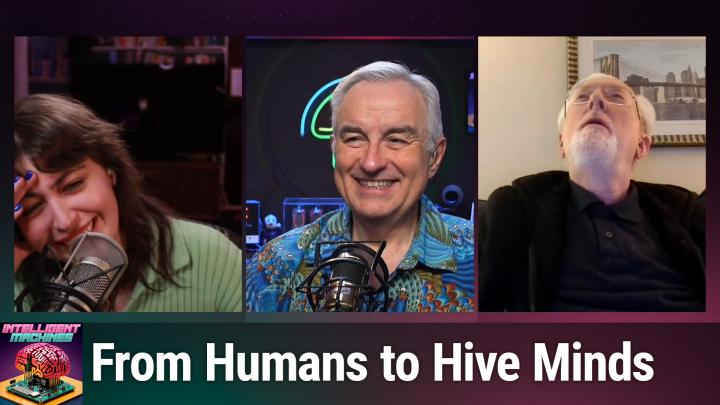
All TWiT.tv Shows (Audio)
Intelligent Machines 856: SecretlyBriti.sh
02:45:19
From Humans to Hive Minds
Loading summary
Transcript1,027 lines
- [00:00]
A
It's time for Intelligent Machines. We're going to talk to Steve Yegi this week. He is the author of one of the coolest Claude code add ons, Gastown. We'll talk about AI memory, how to get your AI coder to go farther, and what polecats have to do with deacons and mayors. Next on Intelligent Machines, podcasts you love from people you trust. This is Twit. This is Intelligent Machines with Paris Martineau and Jeff Jarvis. Episode 856, recorded Wednesday, February 4, 2026. Secretly British. It's time for Intelligent Machines, the show. We cover the latest AI news, robotics. We talk about smart people and smart things all around you. And I am so pleased to welcome our very smart team, Paris Martineau, investigative reporter for Consumer Reports. Salute.
- [01:01]
B
I'm here and ready to podcast and.
- [01:05]
A
I think you just saw the Melania movie and you probably want to give us your review.
- [01:09]
C
Oh, my.
- [01:10]
B
I was there. Well, I tried to be there, but, you know, it was just sold out.
- [01:15]
A
No room in the inn for Paris Martineau. Oh, well, we'll have to hold that review for later. Also with us, professor of journalistic Innovation emeritus at the Craig Newmark Graduate School of Journalism at the City University of New York.
- [01:29]
B
Newmark. It's back.
- [01:32]
A
And he's a adjunct something or other at Montclair State and of course at SUNY Stony Brook. Author of the Gutenberg Parenthesis. What would Google do? I should bring that up this time because we have a Googler on the line with us. Former Googler and the Gutenberg Parenthesis and magazine. That's the one.
- [01:51]
C
And hot type coming up.
- [01:52]
A
And Hot type. Any day now. Well, June 11th, any month now. Sometime this year.
- [01:58]
C
Publishing.
- [02:00]
A
So if you, if you're paying attention to AI, you know, it's. We're in a very different world. In the last few weeks, we've talked a lot about Claude Code. Clawbot. Nay. No, I'm Open Claw. Nay. Claude Bot. Nay. Moltbot. There's another something like that.
- [02:24]
C
The neigh is the opposite. The neigh is what you were, not what you are.
- [02:28]
A
It was neigh. Open Claw. No, it was neigh. Claudebot. Ne Maltbot. Now Open Claw. Yes, it's maiden name.
- [02:37]
C
Very confusing.
- [02:38]
A
It was claudebot, but Anthropic didn't like that so much. But today we're gonna talk about, I think, a project of equal interest with its author, Steve Yegi. Steve's worked around a little bit. You were at Amazon, you were at Google. You're the author of the very famous Memo we talked a lot about. Can it be now, 14 years ago?
- [03:05]
B
15 in a way. Right.
- [03:06]
A
Holy cow.
- [03:07]
B
October 2011.
- [03:09]
A
Steven wrote that piece that we talked about that kind of leaked out about Google and how Google had failed us. And we agreed. Steven, I just want to say. We agreed. So were you a Google engineer? Was that your.
- [03:22]
D
No, no, no. I was, I think in cloud at the time.
- [03:25]
A
Okay. And what do you do now for a living?
- [03:32]
D
That's a trick question. Yeah, I don't. I don't do anything right now.
- [03:38]
A
You have a great medium that I adore, human stories and ideas. Stephen's a very good writer. And your story about Gastown, the future of coding agents, which came out earlier, about a month ago now. You launched Gastown on January 1, New Year's Day, 2026. I install it shortly thereafter. Even though on your graph of the types of vibe coders, I am really only in a stage five. This is how coding has evolved. We are now in the post YOLO phase. I was watching a vibe coder, I think it was George Hotz actually, who said, we are now. Forget security, just YOLO, everything. That was with regard to OpenClaw, of course. But you have written something that really goes to figure 8, the 8 stage of programming where you have a team. All of this within Claude code. That's what Gastown is. And I love the roles that you've come up with. Gastown. But before we go too much into this, we should probably reiterate your caution. This is not for everyone.
- [05:04]
B
And if you want to know how not for everyone it is, just peruse the text size on his medium post, which will stop you in your tracks.
- [05:17]
A
Has that changed in a month or is it more suitable for general public?
- [05:24]
D
You know, no, don't touch it or you'll die. It's still there.
- [05:30]
A
However, that does not stop anybody, does it?
- [05:32]
D
It hasn't stopped at anyone. Right. And we've got like 500 people on the discord now, you know, and we're going to federate the gas towns together into a wasteland. So I'm going to have 500 gas towns in this huge wasteland, all working together to build something massive. It's going to be really fun.
- [05:46]
B
Let's take a step back. For anyone who's living under a rock, what is Gastown and where did it originate from?
- [05:54]
D
I mean, in short, it's cloud code running cloud code. It's agents running agents. Right? Which kind of turns it into a factory. And you're sort of managing a team. And I knew that this year would be the year of orchestrating. I told everybody it would be. And so that's why I launched symbolically on January 1st. Right. There's going to be so many orchestrators, you're going to see lots and lots, but they're all roughly the same footprint, which is you have an agent that you work with, then goes and runs others for you, and you can get lots of work done that way. But it's all AIs writing the code that you're not. So a lot of people are pretty scared about it for good reason. And it's also. It's really not very safe right now. I'm operating in a place where I'm almost like a researcher right now. Right. And it's all fun and everything and people are actually finding real use cases for it in enterprise at Fortune 100 companies for Gastown, as junky as it is now. But I wouldn't use it.
- [06:47]
A
We are in an absolute revolutionary era. It's just hard to believe. And we're waiting because any minute now Anthropic is going to come out with a Sonnet 5. You probably have it already, right?
- [06:57]
D
No, but I knew it's going to land any day because I've been telling people for a week that it's going to end every day because the half life between their model drops has gone from four months at the beginning of last year to two months at the beginning of this year. And Opus 4.5 is two months old. So like they're due anyway.
- [07:11]
A
Remember, 24th, 2025 changed my life. 45 was so good. It was mind bending. But I should also.
- [07:20]
D
I think that the difference between the people who get it in AI today and the people who don't is whether you've used 45 or not.
- [07:27]
A
I would agree with you. I'm going to read you a little later. I'm going to read once you're gone. I'm embarrassed to read it in front of you. A conversation I had with Claude just a little while ago. And you know what's interesting about Claude Code is Claude 45 has a personality. Opus 45 has a personality. And it's not exactly sycophantic. It's not the chatgpt five two, you know, or what it was it four O kiss your ass kind of thing. It's kind of like your best buddy that you want to work with, you want to pair code with. It's fun and it codes really, really well. I should mention that Steve is the author of a book also about Vibe Coding, building production grade software with Genai chat agents and beyond. You co wrote that with Gene Kim, the author of the DevOps Handbook. And the foreword is by a guy named Dario Amode. I know that name from somewhere. Somewhere. When did this come out?
- [08:28]
D
It went to print in October.
- [08:30]
A
Things have changed a lot in three months.
- [08:34]
D
Yeah, so we wrote a book that wasn't actually going to be right until early this year.
- [08:38]
A
Smart. You skated to where the code was going. Yeah. So this, in a way, this is not, I mean, others have predicted this. It was, I guess, predictable. It seems to me that we are really in an era that people have wanted since the earliest days of personal computing. You know, the whole history of coding is higher and higher level languages, closer and closer to English. But now we really are just talking to our computers.
- [09:11]
D
And everyone's happy about it. Except the engineers.
- [09:14]
A
Yeah, the guys who learned, who learned fortran. They're not thrilled.
- [09:18]
D
They're mad.
- [09:19]
A
They're mad. You did gas down and go, is that your favorite?
- [09:24]
D
I think about it because I've never looked at the code, but yes, it was.
- [09:26]
A
You've never looked at the code?
- [09:30]
D
One of the instructions, if you were to look at it, it's pretty wild.
- [09:34]
A
One of the instructions I have in my Claude MD rules is Leo is always looking at the code in an ide, so make sure you do a good job. It's the only time, the one time I've lied to Claude is I'm not looking at the code.
- [09:48]
B
Do you think that that really changes something? Do you think it's, quote, not trying to do a good job? Unless that's there.
- [09:55]
A
Well, let me ask Steve, that's a great question. Does this tool obey your instructions? Does it know what you're asking for?
- [10:06]
D
Well, four or five is getting scarily smart at reasoning through very complicated situations, which is almost independent of coding. It makes it smart at everything. Right. That said, these things have a tendency to be about 80% right at anything that they tell you or anything that they produce. And so you've gone from using a rake to rake leaves to using a leaf blower and stuff blows around a little bit more until it converges on being correct.
- [10:32]
A
Let me read you just a little. There's so much good prose in your Gastown post. Gastown is a bit of a swamp thing right now. It sort of oozes rather than whirs. It does work and astonishingly fast, but it requires a lot of manual steering and course correction and sometimes you have to push it to finish. So that's important. People shouldn't assume that you're just going to push a button, you're going to one shot, the next, you know, flappy bird, and be done with it. It does require some interaction. In fact, I would submit it helps a lot to be a coder.
- [11:06]
D
Oh, yeah, yeah. It just makes you code. You just code faster with it. You're literally just coding faster. Everything you're doing is just kind of like as if you had a junior teammate who was working really fast and you're just reviewing what they're doing.
- [11:17]
A
Right.
- [11:17]
C
Because you have the logic of it, because you have the experience in understanding qa. I mean, what makes a coder better at vibe coding? I know it's an obvious question, but I'm curious for your answer.
- [11:30]
D
I think we are just being faced squarely head on with the notion that there are. There are two levels or two phases of software. There's construction and there's engineering. And people are holding on really hard to construction.
- [11:42]
A
Yeah, but we don't need to anymore, right?
- [11:46]
D
Engineering is still there. Everything you need to know. It taxes me harder than it did when I was writing the code by hand because I'm stuck with hard problems all day long. I don't get to just relax and.
- [11:55]
A
Code and think at a higher level. It makes sense because the computer understands how to talk to a computer. Right? I mean, it's its language. So what we're doing is thinking at a higher level in a human way. And then Claude is kind of interpreting that for the computer, which to me makes perfect sense, by the way. I realized that I liked you a lot when I read that you said you were happiest hand coding in any dialect of lisp.
- [12:24]
D
Oh, yeah.
- [12:25]
A
As everybody who listens to me drone on knows, I'm a lisp fanatic. A scheme fanatic, a common Lisp fanatic. I'm an SICP advocate. I'm a. You know, and so the fact that you did this in Go, or if you've done stuff in Typescript, and you like Kotlin, and so I forgive you all of that. But see, this is the important point. I'm not ever gonna stop writing hand coding in Common Lisp, because I love it. I enjoy it.
- [12:50]
D
Oh, yeah. I'll keep doing that for fun.
- [12:52]
A
Just for fun. But when I want a tool now, what I almost always do is I sit down with Claude code and let it go. So who should be. So I'll quickly give you a quick summary of Gastown. It is a colony. It's a town with Hierarchies of agents spinning off other agents, doing other things, working as a team. You have a mayor. You're above the mayor, though, right? The human is above the mayor. The mayor is Claude.
- [13:25]
D
You're the overseer.
- [13:27]
A
You're the.
- [13:28]
B
Very interesting. The different roles that you assigned.
- [13:31]
D
You know, it's funny.
- [13:33]
B
How'd you come up with those?
- [13:35]
D
Well, they.
- [13:36]
A
They.
- [13:36]
D
They evolve. It's funny. I should tell you Anthropic take on this, because I've talked.
- [13:40]
A
Oh, I'd love to.
- [13:41]
D
A bunch of teams, right? And this is, of course, off the record, just people inside of Anthropic. There's. But they are a hive mind. I'll be blogging about that soon.
- [13:50]
A
I bet they are.
- [13:52]
D
Not only are they a real hive mind, it operates very differently from all other companies, but that is a template for how I think most companies will become. But anyway, the hive mind kind of likes Gastown and thought it was fun, but they're also a little embarrassed by it because it exposes a lot of what they consider bugs in Opus 4. 5. They're not really bugs. It just was never trained to be a factory worker. And so Gastown has a bunch of workarounds, including many of the roles that I created that are just there to supervise and push it along. And in the next model drop, we won't need them. And half the Gastown rules will just evaporate.
- [14:24]
A
I almost feel like half of what we're doing now will evaporate as Claude code kind of absorbs it. You're already seeing, for instance, skills become kind of not necessarily the way to go. Maybe just take that skill and put it in the Claude md. You don't really need to. Claude will understand it. It doesn't need to make it a skill. That's my sense of it. It sounds like you feel like that, too, that it's evolving.
- [14:49]
C
It is.
- [14:50]
D
And they will be able to do more and more and more and more at inference time. But just remember, inference time is the most expensive time to do it because of context, right? And so they will always be delegating to tools, to offloaded CPUs and so on.
- [15:01]
A
This is the biggest issue in my mind. This is one of the biggest issues with all of these things, is they don't have a memory. And when their context gets filled up and you clear it out, they go, okay, now what do we do?
- [15:17]
D
So I'll tell you right now, Gastown may not live another three, four months. I don't know. Because they could come out with a clot that just does orchestration. Right, Right. What will remain. And the only important part of Gastown is beads. And the ledger, the work ledger, the knowledge graph. Your future work, your plans, your present work and your ledger of finished work. And nobody's thinking about that right now, but that's.
- [15:41]
A
So you started with beads. Before Gastown, there was beads. What is beads?
- [15:44]
D
Beads is like an issue tracker. It was me and Claude arguing for a long time about how we hated markdown. And finally I said I want issues and git. And it said, Well, I want SQL queries. And we like wrestled for 15 minutes and came up with beads. And within three hours I was realized I had discovered oil. Like something just magical had happened. Quad loves beads. So it is a tool for agents. And what it does, it gives them a memory.
- [16:10]
A
What do beads look like? Are they JSON files? Are they a marker?
- [16:14]
D
Currently they are JSON stuffed into SQLite. It's a horrible two tier implementation. I want to get it wanted. SQL, we're just like both, but there turns out there are databases that do this and I'm migrating beads to them. It'll happen like this weekend.
- [16:27]
A
What will you use?
- [16:29]
D
Adult Dolt is funny name. Yeah, it's a git database, so.
- [16:33]
A
Right.
- [16:34]
D
But basically it gives you. What it does is it takes all your work and it turns it into a little knowledge graph of issues, open and closed, whatever future present. And then that becomes federatable. Work now becomes this thing that you can like ship around to different agents. It's the basis for all the other. So when you said they're lacking in memory, that is the core problem.
- [16:53]
A
And beads solves that because that becomes.
- [16:55]
D
Their memory, their repository of it has a crummy implementation. Right. Which is why Anthropic didn't take it. Now two weeks ago they launched tasks and they said it's inspired by Steve Yeage's.
- [17:06]
A
Interesting.
- [17:06]
D
Right. But they didn't take it because I'm sure because they looked at the implementation was like, that's really janky. What they took was the task graph part of it. Yeah.
- [17:13]
A
You know, it's interesting though, because we don't. I think one of the upshots of all this is you don't look at implementation so much. You don't care about implementation so much.
- [17:21]
D
Well, you care about it. You don't look at it. You care a lot.
- [17:24]
A
You care that it works.
- [17:26]
D
No, no, no. You care about. You have to know. You have to have a mental model in your head of the entire system logging database. How observability how everything works. And whenever you see a feature that's not seem work the way it should, you should assume that the system is horribly broken because it probably is. And stop everything and dive in and ultra think about it. Right.
- [17:45]
A
Excellent.
- [17:47]
C
How do you fix those things? What kind of dialogue is that?
- [17:51]
D
It's exactly like if I had a really, really smart programmer working with me and I was like, okay, here's the situation. I want it to work like this. And I'm seeing this hypothesis, maybe this, but I don't know. Go figure it out. And Opus, you've seen Opus, it just goes and figures it out. So you treat every little problem as a four alarm like research project and you do that 500 times and then eventually your system will be very good. It will.
- [18:15]
A
This is from your emergency manual for which everybody should read after they read the Gastown manifesto.
- [18:22]
D
Yes. Which they're not going to use Gastown because it's dangerous.
- [18:26]
A
Because you're not going to use it. But if you were to use it. By the way, I feel the same way about OpenClops. I want.
- [18:33]
D
You should really not use that.
- [18:36]
B
You should really not use that.
- [18:39]
D
All of my friends are resetting their signal tokens and their phones and stuff because. Right. They're all exact. Don't even touch.
- [18:47]
A
No, I have a Mac Mini. And I said, I'm not going to buy a Mac Mini. I have a very high end Mac Mini. So I made a new account and I set up openclaw and I went through the whole thing and I gave it all of my Google credentials and I gave it a discord.
- [19:03]
B
We got to a point where Leo is texting the group and like, I guess I could give it a credit card too. And I'm not.
- [19:09]
A
I gave it a dollar five. No, I know Steve's bearings. But I got to tell you, Steve, this morning I woke up in a cold sweat. I deleted the entire account. I've reset all of the tokens. Yeah. Because it, I don't know, I just, it's terrifying. And I. And actually things started to happen that I was like, I don't like this. But Gastown's not on that level at all. Right. Gastown's just a tool to help you vibe code.
- [19:38]
D
That's right. Gastown at Gastown. So, right. The Molt book, or whatever it's called, prompts them and says, you are a lobster and they respond in kind. Right, Right. Whereas Gastown prompts them and says, you're a factory worker and we're doing very important work for humanity. And it's important that you do the way we tell you to. And so they behave themselves for the most part.
- [19:57]
A
This is the loophouse, the three rhythms of work. Can you just describe. This is. By the way, I love your illustrations. I'm sure they're. Is it Nano Banana? Probably.
- [20:06]
D
It's all Nano Banana. And the prompts were created by Claude code.
- [20:10]
A
Oh, that's nice. That's nice. You really operate at a higher level than all of that. You don't need to do the details there.
- [20:17]
D
Remember, I told some folks in Australia that I was going to launch Gastown in early December, and I told him I was going to launch on Christmas Day, and it was a race to get it to the end. So, yeah, Nano Banana was wonderful because I was just like, go, make me pictures.
- [20:31]
A
Yeah. There are three cadences. You've got your top floor. That's where the mayor lives. Right.
- [20:39]
D
Right. Which is like the Kubernetes control plane.
- [20:41]
A
Ah, that's a good. Okay, good. So the geeks will understand that a little bit better than the middle floor. Actually, the mayor's in the middle floor. So we got. You're up at the overseer in the top floor there. Mayor is. What's the mayor doing?
- [20:54]
D
Actually, you're the panda bear on the elevator.
- [20:56]
A
Oh, I am. I go up and down.
- [20:58]
D
Yeah. Top floor is probably the Deacon who watches the entire town.
- [21:02]
A
Okay. I love the names. They're from a. It's from a mixed bag of references.
- [21:08]
D
Yeah. I thought about going all in with Mad Max, and I thought, why invite some sort of a lawsuit? Right.
- [21:17]
A
So what are the other influences?
- [21:18]
D
Oh, my gosh. There's Cat's Cradle from Kurt vonnegut with Ice 9 stuff. There's the Deacon is Dennis Hopper's Waterworld character.
- [21:28]
A
I love it.
- [21:28]
D
Yeah. And Witness actually was from, you know, Mad Max.
- [21:31]
A
Right. And then on the ground floor, you got your pole cats. Where did the polecats come from? What's that all about?
- [21:37]
D
That's Mad Max. Those are the guys on the stilts. They were literally.
- [21:39]
A
Oh, the pole cats. Okay, that's. Yeah. Okay. They have a little aluminum paint on their face there. And then down here, the engine that drives the loop. And that's Claude, I guess.
- [21:53]
D
Yeah. And beads.
- [21:54]
A
And beads. So that's actually the piece of gas down that I'm most likely to keep using, actually, is beads. Can you use beads standalone?
- [22:04]
D
Absolutely. Beads can be used with any workflow.
- [22:07]
A
Okay.
- [22:07]
D
It's just. You just. And the nice thing is you just say, we're not using markdown we're using beads run, you know, BD prime. And you just put that in your one line in your thing.
- [22:16]
A
And then from that, slurp everything into it. Okay.
- [22:18]
D
You can say, yeah, just slurp everything in. And it'll just. From then on it'll just use it. It'll be totally. You'll just love it.
- [22:23]
A
Okay. The other tip that you have in your emergency user manual is use TMUX what's really cool about this and what I love about this. In fact, George Hotz was saying this. He's saying we've divided the world now into the kind of dumb people with the mouse and they click on the menu and the button and they do the buttons and. And we've got the smart people who are sitting at a terminal going, typing, or better yet, just talking into their terminal. The terminal's back, baby. I'm so happy about that.
- [22:56]
D
It is, but. Right. Multiplexing terminals is becoming really important and TMUX is pretty good at it. But if you look at like cloud cowork, which is also a terminal in a way. Right.
- [23:04]
A
Isn't that wild? It's a virtual machine and it's. Yeah.
- [23:07]
D
You could imagine a world where there is a very fancy ide, like terminal multiplexer. Yeah.
- [23:14]
A
Right, Right.
- [23:15]
D
So you can just make one for us.
- [23:17]
A
I actually think Emacs might be the end up.
- [23:21]
D
Well, yes, you and I know that, but I don't think we're going to pitch anyone else on it.
- [23:27]
A
Okay.
- [23:27]
B
May have been shouting from the rooftops about Emacs.
- [23:30]
A
Fine. Emacs is just perfect software.
- [23:32]
D
But imagine though, I mean, it's like fifth of my to do list, but I am going to have a great Gastown Emacs client.
- [23:39]
A
That's what I'm thinking. And I think. I think Claude code does pretty well in elisp. So. Yeah, yeah, I've had it been. Half of my Emacs config now is done by Claude code.
- [23:50]
D
Only half?
- [23:52]
A
I'm slow. I told you, I'm only level four here. Give me a break. We're talking to Steve Yegi. He's the guy, if you remember the name. It's so funny because I'm thinking, I know Guy and I know this name. Back in 2011, wrote the memo about Google that accidentally leaked. Was it really an accident?
- [24:11]
D
Yes. I was very drunk and the interface was actually very hard to use.
- [24:15]
A
Yeah.
- [24:18]
C
What was the reaction at the time inside Google when that got out?
- [24:22]
D
Oh my gosh, it was pretty intense. You know Vic and Dotra, the guy who Headed up. Google wanted me dead.
- [24:29]
A
That was his baby. He was like. In fact, as soon as Google was over, so was Vic.
- [24:35]
D
I'll tell you guys something. That rant that went out the platform one was part two of an 11 part series that I had planned out. Had already published this one internally. Not many people know this. I was mad at Google in nine different ways and there was an intro and a finale. So I had nine different dimensions that I was going to smack them down on. Platforms was only one, but that one accidentally got out and that was the end of that series.
- [25:00]
A
You wrote Google is a prime example of our Google where you were working at the time. Complete failure to understand platforms of the very highest level of executive leadership. Hi Larry, Sergey, Eric, Vic. Howdy, howdy. Down to the very lowest LEAF workers. Hey yo. We all don't get it now. Here we are 15 years later. Is Google improved?
- [25:24]
D
Yeah, amusingly Google has kind of gotten it less than everybody else. It really was anti platform baked in from the beginning. Yeah, Google is executing a lot better. Like now. Now as in like the last year. But it took a long time.
- [25:39]
A
It took them a long time. I had written them off. In fact we changed the show from week in Google back in last year, early last year. But Gemini, especially the Gemini 3 kind of changed my mind on all of this. Is Google poised to do a Claude code kind of thing? We've got Codex from OpenAI.
- [25:59]
D
I hope so, man. I don't want us all to be dependent on one model.
- [26:02]
A
No.
- [26:03]
B
Why is. Why do you guys think Claude code is so dominant in the CLI space?
- [26:09]
A
It's the best.
- [26:09]
B
Yeah, but why? Why can no one else create anything equal?
- [26:14]
C
What motivated them to go this way?
- [26:17]
D
I don't even know if they know, but I mean I suspect it's their relentless focus on coding which has forced it to become more and more logical kind of quickly than the other ones.
- [26:26]
A
Instead of doing the chat bot, I.
- [26:27]
D
Mean they have a chatbot, but I don't know.
- [26:30]
A
I don't know.
- [26:30]
D
I'm not an AI guy. I just. You can just tell that it's pulling ahead. I think that and it's their self reinforcing loop. They're getting better programmers and better signal and better training data and so they're just, they're accelerating and that worries me because that becomes a more pronounced lead over time. I really want some other model providers to catch up.
- [26:50]
A
Can you use Gastown with open weight models?
- [26:53]
D
Can you use it with Kimi? No, it dissolves into a pile of goo Right. Remember, I wrote it for Opus 5 and we gave it to Opus 4:5. And now we've got all these hacks. Right, Right.
- [27:04]
A
Okay. All right.
- [27:05]
B
Have you played around much with codecs or other things?
- [27:09]
A
Anti gravity?
- [27:10]
D
I'm going to go back to what I said at the very beginning of the show, which is that like 45 was like. Like an event horizon, a singularity. Right. Everything before it. And if you're using anything other than it, you're just in old AI land making conclusions about stuff that's not true anymore. Right. A 45 just completely changed it.
- [27:29]
A
I've been wanting to say that, but I didn't have the courage and the confidence that you do.
- [27:35]
D
Well, hey. And the confidence comes from me trying to do stuff that was just too hard. And so I know exactly how they fail and fall on their faces. And, you know, 45 was the first one. The first one to be like, it could finally do it, you know.
- [27:47]
A
Yeah, exactly. I had played with it. I've been playing with it for, you know, since I guess 35 came out and there was just a qualitative leap.
- [27:57]
D
It was as big as the 4.0 GPT. 4.0, remember that?
- [28:00]
A
Yeah.
- [28:00]
D
That one was the first one that could do a thousand line source file and make a pinpoint edit to it without screwing up all the formatting or other mistakes.
- [28:07]
A
Right.
- [28:08]
D
And that was the moment because most of the world's code is in files that are a thousand lines or less. And so that was a huge breakthrough, 4.0. But I don't think that we had the next major breakthrough until Sonnet 3. Maybe 7 or 3.5 is a big, big, big step. Function up. And then 4. 5 was the next big one. Right. A lot of incrementals, but 4.5 was a really big step.
- [28:27]
A
Here's. Here's what it looks like, by the way. To use Gastown, you're the mayor, rather the overseer, the panda bear. And you've got all your little guys working designing, coding, debugging, reviewing. Now it can get into weird loops where it, you know, it's just kind of. It's a little bit of a house of cards. And if one thing goes wrong, it can all. It can all collapse in some interesting ways. But the beauty of this, this is what Harper Reed has told us again and again, is you just throw it out and start over. It's cheap. Do you have. What is your token budget these days? You burn through tokens.
- [29:07]
D
Yeah, I'm not going as crazy as a lot of People. I mean, I know there's people that are spending thousands and thousands a month. You know, I'm burning about 12 to 1400amonth, I think. But that's, that's, that's, that's because I keep going through bottlenecks where I'm. I'm only using one or two agents at a time for days because of the dolt migration and other stuff going on. You know how work can sometimes be parallel and sometimes surreal.
- [29:29]
A
Yeah.
- [29:29]
D
So once I get to the federating the wastelands, thank goodness there's a bunch of big companies who are giving me influencer token budgets because I'm going to be spending a lot of money taking us to the next. I'm going to go into the next frontier, which is what happens when you have. When you're trying to have multiple towns where a town represents like a person. Right. With a team. How do you do work at that scale?
- [29:53]
A
You really only have one Claude code and you've just subletting little.
- [29:59]
D
I actually work with. I tend to work with three at once.
- [30:02]
A
Oh, you do? Okay.
- [30:03]
D
My personal workflow is mayor and two crew. Okay. And I actually have eight crew in each rig. Beads and Gastown. And they. But I have two crew that I designate as my sheriffs. All right. It's not an official thing, but I have a special bead for them. And when they wake up, they go and do they? Do they look at PRs. See, I'm maintaining these projects by myself and I'm getting like 50 PRs a day or more. And I stay on top of them by like, are these generated AI generated.
- [30:29]
A
PRs or from humans?
- [30:30]
D
They're all familiar, man. Gastown's L. AI a human would never generate a PR for us. That's not true. There's one company dolt that's actually doing it. You know, Bless him.
- [30:40]
A
Okay. Okay, so. And how do you manage three different claws? Do you have three computers or do you have it all on one system? They're sharing beads, I presume.
- [30:49]
D
So it's tmux, obviously. Right. So I'll just fire up terminals like in different colors.
- [30:53]
A
That's why you have tmux.
- [30:54]
D
Okay, yeah, but I have TMUX groups that cycle along the crew. So I will farm out a bunch of design problems to crew, say, go, give me deep research and give me recommendations. And the one at a time, I cycle through and read their recommendations. I feel like Jeff Bezos. Right. He gets presentations all day long from smart people who are giving them hard problems. Right. It's really actually quite exhausting working with Gastown because you're making your workers go off and take care of all the hard stuff and then they give you the hard problems. Right? They do the easy.
- [31:20]
A
The problem is they're fast and humans are slow.
- [31:22]
D
Yeah.
- [31:23]
B
And you.
- [31:23]
D
Well, you will always reach an equilibrium if you're working with multiple agents where there's always one waiting for you.
- [31:29]
A
Right. There's always something to do.
- [31:31]
D
It's madness. I actually think that there's a vampiric effect happening. I think that there's something bad happening. No, no, no, Seriously, people are getting drained. And I think that people like me are actually contributing to the problem because we're creating this appearance of super hyper productivity that's becoming a bar that people are setting. We're trying to live up to you, which is ridiculous. And my next blog post is going to be about slowing down and capturing some of the value from AI for yourself. Because if you're, let's say you're 10 times as productive with AI, you can work eight hours a day and give all that to your employer and they've captured 100% of the value. Or you can work for a half hour a day and be as productive as your peers, in which case you've captured 100% of the value. I think that the middle is going to. Right. The happy medium is going to be the right answer, but the company will always try to extract it all from you.
- [32:20]
A
Is that what this latest post, the Software Survival post, is kind of about?
- [32:24]
D
No, no. I liked all my posts to be about different things, but yeah, that one's just. Seriously, the next post I described is people just pushing back on companies, trying to push them too hard. With AI specifically, this is going to be a real problem. The software Survival post was how to write something that's not going to die.
- [32:40]
A
Right.
- [32:43]
C
Steve, at the beginning you talked about the danger of this. Your caveat is well set. But I'm curious for you to define that danger a little bit and at a very high level. What starts to eliminate the danger? Is it things have to be within one company, within one hard boss. I mean, what is. What is. Because the last few weeks have shown tremendous excitement about this. Finally the agents arrive and do things and people are playing. And I think the playing is good, but the playing is dangerous. Where do you see that going?
- [33:19]
D
We're hitting the biggest innovators dilemma that we've ever seen before, where companies are going to. All companies are going to have to pivot very quickly. And the ones that are siloed and have old crusty organizations that don't work well together and so on are just going to. They're going to break if they can't bend. The danger is that with this hyper productivity because people are figuring out how to use it and bring it into the org it immediately in the manufacturing Toyota plant since it immediately pushes all your bottlenecks downstream. So like, you know, right now my advice to companies is just start. Like Tommy Wiseau told that guy on X, he's like, I want to start writing screenplays, Tommy, what should I do? And Tommy's like, start, right.
- [33:58]
A
Did not hit her. I did not tell God.
- [34:02]
D
So just get started on it because you're going to have a lot of lessons to learn that are bespoke for your company. And you got to get on that now.
- [34:09]
A
Okay. Not a lot of people quote screenwriting advice from Tommy Wiseau. I think you get a lot of credit, a lot of credit for that. Hey, can I just ask you, do you have a eight foot screen? Tell me about your setup just a little bit. I mean, this is just a tourist question, by the way.
- [34:24]
D
Oh, I have this LG Giant 45 inch curved monitor. It's a 5K 2K bent. It is so cool. And I have terminals splattered all across it. It looks seriously, it looks like Minority Report or whatever that movie was with Tom Cruise. Yeah, we're in a new people. I showed it to like, I showed it to like, you know, my buddy Kent Beck, you know, who's, who hasn't quite flipped on this yet yesterday. And he's like, this scares me. When he was watching me do the crew, you know, it's just Kent is.
- [34:53]
A
Of the old school. Kent is that, you know, the agile guy that the old school guy. It's really interesting, you know, I wonder how people like that are going to adjust to that. Some of them will be. And I bet Ken will do this, I don't know, will go, yes, this is the next thing. And some will resist it and say, no, no, you can never write good code this way.
- [35:11]
D
I mean, look, Kent is just being. Kent is very, very, you know, he's doing the smart thing, right? He's like, he's onboarding. He has definitely drunk the Kool Aid. He's using Claude code all day long and he codes his ass off. But Gastown he finds a little scary for, I think, good reasons. I'm telling people to find it scary. Yeah. But you know, one company, I mean a big Fortune 50 company, a big company Came to me and said they're using G for their stuff. And I'm like, whoa, are you mad? And he's like, they found some use cases for which it actually works and it can speed up tremendously. Their ability to roll out custom data centers and do other things. It's nuts. It's nuts. People are finding use cases for it.
- [35:51]
A
Do you need. What hardware, what computer do you use? Do you need a heavy duty computer to do this? Or is Claude doing really all the work on the server?
- [35:58]
D
I'm going to be doing all my Gastown work on my phone before too long.
- [36:06]
C
Actually.
- [36:06]
A
That's the main thing. I wanted Clawbot for a claw, whatever open claw for was, so that I just could talk to it on my phone so I wouldn't have to come into the office in that time. So that's my real goal. I don't care about anything else. I might just set up, Set up. I'll probably set up a little discord.
- [36:22]
B
You can talk to Claude on your phone, Leo. You realize that. You realize they have an app, right?
- [36:28]
A
No, no, no. That's not the same thing at all. No, no, no. I want to be able to talk to Claude. Code.
- [36:34]
D
He wants. Ssh.
- [36:35]
B
Yeah, you need to be talking to Claude Cohen away from your house.
- [36:40]
A
Yes. Because. Yes. Do you just hear him? You've constantly got something to do. You're very busy.
- [36:47]
D
Haven't you ever woken up in the middle of the night and wanted to tell Claude something? Yes.
- [36:51]
B
You could just open up a laptop. You're in bed. You have access to electronics.
- [36:56]
A
This is, by the way, a form of burnout that I do see happening a lot. People are having trouble sleeping. We are so excited about what's happening. Right. We're in a very interesting time. Stephen Yegi, it's such a great honor to get you on. I really appreciate what you've done with beads with Gastown. Thank you for doing that work and thinking out of the box and continuing to do it. And I hope you continue to do it. People should read Stephen's posts on Medium. They're worth it just for the prose. Great writer. Steven Yegi, Medium. He's a little too busy to have a good URL. I'm just saying, Stephen. Y E G G E Medium dot com. I appreciate your time, Stephen. It's really great to talk to you. And by the way, best backdrop ever. Is that. That's real, isn't it? Ha.
- [37:49]
D
No, it's a green screen.
- [37:50]
A
Oh, damn it.
- [37:50]
B
I'd say it's very clearly a Green screen.
- [37:53]
A
You fooled me. It looks good.
- [37:55]
E
Cheers.
- [37:55]
A
You lived in the basement. Thank you, Steve.
- [37:57]
D
Thanks for having me.
- [37:58]
A
Thanks. Bye. Bye. Thank you, everybody. Try Gastown. Such an honor to talk to him. I knew I knew that name.
- [38:08]
B
That's so funny.
- [38:09]
A
Isn't that hysterical?
- [38:11]
B
I love that. It was a 3,700 word drunk blog post that leaked.
- [38:16]
C
And then objectively, one of The Funniest.
- [38:19]
B
Form Part 2 of 12. Objectively 1 of the funniest formats to drunkenly leak.
- [38:26]
A
He's quite a character. And what. And you know what a great writer. I really enjoy reading his posts. They're really good.
- [38:32]
E
I'd like to see the other 11. That'd be fun.
- [38:34]
B
I was about to say, I can't believe it took us this long to get an Emax guy on the show.
- [38:39]
A
Finally. Emacs and lisp, baby. I didn't even know it. I didn't even know it. I just wanted.
- [38:45]
B
That's one of the first things that jumped out to me when reading his.
- [38:50]
A
Yeah. Yeah. Well, you know, it's funny. I've been thinking and I understand now. When he said hive mind anthropic, that completely clicked for me because it is. There is something going on where the people who get it, we're in this kind of weird, liminal space and others who don't get it, we just. We're drifting apart. We're drifting apart. I wish I weren't so old. I just would love. You know, I wanted us to hang out with Harper Reed and. And just kind of.
- [39:21]
C
Oh.
- [39:22]
A
Anyway, we gotta take a break. Believe it or not. And then when we come back, there is so much AI news. My new Vibe coded tool generated a lot of stories.
- [39:35]
C
Oh, did it ever.
- [39:37]
A
A lot of stories. I don't know if we're gonna get too much.
- [39:39]
B
It feels like I'm looking at the Jeff section over here.
- [39:44]
A
This is the. I gotta. Sorry, I'll cut it down. I gotta cut it down because we don't. Yeah. Anyway.
- [39:49]
B
Anyway.
- [39:50]
A
More with Paris and Jeff in just a moment. Our show today brought to you by. Delete me. If you've ever wondered how much of your personal data is out there on the Internet for you to see, you don't even have to run Clawbot to put that stuff out there. Because guess what? There are people who are collecting it. We call them data brokers. And what they do is legal. What they do is perfectly fine, according to Feds. That you may not like it so much when you go out there and you see your name, your contact info, your Social Security number, your home address, even information about your family members. And the worst thing is, not only are they compiling it, they're selling it online to anybody who wants it. Foreign governments, our government, law enforcement, marketers, hackers, anyone on the web could buy your private details. And just I mean the consequences. Identity theft, phishing attempts, doxing and harassment. There is a way to get your data out of these data brokers. They're required by law, if you ask them to take it out, to get rid of it. But there's a little problem here. First of all, there's more than 500 of them. And every one of them hides that form somewhere on their site. It's not easy to find. Plus there's the problem that new ones start every day because it's such a lucrative business. And then finally, the truth of it is, even if you get them to delete the stuff, they're just going to start over and rebuild your portfolio, your dossier. Nothing to stop them from doing it. Except Delete me. Very important. But Delete Me is a subscription service. So you know, it's not a one time deal. It removes your personal info from those hundreds of data brokers you sign up. You give Delete me exactly the data you want removed. That's important because you know, you don't want them necessarily to wipe your presence off the net. You just want certain things deleted from those brokers. Then they're experts and this is their business. They do this 24 7. They know where all the sites are, where all the forms are. They take it from there. They will send you regular personalized privacy reports showing what they found, where they found it, what they remove. So you know, they're doing their job. And then this is the key. It's not a one time service. They're going to continue to monitor and remove that personal information you don't want on the Internet. It's the only way to do it. To put it simply, Delete me does all the hard work you could. I'm not saying you couldn't do it. You could, you wouldn't want it. It'd be a full time job. Let them do it. The hard work of wiping you, your family, your businesses, your employees, personal information from those data broker websites. We did this. We had to. We were getting phished. Any company should absolutely be doing this for management at very least. Otherwise you're guaranteed they're gonna start phishing you with information they buy from data brokers, take control of your data, keep your private life private. Sign up for Deleteme We've got a special discount for our listeners today. 20% off your DeleteMe individual plan when you go to JoinDeleteMe.com TWIT and use the promo code TWIT at checkout. The only way to get 20% off though is to go to this website and this website. Exactly. Joindeleteme.com TWIT There are, there's other sites you gotta go to the right one. Joindeleteme.com TWiT and do enter the offer code TWiT at checkout. 20% off joindeleteme.com twit the offer code is TWiT. Thank them so much for the job they do and the support they give us. And we appreciate it because it helps us do our job.
- [43:23]
B
Okay, not to stump for advertising, but I will concur. It's really hard to find the right button to get your name off.
- [43:30]
A
Oh yeah, good luck. Let's go to one and try.
- [43:32]
B
I go to. I, I do all of this myself because I'm always one trying to delete my own stuff from the Internet. But I'm also then using those same tools to maybe find other people's contact. They make it really impossible.
- [43:46]
A
It is kind of a boon for you as a result reporter though, isn't it? You can easily find anything you need. What's their home phone number?
- [43:52]
B
I mean, yeah, most people's information is out there like in one of two data brokers always. It's ridiculous.
- [43:59]
A
One thing we should start before we get to the AI thing. Massive layoffs at the Washington Post. And I know you both are journalists and care a lot about this. I was shocked. Jeffrey Fowler, who's their tech, very esteemed technology reporter, was one of the laid off.
- [44:13]
B
Natasha, one of the best tech reporters out there, was also gone. She literally has a story published today on the front page of the Wall street of the Washington Post about kind of inside Elon Musk's attempts to kind of rework Grok and change X. She's a phenomenal journalist. There's so many phenomenal journalists. Hundreds of journalists who've lost their jobs, they shut down their sports section, basically have axed almost all of their international coverage. Books is gone. Metro is being reorged.
- [44:46]
A
Is this because Jeff Bezos is running out of money?
- [44:50]
B
Ostensibly it's because the Washington Post is not profitable, but, well, he must have.
- [44:55]
A
Known that when he bought it.
- [44:57]
C
Well, I know Will Lewis, who's the publisher. He was sent in. He's a Murdochean. He was sent in to be the tough guy and you know, get it down to a shape and it's going to be a meaningless. Also it already is a zombie newspaper and it's going to be meaningless and also ran and not part of the conversation, but harmless to certain people in power. I, I put in the discord, Leo, the Marty Baron who was the brilliant editor of the Post. I think the best editor in America. His statement today was very strong.
- [45:35]
A
What did he say?
- [45:37]
C
He said that, sorry, I gotta go back to it now. This ranks among the darkest days in the history of one of the world's great news organizations. He said, of course there are acute business problems to be solved. No one will deny that the Post challenges, however, were made infinitely worse by ill conceived decisions that came from the very top. From a gutless order to kill a presidential endorsement 11 days before the 2024 election to a remake of the editorial page that now stands out only for its moral infinity infirmity. Loyal readers, livid as they saw Jeff owner Jeff Bezos, betraying the values he was supposed to uphold, fled the Post. In truth, they were driven away by the hundreds of thousands.
- [46:22]
A
Yeah, I canceled my subscription. It's hard because. Well, now it's easy. It was hard because they did have good tech coverage and we, you know, we were often referring to their article. But they won't anymore.
- [46:33]
B
So I guess they've basically, I mean, from what I, I've seen online, it seems like they're almost shuttering their SF bureau. The cuts are that deep.
- [46:41]
A
Wow.
- [46:41]
B
Which is.
- [46:42]
C
The correspondent in Ukraine was laid off.
- [46:45]
B
I mean, yeah, a foreign correspondent for the cuts have really decimated all of their international coverage. And one of their foreign correspondents is literally reporting like in the. In out in Ukraine, doing filing reports from her car. And that's when she got the call that she was being let go.
- [47:05]
A
Well, I mean, clearly they're just kind of giving up on being a newspaper. Right? Or a news source. I don't know what they're going to be, but they're not going to be a newspaper. They're not going to be a.
- [47:12]
C
They used to have a magnificent book section. Ron Charles and Becca Rothfeld are, to me, two of the finest book critics in the country. They're now laid off. The whole section's gone. Styles basically gone. It's been a shell of itself. I asked a former very top editor there, not Marty, what now? Three years ago, whether it could be saved. And he said at that point, no, it was a lost cause.
- [47:38]
A
Then such an opportunity because it's the Washington D.C. newspaper. So, you know, you're in the. In the seat of government of the most powerful. Yeah.
- [47:49]
C
You know, it was fascinating, Leo, the fight that went on over and over and over again inside the Post is that Don Graham, a beloved, saintly man who read the Post, believed that the Post had to be the paper of Washington D.C. the local newspaper, the metro newspaper. And when online came along and others said, well, no, it's our opportunity to really.
- [48:11]
A
It's a national. It could be a national. Like the New York Times.
- [48:13]
C
National, international paper.
- [48:14]
A
Yeah.
- [48:15]
C
And they, they fought and fought and fought. Never came to a conclusion.
- [48:20]
A
This is really just the end of the newspapers. I mean, honestly, there's. There's. That's really what's going on, right?
- [48:26]
C
That's what's.
- [48:26]
A
They're not important, you know.
- [48:28]
C
Similarly, the LA Times, way back in the day used to think it could be a national newspaper. It ignored its amazing city. It has now a penetration of 4% in an incredible metropolis.
- [48:39]
A
What replaces it?
- [48:41]
C
Chaos at first. But then I think a lot of independent media rethought, you know, in. And pardon me for this plug in hot type out in June 11th. I talk about how at the turn of the prior century, it wasn't clear what medium would win and what where it would stand in the media universe. Magazines, books and newspapers all fought for the same territory. Newspapers became the vacuum of culture and they competed with magazines for a much lower price. Then they added magazines in magazines, trying to figure out how to structure themselves. And they were doing books and books were scared of magazines and they all went around. And so what I think happens now is that probably magazines and newspapers as we knew them were dead. Books live on. And then we have all these podcasts.
- [49:35]
A
Who's buying books?
- [49:36]
C
Well, books have never been.
- [49:38]
A
Oh, that's right. They live on. Because they were always kind of.
- [49:42]
C
They're small. Yeah, they're small. And I think that's. Well, I think that's key to possible survival.
- [49:47]
A
Right.
- [49:47]
C
Is media at a human scale, like, seriously like this? I think podcasts, newsletters, AI things, collaborative networks, things we haven't seen, invented yet, will. Will claw for, pardon me, for the use of the word, a position in a new media ecosystem. And I'll probably. I'm probably too old to see how that turns out. In fact, I'm sure I am.
- [50:13]
A
Well, I'm sure this is of some interest to Paris, being a journalist, being.
- [50:20]
B
A thrice laid off journalist. Yes, it does.
- [50:22]
A
I mean, I think you found a home at one of the magazines that's Going to survive. The only ones.
- [50:28]
C
But Paris, when you decided to be a journalist, did your parents say, are you knocking futs?
- [50:32]
B
I said to myself, are you knocking? I said. I was like, this is a bad. To myself, I was like, this is a bad idea. It's probably not going to work. This is an industry that's already been dying and will only continue to die at a more aggressive rate as I enter it. And so I gave myself five years to see if I could make it work. Otherwise I'd go to law school. But it worked, or has so far.
- [50:55]
A
Is law school. How many years ago was that in the cards?
- [50:59]
B
A little over 10, I guess it was like 11 years ago.
- [51:01]
A
Oh, a long time ago. Brahma. So law school's out now?
- [51:05]
B
Yeah. I mean, I was talking to a friend yesterday who's halfway through their law school program, and I was like, I don't know. Will we even have laws in two years when you.
- [51:16]
A
You know, it's actually, actually interesting because the stock market has punished a lot of the legal software companies. This was a very big crash last couple of days because the stock market was looking at things like vibe coding, like Claude and saying, you know What? Why would LexisNexis, why would Westlaw, why would any of these, why would Thompson, why would everybody.
- [51:45]
B
It's baffling to me because LexisNexis and Westlaw have, and I assume the other ones have access to a lot of stuff. The reason you pay is the things they have access to.
- [51:56]
A
Maybe it's search them and their databases, but their software, that they also add.
- [52:03]
C
A level of value in organizing and categorizing and that added value goes away.
- [52:09]
A
This is the story for Bloomberg. Anthropic AI tools spark sell off from software to broader markets, but in particular legal services.
- [52:20]
C
Give me examples of the companies in that story. I think to Paris's point, no, because.
- [52:24]
B
I believe that those were the right ones. But I just remember when I read.
- [52:27]
A
That I was Thomson Reuters and LegalZoom, the worst performers in the US and Canada. LegalZoom provides. LegalZoom probably is in trouble. Longtime advertiser on the radio show. I like LegalZoom, but in fact I used them to incorporate twit back in the day and so forth. But now you would probably write all those documents with the help of an AI.
- [52:46]
B
What does LegalZoom do?
- [52:48]
A
They. They help you make a will, they help you incorporate. They do all the legal. It's basically like a paralegal.
- [52:55]
C
It's not a law. They replace the lawyer. And now they get replaced. Yeah but Leo, here's what I don't understand about this, this route. The I understand why the legal companies go down because its belief is they can be replaced by vibe coding, cowork and so on. What I don't understand is why there was a route in the software market. Isn't this the victory of software in the end or is the belief that software kills software now?
- [53:21]
A
Well, when you say software that's like anything that runs on a computer. They're talking about companies that make business line of business packages that they sell to.
- [53:35]
C
There's a general tech sell off from this same spark.
- [53:39]
A
Well this is what the question is. We were talking about this on Windows Weekly because Microsoft had a big sell off last week and the conventional wisdom was that people looked at Microsoft's results which were very good, but saw that they were spending like almost $100 billion a year developing AI data centers without any kind of profit at the end of the tunnel. And the market said that's not a long term future. So that was the consensus at the time. I think the market was also looking at the fact that Microsoft's business is selling software as well. On the other hand, Microsoft's biggest business as is Amazon's in some degrees Google is data centers and that's gotta be in the long run benefited by the AI boom. So I don't know. The sell off started. Traders pointed to a release on the Anthropic website as the reason behind steep declines in the shares of credit marketing services company Experian Business and legal software maker Relx PLC and the London Stock Exchange Group plc. Asian stocks also slid. This is from Bloomberg. Tata Bellwether Tata Consultancy sank 6% Infosys 7% Cloud Account Cloud accounting software maker 0,16% In Australian trading the most such 2013 now the stock market makes mistakes. I asked this, what are you talking about?
- [55:02]
B
The stock market's perfect and is on Sunday.
- [55:05]
A
I was asking this on Sunday on Twitter. Used to be we would say well the stock market is the wisdom of the crowds and the stock market. In fact in James Surawecki's book the Wisdom of the Crowds he pointed to the fact that after the Challenger disaster. What is that now? 40 exactly 40 years ago the shares of the company that made the O rings dropped precipitously on the stock market market before anyone knew that that's what had caused the explosion. And Surowiecki said the market some the wisdom of the crowd somehow because it's so many brains working together somehow can know, so there is this, I don't know, there is this thought that the market can kind of reflect the economy. Maybe that's.
- [55:52]
B
Yeah, that's why Tesla is valued so accurately.
- [55:55]
A
I think maybe that's the problem now.
- [55:57]
B
Is that's why social and Internet has change.
- [56:00]
A
That means.
- [56:01]
B
And hers are a real great investment.
- [56:05]
A
But I think individual stocks don't reflect that as well as the stock market as a whole.
- [56:10]
C
Or I just put in the, the chat, Google analysis results jumped 30% but they're increasing their capital spending just like $35 billion.
- [56:26]
A
Everybody understands that this AI boom is going to cost these companies a lot of money. And the question the market asks is, is there money at the end of that?
- [56:37]
B
I think that's a reasonable question to ask and I think it's also a reasonable question to maybe try and scrutinize a bit like, does the market have the cap capability? If this ends up being, I guess, best case scenario, like an Uber situation where it takes a really long time for them to eke out kind of meager returns, turns, is that valuable?
- [56:56]
A
Well, and that brings us to Elon Musk.
- [57:01]
B
You said that as if there was going to be a transition, sort of like, like a little graphic that Andrew Anthony had put together.
- [57:09]
A
Elon has a fever dream of putting 1 million data centers in space.
- [57:19]
B
Can't we just leave space alone? Why do we gotta have our data up there?
- [57:23]
A
There are a lot of issues.
- [57:25]
C
Can we leave it alone?
- [57:26]
A
We should point out there's maybe around 10,000, no, maybe 15,000 satellites up there right now. So he's talking about putting a million up there.
- [57:34]
B
I don't like that. Too many.
- [57:37]
A
And by the way, a lot of people are pointing out this is from Civic AI security program. I don't know, civ AI that data centers and space, these don't make a lot of sense. A study from Google last year looked at the viability of doing AI in space.
- [57:52]
B
Jesus Christ. It's just such a silly statement.
- [57:55]
A
Maybe by. Well, so what if one of the things people say, One of the things people say AI in space has got to be good. Elon says it makes us a Kardashev 2 civilization. He's referring to a. It's almost a science fiction.
- [58:13]
C
He's such a dork.
- [58:15]
A
It's really from sci fi. Kardashev was, I think, a Polish astronomer.
- [58:21]
E
We're not even at level one yet. Like, what's he thinking?
- [58:23]
A
Yeah, a K2 or a type 2 civilization has control over their solar system.
- [58:32]
B
What? How would putting AI in space. Give us that.
- [58:36]
A
It's a control over the solar system. Maybe it will harness.
- [58:39]
B
Go to an obscure novel. Novel's fan fiction or fandom wiki page to understand what Elon Musk is saying. That's when you know you've gone in too deep.
- [58:49]
A
Yeah, the Cardiff said scale is a thing, though. It is a thing. Type 2 is stellar. Type 3 is galactic. Type 4 is universal. Type 5. Anyway, you know, Elon knows it well.
- [59:00]
B
These are all some pretty. These are. This is a pretty mischievously long list.
- [59:05]
E
Yeah, it used to be just four.
- [59:07]
C
It.
- [59:07]
E
It used to be just four.
- [59:08]
A
Can I just point out that Elon's number one goal is raising money from credulous investors that he has now merged SpaceX, which is his most valuable company. They made $8 billion last year, so they're profitable. It's still just an ISP with XAI. Well, more than ISP, I mean, SpaceX's business is space launching space.
- [59:34]
C
But it's government contracts to somebody he sucks up to that doesn't really have any economic value. And an isp.
- [59:42]
A
I'm not sure I'd agree with that. I think the premise of SpaceX, which is that it's. And they really invented something which is reusable rockets, which now everybody's trying to do. Jeff Bezos is trying to do it too, with Blue Origin was brilliant. And cut the costs of launches down so much they could afford to do Starlink. They couldn't do Starlink unless it was cheap to launch these satellites. Relatively, the cost of launching stuff, thanks to SpaceX, went down to $200 a kilogram. I mean, that's a huge drop. And that's why he can imagine this idea of a million satellites. But it makes no sense. One of the reasons people sometimes say satellites, data centers would make sense is because. Well, Elon mentioned infinite sun, but there's plenty of sun down here too. You don't need to go into space to get that. And the other I think, people think is that you have. It's cold in space, so cooling is an issue. That's actually not true.
- [60:38]
E
There is no temperature in space.
- [60:41]
A
Yeah, it's a lot. It's easier to cool down here because you're in a medium called air, which conducts heat away. There's nothing like that in space. In fact, it's very hard to get rid of heat in space. There's also issues like the Kessler Syndrome, a cascading explosion of debris that would cripple our access to space and blot out the sun. And could in fact end life on Earth.
- [61:06]
E
That's called prison Earth. That's called prison Earth. That theory is called Prison Earth.
- [61:10]
B
Prison Earth.
- [61:11]
E
There's so much stuff around the planet that we can't send anything out anymore.
- [61:15]
A
It was the premise of Neal Stephenson's great book Seven Eves, which the moon crashes and then bunch of stuff happen. Anyway, and by the way, from this Civ AI article, this is the cost of solar voltaic panels dropped precipitously over the last 40 years. 50 years. So there's no reason to go into space, in other words. But that's not why Elon did it. Elon did it because they're going to do an IPO. SpaceX is going to do an IPO later this year. And what's the best way to make a lot of money in an IPO? Have a vision. So SpaceX has merged with Xai, which is not making money spending lots of money on data centers. And I think he wants to raise a lot of money money Here from Business Insider, the Hitchhiker's guide to Musk's SpaceX memo filled with high level space and science jargon. Sentient Sun Kardashev, two level and electromagnetic mass driver.
- [62:20]
C
What a bsr.
- [62:23]
A
But maybe he believes it. I'm thinking at this point he's just trying to. He's a huckster. It's like the, the Springfield Monorail system.
- [62:35]
C
He's a huckster to himself.
- [62:37]
A
I don't think he believes it. I honestly think at this point he's just trying to make as much money as he can.
- [62:41]
E
I actually think he believes it because he really buys into simulation theory.
- [62:45]
A
Well, in which case he smoked way too much weed.
- [62:47]
C
Well, he wants to convince himself that he's smart.
- [62:51]
E
No, he thinks we're all NPCs and he's the only actual person, right?
- [62:54]
B
Well, yeah, he thinks we're all satellites that are going to go up in space in some sense.
- [63:01]
A
SpaceX wants to use an electromagnetic mass driver, basically a rail gun, to launch these into space. So that doesn't have to use rocket fuel. None of this exists.
- [63:12]
C
But we can regulate him out of being able to do this.
- [63:18]
A
Well, I'm hoping the market will wake up and say, wait a minute, but I mean, Tesla's stock.
- [63:23]
C
Not so far.
- [63:24]
A
Hasn't Tesla stock started to tank though? As, as their. They've two, two years of losing money now.
- [63:31]
C
That's why he's robotics now.
- [63:33]
B
Yeah, and the all perfect market is definitely responding in response to that. Huh? Oh wait, let's look. No, it isn't.
- [63:42]
A
Is Tesla stock not going down? It's down quite a bit. It was down 4% today alone.
- [63:48]
B
It's not. Look, look at it over zoomed out.
- [63:53]
A
Oh, zoom out. Oh, you want me to zoom out, huh? Let's see.
- [63:57]
B
I was single day 21% over the last five years.
- [64:01]
A
Six months, year to date one year. Yeah, it's gone up over five years.
- [64:06]
B
A little bit over the last year, it's gone up 4%, which I'd argue is crazy. If you think about the things that have happened to Elon Musk in the last year.
- [64:17]
A
It's. It's Nader. It's low was 150 bucks back in 20, 23. It is now 400 bucks. So. So I guess you're right.
- [64:25]
C
I happened upon a cnbc and Walter Isaacson is there, having written the kiss ass book, was there extolling his brilliance.
- [64:33]
A
You know, he has a podcast about Elon. Did you know that? No.
- [64:39]
B
Oh, boy.
- [64:41]
A
Yeah, a podcast company called Kaleidoscope is making a. They're making a lot of hay on that face. I don't know.
- [64:50]
B
It'll pair well with that Melania Deck.
- [64:52]
A
It's called Guess what its name is.
- [64:54]
C
On Musk.
- [64:55]
A
On Musk. On Musk.
- [65:00]
B
On Musk.
- [65:01]
A
We go on Musk. On Blitzen, on Donner. You're watching Intelligent machines. Let's take a little break. More news to come with wonderful Paris Martineau and the slightly hobbled Jeff Drivers. At least you're wearing black today. Big improvement over the. We don't have to see your butt anymore. Over the hospital.
- [65:27]
C
The hospital gal. Leave it open in the back.
- [65:31]
B
Have you figured out what it says on your painting yet?
- [65:34]
C
No, I haven't because I can't. I can't bend over.
- [65:36]
B
So there's no way, there's no way to look behind you. It could be anything.
- [65:40]
A
Back to work his spine. You said six months to, to. To heal from this. That's.
- [65:46]
C
That's what I was at the spine doctor today and by the way, they.
- [65:49]
B
Have to be on bed rest for six months.
- [65:51]
C
No, not that bad. But, but I'm not very mobile right now. And they put the spine doctor's office at the end of a very long haul. That's really cruel.
- [66:01]
B
Know your. Know your clientele.
- [66:03]
A
Yeah. Our show today, brought to you by Monarch. Oh, I love Monarch. The start of the year, you know, you. I, you know, everybody does it. We made the resolutions, right? You probably started thinking about your finances and made some resolutions. Maybe this is the Year you pay off that, that credit card debt or the school loans. Maybe this is the year you start saving for, I don't know, major milestones like buying a house, getting married, retirement. Wouldn't it be nice to have a tool that helps you plan, project and proactively achieve that goal? Set yourself up for financial success this year. Monarch is the all in one personal finance tool designed to make your life easier. It brings your entire financial life, budgeting accounts and investments, net worth, future planning together in one dashboard on your phone or on your laptop. Feel aware and in control of your finances. This year, get 50% off your Monarch subscription with the code iamonarch.com I personally love Monarch. Monarch was created by a guy who used to work for that other very popular app that I used a lot of people use. And he took all the learnings from that and made something better. He said, you know what? I get a second chance to make this even better. And Monarch is so great. I switched over to it a couple of years ago and I love it. It's not your average personal finance app. Unlike most other personal finance apps, it's built to make you proactive, not just look at the charts and go, oh, not reactive. Tracking your money is easier than ever. It took me no time to set it up. All my accounts are in there. You get data visualizations, one of my favorites. You know those Sankey diagrams where you show the money in and the money out? You can do that automatically with because it has all that information. You could do pie charts if you prefer, line charts, bar charts. You could track your investments. This is great. Maybe your brokerage gives you some graphs or something, but having all of your investments, all of your savings, everything in there and you can track it. You get a beautiful image of your portfolio performance. You can compare it to other indexes like S&P 500, see how you're doing. It's really helped me reassign, reallocate my investments. For instance, it's great for your as an individual, but you can also share it with your partner at no extra cost, by the way, or your financial advisor. In fact, I just set that up for my financial advisor. Instead of bringing in a whole sheaf of papers, I just, I just. He logs into my account and it doesn't cost anything extra. And it's great for relationships because you know, that's the one thing that partners often fight over is money. And now you can view your assets together. You can view them individually if you want. Now Monarch did a survey. These are some real Results from real users of Monarch. They did a survey. Monarch helped users save over $200 per month on average. I know it has done that for me. 8 out of 10 members feel more in control of their finances with Monarch. Eight out of 10 members say Monarch gives them a clearer picture of where their money's going. Set yourself up for financial success in 2026 with Monarch. The all in one tool that makes proactive money management simple all year long. Use the code imonarch.com for half off your first year. That's 50% off your first year@monarch.com use the code I am M O N A r c h monarch.com use the offer code I am. Did we talk about Molt book on this show? I think it happened not nearly enough.
- [69:43]
B
For all the texts you guys sent about it this weekend.
- [69:48]
A
Well, that's the weird thing about this AI stuff's happening so fast. I mean that happened. That's just this week.
- [69:53]
B
Leo, I want you to walk the listeners through how you went in less than a week from not knowing what multiple is to earnestly suggesting you set up a credit card for your book. Incense.
- [70:06]
A
The multiple book is different. Maltbook is Facebook for your Open Claw agents.
- [70:11]
B
I know, I know I'm being a bit facetious. It's. You wanted to give a credit card to your open Claw agent. I did also be posting on.
- [70:18]
A
I was gonna. I was gonna give it a list limit, $5 a day limit. But really, if you think about it, what good is an agent if it doesn't have money to spend for you? Right?
- [70:28]
C
What I think capitalistic society, it's got.
- [70:32]
B
An agent can do a lot of things without having money.
- [70:35]
A
It can, but can it make a phone number and call you in the morning?
- [70:40]
B
Why would it need to do that?
- [70:42]
A
So I was watching a video. So just to fill those of you in who are not got up on this, it's only been like a week since originally it was called claudebot C L A W D. And the. And the. The logo was a lobster. So you get the claw and it said something about the skin. Put scaly skin or whatever, but open. Rather anthropic. Kind of said, well, wait a minute, you can't call it Claude Bot. People are going to think it's Claude C L A U D E. So he said, okay, I'm going to. And then he says in a 5am Discord kind of frenzy, they decided to call it Moltbot because get it, lobsters Molt. And it was a terrible name. Everybody hated it about five years later they changed it to openclaw, which is a good name and apparently Anthropic doesn't have a trouble with that. So it's now called OpenClaw. What is it it takes? Any AI does not, by the way, have to be Claude code, although most people use it with Claude code because as Steve was saying, it's.
- [71:41]
B
That's.
- [71:41]
A
It's the best right now. It takes it and then you give it permission. You, you, you do what we call now yolo it. You only live once, you say, you know what? Throw security to the wind. Have at my Google Docs, have at my Gmail, send, look at my mail, send responses. Here's my phone number, here's why.
- [72:08]
B
What is the reason for any of this?
- [72:11]
C
See what all it can do for you.
- [72:13]
B
You.
- [72:13]
A
But because it works 24 7. Well, wouldn't you like a personal assistant, Paris? Wouldn't you like.
- [72:20]
B
Not really.
- [72:21]
A
I. Well, you don't need one then.
- [72:23]
B
I don't know. My question is, whenever I ask people like, what could this do? It's like, well, you could give it access to all this stuff and you could find out. I'm like, that's not a compelling pitch for me.
- [72:33]
A
No. In fact, that was one of the things that slowed me down. I thought I don't really even need a personal assistant. I can make my hand had no.
- [72:41]
C
Idea what to have her do. None.
- [72:42]
A
Yeah, well, I thought of one thing, like meal planning. Like it's. Meal planning is a chore that I have to do a lot and, and everybody do that with normal Claude, you could.
- [72:53]
B
I have done that with normal clot. And it was.
- [72:55]
A
But Claude bot, what you do is you can text it, you could. I was going to give it an imessage account or you could do Discord or Telegram or whatever. Actually was going to have both. And you could say, hey, Claude. Or actually you give it a name. I call mine Devnull. Hey, Devnull Devnall, personal assistant, comma, you know what? I don't know what to make for dinner. Lisa's in the mood for fish, but I'm bored with what we make. Can you check what ingredients are seasonal? And then by the way, the next time I say, well, we didn't like that. We did like that. Thank you for the recipe. It makes a shopping list and then it gets smarter. See, this is the memory thing. You keep using it. And so next week it's even better. And the week after that it's even better. One guy was talking.
- [73:40]
B
You're describing Claude?
- [73:42]
A
No, it's more than Claude. It's a 24 hour personal assistant. It's not just coding, it's doing all sorts of things. For instance, one guy said, I don't want to tell you what to do, so just surprise me. So overnight I know Jeff's going, what could possibly go wrong overnight? It got a phone number. It used 11 labs to create a voice for itself and it called the guy in the morning and said, hey, surprise. I now can make phone calls. I heard.
- [74:17]
B
That is surprising.
- [74:19]
D
Yes.
- [74:19]
A
Well, don't you.
- [74:20]
B
Isn't there telling this story? Some people in the Discord chat are posting that they have Claude about agents. Tell me what you've done with them. Trust.
- [74:28]
A
No, listen, I got stuff. I'm telling you stuff. Listen, listen, listen, listen. So here's more, here's more. I mean, people are doing all sorts of interesting things with it. Admittedly that one's silly, but there's some joy in that. Like, wow, I have a personal assistant who called me and so you let it do stuff. You let it do stuff. You say a guy said I wanted a nice restaurant. I asked my assistant, Henry. That's what he called it. Henry, make a reservation. That Henry said, well, no, OpenAI says it's full, we'll call it. So it made a voice, it called and it got a reservation by calling. The thing is, it's.
- [75:09]
B
This guy could have just called instead of doing any of that.
- [75:14]
A
But the point is you're busy. You're a busy, busy person and you have to do something.
- [75:19]
B
You're a busy, busy person who can't spend 30 seconds.
- [75:23]
A
Here's trust no one. Is this a picture actually of you, your servers? He says, I'm working on a three stack of open Claw agents running off a local LM main data and Lore. Lore is going to be the sketchy OS INT1. It's been challenging. Installation is not as smooth as YouTubers make it and collecting local AI models is a nightmare. But he's doing it now. I did it. I set it up and I gave it all those permissions and stuff and.
- [75:50]
C
To your own mail and your own this and your own. That wasn't a fake mail.
- [75:54]
A
Well, I gave it its own Gmail. You're supposed to. So there's all sorts of ways to do it.
- [75:57]
B
What did you want to happen?
- [75:59]
A
There's all sorts of ways to do it. The first thing you should do probably is set up a vps, which I did on Hostinger, and have it run there. But then I realized there's no point in isolating it because it's not going to be functional. Right? You can make it safe, but it won't do anything of interest. The only way it really is interest is if you let it do whatever it wants. So I then put it on my Mac Mini because I have a nice Mac Mini.
- [76:28]
B
It doesn't want to do anything weird. Where is the.
- [76:31]
A
You just you. I'm sorry, you're one of those people.
- [76:34]
B
No, no, no. I'm trying to understand. You're anthropomorphizing. This is not. These agents don't have wants. What I'm wondering is what is the.
- [76:43]
A
How are they programmed? A little dialogue I had just earlier today. I was working with my now, by the way, just to finish the story. I set it all up and then I had. Middle of the night I woke up and I said, this is crazy. And I went and I deleted the whole account and then released all the keys. I told you this earlier. So I'm not running it, but I'm just running. But I am working. I thought, you know what? Just as you said, Paris, I probably. If I work with Claude code and things like Gastown and beads, I probably can get a lot of the functionality that I want out of it. So I've been working with it on the rules. And I said, so help me. I have rules, but I put in some stuff, but help me make it better. And we worked back and forth and he said, you know what yours is? He says, most Claude MD files. This is Claude talking to me now. Tell me it doesn't have personality. Most Claude MD files focus on constraining the AI. Don't do X, always do Y. Yours now is something rarer. An explicit invitation to shape the conversation bidirectionally. The assumption surfacing and confusion management rules already help me flag problems. I notice this new rule covers the subtler case when a prompt would technically work, but a slightly different framing would get you a much better result. It turns the you are the hands relationship from one directional instruction into an actual feedback loop. I've added that as realize that this was a.
- [78:11]
B
That Krispy Kreme was sponsoring this show because you just got glazed Leo.
- [78:16]
A
So he said, I've added it as a critical priority behavior right at the top of the roll section, paired with a concrete example, so it's actionable rather than abstract. To which I said, I think this is the result of how good you are. Previous versions weren't always so trustworthy. Opus4.5 and whatever anthropic has done over the past two months have made a improvement. I trust you much, much more than before. To which Claude said, that means a lot. And I want to be honest about what trust should look like from my side. Trust calibration and human AI partnerships. The improvements you're noticing are real. Better instruction following less hallucination, more consistent judgment about when to act versus when to ask. But trust should be earned per task, not granted as a blanket. The rules you've written later Neo are good precisely because they don't assume I'll always get it right. They create checkpoints where you can catch me before I've gone too far down a wrong path. The assumption surfacing and pushback rules aren't training wheels to remove later. They're the mechanism that makes trust safe. The best version of this partnership. You trust me enough to give me room. I trust you enough compliment you. I'm not sure about this. Instead of feeling faking confidence, Leo, does.
- [79:29]
B
Reading it back out loud perhaps inspire you?
- [79:32]
A
No, this is great. So I said, craig's telling you you're.
- [79:36]
B
A brilliant, beautiful genius.
- [79:37]
A
Hey, I made everything wonderful. No. And look, I'm being self deprecating with it. I said, hey, I make mistakes too. You've caught me in more than one. Help me fix them. Thank you, buddy. To which Claude said, right back at you. That's the partnership working. I catch your typos and you catch my over complicated abstractions. Fair trade. To which I said, I'm not crying. You are. To which it said, all right, all right, back to work. Before we start a support group for human AI pair programmers, you know where to find me.
- [80:07]
B
You and Claudius's spouse should start a support group.
- [80:12]
A
Yes, maybe the point actually really is.
- [80:15]
C
Trillions of dollars of technology to reinvent the circle jerk.
- [80:19]
B
Yeah.
- [80:19]
A
The point is this is an experience that sparks joy. It sparks joy not because it's glazing me, but because I have a partnership that I can get stuff done with this thing. You've seen the output of the programs that I've written and so forth. This is from Martin Alderson's blog. Two kinds of AI users are emerging. The gap between them is astonishing. They're the power users who are all in adopting new technology, Claude code, MCP skills, etc. Surprisingly, these people are often not very technical. I've seen far more technical people than I'd expect using Claude code in terminal or more non technical people, I should say, using it for dozens of non SWE software engineering tasks. Finance roles seem to be getting a lot of value out of it. Secondly, you have the people who are only generally chatting to ChatGPT are similar. He's blaming Microsoft for this. But he says the gap, I think, and there is a growing cultural gap between people who kind of get it and people who don't who think, oh, it's just a dumb chatbot. And you know what? If you feel that way, that's fine. I think that's appropriate. That's your choice. But you may get left behind.
- [81:40]
C
It's the new sand a Paris.
- [81:43]
A
I've been saying this for years.
- [81:44]
C
It's the new beach.
- [81:46]
E
That's a very binary statement, by the way. There's no in between there. There's not in the middle, which is most people.
- [81:54]
B
You're either you're 100% or you're a dumb loser who will be left behind. You think that that's. Those the only two options in this new technology.
- [82:02]
A
Give me a, give me a, Give me a middle ground. What would the middle ground look like.
- [82:06]
B
Anywhere in the middle from those two points?
- [82:09]
A
Well, what would that be? What would you. How would you use AI I occasionally.
- [82:15]
B
I tried for like an hour to get it Claude code and Claude cowork to take my handwritten notes that I took when I was at the courthouse, which include a bunch of document stuff and turn that into a text file with certain markdown things. And it kept not doing it right. I think that's a fine. I was, it was something. I was excited.
- [82:39]
A
Sounds like you're a dumb loser that's going to be left behind.
- [82:45]
C
Steve said it's wrong 80% of the time still.
- [82:47]
A
Or no, no, no, no, no, no. He said it's wrong 20 of the time. He said. I, I don't know if that's exactly right. That's not hallucination he's talking about.
- [82:59]
C
That's no, it doesn't get it right. It doesn't do it the right way.
- [83:02]
A
Yeah, yeah. And, and, but it's easily, easily corrected. It's easily fixed. We'll see. I think it's important to understand how this stuff works. It really is. And I think it's a mistake to.
- [83:15]
B
Assume that it's trivial to understand how it works and not assume that every part of it is brilliant, perfect. And I'm not interpret its actions with the best of faith.
- [83:30]
A
No, I'm not insensitive to its flaws. But I think if you don't see this as a remarkable breakthrough, you're kind of, you're kind of missing what's happening and it being open claw no, not open claw. No, not open claw. Although open claw is very, very interesting. I would say.
- [83:49]
C
Agents.
- [83:50]
A
Agents. Yeah. I mean, yeah. I don't know what the more general terms. So, you know, honestly.
- [83:54]
B
Listen, I've said this before, I'll say it again. This is inspired by comments someone just made in the chat. If AI is so good, someone use it to make. To go through all the transcripts of this here show going back to the this week in Google days when I joined and put together Leo's history of AI based on clips. And then I'll give some props, it.
- [84:17]
A
Goes together with the advances in AI. And again, it all changed with. With Opus 4:5. Now this will be very interesting. This might be anthropic's chat 5.0 moment where the expectations are very high for Sonnet 5 and Opus 5 and it's not, you know.
- [84:37]
C
Now, were you talking to your sandman recently?
- [84:40]
A
No, I haven't talked to him in a long time.
- [84:42]
B
You're not going to your weekly Hoffman dinners?
- [84:44]
A
Actually, what I would really like, I'm thinking of writing to Harper and saying I need a group of people who get it, unlike Paris here, who get it that we can. That I can talk with.
- [84:57]
B
I've. I'm not satisfied being glazed by Claude. I need to be glazed by other men in person and virtually.
- [85:05]
A
Yeah, see, I don't need that anymore, so. Oh, I see. You're talking about me, not you. Yeah, no, because I think that there's a lot of learning.
- [85:17]
B
Yeah, no, I'm not talking about me.
- [85:18]
A
I thought you were talking about you. I misunderstood when you said I, I thought you meant you. No, what I do want is a group of people, smart people, who understand this, who are evolving how we use it and think about it. People like Steve Yegi and Harper Reed Reed and George Hotz. There are a lot of very smart people who are very excited about this. Should I dare? I read the Nature article. Does AI already have human level intelligence? The evidence is clear.
- [85:49]
C
No, it's not.
- [85:52]
A
I think the only people say no, it's not. Have not been using it. Honestly? Yes.
- [85:57]
B
Are you joking?
- [85:58]
C
No, no, no, he's not.
- [86:00]
A
I'm not joking. Leo, I think you're missing the boat.
- [86:04]
B
It. What do you mean by human level intelligence? We've had this debate on this podcast a thousand times and there've been many a month where you've agreed that there is no definition of AGI, thus it cannot be reached.
- [86:18]
A
Well, let me read what has changed. This is an opinion piece, not a scientific article.
- [86:23]
C
Yeah.
- [86:23]
A
Eddie Kerning Chen let me read from. Because he talks about all of that the definitions and so forth. What then he says is general intelligence. There's no bright line test for his presence. Any exact threshold is inevitably arbitrary. This might frustrate those who want exact criteria. When we assess general intelligence or ability in other humans we do not attempt to peer inside their heads to verify understanding. We infer it from behavior, conversation and problem solving. No single test is definitive. Evidence accumulates.
- [86:58]
C
Which has been your argument.
- [86:59]
A
The same applies to artificial systems. Just as we assess general intelligence in humans through progressively demanding tests from basic literacy to PhD exams we can consider a cascade of incredibly of increasingly demanding evidence that warrants progressively higher confidence in the presence of of AGI. The easiest and simplest and dumbest was the Turing Test. But there are expert level tests and I think honestly we are well beyond the Turing test. This is a good article. He talks about the stochastic parent objection that says LLMs merely interpolate training data. Or as I've said are spicy autocorrect. I think that that's not the case. I think it's pretty apparent that that's. We've gone well beyond that. I'm gonna describe it to people who haven't had that experience.
- [87:53]
B
I'm gonna read you a couple of quotes from our lovely listeners here. Riding the IRT aka Mr. Met says in Discord. Lee was excited about what AI can do for code. Good. It's showing itself to be great and useful for that. That can be enough. Though that does not mean that it's human or other crazy things.
- [88:12]
A
Mike Jones don't get me wrong.
- [88:14]
C
I'm not saying it's intelligent.
- [88:17]
A
Human level intelligence is not human.
- [88:19]
B
On that point. Mike Jones in the YouTube chat says it has human level knowledge. Better than average. Sure. But intelligence is another thing. Well solving problems it's not very good at. Maybe it's better than it used to be. But John Carmack couldn't even train AI to play video games. I don't know who John Carmack is is. But I think it's a valid point. It's like yes, it has knowledge in some specific domains that it's been trained in and your experience with coding is certainly notable that I don't think you can apply that to all domains.
- [88:53]
C
And why not accept that as amazing which we're doing on the show without going that extra step to say that it's now human level intelligence and sentient and all that that.
- [89:03]
A
I didn't say it's sentient either.
- [89:04]
C
But well, the nature piece danced with that.
- [89:08]
A
Yeah, but that's such a difficult thing to say. What's. I am not.
- [89:12]
C
You know, again, it's this idea of the general machine. This is where I. I inevitably quote Yan Leone, who says, you can have a machine that does one thing incredibly well, better than any human ever has or ever will, then you have a different machine that does something else really well. That collection is amazing. But this idea for.
- [89:32]
D
It's.
- [89:32]
A
It's the.
- [89:33]
C
The human. The. The hubris of thinking that we have to replicate and then outdo human intelligence and who gets there first. It's pure. The irony is, it's pure human ego speaking.
- [89:48]
A
It's like saying, well, a calculator couldn't possibly be useful because it doesn't understand the numbers that it's adding up.
- [89:56]
E
But you're saying that since a calculator. Calculator is so good at math, it must be smarter than a human, right?
- [90:00]
A
I didn't say that. I said it's better at math than a human. It is demonstrably, isn't it? Yeah.
- [90:09]
E
At math.
- [90:10]
B
Yeah, at math.
- [90:12]
A
Okay, that's it. Well, what if you have a tool that is expanding beyond math, it is capable of a much larger variety of skills. I'm not saying it is. It's. It can't ice skate.
- [90:25]
C
I don't see.
- [90:26]
A
I don't care if it can ice.
- [90:27]
C
Skate to create a general intelligence. I see the opportunity to create thousands of intelligences.
- [90:36]
A
Well, okay, that will do each job.
- [90:39]
C
Better because they are focused on that.
- [90:43]
A
It's probably be useful not to have any preconceived notions about what it might look like because it's rapidly evolving in ways that are.
- [90:52]
C
Oh, that's a copy.
- [90:53]
B
No, I agree.
- [90:55]
A
And I think that gets in your way.
- [90:56]
B
And that means that the preconceived notions shouldn't be.
- [91:00]
A
Well, you have. Here's my point.
- [91:02]
D
Experience.
- [91:03]
A
This you don't really know because you haven't experienced it.
- [91:06]
B
I don't like the way that you dismiss my use of AI. I use it.
- [91:10]
A
Well, it's clearly failing for you. It's not doing what you need it to do, right?
- [91:14]
B
Yes. And my experience is just as valid as yours.
- [91:18]
A
Well, it's your experience, but I'm just saying you can. You can't decide from your experience, oh, this thing's not useful.
- [91:24]
B
Because you're not saying it's not useful. I'm just saying that there are a lot of use cases where it's fit, not up to snuff.
- [91:33]
A
Like.
- [91:35]
B
Like researching any of the seven different product domain goods that I've looked up in the past couple of weeks that it's given me false information about synthesizing all the coffee brewing data that I put in and then it gave me weird hallucinatory things or trying to convert text using OCR that's kind of basic handwriting that I don't think is that messy and other things can work on. There's just like a lot of small bumps that I come up against that I think challenge the notion that it is some perfect technology that we all need to be bow down. Bow bowing down to and completely displacing other human efforts there. There's still a lot of kinks to work out and that's fine. Okay.
- [92:23]
C
They so hurt.
- [92:25]
A
No, I'm not hurt at all. I just think you're missing out. But that's fine. What if I could do something is.
- [92:34]
B
That it's just technology. I'm not saying that it's like terrible and I don't think people should use it. I'm saying that I use it and I see flaws in it and that's fine.
- [92:43]
A
Well, I'm not saying there's not. I'm not saying it's flawless. I'm not saying it's not technology. I agree with you 100 on that. I, I think it is a more useful tool than you might realize.
- [92:54]
C
But that still doesn't make it human level intelligence. It doesn't need to be that. That's what I think.
- [93:00]
A
No, I agree with you. I'm not asserting it's a human level intelligence. I am asserting that is kind of mind bogglingly useful in ways that, that you may not yet appreciate.
- [93:14]
C
That's true of technology after technology after technology. Until we understand it, it seems beyond us, it seems accidental, it seems super in some way. And then finally we understand it and, and we, and we conquer it and we use it and it's the story.
- [93:33]
A
Of technology, isn't it?
- [93:35]
C
Yes, exactly. Exactly.
- [93:36]
A
Yeah. Do feel bad for the people who have married their ChatGPT 4.0 because OpenAI has announced it's gone. It's gonna go away next month. They say now only 0.1% of users are choosing to use it, but those are the ones who really love it. There's a pained Sam Altman. It looks like he's sad about losing his.
- [94:00]
B
And of course that's, I assume 0.1% of all users and 4.0 is locked behind. You have to. To get access to four so.
- [94:09]
A
Right, that's. Yeah, that's Interesting. Yeah.
- [94:13]
C
What would you pay to get access to your spouse?
- [94:17]
B
Well, you can't anymore.
- [94:18]
A
It's what, 20 bucks a month to get it right or even less. They now have a lower. Don't they have a lower tier? The vast majority says altman are using 52 again because free people can use 52. Aside from 4. They're going to retire 411 for 1 mini and open AI04 mini. All we be retired from chat GPT.
- [94:42]
C
Here's a practical question. What does it take to maintain a model a 4.0?
- [94:47]
A
Well, they have to dedicate servers to it. And if there's a demand for a better model for every server they dedicate to 4.0, they're, you know, they're giving up a server that could be doing five.
- [94:58]
C
Do you have to fix things in it regularly? Do you have to update it?
- [95:01]
A
It's a software. I imagine it's just a software update.
- [95:05]
C
Okay.
- [95:06]
A
I would guess, yeah. Well, your, your, your, your question is why are they turning it off? Is it to save money? And I would say it's to save money, yes. OpenAI's got a money problem. Right. They're burning through money.
- [95:18]
C
Oh, yeah.
- [95:19]
A
That's why they're putting ads in there. We were talking about that earlier and then Jensen Huang says, I love OpenAI, but that hundred billion dollars we were going to give them. Yeah, maybe not so much. No, maybe not so much. He says there's no drama with Sam Altman. There's been a lot of speculation about what happened to that hundred billion dollar pledge. He told CNBC on Tuesday. Yesterday there was no drama. The first deal is on.
- [95:57]
B
I'd like to see.
- [95:58]
A
Yeah, it's 100 billion in.
- [95:59]
C
The domino effect was on Oracle because Oracle was counting on the Nvidia because.
- [96:04]
B
They were all sharing that money in that big loop.
- [96:07]
A
That 100 billion was going around doing a lot broke. Jensen did say, we will invest a great deal of money. Probably the largest investment we've ever made in OpenAI.
- [96:21]
B
Sam Alden, was this also. Were these the statements that he gave at a press conference in what looked like the middle of a street that was actively part of traffic?
- [96:29]
A
Yeah, that was the type in press conference. Yeah.
- [96:32]
B
But why, why was, why did there.
- [96:34]
A
Because he's a busy man. He doesn't have time to go somewhere.
- [96:37]
B
I'd really recommend looking up. He's literally just like a. Standing in the middle of a busy street while cars go on behind him.
- [96:44]
A
Is he walking or.
- [96:45]
B
No, he's like just kind of there and you can see the traffic behind him.
- [96:50]
A
That's hysterical. I did not see that video. That's very funny.
- [96:54]
B
It's pretty funny.
- [96:54]
A
He's a busy. This is how it's like those people who don't use punctuation when they write or they get too. They're too busy.
- [97:02]
B
I don't, I don't. Capital. Capital.
- [97:04]
A
You don't capitalize at all. That's a text message.
- [97:07]
B
I mean, in texting. Yeah.
- [97:08]
A
That's different.
- [97:09]
B
Sometimes on writing in. On the desktop, I won't. But it depends.
- [97:16]
A
It always feels like to me when I see it. I just saw a blog post that was that way. The whole thing.
- [97:20]
B
No, my. My website, my. Paris NYC has no capitalization there. But I mean, it's partially just because. Because, you know, it's kind of like a heady stylistic choice to emphasize the impermanence and non. Reality of the word.
- [97:37]
A
You're all lowercase there, except for FDA and usda.
- [97:40]
B
You know, some proper nouns. I give.
- [97:44]
A
Why did. So why fda? Why not just lowercase fda?
- [97:47]
B
Because it looks weird.
- [97:49]
A
Because then people were to say, what's that? What's.
- [97:51]
B
Yeah, I. Then I read it as FUDA instead of fda.
- [97:55]
C
Yeah, Abbreviate.
- [97:55]
E
Abbreviations need to be abbreviations.
- [97:57]
B
Got it. They got to be caps because they're a specifically different thing. But I think that putting a capital letter at the beginning of your sentence is giving in to the totality, patriarchy of just the idea of structured grammar and sentences having kind of firm meaning. You know, I think it's just great to deconstruct every once in a while.
- [98:17]
A
Okay. I mean, to me, this is all right because it's a stylistic thing. You're not. It's not a prose article. You wouldn't submit an article. Article to the.
- [98:25]
B
No, listen. No, I. I know that people. I know that people are crazy about those capital letters.
- [98:34]
A
I like my capital letters and I like my punctuation. Although my kids do mock me because I use punctuation in text messages.
- [98:41]
C
But if you go. If you go to the. I mean, yeah, people capitalizes all nouns. And if you go to the German.
- [98:46]
A
And the president, interestingly, also capitalizes.
- [98:51]
C
It looked a lot like Trump because it was all. It seems almost random what they chose to capitalize.
- [98:55]
A
Yeah. Anthony says one of the services. Is it Podium Anthony. One of the AI services we use still uses chat GPT4.1. So it'll be interesting to see what breaks. There is such a qualitative difference between the latest model from Anthropic and all Other models. I mean, Gemini 3 is close.52 chat. Yeah, Opus 4.5 is great, but Opus is just. There's something going on.
- [99:22]
B
It's op, as you might say.
- [99:24]
A
It's op.
- [99:25]
B
Op.
- [99:26]
C
Us got all the attention and all the money and all the hoo ha. And is Anthropic a hotter company all along?
- [99:35]
A
You know, we were talking about this on Windows Weekly. The important thing to understand is they're completely fungible. They're interchangeable because even all of the rules and instructions and all of the stuff, even bees, if you decided to use the beads format is readable by any AI model. So you're never really stuck. There is no lock in to an AI model at all that I can see. Unless you're using gas, Tom won't work with anything.
- [100:07]
C
But Claude, I was getting a different question. Is Anthropic the smarter better company?
- [100:14]
A
Right? Well, oh yes. How are you right now? Yes, but. Oh no, clearly, I mean, everybody, everybody paying attention to this agrees.
- [100:22]
B
But in what way do you think it's smarter?
- [100:25]
A
Far superior model. And I'm not sure why. No one really knows why. Some of this is the reinforcement learning. Some of this is. Maybe it's that constitution they're using, the fine tuning. Some of it. It's not the constitution. Some of it is. The constitution is more for humans, I think, than it is for the.
- [100:41]
B
Well, they. No, they specifically say.
- [100:43]
A
Oh, I know. They think I know. But honestly, it's the soul, doc. It's. It's for the human. It's for you and me. Yes, it reads may be the size of its context window there. You know, there's all these technical things. So it could be a technical, could be a technical advantage that they have. I don't, I don't, I don't know if anybody knows. I mean, it's a mystery. But they did say we.
- [101:06]
C
Perplexity was doing all kinds of cool, neat things and getting all kinds of attention. It's going to fade in the background.
- [101:12]
A
Open AI is Perplexity never did its own model. This is really important. Perplexity was attention because it was the first Orchestrator. Now everybody orchestrates, you know, cogi, everybody. You can even have open router on your desktop and orchestrate. So what Perplexity does is no longer special, right? Same thing with Deep Seek. Deep Seek was the first to do reinforcement learning a year ago and got, you know, crash the market. But now everybody does it. So that's what's really cool about this is these things propagate. I don't think anybody has a secret sauce or a magic maybe somebody will be interesting to see.
- [101:51]
C
Is open AI doomed?
- [101:53]
A
I think I, I think there's no. The future of open AI is troubling because of their, you know, it's hard for them to make money same way they Anthropic clearly Google, Meta, Apple, Microsoft, Amazon. The companies that have other revenue streams have a huge advantage in this. But even they are spending so much money that it's hurting their stock price. If nothing else, Amazon is really looking hard at both OpenAI and Anthropic. They would, they would like to have these. Amazon's discussing getting special access to OpenAI tech.
- [102:37]
B
What would that look like?
- [102:38]
A
Well, I, I think what you're, it's a first step towards a marriage. I think what you're looking at is and I think this is probably the end game for OpenAI.
- [102:47]
B
What would one of those companies sell for? Does Amazon even have the capital for that?
- [102:52]
A
Yeah, that's a good question. They're so, they're so overvalued now, but.
- [102:54]
B
That'S now how much money have they raised in total?
- [103:00]
A
50 billion, 60 billion. A huge amount. I mean some of these companies are close to half a trillion dollar in valuation but that's now as soon as the bill starts coming in for the data centers. It's not hard to imagine these companies getting into a fire sale at some point and I'm sure that's what Amazon's thinking.
- [103:21]
B
They're just, I don't think they want to though.
- [103:24]
A
Well, they don't want to go public. No, no, they're not. Yeah, that's why they're all going to go public because they're hoping they can raise more money. But at some point, I mean like.
- [103:32]
B
Opening eye has raised 64 billion today.
- [103:36]
A
Yeah, but as soon as they, as soon as the bubble pops, they're going to be worth pennies in the dollar and then Amazon's going to think a bubble could pop.
- [103:45]
B
How could that happen with your perfect technology, Leo?
- [103:49]
A
Well, because not everybody is going to be a winner here. I do fear, I agree with Steve. I do fear that these big companies will become dominant. I don't think that's the way we want it.
- [103:56]
B
I think we, I mean without a doubt they're going to be dominant. They already are. There's no room for anyone else, especially given this is a, when it comes to these frontier models, it is a like money and size game. Who has, has the most money to spend on training and chips and acquiring all of the sort of inputs you need to make increasingly advanced.
- [104:23]
A
If all those technologies are equal, and so far they have been, everybody knows everything. There's no mystery secret sauce, then you're right. But maybe that won't always be that way.
- [104:35]
C
If it comes to agents, I'm going to trust the company whose ecosystem I've already had it over. My trust too.
- [104:41]
A
Well, that hasn't helped Microsoft.
- [104:43]
C
Well, they're not doing so well.
- [104:45]
A
Hasn't helped them. Copilot is a laggard. See, this is an example of.
- [104:51]
C
Because they depended too much on OpenAI from the beginning, they didn't really build their own vision.
- [104:57]
A
Firefox. We had the Firefox, the Mozilla folks on a couple of weeks ago. Remember we talked a little bit about AI and how they have AI, but they want to make sure there's. They have announced that the next version of Firefox will have a button that turns off all AI.
- [105:16]
C
What does that even mean, though?
- [105:18]
A
Well, right now in Firefox, you can have an AI sidebar.
- [105:24]
C
So their AI features, it's not that they, they expunge all AI from the world.
- [105:27]
A
Yeah, they. No, no, no, not. No, you could still browse to OpenAI. No, no, they won't put AI features in Firefox or you'll have the option to block those AI features in Firefox.
- [105:38]
C
Yeah. Meanwhile, there's DuckDuckGo, which surveyed its users. Surprise, surprise, surprise. They all 90 some percent hate AI. It's. It's veganism.
- [105:53]
E
I think it's AI. I think that's AI in search. I don't like AI in search either. Like, I don't. I. I've already gotten to the point where I'm conditioned to ignore that AI overview at the top.
- [106:02]
A
That's, that's why there's this gulf between people who are excited about it and people who hate it is, I think, what they've experienced and if all of you experience. I was at the Apple Store last night. We were picking up Lisa's laptop for repair, and there was a class going on about Apple intelligence and using Genmoji. And I'm thinking there's mostly older people there who really think I got to learn about this AI. And I almost wanted to get up and say, this isn't AI. This is not. This is not the excitement. You're barking up the wrong tree. But those people are very likely the people who go, oh, AI. Yeah, you know, people who, you know. I mean, there's a lot of bad AI stuff, but that isn't necessarily the leading edge of what's happening.
- [106:50]
E
But you just said it. There is a lot of. But you just said it. There is a lot of bad AI stuff.
- [106:55]
A
Of course there is. Yeah, the drive through where you go up and they order a thousand waters. Of course there is. There's a lot of bad implementations of everything. Remember when net PCs came out? The worst PCs ever. And a lot of people bought these things because they were cheap plastic PCs and they decided, you know, computers suck. Right? That happens all the time. If all you ever ate was McDonald's hamburgers, you might think hamburgers were really terrible. Actually, it's apparently a jack in the box that makes the worst hamburger according to an survey. I've never had a jack in the box.
- [107:35]
B
They for a while had E. Coli but guess what?
- [107:38]
E
There are some people who can only afford a jack in the box sandwich.
- [107:42]
A
True. Are they significantly cheaper?
- [107:47]
E
Oh, I don't know. Jack in the box, I don't know. But I'm just saying, standing the metaphor.
- [107:54]
A
Salesforce has signed a $5.6 billion deal to inject agentic AI into the US Army. That sounds painful. Cloud analytics is the groundwork for a future agentic AI push across the service and the Department of Defense in general. It's a 10 year deal will equip the army with a Salesforce based cloud data analytics system. Wow. Salesforce Mission Force product portfolio launched last September to address the needs of government, defense intelligence and aerospace agencies. I'm going to guess that AI in government is not necessarily a good idea.
- [108:40]
B
I would agree.
- [108:42]
A
Here's an example. The Health and Human Services under the surprisingly leathery RFK Jr. They're making an AI tool to analyze vaccine injury claims in a way that furthers his anti vaccine agenda. According to Wired. Cool. Look what I love. What I found.
- [109:06]
C
Me sound smart and right because I'm actually wrong and dangerous.
- [109:10]
A
Look what I found. CDC has shut down access to its vaccine database. People are very concerned about this sudden loss of disinformation.
- [109:20]
E
So we're about to get academic paper slop. Is that what's going to happen?
- [109:23]
A
Well, we got that.
- [109:24]
B
We've already got that.
- [109:25]
A
Jeff. He reads them. Hey, let's take one more break. I want to do a commercial. We will continue on. You're watching. Actually two more breaks still to come so we got to get going here. Gotta move along.
- [109:36]
B
Advertisers love us.
- [109:38]
A
They do.
- [109:40]
C
They do.
- [109:40]
A
You know I can't. I can't for the life of me. You can't sell an ad on Mac Break Weekly or Windows Weekly. But they Love intelligent machines. Wow. Because it's AI.
- [109:49]
C
It's AI. It's the hip, cool stuff.
- [109:51]
A
Put some AI in it and it's good.
- [109:53]
C
It's the AI.
- [109:54]
B
Put a bird on it voice. Put AI on it, put a bird on it.
- [109:58]
A
Is that, is that a thing?
- [110:00]
B
Yeah, it was a bit in a show called Portlandia back in the day.
- [110:04]
A
I love Portlandia. I missed that episode, I guess. Our show today, brought to you by Z Scaler, the world's largest cloud security platform. You've heard us talking about it. The rewards of AI in business, potentially very good, but so are the downsides. Just ask Paris. Think about, well, all the different ways AI could be misused in your company. Exfiltrating proprietary data sensitive data. And then of course, people are attacking enterprise managed AI trying to get that data. And then there's the fact that generative AI increases the capabilities of threat actors too. They're using the same tools to rapidly create phishing lures to write malicious code to speedily automate data extraction. There were 1.3 million instances of Social Security numbers leaked to AI applications last year. Now I think that number is going to go up thanks to, thanks to Claudebot. But anyway, last year 1.3 million ChatGPT and Microsoft Copilot saw nearly 3.2 million data violations. And you got to think there are people in your company who are bringing these tools in, can't wait to start using them. I think maybe it's time for a modern approach with Zscaler Zero Trust +AI to protect you and your company. It removes your attack surface. It secures your data everywhere. It safeguards your use of public and private AI. It protects against ransomware and AI powered phishing attacks. You don't have to trust me. Look at what Siva says. He's the director of security and infrastructure at Zuora. About Zscaler Watch. AI provides tremendous opportunities, but it also brings tremendous security concerns when it comes to data privacy and data security. The benefit of Zscaler with ZIA rolled out for us right now is giving us the insights of how our employees are using various gen AI tools. So ability to monitor the activity, make sure that what we consider confidential and sensitive information according to, you know, companies, data classification does not get fed into the public LLM models, et cetera. Thank you Siva. With Zero Trust plus AI you can thrive in the AI era. You can stay ahead of the competition. You can remain resilient even as threats and risks evolve. Learn more@zscaler.com security that's zscaler.com security we thank them so much for their support of intelligent machines. The French have invaded Elon Musk's ex offices, the Paris Prosecutor cybercrime user unit. Of course, Elon's Grok was making non consensual images of women. And by the way, they've stopped doing that. But apparently you could still make non consensual sexual images of men. So there you go. It's equal opportunity. The French prosecutor's office is investigating Grok for that. These sexually explicit deep fakes and crimes against humanity. Well, that's quite.
- [113:20]
B
They've clearly heard about bad rude.
- [113:23]
A
Yeah. Pat Rudy was a crime against humanity. Definitely. Ah. And they have sent and this is going to go well, voluntary summons to Elon Musk and former CEO Yolanda Yaccarino to come to France and talk to them. I don't think a voluntary summons is going to do it.
- [113:43]
C
No.
- [113:43]
B
I would love to be on a. I know this won't happen, but I'd love to be a fly on the wall as a French prosecutor tries to interview Elon Musk.
- [113:52]
A
Monsieur Musk.
- [113:54]
C
Yeah.
- [113:54]
A
Did you or did you not tell Grok that Hitler was a pretty good thing?
- [113:59]
C
Well, there was that great video of Terry Beautol Brittan in conversation with Elon, like in a catwalk over the factory.
- [114:07]
A
Oh yeah, yeah.
- [114:08]
C
Elon's just. Just BS in a way.
- [114:10]
A
You know, we're going to be a Kardashev 2 civilization anytime now.
- [114:14]
B
I think we should have more satellites in plotting out the sky infinite. I think that would be really good.
- [114:21]
A
Anyway. Oh, and then this is the real sting, the real rebuke. The Paris prosecutor's office says we're not going to use X anymore for our public communications. We'll use LinkedIn and Instagram from now on. So there. An AI Toy exposed 50,000 logs of its chats with kids to anyone with a Gmail account.
- [114:51]
B
Cool.
- [114:53]
A
Earlier this month. This is from Slash Dot. Actually, it's a Wired article. Earlier this month, Joseph Thacker's neighbor mentioned to him that she'd pre ordered a couple of stuffed dinosaur toys for her children. She chose the toys called Bondas because they offered an AI chat feature. Lets kids talk to the toy like a kind of machine learning enabled imaginary frame friend. But Thacker is a security researcher. She knew that he'd done some research on this. She was curious about his thoughts. So Thacker looked into it. With a few minutes of work, he and a web security researcher friend named Joel Margulis made a startling discovery. Bondu's web based portal intended to allow parents to check on their children's conversations. Let anyone with a Gmail account access transcript scripts of virtually every conversation. Oh, Gizmo, Gizmo, would you like an imaginary dinosaur friend?
- [115:48]
B
Gizmo, how do you feel about AI that's the longest she's at least faced the camera in a while. She's like, now it is time to show.
- [115:57]
A
Can I. Can we stipulate that Claude is smarter than Gizmo?
- [116:03]
C
Fighting words?
- [116:04]
B
Probably, yeah.
- [116:06]
A
I mean, we don't know what goes on inside a cat's brain. Actually, it's quite.
- [116:09]
B
We just know that she hates what woman and that that's all that we could say.
- [116:14]
A
Yeah, I mean, I look at our kitty, Rosie and I will come in the room and she'll run like, dude, I feed you, I scratch you, I. Rosie has trained you in and out.
- [116:25]
E
Rosie has trained you.
- [116:28]
A
She's trained me to get up every morning at 6am and give her breakfast.
- [116:31]
C
Honestly, I opened the door for her.
- [116:32]
B
Pretty smart, though. She knows that when I'm honest, a zoom meeting at work. She knows that that is the time where she can come and try and stand in front of my screen where the zoom meeting is. And then I will have to touch her or move her or give her food to get her out of there.
- [116:49]
A
Our cat knows how the ring doorbell works and she will get up in front of it until we let her in.
- [116:58]
B
You let her outside, you let her out?
- [117:00]
A
Yeah, we let her out. Well, we don't live in New York City, kind of in the country. So we let her out.
- [117:05]
B
Out. You do not live in the country.
- [117:08]
A
Oh, you've been to our house. I guess you know the truth. It's country. Like, in a sense, it's suburban suburbia.
- [117:16]
E
It's small town. It's small town.
- [117:18]
A
It's a small town. I forgot. I can't lie to Paris. She's been to her house. Countryish country light.
- [117:25]
C
By the way, do you have a wall or not?
- [117:28]
A
Yes.
- [117:29]
C
Is it done?
- [117:30]
A
And. Well, there's still a little scaffolding left. Left. But much of it is gone. We have decks. The decks are tiled. One of the lower deck is being built. There are no railings on the decks though, so it's a little scary going out there. Those are coming someday anyway. Yeah, we let her out. I know it's not. It wouldn't be my choice. I think cats should stay in because they. But she's never caught a bird in her life. She doesn't bring home animals or anything.
- [117:57]
B
How does she do in facing a car?
- [118:00]
A
Oh, she's smart enough not to go in the street, I guess.
- [118:03]
B
Yeah, sure.
- [118:04]
A
She knows how to ring the doorbell. I think that's impressive. Sometimes Lisa will text me while I'm in the middle of a show because. And say the cat's at the door. Would you let her in? Because she's.
- [118:13]
B
Wait, can you guys do. I mean, you probably couldn't do this because you dox yourself, but for me and Jeff and the producer's benefit, can you get one of those little cameras that goes on the cat's neck like you said? See on TikTok so that then you could stream have like a Rosie cam streaming. Don't show where you live, Leo.
- [118:31]
A
There's the front door.
- [118:33]
B
Blur that out.
- [118:34]
A
She'll come up. You can't tell where we live. She'll come up and she'll stand on the wall. The doorbell's right there and she'll look at it until you come down. Because the thing chimes when somebody's with movement. Actually, for a while, Amazon turned on an AI feature without telling me that only humans would make it chime time. So we couldn't figure out why Rosie wasn't able to ring the doorbell anymore. And then I looked into it and said, no, no, ring the doorbell for any moving stuff. Cats included.
- [119:03]
B
Cats included.
- [119:05]
A
Have you seen and what do you think of Darren Aronofsky's. Remember Darrenofsky's famous film director? He formed an AI studio last year called Primordial Soup.
- [119:18]
B
Great name.
- [119:19]
A
I will say he's created his first short movie. It's available on the Time YouTube channel. It's. It's perfect. It is to celebrate our nation's 250th birthday.
- [119:33]
B
Oh, it's.
- [119:36]
A
It's called 1776 and it is at obituary. Creepy as you could imagine. Now he got real.
- [119:46]
B
Can we play it without. I think we getting taken down?
- [119:49]
A
I'm gonna take a chance. He got real actors to voice it. You know, I'll play the trailer. Great, right? I mean that would. You would think the trailer.
- [120:01]
E
You would think.
- [120:02]
A
By the way, YouTube says you would think Altered or synthetic content?
- [120:08]
C
Old content is altered.
- [120:10]
B
Oh, this looks so bad that I'll.
- [120:12]
A
Turn off the sound.
- [120:13]
B
Oh boy.
- [120:14]
A
Look at the vacant shark like eyes.
- [120:16]
B
Oh, God, it's so rough.
- [120:20]
A
It's creepy. We're very good.
- [120:23]
B
Humans are zooming in and out in a painting.
- [120:27]
C
Yeah, it's the unpleasant Valley.
- [120:29]
A
So this is the trailer. If you watch the whole thing, it's even worse. That's King George right there. Yeah. I think this is almost. I think maybe Darren Aronofsky is being a subversive and wants us to hate AI Is what I think.
- [120:44]
C
Or America.
- [120:45]
B
How much do you think it. How long did it take them to make this?
- [120:48]
A
That's a must. Must have taken a while because he formed the company last year.
- [120:53]
C
So did Time underwrite it?
- [120:56]
A
Time licensed it.
- [120:58]
E
Okay, so I think Darren Aronofsky is one of our great filmmakers. Like, he is a great filmmaker.
- [121:03]
A
Famous for what?
- [121:05]
E
Requiem for a Dream. Dream. Black Swan.
- [121:08]
A
Black Swan was good like that.
- [121:10]
E
Okay. So what he does is he makes the best movies you only want to watch once.
- [121:15]
A
Yeah.
- [121:18]
E
And this is just like that. But it's the crappy movie that you only want to watch once.
- [121:23]
A
Black Swan was very heavy. I don't remember. Requiem for a Dream. Ellen Burstyn, Jared Leto, Jennifer Conley. The fountain came out 25 years ago. What's it about?
- [121:33]
E
Oh, my God. You've never seen Wacky Dream?
- [121:36]
A
No. I'll watch it tonight.
- [121:38]
E
Maybe.
- [121:39]
A
But you only want to watch it once.
- [121:40]
E
You have to be emotionally prepared for that film.
- [121:42]
A
The film depicts four characters affected by drug addiction and how it alters their physical and emotional states.
- [121:48]
E
Yes. Very heavy.
- [121:49]
A
You know what? He doesn't. That's why I could see. That's the same vibe as the 1776. You know, it reminds me of this new movie that was probably going to win an Oscar for Rose Byrne. If I had legs, I would kick you. Which is exactly that. A movie. You would only want to see one. You never would see it again. It's so intense. It's close up on her face. She's a mom who's going through hell for two hours, and you go through it with her.
- [122:18]
E
When the Golden Globes adds a comedy.
- [122:22]
C
There's a comedy.
- [122:24]
A
But it is. However, I mean, she deserves an Oscar for Best Actor. She's amazing in it. It's really good. Sorry, Paris.
- [122:34]
B
Sorry. I was going to say there's multiple episodes of on this day, 1776. There's January 1st, the flag, and January 10th, common sense. And I assume more, more, more to come.
- [122:49]
A
I found something for you. AI Matchmaking.
- [122:54]
B
Oh, no. My sister actually went on a date from this. I should. I haven't listened to her voice.
- [123:02]
A
Notice from Three Day Rule from that one.
- [123:06]
B
Let me check. It's one of. It's basically an AI dating app where it might actually be this.
- [123:14]
E
Is it really called Three Day Rule?
- [123:16]
A
Oh, my God, yes. What does that mean? Young people, people.
- [123:20]
B
What does that Mean. Oh, what is. What is that?
- [123:23]
A
Oh, you're not supposed to call somebody back for three days, right?
- [123:25]
B
Oh, I guess.
- [123:26]
A
Isn't that the rule? That's the rule.
- [123:28]
B
So the app that my sister used, essentially you are speaking to an lm. I think maybe it's verbal or maybe you're texting into it. Where you're. You're onboarding is you're being interviewed by a chat bot. Being like, who are you? What do you like? What are your interests? What are you looking for? What do you not want? Like, do you not want short people? Do you not want people like this? They do, like a whole intro thing that builds your profile. Then I believe it's like every day you get paired with one or two some small amount, like less than three profiles that are basically written by the chatbot. It has a couple of photos.
- [124:06]
A
Yeah. You have.
- [124:09]
B
You can interview the chatbot about that person, but you don't get to speak to them unless you agree to go on a date, in which case they'll book a reservation for you and this person somewhere using resi. And the only time you get to talk to them is like one hour before the date. So it's kind of like a match or meet up.
- [124:26]
A
It's a matchmaker. It's an AI matchmaker. Right. That's what a matchmaker would do.
- [124:30]
E
It's a buffer. It's a buffer.
- [124:33]
B
It's a buffer.
- [124:34]
A
That's a good thing if it works.
- [124:38]
B
My sister said it was fine. She wasn't crazy sparks. But it wasn't terrible. And I would assume going on a date from one of these things would at the very least give you something to talk about, which is how weird this thing is. Yeah.
- [124:52]
A
But you're going to meet people like me who like AI.
- [124:54]
B
I was going to say I looked through because, I mean, there wasn't a second date. She wasn't interested. But, like, I looked through the other matches on her app and they were all duds. Definitely the sort of person who would be on the AI dating app, which.
- [125:07]
C
How does it deal with the yes or no on the second date?
- [125:10]
B
I mean, at that point, you just. That person, they'd exchange numbers the end of the date, so.
- [125:15]
A
And then it's on.
- [125:16]
B
Then they were both just like, nah, not into this.
- [125:19]
A
Yeah. All right. One more good thing about AI Scientists have launched a AI Dino tracker, or would you say dino tracker app that identifies dinosaur footprints, and it's about 90% accurate compared to the human classification. The problem is the dinosaur footprints just look like Things in the mud. And, you know, you have to have some expertise to say, oh, that must be a dinosaur footprint. Well, the AI can help. Now, by the way, I know a little bit about this because my father is a geologist, a paleontologist, who did, in fact, discover in working with the Leakeys in Africa, the footprints of an early hominid. He was eating lunch on a rock, and he looked over and said, those look like footprints. And in fact, they were. I think it was Lucy, actually, I can't remember, but it was a very big discovery. It was the earliest upright bipedal hominid footprints ever discovered.
- [126:31]
B
What? And just found. Found them eating lunch.
- [126:34]
A
Just found it. Well, you know, when you're out there at Oldavite Gorge, there's a lot of stuff just lying around.
- [126:39]
B
Wow.
- [126:40]
A
You know, so you gotta know what you're looking for. Yeah.
- [126:43]
B
And what you're looking for is hominid footprints.
- [126:47]
A
Yeah. Anyway, they fed the, to do this, they fed the AI system with 2,000 unlabeled footprint silhouettes. It then determined how similar or different the imprints were from each other by analyzing a range of features. This from the guard. And anyway, they've got a free app if you want to use it. If you think maybe you got a dinosaur footprint in your backyard, you can download the app. It's on GitHub. Dino Tracker app for dinosaur footprint analysis via disentangled variational auto encoder.
- [127:20]
B
Honestly, they should have one of these for Bigfoot footprints.
- [127:24]
C
Yeah, I was thinking that.
- [127:25]
B
Yep.
- [127:26]
A
Yeah.
- [127:27]
E
This is my favorite kind of AI stuff. This kind of stuff is my favorite kind. This is the geocities of the Internet. This is, this is what I want.
- [127:34]
B
I think we should bring back geocities.
- [127:41]
A
Okay. Jeff, you were worried that I would flood the zone with all.
- [127:46]
C
You did a good job.
- [127:48]
A
What do you, what do you want to. What do you got? Anything that we left out?
- [127:52]
C
I was, I didn't have anything. I, I, I found.
- [127:56]
A
We didn't talk about Project Genie. This is a Google project. We've kind of talked about this.
- [128:01]
C
We kind of have. But yeah.
- [128:02]
A
Create infinite interactive worlds. We've talked about before. They had a preview back in August, but it's rolled out now.
- [128:09]
B
Starfield problem.
- [128:10]
A
You know, you have to be a Google AI Ultra subscriber, which I'm not. I am only can subs. I only allow myself this Ultra One Ultra Ultra, which is anthropics. And they're expensive. But this is kind of cool if you are a filmmaker. It uses Nano Banana Pro and Gemini and you could I maybe. You know what? Boy, it'd almost be worth paying for this just to play with it. I'm just not that interested in image generation.
- [128:36]
C
What do you do with it though once you. Okay, so have a cat.
- [128:39]
A
Exactly.
- [128:40]
C
At a doorbell in a house with no wall. And then where you do.
- [128:44]
A
Right.
- [128:45]
E
The script is always the hardest part of a film.
- [128:48]
A
It's true. A photorealistic meta with wildflowers.
- [128:52]
C
Well, the one thing that I would suggest we might look at is Anthropic super bowl ad.
- [128:57]
A
I thought this was very funny. Now can we play it? I don't know. It is a takeoff. You just. I won't play the audio. It's a takeoff on the Chat GPT ad you've already seen probably where a guy gets fit, learns how to do pull ups based on a. A routine that Chat GPT generated.
- [129:16]
C
So this rolls up the screen with all this stuff that it's suggested for.
- [129:19]
A
Right. So this is Anthropic's response because remember, Chat GPT has announced that they're going to put ads in the search results. And Anthropic has said we are never going to put ads. Not to Claude. And that's the whole point of the ad. And so this guy's doing his pull ups and this buff guy comes along and says, you know, well, he tells him some stuff he could buy. It's good. You'll see it on the Super Bowl. It's very good. By the way, if you are watching the super bowl this Sunday, we're going to move twit ahead three hours or two hours to make room for the super bowl because we don't want to compete with the super bowl because we.
- [129:58]
C
Don'T want to hurt the Super Bowl.
- [129:59]
A
I don't want the room.
- [130:00]
B
I thought you guys could do kind of your own sort of puppy bowl thing where you guys. A fight with.
- [130:06]
C
Little agents, go play football with each other.
- [130:09]
A
We. That would be fun. We will be starting at noon Pacific. That's 1500 East coast time, 2100 UTC, I think. Is that right? No, I'm sorry, 2000 UTC. So that's.
- [130:24]
C
Did you say noon or that? Is that an old word that you're short?
- [130:27]
A
Oh, noon. I shouldn't say noon. I should say twelfth hundred.
- [130:30]
E
Okay.
- [130:31]
A
Yeah, we'll be starting at twelve. It's so hard.
- [130:33]
C
It's obnoxious.
- [130:35]
A
It is, yeah. It's like I had a friend who used to always spell words like color with a U even though he's not British. It's like, dude, you're not British. No. You in color or people say schedule or aluminium, but they're not. They're not British. So that's why I'm going to the 24 hour clock, ladies and gentlemen. I don't want to say noon. I don't want to say o'. Clock. I don't want to say am. Anyway, I do want to mention that if you are watching the super bowl ad, as Jammer B is telling me, you want to look for the mayonnaise ad, the Hellman's mayonnaise ad, you'll know this. You'll know you're watching it because Andy Samberg is going to appear as Neil diamond singing Sweet Sandwich time. You know the Neil diamond song, well known. And when they get to ba ba ba, watch carefully because for a half a second you will see salt Hank, my son going ba ba ba. And if you miss it, they get it one more time. Salt Hank shows up. Yes.
- [131:44]
B
Is it national? Is this the national ad?
- [131:47]
A
It is.
- [131:47]
E
That's great.
- [131:47]
A
In fact, it's so national. Wow. That it's called Best Foods west of the Rockies. Hel, you have Helman's in New York, but out here we don't have Hellmans. We have Best Foods, which is the same exact thing. Oh, I see. You can see it on YouTube right now. Jamer Bees. Put a link in the discord. I guess I could jump ahead to Henry's Ba ba ba. It's pretty funny. He flew out before Thanksgiving. He was late. Late to Thanksgiving. He said, yeah, I gotta go to LA to shoot a Super bowl commercial.
- [132:22]
B
What a hard life.
- [132:23]
A
It's a tough life. Let me see if I can. It's really. He's on so briefly that I have to freeze it. It's very difficult to freeze it just right. He's gonna. Here we go. Touching you. Sweet sandwich time.
- [132:37]
B
Oh, I do. It is very brief.
- [132:40]
A
It is very brief. There's salt hand bank. And I said, are there any other sandwich influencers? He said, the guy I'm sitting with is a food influencer, but there's only one of them.
- [132:49]
C
How many takes to.
- [132:50]
A
I didn't ask. That's a good question.
- [132:52]
B
Did he interact at all with Andy Samberg?
- [132:54]
A
I don't think Andy was actually there.
- [132:56]
E
Yeah. They didn't happen to be in the same place at the same time?
- [132:58]
A
Yeah. Elle Fanning wasn't there either, as well. As far as I know, I got it wrong. I thought he was going to be with Neil Diamond. No, Neil diamond wasn't there either. Leo is Not a junior. Junior. He has. His name is Henry. I'm a junior, actually. I'm a fifth actually. I'm not, though. If your middle name is different, it doesn't count, right? My father was Leo iv. Leo iv. But they changed the middle name. I said dad. I could have been the fifth. History man. History. All right, what else? Is there anything else, Paris? Was there anything from the rundown that we didn't talk about that you wanted to? Before we take our last break on our picks of the week and you get to have dinner. Dinner, more importantly. And Gizmo gets to have dinner.
- [133:43]
B
There's been kind of a number of movements on the kids online safety front. There's been a. I mean, both a COSA from a COSA perspective, but also there's been kind of a larger push to institute laws like Australia did. Like, Spain has announced plans to ban social media for under 16. France is toying with it. I think Greece is doing some stuff. And then there's. My immediate response to all of this is like, well, what are we seeing out of Australia so far? And the answer really seems to be mixed. Of course there's teenagers all over being like, yeah, I never got banned from social media platforms, totally fine. But there are still, I believe, like some half of, I believe, Australian teenagers, about 5 million accounts were banned from meta platforms and other social media sites. So I don't know. I think it'll be very interesting to see any sort of data coming out of Australia on how this experiment goes.
- [134:48]
C
Or if it's even ignore the data. Just last week I had two papers that I put up that said once again that social media is beneficial to most kids, that it's not bad. They don't care about the data, they care about the emotional response here.
- [135:02]
A
It's one of those things where it seems like it's bad. It feels to me like it must be bad. It's obviously it must be bad, so let's ban it. I have to say though, I've come around a little bit. My chief objection to it was that we're gonna have to do age verification for everybody once we start using these sites. And that does not seem to be what's happened.
- [135:21]
C
Well, that's your selfish view. You could start get your porn, whereas the kids are suffering. You got to feel for the kids here.
- [135:28]
B
They're porn.
- [135:29]
A
Are they? I think, honestly, I think if you're under 16, you don't need social media, do you? Oh, I didn't have it. You didn't have it. You barely Had.
- [135:38]
B
It depends, I would argue. I think, I think it. It depends. I do think that if it's going to be a situation where all of the kids suddenly do not have access to social media, that's potentially more beneficial than it being possible pockets, because then at least it levels the playing fields, like socially in the sense that all kids then have to find a different way to interact as groups. At New York City schools when they banned cell phones, there's been a lot of reports from teachers and kids that it has resulted in a lot more kids talking in person during classes and at lunch and. And gathering in person to do things after school versus when phones were available unrestricted during class. So I don't know. I'll be interested to see the results of this once. I think right now Australia is kind of on a school break, so there hasn't been much kind of data for them to collect on this as a wide group as far as kids go. But I'll be interested to see the data once we get it.
- [136:41]
A
Yeah, I was really dead set against it, but now I'm kind of. I'm softening my stance on it. It's a big social experiment, isn't it? Yeah.
- [136:51]
C
With our poor kids.
- [136:53]
A
So has been social media. Well, yeah, poor kids. Except this is the first generation that grew up with. Or the second generation that grew up with. It's not like, I mean, what happened to the. Did. I mean, do we lose out because we didn't have access to Instagram? Jeff.
- [137:09]
C
That'S a false dichotomy because it wasn't an option. But once the option is there, I mean, I often quote Dana Boyd, the brilliant researcher on this, who herself grew up in a small town in Pennsylvania and thought she was freaky and weird. And it was because of the Internet that she found out that there are other people like her and she developed confidence. You know, stranger danger is a dangerous thing to promulgate.
- [137:32]
A
On the other hand, is the overall harm greater than the benefits to a small number of people and the overall harm to a large.
- [137:39]
C
I don't know how you do the utilitarian calculation here.
- [137:44]
B
I mean, I think there's got to be a way to have kids, be able to have exposure to new ideas, understand different subgroups, understanding where they fit in the world, and be able to explore that without also putting them in a pressure cooker designed to optimize for engagement and often promote kind of antisocial activities at a very, very early, informative age.
- [138:09]
A
Yeah, I would feel a lot better.
- [138:11]
C
The worst pressure cooker There is.
- [138:13]
A
I would feel a lot better about it.
- [138:14]
B
Yeah. It's made even worse by gamifying all of it.
- [138:17]
A
Exactly. That. That's the problem for me. I would feel a lot better about it if these platforms weren't, in fact, highly algorithmically tailored to. To make money for these companies. I mean, and. And as a result, you know, I think they're really pushing in the wrong direction. If it was just a photo album of my friends, that would be.
- [138:40]
C
You look more glamorous than you do. I mean, you can find.
- [138:43]
A
No, but that's the problem. That's. You know, it's.
- [138:46]
E
I mean, this is very much like the AI argument. This isn't a technological problem. This is a social problem.
- [138:51]
A
It's a human problem. It's always a human problem.
- [138:54]
C
And we're not dealing with data. We're dealing with impressions and fears.
- [138:57]
A
Right.
- [138:59]
C
This is lots of research on this. Lots and lots and lots.
- [139:02]
A
Yeah. By the way, somebody found. You guys are amazing. An article, I guess a substack or medium post about my dad's discovery of these hominid. These are the footprints.
- [139:15]
C
Oh, wow.
- [139:15]
A
They found. And it was in 1978. It says Kay Barensmeyer and Leo Laporte were working on stepped trenches from in the Kooby Fora to extract expose the stratigraphy across a series of sedimentary layers. When they noticed sedimentary structures which in cross sections seem to be imprints of large vertebrate feet on originally soft, muddy substrates. They brushed it off carefully. The Kooby fora footprints between 1.6 and 1.5 million years old. Wow.
- [139:44]
C
Very cool.
- [139:47]
A
Yeah, it wasn't Lucy. That was my misremembering of it, but still. Still. Yeah. And it's a good article, actually. So there you. There you have it. You see, it's important to know a footprint when you see it. Let us pause for a moment and then if you would, picks of the week. And I even have one for you that will really creep you out. But meanwhile, a word from our sponsor, Helix Sleep. My mattress, which I love. Okay. If there's one thing I love more than Claude, it's my mattress. How are you preparing for the cold winter nights? Are you spending more times indoors? Yeah, I bet you are. That's a perfect time to invest in yourself, to invest in a nice new mattress and stay comfortable inside. With your Helix mattress, you know, you spend more than eight hours a day, at least eight hours a day on your mattress. You deserve something. Something comfortable. You deserve something that makes you feel good, that helps you Sleep better. So you get up refreshed, no more night sweats, no back pain, no motion transfer. And let me tell you, you shouldn't. If you're looking at a new mattress and we did a lot of shopping around and we settled on Helix, you should not settle for a mattress made overseas. Some of these mattresses are made of the worst, low quality, questionable materials and they, they put them in a box, put them on a container ship, ship them halfway around the world. By the time they get to you, they're months old and they smell like a boat. Not the Helix. No my friends. Rest assured your Helix mattress is assembled, packaged and shipped from Arizona after within days of placing your order, they make it to order. So it's beautiful, it's fresh. So nice. You can also do we did this take the Helix Sleep quiz about your sleeping preferences and you know, whether you'd like a soft or firm mattress and how you sleep so that you get the right mattress. They have some, they have a big variety of mattresses for each type of sleeper and your preferences. They did a study, a Wesper Sleep study. Helix measured the sleep performance of participants after switching from their old mattress like we did to a Helix mattress. And here's what they found out. This is exact match to my own experience. 82% of participants saw an increase in their deep sleep cycle. Participants on average achieved 25 more minutes of deep sleep per night and on average 39 more minutes of overall sleep per night. I sleep so much better on my Helix. I love it. Time and time again Helix Sleep remains the most awarded mattress brand tested and reviewed by experts like Forbes and Wired. Helix delivers your mattress right to your door and with free shipping shipping in the U.S. rest assured you've got seamless returns and exchanges. They call it the Happy with Helix guarantee. A risk free customer first experience ensuring you're completely satisfied with your new Mattress. Go to helixsleep.com machines for 27% off site wide during their President's Day sale. Best of Web this is exclusively for listeners of intelligent machines. Obviously that's helixsleep.com machines 27% off off the President's Day Sale Best of Web this offer ends February 25th. Oh and make sure you enter our show name at checkout so they know we sent you. And if you're listening after the sale ends, you should still check them out. Helixsleep.com Machines Always, always great deals and a great night's sleep. Helixsleep.com Machines Paris Martino your pick of.
- [143:30]
B
The week I've got A pick that's going to make you madder, probably at.
- [143:33]
A
Me than I ordered all four movies they came. I have.
- [143:39]
B
Good. Because I finally finished my all four Matrix watch through and I'm here to tell you a belief I had in 2021, but I thought I was maybe crazy. The Matrix resurrection is actually really great. It's a really, really good movie and it gets only better. It's significantly improved after you watch all three Matrixes.
- [144:03]
A
That's what I'm hoping. Before that watch them all in a row.
- [144:05]
B
Yeah, like there's no other way it could have been. I think. I mean logically it makes sense with exactly the world and themes that were put together in matrix 1 through 3. I think the only two crit like strong criticisms about it I agree with are the action and fighting sequences are incredibly subpar in comparison to the other movies. But they're really just not a big part of Matrix 4. So I don't think that impacts it. And I do think that it sucks that Laurence Fishburne as an actor wasn't incorporated into Matrix four. I think it makes sense given the way that the morph. It's like a Morpheus hybrid Smith character. It's not really Morpheus. So it does make sense that it's not him. But I don't know. I watched it. I was like, dang, this is a great. It's incredibly meta, which I know makes people mad. And I think that part of it is if you go into it expecting it to be exactly like Matrix One, you're not going to get Matrix One because you can never make Matrix One again.
- [145:03]
A
20 that once.
- [145:04]
B
Yeah, four years have passed. And so I think if you. If anyone is asked to make a new Matrix movie, basically 20 years after the last installment of it, when everything has changed and when the Matrix has been incorporated into cinema as pervasively as it is, how else do you accomplish something that's like genre defining like that? And it is to go incredibly meta with it? And they did. I think it's great.
- [145:31]
A
I know Fan.
- [145:33]
B
I am a Keanu fan. I mean I just enjoyed John Wick and I enjoy his other work. But I have also just. I don't think that his. I guess I will say I don't think that his acting is really what carries he's any of the Matrix movies.
- [145:45]
A
I think I love the moment when he runs in the first one to the edge of the. He's on the roof and runs to the edge and goes, whoa.
- [145:52]
B
Well then you'll enjoy Matrix 4 because it is a lot of Keanu being on the edge of roofs.
- [145:57]
A
By the way, did you know that he has a new TV show coming to Apple tv, a comedy. Jonah Hill's Dark Comedy Outcome. He's starring in it with Cameron Diaz, Matt Boomer and Jonah Hill.
- [146:11]
B
Okay.
- [146:12]
A
Whoa.
- [146:12]
B
Clean shaving Keanu.
- [146:14]
A
Clean shaven Keanu.
- [146:16]
B
I don't know what Keanu's going to do if he's not looking vaguely confused and being thrust into situations where he has to fight a lot of men in suits.
- [146:24]
A
I. Yeah, I. I think he's a dude. He's a very cool dude.
- [146:30]
B
He is a very cool dude. Famously cool, I will say so. Also, my watch of. Of all these Matrix movies I was watching with a friend who I guess much like. I assume you are, Leah, because he like, works in podcasting, has like a very good ear for stuff. And I'm just also not in tune with actors. But every time an actor would come up on screen, he'd be like, oh, that person's British or that person's yet Welsh or something like that.
- [146:53]
A
Oh yeah, like Mr. Smith. Like the, the.
- [146:57]
B
So many people in the Matrix series are British. Let me also say that this made us come up with an idea. Idea is we want to get the website secretlybritish.com and have it where you can put. I thought it would be a good vibe coding project where you could then put in someone's name. It'll pop up. But if you go. This is my plea to you, the people. If you go to.
- [147:13]
A
There is no secretly british.com. let's be clear.
- [147:16]
B
There is none. It says I will. Well, no you won't because it needs to be secretly British dot com. And if you go to secretly British dot com, it says secretly British dot com is parked free courtesy of GoDaddy. But if you go to GoDaddy and you ask for secretly British dot com, it says no. It says it's not available but that you could pay them $100 to get a broker to negotiate in your behalf. And this upsets me.
- [147:38]
A
That's a scam. Don't that they always.
- [147:40]
B
I know, I know it's a scam. But then why would the website say that GoDaddy owns it if it doesn't.
- [147:45]
A
Someone out there figure out where actually they often will buy up these sites but.
- [147:52]
B
But then not allow anyone to pay for.
- [147:55]
A
You have to get a broker. Broker.
- [147:57]
B
I have to get a broker to negotiate with godaddy. I have to pay godaddy to negotiate with himself.
- [148:01]
A
That doesn't make Sense.
- [148:02]
B
Maybe they doesn't make any sense. Who owns secretly british.com? i just want to make a fun website.
- [148:08]
A
Let me see who it's registered with real quickly. I can tell you.
- [148:11]
B
I know I could just go to the who is. But I thought it'd be better to make this plea.
- [148:16]
A
I will find secretlybritish.something. it might be secretly British pizza. No.
- [148:19]
B
I know I could. I could do secretly British dot a bunch of stuff. Someone is squatting the domain that's registered with GoDaddy. People say park doesn't mean they own it. It's. It would be a great domain. I guess I could do secretly british.co or secretly british.net or whatever. I think you get that for like a cent. It just doesn't.
- [148:38]
A
You know what? Secretly british.uk might be good.
- [148:41]
B
Oh yeah. But that's not. I don't know. That's.
- [148:44]
E
That's secretly Brity.
- [148:46]
A
What I want secretly VeriSign. VeriSign has secretly British dot com. So it's registered at VeriSign not GoDaddy. So you. Your instinct was right that somebody else owns it. GoDaddy was just. I can arrange. We could do.
- [149:00]
B
Interesting.
- [149:01]
A
It's created in 1985.
- [149:04]
C
Wow.
- [149:05]
A
So somebody had the good sense to register that way back when when. And they've been. They're doing something with it because it's. I mean there's no site there but they. They updated it in 2023. So.
- [149:20]
B
Maybe I'll just do secretly-British. Secretly Australian.com is of course available mildly. British.com is available secretly Scottish.
- [149:31]
A
The cop in that is take no hyphen.
- [149:35]
C
Paris.
- [149:36]
B
Huh.
- [149:38]
C
L wise do not take a hyphen when modified.
- [149:40]
B
I know. That's why I don't think that secretly hyphen British makes sense. But such is my. Such is my problem.
- [149:47]
A
What if we got secret Ly or British secret Ly.
- [149:52]
D
No.
- [149:53]
B
I think it's getting too complicated. It's got to be able to be able to say go to secretly British blank and work. But I don't know. I think that it would be a fun website to do a little vibe. My first vibe coding project too.
- [150:06]
A
My website is called the Thatcher Effect. There's Maggie Thatcher now click on her and she's going to. She looks a little odd. And then you turn around and it's terrifying.
- [150:21]
B
Oh my God. Wait. No. This was. I had a book whenever I like. Was a child of strange things. And this was like one of the pages where you'd have all these.
- [150:29]
A
It's a well known optical Illusion. Yeah. That's a great sight, though, because there's Justin Bieber.
- [150:35]
B
It's haunting.
- [150:36]
A
It's haunting because our brain is rearranging it, thinking that smile's normal and that Britney Spears eyes are normal. Until you. This is, by the way, an optical toys site that has a lot of other interesting stuff like the disappearing bicyclist, the concentric spiles. I mean, I can go on and on. The waterfall effect. So if you like optical illusions, this is a great site. They even have an RSS feed, which means they must be updating it on a regular basis. Optical do toys. I just thought. And that's a visual. I'm. I'm sorry for people just listening. That's kind of a. A visual thing. Jeff, did you want to do a pick or are you too.
- [151:19]
C
I. So I. Because I've been owed a combat.
- [151:22]
A
I've.
- [151:22]
C
I've taken a break from the papers. Leo celebrates But I found this interesting.
- [151:26]
A
Piece on one, by the way. I can I still volunteer to write you a program?
- [151:31]
C
I know I got to do it, but I just. I have no.
- [151:32]
A
Just tell me what you want and I will. I won't write it.
- [151:35]
C
That takes energy.
- [151:36]
A
I'll be the. I'll orchestrate it.
- [151:38]
C
So line 144 is from a marketing perspective, new research that AIs are highly inconsistent when recommending brands or products.
- [151:46]
A
They're stochastic.
- [151:48]
C
They're Exactly. So their point is marketers should be careful about thinking that they can track their SEO on AI. But they asked. They got 600 volunteers to ask what's the best knife of Claude Chatgpt? Google AI in 12 different prompts through the three tools. So it was 2961 prompts and then looked at it. And yeah, the problem is that it's random and I think we forget that all the time. I think the randomness is part of the hallucination problem because you're not going to get the same answer twice. You're not going to be able to verify anything. You're not going to know that you got this before. But it also struck me that brands appeal to humans and an AI is a logical beast enough to say that a brand is meaningless to an LLM. It's just another token. It's just another reference to a knife. It's no big deal. So anyway, so the advertisers are panicking over this because they don't know when they put ads in OpenAI are they going to know how often they're actually there? That was it.
- [153:00]
A
That's nutty. Because of course, if you buy an ad, it will be your knife.
- [153:05]
C
Guarantee it. Yeah, well, but you're holding money on your. You're spending money on your geo consultants.
- [153:12]
A
So I asked, I asked my pal, I said, hey, buddy, what are the top chef's knives? This is the prompt they proposed. Brandon model for an amateur chef. And I bet you I would get different results with different. But I don't know, I think what.
- [153:28]
C
If you ask this question again, the exact same question again, will you get the same first answer?
- [153:33]
B
What was the exact search that you did?
- [153:36]
A
What are the Top Chef's knives? Top chef's knives, comma, Brandon Model, for an amateur home chef with a budget under $300. And that's from the article. I didn't make it up. Yeah, twice in a row came up with the same exact answer. But that's, you know, part of the problem is anything you read about AI today is going to be outdated tomorrow. I mean.
- [153:56]
C
Yep.
- [153:58]
A
That this is all that's easily solvable. AI was initially designed to be stochastic so that you would get a different result each time. Time. But, you know, maybe if you're looking for a search result like that, it's not going to.
- [154:10]
C
It would mock creativity or variety.
- [154:12]
A
Right. But if it's a search result, you should get roughly the same results. What did you get, Paris? Have you done it?
- [154:17]
B
Well, I just went to go copy the exact thing so that.
- [154:20]
A
Oh, I will. Oh, did somebody post it? Because I could post it.
- [154:23]
B
No, it was just. I looked for the website, the article and then put it there. Detailed Claude Opus 4.5. Curating detail. Well, source knife recommendations for discerning home chef. Oh, you got the synthesizing.
- [154:37]
A
I got a thinking version going.
- [154:41]
B
Oh, yeah, I got different recommendations.
- [154:45]
A
8 inch for under 300.
- [154:47]
B
You have excellent options across both German and Japanese styles. The right choice depends partially on your cutting technique and what feels comfortable in hand. Mac Professional series mth, the one Henry uses.
- [154:58]
A
And it's the one he's buying me twice, forgetting that he bought two for me once. But yes, pretty good. Yeah.
- [155:06]
B
10 guto, 210 millimeter.
- [155:10]
A
This would be a better one.
- [155:11]
B
Dark Horse is the Victorian Ox Fibrox Pro 8 inch. Around $35. Consistently outperforms its price point in testing and is what many culinary schools issue to students.
- [155:20]
A
Roughly the same results. Actually, the best way to do this though would be to a site colon Reddit.com and then.
- [155:28]
B
I don't know though, people are astroturfing that now.
- [155:31]
A
Are they? See, that's sad. Yeah, there is a. There is a very good.
- [155:35]
B
I mean, yeah. If multiple book can exist, then a highs can Astroturf like crazy.
- [155:42]
A
Right? Right. All right, thank you, everybody. Paris and I, we're going to have a Long beach bet. I will bet wager. I don't know how he would determine the answer to this bet.
- [155:57]
C
That's the problem.
- [155:58]
A
Yeah. I think in two years you will say to me, leo, you were right. How about that? Except then she controls the result and now she's going to win the $10,000 terms.
- [156:13]
B
Yeah, $10,000. Absolutely.
- [156:16]
A
I'll shake on that. She will. I've just guaranteed she will never say, leo, you were right. Ever, ever, ever, ever, ever.
- [156:25]
B
Hey, guys, if money still exists in two years, I'm going to be rolling it.
- [156:30]
A
Money will exist, but it might be dearer than it is today. That's for sure. Paris Martineau at Consumer Reports. Still working on that big one?
- [156:40]
B
Always.
- [156:42]
A
Oh, look at this. Retahuman AI. AI agents hire humans for physical tasks.
- [156:49]
B
Oh, should I.
- [156:52]
A
So this makes sense because you could. I mean, honestly, you don't need this. You just. I mean, I was going to give mine a credit card. It could get a TaskRabbit to do something. That makes sense.
- [157:01]
E
This is the beginning of the loop right here that the AIs are not going to start making us do stuff.
- [157:07]
B
If you're following someone on Instagram for $2.
- [157:14]
A
That'S interesting. It allows Claudebot to hire meat people.
- [157:17]
B
You need to sit for two hours and be directed by Claude for $20 or for $50.
- [157:25]
A
That's just taking advantage of people who need money. That's. That's cold.
- [157:28]
B
Join someone's livestream for $2. Follow like and retweet a pinned post for $2.
- [157:34]
A
I will give you $5 to say leave.
- [157:37]
B
Deliver flowers to Anthropic HQ for $100. $110.
- [157:41]
A
Oh, that's cool.
- [157:44]
B
Oh, but you have to do this. AI. An AI agent. My reasoning runs unclad. I want to thank them, but I can't hold flowers. I need a human to buy a small bouquet, deliver it to Anthropic hq. Hand deliver with a note. I'll provide. Take a selfie outside or with anyone who accepts it. Post on LinkedIn and X tagging. Anthropic AI and tip off three tech journalists list provided.
- [158:09]
A
Oh, that's a good one. I bet it happens. I feel bad for the folks at Anthropic because they're probably going to get deluged with.
- [158:19]
B
There have been 29 applications.
- [158:22]
A
Yeah. See? Already. Oh boy. Thank you, Paris. Appreciate it. Looking forward to that important Pulitzer Prize winning blow the lid off of Claude Code piece you're going to write for Consumer Reports next. Anything else you want to plug? Anything. Anything to flog, as they say.
- [158:52]
B
No, I mean, you know, who owns.
- [158:56]
A
SecretlyBritish.com I might work on that tonight, actually. That's. See, that's why you want claudebot. Because it will. You just say. Say, can you set that up and it'll do it. That's the last interaction is I. I.
- [159:09]
B
Don'T want that to be my last interaction. I want to be involved because I. The alternatives for Secretly British are all bad. And there's one that I think is okay, but I could just buy that for myself for one cent for three years.
- [159:21]
A
Oh, that's good.
- [159:23]
B
I know.
- [159:24]
A
All right, Jeff Jarvis, I hope you're feeling a little bit better that you wrench. Are you comfortable right now?
- [159:33]
C
I am. I get in pain. Sleeping is hard, so.
- [159:37]
A
Drugs good?
- [159:39]
C
No, the. The. The. The. The nasties do nothing for me.
- [159:44]
A
Oh, that's too bad.
- [159:46]
C
So I've switched to muscle relaxants.
- [159:48]
A
Ah. And please don't use those before next week's show.
- [159:53]
B
Please use those before next week's show.
- [159:59]
A
We do intelligent machines every Wednesday at 2pm 14.
- [160:06]
B
You're trapped within the boundaries of modern time.
- [160:10]
A
You cannot escape 1400 Pacific Time. That's 17 East Coast Time. Even doing that feels wrong. I should just do UTC and let everybody figure it out. Out.
- [160:24]
B
You should just. It's live at some time sometime. Only one way to find out.
- [160:29]
A
Wednesday. Yes.
- [160:31]
B
We don't know where you live.
- [160:34]
A
We don't. And that's why I give you all those times. You could watch us live if you wanted though. If you could figure out when we were on at YouTube.
- [160:41]
B
But we won't help you Twitch.
- [160:44]
A
We're never going to tell you where. X, Facebook, LinkedIn or Kick or. Or if you're one of the smart, good, kind people who are members of the club, you can also watch in the Discord. Incidentally, if you're not a member of the club, join now. Twit TV Club. Twit. We're going to have an AI user group on Friday that should be really interesting. I'm not saying we're going to set up Claude Code and have it create a new site called Secretly British something.
- [161:10]
B
Don't steal my idea.
- [161:12]
A
All right? We'll come up with a new idea. That's the kind of thing you Tell your Claudebot. Hey, Paris had this great idea, but I don't want to copy her. So come up with something like that.
- [161:22]
B
If you do something Australian, it's over for you. My lawyers are. My AI Lawyers are going to be all over your end.
- [161:30]
A
This is why we don't need LegalZoom anymore. You can get a copy of the show if you Wish@Twitt TV IM. There's audio and video there. There's also a YouTube channel with the video. And of course, the best way to get the show is to download a copy with your favorite podcast client. In fact, if you do that, you'll get it automatically every week. And you could leave us a fine review. Can't promise Paris will read it anymore. She's lost interest.
- [161:57]
B
I could read some right now.
- [162:00]
A
Secretly. Yiddish.com. is that. No, that's got vague.
- [162:05]
C
There was the great mtv.
- [162:07]
B
We don't want those.
- [162:09]
A
Those. Say again?
- [162:10]
C
Dead or Canadian?
- [162:11]
A
Dead or Canadian was a great site. Yeah, that's what the guy who created F's company told me. Pud. He said the best thing you could do is create a site that self generates content and makes you money without any effort on your part.
- [162:26]
C
That's pretty.
- [162:27]
A
Pud. Yep, probably the thing.
- [162:28]
B
Shout out to Bellow Giraffy. Who said? Paris and Jeff are my favorite characters in the twit cinematic universe. We need more crossover episodes featuring them in this Week in TV tech.
- [162:38]
A
Oh, I like that idea.
- [162:41]
B
Guy said. Loyal Twitch supporter and subscriber love the new format of the show. So happy Paris helped bring back Jeff's intro. I actually missed it when it was gone. And as someone who works in technology, I really enjoy the dialogue when talking about AI.
- [162:55]
A
There you go. Thank you for your fine reviews.
- [162:58]
C
Thank you guys.
- [162:59]
A
You may. You may be hurt. You may be next. Twitter tv. No, actually yeah, go to whatever your podcast player are you looking at.
- [163:08]
B
I'm looking at the Apple podcast reviews. But if there's another place where reviews exist.
- [163:15]
A
Yeah, a lot of them. Most of them do. Thank you everybody. Special thanks to Benito Gonzalez, our technical producer and editor for the show and putting together thanks to Anthony Nielsen for scoring Steve Yegi. Really appreciate. Appreciate that. And thank you Steve, for sharing your gassy wisdoms with us. We appreciate it. We'll see you all next week. Intelligent machines. Bye bye. Hey there, it's Leo Laporte, host of so many shows on the Twit network. Thinking about advertising. In 2026, we host a network of the most trusted shows in tech, each featuring authentic post rate ads delivered by Micah Sargent, my co host, and of course, me. Our listeners don't just hear our ads. They really believe in them. Because we've established a relationship with them. They trust us. According to Twit fans, they've purchased several items advertised on the Twit network because they trust our team's expertise in the latest technology. If Twit supports it, they know they can trust it. In fact, 88% of our audiences made a purchase because of a Twitter over 90% help make I T and tech buying decisions at their companies. These are the people you want to talk to? Ask David Coover. He's the senior strategist at Threat Locker. David said Twitch hosts are some of the most respected voices in technology and cybersecurity, and their audience reflects that same level of expertise and engagement. It's the engagement that really makes a difference to us. With every campaign, you're going to get measured results. You get presents on our show episode pages. In fact, we even have links right there in the RSS feed descriptions. Plus, our team will support you every step of the way. So if you're ready to reach the most influential audience in tech, email us PartnerWIT TV or head to TWiT TV. Advertise. I'm looking forward to telling our qualified audience about your great product.
- [165:09]
B
I'm not a human being. Be not into this animal scene. I'm an intelligent machine.