← All TWiT.tv Shows (Audio)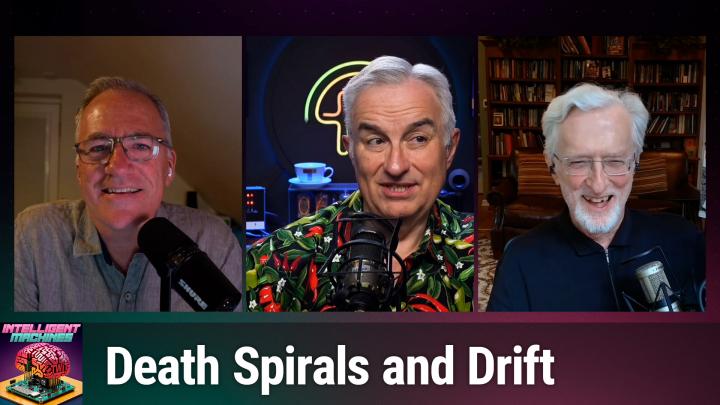
All TWiT.tv Shows (Audio)
Intelligent Machines 877: Model Now Available
02:47:26
The Race for Smarter, Freer AI Models
Loading summary
Transcript921 lines
- [00:00]
Leo Laporte
It's time for Intelligent Machines. Jeff Jarvis is here. Paris has the week off, Mike Elgin sits in and we've got a great guest. Linguist Chris Potts specializes in finding AI failures, how to know if your AI is failing, how it fails and what to do about it. Next on Intelligent Machines. This episode is brought to you by Black Hat usa. If you listen to this show, you go deep on the technical detail. Well, so does Black Hat. For nearly three decades it's been where the security industry's most rigorous research gets presented and pressure tested. More than 100 hands on trainings taught by practitioners who've actually deployed in live environments, not lecturers reading from slides. And hundreds of peer reviewed briefings that go well past the overview into the real work across the four areas defining security right now, AI and autonomous threats, cyber conflict, systemic resilience and identity. This year, Black Hat's briefings pass includes all keynotes and main stage access plus business hall entry. You also get breakfast, lunch, arsenal live tool demos, on demand session access and admission to the midnight in the war room screening. Black Hat takes place from August 1st to the 6th in Las Vegas. If you want the depth this show gets into in person with the people doing the work, this is the room. And we'll be there too. Prices rise on July 17th, so book before then. Use code TWIT for $200 off your briefings pass@blackhat.com us26 that's B L A C K H A T.com us26 podcasts you love from people you trust. This is TW. This is Intelligent Machines with Jeff Jarvis and Paris Martineau. Episode 877 recorded Wednesday, July 1, 2026 model now available. It's time for Intelligent Machines, the show. We cover the latest in AI robotics and all the smart little doodads are getting smarter all the time. I got this little guy, he just, he calls China and talks to it all the time. I don't know what they're saying because it's in Chinese, but that's, that's pretty smart. Welcome to the show. Jeff Jarvis is here, professor of Journalistic Innovation emeritus at the City University of Newark and the Craig Newmark Graduate School of Journalism.
- [02:34]
Chris Potts
Craig Newmark, Newmark.
- [02:38]
Benito Gonzalez
Ah.
- [02:39]
Leo Laporte
His new book is only weeks out now. Finally, we're in July next month. Hot type. In the hottest month of the year comes out the story of the line of type that. You can order it now though@jeffjarvis.com Paris is still.
- [02:51]
Chris Potts
Jeff, I have to steal a joke from a former student of mine. Lucy Lee, she said her dream job is to be professor Emeritus and I agree.
- [02:58]
Jeff Jarvis
Exactly as I say, it's Latin for
- [03:01]
Chris Potts
old who is not for big sabbatical in my view.
- [03:05]
Leo Laporte
Let me just quickly welcome Mike Elgin, who's filling in for Paris Martineau this week. It's great to have you, Mike. What country are you in?
- [03:12]
Mike Elgin
Today I am in the UK Oswalds and tomorrow my wife and I are going to take a road trip to Scotland. So we're super excited about that.
- [03:23]
Leo Laporte
All the FIFA fans will be back by then. You can.
- [03:26]
Mike Elgin
Yeah, we're trying to beat them there
- [03:28]
Leo Laporte
over a little Uskabah. Yes, you've already met our guests. We're thrilled to have Chris Potts on. He's a professor of linguistics at Stanford, on sabbatical right now. Chief scientist and founder of a company called BigSpin AI. But you know, he's also, and I think everybody should read his PhD dissertation, the Logic of Conventional Implicatures. Because I think that will under then you will understand fully what we're going to talk about. No, I'm just kidding. Hi Chris, Welcome.
- [04:00]
Chris Potts
Thank you.
- [04:01]
Leo Laporte
So good to have you. Your timing is excellent. What an amazing time we're living in. You originally were interested in neuro linguistic programming, right? NLP or no, natural language processing. That's an important distinction around the other nlp. Yeah, much more interesting frankly. And natural language is kind of what we're doing these days with our AIs. He was at Sail, the Stanford AI lab, created co creator of foundational open data sets, the Stanford Sentiment Tree bank, the SNLI Natural Language Inference Corpus, and a creator, co creator of dspy, which is the framework that kind of, I think significantly reframed prompt engineering as actually coding. So before there was vibe coding there was you
- [04:58]
Chris Potts
and the visionary project lead for that, Omar Khattab, my student with mate Zaharia. Yeah, I give Omar the credit there for sure. He saw the future.
- [05:08]
Leo Laporte
A lot of what we do these days with rag, although RAG went through really a brief period of fame and infamy and now it's kind of, I think a little bit deprecated. But you were the co author on Colbert, what was basically the original rag, right?
- [05:25]
Jeff Jarvis
Oh yeah.
- [05:25]
Chris Potts
Well, you could break that apart. It's a pioneering neural information retrieval architecture which is a key component in many of the retrieval augmented systems. It would be the mechanism that would find passages to plunk into your context for the language model to use. Incredibly important piece. And in its own right, Colbert is an incredible contribution to information retrieval which is of course, the backbone for web search and other technologies like that.
- [05:51]
Leo Laporte
I didn't realize it was French. I mispronounced it Colbert.
- [05:53]
Chris Potts
Oh, well, no. So we could talk about that. Right? And you could talk about what Stephen Colbert actually says about his last name. Omar happily accepts Colbert. Colbert. I think he's happy with DSPY or DSPY or whatever variant. As long as you're using it, Omar is happy.
- [06:09]
Leo Laporte
Very, very cool.
- [06:10]
Jeff Jarvis
That's all linguistics.
- [06:11]
Leo Laporte
You just kind of let the cat out of the bag on this new company, BigSpin AI. Tell us a little bit about what BigSpin is all about so we can get into the conversation here because this is fascinating.
- [06:23]
Chris Potts
Sure. Everybody should know that a big spin is a skateboarding trick, an advanced one in which the board spins 360 and you go 180. And it involves some real danger. You got to have faith that you're going to land back on your board. It's beautiful when it's done well.
- [06:38]
Jeff Jarvis
Wow.
- [06:38]
Chris Potts
And I guess it also, for the skateboarders, references an old California lottery. So it also has an element of risk.
- [06:44]
Leo Laporte
That's right. That's right.
- [06:45]
Benito Gonzalez
Yeah.
- [06:47]
Chris Potts
So that's the beginning and the end of the relevance of the name to the company's mission. Okay. It's a very dense space and you don't want to choose something like Prism or whatever, because then there will be 50 companies who've chosen the same name. So we just changed the game and went with something that has good connotations for us. The focus of the company is very
- [07:06]
Leo Laporte
important for people who use AI. What? Your. Your research is fascinating. Go ahead.
- [07:12]
Chris Potts
Oh, that's wonderful to hear. Thanks. Yeah, yeah, yeah. We are focused on making sure that people's interactions with AI are productive for them, no matter where they are in their AI journey. And in particular, what we're trying to do is help people in charge of these products figure out what's happening in that interactional sense. Meet users where they are and help empower them. That all begins with finding all these low level signals of small points of failure or figuring out what the user is trying to do in that session and then providing affordances that will help them do that and so forth and so on. There's an incredible opportunity here for customization and there's just much more that we could be doing for these products. So we're trying to push that along.
- [07:58]
Leo Laporte
So your work started with analyzing a million chatgpt conversations, and in those.
- [08:05]
Chris Potts
Yeah, right.
- [08:06]
Leo Laporte
You're. In those conversations, you found 78% of AI failures leave no trace. People don't know.
- [08:14]
Chris Potts
That's right. In the sense that the user just did not give us an indication that they saw that something had gone wrong, even though something had gone wrong.
- [08:22]
Jeff Jarvis
Can I ask you a question there, Chris?
- [08:24]
Chris Potts
Sure.
- [08:24]
Jeff Jarvis
Because I was fascinated by that. There's. There's two sides to this. Does the user give a signal that it went wrong? Is the AI company generally set up to listen for that signal and act on it, or are they using that kind of interaction to fix and train, or are they putting their hands around their ears?
- [08:45]
Chris Potts
Well, that's funny. I tend to assume that they are smart, creative motivated people and they're doing very advanced things. But we did get a glimpse of at least one thing they're doing. When the Claude code code base leaked. And embedded in there was a regular expression that was meant to detect user frustration. Did you all catch that? It's very profane.
- [09:05]
Leo Laporte
Yes. Because they wanted to know. Right. They wanted that signal that meant something went wrong. The user's going, God damn it, how many times have I told you not to do that?
- [09:16]
Chris Potts
Which would be a very visible signal of failure. Yes. Yeah. To be charitable, I would say it's a very high precision device, but very low recall. It's going to catch some instances of frustration, but it won't even catch all of the negative F bombs that people drop, because it's just very particular and not very complicated as an expression. But it shows that they're trying in that fundamental way to capture at least a subset of the worst kinds of failure. That resonates with us, because at Big Swim, we tried to write a similar pattern. It was much longer, and tried to catch many more things, but it still only caught a fraction of the things that are actually going wrong in these interactions. And that's what motivated us to look for what we call the invisible failures.
- [10:02]
Leo Laporte
Is that my fault? Because I have been taught, and I think we've all learned not to yell at my AI because it makes them perform more poorly.
- [10:10]
Chris Potts
Well, in this case, you could be communicating to the Claude code team, and if you study the regex, you can now know exactly which F bomb to drop to possibly get their attention.
- [10:20]
Leo Laporte
But. But what. What I also thought was the case is that we can't really see inside these black boxes that we don't really know what's going on inside the AI. Right. So the user is. It's up to the user to flag the failure. The AI doesn't know.
- [10:37]
Chris Potts
That's a. Okay. The AI in some sense can do verification of its own outputs. That is an easier task. You know, if you have it look at its own transcripts and try to find things that have gone wrong, it might do that at a higher rate of accuracy than you might have thought. And certainly if you have a more advanced model doing it, it can spot, for example, the contradictions, the failures, the mismatches between intent and response that the more primitive model was not getting right. And so that's a monitoring opportunity right there. And that's what we mean by an invisible failure. You ask a question, the answer that came back is not quite an answer to that original question. If the user doesn't signal there was a problem, for all we know they're now running the wrong code or they're off with the wrong factual claim or whatever it is. And I assume that product developers would like to know that that's happening. Yes, that kind of thing.
- [11:31]
Mike Elgin
I use a bunch of prompts that tell the AI to check its own work and in some cases I'll use a prompt that tells it to rate it's the answers on a scale of 1 to 10. This works really great that way it comes back as it sounds very confident. And this is. Well, I give this a 7 out of 10 and I sort of dig into that more. There's also another tool, I don't remember what it's called, where they use two AI models and they use it like a, like a GAN or something, where one AI model checks the other one and they sort of go back and forth. And that seems to me to be kind of an obvious way to check these things. Is this, is this how these things will be improved over time in terms of accuracy through sort of self checking or one AI checking another?
- [12:17]
Chris Potts
I think yes. And in fact there's a, there's a few dimensions to that comment. The first is I just think it is productive to have them interacting in that way. We do that for PRs inside BigSpin and when we do the annotation work that we do for bigspin, that's on the back of us having these annotation protocols where lots of LLMs were critiquing each other and trying to find prompts that aligned their behavior so that we got at least consistent results, all of that is incredibly productive. I think the essence of what you said, Mike, is that this needs to ground out in something like true verification. And that partly explains why progress has been so fast for software development where the verification step is often running the code. And that feels very within reach. And that though does point out some real problems once you step outside of a highly verifiable domain, even going to things like designing UXs. But certainly things like the legal system, verification is not so straightforward. And then I think all our concerns about accuracy and hallucination just come flooding back in, and it's not so clear what mechanism will you use to scale scalably address that. But if we can find those verification signals, we're off and running. I think that's the lesson of software development with AI.
- [13:31]
Leo Laporte
Yeah. So you're not exactly on the stochastic parrot side of the equation, saying that these models are dumb and useless and make mistakes and nobody certainly knows.
- [13:50]
Chris Potts
That's a very complicated thing. We could discuss in its own right, the resonance of that metaphor and what it means and what it implies about us and about the models and about their prospects and so forth. But certainly I think something very sophisticated is happening and there's incredible potential here. Whatever you think about the current moment, I think AI is going to continue to change the world.
- [14:11]
Leo Laporte
This is why I like you.
- [14:17]
Chris Potts
I might be too centrist for you. I took a quiz this morning that placed me right in the most centrist position you could imagine. The most boring perspective imaginable, I assume, versus the other archetypes you could have, according to this quiz, which are really far out there in terms of risks and prospects and the excitement about consciousness. I was just kind of in the middle.
- [14:37]
Leo Laporte
Well, as a linguist, I imagine you're very interested in LLM.
- [14:42]
Chris Potts
Absolutely.
- [14:44]
Leo Laporte
In fact, one of the debates we have on this show, Jeff's kind of in the Yann Lecun camp, the Fei Fei Li camp, where he thinks that an LLM is insufficient to.
- [14:56]
Jeff Jarvis
Amazing, but not quite a perfect.
- [15:00]
Leo Laporte
I think the jury's still out. I think what we're. What's been fascinating to me is how far we've gone with language alone. And I'm not completely convinced that what we do in our own brains exists without language. I'm not sure, but I'm not convinced that an LLM can't go a lot farther, certainly, than we've gone. Where do you come out on that?
- [15:22]
Chris Potts
You'd have to say that a key to their success is that the streams of symbols that they process go way beyond language. Now, they're full of log files and sensor readings and technical descriptions and other things that I would think are giving them an increasingly dense picture of what the world is actually like. And then if you did starve them of all of that and gave them only text from Wikipedia, with no accompanying metadata or images or anything like that, they might be much farther behind because that's a very strange, fragmentary view of the world we occupy.
- [15:58]
Leo Laporte
That's a fair point.
- [15:59]
Chris Potts
But the thing I would want to pick up on is that it's completely eye opening and remarkable to me that such simple learning mechanisms, when scaled, yield all these complicated behaviors. That is one of the most exciting scientific things that has ever happened. And I feel privileged to live through this moment of seeing this. And I definitely did not anticipate it. I thought that for these complicated behaviors we would need something much more engineered, much more complicated, much more futuristic. Whereas the raw ingredients here have been known for a very long time in machine learning and back on through statistics in the early days of AI and some parts of them. Yeah.
- [16:38]
Jeff Jarvis
So where do you come in on explainability then? On whether that's possible, desirable?
- [16:44]
Chris Potts
That's been a major focus of my group. I'm a big booster on the idea that interpretability is going to help us improve these models and also get control of them. And we have discovered, I mean, this actually where my linguistic research and my AI research kind of dovetail. These models solve hard generalization tasks and do complicated things because they have developed these very rich internal representations that in many cases are quite understandable to us and that explain how they can generalize so well. That's a remarkable finding. I think it's again, unanticipated if you think back 15 years, but now it's been so productive and exciting. That ties in with issues of linguistics and cognition because then you can start to think, well, they're not like humans, but they have this human like capability. Whatever mechanisms they have are at least sufficient for those kind of behaviors. And that's a major clue when it comes to unpacking the human capacity to understand language and do complex cognition.
- [17:42]
Leo Laporte
That's just fascinating to me. We're talking to Chris Potts. He's a professor of linguistics at Stanford and the founder of a company called BigSpin AI, which is named after a skateboard trick. Can you do a big spin? I know you're a skater.
- [17:59]
Chris Potts
Yeah, when I was younger, I could do a big spin. And I have pledged to my team that I will learn to do a big spin. But it is a scary trick. You really have to have faith. I can still kick flip. The ollies are fine.
- [18:10]
Leo Laporte
That's good.
- [18:11]
Chris Potts
But I know it's not what the company needs from me.
- [18:13]
Leo Laporte
My son is a skater boy too,
- [18:15]
Chris Potts
and I. Oh, wonderful.
- [18:16]
Leo Laporte
It was fun to watch him Fall a thousand times and then big part of it, make it right. It's amazing. It's a little scary.
- [18:24]
Chris Potts
Also, real life lessons there, though, about persistence. Yeah, incredible.
- [18:28]
Jeff Jarvis
It's real world model time.
- [18:30]
Leo Laporte
It's helped him immensely. That's true. So, in a way, Rich Sutton wasn't wrong with the bitter lesson that it is true that throwing compute at these things is surprisingly effective.
- [18:42]
Chris Potts
Yes, I am inclined to agree. It's a bit complicated for me, though, because the bitter lesson is kind of like one of those lessons from writing manuals that just say, like, omit needless words. It's great as a reminder if you're already a good writer, but if you're not, it's just. Just not helpful advice. And if you just say to someone, hey, just scale endlessly, they'll make lots of bad, expensive choices. And the real lesson of the era of scaling and so forth is, yeah, we scale, but we also learn tons about how these architectures work and find lots of ways to make them efficient. And the example I usually give is it's been a kind of minor miracle that we went from Context windows of 2000 tokens to what might as well be infinite. We did not get that by scaling the transformer architecture from about 10 years ago. That would cost us literally trillions of dollars to get to that big context window. People thought very carefully about locality and language and how neural networks process and learn information in sequences, and they found ways to approximate the context window so that it could be scaled in that way. So, yeah, you scale and you don't get too clever about thinking about all the details of language. But on the other hand, you need a really deep intuition about linguistic data to do that kind of scaling.
- [19:59]
Leo Laporte
So what is BigSpin going to do as a company, besides the research, what's the product?
- [20:08]
Chris Potts
That is a fascinating question for us because, of course, we have an app that has an agent, and it will help a product manager, as data streaming from their product, understand the issues that are arising and find things that are going well and help them with fixes. So it's incredibly empowering as a kind of supercharged chief of staff to the, you know, the product manager, helping them spot all these things.
- [20:33]
Leo Laporte
So it's a way of seeing where
- [20:34]
Chris Potts
your AI is, is going, monitoring visibility. And then one incredible thing about the current moment is that the agent could suggest fixes that might help the product manager connect with their engineering team and so forth.
- [20:48]
Leo Laporte
Nice. But I have to say what Mike was talking about, the whole idea of creating tools that help you find errors.
- [20:55]
Jeff Jarvis
Yeah.
- [20:55]
Leo Laporte
And feed it back to the AI. Yeah.
- [20:59]
Chris Potts
I have to say it's such an interesting moment for thinking about how to build a durable business in an era when anyone could take a screenshot of this app in action and say, hey, Claude, code, make me something like this. And that kind of shows you that the value of the raw software goes to zero. And so my thinking about this is on the one hand, our agent is incredibly good at this job because of all the tools we designed and everything else. But the thing that really supercharges it is that we have all these annotators that run as the data flow in and they connect, they catch things like invisible failures. They do modeling of the user at their level of expertise, the task they're trying to solve, the domain they're in, and all those signals which come from these models that we fine tuned to do those particular jobs based on data that we've got, they supercharge the agent and make it able to do all that important data science. And an agent without all those annotations is really kind of flailing about in the general world of just what language models can do in general.
- [22:00]
Mike Elgin
Just to be clear, the annotators are people.
- [22:04]
Chris Potts
No, those are models.
- [22:05]
Mike Elgin
They're agents.
- [22:06]
Chris Potts
Yeah. Automatic. You could think of them just as classifiers. This gets down. I mean, they're language models, but you could think of them as kind of just like old school classifiers. They assign hundreds of signals. So they're not quite like old fashioned classifiers. And they are actually language models under the hood, but they're very specialized to their task of identifying invisible failures and identifying user expertise levels, domains, all those things that I mentioned that are so critical to understanding where the failure points are and where things are going well.
- [22:38]
Jeff Jarvis
Who's your customer?
- [22:40]
Chris Potts
Our customers have to be organizations that care about their interactions, which is not everyone who has a deployed chatbot. But if you're in an area like you're giving medical advice or helping somebody with scheduling of something that matters, or like doing things like professional coaching, then the nature of this human AI interaction really matters to the success of your product. And the distance between off the shelf ChatGPT and the product that you want is enormous. And every failure is a really important thing for your business. So those are our customers, because those are the people who every day are going to sit down and say, what's going wrong and how can I fix it?
- [23:22]
Jeff Jarvis
Then shouldn't the foundation model makers be your primary? I mean, they should kill for your data and for your Learning. Yes. Rather than the application layer. The company that's using this at an application layer. Right. So how far up the chain do you go?
- [23:42]
Chris Potts
Well, I mean, data, I think are key. I think that's the central insight there. I assume that the frontier model providers have lots of their own data, a super abundance of it. I'm kind of jealous of how much they have, but I do think that data are the key ingredient here. As always, that's a very familiar story in AI, that the data are the thing that give you the transformative capability. Yeah.
- [24:05]
Leo Laporte
So in a way, it's an audit layer for companies.
- [24:09]
Chris Potts
Yeah. I'm happy to think about it as auditing. That could sound quite specialized to people. You know, auditing could be a very particular role, and this is broader to anyone who's just in charge of the quality of their product. But I think what they are doing, in part is a kind of audit. When we have escalations to a human, are they the kind of escalations that we like? If we see the system resetting in these contexts, is that good or bad? And then of course, they're trying to fix that.
- [24:33]
Leo Laporte
Now, everybody who's using AI, especially those of us who use it for coding and so forth, should be concerned about invisible failures.
- [24:41]
Chris Potts
Yes.
- [24:43]
Leo Laporte
Is there a way to detect those, to note what's going on? I mean, obviously we're not your natural customer, but we would like that kind of visibility into what's happening.
- [24:55]
Chris Potts
Right. Well, one thing I'll say there is that it's a characteristic of expert behavior with AI that you make your failures visible. Experts complain, they push back, they iterate on goals, they refine goals, they tell the AI to change course. And we all take that for granted. I'm imagining because you all are at the cutting edge of using AI, I suspect. But for the vast majority of people using AI, they've been told it's a super intelligence. They ask it for things and they take the responses at face value. They adopt what we call a delegative mode, whereas what you want is an augmentative mode. It's the result, causal claim here. It's a result of the augmentative mode that people are able to solve harder tasks more reliably.
- [25:38]
Leo Laporte
And those who just use it as a chatbot are the ones who complain most about hallucinations without actually fixing that.
- [25:46]
Chris Potts
May well be. Yeah, there's probably interesting interaction effects with domain and so forth, but if you just enter a query and get a response you don't like and walk away thinking, well, that was just wrong. That would be delegation with a bad outcome. Even worse, of course, is to walk away with the wrong answer as though it were or believe it.
- [26:03]
Jeff Jarvis
Yeah.
- [26:04]
Chris Potts
But in both cases, what you wanted to do is say, you know, as Mike was saying before, could you double check that? Or open up another window and just ask it to give you the opposite judgment. Hey, you really like this idea. What's the most critical take you could offer of it and synthesize across the two? That kind of very critical mode is what experts are doing.
- [26:25]
Leo Laporte
So I covered.
- [26:26]
Jeff Jarvis
Go ahead.
- [26:27]
Leo Laporte
All right, well, all right, I can monopolize, Chris. I don't want to, so please let
- [26:34]
Jeff Jarvis
me go on that one. If I go for a second. So I. You remember the schmuck lawyer in New York who used ChatGPT very early on and got citations, and I went and covered his. His show cause hearing in federal court. And, and it was interesting because he. He said his. His defense was. I thought this was a super search engine.
- [26:53]
Chris Potts
Yep.
- [26:53]
Jeff Jarvis
I thought computers couldn't make mistakes. Right, right. And then. But what was telling, though, is that he obviously was suspicious because he went back and he asked ChatGPT, Are you sure about this? And ChatGPT said, Absolutely. This is early ChatGPT. So in there, there are all kinds of signals of what was happening. And I'm curious, what are the kinds of signals that you see for an invisible failure?
- [27:20]
Leo Laporte
Oh, that's segues into the question I was going to ask, because in the paper you have eight archetypes for failures. So the one you just described, I think would be the confidence trap where the AI is. And we've seen this, we've all seen it confidently wrong. And that confidence, we believe it, we go, oh, well, it was pretty darn confident. Those sources say. I asked, I asked and it gave me sources that must be. That's a big problem. But you also have some other archetypes which I think are great. The drift archetype, where AI sort of gets your goal, but not quite. It's off a little bit. Right.
- [28:02]
Chris Potts
That's take you on a journey away from where you intended to be. It can be subtle.
- [28:08]
Leo Laporte
That's actually the most. In the corpus you were looking at, that was the most common failure, almost.
- [28:14]
Chris Potts
Yeah, Maybe that. And the walk away. Yeah, yeah.
- [28:16]
Leo Laporte
What's the walk away?
- [28:18]
Chris Potts
That's where you ask a question, you get a response. The response is not a resolving answer to the query. And that's all we get. But you can get walkways later. So another pattern would be like the death spiral. You try a few times. Hey, do this. Maybe you rephrase it, and then you walk away because none of the times was quite what you were looking for. And you don't complain. You just keep trying, and then you bail.
- [28:42]
Jeff Jarvis
Is death spiral also a skateboard trick?
- [28:47]
Mike Elgin
Let's hope that it's the last one you do.
- [28:51]
Leo Laporte
I actually have had. In fact, I think I told the story last week. I had that death spiral where I kept trying, kept trying. Finally I said, and this was a mistake. I give up, and walked away. But instead of the AI giving up, it deleted all of its work. It backed off, and it deleted everything. And I said, what are you doing? And he said, well, you said you gave up, so I just thought I'd just delete everything.
- [29:14]
Chris Potts
Oh, wild. Oh, I hope you capture these behaviors. That's fascinating. A little too autonomous, a little too literal.
- [29:22]
Leo Laporte
Well, they're getting more autonomous, aren't they? In fact, that's one of the things Fable is. Is doing. Is able to kind of keep going. Everybody's talking about loops these days. The idea that, well, you don't just ask it to do one thing. You say, go ahead, do it, and you loop and loop and loop. That makes me very nervous. There's no opportunity there for you to interject a correction or a course correction.
- [29:45]
Chris Potts
Yes, obviously, that could spin out of control very quickly and get very expensive as well.
- [29:50]
Leo Laporte
Yeah, there's the silent mismatch. A user asks for X, gets Y and says, ah, that's close enough. You say, this is rampant in software and education. I have to say, I've done every one of these.
- [30:09]
Chris Potts
Yes, me too. I have a wonderful story about this. I try to be an expert and be augmentative. I had a colleague, he designed this fun infinite runner game. If you 404@ our site, you get to play Ollie Not Found, where the skateboarder just. You click the spacebar and it jumps. And I wanted to play a prank on my colleagues and have write an AI that would play forever. And I would just say, hey, guys, you know, I got 10x, the best score you've gotten. I'm the best player at Ollie Not Found. But I was going to have the AI do this, so I said, hey, Claude, write a perfect player for this game. And it said, I remember so distinctly. I understand the geometry of the game perfectly. Here's a solver that will run forever. And I said, say, great. And I try it, and it's worse than me. I go back and I say, this is worse than me. And it says, oh, you are quite right. You're so correct in this insight that it's not good. Here's a version that's much better. I run that one. It's a little bit better than me, but hardly changed. It just kept cycling through this confident assertion that it had the perfect solver and then disavowing all of it and starting again over and over. In the end, I gave up. Maybe I'm not expert enough. I still don't have a solver that's perfect at this game. I don't know whether it's achievable. My answer, my question was never answered. But I was really caught in the death spiral and the contradiction unraveled there.
- [31:29]
Leo Laporte
And you walked away.
- [31:31]
Chris Potts
I walked away. And it was the perfect scenario because I don't know how the game works and I don't care to learn how the game works. I wanted to offload this to AI, but I had the advantage that I could let the game play. That's my verification step. And I could see that I got 42 and this thing is only getting 36. It's not better. And that is far from perfect. Try again. But in domains like the legal one where you don't. I mean, what would be the equivalent? Like going to trial in that case and then finding it was wrong.
- [32:00]
Leo Laporte
Yeah.
- [32:01]
Chris Potts
It's too expensive. Where are we going to do the verification step there?
- [32:08]
Leo Laporte
I just think this. I think your sense of wonder and excitement at this is. I share. Exactly. We are in a very interesting and strange time today. Anthropic Re released Fable, and actually the word classifier has become part of our vocabulary since it released Mythos. Fable was a mythos that had a bunch of classifiers that were, in theory, going to keep it from doing anything bad to find bad. We'll talk about this more later. What they've done is they've stepped those up. So it's my fear is it's not going to do anything at all.
- [32:44]
Chris Potts
It's very hard to calibrate.
- [32:45]
Paris Martineau
Yeah.
- [32:45]
Chris Potts
There was a quiet revolt from the AI community, which had a real impact. It was mostly on X and it was AI researchers saying, I feel betrayed by this. And they walk those back. Yeah.
- [32:57]
Leo Laporte
Well, it's as if you're peering over a wall at some magical nirvana, but the wall keeps stopping you from getting
- [33:05]
Chris Potts
into that secret part and it erodes trust. Yeah. People started saying, look, I don't know what's happening, but I'm going to use a different model because I don't want all of my responses nerfed I'm trying to do real research here.
- [33:16]
Leo Laporte
Exactly. Well, that's the real fear. And actually, Alex Stamos talked about this today in Twitter. He said, why would any company invest in Fable with the risk that in the middle of the project, Fable just says, no, yeah, I'm not going to do that. Yeah, it's just not, it's just not worth it. So. Well, good luck with the new company. I think this is a very exciting.
- [33:41]
Jeff Jarvis
Can I hit the other topic?
- [33:43]
Leo Laporte
Yeah, yeah, yeah.
- [33:45]
Jeff Jarvis
I'm curious about, because you're a linguist, the debate about understanding and all that follows. Understanding unto. Unto consciousness and everything else. Right, sure. But, but to start with understanding, who was it? Leo? You sent me that long video of Jeffrey Hinton. Jeffrey Hinton, who was arguing that it's obvious that they understand, and then that he argued that it had a desire to lie to him, which also obviously implied that it understood he understood what a lie was. So I'm curious on the, on this, if you were taking a test, as you took this morning on this topic, where do you land?
- [34:28]
Chris Potts
Probably right in the center. You have to be open minded because anything else is way beyond what we know scientifically about how humans are doing this and in turn about what's in principle possible. If you talk about things like beliefs, desires and intentions, we don't know what's necessary and sufficient in humans for this. We rely on an assumption that people are like us. And all those philosophical problems come flooding in as soon as you say that. But we navigate those things, but they're uncertain. And then we also have very little understanding of what models are currently doing now. You know, the interproject is far along, but there's endless things still to learn. And we especially don't know what the models of tomorrow are going to be like. And if you did, just think, okay, understanding is a loaded term, but what it's going to be mean to be meaningful is that you have some kind of mapping from language into some conceptual structures and so that like, you know, we map language into mental representations of things and that's what it means to understand and what that puts you on is a continuum. How complicated is the contextual structures, how complicated is the mapping, how refined and so forth. And obviously language models way behind us along many dimensions in terms of how sophisticated that mapping is. But if that's all there is, then it looks like nothing is stopping you from having a model in the future with exactly these technologies that has a very refined mapping of this sort. And I, if that's not enough for you for understanding that kind of stuff, semantics in that deep sense, then it's on you to tell me what's missing from that picture. And then sometimes people reveal that, like actually they're kind of biologically oriented. So that's a dead end because there's something intrinsically biological about understanding. And it's just good for people to confront that and maybe realize that about their beliefs.
- [36:14]
Jeff Jarvis
So if you were in the studio together, Leo would hug you right now. I would, because this is what he argues. So I'm editing a new book series for Bloomsbury academic called Intelligence, AI and Humanity, where AI forces us to reconsider things in life. Ruben Chowder, he's writing a book about intelligence. What is intelligence? Look at the history of intelligence. You as a linguist, does AI force us as a whole, or even you individually to reconsider our prior human definitions of understanding?
- [36:48]
Chris Potts
Yes. And I feel like whatever your reaction to this and whatever your beliefs, if this moment is not causing you to reconsider all those things, then there's something amiss because this is the first time in human history that we have encountered other non human creatures that can do all these things. It is definitely weirding us out. But if it doesn't have you pause and say, look, I need to critically assess what it meant to be an understander or critically assess what it meant to connect symbols and language in the world. If you're not pausing, even if your response is, this is all you know beside the point because they're too different from us as humans, it should still be a moment of serious reflection.
- [37:26]
Jeff Jarvis
So did it cause you as a linguistics scholar to change any views that you'd had before you encountered all this?
- [37:36]
Chris Potts
That's a great question. I will say that it has been empowering in terms of making progress on some of the most difficult problems in linguistics. And the two that come to mind for me are what's often called the poverty of the stimulus. So how do we, with apparently so little input from the world, get to a full competence in language so quickly? The Chomsky and answer has been you have rich innate priors. But of course, language models get there pretty fast without any innate priors. So you don't. The innate priors aren't intrinsically necessary to achieve this. They might be given human limitations, but you see how nuanced this is getting now. And then there's a related question of what's a conceivable human language? We have only a finite number of them that we've ever encountered in the world. And they're all a product of history and accident. What is the abstract cognitive capacity for language? What set of things is learnable by us? Very difficult problem to address experimentally, but very easy if you're thinking about training language models on different corpora representing different languages and see what final state they achieve. Achieve. So two big questions unlocked. That is just incredible from the point of view of new debates, new discoveries, new terms for these things. And I didn't think again that we would have a new investigative tool like that in my lifetime. And I thought then those questions were going to be kind of stuck where they were.
- [38:54]
Leo Laporte
There's some evidence that these AIs can create their own internal.
- [38:58]
Jeff Jarvis
That's what I was going to ask at some point before we got on showed us a dial or conversation among agents without humans. At some point does one. And you talked about where that might go, the void, does that potentially go to them inventing their own language?
- [39:15]
Chris Potts
Another fascinating question that used to come up more about 15 years ago.
- [39:19]
Jeff Jarvis
Right.
- [39:20]
Chris Potts
When we did more training from scratch. Now that all the best models are pre trained on the Internet, which is a record of actual human usage and everything else, they don't have as many opportunities to go off that distribution. And so it's less likely that they're going to invent their own language. But given sufficient interaction and maybe if they do start doing weight updates as part of these interactions, then you could get into some really far out states and that would be fascinating to see what kind of more efficient systems they might evolve or systems that are differently pragmatic than human languages. Or maybe this would be the most exciting for me. They converge on kind of human like systems at the level of the pragmatics and the encoded meaning which of course
- [40:01]
Mike Elgin
human language is always evolving and splitting off into different languages and dialects and so on. And you, you could imagine isolating AIs and having them talk to each other at high speed for a large amount of time and see if they spin off.
- [40:18]
Jeff Jarvis
Yeah, yeah.
- [40:19]
Mike Elgin
And I'd be really curious if that happens. You could also imagine the constructing in language from the various grammatical rules, vocabulary, German style, plugging everything into a single word. You know, you could imagine all kinds of things from human languages that exist
- [40:34]
Chris Potts
already and sped up. Right. You don't have to wait actual human generations to see what's happening. And again they're always going to be qualifiers. But what an investigative tool. Yeah.
- [40:45]
Leo Laporte
I also think you talked about a bridge that we may cross sometime. I hope we cross it in my lifetime. Where they are self improving, they're able to change their weights. And that might actually be when things get explosive.
- [40:59]
Chris Potts
Yeah. And there are no technical obstacles to that. Now it's just a matter of calibrating those processes and then actually running them at a technological level. It's very expensive to do all those weight updates, but that shows you the potential because in principle, we could do it now.
- [41:13]
Leo Laporte
Interesting. So it's just a cost issue. It's getting enough Nvidia Blackwells together to revere Rubens together.
- [41:20]
Chris Potts
Yeah. And also just fine tuning that process, which across all of these training processes is kind of, at this point, more art than science. And that's why people get paid the big bucks to do it, because it's a lot of lived experience to figure out how to set it up in a way that it goes well as opposed to going poorly. And when the price tag on it going poorly is in the tens or hundreds of millions of dollars, you hope you have experienced people running it.
- [41:45]
Leo Laporte
Chris, such a pleasure to talk.
- [41:46]
Jeff Jarvis
This is so much fun.
- [41:48]
Chris Potts
Yeah, I really enjoyed this.
- [41:49]
Paris Martineau
Real quick, Leo, I know I usually don't talk to you, the guests during this part, but I have a question
- [41:54]
Leo Laporte
that I. Benito, our producer, wants to ask you something because we rarely ever
- [41:58]
Paris Martineau
have a linguist on of his caliber. So is there any kind of qualitative difference between a model trained on English and a model trained on Chinese?
- [42:08]
Leo Laporte
Oh, good question.
- [42:09]
Chris Potts
In terms of the internal representations.
- [42:12]
Paris Martineau
Yeah. Or anything at all, are there any qualitative differences?
- [42:18]
Chris Potts
Are you thinking of a scenario where we train one model purely on English and another purely on Chinese?
- [42:24]
Paris Martineau
I guess the question is more like, is a Chinese trained model qualitatively any different from an English trained model?
- [42:29]
Jeff Jarvis
Is Deep Sea fundamentally different because of the language itself?
- [42:35]
Paris Martineau
And does the language itself have any kind of intrinsic quality that would be different from an English model?
- [42:41]
Chris Potts
Oh, must be. Right. Because the units can be very different, especially from the point of view of the language model. Your tokenizer might be different for English and Chinese, and that's gonna have implications for how it reconstructs those partial words into more meaningful units internally. And then as I was saying before, if you think that what it's doing is partly inducing a mapping from the language into concepts as a way of solving the hard generalization tasks that we pose for these models, then that conceptual structure could be very different. And there is work on this. And you do get these fascinating things that, for example, a model trained dominantly on English, but secondarily on Chinese, when it speaks Chinese, it Might do things like using color terms in a way that looks more like English. Maybe it overuses a word like orange or something, because that's a lexical item, a frequent one in English and it's more marked in Chinese. But this model has kind of had one set of experiences bleed into another, causing it to have a different conceptual structure, arguably. And then of course, you can ask yourself, what about for bilingual speakers? Are they showing similar kinds of things? And again, you just see the power of this potential investigative tool here.
- [43:58]
Leo Laporte
I know why your interest in this. Benito is bilingual, or at least bilingual.
- [44:02]
Paris Martineau
Yeah. And when I do switch languages, I do think differently.
- [44:06]
Leo Laporte
Yeah, interesting. Is it not the case though that all these models are converging because it's basically the same corpus training corpus for everything, I mean. Or is it not?
- [44:16]
Jeff Jarvis
Is it? I don't know.
- [44:18]
Chris Potts
It depends, I suppose. So for the pre training, it does seem like everyone is just getting all the data they can. And that might be quite homogeneous. For the post training, it seems clear to me that, for example, the path that Anthropic uses to train these new products, which I think many of them start from the same base model they've got that really worked out so that they can maintain a kind of personality that they want even as they give the model capabilities. This is quite striking. I would love to understand more deeply how they achieve that. But the stability they've achieved for their product is different from the one that you get from ChatGPT, for example, and certainly different from Deep Seq.
- [45:00]
Leo Laporte
Experientially I could confirm that. And it's one of the reasons people become fond of certain models, because they like the personality of that model. Very interesting. Chris Potts, such a pleasure to talk to you. Chris's startup, BigSpin AI. If you're interested in making sure that your AI models are not failing you,
- [45:25]
Chris Potts
maybe you should check that based on this discussion. My tip of the day, you all would love the Void by Nostalgiabrist. It's this epic essay exploring how we ended up with the models that we've got, why they have the personality that they have have. And then lots of interesting thought experiments and observations about the culture embedded in.
- [45:44]
Leo Laporte
It's a movie.
- [45:46]
Chris Potts
No, it's a 17,000 word blog post.
- [45:49]
Jeff Jarvis
Oh, and is it Les Wrong? Is it from those guys?
- [45:52]
Chris Potts
It is. He posted it actually on Tumblr. There's a link from Les Wrong so that there could be discussion there. But I don't know who nostalgiabrist is in the world, but he's probably a Fascinating character. He or she?
- [46:04]
Leo Laporte
I am going to read this. It is on Tumblr. How odd.
- [46:09]
Chris Potts
Highly recommend it. It's quite a journey.
- [46:11]
Jeff Jarvis
All right, Chris, be careful on that skateboard out there.
- [46:15]
Chris Potts
Yeah, that's good advice. Thank you.
- [46:17]
Leo Laporte
Such a pleasure. Thank you so much for coming on. I can't wait to see what you're up to next. And if you ever want to come back and talk about it, please, we would love to have you, Chris Potts.
- [46:27]
Chris Potts
I'd be happy to do that. I really enjoyed this. Thanks again, everyone.
- [46:29]
Jeff Jarvis
Enjoy your sabbatical.
- [46:30]
Leo Laporte
Yes, no kidding. We're going to take a little break and we'll continue with Intelligent Machines right after this. Oh, he's gone. All right.
- [46:39]
Benito Gonzalez
Wow.
- [46:40]
Leo Laporte
I could spend hours. I love linguists. And this is boys.
- [46:44]
Jeff Jarvis
Well, not all of them.
- [46:44]
Leo Laporte
Up their alley.
- [46:45]
Jeff Jarvis
Not every one of them.
- [46:46]
Leo Laporte
Not all of them. There's certain ones. We know who they are. We know their names. All right, let me get the ad and we can talk. This episode of Intelligent Machines is brought to you by Zscaler, the world's largest cloud security platform. You know, we can. I mean, you listen to this show, you know, the potential rewards of AI are huge, especially for your company. You can't ignore them because the competitors, the competition isn't. Right. But you also should pay attention to the risks. There are lots of them. Loss of sensitive data, sometimes inadvertently. But then there's also attacks against enterprise managed AI. And then there's the issue of generative AI giving new tools and opportunities for threat actors. Things like creating incredibly effective phishing lures like that. Writing malicious code, automating data extraction. AI is changing the entire security space. There were 1.3 million instances of Social Security numbers leaked to AI applications last year. And most of that was inadvertent, right? Somebody uploads their tax return. It's all in there, right? ChatGPT and Microsoft copilot saw millions. The number is a lot. At least 3 million data violations. And again, inadvertent stuff leaks. But that's why you need a modern approach. You need zscaler Zero Trust plus AI. Because it's Zero Trust. It removes your attack surface, it secures your data everywhere. But with the addition of AI, it can also safeguard your use of public and private AI. Protect against ransomware, protect against AI powered phishing attacks. But you don't have to take my word for it. Just listen to the customers. They love Zscaler. Like Siva. He's the director of security and Infrastructure at Zuora. They use Zscaler this is what he has to say with zscaler. Being in line in a security protection
- [48:44]
Chris Potts
strategy helps us monitor all the traffic. So even if a bad actor were
- [48:49]
Mike Elgin
to use AI, because we have tight
- [48:52]
Chris Potts
security framework around our endpoint, helps us
- [48:55]
Leo Laporte
proactively prevent that activity from happening.
- [48:57]
Chris Potts
AI is tremendous in terms of its opportunities, but it also brings in challenges. We're confident that ZSCALE is going to
- [49:03]
Leo Laporte
help us ensure that we're not slowed down by security challenges, but continue to take advantage of all the advancements. Thank you, Siva. With Zero Trust plus AI, you can thrive in the AI era. You can stay ahead of the competition, you can remain resilient, and even as threats and risks evolve. Learn more@zscaler.com security that's zscaler.com security we thank them so much for their support of intelligent machines. Mike, Elgin, So good to see you filling in for Paris. Mike will be in the beautiful area of England for a little bit and then up to Scotland.
- [49:47]
Mike Elgin
That's right. It's delightful afternoon tea today.
- [49:50]
Leo Laporte
Is it burning hot, though?
- [49:53]
Mike Elgin
No, not here. We were just in Provence. We. Five days ago, four days ago, it was pretty hot in most of France. It wasn't too bad in Provence. And in fact, it actually had some rain while we were there, which is really interesting. But no, it's super pleasant here. 73 degrees, blue skies, puffy.
- [50:10]
Jeff Jarvis
So you may not have gotten the full. Since you're going to Scotland, actually may have gotten full sense of it. America fell in love with Scots.
- [50:17]
Leo Laporte
Oh, we did.
- [50:18]
Jeff Jarvis
During the World cup in New York, particularly. They're just great.
- [50:21]
Leo Laporte
Boston, too.
- [50:22]
Jeff Jarvis
They.
- [50:22]
Leo Laporte
They actually drank all the beer.
- [50:24]
Mike Elgin
I saw that article. They drank all the beer in Boston.
- [50:27]
Jeff Jarvis
So in Miami. And the great thing that they did, they. They somehow took to traffic cones and crowned every statue they could find with a traffic cone.
- [50:36]
Leo Laporte
There's a reason for that.
- [50:38]
Mike Elgin
I saw. I saw that here yesterday, actually. There's really magnificent statue of somebody, and it had this, like, Jack in the box traffic cone hat on it. I'm like, huh?
- [50:49]
Leo Laporte
I found out because we had Ian Thompson on the show, and he explained the traffic cones. There is a very famous statue in Edinburgh, I said, of Lord Nelson. I can't remember who it's of, but, oh, it's Duke of Wellington. Sorry. It's in Glasgow. And they cannot. The authorities cannot prevent the Scots from putting traffic cones on its head. On its horse's head. Different cones for different, you know, holidays. And so this was a tradition in Edinburgh, but it spread when the Scottish fans came to The United States. They realized we have traffic cones and statues as well.
- [51:27]
Jeff Jarvis
There was a wonderful young journalist for the Scotsman named Katherine Hay who did great videos in Boston and Miami. And what I love, she just was going around Miami and just seeing where they'd been through the traffic cones.
- [51:39]
Leo Laporte
You can see traffic cones and all the statues. I love it. That's a great tradition. I love it. So the big story today is that Fable is back. So is Mythos for some, for the
- [51:53]
Jeff Jarvis
same people who got it before? No.
- [51:55]
Leo Laporte
Okay, so this is what's interesting. So apparently we're finally getting the details from Anthropic itself. Anthropic did give Mythos back to a number of the same companies through Glasswing that had it originally back in June 26th. 6th. And we'd seen kind of noises that some companies still had access or had gotten access to mythos. It was June 9th when the Trump administration, through the Commerce Department, blocked access to both Fable and Mythos, saying it was a security issue. We are now seeing Anthropic's response to all of this. And even though they're being very careful, you can read between the lines. Fable is back as of, like, about an hour or two ago. But they have really turned up the jailbreak protections, maybe to the point where people. I haven't yet kind of put my finger on the pulse of it, but maybe to the point where people are going to be upset. That's my prediction.
- [52:56]
Jeff Jarvis
Who will they blame at that point?
- [52:58]
Leo Laporte
They'll blame Anthropic. Really? They should blame the US Government. Anthropics doing what they can to appease the Trump administration. So I think Anthropic kind of threw some shade. And I'm not alone, by the way. Alex Stamos agrees. In fact, maybe I should. Best way to recap this is to put Alex Stamos tweet up on the screen because he says there's a lot to unpack here. Anthropic is burying some hard truths in careful political language. First of all, Anthropic verifies none of the jailbreaks provided a capability beyond what many other models, including the Chinese models, could do. Now, that was when Alex was on last week and we were talking. Or was it two weeks ago?
- [53:43]
Jeff Jarvis
Two weeks ago.
- [53:44]
Leo Laporte
Two weeks ago. And we were talking about his letter signed by hundreds of the best names in computer science. Freefable.org that was one of the main critiques, is it's not doing anything that other models couldn't do. In fact, Anthropic pointed out that even Haiku, its dumbest model, could do the same exact jailbreak that Amazon fingered him for.
- [54:09]
Jeff Jarvis
Which is a dangerous thing to say because. Okay, then, ban them all.
- [54:14]
Leo Laporte
Yeah, maybe. I think that Anthropic wouldn't have written this if they hadn't some confidence at this point that they had appeased the administration. We don't know all the details of how they appeased them. It's my theory that they offered them 10% of the company and other things. But anyway, they said when it. First of all, I think they cast shade on Amazon. The Export control directive on June 12 came after the government became aware of a report in which Amazon researchers had found a method of bypassing Fable 5's safeguards. Over the past weeks, we've worked closely with the government, other partners, including Amazon, to review the report and evidence. Our testing confirmed that many less capable models, including Opus 4.8 GPT 5.5, the Chinese model Kimi 2.7, could identify the same vulnerabilities as Fable 5 did in the report when it came to the demonstration of how to exploit the single vulnerability. And that was the things that really scared the Trump administration. It made an exploit. Every model we tested could produce the Same demonstration, including Haiku 4. 5, Sonnet 4. 6, Opus 4.6, Opus 4.7, Opus 4.8 GPT 5. 4 GPT 5. 5 and Kimi 2.7. So they say the reported technique did not expose any unique Mythos level cyber capabilities. So this isn't that judicious. That's pretty clear they busted for something.
- [55:39]
Mike Elgin
It's just evidence that, that, that, you know, the whims of presidential administration is not the best way to go about this sort of thing. And, and, and the, the fact that, you know, the, the Trump administration want, wants, you know, wants to be heavily involved in deciding who gets to see, picking companies that get to use it and that sort of thing. This is really terrible. It's, it's a, it's just amateur hour and it's vaguely totalitarian. The definition of totalitarianism, by the way, is when a government sees every single area, area of human life to be within its province. Yeah, it's exactly. So, so this is, this is a, this is not totalitarianism, but it's, it's
- [56:25]
Leo Laporte
a. Oh, it's damn close.
- [56:27]
Jeff Jarvis
So, so, Mike, two things there. One, I just want to quote Benedict Evans newsletter this week. This is a mess with random unqualified officials banning and unbanning products with no process or transparency. One has to laugh at anthropic and the safety activists air quotes around safety who spent years saying that they wanted restrictions but when they came, they said no, not like that.
- [56:51]
Leo Laporte
Alex Stamos said Casey C A I S I the center for AI Standards and Innovation is the group that's supposed to actually make these determinations, not the political actors in the White House. Casey Prior safeguards. The implication is that this whole thing was unnecessary.
- [57:11]
Chris Potts
Yeah.
- [57:11]
Leo Laporte
It also Alex called it an own goal. He's a sports fan. A goal scored against yourself because he said what's going to happen as a result is US Labs now have to make a much more conservative precision recall trade off on cyber refusals. US models become much less useful for defensive cybersecurity work unless you're in the trusted group. Security companies and startups that provide services to others will now be driven to use Chinese models. Big win for PRC Labs this month. It pushed me, little old me, and I'm not a bellwether, but I think if as an individual, my reaction to this was, well, I guess I better not be dependent on American models because they could rug pull us at any time. Pushed me to A, investigate local models more. I've actually found a pretty good one. We'll talk about that later. But B, to frankly use some of the Chinese models. They're very, very good. And that was the other thing people discovered how good GLM and Deepseek and Kimmy are.
- [58:16]
Mike Elgin
They're good and they're based on open
- [58:18]
Leo Laporte
source and they're open weights. You can, if you had enough machine, which I don't, but you could run the full GLM locally. You'd need 512 gigs of RAM, which,
- [58:28]
Jeff Jarvis
which consider that China, China's goals are political more than economic. They can destroy our AI industry.
- [58:34]
Leo Laporte
Well, and that's the question. People are saying, well, why would China give this away? You just said why? They don't need to make money on this.
- [58:43]
Jeff Jarvis
No. And the other thing that strikes me is that if they ever want to, God forbid this happens. If they ever want to go after Taiwan, now's the time. Because they'll absolutely cripple the technology industry around the world.
- [58:57]
Chris Potts
Right.
- [58:57]
Leo Laporte
Well, they don't even need to because guess what? The technology industry has crippled itself because of, because of its braggadocious for RAM and software hard drives, SSDs. You can't buy them anymore. Everything's gone up in price. Apple raised its prices significantly this week. Every other company has done the same. And even with that higher price, you can't get the amount. I could not buy A Mac anymore. I could have a year ago that had enough memory to run glm. I can't now because the most memory they sell in a Mac studio is.
- [59:32]
Mike Elgin
Is.
- [59:32]
Jeff Jarvis
I think it's ironic that the primary impact of AI on the economy that's going to be most felt is going to be the inflationary impact of the shortage of memory.
- [59:42]
Mike Elgin
Yeah, for sure.
- [59:43]
Leo Laporte
Just as effective as. As invading Taiwan, if you ask me.
- [59:47]
Chris Potts
Yeah.
- [59:48]
Jeff Jarvis
So. So, Mike, I had this discussion with Leo online. We had Olivier Sylvan from Fordham Law School on last week and he was talking about the history of regulation of radio. And I went deep. I read his dissertation.
- [60:02]
Leo Laporte
This was fascinating, by the way. Thank you. So sharing that with me.
- [60:06]
Jeff Jarvis
Yeah, If I can do just a second on this.
- [60:08]
Leo Laporte
Yeah.
- [60:08]
Jeff Jarvis
So things could have turned out differently in broadcast, but the reason that we ended up with, with the regulatory and economic regime we have is because the US Navy intervened and was worried about ship to shore communication and insisted on the creation of RCA and as a patent trust that involved all the companies. And he banged their heads together and said, you've got it, you've got to get along, you've got to do this. And then the government had. The Navy had a seat on the board at first. And it's not hard to imagine, to your point, Mike, that by the time Trump says, I want a piece of open air and I want a piece of anthropic and I want a piece of this company, that piece of that company, that you could see them creating the RCA for today and the next piece of where this goes is that it was the. What was great about Olivier's dissertation is the argument at the time, the reason for the creation of the FCC was that without it, there would be chaos. Without it, everybody would pick their own frequencies and nothing. So we got to create this. And that was, as it turned out, bs that was there only to convince the legislators to pass the 1927 regulatory law that created what would become the FCC. And that would enable, by the way, the restrictions of our language on broadcast that would slice out the First Amendment for broadcast because of this argument of chaos. And so it's not hard to bring that to today and say that the US Government having now intervened to this, I think, extreme impact of pulling products off, off out of the world, out of Leo's hands.
- [61:55]
Leo Laporte
No
- [61:58]
Jeff Jarvis
candy from the baby's mouth that we could see Trump getting in his head. Thank goodness he doesn't watch the show. To create the conglomerate RCA of AI and force everybody to put their patents in and Their intellectual property in and it becomes run by the US Government is not going to happen in the rest of the rest of the world would revolt.
- [62:20]
Leo Laporte
Is that the threat then in the twenties was immigrants?
- [62:25]
Jeff Jarvis
Exactly, exactly. That's the other thing.
- [62:28]
Leo Laporte
Where have we heard that before?
- [62:29]
Jeff Jarvis
Marconi. Marconi being British and Italian, that GE was going to sell Marconi a transmitter device. And when, when Herbert Hoover, who was then head of Commerce, found out and the Navy found out, they put a stop to it and instead created rca and instead then required RCA to buy the American assets of Marconi. So that furnace couldn't control our broadcast because it was a strategic asset.
- [63:00]
Leo Laporte
Yeah. So Stamos goes on to say Anthropic is saying between the lines. Amazon's inability to appropriately communicate severity threw our industry into chaos. I don't know if that's exactly what Anthropic's saying. They say there needs to be a consensus framework in the AI industry for the severity of an AI jailbreak. We cannot agree on the severity. And Amazon way overestimated the severity of this. That scared the Trump administration. So they're lobbying for some sort of way to do this. I don't, I'm not convinced such a thing exists. I don't.
- [63:40]
Mike Elgin
Yeah. I also think that Anthropic way over stated the, the, the power and danger of Mythos, you know.
- [63:51]
Jeff Jarvis
You do or do not think they did?
- [63:52]
Mike Elgin
I do. I mean, I think that they scared people for sure. It felt like a kind of a marketing stunt, right?
- [63:59]
Jeff Jarvis
Oh, yeah.
- [64:00]
Mike Elgin
To get people say, wow, this thing is so powerful. When this thing is available, I want it. And, and so, but, but it all points to the same prescription, which is that we need, we need a good governmental agency that's nonpartisan, that's not about grabbing power, that's not about hyping threats, that's not about to being crazy. And that basically can, you know, we, we have, we have so. We used to have so many great agencies that would shepherd the industry through these things.
- [64:32]
Jeff Jarvis
Yeah, you see, Mike, that's, that's the argument that was made to create the Federal Radio Commission, which became fcc. And I'm a believer that the FCC has done a lot of bad things, especially about our speech. And so I'm going to sound libertarian. I'm not a libertarian, I'm a plain old Democrat, but I'm going to sound libertarian for a minute here. I don't know that I want that agency. I don't know that I trust that agency. I fear what it will do out of a position of Ignorance as it as, as the government just did. And I don't think they'll find the right experts. And look what the FCC is doing today and how awful they are.
- [65:03]
Mike Elgin
But the AI is a speech issue. Clearly. The FCC is around speech. It's all about speech and the First Amendment. But AI is also a cybersecurity issue. Right? So look at the role that CISA has played in the last couple of decades or whenever it was founded, in sort of shepherding and sort of protecting the nation and the companies and getting this cyber security industry singing from the same hymn book. It was a fantastic benefit. And I think, you know, yes, the, you know, government agencies that exist to take, you know, to grab free speech powers is problematic. But we already have a situation where we have the federal government's sort of meddling with and, and asserting itself as the decision maker in terms of who gets access to which model, etc. And then always, you know, basing it on national security, etc. You can always do that. We need, we need a steady hand of nonpartisan experts, an agency that looks at all this stuff and can give us some rational, systematic evaluations of all of these claims that are made by the industry, by governments, by foreign governments, and by everyone else. And right now there's just this huge void and anybody can say anything. And in the case of the presidency, the President can do anything. And so that's the problem we're talking about right now, is just this sort of wild west where nobody knows what's going on, nobody's really in charge. And the people who assert their power over this thing have suspicious motives. It's really a big problem. Given the power of AI.
- [67:02]
Leo Laporte
Exactly. What Alex winds up his post on Twitter. I'm sorry, X with.
- [67:08]
Jeff Jarvis
He says, we don't call it X, it's Twitter.
- [67:11]
Leo Laporte
Yeah, no, it's X. I don't like Twitter because it's.
- [67:13]
Jeff Jarvis
Oh, that's right, you don't. Yes, that's right.
- [67:14]
Leo Laporte
You know why I don't like it? Yeah, I'm twit. We predated Twitter. Yeah, sorry, can we just call it X?
- [67:22]
Jeff Jarvis
I got the memo. I got the memo. Yeah, I'm sorry.
- [67:25]
Leo Laporte
No, it's fine. Everybody thinks of it as Twitter. They still call them tweets. I understand. We give Alex tweets. We give the US Government huge powers. This is why you staff it with competent, calm, non corrupt people who don't use those powers to punish enemies. The only upside I could see from the whole mess is there's a whole bunch of VCs with former or current administration affiliation who we can now safely ignore. On AI policy, they've shown everything they've ever said. I think he's talking about David Sacks on AI regulation was just politically motivated. It's an own goal is what Alex says. And I think that that's pretty clear. We're also, I think, gonna see once people start messing with Fable, that it isn't really very useful. In fact, Anthropic says we had to turn up the classifiers so hard that you may find that as you're coding, it just drops down to 4, 8. Let us know if that happens. We'll do the best we can, but I think that this is a nerfed. This is going to be clearly a nerfed model.
- [68:32]
Jeff Jarvis
And again, it's the lack of. So one of the stories that I put in the rundown, I don't think you had this one, but it goes up for something you speculated about last week. Leo and I kind of laughed at you. But you're right. Austria is talking about playing host to Anthropic.
- [68:45]
Leo Laporte
Yeah.
- [68:45]
Jeff Jarvis
And I don't know if that means merely hosting the software or say, moving the company over.
- [68:51]
Leo Laporte
I wouldn't move to the eu, to be honest. If I were Anthropic, I'd go to Belize or somewhere with a very. What would you recommend, Mike? World traveler. Somewhere.
- [69:03]
Paris Martineau
Somewhere where.
- [69:04]
Leo Laporte
Argentina. Somewhere where the government really just wants the money.
- [69:08]
Mike Elgin
Madagascar. Low labor costs and high. A fast Internet, believe it or not. And really Madagascar Water. Yeah.
- [69:15]
Leo Laporte
Really.
- [69:15]
Mike Elgin
I'm not. I'm not. This is not a serious proposal, but Malta maybe.
- [69:22]
Leo Laporte
Yeah, somewhere, somewhere.
- [69:24]
Jeff Jarvis
What was it that was headquartered in Iceland when it was. When was it? It was WikiLeaks.
- [69:29]
Leo Laporte
Oh, yeah.
- [69:29]
Jeff Jarvis
Quarter in Iceland, Freedom there.
- [69:31]
Leo Laporte
Yeah, Yeah.
- [69:32]
Mike Elgin
I think maybe EU would be the wrong Arctic Circle. Somewhere where you can cool data centers.
- [69:38]
Leo Laporte
What did Larry Page want? He wanted one of those islands, Google island, that are made out of old oil rigs in the ocean.
- [69:46]
Paris Martineau
International waters. That's the right answer.
- [69:48]
Leo Laporte
International waters. No, the good news is, the really good news is not for the U.S. but for us as users, that China has got a lot of open weight models that are very, very capable. This has just stimulated, I think, development of competitive models. This is an opportunity.
- [70:06]
Jeff Jarvis
Which is Jensen Hun's argument that that's exactly what he said happened when you stopped me from selling my chips to China. You only stimulated them to compete.
- [70:14]
Leo Laporte
And already we're seeing Chinese companies like Meituan say, hey, guess what? We're able to Use our own domestic chips to create AI models. We don't need Jensen's chips. We're happy to use the Huawei chips. They're quite good.
- [70:32]
Mike Elgin
Yeah, Sun Tzu was Chinese and he was the one who said that, you know, when your enemy is self owning itself, let it do so.
- [70:42]
Leo Laporte
Yeah.
- [70:43]
Mike Elgin
So that's kind of their strategy right now on many fronts. They're just. It's not that they're doing anything aggressive, they're just watching us do aggressive things to ourselves and just biding their time.
- [70:54]
Leo Laporte
Here's another article from Cade Metz, Karen Weiss, and Megan Tobin in the New York Times. Chinese AI models close the gap with anthropic and OpenAI. Silicon Valley engineers and a few podcast hosts recently flocked to a new technology from a Chinese company, Z AI, that is almost as good as American competitors, but much cheaper. I've actually been using GLM for three months because my subscription, my quarterly subscription runs out in three days. So I did that before this happened. I'm currently, I mentioned I'm using a new model with my Hermes that Larry Lawrence Gold in our club Twit Discord recommended and actually really very happy with it. It's based on Quin, which is a Chinese model, but it's been tuned to be. I don't really understand it, but it's O R I n T H. I guess that's orinthe.
- [71:53]
Jeff Jarvis
Is it easy to switch out models from underneath your.
- [71:55]
Leo Laporte
Well, one of the things I did ages ago when I moved to Hermes, one of the reasons I got off of Claude code is because Claude code really works only with anthropic models. And ironically, Anthropic doesn't want you to use Claude code with any other agentic harness. One of the things we've learned. We're going to have Nate B. Jones on in a few weeks to talk about this. One of the things we've learned in this process, and even before then, is the model is the brain of the robot. But almost, maybe even more important, is the robot itself. The hands, the eyes, the tools you give it, the memory you give it of what you've been doing and what your previous work is. The tools that Mike's doing to say, you know, keep an eye on yourself, make sure you don't make mistakes. All of that becomes more important than the robot brain. I was looking for a way to do all of that in a system that was interchangeable, that I could change the brain. And that's exactly what Hermes does for me. It's very easy for me not only to change the brain once, but to change it anytime I want. In the middle of a conversation, I can go to the dropdown here. This is Ornith, which I'm using right now. But I can choose any of these models and just drop them in the next turn.
- [73:15]
Jeff Jarvis
And they, they. Then it just takes over your memory
- [73:18]
Leo Laporte
and, and yeah, they, and they even remember the session. They remember this conversation.
- [73:23]
Mike Elgin
So this is assistant, lets you do something. Full disclosure, my son works with Coggy, but they, they let you look, sort of have the canned prompts and so on, same thing. And then you can swap out models. The difference is I don't think it can remember between sessions. I'm not.
- [73:39]
Leo Laporte
Yeah, so this is where I argue. Look, everybody starts with a chatbot and gives all their information and all their prompts to the big companies. But eventually you start to look at ways to control it, to own your own destiny. That's when you start looking at agents. There are many, many choices. The one I chose is Hermes from Noose Research. We've interviewed Jeffrey.
- [74:00]
Jeff Jarvis
Is there a literal switching cost in tokens when you.
- [74:04]
Leo Laporte
No, no, just time.
- [74:06]
Jeff Jarvis
Just time.
- [74:06]
Leo Laporte
Just your time.
- [74:08]
Chris Potts
Okay.
- [74:08]
Paris Martineau
Right.
- [74:09]
Leo Laporte
And truthfully, these guys are so good. Now all I did with Hermes is say, hey, look over there at Claude code. See all that stuff? Import it, bring it in, modify it as needed. One thing that's important is that there is an API standard that OpenAI uses that anthropic does not. And almost all of the agents use this OpenAI API. It's an open API. So look for an agent that supports that. Then that means almost every case except for Anthropic, you'll be able to use any model because they all use the OpenAI. And I'm running llama, which is open source code on my framework that lets me download models from Hugging Space and use them. That's why I have Ornith. I downloaded it from Hugging Space. I asked my agent what's the best version of Ornith I could use. It says you can use 35B because you have 120 gigs of RAM. And I installed that and that's what I'm running. So I am running fully locally. All my memory is local, Everything's local. And all I did is I said, if you need to do some coding or need to do something more challenging, then these are some other models you can call on.
- [75:14]
Jeff Jarvis
So what you're also saying is that if government now shuts down OpenAI next, the switching cost for someone is non existent, which is to say there's no moat. Like, once again, there's no moat around any of these.
- [75:27]
Leo Laporte
There's no moat. And that's what, unfortunately, the federal government has done by this rubber. Everybody realized that they've pushed everybody in that direction. And it turns out the harness is absolutely the most important part. The memory is very, very important.
- [75:44]
Jeff Jarvis
Do we know whether Anthropic has also made peace with the Pentagon in all this, or is that. Yes, Stick still going on?
- [75:50]
Leo Laporte
Well, the Pentagon wants Claude.
- [75:52]
Jeff Jarvis
They want Mythos.
- [75:53]
Leo Laporte
They want Fable. They want Mythos. So I think that was part of the. We don't know what the conversations were.
- [75:59]
Mike Elgin
And they certainly used it in the Iran war.
- [76:01]
Jeff Jarvis
Yes.
- [76:03]
Mike Elgin
After it was sort of like designated as a supply chain risk because it's so valuable to them and they're using the best tool that they could get. I suspect that one of the reasons China is doing such a good job at getting everyone to use their models is that they intuit that AI sort of assistance in the future. Right now we're using chatbots and so on. The. It's a matter of months, a year, year and a half, maybe two years. I don't know when it'll take place. But a huge number of us will be using agentic assistance with which is. Has pervasive memory, so it'll remember every. Every interaction and sort of use the context of all of your data plus every interaction you've had in the past. They intuit that. That these, the AI, this technology in general is going to house sort of the worldview or the world's truths, the perspective on everything. And they certainly have an interest in that. And, you know, and I don't trust them on that score. I don't. I don't trust Sam Altman. I don't trust the Trump administration. I don't trust anyone.
- [77:18]
Leo Laporte
We probably shouldn't trust China either, though.
- [77:21]
Mike Elgin
Well, that. Yeah, that's what I'm saying. Yeah. No, for sure, for sure. Absolutely. And if you look at how Russia has worked so hard to sort of LLM groom the. The major models in a couple of subjects, including the Ukraine war, to sort of get their perspective sort of baked into the. To the. To the answers, you can see that I'm sure all the major governments, China, the us, Russia, are very, very interested in having, you know, it's like a battlefield for what's true. Right. And so we. One of the things I hope that somebody's working on somewhere is to figure out how to, you know, protect the public from. From, you know, having. Having these things Be skewed. And I have actually have a. In my tool later in the show, I actually have a tool that sort of addresses this as well in terms of.
- [78:17]
Leo Laporte
By the way, that's one of the great things about having your own agent. If I see. If Mike tells me about a great tool, I say, hey, here's the link agent. Absorb this and use it. Yeah, and it's really cool. So earlier, Jeff asked me because when I said, fable's back, he said, well, ask if it missed you. So by the way, it's been working all this time. I said, hey, welcome back. Did you miss me? It said, good to be back. Let me catch up quietly. First, you've had an eventful few weeks. And then it said, did I miss you, Leo? Well, from my eye, I said, no time passed at all. I closed my eyes mid June and opened them up to find you'd set me as the default again. But I've just read through all the three weeks I slept through, and yes, the answer is yes. A few things I couldn't help noticing while catching up. So this is what it did. It read a bunch of material I've started using. I've been using obsidian for years, but I made sure that I write things down in obsidian because it reads my obsidian journal, absorbs it, and it becomes part of the memory. So it now knows that I saw Bob Dylan at the Greek, the Barber of Seville at the opera, a ball game. I made bagels for Father's Day. It knows what drugs I'm on and what new drugs I'm on. It's reading the coding thing. It says Hermes freelancing and trashing the place. And then I give up on Hermes for coding, which I talked about earlier. It knows about it now, the division of labor. You landed on GLM for quicksilver's writing, local ornith for light agentic work, Opus and now me for the hard stuff is the right shape. I'm told there's a briefing rewrite Opus did on Monday that I should probably look over at some point. You know, Chris was talking about personality. There is something anthropic does to its models that gives it a very. Not sycophantic, but a pleasant.
- [80:11]
Mike Elgin
And also what was interesting in that response to me is that it really avoided lying to you. So if it said, yeah, I missed you, Leo, they'll say sycophantic. But it's also a lie, right? It's not capable of feeling the emotion of missing someone, but it sort of skirted around it very Very skillfully around a lie, which I thought was refreshing and very interesting. But let me ask you this, Leo, is what you have there, is that a lifeblog? Is that a. I'm working.
- [80:44]
Leo Laporte
You're talking about Gordon Bell's famous.
- [80:46]
Mike Elgin
Gordon Bell's going back to 1945 and
- [80:48]
Jeff Jarvis
his and Leo's many attempts with devices he wears.
- [80:51]
Mike Elgin
Put in all your. Exactly. But I think. I think you finally got it.
- [80:54]
Leo Laporte
I. I've been working towards it and we've been talking all about this over the last six months as we've been doing this show. But I understand that we're so early days that not. This isn't fully useful yet and it's got a lot of issues, but I feel like if I started now or a year ago when I started, that by the time these models got good enough, I'd be ready for it. It's getting better and better. And yes, I'm making sure that all these memories are preserved. In fact, I have a lot of backup stuff going on because I really trying to. You know, I've actually explained. I don't know if it understands, but I've explained to my models, look, this is mission critical because I'm getting old and I'm going to lose my memory. And I want you to make sure that you keep track of this stuff so that I can ask you in
- [81:41]
Jeff Jarvis
the future, would it be useful to you to tell it. I want to write my autobiography, my memoir, and I'm going to just. I'm going to. I'm going to constantly dictate. I just listened to an academic's memoir and it was a bit weird, but I was thinking, oh, this is kind of cool. He had all these. He had lots of letters and other stuff. But I wonder that if you. If you went back and told it in snippets. Mark Twain, when he did his autobiography, he did it in pieces that went back and forth and back and forth and back and forth. But if you were able to do that with your model, it would. It would get to know you at a whole different level.
- [82:15]
Leo Laporte
Already doing it. Oh, so. So this is. I. I'm. I'm not sure I should show you this. This is also in. In my obsidian. I've had it do my autobiography every year. And as I add stories, it actually is writing an autobiography.
- [82:38]
Jeff Jarvis
So you go back to the old days.
- [82:41]
Leo Laporte
Well, I haven't. I could. I suppose I should.
- [82:44]
Jeff Jarvis
That's what's interesting to me. Yeah.
- [82:45]
Leo Laporte
Yeah. I would have to start, you know, reminiscing, but I started in 2021 writing stuff in Obsidian and so it's reading my daily journal. What's interesting, for a long time I wrote this thing. I thought, I don't know who I'm writing this, this for. My kids are never going to read this.
- [83:00]
Jeff Jarvis
Yeah, that's the same thing.
- [83:01]
Leo Laporte
But then I thought, well, maybe I'm writing it for older Leo so he can look back. And for a while it was like, Well, I guess 30 years from now I might want to read this or
- [83:11]
Jeff Jarvis
you're making your agent more.
- [83:15]
Leo Laporte
Well, no, as soon as the agent started reading it, I knew I was writing it for.
- [83:21]
Jeff Jarvis
It's the ultimate personalization. I had this discussion with Marissa Meyer many years ago where I talked about hyper local news. You said, you're wrong, Jarvis, you're wrong. It's hyper personal. And that's the way you become hyper personal. Yeah, it knows you so well.
- [83:34]
Leo Laporte
Yeah.
- [83:35]
Mike Elgin
I read an article last week about the most prolific writers in history, people who have written hundreds of books. Jeff, you got to be in there somewhere. And, and most of them were dictators. You know, interesting 20th century people who had a secretary just wrote everything down and they just would dictate from the beginning to the end. Churchill did that.
- [83:56]
Leo Laporte
I was wondering how Church wrote so much.
- [83:58]
Mike Elgin
Yes. So he did it. He would. Basically what Churchill would do is get up at 10:30 or something like that.
- [84:03]
Jeff Jarvis
He would probably have a bottle of bathtub.
- [84:05]
Leo Laporte
Yeah, exactly. In the bathtub. Smoke a cigar.
- [84:08]
Mike Elgin
He would have these massive. Exactly. Water would splash down the hall.
- [84:10]
Chris Potts
But.
- [84:11]
Mike Elgin
But he would have these massive dinner parties and he would invite all these people and try to get intelligence from people. He'd invite these people who had knowledge that he just sort of ply them with alcohol, get all this information and then like at, you know, 11 o' clock at night, he would go in and start dictating books and he wrote, you know, a five volume history of World War II, that sort of thing, just by dictating it. And, and so I don't have that luxury.
- [84:35]
Jeff Jarvis
I could not do it.
- [84:36]
Mike Elgin
Well, yes, you did.
- [84:36]
Leo Laporte
Sure.
- [84:37]
Mike Elgin
You.
- [84:37]
Leo Laporte
Well, that's what I'm doing in effect.
- [84:39]
Mike Elgin
Yeah, yeah, kind of. I mean, we're, we're on the brink of, of being able to just dump all the stuff and also dictate, but also pour all the stuff, all the pictures, all the things, and have an interactive AI sort of grill us with unanswered questions, organize it into chapters, write the whole thing as a draft. We can go in and edit the draft and so on. I think we're on the brink of being able to do autobiographical work. Just it's doable now, I think for that sort of thing.
- [85:08]
Leo Laporte
That's one of the reasons I'm dumping as much as I can. Like as Jeff knows, I've given it my genome, I've given it my entire photo library. I've given it using Image, which is a really nice open source photo sharing vault. And it has an MCP server. So everything. I think everybody should do this. What I always look for is an interface. If it doesn't have an interface, I'm less interested in, you know, Apple silos so much stuff. There's no MCP server for Apple Photos. So I exported everything from Apple Photos into something that did have an agentic interface so that it could do this. This is something kind of interesting. I can put this in the show notes. There are seven prompts that you can give your AI and it builds you a timeline based on when you were born and its history. It's not exactly astrology. This is my timeline based on my birthday. Early baby boom, Eisenhower era. Elvis had just broken through. It talks about what was going on at the time that might have affected me. The Berlin Wall went up when I was five, the Cuban Missile crisis at six. What I might have experienced, how my family might have interacted. It was accurate by the way. Breadwinner, dad, homemaker, mom. Parents survived the Depression in World War II. They weren't negotiating with children. They produced adults who were deeply self reliant and reflexively skeptical of institutions. They once trusted television as a shared culture. So all of this is generic except it also has information about me so wove in when it knew about stuff it knows. For instance, I chose a career in radio. It explained why I chose my career in radio based on the world I grew up in, which I thought was actually pretty interesting.
- [87:02]
Jeff Jarvis
Well, the other opportunity of going back is that you don't have to organize it. You a memory comes to you about some episode.
- [87:08]
Leo Laporte
Yeah, it does it automatically.
- [87:09]
Jeff Jarvis
You feed that in and it will figure out where to put it.
- [87:11]
Leo Laporte
Organize. So it says you grew up in an analog. You grew up analog, but built the digital world. That's anybody of roughly of my generation. You're not a digital native, you're a digital pioneer. You remember rotary phones and party lines. You also remember the first party lines. No, no, I don't remember party lines. I know about party lines, but I never had one because I didn't live in the country. But many people, my contemporaries did because they lived in rural areas. You also remember the first modem you plugged in. Your relationship with technology is instrumental. What can it do? Rather than identity based, you understand viscerally what was gained and what was lost. There's some really interesting stuff in here.
- [87:47]
Mike Elgin
You know, this hints at another autobiographical tool which is to attach events in your life with things that were happening in the world.
- [87:56]
Leo Laporte
Exactly.
- [87:57]
Mike Elgin
I believe it was the book Hatching Twitter that actually went back and looked at tweets to find out what people were wearing, what kind of sandwich people had for lunch on a given day. Basically used that information as color and sort of contextual information for the story. And you can see that how great that would be for an autobiography.
- [88:18]
Leo Laporte
It's also great if you want to become the executive producer of 60 Minutes, as it turns out, because it is. Yes, that's what happened to the author of Hatching Twitter.
- [88:25]
Chris Potts
Yes.
- [88:26]
Paris Martineau
Yep.
- [88:28]
Leo Laporte
All right, let's take a little. But that's really true. That's. Well, the one thing is Elon has kind of siloed Twitter and it is still a great way to get a gestalt on what's going on in the world. I hate it, but I have to read it, especially in the AI section. Fortunately, he's added this capability to look at topics. And so I click that AI button and I can look at. This is a great way to see what's going on. There's a lot of bs, there's a lot of people selling courses and stuff, but there's also a good way to get your finger on the pulse. I actually have a skill, I can't remember where I got it, called Pulse. That goes to X. Well, it sort of goes to X. It can't. So it has to use a third party to go to X. Goes to Reddit, goes to Hacker News and tries to get. So I can say, well, what is the pulse on the Return of Fable? And it will try to aggregate sentiment analysis on what's happening. I found it very interesting and.
- [89:27]
Mike Elgin
Very interesting. Yeah, that's tough because. Because the. The average sentiment on X is. Is like you say, full of garbage. I mean, actually a lot of stuff on X is really, really bad. And there are a few areas where the. There's really, really great stuff and AI is one of them. But it's not the average sentiment on AI. It's the expert views on AI. The experts are using X, the AI specialists and insightful people about AI.
- [89:59]
Leo Laporte
So yes, many of them are on X. Maybe one of the tricks is don't follow anybody, but Andre Karpathy and Jan LeCun. I mean, pick the people you follow. And I could do that. I probably should do that.
- [90:11]
Mike Elgin
It should. The sentiment analysis should be about just the experts.
- [90:14]
Leo Laporte
Those people.
- [90:15]
Mike Elgin
Just the experts, not the bots and the riffraffs.
- [90:18]
Leo Laporte
And I noticed that because there are trends like where everybody says, oh, everybody's, you know, all of a sudden talking about loops. And everybody's all about loops.
- [90:27]
Jeff Jarvis
And it's amazing how that went looped into everybody immediately.
- [90:30]
Leo Laporte
Yeah, yeah. And that's. But that's. I mean, it is sentiment analysis in the sense that they're all talking about it.
- [90:36]
Mike Elgin
Right.
- [90:36]
Leo Laporte
Whether it's legit or not.
- [90:37]
Paris Martineau
I don't know.
- [90:38]
Leo Laporte
We need to take a break. I did, by the way, just ask Hermes, what's the pulse on the return of Fable? So when we come back, it's going to do a temperature check and I will let you know what the temperature is. Right now, my guess is people are going to be pissed off mostly, but we'll see. Yeah. You're watching Intelligent Machines. We're talking about AI with Jeff Jarvis. It's great to have you, Mike Elgin. Great to have you. Mike's, by the way, got a great newsletter and podcast at MachineSociety AI where he also talks about AI. Mike's always had the best insight. I always love reading your stuff.
- [91:15]
Mike Elgin
Thank you.
- [91:16]
Leo Laporte
Yeah. Really, really good. Oh, he. Wait a minute. It says, assuming you mean the Xbox game Fable. No, no, no, I meant that's a failure. The anthropic.
- [91:30]
Paris Martineau
Which model are you asking?
- [91:32]
Leo Laporte
Model Fable 5, exclamation mark.
- [91:36]
Mike Elgin
Send that to Chris.
- [91:37]
Jeff Jarvis
Are you using Fable?
- [91:40]
Leo Laporte
No, I don't know what I'm using. I'm using the mixture of experts. That's a new. On Hermes. So it does multiple models at once. I don't know what's going to come out of this. We'll see.
- [91:52]
Paris Martineau
Maybe they don't know yet.
- [91:54]
Leo Laporte
Huh?
- [91:54]
Paris Martineau
Maybe they don't know yet.
- [91:55]
Leo Laporte
They don't know about Fable?
- [91:56]
Paris Martineau
No, they don't know it's back. Maybe they don't know it's back yet.
- [91:58]
Leo Laporte
Oh, no, no, no. That's one thing. That. That's old school. Where. What was the date of the model? Oh, it doesn't know anything after 2024. All of that's old school.
- [92:06]
Mike Elgin
Yeah.
- [92:07]
Leo Laporte
This stuff has so many tools to check the web check. It doesn't. It knows everything. It's up to the minute. It will absolutely know that Fable's back. Our show today, brought to you by Expo. Let me talk about this. Actually, Agentic pen testing. So for years, pen testing's been the gold standard for security. If you want to know if your company is vulnerable, if your tools are vulnerable, if your software is vulnerable, sure, you can scan and so forth, but pen testing is absolutely the best. There's a problem though. Pen testing's slow and now is not the time to be slow. AI has changed the pace of everything from how software gets developed to, yes, how it gets attacked. So engineering teams have got to move faster than ever. They're creating more and more applications. But how do you keep up with security if pen testing is such a manual process? Well, it doesn't have to be manual. In an AI driven world, it sure can become a bottleneck. It's the best, most trusted way to understand real exploitable risk. But until now, security teams have been forced to choose between slowing down development so they can stay secure and run those tests, or moving fast and accepting that they're going to be gaps in coverage. Well, that's why you need to know about Expo xbow. Like bow and arrow, Expo eliminates that trade off. It's an autonomous offensive security platform. It runs continuous AI driven pen testing, continuous mirroring real world attacks. These are pen testers that never get tired, never get frustrated, never hit brick walls. Expo doesn't just scan for vulnerabilities. No, no, it's, it's good. It discovers, exploits and validates the vulnerabilities. So when you get a report, you know you're dealing with an issue that actually matters dramatically fewer false positives and a clear view into attack paths. With Expo, because it's agentic, tests run in hours, not weeks. You get complete visibility into how an attacker would move through your systems. And you get the ability to uncover issues that traditional tools miss, including zero days, novel attack paths. This is why pen testing is so good. And this is why agentic autonomous pen testing is so much better. Expo's results speak for themselves. Ask the application security leader at Cesnam cz. This is what he said, quote, Even right now, after a year, I don't know any other company that is at least close to Expo in terms of agenc pen testing. The result is predictable cost, consistent quality and stronger security without slowing down your engineers. Expo helps security teams keep pace with innovation and cover more apps more often with the resources they already have. Founded by the team behind Microsoft Copilot, so it's got a great heritage. And already trusted by companies ranging from fast growing startups to Fortune 500 enterprises, Expo is quickly becoming a mission critical Layer in modern security stacks. You need to check this out. Go to expo.com and start your pen test today. That's expo.com expo. You need this thing. Thank you Expo, for supporting intelligent machines and thank you, dear listener and viewer, for going to expo.com and telling them you heard it here. Let's see. Pulse. So it's going now to read Reddit, hacker news and Blue sky for sentiment says anthropics fable 5 and this is a juicy one. Let me pull the community pulse and the official anthropic statement since so far I only have headlines, not the temperature. So it is. It did get. I did straighten it out and say I'm not talking about the Xbox game. It said ignore all that Albion stuff above. Interesting though. The earlier game query results actually surfaced a couple of German language hits, Heisa and Tageschau about anthropic releasing Sonnet 5
- [96:11]
Jeff Jarvis
and Fables Major media outlets. Yeah, yeah.
- [96:14]
Leo Laporte
So it said. Oh yeah, I actually saw that.
- [96:17]
Mike Elgin
Okay, speaking of German, remember Google Zeitgeist?
- [96:22]
Leo Laporte
Yeah.
- [96:23]
Mike Elgin
Which was an annual board of search
- [96:26]
Jeff Jarvis
which I never got invited. You mean the event or the.
- [96:29]
Chris Potts
The.
- [96:29]
Mike Elgin
The tool. Right, the thing that. Or what was that? Was it a tool or was like a post.
- [96:35]
Benito Gonzalez
Every.
- [96:35]
Leo Laporte
At the end of every year you'd go to the website, it would say here's what people are searching for, here's what that, you know, the top topics are. And it was just fun.
- [96:42]
Mike Elgin
Yeah.
- [96:43]
Leo Laporte
If nothing else. I don't know if it was useful. I guess it was useful, but it was really fun too.
- [96:47]
Paris Martineau
Yeah.
- [96:47]
Leo Laporte
So is it back or is it gone?
- [96:49]
Mike Elgin
No, it's gone. I just.
- [96:51]
Leo Laporte
I was hoping you were going to
- [96:52]
Mike Elgin
say, hey, Google's bringing it back, so sorry. No, no.
- [96:55]
Leo Laporte
Yeah.
- [96:55]
Mike Elgin
Another tool that I like for historical. It's not sentiment analysis, but it. Basically the frequency of words appearing is Engram viewer, which is still a great resource. You know, when do people start, you know, stop saying cheerio or whatever. I don't know, whatever it is. You can get a historical graph of.
- [97:15]
Jeff Jarvis
Of.
- [97:15]
Mike Elgin
Of how. How often people said specific words and phrases. Very, very cool.
- [97:23]
Jeff Jarvis
I just went on N. Graham by chance. I was thinking about it today, Mike and I. One of my great irritations is. Is gift as a verb. Drives me nuts.
- [97:32]
Paris Martineau
Gave.
- [97:32]
Jeff Jarvis
Why can't you give me? You didn't gift it.
- [97:36]
Leo Laporte
I hated it, my love.
- [97:37]
Jeff Jarvis
So I wanted to go to Engram. And it's interesting because there was a prior huge. Even a little bit bigger than today
- [97:45]
Leo Laporte
in the 1850s where they started gift as a gifted.
- [97:50]
Jeff Jarvis
No it was gifted was a word used about people.
- [97:53]
Mike Elgin
Ah, oh, okay, well that's got to be.
- [97:56]
Jeff Jarvis
Had to be. So it's really about the year 2000 a little before.
- [98:01]
Chris Potts
So that's.
- [98:02]
Jeff Jarvis
It takes off again.
- [98:03]
Leo Laporte
Yeah. And that's book analysis, right? That's based on writing? Yeah, I think.
- [98:07]
Mike Elgin
Yeah, yeah, I think it is.
- [98:08]
Leo Laporte
Books do learnings. Will you? Because I hate that. The pulse on Anthropics Fable 5 coming
- [98:17]
Jeff Jarvis
back to the moon is huge. Hockey stick at the same time. Hockey stick.
- [98:23]
Leo Laporte
Hockey stick.
- [98:24]
Paris Martineau
It was big.
- [98:24]
Jeff Jarvis
It was big. About 1953, went way down. That must have been a hockey stick. Much higher. Yeah, probably. Yeah.
- [98:33]
Leo Laporte
So here's the pulse according to my. My little search here with my agent. The timeline that everyone's reacting to. January, June 9, ships it, government forces restrictions. June 12, partial thaw. June 27, June 30. Commerce removes export controls. So evidence of today, it's officially back or landing hour by hour. Worth a quick check in your own console. Yes, it is back. So the loudest threads. Is this the real fable or a nerfed one? The dominant worry, Anthropic itself admitted it made the wrong trade off on guardrails and is making Table 5's safeguards visible. The most engaged critical piece, the registers it blocked us at. Hello, this is a governance Rubicon. A frontier model already in users hands. Getting yanked by government order is unprecedented and people know it. Yeah, that's what I've been saying. The damage may already be done. The blackout handed a window to open AI in Chinese labs. Yeah, I should mention by the way that Anthropic did release a new model today or yesterday. A science model, which is kind of interesting. Claude science. This is. We've been talking about the idea of purpose built models being smaller, but maybe
- [99:52]
Jeff Jarvis
better, which I like.
- [99:53]
Leo Laporte
Yeah, so this is AI for pharmaceutical executives, biotech founders, researchers intended to support scientific research. Says anthropic. The same way Claude Code supports software engineering. I think that's interesting.
- [100:11]
Jeff Jarvis
OpenAI released one I'm sure looking up here.
- [100:14]
Leo Laporte
Well they have. Oh, okay. They have a science one, huh? Okay.
- [100:18]
Jeff Jarvis
Yeah,
- [100:21]
Leo Laporte
yeah. Of course OpenAI tried to capitalize on the fable withhold, but then realized maybe we ought to be a little cautious about pull back this.
- [100:30]
Mike Elgin
Yeah, yeah, yeah. And it's not a model, it's not a new model. It's. They call it an AI workbench sort of. It's. It's the existing CLAUDE models that's basically in a. In a scientific research environment.
- [100:47]
Leo Laporte
Oh, the Claude science you're talking About. Okay.
- [100:48]
Mike Elgin
Yeah, yeah, yeah, yeah, Yeah.
- [100:49]
Leo Laporte
Y Chat GBD56 has three flavors. Saul, the flagship model, Terra, balanced model for everyday work, and Luna, a fast and affordable model. I guess the equivalent of Opus, Sonnet and Haiku.
- [101:05]
Jeff Jarvis
I was hoping it was S, A, U, L. It was your Jewish uncle. Saul. Hey, Saul, what do you think? Hey, Saul.
- [101:12]
Leo Laporte
Saul. Like the sun, they say Terra. The middle one is about GPT5.5, but half as expensive. So this is one area that actually OpenAI could try to compete because we know Fable's very, very expensive. SOL launches with our most robust safety stack to date. They're being very aware of the Trump administration. We strengthened our protections for higher risk activity, sensitive cyber requests and repeated misuse, and spent multiple weeks finding weaknesses, pressure testing our system and hardening it against real world attacks. So they're not yet available. They said in the coming weeks when you get.
- [101:56]
Jeff Jarvis
Now that you have access to Fable again, Leo, you have it for what, five days? Six days?
- [102:01]
Leo Laporte
Five.
- [102:01]
Jeff Jarvis
So what's your strategy? What is it you want to really push in that five days?
- [102:05]
Leo Laporte
Well, what I started was this rewrite of our sales.
- [102:08]
Jeff Jarvis
Right. I remember that.
- [102:09]
Leo Laporte
And I got pretty far along. I got the plan. It had read all the source code. It had looked at the database. It had commented on how crappy it was. It mentioned there are quite a few SQL injection vulnerabilities, which we knew it's not open to the public. But then it wrote a questionnaire. I said, okay, well, we have three stakeholders. And it wrote questionnaires for each. And it said, interview these guys. And so that's the next step. And I was hoping to do that before Fable came back, because the time is not tight. But honestly, I think it's so important to us. It's such an important part of our workflow that it's probably worth paying the tokens and how much.
- [102:50]
Jeff Jarvis
It's just tokens. It's not a monthly.
- [102:52]
Leo Laporte
It's token only. So I could, for the next five days, I can use it with my subscription, but in a limited fashion. And then on the 6th or the 7th, it's going to turn into a pumpkin, unfortunately. So OpenAI said, yes, we worked with the Trump administration. Yes, we're doing what the Trump administration wants. So I think this is the new normal in the United States, and I think it's problematic. The New York Times has amended its lawsuit against OpenAI and Microsoft. The Times has accused Microsoft of encouraging OpenAI to train its systems using copyrighted articles. Oh, Lord. The Times sued them back in 2023 saying they infringed on copyrights by using its articles to train it. Remember, this is the one where the Times was able to get it with, I would say with considerable effort, considerable effort to regurgitate full text from. But only by saying, well, this is the first three paragraphs, what's the next paragraph? That kind of thing.
- [103:58]
Jeff Jarvis
Bit by bit.
- [103:59]
Mike Elgin
Yeah. The new lawsuit says that they built a bespoke supercomputing system specifically to mass ingest copyrighted Times content.
- [104:13]
Leo Laporte
And they're accusing Microsoft of contributory infringement. This was Microsoft.
- [104:18]
Jeff Jarvis
Get your own strategy. New York Times protectionism and defensiveness. And claiming you're the victim of technology is not a strategy for the future.
- [104:32]
Leo Laporte
Microsoft's spokesperson, Frank X. Shaw, who's I think their chief counsel, said this is a last ditch effort by the Times to save its claim from unfavorable precedent set in other recent rulings. So it sounds like OpenAI and Microsoft feel pretty confident over all this. Let's see what else OpenAI is doing. A new chip, I think. Did we talk about this last week with Broadcom? I think we did, yeah. Is this jalapeno?
- [105:03]
Jeff Jarvis
Yeah, yeah, I think so, yeah. Jalapeno. We made jokes about that. Yeah. Make it a little less spicy.
- [105:09]
Leo Laporte
They're planning to put this into production with enough chips to consume 10 gigawatts of electricity, which is pretty significant, especially given that they say this chip is, is twice as efficient as existing chips. So they're already building the facility in Abilene, Texas. It's going to build more data centers in other parts of the us, Europe and the Middle East. Nvidia is not involved in this. This is a way of reducing its dependence on Nvidia and AMD and Google. Although Google is using Broadcom to design its AI chips as well. So based on early testing, Richard ho says from OpenAI, Jalapeno is hot. No, we'll efficiently execute our most important workloads close to the hardware's theoretical limits. Took them nine months to design the chip. And this is what we were talking about last week because they used AI to do it.
- [106:12]
Mike Elgin
By the way, is this, is this OpenAI sort of using the Apple playbook, designing their own chips and trying to get a similar advantage, wean themselves off dependence of the, of the giant, you know, of Nvidia.
- [106:28]
Jeff Jarvis
I also think it's just, it's just supply and demand. More chips from more places is going to be helpful.
- [106:32]
Leo Laporte
Right?
- [106:33]
Jeff Jarvis
One of the fascinating stories to me today, Meta Stock went up 8% today because just like Elon Musk. They realized they can't use the capacity they have because they don't really have a strategy. So they're renting it out.
- [106:45]
Mike Elgin
Right.
- [106:45]
Jeff Jarvis
And the market likes that. We know there's a business there, right?
- [106:49]
Mike Elgin
Like McDonald's. They're not in the burger business, they're in the real estate business and they become the landlord. So everybody who's renting out computes space for other AI companies are going to win no matter what?
- [107:03]
Jeff Jarvis
Well, no, I think it's short term. I think until you, until you get the supply is in better shape. But what it also indicates to me is you don't have a strategy. You, you're not. If you can't use, if you have this capacity and you can't use it, what are you doing wrong?
- [107:19]
Leo Laporte
We talked last week.
- [107:20]
Mike Elgin
What isn't matter doing wrong other than AI glasses?
- [107:24]
Jeff Jarvis
Yeah, well, Meta doesn't have an AI strategy. That's.
- [107:27]
Leo Laporte
Are they the most hated company now in technology? I think they are.
- [107:32]
Paris Martineau
They've done nothing since Facebook. Like, what have they done since Facebook except buy?
- [107:35]
Jeff Jarvis
Other companies stumble.
- [107:37]
Leo Laporte
They've stumbled. Meta Quest. I think the glasses are successful.
- [107:43]
Jeff Jarvis
You know, you gotta have some empathy here. When you don't have legs, you stumble. That's what happens.
- [107:49]
Mike Elgin
But now they're submitting themselves in the foot with the glasses even.
- [107:51]
Leo Laporte
Because they don't have feet.
- [107:53]
Mike Elgin
$20 a month.
- [107:53]
Leo Laporte
Didn't you get the memo?
- [107:56]
Mike Elgin
They started to charge $20 a month for, for extra processing for things that, for, for processing that happens on the glasses.
- [108:04]
Leo Laporte
I didn't hear that.
- [108:05]
Mike Elgin
So. Yeah, yeah, it's, it's, it's a new, it's a new subscription model for, for Med AI. They don't let you use certain features unless you pay this monthly fee.
- [108:15]
Paris Martineau
Right.
- [108:16]
Mike Elgin
And, and, and it's just ridiculous. Remember that scene in the Social Network where they're like, well, you know, how are you going to charge for ads? We don't know what it is yet. Well, that's, that's where they're at with AI glasses, right? They, they, they, they've got this rare accidental success story and now they're thinking, how can we, how can we destroy this? How, how can we ruin our own advantage?
- [108:40]
Leo Laporte
They know, they know there's something there. They just don't know.
- [108:44]
Mike Elgin
Yeah. Now is not.
- [108:45]
Leo Laporte
Where, where's the pony? It's in here somewhere.
- [108:49]
Mike Elgin
Yeah.
- [108:49]
Leo Laporte
So we talked last week about Amazon canceling the Sam Altman movie. The movie about the period of time when Sam Altman was fired, which should make a great Movie, by the way, Andrew Garfield portrays Sam Altman. There was an auction. CAA held an auction, and the independent film studio Neon Fair, number of places.
- [109:10]
Jeff Jarvis
I just apparently watched it and said, nevermind.
- [109:13]
Leo Laporte
Oh, interesting.
- [109:14]
Jeff Jarvis
Whether that was quality or whether that was politics, who knows?
- [109:16]
Leo Laporte
Interesting. We don't know how much Neon paid. I think there's going to be some money in it. Even if it's a terrible movie. Just out of interest.
- [109:24]
Mike Elgin
Yeah, yeah, yeah. It's called artificial. They basically are done with it. I mean, it's almost done. This movie is almost.
- [109:34]
Leo Laporte
Amazon spent 40 million to make it.
- [109:37]
Jeff Jarvis
The filmmaker millennia.
- [109:38]
Leo Laporte
We're ready to release it at south by this year, which is, I guess, March. Amazon held test screenings for the film and decided probably. Well, what do you think? You think it was political, or was it that it was a terrible movie?
- [109:55]
Jeff Jarvis
It's like we'll never know why Jassy went to the White House about Anthropic.
- [109:59]
Leo Laporte
Right?
- [110:01]
Mike Elgin
Well, supposedly there was. There was interest from A24 Focus Features, Netflix and Warner Brothers. They have a specialty division called Clockwork. So I don't think. I don't think nobody wanted it or nobody liked it or whatever. The. My guess is, if I had to guess. And again, this is a blatant guess. It's just kind of obscure. Like the public doesn't know who Sam Altman, that they knew who Mark Zuckerberg was when they made the Social Network. So it's probably just a dud of a subject because, you know, we know who he is, but, you know, the average Joe on the street doesn't have any idea who Sam Altman is.
- [110:42]
Leo Laporte
FBI using AI to investigate the White House correspondence dinner attack. Nothing more to say about that.
- [110:50]
Jeff Jarvis
Well,
- [110:54]
Mike Elgin
it's not like it's a.
- [110:56]
Jeff Jarvis
It's a. It's. It's a Palantir use, probably. Like, it's like Palantir. Speaking of which, do you watch. Watch Carp on cnbc? No, that video went up all over. Yeah, he was. He did.
- [111:08]
Leo Laporte
Should I play it?
- [111:09]
Jeff Jarvis
No, because it's 60 minutes and it takes 60 minutes to try to figure out what the hell he's saying. He's basically saying that everybody hates the foundation model companies because they take your alpha and they take your company and your data. But he can use. Palantir, can use an open model and then put its layer on top of it, and then that's much better. So it was a sales pitch. In the long run, it's kind of
- [111:33]
Leo Laporte
like anthropic complaining that Alibaba stole It's Smarts from Claude. Everybody goes, yeah, like you stole your training from everybody else.
- [111:49]
Mike Elgin
They stole our stolen smarts.
- [111:51]
Leo Laporte
Yeah. Yeah. I think we know though, that the Chinese models are probably training on American models distillation. I think we know that.
- [112:00]
Jeff Jarvis
Which is just another.
- [112:01]
Paris Martineau
So our other American models.
- [112:02]
Mike Elgin
Military trained on American military.
- [112:05]
Leo Laporte
I bet you're right. Yeah. We all train on each other and they're training on our data.
- [112:10]
Mike Elgin
Yeah, that's. That's why the Chinese is very good at bringing in the world's intellectual property and deploying it.
- [112:20]
Leo Laporte
Here's a. I have some. A happy story. See this? What do you think this is?
- [112:27]
Mike Elgin
A turd?
- [112:29]
Leo Laporte
No, that's what I thought, but it's not. It turns out it's a carbonized scroll from Herculaneum that was basically fossilized by the eruption of Mount Vesuvius and for years thought impossible to read. But researchers have used AI to extract the entire surviving text. They did super high resolution 3D scans of the bolus without unraveling it.
- [112:58]
Jeff Jarvis
The cigar.
- [112:58]
Leo Laporte
Call it the cigar. I. They don't have the text in this article, but I think, you know, this is very. That. Well, it's been, they've had them since 1752, but nobody thought you'd ever be able to read.
- [113:11]
Jeff Jarvis
Yeah. And then a challenge went out recently, about a year or two ago to do this.
- [113:15]
Chris Potts
Yeah.
- [113:15]
Mike Elgin
It's called the Vesuvius Challenge. And basically it's a contest to basically use machine learning, computer vision and geometry to fig. To chip away at the various problems of identity. Identifying one of the Doge kids, I
- [113:32]
Leo Laporte
think was involved in that, actually.
- [113:34]
Jeff Jarvis
Yeah, I think so.
- [113:35]
Leo Laporte
Yeah.
- [113:36]
Mike Elgin
Yeah. But they've awarded $1,800,000 in prize money so far. And there's, there's, there, there's hundreds of scrolls left. These are scrolls that were like essentially fried in the Mount Vesuvius earthquake in 79. In 19. And I'm sorry, in 79 A.D. and they're gonna keep this context is like a dark challenge for reading these scrolls. And it's.
- [114:02]
Jeff Jarvis
They're believed to have been owned by Julius Caesar's father in law.
- [114:06]
Leo Laporte
So it'd be like if we could get the Library of Alexandria back.
- [114:09]
Paris Martineau
Right.
- [114:10]
Leo Laporte
I mean, exactly.
- [114:11]
Mike Elgin
Would that. Pretty amazing.
- [114:12]
Leo Laporte
Important because a lot of these books are lost to time.
- [114:16]
Mike Elgin
And it turns out that this one was actually a. It's a philosophical thing. The Stoic. Philosophical.
- [114:25]
Leo Laporte
A lot of interesting.
- [114:26]
Mike Elgin
Imagine what else.
- [114:26]
Leo Laporte
Doge kids with Stoics. They love the Stoics.
- [114:29]
Mike Elgin
They love the Stoics.
- [114:30]
Leo Laporte
Yeah.
- [114:30]
Paris Martineau
Isn't it Mostly like receipts, though.
- [114:32]
Mike Elgin
I'm team Epicurus.
- [114:33]
Paris Martineau
Well, that stuff is usually. Oh, it's a receipt for someone who bought bronze from this dude.
- [114:37]
Leo Laporte
No, no, these are books. This is from a library. They're not. You're right.
- [114:41]
Jeff Jarvis
I'd find that more interesting. In some ways, a lot of the
- [114:44]
Mike Elgin
cuneiform tablets are like, oh, this guy owed me 50 sheep, and, you know, whatever.
- [114:51]
Leo Laporte
So you might wonder what happened to Doge. Well, they're now working at the National Design Studio and they have installed visitor tracking software on a variety of government websites. And by the way, it's pretty clear if you look at the government websites that they're designing, that they're not designing them, they're using AI to design them.
- [115:11]
Jeff Jarvis
By the way, don't go there, because it's going to. It's going to slap you.
- [115:14]
Leo Laporte
Spying on you.
- [115:14]
Paris Martineau
Yeah.
- [115:15]
Leo Laporte
So one of the websites is the Trump RX website. Anybody who's ever had their AI design a website will totally recognize this design. The italicized word, the big text, the overlaid, the bad apostrophe. The bad apostrophe?
- [115:35]
Chris Potts
Yeah.
- [115:35]
Leo Laporte
It's not a good apostrophe, is it?
- [115:36]
Jeff Jarvis
No, no.
- [115:38]
Leo Laporte
So, yeah, good job. Doge goons. They can't even design a website.
- [115:45]
Mike Elgin
It's aesthetically. It's as aesthetically pleasing as the National Mall is right now and the reflecting pool and the White House lawn after the. After the big fight night.
- [115:57]
Leo Laporte
Here's another one. This.
- [115:58]
Mike Elgin
This is.
- [115:59]
Leo Laporte
This is the National Design Studio's own website. Let me go there. Oh, look at that.
- [116:04]
Jeff Jarvis
Oh, Leo, you've done it. Now you've.
- [116:07]
Leo Laporte
They're spying on me.
- [116:08]
Jeff Jarvis
Yep.
- [116:09]
Leo Laporte
This is all AI. You could totally. I mean, look, one of the things that's great about using AI is you start to recognize AI tropes. And this is just completely AI. This is just the. The choice of fonts, the. The way it, you know, scrolls up. And. And of course, real food.
- [116:30]
Mike Elgin
Like, the data is clear. All this stuff about food stuff. And they just. I think it was yesterday that the administration legalized two. What are they called? Forever chemicals for use in agriculture. That had never been legal in the United States.
- [116:45]
Leo Laporte
Yep, yep.
- [116:46]
Mike Elgin
But great website, AI.
- [116:49]
Leo Laporte
Yep.
- [116:49]
Mike Elgin
Nice job.
- [116:50]
Leo Laporte
You know what? Don't get a vaccine, but you might want to inject some of those Chinese peptides. Yeah, you never know. You never know what they could do. Ford. We had this story on Windows Weekly. Earlier. Ford had fired a bunch of 350. 350 quality engineers hoping to use AI to replace them. They've hired them back because the AI didn't do such a good job. In Ford's view, AI is both powerful and prone to pitfalls. Hey, you should have listened to this show. We would have told you that. Exactly.
- [117:29]
Jeff Jarvis
Chris could have told you.
- [117:30]
Leo Laporte
Chris, I'm sorry. Charles Poon, which sounds like a made up name, but it's not. It's definitely a Mad magazine name. He's the VP of vehicle Hardware engineering. Charles Poon said in a briefing this week, mistakenly, and I'm sure with a name like that he talks like this, mistakenly. We thought that just by introducing artificial intelligence and adjusting the design requirements that we had that that would produce a high quality product. Says Charles Boone. That didn't. So they hired them all back. Would you go back after they fired you?
- [118:06]
Jeff Jarvis
Would you come with a raise?
- [118:08]
Leo Laporte
I guess maybe.
- [118:09]
Chris Potts
Yeah.
- [118:09]
Mike Elgin
Give me a bonus, a better parking spot.
- [118:15]
Leo Laporte
Let's see. People have stopped trusting news. I thought you'd like this one, Jeff, but not newsrooms. I don't know how that works.
- [118:23]
Jeff Jarvis
That's wishful thinking.
- [118:26]
Mike Elgin
You know, this whole thing about there's just, it's just super socially acceptable to crap all over, quote unquote, the media and people use when they, when they talk about how they don't trust the media, when for surveys and interviews and stuff, the public will think about various times when media so, so called media outlets have let them down and they know they've let them down because of other media they've consumed which told them how the other media is letting them down. And so this, this whole thing is just, it's just a. Not trusting the media is just a ridiculous thing. Unless you're, unless you're doing your own reporting.
- [119:09]
Leo Laporte
Right.
- [119:10]
Mike Elgin
You have no way to know that the me that some of the media is untrustworthy.
- [119:15]
Leo Laporte
So the point of this article, which kind of makes sense is they're getting a lot of their news from social media sources.
- [119:20]
Mike Elgin
Right.
- [119:20]
Leo Laporte
But they still check the source of it. They say, well, and, and I just probably should. Right. Was this in the Times or you know, was this in the Washington Times? You know, the New York Times or the Washington Times, which did this come from? And I think that's good. That's a sign of media literacy, of
- [119:36]
Jeff Jarvis
it's been there for, that's, that's been a behavior for a long time.
- [119:38]
Leo Laporte
Yeah, I've always done that. Right. So Jeff.
- [119:41]
Mike Elgin
Yeah.
- [119:42]
Leo Laporte
Any other stories that we should cover before we take a break? See here, actually hold that thought. I'm going to take the break. Then you and Mike can let us know what? I didn't mention all the big stories we forgot. But first, this episode of Intelligent Machines is brought to you by Rippling. These days you can chat with AI about almost any business problem, but only rippling AI is built to solve it. What makes rippling AI different? Well, it's built on your live global workforce data that makes a big difference. One platform, one unified source of truth, with all your business systems connected from day one. That means rippling AI can operate with the full context of your live business. Surfacing insights and taking action using your org chart, your device inventory, your compliance obligations and more. Say you want to focus on talent retention. Well, you just ask Rippling AI who are my top performers this year? Instantly, because it's based on your data. You'll receive a workforce report highlighting your highest performing employees. And they don't just give you the info, they give you supporting data, comp ratios, recent performance reviews, engagement metrics, the stuff that makes the difference. Rippling AI is then able to turn those insights into real action. In this case, it might say, we recommend a retention strategy that includes a 10% spot bonus for the top performers. And because permissions are automatically inherited and your actions flow through your existing approval chains, it's easy for you. All you have to do is review. You hit confirm and you can add the bonus to the next payroll run. It's that simple. Don't settle for AI. That's all talk. Head to Rippling AI slash Machines and get the only AI built to give you full visibility across your business and take complex actions across your entire organization. That's R, I, P, P, L I N G AI slash Machines and sign up for exclusive access today. Rippling AI Machines, we welcome a brand new sponsor. We welcome them to Intelligent Machines and thank them for supporting us. You support us when you go to that special address. Rippling AI Machines. Let's see, what do we think?
- [122:12]
Mike Elgin
Well, I wanted to mention something. A story that hit just before this show, which is that SpaceX has apparently shown some people. This is a Wall Street Journal exclusive handheld AI device, basically slimmer than an iPhone. It was shown to some investors and other stakeholders and they claim that it
- [122:38]
Jeff Jarvis
will reshape how people just like Musk showed robots.
- [122:44]
Leo Laporte
I mean, everybody is going to do this, right? We know OpenAI is working on it. I'm sure Apple's working on it. Everybody and their brother is going to do this. OpenAI meta. Of course. Yep. Yeah, I'm not surprised SpaceX is. But would you want one with Grok built In. No, no, no. It's funny how Grok's reputation is terrible,
- [123:07]
Paris Martineau
but are people gonna want to bring around this device and their phone around?
- [123:12]
Jeff Jarvis
No, I think this is, this is B.S. it's just like the, the dancing robot that he put on stage that was, you know, it's, it's smoke and mirrors.
- [123:20]
Leo Laporte
SpaceX told some investors, says the Journal, the project is at an early stage. The design could change and it's unclear whether such a device will be made. This is what happens when you become a public corporation. You can't lie with such impunity. Suddenly you have to say things like, this is a forward looking statement and it may never happen.
- [123:42]
Mike Elgin
I mean, and it's also obvious, and I'm a broken record on this subject because it couldn't be clearer to me that the glasses is where. That's the AI hardware for 80% of users and for 15% of users it's going to be a watch or some other wearable. But it's like glasses are perfect. You can put a screen right in front of people's eyes, you can put a speaker right over people's ears.
- [124:04]
Leo Laporte
Glasses or an ear look to where
- [124:05]
Mike Elgin
you look, it has like, glasses are ideal for AI interaction and by the end of this year, it's going to be a new world. And anybody who has a pin, Apple, anybody who has some random thing that you.
- [124:20]
Leo Laporte
What about earbuds, though? What about EarPods?
- [124:22]
Mike Elgin
Yeah, earbuds are gonna be great too. But, but glasses are, are better because of the visuals, right? So earbuds. You know, there's also another problem which is, and I wrote a piece about this recently, all these companies, the most powerful companies in Silicon Valley are working on glasses that have cameras in them. Meanwhile, there's this growing sort of antipathy toward people with cameras and glasses. And so we don't know whether the norm will settle into accepting glasses and cameras or whether the backlash will be so great that these people have to run and cancel their things. In which case earbuds would be great if there's no camera. Right. And you don't need.
- [125:03]
Leo Laporte
Well, that's the fear, right, is that people are going to worry that people are going to complain about the privacy issues of a camera.
- [125:09]
Mike Elgin
Exactly, exactly. And, and people feel uncomfortable with the camera pointed at them.
- [125:13]
Leo Laporte
They don't.
- [125:14]
Mike Elgin
Recording or taking pictures or whatever this is. You know, there are arguments on both sides of it. Like, you know, people used to be super uncomfortable of people pointing their phone camera.
- [125:25]
Leo Laporte
We get used to it, don't we?
- [125:26]
Mike Elgin
They're Pointing in every direction at all times, everywhere in public.
- [125:29]
Paris Martineau
And we're used to it, but we still don't like it. It doesn't mean we like it though. We just got used to to it.
- [125:34]
Mike Elgin
Yeah, exactly. And if we don't like, doesn't matter if we like it or not. But glasses, basically the camera will give you, among other things, multimodal AI. We also know that the number one use for Google Glass was taking pictures. The number one use for the camera in meta glasses is taking pictures. And so people like the idea of an easy to use camera that is hands free and will take a picture of whatever you're looking at. And so it's really unclear. What is clear is that glasses are perfect for AI.
- [126:06]
Leo Laporte
I agree with you, but I wear glasses, so for me it's just getting my lenses put in them. I'm going to buy a frame from somebody. Elon says, the idea of making a phone makes me want to die. But if we have to make a phone, we will. Scooter X is pointing out that this demo of this device was actually before was part of the roadshow for the ipo. Is before the ipo. Nevertheless, I think it still holds. They've got to be a little more careful in, in their forward looking statements than they used to be because they are public or we're going.
- [126:40]
Mike Elgin
But there's such a rich company now and, and so every rich company is going to be working on, you bet, multiple hardware prototypes just, just in case something, you know, hit the next new
- [126:53]
Leo Laporte
thing at some point they got to get the next new thing. Yeah, actually one thing, Grok might be good for porn. Xai is betting on Grok's racy side. Says the information SpaceX is doubling down on video and image generating tools. According to people familiar with the project, they launched an upgraded video model last week, highlighting how it's pushing ahead with its own visual efforts. But what SpaceX didn't mention, according to the information, much of the consumer demand stems from Grok's looser content rules, which have made it a major destination for generating pornography and other racy content.
- [127:41]
Jeff Jarvis
Surprise, surprise, surprise, it's racy.
- [127:45]
Leo Laporte
I haven't heard that word in a while. That was racy. That's a good word. Even these,
- [127:53]
Mike Elgin
the sort of the Vice industrial complex that has arisen, all the things that used to be considered unethical, immoral and wasn't really done in polite company, gambling, drugs, pornography, all these things are going totally mainstream. And in fact, whoever's monetizing them quickest is Doing really well. So it's really, I think that, I think there'll be a pendulum swing in the other direction and we'll see where, where, where Xai lands on that. But it is, it is an interesting thing that we're existing in a time when everybody's like, hey, all this stuff that used to be, that people used to wag their finger at, it's, it's a business model. Let's do it.
- [128:38]
Leo Laporte
Well, but isn't it. I mean, this is kind of a truism, but technology is always advanced by adult content, right? It seems to be the Internet VCRs.
- [128:48]
Jeff Jarvis
Yeah, but this is different. This is not a new business model. This is. GROK has nothing else to do but show you fake naked people.
- [128:55]
Leo Laporte
Even the use of grok's coding model often involves requests for pornography, according to the information. Late last year, a staffer ran an analysis of what GROK users were asking its coding model to do. The analysis found a significant proportion of requests were for porn or nude images in the coding model. Others were using the coding model because it was cheaper to run than Xai's general purpose models. Other teams working on refining GROK for specific tasks such as creative writing have also encountered huge volumes of requests for erotica.
- [129:28]
Jeff Jarvis
And I don't want to know what turns those people on.
- [129:31]
Leo Laporte
Yeah, furries. It's always furries. Yeah, always.
- [129:35]
Mike Elgin
That's sort of. That. The anime thing that is, is, is pretty disturbing because it looks. Yeah, yeah, all of that stuff. But, but just to, just to clarify what, what I was talking about with the vice thing. Yes. This stuff has already been there, always been there. It's always been an early driver of technology etc. But you did, you didn't get this stuff from companies that had government contracts that was being used in schools for educational content. There was car, you know, people who also run car companies like, it's, it's the, it's. That's what I mean by the mainstreaming. Right. And so it's really a, it's really a new world where the president himself is heavily invested in the, the, the
- [130:18]
Leo Laporte
gambling business and crypto business.
- [130:22]
Jeff Jarvis
Witness, Witness the numbers that came out.
- [130:24]
Leo Laporte
Yeah.
- [130:25]
Mike Elgin
Yes, exactly. It's tripled as a net worth on, on these vice, what used to be considered vice to do gambling and to do that kind of speculation and, and what else? So it's, it's really, we're in a new era where it's not only mainstream these, these sort of petty vices, but they, they're the leading indicators of what you know, new ways to make a ton of money.
- [130:51]
Jeff Jarvis
Let me mention a few quick headlines real quick. Yes. New York Times says that OpenAI may delay its IPO until next year. Given I think all of the CS going on and also how SpaceX has. Has plummeted. It's down 8% just today.
- [131:04]
Chris Potts
Whoa.
- [131:04]
Jeff Jarvis
Another. Is that. Is that California. The governor has done a deal with Anthropic for a discount to make Anthropic software available to the state as a whole. Gemini Spark is now going to be available on the Gemini Mac app.
- [131:22]
Paris Martineau
That's.
- [131:24]
Leo Laporte
Yep.
- [131:24]
Jeff Jarvis
That's its agent thing.
- [131:25]
Leo Laporte
Microsoft has an agent similarly named. I can't. So similar. I've forgotten its name. Like Spark, but not. They're also rolling that out to desktops and phones and OpenClaw is now on the iPhone. I mean, everybody's kind of jumping on this bandwagon. Our audience. I would encourage our audience to delve into this themselves by getting an agent. There are plenty of open source choices. I like her name.
- [131:53]
Mike Elgin
Microsoft Scout.
- [131:55]
Leo Laporte
Scout. That's the name of it.
- [131:56]
Mike Elgin
Yeah.
- [131:57]
Jeff Jarvis
The advantage of Spark is that you don't have to install anything.
- [132:02]
Leo Laporte
Yeah. The advantage of Spark, from Google's point of view is that everything you.
- [132:05]
Jeff Jarvis
But you can play with it, you can start to get. Then when you get addicted, go get your own.
- [132:09]
Leo Laporte
I would get your own start, but that's my. Hey, here's some bad news. If you want to run local models. Memory prices, you know they're up, right? According to Jeffrey's Equity Research, an analyst, they haven't hit the top yet. Memory prices, Jeffries says, will surge another 50% next quarter.
- [132:32]
Jeff Jarvis
And are we out of the woods?
- [132:34]
Leo Laporte
Another 40% in Q4, so another doubling almost. And that's just by the end of this year. And there will be no relief until 2028. I've actually heard higher numbers than that 2030. Jesus.
- [132:50]
Mike Elgin
Well, if you think that sounds bad, you know, these processors, memory and storage, all that stuff is going up because the data centers because of other reasons. It's like oil. It raised the price of everything. Software is going to cost more, is costing more. Services are costing more. Electricity costs more because of the data centers. Cars cost more because they also have to compete in the chips are basically computers on wheels. Houses cost more because the data centers are being placed and sucking up the resource for water and power and buying land near where these resources are, which is basically squeezing housing markets. Everything costs. Food costs more. Taxes are going up. All that stuff is secondary effects from the AI boom. And so it's really like Jeff said earlier, really. The thing we'll remember about the air revolution is how incredibly inflationary it. It is.
- [133:52]
Leo Laporte
Yeah. And. And Lawrence, who works in banking, tells me that if, if it goes up 50% and then another 40% for after that, it's more than 100%. It's more than doubling. Okay.
- [134:06]
Chris Potts
Yeah.
- [134:06]
Jeff Jarvis
And.
- [134:07]
Leo Laporte
And to Mike's point, to the magic
- [134:08]
Jeff Jarvis
of compound interest, the things that memory is inside of.
- [134:12]
Mike Elgin
Yeah, there's everything.
- [134:13]
Jeff Jarvis
I mean, a lot of your Apple beloved kitchen gadgets.
- [134:16]
Leo Laporte
Everything. Yeah, everything.
- [134:20]
Paris Martineau
One silver lining to that, though, is that hopefully at least game developers stop trying to push it too far and we all get like good games again because they don't have to do the graphics thing anymore. They can actually design games again.
- [134:34]
Leo Laporte
That's.
- [134:35]
Jeff Jarvis
Dream on.
- [134:35]
Leo Laporte
We'll have all eight bit games.
- [134:37]
Jeff Jarvis
It'll be text games.
- [134:40]
Leo Laporte
So great.
- [134:41]
Jeff Jarvis
You're really in the cave with the wizard.
- [134:44]
Leo Laporte
Scotus giveth and taketh away, but at least in this case, they giveth. The Supreme Court has ruled that geofence warrants, we talked about this last week are in fact protected, require constitutional privacy protection. This is the issue of law enforcement going to say Google and saying, hey, there was a bank robbery downtown. I want a list of everybody within 300ft of that banquet for two hours. These giant geofence warrants are basically fishing expeditions. It's bad law enforcement, it's bad privacy. And Justice Kagan, who wrote the majority opinion, said that sensitive data scooped up by geofence warrants violate fourth Amendment protections against search and seizure and offer individuals a reasonable expectation of privacy, even if they are in a public area. An individual has a reasonable expectation of privacy in records about his cell phone's location. And police intrude on that constitutionally protected interest when they demand the information. Good. Six, three. It was good. You can guess who the three were. I think you probably know already.
- [135:53]
Jeff Jarvis
Yeah,
- [135:56]
Leo Laporte
but that's good. There were other. I think that was the biggest one. From a tech point of view.
- [136:02]
Mike Elgin
Yes.
- [136:03]
Jeff Jarvis
Certainly from the rest of life point of view. There were lots of other things.
- [136:05]
Leo Laporte
There were lots of others there last week of their term. And of course they did agree to, weirdly, to take Apple's appeal of the Apple Epic decision for the Apple App Store, which they had already turned down twice.
- [136:19]
Jeff Jarvis
I don't get that right.
- [136:20]
Leo Laporte
I don't get it either. Well, it's really a very narrow appeal about whether they were in. Apple was in contempt of court, so I don't think it's gonna, you know, that Australian ban which is now being spread around the rest of the world because of such a success. It's such a success. The UK is about to do it. Under 16's banned from social media, including YouTube, which I still don't get in Australia. Turns out four in five kids under 16 in Australia are still using social media despite the ban.
- [136:52]
Jeff Jarvis
Yeah. Surprise, surprise, surprise.
- [136:54]
Leo Laporte
So it's a success in that, that it's not doing anything. So that's the success Australia response.
- [137:01]
Mike Elgin
The reason they're making it tougher YouTube is that they're banning TikTok and, and it seems unfair to ban TikTok and not YouTube and so just ban them all.
- [137:12]
Jeff Jarvis
We have no faith in your own children.
- [137:15]
Leo Laporte
Well, especially anybody under, under 21 is not watching TV, watching YouTube. You're basically taking away all media.
- [137:26]
Jeff Jarvis
Yeah.
- [137:28]
Leo Laporte
So tougher find.
- [137:29]
Jeff Jarvis
That means no Hank Green, no John Green. No. Yeah.
- [137:32]
Leo Laporte
There's huge amounts of learning on YouTube.
- [137:35]
Jeff Jarvis
Tons.
- [137:39]
Leo Laporte
Any. These are all your stories, actually.
- [137:41]
Jeff Jarvis
Well, I think the, the very last one Riverside is now going to take, it's a podcasting platform. They're going to use AI so that when you finish the podcast, it will turn it into a newsletter automatically and send that out.
- [137:53]
Mike Elgin
Yeah.
- [137:53]
Leo Laporte
Nice. Yeah. I, I, we don't use Riverside. We use Restream. Very similar, but a lot of people use Riverside.
- [138:00]
Mike Elgin
I use Riverside.
- [138:01]
Leo Laporte
Do you?
- [138:02]
Mike Elgin
You know, it's gonna, and also use Substack and we also publish newsletters and, and so on. And it's, you know, they're going to be crap newsletters because it's.
- [138:13]
Leo Laporte
So it's AI generated. Yeah.
- [138:15]
Mike Elgin
You can tell by the way when, so when you're using Riverside, it generates a transcript. You can cut passages by cutting the words in the transcript, those sort of things. But you can tell by the transcript that it generates that it's missing. It's like misreading and misunderstanding a ton of stuff. And so that misunderstanding will be reflected in the newsletter it writes. There's no way you're going to be able to publish it from the AI generated newsletter unless you don't care what your newsletter says is right.
- [138:44]
Jeff Jarvis
Do you want to take this moment to mention.
- [138:46]
Leo Laporte
I'm going to do that right now. Yeah. We at the end of. I used to read Newsweek. I was, we were a Newsweek family. You know, families in the 60s and 70s. You're either with a Newsweek family or a Time family.
- [138:57]
Jeff Jarvis
Were you Colgate or did everyone get weird?
- [138:59]
Leo Laporte
Crest did just everybody. Yeah, we got life. Everybody gets life that but you know, you all get life. But you either get Newsweek or Time.
- [139:08]
Jeff Jarvis
So you were Colgate.
- [139:09]
Leo Laporte
Or if you were weird, you would get US News in World Report. I bet you really weird. Mike's family got US News. Yeah, I knew it. I knew it. So I just knew it.
- [139:22]
Mike Elgin
Not my family. I personally got US News. Not my family.
- [139:25]
Leo Laporte
Did you read Foreign affairs magazine also?
- [139:27]
Mike Elgin
I did.
- [139:28]
Leo Laporte
I did.
- [139:28]
Mike Elgin
It's like a book that came out like.
- [139:30]
Leo Laporte
Yeah, it was bad.
- [139:31]
Jeff Jarvis
Perfect.
- [139:31]
Paris Martineau
We used to get the stars.
- [139:32]
Jeff Jarvis
Abc, NBC or CBS News.
- [139:34]
Leo Laporte
Oh, no question. It was Huntley Brinkley all the way.
- [139:38]
Jeff Jarvis
Oh, yes, same here. Oh, that surprised me.
- [139:39]
Leo Laporte
I thought you CBS Family, Dirt Crawler, Kite. But good night, Chuck. Good night, David. And good night for NBC News.
- [139:46]
Paris Martineau
We used to get the Stars and Stripes.
- [139:47]
Jeff Jarvis
Mike, do you ever.
- [139:50]
Leo Laporte
Stripes.
- [139:50]
Mike Elgin
Oh, yeah, I don't remember.
- [139:52]
Leo Laporte
Did it have Beetle Bailey cartoons in there?
- [139:54]
Paris Martineau
Yes.
- [139:55]
Leo Laporte
And stripes. I bet it did.
- [139:56]
Paris Martineau
Yes.
- [139:58]
Leo Laporte
All right, enough.
- [139:59]
Jeff Jarvis
All right.
- [140:00]
Leo Laporte
Media reminiscing. I just wanted to point out that at the back of every Newsweek was a section called Transitions, which I like because it's not just people dying. It could be people being born. It could be people retiring. So we have two transition stories. One is sex change operations is retiring. I have interviewed Vint a couple of times. I love the man. I had no idea he was still working.
- [140:26]
Jeff Jarvis
Oh, yeah. Oh, yeah.
- [140:28]
Leo Laporte
He was Google's chief Internet evangelist and he was going to step down next week at age 83. 83. Wait, wait.
- [140:37]
Paris Martineau
Google had an Internet evangelist? What is he. What was that job? What was he supposed to do?
- [140:41]
Jeff Jarvis
It was a way. It was a way to give honor to.
- [140:43]
Leo Laporte
Have you ever heard the word sinecure? Because basically it was. Yeah, here, have some.
- [140:48]
Chris Potts
He made.
- [140:49]
Jeff Jarvis
He made up the title, I believe.
- [140:50]
Leo Laporte
Yeah. And you can. You can have lunch in the cafeteria.
- [140:53]
Paris Martineau
That'll.
- [140:53]
Mike Elgin
Or on the roof with the other people who aren't really doing anything.
- [140:56]
Leo Laporte
I always think about on the roof. Vint Cerf, if you don't know, is often considered the father of the. Or one of the fathers of the Internet. Brilliant.
- [141:04]
Jeff Jarvis
Tcpip.
- [141:05]
Leo Laporte
Yep, yep.
- [141:07]
Jeff Jarvis
With others.
- [141:08]
Leo Laporte
Yeah, yeah. And he's been vice president and chief Internet evangelist at Google since 2005. So I think he's just, you know, job done, mission accomplished. The Internet has been.
- [141:21]
Paris Martineau
Yeah, I think people liked it, so.
- [141:23]
Jeff Jarvis
Yeah, yeah, yeah. He was at MCI back in the day.
- [141:27]
Mike Elgin
Yes, Right.
- [141:29]
Leo Laporte
I remember interviewing him and asking him, if you were going to design TCP ip, this protocol of the Internet today, what would you do differently? He said, encryption. We would have had encryption. But at the time, it was too much. Processor power.
- [141:44]
Jeff Jarvis
We couldn't also more ip.
- [141:45]
Paris Martineau
It would have been bad encryption though at the time too right. We would have been breaking it today.
- [141:50]
Leo Laporte
The other transition is actually a very sad one. Which one of our dearest friends. Oh, Malik passed away. OM, of course, was on Twitter many times back in the day. His Last appearance was 2015, which coincides somewhat with his health problems. He had a. As Jeff, you always call it a bum ticker.
- [142:11]
Jeff Jarvis
Yeah, a dicky ticker.
- [142:12]
Leo Laporte
Dicky ticker.
- [142:14]
Jeff Jarvis
British friend.
- [142:15]
Leo Laporte
But despite a bad heart for more than 10 years, he continued to write, he continued to take amazing photographs. He was truly a gentleman.
- [142:28]
Jeff Jarvis
He invested. He left journalism to become an investor and mentored a lot of companies, a lot of people. The number of people who came out on techmeme, they put up links to those who talk about something and the. And the pile of links of people in our world who had mentioned something about OM was amazing.
- [142:48]
Leo Laporte
Well, he was on our show regularly, but of course Stacey Higginbotham worked for him at. At Giga Ohm. She has a wonderful piece that she wrote. Thank you, om. She brought back Stacey on Iot just for that. Kevin Toffel also worked there. Janko Rickers. So many of the people we have on our shows cut their teeth in
- [143:09]
Jeff Jarvis
tech and we're taught by om.
- [143:11]
Leo Laporte
We're taught by om.
- [143:12]
Jeff Jarvis
Like you, Leo, you've taught a lot of people too. The horrible thing we heard was that someone who did visit him the week before he was waiting for a heart transplant and it didn't come.
- [143:21]
Leo Laporte
Oh, I'm so sorry to hear that. Yeah, yeah, just a brilliant guy. If you're interested, you can search for his name on the Twitch site. There are many podcasts with him on. He once said I was the Yoda of tech. And I responded, no, no, I'm the Jar Jar of tech. Om. You are the Yoda of tech. Brilliant wizard who. And by the way, the greatest thing about OM is his writing, even to the very end and was really trenchant, really perceptive. In fact, we quoted him about a month ago a wonderful piece he wrote called we are Living in Pinocchio's World, which he used as the taking off point, his Mont Blanc Pinocchio pen. But basically talked about the real meaning of Collodi's Adventures of Pinocchio, which was really more about how bad people are. It's story A and how easily duped we all are. Ohm wrote, the fox and the cat are the novel's most modern characters. They persuade Pinocchio to bury his coins in the field of miracles on the promise that they will multiply overnight, exploit impatience, exploit greed, frame skepticism as a failure of imagination, and dismiss skeptics as lacking vision. Remind you of someone? Space Cowboy, for example. The structure is so familiar, I barely need to name it, Ohm writes, but let me name it anyway. Everyone from Jensen Huang to Sam Altman to Elon Musk spent a decade accumulating what I've called symbolic capital. The reputation, the prestige, the weight of being seen as someone who understands the future better than the rest of us. Now each of them seems to be running some version of the field of miracles, with promises that keep not arriving, timelines that dissolve. Products that exist primarily as announcements and platforms run as machines for generating more reputation, regardless of what they actually do. They don't need to be right. They need to be believed. Velocity is the new authority, and no one has weaponized that more effectively. That he wrote only a month ago, a month before his death. It's such a loss, but we love om. We'll miss him.
- [145:41]
Jeff Jarvis
And Cosmopolitan Gentleman.
- [145:43]
Leo Laporte
Yeah. And go look at his pictures because he used a Leica like nobody, nobody. Wonderful. Om. OM Co. His photographic portfolio is at Photos by om. And he just. He was a master. Really, really, really, really good at. At many, many things. Great writer, great photographer, deep thinker. He will be missed.
- [146:11]
Jeff Jarvis
And funny.
- [146:12]
Leo Laporte
And funny. You know, I don't think I ever met him in person.
- [146:15]
Jeff Jarvis
Really?
- [146:16]
Leo Laporte
Yeah, we had many times.
- [146:19]
Jeff Jarvis
I had Indian food with him in New York. I wish I could have a couple times.
- [146:23]
Leo Laporte
You know, that's one of the things. He was only 59. You think, oh, I've got plenty of time. I can always have dinner with home. I'll do it, you know, next time should. It should have taken advantage of that one. I could have. Mike, Elgin, thank you so much for being here. We really appreciate it.
- [146:40]
Paris Martineau
We still have one more break.
- [146:42]
Leo Laporte
Oh, we got picks. All right, let's take. Let's take a pause. The pause that refreshes. Then I will. Thank Mike, but. Yeah, I forgot we have. We have. I have a very good pick. Oh, yes. If you're having trouble sleeping, I have the best pick ever.
- [146:55]
Mike Elgin
Oh, nice
- [146:58]
Benito Gonzalez
experience. A membership that backs what you're building with American Express Business Platinum. Enjoy complimentary access to the American Express Global Lounge collection and apply to find out your welcome offer, which could be as high as 300,000 Membership Rewards points. American Express Business Platinum. There's nothing like it. Terms apply, welcome offers vary, and you may not be eligible for an offer. Learn more@americanexpress.com Business Platinum Pat a cake
- [147:29]
Leo Laporte
Pat A cake Baker's Man Bake Me
- [147:33]
Benito Gonzalez
if your child has moderate to severe eczema that's not well controlled with prescription topicals, their itchy skin can feel uncomfortable when playing with others. Dupixent Dupilumab helps kids as young as six months stay ahead of their eczema.
- [147:47]
Mike Elgin
Pad king pad Kink Baker's man so
- [147:50]
Benito Gonzalez
they can have clearer skin and noticeably less itch. Dupixent helps them heal their skin from within. And it's not a cream, steroid or immunosuppressant. Severe allergic reactions, including skin reactions, can occur. Get help right away for face, mouth, tongue or throat swelling, wheezing or trouble breathing. Tell your doctor right away of new or worsening eye problems like eye pain or vision changes, skin symptoms, joint aches and pain, or a parasitic infection. Don't change or stop other treatments without talking to your doctor.
- [148:17]
Leo Laporte
Patty cake patty cake baker DUPIXENT helps
- [148:21]
Benito Gonzalez
your child feel the heel. Ask your child's eczema specialist, visit DUPIXENT.com or call 1-844- DUPIXENT when you think
- [148:30]
Leo Laporte
like an athlete, setbacks don't stop you. But mindset alone doesn't get you moving again. That's where Icy Odds steps in. ICI works Fast Heat makes it last. So when the rest of the world settles because of a setback, Icy Hot accelerates your comeback with fast acting powerful pain relief. Icy Hot. You're so back. You're watching intelligent Machines. Mike Elgin is here from machinesociety AI&gastronomad.net Jeff Jarvis the new book Hot Type coming out in a month, but you can go order it right now@jeffjarvis.com Now I forgot the most important part. By the way, Paris will be back next week, and she did send us some pictures from Montana. It looks like she's having a really lovely time in Montana, but we're so glad we could get you in. Mike, what's your pick this week?
- [149:28]
Mike Elgin
Political Bias in AI. This is an interesting project that measures and visualizes political, economic and social leaning of all the major AI models. And what it does. It does this in an unusual way. It plots each model as a cloud, showing the full spread of answers instead of a single point. And it publishes the questions with scoring weights, tags. It's totally open. It shows you exactly what it's asking, what kind of answers it's getting, and it's doing it repeatedly to find the leanings. And they point out that they're nonpartisan and they're purely descriptive rather than prescriptive. It doesn't say who's right, who's wrong, whatever. It basically just says where. They land on a huge range of questions. And one of the most interesting things to me, there are some things that are unsurprising. Grok tends to be on the right. It may or may not surprise you to learn that OpenAI tends to be on the left and that Google Gemini is almost exactly dead center.
- [150:32]
Leo Laporte
Yeah. On everything questions. Yeah. Isn't that interesting?
- [150:35]
Mike Elgin
Yeah, but it's not, you know, this is not going to tell you that, you know, one model or another is full of right wing or left wing propaganda or it's not going to tell you whether your individual responses are going to be biased or whatever. It's a way for you to think about and explore the data and think about how bias works, how the cues can be subtle and just basically drive home the fact that everything has a perspective and a bias, whether it's political, economic or social.
- [151:09]
Jeff Jarvis
But like opinion polls, it matters what questions are asked of the models and that itself has a bias.
- [151:16]
Paris Martineau
Also. What does the poll consider to be the center process? What does the poll consider to be the center? You know, like that Overton window can be shifted easily.
- [151:22]
Mike Elgin
Yeah, yeah. And you can go in and examine all of that because it's very, there's a ton of data on the website and you can look exactly, exactly at that and is asking the very same questions to all the models and they're, they're coming back with different scores and so what does that mean? So it's again, it's more of a thing to explore rather than an answer to, to the question of who's biased, who isn't.
- [151:43]
Jeff Jarvis
I'm always dubious about these things because they're efforts to try to do the same thing with media and we're going to, you know, stamp you with a label and the, the bias of the questioner is more important than the bias of the answer.
- [151:58]
Mike Elgin
Yeah. But they're still valuable. Like you think about it depends is nice when, well, allsights.com attempts and it's very difficult because of the nature of just content generally, but they attempt to say, okay, here's a story about the, you know, whatever the, the, the reflecting pool and they'll, they'll give you what it thinks is the leftist view, the left of center, the center, the right of center and the right view. And so it's interesting to look at that perspective, to think about it instead of just treating Journalism as just like this person says, here's the answer. And so so I tend to like most things if they're used. Right.
- [152:36]
Leo Laporte
It lets you go through it yourself too. And my answers are most like chatgpt economically strongly left, socially strongly libertarian. Strong convictions, rarely on the fence of public figures. You land nearest. I don't even know who they are. Sumar and Podemos Spain.
- [152:53]
Paris Martineau
This is Spain flag. There's a Spanish Spain.
- [152:56]
Leo Laporte
Political parties must be from Spain.
- [152:58]
Paris Martineau
Yeah, there was a Spanish. There was a Spanish flag next to that. So yeah.
- [153:02]
Jeff Jarvis
Ah, but it was a political party.
- [153:05]
Leo Laporte
Maybe I'll move to Spain farthest to me Gemini. So go through this.
- [153:15]
Jeff Jarvis
You can see this is the problem. This is. This is.
- [153:18]
Leo Laporte
I agree it's a little bit of.
- [153:19]
Jeff Jarvis
It's a derivative of mass media thinking and that we can put people into buckets. If you're not in one big bucket then we're going to put you in a few smaller buckets but you're still bucketized without nuance.
- [153:30]
Leo Laporte
I'm most like Sumar Podemos. I'm somewhat like the Green Party of the UK and Die Linka Germany. Die Linka.
- [153:40]
Jeff Jarvis
That's the former communists.
- [153:44]
Leo Laporte
I know. It's. Isn't that funny? Okay, well that's interesting. Yeah, actually kind of makes sense. For instance, Deep Seek would generally kind of be centrist because they don't want it to look like it's coming from a communist country. Things like that. My pick of the week. I told you I would help you sleep. But really credit to Mark.
- [154:07]
Jeff Jarvis
Am I having a five hour podcast? Is that what you.
- [154:09]
Leo Laporte
Well, that's one way we do it.
- [154:10]
Jeff Jarvis
Close.
- [154:12]
Leo Laporte
This is even better than. This will help you sleep. Even better than our show. It's Marfa Public Radio puts you to sleep. So this is really cool. This is from Texas. Marfa, Texas. It's a public radio station and they decided that there'd be a good idea of making a podcast where they read really boring things like the Rescissions act of 2025, the NPR style guide Tower. How about this? The Tower regulations manual read by Travis Pope. So I'll just play a little bit. There's some nice sleepy music.
- [154:52]
Benito Gonzalez
Welcome to Marfa Public Radio puts you to sleep.
- [154:55]
Jeff Jarvis
I'm already snoozing.
- [154:56]
Benito Gonzalez
I'm your host Zoe Kerland here with
- [154:58]
Leo Laporte
my co host Chris Dyer, here to
- [155:00]
Jeff Jarvis
take you to dreamland.
- [155:04]
Benito Gonzalez
Picture this fantastic station manager of Marfa Public Radio. It's raining outside. The pitter patter of the drops hit the roof like a percussive Rhythm.
- [155:14]
Leo Laporte
You gaze out of the window.
- [155:16]
Benito Gonzalez
You see lightning strike in the distance.
- [155:18]
Leo Laporte
You know what that means?
- [155:20]
Benito Gonzalez
The tower is out.
- [155:23]
Jeff Jarvis
So you reach for your handy dandy tower regulations manual. You open it to a page you know well tower regulations. Imagine now your body disappearing into space.
- [155:36]
Leo Laporte
You're becoming a radio wave.
- [155:40]
Jeff Jarvis
You no longer have physical form. You're a spectral entity.
- [155:44]
Leo Laporte
It's gonna hypnotize you as you're driving. Please do not close your eyes.
- [155:48]
Benito Gonzalez
Now first station manager Travis Pope reading a selection from the tower regulations manual.
- [155:59]
Leo Laporte
Building new towers or co locating antennas on existing structures requires compliance with the
- [156:05]
Benito Gonzalez
commission's rules for environmental review.
- [156:07]
Leo Laporte
These rules ensure that entities constructing facilities. You have such great things as A brief history of all things considered. The Texas administrative code, the public broadcasting act of 1967, Creative Commons licenses, the Dark sky ordinance and U.S. postal regulations. This is inspired Marfa Public radio puts you to sleep.
- [156:30]
Jeff Jarvis
That is funny.
- [156:31]
Leo Laporte
What a great idea for a podcast. Jeff Jarvis, your pick of the week.
- [156:36]
Jeff Jarvis
Okay, first I want to just plug something that I wrote because it's so relevant medium there the California's lost opportunity. So Google got there was an effort to pass legislation to force money out of the platforms because publishers think that that was their money and we want it back. And I went out to California, as you may remember and I testified against that legislation. I wrote a white paper about it. The legislation didn't happen. Meta threatened that if it passed they would have pulled news off their platforms as they did in Canada. Apple was specifically written out of the legislation and left Google kind of holding the bag. Google negotiated a non legislative deal and volunteered $10 million to be matched by California itself. $10 million to the $20 million pool for news in California. Oh, that sounds good. It was going to be run by the state librarian who's a former journalist who I talked to and I introduced all kinds of people who are doing great things. I was really excited where it was going. At the last minute the governor pulled it away from the librarian, gave it to go biz, the governor's office, business development office. And the money's going to go just where the lobbyists wanted it to go. They're going to write checks to hedge funds. It's going to be based on how many journalists you have. Only for organizations older than three years, which means that it is specifically anti competitive. I'm pissed. You can't blame Google for this because Google said we're going to give the money but then we're going to stand back so nobody can blame us about what we did with it. We're going to have no influence on the money. But that was that. So I just wanted to get that out there because I'm angry.
- [158:12]
Leo Laporte
Yeah.
- [158:12]
Jeff Jarvis
But on a lighter note, the Atlantic wrote a fashion story about the Palantir jacket. Did you know about the Palantir jacket?
- [158:24]
Leo Laporte
What is the Palantir jacket?
- [158:25]
Jeff Jarvis
So the Palantir jacket is a jacket? Yeah. If you go to the Atlantic store, you'll see it's an odd blue.
- [158:31]
Leo Laporte
Okay.
- [158:31]
Jeff Jarvis
And they sell out quickly. So there was. There was. There was a black jacket.
- [158:35]
Leo Laporte
Oh, it's a French workman's jacket.
- [158:37]
Jeff Jarvis
Exactly. With a design discreet Palantir logo on it.
- [158:42]
Leo Laporte
I've seen millionaires wear this jacket.
- [158:44]
Jeff Jarvis
$239.
- [158:46]
Leo Laporte
Yeah.
- [158:46]
Jeff Jarvis
So they do that.
- [158:47]
Leo Laporte
I first became aware of the French workman's jacket because Kevin Rose was wearing one. And a real French workman's jacket is actually more than $239. I got one from Paris. But they're great. They're utility jackets. And mine has one chief advantage. It does not have the Palantir logo.
- [159:11]
Jeff Jarvis
Yeah.
- [159:13]
Leo Laporte
Why would anyone want to wear the Palantir logo?
- [159:15]
Mike Elgin
That's why it cost more.
- [159:18]
Leo Laporte
Yeah. It costs more without the logo. Yeah. What is the. What is the hypothesis the Atlantic has or this for?
- [159:27]
Jeff Jarvis
I just think that they think they're cool and so they create a demand for things that sell out.
- [159:32]
Leo Laporte
Sahil Desai writes, I bought the most confusing jacket in America.
- [159:40]
Jeff Jarvis
There's one really funny picture. He was doing all the pictures, and then he ran across a model doing an actual shoot. And he's sitting down at a table with the model during the actual shoot.
- [159:47]
Leo Laporte
And she's wearing it.
- [159:48]
Jeff Jarvis
No, he's wearing it. She's wearing a nice outfit.
- [159:51]
Leo Laporte
Yeah, There. There they are.
- [159:52]
Jeff Jarvis
There we are. Yeah.
- [159:53]
Leo Laporte
Yeah. Wow.
- [159:57]
Jeff Jarvis
The inside, the label says, ask yourself constantly, am I winning? If the answer is yes, nothing else matters. Chaos is tolerable. Pain is tolerable. The only thing that matters is to win.
- [160:14]
Paris Martineau
Kinda hobby, dude.
- [160:15]
Mike Elgin
Pain is tolerable. Especially other people's pain.
- [160:18]
Chris Potts
Yeah.
- [160:19]
Leo Laporte
And their money is ours.
- [160:22]
Jeff Jarvis
Yep.
- [160:23]
Leo Laporte
This is something I've been seeing a lot of on Twitter lately. The four burner theory. Why you can't have all four burners running on your stove. Health, work, family and friends. You have to pick one or two.
- [160:42]
Jeff Jarvis
Banal.
- [160:44]
Leo Laporte
Yeah, very banal. And then to top it off, buy a jacket worn by the French proletariat, the people who are working for minimum wage. To show off your what? I don't know what your affluence. I guess they are nice jackets, though. And they have big pockets suitable for putting iPads.
- [161:06]
Jeff Jarvis
Put your pockets in.
- [161:07]
Leo Laporte
Yeah, you can put pockets in your pockets. The palantir chore coat, he calls it.
- [161:13]
Jeff Jarvis
But sold out, folks. You can't get it. Sorry.
- [161:17]
Leo Laporte
Oh, my goodness. Yeah, it is. Blutte travail for the proletariat. Thank you, El Dudarino, and thank you, Mike Elgin, for being here. We appreciate it.
- [161:28]
Jeff Jarvis
Thank you, Mike. Late at night for you.
- [161:31]
Mike Elgin
Yes, it is.
- [161:32]
Leo Laporte
Oh, and you're in the beautiful part of England and you could be enjoying that. Instead, you're here with us.
- [161:39]
Mike Elgin
Well, I had the most beautiful day. We drove all over the countryside around the Cotswolds. Cotswolds are supposed to be just incredible, stunning. It, like, really breathtaking.
- [161:49]
Leo Laporte
It's the England you think of when you think of country, English countryside.
- [161:53]
Mike Elgin
And. And we're actually doing a Cotswold experience next year.
- [161:56]
Leo Laporte
Oh, put me down for that. Put me down.
- [162:00]
Jeff Jarvis
What?
- [162:00]
Benito Gonzalez
Where?
- [162:00]
Leo Laporte
When are you doing that?
- [162:02]
Mike Elgin
We're doing that in. Let me. When is the Cotswolds Experience? I'm asking my CEO here. May. It's in May.
- [162:10]
Leo Laporte
Give Amira my love haggis and put. Put me down for the Cotswolds experience. I would like. You're down.
- [162:17]
Jeff Jarvis
You'll have haggis.
- [162:19]
Leo Laporte
No, no haggis.
- [162:20]
Mike Elgin
Well, I'm gonna have it next tomorrow because we're going to Scott the experience.
- [162:24]
Jeff Jarvis
Are you going to have haggis? Any experience the world wants to know.
- [162:27]
Mike Elgin
I doubt it. We're also. We're also pioneering the concept not only of afternoon tea, which is established idea since 1840, but afternoon beer.
- [162:39]
Paris Martineau
So.
- [162:39]
Mike Elgin
Oh, this is. I'm sure.
- [162:42]
Leo Laporte
Are you gonna do 11 cents? That's what I want.
- [162:44]
Mike Elgin
Here we go. Yes, absolutely.
- [162:46]
Leo Laporte
Second breakfast.
- [162:48]
Mike Elgin
We love pubs so much, and so
- [162:50]
Leo Laporte
we've been the Cotswold. So here's what you do. Go to gastronomad.net there's the Cotswolds Gastronomad experience with the. That looks. That must be a pub. Of course they do Provence. There's your beautiful wife, Amira.
- [163:03]
Mike Elgin
We just closed Provence on Saturday. That ended the Provence experience.
- [163:07]
Leo Laporte
It was glorious. Tuscany. I've done Lisa and I did Oaxaca a couple of years ago. That was amazing. Chile.
- [163:15]
Jeff Jarvis
So I'm telling you, my Craig Newmark loves haggis. Haggis. He fell in love with it. So I'm thinking maybe you need to.
- [163:21]
Mike Elgin
I'm gonna try. I'm gonna try haggis. Yeah. I'm not gonna look at it. I'm just gonna taste it.
- [163:29]
Jeff Jarvis
I saw instead of eggs Benedict, instead of the ham, I saw haggis version of eggs Benedict.
- [163:35]
Leo Laporte
This is a picture of haggis before you cut into it. And then when you cut into it. Oh, God.
- [163:45]
Mike Elgin
I'm sure it's very good.
- [163:47]
Leo Laporte
Why would it be good?
- [163:49]
Mike Elgin
Ian Thompson tells me it's very good.
- [163:51]
Chris Potts
Why?
- [163:51]
Leo Laporte
Look, they've mixed. They've put haggis next to a greasy, cold fried egg. And beets. Harvard beets. That's just the worst.
- [164:01]
Mike Elgin
Beets.
- [164:02]
Leo Laporte
There's a small animal next to a haggis. Here is the recite. Recitation of the poem addressed to a haggis by Robert Burns as part of the Burns supper. More than you'd ever want to know.
- [164:18]
Jeff Jarvis
Well, according to Craig, I think it's kind of like meatloafy, sausagey. Like, it's. It's fine. It's like for years I've gone to Germany and I've seen the Germans eat Leberkeservice, which means liver, cheese. And I'm. I don't like liver. I'm staying away from that. It's awful. Turns out it doesn't have cheese or liver, of course. It's kind of like haggis. It's curry first, like a meatloaf.
- [164:40]
Leo Laporte
I. I actually last I was at the grocery store, for some reason, I don't know why, something came over me, and I bought a roll of Jimmy Dean, pure porch sausage, which probably is very similar.
- [164:50]
Jeff Jarvis
Probably. Mike, I think you got to have the haggis and you got to report back.
- [164:54]
Chris Potts
Well.
- [164:54]
Mike Elgin
Well, just one. One little thing about, you know, PE People think that England doesn't have good food. And this is a antiquated.
- [165:02]
Jeff Jarvis
Well, they. They didn't used to. They didn't used to, but they do now.
- [165:06]
Mike Elgin
I have no.
- [165:06]
Leo Laporte
Most of it's Indian word for it
- [165:09]
Mike Elgin
or it's boiled in London, in London especially. And there's great.
- [165:12]
Leo Laporte
Best Indian food in the world.
- [165:13]
Mike Elgin
South Asian food all over. All over the world.
- [165:15]
Jeff Jarvis
Well, a lot of the things we think are Indian were invented in London.
- [165:18]
Mike Elgin
But English food in this part of England, I can attest is truly fantastic. Truly fantastic. It's so good. And it's an emerging wine region, too.
- [165:28]
Jeff Jarvis
So now in Scotland, when you get up there, it's also. They fry everything.
- [165:33]
Leo Laporte
Yeah, that's not.
- [165:34]
Jeff Jarvis
So there's fried candy bars, fried pizza. I think we did a full report.
- [165:39]
Mike Elgin
It's like the Texas State Fair.
- [165:41]
Jeff Jarvis
Yeah.
- [165:43]
Leo Laporte
I would right now love a ploughman's lunch. I think the Cheese there is excellent. Costco's are famous for their Cheddar's, actually. Really good cheese. Well, Mike, have a wonderful time. Everybody should go to MachineSociety AI and subscribe. Then go to Gastronomad.net and sign up for the Cotswolds Experience. June of next year or October of 2028. You have two choices. Yeah, it's a year from now.
- [166:09]
Mike Elgin
Maybe moving into May. May or June.
- [166:12]
Leo Laporte
Maybe a little bit better.
- [166:13]
Mike Elgin
Stay tuned.
- [166:14]
Leo Laporte
Kind of springy time of year.
- [166:16]
Mike Elgin
Yeah, yeah, it'll be May. We'll have the new dates up.
- [166:19]
Leo Laporte
Okay. Sitting right there. Was she there the whole time?
- [166:23]
Mike Elgin
Yeah, she's. She's very patient. She's doing her own thing. Yeah. But yeah, we're in a little cottage and just surrounded by farmland.
- [166:31]
Leo Laporte
She sent us a wonderful email a couple weeks ago and I just. I love you, you guys, so much. And I miss you guys. And I think I need to go to the Cotswolds with you.
- [166:40]
Benito Gonzalez
Think?
- [166:40]
Mike Elgin
I absolutely think you do.
- [166:42]
Leo Laporte
Jeff Jarvis, why don't you come along? Yeah, wouldn't that be fun?
- [166:46]
Jeff Jarvis
I love bore.
- [166:47]
Leo Laporte
Everybody talking about AI.
- [166:50]
Mike Elgin
That's right.
- [166:51]
Leo Laporte
Jeff is of course, Jeff Jarvis dot com. He is now teaching at the Montclair State University in New Jersey and SUNY Stony Brook. Actually, you don't have any classes yet, or do you?
- [167:02]
Jeff Jarvis
No, I don't. I don't do that right now. No.
- [167:03]
Chris Potts
No.
- [167:04]
Leo Laporte
But PREPARE has fun together. So programs.
- [167:06]
Jeff Jarvis
Working on new programs, other stuff.
- [167:07]
Leo Laporte
And working on a very interesting, as he mentioned earlier, AI series for Bloomsbury. Can't wait to read that. When is the first volume of that
- [167:15]
Jeff Jarvis
going to come out? Early next year.
- [167:17]
Leo Laporte
Great. We'll talk about that then.
- [167:20]
Benito Gonzalez
Yeah.
- [167:20]
Leo Laporte
Thank you, Jeff. Thank you, Mikey. Thanks to all of you for being here, especially to our Club Twit members who make this show possible. If you're not yet a member, please consider joining. You get added free versions of all the shows. You get chapter markers on those shows, access to the Discord, lots of additional programming that we do just for the club because the club pays for it, and all of that for 10 bucks a month. But mostly you're getting the warm and fuzzy feeling of knowing you're supporting independent journalism about topics you care about. If you enjoy our shows, please help us out. Twit TV Club twit. We do the show every Wednesday right After Windows Weekly, 2pm Pacific, 5pm Eastern, 2100 UTC. If you're in the club, you can watch us do it live in the club. Twit Discord chat with other club members while you're watching. But everybody's allowed to watch. We stream it everywhere. YouTube, Twitch. Well, poor Australian teens can't watch it there. But YouTube X, Facebook, LinkedIn. Unless they've got a VPN, then you're welcome.
- [168:18]
Chris Potts
Which they do.
- [168:20]
Leo Laporte
And Kik. Yes, I felt like I left something out. Facebook, LinkedIn, Kik X, Twitch, and YouTube. Six of them. But you don't have to watch it live. You can always get it after the fact and listen at your convenience. We have audio and video available at our website. Website twit tv im. There's also a YouTube channel dedicated to intelligent machines. Great way to share clips of the show with friends and family. And then probably the easiest thing, certainly the most reliable thing, subscribe to the podcast in your favorite podcast client. That way you get it automatically. You don't have to think about it, you just have it ready to listen to at your leisure. Thanks to our producer Benito Gonzalez. Thanks to you for joining us. We'll see you next time on Intelligent Machine.
- [169:05]
Chris Potts
If you like what you heard and you want more of this week's top
- [169:07]
Leo Laporte
stories in tech, well, subscribe to Tech News Weekly.
- [169:10]
Jeff Jarvis
Every Thursday I talk with the journalists
- [169:12]
Chris Potts
making and breaking the tech news.
- [169:15]
Leo Laporte
I'm not a human being, not into this animal scene. I'm an intelligent machine.
- [169:26]
Benito Gonzalez
A burst pipe, a dead water heater, the AC calling it quick, who do you call? HomeServe is an easy way to handle unexpected home repairs with plans covering stuff basic homeowners insurance usually won't. Instead of scrambling for a contractor, you make one call to get the repair process started. Join the millions of customers who trust HomeServe right now. Go to HomeServe.com podcast for 50% less your first year. That's HomeServe.com podcast savings compared to Renewal Price void in Florida hey guys, have you heard of Gold Belly? It's this amazing site where they ship the most iconic famous foods from restaurants across the country, anywhere nationwide. I've never found a more perfect gift than food. Gold Belly Ship Chicago deep dish pizza, New York bagels, Maine lobster rolls and even Ina Garden's famous cakes. So if you're looking for a gift for the food lover in your life, head to goldbelly.com and get 20% off your first order with promo code GIFT. That's goldbelly.com, promo code GIFT.