← All TWiT.tv Shows (Audio)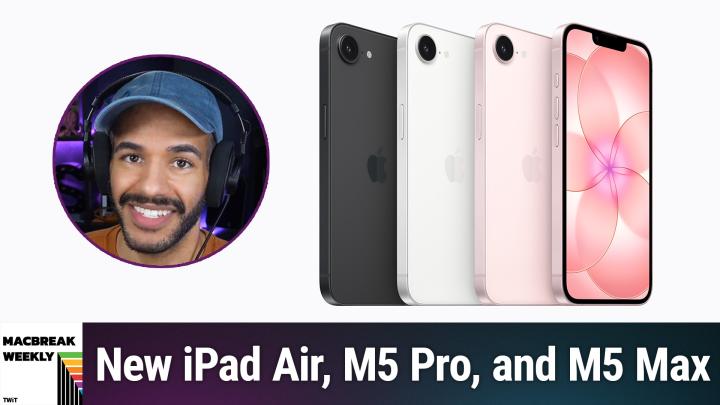
All TWiT.tv Shows (Audio)
MacBreak Weekly 1014: iPhone 17e: The "Enough" Phone
02:12:39
New iPad Air, M5 Pro, and M5 Max Chips
Loading summary
Transcript246 lines
- [00:00]
A
Coming up on Mac Break Weekly, I, Micah Sargent, am subbing in for Leo Laporte. And Apple has released a bunch of new products. We've got Andy Anotko here, Christina Warren, and joined by Shelly Brisbane. We break down what you need to know about the iPhone 17e, the new iPad Air, the new M5 chips, and the new Macs from Apple. Plus some rumors of things to come. All of that coming up on MacBreak Weekly.
- [00:30]
B
Podcasts you love from people you trust. This is Twit.
- [00:39]
A
This is Mac break weekly, episode 1014, recorded Tuesday, March 3, 2026. IPhone 17E. The enough phone.
- [00:53]
C
Hello.
- [00:54]
A
You're probably wondering what's going on because you do not hear Leo Laporte's voice. Well, that's because Leo's out. Hahaha. And I, Micah Sargent, am subbing in for him today. I believe he's in the very humid, very humid Florida. Yes, it is humid, humid. And so I am excited to be joining you today for this, the show known as Mac Break Weekly, where we talk all things Apple all the time. Very excited to be here today in the new era of Mac Break Weekly. Let's kick things off by talking to my neighbor to the north. Hello, Christina Warren.
- [01:37]
B
Hello.
- [01:38]
D
Hello. I'm so happy to be here. Happy M5 days all who celebrate.
- [01:42]
A
Oh yeah, that's right, it is the M5 day. Yes. And we are also joined by my neighbor to the south, Shelly Brisbane. Hello, Shelley.
- [01:54]
B
I was wondering what you were going to do with that, that Micah. And Happy PI day in three days for those who celebrate that, including me.
- [02:03]
A
And last but not least, my neighbor to the east, it's Andy Anatko. Hello, Andy.
- [02:09]
C
I am very, very proud to be this show's first and first and primary line of defense against any incursion from Hessian mercenaries. We are stand ready to defend these borders once again
- [02:22]
A
and you should be proud that you're there to do it. Thank you. This, of course is our opportunity to talk about what we have heard from Apple. Yes, this morning I wake up and I head to apple.com newsroom and I see that Apple has made it very difficult for me to do the shows that I need to do because there are a bunch of new products out and I mean, look, we expected this, right? We've heard about the rumors. We knew that Apple was going to start rolling out products, that it was likely that these products would be rolled out not in some huge news event, but instead from the press releases of it all. And I think we should kick things off by talking about the new iPhone 17. E. Of course, we were expecting that Apple would upgrade its E line. Have we decided, by the way, what we think the E stands for? What's everybody's take on the E stands for?
- [03:23]
C
I, you know, I was writing think about this in Ryan, but this last night, and I decided that E stands for enough.
- [03:29]
A
I like it.
- [03:32]
D
I love that. I love that. No, I think, I think you nailed it. I don't think anybody can do any better. I mean, I was going to be like economy, right.
- [03:39]
B
It's.
- [03:40]
D
It's. Which is, you know.
- [03:42]
C
Yeah.
- [03:42]
D
Really what it is. No, but I think it's enough, right, because the sea was. Was cheap or china or color. It was cheap is what it was.
- [03:49]
B
I was going to try. Okay, true. I was going to try everybody or emerging or something, but yours is so much better.
- [03:58]
A
Yeah, enough. The iPhone 17, enough. And I think that that does a good job of sort of encapsulating what we've seen with this model. One thing that we've seen from Apple, I think lately, I think it was the Apple watch where I saw it happen first and maybe then AirPods after that. Apple has been doing a really good job, I feel, getting a relative amount of feature parity across its lineup, such that there are perhaps not as clear distinctions between the line, which makes some of us who talk about this stuff regularly a little upset, but for the average consumer, really good. And in some ways, I think, Christina, good for us. Whenever someone asks us what device they should get, we can say, oh, it's much easier now to say which one to get.
- [04:50]
D
No, I totally, totally agree with you. And I think that this year the. Enough. Andy, thank you for that, because I am. This is just going to be the enough phone. Like that. That's what this is, I think, becomes a fairly easy to recommend item if somebody is really on a budget. I still feel like, and this isn't true every iPhone year. Some years, like the basic iPhone is just not great. This year, like the basic iPhone17 is so good at that price point that I do feel like it is difficult for me to talk to people and be like, okay, well, do you have. Is there a way you can either finance or get $200 to go to, you know, the full phone, but if you don't, for whatever reason, and there are plenty of people out there who maybe they need a work phone, maybe they need it for a kid, maybe they, you know, just don't have the ability to spend the $200. I feel like, to your point, Maika, they have done a really good job of the feature parody that. Okay, you don't have the front, the really good selfie camera which was the one of the biggest upgrades this year. Okay. You know, the MagSafe isn't as fast. Okay. You have one camera instead of two. But by and large you're going to have a best in class processor. You're going to have, you know, fast enough WI fi, you're going to have a good screen, you're going to have like a, you know, water resistance and, and it's going to do what you need it to do for a long time at a price point that, you know, we, and I think this is going to be a theme of things we talk about this, this show that we used to be begging for Apple to kind of be in this realm. Right. Like I think since the iPhone 10 when they really went to that thousand dollars price point, it's been really difficult to be able to be like, oh, there's like a good reliable every year iPhone that we can recommend. Like when the SE was out, the first year it was out it was a best in class value, especially at $400. But as it was on the market for two or three years. So at a certain point you're like, I don't know if I can really recommend you buying this now. I feel like the enough is because to your point, the features have been so similar across the line for the average consumer and this is true in the iPad as well, which we can talk about a little bit. It becomes harder for us who try to draw those lines, but I think much easier to just tell the average person. Yeah, you can just get the basic and you're still going to have a great time.
- [07:01]
C
Yeah.
- [07:01]
A
And you don't, you don't have to have that maybe opportunity for regret or worry or concern. Like, okay, but you're missing out. I think too to some extent. It gives us an opportunity to learn what Apple almost considers perhaps table stakes. I find it interesting that magsafe is a component of this phone, for example. You know, I was an early skeptic of the wireless charging technology in the sense of I always felt like, well, it still has a wire that's connected to the charger, so it's not really wireless. And so it really bothered me whenever wireless charging first took off. But now I'm a wireless charging person everywhere, Magsafe, everywhere. It's great. Andy, go ahead.
- [07:45]
C
I'm sorry, I was going to jump in because that's such a good point that the thing is like MagSafe offers benefits beyond wireless charging. Like it is now the de facto standard for how do you attach an accessory to this device? It will probably, hey, here's a battery. It just clips on. How do I attach this to a stand or a tripod? Well, MagSafe will just click right on. And it's interesting to think about if Apple is putting this forward as here's what we consider table stakes for an iPhone. Here is what, here's everything that has to be included in the package in order to be able to call this an iPhone. Because this is, I mean this is never going to be a budget phone. Not, not for 599, not for 499. It's more like the least expensive buy in to the platform. And Apple has to really carefully navigate. At what point do we, at what point can we economize on this so much that people no longer really accept this as a part of the iPhone line? They know, they know who's buying this. They have, they have all the marketing data. I personally, when I see $599, I'm thinking, okay, but what if you made the base storage 128gigs and you had a 499 option? I would love to see a $500 version of this. But the thing is, as Christina pointed out, they had an SE model that was even less expensive than that Apple. I'm not saying that that was a bad idea. I love the idea of the most affordable iPhone possible. But the thing is they have all the data that they collected during the sales of that phone. So if they decided to position this as a $599 entry model phone, it's because they are informed by what happened when they really, really super broke the $500 barrier and they decided that either A, that's not necessary or B, a phone that we can build at that price is going to break people's perception of oh my God, I can't believe I finally own an iPhone. Or a, oh God, I'm so glad that I no longer have like that sort of like Walgreens brand Android phone and now I have an iPhone. I can't wrap this up without mentioning that, okay, I seem to be making a good case for yes, consume, become a fan of the brand, be ashamed of not having the best phone and hopefully we can teach kids better than that. But nonetheless, there's something about an iPhone that has to satisfy us. To have that umami feeling when you use it says, nope, this is an iPhone. This is not a really great Motorola $250 phone. This is not a great $200 Samsung phone. This is an iPhone.
- [10:12]
B
I want to go back to what Christina was saying about the se because there's another way that that's a really good comparison. The SE came out and was left fallow for a couple of years. And so I always imagine the, every person, the not me and not you walking into an Apple store or probably more likely a carrier store and they're saying I want an iPhone. And they're pointed to the SE because it's the budget phone. It's the most affordable here it is. It doesn't come in any colors, but it's, it's affordable. And somebod says they may not be fussed about high end cameras or screens or some of those details. They may be willing to make those compromises. But the minute they say so how old is this model? Oh, it's been around a little while, a couple years maybe. But Apple has made a commitment, it seems, and they can change on a dime. But by coming out with the se last, sorry, the 16e last year and a 17e this year, they seem to be indicating that they can make a commitment to this level of phone. And we can argue back and forth about whether the features that we're missing from the 16e or even the ones that are missing from the 17e are ones that would be deal breakers for us. But the fact is, if you can sell a phone that has come out even more recently than the fancy phone over here that you can't afford because it's $1,100, there's going to be a subset of customers who's going to be reassured by that, even if they're not the people that get a new phone every year. This is brand new. This is the 17E. This just came out last year. It's the 16E. Oh, it's the SE. Let me get the dust off of that for. I think that's going to make a difference. And as Andy said, it would be nice if it were lower. I would love a $400 version of the phone. A $500 version of the phone. I don't get my way, but at least it's something that I can very easily recommend. And I should say I recommended the 16e to a few people and I told them the limitations were magsafe charging basically because I don't think many of those folks cared about promotion or always on display to the extent we might. But. But the 17E is really going to be A good recommendation, as is the whole 17 line. If people have more money to spend.
- [12:18]
A
One of the things that I want to talk to you all about to get your take. I was thinking this morning about my use of my iPhone camera. And while I don't necessarily think about switching between lenses, what I have noticed when I really think about my behavior is that I do regularly use different zoom levels, which means that I am using different lenses. But I just didn't, I didn't really think about it that way until I sort of really focused on it. And so the lens system on my iPhone is something that I have found to be valuable and worth what it offers. What do we think? This is sort of like a. There are two ways to think about this. I think this, this question, which is what do we think is the actual practical difference between having this one lens and having multiple? And does that matter? But then also, what about the perception of, oh, you've got the one lens camera. Do we think one of them could end up sort of impacting the other? Where. Okay, it doesn't really matter that you have the one camera because there's a lot of magic happening in the background. But someone's lays down their iPhone and it's got one. Oh, wow, you only have one on yours. You're right, that matters.
- [13:49]
C
It does telegraph that you have the cheap iPhone and.
- [13:53]
D
Or that you have the iPhone. Air.
- [13:56]
C
Oh, okay, well, well, true, I was about to say, but the iPhone here has that big camera bump. But then again, I don't think most people would be sophisticated enough to think about that. So I think you're right. But we just came up through like a sales cycle in China in which one of the reasons why analysts are sort of attributing the runaway success of the 17 Pro is that the orange is such a flashy color that it really telegraphs people who maybe could have waited another year to get a phone can now, but everybody will know I've got the brand new iPhone. So there's definitely something to that. But I think that two observations. Number one, I'm glad that Apple has backed off a little bit from the marketing like folderol that they did with the 16e. Say, oh, well, it's a virtual two lens system with virtual in the tiniest type possible. It's like, okay, the fact that you've got a 48, 48 megapixel sensor and that you're gonna use that as a really great digital zoom does not make it a virtual two lens camera. It means you got a really Good digital zoom. Be proud of that, revel in that. But the thing that I would really, really miss is the lack of the ultra wide because you don't know how valuable that is until you've backed up as far as you possibly can. And you still can't get everybody at the table inside the picture. So that would be the thing that I would miss out on.
- [15:18]
A
How's everybody else feeling about it?
- [15:19]
B
Yeah, a couple things. I think there is a large group of people, both younger people than myself, who, who observe things like, oh, how many lenses does your phone have? Talking about civilians, not, not just Apple nerds who would absolutely look and see how many lenses you have. And then there are people who are motivated by status. A lot of those folks are in China. A lot of those folks are right here in our country here. And so those are not me. So for those reasons I can absolutely see why Apple would differentiate the lenses in that way. Whether it's actually in marketing or whether it's just the status symbol says you have two or three lenses as opposed to one. But I also think that once somebody gets say a pro model or any phone that has multiple lenses, even if they don't perceive themselves as, oh well, I bought this phone for the ultra wide or for the telephoto lens, once they've had the experience of it, they're going to be expecting it. And so if you hand them a 16E or 17E, they'll be surprised and disappointed in ways that they can't really quantify because like, well, why can't I zoom the way I could before or why can't I just zoom really quickly but with the press of a button? I had the experience because I got a 17 Pro, a 16 Pro last year and I had not really bought the pro phones. I've had them around for testing and that sort of things. But my, my daily driver was usually the mid level phone. And so last year I got a 16 pro and my husband got a 16. So whenever I pick up his phone, I expect his camera to do the same thing. Mine does and it doesn't. And so rather than talking quantifying how many lenses or how many different kinds of cameras my phone has, as somebody who is a fairly low level or low impact kind of photographer, you definitely do notice when you pick up a phone that is less capable than the one you have every day.
- [17:06]
D
Yeah, I would agree with that. I mean, I think that if you are going from one phone that had more features to one that has less, that can be more Noticeable, especially in your camera. Although I also think that it kind of depends on what you wind up using your camera for. Like, my mom has had the pro Max series for a couple of versions. I think she had the 13 or 14 Pro Max and then she had the 16 Pro Max or the 15 Pro Max rather. And maybe she had the 12, maybe then the 15. And then this year she opted to get an iPhone Air, which is actually ironically the same camera that I can tell they might do. They might claim to do a few other things in the back end, but. But I think this makes the iPhone air an even worse value for a lot of people because it's essentially the same optics that are in the $600 phone, but it's, you know, $1,000 phone, it's super thin and it's great. And that was honestly why she bought it. And, and I think that. But she did like send me some photos. One that she took with my dad's camera, which I think is like a. An iPhone 14 Plus. So it has two cameras and one on hers. And she was like, why does his look different? And I was like, well, I think they both look great, but you do have a better single lens camera. But to your point, Shelley, if you're used to being able to, you know, adjust things more. And he didn't even have a pro, he just had the standard camera which, which I guess, you know, gave the, the, the wide angle. You know, you can get different types of views for the types of photos that she's taking. It doesn't demonstrately matter and I don't think it does. And I think that by the time ships grace or phone, again, if they do still have an AIR model, they will have figured out how to put multiple lenses in that camera. As far as though people noticing, you know, being a status symbol thing, I don't know, I feel like it's definitely a thing for the pro models, like either by color or in this case with like the 17. Like the fact that the camera array is different signifies I've got the latest and greatest. And so some people really want to show that off. And look, I bought the orange phone and, and, and I definitely noticed when people, you don't have them in cases, other things, I'm like, oh, okay, you know, you get used to the new camera array, whereas you couldn't immediately tell just by looking at what pro Max do you have. Or, you know, now I guess you can tell if you look at the regular model. So if it's diagonal camera or you know, Vertically stacked, what, what year it might be, but I don't know how much that will matter. Someone in Joe in the Discord said that he thinks that the front facing camera matters more to a lot of people. And I would actually agree with that. I think at this point that's the camera that a lot of people use just as much if not more than their rear facing cameras. And that is the one area. And it makes total sense because if you, if they did put the good front facing camera in this phone, you would have zero reason to buy, you know, the, the regular 17 that this would be the one thing I think for anybody who's like looking at getting the 17e, it's like, okay, how much are you using FaceTime? How much are you doing selfie videos, recording for TikToks and Instagram Reels? Other things, because if you are, the upgrades are good enough in this new version that it might be worth spending the 200. If you're, if you're not. And if you're like, look, this is, I'm fine with what my camera was before, you know, what my, what the system was on my older phone. I don't think it matters. But I, I don't know. I mean, school kids are mean and they'll find ways to other people at the same time. I, I don't feel like this is one of those things like, oh, no, you only have the $600 iPhone. Like, come on.
- [20:31]
C
At least my parents are still together.
- [20:34]
B
Going back to my example of our civilian who goes into the Apple Store, the carrier store, that selfie camera is a good opportunity for them to compare. You pick up two phones and you open up the selfie camera. You don't even have to do anything. You just open it up and there it is. And you can see the difference. And that might tip somebody over who would buy a better phone than otherwise would. Of course, you can point the other camera and show the wide angle and the telephoto and stuff like that, but it's less compelling inside of an Apple Store than it would be on a mountain peak or at your family reunion dinner.
- [21:04]
C
Yeah,
- [21:07]
A
there's a lot more to talk about when it comes to the new iPhone as well as we'll get to the new iPad air. But I do believe it is time for us to take a quick break for Leo to tell us about the first sponsor of today's episode of Mac Break Weekly.
- [21:25]
E
Hey, everybody. This episode of Mac Break Weekly brought to you by Space Mail, the professional email service from our friends at Spaceship. A business email is the easiest way to look professional in every message you send and give your emails the best chance of reaching the inbox, not the spam folder. That's why over 2000 users switch to spacemail every month. Switching is easy. Spacemail's super fast unbox process links your domain and email in seconds. And once you're set up, Spacemail keeps everything running smoothly with built in spam detection and a 99% uptime guarantee. New features are shaping user feedback and built around your needs. There's a built in Calendar, an AI email assistant. There are great iOS and Android apps for email on the go. All of that chosen by Space Mail users with more to come. Space Mail is a key part of the wider Spaceship universe. We love Spaceship. And I know if you're a regular user, you know Spaceship offers some of the best prices on domains, plus all the add ins you might need, including VPNs, website builders, hosting and more. So whether you're building something big or launching your first idea, spacemail gives you a pro email address without the pro level price tag. And with a 30 day free trial, you can start today at zero cost.
- [22:41]
B
Yes.
- [22:42]
E
Visit spaceship.com TWIT to see the exclusive offers and discover why thousands have already made the move. That's spaceship.comTwit now back to MacBreak Weekly.
- [22:55]
A
Hello. Hello. Thank you, Leo. We are joined today by a wonderful cast of characters. Andy Anatko, Shelley Brisbane, Christina Warren, all here for today's episode of Mac Break Weekly. Apple just revealed a bunch of new products and we're in the midst of talking about the 17E. You know, we talked about MagSafe, we talked about that camera system. One other place that I want to look to is Apple's ongoing push toward its own connectivity options. It's its own connectivity hardware. I'll be honest with you that when I first heard about the iPhone 17 and the C1X and the modem that we would have in it, I was a little worried. I thought, okay, I get that Apple wants to move to its own hardware, but we haven't had an opportunity for this to be a tried and tested thing. Which made me at times when I was having issues with Bluetooth or I was having issues with cellular connection, obviously the first thing I'm going to think is, is it because Apple's new modem is causing these issues or Apple's new connectivity chip is causing these issues, or is it just genuinely, you know, that something's going wrong, as often happens? So there's been A little bit of skepticism on my part, but we're seeing Apple roll out its connectivity and its modem across the entire lineup. And I just wanted to get everybody's kind of take on where things are as far as that goes. And if we think that Apple having sort of control over the design of this chip is going to have an impact over time on things like the reliability of the battery life expectations that we have when it comes to these phones.
- [24:48]
C
Well, it does seem like everything Apple does really pretty much across everything that they announced yesterday and today. You could really smell how important battery life always is. Where all the way through the choice of CPUs, all the way through the choice of memory, there's always that sort of subtext of and this is more power efficient. They want to make sure they always go forward, never backwards. Like some of these. I mean, we'll talk about other things later on, but like, even with some of these devices, it's like, no, actually we've extended battery life. And so it really is the core philosophy of if we design every widget inside this thing, we can optimize the entire widget from start to bottom in ways that we couldn't when we were relying on Qualcomm to give us our modem. So I think that that's always going to be the premier advantage of switching to a custom modem. A custom Bluetooth chip, custom WI FI chip, and thank goodness, it's like if there were any sort of a widespread issue with this brand new first generation, never released to the public before modem chip, it would have exploded by now. We're not even seeing like pockets of difficulty, which is what quite a neat trick for Apple to pull off or anybody to pull off. Shipping something as important as a modem chip that a has to work 100% of the time also has to work without necessarily violating patents that Qualcomm owns that they don't have licensing access to. I mean, Apple Silicon in general is a success story, but that specifically gets its own little lifetime achievement award this
- [26:24]
B
year, I think, I think it's interesting that they rolled the modems out into the lower end phones first and that in the air. And the air, yes. I think 16e had it first, but then the air got it. Justice for the air. Absolutely.
- [26:38]
C
The ones that aren't going to be the backbone of the iPhone line, right.
- [26:41]
D
Which is the lower sales volume units
- [26:44]
C
instead of quadrillions of sales.
- [26:46]
B
I think, I think it is interesting because it means that it put Apple at a kind of a risk where if you had problems with it, you're going to have not as widespread of problems which are going to have problems among a user base that might be less tolerant of the iPhone, of iPhone devices getting their sea legs, so to speak. The other thing, from a simple sort of pundit class point of view. I'm sorry, I always have to get into these sorts of conversations, but I wonder if the modems have been tested. I'm not talking about the connectivity chips because I think that's a totally different story, but I wonder if the modems have gotten as much rigorous testing with as many carriers and as many circumstances as they would if they were in the Pro and the Pro Max phones. I'm glad that there haven't been any problems to report from people who may not be pundit class testers. But as somebody who follows this stuff and who reads a lot of news, I just didn't see all that much detailed testing of performance with the modems with multiple carries. I think Jason actually was one of the few people who, who wrote something about the 16e and the modem and maybe the Air 2, I can't recall, but because he has some, some, some carrier connectivity issues in his area area and he was able to sort of test those out a little bit. But I, I do sort of wonder whether it would have been put through its paces differently if it was in the Pro and Pro Max. But fortunately for Apple, it seems to be faring pretty well where it is.
- [28:09]
D
Yeah, I mean, and I have to think that they did this by the design, right? Like they've been wanting to move to their own modems for years. They've been wanting to get out of this relationship with Qualcomm for quite some time. They acquired, I believe it was like Intel's, you know, modem business to help build this out. This is clearly a thing that they want to be able to own the full stack so that they're not reliant on Qualcomm in this way. And I think that it does make sense that as you test this out to your point, Shelley, like you. Yeah, I mean, I think if you're going to put this, your best selling product from, from what you know, we've heard is the iPhone Pro. And so before you put it in that best selling model, I think you need to do testing. And so you start with the, the lower end, the 16E, then you go to a more niche product like the Air, you put it in the iPad Pros where if people are going to buy an iPad with with connectivity with, you know, 5G, it is almost certainly going to be the Pro. Yeah, you can do it with the air, but almost everyone is who's going to, you know, shell out that extra $200 is going to be getting an iPad Pro. And then you kind of look at what your data is, you can get refined things. You know, they've already, with the C1X are claiming that it's, you know, twice as good as the one that came out, you know, a year ago. Better battery life. And then we will see like when Apple feels like, I feel like when they do put it in the Pros and the regular models, that will be to me kind of Apple saying, okay, we feel confident enough that this can go in our flagships and that we're not going to run into issues. One other point I want to make though, I mean, because Apple can own the full stack, one of the advantages here, and granted it does require carrier participation, but in iOS 26.3 and later, they added a new feature that says limit precise location, which basically allows you to limit some of the information that like the cellular networks can use to determine your location. And from a privacy, be from a privacy perspective, I think this is great. In the United States, I think it only works on Boost Mobile. So like, again, like, carriers have to opt into this. But this would be a feature that I would, especially if, like, you know, the carriers that I use and right now I'm on T Mobile meant for, for one phone and Verizon for another, you know, if they would support this and granted they probably wouldn't want to, but if they would like, that would be a feature that I would enable immediately and that I think that Apple can only do this sort of feature where they can still sell their brand of privacy. We're not going to give all of your location data and let people track you and sell this and do all this other stuff to the same level that others can. And they can only do that if they own the full stack. They own the hardware and the software. So there are some upsides, I think, even for end users potentially from these modems too. But so far, and you know, I've been a little bit relieved that I haven't had to try out the new modem. I think, you know, to, to your point, Shelly, because I've been like, okay, is this going to work though? And I'm glad that Jason has tested it in some areas that have connectivity issues. But it is always kind of that question like, okay, is this, is this actually going to be an Apple Silicon moment, or is this going to be like the BT modem and that. I just don't think we know yet.
- [31:07]
A
Yep, that's. That's worrisome. Yeah. Again, I think that's the big thing. We just don't know yet. And so knowing that it is an important aspect of Apple's, you know, design plans going forward, seeing the success we've seen with Apple Silicon. Right. Like Apple can make its own chips and can, can design its own chips and do a good job with that, but it is certainly something that, you know, there are times where the. We build it all, we design it all, we run it all is positive. And then there are times where you're going, now what if maybe we considered that someone else might be better at this specific thing and we don't want to mess up something that's. Or we don't want to fix something that's not broken. That's certainly my concern.
- [32:00]
C
But I think that Apple has proven that they're actually good at identifying their own frailty. Again, you just have to point to the deal they made with Google to say, you know what, what if you build us a foundation model to. To our specifications? Because we realized that we are in the middle of a whole bunch of IKEA furniture parts and we lost the instructions and the little l Rat racket things. We just need help. So I feel as though if they were buried, they would not rely on their own technology if they did not feel as though it were up to the task. And I don't think they've had. I can't think of another. Okay, I was about to say, I can't think of an incident in which they decided to basically experiment on its own users to figure out what's wrong with the technology. But of course, we're all using iOS, Mac OS 26, so that. That's. That argument goes away.
- [32:49]
B
I think they might feel more confident with reason in their hardware prowess. I certainly do.
- [32:57]
A
Yeah. So let's. Let's go ahead and talk about the iPad Air again. I'm curious to hear everyone's take on what it means for a product to get the AIR tag, and pardon the pun there, the AIR nomenclature. What is it that makes a Device an Air vs. A? And for anyone who's listening, that was just a stop because there's nothing after it. So iPad or it gets the Pro designation. Where does the Air fit in this, Shelley?
- [33:39]
B
Well, the Air used to be. And when we think about MacBook Air, we thought about Thin Light, bottom of the line. But that hasn't and probably will not for very much longer be where the MacBook Air is and the iPad Air, especially with the last revisions when we went to the M2, it really became the sort of big middle. So Air is not that light fluffy thing over here. It's in the middle and it might have some special features, but it's kind of the every person's device that's not consistent though the iPhone Air is not quite that and the MacBook Air is still perceived as. And it's certainly cheaper and it is the sort of light, lighter duty machine. But I think both the MacBook Air and the iPad Air can be. It can be argued that those devices really are for the every person that doesn't need the absolute power features and who might want something that's a little, little lighter weight in terms of terms of price and in terms of features. So that's a really interesting transformation.
- [34:40]
D
Yeah, it really is. I mean when you, when you think about like when the Air was first introduced, you know, 18 years ago or whenever it was Steve Jobs pulling it out of an envelope and it was very much this high end aspirational product and that failed and then they immediately pivoted and said, okay, this is going to be a little bit lower, lower end and more, you know, price more affordably and kind of replace the MacBook in a lot of ways. Right. Like we'd had the plastic MacBooks and really the drop in for that. They, I think they still sold an aluminum MacBook maybe for a year or so. But the MacBook Air essentially became that and to Shelley's point, I think essentially became kind of like the everyman computer. Right? That was the one that you got at your office, that was the one you got like for college. That was the laptop. Then they abandoned that for a while and stopped kind of updating it and then, and kind of, you know, Wolf did a little bit at the end of the intel era, in my opinion when they did the iPad or the MacBook Air Retina and then really came back screaming in the Apple Silicon era where I think that especially as. And we don't have any, you know, specs or any review embargoes I'm sure are going to be, you know, saved until next week or so on the M5 iPad, MacBook Air. But you know, when you look at the M4 numbers, there were a lot of cases where you could say depending on what you're doing, there is absolutely no reason you need to actually spend more money on a MacBook Pro even for higher end tasks because it's just a tremendous laptop. I think the iPad Air is a little bit trickier because in some ways, yes, it is kind of that middle everyman iPad that everyone can kind of aspire to get. And it's, it's, it's, you know, good enough. It's better than good enough. It can still support some of those higher end features. It annoys me that Apple continues to like basically hold back the, you know, high refresh, you know, 120Hz screens from the iPad Air. Like I, in a lot of ways I don't want to buy another iPad pro because the way I use my iPad is frankly not really commiserate with needing to spend, you know, eleven hundred dollars on an iPad. It's just not having said that, because I've had an iPad Pro since 2016 and then the 2018 model was the one that really kind of redefined everything. I can't go back to a 60Hz display on my tablet. I just can't. And so I think that they make weird demarcation lines between what is what. That doesn't quite make sense. And maybe part of that is just because they haven't done enough to differentiate on IPADOs to make sense why you should be spending, you know, eleven hundred dollars, twelve hundred dollars and up you know, on, on those devices. So I think that it's. But, but I, but I, but I agree with that. I think that it's almost like the phone notwithstanding, because the phone I think is a completely different thing. And I think that's why the nomenclature around the phone is, is probably off. I feel like air is just like, yeah, this is the, this is the one that if you just needed to go in and buy a MacBook or you needed to buy an iPad for a lot of cases, this is going to be the one. I might argue that the base iPad is still better for some people, but in terms of laptops, I mean this might change tomorrow. It's just like, no, just buy a MacBook Air.
- [37:51]
B
It's funny what you're saying about the iPad Air because I had an iPad pro primarily because it was available in 12.9 inch size. I wanted a big iPad. And when it came time to upgrade that to an Apple Silicon version, this was for work. So I was getting it paid for. They offered to get me an iPad Pro. I think it was the M2 at that time, M2, M3, I can't remember. And I said no, you don't need to do that just give me an iPad air. It's not that I'm a magnanimous wonderful human, it's just that I really didn't need it. And I mean I work for a nonprofit, so why not? But I love my M2 iPad Air. I love it, I love it, I love it. I personally don't have an issue with the refresh rate. I get it for people who do. I absolutely do. And I know that that would add cost. And I like the idea that I have the two things I want most. An iPad air with a good processor and a large screen. So for me, like I have a very old, I think it's an 8th or 9th generation iPod iPad living on my living room couch just as a consumption and a looking up things device. I wouldn't use that for any sort of work. But this M2 iPad Air and any upgrade that I might get in the future, it is very satisfying for me as sort of an everyman computer.
- [39:02]
A
Yeah.
- [39:03]
C
I think one of the challenges for Apple is that everybody defines their iPad in a different way. Like is if I. There's so many think pieces about writing about, oh, is the iPad really, can you use that as a notebook? Like, no, I choose to use it as an iPad. However, there are a lot of notebooks or things I can do with it. But it's interesting to look at the demarcations between like all of the different iPad models because it's not when I see air. I mean, you're right, Christine. It's like you see the air and it's like, oh, so that's like the ultra compact, ultra thin. It's like, no, that's kind of the mid range model. Right now it's more of the air. Kind of how the MacBook Air became actually not even the mid range but the entry model. So even that kind of collapses. You look at the specs of this new iPad air and you see like, okay, so they decided that because probably because iOS is now doing a lot more in your face multitasking and multi windowing, lots of people are going to be wanting to run lots of apps side by side. So let's up the RAM to 12 gigabytes. Great. 128 gigabytes of storage, not 256. That's kind of a disconnect between the idea of people are going to be using this for a lot of stuff. So we better give them a lot more RAM. The 60Hz, it's the only consistent thing across the board on Apple products that makes them look Old fashioned and out of step. And because I don't think that Apple is unaware of that sort of thing, I have to assume that this is getting back to power. It's like, how much will it cost us in battery life to Increase to get 120Hz variable refresh rate display? And are people going to be happy about the 120Hz? And we're not just talking about the pundits and reviewers or the gamers. We're talking about the people who are coming to the Apple store to buy something for their kid to have as their main computer. And they probably did the math and realized that no, 60 hertz is fine so long as we can preserve the battery life that we're promising everybody. Even the airs, like the CPU, it's an M4, but it's a binned M4. Meaning it's kind of like, I don't want to say the rejects off the pile, but that's kind of like what binned means. It means that, okay, some of the cores on these M4s are not functional or not up to spec. So therefore we're not going to put them in like the MacBook Pro or the Air or something like that. But if we have a lower, we have them, they're manufactured, the rest of the cores work. So they're still more than powerful enough for an iPad. It's just in a weird space again. I had to kind of refresh myself in the last minute again. What is the difference between the iPad nothing and everything else? And of course the big difference is that the iPad nothing is a series cpu, which is fine for a lot of people. And also it's, it's the $329 price point which to me is the most spectacular bargain that Apple offers anywhere. And nothing can, nothing can challenge that. Nothing can be allowed to compete with that. Excuse me, Nothing can taint that, no matter what Apple might be proposing. But it does get confusing. The longer a product line goes, the more you type saying, well, we need something that's between this platform and this platform. What do we call it? That makes sense. And, and you go from something that was very simple. There is the base model, then there's the Pro model, there's the base model, then there's a pro model. And now across every line it's like, do I want the Mac Mini? Do I want the Mac Studio? Do I want to wait for a Mac Pro? Do I want the MacBook Pro? Do I want the MacBook Pro that has the weaker intro version of the same processor. Do I want the MacBook Air or do I want what's probably going to be announced tomorrow morning? And I'm sure we'll get to that later because that was an interesting leak that came out of an Apple like legal filings that great. They decided to give this a brand new name that is can't be really confused with any other product line. I hope that they take that and make that into kind of a policy moving forward that if we're going to insert a new product into the product lineup, we are not going to create confusion by making people think, oh, it's the air. Which means that if I know, please try again. I know I went. I was talking too long. Siri, I'm very, very sorry. I mean, this is a shared experience where I can now see the screen around my iPad flashing. I know that, oh God, I hit a trigger word. And at some point it's going to interrupt me, isn't it?
- [43:24]
A
I have to turn off it. And you called it. And honestly now with if you had the new iPad Air, maybe it would have been a little bit smarter and known that you were not actually talking to it whenever you were doing.
- [43:37]
C
It's an M1, but it's a real M1, gosh darn it.
- [43:40]
B
It's not pointing out. I guess it's worth pointing out that the iPad air, unlike the MacBook Air, did come out in the middle of the line to begin with. And the Air at that point was to do with its thinness. And it, you know, it's not, it's still, it's more on an iPad Pro form factor. It's not as. It's not. It is thinner than the basic iPad, but it's pretty much the same as the iPad Pro. So it's like, wait, what does air mean?
- [44:05]
C
Yeah, exactly. And yet when you look at the spec, when you look at the physical specific of the MacBook Air, I think it's been a couple years since I checked it out, but it's thinner at its. It's thinner, definitely thinner at its thinnest edge than the MacBook Pro, but at its thickest edge, meaning how thick a thing can you wedge into your bag? It's still not that much thinner than
- [44:24]
B
a MacBook Air, and the weight is not that much different. I have an M1 iPad Air. Sorry, M1 MacBook Air and an M2 MacBook Pro, and they're very physically identical in terms of weight and, and just heft.
- [44:37]
C
Yeah, I'm not advocating like a merge between the iPad platform and the Mac platform. No, no, but I imagine like you talk about super, super.
- [44:47]
B
Don't start that stuff, Amy, come on.
- [44:49]
D
I won't.
- [44:49]
A
No, no, no.
- [44:49]
C
Again, people get freaked out. That's why I wanted, I wanted to, I wanted to preclude people in the discord, like immediately leaping on. No, I'm not advocating that. All I'm saying is that when I use my 12.9-inch iPad Pro and its magic keyboard, that if it were running Mac OS, that would definitely be a MacBook Air, emphatically and unquestionably the Air version of this platform. And I'm kind of hoping for some kind of a redesign of the MacBook Air that makes it look a little bit less, I don't know, stick this under the table leg at the coffee shop to keep the chair from wobbling sort of thing.
- [45:25]
D
The interesting thing though, you say that like Andy, like about like the, you know, the 12.9-inch, you know, iPad Pro and a keyboard is basically a MacBook Air. You're not wrong. Except, and I think this is kind of an important thing like that Shelley pointed out, like the, the amount of storage you're getting. This is the interesting thing. And all the other products that Apple released this week so far, the iPhone 17e now has two 56 basic storage. They've upgraded like the basic storage on all, all the MacBook Pros to one terabyte, the MacBook Air to 512. But on the, on, on the iPad air, it's still 128 gigabytes.
- [46:04]
B
That's weird.
- [46:05]
D
Which is egregious.
- [46:05]
B
Very weird.
- [46:06]
D
Which is egregious because I like, I was going to buy my mom an iPad air for, for Christmas. We wound up getting the regular iPad for a couple of reasons. One, because she was coming off of an eight year old iPad. So for her anything was going to be, you know, a really nice upgrade. But two, this was the real thing. I didn't want to get her the 128 gigabyte version. And then to get the 256 gigabyte version, we're now talking $700 for an iPad that she's only going to use to watch Netflix on. And I can't do that, right? I'm like, no, I will spend, you know, $500 with a case, but I'm not going to spend, you know, upwards of $800, 500 with the case in AppleCare. I'm not going to spend upwards of $800, you know, because that is MacBook Air money, like that, that, that, that literally becomes MacBook Air money. And so that is where I sometimes like look at where this line is and I'm like, okay, once you add a keyboard, once you add other stuff, you actually are priced much higher than a MacBook Air would be to get all the accoutrements for whether your iPad Air or your iPad Pro. And, and that I think is interesting, right? And I think that's a problem with the iPad line in general. Except for the, the base model, which I agree with you, Andy. I think that's one of the best deals in tech. $329. But everything else, it's like by the time you add in all the accessories that Apple claims, you kind of need to really use this thing. You're using a subpar operating system and it now costs more than a very good and non bend, you know, like, like laptop that has, you know, an actual operating system Grant has a touchscreen. It can do things that you can't otherwise. I understand all that, but I'm like, okay, if you're gonna go as far as buying the keyboard and buying all that other stuff, I don't know guys, you know, if that's the primary use case, you're probably better off and saving more money getting a regular iPad and getting a MacBook Air.
- [47:53]
C
Yeah, you're absolutely right. I spent as much on my MacBook, my iPad Pro and the Magic keyboard. Even though I brought the magic keyboard on drop like for like half price after I found whatever. Even so, that's about the amount of money for this 512 gigabyte machine that I could have spent on certainly a mid range Windows laptop, a really hot mid range Windows laptop, or a very, very good MacBook Air. And again, it's so weird that you cannot quantify what is it that draws an iPad owner to having an iPad. And I won't go get into a rat hole about that side quest. But it's like for everybody, it's such a completely different thing. Some people really want to, hey, I love my Kindle, but I wish it were color and I wish I could watch HD movies on it. So great you've got the iPad. Nothing. Like I really, I don't need a laptop so much. I just need something for like weekends when I'm away from the office or weekends where I need to keep in touch, get a few things done. Great. Maybe the, maybe the iPad air, only it'll still cost you as much as again, a low inexpensive mid range Windows notebook. But it can. It'll be more, more stable and less, less trouble with it. It's just really, really weird to try to quantify that. And I think that that's probably the reason why there are so many damn models of these things. Because Apple knows that again, it knows its customers. It knows that selling to a lot of different people for a lot of different reasons, it has to put the chips on the roulette table and cover as many bets as possible.
- [49:21]
B
Well, I'll give you one use case for the iPad Air that makes an iPad specifically helpful to me is that I need a device where I can physically move the keyboard and the display away from one another. And so I put my iPad either in various stands or I have the Logitech equivalent of the magic keyboard, which is a case that you can set. It's a Bluetooth keyboard and you could separate it from the case, even though the keyboard is magnetically stuck to the case during storage. It's a brilliant thing. And I don't have to have the two pieces together. I have my iPad right here in its stand, separate from its keyboard. And so I use the iPad as a teleprompter also when I'm talking into microphones. And so that's the kind of a use case. But Christina's absolutely right. It's really frustrating that a device that I want to use for work and for creativity, I'm going to have to invest more money in it if I want the storage that I really need. Plus, I have actually purchased three keyboard, not keyboard cases, but three cases for this iPad air because one of them has a handle on the back that I use when I go to make presentations. And so I hold it in a way that's more secure for me. So I've invested all this money in cases for this iPad that air, which is, you know, it's not everybody's used case, but it's mine. It's very annoying.
- [50:31]
C
Yep.
- [50:31]
A
Use case, haha. All right, we have a lot more to talk about here. Apple didn't just stop at the iPhone and the iPad. The company released some more hardware and we are likely to see even more of that. But it is time for us to take another quick break for Leo to tell us about the next sponsor.
- [50:53]
E
This episode of Mac Rig Weekly brought to you by Pebble P E B L. Here's a quick question. If you're hiring, your company's hiring in another country right now. Maybe you already know this. We found out once you do, things get complicated fast. But that's where pebble can help. You can send offers to anyone in the world in minutes. Get them onboarded fast. Pebble is an AI powered global human resources platform built for founders, built for HR leaders who don't want the headaches of global employees and operators who are hiring and supporting teams all around the world. Some of the best people aren't here. Pebble helps you hire, pay and manage talent in over 185 countries with fast onboarding that can be done in minutes. Instead of juggling separate tools for contracts, payroll, benefits and compliance, pebble brings everything together with built in guidance and local expertise to support you. That's especially helpful if you're managing teams internationally or planning to grow. The fastest growing companies in the world use pebble to stay organized and reduce risk and founders use it to scale faster without having to become HR or compliance Experts. Rated number one in compliance on G2, the customer testimonials speak for themselves. I'll give you an example. Paige needed a global talent to align with its bold mission as a digital diagnostics company revolutionizing cancer pathology Using AI, Page's VP of Finance and Operations said, quote, over the past year we've doubled if not tripled our global headcount. That growth has been largely thanks to our partnership with Pebble. Bottom line, it simplifies global people operations so you can spend more time growing the business and supporting your team. Pebble's new standard Discount pricing is 399usd per month per employee. It helps you contain costs. Go to Hypl AI to get a free estimate. That's H I P E B L A I for a free estimate. Hi pebble. Now back to MacBreak Weekly.
- [52:57]
A
Here we are. Thank you Leo. Of course Apple has revealed by way of its newsroom several bits of new hardware. We've talked about the iPad air with the new M4. We've talked, well new to it, M4. We've talked about the iPhone 17e. But the company also debuted the M5 Pro and M5 Max chips. And Andy, I believe you said you were, you were doing some homework leading up to this and looking at the architecture here. What, how much of your homework were you able to complete since this was announced?
- [53:34]
C
Basically like they went to a lot, a lot of detail on it as as they sometimes do. They actually gave it its own own newsroom release and its own landing page for everything because I think it was very important for them to land the concept that again it's really just like we were talking about a moment ago that yes, it's a MacBook Pro. But there is the MacBook Pro and then there's the MacBook Pro, and this is the MacBook Pro CPU just because it has an M5, okay? But it's not the. Is it the M5 Pro or the M5 Max? Because those are the ones that are just hessian aggression, as powerful as you can put on something you can pick up and carry with you. And so there are some interesting details here. Most of my notes from reading it is that compare and contrast how they used to promote the most powerful MacBooks in the lineup five years ago with how they're promoting it now. Where it would always be about, hey, look, you can actually look how well it works with Final Cut Pro Pro, how quickly can build and compile like your project. And of course here in 2026, it's all about AI because these are the people who are spending up to 7 to $8,000 on a laptop. You can configure this like up to what, 200 and up to 64 gigabytes of RAM has a little bit more battery life, but they don't care about battery life. All they care about is really, really real performance. And they're hitting all the bases. They're making sure they hit the points that, that like, here's the most powerful GPUs we've ever had. Up to 20 cores in the lesser one, up to 40 cores GPU in the max, which is not just for GPU processing. Better ray tracing. Our RAM has been optimized for large language models and large 3D data sets. Again, on the max, the bandwidth is twice on the M5 Pro. On the M5 Max, it is on the M5 Pro Pro, like something like, I'm not going to say, but 600 versus 300, which basically shows you that they just want these pipes to work extremely, extremely well. And the broadness of this is that this was actually in a caption on one of the illustrations. But I thought that it was significant that they were saying, they're basically talking about, if you are a developer, we know that you're probably going to be interested in a genic code generation xcode. This is the CPU you want for basically agenic assistance in developing software. Because these are the people with the money and the budget to basically max out pretty much anything as far as technical stuff. Again, this is definitely beyond what I can talk about intelligently after only about 90 minutes of research while brushing my teeth this morning. But the other thing, but at least the thing they're trying to make sure that everybody knows about is that something that actually we knew about because of rumors a few weeks ago where they're calling it the Fusion architecture, where they put two 3 nanometer dies on the same system on a chip. So, and this was kind of feeding into discussions about why the Apple Store no longer gives you sort of like a range of baked goods for each model. And now everything is pretty much built to order at a very, very low level of CPU and stuff like that. I mean, as it is, it becomes really, really tempting to decide that again, if you have that kind of money and if this device is being paid for by somebody else and it's not a nonprofit and you have a soul, you might. I mean, you're looking at what can this machine do that a Mac Pro couldn't be able to do like three or four years ago? And the idea of a seven to $8,000 MacBook that is designed for really, when you look at it, it's designed to run features that don't exist yet that haven't been promised and won't be delivered for another year or two. This is the ultimate in future proofness. It goes like stink.
- [57:30]
A
Now that's an interesting thing that you say. It's sort of future proofness. Right. I'm curious what Mac buying habits look like overall. The reason I say that is because when we hear from people in our community, it does seem like buying happens perhaps more often than you would see from, from, you know, the, the average person. Right. And so there is, I mean I'm, I think my, my MacBook Air is an M1 and. Or no, it's an M2. It's an M2. My Mac Studios and M1 and these machines are still fantastic. They still.
- [58:13]
C
I'm running a M1 MacBook Pro and this is. I've been waiting for a really, really good performance excuse to upgrade because I've been sort of in my own books. I've been upgrade eligible for the past two years, but nothing I've looked at has said that this is going to be a transformative experience on my 4 or 5 year old M1 MacBook Pro. I think the M5 series, even the base model might be the reason why I upgrade this year. But not necessarily even now.
- [58:36]
A
Christina, you were on clockwise recently and talked about your, you know, perhaps experimentations around what Mac Mac you would be purchasing. Has any of that changed since we last spoke? Maybe you could clue for people who don't watch that show or.
- [58:54]
D
Yeah, so I had been, I already had a, an informatic Mini. But I didn't know and obviously didn't introduce, introduce a new one. I've been concerned that if they introduce any sort of refresh to that device that it would be priced higher than it currently is, especially if you get it in the education store. And so I was like that's a really good kind of all around computer. Should I go ahead and buy one? Leading up to this, I did not. But I do have an M3 Max M3 MacBook Pro Max in 3Max MacBook Pro 14 inch. And I replaced that with an M1 MacBook Pro M1 Max MacBook Pro 14 inch. And I have to, I have to be honest with you, I, I wish in some ways that I'd kept that M1 Max because I think that it was, it had 64 gigs of RAM. My current machine has, has 128. I don't know in some of the LLM stuff that I've that I do and I do do a lot of local LLM stuff. I don't know how much that would have mattered especially as I've had access to other devices that have, you know, more memory and the battery life on it has been not as good, you know, because it's a beefier machine and whatnot. Like there, there are these, these things that I'm thinking about. I just, I, I don't know if the M3 was a great year, let me just put it that way. I feel like the M1 was like a fantastic year and, and I think the M4 year was really strong. We'll have to wait to see like what the M5 year looks like. My only critique or only thing I would kind of warn people about if you are going to be spending 4000, 5000, whatever it was. Because I think my MacBook Pro that I got it was, was over $5000 by the time I, you know, got it all done and I was able to sell, you know, my, my other unit that was two years old, you know, for, for a decent. Well, I gave the guy a good deal, but it was still very expensive. Let me put it that way. If you were looking to do that and it is not because you can immediately write this off and like money is not an object. I would actually say get the 16 inch if you're going to be going for the max chips, especially those higher core counts and, and the higher RAM counts because the 14 inch chassis just doesn't have the heat, just doesn't have the cooling.
- [61:10]
B
Oh, that's interesting.
- [61:11]
D
That, that would, that would, that would be like my own kind of lived experience is that the battery life is significantly worse than what you expect it to be. And what I did seen with my M1 Max, which I loved about it was oh, when I'm not really using this that heavily, I can kind of use this almost the same way if it was a MacBook Pro or a MacBook Air and I can get like great all day battery life. That is not the case now. And you know, it just the smaller chassis I think just, just limits it because of how, how powerful those chips are now. It's possible Apple has with the 3 nanometer process has been able to really refine things. The M3 was the first, first attempt at that and maybe they've gotten better. But I could even just tell you like looking at the difference between like my. I had an M4 MacBook Pro, it was a 16 inch last year that was great and had like all day battery life. I now have an M4 MacBook Pro 14 inch. That is I, if it's a Max chip then it's the, the lower core one. But it does, it has, has less RAM, has 64 gigs of RAM and that was one has significantly better battery life than mine. And I think it's just because of the, the core count. And so that, that's, that's my only kind of thing is to say get the bigger model if you're going to be spending the five grand anyway. If you're going to be needing the smaller model, look at, look at not going completely all up because for me that wound up at least in terms of using it like a laptop being kind of liability. If you're going to have it plugged in all the time, maybe it doesn't matter but at that point like maybe a Mac Studio is the thing you should be looking at. But if you're going to use it as a laptop, I would actually recommend if you're going to go for like that super high like 40 core machine, get a 16 inch. Even though it's more of a pain to carry around.
- [62:48]
B
I was fascinated with these announcements that we didn't get a Mac Studio with the same or similar specs. And I am aware that the laptops are the number one thing that Apple sells, especially the MacBook Air. But on the Pro side, the Magic MacBook Pro is very, very important. And I can see why they would go out with the M5s, the bigger chips for the M5s, for the MacBook Pro first. But why not the Mac Studio at the same time? With, with similar specs because those are very expensive machines too. You have some opportunity to expand them if you want to. Now, obviously not change the cpu. And if you're talking about a machine that you're going to primarily use at, at your desk. And if you, if you don't need a laptop or if you, you go and get a MacBook Air, for example, I think a Mac Studio or even a Mac Mini, but they're not going to come out with something beyond that right away. I'm just really surprised that the Mac Studio has not been something that has been kept right up to date with the chips as quickly as the MacBook Pro. Especially since we're promoting this fusion architecture that Andy was talking about.
- [63:51]
C
I imagine that it has to do with production quantity, that if you can only make so many of these M5 pros and maxes, you want to put them in the machines that you sell, as many as you can possibly make. But of course that's just a guess. But I'm speaking from the point of view of someone who again, has some money under the mattress for an upgrade to a MacBook. And I don't think I've ever been more confused as to what I'm going to do. I mean, one of the things I wanted to, to ask you, Christina, initially, just in the context of a MacBook Pro, is that what is the benefit of if I have a fixed. Not that I have $5,000 to spend on a notebook, but conceivably if that were my budget for $4,000 for my budget, how do you navigate the difference between I'm going to get the hottest CPU I can, figuratively and literally I can possibly get this amount of money and then whatever RAM I have, whatever storage I have, I'll just deal with versus I'm gonna settle for a less cooked machine like the entry level CPU that's in the MacBook Pro M5 and have the money and the budget to max out RAM and max, not max out, but get so much storage that I never really have to worry about SSDs. And then when you add on the MacBook Air and now I'm looking, there are so many features in there that I would have ascribed to the MacBook Pro. But now I'm like, like maybe I could take even less money than that and say I'm going to buy an absolutely maxed out MacBook Air. Given that my experience with LLMs, I'm mostly doing stuff on servers. I'm okay with not having local performance on that. It's like, where do I put all of this money and can I just max out something versus get the cheap version of the best?
- [65:39]
D
Yeah, honestly, I think it's a great point, right? It's, it's confusing and I think it depends on what you're doing. If you're primarily doing, you know, kind of day to day work stuff, maybe a little bit of video editing and other things. Like I honestly say, depending on the number of displays you're going to connect. To me, that, that, that has to be a consideration. A base MacBook Air could not be MacBook Air, but maxed out MacBook Air could be very good. But I actually feel like, you know, maybe like the, the base MacBook Pro and having it at 48 gigabytes, like that could be like, like a fantastic machine and then spend more money on the storage if that's what you need to do. And if you have leftover money, hey, get another iPad or get, you know, something else. Like, you know, put, put it, put it, put it aside for something else. For me, I specifically bought the machine that I bought because the local LLMs were starting to become a thing and I knew that I wanted to work with that. And so that was a primary use case for, for my thing. And that's why I was like, I want as much RAM as I can get and that's what I'm going to do. And it's been used useful for that. But I also have a Framework computer and I have access to, you know, servers that I can, you know, use GPUs on. But for me, for doing local LLM stuff, I was like, I'm just going to max that and do what I can. And what I found is that yes, it's great, but if you're doing that, my only piece of advice is, you know, really look at like the reviews and on the thermals on that 14 inch because I don't feel like that the chassis is up to par for what that needs to be. And it's not that it can't run it, it's just that your battery life is going to be trash. Whereas the 16 inch, yes, it's more of a pain to carry around. It's a little bit more expensive, is going to have a lot more headroom. So that's my only advice on that end. But for someone like you, yeah, I think you're kind of in a mixed spot. But I, but I feel like just doing like a, you know, a, you know, the M5 Pro chip, you know, with like the 18 you know, core, you know, 20 core and you know, 64 gigs of RAM would be, be like amazing, right? And then you could spend presumably some of that money. Like I, I just put this out there, granted the education pricing, so this is probably $100 less but, but you're, you're, you count as a student. So it's for the standard display, the M5 Pro chip with 18 core CPU, 20 core GPU, 64 gigs of RAM and 4 terabyte SSD. So 4 terabytes, you're looking at 3679.
- [68:00]
C
Nice.
- [68:01]
D
Which is, you know, still a lot of money but like, you know, not,
- [68:06]
C
not insane for what?
- [68:08]
D
Not insane. And that is with a chip that if, if it goes based on history, unlike the Max chips which do run really hot, is still going to give you really good battery life if you are in a space where you can't be plugged in all the time.
- [68:20]
C
That's a really good point.
- [68:21]
D
You know, I feel, I feel like that's probably that that's again, we need to wait for the reviews and, and talk to Jason based on he's gonna see. But that would be kind of like my, my first kind of like go around would be just kind of getting, doing the step up upgrade of that MacBook Pro chip that's not quite the Max and, and then you know, spending some of the money on the ram
- [68:42]
C
and it's a really itchy situation because like again, I'm very, very happy that I, I take good care of my, of my hardware because I paid for it myself. And so again I'm very, very pleased with Apple that they've made a MacBook Pro that again, four or five years later, I'm still not really seeing reasons for me to upgrade. Certainly not because of anything's broken on it. Again, the keyboard's great, the screen's great, everything's great. But the thing is now there's, with AI creating so much uncertainty, what if I decide, you know what I'm going to max out something with lesser onboard neural engines and then two and a half years into this machine's life, something like OpenClaw comes on. But imagine something like OpenClaw, but it doesn't stink, it's not terrible, it's not dangerous, it's actually useful, it's actually productive. It's cheap to run and I can run, but I have to run everything locally. I don't want to be the person saying, oh gosh, it must be nice to have to be able to start my day eight minutes after I wake up instead of two hours after I wake up because I don't have a magical assistant that's doing things for me. Oh, well, I'm glad I got that four terabytes of storage instead of the better cpu.
- [69:50]
D
Right, right. No, I mean, I think that's a great point, but at the same time, like, Openclaw runs really well on a base MacBook Mini or Mac Mini.
- [69:58]
C
Right.
- [69:58]
D
So. So I think, you know, it kind of comes down to local alums and obviously it's because it's not local, but. Yeah, but if you were to have a local one, and you're right, that that could happen. What could also happen, though? I mean, I, you know, I, I always feel like it's my, my, my going philosophy is always like, buy for what is today, not tomorrow. And I do feel like I maybe got a little ahead of myself last time, where I probably would have been better off waiting a year to upgrade my laptop. To be honest with you. I feel like this is probably a much better year to upgrade. And if you were gonna go all out, go all out, my, My only advice would be if you were gonna, you know, do the full max chip to get the 128 gigabytes, because you've got to do that to get the maximum, maximum ram.
- [70:33]
C
Yeah.
- [70:34]
D
Consider that the. It's going to get. It's a much hotter device. That's super, super experience.
- [70:42]
A
All right, we should talk about the kind of full gamut then of hardware, given that we've talked about the chips, we've talked about some of the possibilities there. Look there. I think people, if they've taken a cursory glance or a cursory listen at the rumor mill, they will have heard about Mac that features touch. Where is that Mac that features touch? Everyone, let's explain to the people who may have heard about this and thought, okay, I'm gonna come on Mac break weekly. And they're tell me that Apple released a new Touch MacBook where. What's going on? Why is the MacBook Air, the Touch one? What's going on?
- [71:22]
C
It's weird. So Gurman had a piece today that was. He's been reporting all along that, yeah, Apple's definitely working on of a ton. Apple's definitely worked on a Touch version, which to me, I don't know about everybody else on the panel, but was like, that's weird because you really can't put touch on an OS that has not been engineered with touch points in mind. Windows does a really good job of it. Android does a really good job of it, of saying we've created sort of a hybrid where if you're using it with a keyboard and trackpad, you don't notice that this is touch optimized. But if you're using it as a tablet, it feels like a natural touch optimized thing. And that was the residue of years and years and years are working on this and that Apple can't just simply say, okay, guess what, okay you babies, guess what? We put another layer on the screen so that now it responds to touch. So my feeling has always been that unless there is like an amazing huge like two day Festival of Palooza at WWDC teaching developers of here's all the stuff that we've redesigned for Touch and here's how your apps are going to have to respond to it. I was kind of wondering if this is something to really be believed in. So his update this week basically says. What was the quote he put in here? Basically he said. Basically he said that it's going to be like the most minimal sort of thing ever. I'm sorry. The point and click interface will remain at the forefront and Touch will be completely optional. Which gets me blinking hard because that does seem to mean that we are not going to be really. We snuck some things into Liquid glass that will make sense once we release this machine, but if all it is is that, great. So now, like if I'm scrolling, I could just be holding with my thumbs like a Nintendo Switch and scroll that way again. I would much rather have the extra storage or the extra RAM than have this touch version give me. I really feel as though they missed that bus eight years ago at minimum. And now they just have to be happy with the fact that they've got us buying two different pieces of hardware depending on whether we want touch or not.
- [73:21]
B
And if they're going to do it, shouldn't it just be a developer kit? Because you're obviously going to have to get developers bought in in a big way for this to work.
- [73:29]
D
Yeah, well, I mean, I think that maybe, maybe, maybe not. I mean, I think that when you look at the hubris with the Vision Pro, which I don't know if they learned their lesson from, Apple very much expects that they can just release a new product. The developers will come. Vision Pro, they did not. I think the Mac is a little bit different and I think depending on. I never expected us to get touched this week. I was like, that seems far off. If they're going to do it, that would be a thing that they would have to show off. I think with probably a developer kit,
- [73:56]
C
it would be a moment.
- [73:58]
D
Well, for sure it would never be, oh, we're going to do press releases and invite the press to some cities, be like, no, this is going to be like an actual huge, massive event. And so to me, I'm like, okay, you're either going to release it in, maybe announce some aspects of it at WWDC and then show off, you know, maybe even a redesigned, you know, imac. Because that would be like a really ideal touch computer, to be honest with you, for kiosks far more than even the laptops. I feel like that was one where the screen is the, is the computer. And you could make a very good argument to be like, okay, this, this is one where even if this is more optional, you know, we can really show it off. But yeah, I mean, I, I do feel like they would probably expect developers to just be on board, but, but this might be a thing where, yeah, they might have to have some sort of dev kit, but I would expect earliest would be wwdc. I have no reason to doubt the reporting and it does make sense. But I do also agree with you, Andy, that it feels late. The only thing that for me makes me feel like it probably is coming is when I looked at the way macOS has evolved over the years, but especially with 26 with Tahoe, I feel like some of the reasons there's all this extra white space, which I personally loathe, is it seems like that is their way, especially if they're going to, you know, half, you know, blanket is to be like, okay, well, we will have, you know, bigger grab points on the bottom of the windows. Right. It doesn't work super well for people with the trackpad, but it'll be good enough for a fat finger to be able to grab and adjust window sizes.
- [75:31]
C
Say nothing of gesture tracking, which is going to be on a whole new class of devices that maybe don't cost $3,500 that are actually practical.
- [75:37]
D
Right, right, exactly, exactly. So, yeah, I mean, it does feel like they've done a lot of work in that regard. I'm like, I, I'm just, I feel like it's late, but I also feel like it's probably inevitable to some extent. And I feel like the way that people will use it will probably just kind of depend on how they grew up and what their interaction model is like. Like you, Andy, I've used touch, you know, devices on Windows and Android and things like that. And I typically, when it's locked into a keyboard. Like I don't touch the screen unless I'm trying to scroll something. I just don't even realize it exists. That said, if I turn it over because I have like an HP laptop that also I can draw on that has capability if I turn it over or when I had a service book and I could detach that, that then becomes like a completely different type of, you know, experience.
- [76:22]
C
Yoga style devices are just. That's where I absolutely mourn Apple not jumping on board because I have. One of my favorite laptops ever was the, was the Google Pixelbook. It was just a Chromebook, but it had a 363 and it was my first daily. Not loaner, but a daily driver where the number of times I'm at a diner I'm like, okay, guess what, I'm just here to like read the, read the comics. I'm going to fold the screen over, use it as an intent format and just be able to scroll by tapping or I'm actually sitting in the commuter rail. I just want to read a book and scroll all the different ways it can conform to what you want to do. And the keyboard is out of the way because it is irrelevant to this moment and this, this thing. Now I would so love it if I could do that sort of thing with my Mac and I don't know how they would do that.
- [77:06]
D
No, I mean it'd be great because it would actually in a lot of ways like it would do what Shelly is already doing with, with her iPad Air, right where she has like the large iPad and has the multiple, you know, cases and keyboards and whatnot for presentations and whatnot. I agree with you. I wish that they would give us a device like that that could be more of a convertible and whatnot. But it doesn't seem like that seems, seems that I don't feel confident in.
- [77:28]
B
I don't think the rumors have indicated that's.
- [77:30]
D
No, they haven't. No, no they haven't and that's what I'm saying. I don't feel like that would happen. I wish though that if they were going to, you know, get into the touchway that they would actually be like, okay, let's think about the ergonomic differences and ways that we can actually adapt things based on use case instead though, I think it's just going to be another layer that to your point, Andy, I would much rather have more base storage or more RAM or have those prices be a little bit better personally than paying extra for it. But at the Same time, you know, it, it's hard. I think you're talking about Andy like you are a couple of years out. You've had money tucked away to be able to buy a new laptop. It's been hard for you to because they made such good ones. So at a certain point you almost have to like, I'm not going to say invent features but you know, you have to do certain things, be like, okay, what's the next level level for us to actually get people to buy a new phone or a new laptop? I mean this is the problem when you make really good devices is that people keep them for a really long time.
- [78:28]
B
Conversation about phones for a long time. What is the next killer feature? And what continues to happen is the cameras keep getting better or there keeps, you know, being something like promotion or always on or what, whatever those things are. But I don't know that we know the answer to that question on the Mac side unless it's touch. And what's, what's tantalizing about it is what Andy was saying before about the gesture interactions that Vision Pro has sort of hinted at. Also the voice control accessibility feature has already created places on the screen that could not only be interacted with by voice, but potentially by touch. But then you still have all the scrolling and all the other interactions that touch requires that even, even though those are, those are sort of like way off in the distance and you can see the beginnings of those features but it doesn't seem like they've coalesced into a full function touch interface for the Mac.
- [79:18]
C
Yeah, and also I think that if they're going to be, if their enthusiasm for reinventing or inventing a new interface is about gestures and not about like multi touch because again, I just don't see how that really works really, really well unless they are actually more serious about foldable notebooks books than we think that they are. Because if you. That's the ultimate in transformation.
- [79:44]
B
I mean not tomorrow, right? I mean perhaps they will be. I know but that's the point I make. It's like, well, whatever's coming out tomorrow is something that they want us to be excited about and anticipate, but that's clearly not what's happening. But does, does something we get tomorrow point us in that direction? I don't know. It's not likely.
- [80:03]
C
No, I don't think so. I mean my. When I saw the 1099 base price of the MacBook Air, my heart sank a tiny little bit because to me that thought though, again, it's not unprecedented. They've made 1099 entry point MacBook Airs before and this one is far, far more capable than what that iteration had. But when I saw the 1099 price, I saw that discussion at the conference room saying, well, you know what? Our quote unquote entry level MacBook isn't going to be $599 or $699. It's only gonna be like $7 or $899. So now there's some elasticity in the base level of the, of the MacBook Air. So it's still gonna be great. Again, cheaper is always better. It's easy for any of us to poo poo. Oh God. But it's only like 150, $200 less. Why wouldn't you just spend 10 more? But there are people that have, are just barely able to get at that $990. They're just barely able to get the $800 one that's available airs that Walmart sold.
- [81:02]
B
Yes, they went great.
- [81:03]
D
They did, they did. And I would go one step further, like I was disappointed to see the 1099 price point, even though I'm glad that they raised the base storage. But what I'm hopeful about, and we'll have to wait to see if the margins are, you know, similar to what they were, I guess on previous models. You know, almost immediately you had Best Buy, you had Amazon, you had other retailers selling them far below the retail price and far even below like the education price. And granted that doesn't help businesses who have to like maybe buy in bulk. But you know, for consumers, that I think changes things and that, that's a thing that I think Apple hasn't quite wanted to address necessarily directly is the fact that like their msrp, at least on the base models is tangible. It's, it's fungible rather especially on the MacBook Air and you know, Walmart, Walmart, Amazon was selling that the M4 Air Force for, for 849 or 749, 749 at around Christmas time, which is a ridiculous, you know, the good value. I was able to get an M2 Air with the 16 gig, you know, for my sister on a Cyber Monday special for $600.
- [82:09]
C
I own that one too, which saw
- [82:12]
D
that, that I was like one of the best deals. I went to Best Buy and I was like, I don't care that this is two years old. This is 16 gigs of RAM, which is actually what I do care about. You have a 10 or 11 year old MacBook that you know, doesn't have enough space. You know, like this is going to be great. And it was, it was like she cried when, when, when I gave it to her. Right. Like it was, it was one of those things. And again for someone like her and for like the way that we were looking at budget, it was people like oh, we'll spend the extra $200 and get this. I'm like no, actually this is what our budget is and this is what is, is perfect for it. So I, I'm really crossing my fingers that they do actually not do 799 for the MacBook Neo.
- [82:50]
B
I would really hate that.
- [82:51]
D
I would hate that because I think that that kills the entire price. Because the whole reason at Walmart worked and the whole reason the lower price things worked is we talked about this last week a little bit was it gets in a brand new audience who hasn't maybe able to get into Apple.
- [83:04]
C
They learned that it made the tent bigger and it did not make the people who were spending $1,000, $1,500, $2,000 feel as though the brand had been cheapened. That was just a success and now there's no reason not to. It was beautiful.
- [83:17]
D
If anything, I think we all got excited because we could bring more people into it.
- [83:21]
A
Exactly.
- [83:21]
B
Yeah.
- [83:21]
A
When you really like a thing and I think when you really like a thing and you give up on the, the hipster mindset of I have to gatekeep this, then yeah, you do you want to share it with more people. You want to. And honestly there's also a selfish aspect too because then you're not trying to do support across multiple platforms, which is nice. So all of that comes together to make it, you know, a fun experience to have everybody join you in this space. We need to talk a little bit more about this Neo, right? Because the, you go to apple.com and you go to the newsroom, there's no mention of, of a Neo. Apple seemingly has, has leaked its next product. This is at least according, I don't
- [84:09]
D
think seemingly is the word. I think they did, I think, I think, I think it was out there, right?
- [84:13]
C
Like I think they had to file a regulatory document with the Apple in Europe and they posted that to the place where they published these things postedly on apple.com of course they don't put any information that is advance of release date but unfortunately they put in the URL the name of the product and the fact that they quickly changed it as soon as it Got noticed suggests that, okay, they managed, you had a good run, you managed keep it secret until just the day before. Don't these things happen?
- [84:41]
D
They do. Hey, look, look, at least it didn't get like leaked, you know, fully intact to somebody in Russia, you know, to
- [84:49]
C
a couple, along with the entire code base of the firmware.
- [84:51]
D
Yeah, exactly. So, yeah, I mean, and I think the photo came from the regulatory thing that people were able to grab. I'm not sure, that might have been a mock up, but, but we know the name. I mean I, I really think probably by the time if you're not watching this live, the time, if you really listening to this on Wednesday, I think that we will have a MacBook Neo.
- [85:09]
C
Yeah, it's something that Apple does, has such a good, does such a good job of keeping these things locked down tight that even the most trivial thing of the Name less than 24 hours before release is like, oh my God, why didn't we talk about this at the start of the show? It's incredible. And I don't.
- [85:26]
A
Now, this is of course the MacBook that has a lower powered chip in theory and is supposed to be in that line, as we've talked about now, of the accessible, budget wise, accessible device. A new nomenclature, a new naming system is an interesting choice. It always ends up being so confusing for the.
- [85:55]
C
For audio listeners. Micah is now rubbing his forehead and face.
- [85:59]
B
I don't know.
- [86:00]
C
Look, the first movie, the first Matrix movie was great.
- [86:03]
D
We can pretend that that was the only good one.
- [86:05]
C
It did not work.
- [86:06]
D
We're gonna pretend the actual exist right
- [86:09]
A
when we're talking about this. We've seen now IPADOs continue to take on qualities of macOS. And one would say, as we've talked about, you know, Shelly talked about using an iPad as a sort of a laptop replacement is the MacBook. I remember back in the day, the very, very, very small MacBook and sort of coveting that little tiny MacBook and thinking, ooh, this is, is that who this is for? This feels like a sort of strange product at this point because we've got iPads that can do what this underpowered device would be able to do. So is it just like the few Mac OS lovers that are out there who just want the lightest, lightest, lightest little thing?
- [87:00]
B
I think it was when the rumors of this product began, it was pivoted at education. It was, you know, whether we're fighting the Chromebook directly or whether we're just saying Apple wants to continue its role in education. And here's something for both the budgets and the little hands of youngsters. So that's part of it. I think there are, you know, Apple iPads do have windowing. They have more and more Mac OS like features, but they're not a Mac. And so if you are somebody who likes Mac OS who prefers it or hasn't dug into 26 yet for whatever reason, and your last experience with IPADOs was before 26, you won't have incorporated windowing into the way you think about IPADOs. Plus the availability of apps for particular areas like education is not, I'm not going to say it's greater on the Mac because I can't prove, prove that. But apps, you know, computer based apps in an education context and I'm not gonna, well, I can't say the ability to run AI better because it's going to have, you know, iPad level chip. But I think, I think education is a big part of it. I think for people who just are not into iPad OS the way those of us who have all these devices are, I think that's what Apple is hoping will be the market for this.
- [88:21]
C
Yeah, it's an opportunity to play in a price point that they've never found any use for. Again. We live in the Apple universe. We think that $999 is just how much a cheap laptop costs. But no, that is absolutely a mid price, very nicely built name brand laptop and Windows space. A cheap laptop, a Windows space. If we're eliminating everything that is pretty much you don't want to use it would be a little less than 600 bucks. And Apple has never seen a reason to try to compete with that because I don't think they have really any experience trying to, to engineer down to a price point and create a product that they're going to be happy with. But the Windows 10 going end of life and suddenly legions of people who just want a meat and potatoes level laptop are now shopping for something brand new, something to replace something that they were happy with that's five or six years old. This is such a great entry point for them, such a great opportunity for education. I don't think it's going to be successful in the sense of a school system buying a 200, 200 unit blister pack at Costco because that's still the king of the $300, $200 Chromebooks. But we're talking about a family can now maybe afford to buy a dedicated laptop for their kid or a group of kids. No, you don't have to be stuck with the Chromebook that you're forced to use at school, we could actually give you a decent, useful, powerful machine that will actually engage your creativity as opposed to at least partially beat down your soul. And all the people who are that you have to release this thing like in the spring because that's when a lot of buying decisions are being made for people who are going to be going off to college again. People who maybe have said, look, I really want to buy a MacBook but I can't afford it so I'm gonna have to settle for whatever I can get at Best Buy that costs no more than 6, $700. Now they can go to school with a really well made MacBook. It's going to be looking like a MacBook, not like a cheap, like a cheap book.
- [90:15]
B
I want to say one more thing because I was remembering that when we were covering the news during COVID people experts were reminding us that there is at least if not a whole generation of people. There are an awful lot of people, particularly with limited income, but also for a variety of other reasons who don't have computers. They just use their phones. And that can be done, but there are severe limitations if you're relying on a phone. And I think there are probably a lot of people, families probably chief among them where having a computer to share or having a computer that, that the kid can have to do their schoolwork is a big deal and 999 has just not been reasonable. And certainly they could buy that Windows device, but if for whatever reason they're Mac OS friendly already or if it's somebody who's young and new to computing and has some familiarity with iOS and even has Apple ecosystem services and accounts, this might be a good choice for them.
- [91:15]
D
Yeah, I was going to say, I mean, I think that's one of the things, right, is that the primary, you know, computing device for young people is a phone. Right. And I think, I mean it is for, for everybody, but especially for like younger people and in the United States Anyway, you know, iOS it has a higher market share than Android does and it's very coveted amongst the youth. And you know, people have iPads, they might not upgrade them as frequently because they last a really long time, but people have that familiarity. But the thing is, is that, you know, especially I think as Apple is like wanting to get deeper into services, there's a business case to be made for having a more, you know, economical, like I'm going to say entry level MacBook because it keeps people in your broader ecosystem. Right. Like it's relatively easy to get them to get a phone, but then you have a lot of people who are still going to, you know, have that Chromebook for school. And I agree with Andy. I don't think this changes that, that calculus at all. I think that Apple lost that when they tried to sell the iPad, had as their education, you know, thing and that they did that a decade ago. That was a failure then, that was a mistake then. And instead, you know, everybody went all in on Chromebooks, not only because they're less expensive and in some cases they're not because they have to get big support contracts, but because they're much easier to manage the fleets. And there are just many other features that Google has done to really make that. Like they didn't just kill Apple in education, they killed Microsoft too. Right. So, so I think that the Chromebook is going to remain the education device and maybe they're going to pretend, oh, we still care about educators, but come on, the schools aren't using MacBooks. But if you are somebody who is going to be getting your first laptop and you have an iPhone already, what a great way. If you have something that is not going to cost $1,100 and I can now get into this ecosystem, stay in it, continue to buy Apple Apple services, continue to link all my things together, continue to, then as I get older, you know, maybe make more money, continue to go up the product line. Right. Versus, you know, the situation now, which might be, well, maybe I don't get a laptop or if I do, I'm going to be, you know, the most recent RAM price stuff notwithstanding, you know, getting something, getting a Windows device or something else and having to wait much longer before I, you know, go into the Apple ecosystem. So, so I don't know, I feel like it all depends on what the price on this is going to be. I love the fact that we might finally get like another pink MacBook. I will buy it immediately. If it's, I was wondering, 1,000%, I don't care. But I just hope that they get the price right. Especially if this is. I don't have a problem with them using an iPad chip, like an A series chip. I think that's fine. I think we all know that those are basically just kind of, you know, less core counted M chips anyway. That's, that's not an issue for me. Um, I just, I just hope that they can, can get the price right. If they can get the price, you know, 5.99 would be ideal. 6.9. Nine I'll deal with. If it's 7.99, I think that's a problem. But I think that, you know, it would be like somebody in, in the discord linked to a comment that Steve Jobs made, you know, probably 15 years ago about, you know, pricing strategy and how they saw things. It might be older than that because Tim Cook had much darker hair and you know, they. But it was. And I don't remember exactly what he said. Remember the gist of it. I think though that like in 2026, a lot of those types of like core things Apple, oh, we don't do low market on this I think goes away especially when you look at the fact that like you know, Apple for, for a long time then they got upmarket but they'd sold, you know, the Mac mini for 500, $600 and that been very successful that way the desktop is essentially dead. And so I think that it would be very good to once again have something in that, you know, far sub thousand dollar price range that can bring people into your, your desktop ecosystem.
- [95:03]
A
Very well put. The other thing that I wanted to mention, of course is Apple has released its latest round of displays and I think that you.
- [95:19]
C
We're all prepared to yield to Christina.
- [95:21]
A
We all love them. We will talk about the side but I want everyone to know very importantly that don't worry, Apple has made sure that when you unbox your new Apple Studio display that you will be able to collapse the box afterward and fit it into recycling.
- [95:42]
C
I thought you were going to say that it comes with a stand that you don't just spend $2,000 for.
- [95:47]
B
Oh, that's just a minor change.
- [95:50]
A
That's a desire and a wish. That's not happening now, Christina. Now when I did introduce this topic, I do believe if we were to play back the tapes, there was a very loud sigh. Would you care to tell us what that's about?
- [96:04]
D
Oh my God. Okay. All right. So I've been going through a journey with wanting to get a better upgraded like Apple displays for a while. So I got, got the Studio display the second it came out in 2022, like literally the second it came out. And even then I was like, okay, this is sixteen hundred dollars. Although I got the, the base amount version. So then I had to, you know, pay for the Ergotron, which you know, added another $300 to that. And I was like, okay, so this is, you know, $1,600 and it's not that much better than my LG Ultra Fine 5K that I had, you know, for years earlier than that. But, but this is, this is great. This is going to be a good display and it's been fine. I think we can all agree the camera on it is hot garbage and it was overpriced then the fact that we are now getting the same display but with a slightly less garbage camera and slightly less, you know, anemic, you know, a series chip on the inside for the same price. What are we doing? This is when finally 5k displays have been or retina quality display. 6k displays have been difficult for anybody to get if it's not from Apple. LG had made, you know, the 5K. They stopped making that. But within the last year or so there have been a couple of Chinese manufacturers who've started to sell them that look just like the Studio display, which are really good. And then lg, Asus and Acer have all kind of gotten into this too. Samsung also did, but they're. Jason, I think reviewed their display and it was pretty bad. Now I discloser here, I won a Reddit contest in the November and I won two 32 inch 6k displays from LG and they are. Yeah, I know it wasn't an S test. Yes. And so I, I am very happy with that. But the only thing about those displays, and they're $2,000 a piece for 6K is that it has the 120. It has 60Hz panel but it has a 5 Thunderbolt 5 KVM built in. Very nice displays. They're not glossy. I wish they were glossy. I have a few niggles. But by and large you can also get a 32 inch from, from Acer, I think which is a few hundred dollars less. And so this is why I'm frustrated with the Studio display. It is $1600. You currently have models that are either not much more more expensive, that are bigger in 6K or models that are less expensive and bigger and higher resolution. Then we move into the studio display xdr which is $3300 for a 5k 27 inch with 120hz panel. Now at CES we saw a lot of these panels. In fact some of these panels have already existed on other displays. They should. The fact that says $3,300 is. It was 25. Okay, this is the Apple tax. 33. What are you doing?
- [98:53]
A
Yeah, this is who is like.
- [98:55]
D
And here's the thing, if you're going to charge $3,300 it needs to be 32 inches and 6K. Like I'm sorry. Like this is just, it is absolute to me and I'm the target market for this. I'm someone who has disposable income and clearly has been obsessed with getting the right source of cinema.
- [99:10]
A
You know, Christina, it's got dicom medicine, medical imaging. Doesn't that mean something to you? No.
- [99:17]
D
This should be 25.99 at max and that would be expensive. The fact this is 32.99 is insane to me. I don't.
- [99:24]
C
I can't afford the screen. Why do you think I can afford medical school? Apple.
- [99:30]
A
Yeah, the, the price on this is ridiculous. And I, this is the problem that I've always. Look, I remember absolutely coveting back in the day the Thunderbolt display. And I did get the Thunderbolt display and it was at the time pricey at $1,000, but 999. But that thing was everything to me being a MacBook Pro user because I would come back to my apartment, I would plug in my MacBook Pro, it would sit behind the display and then that display had my Ethernet connected. It had all the stuff in the back connecting everything. It was my dock and my one chord system that made it possible for me to like compute on it. And I feel like it's the, the promise that Apple provided with that sort of all in one design has gotten worse over time because now my studio display has just some USB C ports on the back. Like it's not what it used to be with Ethernet and with like audio in or I can't remember what all it used to have. And, and yeah, it just feels so ridiculously expensive when you could get something very similar without that sort of Apple blessing around it. And that's just frustrating to me now. 120Hz. Let's talk about that for a moment because we are getting used to the faster refresh rates across the rest of our devices. Do you feel it? Do you see it? Do you experience it when you're on macOS?
- [101:05]
D
I don't. It's a weird thing. So I, I'm very sensitive to it on an iPad. And because I use an iPad the way I use an iPad, I think that I would be very. And I noticed this when I was using my mom's iPad which has the lower refresh screen. I was like, oh, the fluidity is not the same as what I'm used to. If I use it day in and day out, I'm sure I'd get used to it again. I. I don't know. I guess because I, I don't play games, not so much. I have 120hz TVs. And so when I play video games, you know, it, it, it has a higher refresh screen. I don't care as much about it for the work that I do on a Mac, but it is one of those things where again, if you're selling a 5K display in 2026, you know, I feel like when 120Hz options are available, you could at least have it be variable the way that you've done other things. You could even say, like I would even be happy to be like for 120Hz it'll be 4K for 5K, 60Hz. And, and there have been some manufacturers who've done that. Like I would take that trade off. Some different people have different trade offs. I don't feel like macOS has the need necessarily to have that higher refresh. At the same time though, this is, I mean, this was Andy's point earlier. This feels like everybody else is doing this. So it just feels cheap. It just feels like nickel and diming when you don't have some of these basic features. Now I understand that for a 6K display you wouldn't be able to do 120Hz and I'm not, I'm not going to, you know, debate that just because of the bandwidth necessary. But for 5k to charge that sort of premium for a refresh, especially when you can only use this screen reliably with a Mac, it's not even like you can plug in your PlayStation or something else to it. Right? Like that, that's the thing that's so egregious.
- [102:38]
A
It's like you also can't plug in your older Macs right? With intel max.
- [102:42]
D
Right, Exactly. So I'm like, so, so what? What's the point? Like, this is, I mean, I know what the point is, but. But it just, just feels like a slap in the face of people who waited a really long time for, you know, a display upgrade. And it's like Apple makes some of the best displays. Unfortunately, they make it really hard for me to want to give them my money.
- [102:58]
A
Yeah, yeah, that, that perfectly summarizes the way that I feel about it as well because I, you could quote me. I talked about the display being something I was excited to see, how they were going to differentiate what they would do differently, what was going to make them. Them make me give them my money. And in this case I was thoroughly underwhelmed by what I ended up seeing. In the end, it's you know, it's, it's one of those categories that we've talked before. It's sort of like Apple got out of the game, then they got back in the game, and we're happy that they're in the game, but then they let us down. Now I'm kind of like, maybe I don't want them to do anything with routers. We talked for a while about what if they go back in the router. Now I'm like, maybe. I don't know.
- [103:43]
C
There's a difference between this product. The thing is, a display is something that sits on the desktop, okay? Everyone who goes into your office is going to see it. And I'm not going to connect this to, oh, it's a prestige, high profile. I have the latest, greatest thing. There's a reason, I think that maybe part of the reason why Apple makes this display and made it the way they did is the same reason why they have the Apple magic mouse. It is, I'm not going to say objectively a terrible mouse, but I've never once in my life recommended to anybody that you buy a magic mouse mouse. I've always say Logitech makes some awesome mouses that cost half as much and are twice as good, has twice as many features, are more comfortable to use, et cetera, et cetera, et cetera, et cetera. But the thing is, there are a lot of people who are like, I like the style of this. I like how it looks. I do find it usable, and I like the way it looks on my desk. And I do like the aesthetic that Apple drops down in the case of these displays. It's like, God, it's got Thunderbolt five. It could be. I can daisy chain these things. It's got like, it's got an array of mics and speakers so that I don't necessarily have to be wearing, wearing headphones and have a mic in front of me to give.
- [104:49]
A
Don't encourage that, Andy.
- [104:50]
C
Well, there are people that are just like talking, talking to their mom or talking.
- [104:54]
A
That's fair.
- [104:55]
C
Talking to underlings who have to stick with whatever they're doing. But I'm saying that, but talk about, these are the little things that says that I have enough discretionary income that I do, it's okay for me to buy this. I just like this thing. Whereas Apple, I like, maybe this is being charitable. I like to think that Apple, as with the mouse, they decided that, you know, there are lots of people making great displays. Anybody who just wants a great display for the amount of money that is appropriate to spend to pay for a 5K display they're going to pick. We are not designing this for those people. We're designing those. For those people who want what Apple would do with a display, including make it look like a million damn dollars. Especially if you got two of them side by side. God, I don't. I want to see the LinkedIn of the person in that photo that's on the promo page of. Okay, you can afford two of these side by side. You boy, you did not choose freelance journalism as a career, did you?
- [105:52]
A
Let's talk for a moment about the current state of Apple AI, because AI, of course did. Apple Intelligence made its appearance in all of these announcements and part sort of drop that came with each of these was how does the chip help make it so that Apple Intelligence is even better than it would be otherwise? Right. And so one would think that we have a situation where Apple is, you know, seeing that lots of people are using Apple Intelligence, these features are getting, you know, regularly, regularly used and. Well, according to. I believe it's the information. Right. It may not be the case. Some Apple AI servers are reportedly sitting unused on warehouse shelves due to low Apple Intelligence usage. That makes me first, firstly want to just ask the three of you, when was the last time you used an Apple Intelligence feature and what feature was it? And I'll give you a second to answer. I will go first so that you have a second to think because the last time that I used an Apple Intelligence feature was two days ago and I'm still not even sure which one it was exactly because it was an accident. I selected some text and I was just trying to copy the text, but instead it went into an Apple Intelligence window and was trying to proofread it or something. I say that because my body reacted before the rest of me did to be like, no, get out of the screen. Because, because I didn't. Yeah, I'm like, don't, don't try to change the words that I'm using. I've never trusted, you know, like the, the, the grammar features anyway, whenever it comes to that. So I didn't want it messing around. But yeah, that was the last one I used and I was able to go in and as I said, sort of cancel it before it ever stopped spinning and thinking about what it was trying to do with that animation up on screen of all the different colors doing all the. I'm going, going, why would I sit here and wait for this? So anyway, that was mine before that accidental usage I do not recall the last time I Apple Intelligence feature. I'm not saying that I don't use generative AI. I have and do use generative AI elsewhere, but specifically Apple Intelligence. I have, I have not. And I want to also say this doesn't apply to testing. We are all, you know, covering this stuff or talking about this stuff, need to know about this stuff. And so of course there are times where on my work devices that I'm using for specific testing to try and learn this stuff. I have used Apple Intelligence. But yeah, I'm talking about in a personal capacity. Who wants to go first?
- [109:03]
B
Okay, I guess if it doesn't apply to testing, I'm not sure whether I have a story because.
- [109:08]
A
Okay, if testing is the last time you used it, that's okay.
- [109:10]
B
Well I, I actually, I think the last one was probably visual intelligence because I'm very interested in its applications for accessibility and there are a lot of other apps out there and tools including the Meta Ray Ban glasses and including just standalone apps that run on the iPhone that will do. Image description will tell you what's in an image. If there's text in an image, not only will they read, interpret it in a way, you ask. And so I was curious about how close visual intelligence came to that sort of thing and I needed to explain it. For some things I was writing and the experience was just was able to describe an image but it was a pretty sort of mediocre experience and I never thought to myself, wow, this is more convenient because it's as close as my capture button or it's because it's Apple. It was just okay, well this is the tool I use today. Let me try the next thing and move on. Testing wise and probably the most closely close real world experience I can remember, I probably made some sort of of fun emoji mashup at some point just to send my husband a weird text with a picture of a tiger doing something that tigers would normally do. And I can't even remember it, but I send him a lot of weird things like that.
- [110:25]
C
Yeah, I can't, I can't think of anything specific for, for a couple of reasons. One is positive for Apple, one is not positive for Apple. I am a big, big user of Gemini and that's not a blessing since I have strictly evaluated every single assistant that's available. And after coming out of my bunker after three months of applied testing, I have decreed that this is the best one. It is the one that is most suited to my interest. It's the Biggest help, it's most reliable, et cetera, et cetera, et cetera. And the problem for a company like Apple is that you don't just have to ship AI features. You have to get me to stop using Gemini. You have to get me to. It's not, it's, it's getting me to break the habit of immediately turning to Gemini when I have a quick damn it, this Apple script is not running. And okay, you know what, Gemini? Why is the system events thing not working? Like, oh, damn it, I forgot. Okay, thank you, Gemini. That sort of thing, it's going to have to be so good and so well integrated that maybe it will seem clumsy for me to click out into a Gemini window in order to make this happen. So that's the big but the good news for Apple is that, that and I still stick by the claim that I can't remember the last time I used Apple Intelligence. However, I have used a bunch of my favorite apps that have been released or updated in the past year that are actually using the AI Apple Intelligence API. So if there's nothing that is forward facing to the user with the Apple logo on it, that here is a wonderful AI feature that justifies the $7,000 you just spent on the M5 Max with a Max amount of memory. The fact that one of my image editors, one of my outliners, one of my text editors, is now a little bit more sparkly when it comes to applying a transform or something like that, that is a benefit that I'm not going to see. And so before I have great sport and slamming, oh gosh, Apple Intelligence, what a joke. The thing is, I think that the second part of Apple's job is to give APIs that are powerful and useful and practical for developers so that they can make their own apps better. Even if it doesn't necessarily elevate the brand, it elevates their own apps. But the thing is that in turn does indirectly make the Macs and makes iPhones, makes iPads look better.
- [112:46]
A
Christina, you have you used Apple Intelligence?
- [112:48]
D
I mean, okay, so here's the thing. I use Gemini. I, I pay for Gemini, I pay for ChatGPT, I pay for Claude. Obviously I use GitHub Copilot every single day for, for my gentic work and coding work and other stuff. Um, I don't, I'm trying to think what the last time I used it was. It was probably an accident. I think what it was is that I opened up the mail client on macOS, which I actually use Mime Stream more frequently. On, but I opened up the mail client and it summarized or, or at least like kind of auto kind of highlighted, highlighted some important emails and I have a bunch of inboxes and it actually didn't do a terrible job. And I was actually kind of impressed. I was like, oh, this did highlight some mail messages that I might have missed. So this is okay. So in that regard, that would probably be the last time. But to Andy's point, like, I don't trust it and I wouldn't ask it anything. Right? Like, there's nothing that I would ask Siri. I have probably accidentally like you invoked it when I'm trying to, you know, like copy and paste something and instead. Oh, I'm going to summarize this. Like, it's just, it's not good. And I think the problem is that Apple's going to face, and other companies have faced this too, is that. But, but, but this is the thing that Apple's really going to face when it comes to AI stuff is that everyone's first impression was so bad and so lackluster that they are going to have to work three, four times as hard to make it good. And I mean, that was something that Google struggled with. Gemini too, right? I mean, the reason it's called Gemini is because, because Bard was not good. It flopped and they worked really hard. You know, I worked there for a bit when we were, you know, I worked on the developer side, not on the consumer side. But there was a lot of perception issues that, that, you know, Google was having to deal with on that. And with enough work and making the product better, I think that that has started to dissipate a little bit. It gets harder when, you know, you had different versions of the product servicing in different areas. So the Gemini you chat with is not the same as the one that's on, you know, Google and whatnot. But it takes a long time to overcome something being bad. And I think that that is the challenge Apple is going to have to face with Apple intelligence and Siri, is that it was botched and it has been so slow to roll out and it has not done anything that was promised to do that. This is going to be similar to the original Siri, which, you know, which was a joke and a punchline years later, even after it got slightly better. But it never really redeemed itself from that kind of punchline moment when it launched. And so I think that's a, that's a thing they're going to have to overcome to make the fact that all of Us on this panel, we can't really remember the last time we knowingly wanted to use a service. That says a lot because we are people who use Apple products day in and day out and you know, like to stay up on these things and. But like, there's no, like, let me put it this way. I pay for all the other major AI tools. I would not pay for Apple Intelligence if it was a standalone service unless it was simply as part of my job where I have to compare all these things. But it would not be something that I would, I would want to pay for if it were being like, oh, this is like a standalone thing and I'm going to pay for Apple Intelligence. Absolutely not. You. There it is.
- [115:50]
A
You couldn't pay me to pay Apple Intelligence.
- [115:52]
D
I agree with you.
- [115:53]
B
It also, it doesn't really have a killer app. Like, I can tell you what I use Claude for. I can tell you What I use ChatGPT for, for what I can play with in Apple Intelligence. I obviously do Siri queries occasionally, but not AI based Siri queries. I had to do some serious Mac troubleshooting the other day at a really weird problem where I had an Internet connection but I couldn't use Safari. Why? Claude fixed it for me, helped me fix it with a lot of command line work. And it was great. It was a really positive experience. All of the things that it showed me how to do, it explained. I could obviously go and check before I entered all the pseudo commands, but. But it was, it was really pleasant experience. But there's no Apple Intelligence tool that I could call on to do the same kind of thing or even, as I say, with visual intelligence or even making silly emojis. Those aren't apps that I think to myself, you know, what I really need to do is do that there are better tools for most of the things that we think of as AI. And apparently Apple either needs a killer app that does something that these other tools can also do and do it better, or it needs to come up with something else that we haven't thought of as an AI function that nobody's doing and say, this is what you get Apple Intelligence for, because you can only do it with this device and with this software.
- [117:10]
A
And I thought Genmoji was going to matter more to me.
- [117:14]
B
I couldn't even remember what it was called. I was like, momojis, you know, where you mash them up. Genojis. That's what it is.
- [117:20]
A
It's like, yeah. And I'm so sad because it's like, yeah, I thought, oh, this I'm gonna be. This is gonna be clever. I'm gonna use it all the time. And as Christina said, it disappointed me maybe three times. And I said, okay, I'm not gonna use that anymore. It takes too long to do one. You swipe through four of them, and then the third one kind of works. But then you are like, well, I need to add an extra word. Oh, great. Now it's an entirely new. No, I don't know.
- [117:45]
C
I never got it. I should probably go back and give it another shot. But I rarely have had an experience with an Apple feature where I'm struggling to figure out what I'm trying to accomplish, what the user interface is trying to help me to accomplish, what I would use this for. And I just. Basically, after three and a half minutes, probably literally three and a half minutes, I was like, what am I even doing here? And you know what? We're all in a position where we get to try out really cool stuff just because we're curious, and we download an app. And then six hours go by because even though we didn't know what this was for, the user interface and its methodology and its reason for being was palpable, even if the best ways to use it were not. And then, oh, that's right. I did not have lunch today because I was having so much time. Like, how so much fun using this. So when after three and a half minutes, I'm like, I don't know what these buttons do. I don't know why there's this picture in the middle and there are other pictures around it, and I don't know how I'm supposed to be able to express into this app what I want it to do. And it's the most disorienting thing when you are using an app that Apple has created, because they're usually really good at that. This isn't like a high school student's weekend code Sprint project. A lot of people had to be convinced that this was a good idea and they should actually start to ship this darn thing. And everyone said, yeah.
- [119:08]
B
Yep.
- [119:09]
C
Yes. Okay by me. This is make. It'll make us all proud. And I'm like, okay, what do I not get? Because maybe it's something I don't get about it.
- [119:16]
A
Yeah, I've been, as I said, thoroughly disappointed with that. It sounds like everyone else has two on this panel anyway, which makes sense why we might hear that some of those servers are going unused. We'll see if Apple's. Yeah, they've got time and they've got partnerships and perhaps things, things could improve from there. We are going to take a quick break so I can tell you about Club Twit. But when we get back, we'll have our picks of the week. So if you are not currently a member of the club, can I invite you to join Twitter TV Club Twitter is where you go to sign up. There's also a QR code in the top corner of the screen. Twitter TV Club Twit. When you join, $10 a month, $120 a year, you are going to get some awesome, awesome benefits. First, you will get every single one of our shows ad free. Just the content. You'll also gain access to our special feeds. We've got a feed that is devoted to our kind of behind the scenes, before the show, after the show. We've got a feed devoted to our live coverage of tech news events and a feed that has our special club shows like My Crafting Corner. We've also got Stacy's Book Club, the recent DND adventure that I ran for some of the hosts on the network, and so much more. If that's not enough, well, worry not because I also can offer you an invite to our Discord server, a fun place to go to chat with your fellow Club Twitt members and those of us here at Twit if you'd like to join, help support the work we do and help us to keep making these shows we bring to you every week. TWiT TV Club TWiT is where you go to sign up. All right, let's head back from the break and kick off with our picks. I think we'll start with you, Shelley.
- [120:59]
B
Oh, goody. Well, so I am a big fan of the Criterion Closet videos. When some actor, director, famous person basically gets to go in the closet and choose movies that they like. And a fairly recent feature apparently is that they get to go in with a Criterion bag and so they get the joy of shopping. They only pick a movie, but they put put it in their bag. And some of them get so excited when they get to do that. I get to take this home. It's like you probably have the money to buy it, but anyway, I love it. It's great. But I wanted to call out two specific ones just because they're a lot of fun. First is Laura Dern, who she comes in and the first thing she says is, I want to talk about actresses. So we're not going to talk about auteur directors, we're going to talk about actresses. But the first two people she mentions, she mentions in terms of their interactions with actresses, which I respect a lot. It's Robert Altman and Ingmar Bergman, not Ingrid Bergman. And so she talks about how he. How both of those directors were very good for what actors, actresses needed. And then she calls out Simone Signore and Catherine denova's actresses she likes. I just heard enthusiasm and also her knowledge of her own craft and what she's gained from these actresses. It's just a delight to watch. The other one is Jamie Lee Curtis. Is that a name on the floor? I seem to have dropped it. She drops so many names and it is so delicious. She's married to Christopher Guest, which I had forgotten. So she talks a lot about him and about his films. She talks. This is my favorite part. So Jamie Lee Curtis, famously the daughter of Janet Leigh and Tony Curtis. She refers to Janet Leigh as her mother. She refers to Tony Curtis, her father, as Tony Curtis. It's almost hilarious. And she tells a story about how on the set of the Manchurian Candidate, George Lee had a small part. Divorce. Divorce Papers by Tony Curtis. And that was a story that came, you know, that. That made her want to get a copy of Manchurian Candidate. Anyway, both of those. But there are so many, many, many other wonderful Criterion Vault Closet videos for you to watch.
- [123:00]
A
Oh, now I've got something to do today.
- [123:04]
C
And every time I see one of those videos, I can only think, but, okay, if they.
- [123:09]
E
That.
- [123:09]
B
That.
- [123:09]
C
That cloth bag that they give them with a Criterion logo on it, if they just put like some cut. Vertical cuts from top to bottom, it would allow the sides to bulge out and I could get way more movies in there. That's all I'm thinking. Because I would be like, there's got to be. There's no way I'm coming out here with just four or five same.
- [123:27]
B
It's like I need.
- [123:28]
C
How do I choose? How do you choose?
- [123:29]
B
Yeah, every once in a while you see somebody that looks as if they take more than. Than their share, or they say, I like this director, and they just grab a fistful of their mouth.
- [123:38]
A
I'm also. The two suggestions that I'm seeing for me are Jody Foster and Mary Steenbergen, whom I love. So now I'm.
- [123:47]
B
I haven't seen Mary Steenbergen. I gotta go back to that.
- [123:49]
A
I've seen it with. With Ted Danson. So it's the both of them together, but I. Ted Danson was second in my mind. He's great, but he's not Mary Steenberg, whom I love. So, anyway, so let's move along to Andy for your pick.
- [124:04]
C
My pick is something that I'm trying to talk myself out of buying. It is the selk bag, which is, imagine, like, it's a wearable sleeping bag. It's like a jacket and pair of pants. If you imagine them being made out of a comforter or made out of, like, sleeping bag material, it looks like the coziest thing ever invented by God or man. And we're coming out of a winter in New England where I can't remember it being this cold for this long. This seemed like a two or three week period in which the high temperatures did not get above like 15, 16, 17 degrees, in which, like, I'm working at my desk, but I've got, like a blanket sort of like over my shoulders, like I'm in La Boheme, riding in my freezing garret or something. And the thing is, I'm thinking this is. This is where I'm so vulnerable. Because it's a $250 thing. It's the end of the season, so it's down to 200. But I'm like, if I had that in December, I would have worn the hell out of that all winter long.
- [125:03]
A
It looks very warm.
- [125:04]
C
It looks not just warm, but cozy.
- [125:07]
A
Yeah. Yeah, exactly.
- [125:08]
C
It looks like you get. And you don't look. You don't look particularly stupid. And it looks like when you're. If you're taking out the recycling, you could throw this on and go out inside it and you wouldn't look particularly out of place. You don't want to go to a wedding reception in this. But unless you want everybody to say, oh, my God, that looks so warm. Where did you get it? So it's, again, it's kind of spendy. So I'm. I'm trying to convince myself not to get it, but I'm remembering that for almost an entire month, like, I was like, wearing a couple of layers inside my house. I have a very, very old house, which is beautiful, it's great, but it's got high ceilings and big windows and not really modern heating and not really modern insulation. So it was like, you have the choice of either, okay, I can either spend $1300 on heating this month, or I could wear like a couple of layers inside the house, and this would seem like I could just wear whatever I want. But I am golden, man. It might even pay for itself.
- [126:04]
B
If you buy that M5 Max, though, you could warm your hands on it.
- [126:07]
D
You wouldn't need them.
- [126:08]
C
Excellent. I could use it as a bed warmer. I could just like simply.
- [126:11]
B
You could
- [126:15]
A
very. But the penultimate. Christina, tell us about your pick.
- [126:24]
D
Okay, so this is great. This is called Spank. And you slap your MacBook and it yells back at you. And it uses the Apple accelerometer via IO kit. You can customize it so that it will, like, by default, it'll just say ow when slapped. There's also a pseudo Spang Dash dash sexy to basically have, I guess, a sexy mode. There's also a Halo mode where it'll play the Halo sounds. You can even have a custom path to your MP3s.
- [126:51]
A
So I could do the Wilhelm Scream.
- [126:53]
D
Yes, yes. And this is just one go dependency. You can also make it more and less sensitive based on the accelerometer. This is just so dumb. And I love it so much. I love it so much. It's a bit available on GitHub and it just. It already has like 1200 stars and it's had, you know, a bunch of releases where they're like, they've added new features as it's come out. So Spank is. Is my pick. My secondary pick. We didn't get a chance to talk about this, but there was an article in the New York Times this week about how the. The. The children are rediscovering ipods. And as luck would have it, a friend of mine, my friend Paul, sent me this ipod that a friend of his who is a. An ipod mini that a friend of his who's a, I guess, organizer found. This thing is 20 years old. Its battery still works. It still has music on it.
- [127:45]
C
Mechanical hardware still works. That's amazing.
- [127:47]
B
Yeah.
- [127:47]
D
And so I'm like very much enjoying this interesting music choices from this random person on this old ipod. So I'm gonna be like one of the kids and go back to listening to music on an ipod. And then when I get upset about things, I'm going to smack my MacBook and it's going to yell back at
- [128:05]
C
me, does it have a Larry Fine or a Curly mode? Because that's the.
- [128:11]
D
It doesn't. But you could. But you could fill your own also. Also, Andy, great, great news. It is open source. You could use Claude code and add that to it.
- [128:21]
B
There you go.
- [128:22]
D
And I bet that that would be like a PR that they would very much appreciate.
- [128:25]
C
Christine, if you don't think that I'm capable of coding that by hand, then you know me extremely well. Thank you.
- [128:34]
A
Very good. Very good. Yeah. So we're all going to be spanking our Macs and living in a.
- [128:41]
C
No kink shaming in the message. No kink shaming here.
- [128:43]
A
No kink shaming. We're fine at all. My pick is actually a collection. And it's funny because when Spigen first introduced this case called the classic LS case for the iPhone 17 Pro, and I was immediately like, yes.
- [129:02]
B
Oh.
- [129:03]
A
Oh, my God, Christina, we're phone twins.
- [129:06]
C
Yes.
- [129:07]
A
So I was obsessed with this immediately. And then I was browsing the web the other day, and I found out. Oh, as I see on yours, Christina, as well, the beautiful lanyard. And what's great about this lanyard is it has. Has a little button, and so you can remove it so that you can just keep your phone. So it's a little wrist strap. That's adorable. And then I was like, you know what? I'm kind of curious what else Spigen's working on, because this is so clever. And then I come to find out, oh, lo and behold, they've got two more products in the lineup, which I immediately ordered. There's a Mag Safe wallet that matches. Yes. And an AirPods Pro 3 case that looks like a mouse. That looks like the Mac mouse, and it actually clicks more like the Amiga
- [129:58]
C
mouse to me, but.
- [129:59]
A
Well, fair.
- [130:00]
D
Okay, fair enough. I don't care. I'm getting it immediately.
- [130:03]
A
Yeah, that's basically what I said. What I love about the MagSafe wallet is it has those beautiful sort of, like, lines on it that are very,
- [130:11]
C
like, the corners of first Max. Yeah.
- [130:14]
A
And so good job, whomever created these. These. I just love every single one of them. And, yeah, I don't think, personally that Spigen's done a great job of sort of, like, marketing these things, because I just came across them naturally, and I was like, oh, I didn't know you also had a phone strap that I now have to own. Oh, I didn't know you had a card holder.
- [130:34]
D
I. I saw. I saw their. Their Twitter advertisements for the. The case, and so I bought it instantly, and I was able to get it when they still sold the. I guess it included this strap for free. But. But. But I didn't know about the. The AirPod case, because if I'd known about that, like, and I guess that must be a more recent thing, I would have bought that.
- [130:51]
A
I think so.
- [130:52]
D
Yeah, instantly. But, yeah, because I got this, I guess, like, a month and a half ago. And, yeah, now I feel like I
- [130:59]
A
need to buy another one of the phone straps to put on the case as a lanyard because it has a spot for a lanyard. But anyway, very, very cool and I think pretty cost friendly as well. None of the individual products is too spendy. Of course, if you buy them all together because I'm a fool, then it starts to add up. But just on its own, it is. They're all really cool individual products and I think cleverly designed so that's they
- [131:31]
C
make great protective cases. I have a spiking case on pretty much every new phone I own because accidents happen on a phone and I have never, ever, ever had a problem with a phone with a spiking case on it.
- [131:41]
A
Nice. Well, folks, if you can believe it, we are here at the end of the show. First and foremost, I want to thank Shelley Brisbane for joining us this week. We appreciate you being here.
- [131:53]
B
Thanks for having me. It was fun.
- [131:55]
A
Absolutely. Christina Warren, thank you for this week.
- [131:59]
D
Great, great to be here seeing you, Shelley.
- [132:01]
B
Nice seeing you.
- [132:03]
A
And of course, the tried and true Andy Inotko. Thank you so much.
- [132:08]
C
Echo more Shelley. Equals more.
- [132:09]
B
Good. Aw, thanks, Andy.
- [132:11]
A
Amen. Amen. Folks, I have been and continue to be and will hopefully continue to be Micah Sargent filling in for Leo this week. And so I guess that means that it's my opportunity to tell you all, get back to work. It's break time is over.
- [132:27]
B
Bye.
- [132:28]
A
Bye.