← All TWiT.tv Shows (Audio)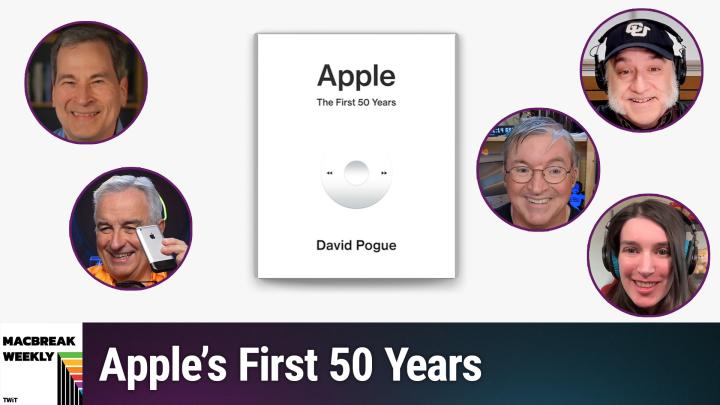
All TWiT.tv Shows (Audio)
MacBreak Weekly 1018: 50 Years and Still Going Strong
02:07:16
Apple: The First 50 Years
Loading summary
Transcript593 lines
- [00:00]
A
It's time for Mac Break Weekly. Very special edition, of course. Andy and Christina and Jason are here, but so is one of the early Mac Break Weekly panelists, David Pogue. You may remember him from the New York Times and CBS Sunday Morning. His new book is out. The 50th anniversary of Apple, and David celebrates with us next on Mac Break Weekly. Podcasts you love from people you Trust. This is TWiT. This is Mac Break Weekly. Episode 1018, recorded Tuesday, March 31, 2026. 50 years and still going strong. It's time for Mac Break Weekly. Hello, everybody. You're glad you're here. The day before Apple's 50th birthday, I am very pleased to introduce our fine panel. Jason Snell is here from Six Colors.
- [00:56]
B
Hello.
- [00:58]
A
Buenos dias.
- [00:59]
B
Good to be here.
- [01:00]
A
Senor Andy Inacco from the library. Hola.
- [01:05]
C
Hello. Your public text. How was your work?
- [01:08]
A
Ms. Christina Warren of GitHub fame. Hello, Christina. And her giant microphone. Hello.
- [01:15]
D
I know.
- [01:18]
A
I think it's a perspective thing.
- [01:20]
D
It's a perspective thing. I'm still trying to dial in my setup, but we'll.
- [01:24]
A
I feel like there's a gap to Mr. Jobs left on your shelving.
- [01:29]
B
There.
- [01:30]
A
Is there. Was there something there before?
- [01:32]
D
Yeah, no, there's a laptop, and it fell, and I need to, like, put
- [01:34]
A
it up on the stand. Yeah, the laptop fell. Okay, ladies and gentlemen, you know, because we are coming up on the 50th anniversary. April Fool's Day is 1776. No, 1976. Although that would be good. Apple was incorporated, and we thought it'd be kind of fun to celebrate with a guy who just wrote a rather large book all about it, Mr. David Pogue. You know him from CBS Sunday MORNING and many, many other places. Hey, David. Good to see you.
- [02:10]
E
Good to see you.
- [02:11]
A
Of all of you, congratulations. The book came out a day. A day after your birthday, I think it did.
- [02:18]
B
Sorry to make you vomit.
- [02:21]
A
I apologize.
- [02:22]
B
He's allergic to praise. This I just nailed.
- [02:26]
C
This is nailed. A book tour where you're like, I can't. I can't stand talking about the book anymore.
- [02:31]
A
Poor guy.
- [02:32]
C
I'm out.
- [02:32]
A
He's so sick of it. He's been on every show, every podcast. This is the last one, David. Then you get to rest.
- [02:39]
E
I was at a book signing last night, and this. This guy came up to get his book signed. He goes, you have taken over my podcast.
- [02:47]
A
It's true. Well, sorry, one more. By the way, Larry Thomas, Clack Shaker Heights Class of 81, says hi.
- [02:55]
B
Oh, my gosh. Hi, Larry.
- [02:59]
A
Watching on YouTube.
- [03:01]
E
That's cool.
- [03:01]
B
I remember Larry Podcast Larry has seen you on this month.
- [03:06]
A
Do you go to your high school reunion, Steven?
- [03:08]
B
I do.
- [03:08]
E
And I spoke last week at a thing called the City Club of Cleveland, and my class, Shaker high class of 81, behind my back bought a table and 12 of them showed up to surprise me.
- [03:21]
A
Well, that's nice. That's nice that you're still on good terms with Larry.
- [03:25]
E
Thomas was not there.
- [03:26]
A
No. Well, Larry's here via YouTube and he looks. He looks well. Although, as everyone else at your high school reunion, they all seem to get so old, didn't they? I don't understand how that happens. Maybe that hasn't happened to you yet, David. Apple the first 50 years. Beautiful book. You obviously. Well, your publisher spent a lot of money making a full color. Huge. Could it have been any bigger? It was the limit.
- [03:54]
E
It was. They gave me a words per page count to aim for, but they said 600 pages, that's it. Because otherwise we lose money on this book. And so I turned it in according to their formula at the right length, and they said, no, you got to cut another 150 pages.
- [04:14]
C
God bless them.
- [04:15]
A
So. So is there anything, really, any juicy gossip and anecdotes that fell to the cutting room floor?
- [04:21]
E
There are some pretty good ones. There's the great story about Woz showing off the prototype Apple II at the first CES that he attended. And he'd never been to Vegas before, and he went out and did the town. He was really exhausted. He stayed up till four in the morning, and then he came back and he thought, you know, there's only one disk with the OS and my programs on it. I should probably make a backup of that. And he was so tired, he wound up copying the blank onto the software disk. And so he wound up before the show opened. He wound up having to retype the entire operating system from memory.
- [04:59]
A
No, come on, really?
- [05:03]
E
I put that in the audio book because I could, but it's no longer in the prints.
- [05:07]
A
Wild. Did you record the audiobook?
- [05:11]
E
I did. It's 23 and a half hours long.
- [05:14]
A
Oh, my gosh.
- [05:15]
E
And you know what I did nobody tell anybody this. This is a secret. 21 hours in, I recorded an Easter egg. Like, I'm in the middle of, like, talking, talking, talking. And then I go, by the way, if you're still listening, send an email to this special email address and I'll send you a PDF of outtakes. And it's so much fun to see who's finally getting there? We're up to like a thousand people so far.
- [05:40]
A
Well, GE Geeking Tom in our club, Twit Discord said there's an Easter egg in the book. I listened to the whole thing. Geeking Tom, did you get your secret PDF yet? That's awesome. Well, we won't give away any more of the secrets. We'll make people. Well, you just did. I guess now people are. But that's okay because it makes them
- [05:58]
B
listen to all 21 of the audiobook now.
- [06:00]
A
Yeah, brilliant. Yeah. He says he hasn't emailed you yet. He just got busy.
- [06:05]
E
Oh, fine. Wow, look at the screen. You have up Amazon selling this thing for $34.
- [06:15]
A
32% off.
- [06:16]
E
That's crazy.
- [06:18]
A
Do you know you have. How many books have you published now?
- [06:23]
E
Well, it's like 125, but that's counting new edition, like iPhone 10, the missing manual. IPhone 11, the missing manual. It's, you know, not.
- [06:32]
A
You farm those out. I mean, I wrote 13 and I only really wrote two.
- [06:38]
B
Dude, why didn't I think of this?
- [06:42]
A
I hate you.
- [06:43]
C
Leo.
- [06:43]
A
I sent you. I know. I sent you pictures earlier from the cruise that we were on back in. I think it was 2007 or something. 2006. And you were working on the boat on a book. Oh yeah, nonstop. I mean, you don't do 125 books without a non stop. Are you going to ever stop or you just. You love doing it?
- [07:02]
E
You know, I've sworn to my wife I'm taking the second half of 2026 off this, this Apple book. I mean, it very nearly killed me. It was like any. As you know, any other book, if you get sick or things get busy, you can shift the ship date by a week or two. But this one, like April 1st deadline, that's not moving. So this book had to be out.
- [07:25]
A
Amazon is cooperating. I see. I can get free delivery tomorrow if I order it right now for and at 32% off. Why wouldn't you?
- [07:33]
E
That's crazy. That's. How can they be making money? I mean, maybe they don't care.
- [07:40]
A
No one's ever asked that. How could Amazon be making money?
- [07:45]
B
They make it up on volume.
- [07:47]
A
That's it. And advertising. I don't want to monopolize you. We've got a wonderful panel, Andy. I know you know everybody on the panel, they're all fans of yours. I know. So if anybody. Andy or Jason. Jason, you already interviewed David.
- [08:02]
B
Yeah. We talked on Upgrade about this and it was a really nice conversation. David, so I want you to talk about the theory that I had, which I think you share, which is Apple. One of Apple's secrets is that they make the whole thing themselves. Like, the IBM PC came and swept every other computer maker away and Apple was like, nope, we're just going to make it ourselves. And they still. And it's 50 years later, and they're still like, it's literally their, their business model was formed in the 70s and they still have it.
- [08:35]
E
It's funny because, you know, there's this famous story that Steve Jobs told Tim Cook on Steve Jobs deathbed. Never ask, what would Steve do? Just do what's right. And yet, and yet, if you look at what Apple does, I mean, his ghost is in every meeting at Apple. Like all those through lines like you just mentioned, like, build the whole widget, secrecy, focus on very few features and very few products, make tiny targeted acquisitions, not big ones. All the things that Apple always, that Jobs always believed in, Apple still believes in. So they really haven't deviated much from the Steve precepts.
- [09:13]
A
Now, obviously Steve wasn't around for you to enter. Jobs wasn't around for you to interview for this book, but I know, I'm sure you've talked to him many, many times.
- [09:20]
E
I did. Well, I mean, when I was at the times for 13 years, you know, like, like the other journalists for big publications, I got 15 minutes with him twice a year.
- [09:30]
A
You know you got the first iPhone, right? You were one of the six.
- [09:33]
E
I was one of those lucky four. Four, yeah. And I. And I lost it. Did I ever tell you this story?
- [09:37]
A
No. What?
- [09:38]
D
Oh, my gosh.
- [09:39]
A
Did you leave it at a bar?
- [09:41]
E
No, no, I. It was Wall Street Journal, New York Times, USA Today, and Newsweek. We four guys got the original iPhone before it was shipping.
- [09:52]
A
David Polk, Stephen Levy, Walt Mossberg, Annette Begg, Ed Big.
- [09:57]
D
Yeah.
- [09:57]
E
And I had a talk to do in Lake Como, Italy, and so I got on a red eye, put the thing in my pocket, and in the taxi on the way to the speaking engagement, I kind of slumped back. And remember, the first iPhone was like a capsule. It was shiny but plastic back. It slipped out of my pocket into the taxi seat and.
- [10:20]
D
I know.
- [10:20]
E
And then fortunately, fortunately there's a happy ending because otherwise Apple never would have spoken to me again. I had the receipt when I got out and we called the taxi company and they got the guy to come back and he was screaming at me in Italian because I wasted his time. I emptied my wallet to this, I
- [10:38]
D
was gonna say, gave him Every dollar, every euro. You had, like, here you go.
- [10:42]
A
I was gonna say, you know, I got this call from an Italian taxi driver, and he found this in the backseat of his car. David, I don't know if he wanted.
- [10:50]
C
It's a beautiful cigarette case, but I can't get it open.
- [10:53]
A
What do I do with it? Probably he had no idea what it was, right?
- [10:56]
E
He didn't. He thought it was like a pager or something.
- [10:58]
A
Yeah. Because no one had this thing. So what do you think Steve would have thought? I mean, this is rank speculation, but what would he have thought on this anniversary tomorrow? Did he have any idea it would last 50 years, for instance?
- [11:13]
E
It depends on which Steve you're talking about.
- [11:16]
A
Right?
- [11:16]
E
I mean, There was the 1.0 Steve and there was the 2.0 Steve that did the imac and the ipod and the iPhone. I think he probably had a good idea that this thing was going to roll. There are some things I don't think you would like. He would not like the proliferation of models. He would not like the iPhone getting so big.
- [11:35]
A
He famously, when he came back to Apple, drew a quadrant of four products. You know, business, consumer, portable desktop. And they. And said, we should have four products. That's it.
- [11:48]
E
Yeah. And he. And they were shipping 50 at the time. They were shipping 50.
- [11:53]
A
That's because they had clones back then.
- [11:56]
D
Aside from that, all the Performas.
- [11:58]
E
Yeah, yeah. And Jobs argument was, you know, if we only have four, then we can put our top engineers on every machine. And the part that I learned researching the book was that this was not a popular decision. Jobs was not hailed as the savior coming back to save Apple. I mean, he had never had success. I mean, the Apple 2 is kind of wises, but the Apple 3 failed. The Lisa failed. The Macintosh essentially failed while he was there, next failed. So he'd never really had a hit. And now he came back to Apple as the conquering hero, and the first thing he does is cancel every engineer's projects.
- [12:34]
A
Yeah, that's not a good way to.
- [12:35]
B
People were leaving.
- [12:36]
E
I mean, it was a.
- [12:37]
A
How about Woz? You've talked to Woz for the book?
- [12:40]
E
Yeah.
- [12:40]
A
Was he surprised at the success of Apple?
- [12:45]
E
I don't think so. He, you know, he created that Apple one, that original board, for the purpose of. Remember, at the time, computers were not anything that people owned or had even seen. They were. Computers were big things in movies and industry. And his whole idea was we could make this so individuals could own one, mainly him. And that's arguably still Apple's mission.
- [13:10]
A
Right.
- [13:10]
E
Taking complex technology and making it beautiful for everybody.
- [13:14]
A
You said Steve wanted it to be small. He didn't like the idea of a giant. A giant phone. He would have kept the iPhone mini.
- [13:21]
B
Yeah, but then he would have seen the sales figures and he would have changed his mind and said, oh, no, no, large.
- [13:27]
A
We know now.
- [13:28]
B
Yeah, because he did. He was a good. I mean, I think that's one of the great lessons of Steve Jobs as a manager, is he held onto these ideas until he was proven that they were wrong, and then he immediately would just drop them and switch sides. He didn't hold on to him. Yeah, smart.
- [13:44]
A
Yeah.
- [13:44]
C
Well, speaking of CEOs, like, I want to. I want to know your opinion on what was Scully's biggest contribution to Apple, even looking back all this time. Like, what did. What did he lay the foundations for that Apple really, really benefited from, for the future of the company.
- [14:01]
E
I mean, that that period when Jobs was gone and Scully and the other CEOs took over is generally sort of disregarded from the Apple history. It's considered a big crash and burn. But Sculley, for example, he did a lot. Remember, he launched the Power Books, the first really successful laptop in the world. He successfully moved the Macs onto RISC processors that made them much faster and much better. And on the first page of the book, there's this. In the introduction, there's this list of things you probably didn't know. And the last one is sort of provocative. It's that the Newton saved Apple. And I will now, for the first time, except in the book, explain that. So Scully was looking for a processor for the Newton. They had had one from AT&T and it was too complicated and too power hungry. So they found this tiny company in England called arm. Arm. And it was low power, very fast RISC processor. And he's like, this would be perfect for us. Let's invest $3 million in this tiny company. Well, ARM, of course, went on to license their chip to everybody and everything. And now there's one of its chip designs in every iMac. IPhone, iPad, watch that anybody owns. By the time Apple was ready to buy next in 1996, that $3 million investment was now worth $800 million. Without it, they never would have been able to buy NEXT and bring Jobs back to.
- [15:36]
A
Wow, what a story.
- [15:38]
B
Also, I mean, and this is in the book, David. I read the whole thing on my vacation. As you know, the. The fact that, like, Jobs didn't want to put slots in a Mac, like the Mac didn't take off in terms of sales until the Mac 2, which was a product that Jobs refused to make. It was only after Jobs left that the Mac took off. Up until that point, the Mac was just kind of like he shipped the original Mac. But the, the, the growth of the Mac as a product happened in Scully's era, not in Jobs first era.
- [16:07]
E
Yeah, that's right. And for all Jobs gift of taste and focus and knowing what the future is, he made that same botch three times. So he botched the Mac by keeping it closed after having the lesson of the Apple 2 with eight slots so
- [16:23]
B
he couldn't botch, which he hated too. But Woz insisted.
- [16:26]
E
That's right, that's right. Woz gave an ultimatum. He did it again with the ipod, insisting that he would never make it for Windows. So the ipod didn't sell especially well the first year.
- [16:36]
D
No, in the second year, it was when they brought it to Windows, that second gen, that it suddenly became not only a huge seller, but ironically, a massive, like reason for people to buy Macs because they liked the ipod experience so much.
- [16:49]
A
I have in my hands a framed Apple II FX motherboard which stood for two effing expensive.
- [16:56]
D
Yeah.
- [16:57]
B
Oh yeah, look at fast though there.
- [16:58]
A
It has those three slots, right?
- [17:01]
B
Yeah, that was open. The Mac 2 totally changed the game. David, after people read your book, which they should absolutely buy and read in May, there's a book coming out by Jeffrey Kane called Steve Jobs in Exile. And I read that, I read a pre release of that and boy, you want to talk about a list of all the things Steve Jobs did wrong. Oh boy, you just say next.
- [17:23]
E
I mean, I'm reading it now too. It's really good.
- [17:25]
B
Oh, it's brutal though. It is like that guy Steve Jobs, say what you will about him. Not infallible.
- [17:31]
E
Not infallible. I mean, he made the same mistake a third time with the iPhone, right? He said you're going to have 16 apps and that's it. There's going to be no app store, closed systems. And for the first year, it didn't sell very well either.
- [17:46]
C
Yeah, there was a lot of dogma, like in the history of Apple that still sticks around, like where you have to ask a question. What rational engineer, what rational product designer would make this choice in the face of overwhelming votes from the audience, they're parking at that. This is what we want. But they're not going to do it because again, dogma, it's like, I'm not going to eat, I'm not going to Eat meat on Friday. Why? Because of dogma. That's the way we were all trained.
- [18:11]
A
We're talking to David Pogue, the well known, of course, David Pogue, the author of a brand new book, lavish if dare I say book, about the first 50 years of Apple computers. Apple, the first 50 years. It is out now and you can get it on Amazon for 32% off, delivered just in time for Apple's birthday tomorrow.
- [18:32]
B
You order now. I want to specify too, it is not a coffee table book. There are beautiful color photos in it. There are lots of them. It is great. But this is a reading with your eyes book or a listen with your ears book that David did so many interviews. There are many words to read. It is not one of those. There are those books and they're beautiful where it's like, oh, pictures of old computers and stuff. And David's got the pictures of old computers, but it's all text wrapped around them so that he could fit all his words in 600 pages. And so it's a real, I mean it's a real deep history. I mean, what we were saying on Upgrade is it's a biography of a company instead of a person. And it really reads like that.
- [19:10]
A
One of our Club Twit members says one of the things, Geeking Tom says, one of the things I appreciate about the book is he stayed with the company itself and kept telling the story during the exile years rather than following Steve off to Pixar and Next and all of that.
- [19:25]
E
I know I was, I was emailing with Jeffrey Kane, the author of the Steve Jobs in Exile book, which is about Jobs during the next years. And we agreed that our two books should be sold as a set because not only did we choose the same cover photo of Jobs, but his book fills in the 11 years of jobs life that I didn't stay with.
- [19:47]
D
So, yeah, that's cool.
- [19:49]
A
I think it's really a great insight that John Scully wasn't the evil, you know, replacement that some people paint him as. You might say that about Gil Amelio or.
- [20:01]
B
But you got to say, okay, Gil, like I just did a piece about kicking off David's book 10 other great books about Apple history. And I. The 10th book in there is on the Firing Line by Gil.
- [20:10]
D
My. It's amazing. It's amazing, terrible.
- [20:13]
B
It's super self serving and all that. And yet I, it does get across that idea that when Gil Amelio came in, he started Turnover Rocks where they're like, we totally have a new OS strategy. And he'd turn over these rocks and the bugs would crawl away. And he'd be like, what is happening here? You got to give him credit though. He made. I mean, maybe the ARM acquisition is a better one, but like, isn't the choice to buy next ultimately maybe the best business decision Apple ever made?
- [20:37]
D
Yeah, sure it was.
- [20:38]
A
It wasn't their first choice. Right. Didn't they want to buy?
- [20:40]
D
They wanted us. Yeah. And, and then, and then I think that, and it's. I don't know. On the Firing Line is one of my favorite books because it is so self serving. It is such a cope. And he wrote it right after he'd been fired. And the whole thing is basically just him trying to be taking credit for everything good. Steve Jobs, you know, was, was being lauded for. And I was like, okay, but yet the one area where he does kind of try to beg off as, you know, it was like you could have just taken the W and been like, well, I brought back this guy that, that can be my legacy. But no, he spends like whole like pages about how bad his shirt was at a, at a certain like Mac World event. Like, he literally talks about how terrible the shirt was and how he looked bad because people made fun of him. It's fantastic.
- [21:20]
E
If you can believe it. I tracked Gil Amelio down and interviewed him for the book. And the one thing that sticks with me both from that interview and from the book is he would, they would have a meeting with the executive team and they would draw up their path forward. And he said, here's what we're going to do. Here's the marching orders. And nobody would do anything. They would just ignore the CEO. And then later I interviewed Jaws Greg Jasiah, who's now the global head of marketing at Apple, who had been there during the Gil Amelio years. And he said yes, of course we ignored him because the ideas were stupid.
- [21:57]
C
So that's why the takeover was like. There was a huge vacuum that Steve Jobs filled. There was nobody moving the chess pieces. And he said, okay, great, I'll move them for you.
- [22:05]
A
We should mention that David's writing a weekly column again, which you can get from his website, davidpoag.com It's a substack. Is that. Cause you just can't get enough writing.
- [22:16]
E
You know, I really miss writing the only writing I've. I mean, I quit writing a column 12 years ago.
- [22:21]
A
Right.
- [22:22]
E
And I write my scripts for CBS Sunday Morning and I write this book, but I really miss the weekly cadence and opining. So yeah, It's a free substack newsletter just for fun.
- [22:34]
A
And you're always welcome to come here and opine anytime you feel like it.
- [22:38]
E
Opine next time I have an opinion.
- [22:40]
B
I highly recommend David substack the. We got to the bottom of what happened on his landing in San Diego. I mean, it's varied and funny and, you know, I mean, David, you're such. I was one of David's editors at Macworld for a little while. And like David's. David's such a funny writer and he's such a good writer and that. It all comes through in that substack. So people should check it out. I am a happy subscriber.
- [23:03]
A
Is that a nuclear power plant control panel you're standing?
- [23:06]
E
That is. That's Three Mile island right there.
- [23:07]
A
Oh, great. Don't push that button on the left there.
- [23:11]
C
It's fine. It's fine.
- [23:13]
A
It's all fine now.
- [23:14]
E
I made the same joke when I was there. I said to the guy, guy, can I press this button?
- [23:20]
B
So is this where Homer Simpson sits right here? Is this.
- [23:24]
A
Yeah, it does look like it, doesn't it? Where's the donuts? How did you get into the ma. I know the story a little bit, but I'd like to hear it from you. Get into this whole Apple Macintosh thing.
- [23:35]
E
I. I was and is a musician. I've always been.
- [23:39]
A
Do you still, by the way, do your parody songs everywhere?
- [23:41]
E
I do every bookstore stop I've done on this promotional tour. I. I bring an electric keyboard and I do the songs.
- [23:48]
A
Worth. Worth seeing him for that alone. Just. Those are so great. So great. So you were a Broadway pianist?
- [23:57]
E
I was. I was a conductor and an arranger and a keyboard pit player for 10 years before I started doing the tech stuff. But the. But the Apple thing, I mean, weirdly, I was never a computer guy. I never built one or could code or anything like that. But senior year in college, Apple had this ingenious program called the Apple University Consortium, where kids could buy Macs for half price. And my friend said, dude, you're about to graduate. You should grab that at that discount. So you have a computer. And that was my introduction to Max. And, you know, there was all this music software coming out, and it was just a natural fit for a creative guy like me.
- [24:36]
A
You also became kind of computer expert to. To the rest of Broadway, I understand.
- [24:41]
E
I did. I had a lot of celebrity clients.
- [24:43]
A
Certain. Stephen Sondheim, for instance.
- [24:46]
E
Deed. Yep. This tech guy for 30 years.
- [24:49]
A
And when did you start writing?
- [24:52]
E
Immediately. Immediately. When I got The Mac. There was a. I was at Yale, and there was a Yale Mac user group, ymug, and they had a newsletter, and I started writing for them immediately. So I can truthfully say I've been writing about the Mac for 42 years.
- [25:07]
B
Wow.
- [25:08]
A
David was at Yale a little after me. We had a Yale System 370 user group, but we didn't. There was no Apple at the time when I was actually there. No, there. Well, there might have been. There was the first year of Apple when I was there. You were class of 81. I was four years before that.
- [25:24]
E
I was 85.
- [25:25]
A
Yeah, 85. Sorry. Yeah. High school class.
- [25:27]
B
High school. 81.
- [25:28]
A
Yeah, yeah, yeah.
- [25:29]
E
We're old, man.
- [25:31]
A
Not as old as I am. But you're getting there. You're getting a little grayer than you used to be. That's for sure. But who isn't? Well, let's see what else. I don't want to monopolize it. Christina, did you have anything you wanted to ask David about?
- [25:46]
E
Well, you know, if I may, we were talking about Jobs in the App Store. I have to tell you one of my favorite stories from this book.
- [25:53]
B
That's.
- [25:54]
A
Please do.
- [25:54]
E
Never been told before. And it's on that topic. Scott Forstall was the head of software. He did the Aqua interface for Mac OS X. He did the iPhone stuff. And he left Apple after that Apple Maps debacle. He'd been in charge, and Tim Cook fired him in a really uncomfortable way. And he's never done another press interview since that day. Really. And what he did was he became a Broadway producer.
- [26:23]
D
Yeah.
- [26:25]
E
Yes. He did Fun Home. He did Hadestown. And so I tried and tried to get him to do an interview for this book. And what I wound up doing is I made a video of me at the piano doing a parody of Hadestown.
- [26:40]
D
That's so smart.
- [26:41]
E
Where the lyrics were all like, you know, do an interview with me. And he finally agreed, and he told me the most incredible story. So when the iPhone came out, it had 16 apps and you were happy. That was all you could have. And over the ensuing months, people began jailbreaking the phone, hacking it so they could install their own apps. And Jobs said to forestall, what are we going to do about this, man? Some of them are actually pretty cool. Forstall said we should create an app store where anyone can write apps. And Jobs is like, no, we're not opening up the iPhone ever. But I'll tell you what we will do. This weekend, you and I are going to meet in the office, and we're going to sit down and we're going to make a list of every app there could possibly be, and we will write them all. I will write you a blank check. To assemble the largest conglomerate of software engineers. We will write every app. And so Forrestal said, okay, okay. And then he went back to his team and said, start writing the App Store.
- [27:44]
A
Yeah, you know, it must have been hard to work for Mr. Jobs.
- [27:49]
C
Colonel Kunst has gone up river again.
- [27:51]
A
You're coming in this weekend, and let's just come up with every possible app,
- [27:55]
D
every app that we can.
- [27:56]
C
Not grindios at all. No, no, no.
- [27:58]
D
I did have a question for you, David. First of all, your book was fantastic. I enjoyed it so much. And the work that you put into it is so evident. And we were saying this on an earlier episode, like, there's no better person than you, I think, to write this book. But kind of going through, especially since you've been so deep in this, as this process is for you personally, like, is there an era of Apple that sticks out as, like, your personal favorite that you might have? Like, you know, either it's because of your own experiences, either as a journalist or as a user or anything else. Is there an era in the history that is your personal favorite?
- [28:31]
E
You know, Steve Jobs came to Apple twice and left Apple twice, if you think about it.
- [28:37]
D
Yeah.
- [28:38]
E
And the two beginning stories were the most thrilling. I mean, that those early years when he was 21 years old and scruffy and smelly and wore no shoes, but he had this vision of making computers, which were then metal and industrial and equipment looking. His idea was, let's make them a household of plans. Make them beautiful. Which was a weird thing to think in 1976. Like, you don't care about how your socket wrench looks. You know, like, why would your tool need to be beautiful? So that period of trying to get the money, trying to launch this company, and then trying to launch it again in 1997 when he came back, I mean, this company was six weeks from bankruptcy. They had 50 Mac models. They had 12 ad agencies, and it's so much duplication and redundancy. My favorite story. Phil Schiller told me that there was a day in 1995 when two Apple lawyers showed up in trademark court to sue each other.
- [29:37]
D
Oh, my gosh.
- [29:38]
E
And so in a year, in a year, Jobs fired the board. He replaced the retail channel. He canceled all 50 Macs. He fired all the ad agencies, killed the Newton, shut down the Advanced Technology Group. Like, in One year he focused the entire outfit on these four machines. Return to profitability in a year. I mean, that's, that's the greatest turnaround there's ever been. And, and thrilling if you were there.
- [30:01]
A
There was always this story, I don't know if it's apocryphal, that Apple had a very short Runway and that Microsoft kind of pulled their iron out of the fire with that $150 million investment. Is that true? Was Apple really close to folding right when Steve came back?
- [30:19]
E
Yes. Apple was spending $50 million a month and bringing in almost nothing. So the Mac had less than 2% market share. Apple was telling the public 5, by the way, but they had less than 2% market share. They were in dire straits. The, the Bill Gates deal was helpful, but really the big part of it was their chief financial officer, this guy Fred Anderson, who, who doesn't like the limelight. He doesn't do interviews, doesn't like this story to be told. But in six months, he did this amazing series of, of financial tweaks that pulled the company out of the fire. He renegotiated $400 million worth of loans from Japan. He re dealt with his suppliers. Apple was paying them 30 days after acquiring the parts. He renegotiated to what the rest of the industry was doing, which was 90 days. Just a lot of simple stuff like that that bought the company breathing room.
- [31:15]
A
I want to take you back to April 1, 1976. Ron Wayne has resurfaced One of the original Apple founders who everybody said was bought out because he chickened out for 300 bucks. He says now, no, I still own 10% of Apple. You didn't talk to Ron Wayne by any chance?
- [31:31]
E
Of course I did.
- [31:32]
A
You did.
- [31:34]
B
He was at your event at the Computer History Museum.
- [31:37]
E
That's right. So he basically vanished off the face of the earth. He had 10% of Apple in 1976, which today of course, would be worth $350 billion. And 11 days later, he backed out of the deal because he was much older than the two Steves. They were janky and smelly and amateur wobbly startup. And they'd just taken out a loan for 15 grand. And he's like, if that gets called, I'm. I gotta pay 15, 10% of that. I'm not up for this startup ride. Excuse me. So jobs gave him 800 bucks and that was that. He wrote a memoir in which he says nothing about changing the story. That's the story he tells in his memoir. So when he showed up, excuse Me dust. When he showed up at the Computer History Museum event a couple weeks ago, I hopped off the stage, he was in the audience, and I held up the microphone and interviewed him for a couple minutes to tell the story. And this is when he started up with this new thing about, actually, I never sold my shares.
- [32:43]
B
I still have them.
- [32:45]
E
And everyone's like, what? What are you talking about?
- [32:48]
D
Well, I had dinner with him 16 years ago. What? And yes, I was at a dinner at a mackerel, I think, in 2009 or 2010. And that was not the story at that dinner. His story at the dinner was the same as what he'd said before, which was that he kind of got cold feet and regretted some things. So that's really interesting.
- [33:10]
E
Yeah, he's in his 90s and sort of rewriting history.
- [33:14]
A
The other thing he said, the rascal,
- [33:17]
E
he said, before the. Before the event began, I got to meet him. He said, before you take the microphone away from me, ask me what I'm working on now.
- [33:27]
A
Oh, Lord.
- [33:28]
E
And then so I did. And in front of this audience of 400 people in the whole Internet, I said, so, what are you working on now? And he goes, I've reinvented the computer. I've got a new kind of computer that's 100 times faster than anything anyone's ever done before, and it's going to revolutionize the world. I'm like, oh, man, you had us on the palm of your hand until that moment.
- [33:49]
A
Peter, History Museum has that amazing event celebrating Apple at 50. Somebody says Craig Federighi is also visible in the audience.
- [33:57]
B
Oh, Craig and John Ternus are right there in the front row, I think, with Jaswiak.
- [34:01]
E
I think they were all there with Jaws. Yeah, yeah, they were there. It was amazing.
- [34:05]
A
What do you think about Ternus taking over, just out of curiosity?
- [34:08]
E
I mean, I don't know him well. I interviewed him for the book without knowing that he's the heir. Apparently he's very quiet, he's introverted, He's a very meticulous guy, much like Tim Cook, but he's also the director of hardware engineering. He's been responsible for working on some of the most recent products. He knows hardware, he knows software. So he is more of a product guy than Tim Cook was. Plus he has the meticulousness. So maybe he could bring us back to those cool new, mind blowing, you know, jobs like inventions.
- [34:42]
A
David, I thank you so much for spending some time with us. I know you've been talking to everybody in the world and you're probably ready to take a little break. We appreciate you.
- [34:50]
E
I was just rehearsing for this, Leo.
- [34:52]
A
That's what it was all about, getting ready for this. David's website is davidpogue, P O G U E dot com. You can go there to read all sorts of stuff about what David's up to. You can also get his column. There's a link at the top of the page there. And of course, you can get the book there. I imagine you probably, I would hope, have an Amazon affiliate link there. So if you buy it there, some of that 32% off gets eaten up by David Polk, which is exactly the way it should be. You can get the book in a number of places. Barnes and Noble still has it at list price. Maybe you should buy it there. I don't know.
- [35:27]
E
Or your local bookstore. Locally.
- [35:29]
A
I like that. Yes.
- [35:31]
C
Another sad story of an author being compensated for his work. When will it end?
- [35:38]
A
David, it's always a pleasure to talk to you. It's great to see you again. Thank you so much for everything you've done and especially thank you for the book.
- [35:45]
E
And thank you, all of you guys. I just admire all of you and your excellent taste in books so much.
- [35:53]
A
Thank you, David. Have a great week. Take some time off.
- [35:56]
D
Thank you, David.
- [35:56]
A
Spend some time on the beach. Good idea. All right, take care. David Pogue, everybody.
- [36:02]
B
Cheers.
- [36:02]
A
We're gonna take a little break. Come back with the rest of Mac Break Weekly in just a moment. Our show today, brought to you by Spaceship. I think you probably heard us talking about Spaceship. It's, I mean, a fantastic way to register a domain name. When Paris Martineau said, I want to create a website called Secretly British, about whether people with American accents on TV and movies are actually secretly British, we set it up in, like, five seconds. In fact, we saved a lot of money by setting up at Spaceship. It's secretly B R I t I.sh There's a reason I keep coming back and everybody keeps coming back to Spaceship. It's rethinking how people register and manage domains. Beautiful site. And its fresh approach has led to more than six and a half million domains being under management in record time. That kind of growth comes from giving people what they actually want. Spaceship, of course, offers transparent, really low pricing on domain registrations, but also on transfers and, crucially, renewals. So, you know, so many times you get a low price up front and then you renew and it's like a sticker shock. Not@spaceship.com Twitter. There's more clarity over what you're paying for over time. And alongside that great value, the platform is especially built for flexibility. You could do what we did and instantly connect your spaceship domain to spaceship products like web hosting, professional email. They've got virtual machines, VPSs and you can build and test before committing because almost every spaceship product comes with a 30 day trial. Now of course, if you prefer your own third party tools, no problem. You just point your domain to what you need by updating your DNS records or name servers. Or have ALF their AI do it. It loves doing all the stuff that nobody else likes to do. So you have the freedom to build your stack exactly as you want it. It's the best of every world. Visit spaceship.com TWIT to learn more. That's spaceship.com Twitter I love it. As they say, it's Black Friday every day. Extra deals too when you go to spaceship.com Twitter thank you Spaceship. Fun to see David Pogue again. Used to be on the show in a fairly regular basis back way back in the day, I think, predating even you, Andy. I don't know, maybe not.
- [38:20]
C
Yeah, well, I'm, I'm also pretty excited because, and Jason is my witness. He did promise me in public that anytime he gets a really sweet gig and then moves on, I get the old gig. So when he moves on from CBS Sunday Morning, it's you, baby. Got his Mac Roll column. And just like I got a lot of cosmetic surgery in my, in my future.
- [38:39]
B
I miss you at the New York Times, but I'm sure that was just a paperwork thing.
- [38:44]
C
You know, the Sun Time just made me better off.
- [38:46]
B
Yeah, that's true.
- [38:47]
C
They're the plucky upstart the tabloid. I'm more of a tabloid guy.
- [38:51]
A
Anyway, anyway, great to see him and thank him for the book. And you all have read it, so
- [38:57]
D
it's so good and genuinely I bought it. I did the rare thing where I got, I used an audible credit, I bought the physical book and then I also got the ebook. So David got a lot of my triple play. He did. He did the whole time.
- [39:11]
C
One of the many things I love about David Pogue is that there's an alternate reality in which he is on stage as a professional performer in some way. And he could have, he could, he could have done as good a job with that as with the way his career went. And you see every time he performs, whether he's like doing a half hour on our show, whether he's on CBS Sunday Morning, whether he's like on stage giving a presentation he just lights up when he has an audience and he. You just want to engage. It's just wonderful.
- [39:39]
A
Yeah. You mentioned, Jason, you'd written an article for 6colors.com about other great Apple history books.
- [39:48]
B
Yeah. Other than David's, of course.
- [39:50]
A
You start with David, but there are interstices that other books can fill. Like I think Steve in the Wilderness. I think that's a very interesting.
- [39:58]
B
Steve Jobs in Exile coming in May by Jeffrey Cain. I have read it. It is very good. Apple in China, I think is the best book written about Apple in the Tim Cook era. Ken Kashenda's creative selection, which is. He. He thanked me yesterday for mentioning his book, which was very sweet of him, but he agrees with me. What I said was, I'm not convinced the definitive insider history of the creation of the iPhone has yet been written. David's book has some of it. Ken Kashenda, his book has some of it.
- [40:24]
A
Ken was there, right?
- [40:25]
B
He was there. He worked on the. On the keyboard. And that's sort of the core of creative selection is about that. I think the problem is it's still too soon because. And you think, wow, 2007, like that was kind of a long time ago now. But so many of those people are still at Apple.
- [40:43]
D
Right.
- [40:43]
B
And you really. For the really juicy stuff, you got to get people out of there and they got to be willing to talk, which is going to be a challenge because they will have been there so long in the PR managed environment and they'll probably still have some stock and they'll probably have friends who are still there. I wonder how good the tell all is going to be when it comes out. But I feel like it's still out there. The ultimate iPhone book is probably still out there to be yet to be written. Just I think should write that a little too soon. I don't know. I mean, Steven Levy, I was gonna
- [41:17]
D
say if anybody could do it, he would be.
- [41:19]
B
I don't know if he wants to do something like that, but he wrote two books on my list, which is obviously insanely great, which is written about 10 years after the Mac was created. But it is the definitive story from an outsider's perspective, putting it in historical context of how the Mac was created. Great pairing there with. With Revolution in the Valley by Andy Herzfeld, who worked on the. On the Mac. And then the perfect thing is Stephen Levy, five years after the ipod came out, talking about the creation of the ipod.
- [41:47]
A
Yeah, those are all complete. The trilogy. He could do the trilogy.
- [41:51]
C
He should do it and on top of everything else, like, he's not just focused on Apple. He has a very broad perspective that I think that amongst all the voices that can tell valuable stories about the history of Apple, he can bring that. That not a whole lot of other journalists can bring.
- [42:11]
D
I would also think insanely great. Circle on.
- [42:13]
B
I was just going to say that Insanely great. I read, after I read Hackers, which he wrote about kind of early 70s Computer hacker culture and hacker culture in general. And when you look at insanely great and I had forgotten this and I was leafing through it this week, it's. It's kind of a sequel to Hackers. And that's what I mean by like placing it in the, like the social context of computers and technology in that era. Because Steven has this broad context about. About that. About the history of technology in a way that, you know, you might not. If you like. We're super focused on Apple. It's really good.
- [42:50]
A
You have a nice guest post today from Anthony Johnson. Anthony Johnson, who many people will recognize his name. I always. Anthony.
- [42:59]
B
It's the worst. It's Anthony Johnston. Yeah, he gets a lot of. Anthony Johnson, video game writer, novelist, and Shelley Brisbane is writing one. She wrote one for Tomorrow.
- [43:10]
A
I'd love to be similar. They echo our own feelings. He wrote this Machine changed My Life. It's about how he was introduced to the Mac and so forth, just as David talked about how he was introduced to it. And I think that those are. They're fun because they resonate, I think, with the reader. Anybody who's reading Six Colors has a similar story. Right.
- [43:31]
B
Presumably. Although I feel like the Mac origin stories are receding into the. Into the background, into the history books now a little bit, which is a little concerning. But, Christina, I know you had another book that you wanted to talk about and also I just wanted to bond again about the fact that we somehow plugged in Gil Amelio's book, which is, again, I'm not sure I call it a good book, but it's.
- [43:52]
D
Well, no, it's one of my favorite. I'm with you because I was going to say, well, Fred Vogelstein's Dogfight, I think that's actually a good one about like the kind of the history of Android and the iPhone as that came out. But no, on the Firing Line. Genuinely. I have the hardcover. I also have the paperback, which was slightly updated. There were very few changes there. I don't know why I have two copies of that book, but I do. But it's genuinely one of my favorite Apple history books, just because it is such an interesting time and place of that era that no one else has ever really covered. I agree with you. I think Steven Levy would be the ideal person to do the story of the iPhone. The only other person I could think of, and I don't think he would want to take it on, would be Michael Lewis, but that would be the only other writer who I think would maybe be able to. It would just depend on who's going to talk, though. That, I think, is the challenge.
- [44:42]
A
It might be too late to reconstruct it at this point. Right.
- [44:44]
D
I mean, it might be. Right. Well. Well, that's the problem, too. Right. Is that at this point, I would even. Even if people were willing to talk. It's like everybody. It's, you know, it's almost like the Ron Wayne kind of stuff. It's like people's own.
- [44:57]
A
They edit their memories.
- [44:58]
D
Yeah, yeah. They added their memories. Things change just based on. Even if you're not intentionally doing it, you know, based on what you've heard. And then people have their own ways of wanting to, you know, recontextualize their own role in. In what's happened. Right. And so that's. That's. That's what's hard, is that I. I would hope that maybe some of these stories exist and people's, you know, personal diaries or things like that, but we might not ever get the real definitive story. Yeah.
- [45:22]
B
Insanely great. Insanely great was 10 years later, and it's almost 20 years now. Right. So. Right. It would be that that book is going to be harder to do. And like I said, I. I'm sure that if for no other reason, that creative selection has a very specific focus. And obviously Apple, the First 50 Years, David's book is so broad that there is probably a book yet to be written that entirely focuses on the creation of the iPhone. And I'm sure it will have some more detail, and I'm looking forward to that book whenever it happens, because it is. I just am not satisfied. I've gotten a lot of anecdotes spread out over the years, and more are coming out. But there's a moment in David's book, and the iPhone, fortunately, is just as the door is closing. So you get a good story from David about the iPhone. It's not like it's just a few chapters, but you get a good story. But as David's book moves to the present, that door, you can see that door swings shut, where a lot of information just kind of Dries up. And it's not David's fault. It's that now he's got to talk to people who still work at Apple and they're very trained and constrained and they're just not going to give you the really amazing juicy stories because they're not, they're not, they're trained not to do that.
- [46:34]
D
Well, and even if they weren't, I mean, even if people had left, right. Like, it's just Apple is a very different company than it was when, you know, Insanely Great was written. Right. Like, it's much easier to be almost open about what happened when Insanely Great is written and it's 10 years later and the company is kind of on the precipice and you don't know what's going to happen even, even with like the perfect thing. Right? Okay. Apple is on the upswing, but it's still not like Apple as it is now where it's like the, the biggest company in the world and by, by a large margin and you know, I mean, you know, market cap might, might, might, you know, hinder. You're there. But like it is undeniable, like the just mammoth impact it's had. And that's going to change just even if you weren't trained by the Apple PR gods, it's like that's just going to, I think, adjust what people are willing to say and, and their own fears about what, what can I say, what can't I say, and that sort of thing.
- [47:27]
A
Frank Wolverstein, who wrote that Dogfight book you mentioned, had a great piece in the Sunday New York Times Magazine about the launch of the iPhone. And he, he talks, I'm sure you remember this. He talked, it came out 13 years ago. It's called. And then Steve said, let there be an iPhone. And he talks about Andy Grignon who was in the audience taking shots as the rest of them were. As Steve was doing the demo of the first iPhone. They would take a shot every time he got through one stage of the demo because they were so nervous that
- [48:01]
E
it wouldn't make it right.
- [48:02]
A
Because it's a wonderful story and this is the kind of story I would love. Maybe Fred should put this in.
- [48:08]
D
Maybe Fred could. Right? I mean, I honestly really like that book and I almost. The only bad thing about the book is almost that it was written in like 2013, you know, 2011 or whenever it was written. And so 2013, I guess. 13. And so, yeah, I just looked. Yeah, I bought it on November 12, 2013. And so is that it was at that point only five years after, like the launch of the, of the iPhone, four years after the launch of Android. And so on the one hand it's great because you get some of those anecdotes and you get some of those stories. But on the other hand, it's like has had enough time passed where you could maybe get some of the really deep insights?
- [48:47]
C
Not only that, but you need. This is true of any sort of like nonfiction history. You need perspective. Perspective. We can't figure out the meaning of what happened 10 years ago until 40 or 50 years have really passed. Not for real. Which is why most of the best biographies happen decades after that person has passed on. Because, sorry, so long as the people who are around to know that person could give their testimonies, you need to know the perspective. Or else these are just incidents that just sort of abut each other chronologically and so. But the most interesting thing is that there aren't a whole lot of companies where when they pass a major milestone like that, you know, see that. Okay, well, gosh, CNBC decided to do. It's the. It's the anniversary of Hewlett Packard. And he. And they found some person who pitched a story about the anniversary. And so there's going to be something on the website or maybe they found a half an hour on CNBC on the cable channel to do it for. Can you think of any other tech company that has that kind of impact where this seems like not just something to celebrate for the fandom, but something that this feels like a moment, a time to look back and not just think about Apple, but think about the relationship of technology. Exactly.
- [50:01]
A
In the industry. Even IBM. Yeah. Yeah. I can't think of another company that's made such an impact. Chris, you're watching MacBreak weekly. So that.
- [50:07]
D
Right. I mean, I mean, even like, even like last year, like Microsoft, you know, had their 50th anniversary and they did a lot of stuff. And I think that, you know, there's, there's a lot to be said about that, but it's not the same as Apple. I mean, Disney would be maybe the only Disney. Maybe Disney the only company. And that's an interesting one too, because they went through periods of time of. Very similar to Apple, although, you know, different timeline where like, you know, after the founder died, like, it, it suffered. And I would compare it more like after Steve Jobs left, you know, Apple the first time.
- [50:37]
A
There's one name that we did not mention, and that is Walter Isaacson. I don't think we want him to write the iPhone book. No, I noticed his Steve Jobs bio is not on your list.
- [50:47]
B
It's not on my list. I mean, again, I was focused on Apple history. There are things in his book that are really interesting. I don't want to relitigate it. When it came out, a lot of people kind of felt like Walter Isaacson didn't really understand a lot about the subject matter. He got all this great access, but it was written by somebody who kind of didn't get it. And so it's a frustrating read from time to time. You know, there are great, there are great details in it. He spent a lot of time with Steve and talked to him like there's a lot of good things about it. But I don't think, I think recommending a book about Apple is very different from recommending a book about Steve Jobs. And yeah, I mean, I feel like Steve Jobs and his legacy has gotten so much oxygen that I like how David, you know, when I asked David, it's a praise him for writing a biography of Apple, I am kind of praising him for not doing, you know, a hero worship biography of Steve Jobs. Because we got a lot of those. We don't need more of those.
- [51:47]
C
I'm sure there is, but if there isn't, there should be an epic anime about Steve Jobs, about the legend of. He went out, he came from the free, came from the apple grove and started a revolution and then was cast out from the empire and then came back when the, when the, when the kingdom was at its lowest and brought it back to. Yeah, that's why it's like Scully, Amelia, all these other CEOs, they don't get Spindler absolutely. For various reasons get dissed in the narrative. But there are some things that each of them did that was like again like the purchase of arm that basically. And also just like, you know what? We actually do need a grown up. Even though basically I think that without the perspective and scholarship that Pogue has done, I always thought that Scully did bring in. This is a time in which we do need a grownup in the CEO position. Not that the Apple, Apple at that time was like a kindergarten of just oh, let's just randomly do things. But at some point you needed a structure so that the tens of thousands of people that you're hiring understand how to move an idea into a proposal, into a product, into something that makes money. And so that's one of the many things I loved about his book. That it really, again, like Jason said, it's not the story of Steve Jobs triumphant return or whatever. It is the story of Apple, like you said. I mean, this is a character in a story and Apple is the character. And we're basically at the midpoint of the story right now.
- [53:12]
A
It feels like, you know, it's interesting. Last week was the 25th anniversary of Mac OS X. Yep. So amazing.
- [53:21]
D
Yeah, yeah. Which is like, I mean again, like you talk about like best business decision obviously, I think like Apple ever made was obviously acquiring Next. And they took like the basics of that and that was awesome. I mean, and look, Emilio again, as Jason mentioned, like to his credit, he was able to recognize the OS strategy was a mess. Right. And it was. And that was very smart of them to look and say, okay, what we're working on is not working. Copeland is not going to be a thing.
- [53:49]
B
This never going to happen.
- [53:51]
D
It's never going to happen. This is too much of a mess. We have to buy our way out of it. Right. And whether it was going to be B or you know, Next. And unfortunately it was next. But, but the culmination of that is obviously with Mac OS X. Right. Which is still kind of the basis for everything that we're doing now, which is kind of incredible.
- [54:10]
C
Every OS is based on OS X. Yeah. And also part of the fun story of OS X was we all remember that.
- [54:18]
B
Great, great.
- [54:18]
C
Here's OS X is finally here and oh, it doesn't really print yet. And now the network doesn't really work.
- [54:23]
D
FireWire doesn't work.
- [54:24]
C
Exactly. Why is the Apple menu in the middle of the menu bar? It took until like 10.4, until it was really stable.
- [54:31]
D
I would say like 3, but before I would say like that's when they brought Spotlight and that's when they started to do the Intel. Yeah, I mean, but yeah, it was like, you know, 10.1, 10.2 were kind of rough. 10.3, I feel like you really kind of got the sweet spot.
- [54:43]
C
But we were just glad to have multi threading like, or that was the thing. Just, just the idea of people. Again, it's not as though like Apple had been beaten down by competition or that, gosh, they were too ambitious. It's like, no, they were lost. We were in a time where wind where people were switching from Mac to Windows because it's more stable, it was better. It doesn't crash on them and take down the entire workspace with them and has more features and the networking is better and it's more forward thinking and it behaves better. This is why people Broke their hearts. So many people, it broke their hearts to switch to Windows. But they're like, I feel like I'm a fool for keeping this relationship alive when Apple doesn't care about the experience I'm having on this, in this, in this work I have to do every day.
- [55:23]
B
So I wrote a piece for the Verge. It went up today, it's called Between Jobs about this era. And I'm coming to the conclusion that the Mac and how brilliant it was was actually sowing the seeds of Apple's almost destruction in a way. And follow me here, Mac OS had been the original Mac right system. You read those books, insanely great and all that brilliant people working on it kind of hacked together like and it was so early. And so often you get that early tech that, that takes the prize of being first and then often it stalls out because they have to, they have to hack it together. And it's not built for the future, it's built to ship it and, and then the second or third wave comes along and it's built for the future using the original as a guide and macOS. The truth is macOS was a hack. It was a, like they hacked multifinder onto it. System 7 was better, but it was still super hacky. And if you clicked on a menu and held it down, the whole system stopped. Like it just didn't do. And because it was coming From a late 70s, early 80s OS era, it didn't have any of those features that came to be seen as necessary because if you don't have protected memory, your computer crashes every day. I remember when my Mac OS 8 Power Mac Mac User magazine, I had to force reboot it after a hard crash at least three times a day. Like it was bad. It was real bad.
- [56:53]
D
I was a nut. Sorry to do this to you guys. I was in middle school in that era and I was like working in like, and I was working.
- [57:01]
C
In fairness guys, she was held back like 10.
- [57:03]
D
It's true, it's true, it's true, it's true. But we work in the Mac lab and it would be that sort of thing in like the Mac OS 8 era where the machines would crash and like the network stuff would die and you know, kids would get very upset that like their, you know, disks went away. And like in 8th grade we, they put like Windows 95 machines like they put in those, like in the schools, they started to take the Macs out. And you. Part of that was because IBM paid a lot of money to the schools to do that. But Another part of it was like just you couldn't rely on them in that way.
- [57:37]
A
Yeah, it was not part of a whole Verge thing on the Apple 50th. You might want to tell the Verge, though, that that Apple office computer building is not in San Francisco, California.
- [57:46]
B
Yeah, I, I did not get to supervise the captions, many of which are wrong. So. Yeah, it is. So. So that's what Gil Amelio came in. When I talk about him flipping the rocks over, like under Spindler. And then Emilio, they. This is the original sin part, right? It's like, yes, they kept. Like they couldn't. First off, Windows had come on and they.
- [58:06]
C
And they.
- [58:06]
B
And they had lost. I mean, the interface was weird because Microsoft has no taste, but technically it had everything. And if you're Apple, like the, if you're a consumer looking at the Mac in this, like, well, why would I make. Get this thing that is slightly better but entirely incompatible and crashes all the time versus this other thing? So Apple had to maintain compatibility or they'd lose literally all of their customers and that the company would go out of business. But how do you maintain compatibility with this existing operating system that's made of, you know, bailing wire.
- [58:39]
D
Exactly.
- [58:40]
B
And so they were like, we'll do Copeland and they did the Pink project that became Taligent. And like there was a period in there, and this is when they fell apart is they kept trying to figure out how to transition off the Mac and they just couldn't do it. And you could argue that although Gil Amelio made. And with Ellen Hancock, they made the right technical decision to basically dump it and buy somebody else's os, which really hurts. Right? Like, we have to go, we can't make a new macOS. We have to do this. So they do that. But also you got to give credit, and this is in David's book, you got to give credit to Steve Jobs, but to Avi Tavanian, I was going
- [59:16]
D
to say Avi doesn't get enough credit because people are angry at him for unrelated reasons. And the Matt kernel was his at Carnegie Mellon and he led the OS project for such a long time for them to.
- [59:29]
B
As the company's on fire, he has to guide a project full of his next developers and a bunch of angry Apple developers to build an os.
- [59:38]
D
He didn't want them there. Right.
- [59:39]
B
Because yeah, to build an OS that is based on NextStep but looks like the Mac and has Mac compatibility on top of it. Because if they can't ship Mac OS X with both of those things, a future and a past. Nobody will buy a Mac and Apple will go out of business. And they did it. It took them several years. Right. I mean, Jobs came back in January of 97 and they shipped OS X in 2001. Right. So it took them four years to get it out the door, but they did and without that, the company's out of business.
- [60:15]
D
Agreed. And that's honestly why I feel like the imac, to David Pogue's point earlier is like such a kind of an incredible story of like Steve Jobs coming back in is because being able to simplify the lineup, come out with this very flashy, very great looking like desktop that kind of reinvigorated what people's idea of a Mac was. And getting people to kind of of think about the idea of buying a home computer. I think between that and also putting out some fairly good laptops in that era really helps them get to that finish line so that they could eventually get to OS X coming out in 2001 and actually getting good by 2003.
- [60:52]
C
Yeah. Also there are many. This was people's first experience with Unix at a time when nobody was using Unix before UNIX became the underpinnings of pretty much everything that you would, would use and would want to use anymore. And I still remember my first briefing with OS engineers saying that we are very much a UNIX operating system. Our goal is that if you don't go looking for the UNIX here and you find it, we screwed up. If you go looking for the Unix and you do not find it, we also screwed up. And that seemed to have paid off like in so many different ways.
- [61:36]
A
We are talking about Apple's history, but I think we should talk a little bit about Apple's present and future as we continue. You know, have a party tomorrow, we'll wear funny hats and there'll be confetti and all of that, but there is also news and we're going to get to that in just a bit. You're watching Mac Break Weekly with Christina Warren. Great to have you. From GitHub where she is a senior developer advocate. Andy Inacco from the library where he is working on his blog every day. Guaranteed to give you great content the minute the doors are open. And of course Jason Snell who's writing, writing, writing about Apple's 50th everywhere.
- [62:17]
B
Yeah, so much.
- [62:19]
A
Are you done now?
- [62:20]
B
I'm almost done. I think I have one more piece to write and then I'm done. And that'll be fine. But yes, you could also introduce Me as from his garage next to the laundry. But I was on the vergecast this week and David Pierce was looking at what MacBreak Weekly viewers know is a zillion old Macs behind me. And he was like, whoa, what is that one? And walk us through it. And it was very sweet because I bought a bunch of shelves and old computers and set it all up and it was nice for. So I'm out here with my old computers.
- [62:55]
A
Not all Macs. Isn't that an Apple ii?
- [62:57]
B
I have an Apple iic. They all work though all old Apple products and they all run. And one day I will set the day, the holiday, one of these MacBreak weeklies. I'll turn them all on to prove that they're.
- [63:08]
A
Oh, that would be fun.
- [63:08]
B
Today is not that all those 240
- [63:10]
C
watt power supplies from. From the 70s and 80s.
- [63:14]
A
You won't be able to do any clothes drying or anything or your refrigerator is going to power down. But other than that, you'll be ready to go.
- [63:19]
C
You'll find. You'll finally find that one that you forgot to recap the capacitors.
- [63:22]
B
You know, I think the, I think the 2C just sips power. It'll be fine, actually.
- [63:27]
A
Yeah, my, my classic Mac original Mac. I think 128k Mac is still being repaired. The caps are still being replaced.
- [63:35]
B
None, none of mine have been recapped. So we are just living by the seat of our pants.
- [63:39]
C
Make sure there's video rolling when you switch them on.
- [63:42]
A
I just smelled a funny smell when I turned it on and I in an abundance of caution, turned it right off and said, burke, take a look. And he did go inside and it didn't look good, but he's been able to find a lot of those.
- [63:55]
C
Oh, it's great. I have an SE30 that like, at this point, I don't want to open it up and look inside because there's probably a leaking battery that's a time bomb. And I'd much rather think of it as it is right now. A beautiful object that could conceivably work if I turned it on rather than Schrodinger's Mac. Yeah.
- [64:11]
A
Oh. Burke says beyond just replacing the caps at this point. Well, what, what more do you need to do? Is there a lot of.
- [64:18]
B
Oh, no.
- [64:19]
A
I know he's. You know what? I'm leaving him to it. He's good. He's gonna fix it. I know it'll boot someday. Meanwhile, I have that little teeny weeny Mac behind me. The Pico Mac actually did you see the picture of Scott Canister.
- [64:34]
B
Oh yeah.
- [64:35]
A
Isn't that hysterical? Long time Apple documentation writer, great guy. He took his little teeny weeny Mac and brought it to the Computer History Museum for the Apple Tech Fest to meet the regular Mac. There's the little teeny, the regular. And they have a Giant Mac. Giant Mac, a 22x Mac. And he's got all three of them together, which is hysterical. Hysterical Is that one. That's a demo Mac somebody built for the Computer History Museum, I guess.
- [65:08]
C
Yeah, you gotta think. And that's one of the reasons why I'm not terribly interested in getting like my old Macs running because I think it's much more interesting to try to get VMAC working like this $11 microcontroller. And it all works and all the software works and now it's on an SD card. Whereas I think my joy in getting that SE3 running again would be limited to. Wow, it's working. It's great. Oh, I can't really get information off of it. Oh, right. And now the hard drive's making clicking noises that I probably shouldn't. Okay. I really wish that I just, just gone to Adafruit, given them about $11 and installed a whole bunch of open source stuff.
- [65:43]
A
I think it was you, Andy, who told us about the Pico Mac Nano. Nick still making them. You can get it at one bit Rainbow.
- [65:48]
B
Yeah, you just have to assemble them yourself, which is fine.
- [65:50]
A
Yeah. Apple was pretty generous saying well, you can't do this and that but you can still sell them.
- [65:56]
B
So I feel like with retro computing at this point, Apple seems to have a policy which is they know they can't give you permission because the problem with like Apple giving away their OSE is that there's license code in there probably that might, might cause a lawsuit or whatever. So they just say kind of like whatever. Like they just don't want to get involved unless it comes to something like you're literally selling a Mac replica that,
- [66:24]
C
complete with the box, complete with the branding, which is what the Mini Mac
- [66:27]
B
was, you know, so like, so like just back. But really they just told him back it off a step and have sell the parts and let people build it themselves. And then they're like that's a more like a fan project and it's fine. And I like that because I think they can. It's unlikely that somebody is going to go through and research all the legalities of taking Apple operating Systems or the ROMs and an Apple II or the ROMs in an early Mac, like, and like what's the encumbrance of that legally? And it's like they're never going to do that. So I think they do the right thing and just sort of like turning a blind eye when they can.
- [66:58]
C
I saw a blog post or someone finished their Apple one or was it even an Apple II emulator for the Commodore 64? So vintage computing inside vintage computing and it's like, does Apple, does Apple really care about like shutting down something like that? Yes, it's. Yes, they should be licensing the ROMs and they should be licensing the source code. But again, I believe that the number of people inside of Apple, if it's not a zero number who actually want to do something about that, is outnumbered 100 to 1 by people inside of Apple. Wow, that is super, super cool. Is there still an ordering page for that?
- [67:29]
A
Yeah, I think they just have to do it to preserve the trademarks and all that stuff.
- [67:32]
C
Exactly.
- [67:33]
A
That's running an actual Mac OS though, right? System three, I think. Yeah.
- [67:37]
C
So it's probably 6.02, I think. I wonder if it's running VMAC. I don't know.
- [67:41]
A
Yeah, I don't know. Anyway, the whole thing is at one bit rainbow if you want to. Yeah, it all about it. Introducing Home Care Plus, a new subscription service from Lowe's that helps make life easier by giving members a hand with home maintenance. Let Lowe's tackle the tasks you keep meaning to do, like electric dryer, vent cleaning, replacing hard to reach light bulbs and more. Subscribe to Home Care plus for just $99 a year and consider your to do list done. Members get more at Lowe's. Available in select zip codes only. Cancel anytime. Non refundable fee.
- [68:11]
C
Product purchase required Terms and service restrictions apply.
- [68:14]
A
Details@lowe's.com Terms subject to change on we go with Mac break weekly in the news, Apple has been rebuffed by the United States Supreme Court, the Court of Last Appeal. Apple was trying to get them to rehear the Epic Games case. The 9th Circuit had denied its rehearing and now. Oh no, it was just the ninth Circuit. We still have to go to the Supreme Court or no, that's a court
- [68:45]
C
of last resort now.
- [68:46]
A
Yeah, appeal.
- [68:48]
C
I think they kind of have to. But the thing is this was unanimous. Like the decision was one was a one page PDF and we said, nope, we all agree 100%. There is no reason for this retry. This is cut and cleared. You're done. So unless they've got. Apple's got some really Great photos of a Supreme Court justice that. That justice does not want to ever see again.
- [69:08]
A
I think the Supreme Court, they did appeal the Supreme Court, and the Supreme Court sent it back to the 9th Circuit. I guess they could go back, but I have the feeling that justices would take a pretty dim view of that.
- [69:19]
D
Yeah, I mean, at this point, it would be. It'd be hard. Their lawyers would have to make some sort of challenge that. That there was some sort of egregious, like, illegal, you know, malfeasance happening because their arguments have been. It hasn't even been close. You know, every. Every court has. Every. Every lower court is ruled against them.
- [69:35]
A
I think we can declare it over.
- [69:37]
C
Do you think? Yeah.
- [69:39]
A
Never say. Never say never.
- [69:41]
C
When it comes to lawsuits, some of these things are evergreen. Like, part. Again, part of the history of Apple was how much they collectively institutionally hated Samsung, and they just. Just wanted to watch them burn. And Steve had to be talked down from. There is no point in continuing from this. We are not gonna win. We've won anything. We're gonna win. Everything from that is simply a waste of resources. But it was still. No, no, no, no, no. So this is kind of like the same Popeye and Bluto sort of struggle where it either goes on eternally or they decide that, you know what, we're getting old.
- [70:13]
D
Yeah. I mean, honestly, I feel like another part of it would be, you have other antitrust concerns going on. Do you want to continue to poke this bear? Especially when the, you know, original court ruling was basically admonishing your legal counsel and, you know, many of your witnesses and was basically saying you have not followed, you know, the orders that we have issued out here and whatnot? Like, do you. Do you really want to continue to poke that bear when you have other, perhaps more important legal challenges, you know, going on?
- [70:41]
C
Like, yeah, you still have guys. You still have to figure out how to defend yourself against the allegation that you're giving Apple music benefits and privileges as an app that you're not extending to any other platform over and over and over again for all the other apps you have and platforms you have, you really need to save your ammo for fights that are imminent and happening and already unfolding. Yeah.
- [71:02]
A
After the show last Tuesday, Apple updated all of its stuff to 26 for. And if you have more than one Apple thing, this cascade is really kind of annoying. I have phones and iPads and computers, and there's a lot to update. We got the new emoji we talked about last week, but also fixes for 35 security issues on the iPhone, so probably shouldn't wait on this one.
- [71:29]
C
Yeah, we talked about that recently because of how bad it was, especially for older phones. Apple actually upped the ante last week by actually sending out a push update to older phones that are still running OS18 saying no, no, no, update up. This is not like us trying to annoy you. This is us trying to prevent you from losing your. All your Bitcoin and all your retirement savings update now. Yeah, that's how serious it is.
- [71:53]
A
There's security content in Tahoe 264 as well. So you should probably update that also.
- [71:58]
D
Yeah, I mean I. They also updated Sequoia, so Yeah, that
- [72:03]
A
usually tells you something when they do that.
- [72:05]
D
Yeah, when they do the. I mean, although at this point they, I think they, they commit to like one year of, you know, security updates or whatever on the past oss. It's when they'll go back multiple versions. I think that, you know that it's bad, bad. But yeah, definitely, definitely worth updating all of your machines.
- [72:22]
A
Couple of other things. They added search to the web interface on icloud Drive.
- [72:29]
C
Good for them.
- [72:31]
A
Apparently everybody else has it. They didn't have it. I think Apple doesn't want you to use that icloud drive as, as a cloud drive, but you do have web access to it. But it's in the final way Apple
- [72:43]
D
does not want you to use the web is I think really how I feel like honestly I feel like Apple goes out of the way to make use accessing their services on the web as difficult as possible. I mean like at least the App Store is finally back on the web so we can view things that way. But yeah, I'm not sure how I
- [73:01]
A
feel about this update. It's probably a good idea. I use the Apple Terminal. A lot of they've updated Terminal. If you attempt to paste in commands, which people do a lot now thanks to AI and other things, you may get a warning. Possible malware paste blocked. And this comes from the fact that scammers will. And this happens on Windows even more often. Try to get you to paste in a command saying oh yes, well, we need to check to see if your computer's been compromised. Paste this command into Terminal. Of course it's a dangerous command so Apple is blocking it. You can still. There is a paste anyway button if you want to press it. But I think, I guess this is okay. I haven't run into it so if I start running into it a lot, I might be a Little annoyed.
- [73:47]
C
It's becoming the bad people have found this as a vector. As a matter of fact, I think last week there was evidence security researchers had discovered that. I don't know whether it was Brew or Flatpak, where if you do a Google search for Homebrew. Home Brew. Thank you for Homebrew. Like, bad people are buying the number one search result to take you to. Hey, great. Just run this terminal command that will install the Homebrew that you. That your friends and savvy podcasters have told you to do when actually you're just basically blowing up your computer.
- [74:17]
A
The basic rule is do not Google. Do not Google search for stuff and then assume that the stuff you found is right. And you got to blame Google a little bit. I was going to say letting bad guys buy ads.
- [74:31]
D
I was going to say I totally blame Goog on. On this. Right. And, and I say this, I will, like, admit my own biases here. The, you know, main maintainer of Homebrew is a friend of mine. And, and I, I know they work on those.
- [74:42]
A
Thank them for me because Homebrew is an amazing thing.
- [74:45]
D
It is amazing. And, and you know, they do it, you know, with, you know, very little resources and it's massively used. But like, but because it's little resources, if someone else is going to buy your SEO out from under you and Google is going to serve that there, like, especially Google, I'll criticize them here too. Like, like internally, a lot of people at Google use Homebrew. So, you know, it's like these are the sorts of results that you should just get rid of because it's, it's potentially going to be. Not even potentially. It is a security problem.
- [75:14]
A
So tell your friends and family if you do a search for Homebrew or Brew Install or something like that, and you see an ad at the top that says sponsored Result, that's not it. Do not click that you'll see right below it. Brew sh.
- [75:31]
D
I was going to say Brew sh is the one, you know, to go for. And so, you know.
- [75:37]
A
Yeah, I don't understand why Google doesn't have better protection. It's such an automated system to buy ads. That's why, I guess. And they just don't. There's no human in the loop.
- [75:47]
C
Yeah, it's a problem. Christina is absolutely right that this is not a problem. That, that Google should be like, distance should be just distancing themselves from. Because they are so completely responsible for it. It's a problem with all app stores, however. But people don't even understand that. Do you realize that when you did a search for Microsoft Office or anything in any app store, basically you are seeing ads because people bought, oh, Microsoft Office. I'm going to try to steer people towards something else instead, and oftentimes it's not. What gets me is that it's not. Okay, well, I know that this app is not Microsoft Office, but the thing is, so many times I've done a search for like something that I might have heard of, like Joplin, like before I started really using Joplin and said, okay, well, oh wow, that sounds like I really want to try it out. And I get a markdown editor that has a blue rounded square logo with a letter with a thick shape to it that kind of looks like the Joplin logo. And if I were not thinking and reading carefully, I would think that this is the actual app. And that's bad enough. That's bad enough. Even though that like this, the app has been vetted for security by the Play Store and by the Apple Store. But it's like, it's annoying that it's not obvious to the user that you are seeing a paid placement ad. The fact that it's not surrounded by a box that simply says, by the way, you're seeing this not because it's relevant, but because you're making us money right now. Thank you very much.
- [77:08]
A
Sigh. I guess you should be happy though, because Windows PCs crash three times as often as Macs, so it could be worse.
- [77:17]
B
Thank you, Avi. Tavanian and OS X and the Mach by the kernel and everything could be worse.
- [77:22]
D
Hey, you know what? Yeah. Tool callback. Although the problems with Windows I don't think have anything to do with the kernel. But yeah, we'll still give Avi.
- [77:29]
B
I mean, it's just what a. Remember when. And now she was on the other foot. It's fine. Absolutely. It's all good.
- [77:36]
A
This is a study from Omnisa's 2026 State of the Digital Workplace that says that Windows PCs crash three times as often as Mac. Lag behind Macs and security and lifespan as well. I'm just saying it because we're all Apple enthusiasts here. So if you have to use Windows, that's okay. That's okay. You know, that's life.
- [78:00]
D
Hey, hey, if you want to play games, do you have to? That's your option. I mean, Linux is getting better, but if you want to play games, it's like, yeah.
- [78:08]
A
I will confess to having spent $450 last week on the Switch 2 yes.
- [78:13]
D
Well, yeah, because.
- [78:14]
A
Pretty awesome.
- [78:14]
D
It is awesome. Well, Pocopia is great and oh my
- [78:18]
A
God, I'm still playing Super Mario World or whatever, but totally there it. The screen is gorgeous. It's much bigger. I didn't. It really is a nice upgrade.
- [78:28]
D
It's a big.
- [78:29]
A
I wasn't gonna get it, but yeah,
- [78:30]
D
I mean, I think there are finally some like, games that are. That make it work worth getting over the switch. Procopia was the first one because I got it when it came out last summer, like the release day, but it kind of sat unused remotely.
- [78:44]
A
I tried to get it, but I was thwarted.
- [78:46]
D
And then you kind of like lost interest.
- [78:48]
A
Yeah, and then I lost interest. So I just got it last week. I was just curious, can I just buy it now? And it's the same. I'd heard they were going to raise the price of stuff, so I thought, well, I should get it.
- [78:56]
D
Yeah, well, I mean, honestly, like, there was a. I saw some people's like, messages on social media last week and this was true because they raised the price price of the PlayStation 5 and the PlayStation 5 Pro again. And it's like, okay, my investment that is, I guess had the best return on investment is like my 2020 PS5. Right. It's like nothing is.
- [79:17]
A
Should I get Pocopia? You think that's a worse.
- [79:19]
D
Yeah. Okay, so here's my pitch for Pocopia. This will be like an early kind of.
- [79:23]
A
Because I'm a Pokemon fan. I play Pokemon Go.
- [79:25]
D
Okay. So take Minecraft, take Animal Crossing, and kind of take the world of Pokemon and put it in like a blender. And that is, yeah, three of my favorite games. Yeah.
- [79:37]
A
Okay.
- [79:37]
D
So you could build your own world and do ridiculous things, but with Pokemon characters, it's so fun.
- [79:41]
A
Sounds good. Let's see. 26.5 is now out. Developer betas new Apple Maps match Maps feature for trending places. I think Apple wants to beef up Apple Maps because as we know, they're going to put ads in it. And I think they want to get you to kind of start paying attention to trending places, things like that. Just like Google.
- [80:04]
D
Yeah. I mean, and if I can be like a contrarian here because I know most people's instinctive thing is to be upset about ads and maps. Here's the thing. If the ads and maps mean that the people who actually own the locations will actually update their Apple Maps stuff more regularly, then I'm all for it. Because one of the reasons why I don't use Apple Maps in general is because and ignore this point. I think depending on if you're in a large enough city, I think that the quality of the stuff is fairly even. But Google, because of the, you know, ad manager and because of other stuff like if hours are going to change, if somebody's be closed, if it goes out of business, whatever, like they update that instantly, whereas it can lag days, weeks, whatever, where before, you know, business owners even think about oh, I'm going to update the Apple stuff, so maybe this will improve that. I don't know.
- [80:51]
C
Yeah, Apple. The difference between Apple Maps and Google Maps has always been Apple Maps is much more of a joy to navigate and use. It's much prettier and that's a function thing, not just an appearance thing. But Google really gets to. They've been doing this for so long that they know every trick and every single detail down to the fact where I'm just not going to trust the business information I get from Apple Maps not because it's necessarily been gamed or incorrect, but because I know that Google has been very, very aggressive and making sure that I want to know exactly when this store closes, if they're closed for two weeks, I want to know that this close, this is closed for two weeks and make sure that all the users know about it. Although I am glad that Google did finally see the light and say, you know what, maybe it would be great if Google Maps for Android Auto did not look like garbage and it was easy to see like where your next exit is and what the building you're handing to without having to stare at your center console screen. I'm glad that they finally got the idea that we don't have to be like grad school students about how a map should look like.
- [81:51]
A
Like Apple's adding finally RCS end to end encryption to messages. That's in the 26.5 beta as well. Yeah, that's very good news.
- [82:01]
C
It was in 264 for testing purposes. So let's cross our fingers that it's in the beta for 20. For 20 it is, it's in the 26.5beta one. I meant it's in the beta. But let's hope that it means it's on track to be released. A lot of this, you know, a lot of the stuff that you're seeing in this new beta is very compliance forward and basically EU forward. A whole list of things to lay the groundwork for. Okay, we're going to have to support notifications for non Apple watches. Okay we're going to have to make sure the third party Bluetooth earbuds can pair as quickly and easily as other stuff. This could be one of the best for someone like me who really loves interoperability and have thought that I really want Apple to address this, even if they're being forced to. This could be one of the most interesting releases that Apple has done in quite some time.
- [82:48]
A
Yeah, live activities now for third party accessories. So if you use an Android watch, you'll be able to see notifications.
- [82:55]
C
They've pushed out a whole bunch of new developer notes by saying, here are the rules now for how you can handle this sort of data, a lot of it. And they're being very, very thorough about it, saying that, okay, you can get this notification from the iPhone, however, you have to process it on the watch itself. You can't send this data anywhere else for any reason. Like now. Not, not even, not from even. They're obviously worried about marketing stuff, but they're also being so diligent about this that yeah, maybe you actually have a legitimate reason to send this off the watch, but you can't even do the legitimate reasons for it. Because we want to hold, we want to hold that covenant of trust between ourselves, the company and the users. So now that they've.
- [83:33]
A
And we don't got any more fines from the eu.
- [83:35]
C
Exactly. I mean, they, let's face it, it's
- [83:37]
A
the EU that's making this all happen.
- [83:39]
C
Oh, no, no. And thank God, because Apple, Apple was, was using this as a kind of, what I thought was a really, really fraudulent excuse that. No, no, we can't have a notification sent to a watch because that's the sort of market. No, people actually just, people bought this Garmin watch, they spent $900 for it because they want to get notifications. They're okay with it. Ask them the question, have them click a box that says, okay, fine, I'm okay with all of this. But Apple's saying, no, no, no, no, no, no, no. They're like children. We really can't. We have to make sure that they can't put their hands on that hot, hot stove. No, you just want to make sure that Apple Watch.
- [84:13]
D
Right. And the irony is, it's that it's like, look, most people are still going to buy an Apple Watch.
- [84:17]
C
Yeah.
- [84:18]
D
You know, I mean, like, if you're going to buy like, I don't know many people who would choose, I mean, a Garmin because it's specialized and it does.
- [84:25]
A
If you're a runner, watches don't do. You may very well have a Garmin Watch.
- [84:28]
D
Absolutely. But they're going to be. Look, will there be people who knowingly, like, buy like a Pixel Watch or like the Samsung watch or whatever to use? Sure. But that's not a common thing at all. Like, if you have an iPhone, you're buying an Apple Watch unless there's a very specific reason why you don't want to, which is going to be incredibly niche. I mean, like, just own it. Like the same thing, kind of. The, the headphone thing is, is annoying too. It's like, look, there are plenty of, like, most people who are going to be getting in earbud headphones are getting AirPods of some variety if they have an iPhone because they're just better. Like, you won't.
- [85:05]
C
Don't.
- [85:06]
D
Don't make this more difficult. You won. Don't make this more difficult for, for everybody else. Have like a lesser experience?
- [85:12]
C
I'll say. I'll say that earbuds are a different case, though I 100% agree with you that most people would, who have an iPhone would want to have an Apple Watch. I think it's still annoying that even the other way around that you can't have an app activate an Apple Watch with anything other than an iPhone, because I also think that's bogus. But there are so Many really great $50, 60 pairs of earbuds that.
- [85:30]
D
Sure.
- [85:31]
C
And I am of the mind, or at least of the tendency to lose things that I don't want to spend $200 or even the cheapest. I don't even want to buy the cheapest set of AirPods because I want to have. I want to be able to. If and when I lose one of these earbuds in a pocket someplace, I want to be able to say, ah, damn it. Okay, well, I'm out 50 or 60 bucks at least. I'm not out $250. So I think I do see that as a completely artificial limitation. And most of my objections is pretty much just, you're making. If you made a better argument about why you're doing this instead of saying you're really asking us to believe that you're just doing this out of the kindness of your heart and protecting your users. Come on, we're not 12 years old. We understand that you just want to lock. You just want people locked to. You just want to lock people into an ecosystem. And you're just being petulant about it, even in the face of regulations. That's saying, no, we're telling you to do this. And Apple says, well, make Us and. Or. Yeah, okay, fine. Hey, look, I'm not, I'm not. You told me not to touch you. I'm not touching you. I'm not touching you. Like. Okay, you know that's not what we meant. Apple.
- [86:38]
A
Like on Thursday, we called it 12:30 Thursday afternoon. Apple killed the Mac Pro. There was some question about why they were still selling an intel version of a Macintosh.
- [86:53]
B
No, it was.
- [86:53]
D
No, no, they weren't.
- [86:54]
B
It was Apple Silicon.
- [86:55]
A
Oh, it was silicon. Okay. M2 ultra M2. That's right. Yeah. So behind the map, you can't buy it anymore. I like this upside down Mac Pro from 9 to 5 Mac. Nice, nice.
- [87:07]
C
$600 wheels for the first, for the last time.
- [87:10]
B
Yeah, yeah, wheel it away.
- [87:12]
A
It was pretty. It was pretty, but so was the cube.
- [87:15]
B
What a, what a. I mean here. Okay, so talk about malpractice, I guess a little bit. I mean the truth is. Okay, who killed the Mac Pro? First thing is computers got so fast that it used to be back in the Power Mac era, like mainstream, like mid range Mac users would get a Power Mac which was the equivalent of the Mac Pro back then because that was like above the consumer level stuff if you wanted a little more power, a little more flexibility. But like I bought, I had a power Mac G4, but in, you know, by the 2000s I just would get an imac and imac when it started was super low end, right. It was really slow and pro users would be like, I'm not getting that toy. But computers got better. And, and so that, that wedge of the market that was that power Mac just got smaller and smaller and smaller and smaller and smaller till the point where the latter day Power Mac G5, when it became the Mac Pro like Apple kept talking about, well, we're using in BioTech, they're sequencing DNA. Like the niches just got narrower and narrower. And then they did the trash can where I would argue this one behind me, I would argue would actually have been a great design for an Apple Silicon Mac Pro because. Yeah, exactly. It's just, you know, keep it cool and you can't put anything in it and it doesn't matter.
- [88:36]
D
Exactly. It's not expandable. You can swap out the memory, but that's about it.
- [88:39]
B
The storage, it's not what the niche wanted. Whoops. And then they apologized for it in that era where the Mac really lost its way and said that they would do it. But like Stephen Hack had pointed this out this week or last week, the Mac Pro, Intel Mac Pro, the promise kept Came out like eight months before the Apple Silicon transition.
- [89:01]
D
Terrible.
- [89:02]
B
What, what are we even doing? Like in hindsight they should have just given up in 2012.
- [89:08]
D
I mean, I agree with you actually. I feel like the 2019 Mac Pro I feel like is a tragedy in a lot of ways because it was a really great, great final kind of like that. I think in like the 2020 iMac were like actually really good intel machines. But, but you know, they did listen in 2017, you know, they had that famous kind of roundtable with members of like the, the press and whatnot. And they basically said okay, you tell us why you're so angry, you know, about this, this, this, you know, Mac that we released four years ago. Because at that point the, the Mac, you know, had been the, the, the Mac Pro or whatever had been out for, for four years, three and a half. And I think that it seems to me like in hindsight that they started work on the Mac Pro at that point, comes out two and a half years later. The timing just was unfortunate. It was a good machine. It obviously didn't have Nvidia cards, but it allowed people to do upgradeability. It had the PCI slots, it was powerful. And I think that I feel bad for people who maybe invested $10,000 in one and then six months later realized realize oh this is kind of on the outs. But hey, at the time you had like a very, very powerful intel machine that you could continue to run and do a lot of other things on. What I still can't defend and I still don't understand why they ever released it was the 2023 Mac Pro, the Apple Silicon version. I don't know why that ever existed. I feel like they never should have released that product because. And part of me a little bit like, I don't want to like blame buyers here, but I feel like if you bought one of those, you rather get getting some sort of business write off or something else. Because for all intents and purposes you should have bought a Mac Studio. That should have been what you did. I don't know why the 2023 Mac Pro existed. And the whole point of the Mac Pro, as everybody who liked it always says, was the fact that it could be expandable. The fact that you could add more either PCI slots or add in more storage or upgrade RAM or whatever. And if you take all that away and all you're basically saying is well we're going to give you some PCIe four lanes and you can add in some storage cards for some stuff, I Mean, okay, great. But I don't know why this product exists, especially at a multiple of the Mac Studio.
- [91:14]
C
Yeah. Also most of the reasons why, legitimate reasons why people were clamoring for a Mac like the Mac Pro. I love it when the answer to when people ask the question, well, gosh, I want expandable storage. And like, no, you don't want expandable storage. You don't want drive bays and such. You don't want that specifically. You just want to be able to attach a storage module, storage drive that is as fast as what you're used to. Okay, great. Well, you don't have to use a storage bay. You can actually use it. We're giving you Thunderbolt for that. And now it's so fast that you don't have to care about. Okay, what's next? Well, I want to be able to use like an external gpu. Again, we've set this up so that if you want to architect it that way, you can actually attach it with Thunderbolt. Okay. But we want colossal computing power are. Okay, we're going to give you ways to stack most of many of our devices together so that they can actually compute together. If you were doing that kind of a research where you need to build as much compute as you possibly want. And so there's still going to be some people that for whom. But there was a need that's not being served. But Apple has now, I feel as though as of a year or two ago, has really addressed every different reason that someone would have for wanting to have a big aluminium box with card slots and with drive bays and with the other stuff that we're sort of used to having a Mac Pro. I think you're absolutely right. The idea of if you bought a Mac Pro willingly, you probably did not do enough research and you were not able to think in the abstract about why you wanted the things you wanted. Because you would discover that a Mac Studio is actually going to give you everything that you need and will do a much, much better job of it.
- [92:49]
B
Yeah. The reason to buy a Mac Pro for the last few years has been because you are used to it or you think the way that you work should just remain the way you work, even though the world has moved on. And I think you're right, Andy. Apple has kind of either with their product choices, their architecture choices, and also the speed of the processors and the speed of Thunderbolt has kind of eliminated any reasonable answer why you might have to have a Mac Pro and a Mac Studio won't do it for you. But I'll mention the other thing here, which is just like, like it's not Apple's responsibility to fulfill every need of every possible customer. I think there are so few Mac Pro. This is why I say it should have probably been years ago is because this has been a dwindling market for so long and at this point at least when they ship the Mac Studio, we had the answer. I think before then there was like, does Apple not make a Mac for pros at all anymore? But once they ship that first Mac Studio with the Ultra chip, we had our answer. And, and that's, that's just, that's what it is going forward.
- [93:57]
A
Is that, is that the best Mac you can get now?
- [93:59]
B
Yes, it's been for a while. It's actually been since the last they updated it. The Apple Silicon Mac Pro when it came out was not better than the Mac Studio that came out the same day. They were identical in all ways other than their case. So it's been over for a while. And again I feel for people who are like, but I really loved it and maybe they're out there and said, you know, it sucks when Apple says, you know what, what, there are a few dozen people left and we're not going to serve you anymore. But it doesn't make sense. It hasn't made sense for years.
- [94:27]
D
I mean, Steve, I mean, sorry, Jason, you and I are both 27 inch iMac users or were, right? So we understand this very well because I am no longer an imac user because I mean I still have my, my intel one, but I'm not going to buy an Apple Silicon one because it doesn't meet my needs. But I loved my imac. It was my, my, my go to kind of desktop machine for years. And so I do understand people being upset. Apple's no longer catering to me. I just feel like when the 2023 model came out, like it was obvious, it was like this product doesn't need to exist.
- [95:00]
B
No, no, because they didn't have, we were all waiting to see like, okay, Apple Silicon. That decision seems to have killed it because the, the GPUs are integrated. That's the whole benefit of Apple Silicon. The number one reason you buy a Mac Pro is to put in a bunch of GPUs and you can't do that now. It doesn't make sense. So we all kind of like, we're like, I don't know, maybe Apple will have like a really clever answer for how you could do that. And the answer is no, no, they don't Apple Silicon is what it is. And it closed. When they made the decision to take the whole Mac platform to Apple Silicon, that closed the door on this product.
- [95:33]
C
Yeah. And on top of everything else, Windows exists and people.
- [95:37]
B
People.
- [95:38]
D
Yeah, exactly.
- [95:38]
C
And people who want that kind of of things that only a Mac Pro can give. They can get it so much better and so much more. They can literally build exactly the power and the flexibility that they want on the Windows side or Linux side of things. So why would any sensible person who knows enough about their specific needs to want that sort of stuff, why would they look at all the options and say, I want to buy a Mac Pro instead of simply buying either off the shelf super powerful Windows workstation or just build it from scratch.
- [96:03]
D
And in the intel era, I mean, I still feel like it could have made sense, right, because you had like, you could run like VMware, you could put multiple operating systems on the Intel Mac Pro and that I think you could make an argument if you were to spec out buying a separate Mac and buying a, you know, a workstation PC, you could even make the argument that's like, yeah, this is actually going to be, you know, more economical to get a Mac Pro if this is what I need. But as soon as they move to their own architecture and they got rid of the compatibility and that's not going to going to be a thing anymore unless it's through virtualization, which is not the same thing, and you lose that hard support, then yeah, I mean, I feel like, you know, 2019, that the timing was not great and it was disappointing, I'm sure, for people who really worked hard on that machine. And they did finally kind of give the pros almost everything they'd wanted. But if you're not going to continue to be able to maintain A alternative OS compatibility and B supporting peripherals outside of certain I O cards and maybe stuff that could be served using your Thunderbolt lanes, like, no, unfortunately this doesn't have a reason to exist. Especially, especially. And this is like to me what killed me when it was so much more expensive than the Mac Studio. Right? Because even then you could still be like, okay, well maybe I do want the bays or I'll do this or that. But it's like, is it, is it worth twice as much?
- [97:21]
A
Yeah.
- [97:21]
D
No.
- [97:22]
C
And the other thing that, another thing is that in the intel days on intel architecture, once you pass a certain power threshold, you need the sort of cooling that only a tower configuration can give you. And once Apple was putting all their power into Apple Silicon, which runs so much more.
- [97:39]
A
Cool.
- [97:40]
C
Again, another reason dropped off of. Here's why the Mac Pro needs to exist. We don't need a tower for any reason whatsoever. Again, it's sad for old timers, but for anybody who has a modern idea of what computing is about and what Apple does, what. It was long overdue. At least a lot of people are going to have a lot of really nice little end tables from now on. I have two Mac Pro end tables in my living room.
- [98:03]
A
I apologize for bringing this up. If you covered this last week. I forgot I wasn't here. Thanks, by the way, Jason, for hosting and just.
- [98:10]
B
No, this happened after. I think this happened like Thursday.
- [98:12]
A
And did you cover the Death of the 32 inch XDR as well?
- [98:17]
B
I don't think we mentioned it. We didn't get through more than like a quarter of the things that were on our list with Steven.
- [98:22]
A
You gotta spank people, Jason. You gotta whip them.
- [98:24]
E
It was great.
- [98:24]
B
We just, you know, we went where we needed to and yeah, I think that's fine. And. And that was fine. But yeah, the xdr, I mean, the XDR died when they announced the. The new studio. Xdr.
- [98:34]
A
Yeah, but it's not as big. Right. If The XDR was 32 inches, 27.
- [98:38]
B
Yeah, right. It's not a PRO display. But that, I mean, the writing was on the wall for the Mac Pro then too.
- [98:42]
E
Right.
- [98:43]
B
Like it really was moving on. That's a different era.
- [98:45]
E
Yeah.
- [98:46]
D
And I Wonder if the 32 inch of that was just. That was a custom panel that Apple had had that. They were the only ones who used those, that specific resolution, that panel, their other 32 inch 6k panels. I wonder if that was just kind of a sourcing thing and kind of also maybe hearing from people. Yeah, we'd rather buy 227 inches or whatever. But yeah, to me, I felt like I was surprised when the announcement happened last week, especially when it was just kind of a confirmation press statement. They just removed it from the website. But I think that most of us probably knew the writing was on the wall when they got rid of the PRO display.
- [99:18]
A
Xdr, let us pause for one moment. You're watching Mac Break Weekly. Just a little breather here.
- [99:28]
B
Pause the refreshes, pause the refreshes.
- [99:29]
A
Jason Snell, Andy Inacco and Christina Warren. Great to have you. And now it's time for the Vision Pro segment.
- [99:38]
D
What do you see? What do you know?
- [99:40]
E
It's time to talk to Vision Pro.
- [99:49]
A
Ladies and gentlemen, there is Vision Pro News. Oh, I'm sorry, I have a spam caller trying to get in. Just, we'll just, we'll just press that button there.
- [99:58]
C
That's not the news.
- [99:59]
A
Yeah, that is not.
- [100:00]
C
Listeners know
- [100:03]
A
when they have spam on the Vision Pro. That's the day I'm retiring. That's, that's iracing on the Vision Pro. Actually I saw a lot of people talking about well iracing is a game that is. I think you play through GeForce right? That it's Nvidia's CloudXR technology. A lot of people are saying this GeForce now, now that it's been tuned for Vision Pro is really a pretty good experience. Have you tried it Jason?
- [100:31]
B
I'm afraid not. I haven't, haven't tried it yet but
- [100:34]
A
you know
- [100:37]
B
I'll get to it sometime.
- [100:38]
A
It looks like some sort of weird bug.
- [100:40]
C
You can't see Jason with the sensor but you are very Borg like because the sensors are firing into the camera
- [100:48]
B
and you will be assimilated.
- [100:52]
A
Apple Insider Malcolm Owen writing says GeForce now streams Apple Vision Pro faster and better than to meta headsets Anyway, so if gaming's your thing, I think Apple might have made a little bit of a tactical error not, not focusing on gaming on the Vision Pro. That's really the thing that's keeping the meta quest alive. Maybe Nvidia has come in to save them as a white knight.
- [101:14]
C
I mean it's giving, it's giving people more reasons to like actually take this thing out of the drawer. But Apple was never going to sell a $3,500 system for playing a handful of immersive games like 500.
- [101:26]
A
Never underestimate gamers and their ability and willingness to spend an absurd amount of money.
- [101:32]
D
Well yeah, but you need the games. That's the problem.
- [101:35]
A
Well that's what I'm saying. If Apple had, they had to wait till, I mean they couldn't get the AAA titles over there.
- [101:39]
D
Correct? Yeah, correct. Because no one's going to still no one's going to build those for the Mac.
- [101:42]
A
It's too small a market.
- [101:43]
D
No one's going to build that for the Mac period.
- [101:44]
B
That's why they showed a bunch of iPad games when they demoed it because that's what they had.
- [101:50]
D
I mean that's why like, and it's great that you can use like the GeForce now service and stream it to your Vision Pro and I'm sure it is better than a meta quest. It's also many times the price so it should be. Right, Right. But the fact is is that you're having to rely on a cloud service to be able to do that. And that's, you know, I mean, I'm sure it can be very immersive and actually I feel like driver sims and flight sims, like that's actually a really great use case for an immersive VR headset.
- [102:17]
C
But yeah, isn't it just disappointing that I was sure that I don't think anybody thought that this was going to be a blockbuster on the level of an iPhone or an Apple Watch or anything. But I was hoping that at least after a year, because Apple has such a vibrant community of creative developers, that there would be some people who saw something in it that Apple never planned on that no one could have predicted that wouldn't send people running out to buy a $3,500 VR headset, but would say, wow, this is a really good use case for it. Or this is something that gets me excited about the platform. It's disappointing that here we are two years later and every time that there's a piece of news, it's all about, hey, this existing entertainment platform has now arrived on the Vision Pro. Hey. The BBC is doing a classical music concert in Apple immersive video. It's like there's nothing. Hey, there's this new app that is really catching on and really is a good demonstration of exactly what this platform can do.
- [103:12]
A
It's disappointing. Are you saying Grieg's Piano Concerto in A Minor is not a killer app for the Vision Pro?
- [103:19]
C
What I want is what I'm hoping for. And this is just a rumor, so take this under because you know that cartoon in which Bugs Bunny is trying to play the concerto, but there's a mouse that's interfering with them.
- [103:29]
A
Yeah.
- [103:30]
C
Rumor has it that they're going to put that mouse in that piano and you will be able to see the perspective of the mouse hitting the little hammers on the thing and trying to put a mousetrap on the piano's fingers. But at least they're.
- [103:42]
A
This is the BBC Proms concert.
- [103:45]
B
It looks great.
- [103:46]
A
Watch that. It does.
- [103:46]
B
It looks great. I mean, I mean, Andy's not wrong because I think that the third party developers are not in a good place with their relationship with Apple right now. And they're less inclined to throw money and time at a platform that is very small because, you know, out of, out of the goodness of their heart because they're really not feeling it when regard to their relationship with Apple. And so I think that's been a problem. And so instead, what we get is a lot of content and the content is great. There's not a lot of it, but when we get it, that's the news we get is, oh, here's an amazing thing. Like, that concert is really great. Live stuff is great. They're going to shoot the Artemis launch tomorrow in Immersive. Apparently Major League Baseball has a new version of their app for the Vision Pro that last year you could watch a game and you'd see little dots move around on the field. This year you can watch a game, you'd have the audio on and it's actually 3D players moving in space based on all of the measurements that they do of those players.
- [104:43]
A
I saw a picture of that, I guess looks great.
- [104:46]
B
It's such a huge upgrade from last year's version of it. It's really nice. They did a really good job with that 3D field and all of that.
- [104:53]
A
That.
- [104:53]
B
So like, there's stuff going on. But Andy's not wrong. It's sort of big partners and stuff that involves content, like, because the content is really good when you get there. But. But I agree. I had been hoping that somebody would devise something that if not a killer app, would point the way toward where this platform should go and some combination of the cost and the low sales and the fact that nobody really wants to help Apple right now.
- [105:22]
D
Right.
- [105:23]
B
And Apple is not, not doing what they probably should have done, which is give huge incentives to developers to develop for the Vision.
- [105:31]
D
Here we are absolutely right. I mean, honestly, like I've said from the beginning, like it was a fantastic dev kit and it always, in my opinion, should have been positioned not as a ready to go mass consumer product that is going to be, you know, some sort of computer equivalent, but instead said, this is going to be a developer kit. Kind of an idea we have have, but we will let the general public buy it. Right. I think that if it had been positioned that way, then you would have had a lot more developers and smaller developers. Maybe the bigger ones still would not have gone out on a whim for it because of their relationship with Apple. But you might have had other folks who would have been like, well, you know what, this is interesting and I'm going to buy this and tinker with it and feel like this is something that I can do because now I feel like I'm being allowed to buy this dev kit. Right. Whereas like with video game consoles, you know, only select numbers of game makers in the early days are allowed to buy the developer machines. And so I think that that would have been one way to kind of get around the fact that when it launched, like, the software stuff just isn't there. And I think that Apple, in their hubris, expected everyone to show up the way they've showed up to their other platforms and instead, like, the relations have not been good and for very good reasons. And you know, there are a lot of people who are angry at, you know, YouTube and who's now finally there, but, you know, Netflix, Netflix for not letting their iPad apps work. And I'm thinking, okay, we've never worked in software development or in QA or in support, because even if it will work fine, if you just check this box, this is now going to add a support load request. We're going to have to put, you know, a PM on this. We're going to have to dedicate resources that we wouldn't have to do otherwise. And for what? Right, for a company that we're in a battle with over, you know, percentages of, of sales and other stuff. And why should we help build their platform for them, right? Like, why should we do that now? If I think the sales have been through the roof, then the scenario would have been different, but it wasn't. And it also didn't help that to your point, going out of your way to maybe bring more developers in, I think that the developer, I guess the cable to be able to do the dev stuff is like $200 or something.
- [107:34]
B
The developer scrap. Yeah, yeah. No, it is Apple policy, basically, that like, of course you're going to want to develop for our platforms because we'll get you rich because our platforms are amazing. And they decided to just go with that for Vision Pro when they should have been, I think, a lot more humble. I think that's absolutely true. It's funny, it's such a weird product because it is amazing hardware and I think the OS is really good and the software that's been written for it I think is really good. The interface is really good. These are not the problems. It's not a bad product, but there's nothing in it and it costs a fortune. And these are the problems that, that they're, they're intertwined. Nobody's going to buy it unless there's a killer app and nobody's going to develop or develop for it because there's no incentive because there's nobody using it. And I don't know how they ever get out of that unless like in five years they do a new version of it that's way cheaper or something. But it is frustrating because when I talk to people, a lot of my colleagues, pigs bought them to cover them, like I did.
- [108:34]
D
Right.
- [108:34]
B
And what they say is. And I agree with this, too, I am looking for reasons to put it on, because when I'm putting it on and using it, it's kind of amazing. But then I use up all the reasons and I'm looking around like, give me another reason to stay on this thing. And they don't exist. And so the killer is they. They made an amazing piece of hardware with some great software on it, and it's kind of empty and that. And it costs too much for it to fill up because nobody's going to buy one. So I don't know. I don't know. It's really weird. It's unusual because it's not. It's not a loser of a product in the sense that it's a good product, but it's a complete. It's a buyer, it's nobody.
- [109:17]
C
It's a good product for the alternate reality in which that became a thing in 2026.
- [109:23]
B
Or it costs $1,000.
- [109:24]
C
Right, exactly. If they had set their sights lower, saying, this is going to be simply a vehicle, VR screen in which apps project.
- [109:29]
D
Right.
- [109:30]
C
I mean, the thing is, like part of a persistent part of Apple folklore is that, oh, one of the great things about Apple is that they skate to where the puck is going to be. And the thing is, like, okay, maybe they do, but sometimes they skate there and the puck never arrives. And this is. Yeah, this is the case. It took so long to develop. They really wanted it ready for a future that never actually came to be.
- [109:47]
B
Yeah. And if it does count, I think, because technically it's so hard, that's the other thing. And I think meta found this out and I think everybody's found it out. Like, maybe there's something here. I do believe that augmented reality in some form is going to reach us eventually. But, like, if you look at the technology and what's being done, it's so far out there. I mean, this is not a. It's right around the corner in a year. This is more like, let's check back in in 10 years.
- [110:09]
C
Well, not, not just, not just that, but the backlash against meta Ray Bans is building, building and building like that. The stuff they. For a miraculous year or so, they escape the backlash that Google Glasses hit. It's like, oh, my God, what this. This blank. Blank, who's wearing this camera on his face. And because it was so cool and so rare and they look like Ray Bans. They, they managed to get a grace period, but now that's. The entire conversation is about these. Look at this. Who's wearing these cameras on creepy glasses and recording my conversation without telling me they're recording the conversation. The social stigma behind these might be impossible to overcome if they, if these glasses stay in their current form, as opposed to one of the other rumors. Is that just simply a pin that has a camera on it that you can put on, take off, maybe turn around so that the camera does not face anybody, but you still get the AI microphone? This is going to be a problem that society might just simply reject outright.
- [111:02]
A
Yeah, well, that's disappointing. I just ordered mine with my prescription.
- [111:06]
C
You look great with them, though.
- [111:08]
D
You do. Well, the annoying thing about kind of the backlash, and it's valid, I think, for various reasons, is that I felt like, like with the, the meta glasses, they did actually kind of achieve something kind of remarkable because they, you know, they're decent Bluetooth headphones. Right. Like, it's a decent way to kind of capture, you know, video if you want to. If you're kind of on the run. Right. They also act as sunglasses or prescription sunglasses. Like, they're. It's not a bad tech product, actually. It's. And it's affordable, right? Like, it's. Actually, it kind of works.
- [111:34]
A
You think it'd be more acceptable. Think it's meta.
- [111:36]
D
That's the problem right now.
- [111:37]
B
Doesn't help. Yeah, doesn't help. That's not a beloved company that people think has their best interests at heart. Right. It's more like I talk to people who use Instagram even they're like, yeah, I can't. I don't do Facebook anymore, but I still can't drop. It's like, nobody really likes them. So that, that can't help. But there are also lots of other cultural issues going on there. And, and once it. It's almost like to Andy's point, when it broke containment. What broke containment is also that creeps disabling the lights on them and stuff broke containment. Like the, the, the, the spreading of the product also spread to the point where the creeps got involved and that ruined it for like, it's. Yeah, it's a real, It's a real question. It makes me wonder sometimes if Apple wanting to do like, you know, what if, what if Apple's got like a pin that you could wear or not, and AirPods that could hear but are not, you know, are not videoing, and your phone is in your pocket wondering if the constellation of devices approach might actually be better than the all in one I see everything, I do everything
- [112:41]
A
approach, I may also just get used to it. You know this is a cultural thing.
- [112:45]
B
Could be.
- [112:45]
A
You know, I haven't disabled the lights. Did you use MLB's app to watch this on the Vision Pro? This is a pretty good look. How do you do this on the Vision Pro?
- [112:55]
B
Yeah, it's great. That's the new MLB app and it's now got 3D players. So it's a little like you're watching a video game but it's based on their, on their metrics on the field because they capture all of that. You might see what it falls going
- [113:07]
A
it is for the Vision Pro.
- [113:08]
B
To be honest, it's. It's pretty good. I heard from somebody who said that they use it. They were blacked out and couldn't see their, their, their local team's game. So they put on audio and watched the Vision Pro version of it. And I, I tried that. It's actually pretty good.
- [113:23]
C
Oh my God, that. Cuz that's classic. Actually any, any longtime sports fans knows about the uncle who, who taught you the hacks that. No, no. Turn on the radio, watch it on TV announcers.
- [113:34]
A
Yeah, yeah. You have to pause the TV so that the radio can catch up with the radio. But other than that it's a nice technique.
- [113:41]
B
Yeah. So they did, they did a good job. It's, you know, again it was hovering discs last year and now it's 3D players because they've got, you know, whatever their licensing agreement is with the, the players association.
- [113:50]
A
I wish they do this with F1. I don't know why they haven't done it with F1. I thought they would by now.
- [113:55]
B
It wouldn't surprise me if F1 is working on something.
- [113:57]
A
They gotta be. And that's your Vision Pro segment.
- [114:02]
D
Now you see. Now you know. We're done talking. Vision Pro.
- [114:08]
A
Bug eyes, Bug eyes. This is Mac Break Weekly.
- [114:15]
D
Refreshing Wild Cherry cola meets smooth cream. The treat you deserve. Pepsi Wild Cherry and cream. Treat yourself.
- [114:31]
A
I think it's time for our picks of the week. Why don't we start with you, Ms. Christina Warren?
- [114:37]
D
Sure. So this was one actually I guess this came out yesterday. But Ollama, which is kind of a Mac app where you can run local models. It's kind of like LM Studio. You might have talked about it before, but they just released a preview version, the latest version of Ollama, which actually is powered by MLX in the background. And so if you just bought a new MacBook Pro, like one of one of the M5s or if you have an older model, as long as you have at least 32 gigs of RAM, this is actually going to be a lot more efficient in terms of like the time for first token than what they were using before which was just using like the Llama llama CPP backend. And so yeah, I just wanted to kind of shout this out. But if you've ever wanted to like the, the local model story and there was some chatter about this in the Discord Channel chat, it is not as good as like the Frontier models. Like it's not going to be as good as Opus or you know, 5.4 or anything like that. But you can do a lot of stuff. And what you can actually do and they have kind of instructions on Olama's website how to do this is you can even connect cloud code or Codex to Ollama and say okay, basically for smaller tasks use my local models. And then maybe for bigger tasks, you know, use, use the Frontier work. But I just thought this was great. The fact that this is something that people have wanted for a long time. The fact that it's got the MLX on the back end and I think MLX is one of the best things that Apple has done in terms of kind of their AI story. So that's great to see.
- [116:08]
A
There's huge potential. You know, right now almost all of the local AI models prefer having Nvidia cards and Cuda. But Apple has such a great story with MLP processing and their unified memory. And it's a lot cheaper to get 128 gigs of Apple memory than it is 128 gig video card, if you even could. So I think Apple really needs this. The MLX support really is important. So I'm glad to hear that. That's really good. I'll try it right away. I've been using Ollama on my framework, but I'll have to give it a shot on the now that it supports Apple's hardware directly.
- [116:48]
D
Yeah.
- [116:48]
A
Thank you Christina.
- [116:49]
D
No problem.
- [116:50]
A
Andy and Ako Pick of the week.
- [116:51]
C
This is such a big one. Humble bundle. You're used to them. You're used to this organization where for charity they'll let you basically buy these packages of digital books and digital content at incredible discounts. There is a humble bundle right now that will let you get every single Peanuts, Charlie Brown, Snoopy strip ever published. All, all 25 volumes that were in print that collect every single strip plus all 10 volumes where they did an additional editions that are just all the Sunday strips in full color, plus a couple of additional collections. $25. And you download them as completely unlocked PDFs.
- [117:30]
A
They're PDFs. They're not in a comic book format, CBX or something.
- [117:33]
C
They're fine. They're okay.
- [117:35]
A
And you can read them and it's okay.
- [117:37]
C
Exactly. And I could not buy this fast. I could not believe I had a reread. So that's. That's not just like the minimum. No, no, no. That is the. That is an amazing amount of the classic content. Beautiful stuff. I can't. I can't recommend it highly enough. And it's like, I do this for
- [117:52]
A
Bloom county, and then I'll be happy.
- [117:54]
C
Yeah, well, Calvin Hobbs someday, that's fine. But I mean, all the.
- [118:00]
A
This is pretty good for 25 bucks. That's amazing.
- [118:02]
C
That's. That's like. It's one of those things where just buy it, and at some point in life you will say, oh, my God, thank God all the stuff is on my ip. Because that's one of the reasons why you buy lots of storage on your iPad, so that if you do acquire every single Peanuts comic strip ever published in collected form, you can put half of it or all of it on there and just simply have something to
- [118:21]
A
put it on your iPad refuge in. Yeah. Next time you're on the airplane board, read the Sunday comics.
- [118:27]
C
Yeah. So humblebundle.com and I think it's going on till like, the 20th of April, but 25 bucks. Don't even think about it. Don't you. You want to risk forgetting about it?
- [118:37]
A
It supports the Canine Companions charity, so.
- [118:40]
C
Indeed. Yep.
- [118:41]
A
Yeah. You're. You're actually doing good for yourself and for some little doggies somewhere.
- [118:47]
C
I. I own all of those Fantagraphics books, like, in hardcover. Like, I was the person who, like, pre ordered it every single time it was announced. So I do have, like, a master. If all the other books in my library and in my house might, like, at some point be packed away or given away or something like that, I want that. Just like you used to be proud of that set of encyclopedias you had, like, in your living room. This is like, I'm proud of. Like, I'm puffing on my pipe as I'm giving people the tour thought. Oh, this, of course, is my complete published hardcover edition of the Peanuts.
- [119:14]
A
I have the complete hardcover Sandman, but I don't tell anybody about it, so that's itchy.
- [119:19]
C
Yeah. That's on a lower shelf now. I still have them, but it's no longer.
- [119:23]
A
Yeah, it's a little troublesome. All right, Jason, your pick of the.
- [119:29]
B
All right. I'm going to pick an indie app that is fun. It does run on the Vision Pro, but also will just run on your Apple TV or other devices, I think iPad and iPhone and it's called Coax. It is replicating, flipping through the cable box, except using a Plex server. So if you have a Plex server, it will do just your cable box. You flip between channels. You can set it up however you want. It's all about serendipity. Flip, like movie. This is a TV show. You can set it to, like, graphics, group a bunch of episodes, like make a marathon of a TV show or have it be totally random. That's it. That's what it does. It is. Imagine if your video collection that you've got on your computer somewhere was just a TV interface that you could flip through live and you'd never know what you're going to get. And it's just delightful. It's a really. It's a really fun idea. It's. You know, there's a free trial. You can buy it weekly or yearly or buy a lifetime. Try it out. See, I tried out on my Apple tv. I thought it was just hilarious. It's like you're watching cable, except you picked all the stuff because it's only the stuff that's on your server.
- [120:37]
C
Jason is every third movie mannequin to just really duplicate that cable experience.
- [120:42]
B
It can be if you want it to be.
- [120:47]
A
Coax out to lunch, channel surf your home media server. And it is on the App Store.
- [120:54]
B
Yeah, it's on the App Store for all the platforms. But like I said, Apple TV was even Vision Pro.
- [120:57]
A
I even Vision Pro.
- [120:58]
B
But like, Apple TV is where this thing was made for. Because then. And I've got a bunch of movies and TV shows and stuff in a Plex server in my house. And this is just another way of looking at it. It's really. You can create channels. It's kind of addictive to do that. It'll do stuff automatically. It's just fun. It's just fun to take and surfaces. You may never think, I want to watch that movie. And then. But at some point, you put that movie on your server and then you're flipping around and it'll automatically make, like classic movies and action and all these different channels based on the content that you've got in your library. And then you're just flipping and you're like, oh, yeah, that movie, right? And then you're. You could just sit there and watch it and it's fun.
- [121:32]
A
Is this in lieu of Plex or something like that? I mean, don't you have.
- [121:35]
B
It uses Plex as the back end. Plex. Plex doesn't do this, though. Plex. You're, like, going through menus, trying to see like. Like there's an app called Channels that does something like this.
- [121:45]
A
But it's mostly recommended Channels before.
- [121:47]
B
Right. But it's. It's sort of mostly for, like, you know, you. You're running your own DVR and stuff like that.
- [121:52]
D
Yeah. Like iptv. Yeah.
- [121:53]
B
This is just an interface in front of your Plex server that is kind of intelligently building these fake channels using your content. Content that you can flip through.
- [122:02]
A
It's fun. Okay.
- [122:04]
B
If you're looking for a new way, if you're one of those people who's got terabytes of video on a Plex server, I think you should try this out. Maybe you'll like it, maybe you won't. But the serendipity for me was kind of amazing because I was like, oh, yeah, I do have that movie. Or here's a random episode of News Radio. I'm pandering to Christina there. Okay, great. Let's watch it.
- [122:25]
D
Thank you for pandering to me. I actually bought. No, no, no, you don't. This is what I literally. It showed up on ebay last week. Somebody, like, found some sort of, I guess, trailer that had a bunch of old scripts in it. And there was a pilot script of Newsradio that had the original network notes on it.
- [122:40]
B
Wow.
- [122:41]
D
Belongs to me.
- [122:43]
B
Amazing.
- [122:44]
E
I love it.
- [122:45]
A
That's cool.
- [122:47]
B
There's an episode of News Radio that you. That if you listen hard, you probably can't hear my laugh, but it's in there. I went to an episode. Yeah, I went to the taping of an episode. News Radio.
- [122:57]
A
So I got a free little app for a power user that you might like. Like, it's called Ghost Moon at ghostmoon app. Don't look for this on the App Store. Apple doesn't like it, but you can install it. You'll have to, of course, use the xatter command or use the Open Anyway command and security to run it. But once you do, you're going to get a nice little menu here that gives you all sorts of power. Tools, Clear clipboard, start screensaver, sleep displays, Keep Mac away. All of this stuff in a single, single menu. Switch to dark mode accessible settings, eject internal drive, audio interface, one menu, soft reboot all the power tools. You could see your IP address public and local. You can do other things. It's free. I'm going to set it up to launch it login because I love having that menu there. In fact, I'm going to unhide it so that I don't have to do this every time I've got a menu hider going on there. We talked about that a few weeks ago. So if you are a power user, this is a free app called Ghost Moon at Ghostmoon app. I'm sorry, it's@mgrunwald.com ghostmoon I don't know if that's the same Grunewald as in Harry Potter maybe, In which case you might be nervous about this. No, don't. It works fine. It's very cool. Every feature you need two clicks away. The essential power tool for Mac OS Ghost Mode Moon. Thank you. Christina Warren. How's everything in your life? I didn't get to ask you up front because we had that David Pogue guy.
- [124:33]
D
Oh, no, no, no. Not problem. I don't know. Things are going well. My recovery is going well.
- [124:38]
B
So when do you go back to work?
- [124:40]
D
Week after next. So.
- [124:42]
A
Oh, are you enjoying your time off though? You must be.
- [124:44]
D
Well, now I am now that I'm having a little bit more. I've had some issues kind of with medication stuff and now that's finally over. So. Yeah, but yeah, but I am looking. I'm like at that point where I'm like, yeah, yeah, I'm ready to go back to work.
- [124:55]
A
Enough sitting around the house.
- [124:57]
D
Exactly.
- [124:57]
A
There's only so much Poketopio or whatever it was.
- [125:01]
D
Exactly.
- [125:02]
A
Thank you. Thank you, Christina. Andy Inaco. Great to see you, my friend. I hope the weather's turning nice in New England.
- [125:10]
C
I was, I wore, I wore my, my Apple campus. Like, look at that Apple. Apple Apple hoodie. And it was too warm to. To be outside wearing this.
- [125:18]
A
I'm.
- [125:19]
C
I can't see how thrilled I am that the weather is. Weather might be over. I'm not going to jinx it.
- [125:24]
A
I should have. I have sealed in a box my Apple T shirt from the store. But I should have worn that for the.
- [125:30]
C
None of people have asked about it while I was walking around so I could say, oh, well, no, don't go looking for it. You have to have gone to the App campus.
- [125:37]
A
You had to have been there. Sorry, Jason Snell. The 50th anniversary is almost over.
- [125:44]
B
Six I know, right?
- [125:45]
A
What a shirt. There you go.
- [125:47]
B
Yeah, I'm flying the six colors today because why would you. So as I download all of Peanuts
- [125:53]
D
in the background same. I was going to say thank you, Andy. I had to like, pause my download. I was like, this is no problem. This is much bigger than I was expecting it to be.
- [126:00]
A
Guys, you're hysterical. Thank you, all three of you. It's always fun to do this show. We do Mac break Weekly every Tuesday, 11am Pacific, 2pm Eastern, 1800 UTC. You can watch us do it live if you want. Of course, the best way to watch is in our Club Twit Discord. You get behind the velvet rope access. I can see Jason in there and Christina chatting away with our Discord members. Club Twit's a very important part of our operation here. Without Club Twit, I don't know if we'd be able to go on. About a 30% of our income now or our expenses now are paid for by Club Twit members. That's going up as advertising goes down. So please, if you're not a member and you want to support MacBreak weekly and all the other shows, shows, it's 10 bucks a month. You get ad free versions of all the shows. You get the Club Twit Discord. You get special programming. We don't put out anywhere else. Twit tv Club Twit. And I would really love to have you in the club. I know times are a little tough, cost of gas is going up. So if you can't afford it, I understand. But if you can, I'd appreciate it. It would help us out a lot. Even if you're not in the club, you can watch us live, live on YouTube, Twitch, X.com, facebook, LinkedIn and Kik. We like to make it available to as many people as possible after the fact. On demand versions available also free at our website, Twit TV MBW. There are even more ads on the YouTube version@YouTube.com and then of course, you can subscribe in your favorite podcast player and get it automatically the minute we're done. And if you would leave us a nice review that helps spread the word. Word about one of the oldest Apple podcasts in existence, Mac Break. Second oldest after Mac Geek app, Mac Break Week. Thank you everybody for being here. But now it is my sad and solemn duty to tell you get back to work because break time is over. See you next week. Bye bye.