← All TWiT.tv Shows (Audio)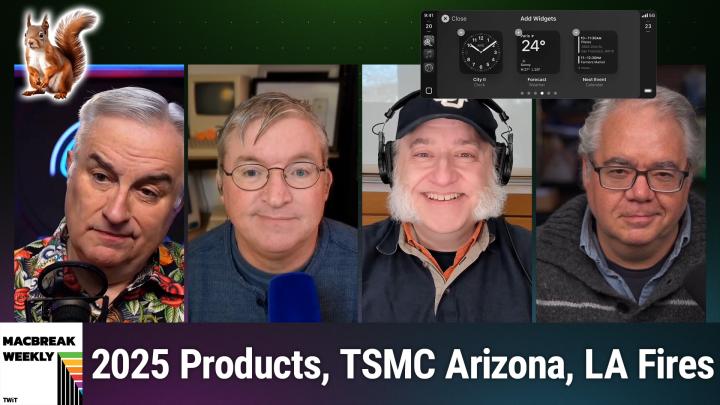
All TWiT.tv Shows (Audio)
MacBreak Weekly 955: Squeeze, Don't Shake
02:36:15
2025 Products, TSMC Arizona, LA Wildfires
Loading summary
Transcript594 lines
- [00:00]
Leo Laporte
It's time for Mac Break Weekly. The gang has assembled. Jason Snell is here from sixcolors. Com. Andy Inocco from WGBH in Boston. Office hours. Alex Lindsey. We will talk about the new TSMC plant making Apple chips. But is it enough to wean Apple off its dependence on China? Probably not. 20 new products expected this year. We'll do the Gurman report and we'll talk about new features that might be coming to the Apple Watch that and a whole lot more coming up next on Mac Break Weekly. Podcasts you love from people you Trust. This is TWiT. This is Mac Break Weekly. Episode 955 recorded Tuesday, January 14, 2025. Squeeze, don't shake. It's time for Mac Break Weekly. The show we cover the latest Apple news with Andy Inocco from GBH in Boston. Hello Andrew.
- [01:05]
Andy Inocco
Hey there.
- [01:05]
Alex Lindsey
Hi there. Ho there.
- [01:06]
Leo Laporte
Good to see you in your comfortable cozy abode featuring books and a view of the river.
- [01:13]
Alex Lindsey
Yes. And they've locked. Actually there's also a view of a very, very football shaped squirrel. Before I as I was closing the blind.
- [01:21]
Leo Laporte
That's good.
- [01:22]
Alex Lindsey
And I'm like oh my goodness. If you're best protected not only from the heat, from the cold weather when you're a squirrel like that but also if a hawk tries to carry you off. That's gotta be like 10 foot claws to get even, even through the layer of fat into the muscles. You're good.
- [01:39]
Leo Laporte
A football shaped squirrel. We already have a title and we haven't even introduced the other panel. Yes, it's amazing.
- [01:44]
Alex Lindsey
New personal best.
- [01:46]
Leo Laporte
It's amazing. Alex Lindsay is also here from officehours global and 090 media. Hi Alex. Hello.
- [01:52]
Andy Inocco
Hello. I'm already I'm spinning up the mid journey for a football shaped squirrel. We'll see what we come back to me a little later in the show. We'll see what we've created so far.
- [02:03]
Alex Lindsey
Oh, oh, oh oh. Ale my Google photos I am well, well supplied with football. I'm sure that when you mid journey football shaped squirrel it's basically educated from my, from my training set.
- [02:16]
Leo Laporte
So. Oh and also Jason Snell from Six Colors. I've been looking for news is what I'm doing right now. Yes, me too. Aren't we all 6colors.com and Mac World and. Hi Jason.
- [02:31]
Jason Snell
Hi Leo.
- [02:32]
Leo Laporte
Is there any news? Is anything going on?
- [02:34]
Jason Snell
It's real quiet out there, right? Not real, almost too quiet.
- [02:38]
Alex Lindsey
It's the flow. It's like the only news is like oh good. Gurman has his first Newsletter of the year. Yay.
- [02:45]
Leo Laporte
Oh, and it was the lightest weight newsletter.
- [02:47]
Jason Snell
It was a recap of his reports about what was going to happen this year.
- [02:50]
Leo Laporte
From nothing. Yeah.
- [02:51]
Jason Snell
Earlier this.
- [02:52]
Alex Lindsey
I think, I think the wasn't.
- [02:54]
Leo Laporte
Without Mac World Expo, you got nothing really on January. Right?
- [02:57]
Jason Snell
Yeah. Ces. Right. Which doesn't have a lot of Apple. There's a little Apple relevance, but not a lot. Not a lot.
- [03:03]
Alex Lindsey
But wasn't that. Didn't he have something on the Apple Watch Ultra that will have. Not blood pressure sensing, but at least blood pressure alerts? I think that was new. I didn't know.
- [03:15]
Leo Laporte
Apparently there was at ces a company. Oh, I wish I could remember the technology I was hearing. Father Robert was telling me about it on Sunday on Twitt that does non invasive glucose monitoring that can go in a watch size device. It wasn't radar, which is what the University of Waterloo came up with last year. It's some other technology and I'm very curious about it and I imagine Apple is, you know, already on the, on the horn, whoever that is saying, let's do it. So I would, you know, Ultra3 is supposed to come out this year. I'm a devoted Ultra fan and, you know, it's been two years. It'll have been.
- [03:54]
Alex Lindsey
It's a cool watch. Yeah.
- [03:55]
Leo Laporte
Yeah.
- [03:56]
Alex Lindsey
I love, I'd love to. I'd love to see like, if they. If there is like a new Apple watch se, I would love to see them introduce like even a third styling too, because it's easy to confuse like an SE for like the regular ones. But also I love. It's one of the greatest things about. They anticipate when Apple was planning a watch is that, wow, this is the first time that Apple gets to design something that is. Yes, it's technology, but it is firmly in the arena of like, style, of like fashion, of jewelry, of something you wear. And I've been really, really keen to see them not just go with the same square pillow design year after year after year, but to give us something interesting and something different, like the Ultra, which is just wonderful.
- [04:39]
Leo Laporte
Well, the Ultra is different, isn't it? But it's still a square pillow. I mean, well, it's still square, but yeah.
- [04:45]
Alex Lindsey
And they had the mandate of making sure that, like, it looks tough and that looks like when they find your body, they'll be able to get your ID off of the watch because it'll still be running this thing.
- [04:55]
Leo Laporte
I have no scratches, no dings, no nicks. I think partly because the titanium ring is Slightly raised around the crystal. And I imagine they're also using sapphire, so that's tougher. I've been very happy with this. It's a great, great little watch. Once you get used to £3 on your wrist, I figure it's like a workout, you know, I'm just pumping some.
- [05:14]
Andy Inocco
I'm far more resistant to upgrading the Ultra. Like, you know, I get. I paid a lot more for it. So I found that I was. When I was buying the lowest end.
- [05:23]
Leo Laporte
Watch, yearly's no big.
- [05:25]
Andy Inocco
No, it was like, oh, we'll get another one. The ultra. I'm kind of like, well it's. It's got to be really good for me to. Well, I saw the version one.
- [05:32]
Leo Laporte
Oh, you haven't even gone to the two. Well, you're going to skip to the three then that'll make sense.
- [05:36]
Andy Inocco
Yeah, I might skip to the three. We'll see.
- [05:37]
Leo Laporte
I don't. Honestly, I think you will see what they put in there. Now, if they put in a glucose monitor, the glucose.
- [05:43]
Andy Inocco
I will say the glucose monitor is the thing that would move me over the. The right now. The timers were great, the alarms were great and the exercise stuff works great.
- [05:54]
Leo Laporte
So.
- [05:54]
Andy Inocco
So for me, like how I. 99% of how I use the watch, it's fully operational and I don't know what I would, you know, how many other features I need.
- [06:03]
Leo Laporte
I will literally, I'll get the. Get to the gym and come back and get my watch because before I work out, because I want credit, I. I went to.
- [06:13]
Andy Inocco
I went swimming last night and usually, you know, I keep track of all my laps, you know, and how many hundreds of meters or whatever that I'm. And I went swimming yesterday and I. My watch had died. Like I just hadn't been plugging it in and I was like, I almost like, like, is it really worth. It was right at the end of the day, so I couldn't go back and back where I was like, should I really go swimming? Because I can't. It's not going to be tracked. And I went anyway. But it was just random. Like I came home curly to ask how long I. How far I had gone. And I was like, I have no idea. Like, I just swam back and forth until I got tired. I looked at the time and figured out, well, I'll just swim for this amount of time and see how it goes.
- [06:45]
Alex Lindsey
I guess I swam for my health.
- [06:47]
Andy Inocco
Yeah, exactly.
- [06:48]
Alex Lindsey
Fun. Even if we didn't collect any data on it.
- [06:51]
Leo Laporte
That's what Lisa says. She says, well, you know, I said no, no chest to know it's not enough for me.
- [06:57]
Andy Inocco
Well, no, but it's like, it's like I, you know, I start off when I, when I swim. I just. The first hundred meters is me. The watch tells me how fast I did it. Like, I'm always trying to look at that carve off a couple seconds off of my. My first hundred meters and, and then, and then. And then after that it's just how many meters do I get done that that day? So I'm always trying to add about 50 meters a day.
- [07:18]
Leo Laporte
Their current big ad campaign, which I saw in the. By the way, sorry about your Steelers. We.
- [07:24]
Andy Inocco
I was a very low expectation.
- [07:25]
Leo Laporte
It was. They did.
- [07:26]
Alex Lindsey
They.
- [07:26]
Andy Inocco
They almost got under my low expectations.
- [07:30]
Leo Laporte
It's pretty low.
- [07:31]
Andy Inocco
But we entered the season, we thought it was going to be a train wreck. The fact that they were in the playoffs. Yeah. Like, oh, this is a bonus. And now I don't have to watch football anymore. So I don't. I like as soon as the Steelers season ends at the end of football for me, it's over.
- [07:42]
Leo Laporte
For you. Yeah, it's curling now. But I saw a lot of Apple ads on there and what were they for? They were for the watch. They were for athletes training and it's snowing and the watch says get in out there and they go ahead and do it.
- [07:56]
Andy Inocco
You know, I haven't had a new person talk to a new person. I finally, I bought my wife a. The watch.
- [08:04]
Leo Laporte
Yeah.
- [08:05]
Andy Inocco
You mentioned she loves it and she's like, she missed her meeting but she's going to like going for training and she'll know more about it than I do soon. But she just really every. She just really enjoys it. And I was. She was the holdout because my kids, of course one of them earlier than that. And, and so the whole fam now is a bunch of Apple watches.
- [08:25]
Leo Laporte
And so anything you can do as a family with those.
- [08:28]
Andy Inocco
I mean, like know where everybody is.
- [08:30]
Leo Laporte
Do you have walkie talkie? We should.
- [08:33]
Andy Inocco
We should do walkie talkie. I haven't. I. I had until you break a 1 9.
- [08:37]
Leo Laporte
I'm on Route to elementary school. Over.
- [08:40]
Andy Inocco
Yeah, exactly. So, yeah.
- [08:42]
Alex Lindsey
So for a bear in the air.
- [08:44]
Andy Inocco
Doing a double nickel, I mean, I think but. And a lot of the Apple fitness stuff is really nice when you have to watch.
- [08:54]
Leo Laporte
Yeah. Yeah.
- [08:56]
Jason Snell
That ad is good. That ad is really good. And it's interesting because it's a. And it's not just for athletes. It really is like it's New Year's Resolution themed. Right. And it's the idea that the second Friday, I guess, of the year is when everybody on average quits their resolutions. And it's basically, well, what if somebody was there to make sure you stayed on your, on your path? And the Apple Watch will do it. I think it also, what I find interesting about it is it says something about Apple's whole philosophy of this, which is they want to be in this space where they are encouraging you and that they're leading people to good health through the Apple Watch, actually encouraging them. And what is interesting is one of Mark Gurman's rumors, in fact for a while now has been that they're working on this kind of AI based health coaching system. And it has the ring of truth about it to me because currently what the Apple Watch actually does, I mean it's a lot of yes, the Apple Watch will help you meet your goals, but you know, just add your own effort, which is, you know, it's like, oh, we'll prod you about your rings or we'll say, hey, you're behind schedule, maybe you should go. But it's like really not sophisticated. And when you look at that ad and you see what Apple really envisions as a mission statement for the Apple Watch in terms of keeping people fit, they really do need more active coaching that knows things about your life and your activity and can make some actionable suggestions and you know, and they're not there. Right. It's very simple in terms of what is offered right now. So I think that's interesting to think we can look at this ad and see what Apple believes the end goal of the Apple Watch is and maybe suggest what they're emphasizing in their internal development which, you know, Mark Gurman suggests is something that might come this year.
- [10:45]
Andy Inocco
Yeah. And, and I, and I will say that I, I thought when I first got it that the rings were silly, but the rings are, they are. I mean, I definitely look at them, I mean they're on my front face and I look at them going, oh, I haven't gotten up very much or haven't done anything today. You know, I need to take a walk or do something else. And, and, and so I do think that it, they, they're more, they encourage me more than I thought they would, you know, to, to have them there. So to just as a, as just kind of a, a picture of that day of whether I'm actually doing something.
- [11:15]
Jason Snell
So yeah, I mean it's nice, but it's a little more passive than I think Apple wants it to be. I think that there is a level where I think Apple knows that there are people that they're losing because they're not able to provide enough of a. Yeah. Framework.
- [11:30]
Andy Inocco
Delicate. Yeah, definitely. Like, hey, you haven't stood up for a while. And I'm like, shut up. Yeah, right.
- [11:39]
Jason Snell
But if it's, I mean, and they talk AI, everything's an AI based system now, right? Theoretically. But like, ideally it would be able to adapt and know what doesn't work and what does work for different people and like, oh, you don't want this anymore, but I'm going to recommend this and all of that. And what they have now is kind of hard coded. You know, if this then that there's a lot of that in there and if it, if it annoys you, you turn it off and then you never see it again. And that's the end of the story. So I do think that that's a place where, I think a, a more sophisticated algorithm that was trying to analyze your health data and motivate you could probably do a better job than what they're doing now.
- [12:15]
Leo Laporte
Y.
- [12:15]
Alex Lindsey
Particularly when, not just that, but also all kinds of reminders where, if it's the, there's times where I get the same reminder that I've set for myself day after day after day after day without clearing it. And AI can say, okay, let's take a look at this task that you really want to be reminded of and why you're not getting that done. Things like that for exercise is also a really good thing. Not just you're being annoyed because, hey, oh no, is something wrong? You only did like 1200 steps today and you normally do blah, blah, blah as opposed to, okay, for the past, this past week you've been down, you've been down for the past two or three weeks. Do you, let's have a conversation if you're interested and figure out like why maybe you're not walking so much and how we can encourage you to do more.
- [12:59]
Andy Inocco
And I, I, I will say that as someone who grew up working out at a gym, I just feel like, and I know that it's complicated because everybody's gyms don't change their equipment very often. And so the problem has been mostly the gyms don't, don't change their equipment very often. And there are handfuls of things that do this at home, but usually they're kind of, we hit thing, you know, hit devices that sit on your wall or whatever. But man, I just feel like if people could walk up to a machine and see a video on how to do it and then have it keep track. The machine tells the. The watch or the phone, this is how much weight it's set to and this is how many reps it would transform, how people.
- [13:35]
Leo Laporte
Aren't there machines that do that though?
- [13:37]
Andy Inocco
There are, there are some home machines that do it, but they don't do it. They. If they're like goofy. I mean, it's just like I can't like, they're not like the gym, you know, they're like goofy little machines that go on your wall that. That's the only ones I've seen that will really tie into your phone.
- [13:49]
Leo Laporte
Right.
- [13:49]
Andy Inocco
You know, I had, I had Peloton.
- [13:51]
Leo Laporte
I think because they have an app and I bet you I have to look. I'm pretty sure the app ties into Apple Health, but it's a bike. I mean, yeah, it's a biker. They have treadmills now.
- [14:02]
Andy Inocco
I like, I like recumbent bikes to watch TV while I'm. By biking.
- [14:05]
Leo Laporte
Oh, no. I mean, I spin, man.
- [14:07]
Andy Inocco
Stand the spinning. I, I hate that position you got.
- [14:09]
Leo Laporte
You don't feel nauseous after working out. You're really not doing it right. I'm just saying. Exactly. I use an app that I really like. I guess I could recommend it called Gentler Streak. And it, it is basically Apple Health with a little AI thing on top of it that, you know, they monitor your, your workout, but you also, they recommend other stuff. I think it's pretty cool. I mean, it's good and it, you know, it take. Has a lot of extra things like tai chi and dancing. I guess Apple Health probably has that now too. I don't know if it's worth spending money for something that does this, but, but I, I like it. And it's, it's that AI thing you were talking about a little bit more, it's got a little, little more gloss on top of it. Gentlemen.
- [14:56]
Jason Snell
Yeah. It's funny we think about how sophisticated so much of our technology is, but the truth is that I think in some ways the quest to do AI is a. Is in part out of a frustration that, you know, in the end you are just creating a chain of if, thens and, and it's not that sophisticated and it doesn't know you and it doesn't learn about you and it doesn't think about you and, and a lot of stuff. Like the Apple watch, hardware wise is so sophisticated. Apple's health database knows so much about.
- [15:26]
Leo Laporte
You and yet train it with AI. Right. I mean it knows the difference between rowing.
- [15:32]
Jason Snell
Sure.
- [15:32]
Leo Laporte
And stepping.
- [15:33]
Jason Snell
But what it doesn't do is, is analyze what you do and when you do it and how you're doing it and, and come up with an actionable kind of plan or.
- [15:43]
Leo Laporte
I think there's a reluctance to do that because of the fda because they health recommendations becomes a little problematic.
- [15:50]
Jason Snell
This, this may be why. Well, for fitness though, fitness is different than health. Right.
- [15:53]
Leo Laporte
Okay. So, okay, they're not saying go to the hospital exactly.
- [15:57]
Jason Snell
Although they do. I mean they'll give you an AFIB notification and say you might want to talk to your doctor. Right. Like they'll do that. And even with their vitals app, they're doing a little exploration of this where I think there's some machine learning involved, where they're trying to sort of make notice general trends. But they are a little reluctant to go beyond that because again, I think there are some regulatory issues. But for fitness, fitness training, I think that's why they're focused on it according to Mark Gurman, is that one is a much less regulated bull area. And, and I just, I'm struck by the fact that as sophisticated as some aspects of our technology is, some of it is not that sophisticated. And, and it could be way better if it like you've got all this personal data, but the algorithms aren't personal. And so they either work for you or they don't.
- [16:46]
Andy Inocco
And I think this is where Apple has a key advantage in the sense that most services that required that data to go off my phone, I would not do like, I just wouldn't, I wouldn't interact with it.
- [16:57]
Jason Snell
Exactly. And Apple on device.
- [16:59]
Andy Inocco
Yeah, if it's all on device and it's inside of that, that relatively secure enclave much more than sending it to some web company that I don't know. It's, it, it's, it's a, it's a. I'm much more likely to do it than, than do it.
- [17:15]
Leo Laporte
I understand that, but it hobbles it. I mean just look at the image factory or whatever they call that thing. It's terrible because it's on.
- [17:22]
Andy Inocco
Well, but I think that generating, generating AI images and, and looking at my health data, I think I understand more complicated.
- [17:30]
Leo Laporte
But in order, if you want AI to really sing, you're going to have to go off device in the long run.
- [17:35]
Andy Inocco
I think, I don't know. I think it's a function. I think that the image generation, the Gen Moji or the image playground or whatever is really, I think the biggest thing that Limits. It is not the processing power. It's Apple's unwillingness to give it that it needs to be effective. You know, like. And so it's just.
- [17:51]
Leo Laporte
That's why I use Grok X's image generator, because it doesn't care. Grok's the honey Badger. Let it all burn generators.
- [18:00]
Andy Inocco
Yeah, yeah, Whatever you want there. Yes, whatever you want.
- [18:03]
Leo Laporte
I'll give it. Whatever you want to put Trump in jail, go right ahead. We'll do that. In fact, there were a lot of Grok generated images of Elon Musk as a puppet master with Donald Trump attached to the strings that I thought, wow, Elon allows that, huh? Maybe Elon likes it. I don't know. I guess we could talk about this. There's some other things we'll talk about that have more to do with Apple, but at ces, this company named Bee B E E like a bumblebee, showed this. They actually were. I bought that from this week. Like two or three things that do this. There's one that's a pearl that you stick to your temple. But the idea is this little wrist thing, or you can clip it on your lapel, records everything and. Yeah. Sends it to an unnamed. I don't even know. It's B computer. They don't even say, I don't think what AI company they're using. I doubt it's their own, but sends everything that happens. It's recording everything. Sends it up to the cloud, analyzes it, sends back notes. But in here, there's also a transcript. Not exactly. Yeah, there's. Yes, there's a transcript you can assign voices to. So I'm sure they're going to be clobbered as soon as somebody figures out they're doing that. And I'm completely willing. I'm doing it right now. I'm sending every. Now it's not hearing you because I'm wearing headphones, but it's hearing me. And it will. It will undoubtedly give me a synopsis of what we talked about on the show. So, yeah, you couldn't use this, Alex, because you have to do stuff that. You've got NDAs. I don't sign NDAs.
- [19:42]
Andy Inocco
That's another too many. I have NDAs stacked on other NDAs interleaved with other NDAs.
- [19:47]
Leo Laporte
But. But I think the potential here, I guess what I'm saying is if you're willing to give up your conception of privacy and there's a lot more you can do with AI. And I think the.
- [20:01]
Andy Inocco
The so many things, and there's so many things other people can do with AI Once you've given them.
- [20:05]
Leo Laporte
Fine, I don't care. I'm getting so much out of this. I've only had it for a day. I just came yesterday and I'm already very impressed. It takes notes. It, it actually makes a to do list based on stuff. You know, when you agree to do something, it actually adds it to your to do list. You can of course delete it later. It summarizes your day. I was reading this before the show, so pardon me for repeating it, but let me just show you what a great day I had yesterday for Alzheimer's patients. This would be amazing. I'm thinking for my mom, who can't remember much. Let me show you. This is the interface. Good morning, Leo. This was yesterday. Daily memories, passions and camaraderie shone brightly through animated debates and shared laughter brimming with social interactions. We were watching the football game. It talks about what we talked about. It says, you know, we made jokes about the medical ads. I think this is kind of interesting. I know. I'm sure. I approve of the florid pros. The overall mood of Leo's day was dynamic and lively, characterized by a blend of excitement from sports analysis, upbeat sharing of personal hobbies, and spirited discussion.
- [21:22]
Andy Inocco
There was an evidence when it goes bad, like, does it tell you that? Like, does it tell you that, you know, you had a horrible day today?
- [21:28]
Leo Laporte
Well, we'll see. That's a good question. That's a very good question. I mean, this was a good day because we were watching the Monday Night Football with Lisa and her son and her ex husband. They don't mention that. And we had warm social ties, rich in camaraderie, underlining the strong bonds within Leo's purse. I can't wait to have a bad day. And I will let you know what it says on a bad day. Oh, this is. I also gave it. See, I really gave it. Ever gave it up. Everything. I gave it my email, I gave it my calendar, I gave it everything. My whole Google, my contacts. This is emails. It's summarizing my emails. I haven't seen that yet. A late night visit from Stephanie. I don't know the woman. I don't. And chilly weather. It's a little confused on that. It says it's 18 degrees. I hope that's not, it's not going to be 18 Jason.
- [22:27]
Jason Snell
Friendly chest max. 18 Celsius, maybe.
- [22:31]
Alex Lindsey
What did California do to God to make God so angry?
- [22:37]
Leo Laporte
I just think this is so cool. I, I so. But the point being not. I mean this is cool. It's 50 bucks and so far no subscription. I'm sure there will be a massive subscription or they'll go out of business. But this is the promise of AI down the road, right. And this is something Apple could do. In fact I can use the Apple Watches recorder with the B AI they said we'll see how quickly Apple turns that off but I don't think it would be as good if it weren't connected to the outside world. I think this is the kind of the challenge that we're facing with AI. Apple can do it, but if it's all on device, I just don't think it's as rich and as useful.
- [23:19]
Alex Lindsey
Yeah, well that's why I was so excited about Nvidia's like $3,000 personal AI machine that they announced last week, they're shipping in May. The idea of having like a person, it maybe wasn't designed for the home but eventually the idea of having like a personal AI server in the house, something that can run these enormous models that normally have to go into the cloud so that you won't feel bad or sketchy about using it for financial advice, using it for like personal therapy, the sort of stuff that I would never allow this to leave the house and live on another server let alone possibly be used to train other AI possibly to be exploited by people who know who have red teamed correctly this chatbot and know how to exfiltrate information out of it. The best the, the it's not going to be easy to get those kind of huge scale models the kinds do the really good stuff to work on device and give you the results that you want. However I think for just like a lot of people are willing to spend $500,000, $2,000 to have like a home storage server to do a whole bunch of things. I think a lot of people would be willing to spend that money, that amount of money to have like the ultimate in secure and personal and private AI tools.
- [24:31]
Leo Laporte
I wonder if that's what Nvidia is thinking. I mean I think they intended more.
- [24:34]
Alex Lindsey
For researchers to develop models that they could then deploy.
- [24:38]
Leo Laporte
Really interesting idea, a supercomputer, the idea of still not as big by the way it's only 200 billion tokens. I think it's still not quite as big as you know, an external but it's still pretty good.
- [24:51]
Jason Snell
Doesn't it feel like we're watching the computer industry repeat itself here where I think because I think Andy's exactly right that right now, you know, all These incredibly useful AIs are on huge servers that cost a lot of money and burn a lot of power and are in the cloud and you have to send a data. And I think some people expect that it's going to stay like that, and it's like it's not. We have already learned that for so many reasons. And Apple's already learned this because they've got neural engines in everybody's pockets. And so they're trying to build small models that can run on device as well as their cloud models that they're trying to build. But, like, in the long run, I think this all points toward personal data that belongs to us and is analyzed on our devices by models that run on our devices. And devices get more powerful and the models get more efficient. And I feel like that is a direction that everything has to point because it's so much more effective for your AI model to look at what you know, your personal data collection on your device rather than say, well, okay, I guess I'll authorize all my personal data to some server that's provisioned somewhere in the cloud and I hope that they don't hack my entire life. And if there's an AI Leo here next week, we'll know what happens.
- [26:12]
Leo Laporte
Well, the cynic in me says that really the reason this whole thing is developing as fast as it is is because there is so much money to be made by exfiltrating all your personal information to the cloud. And that's what's really driving OpenAI and everybody else. Not that you're going to pay for a service, but that they're going to be able to suck you dry for all your information.
- [26:35]
Alex Lindsey
And in addition, if you have a conversation with any one person, if you work alongside somebody, or if you had a personal assistant for five or six or seven years, at some point, they know so much about how your work functions and what you need, what your priorities are and what you mean when you grunt something instead of being really, really explicit about what you need. That is such a valuable set of training data about how to be a good assistant to Leo laporte, that why should it belong to anybody other than you? Why should it not be an open, an open corpus of data that you can then keep on, put on another box, upgrade to a different sort of AI.
- [27:16]
Andy Inocco
But I still think that, I still think that Apple, over time, again, I think that they, and I think Apple has more time than everyone else because their user base is moving. I mean, I am constantly looking at different AI models for what I want to do, whether it's in rock for one thing and chatgpt for another, and Google, you know, for something else. And I'm constantly optimizing, so they're, they're in this kind of, you know, you know, pit match between each other because people like me are like deciding which ones I'm subscribing to. And I'm turning subscriptions off on stuff I'm not using very often. So as soon as I decide that this isn't as good as the other ones, I just get rid of it. And so they have to fight every single day over what that looks like. I'm doing all of this on my Apple devices, which I'm not planning to leave anytime soon. So I think, I still think Apple has a lot of time to do this. And I do think, though, that as they continue to optimize, you know, the hardware so that it can process this better, it's going to be able to do more of that data. And then in this kind of secure area, it's going to get stronger and stronger and stronger. And I think that some of the things we're talking about, this personalization is not the hardest thing that that AI has to figure out. You know, figuring out images, imaging and video and everything else, that's really hard stuff, you know, and compared to figuring out how to optimize, how to work with us, I don't think that that's nearly as complicated for an AI tool to do. And again, I think that, you know, Apple, I'm going to guess, is spending billions a year on, on make, on improving this, this model, as is everybody else. But I think that they are, you know, they're going to continue to grow the stage one and stage two that are relatively secure and stage three, which right now I think is 80% of the solution will become 10% of the solution over the next five or 10 years.
- [29:01]
Leo Laporte
It's going to be very interesting times no matter what. And I agree with you, Andy. If I could buy 3,000 is worth it. A server that I could run in my house that would give me all the capabilities. The problem is it's probably not because one of the things that makes, for instance, perplexity AI so good is that it's always connected to the Internet and it's always getting stuff from the Internet, I guess, my digit server, that's fine.
- [29:26]
Alex Lindsey
Like what, what if you could, what if you could just set up fence post that says, look, the conversations that I have with you are private if you want to, if you want to go and Google something on my behalf, do it, but don't say it's because you want to talk to me about this.
- [29:38]
Leo Laporte
Yeah, right.
- [29:39]
Alex Lindsey
I think it's possible.
- [29:40]
Andy Inocco
I just think the, the processing power required when you, as soon as you get out, you know, out there, it's a. I don't think it's. I don't think we could have something at home that would do it.
- [29:50]
Leo Laporte
Well, what's powerful? And I've actually talked about this, which by the way, AI has become such a focus that we've decided to make this week in Google, kind of re. Retool it to be, we're going to call it intelligent machines. It's not going to be just AI. It's going to be about intelligence and artificial intelligence and machines that are intelligent. This is clearly going to be the next. For this decade, the next big thing. I just really wonder how well Apple is going to be able to survive in this. But it is the case. We were talking about this on Wednesday on Twig that there are a number of AI scientists who say, really, we got all the information now, thank you for putting everything, you know, into the Internet. Really, it's about better models and, and faster machines. And Moore's Law is very much the benefit. AI is very much a beneficiary of Moore's Law.
- [30:44]
Andy Inocco
I think that again, I don't know, I'm doing all this AI stuff on my Apple computers, so I'm not sure when I'm going to decide, oh, I have to leave Apple because some other.
- [30:52]
Leo Laporte
They're going to get faster and faster. That's the point. They're going to have more memory and they're going to get faster.
- [30:56]
Andy Inocco
But even, But I'm saying, like I'm using ChatGPT on my Mac, so I don't know when I go, oh, Apple's fallen so far behind an AI that I have to leave them because I'm still using all these tools on my phone.
- [31:06]
Leo Laporte
But as soon as you use ChatGPT, all bets are off. You're now regardless of what platform you're now sending information to. Chat GPT.
- [31:13]
Jason Snell
Right.
- [31:13]
Andy Inocco
But I think that the. I think so. I think Apple's got a lot of. All I'm saying is if I'm using it, Apple's got a lot of time because everybody giving away my. They. The advantage that Apple has is decades of privacy first development in the sense that if, as they, if they're able to continue to expand that over time and again over Years, not over the next couple months. That there is an advantage to where that I would let. Like there's just a lot of things I won't ask ChatGPT or I won't go into or I won't whatever. Because you know, from a security perspective. But, but I think that if Apple was, you know, got good at those things over time, they have a huge advantage over everyone else who's just simply unable to provide that kind of security.
- [31:54]
Alex Lindsey
Oh, if it, if it, if it becomes a product, then it might not be quite such a big defining deal. Remember that both Google and Apple provide a lot of the same services and a lot of people don't seem to mind that Google is an advertising company and make personal information.
- [32:13]
Leo Laporte
But Google was going to, was kind of doing this. Remember those cards? And the whole idea is we know you're at the airport, so here's your flight information, your travel information. And they kind of pulled back. I don't know why.
- [32:25]
Alex Lindsey
Well, yeah, but all I meant is that like if, right, right now we're at such a point of freedom for artificial intelligence because I think there was a recent study that said that something of Apple iPhone owners, they regard Apple intelligence as important to them. I think the number of that who answered yes, that question were like high teens, a very low number.
- [32:48]
Leo Laporte
So there's still.
- [32:49]
Alex Lindsey
So there's. So if Apple a thank God, needs to make a whole bunch of mistakes over the next couple of years, they have the freedom to do that. Because eventually we're going to settle into a world in which people understand basically what AI is. Just like there had to be a time for people to understand what word processing was, understand how it's relevant to them. Even if in the first two or three years there weren't products or services that were relevant to what they do in any way, shape or form.
- [33:20]
Leo Laporte
Don't you think Apple is shaking in its boots just as Google is that they're gonna. That something like this is gonna come along and obviate the need for a smartphone. That there's gonna be. I mean Google's terrified that search is and they should be gonna be replaced by AI.
- [33:37]
Andy Inocco
But I think Apple, again, because there's so many people with so much of their hardware, I just, I think that their base is not gonna move very quickly, you know, one way or the other. It's a pretty solid base.
- [33:48]
Leo Laporte
As far as.
- [33:50]
Andy Inocco
MySpace was a webpage and that was, that's easy to disrupt. You know, the. I think that Google has more to worry about because they're Primarily software.
- [33:58]
Leo Laporte
Tell Zach.
- [33:59]
Alex Lindsey
Well, I see. I kind of feel, I kind of feel like it's exactly the opposite where Google is putting their chips on every single square in the roulette betting board, where whatever it is with AI, they've got a business there, okay? They're not just giving you a better smart assistant on a phone, they're not just giving you like funny emoji. They are building world models that hopefully they hope AI developers of this year and 10 years from now are going to be relying upon and creating the computing power that they be able to, they will be needing to lease, lease service from in order to run these models. If AI eventually comes into a topic that I've been coming back to so often that again, if I just had all I need is one Bluetooth wireless Bluetooth earbud that can connect to, that can talk to, let me talk to my phone, have conversations, that's a lot more powerful than VR headsets for me or augmented reality. And so no matter how what piece of hardware comes along, Google can create the AI or for it, create a product or service for it, or again create the compute power that this third party company is going to build it on. Apple, if people go away from phones, if they decide that it's the earbud and it even doesn't really even matter like what earbud it is, so long as it's relatively good, they're the people who I think would be in trouble. Now I don't think that that's going to happen anytime really soon. I do think that the phone is going to be the host for the AI for the foreseeable future, but you never know. There are so many things that nobody saw coming until it was the only rational thing that anybody could conclude. But I do think that Google is not, not as vulnerable as Apple on that specific scenario.
- [35:48]
Leo Laporte
I think Google's almost out of the business, to be honest. I think Google's really looking laggard. And I think both Apple and Google should really be worried that they are about to be kind of replaced. As happens always in technology, the next thing comes along, it's not such a big deal to go from an iPhone to an Android phone. And the next time you buy a phone it may not be an iPhone. And then what does Apple have? Yeah, I don't think the lock is straight.
- [36:17]
Andy Inocco
I own a lot of both and I would never use it on a day to day basis.
- [36:21]
Leo Laporte
Android outsells Apple.
- [36:23]
Andy Inocco
Yeah, it does, but I mean when we look at the next generation, it doesn't so.
- [36:27]
Leo Laporte
So it's.
- [36:28]
Andy Inocco
So it's. I mean, I think that's the. In the U.S. but, but that's a pretty big market. You know, I don't, I don't know if it. Yeah, I don't. But again, I don't know if the current market is really going to. I don't know that many people that went from an. I mean, and that could be wrong, but I just don't know that many people that have gone from an iPhone to an Android.
- [36:46]
Leo Laporte
I think complacency on Apple's part at this point would be a big mistake. And I bet you anything I don't think they're complacent. Very hard about what, what to do to stay relevant.
- [36:54]
Jason Snell
Well, I mean, what. Just look at the evidence of the last six months where everything is Apple intelligence. That is a sign of a company that got the, Got scared and got the, and got the message. Who knows if it's enough. But I would say that at least at a very bare level, you can't say that they seem complacent.
- [37:13]
Leo Laporte
They recognize complacent. No, I agree.
- [37:15]
Jason Snell
They do recognize. Now they say, Alex, succeed or fail. But they are, they are not being complacent because. And because Apple intelligence, first off, it's forcing them to behave in ways that I would say are maybe even counter to ways that Apple's behave. They're making mistakes and throwing things at the wall, and they're doing that because they feel an existential threat from the rise of AI technology, especially as embraced by their competitors, and they got to catch up. And that is, I mean, I think that says it all now. I think there is an interesting question about whether Apple's ways are so locked and have been so fixed for so long because they've been so successful, whether they can unlearn the details like.
- [37:57]
Leo Laporte
It's always the question. It's the innovator's dilemma. It's the question for every company.
- [38:01]
Jason Snell
It's the corporate culture and how it all stacks up. And I, you know, I was charged in my career at a print magazine with dragging the entire staff onto the web. And I would have meetings where everybody would agree that it was a good idea and then it wouldn't happen like they would. Because saying we're going to do this is not the same. Changing corporate culture is brutally hard. And I do, I think that's the greatest risk for Apple is not that they don't intellectually understand the importance that I might have in changing the fortunes of the companies. In this business. Not to say, you know, again, I don't want to oversell. I think there's a lot of it that's overhyped, but there's a lot of it that will meet the hype as well. But like that's the risk that Apple has is not, not that they don't agree that it's important and they need to meet this moment, but that culturally they are using a culture built by Steve Jobs in a very different era. And two, and they're too calcified. They're just too list you know, tied to how they, you know, what got them here, which is to be very successful. But it might not be the rule book you need to follow going forward.
- [39:12]
Andy Inocco
But I also think that, but I think that the upside is, is that, you know, when you look at how many people, when they're asked do you want to share my, you know, asked to not share my information? The percentages, I don't remember what it was, but it's very high. The people just say I don't want to share my information. And so the issue is, is that this kind of as we get more intimate in our connection with, with AI and wanting to have something on all the time, like I would never put something on my body or, or anything else that, that gave something to someone other than Apple, that ongoing data like, you know, like. And, and the thing is is that because I don't think, I think Apple culturally, I mean I think they, they consider privacy an existential problem for them. You know, like, so they, and I think that that's a challenge for them in AI but I think that also this device than private enclave, than everything else approach, if a, you know, it's one of those things like if you can pull it off, it's far superior for the, for many users to do things with it that are much more connected to their everyday life than many of the other AI solutions. Now the question is can Apple pull it off? And it's going to cost billions and billions, tens of billions of dollars for them to do that. But they are and if they do that, and as some of these other, you know, models, you know, will are a little leaky. You know, I think that as more of that stuff starts to come out then I think that, that Apple is in a, in a different position, you know, than everyone else. And, but they have to pull it off, you know, that that's when I, when I do an image, playground image, then I go, maybe they can't do it.
- [40:46]
Leo Laporte
No, I agree with you if Apple couldn't do it, if I could get all the benefits of this B thing on my wrist, but it's all from Apple. I far prefer that.
- [40:54]
Andy Inocco
Exactly. And that's, that's, that's Apple's opportunity.
- [40:57]
Jason Snell
Yeah.
- [40:57]
Andy Inocco
The risk is, is that they don't move fast enough and they don't get that done. But their opportunity is something that is far superior from A. I'm willing to share all of my private data because you know, my health data and my other things, everything else.
- [41:10]
Jason Snell
And Kodak ecosystem connectivity, it's familiarity with the brand, all of these things. But they have to have the product right.
- [41:16]
Leo Laporte
But if Kodak could have owned digital photography, could have owned it, but they didn't. It's the innovators dilemma. It happens again and again and again.
- [41:26]
Jason Snell
But existing companies are not precluded from adapting. We don't tell those stories. But they do. They can adapt, but sometimes they don't.
- [41:36]
Leo Laporte
Exception. That proves the rule though, I think. I mean it's very well somehow Microsoft.
- [41:40]
Andy Inocco
Has stayed in the top five for a long time. They keep it down.
- [41:43]
Jason Snell
Smart.
- [41:43]
Leo Laporte
No, Microsoft and Apple. And Apple has done it too. They've done the transition. Absolutely.
- [41:48]
Alex Lindsey
I will say one thing though. I think that regarding your comparison to the app tracking protection, I'm not sure if it's 100% comparable here because the way that I would think of it is that if you ask somebody would you prefer that here is a diner that you like or a restaurant that you like, would you prefer that there are no vegetarian options or rather we'll get rid of the vegetarian stuff on the menu to make room for more non vegetarian options? In abstract I think most people might say yes because most people aren't vegetarians and they're not looking at that place on the menu. However, if you put in front of them red beans and rice and quinoa and a really great vegetarian dish and you ask them would you like this to be on the menu? They might say yes.
- [42:41]
Leo Laporte
I'll give you an example that's actually real which is if you ask people if they're gonna. If they watch pbs, far more people say they watch public broadcasting than actually do. Yeah, it's a poll question. And poll questions are notoriously bad way to find out what people really think.
- [42:57]
Alex Lindsey
Maybe, maybe I maybe introduced this the wrong way. What I'm getting at is that I think that people are in would much rather have more privacy than less privacy in the abstract. When you give them an exact example saying here is what your Calendar app can do for you. If it collects no information about you, here's what the Calendar app can do about you. If it is almost always aware of what's going on in your life, do you feel that strongly about privacy then? I do think that it's, I do think that people's desire for privacy is flexible. If you give them something that it seems like a good trade.
- [43:33]
Andy Inocco
Yeah, I mean, I mean the, the equation that I often use is action will always occur when possibility is greater than circumstance. So, so it'll always occur. So if you view the possibility of getting something more than the circumstance of giving up your privacy or, or more work or whatever, you're always going to move forward. It depends on where, what that circumstance is. The. For some people, for a lot of people, if the, if, if Apple was able to most, for most Apple users, if Apple gets within 10 or 15% of the quality of something else, they'll choose it because, because, you know, so they'll just go down.
- [44:09]
Leo Laporte
They'll.
- [44:09]
Andy Inocco
They'll go that automatic path. I think that, you know, if it's, you know. But I'm using, for instance, I'm using lots of AI that I know is leaky. I'm conscious to what I'm putting into it, but I'm also asking lots of questions. I'm trying to learn how to use air table right now. So I sit there with ChatGPT open and I'm sitting there like, how do I do this? I want to create this kind of table. I want to do this, I want to do this, I want to do this. And I'm asking all these question and I'm giving up whatever I'm giving. I'm probably not giving up very much there. But the point is, is that other than somebody knowing that I'm using the airtable all the time. So, so the, so the, the. But I'm the. The thing is, is that if Apple did that, I would use Apple to do that if it got within 10 or 15% of the quality. So Apple's advantage, advantage among their own users is they don't have to, they don't have to beat everyone. They just have to be within. They just have to be close. And an Apple user will tend to use the Apple resource. But if they're really far behind, Apple, you know, lost a lot of ground because they didn't choose subscription for Apple music until it was, you know, way too late. If they had done, if Apple had done subscriptions in 2009 or 2010, Spotify wouldn't exist. You Know like, you know, like it would, you know, and so, so you know, they can fall further behind and then, you know, but, but you know, I think that when all things are equal, Apple has an advantage or even if Apple's a little behind on another innovation. But I think that there's, but I, so I think that if Apple can get it turn the corner, they have a huge advantage. If they can't turn the corner, they've got time to figure it out. I think that's all I'll say is that I'm not saying that. And they're obviously very focused on it. I mean they're, they're, that's all they want to talk about. But so it's not that they're, not that they don't see it, but I still think that they have years, not months. And I think some of the other ones have months. You know, like if Chat GPT didn't perform as well. Like I've decided that, that Claude is better than Chat GPT to do programming. It's not programming built, you know, playing around, building programs, writing programs in xcode, but based on stuff I did with AI and I've, I started in Chat GPT but moved over to Claude and that, and that happened in a series of weeks, you know, and that, so that's a much different situation for these AI.
- [46:17]
Leo Laporte
It's not sticky. You will move away from Claude in.
- [46:21]
Andy Inocco
A week if it's, if I found something else that does it. And that's the. No, but that's the problem for the software based ones or the cloud based ones it is, but, but I'm not leaving. But I'm still, I'm not, I'm not going, oh, Apple intelligence isn't close enough yet. I'm going to leave my phone like that's not like. So that's, that happens over many years. So that's the curve that Apple has is that there's a huge ecosystem. I have to make big decisions. I've got Apple TVs and speakers and computers and watches and iPads and everything else leaving that ecosystem, that's really sticky. And I think that still gives Apple some time.
- [46:55]
Leo Laporte
We gotta take a break. I'm way behind. But I have one more provocative question. Do we have any information on how many homes are homogeneous? They're all Apple. And how many homes are heterogeneous? I'm guessing that just because you have an Apple phone doesn't mean you don't use Windows or have a Google tv. But I wonder, do we have any Numbers. Has anybody ever done any research on this? I'd be very curious.
- [47:19]
Andy Inocco
I don't know.
- [47:19]
Leo Laporte
The all Apple homes, I think have to be in a. Oh, there are very few.
- [47:23]
Jason Snell
Right. Just the sheer number of iPhones, especially in the US and you look at Mac market share, it's like not possible, right? I think that's right. You could even argue that maybe most iPhone users use Windows. Right. Like, just because of the numbers. It kind of has to be that way.
- [47:42]
Leo Laporte
We know that because of the success of itunes once it. It went out of Windows. I think that's still the case. So I think you're an outlier, Alex, is. All I'm saying is I think that the people are much more comfortable with a heterogeneous system than you are in general, anyway. We'll see. I mean, we're all going to see. I would also say. And this is a longer subject for another time, but yeah, the app tracking question notwithstanding, Apple. I'm not convinced Apple's more private than anything else. There was just a really interesting piece from Wired and 404 Media showing how many thousands. It's something like 4,000 apps are tracking your location because they're. And by the way, this information was then leaked in a hack file from a company called Gravy Analytics. The app developers don't even know that the location is being tracked. It's because they're using an advertising ecosystem that is tracking you. And if you look at the list of apps, it's everything. It's period tracking apps, pregnancy apps, it's game apps. It's huge. And this spreadsheet, which is available from 404 Media goes into the. Let's see, I'm at the bottom. No, no, I'm not. Yet more than 5,000 different apps. You saw this, Andy, I can hear you. I mean, this is the notion that you are somehow magically protected because you're on Apple.
- [49:18]
Alex Lindsey
Yeah. It's just good to have that broad understanding. I value the fact that Apple has ways of exploiting me that don't involve exploiting my personal information. And that's one of many reasons why my desktops are all Macs, my iPad is a Mac, all that kind of stuff.
- [49:39]
Leo Laporte
I use them because I like them.
- [49:40]
Alex Lindsey
Well, people use them. But people have to make sure that they understand that just because Apple goes the extra mile. And truly, truly, truly, this isn't just marketing hype. They do truly go the extra mile to make sure that if they can make something private without affecting their profits, they absolutely will. That doesn't mean that you're clean, you're pure, you're safe. Because there's so many other organizations out there, they're trying to track you.
- [50:06]
Leo Laporte
This is one of Windows and they know how bad Microsoft is and they still use Windows in the vast majority.
- [50:12]
Alex Lindsey
And I know, I know you need to get to commercials. I'll say this is one of the reasons why I don't. It mitigates to me the argument against, like using Google products and services. There are people who are want to de Google their phones go to really extreme lengths to make sure that their phone is absolutely clean of any, any taint or influence of Google. That's perfectly up to them. That I absolutely respect that decision. However, it's really, really hard to exchange oxygen for carbon dioxide on this planet without being tracked and without losing your privacy. So it's. That's part of the matrix when you're making the decision, what companies do. I want to deal with what companies do. Am I willing to trade my personal information for if they're giving me a better user experience for it?
- [51:00]
Leo Laporte
Yeah. I got to take a break. It's a great conversation which will never end. So that's the good news. We'll be back to it soon, I'm sure. And I think it's really fascinating to see what's going on with AI because it's moving fast, but it's also moving in unpredictable ways. Steve Gibson did an assessment of AI on last Tuesday on Security now and is basically his conclusion is everything you thought about AI yesterday is different today and it's going to be different tomorrow. We are in a giant disruption, the kind of disruption that happened with the Internet, but it's happening in a much faster time frame. And I think incumbent companies are going to be challenged in general by what's going on. It's fascinating to me and the fact that I'm willing to wear this thing. It's recording everything I do all day, all night, and sending it to an unknown server in an unknown country just shows you how all in I am on AI. Right. We got a great show. We got lots. We actually have Apple News we'll get to in just a moment with Andy Inocco, Alex Lindsay, Jason Snell, Great to have you here on Mac Break Weekly. So this episode of Mac Break Weekly brought to you by Delete Me. Actually, it's very appropriate to our privacy discussion because unfortunately, you know, we just were talking about those apps that leaked your location information and put it on the open market. If you've ever searched for your name online, perhaps. And don't. I don't recommend it. You've seen how much of your personal information is out there. Maintaining privacy is not just a personal concern. It's a family affair. It's a corporate affair. We use delete me as a business and I think every business should have delete me for their managers because all that information opens you up to spear phishing attacks. Your family needs to be protected. With DeleteMe's family plans, you can ensure everyone in the family feels safe online. How does DeleteMe work? It reduces risk from identity theft, from cybersecurity threats, from harassments and more by going out. They're experts and they are really experts in this data broker industry. They will go out and they will find and remove your information from hundreds of data brokers. I was shocked. The Consumer Financial Protection Bureau is considering making it illegal to sell your Social Security number. But right now it's legal for a data broker to collect your social and sell it on to anybody. The highest bidder. With delete Me, you get that data off of their servers. That's the only way to prevent them from selling it. And for your family plan, you can assign a unique data sheet to each family member that's tailored to them because, you know, some people, you know want to use Instagram, some don't. With easy to use controls, account owners manage privacy settings for the whole family. So what they do, they go out, they delete that information. But then this is very important because there's always new data brokers coming along. They will continue to scan and remove your information regularly. And I'm talking everything, not just socials, addresses, photos, emails, relatives, phone numbers, your social media, your property value and more. There are no secrets on the Internet unless you're proactive enough to delete it. Protect yourself, reclaim your privacy. Visit joindeleteme.com TWIT we did this for Lisa when she was. People were impersonating her spear phishing our employees because they could find her phone number and all her other information and who reports to her and all of that stuff. It's amazing what's out there. You gotta get it off the Internet. Joinedeleteme.com Twitter do use the offer offer code Twit if you will. That'll get you 20% off. Joined deleteme.com TWiT the offer code TWiT will get you 20% off. So remember that too. We thank them so much for their support of Mac Break weekly. Joinedeleteme.com TWIT we have lost all but you, Andy. So it's just you and me right now. Okay. Everybody else has gone to the bathroom, I think.
- [55:02]
Alex Lindsey
What, what are you dreaming about, Leo?
- [55:04]
Leo Laporte
I just, I have thoughts. I don't know. Let me ask my AI little AI pal. Maybe it knows what's going on in the, in the real world. Actually there is real, real Apple news. Not a lot of it. There is a question though. I have. Apple did say that they were going to release the new CarPlay in 2024. Let me check a calendar. They didn't. So I'm guessing that this doesn't have much to do with Apple's ambitions, but the automakers, Right?
- [55:35]
Alex Lindsey
Yeah, absolutely.
- [55:36]
Jason Snell
Yeah. Because this requires integration on the automaker side. So it's not a. Apple releases a software update and then they've got CarPlay. It's this bespoke partnership that they sort of wanted to enter into with carmakers and the carmakers are less interested in that.
- [55:50]
Leo Laporte
Yeah. Perhaps with the help of Apple, Aaron Paris has leaked on x.com an upcoming look at widgets. In this so far unreleased CarPlay 2.0. You can, there's a little add widgets screen you can add. I like that. I think that'll look nice on my cars dashboard but of course I'm never going to see it because automakers, I.
- [56:12]
Andy Inocco
Don'T think that the hard part is the automakers are not very good at building these interfaces but they don't want to be this intermediated either, you know, like. And so, and because, you know, I have a finally upgraded my, my old car with a new screen and you know, it's as good as, as far as I'm concerned it works as well as a new car. I've got all the Apple features on it. I don't feel like I, you know, my car no longer feels as old as it did, you know, two weeks ago or whatever.
- [56:36]
Leo Laporte
And I wouldn't buy a car without.
- [56:39]
Andy Inocco
CarPlay but 100% like, I would not. There's no way. It's like too tight.
- [56:43]
Leo Laporte
The manufacturers are doing everything they can without actually getting rid of CarPlay. Although GM did get rid of, of CarPlay but the, I have a BMW and it's, you know, yeah, it's got CarPlay but that's not the preferred screen.
- [56:56]
Andy Inocco
Right.
- [56:57]
Leo Laporte
And, and they have their own widgets and they have their own apps and they have all this other stuff and it's, it feels like it's, it's redundant since I just want to use CarPlay but they want to make sure. They gather the data. The CarPlay could, could gather, I guess.
- [57:11]
Andy Inocco
I don't know, more data.
- [57:14]
Leo Laporte
I think it's about an Apple.
- [57:16]
Andy Inocco
An Apple user is going, hey, I would love to just have it all inside of this little bottle bubble.
- [57:19]
Jason Snell
Right?
- [57:19]
Andy Inocco
You know, my phone, I mean. But, but for me, I have to admit, it's not data. It's just that the interface, I'm used to the interface. It looks the same everywhere I go, no matter what car I'm tied into. I, you know, and it has all the stuff that I want it to have, you know, my playlists and my, my maps and everything else. And I don't feel like trying to figure out how to. I think that that's the big thing that I still think that Apple users, not all of them, but I think a majority of Apple users, they just want it to work. They don't like, need it to be perfect. They don't need it to be the best thing ever or the coolest thing ever. They just don't want to think about it. I just want it to work. I just want to turn it on and have it do the thing. And I think that CarPlay does that exceptionally well.
- [57:56]
Leo Laporte
Something that probably won't come out in 2025. Vision Pro 2, at least according to Mark.
- [58:04]
Andy Inocco
I don't think anybody ever expected it to come out in 2025.
- [58:07]
Leo Laporte
I did see a story that said Apple actually sold a lot of Vision Pros later in the cycle that they. I don't know. I mean, I mean, I think that.
- [58:16]
Andy Inocco
I, But I think that there's, there was a goal to sell. I mean, I think that before we did it, everyone was like, they're not going to sell more than half a million. Then they sold about a half, but they sold about what they, what they. And then the next ring that most of the rumors had was sometime in 2026 there'll be a high, higher level version and a lower level version than what we have right now. The one we have right now is the middle. That was the rumor two years ago. And now they're acting like, well, Apple's now working on a lower cost one. Yeah, they are working on a lower cost one. They've been working on it for probably a little while, probably since before they released the product. They knew that $3,500 or $4,500 or $5,000 when it's all done is going to be too much. This is the state of the art of what they could do within that price range. I still think that either at the same price or a price higher. They're going to have one that's a higher performance version and then they're going to have a lower. And they. We all. Everybody knew. I mean, I don't know. Just about everybody knew there's going to be a lower cost version. It's probably under sub 2000.
- [59:11]
Leo Laporte
I didn't play the Vision Pro theme because I thought this probably doesn't merit a theme.
- [59:17]
Jason Snell
That's fair.
- [59:18]
Leo Laporte
There's really nothing else.
- [59:20]
Alex Lindsey
We don't want to devalue the Vision Pro theme. It's such a good theme.
- [59:25]
Leo Laporte
But that was the Vision Pro segment. Such as. Such as it is.
- [59:29]
Alex Lindsey
That's speaking as someone who gets $27.30 every time that music is played because I'm the composer.
- [59:34]
Leo Laporte
Oh, that's right. Well, you wrote the lyrics, so there's a. Did you write the music too?
- [59:39]
Alex Lindsey
Well, I did as a writer.
- [59:41]
Andy Inocco
And then there's mechanical rights.
- [59:42]
Alex Lindsey
You know how like Gene Roddenberry like put wrote some BS lyrics to the Star Trek theme just so he could have half the royalties from the. I thought he was. He was a smart guy. People think the world to him. Why can't I get a piece of that pie?
- [59:57]
Leo Laporte
Well, I guess we're in the German section of the show. And since I do pay now for access to Mark's newsletter, I guess we should do the German section of the show these days though.
- [60:08]
Andy Inocco
Sounds like we need a. A. We're gonna need a theme for that one.
- [60:16]
Alex Lindsey
Where are you? Who are you? Where are you?
- [60:19]
Leo Laporte
Wait a minute. I'm off to Suno AI. If you give me some lyrics, I'll.
- [60:23]
Alex Lindsey
Man of the future.
- [60:28]
Leo Laporte
Mark Gurman.
- [60:30]
Alex Lindsey
What'll we buy? What'll we find?
- [60:33]
Andy Inocco
Who?
- [60:33]
Leo Laporte
Not German.
- [60:36]
Alex Lindsey
Mark Gurman.
- [60:37]
Leo Laporte
But he's in the know. It's the Mark Gurman show. Okay, let's see. I'll just have Suno generate a little something. What style of music would that be? Maybe jazz. Jazz vocals.
- [60:54]
Alex Lindsey
It should be like the theme song from Bewitched.
- [60:56]
Jason Snell
TV theme song. Yeah.
- [60:58]
Leo Laporte
Oh, TV theme song. I like it. All right. Suno A. By the way, this is the version 4 of Sunno AI, which is kind of amazingly good. I've been playing with it as usual and I cannot stop. So this, this song is now titled oh, Mark Gurman. Mark, this one is going out to you. It's a. It's a little request. Let's see if I can get it to play.
- [61:31]
Alex Lindsey
Walking down the dirt road with a fishing pole.
- [61:35]
Leo Laporte
He's not German, but he's in the know.
- [61:42]
Jason Snell
It's marker.
- [61:46]
Leo Laporte
That's pretty good. Makes you want to watch, doesn't it?
- [61:49]
Alex Lindsey
I know there's a montage of supporting.
- [61:51]
Andy Inocco
Jason is just embarrassed for all of us.
- [61:54]
Jason Snell
Like, he's just, like he's not sure is the. Is a very bad rhyme. We're all squirm in.
- [62:02]
Leo Laporte
Okay, I'll change it to we're all squirming with that stupid.
- [62:05]
Jason Snell
I'm making fun of you.
- [62:08]
Leo Laporte
I intentionally write bad lyrics because it makes it fun. It makes it fun. All right, the marker. That's the Mark Gurman segment. Here we go.
- [62:18]
Jason Snell
Great.
- [62:25]
Leo Laporte
Apple plans 20 new products in 2025. Yes.
- [62:31]
Andy Inocco
Not new set categories, just new products. Like new products.
- [62:34]
Leo Laporte
IPhone. And there's going to be a what? IPhone Slim. Smart home push. New AI features.
- [62:41]
Andy Inocco
Well, I think that the smart home thing we've talked about, I think Apple will not be successful until they build the core themselves. I think it sounds like they're going that way, but it also sounds like.
- [62:51]
Leo Laporte
It'S taken longer than we thought. I don't know. I don't know.
- [62:54]
Andy Inocco
It's hard.
- [62:55]
Leo Laporte
It's hard.
- [62:56]
Andy Inocco
I think that stuff's hard. I think that Apple really thought that they could somehow build and with enough integration, with enough talking, they, you know, but the home automation market is just such a mess, you know, like, with so many different formats and so many different standards and so many different ways of doing things, and everybody wants to hang on to their little island of what they're doing. And I think that, that, you know, it was never going to work until Apple. I think Apple really didn't want to get it, stick their nose into it. Because the problem is there's the Sherlock factor, which is as soon as Apple builds something, they kill that market. Like, you know, they, they, you know, like it's going to be like the users are just going to go to that and, you know, if the company that makes doorbells and a whole bunch of other things, if Apple builds the doorbell thing, will just stop making. Stop trying to integrate with Apple, you know, because, you know, the. Apple's just going to roll into that market. And so as they do, if they do. I think the concern on their end was if they do too much of that, they end up with having to build everything that you're going to use. But I think that if they build the core, most of their users will be happy and be using a lot more home automation and probably be a better market. But I think eventually is that they're going to stop using material or whatever they're going to, whatever the next thing is, there's some Apple matter and they're just going to.
- [64:05]
Leo Laporte
No, I don't. Boy, it seems like that would be a mistake.
- [64:08]
Andy Inocco
But no, I think, I think, I think if they're successful, Walter, if the doorbell is successful.
- [64:14]
Leo Laporte
Right.
- [64:14]
Andy Inocco
It's going to be an Apple integration. Like you're going to. They're going to stop ask. They're going to stop trying to play with others. Because the bottom line is this. Apple is not good at playing with others. Like, that is not what. They have a lot of great skills, but integration with other people is not one of them matters. And I think that they thought that matter was going to work. Everyone thought that matter is going to work. It's been a disaster. And so, so the. So I think that, that Apple may just say, hey, here's how you talk to our devices, like, and here's how you talk to our computers and our phones.
- [64:41]
Leo Laporte
Gurman says Apple's been planning to introduce the home hub in March, but it may take longer to reach consumers. The new operating system, codenamed Pebble. I want an operating system named Bam. Bam is heavily tied to the app. Intense features coming in 18 4, iOS, 184 and 19. So he says it's plausible a hardware itself will ship a bit later. 19 won't be out till September.
- [65:05]
Jason Snell
Yeah, this is that last feature that is sort of really intriguing. The app intents as well as the personal data store that can be mined and those are the ones that are the most promising and also the ones that are going to ship the latest because they're the hardest to implement. It sounds very much like they went all in on like app intents as a way to drive this product and then they're not ready, so you can't ship the product.
- [65:25]
Leo Laporte
Describe what an app intent is. I mean, I know what, when you, when you have an app, it's all.
- [65:30]
Jason Snell
The stuff that you can do.
- [65:31]
Leo Laporte
You write an Apple, you say, I need a camera, so I'm going to have an app intent for camera access.
- [65:36]
Jason Snell
No, no, no, no, no. So this is different. This is not the permission stuff that an app gets. This is what can an app do that is exposed to. If you want to think of it as a scripting interface, it's actually like if you use shortcuts, all of that stuff is basically app intents. An app contributes. Like, here are the things that you can tell this app to do and it can contribute that to the system and it can contribute that to Siri and It can contribute that to shortcuts. And the idea, and they really evangelized this at WWDC last year, is that developers need to be building on this. Hint, hint. Like, the idea is that this is going to be a huge way that they're going to drive the platform forward. So you need to atomize your apps basically and say, all right, here's my app. It does. You can tell it to do 15 different things and it'll do them.
- [66:20]
Leo Laporte
And then it integrates back in the day with Apple Script.
- [66:23]
Jason Snell
Yeah, this is the, this is, this is the next step of what was, you know, in the Last generation was AppleScript, which is how do you make a scriptable app? Well, in iOS and modern Mac OS, you use app intents to make a controllable app using app intents. And then the system will, you know, whether it's shortcuts or Siri or Apple Intelligence will tell your apps what to do. And the dream is you'll say, hey, Shlomo, do a thing. And it knows that it can do that thing by using this app to do that part and then passing it to this app to do this other part. Solved. Right? It's going to use your apps to do what you want. And that's a great idea. But you know that that's, that's where they're headed. And so it is, yes, it is sort of a replacement for. Well, you know, I can't tell my app to do this very specific thing that I could back in the AppleScript days. You know, that's what they're trying to evangelize here.
- [67:16]
Leo Laporte
That was such promise with AppleScript and, and except for a few narrow niches, it just really didn't do what I thought it would do. I was hoping every app on the Mac would be scriptable.
- [67:28]
Jason Snell
There was a time when almost every app on the Mac was scriptable, but it passed pretty quickly. And, you know, at least they were considering not bringing it to OS X at all.
- [67:37]
Leo Laporte
It's huge in pre press.
- [67:38]
Jason Snell
They can't because it's, that's why they kept it, that's why they kept it in the OS X transition is that all of the people who are doing publishing used it in their workflows.
- [67:46]
Andy Inocco
I use it really heavily to like, like the amount of data that we took tying filemaker to Quark, you know, and other data, like we would be, I mean, all the classified ads on a, I was working on a magazine. All the classified ads, all the displays, everything else was all driven from a database that was feeding in and that was all AppleScript using it to. To tie. Tie those things together. And it was so key.
- [68:10]
Jason Snell
When I still use AppleScript, it's mostly for the fact that shortcuts or other things won't let you get that granular control over doing a specific feature in an app. And if AppleScript is going to fade into the distance, then something needs to let you do that. What is that? And app intents, I think is the answer.
- [68:30]
Alex Lindsey
Yeah, and it's a really big deal with AI because the ability to. The thing that's going to hook a lot of people is agentive. I hate to use the buzzword, but agentive AI, where you can say things like take this omniautliner doc and turn it into a Google workspace spreadsheet and format it with A, B and C. And for to be able to control Google, control Safari, control Omni Outliner and apply everything you want to do. I mean, funny we're talking about AppleScript because I just wrote AppleScript yesterday to essentially reformat some stuff from Omnia Outliner into a spreadsheet. And I went there after spending like an entire afternoon trying and failing to get Google Gemini and open and Chat GPT to do this really, really simple thing that I thought would be, oh, well, why am I even bothering to do a bbedit search and replace? I can just simply say, hey, here's a file. I want it to be reformatted like this. No, no, no, no, no.
- [69:33]
Jason Snell
Did you know that there's actually one of the great ways to generate AppleScript now is to use an LLM. They're actually pretty good at writing.
- [69:43]
Alex Lindsey
That was the ironic thing. I should have started with AppleScript, but as usual, I should have just basically asked, hey, I need a routine that does this bump. Okay, that's a little bit wrong, but I can fix it. Thank you.
- [69:51]
Jason Snell
Yeah, I used AppleScript this week too, because I had to script something very specific that I couldn't use just command line or, or Python or shortcuts for. And so I went to AppleScript. That's why Apple has not replaced AppleScript yet, because you would lose lots of functionality in controlling apps. But I think intense is where they're going. By the way, this is probably as good a time as any to mention because I don't think we mentioned it before that script debugger, which has been around for 30 years, is being retired and the developers. I wrote about this this week. The developers are retiring, which again, like, because they're old. I can't, because this has been around a long time, right? Like so they should retire. I'm not going to complain about that. It's just one of those things where it is a classic indie Mac app that has been around forever. But the problem is if it's only a couple of people working on it and they aren't, they're going to retire. That's the end of that app. The truth is, if AppleScript was still like the a number one priority of Apple, they'd sell it. But it's not. It's fading away. The problem is it hasn't faded away yet, in part because they can't. It hasn't been replaced. And the fact that Andy and I sometimes still resort to AppleScript and that I'm starting to tell people, oh, just ask Chat GPT to write you an applescript to do this thing. It's so dumb. But like until app intents are and the evangelism is the point. Leo, what you said about how I really wish more apps were Apple scriptable back in the day.
- [71:16]
Leo Laporte
Yeah.
- [71:17]
Jason Snell
Goes for app intents too, right? Because that's why Apple, to their credit up they're really evangelizing this. But like if they developers have to do this, the problem is if you're a developer and you hear Apple say, okay, here's our plan. We're going to make it so people don't need to use your apps anymore. They'll use them, but it'll just be our AI driving them and they won't actually have to use them anymore if you're a developer. Do you like that? I'm not sure you do, but I'm not sure what your alternative is because the platform owner is telling you to do it. So maybe you ought to do it. But we'll see what happens.
- [71:50]
Leo Laporte
I've got several, very several editions of Script Debugger lately. Software. It's so good, you know, it's a great product. I'm sad that they're going out of business, but not out of business. They're retiring. So.
- [72:03]
Jason Snell
Yeah.
- [72:04]
Leo Laporte
By the way, it's weird you guys both did something with AppleScript because I did too. I launched Automator so that I could write a quick action so that I could have emacs open text files if I right click on it and have a quick action. And that just shows you there's little weird niche uses for it.
- [72:23]
Jason Snell
You can do most of that quick action stuff in shortcuts now, but I still have some stuff that's based in Automator that uses some applescript at A few points and actually the funny, I've got one that's huge. It's probably the most complex thing I've ever done and I have to keep it automated for now, at least for expediency's sake. Because an Automator action, you can like put command line utilities inside the package and then hand it to a friend and say, just use this. And shortcuts, you know, that would be a horrendous security hole for me to give software to people. So I still use Automator for some of that. But they're slowly. The truth is Apple is slowly replacing all that stuff with a new version that is. That is going to be the way forward. It's just, it's such a. There's a reason when they announced shortcuts that they said it's the beginning of a multi year process, multi year transition. Multi is a great word because it could mean 1 or 2 or 5 or 20 or 50 or infinity. And it's fine. It's just a lot of years. More than one. More than one.
- [73:22]
Leo Laporte
And since we mentioned Automator, we should probably mention that Sal Segoyan, who is that, was the king of applescript. The king of Automator. In fact. Fact, I think one of the first guests on Mac Break, Alex, way back in the day we did a bunch of shows.
- [73:34]
Andy Inocco
One of the first guys he was in the first. The first record. He was. Not only was Sal the first, he was in the first. The first day we recorded, which we recorded like 25 episodes or something. I think we got four or five from Sal. He was also the first time we ever tried to do a 4K upload. When YouTube allowed 4K, Sal came in, I was like, we're gonna do it in 4K. And then it took us three weeks to.
- [73:56]
Leo Laporte
That's the one. He is still around. He works for the Omni Group. In fact, he just has put out a series of Omni automation vids. You were mentioning Omnifocus. It's a podcast from Auto Automator which is Sal. And it's also on the Omnigroup webpage.
- [74:19]
Jason Snell
Yeah, so what Sal's been doing a lot of lately is. I mean, first off, every now and then I get an email where, where I. I've talked about, you know, Apple should really do this thing with Siri. And he'll say, that's what we told them, you know, 20 years ago. And they said no, no, they weren't interested. And now they've gotten there because he was really absolutely ahead of his time and there was a period where they just stopped listening to him. They didn't, the, the people in charge at Apple just didn't want to. But once he left Apple, one of the things that happened very quickly is that Omni Group approached him and they're all their app scripting is not in app intents or applescript. It's, that's in JavaScript and they built a robust JavaScript based scripting system so that you can script all the stuff that's going on. That's kind of smart and that's fine. I use audio hijack scripting to do a lot of stuff and it's JavaScript based and you can. And there are like shortcuts that say run this script or you know, run this code. And it's a good, that's good enough, it's close enough. Like it doesn't all have to be necessarily in the same format as long as you can control an app and tell it what to do. But that's what a lot of what's missing in the shortcuts era right now.
- [75:21]
Leo Laporte
So just to follow up on Late Night software, the end of development is this month. They are going to withdraw the product in June, but they will offer a free download of Script Debugger which is kind of nice and their forum will continue to operate.
- [75:36]
Jason Snell
They're going to put all the versions like the last many versions up with serial numbers in mid year. So if you're somebody who has. Because basically for retro computing, if you've got an old system that relies on this or I think in the future somebody is running an emulated Mac from particular period, they could get it up and running and that's cool. I mean they can't open source it, but they can make their binaries available with serial numbers. That's pretty great.
- [76:00]
Leo Laporte
Yeah, they say there's, there's too much encumbered stuff in there, they can't release it. Mark Aldrit and Shane Stanley, enjoy your retirement. I'm actually thrilled that they were able to, you know, make a living for so long selling what it was excellent.
- [76:15]
Jason Snell
I do fear all of these classic Mac indie software groups that are potentially, you know, full of people who are approaching a retirement age. The, I guess the upside is a lot of its most loyal users are also approaching retirement age. But like, I just don't many, many.
- [76:33]
Leo Laporte
Of the podcasters who, yeah, I don't like are reaching retirement.
- [76:37]
Jason Snell
I like, I, I never want to reach that day where Rich Siegel says, you know, I don't need to do BB edit anymore. I'm just gonna go fishing.
- [76:44]
Leo Laporte
Yikes.
- [76:45]
Jason Snell
Don't want that.
- [76:46]
Leo Laporte
Probably long ago, but he hasn't done it yet.
- [76:49]
Alex Lindsey
He's, he's. Well, he's got a backup plan. He's, he's fixing mixers.
- [76:53]
Jason Snell
He's gonna open, he's gonna open a KitchenAid mixer stand somewhere in Rhode Island. That's.
- [76:57]
Alex Lindsey
No, he's, he's fixing, his hobby is fixing KitchenAid mixers. I'm not just talking, talking about like replacing the plug. We're talking about. He, he's a car nut and he basically strips it all the way down, takes all the gears.
- [77:10]
Leo Laporte
I've had mine for 40 years.
- [77:12]
Alex Lindsey
Plastic here can be replaced with a bronze one. I'm going to repack the.
- [77:15]
Leo Laporte
I love my.
- [77:15]
Jason Snell
I've done two. I, I did, I, I did mine. The, the, my KitchenAid mixer was my mom's and so all the cookies I had as a kid and I, and I, I used Rich's advice. I replaced a couple of gaskets and re lubricated it because it probably hadn't been lubricated in 40 years or 50 years. And, and then one day a couple years ago I was running in my neighborhood and There was a KitchenAid mixer by the side of the road and I was like, oh boy. And so I got it and I said, Rich, he said bless you for being a good person. And then we rehabbed it and now it's in my closet here. I got. Probably one of my kids will end up with it, but I got it back to working condition. So yeah, Rich does that as his hobby. It's. It's pretty hilarious.
- [77:55]
Leo Laporte
That's hysterical. I might have to write him and send him mine onto the Mark Gurman continue with the Mark Gurman segment that we really went far afield on that one. He did say, which will be a little disappointment to some people, that there will be new iPads. But there are a number of things that will not come out this year. A revamped Siri for ChatGPT due in the spring of next year, more than a year from now. Also an in home privacy centric security camera. A Face ID driven doorbell. He says 2026. So what is available in 2025? A Mac Studio refresh. I think we knew all of this, right? Which is going to be a beast.
- [78:35]
Andy Inocco
I mean if it'll be great. I mean I'm doing a bunch of stuff with the Mac mini M4 right now.
- [78:40]
Leo Laporte
I love my mini.
- [78:41]
Andy Inocco
I have the $599 version I am streaming 120 frames a second out of the HDMI and is running at 6%, you know, 6% utilization. That's with OBS, like running 120 frames a second out, you know, pushing something out and it's like I don't know if I should go to sleep. Right.
- [78:57]
Leo Laporte
He says It'll have the M4 Max M4 Ultra Chips. IOS 19, six months away. Of course there'll be an 18.4update with new Apple Intelligence features in the next few months. I think we're in beta now, right Jason, for 18.4.
- [79:13]
Jason Snell
No, 18.3 is beta right now. 18.4 is yet to be seen and there's very little in 18.3 which it may just be a bug fix update with minor things and we'll have to wait for 0.4 which will be much.
- [79:25]
Leo Laporte
Later and an updated Apple Watch which we were talking about, including we presume the Ultra 3. Apple's planning a revamped coaching health app. We kind of mentioned that already. IPhone 17 Pro Pro Max and an Air or slim, some sort of slim 2 millimeters slimmer. Isn't that slim?
- [79:49]
Alex Lindsey
There's also the 11th generation iPad which in the government report was a really interesting because the suggestion is that it's going to support Apple intelligence which is a really good sign that if there's really going all in that look if this is an Apple, any new Apple hardware that we're releasing from now on has to support Apple Intelligence. I don't care if it is the riffraff end of the range. We're gonna have to make sure that it runs Apple Intelligence.
- [80:15]
Leo Laporte
He says don't expect too many changes in the MacBook Pro later this year. He says he does expect the M5 versions will continue with that 2021 design, but that's because next year is the 20th anniversary of the MacBook Pro. And he says there'll be a a bigger revamp next year. New Mac Pro in development, high end Hydra chip. Is that when they combine two M4s or two M5s to make one giant thing. He says the machine is on track to be ready before the MacBook Pro, although the timing isn't yet clear. I wonder how many people are buying Mac Pros these days. There's less and less reason to do it.
- [80:53]
Jason Snell
Nobody.
- [80:54]
Leo Laporte
New Airtag already nearing production. New HomePod mini Apple TV planned for release later in the year. I mean the Apple TV doesn't really need to be updated, but I have throughout the house. I love every TV as an Apple tv It's all I need now. Everything's over the top.
- [81:12]
Andy Inocco
I just wish they'd upgrade the controller to the old one. Yeah, I still use the old controller with the new TV because there's, like, features in YouTube TV, for instance, that you can't get to from the new controller that you can't from the old one.
- [81:26]
Leo Laporte
Right.
- [81:27]
Andy Inocco
So that's them.
- [81:29]
Leo Laporte
So that is the Mark Gurman segment with its own Mark Gurman theme. We thank Mark for allowing us to use his name in vain. I wrote new lyrics.
- [81:50]
Jason Snell
What's cooking in the Apple room? Tell us what's coming soon.
- [81:54]
Leo Laporte
Actually, this is Paul Holder's lyrics. Don't like that. I got another one here.
- [82:00]
Jason Snell
That was better.
- [82:04]
Leo Laporte
This is like Saturday Lives. What are you doing, Andy? Are you dancing?
- [82:11]
Alex Lindsey
I'm not. I'm not dancing to that. To.
- [82:13]
Jason Snell
To.
- [82:13]
Alex Lindsey
To music that. See, I'm. I'm not good. I'm not throwing. I'm not throwing to things that are designed for someone who's 30 years younger than I. That would be foolish.
- [82:23]
Leo Laporte
Okay, thank you very much.
- [82:24]
Alex Lindsey
I thought I do an okay go sort of thing where when you speed it up, you get the act.
- [82:27]
Leo Laporte
Ah, that's the key. You just need a little one of those things. What do they call those things? You know, treadmill. You just need that. That's all you need. A treadmill. Yeah, that's what I was saying.
- [82:38]
Alex Lindsey
Not the first time someone's told me that.
- [82:40]
Leo Laporte
Actually, Jason has a very nice article. Did you write that on the treadmill desk?
- [82:45]
Jason Snell
Well, that was Lex Friedman.
- [82:46]
Leo Laporte
Lex did that. Okay. He's apparently decided that he wants to move all the time.
- [82:51]
Jason Snell
Yeah, he wrote the whole article at like 1.5 miles per hour.
- [82:57]
Leo Laporte
Something to be proud of. Thank you, everybody, for joining us. This episode of Mac Break Weekly brought to you by Bitwarden, the trusted leader in passwords. Not just passwords, in secrets and in passkey management. You know, in today's digital landscape, by the way, I think everybody watching by now knows that's the password manager I recommend and use. That's the one Steve Gibson recommends and uses for individuals. But it's for business too. And I think sometimes when you say it's an open source product, people go, oh, that's probably just not for business. Oh, no. Bitwarden's very focused on enterprise. In today's digital landscape, protecting your organization is more critical than ever. And Bitwarden has stepped up to the challenge with powerful new features designed to simplify and fortify your password management strategy. They just expanded their teams, plan they have a teams plan and an enterprise plan with a robust scim. That's a system for cross domain identity management, user provisioning. Well, why does that do? In a nutshell, it allows organizations and actually MSPs as well. If you're a supporting some company that use or companies that use Bitwarden to streamline access control with ease. By integrating seamlessly with leading IDPS like Azure Active Directory or Okta or OneLogin or JumpCloud, Bit Warden delivers enterprise level security capacities that work for all businesses of all sizes. There's more. That's not all Bitwarden's Also, you may have noticed if you're a Bit Warden user redesigned its password manager browser extension. I think it's pretty, it's more intuitive, it's more efficient and it is faster. It's a modern, faster interface with better navigation, clearer organization, smoother workflows. That's great for everybody who uses Bit Warden. Both individuals and businesses managing their passwords across platforms. And with Bitwarden, it's security, yes, but there's no point in having a password manager that's hard to use. Bitwarden makes it easy, setup is a few minutes. They support importing from most password management solutions. And I do think it's really important to say it's open source, it's gpl. The value of that is you can inspect the code, but also experts inspect the code. Bit Warden pays annually for third party audits and they publish the full results of those audits. So you can know that this, this password manager does exactly what it says it does. It's using real good, strong encryption with no security flaws. You need that you deserve, your business deserves a cost effective solution for enhanced online security. Everybody should be using Bit Warden. If you're a business, get started today with Bitwarden's free trial of a teams or enterprise plan. As an individual and I know you're already all using a password manager, right? Right. But friends and family who aren't, and I know you've been trying to get them to for just tell them this is free, free forever. All devices. IOS, Mac, Android, Windows, Linux. It also works with passkeys, it supports secure notes. All my documents are, you know, my passport, my driver's license stored in Bit Warden because I know it's secure. Free forever. Free forever for individuals. I think that's a great important thing to know. So you can tell your family and your friends. Just use this, okay? It's easy, it's fast and it's free. Bitwarden.com, try the enterprise or teams plan in your business too. Really good. Bitwarden.com TWIT we thank them so much for their support of MacBreak weekly. And by the way, you can support Mac Break weekly by very simply by going to that address. That way they know you saw it here. Bitwarden.com TWIT I'm glad we could mention Sal's new videos. I got an email just Christmas, early December I think from Naomi Pierce, his fine, fine friend.
- [86:58]
Alex Lindsey
Sal's a legend.
- [87:00]
Leo Laporte
Yeah, Sal. And I love Naomi. I love the two of them as you have too, I think many geek cruises with them.
- [87:05]
Alex Lindsey
Oh yeah, no, but they've been to their house. It's hung up. I haven't been to San Francisco in a while, but there used to be like one of my regular like San Francisco hangs.
- [87:14]
Leo Laporte
He's like Sorba the Greek, right? He's amazing.
- [87:17]
Alex Lindsey
Again, look at his energy, his like style, his like positivity and is just like. We forgot to mention that. One of the reasons why like applescript actually made it into OS X is because there's the legend that Steve Jobs came back, took control of everything, had a big, big company meeting inside the town hall, 150, 160 people in which he went person to person berating them, all these product managers for making terrible, crappy products that they should be ashamed of. That's bringing the entire company down and we should cancel this. And people just sort of hanging their hands, heads, insane shame or trying to like, you know, not have the courage to. And Sal just basically come back with, you're totally, you're crazy. You're totally wrong. You don't understand AppleScript, if that's what. And after back and forth, back and forth, back and forth, the story goes. Then Steve just like pauses, looks at him and says, okay, and then moves to the next guy.
- [88:18]
Jason Snell
So I have a, I have a related story, which is they were doing an OS X press conference essentially, right? So they invited us down to. It must have been, it must have been infinite loop in the, in the town hall. It's got to be where it was. And it was during that rollout of OS 10. So it might have been developer preview, it might have been 20, you know, post 25 years ago or just a little bit longer than 25 years ago. But it was one of these. We're rolling out our OS X strategy. And it was back in the day where they took questions from the audience afterward from the press, because it's just the press who were there and I stood up and said to Steve Jobs, a lot of your professional publishing customers rely on AppleScript. Are you going to support AppleScript in OS10? Because they had been real squirrely about it. And Jobs paused for a moment and then he said, and of course, in a way that felt to me at the time a little like he was making it up on the spot. I have it on good authority that you could literally, like, cut to offices where AppleScript people work. Somebody bursts in the doors and says, did you hear? Steve said, of course. He said, of course. Like, they weren't entirely sure it was going to get into OS X, but then I asked him the question and he said, yes. I'm not saying that I saved AppleScript, but I'm saying I did put Steve Jobs on the spot and made him defend AppleScript.
- [89:54]
Alex Lindsey
And at the same time, he did, Steve Jobs did once, like, give him a little bit of applause from the stage during a keynote and said, yeah, there's good old Saul.
- [90:02]
Leo Laporte
Saul who?
- [90:03]
Jason Snell
You all know, that was when. That was when Sal unveiled automator. He couldn't pronounce Segoian, so he just said, here's Saul who y'all know.
- [90:13]
Leo Laporte
I can't. I don't know how to say his last name. Or as first scene, as it turns.
- [90:16]
Jason Snell
Out, it was all, who y'all know. I still. Every now and then I hear from Sal and I'm like, oh, who y'all.
- [90:21]
Leo Laporte
Know, y'all know, y'all know.
- [90:23]
Jason Snell
It's a classic moment. Anyway, it was. It was my. That was my one chance to put Steve Jobs right on his heels a little. And it was, you know, if it helped at all in making him feel like there was pressure for them to keep AppleScript, great, because it was powerful enemies. I would argue. I would argue that if they. I mean, I know I ran it about this a little bit last week, but like, that OS10 transition, if they had done enough things wrong, they would have just been abandoned and their customers would have gone to Windows. So AppleScript was one of those technologies. It's like, I don't even know if, like, in the long run they really even needed to keep it. But, like, in that moment, they had to keep it. Because if. If we're going to break the workflow of every newspaper and magazine that's built these Apple script workflows, we're going to break it. When they go to OS10, they'll just go to Windows at that point, right? Like, just like, why? What are we even doing here? Why are you not Maintaining continuity. So it's good that they did it.
- [91:17]
Leo Laporte
Those are the days.
- [91:19]
Jason Snell
Those were the days.
- [91:20]
Leo Laporte
Those were the days. So Apple got a little. Got a little subtweet. Little, little shade from Mr. Zuckerberg on the Joe Rogan Show. He said they haven't invented anything great in a while.
- [91:35]
Jason Snell
Man. Who never invented anything. They never invented anything.
- [91:39]
Leo Laporte
What did they invent? I invented no legs. He says I invented.
- [91:43]
Jason Snell
Yeah. What did Facebook invent? But let's listen. What did Facebook invent? They did a knockoff of are you hot or not. That turned into the Facebook, which turned into Facebook. They bought Instagram. They've knocked off. They knock off everything. Yeah, yeah, they bought lots of. And then. And then they're famous for knocking off other people's features and implementing them.
- [92:03]
Leo Laporte
Like, come on, man, Apple is sitting on the iPhone. He says Apple's used the iPhone to put in place a lot of rules I think are. Feel arbitrary.
- [92:12]
Andy Inocco
It just really felt like he's just really bitter.
- [92:15]
Jason Snell
Yeah.
- [92:15]
Andy Inocco
Like he doesn't have. He doesn't have control of something he wants to have control of and he's mad about it.
- [92:19]
Jason Snell
He's really mad about app tracking transparency, obviously.
- [92:22]
Alex Lindsey
Yeah. He was also throwing shade at like at rate at Apple, basically. Oh, they only the Apple. Their lack of innovation is reflected in the fact that their market share is going down the iPhone. Their sales are going down in the iPhone.
- [92:38]
Andy Inocco
Like really?
- [92:39]
Jason Snell
Yeah, he's making. He's making things up.
- [92:41]
Leo Laporte
But we live in a good but.
- [92:42]
Jason Snell
But don't forget the quest 3 is. Is. Is way better than the Vision Pro, which is only true in. In terms of value because it's so much. It's also way cheaper than the Vision Pro.
- [92:53]
Leo Laporte
But he does make some interesting points. He says, for instance, we don't have the same ability to do with the meta Ray Bans, what app on the iPhone, what Apple does with the AirPods.
- [93:03]
Jason Snell
He's right.
- [93:05]
Leo Laporte
You know, it's a terrible feeling when.
- [93:08]
Jason Snell
The worst person in the world says something you actually agree with.
- [93:12]
Alex Lindsey
Yeah, we talked about that a few weeks ago. That was. That's actually one of the things that the EU is going after Apple for. But they're not. They're not saying you can't make Apple watches anymore, but they saying you have to explain why it is that there are protocol. There's a level of intimacy between Apple branded earbuds and Apple branded smartwatches that you are not willing to give the same advantages to third parties. And yeah, I mean this is. This is one of the reasons why I'm a little bit more inclined to stay on Android for the near future because I do feel like sometime in the next two or three years I'm going to be buying a pair of smart glasses or some sort of AI enhancement device that is yet to be really designed that I don't know about. And I feel as though that thing is never, ever, ever going to work with Apple the way that it can work with Android. And I'll be stuck with, wait until Apple decides to make one a knockoff. Not. Not a knockoff, a version of an improved version, the right version of that and see if I can afford it when they do.
- [94:12]
Leo Laporte
And of course, Meta killed their diversion, equity and inclusion programs and probably Mark thinks that's a bad thing that Apple does. The Apple board has actually recommended that shareholders vote against a proposal to eliminate DEI programs.
- [94:28]
Jason Snell
They also wanted them to stop their environmental efforts.
- [94:33]
Alex Lindsey
I actually have a list here because they released their proxy document for their shareholders shareholder meeting in February 25, next month. And there are four shareholder proposals. Many of them are really deeply politically motivated.
- [94:46]
Leo Laporte
One is all from the national center for Public Policy or they're from different.
- [94:50]
Alex Lindsey
No, I think they're from a couple of are different. But you can tell the ones there's kind of standout report on ethical AI data acquisition and usage, which is something we've discussed before where it's like, yeah, you said that how does you buy, how does you having a deal with OpenAI match in with your pledges and that sort of thing. But yeah, then number five, which is probably related to that loss that class action lawsuits is spinning up, report on the costs, the shareholders asking for a report on the costs and benefits of child sex abuse material, identifying software and user Privacy. But then 6 and 7 are requests to cease DEI efforts, basically saying, oh, it's because, you know, it's because the Supreme Court has basically made you like liable for lawsuits if you use the DEI process. And number seven, a report on charitable giving. I don't want to read the entire first paragraph of this question to you as written, but it's basically saying that some of the most fundamental rights are the rights to free speech and religion, which are recognized by the. Okay, here we go.
- [95:49]
Leo Laporte
Yeah, I guess Apple needs to give more money to the inauguration.
- [95:54]
Andy Inocco
I just, I just think that the shareholders, shareholders need to stay in their lane. Like, you know, like, like, I just, I just. All these, all these shareholder actions are usually driven by somebody who's an idiot, you know, and so the, you know, like it's Always some idiotic whatever. And the fact that, that it's even possible to do this is annoying. You know, like, hey, your kid have a piece of candy.
- [96:14]
Leo Laporte
Like it's a public company. That's how it works.
- [96:17]
Andy Inocco
We'll tell you what we're doing. If you don't like it, then divest. Like, like they have a way to vote. It's called selling their stock. Otherwise be happy that you're in the bus and just shut the up.
- [96:29]
Alex Lindsey
Yeah. Didn't Tim say something kind of to that effect at one shareholder meeting a while back?
- [96:34]
Andy Inocco
Steve said it a bunch of times.
- [96:36]
Alex Lindsey
I think the way Tim put it and in his Tim level of calm was that we feel as though we deliver great value to shareholders. If you wish to sell your shares, we feel confident that you'll find someone to buy them from you.
- [96:49]
Leo Laporte
Yeah, that's a nice way to put it.
- [96:51]
Andy Inocco
A much nicer way than I said. But it's really like, oh my gosh. Like you guys just, just like I've never seen, I don't think I've ever seen a shareholder like thing that I thought, oh, I should. That would be a great idea. It's always some stupid.
- [97:04]
Leo Laporte
TSMC is almost ready for Apple approval for their Arizona chip plant. Of course this is a big initiative to get more of these chips made outside of China. TSMC is a Taiwanese company, but I think people are using even concerned about that. So back in 2020, TSMC announced a build a processor plant in Arizona. By 2022, they expanded plans for a second plant. Tim Cook said, we promise we'll use those processors. According to Nikkei Asia, and I'm reading from Apple Insider, Apple is now in the process of certifying and verifying the processors made in Arizona. These are 4 nanometer process.
- [97:47]
Jason Snell
Yeah, it's. It's what Tim Cook loves to call legacy nodes. Yeah. So it's one. It's a step behind what they're doing in Taiwan. But these processes are still throwing out chips that I believe these are the chips that are in the Apple Watch, the current Apple Watch and as well as the A16 which is in a bunch of sort of secondary products that Apple is making. And I would imagine that's where we will see this all start. Is ironic. They're not necessarily going to be cutting edge, but the fact is those legacy nodes get used for a lot of stuff too.
- [98:16]
Leo Laporte
Ironically, these processors will then be shipped to Taiwan and China for packaging.
- [98:21]
Jason Snell
Yeah, yeah, it's true.
- [98:23]
Leo Laporte
And then they'll be putting the iPhones in China it's, but it's a start, right?
- [98:26]
Jason Snell
I mean, you can't, it's a chicken and egg thing. Like, the more processes you can do outside of Taiwan and China, then the more, you know, you are able to withstand something bad happening in Taiwan and China.
- [98:39]
Alex Lindsey
This is the, this is the result of the 2022 Chips act that they.
- [98:44]
Leo Laporte
Got $6.6 billion from the Chips act and that's why they're doing it.
- [98:48]
Jason Snell
Yeah.
- [98:48]
Leo Laporte
Apple is building a plant in Peoria, Illinois that will do the packaging, but that won't be ready for a few more years.
- [98:54]
Jason Snell
Right. Did you see the New York Times did an excellent story about the cultural impact of a bunch of people. Because, you know, TSMC ultimately is going to employ a lot of people from the United States in these plants, but they also have to bring over their people who know TSMC from Taiwan to.
- [99:09]
Leo Laporte
Get them up and running and all of that. Cory Doctorow was talking about this also on Twitter. He said they're paying PhDs to run their EUV and assembly and chip manufacturing machines, their fab machines, $50,000 a year in Taiwan. They ain't gonna cost $50,000 a year in Arizona.
- [99:28]
Jason Snell
No, that's true. I mean, and that's one of the reasons why the CHIPS act is funding this and that. They wouldn't necessarily do it. Although, you know, TSMC may also say, yeah, you know, being in another place is probably not the worst idea in the world. But I like the New York Times story because it's about all those workers from Taiwan who are suddenly in the desert in Phoenix and how do they deal? And it's like there was a small Taiwanese community in Phoenix, but it's in the other side of that valley, which is so huge. But they like started to come over and they, and they, you know, put Taiwanese food into the, into the mini malls that are next to the TSMC plant and that there, there's like, and the, and the people from Taiwan have to adapt to the very different climate and the educational system and all and like culture of the U.S. it's just, the New York Times story was just a great little slice of life about the, the human fallout from building a Taiwanese chip plant in Phoenix, Arizona, which is, it's, it's complicated and interesting and I thought it was a really cool story.
- [100:25]
Leo Laporte
They call it Tiny Taipei.
- [100:26]
Jason Snell
Tiny Taipei.
- [100:27]
Leo Laporte
282 new students enrolling in schools in the area. Chinese speaking students. It's going to be an interesting cultural shift.
- [100:37]
Jason Snell
Now, let me tell you, I will say, because my mom lives in Phoenix, and I go there a lot. Phoenix is a rapidly growing area, so there are lots of people pouring into Phoenix in general. Among them are this group of people from Taiwan. And I love the fact that the people who already have the Taiwan community in Phoenix are like, we can help. We, you know, we understand the culture clash. We can help you work it out. And that's pretty cool, too.
- [101:01]
Andy Inocco
Well, and a lot of water engineers because, like, Phoenix is growing so fast, and where are you going to get. Like, when I see people build this up, you're like, good luck. How is this going to work? Like, it's way oversubscribed.
- [101:14]
Leo Laporte
Alo Bachicalupi wrote an amazing book about this, the Water Knife, and I think it will probably prove to be prescient. It's kind of a depressing book, but it really talks about this issue.
- [101:26]
Jason Snell
Yeah, for sure.
- [101:27]
Leo Laporte
Yeah. Phoenix is built in the desert.
- [101:29]
Jason Snell
Yeah. No, they've got all the land but no water.
- [101:32]
Leo Laporte
Right. It's really. This is a great article. Thank you for pointing it out to us. Arizona's Tiny Taipei, How a Taiwanese Chip Factory Seeded a Community came out at the end of the year last year. From John Liu and Jack Healy reporting from Phoenix.
- [101:49]
Jason Snell
Great little story.
- [101:50]
Leo Laporte
Yeah. I feel for them a lot better, I got to say.
- [101:54]
Jason Snell
They got to move all the way from Taiwan to. To Phoenix and they're like, what the heck am I getting myself into? I'm sure they got, you know, are being paid really well for it by DSMZ to have them move there, but what a wild. What a wild thing for them to adapt to.
- [102:08]
Leo Laporte
Yeah. All right, let's take another little break. I don't have any theme songs, but I can work on them if you want. No. All right. Our show today, brought to you by On Break.
- [102:23]
Alex Lindsey
My show. Read another ad.
- [102:28]
Leo Laporte
I like the. I love these Suno 4.0 things. It's kind of amazing what you can generate just simply by stealing music from other people's members.
- [102:37]
Jason Snell
You won't hear the ad, but don't go away. More content is coming.
- [102:43]
Leo Laporte
We should torture them with music. Like hold music for hello Silence, my old friend. No, we just cut it out and you get right back to the show. That's why you should join the club. By the way, ad free versions of all the shows. None of these interruptions. However, I do know a lot of club members who say, but I like the ads. I learn about new products like our sponsor for this segment, Zscaler. Have you heard of them? They are the leader in cloud security. See here's the problem. Enterprises have spent billions of dollars on perimeter defenses, firewalls, and then more on VPNs so that your employees can get in through the firewalls. Has this helped? Has this everything's fine now, right? No. Breaches continue to rise. Ransomware attacks up 18% last year, year over year. In fact, in 2024, the on record payments for ransomware attacks were $75 million. I have to think it's many times that the kind of secret payments that people have made. Clearly the traditional security tools are not working. In fact, they may be bad. They expand your attack service with public facing IP addresses easily exploited by bad actors. Now the bad actors are using AI tools not just to write Apple scripts scripts, but to write attack scripts. And they're very good and very fast. The other problem with these perimeter defenses, they struggle to inspect encrypted traffic at scale. Why is that important? Because once the bad guy gets in through the perimeter defense, maybe taking advantage of your VPN or as we've seen many times, once they're in, they start finding things like, you know, emails and customer information, which they then exfiltrate. Of course they encrypt it before they do and the firewall can't see it. Which means your compromise is an ongoing problem. There's another problem. VPNs and firewalls enable lateral movement. They connect users to the entire network. So now the bad guy can move around, find all the little juicy bits, exfiltrate that and they can't stop that. Find all the places you put your backups so that when they do trigger the ransomware attack, everything's encrypted. Encrypted. It's a nightmare. Hackers are using AI to exploit traditional security infrastructure to outpace your defenses. You've got to start rethinking your security. We cannot let these bad guys win. They're doing the innovation. They're exploiting your defenses. Fortunately, their Zscaler Zero Trust plus AI. It stops attackers by hiding your attack. Surface apps and IPs are in invisible. It eliminates lateral movement because connecting users. Users are only connected to specific apps and only when they have explicit permission, not the entire network. Every request is continuously verified based on identity and context. It's zero trust, but it's easy to implement. You can simplify your security management with AI powered automation. Detecting threats using AI to analyze half a trillion daily transactions. You need AI to do that. Hackers can't attack what they can't see. Protect your organization with Zscaler Zero Trust Plus AI. You can learn more at Zscaler.com Security Z S C A L E R Zscaler.com Security Great product. Find out more. Go to the website and when you do that address, they know you saw it here. Zscaler.com Security we thank them so much for their support of Mac Break weekly wildfires, of course, in LA continue at seventh day. I think we all know people who've lost their homes. We've been evacuated. Kevin Rose, he, his wife Daria and their children and Toaster the dog, all safe. But his home was burned in the fires in Pacific Palisades. It was a brand new home. They just built it too. It's very sad. So many people displaced. Apple of course, donating to wildfire, recovering. And if you are an Apple card holder in the area, you can delay payments as well, which I think is nice. The least they can do. Yeah, I think that's really good. Anybody we know in, in the, down there, in the fires?
- [107:19]
Jason Snell
I was going to say there's a great Verge story that's basically a profile of the people who did the Watch Duty app, which very rapidly Watch Duty went to like everybody in LA, like on the news.
- [107:29]
Leo Laporte
3 million downloads in a week.
- [107:31]
Jason Snell
Yeah. On the local news. So I, I have, I have the Channels app, which lets you record stuff if you're a, you know, if your cable company allows it from an Internet stream. And one of the weird side effects is you get the local news channels for like 30 different cities. And so I've been spending a lot of time watching the LA local news and there is a moment where you can see everybody say watch duty. And Watch Duty goes from being an app nobody's heard of to an app that literally everybody in LA has heard of. And so Abigail Bassett's story in the Verge is really great, talking about the people who built it. It's a 501c3 nonprofit and they, the whole idea is they just want to make it simple. They don't want to track you, they want to get that information out to you. It's got notifications for your area. It came out of the Santa Rosa fires, I believe is the people who.
- [108:23]
Leo Laporte
Started it, our local, our local wildfires. And I've been using it ever since 2018 when those wildfires hit us.
- [108:30]
Alex Lindsey
Yeah.
- [108:30]
Jason Snell
And I love that. The people really have their heart in the right place. And everybody out there, I think in LA especially, has taken to it. And it's great because that's got your immediate warnings about where the fire is going. And the winds are about to pick up again. So it's a good thing for people to know if they need to prepare. They seem to have a green, yellow, red system. So yellow is get ready. You know, it's like ready, set, go. Yellow is get set, prepare to evacuate. And then, and then the red is to go. Or is it green? I don't know. Red is danger and you should get out of there, is what I'm saying. So a great app if you don't have it. Free, non profit and just a happy story amidst the terribleness that these people put this great app together to give people information.
- [109:15]
Leo Laporte
Yeah, I mean, I never took it off my phone and I've turned on notifications, so I get notified if there's a wildfire. And it's very useful because, you know, and you live up here too, Jason. You know very well. So do you, Alex, that, that we are in high danger time.
- [109:29]
Jason Snell
Absolutely.
- [109:30]
Leo Laporte
Right.
- [109:30]
Andy Inocco
We think about it a lot.
- [109:31]
Jason Snell
We do, too. Yeah, we do too. We got a go bag and the whole thing. Like, it's a, it's a lot of.
- [109:37]
Andy Inocco
Discussions with our, with our neighbors about like, what needs to be cut down and what needs to be moved around and like just trying to make sure that there's no, you know, but you definitely. There's right across the street from where my house is, there's a whole bunch of charred wood, you know, like, you know, across the big road that where the fire got some fire somewhere in the past, not too far in the past, charred everything on that hillside. So we're pretty clear that it's quite possible.
- [110:01]
Leo Laporte
Yeah, we, we took out all the vegetation around the house. We have just stone everywhere. And you just, you know, you kind of cross your fingers. The other problem, of course, in California is getting harder and harder to get.
- [110:14]
Jason Snell
Home insurance, fire insurance, and that will only increase now.
- [110:18]
Leo Laporte
Yeah, we were told by our insurer that they're going. Our insurance is going to be canceled in June. We have to find somebody else. Yeah, just. It's horrific. Tim Cook getting a little raise, 18%. You know, poor Tim. He's only making $74.6 million a year.
- [110:39]
Alex Lindsey
But even so, it's a. That's. That's another piece of information that's disclosed in the, in the proxy statement that got released a few days ago. I think his base pay is still the same.
- [110:47]
Leo Laporte
Three million. Not bad. Yeah, exactly.
- [110:49]
Alex Lindsey
And if and when you look at the documents, like every single one is like, no, none of these, none of these top executives have had raises in many Years. It really is all based on performance.
- [110:58]
Leo Laporte
Pay, as it should be.
- [110:59]
Alex Lindsey
Yeah, right.
- [111:01]
Jason Snell
Yeah, it's, you know, it's. He, he is running a business that generates huge profits for its shareholders and should be compensated. I think there's probably a conversation to be had about the disparity between the pay of the high executives and the rest of the people who work at Apple. But if you're, if you're talking about the highly, you know, highly important, compensated people in Cupertino and all, they probably get paid pretty well, you know, so it's like, I get it. He has increased the value of that company tremendously.
- [111:30]
Leo Laporte
He makes half what the CEO at the United Health Group makes. Just to put it. There you go, perspective. Or David Zaslav of Warner Brothers Discovery.
- [111:40]
Jason Snell
Right. Creating a lot less value, negative value. In some cases.
- [111:44]
Leo Laporte
He does make more than Linda sue at AMD or Sachin Adela at Microsoft or Safra Katz at Oracle or Bob Chapek at Disney.
- [111:52]
Jason Snell
And I think that that's the point is we can all, we can all like, lift an eyebrow at the disparity, which has increased dramatically over time, of CEO pay versus average pay at a company. But in this era, would we say Tim Cook should not be compensated for the value that he's created at Apple? I mean, I wouldn't. He, he, he. He's earned it, if anybody has. It's a little different from like a professional athlete where the, you know, the entire organization is worth billions and only has 100 employees. It's, it's not quite that, but, you know, his compensation largely being tied to the stock. Right. I mean, kind of makes sense.
- [112:29]
Andy Inocco
Yeah, Yeah. I mean, and I've had the opportunity to work. I worked with Tim Cook, but I worked with a lot of executives and different breed of person. Like, I just have to say that, like, it's not like anybody can run a company. You know, there's the amount of complexity and the amount of, like, managing that process. It takes a lot. It is like an athlete. You know, I would say that my experience has been mostly for most of these executives, you know, there's the athletes that you see watching, playing football, professional football, European or American or baseball or whatever. I mean, they went through a huge winnowing process that got them to that place. And of course they make mistakes and some of them are better than others. But I would say that especially now with companies with what they have to do from a publicly traded company, they're getting paid what you need to pay to keep. Although I don't think that Tim Cook, regardless of any kind of bonus, I think his next job is nothing like. I don't think he's. He's not. It's not like you're giving him a raise to send to so that. To keep him at Apple. I think he's just going to do Apple until he's done and then. Then go do other things. Yeah.
- [113:36]
Leo Laporte
Do CEOs really do, though? I mean, how important is a CEO really?
- [113:41]
Andy Inocco
Yeah, they're really important. Yeah.
- [113:43]
Leo Laporte
Really?
- [113:43]
Andy Inocco
Yeah. Yeah.
- [113:44]
Leo Laporte
It's.
- [113:44]
Andy Inocco
They're like. They are the quarterback and, and, you know, they are.
- [113:48]
Leo Laporte
I mean, I understand how important Steve Jobs was.
- [113:52]
Andy Inocco
No, I. There's a lot of. A lot of them are making a lot of decisions. A lot. And it's not just making decisions. They have to make decisions through, like, eight levels of decision making. They're looking at what those things are. They have to build an entire team around them that's providing that information. It is. It is a. It's a. Yeah. Not. Yeah, it's a very complicated job. And they have to figure, you know, they have to be looking pretty far down the road. And a bad CEO can drive a company into the ground pretty quickly. So it's, you know, like, it's also. So. And, and that can be done because they take up the. The. There's this balance of delegating and, and. And also being explicit and that, you know, some things are going to come up to that CEO and they're gonna have to make a decision. And some things they have to not make the decision and have. And they're building a team around them that is making those decisions. And they got to know that those two people are going to make those. Make the right decisions in that area. And there's this. What I'm always amazed at, again, when I've worked with a lot of. I've worked with a lot of CEOs, is that there's this kind of, you know, you can tell that they're thinking and they say just what they need to say. And there's, you know, and oftentimes. And there's. And they're, you know, they're very careful. Like, once you get to the C level of a Fortune 10 company, there's this very careful view of how they look at things and how they talk about it and how they work with others to make that work and how they, you know, it's, it's. It is a.
- [115:18]
Leo Laporte
Does.
- [115:18]
Andy Inocco
It's very important.
- [115:20]
Leo Laporte
So does the CEO decide what the next products are going to be? What Money is going to be spent or is it a team? It feels like it's.
- [115:31]
Jason Snell
It's a. I mean, a good CEO or a bad CEO. Right. I mean, this is the thing is that I would argue a bad CEO. CEO makes more decisions and doesn't listen to their team. And a good CEO is enabling the team and enabling the corporate culture. And I. Forgive me if I've told this story before, but just really quickly. There was one of the more perceptive interviews I've seen. There was an interview when Obama was president where he described his job. Somebody said, like, what comes to your desk? And he said, everybody thinks being president is that you're given these things that are like, well, 70%, we should do this, 30%, we should do that. He says, that's not what comes to your desk. When you're president, what comes to Your desk is 51, 49 or 50.5, 49.5, or literally 50, 50. The hard questions. Everything else is filtered out. And that is one of the big jobs of the CEO, is you do, you know, not everybody agrees. There's no clear answer. You need to think about where you're headed.
- [116:29]
Leo Laporte
That's what you do.
- [116:30]
Jason Snell
And you need to affect. I mean, remember when Tim Cook took over at Apple, People like, oh, my God, he's just an operations guy. He can't be a genius like Steve Jobs. Apple is doomed. And what, you know, Tim Cook did was say, I have a whole company full of brilliant people who helped take Apple here and who will help take it to where it needs to go in the next couple of decades. All I'm going to do is, you know, steer the ship and listen to them and make sure we're all going in the right direction. And that is, ultimately, that's all you can be as a CEO. I mean, to use a sports metaphor, like, some of the worst head coaches are micromanagers who won't stop calling the plays and, like, and they lose the plot because that's not their job anymore. I would argue that at any kind of, like, fairly senior level at a company, it is a problem if what you really want to do is the little stuff. Because the little stuff, there are people to do the little stuff. You need to think about the big picture.
- [117:27]
Andy Inocco
Yeah. And you need to be able to surround yourself with people that you trust enough. You know, like, when I started doing productions, I told everybody what to do pretty explicitly by, you know, nowadays I hire people that know each individual job better than me, and I ask them what they think, you know, like, what do you think we should do here? What do we, you know, and I still got to make a decision, and I know enough to cause damage, but I. But I'm, you know, I'm asking for their input and then. And then figuring out how we coordinate with everybody else to make that happen. And CEOs are at a different scale. I mean, if you look at a, you know, a company like T Mobile, John Leger came in and, you know, I did have a tent opportunity to work with him a little bit.
- [118:01]
Leo Laporte
He transformed T Mobile, didn't he?
- [118:03]
Andy Inocco
And he. That's one person who came in and flipped that whole company. And on the outside, he looked pretty crazy some of the time. Like he did this cooking thing and he has all this stuff, and he'd wear all these crazy things. And when you saw him actually do a. A quarterly or whatever, man, I mean, he had every. All the numbers in his head. He had all the employment in his head. He knew everything about that company inside and out, as a CEO would, and was still able to kind of play off this rockstar thing. But the rockstar thing was all about. It was something he was creating to create the coolness, cool factor for T.
- [118:36]
Leo Laporte
Mobile, which is part of the job, too, is marketing.
- [118:38]
Andy Inocco
All they have is cool.
- [118:39]
Leo Laporte
Benito says, in my experience working at big corporations, the CEO is always so disconnected from what's actually happening on the ground.
- [118:46]
Jason Snell
I mean, it's.
- [118:46]
Leo Laporte
That's probably true, right?
- [118:47]
Jason Snell
I mean, do you think Tim Cook is really connected to what's happening, assembling in a factory or working at a real retail store? No, but what you want is to create a chain of accountability and understanding and corporate culture so that, you know, Tim might not know. But Tim is talking to his selection of senior vice presidents, and they're giving him the scoop about it, and he's telling them what they think. And then those people are dealing with people who are probably managing people who are managing people. And that's hard. But, like, you can be under. You can understand the gestalt without understanding all the little details, or you can be kind of like in a fantasy world where you're clueless about it. And that's. I mean, I don't know.
- [119:23]
Leo Laporte
Well, to give you an example, RBN in our discord says, I was an engineer in the Mac OS group at Apple from 1990 to 1997, during which a succession of CEOs, Gil Amelio, Michael Spindler, Mike Haschully, John Scully nearly killed the company. Right. And then Steve came back to save it. But it was really on its last legs. A good, capable CEO does make a difference.
- [119:48]
Jason Snell
Yeah, it's a. It's a bit of a black art as well. I mean, Sonos is the one that's the obvious one.
- [119:53]
Leo Laporte
Well, there's the example. They got fired there, got ejected, and.
- [119:57]
Jason Snell
Probably their head of product needs to get ejected as well for. For that. And it's just an interesting thought of like, you know, what did he do wrong and what did he do right? Whatever he did wrong, though, he created a breach between the customers and the company and the brand promise. And that is kind of unforgivable that.
- [120:14]
Leo Laporte
The companies in america where the CEOs are getting paid, you know, 10,000% more than the line worker, are doing better than companies in Europe where the CEO is paid a much smaller multiple of what the lowest paid employee gets.
- [120:30]
Jason Snell
I don't think. I don't think there's any such thing as an irreplaceable CEO. I think there are a lot of.
- [120:35]
Leo Laporte
People kind of out of the control.
- [120:38]
Jason Snell
It's a hard job. But I. But it's not as if we have a huge CEO shortage.
- [120:43]
Leo Laporte
Yeah.
- [120:43]
Jason Snell
And that's what I would say is I think a lot of these CEOs get paid because they're the CEO and not because they're worth it. And that's a difference. I mean, at least Tim Cook can point at what's happened with Apple under his stewardship, and he can take some level of credit for it. But I. I feel in general that that disparity is toxic and that if you're making that much money, you should pay your people better. But that's where we are.
- [121:05]
Andy Inocco
The hard part is, is that the scale is when you pay a lot of people a lot, a significant amount more, the number is bigger than paying one person a lot of money. It's a, you know, the multiplier, you know, you look at the multiplier is a hundred thousand. So I get. I can pay everyone a hundred dollars more, and that's $10 million. You know, like, the thing is, is that it's. And $100 more doesn't move the needle. What they want is $2,000 or $10,000 more. And $10,000 more times 100,000 is a lot of money, you know, and so it's easy to say, oh, we shouldn't do that. But it's as soon as you start doing actual math about what it takes to make. Move the needle for someone where you're going to give them enough of a raise that it matters. It's a lot like, it's, you know, it's billions and billions and billions of dollars. And that's the, that's the part that doesn't make as much sense.
- [121:51]
Leo Laporte
One CEO I am not sad to see go is Patrick Spence. He was the CEO of Sonos.
- [121:58]
Jason Snell
Yeah.
- [121:58]
Leo Laporte
And Sonos announced that he will step down, effective immediately. Which means he was fired.
- [122:03]
Jason Snell
Yep.
- [122:04]
Leo Laporte
And he's off the board as well.
- [122:06]
Andy Inocco
Was he part of the bricking?
- [122:08]
Leo Laporte
Yeah. So this is a good question because, I mean, how responsible is he for the crappy app, the software and hardware problems Sonos has faced, the, the. How much they've annoyed people like me, who spent a lot of money on Sonos equipment by making.
- [122:21]
Andy Inocco
But I think that he's not directly responsible, but he's definitely picking teams. He's picking the people who pick the teams. And that's the hardest.
- [122:27]
Jason Snell
Ultimately, he is responsible. That is part of the reason the CEOs get paid is that CEOs take the bullet. Right. Like they really should. This was a disaster, and the board is going to call him to account for it. And so they, they, you know, they got rid of him and that, like, it's very clear. Look, over the last year, all these statements that have been as this fire has been smoldering at Sonos of, like, it's been very slow, low level, but it's like people were mad. They kept saying things, nothing changed. Then. Then they finally came out and said, well, yes, you're right, it is a disaster, but we can't go back. And, you know, in the end, is he responsible? I mean, ultimately, yes, he is responsible. And I think that, that the fact that the board. Board probably thought he had failed to clean up the mess. Right. I think that maybe he had been given the opportunity to fix it and they were feeling like it didn't get fixed. And so maybe they're wrong. Maybe he was working on it and then they're going to be too capricious. But, boy, from the outside, I look at that and think there are several people at senior levels inside Sonos who made colossal mistakes, including the. The guy who is the. Who is still there so far, who was the head of product design and probably, you know, probably need to go based on the reports about how they totally misexecuted this.
- [123:47]
Leo Laporte
Yeah.
- [123:49]
Jason Snell
Shame.
- [123:51]
Leo Laporte
You're always happy about his firing. I'll be honest with you. Even though I still have a lot of Sonos, you know, I never want.
- [123:57]
Jason Snell
To be gleeful about people losing their jobs. And we don't know the complexities of the story. I don't want to say, like, this person should be fired.
- [124:04]
Leo Laporte
The CEO ultimately has to fix the problem.
- [124:08]
Jason Snell
Well, yeah, and that's why I think that maybe the issue is not that they had this problem. That they fired the CEO now suggests to me that the board is not convinced that they know. Know what the problem is and that they are fixing it. And, and I, I agree. I mean, Sonos is a premium brand. That it is. It is. I saw somebody referred to them as the Apple of audio, and that is so true. Their stuff is really expensive, but people rely on it and, like, it shows you how little their space there is between you having a very successful premium brand and burning your whole brand down.
- [124:41]
Andy Inocco
Well, and the saying is, of course, you know, trust arrives on foot and leaves on horseback. And the problem is, is that I, you know, I have 14 Sonos amps that, that don't really work. And I would never buy a Sonos product again, like, just ever. Like, there's no way. And I thought it was a cool brand, you know, like, and I would.
- [125:01]
Leo Laporte
Never, ever, like, thousands.
- [125:03]
Andy Inocco
I see the brand, I see the logo of Sonus, and I'm angry. Like, and that's Me too. That's a huge mistake. Like, that's how you really screw something up. Is that. That the amount of digging that is required to get out of that hole is a lot when you have people who are passionate about your product that now hate you, you know, and would never buy anything, would never give you another chance, you know, And I don't even have another solution yet. You know, like, it's, you know, it's just. But it's so frustrating.
- [125:31]
Leo Laporte
Jason says he has a golden parachute.
- [125:33]
Jason Snell
Oh, well, he does. That guy is going to get paid. He's like, something. Nobody's going to talk to him. Yeah, he's going to. He's going to get millions to, to, you know, look out the window and then. And then take his leave. And that's just, that's how the game is played. But when we talk about CEO compensation, let's just say it like, this is part of it is the CEO. Like, in a bad situation, you can destroy value for the shareholders and you can destroy your brand. And that's like, what you need to not do. And that, that does come to. Back to the CEO. In the end, they have to be.
- [126:06]
Andy Inocco
Responsible and definitely, like, like a football team, if you're having a winning season and you keep on in your. And you know, your, your quarterly keeps on going up they're going to do everything they can to keep that quarterback. And if you have a couple losing seasons, hey, who, who can we put in? Who can we replace?
- [126:20]
Jason Snell
Yeah, the, the great John Madden line is winning is a great deodorant. It masks a lot of underlying sense. And then when you stop winning, suddenly you realize that it stinks.
- [126:32]
Leo Laporte
Jammer B has all of our old Sonos speakers. We had how many? We have Jammer B in the Eastside studio. We had like a dozen or something that had been accumulated over the years. He's able to use them, he's keeping them working, but he only can do it by downgrading SMB on one of his NAS's. So that's not a perfect solution. Just don't expose it to the outside world, John. You'll probably be okay. Let's take a little break. Your picks of the week, gentlemen. And I want to thank Andy for his pick of the week last week or a couple of weeks ago, but we'll talk about that when we return. You're watching Mac Break Weekly. Andy Inotko, Alex Lindsey, Jason Snell. Our show today brought to you by Zoc. Doc. When you need a doctor, you need a doctor. You need somebody competent, right? When you need a doctor, you need to be able to go somewhere and find the right doctor fast. Right? I have a lot of experience with this recently. And then there's the typical thing. My wife, our CEO, by the way, often says, you live longer because you're married to me because I make you go to a doctor. How often? Especially as guys, we just, I'll be all right. I'm gonna rub a little dirt on it. It's gonna heal on its own. Maybe if it were easier to find a great doctor who really could help, that wouldn't happen. But it's just so daunting, not just finding a doctor, but finding one that takes your insurance, one that has appointments. Lately, I've run into a lot of doctors who say, no, I'm not taking any new patients. Maybe they saw me coming. Well, thanks to zocdoc, there's no delay. They make it easy to find and book a doctor who's right for you. Zocdoc. It's a free app or website. You can do it either way. I actually keep the app on my phone because you never know where you can search and compare high quality in network doctors and even click to instantly book an appointment. We're talking about in network appointments with more than 100,000 healthcare providers. Wow. It's not just MDs, by the way, it's across every specialty. Mental health, dental health, health, primary care, urgent care, chiropractors, and on and on and on. You can filter for docs who can take your insurance, who are located nearby. You get to set the range. I think the most important thing to me, verified reviews from actual patients that really give you an idea of how this doctor deals with his patients. How good she is, you know, whether she was helping, helpful. I love that. And every doctor has a little bit of a different style. Do you want somebody with a great bedside manner or somebody who's like Mr. Spock who could just give you all the information? Well, you can find out in the reviews and they're verified, they're real reviews. Then once you find the doctor that fits your needs, you can see their actual appointment openings. Choose a time slot that works for you and click to instantly book a visit. By the way, this is how Zocdoc gets all those great doctors. It's a great thing for them too. Plus Zocdoc appointments, they happen fast, typically within just 24 or 72 hours of booking. You can even score same day appointments. I love Zocdoc. I use Zocdoc. I've used it many times. I was thrilled to find a specialist in gerontology for my mom. Stop putting off those doctor appointments. Go to ZocDoc.com MacBreak to find and instantly book a top rated doctor today. Z o c doc.com MacBreak that's ZocDoc.com MacBreak make sure you use that URL so they know you saw it on MacBreak weekly. Zocdoc.com MacBreak Zachdac Zachdac I want to play that again. I like that. Thank you Zachdoc for supporting Mac Break weekly Pick of the week time. Mr. Jason Snell.
- [130:34]
Jason Snell
You know the thunderbolt doc comes for us all eventually. Leo, you got the good one though.
- [130:41]
Leo Laporte
You got a good one.
- [130:42]
Jason Snell
Doc. Rock picked this at one point in the history. I checked on mbwpicks.com, your official source for picks of the past. But I'm deciding that I just bought one, so I will pick it again. Caldigits TS for dock. It is not cheap, but it's got 18 ports and it allows you to lead what I think is one of the most important things to do if you're a laptop user, which is the single plug lifestyle. So out here in my office, I now have a MacBook Pro as my main system so that I can work at a desk in the back of my house or I can work out here. And with the TS4, Single Plug provides power and data to my MacBook Pro. It all runs through the TS4. Hanging off the TS4 is all the other stuff, you know, and it includes my keyboard and my stream deck and my trackpad and my USB USB microphone interface and my Thunderbolt driven studio display and all the stuff that's attached to the studio display, including my camera, it's all hanging off of that one dock. And so that dock has all the cables. That's the mess of wires that you expect to come off of a computer. Because when I come out here, I don't want to plug in eight things or five things or whatever. I don't want to do that. I want to plug in one cable. And that's living the dream for a laptop person when you're docking at a desk. And I can do it. And it was enabled by that TS4, so it was totally worth the price.
- [132:12]
Leo Laporte
This one, for months it was back orders 18 ports.
- [132:15]
Jason Snell
It's got ports I don't even need to use. It's got like a couple different audio ports on it. It's got like an SD card reader on it. It's got all the, it's like it's anything you ever need. But the key is it's got multiple Thunderbolt ports on it because I need to have Thunderbolt out to drive my display as well as, you know, coming out of the computer. But the fact that it also provides power. So my laptop remains fully charged while I use it here. Just one cable. Love it. Couldn't love it more.
- [132:45]
Leo Laporte
Truly.
- [132:46]
Alex Lindsey
One dongle to rule them all.
- [132:48]
Jason Snell
It's the way to live. It is the way.
- [132:50]
Leo Laporte
I purchased mine in 2022 and I still use it. Although I will see your Thunderbolt four and I will raise you Thunderbolt five.
- [133:01]
Jason Snell
That was pretty nice.
- [133:02]
Leo Laporte
This is the under Otherworld Computing. $5 is half as expensive. But it also has fewer than half the ports.
- [133:09]
Jason Snell
Yeah, that's, that's the problem. There are a lot of great, there are a lot of great ports out there. I have a, I have an anchor. It's actually a USB C and it's got, you know, a couple USB C and A and A, and some USB A on it and Ethernet. I have a couple of these that are pretty nice too. The challenge is if you need like full speed Thunderbolt and a bunch of USB C, the pickings get slimmer and slimmer because I think that there are lots of challenges with data and power as you start to add those ports.
- [133:38]
Leo Laporte
I think there's also. It's expensive too. I think you have to license the.
- [133:41]
Jason Snell
The chips and keep in mind most of these things are being built out of very specific chipsets that are being built or boards that are being built. And that's why they all look the same. They all have the same ports on them and all of that. And it's, it's, it's not likely that somebody is going to do a bespoke design for this. So you sort of have to take what you have, what you get.
- [134:00]
Leo Laporte
I trust Caldigit. I think that they did a solid job.
- [134:03]
Jason Snell
And I'll give one tip that I'll throw out. There is a Thunderbolt 4 dock from Caldigit being sold in the Apple Store. You can get that, but it's not quite the same. Like, my understanding is like, Caldigit releases firmware updates for its ones that you can get on Amazon, the one in the Apple. I don't think they do firmware updates on. I think it's like special Apple Store sku. Something to keep in mind if you can get a better price or even the same price outside the Apple Store, you might be better off buying that model and not the one that seems to be the same, but is not quite the same at the Apple Store.
- [134:43]
Leo Laporte
Umph. I got this because it's Thunderbolt 5 and I have the new Mac Mini, but there's nothing I don't need.
- [134:50]
Jason Snell
Thunderbolt 5, you really need it. If you need a Thunderbolt 5 drive with that speed or something else that requires Thunderbolt 5. I did my calibrations. I was like, you know, I actually thought about buying the Caldigit TS3 dock, which is just Thunderbolt 3, and that would probably be fine. But I was like, okay, you know, I'll buy this thing now and then I'll keep it for years and it'll be fine at Thunderbolt 4. I don't need more than that.
- [135:12]
Leo Laporte
I am using the CS4 dock right now as part of my studio setup with the MacBook M3. So that's what you're seeing me on. It's right over here. I would disconnect it, but the whole thing would go to part fall apart.
- [135:24]
Jason Snell
Yeah, yeah. And then a little tidbit as an aside, I have a switching power strip under my desk that turns off a bunch of stuff that's not necessary when I'm not working. And I thought, what am I going to do now that I'm not using a Mac Studio anymore? How am I going to get that power to flip off? Because I would like that power to turn off when I'm not out here. A bunch of other stuff that doesn't need to be on. And it turns out the answer is I plugged the. Not the computer. I plugged the dock into the sensor switch. Because guess what? It doesn't draw very much power unless you plug a laptop into it. At which point it draws a lot of power because it has to power the laptop. And so I plug in the laptop and all the other stuff turns on too smart. Because the Caldigit is now pulling a lot more power. Pretty cool.
- [136:06]
Leo Laporte
Very smart. Very smart. Smart.
- [136:08]
Jason Snell
That's my pick.
- [136:09]
Leo Laporte
Good pick. I want to thank Andy for his anchor 140 watt power supply pick. Mine came. I'm thrilled it does. Everything's off the bottom, so when you plug it in, the cables are going down, which I like. Thank you, Andy. That was a great pick. I appreciate it. What have you got for us this week?
- [136:29]
Alex Lindsey
My pick is actually related at the end of that pick. Like, I actually recommended where when we're talking about, hey, the great thing about this new one is that it's got four, not just four USBC ports, but each one delivers enough power that you can fast charge, like everything you've got in your bag all at once from like just one outlet. And I recommended a technique, but not the tool. I used to do that every time.
- [136:50]
Leo Laporte
Everybody wanted to know, how do you do that, Andy? How do you do that?
- [136:53]
Alex Lindsey
So for, so for instance, like, there are things you kind of need to know. Like this is the, this is the, the adapter that it replaced so that this has like three ports on it. It's 100 watts total. And I have to remember that if I use both of the USB C ports, the top one is going to be delivering 60 watts. The bottom one is going to be delivering 40 watts. So I'll make sure that I plug my MacBook into the top one, my iPad into the bottom one. There's also another one for the third. But this is something I do like with all of my power jacks. I make sure that the information I need to use them and not screw up either my day or my hardware is written right on it. And that's why I have the Pentel Presto correction pen. This is something that I found out about from an Adam Savage video untested because he uses it to write labels on stuff on drawers and stuff like that. It's technically a correction fluid for when you're typing and you need to write something out. But actually it is full of like a very, very completely opaque white ink that is completely durable. And the kind of. I'm trying to find out exactly what kind of like paint it is, but it's the kind where like you have to shake it up and there's a thingy in it to keep it shaken up, like when you're using it. And it's not like a felt tip. It literally is. This part of it is, is squeezable. So you have to basically hold it like gravity down and give it a little bit of a squeeze as you, as you write. And it will, it will eject some. It will squeeze a little bit of paint out. I always have to. If I haven't used this in a while, I have to like, practice because it's easy to get really, really gloppy with it. But the thing is having. And they're dirt cheap. They're like on Amazon, they're like five and a half bucks. At other office supply stores you can get them like ten of them for like three bucks each. And if you have these around every time you've got something that you just need a label label on it. Whether it's a, whether it's a, an organization bag, whether it's a power adapter, whether it's a drawer or something, you can just quickly write on it after like 30 seconds, it'll dry. If you're.
- [139:00]
Jason Snell
It's.
- [139:01]
Alex Lindsey
This thing has been rattling around like my backpack, like every week when I come here for like months and months and months. It's still perfect. And this wasn't the first time that I used it either. If you cover it with nail polish, clear nail polish, if you really are concerned about, about it flaking off. But, but Super Durable is really one of those things where like, it's high ratio of how little money I spent and how much like how many annoyances in my life were like, done away with once I had access to Presto correction pen technology. You've convinced Age of wonders.
- [139:32]
Leo Laporte
I have like the Dymo labeler, but it's too much trouble to type out a label.
- [139:37]
Alex Lindsey
I have one too. I think I got that on Alex's recommendation one way. And I do use it, but the thing is, like, oftentimes it's like, oh, right. So. Oh, God. Okay. Is it plugged in? Yeah. Okay. Do I have like, do I have a material for it? Like the tape for it? Okay. Oh, I need to use the phone that has the app on it and Actually, all I want to do is like, I'm just go rummaging through a box of stuff, say, oh, right, this is the adapter. Before I forget, this is the adapter for that circular cutter I have. Get the pen adapter for circular cutter and I'm done.
- [140:09]
Leo Laporte
Yeah. It is cheaper to buy it directly from Presto than it is to buy it or from Pentel rather than it is to buy it on Amazon for some reason.
- [140:18]
Andy Inocco
So is it, Is it. Does it stick better than, like. I use silver Sharpie. Sharpies, yeah.
- [140:26]
Alex Lindsey
I will tell. Well, I'll tell you one thing you can. This is me rubbing my fingernail on the A and amps and it's not coming off. One thing I will absolutely tell you, it is a thousand times more opaque than those, those Pentel pens, excuse them, those pens you talked about, the Sharpies. It basically, it will put deposit a. It feels like with the Sharpies you're depositing a thin layer of silver or gold particles to the surface. Whereas with this one you have a paintbrush and you are over obliterating it with white paint. This thing is like, you can see this from a mile away. You don't have to. You don't have to crawl under the, the table to see this adapter. You can just glance, you see, oh, 15 volts, two amps. Got it.
- [141:10]
Leo Laporte
I just bought three.
- [141:14]
Alex Lindsey
Again, practice with the first when it's in your hand. And also it comes with a nice cap with a clip on it.
- [141:21]
Leo Laporte
Is it. Is it one of those things where the smell is going to like you're going to go, whoa.
- [141:25]
Alex Lindsey
It has no smell whatsoever.
- [141:27]
Leo Laporte
Ah.
- [141:29]
Alex Lindsey
And all. Forgot what I was going to say, but. Oh, I'm saying make sure you press with it again. It looks like like a, like a pen. It looks like a lot of like felt tip pens you've seen that has like a metal barrel. Barrel on it. And you'll wonder, gee, why is the ink not coming out? Why is the ink not coming out? And you might shake it. And you wind up shaking paint over the thing. Don't shake it or you'll. Oh, that's right, I have to squeeze it. And then you'll squeeze it like you're frosting a cake. And then you put a big, big blob of it. Just a little bit of fingertip pressure.
- [141:58]
Leo Laporte
Use a screw.
- [141:59]
Alex Lindsey
Get it started. Yeah.
- [142:00]
Leo Laporte
Gentle squeezing on the Presto Jumbo correction pen.
- [142:05]
Alex Lindsey
Now I'm adding gentle squeezing, no shaking to the list of possible show titles.
- [142:12]
Leo Laporte
Don't squeeze it. Shake it. No, don't shake it, Squeeze it.
- [142:16]
Jason Snell
Andy's got this episode title covered wall to wall from Fat squirrel start to finish man.
- [142:23]
Leo Laporte
Football Squirrel.
- [142:25]
Jason Snell
No, don't. Do not. Do not shake or squeeze the football shaped squirrel.
- [142:28]
Leo Laporte
By the way, that's maybe the real title.
- [142:33]
Jason Snell
It's too long.
- [142:34]
Leo Laporte
Alex. Lindsay.
- [142:37]
Alex Lindsey
Hey, who, who had. Who had mid January 2025 as the episode in which the team would get go totally, totally insane and put away someplace. I had it.
- [142:47]
Leo Laporte
Alex already talked about this pick.
- [142:49]
Andy Inocco
I talked about this a little bit.
- [142:50]
Leo Laporte
You're using it a lot I think man.
- [142:51]
Andy Inocco
You know, you think that you're gonna, you get into, into media production and you think you're going to spend all your time plugging in cameras and stuff like that but eventually you end up in Google Sheets, you know and you're doing a lot of stuff in Google Sheets or numbers or Excel and you're trying to figure out how to manage lots of projects and lots of particles and keep people going. And it's easy for me to run out of like it starts to get pretty complicated to have complex data interactions with Google Sheets. I mean it's great because everyone can interact with it but it's hard to build a real database with it. I no people who can, I can't. And so I was on the outside in for a long time with Airtable and now I'm building something I can't show but, but I have to deal with many teams, hundreds of people, many locations and everybody has to have their own view of the data. Like that's the big thing is that they have to. I can send out a doc, I can send out a form for instance that everyone has to do that has to feed all back into that data and it's a relational database and I need it to all look at an airtable is the thing that it's not cheap but if you're looking for something that is really, you know, I spent a lot of time, I mean I programmed a radio station with HyperCard and then spent years doing this is the replacement for HyperCard. Well, it's a lot more than that. And you know, I used FileMaker for a long time, you know. And so what I was looking for is something that's kind of an online database. But what happens is that you can very, very quickly build lots of views of your data so everything's. You got the same source of truth which is the data. And you know, Salesforce would do that for even more money. But this is a very, very easy way to build UXs that are, hey, I want to display the data this way for these people, but I don't want them to touch it, I just want them to see it. And then these people, I want them to edit it. And then some people I want to fill forms out that feed into the system. And so all of these different things that have to happen, I can make them all work from one source of truth and I can pump out like someone need. Needs something that they. I just need to see this, this information. I can push that out as its own interface in minutes, you know, and. And it's still driven back. If I make a change on my database, their interface changes to what it looks like. And I. And it takes me almost no time to put that together. And so it is. If you're trying to manage, you know, more complex. I mean there's a lot of things that I will say that now that I have airtable, a few not really using. I mean I used Google Sheets and use numbers for building quotes and then I used Google Sheets for anything we had to interact with lots of people. I think that the numbers I still use because it's pretty quick, I'm pretty fast at it. But for Google Sheets, I think that if you own airtable you'll stop using that. You'll start to just go into airtable for this. I will say the danger is that, man, is it. It's addicting. And then you can't, you know, it's. The lock in, I'm sure is going to be pretty heavy because there's so much data and it's tied together so well that.
- [145:51]
Leo Laporte
Have you ever used Notion or Coda or any of the other competition?
- [145:55]
Andy Inocco
I'm just, I don't know if those are really competition. I mean, I think that those are for personal, you know, managing things. This is, I think this is a different scale, you know, like it's, you know, so I think that I wouldn't, I don't know about the free.
- [146:07]
Leo Laporte
Is the free version worth. It's $20 per seat per month if you go with a team.
- [146:13]
Andy Inocco
Yeah, I think that's the version that we have right now. Probably going to go up to another version above it, but the free version is definitely. You can jump in and start building stuff, see what's going on. It took me a little time and again, there's still things that I'm like, oh, how do I do this? And I will say it's very well documented. I sit there with ChatGPT opened all the time. I think I mentioned this earlier And I'm trying to build something in, in airtable. And so far Chatgpt's batting average is.100. Like I just say, how do I do this? And it just tells me how to do it. And I just go, okay, this is how I'm doing this thing in airtable.
- [146:46]
Leo Laporte
And they offer a AI plug in themselves. Do you use that?
- [146:50]
Andy Inocco
I have not been successful at using their AI. I've been using, I've been successful at using ChatGPT. I tell it what I want and when it comes out of it I'm like, no, it's not really what I was looking for.
- [147:00]
Leo Laporte
So.
- [147:01]
Andy Inocco
So I mean, I think it's a. I think, think maybe someday it'll be great. But, but right now, you know, it's. And again, it's as you keep on. The reason I got into it is that I have to build something very complex that's going to keep growing over many years, that's going to have a lot of data in it. And usually what happens is you start in Google sheets and you build up to a certain point where you've now outrun what it's designed to do. And now you have to figure out how to port all that information to something new. And I decided, hey, let's just do that at the beginning and start building all the data when it's small. And so that's what we're, that's what I'm working on. And it's pretty powerful. It's a, if you're looking for that kind of thing, lots of different views of the data and the ability to generate new interfaces that are isolated for given certain people but still dynamic. It's a pretty powerful.
- [147:49]
Leo Laporte
It's been around for a long time and I know a lot of people really love it. One of our club members, Mike Gaines, says, oh, I love airtable. Run my entire business with it, IT and automations, interfaces, API, et cetera. He also says the free version works great for most things. So thank you, Mike, for seconding.
- [148:08]
Andy Inocco
We started with the. I had the free version for a week and I was like, oh, this is great. And immediately hit the wall, like, of what I wanted to do. And it started, this is amazing. And I had put it off for a long time. I'd been on projects where someone's using airtable and they're providing it to me and I was like, oh, this is fine. And I really resisted. I was like, I don't want to learn something new. So I resisted it for months. When we were trying to figure out what to do. And once I gave up on that it's. I'm in it all, you know, I'm in it half the day. So.
- [148:36]
Leo Laporte
Interesting. Cool. Airtable.com it's not free but it, well there's a free.
- [148:41]
Andy Inocco
There's a free version.
- [148:42]
Leo Laporte
Kind of mess with it, you know first.
- [148:44]
Andy Inocco
The first hit is free.
- [148:45]
Leo Laporte
Yeah. Thank you Alex. Lindsay, thank you for being here. Office Hours Global. What's going on over there in the Office Hours?
- [148:55]
Andy Inocco
You know we're starting to do this thing where we experiment where someone just kind of comes in at the last minute. Right. Right at the very beginning of the show and talks a little bit. Yesterday last week Laura Davidson from sure came in. They had announced a new mic and.
- [149:06]
Leo Laporte
So she said that was going to happen. Yeah.
- [149:08]
Andy Inocco
And showed it and then, and then, and then we had Kirk Howler who was the head of YouTube Live Engineering just dropped in on Friday.
- [149:17]
Jason Snell
Wow.
- [149:17]
Andy Inocco
Answered some questions. So you never know what's going to happen.
- [149:20]
Leo Laporte
Heavy duty.
- [149:21]
Andy Inocco
We're not announcing he, you know we were not announcing them. So you never know what's going to happen at the top of the hour. So some of them are like if we can schedule somebody in to talk about some specific thing for that moment, it's really these little 15 minute hits at the top just to give a little information and then we might come back to it later. In with Kirk, he jumped into After Hours, our non broadcasted version for another half hour after the show to keep answering questions about YouTube and YouTube live and stuff like that. So we'll continue to. That's kind of a new thing that.
- [149:50]
Leo Laporte
We'Re starting to play with Office Hours Global. But I would recommend also the YouTube page. Office Hours Global.
- [149:58]
Andy Inocco
Yeah, absolutely.
- [150:00]
Leo Laporte
You're built up now a huge quantity of very useful you can watch.
- [150:06]
Andy Inocco
There's you know, we produce a new hour a day of talking and every day we don't know it's. We're just answering people's questions. So there's not other than these little things that happen at the top of the hour occasionally. Otherwise we answer about anywhere from 15 to 25 questions every morning. We don't know what they're going to be. We don't know who the showing up we, you know. But so far we haven't missed a day since any day, holidays or Sundays since May 25, 2020. And so we're always up there answering people's questions and it's always interesting to see what people are working on.
- [150:41]
Leo Laporte
Officehours Global. Thank you, Alex. WGBH is calling Andy and I go, when are you gonna be on next?
- [150:50]
Alex Lindsey
Tomorrow, as a matter of fact, on Wednesday, 12:30 Eastern Time. Go to wgbhnews.org to watch it live or later. We're in the library. I don't know if I'm going to be in the library. I'm going to be in a library. I don't know if I'm going to be the Boston Public Library or my local library sometimes, but I will be in one or two of those things.
- [151:10]
Leo Laporte
Awesome. Thank you. Appreciate it. It appreciate you my friend. And also of course Jason Snell, 6colors.com he is a legend in the Macintosh community. You can also hear many podcasts@sixcolors.com Jason, what's on the list?
- [151:29]
Jason Snell
Say there is a person named Jason out there somewhere. Others think it's just.
- [151:34]
Leo Laporte
Are you talking about severance? We're only a week away from its return.
- [151:40]
Jason Snell
I do not have a podcast about severance. You can check out Upgrade on Relay where Mike Hurley and I talk about stuff. And probably in a couple of weeks the six colors report card on Apple for 2024 will be out. And this is my reminder to you fellows to fill out your report card.
- [152:02]
Leo Laporte
I got my email and I haven't done it yet. I will get around to that.
- [152:06]
Alex Lindsey
I was focusing so hard on it that I said I'm going to give myself two weeks of thought.
- [152:10]
Jason Snell
Yeah, well, the thought process there is. I don't want to shock people so I tell them that they've got two weeks to work on it. And I know that then by not shocking them, they all say, oh, two weeks. I'll just leave it. It's okay. I've done this for 10 years now. You'll get a reminder email from me.
- [152:28]
Leo Laporte
Thank you Jason. And here for your edification and delectation is a football shaped squirrel. Thank you everybody for joining us. We do Mac break weekly every Tuesday, 11am Pacific, 2pm Eastern. That's 1900 UTC. You can watch us do it live if you're a club member. Thank you very much club members. By the way, that's a wonderful thing to do. You get a great feeling, a real warm feeling throughout your entire body when you pay that seven bucks a month. But you also get access to the club to a Discord ad, free versions of all the shows. You can watch the show and talk about it in the behind the scenes. Be one of the wiseacres in the back room watching the show. So that's one place you can watch it. Discord, Twitter, TV Club Twitter if you're not in a member. Also you can watch it on YouTube. There's a live stream there. Twitch Kick, Tick Tock. And you know what? Even if they ban TikTok, we're still going to stream on Tick Tock. So there's Because I don't know why, because they're not going to ban our streaming on it, which is weird. What else? X.com, linkedIn and Facebook. We're on all the Nazi platforms, so come on and watch. I'm being facetious, but we're on all the platforms and some of them are Nazis. But not us. We're nice guys. Watch live if you want. You don't have to. It's easier to watch or listen whenever you're in the mood. So for that we've got a website, Twitter tv, mbw. If you want to subscribe. You can also go to your favorite podcast player and get it automatically as soon as it's available. You can also watch it on YouTube. There's a YouTube link at Twitter TV MBW. So there are lots of places to watch, lots of places to go. Anthony, you think we're going to rednote if TikTok see, TikTok's not going to go away though. We're going to find out soon. I'm sure the Supreme Court will rule tomorrow. Yeah. Actually tomorrow McCathy Gellis will be joining us on Twig. She is an attorney admitted to the Supreme Court and we'll talk about the oral arguments and maybe about the decision.
- [154:38]
Andy Inocco
It feels like nothing's going to happen. Like we're just going to get to the other side and everyone's going to. Other than possibly the most. The largest move to VPN in the history of the world is you won't.
- [154:48]
Leo Laporte
Even need to do that.
- [154:49]
Andy Inocco
The only sounds download new ones.
- [154:51]
Leo Laporte
Yes. Is it prevents Apple and Google from putting it in their store. It does not prevent ISPs. It does not prevent you from having TikTok. You just won't be able to get a new version and we can stream on it.
- [155:05]
Andy Inocco
Yeah, I kind of felt like this whole rush to stop the whatever by January 19th, I was like, we're all going to get up on January 20th. It's all going to be pretty much the same.
- [155:15]
Leo Laporte
Yeah.
- [155:15]
Andy Inocco
For a long time I, I have.
- [155:18]
Leo Laporte
A feeling the Supreme Court's gonna protect it, but who knows? Who knows? I don't have a dog in this hunt. We'll go to. He's saying we're going to Red Note. I never even heard of Red Note. Is that another Nazi bar?
- [155:30]
Alex Lindsey
It's the number one downloaded, downloaded free app on the Apple App Store. It is a Chinese basically as a middle finger tick tock saying, okay, I'm gonna create an account on the. Absolutely. You think TikTok is Chinese? I'm gonna go double Chinese, Mr. Man.
- [155:46]
Leo Laporte
Oh, perfect. You can't win in this world. You just can't. Thank you all for being here. I look forward to seeing you again next Tuesday. Stay tuned. If you're watching live, security now is just around the corner. Meanwhile, it is my sad duty to tell you've got to get back to work because break time, it's over. We'll see you next time.
- [156:05]
Jason Snell
Bye.
- [156:05]
Leo Laporte
Bye.