← All TWiT.tv Shows (Audio)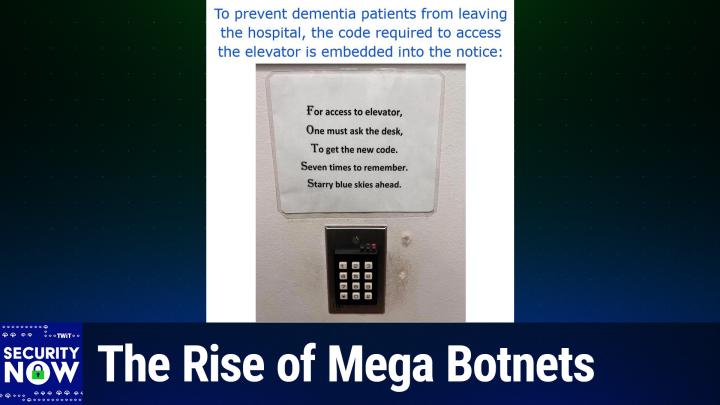
Loading summary
Transcript149 lines
- [00:00]
A
It's time for Security Now. Steve Gibson is here with good news on the EU chat Control vote. We'll talk about that Discord breach. Salesforce says we're not gonna pay. And then there is a very bad bug in 330,000 publicly exposed Redis servers. It's got a CVSS of 10. Stay tuned. All will be revealed next on Security Now. Podcasts you love from people you trust. This is Twit. This is Security now with Steve Gibson. Episode 1047 recorded Tuesday, October 14, 2025. Reddish Shells, CVSS 10.0. It's time for Security now, the show we cover the latest in security privacy computing. Pretty much anything Steve Gibson wants to talk about because he's the man of the hour. Hello, Mr. G. And I do try.
- [01:06]
B
To largely keep us on topic as much as possible.
- [01:10]
A
No, I'm the one who distracts. I'm the distractor.
- [01:13]
B
There are, there are. Sometimes we wander a little bit off the range, but I always get feedback from our listeners saying, hey, that was fun or that was interesting or like with know, like sci Fi stuff. Some of the best sci Fi series that I've read have come from listeners saying, hey, try this.
- [01:31]
A
That's true.
- [01:32]
B
Also some of the worst. But that's just the nature of. That's just the nature of the game. So the, the topic I chose for today is, is just one of a bunch of interesting news that we're going to cover and you know, it came at the end. So okay, that's what we're going to talk about when we wrap things up. And that's a arguably really worrisome remote code execution exploit in all Redis servers, which have been around for the last. The exploit has been around for the last 13 years. It's in Lua.
- [02:15]
A
But we use Redis. We use Redis for caching our, our website.
- [02:21]
B
I do even, even I have a Redis server at grc. So anyway, it's got the It. It has earned itself the difficult to obtain 10.0 CVSS score. And we're gonna finish by talking about that. But we've got news on the EU's chat control vote, which we know is happening on the 14th of October, which is today for episode 1047 of Security Now Salesforce says it's not going to pay any ransoms and we're starting to see data leakage. Hackers claim that Discord lost control of tens of thousands of government IDs, which, look at that. Microsoft plans to move GitHub to Azure, which is where we roll out our. What could possibly go wrong with that? Actually, they tried a few times and then aborted the effort because it's not going to be easy. We've got a new California law that our governor Gavin Newsom signed last week that should be. Should help things. We'll talk about that. OpenAI blocking foreign abuse. Does anyone care? IE there's actually some. Some news about. About IE mode which believe it or not, refuses to die. We've got. Okay, we're going to spend a little bit of time on a Texas law that's going into effect on January 1st. Tim Cook reportedly phoned Greg Abbott and said please, please don't let this happen. Veto this or at least amend it because it's really bad. Well Greg, you know, I don't think he has much sympathy for anything Tim Cook has to say. So we're getting this in 10 weeks and oh boy, is it going to be a problem. Also Breach forum which I we showed last week, the Breach Forums webpage, remember that was with the extortion demand from Salesforce. Well, that site has received a makeover which we'll be looking at today. Also we've got a. Oh boy. A 100,000 strong global botnet attacking US based RDP services. And again, what could possibly go wrong there? I did see one of our listeners sent me a UI experts weigh in on Apple's iOS 26 user interface. I did talk a little bit about going off topic. Well, I just have to indulge myself here. You.
- [05:13]
A
You don't like it one bit.
- [05:15]
B
I know. Turns out I'm in good company. Yeah.
- [05:20]
A
Yes.
- [05:21]
B
Anyway, so that the Redis servers. We got a picture of the week and I think maybe Leo, this time we've got a good podcast for once.
- [05:34]
A
It's about damn time.
- [05:35]
B
Maybe this will be worthwhile.
- [05:38]
A
I should mention this is also the last patch Tuesday for Windows 10 today.
- [05:43]
B
That's right.
- [05:44]
A
End of life for Windows 10.
- [05:51]
B
Except of course if you click your heels twice and look at the moon, then, then Microsoft says okay fine. I.
- [06:02]
A
Well, before we get to the picture of the week, because I know that's imminent and I have not, as always, I have preserved. I. I've stayed all week in the soundproof room and I preserve.
- [06:13]
B
Are you going to tell our listeners who's paying the bills?
- [06:16]
A
I'm going to tell our listeners who's paying the bills. Exactly. This portion of security now brought to you by Zscaler, the world's largest cloud security platform. The world's largest. Let me say that again. Cloud security platform Pretty good. As organizations leverage AI to grow their business and support workforce productivity, they can't rely anymore on traditional, you know, network centric security solutions. Perimeter defenses that just don't protect against emerging threats and particularly against AI attacks. Bad actors have jumped on AI like everybody else. Like business too, right? AI is amazing. They're using new AI capabilities and powerful AI agents and they're using it across all four attack phases, which I think is interesting. They're using AI to discover the attack surface, to compromise it once in. They're using AI to move laterally. They're using AI to exfiltrate data. That's what Salesforce is learning about right now. Traditional firewalls and VPNs in fact don't help. Instead they expand your attack surface by giving you public IP addresses. They enable lateral threat movement. They're also more easily exploited with AI powered attacks. So what do we need? We need a more modern approach. We need, say it with me. Z scalers, Zero Trust plus AI that A, removes your attack surface, B, secures your data everywhere and very importantly, C safeguards your use of public and private AI. And then finally, of course, the most important protects against ransomware and AI powered phishing attacks. Just think about the job Steve Harrison has to do. He is the CISO of MGM Resorts International. They've been hit in the past. They are not going to, they're not taking any chances. They chose Zscaler. He says with Zscaler, quote, we hit zero trust segmentation across our entire workforce in record time. And the day to day maintenance of the solution with data loss protection, with insights into our applications. These were really quick and easy wins from our perspective. Here's a guy who knows the risks and has chosen Zscaler to protect his entire organization. With Zero trust plus AI you could thrive in the AI era. You could stay ahead of competition and you can remain resilient even as threats and risks evolve. Learn more@zscaler.com Security Zscaler.com Security we thank them so much for their support of security now. And now I shall turn on my extra camera so that we can see.
- [09:10]
B
This was just picture. This was very clever. The goal is to prevent dementia patients from leaving the hospital which has an elevator. Okay.
- [09:22]
A
My mom is in a memory care ward and that's exactly right. They have a code panel in the elevator, right?
- [09:28]
B
Right. And so above this code it says for access to elevator, one must ask the desk to get the new code seven times to remember. Starry blue skies ahead.
- [09:44]
A
Whoa.
- [09:45]
B
That's a code is 4127, the first word of the first four sentences.
- [09:54]
A
And they've capitalized each of them too, to make it a little bit more obvious. But if you've got dementia, you're probably not going to be able to.
- [10:02]
B
Uhhuh. Yeah. Well, no, no one would tell you so.
- [10:07]
A
Right.
- [10:07]
B
So here is the code published above the keypad for access to elevator. One must ask the desk to get the new code seven times to remember. And so four, one, two, seven. So everybody who. All of the staff.
- [10:24]
A
Kind of brilliant.
- [10:26]
B
Isn't it wonderful? Yeah. Yeah. And nobody would ever think. They would think, oh, I, I better go to the desk and ask for the new code.
- [10:35]
A
You know what? I'm stupid enough. That's exactly what I would have done. Oh, that's clever. I like it. I like it. Yeah. In order to get up to see my mom, I have to get them to come and open the door and enter the code and bring me up and then I have to do the same to get down. And I wish they had something like this, but they don't. I have to have help every time. That's all right. Yeah.
- [10:57]
B
Okay. So the much anticipated. Yes, good news. The much anticipated vote among EU member countries originally slated for today, October 14, was called off once it became clear that the vote for the adoption of the controversial measure would fail, thankfully. Remember last week we, we reported that Germany seemed to be waffling a little bit, although the Netherlands said they firm no. Turns out Germany made up their mind, also signaling a firm no. I learned of this from a blurb on the Risky Business newsletter, which offered some additional detail. They wrote, the European Union has scrapped the vote on Chat control. Proposed legislation that would have mandated tech companies to break their encryption to scan content for child abuse materials. The project was supposed to be put to a vote on Tuesday, October 14, during a meeting of interior ministers of EU member states. Denmark, which currently holds the EU presidency and was backing the legislation, scrapped the vote. According to reports on Austrian and German media. Danish officials scrapped the vote after failing to gather the necessary votes to pass the legislation and advance it to the EU parliament. Only 12 of the block's 27 members publicly backed the proposal, with nine against and the rest undecided. The final blow to Chat Control came over the past two weeks when both the Netherlands and Germany publicly opposed it. I love what the.
- [12:40]
A
With the. Oh, go ahead, you're going to say it. Here's the.
- [12:43]
B
Yeah. Germany's justice minister, Dr. Stephanie Hubig, went out of her way to describe Chat control as a, quote, taboo for the rule of law, unquote. Arguing that the fight against child pornography does not justify removing everyone's right to privacy.
- [13:03]
A
She used the phrase suspicionless chat control. And I think that's key because of course it was for everyone, not just.
- [13:10]
B
That's really. Yes, yeah, yeah, right. Well, I mean, and that's what you have to do if you're going to find people you don't know. It's got to scan everybody sharing illegal content. Everybody has. Exactly. It's like if a website says you have to be an adult, well then everybody has to prove their age, you know, not just young people, because you don't know. So anyway, the Risky Business newsletter said the law has been seen, has seen the usual mass opposition from privacy groups such as the EFF, but also from the tech sector too. With over 440 major EU tech companies signing an open letter to EU officials. Signatories describe chat control as. And this is really interesting, I'm going to share this letter because it also contains some interesting stuff. They, they, they quote, quote, a blessing for US and Chinese companies, unquote, since EU users will migrate to products that respect their privacy and ignore chat control. The chat control opposition also received major help from a Danish programmer whose fight chat control website allowed Europeans to mass mail their representatives and urge them to vote against. According to a Politico Europe report, the website had driven so much traffic that it broke the inboxes of EU members of Parliament over the past few weeks. And you can imagine that might get their attention. So you know, it's one thing to be living within a government that declares itself to be a democracy, but it's truly wonderful to see a movement where the voices, opinions and feelings of, of that democracy's subjects can be and are heard. So I checked out that open letter as I mentioned, to the EU Parliament that was signed by 40 major European Union companies. Since this is one of the major issues of our time, I want to share that letter. It was addressed to open letter to EU Member states on their proposed CSA regulation. And it read dear Minute. So this is from the 40, you know, co signed by the 40 top tech companies in the EU. Dear ministers and ambassadors of EU member states, we the undersigned European enterprises as well as the European Digital SME alliance, you know, Small Medium Enterprise alliance, which represents more than 45000 digital small and medium enterprises across Europe, write to you with deep concern regarding the proposed regulation on, on child sexual abuse, protecting children and ensuring that everyone is safe on our services and on the Internet in general is at the core of our mission. As privacy focused companies, we see privacy as a fundamental right, one that underpins trust, security and freedom online for adults and children alike. However, we are convinced that the current approach, followed by the Danish presidency will would not only make the Internet less safe for everyone, but also undermine one of the EU's most important strategic goals, progressing toward higher levels of digital sovereignty. Digital sovereignty is Europe's strategic future. In an increasingly unstable world, Europe needs to be able to develop and control its own secure digital infrastructure, services and technologies in line with European values. The only way to mitigate to mitigate these risks is to empower innovative European technology providers. Digital sovereignty matters for two key reasons. First, economic independence. Europe's digital future depends on the competitiveness of its own businesses. But forcing new European services to undermine their security standards by scanning all messages, even encrypted ones using client side scanning would undermine users safety online and go against Europe's high data protection standards. Therefore, European users, individuals and business alike, and global customers will lose trust in our services and turn to foreign providers. This will make Europe even more dependent on American and Chinese tech giants that currently do not respect our rules, undermining the block's ability to compete. And second, national security Encryption is essential for national security. Mandating what would essentially amount to back doors or or other scanning technologies inevitably creates vulnerabilities that can and will be exploited by hostile state actors and criminals. For this exact reason, governments exempted themselves from the proposed CSA scanning obligations. Nevertheless, a lot of sensitive information from businesses, politicians and citizens will be at risk should the CSA regulation move forward. It will weaken Europe's ability to protect its critical infrastructure, its companies and its people. The CSA regulation will undermine trust in European businesses. Trust is Europe's competitive advantage. Thanks to the GDPR and Europe's strong data protection framework, European companies have built services that users worldwide rely on for data protection, security and integrity. This reputation is hard earned and gives European based services a unique selling point which big tech monopolies will never be able to match. This is one of the few, if not the only competitive advantage Europe has over the US and China in the tech sector. But the CSA regulation risks reversing this success. This legal text would undermine European ethical and privacy first services by forcing them to weaken the very security guarantees that differentiate European businesses internationally. This is particularly problematic in a context where the US Administration explicitly forbids its companies to to weaken encryption even if mandated to do so by EU law. Ultimately, the CSA regulation will Be a blessing for US and Chinese companies as it will make Europe kill its only competitive advantage and open even wider the doors to big tech. The EU has committed itself to strengthening cybersecurity through measures such as NIS 2, the Cyber Resilience act and the Cybersecurity Act. These policies recognize encryption as essential to Europe's digital independence. The CSA regulation, however, must not undermine these advancements by effectively mandating systemic vulnerabilities. It is incoherent for Europe to invest in cybersecurity with one hand while legislating against it with the other. European small and medium sized enterprises, SMEs would be hit hardest if obliged to implement clients client side scanning. Unlike large technology corporations, SMEs often do not have the financial and technical resources to develop and maintain intrusive surveillance mechanisms, meaning compliance would impose prohibitive costs or far far force. Market exit Moreover, many SMEs build their unique market position on offering the highest levels of data protection and privacy, which particularly in Europe, is a decisive factor for many to choose their products over the counterparts of big tech. Mandating client side scanning would undermine this core value proposition for many European companies. This will suffocate European innovation and cement the dominance of foreign providers. Instead of building a vibrant, independent digital ecosystem, Europe risks legislating its own companies out of the market. For these reasons, we call on you to and they have five points. Reject measures that would force the implementation of client side scanning backdoors or mass surveillance of private communications, such as we currently see in the Danish proposal for a Council position on the CSA regulation. Second, protect encryption to strengthen European cybersecurity and digital sovereignty. Third, preserve the trust that European businesses have built internationally. Fourth, ensure that EU regulation strengthens rather than undermines the competitiveness of European SMEs and pursue child protection measures that are effective, proportionate and compatible with Europe's strategic goal of digital sovereignty. Digital sovereignty, they finish, cannot be achieved if Europe undermines the security and integrity of its own businesses and by mandating client side scanning or other similar tools or methodologies designed to scan encrypted environments, which technologists have once again confirmed cannot be done without weakening or undermining encryption. To lead in the global digital economy, the EU must protect privacy, trust and encryption. So that's sort of the biggest business side, you know, business centric view of, of what this meant for the EU's businesses. And I wanted to share that because we don't want this to rear its ugly head again. You know, I mean this, this, it's Hard to put this thing to bed once and for all. We, we keep, you know, smacking it down and it, it pops up because you know, legislators say well but what about the children? And that gets everybody all riled up again. So hopefully this is, you know, having this come to as much ahead as it has and, and really get her at getting everyone's attention. Notice that they weren't breaking encryption. They figured out, okay, we're not going to do that. We're gonna, we're gonna do client side scanning before and after encryption. Believe that alone, you know, trying to come up with a way of shimming the, their scanning into the system. And even that didn't go the idea being, no, sorry, we're just not, we're, we're not going to become a surveillance state. Doing that would, would kill and you know, we're, we're thinking of companies like threema, right, that are EU based and couldn't do what they do that mean it would just kill the, the, the THEMA messenger completely to have to, to have to operate under a, a chat control legislation. So one, one line stood out for me in that letter that I thought was interesting. It said this is particularly problematic in a context where the US administration explicitly forbids its companies to weaken encryption even if mandated to do so by EU law, even though it wasn't the EU. You know, that feels like a response to the UK's order right to Apple, which as we know was loudly and publicly rebuffed when Tulsi Gabbard, the US Director of National Intelligence, tweeted on X that as a result of the US administration's closely working with the UK Americans, private data was, would remain private and our constitutional rights and civil liberties would be protected. You know, she stated in that tweet that quote, as a result, the UK has agreed to drop its mandate for Apple to provide a back door that would have enabled access to the protected encrypted data of American citizens and encroached on our civil liberties, unquote. So, you know, unfortunately, as we know, it's now believed that the UK has since issued another order to Apple requiring it to allow the government access to the icloud data of its own citizens. Not everyone, everywhere. And so we're going to see how that plays out. Overall though, I think that this open letter made a very good point about the fundamental competitive disadvantage that the entire EU business sector would face if its companies were forced to abide by a clearly, you know, surveillance oriented privacy invading law. They're right about you know what the rest of the world would do in response. So anyway, that bullet got dodged. You know we still have this unknown order in the UK and of course the, the the UK is still strong on enforcing age restrictions so gna see how those things continue to play out.
- [27:23]
A
Yeah, you saw. Well probably going to talk about it, but you saw what California did with that.
- [27:29]
B
Yeah, yeah, yeah. Okay. So Salesforce said it's not going to pay that and this is the extortion demand threatening a billion. Actually it was 984 million. You know, just shy of a billion records belonging to it's believed to be 39 of its customers whose, who, whose networks were all breached as a consequence of their relationship with Salesforce. So as I said last week we showed the ransom demand posted to breach forums by the Scattered Lapses Hunters group Salesforce public response was widely covered in the tech press. Here's what Dan Guden writing for Ars Technica said. He wrote Salesforce says it's refusing to pay an extortion demand made by a crime syndicate that claims to have stolen roughly 1 billion records from dozens of Salesforce customers. Google's Mandiant group said in June that the threat group making the demands began their campaign in May when they made voice calls to organizations storing data on the Salesforce platform. The English speaking callers would provide a pretense that necessitated the target connect an attacker controlled app. We know that now that that was an OAuth based authentication app to their Salesforce portal, dan wrote. Amazingly, but not surprisingly, many of the people who received the calls complied. The threat group behind the campaign is calling itself Scattered Lapsis Hunters, a mashup of three prolific data extortion actors, Scattered Spider Lapsus and Shiny Hunters. Mandiant meanwhile, tracks the group as UNC 6040 because the researchers so far have been unable to positively identify the connections. Earlier this month, the group created a website that named Toyota FedEx and 37 other Salesforce customers whose data was stolen in the campaign. In all, the number of records recovered scattered lapses Hunters claimed was oh it's 989.45 million. Approximately a billion. The site called on Salesforce to begin negotiations for a ransom amount quote or all your customers data will be leaked unquote. The site went on to say nobody else will have to pay us if you pay Salesforce Inc. The site said the deadline for payment was last Friday. In an email Wednesday, a Salesforce representative said the company is spurning the demand. The representative wrote, quote, I can confirm Salesforce will not engage, negotiate with or pay any extortion demand. The confirmation came a day after Bloomberg reported that Salesforce told customers in an email that it won't pay the ransom. The email went on to say that Salesforce had received credible threat evidence indicating a group known as Shiny Hunters planned to publish data stolen in the series of attacks on sales on on customers Salesforce portals. The refusal comes amid a continuing explosion in the number of ransomware attacks on organizations around the world. The reason these breaches keep occurring is the hefty sums the attackers receive in return for decrypting encrypted data and or promising not to publish stolen data. Online security firm Deep Strike estimated that global ransom payments totaled $813 million last year, that being down from 1.1 billion in 2023. So $1.1 billion in ransom payments in 2023, 813 million in 2024, Dan wrote. The group that breached drug distributor Sencora alone received a whopping $75 million in ransomware payments, Bloomberg reported, citing unnamed people familiar with the matter. So one payout of 75 million for the breached drug distributor Sencora's ransom payment. No wonder these guys, you know, stay at it. Making ransomware payments, he finishes, has come increasingly under fire by security experts who say the payments reward the bad actors responsible and only encourage them to pursue more riches, right? Independent researcher Kevin Beaumont wrote on Mastodon, referring to the UK's National Crime Agency. Quote, corporations should not be directly funding organized crime with the support of the National Crime Agency and their insurance. Break the cycle, Beaumont said in an interview. While the NCA publicly recommends against paying ransoms, multiple organizations he's talked to report having NCA members present during ransom negotiations. On Mastodon, Kevin warned that payments pose threats to broader security, writing, it's becoming a real mess to defend against this stuff in the trenches, let me tell you. I'm concerned about where this is going, unquote. So I imagine that Kevin is worried because there's no end in sight. The bad guys have figured out that the human factor is reliably the weakest link in the enterprise security chain. This gets the attackers inside the enterprise, and enterprise networks are not currently hardened against abuse from the inside. Among the approximately 39 companies believed to have been breached due to their customer relationship with Salesforce Sales Loft and Drift is the Australian airline Qantas that we talked about last week with its loony injunction against anyone republishing their data after it's leaked on the dark web. Like those guys are going to care about an injunction. And also reportedly, the Australian telco Telstra, although Telstra is denying the Cyber Daily report of their breach, unfortunately, these ransomware groups are compelled to release the data they have obtained from once they've made such a public spectacle of their data breach. Right. You know, they can't ever be seen to be bluffing or making empty threats, or they'll lose their ability to threaten. So I imagine that next week we'll be seeing stories of nearly 1 billion records of data from around 39 major Salesforce customers being leaked online. The bad guys need to leak the data so their next victim will take them seriously. Oh, Leo, what a world. But we have some good news, and it comes from one of our sponsors that I can.
- [35:00]
A
Can definitely provide you with. Can't help you with the other stuff, though, unfortunately. That's unbelievable. I swear, we live in difficult times.
- [35:10]
B
And now we're after this, we're going to talk about the extent of Discord's horrible breach.
- [35:17]
A
Yeah. And of course, since we use Discord for our club, I read that story with great interest. I have never been asked for my government ID from Discord, but a number I asked in our club and a number of our club members have. Mostly outside the U.S. but.
- [35:33]
B
And it's when their estimate of your age needs to be challenged. So they come back and they say, we think you're a teenager.
- [35:43]
A
Yeah.
- [35:43]
B
And it's like, you know, you talk.
- [35:46]
A
A lot about Pokemon Go. I don't know. Right. Yeah.
- [35:52]
B
Actually, you know, we looked at your discourse on Discord, and it looks a little junior.
- [36:02]
A
Yeah. There's no question. I'm a. I'm a kid. We will get to that in just a bit. But first, first word from our sponsor. My favorite vpn. I'm talking, of course, about Express vpn. Let me just click this link so I can get the full screen and Steve can have a little privacy while I talk about protecting your privacy online.
- [36:24]
B
Right.
- [36:25]
A
If you've ever browsed in incognito mode. Well, you know, I think we've talked about it. It's probably not as incognito as you think. Google really recently settled a $5 billion lawsuit with a b billion dollar lawsuit as being accused of secretly tracking users in incognito mode. Google's defense is. Well, incognito doesn't mean invisible. In fact, you're not. All of your online activity is still 100% visible to third parties. Don't use incognito mode. Use ExpressVPN. The only VPN I Use and trust. And you better believe, when I go online, especially when I'm traveling in airports or coffee shops or I'm outside the country, ExpressVPN is my go to. Why does everyone need ExpressVPN? Well, with ExpressVPN, these third parties can still see every website you visit, even in incognito mode. Who are the third parties? Your Internet service provider. They see what you're doing. Or your mobile network provider, whoever administers that WI FI network you're on, if it's at your school, the school IT department. If it's at work, your boss. ExpressVPN reroutes 100% of your traffic through secure encrypted servers. So third parties can't see your browsing history. They can't see whatever you're. They can't see anything. They just see gobbledygook, they see encrypted data. It works beautifully. Now, I should point out that when you do get to the ExpressVPN server, they're the end point of that encrypted tunnel. You have to be unencrypted, right? So you can browse, you can't maintain it. So it's really important you choose a VPN provider that protects your data, because they're at the other end of that, you know, of that tunnel. That's why I use ExpressVPN. They make the extra effort to keep you private. ExpressVPN completely hides your IP address, which means it's very difficult for third parties to track your online activity. To them, you look like one of other. Hundreds of other people are using that same IP address. ExpressVPN customers, the other thing they do, though, that I think is really important, they rotate their IP addresses. They spend the extra money to make sure those IP addresses change. So it really is hard to track you. It's hard to even know that you're on a VPN, which is great. ExpressVPN is easy to use. You fire up the app, you click one button, you're done, you're protected. And it works everywhere, on all devices. Phones, laptops, tablets, even. You can put it on your router to protect your whole house. You could stay private on the go and at home, wherever you are. And ExpressVPN is rated number one by the top tech reviewers, people like CNET and the Verge. It's what I use. Secure your online data today by visiting ExpressVPN.com Security now that's E x P r E-S-S v P n.com SecurityNow to find out how you can get up to four extra months. ExpressVPN.com SecurityNow ExpressVPN.com SecurityNow we thank him so much for supporting Security now and Steve Gibson. Back to you, Stevie. So.
- [39:42]
B
Hackers are claiming that the Discord breach exposed the data of 5.5 million users.
- [39:51]
A
Oh, I didn't know it's that many.
- [39:53]
B
Yeah, yeah, but not the, not the government IDs. That's a subset. Okay, so since my initial reporting of the Discord breach last week, additional troubling details have surfaced. Bleeping Computer reports this significant breach at Discord, though the attackers and Discord numbers don't agree. Bleepy Computer reported Discord says they will not be paying threat actors who claim to have stolen the data of 5.5 million unique users from the company's Zendesk support system instance. The stolen Data includes government IDs and partial payment information for some people. The company is also pushing back on claims that 2.1 million photos of government ideas were government IDs were disclosed in the breach, stating that approximately. As if this is not. I mean, this is not much better. 70,000 users had their government ID photos exposed. So folks, we need a better solution for proving age.
- [41:03]
A
Wow, this, this shows you exactly why.
- [41:06]
B
Yeah. Yes, they said while the attackers claim the breach occurred through Discord Zendesk support instance, the company has not confirmed this and only described it as involving a third party service. So they're being coy used for customer support. Gee, I wonder what that could be. Discord told Bleeping Computer in a statement. Quote, first, as stated in our blog post, this was not a breach of Discord. Okay, who cares? But rather a third party service we use to support our customer service efforts. Second, the numbers being shared are incorrect and part of an attempt to extort a payment from Discord. Of the accounts impacted globally, we have identified approximately 7,000 70,000 users that may have had government ID photos exposed. That's like saying, well this, this zero day export may be attacked, which our vendor, they wrote, used to review age related appeals. Third, we will not reward those responsible for their illegal actions. In a conversation, writes Bleeping Computer with the hackers, Bleeping Computer was told that Discord is not being transparent about. So. So Bleeping Computer talked to the hackers and the hacker said Discord is not being transparent about the severity of the breach, stating that they stole 1.6 terabytes of data from the company's Zendesk instance. According to the threat actor, they gained Access to Discord's Zendesk instance for for 58 hours beginning on. You know, because it takes a While to exfiltrate 1.6 terabytes of data, it gained access for 58 hours beginning on September 20, 2025. However, the attackers say the breach did not stem from a vulnerability or breach of Zendesk, but rather from a compromised account belonging to a support agent employed through an outsourced business process. Outsourcing, that's our new term of art. A BPO business process outsourcing provider used by Discord. As many companies have outsourced their support and IT help desks to BPOs, they have become a popular target for attackers to gain access to downstream customer environments. The hackers allege that Discord's internal Zendesk instance gave them access to a support application known as Zenbar that allowed them to perform various support related tasks such as disabling multi factor authentication and looking up users phone numbers and email addresses. Using access to Discord support platform, the attackers claimed to have stolen one 1.6 terabytes of data, including around one and a half terabytes of ticket attachments and over 100 gigabytes of ticket transcripts. The attackers say this consisted of roughly 8.4 million tickets affecting 5.5 million unique users. I'll just mention that all those numbers track, they all make sense in terms of like the ratios that you would expect to see and that about 50 580,000 users contain some sort of payment information. The threat actors themselves acknowledged a belief in computer that they're unsure how many government IDs were stolen, but they believe it's more than 70,000. As they say there were approximately 521,000 age verification tickets, so more than half a million age verification tickets among the 8.4 million tickets total. The threat actors also shared a sample of the stolen user data which can include a wide variety of information including email addresses, discord usernames and IDs, phone numbers, partial payment information, date of births, multi factor authentication, related information, suspicious activity levels and other internal info. The payment information for some users was allegedly retrievable through Zendesk integrations with Discord's internal systems. These integrations reportedly allowed the attackers to perform millions of API queries to Discord's internal database via the Zendesk platform and retrieve further information. Bleeping computer could not independently verify that the hackers claims or the authenticity of the provided data samples. The hacker said the group demanded five million dollars in ransom only five million later reducing it to three and a half million and engaged in a private negotiation with Discord between September 25 and October 2. After Discord ceased communications and released a public statement about the incident. The the attackers said they were extremely angry and planned to leak the data publicly if an extortion demand is not paid. Bleeping Computer contacted Discord with additional questions about these claims including why they retained government IDs after completing age verification.
- [46:49]
A
That's the key.
- [46:50]
B
Yeah, uhhuh. But did not receive answers beyond the above statement. So you know, no one's going to shed a tear for angry extortionists whose three and a half million dollar payday fell through. Unfortunately, as I noted in the case of Salesforce, the attackers must now follow through with their threats. I would not want to have my own photo ID out on the Internet circulating among criminals. And Leo, it's interesting in the details that we, we got thanks to bleeping computers pursuit of this. This is what we are increasingly seeing. We are seeing that, that automated back end systems which publish an API are then being used by their clients or their customers to act you know, in order to get the services. So like Discord's platform accesses Zendesk or vice versa. You know, they've got APIs going in both directions which means that if, if and in this case this BPO guy, this business process outsourced person, they got compromised, who knows, clicked on email, phishing, whatever that allowed their credential which allowed them to log into either Discord or Zendesk to get them in. And then the bad guys were able to use the, the, the, the basically the automated API cross access in order to plumb the other services. You you using the API at high speed in order to, to, to, to obtain more data and, and create problems. So basically what, what's happened is we've sort of that enterprises that are, that are establishing operational back ends are have like an underground private network which is, which is data rich. And now bad guys are breaking into that and then, and then taking advantage of these APIs in order to suck out all of the data that is normally you know, layers deep from the, the, the, the front end that users see, you know, convenient for those people who are doing it. But boy it magnifies the effect of a breach when one happens. And guess what? They're happening. And yeah maybe half a million government IDs and, and, and as you clued in on and as we mentioned before, why are the age verification records being kept?
- [49:40]
A
That's just lazy. That's Just lazy.
- [49:43]
B
Well, and it's also, it's. It's data. Data aggregation fever.
- [49:49]
A
Yeah.
- [49:50]
B
I mean, it's like, oh, the more data we have, you know, who knows what we'll be able to do with this in the future, right? So why delete what. What might be of some value to us? Yikes. Okay, so I suppose it was only a matter of time before Microsoft would decide to move its GitHub property over to their own Azure cloud infrastructure. But the details behind the move will likely be of interest to many of our listeners. The publication the Next Stack provided the background for this move. They wrote, after acquiring GitHub in 2018, Microsoft mostly let the developer platform run autonomously. But in recent months that's changed. With GitHub CEO Thomas Domke leaving the company this August and GitHub being folded more deeply into Microsoft's organizational structure, GitHub lost that independence. Now, according to internal GitHub documents, the new stack has seen the next step of this deeper integration into Microsoft structure is Moving all of GitHub's infrastructure to Azure, even at the cost of delaying work on new features. In a message to GitHub staff CTO Vladimir Fedorov notes that GitHub is constrained on capacity in its Virginia data center. He writes, quote, it's existential for us to keep up with the demands of AI and co pilot. Well, of course, Leo, you can, you know, if you're going to have AI and co pilot, you got to move to a facility that's big enough for that, he said, which are changing how people use GitHub. The plan, he writes, is for GitHub to completely move out of its own data centers in 24 months. Quote, this means we have 18 months to execute with a six month buffer. Fedorov memo says he acknowledges that since any migration of this scope will have run in parallel on both the new and old infrastructure for at least six months, the team realistically needs to get this work done in the next 12 months. So during 2026 to do so, he's asking GitHub's teams to focus on moving to Azure over virtually everything else, Fedorov wrote, quote, we will be asking teams to delay feature work, to focus on moving GitHub. We have a small opportunity window where we can delay feature work to focus, and we need to make that window as short as possible. While GitHub had previously started work on migrating parts of its service to Azure, they write, our understanding is that these migrate migrations have been halted, halting, and sometimes failed. There are Some projects, like its Data residency initiative, internally referred to as Project Proxima, that will allow GitHub Enterprise users to store all of their code in Europe that already solely use Azure's local cloud regions, fedorov writes. We have to do this. It's existential for GitHub to have the ability to scale to meet the demands of AI and Copilot, and Azure is our path forward. We have been incrementally using more Azure capacity in places like Actions, Search, Edge Sites and Proxima, but the time has come to go all in on this move and finish it. Unquote, the next stack said. GitHub has recently seen more outages, in part because its central data center in Virginia is resource constrained and running into scaling issues. AI agents are part of the problem, but it's our understanding that some GitHub employees are concerned about this migration because GitHub's MySQL clusters, which form the backbone of the service and run on bare metal servers, won't easily make the move to Azure and lead to even more outages going forward. In a statement, a GitHub spokesperson confirmed our reporting and told us GitHub is migrating to Azure over the next 24 months because we believe it's the right move for our community and our teams. We need to scale faster to meet the explosive growth in developer activity and AI powered workflows, and our current infrastructure is hitting its limits. We're prioritizing this work now because it unlocks everything else for us. Availability is job one, and this migration ensures GitHub remains the fast, reliable platform developers depend on, while positioning us to build more, ship more, and scale without limits. This is about ensuring GitHub can grow with its community at the speed and scale the future demands for open source developers. Having GitHub linked even closer to Microsoft and Azure may also be a problem, though for the most part, some of the recent outages and rate limits developers have been facing have been the bigger issue for the service. Microsoft has long been a good steward of GitHub's fortunes, but in the end no good service can escape the internal politics of a giant machine like Microsoft, where executives will always want to increase the size of their fiefdoms. So to me it makes sense for Microsoft, but it also sounds as though it's going to be more easily said than done. You know, and the thing about unforeseen consequences is that they're unforeseen. And outages for any service? Yeah, outages for any service such as GitHub, upon which so much depends are going to be a big problem, you know, but no one sees another way. So I have the feeling that some future security now podcasts will be reporting on the consequences of this move. And boy, if like moving to Azure gets screwed up from a security standpoint, that's going to be a big nightmare for GitHub because that's, that's not something anyone wants to see happening. So I've been noting that the proper place for consumers to specify how they would like the Internet to treat them is their browser. You know, that was what I love so much about the original DNT that you know, the do not track beacon with just the flip of a switch. Just once a user could configure their web browser to always append a DNT header to every Internet resource request. And had anyone ever cared to honor that request, which of course was the big problem, that would have been their one and done prohibition against tracking. Because this broad concept has merit, the newer incarnation of DNT is GPC, the Global Privacy Control. And remember, Global PrivacyControl.org is a site you can go to and right up at the top of the page you are notified whether your browser is broadcasting the GPC signal saying no thank you. But even though the GPC signal has been around since it's since its release for like quite a while, sorry, only today, only Brave, the Duck Duck Go and Tor browsers are broadcasting that signal by default. Firefox, since its release number 95 has supported GPC, but it needs to be turned on. And of course I went over to global privacycontrol.org with Firefox and yep, right up at the top I get a little green light saying your browser is GPC enabled. Sadly and perhaps not surprisingly, there's no support for GPC from the various other Chrome based browsers. Chrome, Edge, Vivaldi and Opera. Anyone wishing to emit the GPC signal from any Chromium based browser other than Brave will need to install an add on. And there's also been no sign of GPC from Safari, which I find kind of surprising. Okay, so all that make all makes news. All of that makes news because of California's new legislation last Wednesday, which Gavin Newsom signed. The the the the Record reported California Governor Gavin Newsom on Wednesday signed a bill which requires that's right requires web browsers to make it easier for Californians to opt out of allowing third parties to sell their data. The California Consumer Privacy act signed in 2018 gave Californians the right to send opt out signals. But major browsers have not had to make opt outs simple to use. The bill signed Wednesday requires browsers to set up an easy to find mechanism that lets Californians opt out with the push of a button instead of having to do so repeatedly when visiting individual websites. Privacy and consumer rights advocates have been nervously waiting for Newsom to sign the bill which passed the California legislature on September 11th. This is the first law in the country of its kind. The governor vetoed a similar but broader bill last year which also applied to mobile operating systems. Matt Schwartz, a policy analyst at Consumer Reports, said, quote, these signals are going to be available to millions more people and it's going to be much easier for them to opt out, unquote. Until now, Schwartz said individuals who want to use a universal opt out have had to download third party browser extensions or use a privacy protective browser, you know, meaning Brave duckduckgo or Tor or Firefox if you flip the switch on. Other bills signed by Newsom on Wednesday also give Californians important data privacy rights. One of them requires social media companies to make it easy to cancel accounts and mandates that cancellation lead to full deletion of consumers data. A second bolsters the state's data broker registration law by giving consumers more information about about what personal data is collected by data brokers and who can obtain it. So I did some additional research and found that this was measure AB566 relating to OPT out preference signals. Unfortunately it appears that we're not going to be getting it for another 14 months since the new law doesn't take effect until January 1, 2027. But at that time all web browsers will need to include functionality for Californians to send an opt out preference signal to businesses they visit online through the browser. The law follows the California Privacy Protection Agency CPPA announcement of a joint investigative sweep with privacy enforcers in Colorado and Connecticut to investigate potential non compliance with global privacy control the GPC signal. So at least we have some progress. Chromium browsers will need to get with the GPC plan, which just basically means that Chromium, the Chromium core is going to have to support it as will Apple's Safari browser. And once we have GPC available, privacy enforcers or will then be able to start investigating who is and who is not honoring the clear preference setting that will be sent to all browsers. As we saw, do not track, you know, never got enforcement, you know, and just having a GPC signal means nothing if there's no penalty for ignoring it, you know, and While we're at it, how about we also allow our browsers to send a cookie to acceptance preference signal so that we can also dispense with all of those ridiculous cookie permission pop ups. That would be a step forward for the, you know, the world's user interfaces. Anyway, it's, you know, it's progress. We, we have the technology and then we have the legislation to, to require its use and that it actually be honored. So you know, it takes years but we're getting there. Last Tuesday, Open AI posted a piece titled Disrupting Malicious Uses of AI. This this their little blurb pointed to a detailed and lengthy 37 page report about their efforts to block many different abuses of their technology. Among those cited Open AI moved to disrupt prc, you know, People's Republic of China espionage operations. Their security team banned chat GPT accounts used by Chinese state sponsored hackers to write spear phishing emails. The accounts were allegedly used by groups tracked by the infosec industry as UNK, Drop, Pitch and UTA0388. The emails targeted Taiwan's semiconductor industry, US, US academia, US think tanks and organizations representing Chinese minorities. OpenAI says threat actors primarily abuse its service to improve phishing messages rather than write malware, which is also what the threat company that the threat intel company, Intel 471 has observed. Okay, now this is certainly a good thing for them to do. We've noted how phishing email is no longer obviously grammar impaired, making you know, you know, basically removing the first obvious sign that you should hit delete in your email and instead of bothering to even read what the nonsense that it's spewing. But I suppose I'm not hugely impressed because OpenAI was likely being used only because it was among the lowest hanging of the myriad of available fruit. There are so many other sources of the same or similar generative AI assistance. I mean the threat actors could even spin up their own as we know that this feels like a battle that will always be lost. You know, just it it seems to me that there's just no way that AI is not now going to always be used to improve the quality of fishing males. Regardless of what barriers any of the commercial providers put up, there will always be, you know, alternatives available. So I guess I'm not hugely impressed. It would be difficult to find a better example of the need to continue supporting long past its prime website code than is evidenced by the fact that Microsoft continues, believe it or not, to need to offer the option to reload very old web pages under its creaky old ie Mode. It's true. And in fact, this email went out yesterday afternoon and I have already heard from one of our listeners who said he just the other day encountered an instance where some government websites would not run under Edge and he had to switch to IE mode and then the page rendered. So they're still out there. What's also true, unfortunately, is that IE's old Chakra JavaScript interpreter contains known exploitable flaws that bad guys want access to. We're talking about this ancient history today because it's apparently less ancient than we might hope. IE mode is still being exploited to the point that Microsoft's most recent iteration of Edge has removed all of the easy to click buttons from the browser's ui. An unknown threat actor has been tricking Microsoft Edge users into enabling Internet Explorer mode in Edge to run their malicious code in the user's browser in order to take over their machine. These mysterious attacks have been have been conducted since at least August of this year. According to the Microsoft Edge security team, IE's legacy mode, or IE mode, is a separate website execution environment within Edge. It works by reloading a web page, but running the reloaded page and its code inside the old Internet Explorer engines. And as we know, Microsoft included IE mode in Edge when it retired its official IE predecessor. And I guess we had like, IE 11, I think was the last version of IE, but there were still some code that was dependent upon it. So to access a site under IE mode previously, users would have to press a button or a menu option to reload the page from Edge into the old IE execution environment. Microsoft has said that it has received credible reports that hackers were using clones of legitimate websites to instruct users to reload the clone pages in ed IE mode.
- [70:06]
A
Oh, God.
- [70:07]
B
Yep, yep.
- [70:09]
A
And why would they do that, Steve, why?
- [70:11]
B
Well, when that happened, the malicious site would execute an exploit chaining an exploit chain targeting IE Mode's creaky old Chakra JavaScript engine that has bugs that have never been patched. The exploit chain contained a chakra zero day that allowed them to run malicious code and a second exploit that allowed them to elevate privileges and take over the entire user platform.
- [70:41]
A
Now, that's actually pretty ingenious, though it is.
- [70:45]
B
I mean, if you think about it again, if, if there's a way these guys do it. So in response, Microsoft did not assign a CVE nor release a patch. Instead, they overhauled the entire IE mode access. The Edge security team has completely removed all the dedicated buttons and menu items that could once easily refresh and relaunch a website under IE mode. This includes the dedicated toolbar button, the context menu option, and under the Hamburger main menu item. From this point on, anyone wishing needing actually to relaunch a website in IE mode will first have to go into the browser settings and specifically enable the normally disabled feature there. They'll then need to to relaunch the browser, you know, shut it down, completely relaunch their browser, and manually add the URL of a website into an allow list of sites permitted to be reloaded in IE mode. So, I mean, they, you really have to need it that way. But it does sound like for those people, for example, who, who are using a government site that is old and creaky and only runs under IE mode, well, you can still do it. You just have, you know, you have to go in and you turn it on. Then, then you relaunch the browser. Then, then you manually put that government URL into the allow list and then you'll be able to access it. So it sure sounds as though Microsoft is none too happy that their old Internet Explorer code is still coming back to bite them. So they've decided that while they still cannot safely just kill it off once and for all, at least they can make it really much more difficult to use and thus to abuse. So that's good. Leo, break time. And then we're going to look at some news that actually occurred while I was putting the show together about Salesforce customer data leakage. And we're going to get to this horrifying new Texas law that takes effect in 10 weeks that Tim Cook begged not to have.
- [73:12]
A
Yeah, Apple's not thrilled about what California did either, although it's exactly what you proposed, I think, in the past, which is that the App Store ask people when they're setting up an account, are you 18 or over? Are you over 18? And then if, or I guess what they do is they say, is this being set up for somebody besides you? And what is the age of this child? And then it's in the phone and there's an API that apps can query it. That seems like such a sensible plan. It's what Meta wanted. Google even wanted it OpenAI wanted. But Apple's kind of like, well, do we have to be responsible for this?
- [73:47]
B
Well, well, as we're going to see in a few minutes, everybody's going to get it as a result of SB 6420.
- [73:55]
A
Yeah. Oh, you're going to talk about SB2420. Good. Okay, good. Coming up. But first, a Word from our sponsor, vanta. What's your 2am security worry? What keeps you up at 2am? Is it do I have the right controls at place? Or is it are my vendors secure? How about the really scary one? How do I get out from under these old tools and manual processes? Well, enter Vanta. Vanta automates manual work so you can stop sweating over spreadsheets, chasing audit evidence and filling out endless questionnaires. Vanta's trust management platform continuously monitors your systems, centralizes your data and simplifies your security at scale. Vanta also fits right into your workflows, using AI to streamline evidence collection, flag risks, and keep your program audit ready all the time. Isn't that nice? With Vanta, you get everything you need to move faster, scale confidently and get back to sleep. Get started@vanta.com securitynow that's V-A-T-A.com securitynow thank you Vanta for supporting the good work Steve's doing here at Security Now. And you support us by going to vanta.comsecurity now. Okay, Steve.
- [75:23]
B
Excuse me. Okay, here we go. Wow. So first of all, remember how I was saying that we were almost certainly going to soon be hearing news of the leaks of Salesforce customer data? Just during the time I was assembling today's show, the news broke that the first tranche of those nearly 1 billion leaked Salesforce customer records has been published. Top of the list was Qantas Airlines. And what do you know, the criminals were not dissuaded by that permanent injunction the Qantas CEO managed to obtain from Australia's Supreme Court. Joining Qantas in private database publication. We also have Vietnam Airlines Albertsons, the Gap, Fujifilm and NG Resources spelled E N G I E Resources. And in the case of Vietnam Airlines who were mentioning for the first time the scattered lapses hunters group leaked 7.3 million details from Vietnam Airlines customer loyalty program which was data taken from the company's Salesforce account. So the salesforce said, nope, we're not paying you your $3.5 million, which, you know, doesn't really seem like that much for 39 of their customers. All the data of 39 of their customers. But what are you going to do again? You know, I mean they made a lot a big stink about it. Everyone says don't pay the bad guys, so they're not going to. But you know, their customers, customers are paying the price. Wow. Okay, here we go. Last Wednesday, Apple's developer portal posted their position and response to the Texas Senate bill SB that's what, you know, Senate bill stands for, SB 2420, whose official title is relating to the regulation of platforms for the sale and distribution of software applications for mobile devices. Okay, so there's been a lot of recent child protective legislation activity in Texas recently, so things could get a little bit confusing there. So first, to clarify, this Senate Bill 2420 legislation, which Apple is responding to, is not the same bill that recently caused pornhub to go dark across Texas. Pornhub suspended its services in Texas because of a Texas law that was passed two years ago back in 2023. That was House Bill HB 1181. It was. That bill was immediately challenged in the courts, and it wound up surviving. That's the law that requires websites hosting a majority of content that's inappropriate for minors to proactively verify the age of every single visitor before they are allowed to view the site's context contents, lacking any accepted privacy enforcing means to do that. And given that we're now seeing tens of thousands of extremely personal government ID scans falling into criminal hands during data breaches, which appears to be inevitable, pornhub probably correctly determined that the percentage of people who would be willing to be fully de anonymized during their visits to their site would not be appreciable. So just closing their doors to Texans was the right solution for them. It's worth mentioning that this Texas legislation, HB 1181, now having survived the courts all the way up to and including the Supreme Court, is likely to become a model for other states legislation, which will therefore not need to struggle for adoption and enforcement, because Texas already did that, you know, verifying that the legislation passed the court's scrutiny. So we might expect to see many other states driving adult content websites out of their jurisdictions simply by following Texas's lead. Okay, but back to Texas's newer legislation, which is Senate Bill SB2420. While its official title is quote, relating to the regulation of platforms for the sale and distribution of software applications for mobile devices, it is commonly referred to as the App Store Accountability Act. It regulates how app stores and software application developers operating in Texas must verify users, ages, and handle purchases or downloads by any miners in the state. The legislation states that the owners and operators of app stores, meaning Apple and Google, Right, must verify a user's age via a, quote, commercially reasonable method, unquote, when an account is created. If a user is a minor under 18, as defined in the bill, the legislation requires that the minor's account be tied to, you know, affiliated with a parents or guardian's account. Additionally, you each download or purchase by a minor must first receive explicit parental consent. And I'll. I'll expand on some of these points in detail from the language of the law. The store must also clearly and conspicuously display each app's age rating and the content elements that were used to derive that rating. App stores must limit their data collection. And me just reinforce this is going into effect in 10 weeks. This is not, you know, 2029 or something. This is January 1, 2026. This is happening. And I'll ju. I'll. I'll. I'll preempt something I mention later. There's been no legislation filed against this, probably because people, after what happened with HB 1181, no one's bothering. So this is happening. App stores must limit their data collection to what is needed for obtaining age verification, consent, and record keeping. And any violations of any of these provisions, such as attempts to obtain blanket consent or making any misrepresentations, can be treated as deceptive trade practices. Okay, so that's on the App Store side. Software developers have obligations under this new legislation as well. Developers must assign an age rating to each of their apps, including any in app purchases, and those age assignments must be consistent with the age categories specified in the bill. Developers must also substantiate their age assignments by providing the app content elements with which led to that rating. They must notify app Stores of any significant changes to the app's terms, its privacy policy, changes in monetization or features, or any change in the app's resulting rating. Apps must use the age and consent information from the App Store to enforce age restrictions to comply with the law and enable any safety features. Apps must delete any personal data received for age verification once such verification is completed. So that's very good. That gives us what we didn't see happening with discord, Zendesk deal and any violations such as misrepresenting the app's age rating, enforcing terms against minors without consent, wrongful disclosure of personal data and and such are actionable. However, there are some liability protections if the developer follows widely adopted industry standards in good faith. This new Texas law states that they may be exempt from liability, so mistakes are understood. Okay, so until we had this new Texas law, which was signed into law by Texas Governor Greg Abbott and is scheduled to take effect on January 1, 2026. So in less than three months, App Store and application age and content ratings were advisory only App stores run by Apple and Google were assigning age ratings to apps. Using self regulatory frameworks such as the iarc, the International Age Rating Coalition system, developers answered questionnaires about their apps. The stores would generate an age rating such as 12 plus or teen and display those indications. But all of those were informational only. Nothing prevented app acquisition and download by younger users. That is the big thing that SB2420 changes one of them at least. Now app developers are legally required to assign an age rating using criteria defined by this Texan law. App stores must display those ratings and the specific content descriptors. And these ratings now carry legal weight and must be enforced by App store technology to trigger parental consent requirements and enable or disable the app's download. And any developer who misrates an app or fails to update ratings after material changes can face liability under deceptive trade practice law. Naturally, Apple, who sees privacy concerns hiding around every corner, has not been happy about any of this. And Tim Cook is believed to have called Greg Abbott to argue against the provisions of the legislation, asking Abbott to either modify or completely veto the bill. Those pleas apparently fell on deaf ears. Apple's concerns have been that the new law would require sensitive, personally identifying information to be collected from any Texan who wants to download apps, even innocuous ones such as weather apps, sports scores, etc.
- [86:46]
A
Yeah, because everything's going to be designated. Even if it's a weather app. I'm going to designate it adults only because I don't want to take any chances. Right? Almost all apps will be adults only.
- [86:56]
B
And but get this Leo, even if it says age 2 and above still requires. Got it. Anything? Anything. Yes, anything. Any. Any app downloaded by a minor, regardless of its rating, requires parental consent. I mean, parents are going to get fed up having to say yes, fine, you can download the port the sports scores app. Anyway, Apple is warned of downstream Data sharing since SB2420 requires App Store stores to implicitly share age and parental consent status with developers. Now of course the bottom line is that Apple really, really, really really doesn't want to do this or get involved in any way with any of this. However, that doesn't feel like a practical long term position for Apple to be taking given the legislation which we're seeing. You mentioned California. That's that that's like generous compared to what Texas is is doing in 10 weeks. Everything we see everywhere evidences a growing awareness of age related Internet content control. Okay, so I started out noting that last Wednesday Apple's developer portal posted their position and response to these new Texas requirements. Apple's posting was titled New Requirements for Apps Available in Texas and Apple writes Beginning January 1, 2026, a new state law in Texas, SB2420 introduces Age Assurance requirements for app marketplaces and developers. While we share the goal of of strengthening kids online safety, we're concerned that SB2420 impacts the privacy of users by requiring the collection of sensitive, personally identifiable information to download any app, even if a user simply wants to check the weather or sports scores. Apple will continue to provide parents and developers with industry leading tools to that help enhance child safety while safeguarding privacy within the constraints of the law. Once this law goes into effect, users located in Texas who Create a new Apple account and I'll come back to this but this is interesting Leo create a new Apple account. There is no language that is retroactive in this legislation which is really interesting, Apple said will be required to confirm whether they are 18 years or older. Again required to confirm whether they're 18 years or older. That means everybody. I mean all adults. All new Apple accounts for users under the age of 18 will be required to join a family sharing group and parents or guardians will need to provide consent or for all App Store downloads, app purchases and transactions using Apple's In App purchase system by the Miner. This will also impact developers who will need to adopt new capabilities and modify behavior within their apps to meet their obligations under the law in 10 weeks. Similar requirements will come into effect later next year in Utah and Louisiana so Texas alone for now here comes Utah and Louisiana so and just wait till Mississippi gets wind of this and figures out that they can do the same thing. Apple continued. Today we're sharing details about updates we're making and the tools we'll provide to help developers meet these new requirements. To assist developers in meeting their obligations in a privacy preserving way will introduce capabilities to help them obtain users age categories and manage significant changes as required by Texas state law. The declared age range API is available to implement now and will be updated in the coming months. I hope it's in weeks to provide the required age categories for new account users in Texas and new APIs launching later this year, meaning in time this year will enable developers when they determine a significant change is made to their app to invoke a system experience to allow the user to request the parental consent be reobtained. Additionally, parents will be able to revoke consent for a minor continuing to use an app. More details, including additional technical documentation will be released later this fall. In other words, Apple is scrambling in order to to provide the API which the APIs that developers will need in order to be compliant with this Texas law. They said, we know protecting kids from online threats requires constant vigilance and effort. That's why we will continue to create industry leading features to help developers provide age appropriate experiences and safeguard privacy for their apps and games. And empower parents with a comprehensive set of tools to help keep their kids safe online. Okay, so I, I went over to check out Apple's declared Age Range API. The page is titled Declared Age range. Create age appropriate experiences in your app by asking people to share their age range. Okay, I was struck by the language by asking people to share and by the name of the entire API, the API, which is after all the declared age range API. What follows then is the overview of the API on the page. And it just says in so here's the overview of the declared Age range API says use the declared Age range API to request people to share their age range with your app. For children in a family sharing group, a parent or guardian or the family organizer can decide whether to always share a child's age information with your app. Ask the child every time or never share their age information. Along with an age range. The system returns an age rangeservice age range declaration object for the age range a person provides.
- [94:09]
A
This is Apple's compliance with the California law because it doesn't work with the Texas law.
- [94:15]
B
Right, right, right.
- [94:16]
A
So the California law does exactly that. It says a maker of an app store or operating system, by the way, the California law would apply to Linux has to ask for an age of the user and then have an API that returns that age range. And it's like 0 to 5, right?
- [94:35]
B
It's like 4, 5 to 10, 10.
- [94:37]
A
To 13, 13 to 16, 16 to 18 or at 18 or over. But that satisfies California, you're about, I mean there's no way this satisfies what Texas is asking for.
- [94:49]
B
No, no, just wait till we get to the specifics. Yeah, so, but, but even on Apple's page, in a vividly highlighted call out box labeled important, the page states data from the declared Age range API is based on information declared by an end user or their parent or guardian. You are solely responsible for ensuring compliance with associated laws or regulations that may apply to your app. So you know Apple is saying we're not responsible for verifying what this, what is declared as the user's age. So to exactly to your point, Leo, none of this is useful for Texas. Right. And so you know this is Apple saying that all they're doing is here is functioning as a middleman to pass along whatever age declaration the user might assert and that the app's developer is in this instance remains responsible for ensuring compliance with associated laws or regulation. So this of course begs the question, what does the forthcoming Texas SB2420 law require in that regard? We know that in other jurisdictions and contexts, self declaration of age is specifically regarded as insufficient. So what about Texas?
- [96:20]
A
Because kids are going to lie, they're.
- [96:22]
B
Going to say of course, yeah, yeah. The bill does not mandate a single specific age verification method such as uploading an id, but it does require app stores to use a quote, commercially reasonable method to verify a user's age, not just accept whatever age the user may self declare. So as a clarifying example, the legislation states that app stores may not rely on a birth date entered into a form or any other method that is, quote, reasonably likely to be circumvented by a minor. So I've been studying this carefully in an attempt to understand how and whether Apple's declared range API is in any way sufficiently responsive to what Texas requires. You know, clearly it's not. The only way I can see that it could be applicable would be if Apple starts out with declared age, then later replaces the declaration part with a full, some sort of full responsibility taking, verifiable age determination mechanism, because that's what Texas requires. And in that way the same API could be used and just the source of the age determination information would change. And Apple has said that they will have other new APIs, you know, later this year. There's not much of this year left, so I'm sure they're working on it. So for example, what could be done state by state or political jurisdiction by jurisdiction would allow self declaration to continue to be sufficient within regions that have not yet clamped down on their citizens and only using and requiring verifiable age verification where the governing laws require that it be used. So what Apple has today with their families sharing is, is that Apple asks for a date of birth during account creation. For accounts under 13, Apple requires an adult parent or or guardian to be a member of the family group. And for ages 13 through 17, a teen can create their own Apple ID without parental verification with Apple trusting the date entered. Which seems screwy to me. If you were 12, why not that? What prevents you from just declaring that you're 13 and then not having parental verification? So again, Apple historically has done what they can not to get involved in all this. All of this changes in 10 weeks. It all dies in Texas on New Year's Day. What's required by Texas SB2420 is an affirmatively commercially reasonable method of age verification for every account created. Self declaration never is sufficient in Texas. This implies that for Texas users Apple will need Apple will need to implement some new form of age verification, ID checks, credit card based validation or some other form of verifiable age assurance technology. And Apple has fewer, as I've mentioned, than three months to bring this online. While Apple currently only requires and enforces parental linking for account owners younger than 13, SB2420 specifically applies to all minors under 18i under Apple's current family sharing plan. The so called it's asked to buy option is available to parents who may choose to enable it for their kids, but it can be disabled and parents can also choose to grant blanket permissions under SB2420. Blanket or any form of pre authorized permission is expressly forbidden in the law it states it under SB2420 Parell consent is legally required for every app download and in app purchase by any minor. Imagine being a 17 year old high school senior in Texas and needing to obtain your mother's permission to add an app, any app, regardless of its age rating, to your iPhone. I mean Leo, think of, I mean think of all the apps we've downloaded just because it was easy, it was, you know, just to see what they were.
- [101:24]
A
Now anything that if accesses the Internet like a browser would probably have to be marked adult only, right?
- [101:36]
B
Good point. Because kids are not going to have.
- [101:38]
A
Much access to anything except kitty stuff, right? That explicitly for kids.
- [101:46]
B
It's a mess. The language of the law states quote from the, from, from the, the. The. From the text of the legislation it says an operator of a digital distribution platform, App Store shall obtain verifiable parental consent before allowing a minor to download or purchase any software application through the platform, unquote and also quote parental consent must be obtained on a per transaction basis and may not be granted as a blanket authorization, unquote. So anyway, it's not difficult to see why Tim Cook would have given Greg Abbott a call to plead with him to amend or to veto this legislation. One interesting aspect of the legislation is that nothing in it appears to apply retroactively. As I noted, the age verifications are only performed upon new account creation. However, existing adult accounts might need to have their adult status reasserted, you know, verified if a minor's account were to be linked to it as a parent or guardian. So wow. Whatever the case, this new Texas SB2420 legislation is going to create a mess, and it's only about 10 weeks away from coming into effect. So far, the law has not been challenged in court, as I mentioned, and I assume that's because Texas's earlier HB 1181 legislation survived both the Fifth Circuit Court of Appeals and then the US Supreme Court's analysis. So under the current US legal climate, it might be viewed as a fait accompli. That's not even worth fighting. Which leaves us with a question. How is Apple going to verifiably determine the ages of any new account holders in Texas? One thought occurred to me, which is perhaps an age verification performed at the purchase time of a new iPhone. You know, you're buying it with a credit card, presumably, or mom and dad are buying it for their kids. So perhaps you tie age verification to purchase, but, you know, but then you have the problem going forward of, of new accounts being created. Any new account created will need to have its age determined. And it does seem like a huge loophole in, in SB2420 that there doesn't appear to be any retroactive action here. So I don't understand that, Leo, but boy, you know, and if Apple has to do this in Texas and if it's coming in Utah and Louisiana and Lord knows nationwide.
- [104:54]
A
Yeah, yeah, because as you've pointed out, GeoIP location.
- [104:59]
B
Yeah, yeah, Geolocate. I mean, IPs were not designed to be, you know, about states of the US and, and they're not very much. So. Okay, break time. And then we're going to look at the interesting site makeover that the Breach forums scattered spider lapses Hunters site recently got.
- [105:25]
A
Okay, but our show today, brought to you by the Thinkst Canary, let's talk about how you defend yourself against scattered spirit spider lapses and all the other little critters floating around the Internet. And the real issue, of course, is how do you know if they've penetrated your defenses? You're going to have the best defenses money can buy. But what if they get in? The problem is most companies don't know for 91 days on average that they've been breached. That's three months that the bad guys can do what they did to Salesforce, which is wander around inside, exfiltrate everything they. What was it? Terabytes? How many terabytes of data? Nobody was like, they didn't know. They weren't paying attention. Wouldn't it be nice if you knew that's why you need our sponsor. And they're wonderful things. Canary. You've heard me talk about it before. It's a honeypot. It's a honeypot that is secure, is super easy to use. You can deploy it in minutes and it tells you if somebody's entered your network. Here's my. My thinks Canary interface here. You see, I have one things Canary, the one in the attic. Oh, wait a minute. I have an alert. Let's see what it is. It says, oh, the device was reconnected. Yes, I. I moved it over to my desk. So I disconnected it. That's how I know it's still alive, because I get that little notification. You can, even if you want, you can. You can look at all of the. You can get the audit trail and see all of the notifications you've received, whether there were incidents when they were notified. So I don't know what seasonal effects are, but I've enabled them, disabled them, and re. Enabled them. I can't remember what I did, but that's the point. You've got an audit trail. You've got a device that can be anything. As I said, it is a honeypot. Which means it's posing. It's not really, in my case, a 2019 Windows Server Office file share. It's just posing as that. But when I say pose, I mean it's really posing. It's got a Microsoft Mac address. It in every respect looks exactly like what it's pretending to be. But it's not limited to Windows servers. It can be almost anything. An active Directory, Domain Controller, SharePoint. It can be a Linux box. It could be an Oracle Enterprise server. It could be Mac OS X file share, a Cisco router, a Dell switch, a Fortigate, a Palo Alto firewall. I can go on and on and on. It can even be a SCADA device. It could be a synology. So the point is, make it something you think a bad guy will find valuable or maybe vulnerable. Like, what if I decided to make it a, I don't know, Windows XP desktop file share? Yeah, baby, that sounds good, doesn't it? You can turn on. You can make it a Christmas tree. Turn on all the services or just a few select ones. Turn on an SSH server. Yeah, that's good. And I want to leave it on port 22. No, wait a minute, I'm not. Because I'm going to be clever and the bad guy's going to look at me and say, oh, he's trying to hide it on port 22346.
- [108:48]
B
Ha.
- [108:49]
A
Not going to fool me, says the bad guy. Discard the changes for now. Just, just, just so I can show you some other features. These are the Canary tokens. These are files that when accessed, will let you know. And you can put these anywhere. I've got them scattered all around. They can be everything. An AWS API key, a Microsoft Word or excel document, a WireGuard VPN client config. Oh, that'd probably have the private address, wouldn't it? That sounds like a good thing to stick around. Put it on your, put it on your Google Drive or your OneDrive. Put it, put it on your hard drives. Put them everywhere. When these Canary tokens are hit or somebody brute forces that fake internal SSH server, I just set out your Thinks Canary immediately. Tell you, hey, you've got a problem. No false alerts, just the alerts that matter. And in any way you want. Sms, email, it supports syslog, it supports web hooks. There's even an API if you want to write your own interface. So it's very simple. You just choose a profile for your things Canary device, you register it with a hosted console for monitoring and notifications and then you sit back and wait. Attackers who have breached your network, malicious insiders and other adversaries, they can't help it. They see that Windows XP file share sitting there and they say I gotta go. After that they make themselves known just by accessing your thinkst Canary. It's the best honeypot ever and it's absolutely secure. The folks at thinkst have many years teaching enterprise and governments how to break into systems. So they know all the ways of the wily hacker. They've been them themselves. And so they've made sure that this is a bulletproof solution, absolutely secure solution that does one thing, lets you know when a bad guy has entered your network and is attacking your. Thanks to Canary. Visit Canary Tools Slash Twit. If you're a big bank, you might have hundreds of them. Every segment should have at least one, right? A little business like ours might just have a handful. Let's say you need five, $7,500 a year, you get five things to Canaries, you get your own hosted console, you get upgrades, you get support, you get maintenance. By the way, if you use the code twit in the how did you hear about us Box, you're going to get 10% off that price for life. And the other thing, good to know. You can always return your Thinks canaries with their two month money back guarantee for a full refund. However, during all the years we have partnered with Things Canary. Their refund guarantee has never been claimed. Visit Canary Tools Slash Twit. Visit Canary Tools Slash Twit. Enter the code TWIT in the how did you hear about us? Box. You're going to get that 10% off, not just for the first year, but for as long as you have your Things Canary. Canary Tools Slash Twit and the offer code TW I T. Yeah, that's a good one. Flow Connect says I'm going to be a solid state drive that says adult videos on it. That'll get them. You get to do whatever you want. I'm not going to tell you what to do. It's actually fun to play with a configurator. Canary Tools Twit use the offer code Twit. These are honeypots that are easy to set up, easy to maintain, and they do the job. And that's the most important. Now back to Mr. Steve Kips.
- [112:19]
B
So this was a little bit tongue in cheek. I described what happened to scattered spider lapses Hunters Ransom forum as a makeover because Breach forum is no longer showing the extortion notice that we had in the show notes last week. Hello. That's right. This domain has been seized. And then we have the Department of Justice seal the FBI investigation looks like. What is that? Spain Criminal. And then certainly. And then France. France, yeah. So BreachForums HN HN is the top level domain for the Central American country of Honduras. So the FBI has taken over that domain's DNS, pointed it to one of their servers. So for anyone who goes over to BreachForums Hn, whoopsie. They're not home anymore.
- [113:35]
A
I like the email address on the new page. Breachforumsbi.gov yeah, just give them a ring.
- [113:44]
B
Wow.
- [113:45]
A
Wow.
- [113:45]
B
Yeah. So Gray Noise has detected and reported a widespread botnet driven attack which began last Wednesday. So six days ago on the 8th of October. That attack is being sourced by more than 100,000 individual bots scattered across the globe, all aimed at at us based exposed RDP endpoints. Now, as we know all too well, RDP is Microsoft's very poorly authenticated remote desktop protocol, which keeps being used because it works so well, built in, so.
- [114:34]
A
Easy, it's so handy.
- [114:36]
B
Yes, unfortunately, it has also been an unending source of remote network intrusions through the years as bugs and other various failings have continued to be found in its code. Now, just to be clear, I love rdp. It works incredibly well and I use the crap out of it. But nowhere among any of GRCs, Internet facing IPs and ports, or will anyone ever find any exposed RDP service? Because for me or anyone to publicly expose any instance of RDP to the Internet would be just begging for an intrusion.
- [115:22]
A
Yes.
- [115:23]
B
So I have three words. Don't do it.
- [115:26]
A
I thought you were going to say vpn, but okay, don't do it, don't do it, don't, don't.
- [115:31]
B
Those are, those are a good three also, because you need to have some way to not do it. But one way or another, arrange. Don't do it, don't do it. Okay, okay. Now, unfortunately, my repeated admonishment flies in the face of convenience, right? As we all know, convenience often trumps security. You know, it's like, what? Why would the great and powerful Microsoft allow us to turn it on if it wasn't secure? And my God, it's so handy, right? A Shodan search for remote Desktop protocol returns on the order of 2.4 million results. Some sources have claimed that Shodan has indexed more than 3.5 million exposed RDP ports. And some non Shodan research has shown 4,493,357 exposed RDP services when scanning for RDP running on its default port of 3389. All of this, all of this RDP nonsense is very nicely covered by one of the most important lessons on all of us who've been participating together in this podcast for the past 20 years have learned authentication is generally broken and should never be trusted. The only Internet servers that should ever be placed onto the Internet are those that do not use any authentication. Authentication that's never used can never be broken because there isn't any. So things like web servers and DNS servers and email servers, which are designed and intended to be accessible by anyone anywhere, whose entire purpose is that they are for use by anyone anywhere they're safe to deploy. But anything that requires any form of authentication is inherently risky. The only exception to this, and I, I even I even hesitate, but I got to be a little reasonable, the only exception is that I would be inclined to trust well tested and carefully vetted connections to SSH servers running on a non standard port if those connections are authenticated with with cryptographically secure certificate credentials. But even there, wherever possible, filter all incoming connections by region. If you never roam outside of your own country, why would you ever entertain connections from China, Russia or Iran? You know, none of those people are friends of the West. Don't even consider accepting their traffic to your non public servers. Use some geofencing to drop any traffic coming into authenticated endpoints. If its IP is foreign, why not? Gray Noise wrote. Since October 8, 2025, Gray Noise has tracked a coordinated botnet operation involving over 100,000 unique IP addresses from more than 100 countries targeting remote desktop protocol services in the United States. The campaign employs two specific attack vectors, RD Web Access Timing Attacks and RDP Web Client Login enumeration. Again, you can never trust authentication don't with most participating IPs sharing one similar TCP fingerprint indicating centralized control. Source countries include Brazil, Argentina, Argentina, Iran, China, Mexico, Russia, South Africa, Ecuador and more than 92 others. So I would only ask that everyone consider filtering and dropping any traffic coming into any non public authenticating services you know you don't need or want that traffic. You should never assume that your authentication will hold. All of our experience says it probably won't. Blocking and dropping traffic that you know you don't want is what firewalls are for. But firewalls won't help if they're not used. So again, you'll never find RDP at grc, even though I use it like crazy. A listener of ours, Dan Linder, wrote this well respected UI UX organization agrees the new iOS 26 interface is a mess. They clearly destroy. They clearly describe a lot of our feelings. Well, I hope Apple listens and he provided a link to the nngroup.com articles Liquid glass and of course Dan is posting this at least impartial response to last week's UI rant where I detailed my feelings about the unproductive nonsense that Apple had added to their user interface, forgetting the number one rule of UI design, which is that the interface should never call attention to itself for its own sake, and should do everything it can to to disappear and to facilitate the user's use of whatever it is it's interfacing. So the brief TLDR summary at the top of the wonderful takedown piece reads, QUOTE ios26's visual language obscures content instead of letting it take the spotlight. New but not always Better design patterns replace established conventions, and I just want to share a bit of the piece, which begins with iOS 26. Apple seems to be leaning harder into visual design and decorative UI effects, but at what cost to usability? At first glance the system looks fluid and modern, but try to use it and soon those shimmering surfaces and animated controls start to get in the way. Let's strip back the frost and look at how these changes affect the real use iOS 26 introduces Apple's new glassmorphic visual language into its phones. Apple describes liquid glass as a translucent material that reflects and refracts its surroundings while dynamically transforming to help bring greater focus to content, delivering a new level of vitality across controls, navigation, app icons, widgets, and more. Translated, they write, the interface now ripples and shimmers as if your phone were encased in jello. At first glance, it does look cool, but problems arise as soon as you start actually using your phone. Transparency equals hard to see. Liquid glass makes UI elements translucent and bubbly. The result is light, airy, and often invisible. One of the oldest findings in usability is that anything placed on top of something else becomes harder to see. Yet here we are in 2025 with Apple proudly obscuring text icons and controls by making them transparent and placing them on top of busy backgrounds. Text on top of images is a bad idea, because the contrast between the text and the background is often too low. So why does Apple now encourage users to set photos as backgrounds for translucent text messages? The result is that your friend's words are camouflage against their beach vacation photo or worse, their pet's fur. Content may technically be in focus, but you can't read or see it. And then comes Apple's boldest or dumbest experiment. Text on top of text. Apparently, designers decided users have eagle vision and infinite patience because deciphering one line of text written across another is now fair game. Reading an email subject line now requires Dan Brown level cryptographic decoder skills. Not only is it illegible, it's also ugly. Okay, and while this goes on, and there's much, much more, I'll just finish by sharing this piece verbatim, because if you recall my rant last week, you'd be inclined to wonder whether I am had written this one too. The section heading is Animated Buttons Motion without Meaning, and it reads Animations can be delightful the first time when used intentionally. They can also be satisfying, creating the feeling when someone just clicks or snaps into place. Our eyes are finely tuned to detect motion, which is why animated buttons grab attention instantly. But delight turns to distraction on the tenth, twelfth, or hundredth time. In iOS 26, controls insist on animating themselves whether or not the user benefits. Carousel dots quietly morph into the word search after a few seconds. Camera buttons jerk slightly when tapped, tab bars bubble and wiggle when switching views, and buttons briefly pulsate before being replaced with something else entirely. It's like the interface is shouting look at me. When it should quietly step aside and let the real star the Content take the spotlight. So anyway, I thank Dan.
- [126:56]
A
Wow.
- [126:56]
B
For sharing another view posted last Friday by a group that specializes in UI design. As Dan says, I hope Apple is listening. I'm glad it's possible to turn those superfluous wiggles, jiggles, zips and zings way down to a tolerable level.
- [127:15]
A
Yeah, in accessibility you can turn it almost often entirely. But just as a Footnote, who is NNg? It's the Nielsen Norman Group and I've interviewed Jacob Nielsen and Don Norman both. They are the king.
- [127:28]
B
Legendary.
- [127:29]
A
They're the legends. In fact, Don Norman's incredible book, the. What was it? The Usage of Everyday Things is one of the best things ever written about.
- [127:40]
B
It's the bible on ui.
- [127:41]
A
Yeah. So this is not just any, any, you know, company. This is the UI company. And I, you know what I've been putting up with liquid glass, you know, trying to get used to it, and now that I read this article, I'm not going to get, I'm really not going to get used to it. I guess you can kind of turn it down. But what was Apple thinking? I really have to wonder.
- [128:03]
B
I just think maybe something's in the water or, or they're just so self obsessed.
- [128:13]
A
I mean, it's, it's truly awful. It's really bad.
- [128:16]
B
Truly awful. Yeah. Yeah. I mean, it, it, it really, I mean it does. It really. I mean, it's like a game. I don't, I don't, I, I. You know, there are games you can play on your phone, but you don't want your phone to be the game.
- [128:29]
A
Well, maybe they're trying to reach a younger audience. I don't know. I don't know. It's terrible.
- [128:34]
B
I don't know. If you shake it hard enough, does it come out the end?
- [128:37]
A
I wish it would. Like toothpaste.
- [128:40]
B
Gosh. Okay, last break, then we're going to look at what happened with the REDIS server.
- [128:48]
A
Oh, all right. Yes, Steve, what happened? We're going to talk about that in just a moment. But first a word from our sponsor. This episode of Security now brought to you by Big ID, the next generation AI powered data security and compliance solution. BigID is the first and only leading data security and compliance solution to uncover dark data through AI classification, to identify and manage risk, remediate the way you want and to map and monitor access controls. Plus scale your data security strategy. Along with unmatched coverage for cloud and on prem data sources. BIGID also seamlessly integrates with your existing tech stack and allows you to coordinate security and remediation workflows. You could take action on data risks to protect against breaches. You can annotate, delete, quarantine more based on the data, all while maintaining an audit trail. So it's great for compliance and it works with everything you use. Partners include ServiceNow and Palo Alto Networks, Microsoft, Google, AWS, and on and on and on. With BigID's advanced AI models, you can reduce risk and accelerate time to insight, plus gain visibility and control over all your data. Intuit named it the number one platform for data classification and accuracy, speed and scalability. But I've got an even better testimonial because Big ID equipped probably the one organization with the most dark data in the world, the United States army, to illuminate dark data. I mean they've hundreds of years of dark data, right, to accelerate cloud migration, to minimize redundancy and to automate data retention. All of these are very high priorities for the Army. U.S. army Training and Doctrine Command gave us this great quote quote the first wow moment with big ID came with being able to have that single interface that inventories a variety of data holdings, including structured and unstructured Data across emails, zip files, SharePoint databases and more. To see that mass and be able to correlate across those is completely novel. I've never seen a capability that bring this together like Bigid does. End quote. Cnbc recognized Big ID as one of the top 25 startups for the enterprise. They were named to the Inc 5000 and the Deloitte 500 four years running. The publisher of Cyber Defense magazine says BigID embodies three major features we judges look for to become winners. Understanding tomorrow's threats today, providing a cost effective solution and innovating in unexpected ways that can help mitigate cyber risk and get one step ahead of the next breach. Start protecting your sensitive data wherever your data lives@bigid.com security now. Get a free demo to see how Big ID can help your organization reduce data risk and accelerate the adoption of generative AI. Again, that's B I G I D.com security now. Oh, also there's a free white paper that provides valuable insights for a new framework. It's aitrism T R I s m. That's AITrust risk and security management to help you harness the full potential of AI responsibly. You'll find that@bigid.com security now. Thank you Big ID for supporting Steve's work here. You support us too by going to this address. Big ID.com security now. And now Back to the show.
- [132:32]
B
Oh boy. So a trio of researchers at Wiz, that's W I Z as in wizard. There's no H research. They worked through Trend Micros zero day initiative to disclose the significant problem they uncovered in Redus servers which are exposed over the public Internet. Why it's hard to understand. Now we already know from today's episode title that this vulnerability has received the difficult to obtain CVSS score of 10.0. You know 9.8 is normally the, the limit. You can't, it's difficult to get beyond 9.8 and 9.8 is, are really bad 0 days. This is a 10.0. The reason this has come to the attention of the Internet community is that there are, get this, nearly 330,000 thousand. A third of a million 330,000 publicly exposed Redis or Redis servers on the Internet. With around 60,000 of those which require no authentication, they're wide open, ripe for exploitation. Now Redis R E D I S stands for remote dictionary server. It was Created back in 2009 by Salvatore Sanfilippo who built it to solve his own problem performance issues with his startup company. He initially created it to improve the performance of a real time web analytics system. But the speed of an in memory network accessible dictionary ended up being so useful that it evolved into a standalone open source project of its own. Since then it's evolved beyond a simple key value cache into a full in memory data structure server. Unfortunately that means there's a lot of data stored out on the Internet in all these servers and they're on networks and unfortunately they're penetrable. Now I run a Redis server for Windows to improve the performance of the PHP based web forums. I've got my Redis server bound to the local host IP 127001 and listening on its default port of 6379. So a number of the PHP based services on that server take advantage of Redis to improve their performance. What I'm doing differently and Leo, what I'm sure you're doing differently from 330 other instances is that the last thing I would ever think of doing would be binding the Redis service to any network interface that's connected to the public Internet.
- [135:47]
A
I use RDP for that. Is that okay? No, of course not.
- [135:54]
B
Historically, you know, there have been thousands of botnet infections and data leaks due to open Redis ports. I mean it has been a magnet for exploitation. So on the one hand, nothing horrible involving Redis would be the first time but what's been found is still new and maybe worse than anything. The guys at Wiz Research titled their report Redis Shell Critical Remote code execution vulnerability CVE2025 49844 in Redis 10 CVSS score and their tease was Wiz Research discovers vulnerability stemming from 13 year old bug present in all Redis versions used in 75% of cloud environments. So they wrote Wiz Research has uncovered a critical remote code execution vulnerability to CVE which we've dubbed Redis Shell. In the widely used Redis in Memory data structure store, the vulnerability has been assigned a CVSS score of 10.0, the highest possible severity. The vulnerability exploits a Use after free memory corruption bug. There's use after free again that has existed for approximately 13 years in the Redis source code. This flaw allows a post auth attacker to send a specially crafted malicious LUA script, a feature supported by default in Redis, to escape from the LUA sandbox and achieve arbitrary native code execution on the REDIS host. This grants an attacker full access to the host system, enabling them to exfiltrate, wipe or encrypt sensitive data, hijack resources, and facilitate lateral movement within cloud environments. Given that Redis is used in an in an estimated 75% of all cloud environments, the potential impact is extensive. Organizations are strongly urged to patch instances immediately by prioritizing those that are exposed to the Internet. And again, why? Ner I have no idea, but almost a third of a million are and 60,000 of them require no authentication at all. So being post off means post nothing. On October 3rd they wrote Redis released a security advisory along with a patched version of Redis. We extend our gratitude to the entire Redis team for their collaboration throughout the disclosure process. We greatly appreciate their transparency, responsiveness and partnership during this engagement. In this post we will provide a high level overview of our discovery and its implications. Given the prevalence and sensitivity they didn't say severity, but I would of this vulnerability we will defer some of the technical details to to a future installment, omitting exploit information for now to allow impacted organizations sufficient time to address the vulnerability. Organizations utilizing Redis are strongly encouraged to update their REDIS instances to the latest version immediately. And I'll just note also exposure to the Internet is bad, but when bad guys get into a network through any means, they look around for some means of obtaining a foothold, some other server which they can access which is vulnerable from the inside. So even Redis sitting inside a network containing a remote full full remote code execution. Native code execution on the host would be a juicy target for somebody to to to jump onto. Once they got inside and and were sitting on a machine they couldn't do anything with, they'll start looking around for one they can so so there's there are plenty of public targets that's going to be a problem, but all Redis everywhere should be updated, they wrote. The newly discovered Redis shell vulnerability in Redis has been assigned a a CVSS of 10, a rating rarely seen, with only around 300 vulnerabilities receiving it in the past year. So yes, rarefied as we've said, it's also the first Redis vulnerability to be rated as critical. The score reflects not just the technical severity of remote code execution, but also how Redis is commonly used and deployed. Redis is widely used in cloud environments for caching, session management, and pub sub messaging. While Redis has had a strong security history, the combination of this flaw and common deployment practices significantly increases its potential impact. The vulnerability is a use after free memory corruption that allows an attacker to send a malicious LUA script that leads to arbitrary code execution outside Redis LUA interpreter sandbox gaining access to the host the urgency with which you should address this vulnerability depends upon how Redis was installed and its exposure level. Our analysis across cloud environments revealed the extensive scope of this vulnerability. Approximately 330 redis instances are exposed to the Internet at the time of this blog post. About 60,000 instances have no authentication configured. 57% of cloud environments install Redis as container images, many without proper security hardening the official Redis container by default does not require authentication. Our analysis shows that 57% of cloud environments install Redis as an image. If not installed carefully, these instances may lack authentication entirely. The combination of no authentication and exposure to the Internet is highly dangerous, allowing anyone to query the Redis instance and specifically send LUA scripts which are enabled by default. This enables attackers to exploit the vulnerability and achieve remote code execution within the environment. Redis instances are also frequently exposed to internal networks where authentication may not be prioritized, allowing any host in the local network to connect to the database server. An attacker with a foothold and in the cloud environment could gain access to sensitive data and exploit the vulnerability to run arbitrary code for lateral movement into sensitive networks. So they conclude their report as they promised, without disclosing any of the critical details behind their discovery. Because Redis has been updated to cure this 13 year old vulnerability, and because they most want the world to update, sadly, we pretty much know how that's going to go. And given that Redis is a widely used open source project, it will not be difficult for the bad guys now, knowing that there is a huge vulnerability in all of the past 13 years of Open source Redis to determine what has been broken for the past 13 years and start screening scouring the Internet for networks to attack and infiltrate. Also, since Redis is almost ubiquitously available on internal networks, even when instances are not publicly exposed, attackers will be able to scan the internal network for Anything answering on port 6379 to see whether they found a long ignored instance of Redis and no one ever bothered, which no one ever bothered to update, which would allow them, as I mentioned before, to pivot their attack into that machine to obtain a deeper foothold inside the network. The Wiz guys which first demonstrated this during the Berlin Pwned own competition by the way, included, concluded their write up writing Redis shell represents a critical security vulnerability that affects all Redis versions due to its root cause in the underlying LUA interpreter. With hundreds of thousands of exposed instances worldwide, this vulnerability poses a significant threat to organizations across all industries. The combination of widespread deployment, default insecure configurations and the severity of the vulnerability creates an urgent need for immediate remediation. Organizations must prioritize updating their Redis instances and implementing proper security controls to protect against exploitation. This vulnerability also highlights how deeply today's cloud environments depend on open source technologies like Redis. So the biggest takeaway for our listeners is to check your own use in your organizations for any creaky older instances of Redis that might be running. You could simply perform an internal port scan for anything accepting TCP connections on Port 6379 if any are found or known, carefully examine and consider who could obtain connections to its services. And of course it's always best to keep current with open source releases. In this instance it could be crucially important and if you've got any Redis on in a cloud environment, make sure that it's not publicly exposed. It's just crazy but for for some reason 330,000 instances are which again we you can't trust authentication. 60,000 don't have any need for that. But the other ones. Yeah, who knows what the username and password is going to be. Wow.
- [147:02]
A
Well, I'm just going to trust that Patrick has locked our Redis instance down and is keeping it up to date.
- [147:10]
B
I think probably if he's listening to this podcast he is.
- [147:14]
A
He listens religiously.
- [147:16]
B
In that case, I'm I'M sure it's probably already been fixed, but if not, it will be. And the good news is there's, as far as I have seen, there's as yet no proof of concept. As soon as one gets published, then it. That's, you know, Katie bar the doors, I think is an expression you and I have probably heard before.
- [147:37]
A
Once or twice. I don't know who Katie is.
- [147:40]
B
Who Katie is.
- [147:40]
A
Yeah, yeah. And whether it's the barn door, I don't know. You know, there's a lot of stuff written in Lua. That's pretty cool language. Do you think this Lua interpreter flaw might hit other.
- [147:56]
B
That's a good question. Whether it's a. Whether that's a shared exploit. It does whatever it is, the problem in Lua escapes its own sandbox allowing external access. So good whiz guys are on it. If there. If it hadn't occurred to them.
- [148:17]
A
There's a ton of stuff coded in lu. I actually like it as a language. Huh.
- [148:21]
B
Yeah.
- [148:21]
A
Okay. A lot of it's gaming, so, you know, so what if you have a user.
- [148:25]
B
It's one of those hobby languages that sort of grew up. Sort of like php.
- [148:30]
A
Yeah, it's not as bad as it's not. I think it's a little better than php. Maybe not. Now that I know they've got this problem. Okay, ladies and gentlemen, that concludes this thrilling, gripping edition of Security. Now we're getting better every episode. And considering now this is our 1047th, we must be pretty darn good by now.
- [148:50]
B
I think we're getting the hang of it.
- [148:51]
A
Getting the hang of it? Yeah, we do the show every Tuesday right after Mac break weekly. That ends up being around 1:30 Pacific, 4:30 Eastern, 20:30 UTC. We are still on summertime. We won't be on standard time until after Halloween because the. The candy makers want to make sure the kids get plenty of sunlight so they go out and get their candy. So for now, you can watch us live at those particular times in. In, well, a number of places. If you're in the club, of course, in the club Twit, Discord. That's the special access behind the velvet rope stuff. And if you're not in the club, join, please. It makes a big difference to us, really helps us. And I think you get a lot of benefits. TWIT TV Club, TWIT. But everybody can watch on YouTube, Twitch, X.com, facebook, LinkedIn and Kik. So there's plenty of other places you can watch the show. You don't have to watch live. That's just for the hardcore folks who want the latest version, the freshest possible version of Security. Now the rest of you of course can get a copy on the website. We've got one at Twitt TV SN. We've got two. We've got audio, 128 kilobit audio which is more bits than you need, but that's how we do it. And there's video as well. Again, Twitt TV SN. Steve has copies, unique copies at his website, GRC.com he's got a 16 kilobit audio. Okay, that's just as. We're too high, that's too low. There is something though, right in the sweet spot. Steve's got it. 64 kilobit audio. Mono audio perfection. He also has very perfect transcripts written by an actual human, Elaine Ferris. Those are there, the show notes. He writes very complete show notes. They're wonderful. Actually you can get those emailed to you if you, if you really want by going to GRC.com email. The main purpose of the page is to whitelist your email address so you can send Steve pictures of the week and comments and so forth. But you'll notice there are two boxes unchecked by default below it. One is for his weekly Security now newsletter with all the show notes. The other is for a very rare announcement newsletter. We're all waiting, we're all waiting for the announcement of DNS Benchmark Pro. Could be any day now. You'll get an email when that comes out. So that's how you stay in touch. Again, that's GRC.com email there are many, many other wonderful things to check out at grc, including Steve's bread and butter. So it's very important to support Steve by buying a copy of Spinrite. If you have mass storage, and I know you do, then you need spinrite. It's the world's best mass storage maintenance, performance enhancing and recovery utility. That's@grc.com we we would like you to come back next Tuesday for this show. We will be here. I hope you will be. But in the meantime I think it's time to say a fond email. Asta. Take care Steve. Morning Zoe.
- [152:09]
B
Got donuts. Jeff Bridges, why are you still living above our garage? Well, I dig the mattress and I.
- [152:16]
A
Want to be in a T Mobile.
- [152:17]
B
Commercial like you teach me so Dana. Oh no, I'm not really prepared. I couldn't possibly AT T Mobile get the new iPhone 17 Pro on them. It's designed to be the most powerful iPhone yet and has the ultimate pro camera system. Wow. Impressive. Let me try.
- [152:34]
A
T Mobile is the best place to get iPhone 17 Pro because they've got the best network.
- [152:39]
B
Nice. Jeffrey you you heard them. T Mobile is the best place to get the new iPhone 17 Pro on us with eligible traded in any condition.
- [152:48]
A
So what are we having for lunch?
- [152:50]
B
Dude, my work here is done.
- [152:52]
A
The 24 month credit is on experience.
- [152:53]
B
Beyond for well qualified customers plus tax.
- [152:55]
A
And $35 device connection charge credits ended.
- [152:56]
B
Balance due if you pay off earlier, Cancel Finance Agreement.
- [152:58]
A
IPhone 17 Pro 256 gigs $1099.99 and.
- [153:01]
B
New line minimum $100 plus a month plan with auto pay plus taxes and fees required.
- [153:04]
A
Best mobile network in the US based on analysis by Ooklove Speed Test Intelligence data 1x2025 visit t mobile.com.