← All TWiT.tv Shows (Audio)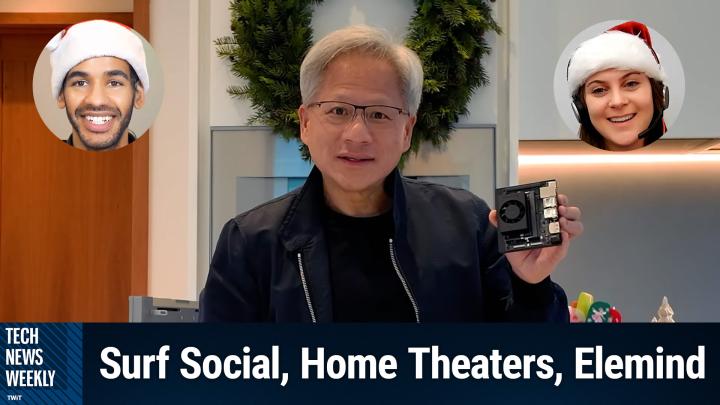
All TWiT.tv Shows (Audio)
Tech News Weekly 366: Nvidia's Affordable AI Supercomputer
01:05:41
Surf Social, Home Theater Tech, Elemind
Loading summary
Transcript151 lines
- [00:00]
Micah Sargent
Coming up on Tech News Weekly, Emily Forlini is here and we kick off the show by talking about a story she recently wrote about Nvidia's new palm sized supercomputer, how you can use it to bring AI smarts into your home or create new projects. It's all about the AI hobbyist and we're getting pretty excited about it. Then I talk about the new social media app that aims to bring all of those disparate social media networks together in one place. But what's the impact on those companies? Emily asks some great questions and we try to dive in after that. Scott Wilkinson of Home Theater Geeks fame stops by the show to give us the rundown of this year in home theater tech and what he's looking forward to in the new year. Before we round out the show with a nap. Well, sort of. Nasha Aderich Martinez joins the show to talk about the $350 headband that says, hey, I can help you nap a little bit better and a little bit faster. All of that coming up on Tech News Weekly. Oh, and by the way, you should know that the TWIT survey is now live. If you head to Twitter TV Survey25, you can fill out the survey and help us get to know you a little bit more. Promise it won't take you very long and we hope that you will help us out by heading there. Twit TV survey 25. Thank you. Podcasts you love from people you Trust. This is TWiT. This is Tech News Weekly episode 366 with Emily Forlaney and me, Micah Sargent. Recorded Thursday, December 19th, 2024. Nvidia's affordable AI supercomputer. Hello and welcome to Tech News Weekly, the show where every week we talk to and about the people making and breaking the tech news. I am your host, Micah Sargent and this week on this very festive day, I am joined by the Emily Forlini. Welcome, Emily.
- [02:08]
Emily Forlini
Hi, my Mrs. Claus today.
- [02:11]
Micah Sargent
I love it. Yes, the hat looks great. You have the, the ball that like has the string in between, which is the style.
- [02:18]
Emily Forlini
It's very dramatic.
- [02:19]
Micah Sargent
Yes, incredibly dramatic. You came in like a wrecking ball and hosted that holiday party. It's great to have you here. Thank you for joining us this week. Jennifer Pattison Tuohy, who normally joins us on the third week of the month, is preparing for CES and so I wish her all the best. We wish her all the best in that and of course, staying healthy at ces. Maybe the two of you can link up while you're there because I hear that you're going there as well. Well, but I want, I'm very excited because this was actually going to be potentially one of the stories that I reached out to someone about. And in getting ready for that I was like, I can't reach out to this person because they're going to be on the show already. So Emily, tell us about your story of the week and the piece that you wrote.
- [03:14]
Emily Forlini
Cool. Yeah. So this is one of the more kind of fun things in the AI space. It's Nvidia's new supercomputer that can run AI projects at home. So it's kind of making AI more accessible to hobbyists, to students, even small businesses. And what I thought was really cool about that is usually when like all the many hundreds of articles I write about AI are always like the big tech companies, it's kind of this really expensive, exclusive thing that only the truly biggest companies in the world are able to participate in. And then I saw Nvidia came out with this little supercomputer. It fits in the palm of your hand and it's $250. And basically what it can do is support larger scale AI projects. So if you're running your own large language model, you could use that at home and, or it has a big robotics focus. So if you have a robot or let's say a drone, you could kind of put it inside that robot and you could use it for advanced functions. Like, I mean drones are the hot topic this week. So if you wanted a drone that could, you know, have the vision capabilities and move based on what it sees, that would be for example, like a vision AI thing that you could, you could do with this small self contained computer that you could put in it. So very cool. Opens up tons of avenues for AI hobbyists, which is I guess a new hobby category. Maybe not new, but growing, right?
- [04:43]
Micah Sargent
Yeah, growing category. Now something that, you know, the average person might wonder about this is what is the difference between I, I put this thing down and I strap it to a bunch of other electronics and then I connect a keyboard to it and I Type in what's 4 +9 -6 divided by 3. Write a poem with that many lines and it does it versus me to gemini.google.com and doing the same. Why would someone want this instead?
- [05:24]
Emily Forlini
So you could build your own large language model that's for example, more private with your data. It doesn't give it to Google or give it to OpenAI. You could tweak it and customize it for your own use case. Whereas a general purpose chatbot like ChatGPT or Gemini is just kind of all things, all purpose player. Maybe you have a specific function for your business. Like you. This is an example I've used before. But let's say you run a hotel and you want to make a chatbot for customer service with just your customer service policies. Like you could create that and host it on something like this. So it's just more personalization, just your own projects, what you want to do versus a big huge company's chat.
- [06:13]
Micah Sargent
So then does that mean. Because if I go to, I'm trying to cover the bases before I hit up chat GPT, if I go to Claude AI and I type in, oh, I upload a photo of myself and I say, make me look like a, a, what is it called? A voodoo doll with pins stuck in my body. Claude's going, no, no, no, I don't work with, I don't work with human being like photos of human beings. There are guardrails and protections in place with these large language models that have the people have access to. Does that mean that somebody could in theory use one of these to create their own model that would not have some of these guardrails in place and sort of use it for nefarious purposes then?
- [07:14]
Emily Forlini
Yeah, it does. I mean they still would probably be using the source code from like an open source model, let's say meta's llama model or something. But that is something the open source community is doing and I've interviewed people who are doing that. A big use case is like sex chatbots, like porn chatbots, adult entertainment we'll call it. So yeah, there's some risky business happening there. But I mean if you consider just an innocent tech interested person, they might consider upgrading from a Raspberry PI to this. It's kind of like in that field of tech, it's kind of like an external computer that you can have and it can run your project 24 7. So that's another thing that is different than just going to chatgpt.com and typing something in. Your computer has to be open, has to be on, you have to be logged in, you have to be engaged. But if you have a project that's just running constantly on this very powerful little thing, it kind of opens up different capabilities to you and you don't have to be writing prompts all the time. It can do its own thing.
- [08:31]
Micah Sargent
Dave Plummer, former Microsoft employee, used this device to create a camera that watches for cars to Arrive and depart from his driveway.
- [08:46]
Emily Forlini
Yeah, perfect.
- [08:47]
Micah Sargent
That's. Yeah, that's one use case where normally what you would do in that situation is you would pay a company a monthly subscription to run some sort of computer vision model on its system with your footage to say, oh, that looks like a car, not a cat walking up the driveway. And therefore I'm going to alert you that there is indeed a car. And then it could maybe track how long the car is in the driveway. It can do all these things and it's all happening locally. So that 240 investment, plus, of course, the time. Wow, look at those lights in the back. I mean, the time that you spend doing it, I'm gonna have to get his set up is, is perhaps worth it in the long run. Particularly, as you said, for hobbyists. I can see people, you know, taking this technology, pairing it up with like a Raspberry PI or something like that and making some fun. I. There's a part of me that kind of wants to get one of these myself and do something fun.
- [09:44]
Emily Forlini
I don't have the skills. I mean, it's like a hobbyist, but like a specific, skilled kind of person, you know, like my hobbies might be cooking and crafting and traveling and, you know, other hobbies, but.
- [09:57]
Micah Sargent
Guitar playing.
- [09:58]
Emily Forlini
Guitar playing, exactly. You have to have a different set. You have to have some hard skills to hook this up. But if you can, it's kind of, kind of like magic. I mean, it would just be such a great gift for that type of person in your Life. Just that $250 price point is, is accessible for someone you really care about and want to get something super special for this, this could be a cool one.
- [10:19]
Micah Sargent
I think that word that you used, accessible. When I think about the chance for some of these AI systems to become less accessible over time because everything is a monthly subscription, it feels like. And if you have so many of those for your absolute necessities, plus a few of the things that you like, then also adding on a monthly subscription for the AI system that you're trying to use, and if we're at a place where everybody is using AI regularly for parts of the tasks that they do. Right. The idea that you could spend a one time thing here and work on it yourself and make it exactly as you want, I think is a really cool and accessible option. I also think that this speaks to where we could see sort of young people getting into coding. Up to this point, it's been a lot of Raspberry PI. It's been a Lot of like Minecraft plus code equals, you know, learning python or what have you. Now you get your curious teen a, an AI dev kit and they start to make a little robot that can, you know, drive around the house and bark or whatever.
- [11:43]
Emily Forlini
It happens to be totally.
- [11:45]
Micah Sargent
That's pretty cool. Yeah. What were the use cases that Nvidia, you know, showed off? Did they have any specific examples of like, this is really how we see it being used or was it more just like a go forth and do situation?
- [12:03]
Emily Forlini
Both. I mean the press release wasn't super detailed and also there was a video with video and Nvidia kind of sounds similar. There was a video with Nvidia CEO Jensen Huang and he, it was only two minutes and he just kind of talked about different ways you could use it. Like the vision AI talked about. He did say, I think that I can quote this if I remember. He said like general robotics is upon us. So kind of like everyone being able to create their, their own robot. So I think the robotics is a big focus. It would be pretty crazy if you could create a robot that would like water your plants or feed your dog or something. That could be cool. I could see definitely a high school robotics team getting funding to buy one of these things and using it to tinker and bringing that to a competition or something.
- [12:56]
Micah Sargent
Yeah, that would be pretty cool. Anything else you want to say about the Jetson Orion Nano before we take a little break?
- [13:08]
Emily Forlini
Not much, just it's cool, it's affordable for the right person and if anyone gets one, let me know. I'm trying to get a free sample from Nvidia so hopefully, hopefully I can come with some experience next time.
- [13:22]
Micah Sargent
That'd be really cool. Yes. If you end up getting that, I would. Yes. We'll get to talk about it. I would love to know. All right, we are going to take a quick break before we come back with my story of the week. I would love to tell you a little bit about 1Password who are bringing you this episode of Tech News Weekly. A question that I think we know the answer to. Do your end users always work on those company owned devices and IT approved apps? No, they don't. I didn't think so. So how in the world do you actually keep your company's data safe when it's sitting on all of those unmanaged apps and devices? Well, 1Password has an answer to this question. It's called Extended Access Management. With 1Password Extended Access Management, you will be able to secure every sign in for every app on every device. Because it solves the that traditional IAM and MDM can't touch. Love this metaphor. If you imagine that your company's security is sort of like the quad of a college campus, goodness gracious, is it beautiful. There are these nice brick paths between the buildings. Those are the company owned devices, those IT approved apps, the managed employee identities. But then you look around and you see these paths that run through the grass, the shortcuts that people have taken. Those are the straightest lines from point A to point B. Well those are also the units, managed devices, the shadow IT apps and the non employee identities. Like contractors. Most security tools that you go looking for are only going to work on those happy brick paths. But a lot of the problems actually take place on the shortcuts. 1Password Extended Access Management is the first security solution that brings all of these unmanaged devices, apps and identities under your control. It ensures that every user credential is strong and protected, every device is known and healthy, and every app is visible. It's security for the way we actually work today. And it's now generally available to companies with Okta and Microsoft Entra and in beta for Google Workspace customers. So check it out at 1Password.com twit that's 1p a s s W-O-R-D.com twit and we thank 1Password for sponsoring this week's episode of Tech News Weekly. All right, back from the break and it is time for my story of the week, joined this week by Emily Forlini of PCMag and are talking about social media. I am. My social media use has changed so much over the past three years, I would say three or four years where I used to just regularly be on Twitter at the time now x just reading to see what people were saying and responding and sharing and this and that and the other and then Instagram too pretty regularly and and my uses absolutely tanked. Flipboard has what it hopes or plans to be a kind of solution to this problem by way of a new app that the company is working on currently in beta. And the app is called Surf. So first, before I even talk about surf, I want to make it clear that Flipboard as it exists right now will continue to exist and that surf is an entirely different thing. So if you're not familiar with Flipboard, Flipboard came around the same time the iPad, around about the time, the same around about the same time that the iPad was launched. And it was this idea that you would have like a social magazine, you could follow your friends you could see what they were reading and it would present it to you in this beautiful magazine view that flipped through the pages. Really cool system. And over time, Flipboard continued to offer different types of integrations with RSS feeds and things like that. Now it's working on something called Surf that is essentially giving you the ability to curate your online experience across these different social media platforms. So if you can imagine right now, if I want to know what my friends are talking about, I have to. I've got. I've got a folder on my homepage, on my phone, and I launch. I launch Ivory, which is a Mastodon client, and scroll a little bit and read some of what's there. And then I launch Threads, the actual Threads app, and scroll through there. And then I launch Blue sky and scroll through there and see what my friends are saying. That's a lot. And so I barely ever do that. Having one place to go already seems really exciting. But Surf is kind of trying to take things to the next step where you can combine your, the people in the post, from Blue sky, from Mastodon, from Threads, from flipboard itself, from YouTube and from RSS and create your own social feeds. You can also follow feeds that already exist and you can create feeds that have feeds within them. So if you can imagine, one example that Harry McCracken gave over at Fast Company in talking about it was creating a feed of, of tech journalists. But in the feed, you customize it to say, filter out any stories where they talk about cryptocurrency. And then you can also sort these feeds because each feed has tabs such as Watch, Discuss, Read and Listen. So you can tap on Watch, and it's only going to show you videos from those sources, whatever you've popped in there. And then you could imagine that you could create. Maybe you have a, A, a tech journalist feed and you have a. I'm trying to think of some other category. You've got a food.
- [19:15]
Emily Forlini
There's only tech journalism.
- [19:17]
Micah Sargent
You've got a food journalist feed, and you've got a feed that just covers rating of microwave noodles. And you could combine that all into one feed. You know, my daily. Because those are the things that you read about on the, on a daily basis. So you're really like curating the entirety of the online experience in one app. In theory, that's something that I would want, but I also wonder what that does in terms of creating something where you never see anything you don't want to see and if that's a good thing or a bad thing. And so I'm curious, Emily, to hear a. Your take on this app itself, but also just the complaint that exists about the current state of the. For you experience where things are served up based on how much interaction they get.
- [20:20]
Emily Forlini
Yeah, totally. I mean, you called out. One of my first thoughts was just this is deep curation. I mean the Internet already provides so much more curation. I mean algorithms, if you compare it to something like a print media or you know, just 20, 30 years ago, now everything is a curated algorithm and this is. It sounds like an even more hyper personalized level of curation. So there is, you know, could you get locked into certain narratives? Could there be less chance you change your mind? You know, just all the, all the issues we already know. I just wonder if all the social media companies are going to let Surf do that. What do you think they will?
- [20:59]
Micah Sargent
That's. Well, see, that's the thing, right? Is that right now. Yes, because it's hip to be open and, and to let things be cross posted and to, to you know, not be this siloed experience.
- [21:15]
Emily Forlini
Is that hip?
- [21:17]
Micah Sargent
Well, okay. It's hip for the companies that are not trying to be. Basically. Yeah, I think it is hip for everything except for X. X is the only one that's like closing itself down. And I don't think that they're hip. I think that they are contrarian versus meta, which is trying to be more open and make threads compatible across experiences. Blue sky, which from the get go has been that way. Mastodon, which from the get go has been that way. RSS feeds, which from the get go have always been that way. So yeah, I think that it is, it's hip among extremely online people. We'll go with that to be a.
- [21:55]
Emily Forlini
For sure. Yeah. I mean it is true. I mean obviously for my work and for so many people's work, like I have to be on the computer and online all the time and at the end of the year here I'm just exhausted from going on the Internet and like going through all these feeds and all these places. It's total information overload. So I mean, maybe it really could be an upgrade if for whatever reason all the social media companies and, and just regular media companies actually allow Surf to access their, their content. We'll see. I mean, have you tried to sign up or anything?
- [22:30]
Micah Sargent
I have, I'm on the wait list. I haven't had the opportunity to sign up yet. I think that what the one thing about Flipboard is, it is it has always been a thing where you see what you want to see, but if you tap on it, it's going to take you to that thing. And so the end use, the end case is still getting what it wants in terms of like your interactions. So I don't know if this would have a noticeable impact on daily active users for other services, but other than maybe going up, because I hear, and of course this is anecdotal and it's, it's within the scope of the people that are extremely online. I hear a lot about that fatigue of where do I go to find what, what where, like what's the place? And how this friend decided to be on this platform. Well, I didn't, so am I going to see them? So in that way, I think this could be a positive if you can have everything in one place and then go to it if you want to respond or, you know, go to it if you want to interact. I mean, Twitter even used to be more open as well. And the, the, the flourishing of that third party Twitter client experience meant more people regularly using the site. In fact, like some of Twitter's most steadfast and true people were people who use the third party client and were very upset whenever that third party option pretty much tanked.
- [24:11]
Emily Forlini
Because of the API changes.
- [24:13]
Micah Sargent
Yeah, because of the API changes.
- [24:14]
Emily Forlini
That's where I'm wondering, like, can surf now, the API, you have to pay a lot more for it, Right? That's the issue. So can something like Surf, which is kind of a startup, afford that?
- [24:25]
Micah Sargent
Right. I don't think that they're planning on integrating with X at all. So yeah, that's, that was my understanding based on the Fast Company piece, is that they're just not messing with, with X. So everything else that they are integrating with with Mastodon, Blue sky threads, rss feeds, podcasts, YouTube videos, but just because here's the, here's the quote from the Fast Company. Not that long ago, being cut off from Twitter might have proved fatal to an app such as this. Now, some people may consider its lack of elonization to be a feature, not a bug. So yeah, they're specifically saying it's not going to have X involved. So you'll be able to see all of the, I guess if you just say we work with open clients, use us if you want to for those open clients, which those happen to be all the places where the people that I'm trying to follow are.
- [25:24]
Emily Forlini
Yeah, I mean, it could be good. It does kind of portray all those sites in a way of like, these are, I don't know, Almost like tiny little warring states like Reds, Blue sky and Mastodon. Like who's gonna win is kind of the vibe. And then X is successful and separate. So it, China does put ban them together into that, that kind of. We're trying to figure it out bucket and I mean, do you think it's good for them in that way? Can they get ad revenue from this surf platform?
- [25:59]
Micah Sargent
That is a, that is a good question. If those sites start serving ads, will those ads go through into something like surf in the same way that, you know, the, the part of the reason why people use the third party clients for Twitter was because they could avoid the ads. Yeah, I will have to see how that, how that ends up shaking out.
- [26:24]
Emily Forlini
Maybe they like it just for the users and that's their play and maybe it's a smart product just for where the market is right now. I don't know.
- [26:32]
Micah Sargent
But that could change. In which case. But I think that if you. From the, from the, from the starting. What am I trying to say? From the, from the start line. If you are saying I am an open platform that will make sure that your content is never siloed off and that you can access it however you want to and then you shift that away. I think the people who joined it for that reason, your original fan base or your original user base is going to not, not be happy about that. Whether that matters, you know, that's remains to be seen. But that all of these, well, threads is kind of late to the game in terms of being more open, but it is, you know, being more open. I think that this is just another way for all those things to be gathered. For example, I use a client called Croissant or Croissant that lets me post to write one message and it posts to all three of threads, Mastodon and Bluesky. And that Is because those APIs all allow for it. It integrates well enough that you can search for a username across the three different platforms and tag it properly. It works with the like, it pulls the alt text in, it does all of that stuff. And that is only good for each of those three places because that results in me being a daily active user on Mastodon, bluesky and Threads all at once. So in that same way, in theory, that's what this would do too because instead of me just saying, well, I give up, I cannot keep opening all three of these every day, you're going to each of them in your little feed that you see.
- [28:24]
Emily Forlini
Yeah, it's user centric. It could be good because the Reality is all of these apps are so similar. I mean, Threads, Mastodon, bluesky, Twitter, very similar. Same, same, different website. So if for us it is true, if you can organize it into one, it would organize well because they're all just the little kind of tweet. Tweet things.
- [28:48]
Micah Sargent
They are tweet things. They are, yeah.
- [28:50]
Emily Forlini
Are they called Skeets on Blue Sky? I think I hear that and I'm like, that cannot be real.
- [28:56]
Micah Sargent
No, it was sort of a joke, I think, originally. And then you like lean into the joke.
- [29:00]
Emily Forlini
So, yeah, Skeets, I'm like, is that an official thing? I heard. I see John just popped into the.
- [29:08]
Micah Sargent
To the chat and Patrick too. It's definitely. Yes, they're Skeets says Patrick.
- [29:12]
Emily Forlini
Okay, got it.
- [29:14]
Micah Sargent
Yeah. So, okay, it's happening. Whatever. Skeets and posts and Toots and all of the different things. Right, but they're all. Yeah, they're all just text and sometimes an image and sometimes a video and sometimes a link.
- [29:27]
Emily Forlini
Right. So you could, you could create a somewhat cohesive looking feed with. With all that. Yeah, yeah.
- [29:34]
Micah Sargent
Well, I'm looking forward to trying it because the thing that it will do for me is let me mix the RSS stuff with these social posts at once. That's the part that I'm looking most forward to. I also am interested to see how well it does the. I want to just see the videos from these people. I just want to see the audio from these people and if that works well. And so, yeah, it's an interesting way to go where you're just saying, I will be the multi armed or multi legged hydra, multi headed hydra that reaches out and pulls in everything.
- [30:19]
Emily Forlini
It's kind of like a humble brag for anyone who uses it. Like, oh, I have so much information and no way to organize it. I'm so exhausted from all the news I read.
- [30:30]
Micah Sargent
Oh, that's a good point. Or maybe I'll just continue to let it all go away.
- [30:35]
Emily Forlini
Just stick your head in the sand.
- [30:38]
Micah Sargent
Yeah. Emily Forlini, I want to thank you so much for taking the time to join me today to have some lovely conversations about AI and social media. If people would like to stay up to date with what you're doing, where is the place they should go for that?
- [30:54]
Emily Forlini
So, as discussed, I'm on many platforms so you can find me In, I guess, TikTok, Twitter, or X and Blue sky. And my username across all them is just MillyForLaney.
- [31:07]
Micah Sargent
I thought that was gonna take a little bit longer, so I took a sip of water. But you've done the great job of making sure you're the same in those places. So thank you so much and have a great rest of your year.
- [31:18]
Emily Forlini
Thank you. I hope you and everyone listening has a very healthy, restful, happy holiday. We all earned it.
- [31:25]
Micah Sargent
Yes, I agree. Thank you.
- [31:27]
Emily Forlini
Take care. Bye.
- [31:30]
Micah Sargent
All righty. Coming up on another break here before we head into our next interview with a familiar face, but I want to tell you about US Cloud who are bringing you this episode of Tech News Weekly. US Cloud is the number one Microsoft unified support replacement. US Cloud is the global leader in third party Microsoft enterprise support, supporting 50 of the Fortune 500. Switching to US Cloud can save your business 30% to 50% on a true comparable replacement for Microsoft unified support. US Cloud supports the entire Microsoft stack and they do so 24 7, 365. They respond faster, they resolve tickets quicker for clients all around the world and you always talk to real humans. Let me tell you a little about their proven track record. You get expert level engineers with an average of 14.9 years of experience and that's for break fix or DSE. You get 100% domestic teams so your data never leaves the US financially backed SLAs on response time and initial ticket response averages that are under four minutes. In 2023, 94% 94% of US Cloud's clients reported saving 1/3 or more when switching from Microsoft unified support to US Cloud. From Fortune 500 companies and large health systems to major financial institutions and federal agencies, U.S. cloud ensures that vital Microsoft systems are working for more than 6 million users globally every day. Big brands trust US Cloud, including Caterpillar, HP, Aflac, Dun and Bradstreet, Under Armour and KeyBank. Even the IT folks at Gartner have chosen US Cloud for their Microsoft support needs. A Director of Information Technology says, and within an hour US Cloud responded with I want to say four engineers. So not only did they bring the right guys to the call, but they brought the cavalry. I just felt like, wow, that was amazing. That was unlike anything I had experienced with Microsoft in my eight years of being with Premier. We made the right choice. So when it comes to compliance, no one gets it more than US Cloud. ISO, gdpr, esg, compliance. They're not just regulatory requirements, they're actual strategic imperatives that drive operational efficiency, legal compliance, risk management and corporate reputation. So they're about more than just that one field. These standards foster trust and loyalty among customers and stakeholders. They attract investment and they ensure long term sustainability and success in a competitive global market. So visit uscloud.com, book a call today to find out how much your team can save. That's uscloud.com to book a call today and get faster Microsoft support for less. We thank us Cloud for sponsoring this week's episode of Tech News Weekly. And now we are back from the break, and I am thrilled to be joined by a jolly and familiar face. It is the Scott Wilkinson. Hello, Scott.
- [34:43]
Scott Wilkinson
Hey, Micah. So good to see you.
- [34:45]
Micah Sargent
It's really good to see you too. It's been a long time and I have been thoroughly as our listeners have been as well, enjoying home theater geeks and everything that you do for that show.
- [34:57]
Scott Wilkinson
Thank you.
- [34:58]
Micah Sargent
And we appreciate that.
- [35:00]
Scott Wilkinson
It's a lot of fun.
- [35:01]
Micah Sargent
Good, good. I'm glad to have you here today because I thought it'd be a nice time, given that this is the final live show of Tech News Weekly to kind of take a look back on home theater tech this year. Let's kind of start off by talking about what tech you saw this year, if there were any new features that kind of came across for you that interested you, and what were kind of the offerings this year in terms of getting people to go out and buy new home theater gear, be it a TV or something else?
- [35:37]
Scott Wilkinson
Well, there weren't any major breakthroughs that I can identify as in most years, the improvement has been incremental. You know, things have gotten a little better here and there. I am still a big fan of OLED or OLED TV technology that's been around for now quite a few years and it has gotten better and better over the years. There are two types of TV's basic TV technology, OLED and LCD, which uses an LED backlight, so it's often called LED tv. And more recently they have started to incorporate a technology called quantum dots. And therefore the TVs are referred to as QLED, quantum dot LED, but there's still LCD TVs. There's lots light shining through an LCD panel. The LCD panel blocks all the light except in the sub pixels, the red, the green or the blue and, and that forms the image. They're generally less expensive than oled. They're generally brighter than oled, but they suffer other problems that make me prefer oled. And so, you know, we saw improvements in both technologies. This year. Sony announced its latest both of those types. The QLED, the Bravia 9 achieves a brightness of 4,000 nits, which is just a measure of brightness, and that's brighter than any commercial TV has Been available so far.
- [37:29]
Micah Sargent
Yeah. That sounds really bright.
- [37:33]
Scott Wilkinson
Man. You got to put your sunglasses on for that for sure. Now, the advantage of that is that high dynamic range content is mastered in the studio at either 1,000, 2,000 or 4,000 nits. And if it's measured, if it's mastered at 4,000 nits and your TV can't achieve 4,000 nits, which virtually none of them can, except this Bravia 9, then they have to kind of roll off the brightness. If the brightness gets up there higher and higher and higher, the TV can't do it. So it's got to use processing to. To sort of roll off or limit the amount of brightness that it'll produce. On this new Bravia 9, it doesn't have to do that.
- [38:21]
Micah Sargent
Wow.
- [38:22]
Scott Wilkinson
It can display the content exactly as the creator intended with. And that's a big advantage.
- [38:30]
Micah Sargent
Can. Is there a way for someone. Is there some secret code on the Blu Ray disc jacket that says that it was, you know, mastered at 4000? How do you know that?
- [38:43]
Scott Wilkinson
Man, that's a great question. That is a great question. And the answer is typically not. As far as I know, there is not a code or a note or a little bad on the. A badge. You just kind of have to know or do research, go online. And, you know, a lot of websites that deal with this kind of stuff will tell you, you know, they will dig in and they'll find out, but it's not generally well known that that is a problem. I couldn't agree with you more. I wish, I wish it were well known. It gets a bit geeky, you know, so maybe a lot of people don't care or aren't even aware of it, but. But for those of us who are and do care, I want to know, what was it mastered at?
- [39:29]
Micah Sargent
Yeah. So is this something where you're just looking through Reddit threads and that kind of a thing? Got it. To figure it out.
- [39:35]
Scott Wilkinson
Yeah. Or going to flatpanelshd.com or avsforum.com you know, a lot of people talk about this on AVS forum.
- [39:44]
Micah Sargent
Now I want to talk about something that I have noticed maybe over the past couple of years. More and more I see the average person, and by that I mean somebody for average. For us. Meaning they're not super, super techy. They're not, you know, gearheads who are regularly buying stuff anecdotally. On occasion I've gone to someone's home, talking to them, whatever, and they start talking about their projector. They don't have a tv, they Have a projector and these come at different price points with different brightness levels and that kind of a thing.
- [40:22]
Scott Wilkinson
Yep.
- [40:22]
Micah Sargent
Where do you stand in general kind of on projection technology? And more importantly, and I really. The important part here is to get into the mindset of someone who is not going to spend thousands of dollars on the. The light rejecting or the ambient light rejecting panel. What's some advice that you would give to the average person who got their projector on Black Friday from Amazon to make the picture even the slightest bit better? What's your advice there?
- [40:59]
Scott Wilkinson
Well, I'm afraid my advice is to get an ambient light rejecting screen. I mean, unless you're willing to watch in the dark.
- [41:12]
Micah Sargent
Okay.
- [41:13]
Scott Wilkinson
And when you're talking about your average consumer, as you have sort of stated, let's start from that platform. They don't want to watch in the dark. They don't want to make a dedicated room with no windows, you know, and they can turn the lights out and they can turn it into a black hole. That's the only way you're going to get a good picture without an ambient light rejecting screen. If you want to watch in the daylight with the windows open or the lights on at night or whatever, without an ambient light rejecting screen, the picture is going to look totally washed out. Out and lousy. Not compelling in the least.
- [41:53]
Micah Sargent
Not compelling to us.
- [41:58]
Scott Wilkinson
Yeah, I suppose you could say that.
- [42:00]
Micah Sargent
But I don't think that they even know to be compelled, if that makes sense. No, I'm, I'm, I'm being genuine. Like they, they're thinking, I've got this big screen and that's cool and so great. And I, I'm going. You do notice how blurry that is, right? Like you like. But look at this big screen I have.
- [42:19]
Scott Wilkinson
Yeah, I'm not talking about Bl. Blurry so much as washed out. Yeah, I mean, I think anybody who looks at a picture that's super washed out and the contrast, you know, from the darkest to the brightest is really low. Like 10 to 1 or, you know, something super low. It just looks washed out. It doesn't pop it doesn't. It. It's kind of like really is that. I mean, anybody looking at a picture like that, I think would be dissatisfied.
- [42:46]
Micah Sargent
Yeah, no, that's.
- [42:47]
Scott Wilkinson
I really do. I really do. Now, in, in return, in regards to projectors, I want to mention this. You're probably talking about a projector that you mount across the room from the screen.
- [43:00]
Micah Sargent
Right.
- [43:01]
Scott Wilkinson
And that really requires a dark room or an ambient light rejecting screen. There's another Type of projector that has actually gained a foothold in the last couple years called an ultra short throw or UST projector. And they're often called laser TVs. And the reason they're called that is that they use a laser light source and they are intended to replace a flat panel tv. So instead of the projector being across the room, it's right up there against the wall where the screen is. It's like on a credenza or some sort of surface that's up against the wall of the screen and it shoots the light way up at a steep angle. You do need a special screen, but it then reflects that light out into the room. And that special screen is by nature ambient light rejecting as well as specialized to reflect light coming up at a steep angle and then going out at a flat angle, if you will. And those can replace a flat panel tv. Be perfectly fine in a well lit room. It basically replaces a tv.
- [44:18]
Micah Sargent
Speaking from personal experience. Yes, they look great. They. I've got the. The hisense that Leo used to have.
- [44:27]
Scott Wilkinson
Yes.
- [44:28]
Micah Sargent
And I've. We've got that set up in our living room now. And even with the lights on because of the screen compared with the fact that it's right there. Yeah, it looks great.
- [44:39]
Scott Wilkinson
And the technology has come a long way since that one you got from Leo.
- [44:43]
Micah Sargent
I'm sure.
- [44:43]
Scott Wilkinson
I'm sure. Yeah, it's gotten a lot brighter. They even support a high dynamic range format called Dolby Vision. Some of them do. Which no TV does.
- [44:56]
Micah Sargent
That is what I was going to actually ask you next is a little bit about. And please finish that thought and then I'll touch on the Dolby Vision thing.
- [45:05]
Scott Wilkinson
Okay. Well anyway, Dolby Vision is a. Is a format of high dynamic range. Which is. Which means that the blacks are blacker and the brights are brighter than your standard dynamic range of most TV really makes the picture look great. But TVs. Well, no TV. There are many TVs that do support Dolby Vision. There have been no projectors that support it. I misspoke before. Pardon me for misremembering. Plenty of TVs have Dolby Vision. Virtually no projectors have had it. These ultra short throws now are starting to get it. Which is really interesting. And yet another example of how they can replace a tv.
- [45:51]
Micah Sargent
Right. I'm realizing we only have a couple of minutes left and so I wanted to ask you what. What's coming down the pipeline that has you interested going forward? You know, as we. Because again you always. There are people who just buy a new TV every eight years or something like that. There are people who are, you know, what's going to get people interested in getting. And it doesn't even have to be televisions. It could be home theater gear. Maybe there's a new sound system. What's got you excited, Blue? Looking, Looking into the future.
- [46:25]
Scott Wilkinson
Well, there's a couple of things and unfortunately the ones that I have in mind are not gonna be general consumers.
- [46:34]
Micah Sargent
Got it. Oh, okay, okay.
- [46:36]
Scott Wilkinson
But the, the big news at ces, I think for us, for us home theater geeks is going to be. And this, this got leaked, I can say it because it's been on the Internet, on various websites. HDMI 2.2, the next version of HDMI. HDMI currently 2.1 has a bandwidth, maximum bandwidth of 48 gigabits per second. DisplayPort, as you know, has a bandwidth of I think 80 gigabits per second. But HDMI 2.2, we are rumored it will match DisplayPort. Now the unfortunate thing is it will probably require a new cable and a new connector. Oh no, really?
- [47:28]
Micah Sargent
A new connector?
- [47:30]
Scott Wilkinson
I hate that. I hate that. But because the bandwidth of the current cable is I think, pretty maxed out. So.
- [47:40]
Micah Sargent
Ah, let's see. I can understand needing a new cable, but I don't want to. That means that none of the stuff that I have would. Would work.
- [47:45]
Scott Wilkinson
Will work. Well, the good news is you don't need it anytime soon. I think the biggest market for HDMI 2.2, at least in the beginning, is going to be gaming, because that needs as much bandwidth as you can get. But movies, 4k movies at 120hz refresh rate are going to be. That's supported by the current HDMI. So you know, are we going to go to 8K 120Hz are we going to go to 16K? Maybe years in the future. But I don't. This is not something that consumers need to fret about right now of. Oh no, I've got to replace all my stuff. No, you do not.
- [48:28]
Micah Sargent
Got it.
- [48:29]
Scott Wilkinson
But it just goes to show you that technology is constantly being improved. One of the biggest bugaboos of HDMI compared to display port was lower bandwidth. And that problem apparently will now be no longer. Longer.
- [48:45]
Micah Sargent
All right, well, I am equally looking forward to that tech making its way down. And also we'll be excited to hear about the kind of higher up the scale, not so much consumer tech. E. Of course people can head to our site to check out home theater geeks, Twitter, TV htg Are there other places they should go to keep up with what you're doing? Like the Home Theater of the Month?
- [49:09]
Scott Wilkinson
The Home Theater of the month. @avsforum.com I do a monthly feature called Home Theater of the Month where I highlight a home theater of an AVS Forum member. And boy, they, and they just do some fantastic home theater installations. These are all dedicated rooms. We were talking earlier about projectors and you have to be in a dark room. These are, these are rooms that can be blacked out completely because they want to be cinematic. And you go to a cinema, you've got a projector behind you, shooting onto a screen in front of you. And that's what all of these home theaters do. So.
- [49:49]
Micah Sargent
Awesome. Yeah, they, they are pretty cool.
- [49:51]
Scott Wilkinson
And they're really, really cool. They're. They're great to look at. The DIY ones are not that expensive. The. The ones that have been installed by an installer can be really expensive. But I like to look at ones that are accessible and others that you know, like. You don't read a car magazine to read about Hondas, read a car magazine to read about Ferraris and Lamborghinis. Right.
- [50:14]
Micah Sargent
Accessible and aspirational. Correct? Correct.
- [50:18]
Scott Wilkinson
Exactly right. I like to mix those up.
- [50:21]
Micah Sargent
Awesome. Well, Scott, I wish you the best holidays you could possibly have and I appreciate you for joining us today and also wish you the best with home theater geeks in the new year.
- [50:33]
Scott Wilkinson
Thank you so much. And you too. I hope you have a great holiday and a great new year.
- [50:39]
Micah Sargent
Thanks so much. Alrighty, we'll see you later.
- [50:41]
Scott Wilkinson
Okey doke.
- [50:42]
Micah Sargent
Bye bye.
- [50:43]
Scott Wilkinson
Bye now.
- [50:44]
Micah Sargent
Alrighty. Up next, we are going to talk about napping, if you can believe it. But we have a quick break before we get to that. Before we head into our next interview, let me tell you a little bit about Cash Fly who are literally bringing you this episode of Tech. For more than 20 years, CashFly has held a track record for high performing ultra reliable content delivery serving more than 5,000 companies in more than 80 countries. At TWIT, we have been using Cashfly for more than a decade and we love the lag free video loading, the hyper fast downloads and the friction free site interactions. See, Cashfly is the only CDN that's built for throughput. You get ultra low latency video streaming that delivers video to more than a million concurrent users. You get lightning fast gaming that delivers downloads faster with zero lag glitches or outages. Mobile content optimization that offers automatic and simple image optimization so your site loads faster on any device, plus flexible month to month billing for as long as needed with discounts for fixed terms. You can design your contract when you switch to Cashfly and CashFly has several exciting updates to announce. SAML SSO Cashfly now supports Security Associates markup language. That's SAML for enhanced secure authentication and seamless SSO integration. So you can now integrate your Cachefly login with your choice of identity management platforms such as OKTA plus Multiple Origins Script Using path and extension filters, you can now easily enable multiple origins on a single service. New Status Code Report and analytics Currently in beta, you'll be able to view reports based on detailed status codes at 5 minute intervals each pop service and group, easily showing you when your service experienced a high number of errors and pinpoint time and location. Cashfly delivers rich media content up to 158% faster than other major CDNs and allows you to shield your site content in its cloud, ensuring a 100% cash hit ratio. And with Cash Fly's elite managed packages, you will get the VIP treatment. Your dedicated account manager will be with you from day one, ensuring a smooth implementation and reliable 24. 7 Support when you need it. Learn how you can get your first month free at cashfly.com twit that's C-A C-H-E-F L Y.com twit and we thank Cashfly for sponsoring this week's episode of Tech News Weekly. All right, we are back from the break and as I promised, we're going to talk about napping. I have to tell you I'm very excited about getting this next guest on the show. As a sleep nerd myself. Hearing from Nasha Aderich Martinez, Managing Editor at cnet. Welcome to the show.
- [53:26]
Nasha Aderich Martinez
Hi. Thank you so much for having me here.
- [53:29]
Micah Sargent
Yeah, pleasure to have you join us. So you had the opportunity to try out a headband that is supposed to help with sleeping. This $350 headband promises on demand naps. Maybe you can start by telling us a little bit about it. But more importantly, kind kind of what made you curious about testing it given your interests?
- [53:53]
Nasha Aderich Martinez
Yeah, so I've been working in the sleep industry for many years now and in doing so I've tested so many products that claim that help you sleep, right? I've tested anything from supplements to tech to wearables, you name it. And some of them work, some of them are just pure marketing. And when I heard that there's a headband that that can help you sleep on demand, I was like, I really want to put this to the test to see if it works or not. But also because I got invited to nap in the middle of my work day and I'm like, I absolutely want to go get paid to take a nap, so let's do that.
- [54:30]
Micah Sargent
Yeah, I think I would pick up on that too. Absolutely. So when it comes. So you said you worked in the sleep industry for years. Do you mean as like a. If you can talk about that. I am curious about that aspect.
- [54:46]
Nasha Aderich Martinez
So at cnn, I oversee the sleep and wellness vertical. So on sleep, we write about and we are all sleep science certified coaches on there. So we know a lot about sleep, how to get better sleep and all of that. But we also spend a lot of time with hands on testing with all of the products that we review. So if you go on Sina.com you'll see that we've tested all sorts of things. All the magnesium supplements, all the melatonin supplements, all the sleepy time te, all the bed sheets, mattresses, pillows, you name it, anything that you can think of that's related to sleep, we've tested it all. So with that comes many, many years and experiences of just testing what's out there on the market and separating fiction from hype.
- [55:36]
Micah Sargent
That is the most important thing. Now you talk about with this device. It's got EEG capabilities and also uses buzzword AI to interpret brain activity. Can you tell us in simple terms how the technology actually works?
- [55:51]
Nasha Aderich Martinez
Yeah. So basically when you are sleeping, your brain is emitting a type of frequency right through your brain waves. And what this headband does is that it detects those brain waves and helps offset high activity so that you can fall asleep. Basically, it's like noise canceling for your brain. So when it detects this high frequency, you feel, but you also hear like a light buzz. So it's like a very subtle buzz that you feel on your forehead, but you can also kind of feel it in your mind. It's a weird sensation. So, yeah, basically that's what it does. It just helps offset that brain activity to kind of help you relax and ease your way into sleep.
- [56:33]
Micah Sargent
Interesting. Yeah. I think many of us, especially watching the show, are going to be familiar with noise cancellation technology. So the idea of brain noise cancellation is a pretty cool concept.
- [56:45]
Nasha Aderich Martinez
Yeah.
- [56:46]
Micah Sargent
Can you tell us about your experience at the Crosby Street Hotel where you actually did get to go get some sleep while getting paid? What did it feel like using the headband and then how. Because in your writing it seems like it happened pretty quickly in practice. Did you start to really feel those effects really quickly. And then I think for our listeners they would want to know if you as a person person typically have any trouble falling asleep or if you're one of those folks who can just sort of close their eyes and drift off.
- [57:14]
Nasha Aderich Martinez
I'm not gonna lie, I fall asleep pretty quick, quickly. So my sleep latency, which is like the amount of time it takes you to fall asleep at night, it's pretty, pretty quick. Like my head hits the pillow and I'm out. But I'm not so great taking power naps during the day. So for, for full contacts, I did not have coffee a few hours before testing. This was around 2pm So I did have my morning coffee, not have any afternoon coffee or at least like two to three hours before testing. So that happened. Also very important for context, I had Lai, who is my social media manager with me in the room. Everyone else left. But I want you to know that it is extremely hard to try to nap when you have a coworker in your room.
- [58:00]
Micah Sargent
Yeah.
- [58:00]
Nasha Aderich Martinez
So that really impressed me that it worked because I had someone who was filming my entire nap the whole time. Yeah. And she was hoping that I would snore so she could have a sound bite. So I was like really self conscious about it. But yeah, so I put on the headband, we turned it on and I could feel the buzzing. So it's like rhythmic, right. So you would feel it like at a certain beat and it was really, really fast in the beginning and as I started to drift off, I started to feel how it got slower, slower. So it's like a heartbeat like say like you're running and you feel your heartbeat going really, really fast and as you're pacing down it starts to slow down a little bit. So that's the same way I felt the buzzing. And then next thing I knew I was just waking up to the sound of the door opening.
- [58:50]
Micah Sargent
That is pretty cool. Times almost up on holiday shopping and so are amazing deals at Amazon. You'll save so much on holiday gifts for the kids like arts, crafts, games and tech. You'll have money left over for some new board games to boost the kids confidence. Ah, you want again. Or that multi voice changing megaphone so you can really spread the cheer. Happy holidays. Oh what fun it is to save. Shop new deals added every day. It's better over here at&T Customs customers switching to T Mobile has never been easier. We'll pay off your existing phone and give you a new one free. All on America's largest 5G network. Visit t mobile.com CarrierFreedom to switch today pay off up to 650 via virtual prepaid MasterCard in 15 days. Free phone up to 830 via 24 monthly bill credits plus tax qualifying port in trade in service on Go 5G next and credit required. Contact us before canceling entire account to continue build credit to credit stop and balance and require finance agreement is due. The data that you. The data rather showed you that you achieved an alpha state during your nap. And so tell us about what that means in comparison to maybe what someone would expect when it comes to a nap.
- [60:07]
Nasha Aderich Martinez
Yeah. So, okay, so when you're in alpha state, it means that you're in a resting state and you're asleep, but you're kind of still aware of your surroundings. And this is what I expected for a 25 minute nap, which was not in my home and with a coworker there. Um, so I best describe it as, you know, when you're waking up in the morning that you're kind of still asleep but still kind of awake. That was the feeling. So like I was very much aware of what was happening around me, but I was in a resting state. Yeah. So I only got to use it for 25 minutes. I'm really curious to see how it would perform overnight. Having it on for hours and just like in the comfort of my home by myself.
- [60:52]
Micah Sargent
Without somebody filming you, hoping you snore.
- [60:55]
Nasha Aderich Martinez
Yes, exactly.
- [60:56]
Micah Sargent
Sounds like it would probably work a little bit better in that situation.
- [60:58]
Nasha Aderich Martinez
I think so too.
- [60:59]
Micah Sargent
Yeah. Now getting into the practical for a device at this price point, potential buyers will want to know about comfort and usability. What was your experience actually wearing it and feeling it? And I think most importantly, because many people have different sleeping positions, I'm a side sleeper, for example. How do you think it is practical for different sleeping positions?
- [61:21]
Nasha Aderich Martinez
Yeah. So Meredith Perry, who is the co founder of LMind, explained to me that they did many, many studies and trials with people who have different sleeping position preferences. So lots of side sleepers, back sleepers, stomach sleepers, wanted to make sure that this headband really suits all sleeper types. I mostly did nap on my back, but I did lay down with it on my side to see if I was able to feel it. Now, the headband itself is almost imperceptible. It is so lightweight. It's made of a stretchy, very light material. So you really can't feel the headband. I think what you feel most is the buzzing and the sensors just kind of playing on your forehead. But it's very, very subtle. If you are someone who likes white noise, I think you would find it really soothing because I found it soothing. But, yeah, I don't think anyone who's a side sleeper or a stomach sleeper is going to feel uncomfortable with it.
- [62:23]
Micah Sargent
Nice. And then lastly, I was just curious, given that you are regularly writing about this stuff and talking about this stuff, and I'm just someone who's always curious what's out there. What are some other sleep tech that you've used this year that you've edited from other people that kind of stood out to you?
- [62:42]
Nasha Aderich Martinez
Yeah, I would say sleep masks are getting very techy in this space. So we've seen sleep masks that kind of massage your eyes, that also have sound white noise integrated into it that's kind of like on the lower price points. Higher price points. I would say something like the eight sleep pod, which is like a sleep tracker but also helps you cool down your bed. So it's very great for those who tend to sleep warm or hot. And then you can customize it by size. So if you sleep with a partner who, who isn't necessarily a hot sleeper, you can customize just your side. So it's like really, really smart sleep tech, but very pricey also. And I would say just like how smart sleep trackers are getting in general. So I have tested the whoop and the aura, which are not just sleep trackers or fitness trackers, but give you a lot of insight and data into your sleeping patterns. So before let's say something like whoop, they would just give you your data. Right. So like, you spent this time, this much time in rem, you spent this much and light sleep, but now it's coming with AI coaches. So they it actually analyzes your data and it tells you like, hey, try going to sleep 30 minutes earlier tonight to see if you can spend more time in deep sleep. So it's getting very personalized very quickly.
- [64:11]
Micah Sargent
Nice. Well, I am looking forward to this coming year in sleep tech and I appreciate you for taking the time to join us today. If people want to follow you online to keep up with what you've got going, where's a good place for them to do that?
- [64:25]
Nasha Aderich Martinez
Yeah, at cena.com you can just click the sleep or wellness tabs and you'll see everything that my team and I are working on.
- [64:32]
Micah Sargent
Awesome. Thank you so much for your time and I hope you have a great rest of your year.
- [64:36]
Nasha Aderich Martinez
Thank you. You too. Happy holidays.
- [64:38]
Micah Sargent
Alrighty, folks, we have reached the end of this episode. Of Tech News Weekly. All that is left is to say goodbye to all of you. The show publishes every Thursday at Twitter TV tnw. Next week we'll have our Best of Episode where you can check out the the different interviews and conversations that I had that I thought were worth your time for a second look. And that's where you go to subscribe to the show in audio and video formats. If you'd like to get all of our shows ad free, well, there's a way to do that. You just head to Twitter TV Club Twit. By the way, we are extending our offer, our limited time offer for free. Two weeks of Club Twit. So if you've been hanging out hoping to be part of the Club Twit experience, now's your time. Twit TV Club Twit after the fact $7 a month. That's it. And gain access to some pretty awesome things. You get access to the Twit plus bonus feed. There's extra content you won't find anywhere else. You get access to the ad free versions of all of our club, or rather all of our Twitch shows, and access to the video versions of our club twitch shows like iOS today, hands on Mac, hands on Windows, et cetera. So it would be great if you join. Oh and access to the Discord Server. A fun place to go to chat with your fellow Club Twitt members. And those of us here at TWIT would very much look forward to seeing you in the club. So again join now because two weeks free for a limited time. And for those of you who are already members, TWiT TV club TWiT referral is the place you go so you can get months of Club Twit for free. Thanks so much and if you'd like to follow me online, I'm @MicasArgent on many social media network. Or you can head to Chihuahua Coffee that's C H I H U a H u a Coffee where I have links to the places I'm most active online. You can check out my other shows like Hands On Tech this Sunday and of course the shows that publish in the club. Thank you and goodbye. Happy Holidays, happy new year etc. Etc. Etc. It's better over here at T customers switching to T Mobile has never been easier. We'll pay off your existing phone and give you a new one free. All on America's largest 5G network. Visit t mobile.com CarrierFreedom to switch today pay off up to 650 via virtual prepaid MasterCard in 15 days free phone up to 830 via 24 monthly bill credits plus tax qualifying porting trade in service on go 5G next and credit required. Contact us before canceling entire account to continue bill credits or credit stop and balance and required finance agreement is due. If you know your party's extension, press or say 1 to leave a message in our company mailbox box. Press or say too Spoiler alert. It will be full representative. Would you speak to your mother in that tone? Speak to a real human being.
- [67:28]
Nasha Aderich Martinez
You shouldn't need to shout into the.
- [67:30]
Micah Sargent
Void to get your health insurance questions answered. Pacific Source Health Plans this is a real person.
- [67:36]
Emily Forlini
How can I help you?
- [67:37]
Nasha Aderich Martinez
Human service not automated phone trees. Pacific Source Health Plans.