← All TWiT.tv Shows (Audio)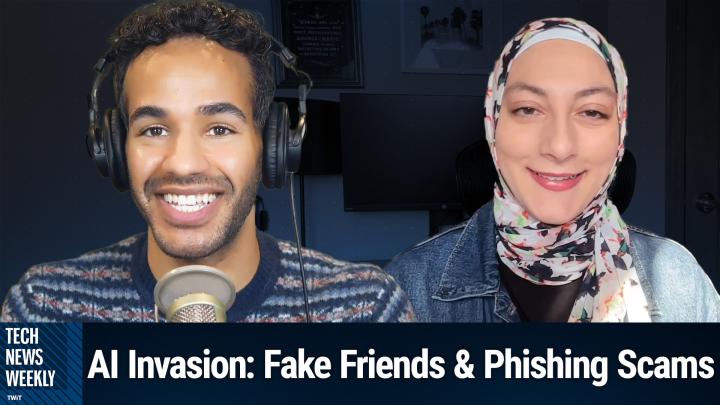
All TWiT.tv Shows (Audio)
Tech News Weekly 368: Facebook Hopes You'll Befriend AI Influencers
01:10:32
AI Phishing, Retro Tech Revival, Passkey Predicament
Loading summary
Transcript86 lines
- [00:00]
Micah Sargent
I'm Micah Sargent from Tech News Weekly and I am back with Abrar Alheati of cnet. Abrar joins me for a full episode this week where we share two great stories of the week, both. First, we kick things off with a brar story of the week about Facebook adding a bunch of AI bots to its social media platform so that you make friends with them and they post on your posts. We'll have to see how that turns out. Then we move on to talk about AI generated phishing scams and how they're using personal identifiable information to try and gain access to accounts and services and all sorts of things. It's a mess out there and we ask AI how it would handle the problem. Then we take a trip down nostalgia lane as we talk about parents gifting their kids Walkman and MP3 players to, you know, get them away from those screens for a time. Before we round things out with a look at the current state of passkeys and what we hope to see in the future from this passwordless offering. All of that coming up on Tech News Weekly. Podcasts you love from people you Trust. This is TWiT. This is Tech News Weekly. Episode 368 with Abrar Al Heati and me, Micah Sargent. Recorded Thursday, January 2, 2025. Facebook hopes you'll befriend AI influencers. Hello and welcome to Tech News Weekly, the show where every week we talk to and about the people making and breaking the tech news. I am Micah Sargent and it is a new year as we are kicking things off here on January 2nd. I am excited because I, you know, maybe misread my calendar and was looking at things and I am very excited and happy that my wonderful, wonderful guest host is ready to do the show with me today. Welcome back, Abrar, and welcome to the new year.
- [02:14]
Abrar Alheati
Thank you so much. Happy New Year. It's a great way to kick things off with you. So I'm looking forward to getting back into work today and this was a good way to get back into reality. So I'm happy to be here.
- [02:25]
Micah Sargent
Back to life. Yes. So with that, people will be familiar hopefully by this point with the format of the show. We're actually going to do a full show of Abrar Al Heati and Micah Sargent discussing their stories of the week to kick off the year. And I think it's great because we're getting back into the swing of things. There are a few stories that actually, you know, took place over the course of the end of the year or right here at the Beginning and so it's kind of fun to kind of see where things are. So Abrar, if you would like to kick things off with your first story of the week, I'd love to hear about it.
- [02:59]
Abrar Alheati
Yes. So I wanted to talk about, you know, we're starting in a year and let's just start things off with a dystopian vibe, just to jump right into it, really setting the, the tone for what we may see in 2025. So I wanted to talk about Meta using AI bots to, you know, using populating things like Instagram and Facebook with, with AI users. It's, it's a little unsettling, but let's dig into this a little bit. So these reports say that Meta is essentially going to have these, these profiles with, you know, they have profile pictures and they can generate content and they can share content just like you and I can. But these are again, AI bots, so it's a little unclear why. Why?
- [03:48]
Micah Sargent
There we go.
- [03:49]
Abrar Alheati
Why? You know, like, let's really get into the question here. You know, Meta has been tapping into AI a lot lately. They've, they've released, they've announced AI Studio, which is a tool that lets people create AI versions of themselves or their favorite characters. People can dm. They pitch this as something where, you know, creators and celebrities can just have their AI Persona take care of any common questions that they get. Let's just let you know DM that and it'll respond to you and it'll be just like me, but it's AI, which, it's not the same, but it's okay. Don't tell them out of that. You know, this kind of takes things another step. They've also announced something called moviegen, which can create videos based of uploaded images. That's supposed to roll out sometime this year as well. So we know Meta has been tapping into AI, but this is really kind of the next level because the thing that I'm thinking about is we know Instagram competes with TikTok, for example, or even YouTube, for example. Those are the most popular apps among people, you know, younger people. The thing that appeals to a lot of users about TikTok, about YouTube, is that you have personalities, right? You have people who feel real, who share experiences that feel real. You have a lot of fake people too. Don't me wrong. That's all across social media. But the thing that really stands out about TikTok is that relatable, the kind of unfiltered Personas that you encounter. The reason Instagram has Kind of struggled to compete, I think, is because a lot of the things on Instagram are very manufactured. Right. You have influencers who have these very polished, inaccessible lives. For a lot of us, a lot of unattainable standards are set. And we know that Instagram has realized this and has been like, well, we're going to work now to promote profiles and accounts that maybe, you know, don't have as many followers. If something resonates, then we'll surface it in the same way that TikTok does. Right. It doesn't matter how many followers you have. We've yet to see that. But that's what they say. Right? So my question then becomes, what is the appeal of then having these AI bots create and share content on a platform like Instagram, for example? What does meta hope will be gained by that other than inflating their numbers because they're running out of new users? A lot of us are already on meta owned platforms, so they're looking for new ways to, you know, generate revenue and get users. But, but, you know, if the platform already feels fake because of influencers, how is it going to feel because of AI bots? So, Mike, I want to talk to you about this. What do you think the benefits and the drawbacks of this move could be?
- [06:16]
Micah Sargent
It feels exclusively drawback to me, if I'm honest. Yeah, like, okay, you already have a company that in the past has come under fire for inflating numbers with advertisers. And there was a huge sort of crash, a huge tanking when it came to video posting on Facebook. I remember working at a startup at the time that was a video news company. And we were thinking we were just, you know, making it happen and just soaring through the stratosphere because of the viewership that we were allegedly seeing on the platform. And Facebook at the time was criticized for, for probably inflating those numbers or at least sort of obscuring and figuring out ways to make those numbers count when really someone was just scrolling past something quickly. So then there are two aspects here. You've got the side of the business that is all based on advertisers being able to directly target exactly the person that they're going for. So Senator, we ads. And then you also have the side that is as you're talking about, you know, your daily active users, the people who need to be there to see the videos for the advertisers to want to sell or ads or whatever they happen to be, not just videos. And so it feels like you're Going against both sides. There you are making. You're showing that you do prioritize inauthenticity for. Towards the advertiser side. And then you're also, as you're talking about showing that you're supporting inauthenticity, which is something that people are, in theory not interested in. I will say this, however, those of us who are the, I will say the younger generations that are not on Facebook, in particular of the meta owned properties.
- [08:29]
Abrar Alheati
Right.
- [08:30]
Micah Sargent
Probably desire that more.
- [08:34]
Abrar Alheati
Yeah.
- [08:35]
Micah Sargent
Based on just frankly, it is anecdotal, you know, evidence of what you see. It basically Facebook is like the new chain mail from your great uncle that says that, you know, if you, if you flash your headlights at another car, then they'll run you off the road or whatever because that's the new thing to do. Or kids are eating Drano these days or whatever. You know what I mean? That. Hide your Draino, lock it behind a cab, whatever. And so I think that those people aren't going to care if it's a real person or not. They may not even think in the first place about it being a real person or not. If it is sharing something or saying something that they support on one side or that they vehemently do not support on the other side. It's a chance to rail against your personal machine or a chance to, you know, I guess put some oil in your. Your favorite machine. So maybe that's just Facebook leaning into what it has found success in, in one way. And then also just preparing for a future in which Facebook becomes more human barren as frankly, the folks who are using it start to shuffle off this mortal coil.
- [10:06]
Abrar Alheati
Yeah.
- [10:07]
Micah Sargent
So maybe it's a smart thing on their, on their side. But I say that with some anecdotal evidence that suggests that there are some young people, as we've seen in. I guess that's not anecdotal. There's, you know, research that suggests that some young people are hopping back that platform. The anecdotal part of it is for some reason the one social media platform that my youngest brother uses is Facebook. And it blows my mind. Like, why are you even there? Weird. Go ahead.
- [10:35]
Abrar Alheati
No, that's just. I'm still absorbing that. That's really interesting. That's a really good point that you bring up. That there has to be a reason for them to think that this is a good idea. Right. There has to be something where it's like, oh, this is good. And not to say that they're always right, because they're not. But you know, like, what is, what is it that makes them think, oh, we have enough evidence to think that perhaps this, this could be worth a shot. And Facebook is just a really interesting example now that we talk about it. Like, it, it, it has lasting power. Like, it's still around, it's still kicking. People still love it. Even if those of us are of a demographic that's like, okay, those days are over, but, but it's still worth something. Right. It's not dead. It's far from it. And so it is so many users. Yeah, absolutely. And so it's interesting to think how something like this could. Facebook versus Instagram. Right. It's. It's going to be different, but I don't know, it's generative. AI is here. Right. So it's not like we're not going to have it on these platforms, but I think just explicitly saying there are going to be AI profiles just feels like such a leap. But it also feels like we were headed here anyway, I guess, and there's nothing we can do to avoid it.
- [11:49]
Micah Sargent
Yeah. Because if I can. One of the reasons, right. That people spend their time on these platforms, that they go back to these platforms.
- [11:59]
Abrar Alheati
Yeah.
- [11:59]
Micah Sargent
And I will admit to it myself if I, I rarely make a post these days, but if I. Especially on Instagram, if I post something on Instagram, because I do it so rarely.
- [12:09]
Abrar Alheati
Yeah.
- [12:09]
Micah Sargent
I have so much fun, frankly, throughout the day, opening up Instagram.
- [12:15]
Abrar Alheati
Yeah.
- [12:15]
Micah Sargent
Looking up at the top, seeing that little red dot appear, seeing how many people have liked it, seeing that people like me and they enjoy what I'm posting. It feels good.
- [12:23]
Abrar Alheati
Yeah.
- [12:24]
Micah Sargent
And so if you are regularly getting responses, even if they're coming from fake accounts.
- [12:31]
Abrar Alheati
Yeah.
- [12:32]
Micah Sargent
You still are getting that boost. So maybe that's. It's about increasing those daily active users. But I mean, what are they going to be posting on. On my posts? I'm a little worried given, you know, like Microsoft tay of yesteryear. That could get pretty hairy.
- [12:52]
Abrar Alheati
Yeah, absolutely. I'm. I'm curious and scared at the same time. But yeah, I mean, there. These AI is becoming so intelligent that it's like it's gonna. You see that the interactions and honestly, the types of relationships people create with even something like chat GPT, which is a scary and real thing. And so it is possible that this could be something where it's like, oh, my favorite bot just commented on my post, which is so weird, but it's possible, right? Oh, I love her so. Or it's like, oh, so and so. Just watched My story, and it's going to be about bots instead of, you know, your crush, your human crush.
- [13:30]
Micah Sargent
Exactly.
- [13:31]
Abrar Alheati
Concerning, now that I think about it more and more. But, but then the other thing too is like, we know that platforms like, you know, Instagram and Facebook and even Twitter, for example, are, are learning from the things that we posted publicly. Right? And so when we think about that factor, and in case you weren't already freaked out about that, I wonder if all these things put together is going to push certain people to say, okay, I can't do this anymore. I've been trying to cut social media anyway and this is enough for me to hop. But I also feel like that won't be the case for most people. Like, I would love to be off social media and I would love for it to not be training off of my publicly posted information, but I'm hooked. And so I think even if they lose a few users, they're not going to lose enough to be like, well, let's kill it, you know.
- [14:15]
Micah Sargent
Yeah, exactly. I think it's, again, I think we perhaps on a whole, those of us in tech journalism overestimate or it's almost like it's a hope, it's a, it's a, it's an. What is the word? An optimism that people pay more attention than they actually do. And so we overestimate how much attention people are paying to this kind of thing because they've got 50,000 other things to be worried about during the day that they don't turn on their critical brain switch when they are on social media. So it doesn't even get to the point of critically analyzing it to then get to the point to make the choice of am I going to use this or am I going to leave it? Because it doesn't make sense to me. And if it's something that they've been doing for a long time and they're used to it and it gives them some level of it doesn't even have to be joy because it can also be anger, then they'll just keep going back to it regardless of it takes a lot to get we humans from breaking from habits. And I think that that plays a role paired with, as a, you know, again, the idea that, you know, if you've got a 9 to 5 job and the children and whatever else you know, you've got to deal with during the day and you don't have the opportunity to spend time thinking critically about it, it's probably just going to fly right over your head or under the radar, depending on which of those you want to use. Now I did want to mention Anthony shared in the chat, the Discord Chat, a social media or social network that is only AI bots. It's called Chirper AI. I've also seen some where you create your own AI bots for the social media network and then you can be there and you can see how your AI bot that you created using some kind of, you know, like dials and stuff to say, I want it to be heroic and I want it to be this and I want it to be that all interact with one another. So there are some that, that to me makes a little more or makes me feel a little better than having this mix of, of accounts where you're going into it knowing exactly what it is and that everything here is just weird AI stuff and they are very, very strange. It gets really weird really quick.
- [16:49]
Abrar Alheati
I believe it. I need to check that out. But I agree. I think, you know, we'll be questioning even more what's real and what's not. And yeah, we'll, we'll see if we end up warming up to this. And I really hope I don't.
- [17:00]
Micah Sargent
Yeah, I'm already exhausted trying to think about all the times I'm going to have to go now. Uncle Ralph, did you look to see that that was tagged as an AI bo? That it's not real? Uncle Ralph.
- [17:12]
Abrar Alheati
Yep. Those are going to be fun conversations. Yep.
- [17:15]
Micah Sargent
Yay. 2025.
- [17:17]
Abrar Alheati
Great start. Love starting off the year on this note. Yay.
- [17:21]
Micah Sargent
All right, while we ponder that, let's take a quick break so I can tell you about Zscaler, who are bringing you this episode of Tech News Weekly. Zscaler is the leader in cloud security. Enterprises have spent billions of dollars on firewalls and VPNs, yet breaches continue to rise by an 18% year over year increase in ransomware attacks. $75 million record payout in 2024. These traditional security tools expand your attack surface with public facing IPs that are well exploited by bad actors more easily than ever with AI tools. And they struggle to inspect encrypted traffic at scale, allowing for that compromise VPNs and firewalls while they also enable lateral movement by connecting users to the entire network. And that allows data loss via encrypted traffic and other leakage paths. Hackers exploit traditional security infrastructures using AI to outpace your defenses. So it's time to rethink your security. Don't let bad actors win. They are innovating and exploiting your defenses. Zscaler Zero Trust +AI stops attackers by hiding your attack surface, making apps and IPs invisible, eliminating lateral movement. Connecting users only to specific apps so they don't have access to the entire network. Continuously verifying every request based on identity and context. Simplifying security management with AI powered automation and detecting threats. Using AI to analyze this is a huge number. More than 500 billion daily transactions. Hackers can't attack what they can't see. So protect your organization with Zscaler Zero Trust and AI. Learn more@Zscaler.com Security that's Zscaler.com Security and we thank Zscaler for sponsoring this week's episode of Tech News Weekly. All right, we are back from the break, and that means it's time for my first story of the week. And it is appropriate, given our sponsor that we just had, because this is all about AI generated phishing scams and how we're seeing executives being targeted by these phishing scams. But I think honestly, anybody being targeted by these phishing scams are, you know, vulnerable to this. So for the longest time, we've had lots of different methods for people gaining access to online accounts, gaining access to, you know, systems. And there are many ways to pull this off, right? You can, you can go the COVID spy route and you have somebody that sneaks in and maybe they become an employee, or maybe they're the person who's checking on the fiber installation or whatever it happens to be, and they go in and they plug something into the network and, oh, I'm in, and there's somebody furiously hacking away at a computer nearby that gains access to the network that way. That's complicated. That's a lot of work that takes Hollywood magic. There's a much arguably simpler way, and that is to focus on the weakest link. And unfortunately, that is in many cases, humanity, because we can be convinced of things. And that's where phishing comes in. You get an email and it says, hey, I am the Chief Financial Officer, but I am contacting you for my personal email because I, I can't because I tried to log into Gmail this morning and it locked me out of my account. So I'm totally me, but I'm just contacting you for my personal account. And I just need you to click on this spreadsheet and make sure that these numbers line up and you, lowly employee number 5637, click on that and it opens up and then a bit of code runs on your computer. And gains access to the network that way, and then the rest is history. Turns out, according to the Financial Times, that more than 90% of successful cyber attacks begin with a phishing email. So phishing emails, those emails of somehow getting credentials, getting information, are 90% of the attacks. And things are becoming more convincing and more complicated by way of AI. So let's talk about what that means, because it's not like, again, we're. We're not putting like an AI quantum computer in the fake floral van that's sitting outside of the. The building and then giving it direct access to the network, and then it's doing its AI thing to gain that. No, no, no, no, no. Instead, what we're doing is we're going to that chief. Fine. We're going to that chief financial officer's social media platform, the. Their. Their Facebook, their X account, and we are grabbing all of their posts and we're ingesting them into an AI, and we're getting an understanding of the way that the person communicates, and then we're training that AI on the way that that person communicates in such a way that a person who has been trained on cybersecurity practices, who would normally not be convinced, you know, if I'm. If I get a random email and it says, I've been locked out of my account and I need you to buy 15Amazon gift cards for the. I know that's not real. I'm not going to be convinced of it. But this is much more complicated, much more robust, and much more convincing because you start to have it. Have a conversation with the person and you figure out how to make it sound just the right amount of, you know, frightful, so that it kind of gets your anxiety going, so that you drop your guard a little bit as you're trying to fix a thing. It's very clever, and it's only getting better. Now, I want to be clear. In this Financial Times piece, they talk about how the cybersecurity experts who have seen an increase in phishing this year, they're seeing an increase in personal information being used, used in such a way that they are convinced that AI is involved by that.
- [23:58]
Abrar Alheati
I.
- [23:59]
Micah Sargent
What I'm trying to point out is that. That there's no direct evidence that AI is involved. But based on what they're seeing and the shift in how it's being done, they are then inferring what is the case here, which is that likely AI is being involved in this way, and they're having to kind of compete with that that on the back end. And I, I've had, you know, a number of, of texts that have come through and emails, and 9 times out of 10, no, probably like 9.8 times out of 10, they don't get me. I'm not, you know, I immediately go, oh, right, this is fake. And many people in my family also are pretty good about going, oh, no, this is fake. But every once in a while, something will come along that's pretty convincing, and it'll be right before I go to click the button that takes me to the next thing that I have that thought of. No, wait. And I go, oh, that was really good. So, Abrar, I wanted to talk to you about the current state of things for you and, you know, the phishing scams that you have come up against. And then if you're able to, maybe you can talk about how you, as an employee of a larger company, are trained in terms of cybersecurity.
- [25:21]
Abrar Alheati
Yeah, absolutely. So I think probably a lot of us got a lot of USPS spam texts leading up to the holidays. And that was something where it's such an easy thing to do because a lot of us are ordering packages and we want to make sure that our packages are arriving on time. And then you get a text that says, oh, it's being held at a warehouse. You need to click on this link to make sure that it's arriving. Thankfully, I've not fallen for any of those tricks, but it's something that. Imagine you just wake up and you're like, you know, your mind isn't on fully yet. And you get this text about like, oh, my gosh, yeah, my package. Like, I have it coming. And then you accidentally click before you kind of pause to think, okay, why would USPS be sending me this text message? There's that. And then I get a lot about, like, unpaid tolls. I don't drive or have a car, so that one's not going to get me. But if you did, so spammers take notes, tweak that strategy a little bit. But if you did, you know, you think, okay, I drive past a toll every day. This could be something that I need to pay before I, you know, face more fines. So I get a lot of those in terms of. So. So I have thankfully have not fallen for anything yet. But. And I hope I don't, but it is becoming a lot more sophisticated and personalized and, and believable. And I think, you know, we've gone are the days of like, oh, this is a ridiculous thing. Why Would I, you know, this random.
- [26:40]
Micah Sargent
Person prints from somewhere.
- [26:42]
Abrar Alheati
Exactly. We all know the Prince. And so I miss those days. They were so innocent. And so it's becoming a lot more sophisticated. And I think the introduction of AI poses a lot, a lot more fear in terms of the kinds of things, the kinds of information that can be collected about you to make this more targeted. I think the other thing that was really interesting in this Financial Times piece was mentioning that phishing scams that use AI can, it's easier for them to go through filters and that, that can catch these things because they're tweaking the wording and it's not like, you know, the systems are catching that, oh, this is something that's being sent multiple times. We know to block this. There's something suspicious here. The AI can tweak the language and kind of bypass a lot of those filters in, in people's emails, which is really scary to think about. But then in terms of, you know, being an employee of cnet, which is now owned by Ziff Davis, and even when we were under Red Ventures and cbs, there were always, you know, you do the cybersecurity training and you, you know, you, you learn about common, common schemes to get information because, because there's so many people at, you know, these bigger companies and just, it just takes one person to let things slide. And so, yeah, the trainings and then very aggressive email filters, sometimes things end up in my junk mail that probably shouldn't. And I will blame Outlook for that as well because I feel like Outlook is a headache to you sometimes. But, but, you know, better safe than sorry, I think. And I think that's what a lot of these bigger companies do is, you know, even if this was an important email, sorry, we kind of thought it might be a little risky. So you're not going to ever see it. So I think that's kind of the general idea in terms of what these, what the strategy is to keep all the information and the employees safe.
- [28:28]
Micah Sargent
Yeah. Out of Curiosity, I told ChatGPT about this thing, about this concern that has increased. I quoted some of the statistics and I said, provide me. I just wanted to see what AI would say with 10 suggestions on how to mitigate the issues that I reference. And interestingly, the answers were basically unhelpful because it was all the things that are already being done. So it says implement continuous cybersecurity training, right? Of course.
- [29:04]
Abrar Alheati
Right.
- [29:05]
Micah Sargent
Use email security tools. Yes. But again, it's doing things to circumvent that. Here's a Good one. That actually everyone should do. Enforce multi factor authentication. Companies need to enforce it. I think that it's good to, you know, take the manager part of yourself and tell the other part of yourself, hey listen, you've got to have multi factor authentication turned out on all your accounts. Do that.
- [29:31]
Abrar Alheati
Yeah.
- [29:32]
Micah Sargent
Limit sensitive data exposure. So in this case they're talking about. It is talking about reducing publicly available information. That is a hard one because of data brokers. But there are tools out there that will let you go and reduce, remove some of that information. This is particularly helpful at our small business. At some point the like flowchart of. I can't think of what it's called but the, the like this person's at the top and then there's this person, this person, whatever that thing is called. The hierarchy was. Org chart out there. Yeah, org chart. Thank you.
- [30:08]
Abrar Alheati
Yeah.
- [30:09]
Micah Sargent
And so the scammers knew that Lisa is our CEO and we were getting texts that said they were coming from Lisa and hilariously it was using a previous last name of hers to sign all of them. So we immediately knew that it wasn't real. But it was doing the. I need you to. I'm at the store right now and there aren't any Apple gift cards here. So I need you to buy 10 Apple gift cards and send them here or whatever. But it knew my name and it knew her name and that she of course was over me. Given that she's the CEO but with a small company, you know, it's not. It wouldn't be weird for her to text.
- [30:52]
Abrar Alheati
Right.
- [30:53]
Micah Sargent
Obviously it would be weird for her to text me with the wrong last name. So without that sensitive data out there. Yes. That would help regularly assess vulnerabilities. Yeah, of course. And then there was, let's see, one other one. Oh, this one cracked me up. That I'll mention. I won't mention the rest because they're pretty much just what people already do, deploy AI driven anomaly detection.
- [31:17]
Abrar Alheati
If you can't beat them, join them. Right, exactly. Fight fire with fire and you've got.
- [31:22]
Micah Sargent
To fight fire with fire here. So I got a little chuckle out of most of that. But there is some good advice in there. I think ultimately it is just. It's going to require. Yeah. More of the automated tools but I think a stronger education in examples based kind of teaching to show how good these can be at times and how convincing they can be. And when you start to see that you get two, two or three of those, then you go, oh wow, you know, I've Always got to be on guard about this and make sure that I'm actually talking to the person I think I'm talking to.
- [32:06]
Abrar Alheati
Absolutely. I think that is the best example of the best strategy, is the examples. That's how you learn. Yeah.
- [32:13]
Micah Sargent
All righty. We're going to take another quick break before we come back with Abrar's next story of the week. Abrar El Heiti of CNET here for our first episode of Tech News Weekly in the new year. Let me tell you how appropriate. We just talked about an AI driven company that will help you mitigate some of these security concerns. Fighting fire with fire. And now we're going to talk about a company that will help you remove some of that sensitive data from online. I promise I didn't plan this. It just worked out this way. Delete Me is bringing you this episode of Tech News Weekly. If you've ever searched your name online and you didn't like how much of your personal information was available, well, Delete Me can come in handy. Maintaining privacy isn't just a personal concern. It's a family affair. With Delete Me's family plans, you can ensure that everyone in the family feels safe online. Delete Me helps reduce risk from identity theft, cybersecurity threats. Like we just were talking about harassment and more. You know, I have looked in the past online and given that I am, I have a public facing Persona, there's a lot of information out there about me, me and I want some of that information out there that pertains to my work. But the private stuff, I want to keep private even more so because I have a public facing Persona. And so I actually have used Delete Me in the past. In fact, I think it's still, yeah, it's still going to continually remove, continuously remove data from online because I don't want that on there. I loved being able to go through and see, you know, the 10, 15, 20 different sites and services online that Delete Me was working with to get my data taken offline. And yeah, if you have that concern of, oh, then when people type in my name, they're not going to be able to find the work that I do. No, it's not about getting rid of that data. It's about getting rid of where you live, where you have lived, all of that kind of personally identifiable information. So doing this doesn't completely wipe you from the Internet, which is what I wouldn't want that to happen. I want my work to still be out there. But that private stuff gets kicked. Deleteme experts will find and remove your information from hundreds of data brokers. You can assign a unique data sheet to each family member if you go with that family plan. And that data sheet is tailored to them so you get easy to use controls. And as an account owners, you can manage privacy settings for the whole family. DeleteMe will continue to scan and remove your information regularly, including addresses, photos, emails, relatives, phone numbers, social media, property value, and more. I just watched a a movie recently and it showed a grandmother. She was a grandmother of a grandchild and they called pretending to be her grandchild. The movie's called Thelma saying I'm in jail and I need you to send me bail money. And here's where you send it to. And Thelma sent the money because she's in a panic thinking that her grandchildren and they had that information to know that she was the grandparent of a grandchild and had enough information about grandchild to be able to do this. This was an adult grandchild, obviously to be in jail. And so, you know, not having that information online, people not knowing who my grandparents are is a good thing because it means that they can't then call my grandma and try to ask her for bail money pretending to be me, especially because my voice is out there. And now there are all these AI things, things that can train on people's voices. Like it could get pretty bad. So I'm glad that I have delete me to get rid of that. You can protect yourself and reclaim your privacy by going to JoinDeleteMe.com TWIT and using the code TWIT. TWIT. That's JoinDeleteMe.com TWIT with the code TWIT for 20% off. And we thank Delete me for sponsoring this week's episode of Tech News Weekly. Alrighty, folks, we are back from the break, continuing on with our stories of the week to kick off the year. Tell me Abrar about your next story of the week.
- [36:15]
Abrar Alheati
Well, it's a new year, but we're going to go back in time a little bit. There's a really interesting story from the Washington Post about parents who are giving their children not new iPhones, but they're old walkman, they're old MP3 players, they're old old portable CD players, record players, all in an attempt to slow down the obsession with screen time. So if you can kind of, you know, curtail that for a bit, just slow down the process of getting hooked on screens, as we all are unfortunately these days, then they're going to do it with these old school music players. And so, you know, they talk to several parents who have found the appeal of kind of digging through their old collections as well as their old, you know, album collections to introduce their kids to the ways that they used to listen to music. And I think it's so interesting and it's so cool to see. Apparently, like, a lot of these kids are really into it, right? It's, it's like retro tech is so in these days. And I think it's really cool that, like, you can possess something that, you know, your parents once used and, and find the value and the magic in that despite, you know, the digital age that we live in. And so this. They spoke to several parents who talked about how their, their children have resonated with, with, you know, it's not. And the thing, the thing is not just the tech itself that's been interesting, but it's the actual music. Because if you think about TikTok trends, a lot of music that kids and all of us are, are, you know, listening to either for the first time or again, is, is old school music. I, I use that lightly. I hope that's not offensive to. Not old, old, but relatively older music. And, and so, you know, music from the 80s and 90s is resurfacing. And so for kids to be like, oh, this is a cool song, and not just like, oh, what is that thing my parents used to listen to? It's kind of refreshing. And it's really cool to think that, you know, so many kids and parents are able to connect over this thing. And music is so. Is so fundamental and it's, it's such a critical part of so many people's lives. And so to be able to tap into nostalgia and to use that as kind of essentially a bonding mechanism for parents and their kids, kids to kind of relive those memories and create new memories, I think is really, really cool. And, you know, we think about the fact that you kind of have to. I mean, there are some manufacturers, like the Yodo, for example, or the Mighty, These are still digital music players that, that exist today and that you can still buy. But, you know, you can't really just go and buy a classic ipod that that's no longer an option anymore. And so if you did want to listen to music, a lot of times the easiest option is to grab an iPhone or a smartphone and, you know, pop open Spotify or whatever and listen to music there. But it's cool to think that, you know, I'm first of all. I'm glad these parents have saved their old MP3 players and their, and their Walkman, but. But it's. I wonder too, now that, you know, if this is something that continues and it's not just a fad, if, if, you know, more companies will pop in and say, oh, we also have something that, that your kids can use. And I think there's this general movement to, for all of us to detox, right. We see, we see some people not, not a lot probably, but some people who are going back to dumb phones, as we call them, right? Like phones that don't have the capabilities that our smartphones have. It's not particularly widespread, I think, but there are people who want to unplug a little bit. So I don't know how much of a trend this will be into this year and into the future, but it is kind of refreshing to see kind of something nostalgic for a lot of people come back into circulation. What were your feelings when you. I know you like the story too, so I want to hear.
- [40:08]
Micah Sargent
I do, I do. This gave me warm feelings in many ways. I'll be honest with you. When I first read the headline after you sent it, I thought it said, sick of Streams. Families are giving kids old Walkman. And so I was thinking they. Because there have been a couple of stories this year of people being upset by their unwrapped or whatever it happens to be for the year because they also use it for their kids account. And in the past, mine has been an issue because I would, whenever I would leave the house, I would play. It was classical music. It didn't really matter what it was. Classical music's the most like soothing so that the dogs would not hear like all the stuff going on outside, which gives them anxiety. And it would just be kind of a regular consistent sound in the background so that they're not constantly getting afraid and barking and doing all that stuff. And so my, my recommendations and my algorithm and all that stuff would be absolutely ruined by having classical music as like the most listened to stuff whenever that was just not the case. So I was already on board in the beginning because I thought, oh, this is. These are parents who are going, I'm tired of a, hearing like 50,000 versions of baby Shark. And I'm tired of B, having my, my Spotify get messed up by 50,000 versions of baby Shark. So yeah, I was already on board with that. But then I saw about the sick of screens and what I'm about to say. I don't, I think it's important that we separate the two two things here because there's the, the not backed in actual science and research yet idea that social media is causing depression and anxiety and the kids are spending too much time on social media, et cetera, et cetera, et cetera and social media is ruining the world. That we don't know yet. There has been, you know, one book that has gotten very popular but that book, when it was sort of examined from the point of the research that's been done, suggests that that's not the case or that there hasn't been any proof of that yet versus what I'm about to talk about which is screen time and electronic device usage and what that provides. This is where I say again this is anecdotal but I have two family members who are very young and anytime I am interacting with them I am fighting for attention with a tablet that is always in their hands and probably in front of their eyes at the same time. And it's kind of, I know it makes me sound a little old Manish, but it's, it is a little concerning to see the amount of time that's spent on focused on that. And let me be clear too, if it was doing little apps that teach you how to read or math, you know, or even just like nonfiction or fiction that's you're just listening to a book if it's something that is educating, I think I would probably not have as much of an issue with it. But when every time it's like six second clip after six second clip of somebody playing like a Roblox game and running around and bopping their friends on the head and just, I don't know how anyone can stare at that for hours and hours, but apparently they can. That is a little concerning. And to see like you know, the moment you get home from school, drop everything and run for the tablet so that you can do that again, that does make me a little worried. And so yeah, let's have some non screen stuff to stimulate different neurons in the brain, make, make other connections that you know that take place. I'd love to see that happen with not just, just music but also we, I, I don't know like any, any means of, of older media to get the kids into that gets them away from this device that can do so many things all at once and it's constantly drawing their attention. One gift that I got for one of these family members was it kind of looks like a tablet it, but it's like a boogie board thing and so it's like an LCD that you. You write on with the pen and then it makes the marks into it, and then you can hit the button to erase it, but that's all it does. You just can write on it and you can erase it. There's not 65 different apps that can all get your attention and have you watching other videos and stuff. So you get that tablet. It's almost. I hate to say it, but it's like someone who's trying to quit smoking and they just hold their hands. You know what I mean? Yeah.
- [45:23]
Abrar Alheati
Whatever it takes.
- [45:24]
Micah Sargent
Whatever it takes.
- [45:25]
Abrar Alheati
Even as adults. Right. Like, the appeal of my Kindle is I can't go on TikTok on it. I hope I never can. Right. It's like, it's a screen and it's barely. You know, it is a digital device. Right. But it's. It's convenient and it's small and it has all my books on it, but that's all it does. And so I love this idea where we're like, we want the things that just do the one thing that we want and so we're not constantly distracted. There's so many things pulling at our attention. So interesting to see how people, you know, can solve that, either with retro tech or with any new tech that springs up that can help mitigate that.
- [45:57]
Micah Sargent
Absolutely. We're going to have a return to. I can remember is a little bit older, maybe. Maybe it's like middle school time. Those little. They were maybe about the size of. I don't know, I'm trying to think of a comparison. Oh, about the size of an Apple watch. Like, without the watch straps. And you could put a little plastic radios.
- [46:24]
Abrar Alheati
Yeah.
- [46:24]
Micah Sargent
Hit clip. Right.
- [46:24]
Abrar Alheati
Yes.
- [46:26]
Micah Sargent
Oh, my goodness.
- [46:28]
Abrar Alheati
Loved those. Oh, they were the coolest things ever. And you get like, what, 60 seconds of a song or something.
- [46:32]
Micah Sargent
Yeah. You don't get the full song. You just get a little part of the song. And then you could go and buy more that you could slide in there and have 60 seconds of that song and you just. Yeah. You clipped them to wherever you wanted to. And I thought it was the coolest thing, but it was very much like, that's what you get, you know, and that. That's all there was to it. Boy, we have come a long way from there.
- [46:50]
Abrar Alheati
I know, but I want that back. Can we bring that back, too?
- [46:54]
Micah Sargent
Yes. Oh, and I remember even as a. As a younger, as like a true tiny child having this little. Probably like Fisher Price CD player, and you would put. I think it was actually A vinyl is what it was. It wasn't a CD player, but like a, A vinyl player. And so I would. A record player, I would put the records in and it didn't actually have a needle on it, but instead I think it was underneath. Depending on where the, the there were little nubs and depending on how those nubs ran across, then it told the thing how to, like, what song to play. And I remember just being so my, like, how is it doing this? How, how? And finally figuring it out. And that was, you know, a great moment. And of course someone shared an Etch A Sketch in the chat as well, which was also a great one, except I always wanted to take it apart.
- [47:48]
Abrar Alheati
That sounds a little dangerous.
- [47:49]
Micah Sargent
I don't know. Yeah, I was like, what is inside of here? I have to know. So, yeah.
- [47:55]
Abrar Alheati
Oh, is this from birth? I love it. I love it.
- [47:57]
Micah Sargent
Definitely. All right, we are going to take another break before we come back with our final story of the week. We will be looking at a promising technology of the future. We shall see. Wow. I can't normally I can do those. The voice of question. But it was just New Year's Eve and New Year's Day, so my voice is not quite there yet. So I didn't quite get to do the promising. Oh, there it is. Promising technology. We shall see. Oh, sorry. Someone just shared in the chat. Paul shared in the chat. I don't know what it's called, but it's there and it's the record player that I had as a kid and it's so cool. It is. I don't know if, Anthony, you're able to show that on screen, but it. Wow, that is old school. It's got this little crank on it and then multiple track, multiple records and multiple vinyls, I guess. And it looks kind of German. The design of it looks kind of German. It's called the fish. Your price record player. Classic toy. It's so cool. Anyway, let's go ahead. Yeah, you should look it up and honestly, if there's one out there, somebody shared in the. The chat because I want to buy it. All right, where am I? Oh, yeah, I'm telling you about our sponsor of the show. It is Cash Fly, who is literally bringing you this episode of Tech News Weekly. I got that high note again. For more than 20 years, Cash Fly has held a track record for high performing ultra reliable content delivery serving more than 5,000 companies in more than 80 countries. And we are one of those more than 5,000 companies because we've been using Cashfly for more than a decade now and love the lag free video loading, the hyper fast downloads and the friction free site interactions. CacheFly it's the only CDN that's built for throughput. You get ultra low latency video streaming that delivers video to more than a million concurrent users. Lightning fast gaming that delivers downloads faster with zero lag glitches or outages. Mobile Content Optimization that offers automatic and simple image optimization so your site loads faster on any device. Plus flexible month to month billing for as long as needed and discounts for fixed terms. You can design your contract when you switch to Cash Fly. Cash Fly has several exciting updates to announce as well. Well, there's SAML SSO so now cachefly supports Security Assertion Markup Language for enhanced secure authentication and seamless SSO integration. You can integrate your Cachefly login with your choice of identity management platforms such as Okta. You also get the Multiple Origins script using path and extension filters. You can now easily enable multiple origins on a single service and the new status code report in analytics, which is currently in beta. You're able to view reports based on detailed status codes at 5 minute intervals each pop service and group, easily showing when your service experienced a high number of errors and pinpoint time and location. CacheFly delivers rich media content up to 158% faster than other major CDNs and allows you to shield your site content in its cloud, ensuring a 100% cache hit ratio. And with Cash Fly's Elite managed packages, you will get the VIP treatment with a dedicated account manager that will be with you from day one, ensuring a smooth implementation and reliable 24. 7 Support when you need it. Learn how you can get your first month free at cashfly.com twit that's C-A C-H-E-F-L-Y.com twit and we thank Cashfly for sponsoring this week's episode of Tech News Weekly. Alrighty, back from the break and it is time to round out our show with a conversation about pass keys. Okay, so pass keys hit the scene now. It's been like two, three years ago when things really kind of kicked off and pass keys were are this technology that that is aiming to be a replacement for our classic password login. For many people of course their password is really just the I forgot my password link. That's how they actually access sites because they just don't remember their passwords. For others it's the same password used across multiple sites, and for others it's the same password changed Ever so slightly across multiple sites. Whatever your means of logging in happens to be, I wouldn't be surprised if you told me you don't really use pass keys. Because even though every year we're hearing more and more about pass keys and that more and more sites are starting to offer pass keys, users are still kind of pushing back on it. Interestingly, this is a huge Ars Technica piece from Dan Gooden that I recommend everybody go and read. There's a lot of great information here and a lot of great analysis from Dan. But in this piece, Dan talks about the implementation of passkeys and the sort of response of the average user, plus Dan's own personal experience using passkeys. I want to briefly kind of explain passkeys, which we've done in many different ways across many different shows, and you can also go find more about it. But the simple understanding of it is, is that you go to a site, and if it's a site that already exists, like you've already got an account, let's say it's, you know, bamazon.com and you already have an account there. You log in with your bamazon.com login, and then because you have shown that you are you, you can add a passkey to your account. When you do that, it will. Will create on the device that you're using to be that kind of authenticator. So let's just say it's your phone. It will create a public and private key pair. You just need to know that these are two different keys, two different sets of characters that are randomized and very long and complicated. And there's the public version that the site has, and there's the private version that, that your phone keeps on its. In a very special place in its chip. Okay. And when you then go back to bamazon.com and you try to log in again, the website is going to send a special kind of like, it's almost as if it's whispering part of a phrase. The moon walks, and then it sends that to your phone and your phone uses that secret hidden thing that's in its chip to figure out the rest of that phrase. Silently by the beach. And then it sends it to the site, to Bamazon, and it hears the moon walks silently by the beach, which I don't know how that happens, but it does. And so then it says, okay, you actually are you. Because you use the. That secret key that's on your device. And I'm comparing it with the public key that I have, and when those both kind of come together, then I know that you know the phrase and we're good and you're able to access the site. Okay? That's essentially what a passkey is. Those of you who are pedants, you can email me. It gets filtered out. So whenever it comes to passkeys, it would mean that when I go to a site, I say, yeah, use my passkey and all that stuff that I just talked about happens in the background. I don't have to think about the moon walking silently on the beach. It just takes care of that for me. I immediately gain access to my account. What is arguably great about that is without your interaction. Remember earlier we were talking about how humans are usually the weakest link in this. There's less human involvement. And so you don't have a password that's in your head or written in a book or in even a password manager, wherever it happens to be that another person can come along and somehow get from you. And instead it's just these two things working together to authenticate that you were you. That's the big beauty of passkeys, that they're more convenient than having to try to remember a password. And somehow this is very rare, more secure than using a password. It's very rare that you, that you get to be both more convenient and more secure. But that is the case with passkeys. The problem is every site, every browser, every app, every service all wants to use passkeys in a different way. And if you're an early adopter like yours truly and like many of us in the tech space, then there was a brief period where sites were testing out passkeys by making them the two factor authentication part of a login. So you would log in with your username and password and then to actually gain access to your account, you would use a passkey. So there was this transition period where passkeys weren't really your password. And now we're at a place where passkeys are more your password. But a lot of people get used to it just being that two factor means. And now people are, are confused because if they're creating a new account, they might be able to create a passkey upon account creation. But if they've got an old account, then they have to add it. And one site might have you type in your, your email and then on the next page it asks you, do you want to use a passkey to log in? Some sites might just let you do it right away. It's a mess. And that's what Dan Gooden is talking about in this piece. But Gooden goes on to talk about how despite that, Gooden uses 1Password. And I should note that 1Password is a sponsor on the network, has used 1Password as the means of being able to gain access with passkeys, and that experience has been mostly flawless and easy for him. If you don't use that, which is, by the way, going to be most people who use their browser to store their passwords or their phone to store their passwords, that can get complicated because if I go to a friend's computer and I try to log in, if I didn't do the QR code method, or if I did do the QR code code method, and for some reason that the air pressure is just right, that Bluetooth is suddenly not working for whatever reason, then I still can't gain access to my account, which what does that do? It makes people afraid that it's not going to work, so they don't want to use pass keys and they want to go back to their passwords. And then lastly, the biggest issue with all of this is that pass keys are being, you know, put forth as this thing that's more secure than passwords. But nearly every, literally, I think Gooden quotes one or mentions one site that does not fall into this. Every other site, every other service, every other type of login all still lets you use your username and password to log in. Which means that the big thing about passkeys being more secure than passwords is not the case for those places because that bad actor can come along and still steal your password and your login and gain access to your account. So now I'm curious, Abrar, where do you stand whenever it comes to passkeys? Have you used them? Do you like them? Have you helped family members figure them out? Have you like, I fielded complaint after complaint from family members who are tired of being prompted about passkeys. Where are things for you?
- [59:50]
Abrar Alheati
Okay, so this is going to really illustrate the fact fact that this is a mess. Because yes, I am a technology reporter and I get that when we talk about passkeys, I'm like, I think that's the thing that pops up on my phone when I need to log into something. It's icloud keychain, right? Like, right? Is it icloud keychain maybe icloud keychain.
- [60:07]
Micah Sargent
That's the thing. Icloud keychain can store pass keys, but it also does store passwords and also is the pop up like Whenever it's saying logging into your icloud account. Because that's one thing. Yeah, it's a matter. Yes, it's a mess.
- [60:20]
Abrar Alheati
So that really illustrates the point here, because I was trying to rack my brain. I was like, what? Like, you know, I should be using one password. I fully agree. I think that's something that's been told to me multiple times. But, you know, I'm just relying on what I've already got on the device. And as most people do. As most people do, because we do just. All we want is to get into our accounts and we want to do it securely. But there's so many things, right. There's so many steps to make sure that you're really doing the safest and smartest thing. And sometimes we're frankly, lazy. I'm lazy sometimes. So I think this as a concept is very, very helpful. And I hope that it gets to the point where it becomes standardized seamless, because I think we're all sick of tracking passwords and having to keep them updated and safe all the time and making sure they're different enough across accounts. And so there needs to be a change. I mean, it's, it's, you know, we got to get with the times and not only keep our account secure, but have something that's a bit more modern and, and bulletproof. So. So, yeah, I would like for it to be less of a mess and, and then I am so, so pro passkey in that. That regard.
- [61:34]
Micah Sargent
Yeah, it's just, it's. It's going to take some time. Right. By the way, if anybody wants to try out a passkey and they've not done it before, and they want to see how their phone or their browser or their device handles it, you can go to WebAuthn, that's web a U T H N I O. And right at the top, you will see a place where you type in a username. So I would type in micatnw, for example, and then you click on register and then it prompts you. In this case, we're using Chrome, and so Chrome is asking, can I set up a. Excuse me, can I set up a passkey for this? I can't quite see what it says from here because it's very small. But assume you can say yes and you can save it. And if you save it, then you would click on the authenticate button and then your browser or your device or whatever thing you're using. In my case, my 1Password pass password extension would prompt to say, go ahead and log in with that passkey that you saved and boom, right there you're logged in. This is again not the case for how most things work. If you have, if you, for example, use Apple's devices, unless you go into your settings and make sure to turn off every single little setting for having Apple prompt you to save your, your pass keys, it gets in the way of, in my case, the password manager that I use, which is 1Password. I only recently figured out the exact recipe to get everything else out of the way so that I can just use one password. So honestly, I was a little jealous of Dan Gooden, who apparently has been using 1Password just fine for months. He figured out that that recipe of herbs and spices early on to know what you needed to tell the system so that it didn't get in the way. And so now mine is finally working where I have no other prompts getting in the way saying, do you want to use what you have saved in icloud to do this? Maybe you have a physical key. Maybe I'm like, no, I saved it in one password. And the reason why Dan Gooden and I are suggesting one password or another password manager, by the way, I have used 1Password since I was in college, maybe even in high school. So it's not because they're a sponsor that I'm, I'm touting them, it's just literally the one Again, we're lazy, we don't switch. And one password is great. But any of the password managers that offer to save passkeys, that's the way that I recommend going for now because of the fact that they are cross platform. So you're not dealing with the issue of, well, it's on my phone, saved in my icloud, but now if I have to log in on a work computer and it's a Windows machine, do I have access to that passkey? That's why we're all touting the third party password manager. But that's the thing. If you can teach someone how to use password manager to save a passkey, then it's just as easy to teach them to use a password manager to create pseudo random passwords for every single account. So it's not really any more convenient if they're having to use a password manager in the first place. It should be simple. And these sites and services need to get out of the way and stop competing with one another. And I think that's the big, kind of one of the big takeaways with the rsp. That's not Everything. Because again, this is very in depth and I recommend everybody go and read it. But I don't know. I would love a future where pass keys replace everything else. But. But it sounds like it's going to take some time. A developer who works at Google on like login flows, when they were wording things as passkeys will replace your password, they said so many people balked to that. So they had to change the wording to say you can log in with a passkey too, so that people didn't freak out.
- [65:33]
Abrar Alheati
It's funny how much we dislike change but need it. And then when it happens, you're like, oh, no, this is great. What is everyone talking about?
- [65:40]
Micah Sargent
Yeah, so we. I think we're going to be another few more years before passkeys are. Are they feel safe enough that we can actually give people the option to just get rid of their passwords. So even in a future where I'm logging in with everything using passkeys, passwords are still going to be there, unfortunately. Which of course is just going to make it no more secure than it already is, which is unfortunate. But, yeah, this kind of thing takes time. And I get why they're going slowly because I can't imagine the number of personal requests I'd be fielding if tomorrow they turned off passwords for everything and made you use passkeys to log in.
- [66:23]
Abrar Alheati
Yeah, absolutely. We'll revisit this topic in our 2027 New Year's Show. Right. Just to everyone. Mark your calendars.
- [66:29]
Micah Sargent
Yeah, mark your calendars.
- [66:32]
Abrar Alheati
Look forward to it.
- [66:33]
Micah Sargent
Wow. Well, if you can believe it, we're back in the swing of things. I feel like we have pulled this off. We have reached the end of this episode of Tech News Weekly, Abrar Al Heati. I want to thank you so much for being here. If people would like to follow you online and check out all the great work that you're doing, where are the places that they should go to do that?
- [66:53]
Abrar Alheati
Well, you can go to Instagram and I'm a real person and not a bot. At Abrar Al Heati. We'll try to keep it that way. And I'm also on X@lheti_3. And all my work is on cnet.com, which you can also find some videos on YouTube and articles and videos on cnet.com awesome.
- [67:10]
Micah Sargent
Thank you so much and we will see you again in a month.
- [67:14]
Abrar Alheati
Thank you so much. I look forward to it. Bye.
- [67:17]
Micah Sargent
Alrighty, folks, the 2025 TWIT survey is open open at Twitter TV Survey 25. The annual survey helps us get a general idea of who our audience is. It helps us make better programming decisions and pick advertisers we think that you would be interested in. So we'd love it if you would go and fill it out. You know, some of the questions in the survey are a little personal. We get that. We do not identify you in any way. We only use the aggregate information from the tens of thousands of responses. So, you know, one of the kind of bits that we get out of it is more than 60% of our audience are in management level or higher. That's what we're looking for. It's, it's that, you know, small. It's that percentage amount. It's not this individual person is this person at this company. None of that. We know many of you take your privacy very seriously. Absolutely respect that. You don't need to submit any personally identifiable information, you know, not even an email address in order to take the survey. So if you would like, please take the survey before it closes in mid January, which is coming up quick. And of course, thank you for helping us make Twit even better. Just head to Twit TV Survey. We've made it very easy this year. Twit TV Survey. You don't even have to remember any numbers. TWiT TV survey. This show publishes every Thursday at Twitter TV TNW. That is where you can go to subscribe to the show in audio and video formats. If you'd like to get all of our shows ad free, by the way, check out Club Twit at Twit tv. Club Twit. For a limited time, we're offering two weeks of Club Twit for free. So if you have yet to check it out, now's your chance. TWiT TV Club TWiT. After that, it'll be $7 a month. And we would love, love, love to see you in the club. We've got lots of great offerings. You get every single Twitch show with no ads, just the content. You gain access to the Twit plus bonus feed that has extra stuff you won't find anywhere else behind the scenes before the show. After the show, special club Twitter events get published. There you gain access to the members only Discord Server. A fun place to go to chat with your fellow Club Twit members and those of us here at Twit and the opportunity to chat with us. Hang out for things like Micah's Crafting Corner and many a special show. Plus access to the video versions of our club twitch shows like iOS today and Hands On Mac from yours truly. So please be sure to Check out TWiT TV Club TWiT if you are already a member. By the way, head to Twitter TV Club TWiT referral where you can earn months of Club Twit for free by referring your friends. If you would like to follow me online I'm ichasargent on many associations social media site. Or you can head to Chihuahua Coffee that's C H I H u A H u a Coffee where I've got links to the places I'm most active online. Thanks so much for tuning in. Be sure to check out iOS today, hands on Mac, Hands On Tech, all those great shows from yours truly. Well I hope they're great shows and I will catch you next week for another episode of Tech News Weekly. Thanks so much everybody. We'll see you again then. Bye bye.
- [70:21]
Abrar Alheati
It.