← All TWiT.tv Shows (Audio)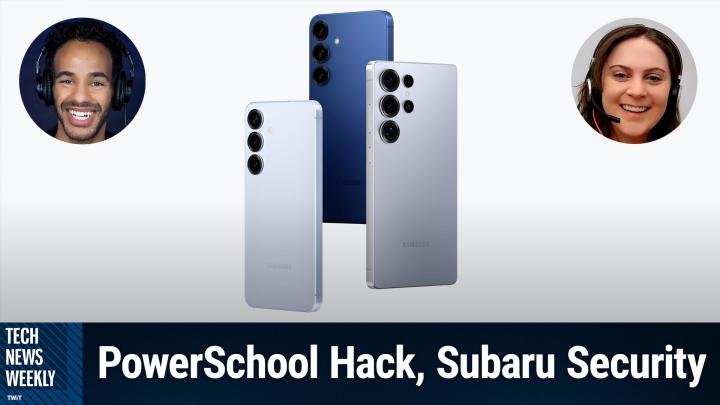
All TWiT.tv Shows (Audio)
Tech News Weekly 371: A Look Into the Galaxy S25 Ultra
00:54:05
PowerSchool Hack, Subaru Security Flaws
Loading summary
Transcript82 lines
- [00:00]
Micah Sargent
Coming up on Tech News Weekly, Emily Forlini is here. We start the episode by talking about a power school breach. Then we talk about a Subaru hack. After that, Patrick Holland of CNET joins us to give us the lowdown on the Galaxy S25 lineup after Samsung's unpacked event. All of that coming up on Tech News Weekly. Podcasts you love from people you trust. This is twit. This is Tech News Weekly with Emily Forlini and me, Micah Sargent. Episode 371, recorded Thursday, January 23, 2025. A look into the Galaxy S25 Ultra. Hello and welcome to Tech News Weekly, the show where every week we talk to and about the people making and breaking the tech news. I am one of your hosts this week. My name is Micah Sargent and as is the way of this show, we are joined by an awesome guest host this week. We've got Emily Forlini back with us. Hello again, Emily.
- [01:12]
Emily Forlini
Hello, hello, hello.
- [01:13]
Micah Sargent
Good to see you. How are you?
- [01:15]
Emily Forlini
I'm good. I'm in the office in New York today, hence my blander than bland background. But you're, you're making up the slack because yours is cool.
- [01:23]
Micah Sargent
Thank you, thank you. I've been working on it, so I'm glad to. I'm glad you think so.
- [01:27]
Emily Forlini
What is the texture actually?
- [01:29]
Micah Sargent
So it's actually a custom texture I created myself.
- [01:33]
Emily Forlini
You don't say.
- [01:35]
Micah Sargent
I do say. Actually, it's with the help of the wonderful Burke McQuinn. You start with a semi gloss base and then you take flat paint of a slightly lighter color and sort of dry brush stroke over it and that helps to pull the light. So before I had the texture on there, those lights really just stayed like right at the top of the frame. But with that you can see it kind of coming down almost to this level because of that flat paint that's there. So yeah, kind of.
- [02:06]
Emily Forlini
That is super cool. Did you, did you do a crafting corner special on that?
- [02:09]
Micah Sargent
I should have. Why? Listen, I need to consult you about everything before we, before we do it because you've inspired me to create some new devices. I should have thought about that for the show.
- [02:22]
Emily Forlini
You need to keep me in your back pocket, that's for sure.
- [02:24]
Micah Sargent
Exactly. Well, I am excited though to talk to you this week about something that I think, you know, we always kind of chat before the show to figure out what we're going to be talking about. And we both kind of came to a conclusion that more people need to know about this because it's a big deal and it has to do with Power School, which many of us, many of us have at least heard of, if not been a part of in some way. So what's the story?
- [02:57]
Emily Forlini
Yeah, so this is a really good example of a data breach. If you're kind of looking to learn about data breaches and you're like, what the heck is going on and how does this affect me? So PowerSchool is a record keeping system that over 60 million kids, parents, teachers in the US use. It's something that sometimes you have to have an account to enroll in the school. It will have your name, your date of birth, your grades, your siblings names, your parents names, your address, in some cases your Social Security number or relevant medical records. So it's just this kind of mega tech education platform that everyone's using. It started a while ago, but up until today it's still in use. And basically a hacker has accessed their entire record system. It's millions and millions of kids, parents, teachers, who, someone infiltrated this data and we think got almost all of it. What Mike is showing here is a new report from publication called Bleeping Computer, which does really excellent cybersecurity reporting. They seem to somehow have access to this, this information which is the actual number of people affected. They're saying it's 6.62.4 million students and 9.5 million teachers. So I had reported on this before this came out, but it was all, it was very murky. It was like all these local news reports were saying, oh, you know, 10 districts in our state were affected. In Canada, there was a province, it was like 80% of district in the province. And so finally Leaping Computer seems to have confirmed, you know, some of the top districts affected. The total number, which lines up with the number of, of students that Power School says it keeps record on. So it's really crazy and it really should have a lot more outrage. I think people maybe see this and they're like, that's so horrific, I can't even engage with it because, you know, oh wow. Kids are potentially getting their identity stolen just from enrolling in school. So that's, that's what this is.
- [05:06]
Micah Sargent
And that's. You look, I understand like parent, parents and teachers and to some extent especially high school students see the benefit of platforms like this. You know, growing up, I can remember the system that the teacher used that had the grade books and the attendance and all of that built into one. And it gave parents the ability to communicate with them, teachers and teachers to communicate with the parents. And so everybody hops on board with these platforms. And it's not like if you were a company that works in one version of cybersecurity and you hire a company that, or you hire like the software from a company that works in another form of cybersecurity in that case, that the first company is going to do its due diligence with the other company. When you've got these, these teachers are not, they shouldn't feel the need to figure out whether this is a good system and a safe system for them and students. Parents shouldn't. That's not something that they should have to worry about. And so there's an administrators too. Like, this is supposed to be in the hands of the company to make sure it's good. And as you point out, the fact that these students who are at young ages already potentially dealing with identity theft and everything that's involved there is just awful. And it's, it's cumbersome and it is. You, you never know when it's gonna pop up again. Like, it can come at any time and you are just going, oh, I suddenly am trying to buy a car and I can't because somebody stole my identity seven years ago. That's awful.
- [06:57]
Emily Forlini
Right? And it's, it's just, it feels like a big failure. Like, oh, wow, we, we failed to protect these kids who are in public schools and private schools. This is not just a public school system. You know, we kind of fail to protect teachers. And meanwhile, teachers are getting flack all the time for like, oh, your job's so manual, or, you know, the school is not tech forward. And, you know, schools are so inefficient. And why does it take teachers 8 hours to grade all night? And then they demand more pay and there's like this, all this controversy and it's like, well, they tried to make it more technical and then, and then this happened. It's just a sad situation.
- [07:34]
Micah Sargent
Now, do we know the. And you may have mentioned it and I missed it. Do we know what type of information it actually was? Have they broken it down into. We're looking at, you know, full. I mean, because I think about two. In elementary school in particular, the teacher would put little notes in the grade cards. Right. And that stuff. I mean, I'm thinking about what if a kid wants to become a politician someday? And they. This, this data is out there and it shows that in middle school they got into arguments with people or something because that information was made available by way of these data breaches.
- [08:15]
Emily Forlini
Yeah. So I've been combing through There's a lot of Reddits about this, about three different Reddit. There's like the K through 12 Reddit, there's it school administrators Reddit because all it people are trying to figure out, you know, what their school asks people to enter in the system and therefore what was stolen. And there's like Google Docs that IT administrators are looking at on how to figure out what's going on. But like I said, there's, there's. I mean, I found over 50 districts that were affected just in the work I did, combing through local news reports to figure out the scale of it. This was before that reporting today, but there's one school in California that publicly disclosed what was stolen. So I will read off everything that was stolen from them. And it, it varies by school, but. So they had student name, student id, date of birth, date of enrollment, ethnicity, home address, home phone, grade level, gender, enrollment status, name of mother and father, registration, pin, guardian, email address, emergency contact, graduation year, gpa, phone, doctor phone, and then for staff, it was name, email, home address, home phone, ethnicity, and their PowerSchool login. So that was this one school.
- [09:29]
Micah Sargent
So in that one school, then, what you've got on the student side is, oh, my goodness, there's so much there that can be exploited. And I particularly think about the new versions of social engineering where someone claims to be the child or the grandchild of this person they're talking to, and, oh, I'm in jail, I need to be bailed out, and you just need to send the money here or, you know, some, some semblance of that. And these things can wait in the pocket for a long, long time. And then on the other hand, I, on the staff side, it seems like there's less information there. Right, but when we're talking about PowerSchool login, does that mean username and password? Because I know that not all of my teachers were using password managers with pseudo random passwords. And probably their login at school is very similar, if not the same as their logins to all their other accounts. Very bad.
- [10:25]
Emily Forlini
Right. And I also saw on some Reddits that it's not just current students, it's just all students who the school ever logged. So it might be you, it might be me. I don't know when my high school started using PowerSchool or, yeah, I don't know when it was founded, but it's that, that makes it personal. So you don't have to just be a parent of a kid to, to wonder if this affects you. It's, it's kind of crazy just like how they figured this out. So this came up in December and Power School as a company, I guess got notified by the hacker. Then the hacker asked them to pay a ransom. So they. Yeah, right. So they paid who knows how much money. I don't think that's been disclosed. And then all they know is that in exchange for that money, the hacker showed them a video of them deleting the information. So the, the New Jersey Cybersecurity. State of New Jersey Cybersecurity portal was like, well, there's not actually really a way to confirm that they actually deleted it. So the New Jersey is conducting their own investigation. I'm sure many states around the country are conducting their own investigation. I reached out to the Federal Education Department and they said oh well, please direct your questions to PowerSchool. It's just, it's just very kind of piss poor that we don't even have a full list of administrations and districts affected. We don't even know the data. And PowerSchool says that they're contacting each school directly, but seems to me like there's just a lack of awareness about this. Especially because what TechCrunch calculated was that 75% of students in, in the US are in this system.
- [12:01]
Micah Sargent
Great. Yeah, See and that's, we talked before about how when a, when a company is so big that it becomes the default, which is what it sounds like for most systems, then you run into issues like this. If every school is using PowerSchool and PowerSchool gets breached and it's from both sides too, because you think about who are the hackers going to go after but the big fish. And so PowerSchool sets itself up as a target, which means that it should be doing an incredibly fastidious job of making sure that it is protecting itself and therefore it's its clients from this. And what, what is Power School said in terms of how they're planning on helping? Have they said anything on, on other than we're reaching out to the.
- [13:00]
Emily Forlini
Yeah, the usual identity theft, credit monitoring, blah, blah. They're, they're their big point, their big saving grace or saving face is that oh, not every school collected Social Security numbers because that's, that's the big piece of information. So they reiterating that in their communications they are saying they're investigating. They did not confirm or deny the numbers to me in that leaping computer report. They have a website set up, they are contacting schools. It should be treated as a total disaster for them because it completely undermines the integrity of their product. So I really hope they're working on it. Seems like they are, but it's, there's not a lot of specifics and I do feel like there should be a little more heat on them just.
- [13:50]
Micah Sargent
Yes.
- [13:51]
Emily Forlini
To, to figure this out and everyone should be talking about it.
- [13:55]
Micah Sargent
Yeah, I, I absolutely agree. It is kind of weird that, you know, it was a bleeping computer article and then, you know, you also wrote about it and that it's not coming across every single news desk or if it is, that it's being ignored, I guess because this is. Yeah. As you said, the, the big number there percent estimate of students in the US and then that means that probably 75% of teachers then too in the US would be impacted. So this is a lot of people in the United States who have been impacted by this.
- [14:33]
Emily Forlini
And it's a successful platform. It's a public company. It was purchased by Bain Capital last year. You know, the, the money wheels are turning for this platform and when something like this happens, I mean you can't blame business for thing. But this really calls into question like you're making money off of, of this, you know, just this data and this, these kids that are kind of in your hands and, and you did not, you didn't protect them. You failed to.
- [14:59]
Micah Sargent
Yeah, this is, this is terrible. So all of you listening out there, share this with, I mean frankly, everyone, but in particular any of the people you know who have students in school right now. But again, this could also include students who have been enrolled at some point.
- [15:17]
Emily Forlini
Right.
- [15:18]
Micah Sargent
And in the U.S. given that you are required to provide an education to those 18 years of age and younger, that accounts for a lot of people, frankly. Yeah.
- [15:32]
Emily Forlini
Just try to learn about it. I know it's scary and alarmist, but it's like it's just such a tangible example. Like okay, kids put their records in this system. They have to do that to be at the school. A hacker hacked into that system. It's like very straightforward.
- [15:49]
Micah Sargent
Yeah, absolutely. All right, we're going to take a quick little break and believe it or not, we're talking about some cybersecurity. And then we will be back with my story of the week. Bringing you this episode of Tech News Weekly is Threat Locker. Harden your security with Threat Locker and never have to worry about zero day exploits and supply chain attacks. Again worldwide, companies like JetBlue Trust Threat Locker to secure the data and keep the business operations flying high. Imagine taking a proactive deny by default approach to cybersecurity. So you're blocking every action, you're blocking every process, every user, unless they're actually authorized by your team. Threat Locker helps you do this and provides a full audit of every action for risk management and compliance. It's 24. 7 US based support team, fully supports onboarding and beyond so you can stop the exploitation of trusted applications within your organization and keep your business secure and protected from ransomware. Organizations across any industry can benefit from Threat Locker's ring fencing by isolating critical and trusted applications from unintended uses or weaponization and limiting attackers lateral movement within the network. And ThreatLocker works for Macs as well. Get unprecedented visibility and control of your cybersecurity quickly, easily and cost effectively with Threat Locker's Zero Trust Endpoint Protection Platform. Get a free 30 day trial and learn more about how ThreatLocker can help mitigate unknown threats and ensure compliance. Visit threatlocker.com that's threatlocker.com and by the way, for a limited time you can visit 0TrustWorld.threatlocker.com and use the special code we have ZTW Twitch 25 to save $200 off registration for Zero Trust World 2025. So that's ZTW Zero Trust World Twitch 25. Get access to all sessions, hands on hacking labs, meals and an after party. The most interactive hands on cybersecurity learning event I think those folks we were just talking about need to attend this of the year is happening February 19th through the 21st in Caribe Royale, Orlando, Florida. Be sure to register with code ZTWIT25. And thank you ThreatLocker for sponsoring this week's episode of Tech News Weekly. All right, we are back from the break and continuing on with talk of cybersecurity. This story ended up kind of making me drop my jaw a little bit because humans are a problem. Yeah, look, I know computers are also a mistake at times, but humans are just the weakest link in so many cases. So. All right, let's, let's start this from the beginning. First and foremost, it's important to understand there is kind of, in my opinion, cool group of hackers who are solely focused on not solely focused, but very focused rather on cars and kind of automotive industry exploits and looking at and exposing the different systems that these cars use and the exploits that are possible with them. And one of these individuals is Sam Curry who is a security researcher. And Curry said, mom, I'm going to buy you a car, but here's the deal. If I buy You a car, then you need to let me try to hack it it. And Curry's mom said yeah. And so Sam Curry bought his mom a Subaru and just was able to get around to attempting to hack it in November while visiting for Thanksgiving. This is in the Wired piece and basically was looking at different ways to go about exploiting it. So what Curry and Curry's friend did or colleague did was they kind of, you know, poked around looking at different systems within the vehicle and used Subaru's sort of emergency access technology, but also just sort of the car's inbuilt system called Starlink, not to be confused with the other Starlink, but Starlink, which is part of Subaru, and discovered that when using Starlink, the system reached out to a website, subarucs.com so they went to subaruscs.com and started looking at how the site worked and what it was. And it turned out to be kind of an admin database. And when they went there, they figured out that all they needed to do to reset an employee password was to type in an employee email. And let me be clear with what I'm about to, with what I'm saying here. It wasn't the standard thing where I go to a site, I type, I click the forgot my password, I type in my email and they send me an email to reset my password. No, you just needed to have the employee pass or the employee's email. Okay. And then there's a little bit more that's involved and I'll explain that in just a moment. But all they needed to do was go to LinkedIn and find one of these Subaru employees who had listed their Subaru email. And then they typed that in. And then you go, okay, Micah, but here's the thing. They're not going to be able to gain access because Subaru cs. Don't you worry. The site makes you type in the answers to security questions. So. Well, they're stuck there, right? They type in goof troop97subaru.com and hit enter. And then there are two security questions. What's my favorite flower? And how do I like my eggs? Oh, can't get in. No, they can get in because the website literally they just use practically right click and choose show page Source. The website checked the answer of the security question with plain text responses that were stored in the code. So tulip and scrambled were. Remember that was what's my favorite flower? And I'm following, I'm following. Were in the website's code right there available to them, at which point they pop into the admin site where they are able to get a bunch of information about the individual who purchased the vehicle. You know, the standard kind of information, get access to the, I believe even the license plate, get access to the state that they live in, get access to their home address if they put that information in and loads more. But most importantly, and most disturbingly, they were able to gain access to every location that the car pinged while it was in transit. So, or I guess not even while it was in transit, but while it was, while it was, you know, registered with that account. So they were able to look at the mom's Subaru account and see where she went to the doctor, guess who her friends probably were, see where she went to, went to church, and even where she parked, if she parked in the same location every time. They were able to, with this, this access, unlock the car, make the car horn, honk, start the car. And this database, or this, not database, but this, this site was not just because I have my mom's information that I'm able to, to access this. If they had enough information about any other person, they could also access that person's vehicle. So they reached out to Subaru and told Subaru this was up. And Subaru said, right, right, right, that's bad. That's real bad. And they fixed it. But here's what Shaw and Curry, the researchers have said, which is that, sure, they fixed it so that now it's not as easy to hack it, but let's be clear that Subaru employees still have this, what, carte blanche access to all of this data, and that Subaru is storing this data at least up to a year, which was how long the mom had the vehicle. But they, they tried to claim, or they did claim, the company claimed that the reason for this is so that an employee is able to call, you know, emergency services to your location. Sure. Give them live access to my location. If I hit the button and say I need emerg access, don't give them a year's worth of information about where I've been. And the company, of course, said, well, they sign NDAs, they pass these security checks, they do this, they do that. That only matters as long as it matters, because again, humans. So I wanted to hear your take on this. Emily, as someone who is, you know, who knows a lot about cars and especially as we look at electric cars and the ongoing computerification of these electric cars, does this surprise you at all? And of. Yeah. What's your thought? What Are your thoughts?
- [25:47]
Emily Forlini
Yeah. So when you sent me this, I was like, oh, this sounds like something I wrote about that with Kia. And actually it's the same group that did this with Kia, these two researchers. The Curry guy was on both studies and, yeah, just being able to remotely access the car and data about it and then also make it do things like honk, unlock, lock. And it's scary. I think he just used the VIN number. And in that case, it was dealer credentials, something like that. So again, similar. Similar approach, like employee credentials, plus some information about the person's car, like an identifier. It's a minefield out there. You can't go to school, can't drive a car.
- [26:29]
Micah Sargent
Exactly. Yeah. Or at least here's the thing. The one good thing about this is that I look back on the cars that my. My family is. My family, and thereby me, because I grew up with them, are not really car people in the sense that, A, we couldn't really afford new cars growing up, but also we always just kind of saw them as tools to get from point A to point B. So I've never been super into cars, but even when my family would get cars, they couldn't afford these extra little features and stuff. And so I do think about people who. They get an aftermarket vehicle and there's that button on their, you know, rear view mirror that they never press and they never use, and they never, you know, call in to get this service. But there are a lot of people who do have it because of the. And it's something that I was thinking for myself that would be something that would draw me in for sure. I would absolutely have something like this, because I want to know that if I was ever in an accident or that I couldn't gain access to my car for whatever reason, someone somewhere could pop it open for me. But this is what you expose yourself to. And I think the big thing here is that these companies have been doing this for some time. And while it may have started out as a means of helping the consumer, suddenly you realize you've got this delicious database of very expensive or valuable, I should say, data that maybe, you know, those. Those. Those. Those services that want to grab that who are willing to pay quite a bit for it, start to sound pretty good. And then you start to look at them and go, well, maybe we do hand over this data. And, you know, the. The thing that really stuck out for me and stuck out for these researchers is what they talked about in this, where what happens if this data is suddenly Made available in instances of someone needing to have, or trying to find out if they are participating in protests or if they go to church. You know, any of these things could be something that is looked at because that data is being stored. Right. And I think that's the big problem here is how much of this fine grained historical data is available. That's the problem that at least I have with it. They're looking at a lot of car manufacturers, which I'm happy that they're doing. And now it makes me really want you to interview this, this group because.
- [29:04]
Emily Forlini
I know, I know.
- [29:05]
Micah Sargent
I hope you can get in touch with them.
- [29:08]
Emily Forlini
What I would, I'll, I'll try. What I would be curious about just with how much I report on this type of thing. Like if someone did launch a new car that had a cool modern design and a cool interior, but 1995 technology, would it sell? I mean, because as long as you can fill it up or you can plug a charging cord into it, like you can do those things in a rudimentary way. Like I wonder if people would buy it. Or we're all just going to keep buying these super techie cars and being so proud of them and then complaining about data collection.
- [29:39]
Micah Sargent
Yeah.
- [29:41]
Emily Forlini
Like, is there any way to, to, you know, put our feet to the fire here or like launch a compelling product and see if it would actually take off? Or do we just love the tech? The dumb car, but like. Cool.
- [29:54]
Micah Sargent
Yeah, the cool dumb car. Exactly.
- [29:56]
Emily Forlini
Because people want to buy cool stuff. Let's be honest.
- [29:58]
Micah Sargent
Yeah, we get a lot of requests for us to give people suggestions for what they call dumb TVs. They don't want the TV that connects to the Internet because that is another data collection place. And those people are very techy people. They're aware of what that tech is doing and so they want a good dumb tv. So give me the great panel, take out the wifi chip and we're good to go. And so, yeah, I actually, I think you might be onto something. When I think about all of the people I know who complain about, well, I used to be able to take out the carburetor and switch out. Now everything's in a computer. So maybe that's me when I'm like 20 years from.
- [30:40]
Emily Forlini
Are those your friends?
- [30:41]
Micah Sargent
Those are my friends, yeah. My poor friends.
- [30:45]
Emily Forlini
Do a health check.
- [30:46]
Micah Sargent
Yeah, you're right. I should check on them. I'll give them a call after this. I know where they all are because I've looked at their location data. They all drive Subarus.
- [30:54]
Emily Forlini
No, they're at the Mechanic right now.
- [30:56]
Micah Sargent
Exactly. Fiction. Ish for me. Anyway, I look forward to maybe reading a piece from you with with these folks. But more importantly, if folks would like to stay up with what you are writing about, where do they go to do that?
- [31:16]
Emily Forlini
So you can definitely find all of my pieces at PCMag. I just have a bio page. It's Emily Forlini. I'm also at Emily Forleani on all social everything. I am leaning more into blue sky these days, so that's where you're going to get most of my personality and my honest thoughts. But sometimes I do dabble in the other platforms. It's just speaking of minefields feels a little crazy right now on social media, so. So I'm on it. You can find me everywhere. It's evolving.
- [31:45]
Micah Sargent
Yes, indeed. Well, thank you so much for being here with me today. Always a pleasure to get to chat with you and we'll see you again next month.
- [31:54]
Emily Forlini
Yeah, it was fun. See you in a month.
- [31:56]
Micah Sargent
Bye.
- [31:56]
Emily Forlini
All right, take care.
- [31:58]
Micah Sargent
All righty. We're going to take another quick break before we come back with the latter half of the show. I am excited to bring on an individual to talk to us about what Samsung announced. And maybe, maybe, just maybe, you'll get a first look at one of the devices that was announced. But let me tell you about Melissa, who's bringing you this episode of Tech News Weekly. The Trusted Data quality expert since 1985. With Melissa's launch of the Melissa address validation app and the Shopify App Store, Shopify plus merchants now have access to a critical data quality tool directly from the Address Expert. And honestly, as a person who makes purchases online and who likes to do it through Shopify like, you immediately know the system, right? Then I go to type in my address and I don't have to finish the whole address and I don't have to type in zip codes because they're using a tool that automatically pops that in. Oh, it's great. And that's what the Melissa address validation app does. Here are some of the key features. Real time address validation. So customers are immediately notified if the address they enter contains errors or needs corrections. Prevents shipping delays, and of course reduces return rates. And when I'm after whatever it is I've ordered, I don't want some address typo to get in the way. Plus, there's Global Reach. The app validates addresses in more than 240 countries and territories, standardizing them according to local postal regulations. You get enhanced address correction. So even If Google Auto Suggestion is enabled, Melissa's app can correct and standardize addresses, adding missing components such as postal codes and ensuring compliance with local formatting rules. CASS and SERP Certification the address engine is certified by USPS and Canada Post, so you know you're getting reliable validation for North American addresses and smart alerts. The app provides a warning on the thank you page if there is a potential issue with the shipping address, allowing customers to update their information before the order is processed. Shopify plus merchants can easily install the Melissa address validation app to improve customer satisfaction and avoid those costs that are associated with returns and redeliveries. And I think not just financial costs, but also customer satisfaction costs, right? I want my product and if I did a typo, I still might be upset with the company that I didn't get it. So knowing that Melissa's there to make sure that it's correct is great. With Melissa you get secure encryption for all file transfers and an information security ecosystem that's built on the ISO 27001 framework, adherence to GDPR policy and SoC2 compliance. So get started today with 1000 records cleaned for free at melissa.com TWiT that's melissa.com TWiT and we thank Melissa for sponsoring this week's episode of Tech News Weekly. Alrighty, we are back from the break and I am very excited to be joined today by Patrick Holland of cnet who joins us to talk about Samsung's Galaxy Unpacked event. Hello Patrick.
- [35:07]
Patrick Holland
Micah, it's been a long time. Hi, how are you doing? I'm so excited to talk with you.
- [35:11]
Micah Sargent
It is so good to see you back on the show. Thank you so much for being here. There's a lot to get through so we'll just get started. You know, it starts with the S25 and the S25 plus you see kind of these major smartphone manufacturers sort of launching some base models and then some fancier models and making sure they kind of COVID the full gamut. It I'm kind of curious though, how do they compare to the models of yesteryear? What can people look forward to in this next set? And how does Samsung kind of sell it as here's why you should upgrade to this phone?
- [35:47]
Patrick Holland
Yeah, I mean that's that these are the important questions we ask every year with new phones or really new electronics at this point. And phones have kind of hit a point not just with Samsung but most manufacturers where they are just part of our everyday life. So a lot of those wild like swing back and forth years of design changes that we would see maybe five, even 10 years ago, we don't see that as much. We see a lot more refinements, a lot more subtle things. So the S25 and S25 plus, unsurprisingly, look almost identical to last year's phones, which look almost identical to the ones before that. But get this, last year's phones are really good. Like, the S24 got a CNET Editor's Choice award because it had outstanding battery life, it had great, great processing power, great software support. So in one thing, it's like that old ad, if it's not broke, don't fix it. But in another one, it's like we want something kind of exciting. So that's where we have something like the Ultra. Right. So the S25 is their base model. For $200 more, you can get the S25, which is the base model that says bigger. And then for $1,300, you can get the S25 Ultra, which is kind of like their premium flagship phone. Samsung does do foldables, but that's a whole other thing. Right. And what the Ultra does is it has the same processor, has the same ram, and a little bit more storage than the regular model. But the big thing is going to be the cameras. The cameras are just a big step up in terms of quality. But then get this. All the software on all these is all the same. So that's where you get this weird thing where, like that S25 model on paper seems like an incredible value. Now, the S25 Ultra I have right here does have some physical changes. It might be hard to see on camera. The corners that used to be right, angles that used to go back to the Note series are curved and the edges are more flat. A bit like the S25 and S25. But the big thing that separates all these models is this thing on the bottom, which is a stylus. Yes. Because who doesn't love a stylus in your phone? And I'm going to have a hard time putting him back to camera.
- [37:56]
Micah Sargent
Yeah, that could be kind of difficult. So, yeah, I mean, this is as, as you kind of mention. That is the big struggle that I think these, these companies have when it comes to announcing the next iteration. Right. It used to be that you could make leaps and bounds improvements, but as we've kind of solidified around a, a sort of physical concept, it becomes more difficult to really set something apart. And so you just get these, these little bumps to everything. When it comes to, though, the Ultra. Is the pen the main draw or is there more to why you would go Ultra versus those standard models?
- [38:43]
Patrick Holland
I mean if you want a pen, you have one choice, right? But in other, other senses, like so all of the phones and this. Let me just make sure I do a little promotion for Samsung. All the phones did get some refinements. They're a little bit lighter. The glass on the Ultra is more durable and last year's glass was more durable before that. So if you're dropping it, that, that should be helpful. We haven't tested that yet, obviously. We just got it. The other thing is it carries over some of the neat features we had in last year is like the Ultra has an anti reflective display. So even as I'm doing it here, it would probably look a lot less like a mirror then if I do that. And as someone who does a tech podcast, I'm sure you appreciate if you had to film an actual device, it would be a lot easier to film because you don't have like bouncing off it or like, hey, you could see the cameraman. But in everyday use that anti reflection stuff I think is such a big, big feature. And that's not new. That came from last year, but that's something that the other phones don't have. And then they're saying that the battery life, even though the batteries are the same sizes last year, the Ultra does have a slightly bigger battery than the S25 plus but that all the batteries get more battery life. So that will be curious because last year's Ultra did well for us. But the it was really the smaller phones that did great on our battery test. So I'm excited to do that. But the thing that we have not mentioned, that the elephant in the room is AI. Right. And that's kind of where Samsung is hoping to kind of make things seem exciting and new. And there is some really interesting AI they talked about, but that's kind of what the upgrades we're looking at in terms of that now. It does have a new Snapdragon processor, as will all like major flagship phones from Android. And it has. The Ultra also has a new Ultra Wide camera. So that is new. We have new hardware. Yay. First time in a while.
- [40:30]
Micah Sargent
Nice. A new Ultra Wide camera. So yeah, let's talk about. We'll get to even more after we take a little break. But when it comes to these phones in particular, how much of the announcements for these devices were focused on the software side and in particular AI versus being about that hardware. It was another AI event Right, it really was.
- [40:53]
Patrick Holland
I mean if you tuned in for the first like 30, 40 minutes you'd be wondering like am I watching a developers conference and what's going on here? Like are they launching phones? Like it was a lot about like, let's celebrate our partnership with Google. Let's celebrate our partners partnership with Qualcomm and these other companies. Let's also show off AI and list all the reasons people like the AI that we have and, and offer some new features. Now the new AI, if you get past like just how much of it is the, the takeaway is there's some really interesting ways some of this is getting better. So as opposed to being something I use AI for one particular task, one particular setting setting, I'm now able to use things where I can do kind of multi step things for the device. Like an example like that you could try is like, hey, I'd like to go see a warriors game, add it, find the next warrior game for me and add the date and time to my calendar. And it will do all that in one prompt versus having to do it in steps. Now how well that will work across the system is interesting because a lot of the stuff they're showing are just Samsung based apps and really not everyone's tied to Samsung that strongly. A lot of people use Google apps and other third party apps. So it's this interesting thing. Like there's some potential here, we're seeing some movement, but is it worth 45 minutes of talking about? I'm not sure. Technically it probably really is and for scientists and engineers working on it, it's probably like yes, please, three hours of that. Right. But for consumers you're like, is it a good phone? Should I get a new one? Should I wait next year? That's kind of the questions I think they ask.
- [42:25]
Micah Sargent
Absolutely, yeah. I was intrigued hearing about the aspect where it could do these multiple prompts all at once. But as you say, we've got to see how that plays out because if it does do what it says on the tin, that will be I think a really standout feature that can be very helpful. But again, there's a difference between showing demonstrations on stage versus actually seeing them in real life and testing them in that way. We do need to take just a little break here for a moment before we come back to talk about Samsung's one more thing moment and a little bit more about AI combined with ar, combined with VR, which was another part of the Samsung experience, if you will. But I want to tell you about Club TWIT at Twit TV Club Twits Right now we're offering a two week free trial of Club Club Twit. So all you have to do is head there to sign up and when you do you will gain access to ad free versions of all of our shows. You'll gain access to the Twit plus bonus feed. You'll also gain access to the Club Twit Discord, a fun place to go to chat with your fellow Club Twitt members and also those of us here at TWiT. The video versions of our Club Twitch shows are also available to you as a member of Club Twit, so be sure to join for that as well. And if you you are already a member of Club Twit Twit TV Club Twit referral will let you refer your friends to earn months of Club Twit for free. So again, head to Twit TV Club Twit or scan the QR code on the screen to check that out.
- [44:05]
NerdWallet
Listeners as we go into a new year, we all have a lot on our plates. There are backpacking trips across Europe to plan, personal best to crush in the gym, and capsule wardrobes to create Good thing. Our sponsor NerdWallet is here to take one thing off your plate. Finding the best financial products introducing NerdWallet's 2025 Best of Awards List your shortcut to the best credit cards, savings accounts and more. The nerds have done the work for you, researching and reviewing over 1100 financial products to bring you only the best of the best. Looking for a balance transfer credit card with 0% APR? They've got a winner for that. Or a bank account with a top rate to hit your savings goals. They've got a winner for that too. Know you're getting the best products for you without doing all the research yourself. So let NerdWallet do the heavy lifting for your finances this year and head over to their 2025 Best of Awards at NerdWallet.com awards to find the best financial products today.
- [45:03]
Micah Sargent
If you love your phone but not your carrier, just switch to T Mobile. You can keep your phone, keep your number and we'll help pay it off up to $800 per line. You can also use our savings calculator to compare our plans and streaming benefits against Verizon and AT&T. So switch and keep your phone, keep your number and keep more of your moolah@t mobile.com up to four lines via virtual prepaid card. Allow 15 days qualifying unlock device credit service ported 90 plus days with device and eligible carrier and timely redemption required card has no cash access and expires in six months. All righty, back from the break. We are joined by Patrick Holland of cnet who is here to talk to us about the unpacked event. And we saw a nice little hey, we've got something else moment with a little bit of detail. What is the S25 Edge? Is it vapor hardware or is it a real thing that's coming out?
- [45:56]
Patrick Holland
Okay, well, can we talk about the one more thing moment is what people are calling it alluding to Apple, but normally when you have a one more thing thing moment, you don't have like a fake ending, right? So it's normally like, hey, and by the way, we actually do have one more thing to show you today. And then you keep it going. What Samsung did is kind of like like a DJ at a nightclub. They kind of just. Everything just kind of stopped. They even had fake credits rolling. At least inside the auditorium. They did.
- [46:22]
Micah Sargent
Wow.
- [46:22]
Patrick Holland
And then like, I'm, I'm looking at like Cnet Abrar. He's like, what is going on? Like, as a theater director, like, this has not been. You've not built the tension to have this release. And, and the next thing you know, they're showing off this new product called the Galaxy S25 Edge. So we have the S25, which is the regular model, the slightly larger version, which is the S25 Plus. And then we have the S25 Ultra, which is this one, right? It's the big dog. It's the expensive one, the premium. And now they're saying, hey, we're going to make a thinner version phone, but it's premium. So if the S25 plus cost $1,000 and the S25 Ultra costs $1,300, my guess is somewhere in there probably 1200dol would be the price of this new phone. Now, this new phone, is it real? It is. And then in the demo area, they had it hanging dramatically off one of those, like, stands you might use to hang your microphones on. Or like a banana, right, to show off how thin it was. And everyone's tripping over themselves to get a photo of it. But in terms of thin, it's like, yeah, it looks thin. But you know what? We saw images of Oppo's new phone, which looks even thinner in terms of when does this release? We don't know. It's going to be later, later this year, probably in the first half of the Year. But beyond that, that's really the detail we have about this phone. So it was exciting. It kind of made up a little bit for that first half, which is very technical, very in the weeds about ar. Excuse me, about. Well, it was ar, actually we're going to talk about in a moment. But also, AI, excuse me. But then, yay, we have some hardware to talk about. And then, hey, this thing that we're excited about, we show you, you we're not going to talk more about it. You're like, wow, why are we here?
- [48:00]
Micah Sargent
So, yeah, that's interesting. It makes me wonder too if the, you know, what's the reason for it not being released with everything else. If they really were just trying to build that suspense or if it's a matter of manufacturing delays, you know, what's going to make this phone stand out, as you said, with this thin form factor. And then, you know, you start asking about, well, what's the battery life on something like this? Are we still counting on good battery life? So that will be interesting. And this is one thing that I didn't mention ahead of time, but I saw something about the QI charging in these devices. Can you tell me a little bit about that?
- [48:39]
Patrick Holland
Oh, I would love to tell you about it because you're talking about game Micah. So basically there's these different standards. One is called Qi, which is Qi, and one is called Qi 2. And Qi 2 is the latest standard. It came out a year, maybe even a year and a half ago. And all this means is that that phones that have the standard can support 15 watt wireless charging. Great. These phones do that. However, another aspect of the QI2 standing standard is this magnetic profile. So if you're familiar with any of the iPhones in the last few years, they have a thing called MagSafe charging. And essentially the Qi 2 magnetic profile is the exact same magnetic placement on the phones. Up to now, I believe the only phone that has been released with this is the HMD Skyline phone, which. What is that exactly? So for Samsung to have the least, the charging capacity on here is great. But what they do now is they actually sell a case that has that magnetic profile in it. So you could put the case on the back of the Ultra and then I could put this in theory on a MagSafe charger. They had a very looking, a very similar looking MagSafe charging stand with the phone on it, a watch and I believe the Galaxy Ring. So that looks really cool. They had a little wallet accessory you could attach to it, but with the. Does the phone naked have magnets that I could do that with? No.
- [49:58]
Micah Sargent
Got it. Okay, that makes sense. Thank you for clarifying that, because I. It's all about magnets. Well, it's all about the magnets. How do they work?
- [50:06]
NerdWallet
I'm no tech genius, but I know if I want my business to crush it, I need a website. Now. Thankfully, bluehost makes it easy. I customized, optimized and monetized everything exactly how I wanted with AI. Within minutes, my site was up. I couldn't believe it. Plus, Bluehost keeps me protected 24 7. No more worrying about hackers. I just relax and focus on my customers. So whatever your hustle may be, secure your online presence in 2025 with Bluehost. Head to bluehost.com to start now.
- [50:40]
Patrick Holland
Stop hitting snooze on new tech. Upgrade the whole team@lenovo.com Unlock AI experiences with the ThinkPad X1 Carbon powered by.
- [50:51]
Micah Sargent
Intel Core Ultra processors so you can.
- [50:54]
Patrick Holland
Work, create and boost productivity all on one device. Win the tech search for business PCs@lenovo.com.
- [51:05]
Micah Sargent
Lenovo all right, let's round things out here with the conversation around. Is it Project Muhan and the kind of the technology that of course had been seen before, but there was, there was, there were some demos.
- [51:26]
Patrick Holland
Yeah, kind of. So, so there's kind of, there's a lot of, how to say this, like, so VR for years, we think of the headset, we think of playing games on it. And there's been always been pass through cameras. Right. I think Apple kind of really made that pass through camera kind of to the forefront with the Vision Pro last year. But what this is doing is taking a look at a lot of other technology too. It's incorporating things like AI Gemini specifically. And what it really is is it's a combination of a partnership between Qualcomm, Google and Samsung and the platform's called Android XR now. Now, Android XR could be made by a variety of companies, so people would adopt this like they would an Android phone and make their own version of that headset or glasses. Now, what Project Muhan is, is Samsung's version of a headset on that platform. And this was, I think revealed like in December. But what's notable about yesterday was until then no one had been able to take photos of the Project Wuhan headset or video of it. So they actually did have it in the demo area. And there's a lot of, I'm sure, very similar looking photos of people taking of it on a stand. But essentially that's kind of what the breaking news side of it is. I expect we'll probably hear a lot more about it at Mobile World Congress. But what's really fascinating about it is some of the features on these phones are kind of tied to that because it's not all about VR and ar, it's about Gemini, it's about Project Astra. There's going to be an app on these S25 phones. You'll be able to like see some of those features and it's basically bringing all that stuff and putting it near your, your eyes and your head so you have cameras and be able to react to your environment that way. So it's a lot of different things, but the, the notable takeaway yesterday is we got to see a physical device. It's in person. No one got to touch it or put it on. I, I know some reporters did earlier, including CNET's Scott Stein, but I, hopefully we'll see more of that. I think they're kind of like dribbling it out a bit.
- [53:24]
Micah Sargent
Understood. Well, that, that I think covers the event. Was there anything else that you wanted to mention? Anything maybe in your, your early look at that device you've got in your hands that, that bears a little, a little mention or have we covered it all?
- [53:41]
Patrick Holland
Say, Michael, as we maybe sounded a little skeptical about like how many updates there are and how big these are, but I have to say these refinements, it does feel really nice in hand. It's still a very, very much a brick of a phone. I could probably really hurt somebody if I really wanted to with them with this. But it feels a little bit better in my hand. It feels a little bit lighter. Is it dramatically different? No. And to be honest, like it was a really good phone last year, so I wouldn't expect a lot of changes. I'm still a big fan of the screen, the anti glare thing. I can't go on enough about it and I'm really excited to play with Gemini. So we're going to be working on, or I'll be working on a review over the next few days and have a lot more answers to a lot of these questions. Questions probably within the next week. So stay tuned for that.
- [54:22]
Micah Sargent
All right. That's exciting. I will be, I will be staying tuned. In fact. This is a great time to ask. Of course folks can head to cnet.com to check out your work. Is there anywhere else they should go to keep up with what you're doing?
- [54:34]
Patrick Holland
Man, There really are, but there's so many different networks these days. So you can find me on Instagram at. Directed by Patrick. I used to be a theater director. Director, look out. And you can find me on a lot of other websites. It's my name without the first two letters. So Trick Holland. So I know I'm on Twitter. I'm on Blue sky now. And I think I'm on threads, and I think that's about it. So.
- [54:56]
Micah Sargent
All right, sounds good. Thank you so much for your time today. We appreciate it.
- [55:00]
Patrick Holland
You bet. Take care. Thanks.
- [55:02]
Micah Sargent
All righty, folks, we have reached the end of this episode of Tech News Weekly. Our show publishes every Thursday at Twitter tv, so you head there to subscribe to the audio and video formats of the show. I mentioned Club Twit during the show Twit tv Club Twit. This is a reminder for the URL. Be sure to check it out, especially right now, while we have the ability to get you two weeks free so you can join the discord, join the fun, see everything that you like. And I of course, want to remind you, TWIT TV Survey 25. It's, it's about to close, so we would love, love, love it if you hopped in there, filled out the survey before we shutter it for the year. Again, TWiT TV Survey 25. If you'd like to follow me online, I'm ikasargent, which is my username across many a social media network. Or you can head to Chihuahua Coffee C H I H U A H U A Coffee where I've got links to the places I'm most active online. And be sure to check out my other shows, including Hands On Master, Hands on Tech, and iOS Today, which are all in the club. And I'll see you again on Sunday for another episode of Hands On Tech and of course again next Thursday for another episode of Tech News Weekly. Bye bye, everybody.