← All TWiT.tv Shows (Audio)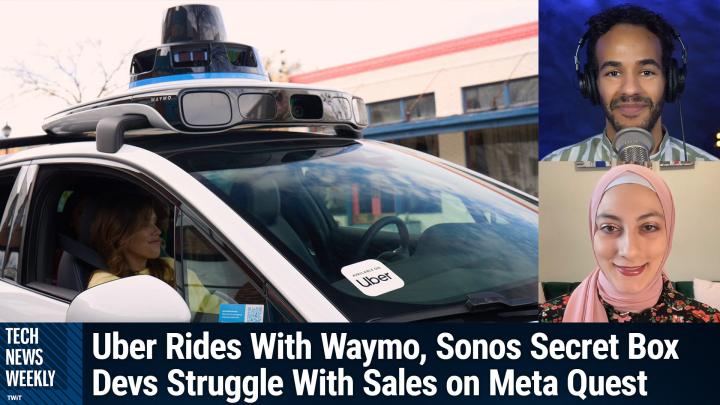
All TWiT.tv Shows (Audio)
Tech News Weekly 373: AI Wins a Grammy
01:03:59
Uber Rides With Waymo, Sonos Streaming Box, Meta's VR Devs Struggle
Loading summary
Transcript81 lines
- [00:00]
Micah Sargent
Coming up on Tech News Weekly, Abrar Al Heati joins me for the full show. We start out by talking about where self driving is taking us. Then we talk about Sonos and its work on a set top box. Before we discuss the Beatles winning a Grammy for their AI assisted song and how things are going for developers of VR games. All that coming up next on Technos Weekly. Podcasts you love from people you Trust. This is TWiT. This is Tech News Weekly. Episode 373 with Abrar Al Heati and me, Micah Sargent. Recorded Thursday, February 6, 2025. AI wins a Grammy. Hello and welcome to Tech News Weekly, the show where every week we talk to and about the people making and breaking the tech news. I am host Micah Sargent and I am joined today because it is the first Thursday of the month by CNET's own Abrar Al Heati. Welcome back, Abrar.
- [01:13]
Abrar Al Heati
Thank you so much for having me. Good to be back. Month 2 Here we go.
- [01:17]
Micah Sargent
Yes. We love it. We love it. We are in February. I like the, I don't know if you did it on purpose but the delightful pinks that you're wearing.
- [01:24]
Abrar Al Heati
I didn't do it on purpose but I love that you made that connection. I never would have. So let's pretend that. Yes, that's exactly my intention. I'm very on brand here.
- [01:33]
Micah Sargent
Yeah, very intentional. Very good. We are living, we are loving, loving February. Okay, so anyway, I'm excited because today Abrar has agreed to join me for the entirety of the show. We'll both be bringing two stories of the week to the table. And Abrar, you were the person who introduced me to in an actual, I've done this thing way of being in a self driving car. So I'm really excited to hear about your first story of the week.
- [02:05]
Abrar Al Heati
Yes, I am become quite obsessed with self driving cars lately just because there's, there's so much happening in this space right now. And what I wanted to talk about was how Uber is expanding its partnership with Waymo, meaning that in Austin sometime soon, we don't know exactly when people in Austin will be able to use the Uber app to summon a, a Waymo Robo taxi. So instead of just getting your standard Uber ride with a human driver, you could have a self driving ride. If you just want to control the music and be alone and you know, enjoy that. Seren, this is interesting to me because of the relationship between Uber and Waymo. Right? So they've had a, they've had a contentious start to their relationship. You might remember back in about 2016 when a Google engineer had left that company. But this is back before Waymo was spun off from Google's parent company Alphabet. This engineer had left and went to Uber and then was later convicted of stealing Google's trade secrets. So yes, so that was quite dramatic. And since then Uber and Waymo seem to be getting along. But I also saw this really interesting New York Times story which I think does a really good job of characterizing this relationship where yes, Uber and Waymo are getting along, but kind of because they have to right now. Because you know, if you're Uber, you're thinking, you know, we want to maintain our business. We tried our own self driving effort. It didn't really work. We sold it off. We're now just focused on our bread and butter human driven rides. But self driving is a thing that's not quite going away yet. Yes, it's expensive, yes, it's very difficult to develop this technology, but people are still doing it. And by people I mean Waymo and Z Cruise. And then there are a few startups too that are, that are working on this, companies like AV Ride and May Mobility. But you know, the point being Uber is trying to figure out and Lyft is trying to figure out how do we stay relevant as self driving continues to take off. And now Waymo is probably thinking, okay, we have our own Waymo One app. When you're in, when you, if you're hailing a ride in San Francisco or in LA or even in Phoenix, you can use the Waymo One app to get a ride. But also if you're in Phoenix and soon in Austin and soon in Atlanta, you can also use the Uber app. So they're trying to figure out, you know, how, how can each company try to figure out how can we stay relevant and tap into more riders. The biggest thing for me is when you're hailing a ride with the Waymo One app, oftentimes for me in San Francisco, it is a little bit more expensive to get a Waymo ride than it to just call an Uber. I think that'll change as there are more vehicles and as you know, the technology develops and as time goes on. But right now it's a little bit more expensive and then you just, it sounds like such a minor step, but is the added step of downloading a new app. So if you don't have the Waymo One app, you might be like, well I already have an Uber app. Let me just call an Uber. But if you're in Austin or if you're in Phoenix or soon to be also in Atlanta, then you already have the Uber app on your phone. So if you're opening it up and you think, well, I could just get an Uber X, but let me scroll down and actually just get a Waymo instead and it can be fun and I can try this out and see what everyone's talking about. So I think that idea of having it all within one app that people already use and then the other critical piece is Uber says that prices for a Waymo will be the same price as getting a standard human driven vehicle like an Uber X, for example. So that is a very critical point because you won't be paying more for this novelty. You may or may not get matched with it if you request it, but if you do, then you're paying the same price and you get this brand new experience you can go and tell all your friends about. And so, so I'm just really curious how this relationship will develop. It's. There are very few key players at this point and I think everyone has to kind of buddy up right now and get through the storm and see who makes it out alive. But, but I don't know. I would love to know your thoughts about if you had, if you had that option of, you know, it's already in the Uber app, wherever you are and it costs the same price, do you think you'd let your curiosity get the best of you and just give it a go? Would you be more likely to?
- [06:10]
Micah Sargent
Yes. I will have a question for you at the end. I will say I absolutely. I'm. There's one actual regret that I had. Well, if there's one sort of silly regret involved with moving away from San Francisco that I was. That I did not, before I left, take the time to head in and use the Waymo service. Because I did get access via the app and I didn't get the chance to. And was so funny. It's weird how these things kind of cross cultural groups and boundaries. I was watching a little clip from a show where there are these two drag queens who watch Netflix shows and talk about them. And one of the drag queens, just as they were having this conversation about this Netflix show, one of them brought up, oh, I just got access to. I just got invited via the Waymo to get to do the self driving. And it's just like, that's so funny that so many of us from these different, you know, walks of life are all find this thing kind of cool.
- [07:18]
Abrar Al Heati
Yeah.
- [07:20]
Micah Sargent
And I think it's cool and so in that way, yeah, I absolutely want to try it. I don't, you know, I don't know where, how far away we are from this being a regular and consistent thing. But I just point blank, I think it's cool.
- [07:38]
Abrar Al Heati
Yeah.
- [07:38]
Micah Sargent
But I did have the question for you because I'm an anxious person and I give an example would be that when Apple Pay first came out, I think it took me a very, very long time I know it took me a very, very long time to use Tap to pay in a store because I was worried I'd end up being that person who was holding up the line because something went wrong and then using it for a while. And then one time something went wrong and so then it took me longer to do it again because of it going wrong. I see the, the, the blowback when it comes to these self driving cars and the times when something goes wrong and also the one that really stood out to me, stuck out to me was when there was a person was in a self driving car and there was a traffic officer who was trying to say, you know, do this or don't do this. And the car obviously was not listening and the officer made eye contact with the person in the vehicle who's just riding, asking them like what in the world, why are you. And the person that's in the car is like I don't know what, you know. And I was just thinking about how if I was there I would have melted into a puddle and just like disappeared.
- [08:54]
Abrar Al Heati
Yeah.
- [08:55]
Micah Sargent
Do you, do you have those? Am I, oh gosh, am I giving you those anxieties? Do you have those anxieties? Like how do you, what's, is your curiosity and enthusiasm stronger maybe than that? Anxiety and maybe how often are you making use of this service and has it been mostly the case that it's been a fine thing that works?
- [09:19]
Abrar Al Heati
I think you've really got it right. When it comes to my curiosity, overshadowing any anxieties I have. The first time I got on a Waymo it was for, for a video and so I was really excited to be able to, to kind of demonstrate that experience in real time. And so I think I was running off adrenaline and so I get in the car and then you see the wheel turning by itself and it's really weird. And, and, and then truly within I think 20 to 30 seconds you're like, oh, this feels so normal. And I think the real test was we got to a four way stop and the fact that they've, the car obviously had to know what it was doing. It wouldn't have gotten to that point if it didn't know how to handle a four way stop. But still you're in it for the first time. And it felt so seamless and so smooth. And the thing that helps with anxiety is that there are customer support buttons across, you know, in the front seat and in the back seat. So you can also pull over at any time, call someone. But there are always, you know, these freak incidents. Right. And I don't know if you also saw the video where, I think it was in la where somebody was stuck in a Waymo that was just going in circles just trying to get to the airport. So of course there are things that happen. These are not, you know, foolproof technologies. But I think I am quite impressed with how it handles. I mean, I think San Francisco is such a good test of this because you have pedestrians who may or may not follow, you know, when they're supposed to walk or when they're not supposed to walk. And Waymos do a really impressive job of being aggressive drivers, but also careful drivers, which is a very fine line to walk. And so they're very like you see, very assertive on roads, but the second they see any semblance of motion, they're going to stop. So. So yeah, I think that really helps me feel better is that I've had pretty positive experiences in terms of how often I've used this. I think it's probably no more than twice a month at most. I, you know, tend to rely on public transportation more than anything. And then when I am in the city, the thing is, I live in Oakland, but I work in San Francisco. I think if Waymo was able to cross the Bay Bridge and go from Oakland to San Francisco, I would take it all the time. I don't think I'd ever take an Uber, to be honest. I love the serenity of having space to myself. I love not being asked personal questions for no reason by curious drivers who probably mean well, but it's. Sometimes it's a little too much. But I think we have to kind of wait for Waymo to expand and come over to this side of the bay.
- [11:55]
Micah Sargent
Yeah, absolutely. Anything else you want to say about that before we take a break?
- [11:59]
Abrar Al Heati
I think that's it. I think, you know, it'll just. The only other thing is in Austin it'll be interesting because Elon Musk also says that self driving Teslas will be coming to Austin in June. So we'll see if that happens and we'll see what that all looks like in the coming months.
- [12:12]
Micah Sargent
Yeah, I would say write that down in your calendar so we can fact check things along, but at the same time take it with the punches anyway. Yeah, yeah. Let's take a quick break. Before we come back with my first story of the week. I want to tell you about Delete Me, who is bringing you this episode of Tech News Weekly. If you've ever searched for your name online, you probably didn't like how much of your personal information was available. I certainly didn't. And maintaining privacy isn't just a personal concern. When you think about it, it's really a family affair. With Delete Me's family plans, you can ensure that everyone in the family feels safe online. Delete Me helps reduce risk from identity theft, cybersecurity threats, harassment, and more. See, you could look up my information and you would find out stuff about me, but given my background, I'm going to be careful about what is being sent to me and maybe, you know, filter out the stuff that is attempting to get in, in touch and use that in a negative way. But when you think about how if they could find out who my family is and they could reach out to my uncle or grandpa and call my grandpa and say, hey, it's Micah and I am in jail and I need bail, can you send the, can you send a check to this address? Those kinds of things where you are suddenly being faced with this frightening situation and you are, you know, moving quickly and not thinking because it's bypassing that kind of critical thinking aspect. Those are the things that happen when your information and your family's information can be connected to one another. So having that information removed is super important. And that's what Delete Me does. The experts will find and remove your information from hundreds of data brokers. You can assign a unique data sheet to each family member that's tailored to them. And with easy to use controls, account owners can manage privacy settings for the whole family. DeleteMe will continue to scan and remove your information regularly, including addresses, photos, emails, relatives, phone numbers, social media, property value, and more. And for those of you who are online, they would say extremely online, who want to, you know, make sure that your, your work or your, you know, if you're a streamer or something like that, you may be going, oh, no, I don't want them to get rid of my information because I want people to be able to find me, understand that I have used Delete Me. And what Delete Me does is it goes after that private information and you can still search my name and find the work that I do, but now it's much more difficult to search my name and find different addresses that I've lived at and who my family members are and those kinds of things. That's what delete me goes in and removes, and that's what it helped to do for me. So protect yourself and reclaim your privacy by going to joindeleteme.com twit and using the code twit twit. That's join deleteme.com twit with the code twit twit for 20% off. And we thank Deleteme for sponsoring this week's episode of Tech News Weekly. All right, we are back from the break, and that means it is time for my story of the week. I wanted to talk about Sonos, because I know Sonos is a very popular company and device maker among listeners of the show. And Sonos has had a bit of a rough year this past year given its introduction of a new Sonos app that people just flat out did not like. And on top of that, honestly, shame on the company. It did not have the accessibility tools in place that the former version of the app did. So many Sonos customers who relied on those accessibility features were unable entirely to use their Sonos devices that up to that point they were able to use it was a mess. And that resulted in the shift of the leadership at the company. There's now a new interim CEO, Tom Conrad, and Conrad is kind of looking at how to move things forward. Well, one of those things that the company is reportedly working on, according to this piece from the Verge, is a new streaming box. And that is an interesting introduction from Sonos, who up to this point has mostly focused on obviously audio and has created different audio devices, be it speakers or sound bars or headphones. A streaming box obviously puts you into a new category where you are now in charge of what is visually displaying on a television or some other, you know, device for displaying content. And this device, which is codenamed Pinewood, is not just your traditional streaming media box like an Apple TV or an Amazon Fire tv, in that Sonos is reportedly working on an HDMI switch. So what that means is you would plug in multiple HDMI devices. So a television, for example, on one end, but then on the other end you could have a PlayStation, an Xbox and perhaps even another set top box, and then your television again on the other end, and be able to switch between those, where Sonos serves as the in between for all of them and the reason why the company is doing this is because up to this point, there have been loads of different inconsistencies that exist in firmware and software for modern smart televisions that have resulted in issues over time where somebody buys a Sonos soundbar, for example, and it doesn't work as one would expect with their television. So you can imagine that you plug it in and you're watching a show, and then the audio falls out of sync. That's frustrating. It could be that the audio is distorted and you're trying to go in and make changes and make sure that the codec is set right here and that this is set up and you're using HDMI cec, but it needs to be HDMI CEC plus, and you've got to plug it into the Arc channel. I mean, there's a lot that's involved and a lot of troubleshooting that is done and a lot of support calls that cost money. And so Sonos says, how can we address this problem? Well, let's be in charge of the IO, the input output. Let's be the middleman essentially, that will make sure that we're handling all of that stuff. So then there's not a concern. And what that allows Sonos to do is something that people have wanted for a long time, which is to have like a full featured streaming sound setup where you can have this box and you can have the Sonos speakers that you already have in different places in your house, and the audio can be output to them, and you can do something like surround sound, for example, so you can use two of your Sonos speakers to serve as, you know, your left and right channel and your up left and right, which is for Dolby Atmos, for example. And I think the big sort surprise here is that it's reportedly going to cost between 200 and $400, which is, you know, it used to be the Apple TV was the one that you would go, I know it's expensive, but I promise you it's worth it. This is why it's easy. It's this, it's that. And hearing 200 to $400 for a set top box. That's according to Chris Welch of the Verge, a flattened black square that's slightly thicker than a deck of trading cards. That's an interesting thing. But if there's anything I know about a Sonos customer, it's that they don't mind spending money on Sonos devices. Those things are expensive by default. And so I think that there's. It doesn't surprise me that people might still be into this now. The other thing that I'll say about it is that one thing that could potentially set this device apart, although there are many a set top box of yesteryear that have said that they were going to do this, although Sonos says no, no, no, but trust us, we actually are going to make this. The central feature of this set top box is being able to search for content across streaming services and be able to find something regardless of where it is. I remain skeptical because we've seen so many different companies try to do that. Apple, who's got deep pockets and, you know, lots of relationships with lots of different companies, has struggled to get some. For example, I can't do a search in the basic search of the Apple TV and have it look for Netflix content and, and when it comes to prime video content, you can sort of search for it, but it doesn't show up in different parts of the app that other things do. And the ability to set a user is supposed to sync between the basic user that you have on the device itself. And then if you launch an app, it's supposed to go to that user automatically and it never does. These integrations very rarely work. So if Sonos was able to pull that off somehow, I would be shocked. But I could see it being something that Sonos could do simply because there's no Sonos streaming service. So they're not a direct competitor. So they're really only adding value to those streaming platforms by making it a little bit more searchable. So I guess what I'd love to talk to you about first is Abrar is what's, what's your streaming setup look like? And do you have, are you a sound bar girly? Do you. Yeah. What do you, what, what's, what's, what's it look like for you?
- [23:07]
Abrar Al Heati
I was thinking about this all as you were talking. I was like, my setup is so primitive. I've got my Sony Smart tv, Google, you know, Google Powered, and that's whatever is baked in is what I use. I've got my, my apps on there and I just click into them. I think as far as I get is, you know, I think it does a decent job of if I search for a title, I think 85% of the time it will, it will find where that is streaming. Sometimes it, it misses and doesn't necessarily point me to the right streaming service and then I gotta go tap in which, oh, God forbid, I, you know, click two buttons. But, but that's how it feels though, right? It should be easier. There's just so much. And I think what ends up being easier most of the time is literally just, just, you know, doing a Google search beforehand to see where something is streaming because sometimes you're not going to be able to, you know, find it with these smart TVs. But my brother is really into sound bars and I have not tapped into that yet. And so I feel like I should. I think living in an apartment, you're like, how much sound can I get away with though?
- [24:09]
Micah Sargent
You know, 100%.
- [24:11]
Abrar Al Heati
Like, for him it's like he doesn't have to worry about that. But I'm like, I think I'd have to figure out how to best tap into that without getting noisy. Always complains. But someday I hope I do become a sound bar girly. But I don't have a streaming box or anything, so. So I guess I've saved a lot of money after hearing about this one. But. And, but, but I think it's fascinating that something like this is so needed because everything's so fragmented, right? You kind of just need something to bring it all together and make people's lives easier. But, but how about you? What's your setup look like?
- [24:46]
Micah Sargent
So I want to like triple agree on the fact that living in an apartment as I did in California, meant needing to be very mindful of the sound. And so we had things in place to make sure that, you know, like the. I'll explain my setup in a second. But there was a setting to basically reduce bass. And so that was one thing that we did. And then you never turn it up past a certain point. And that was regular. So yeah, it's kind of hard to go all in on the setup now that we're in Portland. We are in a home that is not attached to anyone else. And yes, so I turned that reduced bass thing off, which has been nice. And then also if we want to get loud watching a movie, we can. So for me, we have an Apple tv the. The latest model and it is connected to. We were given a. Because this is. This is not a purchase I would have ever been able to afford to make myself. So I want to make that clear before I sound super bougie. We were given a short throw projector and so we've got the big screen that it came with on the wall and then the short throw projector goes to it. But I'm actually using two first generation HomePods as the main sound system because you are able to link those together. And then make them the output with an Apple tv. That's very cool.
- [26:26]
Abrar Al Heati
Yeah.
- [26:26]
Micah Sargent
And what's super cool about it is Apple actually introduced a feature a couple of generations ago, a couple of operating systems ago, that gave it the ability to serve as the audio output for anything that's connected. And so even if we're watching or, you know, like we've got a Wii or. No, what's it called? What's the switch? We've got a switch. Yeah, exactly. I just went back into the day and that's plugged in to the short throw projector. But because of the ARC functionality, those HomePods actually serve as the output for that as well. So it's like. It's a sound bar, essentially. That's so smart, too.
- [27:08]
Abrar Al Heati
I love it.
- [27:09]
Micah Sargent
Yeah. Super cool. And it works well, surprisingly, because, you know, they're not connected to anything except over WI Fi. And so you'd think that it'd have some delays, but they've figured it out. They've done a great job. Yeah. And I'm very impressed with it. I grew up with a. A couple of family members who were super into the whole setup. Like, ran wires all over their house, and I always thought it was cool, but way too involved. And I have a significant other who's very sensitive to wires being run all over the place as well.
- [27:48]
Abrar Al Heati
Yeah.
- [27:48]
Micah Sargent
Yeah. So it's kind of. And. And I honestly, wireless, for me, I love. I know I don't want to have a bunch of wires running everywhere and. And I also just, like, I don't have the energy if, you know, to set it up in one place and then know that there may come a time where you got to set it up again in another place. It's just. So the idea of being able to do this wirelessly, I think, is pretty cool, whether it comes from, you know, Sonos or whatever it happens to be. But, yeah, that's my setup. I'm not. I don't need to have a it in my own home, but I can appreciate it when it is presented to me, you know, at the movie theater, having some creepy sound from behind whenever you're watching something creepy is exciting and fun and I get it and I enjoy it.
- [28:38]
Abrar Al Heati
Yeah.
- [28:39]
Micah Sargent
But for every day watching, you know, especially some of the silly reality stuff that we watch, I don't really need, you know, somebody whispering behind me.
- [28:49]
Abrar Al Heati
Top quality. Great sound for that, for sure.
- [28:53]
Micah Sargent
It's like you could hear them whispering over in the corner about how this next game is going to go.
- [28:57]
Abrar Al Heati
Exactly. Yeah. This. This brings me Back to I, I not for not to like make this a self plug but I got to go to Dolby last year which was really fun and go to their HQ and was in a room where they had, you know, their, they had Dolby Atmos.
- [29:11]
Micah Sargent
Wait, Anthony, can you play the humble brag sound? I'm kidding, I'm kidding, I'm kidding.
- [29:15]
Abrar Al Heati
Do you have that ready to go?
- [29:17]
Micah Sargent
Wouldn't that be funny? We should know. Sorry, go ahead. This is. No, no.
- [29:20]
Abrar Al Heati
That was so relevant. That was so needed. So, so. But it was cool because you know, they had the setup and it was like a living room and they had, you know, you're listening obviously. I requested listening to Taylor Swift and Dolby Atmos because I had to. And, and the only thing I thought two things I thought one, this would be really cool to have in my house and two, I'm not a millionaire so I probably never will. But it was a really cool experience to have that, you know, sporadic, you know, interaction with very cool technology that makes things sound very, you know, true to life. Which is awesome.
- [29:51]
Micah Sargent
But yeah, I'm with you. Okay, we are going to take a little quick break and then we're going to come back with your next story of the week.
- [30:00]
Abrar Al Heati
25 years ago, a small group of business and government leaders met in Washington D.C. they envisioned the creation of an independent non profit organization with a mission mission to help people, businesses and government mitigate the growing threat of cyber attacks. Today, the center for Internet Security embodies that vision. For 25 years it's worked with a global community of IT and cybersecurity experts to develop the CIS benchmarks and CIS critical security controls. These proven security best practices defend against common cyber threats and streamline compliance with industry frameworks, regulations and standards. Today, CIS provides cybersecurity services, threat intelligence and critical resources to help public and private sector organizations alike strengthen their Cyber defenses. Visit cisecurity.org today. That's the letters cisecurity.org to find out how CIS can help your organization as we create confidence in the connected world.
- [31:01]
C
Nerds, listeners. As we go into a new year, we all have a lot on our plates. There are backpacking trips across Europe to plan personal best to crush in the gym and capsule wardrobes to create good thing. Our sponsor NerdWallet is here to take one thing off your plate. Finding the best financial products, introducing NerdWallet's 2025 Best of Awards list, your shortcut to the best credit cards, savings accounts and more. The nerds have done the work for you Researching and reviewing over 1100 financial products to bring you only the best of the best. Looking for a balance transfer credit card with 0% APR? They've got a winner for that. Or a bank account with a top rate to hit your savings goals? They've got a winner for that too. Know you're getting the best products for you without doing all the research yourself. So let NerdWallet do the heavy lifting for your finances this year and head over to their 2025 Best of Award at NerdWallet.com awards to find the best financial products today.
- [32:01]
Micah Sargent
I'll take this moment to remind you all that for a limited time we are offering a two week free trial of Club Twit. You can head there Twit TV Club Twit to join the club and when you do, you're going to get some pretty awesome benefits. First and foremost, you will gain access to our ad free experience. So all of the Twitch shows will be ad free and available to you. That way you actually get your own personalized feeds. For every single show you will gain access to the Twit plus bonus feed that has extra content. You won't find other places behind the scenes before the show. After the show, special club Twitter events get published there and access to the Members Only Discord Server. A fun place to go to chat with your fellow Club Twit members and those of us here at twit. You also gain access to the ad free versions of our Club Twitch shows as well. So if you want to view or listen to those shows without ads, that is how you get those. Plus of course that warm fuzzy feeling knowing that you're helping support what we do here on the network. Last but not least, if you are a member of Club Twit already and you're watching this live so you're hearing this advertisement, then know that you can go to TWiT TV ClubTWiT referral and there you can invite your friends to join the club and when they do, for $7 a month after that two week free trial, they will earn you free months of Club Twit. So if you want to earn, we've set the limit pretty high so you can the limit does exist, but it's pretty high so you can earn many months of Club Twit for free. TWIT TV Club TWIT/ Referral Alrighty. Thank you very much to our Club Twit members and to those of you considering joining the club. Let's head back to the show with our next Topic we are joined this week by Abrar Alheati. And our next topic is a little bit about AI and art. Tell us all about it.
- [34:10]
Abrar Al Heati
Yes, well, I think, you know, two words that I don't think most people thought would go together are artificial intelligence and the Beatles. So those were four words, but you know what I mean. Essentially, I want to talk about how the Beatles song Now and Then won a Grammy. And it is the first AI assistant assisted track to do so. This one, the best rock performance beat out, you know, Pearl Jam, St. Vincent, Black Keys. So the critical thing here is, yes, it is an AI assisted track. It is not an AI generated track track. These are, you know, all the vocals are from the actual Beatles. It was essentially, AI was essentially used to clean up the track, separate John Lennon's voice from the piano that he was playing while he was recording this back in the day. The Beatles then later came back and added their own touch to this and it has now won a Grammy. The reason this is interesting is because for the last two years there have been a lot of conversations about what role, if any, AI should play when it comes to music, movies, art in general. Right. And so this feels like a critical stepping stone. It feels like, okay, if an AI assisted track is eligible for a Grammy and wins said Grammy despite, side note, a lot of people feeling like the song wasn't that good. But that's, you know, to each their own. It's another topic.
- [35:37]
Micah Sargent
But yeah, that's not our conversation.
- [35:40]
Abrar Al Heati
Yeah, exactly. So, you know, if, if that is now a possibility, how will these guidelines potentially change as time goes on? Because AI isn't going anywhere. It's only going to get better and people are only going to use it more and more. Right. Creatives are going to find ways to tap into it. And so you have the conversations about fears about AI, you know, taking over people's jobs, destroying creativity. But then you also have the more nuanced conversations about people using AI for things like brainstorming or again, like, you know, cleaning up a track or adding some type of vocal twist to something or, you know, filmmakers using it in post production to like de age actors, for example, or remove something from a shot shouldn't have been there. And so, you know, this is all timely because the US Copyright Office has also now said that AI tools that are used to assist in the creative process don't undermine the copyright of that work. And that's been a really big conversation. I think a lot of, you know, authors in particular have been very concerned about this this. And I still think it's a very real issue of AI kind of pulling from work without getting permission to do so. I think slowly but surely we're getting more guidance on what is okay and what is not. I think the road is very, very long ahead. I think we're still going to get a lot of back and forth about what creatives want, what industry executives want, what people in the tech industry want. There's just a lot of conflicting interests here, and it's just gonna be so, so rapidly evolving. But. But I. But I'm. Yeah, I'm just very curious about how art will change, how art will be recognized with AI assistance, what lines we draw and how we erase and rewrite those lines as we go forward. But it's always. It's always fascinating to hear how different, you know, organizations and people feel about this. I mean, I think. I think a lot of, you know, we saw with the Hollywood strike, a lot of artists expressing concern about AI and then now having situations where they're able to reach some sort of consensus where, you know, for example, sag, aftra, you know, signing a deal that allows actors to let advertisers use their voice in an ad. But they are in control of that. Right. They can say, I want to make money off of this, and I have control over what ads use. This. I think that's really the idea is the control. Right. And being able to still benefit off of your likeness and your work. Right. And so I think we're seeing more of that. We're seeing, you know, companies like Universal Music Group partnering with AI companies like Sound Labs and Clay Vision and. And just finding ways to allow for AI to exist because it's not going to go away, but making sure it's done in a way where artists benefit. And let me just add, you know, music executives also want to benefit off of this, and they want to make sure they're getting a cut about all of this. But. But yeah, I think it's just. It's fascinating to see how this has evolved and will continue to evolve, but also would love to hear your thoughts about where you think this space is, Is. Is heading and how you feel about kind of the increased use of AI that's undoubtedly going to happen.
- [38:54]
Micah Sargent
Yeah. So this, of course, is like a multifaceted conversation. And I think my initial thought, as it has always been, I'm happy that I've remained consistent on this, is that regardless of how we feel about this thing, and as you've said yourself, it is here and it is going to continue to be here and it is going to continue to evolve and do the things that it is expected to do in a way that improves upon how it's done them thus far. I hesitate to use the word it's going to get better only because I think that better is a subjective term. And so for some people, it doing its job at higher quality than it does now is not better for them. But. But with all of that in mind, it makes me think of another thing that we see regularly, which is in grocery stores, you see different products labeling their products as non GMO and the push regarding genetically modified organisms and them being good or bad. And I was recently. This is such a weird thing to say almost, but I was recently talking to a plant scientist essentially and someone who specifically works with plant genomes, who explained something to me that kind of blew my mind, which is that almost all of the foods that we regularly consume are not even. There's no GMO available option for those things anyway. GMOs are very specifically focused on certain oils, for example, and certain grains that are fed to animals. And the rules and laws that are in place don't allow for most things to have GMOs in them in the first place. And so brands that are putting that non GMO tag on there are kind of like brands who put gluten free on there on a product that there's no way it would have gluten on it in the first place. Yeah. And the same thing for or no antibiotics used ever, the US Government, as it currently stands, knock on wood, doesn't allow for antibiotics to be used in certain meats anyway. So them putting that on there is just sort of taking advantage of the fact. Yeah, like you're saying this, but you couldn't have done it even if you wanted to. So it's not as if there's some meat out there that has antibiotics being used because you're not allowed to use them in this. This.
- [42:08]
Abrar Al Heati
Right.
- [42:09]
Micah Sargent
And so. And growth hormones too, is another one. So, yeah, it turns out that it's certain, like canola oils that we would ever come into contact with and use. That's where seeing non GMO would actually matter. But outside of that, like produce and those different things, that's not a thing that is happening in the first place. And it's not. He said, like the big thing is even if we, you know, we put on the cynical cap, he said it's not, it's not financially viable to be genetically modifying a bunch of different things. So it's not within anyone's interest to do so in the first place. So anyway, all of that's to say that there's a lot of misunderstanding about gmo. And I, you know, you see people like, hyping this and it's like, even in a world where we didn't have the non GMO label, none of those things that you're eating would have been GMO in the first place. So that kind of blows my mind a little bit. And I. That's. That aside. Well, sort of that as a, as a place to look. I wonder if we're going to see the same thing where we will have. Have a no AI used label. And does that mean that in future awards there will be AI assisted awards and non AI assisted awards?
- [43:39]
Abrar Al Heati
Yeah.
- [43:40]
Micah Sargent
What does that look like? If there is enough of a blowback from the artists that are creating versus what, you know, the industry might want and the people who have a voice and a say in these things. I'm, I'm curious about that. I wonder if that is going to be a factor or if it's. If, you know, we get to a place where we realize this can be used as a tool. Just like me, OOG takes a stone and hits against another stone and keeps hitting it until it's sort of in the shape of a circle. And then I put it on my caveman fireplace above the fire, and I look at it and I think it's great. Not great, but I go over and I make a little tool and suddenly I've got a chisel. And now I've got a perfect circle that I've got above my fireplace and I have, you know, are we going to have one where if you use a tool versus if you don't use a tool, let AI be a chisel, not the full entire creator of the thing, and, you know, let the human run the system. And I think, then, then it's okay, but who knows? Who knows? Honestly?
- [44:59]
Abrar Al Heati
Absolutely. I mean, it makes me think about AI labels on social media, which I think will be beneficial. Right. With AI generated content. But I was thinking about this. This is a very specific example, but it might kind of illustrate kind of the bigger picture. But I've been playing with the Galaxy S25 this week, and there's a feature called Generative Edit, which lets you erase. Erase things in the background that you don't necessarily like. So, you know, filmmakers are using AI tools to erase unwanted objects from shots. You can also use this on your phone to erase unwanted things from your Shots. But there's also this thing called Photoshop that has been doing that for a very long time, right?
- [45:36]
Micah Sargent
Yes, exactly.
- [45:38]
Abrar Al Heati
AI makes it easier to do something that has been done for a very long time. And I think the word AI, I think that label carries a stigma and carries a warranted fear of what this could mean for a lot of things, a lot of works of art, right? But I think sometimes you have to take a step back and realize, like, that's a very broad category, right? AI can do a lot of things. It can do little things that help you tweak what you're looking at and make your job easier. It can also completely create something that takes away the human element. And so there's such a broad spectrum here. So I think, think keeping that in mind of AI can actually. It can both help and hurt artists is basically what I mean by that. And so labels might be the way to go with some things, like, you know, posts on social media. But when I, when I use the Generative Edit tool on the Galaxy Phones, there is now it. There's a label at the bottom, a disclaimer of every photo that I. That I tweak with Generative Edit, if I erase anything from it, it'll say, this is AI generated content. And in my head I'm like, that's so annoying. Because, like. Yes, because why do. To like, I didn't generate any. I mean, you generated a background, but you didn't generate what I captured in that photo. Right? So. So that's just an example of how there's so much nuance and I think not having something blatantly just be, if any, if AI touches it at all, then it's been polluted. That's not really the way to go.
- [47:09]
Micah Sargent
About it, I think, because let me tell you something that was in a small part ruined by that nonsense is my announce. Our announcement of our engagement.
- [47:24]
Abrar Al Heati
I remember this.
- [47:26]
Micah Sargent
So I posted photos of our announcement of our engagement on social media and I used Photoshop. There was one photo where the photographer had taken it and there wasn't enough of like a vertical to be able to display it in the same way that all the rest of the photos were displayed. And so I extended the canvas and used the tool to add some trees up above or like, you know, extend the trees. That's something that Photoshop's been able to do for a long time. It's not just since the AI generation generated tools came along, but the people in the photo were very much real people and the situation was very much Real. And no one's face was changed or anything like that. That. And I posted these photos and then afterwards saw that Instagram had tagged them as having been created with AI. And there were multiple people who, like, reached out to me saying, is that. Is this real? Like, what's. And I was like, no, I have to. It's very real. It's true. And it's like, very exciting. Be excited, too.
- [48:36]
Abrar Al Heati
It's just cold.
- [48:37]
Micah Sargent
Yeah. Of all the posts. Yes. Because I'm sure that I've posted something on Instagram before. Up to that point that I had used Photoshop to do, but Adobe had introduced that new watermarking, like virtual or digital watermarking thing. And that. The thing that bothered me about it was I didn't have the ability to turn it off. Instagram had, with its tools at the time, had. And I don't know what the current state of things is, but the policy was if its AI detected human beings in the photo and then detected via this digital watermark that AI was used, then it did not give you the ability to turn off that label or even just make it so that it's hidden behind a moor or something like that. It had to be displayed. So I was really annoyed by that.
- [49:29]
Abrar Al Heati
So you never were able to remove that label?
- [49:30]
Micah Sargent
It's just there? No. I don't know what it looks like like today, if it's still there or not, but it might be. But I very quickly put a little pinned comment that said, I promise this isn't my Canadian fiance that doesn't go to the same school as me. So, yeah, that was.
- [49:48]
Abrar Al Heati
That's a perfect example. Exactly. So not all AI is created equal.
- [49:51]
Micah Sargent
And.
- [49:52]
Abrar Al Heati
Yeah.
- [49:53]
Micah Sargent
All right, we're going to take another quick break before we come back with our final story of the week and we will briefly talk about the current state of VR and AR according to the people making the apps and games.
- [50:14]
C
Listeners, as we go into a new year, we all have a lot on our plates. There are backpacking trips across Europe to plan, personal best to crush in the gym, and capsule wardrobes to create Good thing. Our sponsor, NerdWallet, is here to take one thing off your plate. Finding the best financial products, introducing NerdWallet's 2025 Best of Awards list. Your shortcut to the best credit cards, savings accounts and more. The nerds have done the work for you, researching and reviewing over 1100 financial products to bring you only the best of the best. Looking for a balance transfer credit card with 0% APR, they've got a winner for them. That or a bank account with a top rate to hit your savings goals. They've got a winner for that too. Know you're getting the best products for you without doing all the research yourself. So let NerdWallet do the heavy lifting for your finances this year and head over to their 2025 Best of Awards at NerdWallet.com awards to find the best financial products today.
- [51:13]
Abrar Al Heati
Like your favorite startup's growth curve. T Mobile's coverage keeps scaling because T Mobile helps keep you connected from big cities to your hometown on America's largest 5G network switch. Now keep your phone and T Mobile will pay it off up to $800 per line via prepaid card. Visit your local T Mobile location or learn more@t mobile.com keepandswitch up to 4 lines of your virtual prepaid card. Allow 15 days qualifying unlocked device, credit service port in 90 plus days device and eligible carrier and timely redemption required card has no cash access and expires in six months.
- [51:43]
Micah Sargent
All right, we are back for our final story of the week here on Tech News Weekly, I am joined by Abrar Alheti of cnet. And this final story of the week is about kind of the current state of the developer sentiment, I guess, regarding Meta and Meta VR. So there's this incredible piece that everybody should go read from Upload VR called From Quest to how Meta's shifting priorities are affecting developers. And in it, Upload VR has spoke with about two dozen VR studios to talk about shipping VR games on the Quest, and it seems like there's a bit of a problem. So first and foremost, Meta's Reality Labs did report record revenue and the Quest 3S, the model of the Quest that's a little bit more consumer focused I guess appears to be selling well. But despite the fact that the devices are selling well and that Meta's VR Arkansas group within the company is getting record revenue, the developers who are creating the experiences that make these devices sellable are struggling with declining sales and visibility in the store, the App Store. So one of the things is that the Meta Horizon app was merged with App Lab in the main store. And so kind of these different places where you could go to get your apps or look for apps all got merged together and it's made some developers say it more difficult to find games that you would otherwise be able to find. But it seems like the biggest issue here, and I thought this was interesting, is that Meta, which originally kind of realized it needed to look out and say please build it if you build it, they will come, are now looking inward and focusing a lot of attention on their own being Horizon Worlds. Horizon Worlds is of course the VR experience where you can go in and be part of this sort of social virtual space where people gather together and you can create your own personal space and you can build things and you can go to other people's spaces. I remember the first time I tried it out, I think it was around Halloween and I went to somebody's space and it was like a scavenger hunt and it was pretty cool. I was running around and finding different pumpkins that were hidden all over the place and there were jump scares and the person had created that, you know, you can create automations and so when someone's, you know, within view of this square, then do this. And there were little mini games and honestly, Horizon Worlds was a pretty cool concept. Have I been back? No, but there's been a lot, a lot, a lot of focus on Horizon Worlds and given that it seems to be at the expense of those traditional VR games. So with Meta putting its focus there, then the teams that are in charge of finding and surfacing new games and experiences aren't as focused on that. The editorial team seem to be more focused on Horizon Worlds and it has resulted also in the introduction of many more free to play experiences which we all, despite the fact that it seems to work on our psychology, we all know our garbage. And those of course, compete with the fully paid apps. According to the report, developers have reported sales drops of 50 to 80% in 2024 compared to 2023. And that's despite the launch of the Quest 3S, where things seem to be selling well, but not to the level that they were expecting. And with those lower quality apps kind of overtaking things, and more importantly the free clones of popular paid apps being an issue, it's really hard for these developers to compete. One other thing is a kind of mixed reaction of an introduction to the App Store, which is to, I should say Quest's App Store, which is the Quest plus subscription. Certain developers can become part of Quest plus and you pay a monthly subscription and then you get access to the different games and experiences that are part of Quest Plus. Well, some feel like that has helped because it means consistent revenue. But others say that those subscription services impact direct sales, as you might expect, which again makes it hard for those games to compete. Last but not least, I'll say this, which is that developers are finding it more profitable to sell on other platforms like steam and on PlayStation VR, where they're ending up making more money or selling more copies. And then one, one developer reported that the non VR version of its game outsold the VR version of its game by 500%. So some are just finding that going into VR is not worth it. So there's a lot that's kind of at work here that seems to make it the case that Meta itself is focused a lot on its own thing, even though developers were part of the reason why the Quest found a footing in the first place. And also I think it's something that we heard as a common refrain when we talked about the Apple Vision Pro headset was that, yeah, it's got great graphics and this and that and the other, but it doesn't have the robust app platform that you get with the Quest. And it's kind of shocking and unfortunate that Meta is not putting more respect toward its developers because I think also about the iPhone and how the iPhone would not be the success that it is today if it weren't for the developers making thousands upon thousands upon thousands of apps that people enjoy and want to use. So now I'll ask you, Abrar, what's your experience with VR? Have you used Horizon Worlds and kind of, what are your thoughts about what Meta is doing? Does it make sense for the company to just kind of focus on its own thing here, or what do you think?
- [59:05]
Abrar Al Heati
I'm going to paint a picture for you for how inexperienced I am in VR and gaming. My first time using a VR headset was, I think it was either 20, probably around 2014 or something when I was an undergrad and I was like writing an article for our school paper and it was Oculus back in the day. And I got to. I got to try it out. And it was very novel at that point. Right? It was a very, very cool experience. It was like, with researchers that I got to like put it on because they were. It was some sort of. It was related to the engineering department. They had some sort of simulation in there for students which was very cool. And then fast forward to when I joined CNET in 2017. We had one of our. One of my colleagues had me try on a Batman VR game, which I don't know the name of. I know nothing about it. I don't remember anything except for it was very cool. And it was in 2017. So that was very fun. And since then I have not put on a VR headset. And I think it's mostly because I'm not a gamer. And I think if I were a gamer Though VR would be a very cool way to experience that. But there's been no reason for me otherwise to invest in my own headset. Whether it's Quest or definitely not the Apple Vision Pro, I will tell you that. But it's interesting to hear about this and it's interesting to see how this is evolving. I've never used Horizon Worlds, but it is fascinating. I think the most interesting point that you brought up was developers talking about. About standard versions of their game being more popular than VR versions. Do you prefer. Do you have a preference for whether you play in VR or regular? Is it just kind of depend on what you're feeling?
- [60:54]
Micah Sargent
So I'm not big on VR. Many of the gaming experiences make me physically ill and so that's always going to keep me out of VR. I've got a Quest, two, three, one of those. Look, I don't even know. And I found some of the experiences, as I said, kind of novel and fun for a little bit of time, but nothing ever keeps me coming back. I just don't. I'm not. It's not compelling enough to put me through the experiences that I've had with them. So I. I'm not big on gaming also. So it really has to be a standout thing for me to want to play it. And if I want to play it, I'm typically going to want to play it in meatspace, not in VR space. That said, it's kind of odd because I think that Horizon Worlds is the kind of thing that it almost boggles my mind that I'm not more enamored of Horizon Worlds, given what it is and how it works. Works. I like that sort of build and create and automate and share kind of experience. But maybe it's that it's in VR and that's actually what one of the internal teams said at like within Meta is reported to have said. If we don't bring this to mobile, Horizon Worlds is not going to take off as it should. It needs to not just be a VR experience. And I thought that was kind of interesting. So I don't know.
- [62:30]
Abrar Al Heati
Yeah, I feel like that really illustrates Meta being kind of stuck in between what they dreamed of and what people actually want. I mean, I think that whole pivot to the metaverse and this idea that we'd all be donning headsets and interacting in a virtual space that didn't quite materialize maybe has some thinking, what do we actually need to develop? And people do like being in the real world a little bit and just having A screen held up, you know, in front of their face. Yeah, it's, it's an interesting reflection of where they're at right now.
- [62:58]
Micah Sargent
Absolutely. So I do want to again, encourage everyone to go check out the piece from Upload VR. It's, it's a really like in depth piece. There's YouTube videos included, lots of information cited, some of the direct quotations from the developers themselves and kind of the current state of things as far as that goes. I wonder if it was Batman, Arkham Shadow that you played or one of those, those Batman arcing games, but maybe.
- [63:27]
Abrar Al Heati
Could have been, let's say.
- [63:29]
Micah Sargent
Sure, that's one that definitely reminded me of that. So, yeah, I don't know. I feel for these developers in every sense of the word, in every sense of the situation, you have this expectation of how you're going to be treated and so many times they're reminded of the fact that they aren't as important to the company as the company's bottom line. And that's so frustrating and especially if arguably you are responsible for any level of success that the, that the product has. So we will, you know, continue to watch that as well and see what VR and AR looks like going forward. And you know, I think there's, there's competition even amongst those two. Right. Developing an experience for VR is vastly different in most cases from developing an AR experience. And there's a lot of attention being paid to AR right now and I think that kind of further breaks things apart and messes with the focus and the attention as well. And dilution is what I was looking for. It dilutes everything and that isn't great for these company or these developers that are trying to, you know, skate to where the puck will be. Yeah.
- [65:03]
Abrar Al Heati
Yeah.
- [65:05]
Micah Sargent
All right. That is going to bring us to the end of this episode of of Tech News Weekly. Our show publishes every Thursday at Twitter TV tnw. That is where you can go to subscribe to the show in various formats and it's audio and video formats and I would love to know Abrar Alhiti if people want to follow you online and check out a great work you're doing, where should they go to do so?
- [65:29]
Abrar Al Heati
Yes, you can find my work@cnet.com I'm also on Instagram. Abrar Al Heati. I'm also on X. Abrar or that's top. My username. My username on X is LT underscore 3. I decided to mix things up a little bit. Why keep it consistent. And I'm also, you know, I always say this. I'm on TikTok, but it's never anything related to my work. But if you want to have some fun, come join me over there.
- [65:50]
Micah Sargent
Beautiful. What's the three?
- [65:53]
Abrar Al Heati
You know. Oh, because I'm the third sibling. So I picked that just to make it easier. And then apparently I had to have the underscore because somebody took it without one. But I've never found them. I don't know who that is, but I'd really, you know, I have some.
- [66:05]
Micah Sargent
Yeah. If you're out there. Yeah.
- [66:06]
Abrar Al Heati
Let's talk for real.
- [66:10]
Micah Sargent
If you'd like to follow me online, I am at Micah Sargent on many a social media network. Or you can head to Chihuahua Coffee, that's C H I H U A H u a Coffee, where I've got links to the places I'm most active online. Be sure to check out my other shows including Hands On Tech, hands on Mac iOS today I was like, I know I'm forgetting one. And I'll be back next week with another episode of of Tech News Weekly. Thank you all so much for tuning in. We'll see you again next time. Bye bye. Business leaders need clear insights into both the Apple and Microsoft ecosystems to stay competitive. That's why we provide expert led coverage on both with TWIT's Mac Break Weekly, iOS Today and Hands On Mac. You'll get the latest Apple updates, productivity tips and innovation insights.
- [66:59]
C
Meanwhile.
- [66:59]
Micah Sargent
Meanwhile, our Windows Weekly and Hands On Windows shows deliver the newest developments on Windows, Xbox and more. Tune into Security now for essential cybersecurity strategies for both companies. Gain comprehensive tech insights across platforms at TWiT TV and always stay ahead of the curve.