← All TWiT.tv Shows (Audio)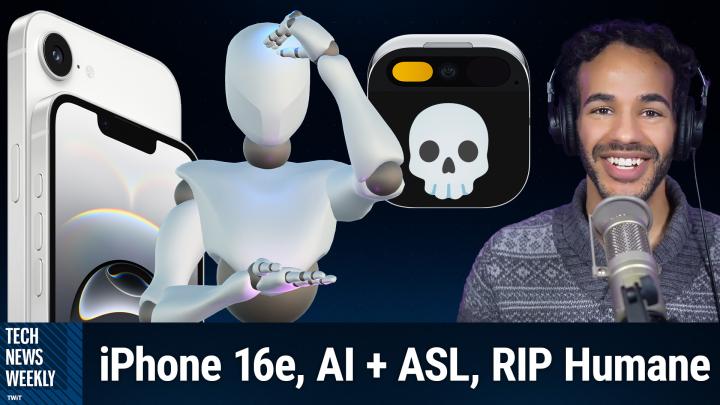
All TWiT.tv Shows (Audio)
Tech News Weekly 375: Apple's New iPhone 16e
01:02:35
RIP Humane AI Pin, NVIDIA's AI Platform for American Sign Language
Loading summary
Transcript86 lines
- [00:00]
Micah Sargent
Coming up on Tech News Weekly, Jennifer Pattison Tuohy of the Verge joins me, Micah Sargent, on the show we talk about Nvidia helping to launch an AI platform for asl. That's American Sign Language. We also talk about Jennifer's Skylight calendar, Max review and what we can expect from Amazon next week. Before we head into the interview, Zach hall of 9to5Mac joins us to talk about the Apple iPhone 16e. And Scott Stein of CNET gives us an understanding of Humane's AI pin. All that coming up on Tech News Weekly. Podcasts you love from people you trust. This is twit. This is Tech News Weekly with Jennifer Pattison Tuohy and me, Micah Sargent. Episode 375 recorded Thursday, February 20, 2025 Apple's new iPhone 16e hello and welcome to Tech News Weekly, the show where every week we talk to and about the people making and breaking that tech. I am one of your hosts, Micah Sargent, and I am joined across this vast and ever changing landscape that is the Internet by the very cool, the very awesome and the very smart home knowledgeable Jennifer Patterson Tuohy of the Verge. Welcome back to the show, Jen.
- [01:24]
Jennifer Pattison Tuohy
Wow, that was a great intro. Thank you.
- [01:27]
Micah Sargent
You're very welcome.
- [01:29]
Jennifer Pattison Tuohy
Happy to be here.
- [01:30]
Micah Sargent
Yeah, it's good to get you. So we've got some great stories of the week. I'll actually be kick things off today, so get ready because we're mixing it up. I wanted to talk about this really cool story over on VentureBeat. It's the sort of games beat section of VentureBeat and that's because it's about Nvidia for people who might be familiar, not super familiar for the company. Nvidia is pretty well known for making graphics cards and also having kind of games related platforms and graphics related platforms for people who are making games and then of course also having a pretty big piece of the a generative AI pie for what GPUs can do when it comes to training those systems. What's super cool is that Nvidia is working with the American Society for Deaf Children and a creative agency called hello Monday to create an online platform that is called Signs. And this platform is actually going to help people to better practice and understand American Sign Language. It is the third most prevalent, according to this Venture Beat article, the third most prevalent language in the United States, which may surprise some people. I'm going to guess that English and Spanish are above it and then comes asl. And this platform is essentially creating like a validated and confirmed data set that can be used to almost kind of grow on itself. Because in the same way that I might say because versus because or both versus a lot of people in the Midwest say both with a, as if there's an L in it. And of course, Jen has a different accent from me, but is speaking English as well. There's the same sort of application when it comes to American Sign Language. People may sign a little bit differently from others. And so when you're learning, learning from one person and trying to get the sign right may be. It may depend on, you know, slight differences whether it is that you're saying what you expect to be saying. Now, one of the things that they talk about in this piece that I thought was kind of important and I don't know that people necessarily kind of think about is that most of the people who are born deaf are born to hearing parents. And so in that situation, it leads to family members then wanting to learn sign language to be able to communicate with their child. And I have always thought that American Sign Language was one of the, I mean, just coolest languages in general as a, as a very expressive language. And I've used different tools in the past to attempt to learn it. But the idea that you have what they want to have, which is 400,000 video clips representing 1,000 signed words, this is all going to be validated by actual fluent ASL users and interpreters to give that accuracy and make sure that it works. But then afterward, you're able to use this platform not just like in, in and of itself, but also people who are making different apps can tie in with this, this platform called Signs. And you can go to signs-AI.com to be able to use this. And I just think ultimately, you know, we think about the different ways that sign language, or excuse me, that AI is impacting us. And we can kind of think of high level things and low and things that are, I think, maybe not directly impactful for us. Right. And this is one of those that I just think is really, really cool because you can see the direct impact that it has. And also I love when we learn something, you know, new and arguably in this case cool that we actually get to try. And so you can go to that website and check it out. But yeah, I want to hear your thoughts on this as well. J and kind of, you know, I don't know if you've seen any other projects like this maybe that have caught your attention whenever it comes to AI providing useful tools maybe for humanity, you know.
- [06:25]
Jennifer Pattison Tuohy
Yes. Well, this feels like I mean, one of, I think I was reading through the article and it says that, you know, this AI tool kind of analyze your footage so you get real time feedback on how your sign language is. So you're literally having it help you. It's being a teacher to help you be able to communicate better. And, you know, that is seems like such a hugely valuable tool because especially as you mentioned, for parents who probably don't, who have children that can't hear, that are deaf, born deaf, and they're trying to learn, it must be so difficult to be able to kind of get the tools and the resources that they need and to have something in their home they could just use on a, use this platform to help teach them. You know, it's like a duolingo for ASL that's going to actually really give you this feedback and help you become more fluent and understand the nuances. I've never used ASL myself, but my husband actually learned it in school, in high school. And then my daughter is going to start learning it next year. She's really excited because it is something they offer in high schools in the U.S. and I mean, it is interesting that it is the third most popular, most used language in this country. And I think it's great that now it's this, these kind of AI tools are making it much more accessible for more people to be able to learn. So it's a great application for, you know, this, this new compute power, this new artificial intelligence that we're, that we're seeing. There's been so much in the tech press in particular, you know, that's, you know, not negative necessarily, but, you know, restrained skepticism about where AI is going to take us. And that's, you know, part of our job. But when you see things that could really have such a positive impact on so many people, it, you know, it sort of, it's, it's exciting. It's that part of technology that really does kind of get you like, wow, this is great. And it's so exciting to be part of this and to see where it's going to go and where it's going to lead. So, yeah, I think this is, this is really exciting. Is it available for people to use? Is it available to people to use now? Or is this. Yeah, yeah.
- [08:37]
Micah Sargent
So it's not the final full project that Nvidia and the team want to get to, but you are able to go through the tutorial and you can go through different levels. Whenever you visit the website, it asks you, can I use your camera? Can I actually see the recordings and things like that? And as you pointed out, one thing that I think is really important about this American Sign Language, like other languages that you learn, you can. You can attempt to learn them sort of in a vacuum with apps, but having that direct feedback and visual feedback and in particular having feedback that is. What's. What's the word I'm looking for? Like that you can. You can trust, I guess is kind of important. Yeah. Verifiable. Exactly. Because you may end up, you know, not realizing. And there's.
- [09:40]
Jennifer Pattison Tuohy
Teach yourself the wrong way. And then.
- [09:42]
Micah Sargent
Yes.
- [09:42]
Jennifer Pattison Tuohy
Like when you teach yourself French and go and say something really stupid when you're in France, everyone laughs at you. Excuse me. A lot.
- [09:49]
Micah Sargent
I was going to say, sounds like you speak from experience a little bit there. He's getting a little, like, anxious. But yeah, no, I think that this is, again, as we're seeing, just, let's do this kind of stuff. Right. I just, I love this. The good stuff. Absolutely.
- [10:05]
Jennifer Pattison Tuohy
But not take over humanity stuff.
- [10:07]
Micah Sargent
Right. I know that I will be spending some time checking this out for sure, as I kind of. Because we didn't have it in high school. In high school, I learned Latin.
- [10:23]
Scott Stein
Oh, wow.
- [10:24]
Micah Sargent
Right after. Yeah, no, you don't. You don't. But except to sort of quickly find your tribe, I think, because you're like, oh, you're one of those. But see, we get it kinship here. But after I was graduated, then they stopped teaching Latin and at my university, they weren't offering ASL until much later. So I was taking some community courses and I really fell in love with it. And I was sad that I kind of didn't keep up with it. And it is for people who maybe don't have someone around them who they can learn with or for someone who. Because you. The only way to become fluent in a language truly is to practice and interact. And so I think having some sort of response there is going to be helpful. So, yeah, I'm looking forward to seeing how that project builds out. And I applaud Nvidia for working on something that doesn't seem like it's just about, you know, profit and that kind of thing. Although I'm sure they've figured out a way for that to be part of it as well. All righty. We do need to take a little break here before we come back with our next story of the week from Jennifer Pattison Toey, I want to tell you about Melissa, who are bringing you this episode of Tech News Weekly. Melissa is, of course, The Trusted Data quality expert since 1985. Melissa's AI enabled data quality solutions go way beyond just address verification. They leverage four decades of accumulated data knowledge, advanced machine reasoning and cutting edge AI to transform that raw data into actionable, reliable insights for your business. We recently had a chance to talk with the folks Melissa. They've been a sponsor on the network for a long time and you know, I've been used to Melissa being the data quality experts and so getting to talk to them and go, oh, there's more, there's, you know, there's a lot that you are able to do that is very impressive. Melissa's ability to enrich and cleanse that data spans multiple industries from fintech to health care, government, education, real estate. I mean the list goes on and on. You can go to the website and see Melissa's suite of verification and cleansing services benefit any business that doesn't want to act as its own data scientist. Whatever rules your business operates within, Melissa is there to support you. So imagine having that data expert that never sleeps. With Melissa's intelligent system, you get verification of identity to prevent fraud and gaming operations. It also ensures valid patient and medicine identification in healthcare systems. That can be a nightmare to not have that medicine identification there can be, we were talking to the team, so many different names for just one medicine. And so having that verification there is very important, very helpful. It also securely updates and verifies constituent data across government databases. And Know youw Business enables verification and monitoring for financial institutions. Melissa guides you through complex data management with ease, making advanced data quality accessible to everyone from small businesses to enterprises with real time data validation, comprehensive enrichment, cross reference verification with gold standard reference data and intelligent anomaly detection. It is no wonder why Melissa is the trusted Data Quality expert worldwide. Melisix securely encrypts all file transfers and has an information security ecosystem that's built on the ISO 27001 framework to GDPR policies and SoC2 compliance. So contact Melissa's team to find out what they can do to elevate your business and evolve your data quality. You can get started today with 1000 records cleaned for free at melissa.com TWIT that's Melissa. M E L I-S-S a.com TWIT and we thank Melissa for sponsoring this week's episode of Tech News Weekly. All righty, we are back from the break as we continue on with this episode of Tech News Weekly. Jen, what have you got for us us today?
- [14:31]
Jennifer Pattison Tuohy
Okay. Yes, so one of the things as some of the listeners Viewers may be aware my main role at the Verge is as a reviewer, and I published a review this week about a product that's actually been out for a little while called the Skylight Calendar. This is their new version. It's the Max, which is huge 27 inch digital touchscreen display that displays your calendar. Now, I realize that your audience might find this a little pedestrian because I'm sure a lot of people here know how to use DAC board and roll their own type of communal family notice board, of which I do mention different options in my article. But what really interested me about this, the Skylight Calendar, and one of the reasons I wanted to talk about it, is one of the themes I've been exploring and we've talked a lot about on this show, is how AI is used in the smart home and what tools it can bring to us and benefit us in the smart home. Because as I've mentioned before on the show, there's a lot around a AI in the smart home that I feel has some great potential. We've seen security cameras that are using AI to give you more relevant alerts, and we're seeing smart home voice assistants hopefully one day get better with AI. In fact, we'll talk about that in a little bit more in a little later. But what this has done, they have a new service called Sidekick and it is an AI powered assistant. You have to pay. It's an annual fee, $39 a year. That includes a few other features as well. But what's new about this AI element is you can feed it any data that you like, you can send it an email, you can upload a photo, you can send it an Excel spreadsheet and it will turn it into calendar events and put it on your calendar. Now, if you have children or busy household, multiple members of your home that are always trying to figure out where they're supposed to be or who's supposed to be taking someone where at what time, having a central place where all of your activities arrive so that everyone can see what's going on that isn't your phone, because not everyone in a family has a phone, is a godsend. And I literally have to say that this, I've used this for a month and it has been so helpful. It saved me hours of time manually inputting my son's tennis schedule, my daughter's lacrosse schedule, all the other things that I have to remember to, to put on our calendars. And I just. And this is something that other services do offer, I think. Gemini and ChatGPT you can also use, you can input this data and it should send it to your calendar. But as I describe in the article, it just didn't work as well as Sidekick. And what's really interesting here for me is that this company, Skylight has managed to create a very specific AI that really knows, you know, it has the capability to, to know, to do exactly what you want it to. Like I could send it, I've sent it so many different types of data and it was able to successfully pass them, create calendar events with the correct time, the correct place, you know, location to the correct calendar. So to my daughter's calendar or to my son's calendar. And it is just sort of, as I said, I know it's not, it's an overused word game changer. But if you're a parent and you've ever had to deal with this kind of stuff or like I say, not necessarily, you know, you have to manage multiple schedules. Something like this is incredibly useful and I just thought it was an interesting use of AI in the, in the smart home and something that I'm interested to see if we might start to. Next week there is a big Amazon event talking about their new AI powered Alexa. Don't speak to me. Sorry, sorry. And Google obviously has Gemini. Apple is about to announce, announce or bring us hopefully a more intelligent Siri. And these are the types of tools I think everyday people are going to find really useful about sort of AI. You know, at the moment a lot of AI talk has been sort of, I feel like it doesn't feel like it's relevant to a lot of people, maybe writing their emails better, you know, these basic things but they can be really useful tools. And that's, this is something that I found to be incredibly useful and it's one of the first times I've actually found an AI service to really fit into my workflow and life and I found it really, really useful.
- [19:00]
Micah Sargent
So I think so about that. I think there's something to be said for not trying to do everything. Skylight's been around for a while and I actually got my mom a Skylight years ago whenever it was just a digital, digital photo frame. And then over time I saw Skylight add, you know, the calendar features and kind of grow from there. And what's good about what Skylight's doing and why maybe this is working so well is again it's not trying to be everything. The AI can be more purposeful and so you don't. When you, I think when you've Got an AI that you need it to do your calendar events and you also need it to describe what's inside of a photo and then also generate photo. I mean it gets so complicated that there's more opportunity for things to get messy. But if you apply it to this one task and say, you know, this is the thing that you. This is the thing that I need. I really, I love this idea of. Because I'm thinking about my calendar app and I use fantastical and I have for years and I, I shout its praises always. But what it has offered for a long time is this sort of quick add feature where you kind of just type into the top and you say 7pm dinner with blah, blah, blah. And then it takes those little bits and pieces and puts them into a calendar event. And that maybe when I first started using it, it did something wrong once or twice and from that point on I was done with it because it was a waste of my time to use that. So I always, when I create a calendar event, I take the time to go, I want a new event, I'm giving it my title. I don't want the little smart features. And of course that's not AI, this is before that. It's, I mean it is a version of it, so to speak, but it's, you know, using data detectors, that kind of thing. And so I have wanted this for a long time, but I don't, I have not trusted the systems that have been there to actually make it happen. Yeah, yeah, to get it right.
- [21:16]
Jennifer Pattison Tuohy
Yeah. And that's, and that's one of the things. So I tried the, I said, I tried Chat GT GPT to do similar instances and Gemini and that was one of the issues with them. It was harder to sort of check its work, so to speak. And one of the things that Sidekick does is it'll send you an email after it's imported everything. So it sends it, it does it. Or for you. But you can then see in the email and delete anything it got wrong with just one click rather than having to kind of go back to the calendar and check it's work. It sort of, it sort of says here, did I do it? Is it good?
- [21:47]
Micah Sargent
Are we good? Yeah. See that Check in is nice, right? And that again, I, I'd love to speak to the team at Sidekick who, like who, how did they come to this? Because you, I think you have two choices whenever you are creating this. And the one choice tends to be kind of what the big tech companies do, particularly in particular Apple is good at this. But also it could be bad, which is the it just works mentality.
- [22:16]
Jennifer Pattison Tuohy
Right.
- [22:17]
Micah Sargent
And so when something doesn't just work.
- [22:19]
Jennifer Pattison Tuohy
You kind of get a whole lot.
- [22:20]
Micah Sargent
Yeah. You don't get a whole lot of feedback. Yeah. And Amazon at first was like that over time has added in features that I like the sort of. You can ask, why did that happen? Yeah. And actually get some understanding of what led to, you know, it making this choice decision. Yeah, yeah. I want something that checks in with me and says, did I get it right? And you can say, okay, this is good, this is good, this is not.
- [22:45]
Jennifer Pattison Tuohy
And then it lands in theory from its mistakes and that. And then it also does have. It has a couple other things it can do. Like it can take a recipe. If you take a picture of a recipe, it can put that into like a meal planner for you. And there are also. I didn't do this because my kids are teenagers, but has a chore chart and rewards and. Oh, nice. So it has other features for that $40 a year thing, but the Sidekick really was the kind of the selling point for me. Just, it's just taking. And this is the thing I've noticed with AI, we're still at this lower level of benefits. Like it can do small things relatively well and take some of those menial chores off your hands, like entering calendar data. Calendar data into your calendar, which is not something anyone ever enjoys doing. You know, no one's going to miss having to do that. But, you know, the next level is also interesting. Like where, you know, where can it. Where could this. This become like, as you say, it's good that they've pinpointed a solution that they can provide that is useful. But now I'm kind of like, what else can it do for me? So I'm kind of getting excited about what. And this is what I was mentioning. Amazon next week has its Amazon event where we may finally get the.
- [24:05]
Scott Stein
Are you souped up?
- [24:06]
Micah Sargent
Can you talk about our. Can you answer this question if you can't find Will? Because sometimes these events don't. Well, a lot of times these events don't stream. Will someone from the Verge have press knowledge upon the event taking place? I guess is the question that I'm asking.
- [24:25]
Jennifer Pattison Tuohy
Well, I'm going to it.
- [24:27]
Micah Sargent
Okay. That's what I was asking, but I didn't know if I could. Good, good.
- [24:31]
Jennifer Pattison Tuohy
Yes, I'm going to be there. And in fact, it was when they announced it. I can't remember if I don't think I already talked about this. They Sent out five invites, different invites to different. Everyone got a slightly different one or not everyone, but there were five slightly different invites. I saw them on different websites and I was like, hang on. And I started to put them all together and they actually spell Alexa because they didn't actually say what they were going to do. It was very Apple.
- [24:56]
Micah Sargent
Oh, wow. Yeah.
- [24:57]
Jennifer Pattison Tuohy
They didn't actually say in the event what it was going to be about. But obviously we kind of assumed. But now that kind of that clarified or confirmed that yes, we should hopefully be hearing about this new AI powered or generative AI powered voice assistant who, you know, and Amazon's whole thing with Alexa, which is different really from what we see with Siri. And Google to some extent is very much home focused because most of its use is in homes, whereas the other voice assistants are also used on phones a lot. So they have slightly more personal focus to some extent. And I think we're going to see, I'm hoping we're going to see a real focus on making the voice assistant work a lot better in the home and work better for families. So I'm wondering if we may even start to see, and I don't have any insider knowledge here, this is all my speculation. Start to see how the assistant can really work with our smart homes and people in our homes because it has the ability to recognize different people in your home and show a different calendar when you approach their screen. Because you can, can use digital calendars on Echo shows. They're just not, they just don't work that well. That's something I talk about in my review like it's just not that useful yet. And I think that AI in this instance, if Amazon can sort of pull it off, could really bring Amazon's voices in the home to kind of that next level. And what Sidekick, what's what Skylight is doing with Sidekick, sort of to me maybe sort of foreshadows what we might, might start to see Amazon being able to do because this is a, this is a niche device, to be fair. The calendar, it's 650, $660, I forget right off the top of my head. Very expensive. You can get cheaper ones. The smaller ones I think the cheapest is $200 but still quite a lot compared to say an Echo Smart display or a Google Nest Hub.
- [26:51]
Micah Sargent
Yeah, because there's no subsidizing going on here, I guess, right?
- [26:54]
Jennifer Pattison Tuohy
No, I don't think so. Very expensive. Yes. But it does look very cool and like you said, it works as a photo, photo frame. Digital photo frame as well. But again, you have to pay the monthly fee. So it's there's some downsides to this for sure, but as a complete package, they've kind of nailed a really good user experience and service here with this AI Sidekick. If you've got the time to go and roll your own. Yay. But lots of busy parents don't, and this is a great solution I found.
- [27:28]
Micah Sargent
Anyway, absolutely everyone should head over to the Verge to read your full review of that and also of course, get ready to see what you have to say about the Amazon event. We'll look forward to that. If people want to stay up to date with what you're doing, where's a good place for them to do that?
- [27:46]
Jennifer Pattison Tuohy
Theverge.com is where all my stories will be posted. And then I'm also on threads and bluesky and I think Am I allowed to say that I think I'm gonna be on Twitter this Sunday?
- [27:56]
Micah Sargent
Yeah, you can say that. Yes, that is true. I hear that. I hear that. In fact, two of my awesome Tech News Weekly hosts are gonna be on TWITT this Sunday. Abrar Alhiti will also be joining.
- [28:07]
Jennifer Pattison Tuohy
Oh great.
- [28:08]
Micah Sargent
So that's awesome. Thank you so much for your time today. I always look forward to getting the opportunity to chat with you and we'll see you again next month. And our listeners will see you again on Sunday.
- [28:20]
Jennifer Pattison Tuohy
All right, thanks guys.
- [28:22]
Micah Sargent
Bye bye. All righty, we're going to take another quick break. Before we come back with our first interview, I want to tell you about Threat Locker, who are bringing you this episode of Tech News Weekly. You can harden your security with Threat Locker and stop having to worry about zero day exploits and supply chain attacks worldwide. Companies like JetBlue trust threat locker to secure data and keep business operations flying high. Let's imagine taking a proactive deny by default approach to cybersecurity. So you're blocking every action process every user unless they're actually authorized by your team. ThreatLocker helps you do this and provides a full audit of every action for risk management and compliance. It's 247 US based support team, fully supports onboarding and beyond, so you can stop the exploitation of trusted applications within your organization and keep your business secure and protected from ransomware. Organizations across any industry can benefit from Threat Locker's ring fencing by isolating critical and trusted applications from unintended uses or weaponization and limiting attackers lateral movement within the network. And by the way, ThreatLocker works for Macs as well. You can get unprecedented visibility and control of your cybersecurity quickly, easily and cost effectively with ThreatLocker's Zero Trust Endpoint Protection Platform. Visit threatlocker.com to get a free 30 day trial and learn more about how ThreatLocker can help mitigate unknown threats and ensure compliance. That's threatlocker.com and we thank threatlocker for sponsoring this week's episode of Tech News Weekly. All right, we are back from that break and it is time to talk about an interesting February. February. I don't usually say that. February. Introduction of an iPhone to the iPhone family. Joining us to help us understand the iPhone 16e is Zach hall of 9 to 5 Mac. Welcome back to the show, Zach. Hey there.
- [30:26]
Zach Hall
Thanks for having me again.
- [30:27]
Micah Sargent
Yeah, pleasure to have you join us. So obviously the first question is, what does the E stand for?
- [30:33]
Zach Hall
Everything. Everyone.
- [30:35]
Micah Sargent
All of us. Wait, all of us. No. Apple adults. The iPhone 16e to go along with the iPhone 16 lineup. And this is in theory, Apple's affordable phone. Can you tell us first and foremost about price and kind of initial specs and understanding of or initial reactions of what this device is?
- [31:00]
Zach Hall
Sure. The iPhone 16e is E fordable. It replaces the iPhone SE third generation and the iPhone 14 in Apple's current iPhone lineup. And so the SE3 was the old iPhone 8 design with Touch ID, the home button, big bezels and everything, no Face ID and that cost $429. Most recently, the iPhone 16e is a bit more expensive at 599 and up, but you've got more storage and you've got a whole lot more features including face ID and this full screen display with no home button, better camera system, a lot more battery life. So it's more expensive. But you get sort of a five or six year generational leap in terms of what technology is being offered there.
- [31:55]
Micah Sargent
That makes sense that, you know, when we compare it to the SE of yesteryear, this phone starts to make a lot more sense versus kind of comparing it as the affordable model to go with the other models that exist where then people kind of are going, okay, but m. I will be honest with you. I said this on my show yesterday, that when I first saw the phone and I saw it had one camera lens on it, my initial thought was like, oh wow, that reminds me of an iPad. And. And iPad camera equals ugh. And so I suddenly was starting to feel a type of way about this phone before I had to sort of step back and go, okay, hold on, let's take a second to think about this. With this phone, we do have an action button. Do we get the capture button on this little baby?
- [32:47]
Zach Hall
There's no camera control. There is the action button. And one thing that it does on the iPhone 16E is you have this Apple Intelligence AI feature called Visual Intelligence. On the iPhone 16 and 16 Pro, where this feature originated, you use the capture button, the camera control. You hold it down and it opens up this mode where you can scan objects, images, or, you know, things in your real world environment. And you can look up things about those on google or chatgpt or even like translate something or add it to your calendar. This is available on the iPhone 16e through that action button. So you do lose the ability to assign that action button to something else. Or you can use it, you can access it from camera from the control center. And those two features are being backported to the iPhone 15 Pro, which has Apple intelligence, but not visual intelligence, because there's no camera control. Something else about the iPhone 16 I should mention is that even though it's not affordable compared to, or it's not, you know, as good of a, maybe as good of a value compared to the iPhone SE generation, which was usually, you know, $430 or $500, it is affordable compared to the iPhone 16, which is $800 and up, or the iPhone 16 Pro, which is $1,000 and up. So looking at a 2 and $400.
- [34:03]
Micah Sargent
Difference, there makes sense. Now, one thing that stood out to me initially was the lack of magsafe wireless charging in the device. And initially that alone kind of of felt a little surprising to me. But on 9to5Mac, something else was pointed out, which is that you lose MagSafe charging, but you also lose magsafe in terms of accessories. And I have to say, with my phone, I'm used to thwacking it all over the place. Like right now it's technically a charger, but even if there wasn't a charger here, I just like to have it sort of magnetically placed there. I know a lot of people do it in the car. Any insight into the lack of MagSafe here? Is it just a cost thing? What do we think?
- [34:57]
Zach Hall
It must just be a cost thing. And one theory was Apple's using their own modem. Now they're replacing qualcomm modems with their own C1 modem in the iPhone 16e is the first time they're doing Apple modems. And so, you know, my first guess was maybe the magnet interferes with the modem. That could be an issue. Maybe there's not enough space to sort of, you know, separate the magnet from the modem, but I don't really think that's the problem. And Apple even said today that that's not why they didn't include MagSafe. They didn't say why they didn't include it though. One thing that we're seeing though is that accessory makers like Spigen, for example, they're making cases that have mag safe magnets so that you can do things like attach a wallet or a pop socket, you know, holder, for example. What you won't get is, you know, probably is that wireless charging that MagSafe offers. So it does have wireless charging, the old QI standard where it's just wireless, but not the new Qi 2 or what Apple made with MagSafe back in the iPhone 12 days, which is it snaps into place magnetically and it charges efficiently, giving you faster wireless charging speeds. So it's a very weird omission, but it's one that you can sort of overlook when you look at what else you get with the iPhone 16e, especially the newer processor and the more RAM that supports Apple intelligence and other new features.
- [36:14]
Micah Sargent
You wrote an article for 9 to 5 Mac and it was kind of interestingly entitled something along the lines of don't buy this phone. And you're going, which phone is Zach talking about? Can you tell us a little bit about your insights there? I want people to go and read it. So we'll link to it in the show notes. Sorry, Anthony, I did not not drop that in. But yeah, is it the 16e you're talking about?
- [36:41]
Zach Hall
It's not the 16e, sort of surprisingly, it's the iPhone. I'll just give it away here. It's the iPhone 15. And the reason for that is the Apple lineup right now for the iPhone includes since the SE3 and 14 went away yesterday, it includes the iPhone 15 and then iPhone 16E, 16 and 16 Pro. And you think, okay, that's least expensive to most expensive. But in fact the 16e is $100 less than the 15, but you get more hardware oomph. With the 16e, you get a sort of two year generationally new chip and you get more RAM than you get in the 15. So my advice for anyone buying a new iPhone in 2025 is if you're looking at the 15, you probably don't want a 16 or 16 Pro. You probably should look at the 16 E instead. And you know, I think the, the E is a little confusing. It's like what does that mean. And for all intents and purposes, it's. It's a, it's an SE4, it's an older design. It's, you know, this year's hardware and an older design that Apple will probably sell for the next few years without updating it. But it's, I think it's a better value than the 15 because the 15 does cost 100 more now and we'll probably lose iOS support maybe a year or two before the 16e does, you know, years down the road.
- [37:58]
Micah Sargent
Absolutely. The one thing that I have heard people talking about is with the se, you have ambiguity because it's not tied to a number. Do you think there's anything to that in terms of this now being a 16e? Will we then see 17e, 18e, or is it more likely that in the lineup, I mean, Apple's still selling older models of iPhone. This just becomes that model that is the lower cost model. Because you even mentioned there, because you see that it probably is going to exist for a few years.
- [38:35]
Zach Hall
Yeah, I think so. I think we won't see a 17E or an 18E. Maybe we'll never even see another E. You know, we've had one off iPhone versions that are sort of the cheaper, more affordable model, the iPhone 5C and the iPhone XR. So C and R are only one version of each of those phones, so we could only have one C. But I think what's nice here is it is sort of clever marketing to frame it as the 16e because it has the internals of a 16 for the most part. In the past, like the original iPhone SE was the shape of an iPhone 5 or 5S, but it had the internals of an iPhone 6S. So there was only kind of a two year gap there. But Apple kept it around for two or three years before making it look like an iPhone 8. And it was sort of hard to track then. Is the SE1, SE2, SE3, what are those phones? Phones. And by saying 16e, it makes it feel, you know, newer than the 15, much newer than the 11 through 14, and we'll be able to keep track of it easier in the future too. Oh, it's like the 16e is less than the 17, less than the 18, while those phones are sold next to it, I believe.
- [39:39]
Micah Sargent
Absolutely. To round things out, I'd love to hear your take on, like, who exactly the phone is for and maybe you can give us some understanding of availability and when, you know, people can take a look at this phone and have it in their hands, etc. Etc.
- [39:57]
Zach Hall
Sure. So I think the iPhone 16e, you know, again, if you're looking at the iPhone 15 as an option, maybe look at the 16e instead because of the longevity we'll offer. But if you're currently an iPhone SE user of any sort, or use an iPhone 11 or iPhone 12 or 12 mini, then I think Apple is especially looking at you because they've got all these different comparisons in terms of battery life and performance on their website and in the press release that shows just how much better the 16e is compared to those phones. And I imagine if you've got maybe a 13 or 14 then you may be holding out more now or more likely to go to a plain old iPhone 16. But yeah, if you've got a 12 mini or a 12 or older than this 16 either I think is probably a pretty good, pretty good bet for you. And the pricing starts at 599. Pre sell is available. Pre orders start tomorrow and Friday at 8am Eastern time and the phone starts to ship one week later. So next Friday it'll start to arrive in stores and reach customers.
- [41:01]
Micah Sargent
Awesome. Well Zach, I want to thank you so much for taking the time to join us today on the show. If people would like to keep up with what you're doing online, where's a good place for them to go to do that?
- [41:12]
Zach Hall
You can always read 9to5Mac and I'm also on social at Apollo.
- [41:17]
Micah Sargent
Zach as well.
- [41:18]
Zach Hall
Thanks Micah.
- [41:19]
Micah Sargent
Wonderful. Thank you so much. Good to see you.
- [41:21]
Zach Hall
You too. Bye.
- [41:22]
Micah Sargent
All righty folks, we're going to take a quick break before we come back with our next interview. I want to tell you about US Cloud. We're bringing you this episode of Tech News Weekly. US Cloud is the number one Microsoft Unified support replacement. We've been talking for a few months now about USCloud. We know them to be the global leader in third party Microsoft support for enterprises now supporting 50 of the Fortune 500. Switching to US Cloud can save your business 30 to 50% over Microsoft Unified and Premier support. And it's also faster too. 2 times faster. Average time to resolution versus Microsoft. But now US Cloud is excited to tell you about a new offer. US Cloud has the Azure cost optimization services. So I mean, let's look at your company and think about the last time you evaluated your Azure usage. Chances are it's probably been a while and if it has, you probably have some Azure sprawl, a little bit of that spend creep going on. So that is where US Cloud can come in because you can save on Azure with US Cloud. US Cloud offers an eight week Azure engagement powered by VBox that identifies key opportunities to reduce costs across your entire Azure environment. With expert guidance, you will get access to US cloud senior engineers with an average of more than 16 years with Microsoft products. And at the end of those eight weeks, your interactive dashboard will identify, rebuild, downscale opportunities and unused resources, which will allow you to reallocate your precious IT dollars toward needed resources. Or you can also just invest your Azure savings in US Cloud's Microsoft support like a few of US Cloud's other customers, and completely eliminate that unified spend. Sam, who is the Technical Operations Manager at bead gaming, gives us Cloud 5 stars and has this to say. We found some things that have been running for three years which no one was checking. These VMs were, I don't know, 10 grand a month. It's not a massive chunk of the grand scheme of how much we spend on Azure, but once we got to 40k or 50k a month, it really started to add up. So it's simple. Stop overpaying for Azure, identify and eliminate Azure creep and boost your performance all in eight weeks with USCloud. Visit uscloud.com and book a call today to find out how much your team can save. That's US Cloud to book a call today and get faster Microsoft support for less. Thanks so much to US Cloud for sponsoring this week's episode of Tech News Weekly. Already back from the break and I am excited to be joined by CNET's Scott Stein, who is here to talk about the elephant, the AI elephant pin in the room. I don't know. Welcome to the show, Scott.
- [44:25]
Scott Stein
Hey, thanks. Good to be back on.
- [44:28]
Micah Sargent
Yeah, it's good to have you back. So let's kick things off by talking about Humane's AI pin. If people didn't hear about it when the hype was kicking off, can you tell us what it was, what it aimed to do?
- [44:41]
Scott Stein
Sure. So this kind of emerged as this extremely hyped device that looked kind of futuristic and former Apple engineers and designers who wanted this to be the future beyond phones. You know, it was one of a wave of AI assisted gadgets that wanted to be there for kind of an ambient interaction computing, bring up things, look at the world with a camera, respond to your voice, and also replace your phone because this had its own phone plan and did not connect to cell phones at all.
- [45:15]
Micah Sargent
Wow, okay. Yeah, so it really was trying to shove into and, and take over a pretty steadfast market, which is not an easy thing to do. Yeah, we've got some video of your review. Very Star Trek. Love that. I was hoping that now that we know what it was aiming to do and I think maybe people who are listening are going, yeah, that's kind of hard. Tell us about the latest news regarding the AI pen. What is happening to it and if one of our lucky listeners or viewers were one to get one of of these, what can owners of the device expect going forward?
- [45:55]
Scott Stein
Yeah, I hope you did not get one of these. But the announcement was that it's being sold basically for the IP to HP for 116 million. It kind of reminds me of like Palm or webos, like all these things in the past that got eaten up or even when Google acquired Pebble. And pebble was a far, far more successful device and is actually coming back. So it's probably a bad analogy. But in the meantime this is going to lose its data February 28th and there's no recourse. It's going to be a little disposable item that they encourage you to recycle and no refunds unless you've recently bought it. So. So that's really upsetting. And because they put it on an island and it does not connect with phones, there's no other way that you'd get it to function.
- [46:53]
Micah Sargent
Holy moly. In the announcement for this, was there any sort of remorse at all involved? I know probably not because lawyers are going, you can't be remorseful. But that seemed to say you can't get a refund for this thing. It seems, I mean, it wasn't even. We'll talk a little bit about your review. It wasn't even a full year ago. This thing hasn't been out that long. And yet they're claiming that. And especially with the acquisition by a larger company, one would hope that, you know, maybe there's a little money there to, to, to give people their money back. What's been the reaction? I guess and yeah, that initial question of what did the company have to say about we're not giving anybody money back unless you bought it recently.
- [47:39]
Scott Stein
I mean it seems like kind of like a thank you for the journey type of response. But you know, it's. Reactions have been really upset obviously, but, but also, you know, since people didn't. People acknowledge that it was a bad product from the get go. I think this was also like an RIP AI gadgets, terrible, terribly conceived AI gadgets type thing, which I thought some of the ideas they had were really interesting. The problem was they didn't work as I expected them to. And it's not interesting in its. It wasn't interesting in its current form and it wasn't useful to me. But also what's concerning is that anytime you have a device like this that's so service based, you're really just kind of like renting the service. And then in the past you'd have a device that probably would have still functioned in some way even without software updates. There are game consoles that are like that. And that's definitely not the case because it's all coming from their servers which are going to have all the data wiped off of them.
- [48:46]
Micah Sargent
Yeah. That is, in my opinion, really ridiculous part of this. You think about pebble in that example and how people were able to keep using pebble and there were third party hacks for it, or even Amazon that at one point offered those little dashboards buttons where you could order goods by pressing the button. People figured out how to hack those and use those as like smart home buttons. There have been all sorts of these gadgets that lost access to whatever services were available. But yeah, you could do so much locally.
- [49:21]
Scott Stein
What, hack the Pebbles too? To bring up the pebble analogy, there was that movement too.
- [49:26]
Micah Sargent
Yeah. And so that's really disappointing. Again, this. I wonder if it kind of. Probably not, but I wonder if there's any sort of cooling on the enthusiast market to grab these things up as soon as they come. But then I think things like Kickstarter would not be as successful if that was the case. I think people like to be in on the get go. I do want to talk a little bit about your review just under a year ago. I do need to take another quick little break and then we'll be back with that and also your kind of retrospective commentary on what went wrong or what, what the company could have worked on to make things a little bit better. Let me tell you though, about Delete Me. Dear listener, who are bringing you this episode of Tech News Weekly. If you've ever searched for your name online and you didn't like how much of your personal information was available, well, join the club, because I felt that way in the past for sure. Maintaining privacy isn't just a personal concern, though. It's a family affair. In fact, that was what made me really happy, that Delete Me offered a chance for me to use the service. Because I, by nature of my job, do put myself out there to a certain extent. But me searching my name and seeing all of my family connected to me and then seeing you know, where they lived. And that kind of a thing was a little bit shocking. And I think you'll be surprised what you find if you've not done one of those searches before. And now a lot of that stuff is not available anymore because of Delete Me. So it's really pretty cool what Delete Me is able to do. With DeleteMe's family plans, you can ensure that everyone in the family feels safe online. Delete Me helps reduce the risk from identity theft, cybersecurity threats, harassment and more. You know, there are a lot of these phishing attempts now that involve gaining information about a person and knowing who they know and reaching out to those people to try and get access in some way. And so having that information online is not good. Don't want it there. And being able to see Delete Me go through and remove data from so many different places, this personally identifiable information, it's pretty satisfying, honestly. Delete Me experts will find and remove your information from hundreds of those stinking data brokers. You can assign a unique data sheet to each family member that's tailored to them. And with easy to use controls, account owners can manage privacy settings for the whole family. And DeleteMe will continue. This is the important part. Continue to scan and remove your information regularly because that stuff gets scooped up again, including addresses, photos, emails, relative phone numbers, social media property value and more. So protect yourself and reclaim your privacy by going to joinedeleteme.com twit and using the code twit. Twit. That's joindeleteme.com twit with the code twit for 20% off. All right, heading back into the show, I am joined by Scott Stein of CNET who is here to give us an understanding of of what is going on with the humane AI pin. Now, as we mentioned before the break, when this device first came out, you had a wonderful video review and you know, full on review of this device. What were your thoughts about the device at the time? Was a writing on the wall for you then or was there at least some level of this is new and interesting and maybe this is a category that could exist.
- [52:59]
Scott Stein
So I tried wearing it not just around the office, but I brought it with me to Disney World along with meta Ray Bans because it was at the time I was about to travel and I really wanted to give it a chance around Epcot even and go to the try using the Translation around the World showcase. That wasn't part of the of the video, but I had it in the mention in the write up, but both in, in big situations like that and in small, it wasn't functioning well. And not functioning well is really an understanding statement. Not only the AI kind of gave answers, but I also. It overheated. It overheated? Yeah.
- [53:35]
Micah Sargent
Oh Lord.
- [53:36]
Scott Stein
It overheated at the drop of a head. Because it used this incredibly ornery projection system that used lasers that would project onto your hand. So you'd hold it up and it would bring this projected display that you use hand gestures to interact with. Super sci fi sounding and kind of like augmented reality. What I saw in there was a little bit of a future of like in glasses, if you bring up your hand and bring up something like in Vision Pro. But the difference here is that in the real world, that display gets projected on your hand and it keeps moving depending on where your pin was placed. So getting it to center, getting those hand gestures to work and then it would overheat. So if it was kept on for more than like 20 seconds, oh my gosh down. Because it was overheating between the cellular and I guess the projections and which is, which is. Which is nuts. So there was that and then also just having it like kind of sagging on my sweater. And like being this weird pin was a weird way to live. I mean, I like that it connected magnetically. Although passing power through my clothing was a little weird. Like I didn't know how that would work long term and I think also probably inefficient, but I liked some of its design flare ideas, but they just didn't turn into anything. And the other thing is that because they didn't connect with a phone, not only did it not play notifications or anything or take a phone call from your phone, but also just for setup, you know, like if you want to connect to a WI FI network, I had to like tap like the passcode with like my fingers using the, the projected display on my hand. Like I was, I was kind of losing it from that. I mean there's like a web, there's a web interface for setting up some of that stuff. But a lot of stuff gets done on the device. And it, it just drove me crazy because the phone in your pocket already does so much of this stuff and they were willfully ignoring the phone. Whereas something like Meta Ray Bans, which came out with its AI features around the same time, I still wear those a lot. And it's because the AI is really just like, like a gimmick. The rest of it has other features.
- [55:43]
Micah Sargent
That you might use Instead, Yeah, yeah, it's, it seems so cool. I remember at the time I thought, oh, it seems so cool. But it's just like it was a cool concept. And then as it played out, you're going, oh, right, this is not, not what you thought. Now you did, you wrote this retrospective commentary and talked about the, the failing of this product. And I think like you said, the big thing there is it shoving into a category that was already just fine. But it does have me wondering, is there anything in this sort of category of devices, any compelling devices that stick out to you that do feel like there's a place for it? Or is the sort of AI augmented device doomed to fail because we have smartphones that can access so many of the other AI services?
- [56:41]
Scott Stein
I've never liked the idea of having AI manage your life because it's so diffuse and I like to make individual decisions. That a lot of the whole metaphor of AI being your personal agent bothers me. And that is the problem when you have like a whole AI based OS is that there's no out, you know, there's no escape hatch where you can just use it like a regular phone or something else. But I do think that things that are extensions of your phone make sense. Right? So like smartwatches. Those are already, we already wear smartwatches. The AI PIM was kind of almost being like a smartwatch on your, on your chest, but without some of the features. And so I feel like those are going to add more AI features. Glasses are interesting to me because again, anything that's a peripheral to what you're carrying with you. But I think the moment you start saying, and I love the future, but if you're going to say, I'm replacing your phone, when, when is that going to happen?
- [57:43]
Micah Sargent
Right.
- [57:44]
Scott Stein
Who's leaving their phone at home? I don't think anyone I know in the universe would be like, I'm leaving my phone at home. I'm going to carry this random thing with, with me. Because you could get, you know, you could get lost, you get in trouble. There's security, you know, their payments, the emergency calls, there's a lot of. Your phone is important. So absolutely, I do think, and also working with the apps you have and the AI that you're used to using, like AI is so all over the place right now that like, if you're going to even get traction to use it for everyday functions, I think it needs to be something that works comfortably with the stuff you have. And so I don't want they had their own Cosmos os, which hooked in to some AI services, but it only connected to Tidal Music Player. It didn't play other music and some other features weren't added yet. So it was like you had to wait for them to hook in all those things. That was unacceptable. And that's part of the problem still with Meta glasses too, is that they don't fully hook in to all the stuff that you'd want. But I don't use the AI features much on Metas Ravens. I play with them, but I use it mainly for wearable headphones and for the camera thing. And the AI is a. It's an experiment and I like playing with it. But it's like as a bonus extra. I can accept that. But as the main event for those two, I would be annoyed.
- [59:04]
Micah Sargent
Yeah, yeah, absolutely. Look, I love getting the chance to talk to you. You have a lot of insights about the, the tech that is taking off right now as we look to this sort of AI and augmented future. And so it's always a pleasure to have you join the show and chat with us. Thank you for taking the time to join us today to talk about the humane AI pin. Everyone should go read that retrospective that you have. And also I think even the initial review of it just to. It's kind of nice to remember where we were, where we are, and how quickly these things can change as well. If people want to stay up with what you're doing, where's a good place for them to do that?
- [59:41]
Scott Stein
You can follow me on Bluesky. Scott Stein. I think there's another Scott Stein too, who I'm friends with, who's a novelist, so you might get him by accident. You can follow both of us.
- [59:49]
Micah Sargent
There you go.
- [59:51]
Scott Stein
And bluesky is where I'm at mostly at this point and also on cnet.
- [59:56]
Micah Sargent
Awesome. Thank you so much for your time today. We appreciate it.
- [59:59]
Scott Stein
Yeah, thanks a lot.
- [60:00]
Micah Sargent
All righty folks, that brings us to the end of this episode of Tech News Weekly. Of course, the show publishes every Thursday at Twitter TV tnw. That is where you go to get the show in audio and video formats and subscribe. If you'd like to get all of our shows ad free, well, you can do that by joining the club at Twitter TV club TWiT. We still are offering that two week free trial, but it is for a limited time, so hop on that offer as quick as you can. When you join the club, you gain access again to all of our shows without any ads. You gain access to the Twit plus bonus feed that has extra content you won't find in other places behind the scenes after the show before the show Special club events Access to the Members Only Discord Server A fun place to go to chat with your fellow Club Twit members and also those of us here at TWiT and it is a really good time. It is awesome to get to hang out with all of you in the chat and see what you are talking about during the show and in between. And also I want to remind you that if you're watching live and are a member then you are hearing this promo. So TWiT TV Club TWiT referral is where you should head because when you refer your friends to Club Twit you will earn months of Club Twit for free. So be sure to check that out as well. Thank you all so much for tuning in. Be sure to check out my other shows, Hands On Mac, hands on tech iOS today which are all published on Thursdays. So yes, those will be available to you then as well. Thanks so much. If you're looking to follow me online, I'm ichasargent on many social media network or you can head to Chihuahua Coffee that's C H I H U A H u a Coffee where I've got links to the places I'm most active online and we'll catch you again in the future. Bye bye. Business leaders need clear insights into both the Apple and Microsoft ecosystems to stay competitive. That's why we provide expert led coverage on both with Twits, Mac Break Weekly, iOS Today and Hands On Mac. You'll get the latest app, Apple updates, productivity tips and innovation insights. Meanwhile, our Windows Weekly and Hands On Windows shows deliver the newest developments on Windows, Xbox and more. Tune into Security now for essential cybersecurity strategies for both companies. Gain comprehensive tech insights across platforms at TWiT TV and always stay ahead of the curve.