← All TWiT.tv Shows (Audio)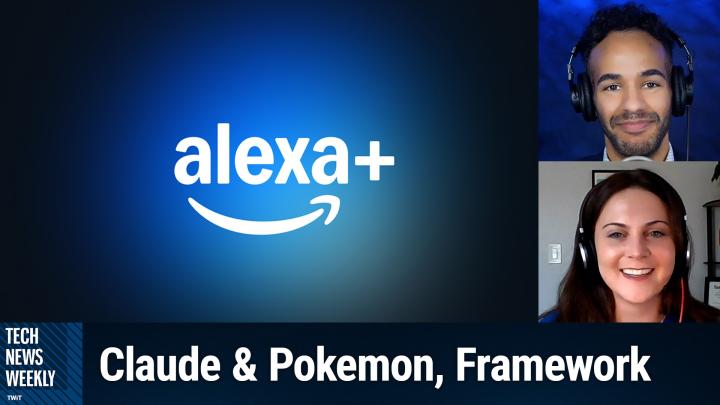
All TWiT.tv Shows (Audio)
Tech News Weekly 376: Amazon's New AI-Powered Assistant
01:06:02
Claude Plays Pokemon, Framework Desktop
Loading summary
Transcript149 lines
- [00:00]
Micah Sargent
Coming up on Tech News Weekly, Emily Forlini of PCMAG is here. We kick off the show by talking about Claude AI from Anthropic playing Pokemon on Twitch. Then Emily, who was at Amazon's recent Alexa event, tells us about what we can expect from the AI powered virtual assistant. Before Sean Hollister of the Verge stops by to tell us about his time with Fred Framework's new desktop PC. It's sorta kinda modular. All of that coming up on Tech News Weekly.
- [00:37]
Emily Forlini
Podcasts you love from people you Trust.
- [00:41]
Micah Sargent
This is TWiT. This is Tech News Weekly, episode 376 with Emily Forlini and me, Micah Sargent. Recorded Thursday, February 27th, 2025. Amazon's new AI powered assistant. Hello and welcome to Tech News Weekly, the show where every week we talk to and about the people making and breaking that tech news. I am one of your hosts, I am Micah Sargent and I am joined on this vast and ever changing landscape that is the Internet by the wonderful Emily Forlini. Welcome back, Emily.
- [01:22]
Sean Hollister
Hey, Micah. Happy to be here.
- [01:24]
Micah Sargent
Happy to have you. So we have some stuff to talk about today. As people are aware, we typically kick things off with our stories of the week. Emily did just get back from an interesting event, so she's agreed to stick around for a little while longer and tell us about that. So I'm actually gonna be kicking off the show this week with my story of the week and that is about a new. A new player has entered the race, so to SPE speak, because Anthropic, which makes the Claude AI decided to essentially use, I would say, kind of a newer benchmark to test the capabilities of its AI model. And in doing so, we have been blessed by the introduction of Claude playing Pokemon Red on Twitch. So I want to start by kind of laying the groundwork here because it's important to understand this isn't a case where we have, you know, a bunch of YouTube videos, right, of people playing Pokemon being uploaded into the system and saying, hey, watch, this is how people play this game. Here is the sort of game manual. Here are the in game instructions for how to play. No, instead what they've done is they have actually just dropped essentially Claude into a game and said, now learn how to play it and then play it. So there's no kind of prior understanding to how to play this game in ways that We've seen other AIs play games. Okay. This is kind of just like a. What the. The. Not Crucible, but what is the. A trial by fire. There we go. A trial by fire. Situation. And I found this incredibly fascinating and enjoyable to watch. I've had it kind of running in the background for a while now, just seeing how this whole thing plays out. Because what you have is essentially in every moment, not just the AI trying to move around, because it's got like a. It's tied into the emulator so that it can hit, you know, up, down, left and right, and a. And that kind of a thing. But what. I found it fascinating almost as a way to think a little bit about how we think and to see all of that play out and to think about all of the things that we might think about in a given moment. Because there's one. One kind of quirk of this game in comparison to maybe some other games is typically, many of your interactions in RPGs are going to involve walking up to something, be it a person or a door or a store or whatever, and hitting a button, the A button, the main button, to say, I want to talk to this person or I want to interact with this thing. One thing with Pokemon is that doors and certain other, like, entrances and exits only require just kind of moving once more toward it. So you get to the spot and then you move once more, and then you can leave the space. And so you see the AI trying to figure out how to leave. And, you know, I walked up to the door, I've pressed a. It's not letting me leave. Finally learning how to do so. And then the thing has gotten stuck at different times. In fact, just recently, it got stuck somewhere and decided that the. This. This felt very. And instead of trying to figure out what it needed to do to get out of its being stuck, it just decided that the game was broken. So it's like, hey, this isn't me. This is the game. And that is so human to me, which I found very fascinating. But I don't know, I kind of wanted to talk to you first and foremost about maybe how much do you think a. A benchmark like this matters in the scheme of things? And also just if you had heard about this and what are your thoughts on this? And then also, did you play Pokemon? Have you played Pokemon? I'd love to hear about that, too.
- [05:57]
Sean Hollister
Yeah. So I'm just thinking of when I was younger and playing N64 or something, and you have all the cars lined up and half of them are computers, and then it's like you and your best friend who are playing, and so those computers. Do you know what I mean?
- [06:12]
Micah Sargent
Absolutely.
- [06:13]
Sean Hollister
So that's a little different than this. I Think I always felt like those are a little too autonomous for my taste. Like they could beat you. And I was like, I don't want that. But I feel like maybe this is a little different because you're watching them play solo. Like, it's kind of like. Like another. I mean, I don't play video games anymore, but when I was younger, I used to, like, I used to make my sister watch me or my sister would make me watch her. I don't know why. I don't know if anyone else did that, but it was like a thing we did together. And so this is almost like you would just. You would sit and you would just watch the AI and maybe it's like entertainment because you're wondering what decisions it's making and, like, how stupid it is.
- [06:50]
Micah Sargent
I was cheering, let me tell you, and all I had to do was get out of a store. And I was like, from the other room. I had to, like, I had to apologize to my significant other. I was like, I'm sorry. I just got really excited because the AI made it out of the store.
- [07:02]
Sean Hollister
He's like, wow, that's crazy experience. Yeah, it's almost like esports, but you're watching the player you're watching. I mean, I wonder if that it'll wear off, like the novelty or if this signals like some new chapter in gaming. I'm not sure. What do you think?
- [07:21]
Micah Sargent
Yeah, I want. So here's what I. What I found myself as I was watching. My first initial thought was, is this thing. Because the whole idea, right, with AI, when we talk about kind of the benefits of AI, we often look to sort of medical and health. Health stuff, right? We. We say, if we're humans can have the knowledge and the scope of what's in front of them, we can feed this person's symptoms right into the AI. And the AI has had the time because it has the processing power to also look at a bajillion the other cases that exist that have been published, and then use all of that to Dr. House the situation into figuring out what that person has. And so I found myself, and I was looking at the chat too, and seeing some other people being like, are we going to see it Galaxy Brain, this game? And figure out how to play the game in a way that maybe a person had never thought of that. It's a technique that the person never thought of. Because one of the things that caught me off guard, I'm very much. When I play a game, and I don't do that very often, but If I am playing a game, it tends to be an rpg, a game where you go around and you collect things and you build up your levels, that kind of a thing. And so I'm a resource hog. I'm holding onto the money for as long as I can can. I'm going around and finding objects instead of buying them. And one of the first goals that this thing had was to go buy Pokeballs. And I'm going, is this something I should have thought of? It goes in and it bought 15 Pokeballs, which was like, almost all of the money that it had. And many of us are sitting there in the chat being like, okay, is this a strategy that, you know, you should. We should be thinking, maybe this is the way to do it. And despite buying all of those, then it goes out and it starts to try to catch Pokemon, but it hasn't quite learned yet how. You have to kind of go between attacking pretty hard and not pretty hard, because if the Pokemon faints, you can't catch it anymore. And so it has to kind of, like revise its technique on lowering defenses and attacking and then not doing too much. And so it's got all these pokeballs, but it's basically progressing through the game with just one Pokemon and very little money. And you're just going, is this the way to do it? And we've been. You know what I mean? That, I think, is what this potentially opens up is seeing it play through games and wondering if it's just kind of bumbling along, sort of like a. Like sometimes a person. I think we even actually talked about this, we might have skills that we don't realize we have, and you just stumble across something and you're like, oh, wow, I'm actually good at this. But you don't have the context or anything like that. And maybe that's why you end up being good at it, because there's not all of this preconceived notion, is it going to discover something about playing a game that we didn't think of? And, you know, also will it come across different because there are bugs in games and there are exploits in games. Will it find those by accident on purpose, based on its own training set? Will it make use? That's the thing that's fascinating is, like, you get to see it through a whole new lens. I think the game that you didn't get to see it before.
- [10:46]
Sean Hollister
Okay, so it's like a fresh take on gaming, and everyone's just watching to see what this thing's going to do.
- [10:51]
Micah Sargent
Yeah. Absolutely. I think so. I mean, that was. That was. For me, the other part is just. I think there's still. It's still very much a. Okay, this is a goofy thing that can't really do a whole lot. Like, it's getting. It thinks that while it's in this store, it's actually in the town and it can't find how to go left. And so you see people going, no, no, no, don't go left again. You've been going like, you need to make it to the door. So it's a little bit of pin the tail on the donkey sort of situation. There's a. There's a. I think there are a lot of dynamics to this that I. That I'm just now kind of picking apart here as we're talking about it.
- [11:31]
Sean Hollister
Yeah, Yeah. I could see. Since it is so fun now, I'm like, okay, Twitch is going to try to replicate this now. It's going to try to get tons of streaming parties and get more people using Twitch and they're going to every other tech company that's like, oh, we can automate this. We can make AI as creators and they'll have their own Twitch streaming channel and it'll be an AI with like a character that's playing games and.
- [11:55]
Micah Sargent
Oh, my goodness, it just clicked with me. Claude plays Halo. Claude plays this.
- [11:59]
Sean Hollister
Yeah, exactly. There should be a whole revenue model around it, just like the influencers, which we've talked about. I think you've talked with Abrar about that too, and other people. Like, it'd be the whole. On your Instagram account, you'll be following like, fake AI people. So, yeah, just another example. I know, I was having fun with it. It is cool to have fun with that stuff, but then it becomes less fun and independent when it's commercialized.
- [12:24]
Micah Sargent
I think absolutely. No, you're right. And I think for now, it smacks of sort of the celebration of humanity. But yeah, it quickly. The term in bleepification, which was core doctoro, that essentially a service ends becoming garbage whenever you switch from serving your users to serving the shareholders. And yeah, I think that ends up happening in anything. So that will be interesting to see how this progresses and evolves. As, you know, for. For anthropic, it's just about showing what its latest model is capable of doing, versus for Twitch, where, yeah, they might go, oh, this is something that we could actually take advantage of. And there is a little sort of milestone kind of progress chart that shows that its original model. Well, its earlier model of 3.0 was barely able to get past the start of the game, and that kind of then put milestones throughout the game. 3.7, which it's now on, is able to get multiple gym badges and make it pretty far in the game, also completing 35,000 actions before it has to stop because it thinks the game is broken or whatever that happens to be.
- [13:52]
Sean Hollister
Well, that's the best measure for AI progress I've heard, ironically, because, I mean, every time they say, oh, our model's better, you know, Grok is better in this. OpenAI's, you know, O1 model is better in this. It's like this nonsensical table of percentages and the different domains, math, science, and it's like it could be truly made up.
- [14:11]
Micah Sargent
Like, yeah, what does it even mean?
- [14:12]
Sean Hollister
Nobody could possibly analyze these spreadsheets that they put in their PR about how good their model just got. It's just. I completely scroll through. But what you just said, I'm like, oh, I can. I can visualize that. I can see that. So I don't know. That's. It's a cool experiment for sure.
- [14:28]
Micah Sargent
Absolutely. All right, we have to take a quick break before we come back to a conversation I'm super excited about because Emily was at the Amazon event and had an opportunity to learn in person about the stuff that the company has announced. So we'll take a look at that or a listen to that whenever we get back from this break because I want to tell you about Veeam, who are bringing you this episode of Tech News Weekly. You know the rhyme by this point. Without your data, your customers trust turns to digital dust. And that's why veeam's data protection and ransomware recovery ensures that you can secure and restore your enterprise data wherever and whenever you need it, no matter what happens. As the number one global market leader in data resilience, Veeam is trusted. This is. This is a huge number. By more than 77% of the Fortune 500 are using Veeam to keep their businesses running when digital disruptions like ransomware strike. We hear about these ransomware attacks all the time. You need that data resilience. Veeam lets you back up and recover your data instantly across your entire cloud ecosystem. Proactively detect malicious activity, remove the guesswork by automating your recovery plans and policies, and get real time support from ransomware recovery experts. Data is the last lifeblood of your business. So get data resilient with veeam. Go to veeam.com that's V E-E-A-M.com to learn more. And we thank Veeam for sponsoring this week's episode of Tech News Weekly. All right, back from the break, and Emily Forlini is here to tell us a little bit about your trip to. Where was it? Yeah, start there. Where'd you go?
- [16:19]
Sean Hollister
Well, it was in New York and I live right outside New York, so it starts. Started with I got breakfast in the morning, I picked a train, I got on the train and then I went to a little studio. It was kind of south of Penn Station. They had decked out the whole outside, so from the street you could see it was an Amazon event. And so basically it was the reveal of the new. Which do you have?
- [16:44]
Micah Sargent
Yeah, I do, but I have headphones on, so we're fine.
- [16:47]
Sean Hollister
Yeah. Okay. True. Yeah. Well, my. Has certainly been just like collecting dust and I just. It just.
- [16:53]
Micah Sargent
Oh, I thought you. Sorry, let's rewind. Because I thought you meant for the sake of you saying the name like the keyword out loud, but now I realize that's not what you're asking. Yes, I have one. Mine is also collecting dust.
- [17:03]
Sean Hollister
Yes. Yeah, no worries. I mean, collecting dust or responding when it shouldn't, like you said, it's just. It feels like the experience is so deeply broken. I mean, I can't even get mine to play music. It never knows if it's like my account, my husband's account, Amazon Music, Spotify, it just can't do anything I want it to do anymore. And so, so basically Amazon knows this and they are revamping their also to compete with things like ChatGPT's voice mode, Gemini Live, and then there's a new Siri on the way from Apple. So it was just a bunch of journalists and it was a nice event. It was clearly very important to Amazon. The CEO Andy Jassy was there. He kicked off the event. I mean, I don't think he comes just to any old reveal. So this is clearly kind of like a new chapter. And he talked a lot about their AI stuff and then it went into, you know, good old voice demos on stage. You know, they asking the new questions and seeing how she was going to respond. And it was. It was better than. It was impressive. It was impressive. It's just, you know, you could say things in a natural voice. It wasn't that, you know, set a timer.
- [18:15]
Micah Sargent
Yeah, the like only the keywords and said in exactly the right way sort of situation.
- [18:20]
D
Yeah.
- [18:20]
Sean Hollister
And they even acknowledged that, like they called it quote unquote speak. And.
- [18:24]
Micah Sargent
Oh, interesting.
- [18:25]
Sean Hollister
Mine's going off now.
- [18:26]
Micah Sargent
It hears you.
- [18:27]
Sean Hollister
Wow. It finally, finally does something.
- [18:32]
Micah Sargent
Let me ask you, I. So first and foremost, what's your thought on. You know, you said you felt like this is important. The CEO was there. Why does Amazon not stream its events, given that the rest of the tech, like big tech does? And then the second question would be, I'm forgetting it as I'm talking. When it comes to. Oh, oh. When it comes to the demos, do you feel like they were true live demos or was there a little bit of magic going on?
- [19:12]
Sean Hollister
So I don't know. So does Amazon not typically stream any events? Is that a thing?
- [19:16]
Micah Sargent
It hasn't in a while. It used to. And then I think a couple of, maybe a couple of years ago suddenly was not doing it anymore and I thought, what is that about?
- [19:27]
Sean Hollister
I don't know. So is the video up even online?
- [19:31]
Micah Sargent
I don't, I don't quote me on that, but I don't believe it is. I think the most we have is a press page that just talks about the things that the company announced. Okay, so we only have what you have reported on, what the Verge has reported on. Yeah, Even its own page is just like a live blog of the stuff.
- [19:53]
Sean Hollister
Wait, go up to. Let me see if I'm in that picture. I probably am. I was in like the third row. I can see the person in front of me. Anyway, it was, it was a cool event. But yeah. So I don't know why they don't livestream. And it does feel like they want an element of control there because, you know, what if the demos don't go well or what if something happens? They. They want to control the press cycle. They don't want something to happen. And, and all the press and the influencers and the Joe Schmos on social media start just going off on a tangent about how horrible this demo was. I think they just want to shut that down.
- [20:28]
Micah Sargent
So just more control.
- [20:30]
Sean Hollister
I think it's more control. I do think as an attendee, it can feel more. It can feel better if it's not live streamed because the presenters are less nervous. Like there's a little bit more authenticity in the room of they're just presenting something, not that they're running through a super, super canned presentation. And it was canned. I mean, I could see the teleprompters in the back, but there just a little more relaxed than sometimes, like a live stream can make these tech press conferences. So there was that. But to your second question about the Demos, I mean, they kept saying, you know, oh, this is the first time I'm doing this. I'm so nervous, like trying. This guy Panos. Panay. Do you know that guy?
- [21:07]
Micah Sargent
Yes, yes. He's from Microsoft.
- [21:10]
Sean Hollister
From Microsoft.
- [21:11]
Micah Sargent
And he's funny. He's a funny guy.
- [21:14]
Sean Hollister
Yeah. I mean, like 30 seconds into his speech, I was like, this guy's a wacko.
- [21:20]
Micah Sargent
Okay, so here's the funny thing I want to. Because you don't have then the pre. Context of Panos Panay, which I had.
- [21:27]
Sean Hollister
No idea who he was, so.
- [21:30]
Micah Sargent
Because I've been on Windows Weekly a bunch of time, like co hosted that show. He comes from Microsoft. And Paul Thurrott, who is one of the hosts of Windows Weekly, has like interacted with, with Panos. And anytime there was a Microsoft event, he, you know, Paul would always jokingly be like, I wonder if he's going to start playing the piano randomly. Is he going to show weird videos of his kids doing things like playing. He did that kicking, you know, tell me everything because we all wondered what Panos was up to.
- [22:02]
Sean Hollister
Okay, so Panos is a figure out in the world, which I am now aware of. And I mean, he just gets on stage and he's got glasses on, his jewelry, visible jewelry, like I think a bracelet, maybe some stuff around his head, I don't know, necklace. I don't know what he was wearing. And this goes. Remember the first time you used that moment? You asked a question and she responded, what a moment. And he's just telling like the legacy of life. And I was like, what is this guy? So I mean, he got like slightly more normal throughout, but he almost was trying to convince us he was normal. He was showing his kids, showing his Husky. And I was just like, I don't know if I'm buying it, dude.
- [22:47]
Micah Sargent
Why is he always trying to show his personal photo album? That's so funny. That's like a thing that he does, apparently.
- [22:53]
Sean Hollister
Yeah.
- [22:54]
Micah Sargent
I'm happy to hear this, honestly.
- [22:56]
Sean Hollister
Oh, yeah. I mean, I. This is. I was like, wow, I don't even know what's happening. I mean, I could. I was trying to imagine him in like meetings at Amazon. Like, what is he doing? Like, he's just such a character and he just doesn't speak like a typical, I call it like Amazonian because he's just so loopy.
- [23:13]
Micah Sargent
Yeah. You know, a little tidbit about him. There was one event at Microsoft where he was supposed to be giving the presentation for this new thing that Microsoft had announced. And at the Last minute, they decided to let the CEO of Microsoft introduce it. And so when it came around for his part of the presentation, he had nothing to talk about because the CEO had taken what he was supposed to talk about. So he spent the time, like, walking around in the audience doing crowd work and taking people, because somebody had, like, a Mac in the audience. And so he was, like, taking it away and be like, you should be using a Microsoft Surface, that kind of a thing. Oh, yeah. And apparently his favorite thing to say is that he's pumped. I don't know if he said that a lot at the event, but you didn't know to listen for it, so I didn't know.
- [24:02]
Sean Hollister
I'm sure he was pumped. He seemed like he could be pumped. There were a couple things. So, yeah, what did it. What did he do? What does a tech do? I guess we'll leave our friend Panos aside.
- [24:14]
Micah Sargent
Thank you for being there and for that little tidbit. But, yes, let's talk about the tech.
- [24:19]
Sean Hollister
Yes. So he was asking questions. It was responsible, and it did seem to respond well. Like, you know, you could say, oh, can you look up concert tickets for me? And then it would. It would display some concert tickets, and they'd be like, oh, those are a little steep. Can you, you know, find some under 200? And so it knew the word, you know, steep, which is kind of slangy in that context. And it was very conversational in a way. That was impressive. It was.
- [24:42]
Micah Sargent
Did it go, yeah, good luck?
- [24:45]
Sean Hollister
No, because it's so annoyingly positive. That was my one thing with how it speaks. It's like, you're right. Those are so expensive. Like, let's look at other options. Or. Or it'll just be like, what a great idea. And so it just. When you're talking to these AI systems, I think they just make you feel like you ask the best questions.
- [25:02]
Micah Sargent
Like, you're so agreeable.
- [25:04]
Sean Hollister
Yeah. But the most important thing I think that it can do is it can kind of, like, take actions on your behalf. So you could tell it, you know, like, theoretically hold your phone up or, you know, talk to your living room and say, like, oh, text mom that I'm on the way now. And it could do that rather than, like, you know, having to, like, open a text and dictate specifically. So it could just. You don't have to do that minutiae on your phone of, like, opening the text and, like, just setting up a voice recording and pressing send kind of thing. You could just say without even opening your phone, like, oh, text mom, I'm on the way. It could also. What did he do? He had so many examples of it doing things for him like, oh, someone else came on stage and was like, oh, I love to cook. And if the, if the oven broke right before my dinner party, you know, what would I do? And then he was like, oh, like Alexa, like find a repairman to come fix the oven immediately. And then it looked up like all the repair options and you know, could, could theoretically call the repairman.
- [26:02]
Micah Sargent
Oh, and pick a good one.
- [26:04]
Sean Hollister
Maybe pick a good one. Good reviews. That was a stretch for me. I don't know. I need to know like, what I'm paying for, right?
- [26:12]
Micah Sargent
Yes, yes, I agree. I don't a lot of the, like buy actions and stuff I'm not big on. You know, don't order pizza for me. Don't think that I need to get a car summoned. One thing that I saw in the examples that it gave, that the company gave in the videos afterward, that I thought, okay, now that is something that's really cool. The person was, because this happens to me all the time. If I'm Thanksgiving or some other time where I'm making multiple meals at once and the person is working on the next step, I think it's like a side and says, okay, now put the potatoes in the oven. And the person goes, oh no, I'm using the oven for meal prep right now. And then it's like, oh, that's no worries. I'll tell you, I'll adapt the recipe with a frying pan instead and it'll turn out just fine. That is like if that works, if that actually works, that's the kind of stuff that I want. I know smart home was a big aspect of, of this, right? I want to talk to you about that and also the pricing and your, your thoughts on where Amazon prime might be going. But we do need to take a quick break before we get to that. So let me tell you about Stash, who are bringing you this episode of Tech News Weekly. With Stash, there's no more confusing, frustrating gatekeeping to keep you from investing. Stash isn't just an investing app. It's a registered investment advisor that combines automated investing with dependable financial strategies to help you reach your goals faster. They'll provide you with personalized advice on what to invest in based on your goals. Or if you want to just sit back and watch your money go to work, you can opt in to their award winning expert managed portfolio that picks stocks for you. Stash has helped Millions of Americans reach their financial goals and starts at just $3 per month. Don't let your savings sit around. Make it work harder for you. Go to get.stash.comtnw to see how you can receive $25 towards your first stock purchase and to view important disclosures. That's get get.stash.comtnW paid non client endorsement not representative of all clients and not a guarantee. Investment advisory services offered by Stash Investments LLC and SEC Registered Investment Advisor. Investing involves risk offer is subject to TNCs. All right, we are back from the break and we are talking about the Amazon Alexa event. By the way, this new Alexa is, it's got a plus on the end which immediately made me go, oh no, I'm going to be paying for this. Is that the case?
- [29:06]
Sean Hollister
That's what I thought. I mean there were rumors that they were going to make everyone pay for it and then when you add a plus, that's the signal. Hey, subscription, subscription. But so the pricing is a little odd and not totally adding up to me because. Okay, they say it's free with Prime. Yay. That's great. Great. So that's $139 a year prime by then they're saying, or it's $20 on its own. Technically 1999 per month, which would be $240 a year. So if you buy it on its own, it's more expensive than prime, which you could get and also have the free shipping and you could have the movies and you could have everything that comes with Prime. So kind of like what gives? Like what's going on here? So, so my theory, which I wrote about is either they're going to use this as an excuse to raise prime because actually it hasn't gone up since 2022. So it's kind of unfortunately really ripe for a raise. And what's more expensive than AI? Like nothing in the world. So they could definitely raise prime, or I think more likely they'll use prime as a kind of like a watered down version of this to like show you kind of what it can do. It'd be like a mini version and they'll really start developing it more seriously and in earnest on that 1999 platform. And that'll be like a standalone product.
- [30:26]
Micah Sargent
Got it.
- [30:27]
Sean Hollister
And they kind of dropped in the presentation very quickly. I don't even know if it's in the press release. They said that it's getting its own desktop, like URL elect.com.
- [30:37]
Micah Sargent
Yes, I did see that.
- [30:39]
Sean Hollister
Yeah. So I think they're just going to. And which would be a kind of like a chatgpt kind of vibe or a Claude. You know, you can access that separately as a chat bot in its own kind of like, domain. So I think they're gonna try to compete more directly with other chatbots in that way and not only contain it to Smart Home or Prime, probably gonna have their own standalone product with like, better features, more advanced stuff, like developer kits and like API pricing and just the whole thing. So I think that's what they're gonna do. But they, they don't, they didn't say any of that. They just gave some like, very confusing numbers. So that's, that's where we are.
- [31:16]
Micah Sargent
So is this new version of Amazon's Assistant, is this its own AI LLM? Is this someone else's or some other companies? Where, where is this? And also like, where is this happening? Right, because we know that the database and the infrastructure are all a huge part of, of whether AI is the, you know, the generative AI is going to work or not.
- [31:44]
Sean Hollister
Yeah, such a good question. So Amazon is doing it differently than others. Whereas Chat GPTs makes and advertises their own models really prominently, what Amazon does is it just has what it says is the largest selection of models that are out there. So it has a huge catalog in the back end. And when you ask the new question or ask it to do something, it will. Will on its own figure out the right model for the job.
- [32:12]
Micah Sargent
Oh, that's cool.
- [32:14]
Sean Hollister
So Amazon has. Yeah, exactly. Which. And even OpenAI wants to go in that direction. Like Sam Altman tweeted, you know, we hate that you have to pick the model that you want. On our site they call it the model picker. Like, we hate that it's confusing. Like we should really just kind of like choose for you. And Claude, the 3.7 model you were talking about just got an upgrade that it now has like dual capabilities and can do two in one. And so the whole industry is going towards like stopping with the model thing and trying to keep track of all the O's and the fours and the one, two threes and all that. So Amazon's just like, yeah, we just going to have, I mean they'll probably have deep seek and they'll have like all the models just available and then it'll choose. And I think it'll probably be doing a calculus of like, how cheap can we perform this action for the user? Like, what's the cheapest model to get the best outcome? Outcome is probably what they're doing.
- [33:05]
Micah Sargent
Yeah, okay, that. Yeah, that. See, and that's the thing. I. It makes you wonder whenever the companies are deciding for you. Right. Are they doing it on your behalf? Are they doing it? Because I think there's, there's a part that makes you go, I want to use the best one possible. But what's the best is different for you versus what the company thinks. I think that this is clever on Amazon's part for just from the get go, making it that you're. Because if you don't have the choice in the first place, then it's not being taken away from you. Whereas I think it's going to be a little bit more difficult for these other companies where you might be skeptical and you'll go, well, I want to try a different one to see if I get a better answer. Right. And then maybe you don't. And you I guess, learn at that point that, oh, this actually does work. One thing that I saw that I thought was also really cool and this was kind of in the launch video was because I kind of had a whole family in a home with the new version of the assistant. And at the end of the video, the dad goes to sit down in the chair and kind of relax and has this kind of like moment where he says, did anyone let the dog out today? And the assistant says, I checked the cameras and the dog has been out today. And I also, I thought that was also really cool. I could see some people being a little put off by that, but I thought it was cool that Amazon is really leveraging its network, its. Its ecosystem, I should say, of devices, because that's typically a thing you see from Apple. Apple's devices work really well together. Amazon has made quite a few acquisitions of Eero of Ring Of. I think Blink wasn't originally an Amazon product, if I remember correctly, and then became one. So all of these things kind of working together with the AI. That leveraging I thought was pretty neat. Was there anything like that that kind of stuck out to you for. For this, this event?
- [35:10]
Sean Hollister
Yeah. You know who also thought that was cool was Panos, who showed us that on his home ring camera and showed his kids, which I heard it's. He asked it like, oh, did my daughter walk the dog today? And then it basically looked at the ring and then pulled up the video clips for him to see.
- [35:31]
Micah Sargent
I feel bad for his kids. They don't have any privacy.
- [35:34]
Sean Hollister
I know, I know. Also they're like super wealthy and just probably live on like some compound. I'm like, what is what is happening in this, like, this man's household, but separately. Um, that brings, like, an interesting point, is that, you know, I said you could, like, watch the video clips. They demoed this on the Echo show, which has a screen and it's coming first to the Echo show devices. So, like, the Amazon I have in my house wouldn't work with this because it's just that little ball. What is it, the dot? Yeah, the little ball or the spot.
- [36:11]
Micah Sargent
One of the. I can't remember which one.
- [36:12]
Sean Hollister
Yeah, I think I have one that's like a cylinder. Kind of looks like Beat the beats. Whatever.
- [36:16]
Micah Sargent
I don't have any with screens. Yeah, yeah, that's. That's the point. You don't have any with screens. So it's coming to screens first and then making its way to the others. I know it won't be on, like, the farthest. The oldest generation of devices.
- [36:30]
Sean Hollister
Right. They were pretty coy about it. They didn't really explain, like, I don't even know all the devices that I will work on and when. They were only specific about the show and then they Echo show. And then they. They did say one additional feature they're going to add to the screen, which are these little, kind of like expressive little blue symbols at the bottom. So if, like, you're looking at me right now, like at the bottom, if this is an Echo show, like, at the bottom, there's a little like, ding. Like a little thing that pops up when you ask it to do something. It could be like a. A music note if you ask it to play music, or like a. A happy symbol if you ask it. It's just trying to be like, expressive. I don't know how to let you.
- [37:07]
Micah Sargent
Know that it's understanding you, maybe.
- [37:09]
Sean Hollister
Point of it. Yeah, it's a little like, like the blue branding, these little icons that will kind of like dance. Dance up at the bottom of the screen.
- [37:16]
Micah Sargent
What they call the Alexicons, right?
- [37:19]
Sean Hollister
That's. They. They made it seem like it was new. I don't really know.
- [37:22]
Micah Sargent
No, it is. It is that. But I guess I don't know if it was at the event or afterward. They just, they. They explained that those are called Alexicons, which is. I think I love a pun. So I thought that was funny, but some people were like, oh, brother. But that. It's interesting that they mentioned that because you wouldn't think that's super important, but Apple, there's recently a patent that kind of got released that had video with it, and it was showing a lamp that had kind of expressive behavior to communicate to the person that it was doing a thing and then also understanding a thing. And so if you asked it something, it would look as if it was kind of seeing what you were talking about. It could like nod, do a little dance. And it turns out that psychologically that kind of a thing is important to us, to where we feel more comfortable and less skeptical.
- [38:14]
Sean Hollister
And that's me.
- [38:16]
Micah Sargent
Yeah, I, I don't think I, I, that why is mine covered in dust and I have it muted so that it doesn't pick up on me saying the wake word. Because every time I've used it to do a thing, it doesn't do it right. So I just don't, I don't use Siri, I don't use it, I don't use Google, I don't use any of them.
- [38:35]
Sean Hollister
Because that's the thing is we've all been so burned by this technology. It's like probably one of the least successful pieces of tech. I hate voice assistants, like in a car and my phone anywhere, they're awful. And so then Amazon comes in this big event with their CEO in New York. You know, I got a plate of chicken and steak. They got it all, they got it all, this big event. But it's like, wait, this technology has been terrible so far. Like you, like, how are you going to convince me? I don't know. It's a huge stretch and it really, it totally is. Like, I'll believe it when I see it. And I just have to thank. So many people feel that that way.
- [39:08]
Micah Sargent
Yeah, I, I think, I think so too, anecdotally, and actually that seems to be the case.
- [39:14]
Sean Hollister
Yeah.
- [39:15]
Micah Sargent
So maybe, you know, these, these little visual things, emoticon things.
- [39:21]
Sean Hollister
Yeah, that's not enough. That's not enough.
- [39:23]
Micah Sargent
Like, you're right.
- [39:24]
Sean Hollister
Yeah, we need. I just don't want to look at anything. That's the promise. Right. I don't want to be like, find a restaurant. You know, I just, I don't know, I just. Maybe you should just read my mind. Maybe that's the only time I'd be happy.
- [39:36]
Micah Sargent
That's the next step. You're just going to plug a little thing into the center temple and. Yeah. Oh, well, I believe that we are just about to the time where we need to say goodbye. But I did want to ask, do we have any expectations on when people will start to see these features hitting their devices? Did the company talk about that?
- [39:58]
Sean Hollister
I think very soon, in the next couple of weeks even. So we should hopefully next step is we can test it and see what it does. I mean, I'm at PC Mag so we have to have an Echo show somewhere. We have like a whole room of devices, so I'll probably get one out and see how it works.
- [40:16]
Micah Sargent
Nice. Well, I'm looking forward to hearing your thoughts on that and maybe I will hit that unmute button once again. We'll see. We'll see. Emily, it is always a pleasure to to chat with you and if people would like to keep up with what you are doing, where should they go to do so?
- [40:35]
Sean Hollister
Yeah, so you can find my work at PCMag. I'm Emily Forlini. You can follow me on BlueSky, Twitter and TikTok or just email me. I'm easy to find. I'd love to hear from you.
- [40:47]
Micah Sargent
Beautiful. Thanks so much and we'll see you again soon.
- [40:49]
Sean Hollister
Thank you. See you next time.
- [40:52]
Micah Sargent
All righty, we've got another break before we get to our final chat of the day about I know, I know. The listeners out there love the last time we talked about Framework. So we're going to be talking about Framework again in just a moment. But first, this episode of Tech News Weekly is brought to you by Zscaler, the leader in cloud security. Enterprises have spent billions with a B of dollars on firewalls and VPNs. Despite that, breaches continue to rise by an 18% year over year increase in ransomware attacks and a $75 million record payout in 2024. Wow. These traditional security tools expand your attack service with public facing IPs that are exploited by bad actors more easily than ever with AI tools. And they struggle to inspect encrypted traffic at scale, allowing compromise. VPNs and firewalls also enable lateral movement because they connect users to the entire network. That allows data loss via encrypted traffic and other leakage paths. Hackers exploit traditional security infrastructure using AI to outpace your defenses. So it's time to rethink your security. Don't let those bad actors win. They are innovating and exploiting your defenses. Zscaler Zero Trust +AI stops attackers by hiding your attack surface making apps and IPs invisible, eliminating lateral movement Connecting users only to specific apps and not the entire network network Continuously verifying every request based on identity and context Simplifying security management with AI powered automation and detecting threats using AI to analyze more than 500 billion daily transactions. 500 billion per day. Hackers, they can't attack what they can't see. So protect your organization with Zscaler Zero Trust plus AI learn more at Zscaler.com Secure that's Zscaler.com Security. Thanks so much to Zscaler for sponsoring this week's episode of Tech News Weekly. All right, we are back from the break, and I'm very excited about our next guest. It's Sean Hollister of the Verge. Welcome back, Sean.
- [43:09]
Emily Forlini
Hi. Glad to have you.
- [43:11]
Micah Sargent
Have me, yeah, absolutely. So you are here to talk about a kind of popular topic among our listeners who are in many ways, you know, they like to tinker to build, to do all of that kind of thing. And Framework seems to be a darling among that group.
- [43:32]
Emily Forlini
Nerds.
- [43:33]
Micah Sargent
Yes. Hello, fellow nerds. We know that the company has made a name for itself with those modular, repairable laptops, but when we think about the next product, the one that you you reviewed as a desktop, and traditionally, at least on the PC side, desktops are already modular by design. So has the company kind of talked about releasing a desktop and how that does kind of fall in line with what Framework does and kind of where it fits in the lineup?
- [44:08]
Emily Forlini
I mean, this is the real head spinner around this. I mean, in their blog post right at the beginning, they say, basically they say we, we understand, we don't need to fix this category. Desktops are already modular. They are already repairable. There are many, many standards in a modern desktop that make it that way. From the ATX standard that determines the size of the boards that'll fit in it, the spacing pattern of the screws, the way the power connectors plug in to the M2 bits that you'll use to plug in mostly your solid state drives. But there are also other kinds of cards that go into those. Many of these modular things exist. But what they said is they wanted to bring this idea of gaming and this idea of local AI processing to a wider audience. And so what they did is they took a chip, a chip that AMD has that's like no other chip that AMD has created before, called the strix. Halo is the internal code name. I think they're calling it the Ryzen AI. Ryzen AI Max and Ryzen AI Max. Plus, they're taking that monster chip which has more graphics, more integrated graphics power than I think any chip ever made has had before. And it has a tremendous amount of unified memory. There's up to 128 gigabytes of memory, 128 gigabytes of memory, and about 96 that available to the GPU. So there's all that shared unified memory in there, which lets you run some local AI models on there that would be difficult to run on anything outside of a large GPU cluster that you might put in a server farm right now. Not that it has the power of that, but the memory, and maybe gives a sizable fraction of the performance of a gaming PC to an audience that just wants something small that sits on their desk, something that's easy to upgrade, something that might be relatively, relatively affordable for them. And so that's the overarching idea here.
- [46:10]
Micah Sargent
Interesting. Now, I love that, you know, they're trying to serve a specific area there when it comes to that AMD STRIX Halo processor. You talked about some of the features that it has. If someone were to look at the more traditional gaming PC setups, how does that compare in terms of. Are you going after multiple things? If you're going with a traditional PC setup and you only have to go for this one thing, are we just looking at power consumption? Are we looking at size? How do the two kind of compare there to make the company want to go for something like this versus those more traditional options?
- [46:48]
Emily Forlini
If you're building a traditional gaming PC, the sky is the limit up to a certain point. You can buy $500 motherboards if you want, and crazy amounts of processing power to go in there, and giant graphics cards. I recently tested a $2,000 RTX 5900. I stuck that in a PC that's about 12.9 liters. And because it's the PC I'm talking to you from right now, I can't pull it out and show you, but it's about, you know, it fits between these hands, you know, this direction and this direction. You could. You could fit maybe, you know, 12, 14 Coke cans inside of this thing. It's not big, but it's not tiny either. That's 12.7 liters, I believe, for that PC. The PC that we're talking about here, the framework desktop, is 4.5 liters. It is smaller than a PlayStation 5, which admittedly one of the biggest game consoles ever made. It is smaller than an Xbox Series X. It is something that you can pick up on a carry handle, and you can see in my. My video on YouTube on the Verge and easily carry around with you lots of places. And so Frameworks founder hearkened back to LAN parties. You know, you carry your PC, your big CRT model, your light party. Now you could carry this small piece. Well, the community can already build very small mini ITX PCs. They don't need to build in 12.7 liters, you could make one that's as small as the one Framework's building, but it would not be as easy to do. So you wouldn't be able to just buy that easily from someone with a small amount of money. It would consume a lot more wattage. Hundreds, many, many hundreds of watts. This one has a 400 watt power supply in it, but it's not even going to be used anywhere near the 400 watts. The chip is rated at 120 watts of sustained power and up to 140 watt boost. So a little bit of overhead for your peripherals, a little bit overhead for, you know, your storage there. But that is your CPU, GPU and memory at your, you know, 140ish watts.
- [48:54]
Micah Sargent
Nice. Now, of course with Framework, customization is the big selling point. You have 3D print, printable front panel tiles, user selectable front IO ports. But you kind of have to find, you know, strike that balance right between modularity, between personalization, with also keeping that system compact and also providing that high performance. It sounds to me like most of that comes by way of this, this chip choice, this, this Strix Halo processor. Are there any other decisions, decisions that you see that the company made that makes this compact modular system work?
- [49:34]
Emily Forlini
Oh yeah. I mean, absolutely. The way that they give you a single board with your I, with most of your I O and your CPU and your memory on it, not, you can't pull any of those things off. That has pulled some criticism from the PC gaming side of things. It's the strength and the weakness of this situation. If you want to upgrade this PC, you're going to be upgrading the entire CPU, memory and board, and all these rear ports. I mean, it's got an HDMI port, two display ports, two usb, four, two usb, three headphone jack all, and five gigabit ethernet. All of that you're going to have to upgrade at the same time. Question is, if you were building a desktop PC, PC anyhow, wouldn't you also upgrade all at the same time? Personally, I don't. I like to buy a new graphics card for my gaming computer, which already has a good enough CPU and will have a good enough CPU for some time to come. And for the next decade, I imagine I'll be able to stick just a new graphics card in there and get a tremendous amount more game performance just by doing that. You can't do that with this. But I have to admit, every, almost every time I upgrade to a new cpu, I do also have to replace the motherboard at those point. At that point the sockets do change. There are new ports that do come out that are desirable. Even now I wish I had more USB 4 ports in my PC, more USB C ports in my PC that I I don't currently have. Most of my USB ports are fairly slow, even though I've got a very powerful GP in this machine.
- [51:16]
D
The IRS is the largest collection agency in the world, and with April 15th fast approaching, it's more aggressive than ever in 2025, enforcement has ramped up, and if you owe back taxes or have unfiled returns, waiting is not an option. The longer you do, the worse it gets. Ignoring your tax troubles is the worst thing you can do. April 15 marks another tax year that has passed you by. Getting ahead of this now is the smart move, but never, never contact the IRS alone. Instead, let the experts at Tax Network USA handle it for you. Why? Because not all tax resolution companies are the same. Tax Network USA has a preferred direct line to the irs, meaning they know exactly which agents to deal with and which to avoid with proven strategies to settle tax problems in your favor. Whether you owe $10,000 or $10 million, Tax Network USA's attorneys and negotiators have already resolved over $1 billion in tax debt. Talk with one of their strategists today. It's free. Stop the threatening letters, stop looking over your shoulder and protect yourself from property seizures and bank levies. Don't let the IRS control your future. Call 1-800-958-1000 or visit tnusa.com April 15 is just around the corner. Corner Act now before the IRS acts first, listeners.
- [52:37]
Emily Forlini
Are you looking for a shortcut to better auto insurance for you? Something that takes all the research off your plate. Something that's easy. Something that matches you with lower rates? Something genius. That's where NerdWallet comes in. Their nerds already did the work for you. Just answer a few questions and ta da. You'll be matched with top insurance providers in your area. Find the right rate for you@nerdwallet.com after all, using NerdWallet is more than smart.
- [52:59]
Micah Sargent
It's genius.
- [53:00]
Emily Forlini
Genius. Not all applicants will qualify for the lowest monthly payments. NerdWallet Insurance Services Incorporated, CA resident license number OK 92033.
- [53:08]
Micah Sargent
So what is upgradable after the fact outside of all of if all of that has to be changed at once, what's the modular part outside of those 3D printed tiles on the front?
- [53:20]
Emily Forlini
So the weakness and the strength. The strength is when it comes time to replace those components, theoretically, and this is important, we should get into this more theoretically, you take out that board with those parts on it and you put in another board from Framework that will let you upgrade all of that at once. And the price that they're asking for that is not unreasonable. I don't think they're asking for the base system. An entire complete system with the lower end chip is 1099 should offer roughly the performance of a mid range gaming laptop for roughly the price of a mid range gaming laptop. Only now it's in this desktop form factor with all these extra ports and things and should, unlike most gaming laptops, you'll be able to replace this whole board and get all that new performance. Assuming they keep making these boards with new chips down the road. And that's the question, will Frame Framework continue to have new boards for these products? The company has said, Framework has said many times that its goal here is to make things repairable and modular and that upgradeability often comes with that. They don't promise the upgradeability now. Historically they have delivered on their 13 inch laptop. They have delivered, delivered many generations of that. Where if you take an intel laptop from 2020, 20, assuming from 2021, not 2020, 2021 I believe was their first intel laptop. They just announced a new AMD board that'll go in that, I think their seventh maybe board that can go in that, that you can bring that 2021 laptop up to 2025 spec just by replacing that board. And if it's, if you're going from intel to amd, you also have to put a different WI FI chip in there. But we'll skip past that for a second. But you put that, you put that board in there and you're, you have a laptop that can, you can keep upgrading year after year. That's never happened before. Not in my, my, not in my recollection. Maybe some ID IT departments with a specific ThinkPad or a specific, you know, Dell Latitude years ago, maybe there's been one or two of things like that. Never anything like this generation after generation. Now with will they do that for their other machines too? They don't like to say yes, we will do that. We will absolutely have new motherboards for this thing down the road. And because this is a, this is an unusual chip from amd. We've never seen an AMD chip like this before. The one, one of the men in charge of it, AMD's Frank Azor, told me, you know, they invested a lot on this experimental new category of Halo chips, Strix Halo. Will there be a successor to Strix Halo? I mean, they invested a lot. They probably will, right? But it depends on if people buy it. Is this thing going to be popular enough? Not the Framework desktop by itself, but the entire Strix Halo, the Halo class chip?
- [56:21]
Micah Sargent
Yeah. Okay, that makes sense. Like that's got to be for, for Framework. They can't say, absolutely we will because they're relying on AMD to continue to make those and AMD is trying to figure out if it's a profitable enough thing to do. So yeah, that's hard.
- [56:37]
Emily Forlini
But a couple things, a couple things in its favor. One, they are not the only customer for the Strix Halo chip. Asus has a Z13 tablet that we're currently reviewing that has this chip in it. A tablet that gets notably more powerful when you plug it into the wall. I believe HP has both a Mini Tower, a tiny PC, kind of like the Framework one, but not as you know, it's, it's, it's designed for other things. And a laptop with the Strix Halo chip in it. So you've got a laptop that theoretically has that 128 gigabytes of memory. So if you're an AI enthusiast and you want to be able to do those local AI models on a laptop, it's possible. They've got a couple customers, ASUS and hp. For now, three other design wins we can think of. And if it doesn't work out with Strix Halo, it's still a desktop with a mini ITX motherboard spot in it. You could put a different mini ITX motherboard in this, maybe just any mini ITX motherboard that you find that all your components fit in here. Maybe Framework will develop another one around a different chip next year. This could, or the year after that. They could put an Nvidia thing in there instead. An Nvidia cpu, an Nvidia gpu. If Nvidia follows through on its long held plans to make CPUs for this kind of audience. At CES we saw Nvidia show off its digits, tiny supercomputer thingamabob. Maybe one of those boards could fit in here. I'm not sure now.
- [58:09]
Micah Sargent
I guess overall, I'm curious, having tested many a device in this category, I mean, and kind of you talked about middle range gaming and then there are also laptop gaming options and you know, very, very, very powerful gaming options. Where does this fall in there? And you know, in that line. And did you find yourself underwhelmed whelmed, overwhelmed by what? By what you saw. All given this sort of system on a chip design, right, of like all of the pieces and you had a name for it, but all of the pieces there as one thing. Did it kind of have you go, maybe this isn't such a bad idea because of what it means in terms of the RAM being available to all the different parts.
- [59:04]
Emily Forlini
I would have been underwhelmed if it seemed like it had a lot less performance than I would expect at that price from a laptop. It seems like it might have a about the same. You want to have more in the desktop realm. If you're paying for that amount of money and you're not getting a screen and you're not getting swappable memory and you're not getting built in storage because storage is on top of the price here, you'd have to bring your own storage for these desktops. If it was much less value for money, I'd be very underwhelmed. But as it is, it's cute, it's badass. The price doesn't seem outlandish. I would need to review it and really dig into the performance. What we're seeing from the laptop that we're test, excuse me, the tablet, the Asus tablet that we're testing with the same chip is we're seeing roughly the level of an RTX 4060 mobile in performance, which is, you know, mid range average. And There are new 50 chips coming for laptops right now, so maybe a little bit behind the curve. You're definitely paying for the modularity here. You're paying for the Framework ecosystem, you're paying for the two ports that you can interchange on the front of the system using the expansion cards. I'm looking forward to getting one of these in and instead of having just USB ports on the front, I might swap out one of the two front ports and stick in the SD card module that Framework now has. So I can pull the SD card right out of my dslr, stick it in there and then transfer the files off that way without having to reach around the back of the computer or stick in an adapter like I usually do. So that's, you know, you're paying for that kind of stuff. I of course would love to see even more performance with the extra wattage that you get plugged into the wall all the time. Not having to deal with a tablet or laptop battery, it should perform a little bit better. We did see get one decent example while we were there and I'll obviously This is pre release, but since Strix Halo is out in shipping products, I wouldn't expect the drivers to be too far behind. We did see a Cyberpunk 2077 running at a native 1440p averaging over 70fps without any fancy tricks like FSR. We didn't have ray tracing on, but it was running at ultra spec 1440p native very smoothly. Delayed lows were at 60fps. So I mean if you're, if your gameplay is not falling below 60fps, you've got a pretty good experience there.
- [61:36]
Micah Sargent
Absolutely.
- [61:37]
Emily Forlini
Is it going to be the best choice to plug into a 4K TV? Probably not, but with a 1440pmonitor it could do pretty respectably.
- [61:45]
Micah Sargent
My last question then for you is, do you, do you feel this device is a good choice for gamers, for AI developers, for people who do that thing on the side? You know, where, where does this fall in line for you as a devi. Who's it for? Who, who do you feel it's for from the test that you've done thus far?
- [62:12]
Emily Forlini
I, I haven't done any meaningful AI tests, but what I've been hearing in comments around the web and on our site and on our videos, you know, is that people who do AI or do AI on the side, they don't have a lot of options for what to buy, to run models locally in terms of hardware because, you know, big companies are buying up big GPUs that are very expensive. If you want that RTX 5090 and you're thinking you might do local stuff on there, the card alone costs as much as the high end board here and you're getting what, 32 gigs of vram there versus like 90. So you can keep your model, you know, loaded into the VRAM there. And I've not done this myself, I don't know if it's good for that. They're telling me, wow, this is great. I'm definitely getting this for that reason. Gamers, you know, it's a bit dicier. It really, really depends if you like the idea of laptop performance in a desktop to make it tiny but then upgradable down the road. Hope that's a lot of ifs, right? That's a lot of ifs. And the performance right now, certainly you could probably do better if you spent a little bit more on a gaming laptop in terms of raw performance and have a screen built into it and all that kind of stuff. That said, if Framework does show that the desktop's here for the long haul, that they're going to be putting new boards into it year after year, that it is really, really easy to do that that could be pretty compelling. And it also depends on the overall PC market. We know that prices are going to be going up under tariffs right now for things coming out of China. Most machines that come into the US Most gaming laptops manufactured in China, they are created by Taiwanese companies in many cases, but manufactured in China. Framework has said that it doesn't think the tariffs are going to hit it as much because it does its manufacturing in Taiwan. In addition to that, the hunt for new GPUs is always confounding for desktop PC gamers. A new card will come out and Nvidia will say, oh, it's $750 is the price of this or it's going to be 550 for this new Nvidia, a desktop card. But good luck finding for that price, maybe good luck finding it at all for months. And if folks are tired, if PC gamers decide they are tired of building PCs to their exact spec the way that they are used to building them and hunting for those parts in this moment where things are getting difficult to find again and pricier again, maybe this is the right moment for a framework desktop.
- [65:06]
Micah Sargent
Okay, well, Sean Hollister, I want to thank you so much for taking the time to join us today on Tech News Weekly to talk about the new framework desktop. Everyone, everyone listening. Head over to the Verge and check out Sean's articles about the framework desktop as well as the video. And if people want to keep up to date with what you are are writing about, is there a good place to go or maybe places to go to do that?
- [65:33]
Emily Forlini
Yeah, in addition to my Verge profile, I'd recommend Sean Hollister, BSky BlueSky Social Beautiful.
- [65:42]
Micah Sargent
Thanks so much for your time. We appreciate it.
- [65:44]
Emily Forlini
Thanks for having me.
- [65:46]
Micah Sargent
Alrighty folks, that's going to bring us to the end of today's episode of Tech News Weekly. As you know, the show publishes every Thursday at TWiT TV TNW. That is where you can go to subscribe to the show in audio and video formats. If you'd like to get all of our shows ad free, just the content and also a warm fuzzy feeling in your heart knowing you're helping to support what we do here on the network. Well, join the club. Twit tv. That's not like a sassy thing. Join the club. No, join the club. Join our club. Twit TV Club Twit. It's just $7 a month, but you can check it out for two weeks free if you're new to the club and see what that gets you. Because along with those ad free shows, you also gain access to the Twit plus bonus feed that has extra content you won't find anywhere else and access to the Members Only Discord Server. A fun place to go to chat with your fellow Club Twit members and also those of us here at twit. That sounds good to you, doesn't it? I'm sure it does, so head to TWiT TV Clubtwit to check it out. If you'd like to follow me online, I'm at Micah Sargent on many a social media network. Or you can head to Chihuahua Coffee, that's C H I H U A H U a Coffee where I've got links to the places I'm most active online. So I'd love to see you there. And of course you can always tune into my other shows and many of them publish on Thursday so you can check out Hands On Mac and Hands On On Tech. And be sure to those who are listening now and who love to tune in live to tune in this Sunday, I'm saying tune in a lot. Join me this Sunday because we'll be recording many episodes of Hands On Tech this Sunday, so I'd love to see you there. Oh, and of course,oos today. Don't forget,os today. Thanks so much and I'll catch you again next week for another episode of Tech Tech News Weekly. Buh. Bye.
- [67:55]
Sean Hollister
These days work is in trouble. We've outsourced most of our manufacturing to.
- [67:59]
Micah Sargent
Other countries and with that we sent.
- [68:01]
Sean Hollister
Away good jobs and our capability to make things. American Giant is a clothing company that's pushing back against this type. They make all kinds of high quality clothing and activewear like sweatshirts, jeans, dresses, jackets and so much more right here in the usa.
- [68:17]
Micah Sargent
So when you buy American Giant, you create jobs in towns and cities across the country. And jobs bring pride, purpose.
- [68:25]
Sean Hollister
They stitch people together. If all that sounds good to you, visit american-giant.com and get 20% off your first order.
- [68:33]
Micah Sargent
When you use code STAPLETENTY at Giant.
- [68:35]
Sean Hollister
That'S 20% off your first order at.
- [68:38]
Micah Sargent
American-Giant.Com with promo code STAPLE20. Welcome to Combat Story. I'm Ryan Fugit and I served warzone tours as an army attack helicopter pilot and CIA officer over a 15 year career. I'm fascinated by the experiences of the elite in combat. On this show I interview some of the best to understand what Combat felt like on their front lines. This is Combat story.
- [69:01]
Sean Hollister
They were pinned down from additional and.
- [69:03]
Emily Forlini
The dishka was coming from the third story of a seven story apartment building. And then we blew that third story.
- [69:08]
Micah Sargent
Out within like maybe a minute and.
- [69:09]
Emily Forlini
A half or two minutes of getting that nine line.
- [69:11]
Micah Sargent
If you love chilling mysteries, unsolved cases.
- [69:14]
Sean Hollister
And a touch of mom style humor.
- [69:16]
Micah Sargent
Moms and Mysteries is the podcast you've been searching for. Hey guys, I'm Mandy. And I'm Melissa. Join us every Tuesday for Moms and Mysteries, your gateway to gripping, well researched true crime stories.
- [69:27]
Emily Forlini
Each week we deep dive into a variety of mind boggling cases as we.
- [69:31]
Micah Sargent
Shed light on everything from heists to whodunits. We're your go to podcast for Mysteries.
- [69:36]
Emily Forlini
With a motherly touch.
- [69:37]
Micah Sargent
Subscribe now to Moms and Mysteries. Wherever you get your podcast.