← All TWiT.tv Shows (Audio)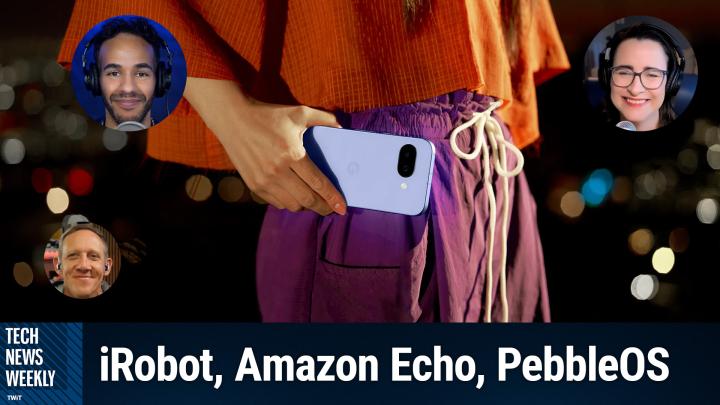
All TWiT.tv Shows (Audio)
Tech News Weekly 379: Google Unveils Midrange Pixel 9A
01:12:55
iRobot, Amazon Echo, PebbleOS Watch
Loading summary
Transcript109 lines
- [00:00]
Micah Sargent
Coming up on Tech News Weekly, Jennifer Pattison Tuohy of the Verge is here to join me, Micah Sargent. And we kick things off by talking about the state of Roomba and its future. Then we talk about the Amazon Echo, sending your recordings to Amazon and what you need to know there. Plus a conversation about the new Pebble OS smartwatches, and a great conversation with Jason Howell all about the Pixel 9amid range phone. Stay tuned for what I think is an excellent episode of Tech News Weekly. Podcasts you love from people you Trust. This is TWiT. This is Tech News Weekly, episode 379 with Jennifer Pattison Tuohy and me, Micah Sargent. Recorded Thursday, March 20, 2025. Google unveils mid range Pixel 9a. Hello and welcome to Tech News Weekly, the show every week we talk to and about the people making and breaking the tech news. I am your host Micah Sargent and I am joined on this episode on this, the third Thursday in March by Jennifer Pattison Tuohy. Welcome back, Jen.
- [01:21]
Jennifer Pattison Tuohy
Thank you. You know, I think I've been doing this for a year.
- [01:25]
Micah Sargent
It has been a year because it's.
- [01:27]
Jennifer Pattison Tuohy
My birthday tomorrow and I remember it was my birthday like the first day I did it. So I think it's been a year.
- [01:35]
Micah Sargent
Oh my goodness. Congratulations. Thank you for being here with us. It's been wonderful. It's been lovely. And of course it started out here and then I know you've been on Twit a couple of times at least now and we just, we adore you. So thank you for agreeing in the first place and for continuing to show up.
- [01:56]
Jennifer Pattison Tuohy
Always happy to be here.
- [01:59]
Micah Sargent
So as folks may know or if this is your first time tuning in, you don't know, we like to kick off the show with our stories of the week and Jen has actually a couple of stories of the week because there's a lot to talk about since you've last been on and I would love if we could kick off by talking about everyone's favorite, let's say kitty cat bumper car. The Roomba.
- [02:30]
Jennifer Pattison Tuohy
Yes, the Roomba. Roomba. Oh, it's been a week. Last week was my iRobot week. So I wrote three stories about this news because it really was in MySpace a there was a lot going on. So what started the week was iRobot, the company behind the Roomba, which is essentially like the Kleenex of robot vacuums, launched a whole slew of new robot vacuums, eight which they've never launched that many before. It was a big, it was a big Splash a whole thing. And they're interesting robot vacuums. Lots of price points, starting at like $300, going up to a thousand dollars and completely different from any Roomba that they had ever made before. So at the time I kind of went, huh, this is a whole new thing. And we if for backstory, if you're familiar, iRobot was about to be bought by Amazon a couple years ago and then that deal fell through because EU regulators were concerned that it would be anti competitive to all the other gazillion robo vacuum manufacturers there are out there. So iRobot was left in a kind of tricky spot after that. They had already been seen declining revenue and sales because of the competition. And then two years of are we going to get bought or aren't we going to get bought? Kind of killed their finances and the day and they fight. They had to get rid of their CEO, they laid off half their staff, they, you know, really retrenched. And so this was kind of like the big new splash. This is, these are our new robots. The next day they released their f. Their financial reports and said basically we're very close to going out of business. So literally the day after launching these and they end in the financial reports. If you dig down into them, their current CEO, who was pretty much brought in to sort of turn the company around, said unless these roombas, these new roombas are a huge success or someone buys us within the year, we will no longer be operating. So yeah, that seems wild. Yes, wild. I mean when you trace back all the pieces, you can sort of see how they got here. And just yesterday roborock, which is one of the other big manufacturers based in China for the first time overtook iRobot in global sales and shipping. So basically they used to have like 90 of the market. And over the years it's being whittled down and whittled down and whittled down until now while they've been knocked off the top spot. So it's been a journey for the company and the everything lies, you know, also the success, potential success of the company hinges on these new products which I looked at and said these are just like every other robot vacuum out there. They don't have anything notable, anything particularly exciting, a few interesting features, but nothing like, nothing like iRobot had been known for. I mean they invented this category they brought. I mean we would not have robot vacuums if it weren't for iRobot. I mean there had been like one before them, but they really did bring this category to Life and, and they invented the auto empty bin, they invented the robot mop. I mean, they are the innovators in this space, but they haven't been for a while for various reasons, I guess, obviously financial being one of them. And then consumers have been very much sort of trained, I think, by all the other manufacturers to really focus on like three features when you're looking for robot vacuum. One is lidar navigation, the other is suction power. And then price. And roombas have always been expensive, never had lidar and never published their suction power specs until last week. So they basically just kind of said, and the sub head for my first story was if you can't beat them, join them. And that basically seems like what a robot has said. So it'll be interesting to see whether they can succeed with these robots. But I'm a little disappointed because they do feel a lot like copycat bots and not really innovative. They have a lot of features that you can already find on most robot vacuums that they didn't used to have. So they've got these spinning mop pads. Whereas Roomba had invented this kind of neat mop that was like a robot mechanical mop. It wasn't the most effective mop in the world, but it, it was cool. And I was kind of hoping they would do more with it, make it better rather than just, okay, we're just going to do what everyone else is doing.
- [07:12]
Micah Sargent
So yeah, let's, let's look back because. So one might argue that part of this is, you know, the market working how it's intended to work in the sense that Roomba owned a hu. Huge part of the market and could charge a lot of money for the robot vacuums that it brought, you know, to market. And over time, as we saw others kind of play in the space and be able to drop those prices, I think it did make it kind of more difficult perhaps to justify spending more money on what IROBOT offerings were. And I guess I'm kind of curious why the company didn't move quicker to trying to at least get some, some models out there that were less expensive. It's like they were sort of stuck, stuck in your ways sort of situation. And now it's like at this desperation level now willing to do something about it is, is pretty, it's pretty rough.
- [08:25]
Jennifer Pattison Tuohy
Yeah, I think, I mean, robot vacuums really are becoming commodities. And the only way that people are really differentiating is by doing something crazy and new, which. And someone just dropped in the chat the robot vacuum with the arm, which we've talked about on the show before, is an example of that, which, you know, it's crazy, but also could work because the idea is it's going to pick up socks and shoes so that it doesn't, you know, it actually cleans up your house before it cleans, which that's an improvement. That's an evolution I'm interested in. But yes, I think, I don't, you know, I don't know. But from talking to Colin Angle, who was the previous CEO who founded the company, I mean, iRobot's been around for over 30 years. They had a lot of innovation, but I think they were focusing. It felt to me like they were focusing a lot on software, which. Which was great and it has improved their robots. They have. They are the ones that invented machine learning for the robot vacuum. So the poop avoidance came from roombas. Everyone else has adopted it now, but AI obstacle navigation in your home so it can detect it sees what's in your home and knows what to do about it. So it'll vacuum up the popcorn, but it won't vacuum up the poop. So they were focusing a lot more on like making the robots more intelligent, which is not really as easy to sell as we've got spinning mopads and we've got an arm and I feel like the hardware side, they kind of felt like, well, we've developed the robot, let's make it smarter as opposed to what else can we make the robot do physically? I don't know. I mean, that's. And they're very much about innovation and incredibly smart people. IRobot, amazing R& D team. I'm sure they have a stair climbing robot and mop spinning robots and all sorts of things in their labs, but yeah, they didn't bring them to market. They didn't provide enough depth, which is all the other companies. I mean, I. Roborock has, I think right now about 25 different models, which is like crazy. But it's working for them, obviously, so. And they did come out with a few cheaper models in the last few years, but they were still keeping off some of the most important features. Like their least expensive Roomba didn't have mapping, which is kind of like a core feature for any robot vacuum now. And so, yeah, the marketing, product execution just. Yeah, sadly, I don't think kept up with the software side of what they were doing, which I've always thought was really good. And hardware wise, they're great vacuums. They have these great dual or they do have these dual roll of rubber brushes, which I test robot vacuums for a living. I have about 10 in my house right now. And I've always found the roombas to be the most effective at actually getting dirt up, which is really the point.
- [11:18]
Micah Sargent
That's the whole point. Yes. It's not the arms and the this and the that. It's actually cleaning vacuum. Yeah, that's what it's supposed to be. Now, I, I'm curious, do you think that because I remember when Amazon actually, I think it was right before maybe even Amazon had kind of potentially put its hat in the ring for this acquisition, that there was a lot of talk, particularly in the tech space about Roomba and its mapping technology that it did have and how the company then had access to the maps of your home. And then with the thought of Amazon potentially acquiring the company, that went into a whole nother level of okay, now Amazon's gonna know exactly how your house is set up and this and that and the other. Did that, do you think that hurt the company itself? I think it's safe to say that it played a role in the acquisition aspect. But do you think it hurts Roomba or.
- [12:14]
Jennifer Pattison Tuohy
Yeah, I mean, that's why Amazon wanted them, in my opinion. I mean, iRobot has been around for a long time. They could have bought them at any point. They didn't need to. But what the software development is what made them attractive. I think that they were able to. They had developed. It was called the irobot IROBOT os. So they developed an operating system for their robots. And Colin Angle was sort of explaining to me how this could become a whole home operating system. And they had bought an air purifier company and their kind of sell was, you know, we, we know what's in the home, we know the rooms in the home. So we can help with the smart home. Like we can add that context that the smart home is missing. Obviously that with paired with Amazon started to fire up the privacy advocates, like, do we want Amazon having this data about our house? Will they. I wrote an article actually about saying iRobot, Amazon wants iRobot for your maps. I mean, that's basically. That was my theory anyway. And yeah, there's good and bad to that. If you can keep it private and keep it local, that context hugely important in the smart home. But on the flip side, a massive digital advertising company, Shop E Commerce Shop will be able to know, hey, that sofa looks a little old. We'll start sending you ads for new sofas and you Know that there was definitely concern there and I, I don't think that was the regulators were against that was more about competitiveness on Amazon selling robot vacuums. But all of these things combined I think did sort of create a cloud around the acquisition and it seemed to me like Amazon kind of gave up a little early. They could have probably fought for it and it was a real shame because iRobot obviously is now left in this very sticky situation. Yeah.
- [14:06]
Micah Sargent
And I don't know that, I don't know that it's a great idea to tell everyone that if these don't sell well, we're going under because we. Anybody who purchases an Internet connected or server connected or whatever connected device is always a little bit worried that what happens when the company goes under. Am I still going to be able to use this? Am I still going to be able to use these features? So I'm not rushing to buy any of these robots, you know, Roombas that the company has announced because what happens in two years when they don't work? I get needing to inform investors.
- [14:44]
Jennifer Pattison Tuohy
Yeah, I mean really wasn't like a public press. I mean it was a public press release but this wasn't one they sent to like the Verge. This was the one that went to like, you know, yeah, this is for the investors. But yeah, we read it and we're like, oh, it's not good.
- [14:56]
Micah Sargent
Yeah, it's very not good.
- [14:58]
Jennifer Pattison Tuohy
So you know, they've been around 30 years. There's a lot of infrastructure there. This isn't like a fly by night startup. It's if they go under, I'm sure they will have. Well, I don't think they're going to go under. They'll get bought.
- [15:10]
Micah Sargent
I do think so.
- [15:12]
Jennifer Pattison Tuohy
They'll either get bought or this will work and they'll be able to survive. I think the first option is more likely. I mean the Roomba name is worth a lot of money.
- [15:21]
Micah Sargent
Exactly, exactly.
- [15:23]
Jennifer Pattison Tuohy
So I'm not a robot.
- [15:25]
Micah Sargent
Could you see another robot company buying? Okay, that's what you think will happen? Not like an Amazon or an Apple.
- [15:31]
Jennifer Pattison Tuohy
An Amazon or an Apple. Well, an Apple might be able to, but no, Amazon's not be able to anything like Amazon won't be able to because of that competitive side. I don't see Google, Google's not been in the hardware business. Trying to get out of the hardware business for a while. I think it's most likely another robot vacuum company. Probably one of the Chinese. Possibly Ecovacs.
- [15:52]
Micah Sargent
I was thinking Ecovacs too. That's funny.
- [15:55]
Jennifer Pattison Tuohy
Which is roborock's biggest competitor and number three in the list of most bought robot vacuums. And actually I believe or at least ecovax a few years ago announced that they had some kind of partnership with ro. With Roomba around, they never went into specific details, but there's already some kind of a business relationship there. So it's possible that something like that's likely to happen. But there could be someone completely left to feel come in and and swoop up and take them off.
- [16:26]
Micah Sargent
Shall see.
- [16:27]
Jennifer Pattison Tuohy
But I wouldn't worry too much about not buying one because it will stop working next month that I think that's unlikely. I think they'll, they'll keep supporting the vacuums however they can, you know, for, for the future of the foreseeable future. And in theory these things can work without the Internet too. So I mean not in exactly the same way and that you lose a lot of features but you can just press go on most robot vacuums and they will just go in vacuum do their thing.
- [16:55]
Micah Sargent
Yeah that's T.R. all right. We do need to take a quick break. We're going to come back with another very important story for those of you out there who own Echo Devices, but I want to tell you about threatlocker, who are bringing you this episode of Tech News Weekly. Ransomware is harming businesses worldwide through phishing emails, infected downloads, malicious websites and RDP exploits. You don't want to be the next victim. ThreatLocker's Zero Trust Platform takes a proactive deny by default approach that blocks every unauthorized action, protecting you from both known and unknown threats. It's trusted by global enterprises like JetBlue and Port of Vancouver. ThreatLocker shields you from zero day exploits and supply chain attacks while providing complete audit trails for compliance. ThreatLocker's innovative ring fencing technology isolates critical applications from weaponization, stopping ransomware and limiting lateral movement within your network. With ThreatLocker, you know that it works across all industries, supports Mac environments, provides 24.7us based support, and enables comprehensive visibility and control. Mark Tolson, the IT Director for the city of Champaign, Illinois, says Threat Locker provides that extra key to block anomalies that nothing else can do. If bad actors got in and tried to execute something, I take comfort in knowing Threat Locker will stop that. So stop worrying about cyber threats. Get unprecedented protection quickly, easily and cost effectively with ThreatLocker. Visit threatlocker.com TWIT to get a free 30 day trial and learn more about how ThreatLocker can help mitigate unknown threats and ensure compliance that's threatlocker.com TWIT and we thank ThreatLocker for sponsoring this week's episode of Tech News Weekly. All right, we are back from the break, joined by Jennifer Pattison Tuohy of the Verge, who is here to help us all understand what we should be doing or maybe not doing, or how we should be feeling about the fact that some of us who said, you know, Amazon, I don't really want you to have my voice interactions with the Echo stored elsewhere is now saying, well, that's just too darn bad. Tell us what's going on here.
- [19:18]
Jennifer Pattison Tuohy
Yeah, so there have been a lot of headlines like, oh my God, Amazon is sending everything you say to Alexa to the cloud. I'm like, dudes, it always was. Except if you had one of these three Echo devices which did have the option to say, okay, I don't want my voice recordings going to Amazon's cloud. I'm going to turn on do not send recordings to the cloud. And then only the transcript of what you asked the device would be sent to the cloud. And that would be then let it do whatever it wants.
- [19:56]
Micah Sargent
Let me ask you repeat that please, because what you have just said, or maybe you can confirm for me what you have just said is, yes, your voice recordings are not going to the cloud, but even in those instances, a transcript of what you were saying was still going to the cloud. Is that correct?
- [20:13]
Jennifer Pattison Tuohy
That's correct.
- [20:14]
Micah Sargent
Yeah. Yeah, so.
- [20:15]
Jennifer Pattison Tuohy
So I mean, yeah, it's just not keeping your voice. And I, a lot of people, I can see why you might think, oh, I'd rather it doesn't have my voice. But yeah, it still knows what you're saying. It's just not in your words, not in your, sorry, not in your tone and intonation, but just written. So because Amazon devices don't process commands locally in most cases, there are some instances if you have local smart home control, zigbee devices, thread devices, Matter devices, it can do things locally. But all of the voice commands have. There's no on device voice processing. So what this feature did was limit how much voice limited your voice from going to the cloud. Some queries still did have to go to the cloud for various reasons. There's very detailed descriptions if you read through Amazon's privacy policies. But yeah, you had the option to say, I don't want my voice recordings going to the cloud on three devices, Echo Dot, 4th gen, Echo Show 15, 1st gen and Echo Show 10. And as of March 28, Amazon has said this feature has just been turned off and if you opted in, it is now going to send your voice recordings to the cloud automatically. And the only option now, well, it sends your voice recordings to the cloud automatically, but will then delete them as soon as they've been processed, which is an option you've always had. So you could have always been able to go into your Amazon Alexa settings and turn off so you can choose for how long it stores your voice recordings for. One of those options is never. So. But, you know, obviously there's still concern because they do have your voice recordings and if that's something you didn't want, now you have no option to get for them not to have your voice recordings. So if you are going to, if you have any of these three devices and you had that option turned on automatically on the 28th, it will switch to delete your recordings. If you don't like that option, then really your best option is to stop using them because there's no other way you're going to be able to. I mean, all the, all of the processing is done in the cloud and Amazon is saying that this change has been made on these three devices because that Alexa AI, Alexa plus the AI generative AI powered version really does require processing in the cloud. And that is coming at the end of March, which may be March 28.
- [22:48]
Micah Sargent
So the local processing was. This is why it's these specific devices, because they had the processor, they had the ability, right, to do local processing. That was a selling feature of those devices. And something that I think some people perhaps thought, okay, I can rely on my local network and not have to send anything to the cloud. Do we think Amazon's kind of just casting aside the local stuff now or. I can tell you a lot. Yeah, tell me what's going on.
- [23:23]
Jennifer Pattison Tuohy
It's very, I know it's very confusing and complicated. So the local processing of smart home commands, I don't think is going away. That's because these devices have local, not these three devices. A number of Amazon Echo devices have local radios. So like zigbee Thread matter, for a long time that wasn't being processed locally, it was still going up to the cloud. But recently I think with the Echo Hub launch and the more powerful chip in newer Amazon Echo devices, off the top of my head, I can't remember the name of it. It's like a Z something or other. But the ones that have that Z something or other chip have the ability to do more of this local processing, but it's local processing of the commands from the device to the Hub, not of your voice going to the cloud and back down. So, yeah, so now that's not an option anymore. Obviously everything is going to the cloud, which it was before, as you mentioned via transcript. So this isn't actually that big a change, but it does make for a.
- [24:32]
Micah Sargent
Good headline and that is what it is. Right? That's, that's the big thing. So I guess then again, if. So you're saying every device, well, every Amazon Echo has a setting that you can tell Amazon, fine, you get my recordings. But how long are you storing them? Don't delete them after you're done Correct processing file.
- [25:00]
Jennifer Pattison Tuohy
You can do that with any Echo device. Yes.
- [25:02]
Micah Sargent
And that will continue to be available to people.
- [25:06]
Jennifer Pattison Tuohy
Correct.
- [25:07]
Micah Sargent
Okay, so everything's going to be okay.
- [25:11]
Jennifer Pattison Tuohy
If you're okay with your voice going to the cloud, because once it's at the cloud, you have no longer, obviously have no control over it anymore. So Amazon says they will delete it and we have to. If you have an Echo device and you trust Amazon, then you. That's part of the trust. Like they said, they're going to delete it, they're going to delete it, but as soon as anything leaves your home and goes up into the cloud, it's automatically already more vulnerable, even though Amazon does have secure encryption and lots of, you know, they have very detailed privacy and security policies on their websites that you can read. But it's a trust. There's always going to have to be a trust, a level of trust that you have in Amazon if you're using their devices.
- [25:53]
Micah Sargent
Yes, understood. Now, I think the big thing with the Alexa that's coming is the fact that obviously it's got to do a lot of processing of your data of, you know, calendars of all of that. And I'm curious, kind of just from your perspective, because one thing that we kind of have to do as, as, as tech folks is give over a certain level of privacy for the sake of being able to test these things and understand how they work and also what the privacy implications therein are. Are you at a point where you kind of are willing to say, look, it's either privacy or it's using features like this. You can't have your cake and eat it too. Or is there a way to find some kind of middle ground? Do you create a specific calendar that you sort of like copy everything over to and that's just your Amazon calendar so it doesn't have access to. You know what I mean? How do you go about finding a middle ground or do you really feel like there is one that's worth it?
- [27:05]
Jennifer Pattison Tuohy
So in the smart home, it's a whole different ballgame I think from having our phones or having our Google email Gmail. I mean it's, there's a cost benefit ratio with technology and privacy. You know, how much value I get from a product versus how much I have to give. And I know I've heard on this show many times on the Twitter network, you know, if you're not paying, you are the product, right? So you know the, if you use Gmail, the free, excellent Gmail. But you are giving a lot to Google. If you use a smartphone, you're obviously paying for that. But there are potentially, you know, that's got a speaker and a microphone built right in that you're carrying around all the time. But again, but both of these things are personal devices. So you are putting the onus on your privacy when you start bringing things into the home, unless you live alone. Even if you do live alone, when you bring visitors to the home, you know, you, the privacy is not just about you anymore. It's about your entire household. So that's where I think that that payoff becomes a lot harder to evaluate. And you know, my family unfortunately kind of has to deal with it so that they can go to colle. But yeah, I do, I do. I'm definitely mindful of their privacy when, you know, dealing with this, these types of devices in our home. But it is, it's, yeah, it's about, it goes back to trust. If you trust these companies, then you can, you know, that's, that's your choice. But again, does your family, is it your family's choice? Is it the people in your home's choice? And then you, you have to, you have to weigh that, the convenience though. And I think this is where generative AI and Alexa, Alexa may help tip that balance for a lot of people because to date the smart home hasn't really been quite as convenient as it had been promised. And I think with generative AI in the smart home, we are going to see things get a lot easier. So we may feel more comfortable with that payoff. And to their credit, companies like Google and Amazon and Apple do try, are trying very hard to convince us and show us how they are protecting our privacy. But again, no matter how hard a company tries to protect things, once you put things out there on the Internet or connect things to the Internet, there is a vulnerability there that you always have to be aware of.
- [29:41]
Micah Sargent
Absolutely. I think that's well said. Well, you know, be prepared, everyone, as this changes and know that again, you can have your, your those immediately deleted after they're kind of processed. So that is a possibility for you. We are going to take a quick break before we come back with a quick story of the week from yours truly before we say. And then we'll say goodbye to Jennifer Pattison Tuohy. But I want to tell you first and foremost about Delete Me, who are bringing you this episode of Tech News Weekly. If you've ever searched for your name online and kind of had that cringe emoji face, yeah, you probably didn't like how much of your personal information was available. Maintaining privacy. It's not just a personal concern, though. It's a family affair. We were just talking about this on the show that, you know, privacy involves the whole family. And unfortunately, when you've got someone in your family who's a little more public, like again, yours truly, then suddenly when people are looking me up, they're starting to find all of the other people that I know and they're finding my mother, my grandmother, my father, my uncle. It's not fun. With Delete Me's family plans, you can ensure that everyone in the family feels safe online. Delete Me helps reduce the risk from identity theft, cybersecurity threats, harassment, and more. You know, going online and looking myself at what was there was not fun. And using Delete Me to get rid of a lot of that information was a lot of fun because it felt like I was taking a step back and saying, no, you don't just get to post all of this stuff online and make it available to everyone. One, that's ridiculous. So getting to say, yeah, you get to stop having my data. You get to stop having it. You get to stop having it was wonderful. Delete Me. Experts will find and remove your information from hundreds of data brokers. You can assign a unique data sheet to each family member that's tailored specifically to them. With easy to use controls, account owners can manage privacy settings for the whole family. So, you know, if a family member doesn't really know what they're doing with this, don't worry, you can take care of that for them. Delete Me will continue. This is the important part. Continue to scan and remove your information regularly. Because, yes, these data brokers will continue to scoop up that data and make it available regularly. You can make sure to have addresses, photos, emails, relatives, phone numbers, social media, property value, and more taken care of and removed from these online locations. So protect yourself, reclaim your privacy by going to JoinDeleteMe.com twit and using the code twit twit. That's JoinDeleteMe deleteme.com twit and code twit t w I t for 20% off. Thank you DeleteMe, for sponsoring this week's episode of Tech News Weekly. All right, back from the break and it's time for my story of the week. Recently I had on Eric Majakovsky who joined us to talk about how Google had open sourced pebble os, the operating system behind the pebble smartwatch. And during the show he revealed that he was planning to bring the pebble back to market. For those who aren't familiar with the pebble, it was a sort of as a Kickstarter project of an E Ink smartwatch and boy howdy did I hop on board. I thought it was the coolest thing. I still have my pebble to this day. I don't think the battery works anymore, but I do still have it as sort of a sort of moment in time. But, but Eric revealed on the show that as one of the creators of pebble, of course he had several pebbles that he had in his little pebble vault. And so over the many years he has just anytime a Pebble went kaput, he would just get a new pebble out of his vault and be ready to go. To this day still uses pebble, but he was starting to run out of pebbles and said, I think it's time for the pebble to make a return. Well, the company has officially announced the introduction of the Core 2 Duo, which is a hilarious name, and the Core Time 2, which are two E paper or E ink display smartwatches. The Core 2 Duo has a black and white E Ink screen. The Core Time 2 has a 64 color E Ink Ink screen so you'll actually be able to see multiple colors. The Core Time has a touchscreen and it has a heart rate monitor and the sort of lesser or the inexpensive, the less expensive model. Excuse me. The Core2 duo has a plastic frame of polycarbonate and then a barometer and a compass built in. They both offer 30 day battery life, IPX8 water resistance, step and sleep tracking, a little microphone and a speaker. Of course it has the open source Pebble OS so you can tinker and play with it as much as you want to. And the thing that always made it stand out in comparison to the Apple Watch and some other smartwatches. 10,000 plus watch faces available for your Pebble. I wanted to ask You, Jen, if you, back in the day, got a Pebble, were interested in the pebble and what you think about these new pebble watches that have been made available?
- [35:23]
Jennifer Pattison Tuohy
Yeah, I was. So when did it come out? Like 2000? Was it 8?
- [35:28]
Micah Sargent
Let's see. It was 2012. 2012 was when.
- [35:33]
Jennifer Pattison Tuohy
So it was a long time ago. Yeah. And I remember being interested, very interested. But I was iOS and it's never worked that well with iOS, although at the time there weren't really alternatives and I just. Yeah, I never pulled the trigger, but I was interested. I love the idea of the smartwatch and I did get myself an Apple Watch pretty much shortly after they launched. And I. Yeah, I think. I think it's neat. I love the sort of resurgence of tech. I love how all we're talking about in this episode is tech that's been around for a while. Yeah. But, yeah, I think it's great that I was reading through the piece and he's like, I've actually found a supplier that still had some of my old pebble stuff. Like, this is great. We're able to recycle all of. Reuse all this stuff. I know there's had a rabid fan base who. And many people in my office are very excited about its return. I'm not sure it's. There's enough in there to compel me to switch from my Apple Watch. So I'm afraid.
- [36:39]
Micah Sargent
Yeah, I'm with you. I'm with you on that.
- [36:41]
Jennifer Pattison Tuohy
I think if I was an Android user, I'd be. I'd be very interested.
- [36:44]
Micah Sargent
Be much, much more interesting. Yeah. So this is actually one of the things that Mizikovsky and the team at Core Devices kind of talked about a little bit, is it is difficult on, unfortunately, on iOS to be able to integrate to the level that the Apple Watch is able to. Don't tell the eu. They might start looking and so do tell the eu. Yeah, exactly. No, but for real do, because, yeah, the. The Apple Watch gets these kind of deeper connections to the iPhone, where maybe the Bluetooth is a little more chatty and the conversations that are taking place are a little more lengthy and in depth, and every other kind of Bluetooth peripheral has to sip a little bit from the available connection. And so that does make it difficult. It makes it where you have to either do more on the watch itself or, or you have to just go, okay, it's going to be a while before this gets, you know, before it reaches your device. And that's troublesome. That should not be the Case that again, yeah, as Jen was saying, do tell the eu, because there are lots of third party devices out there that potentially could be better for us as iPhone users if they were able to have as much of that deep connection as the Apple Watch does have. So, yeah, I mean, I think that, that frankly, even if for me, this watch had as much of the connection as the Apple Watch did, I'm still a big Apple Watch person. I like, you know, I'm used to it by now. But as a person who likes to tinker and play around, the fact that, you know, Pebble OS is open source means that, yes, that's great. Yeah, you can modify it, you can change it. And that, I think was always the initial, the initial sort of interest in pebble in the first place, where it was different from what you had at the time and you could do more with it. And I think that's very exciting. I think that's what's going to get the folks who were interested in the original into this one as well. And in that way, you know, I hope that it's enough of a success that the Court of Isis team continues to get to make cool stuff, because I, I always thought that this product was unique in its quirkiness. That just was what made me kind of fall in love with technology in the first place. And so, yeah, it'll always have a kind of special place in my heart as far as that goes. Right.
- [39:24]
Jennifer Pattison Tuohy
And I like the newer one. Or is it the Core two, the one that's coming out later and how thin it is. I think that's really nice. Did pebble ever really have any. I mean, it wasn't really a thing when pebble launch, but did it ever have any kind of smart home integration? I wonder if that's something that might be new this time around. I could see Home Assistant and Pebble OS just having the weather.
- [39:46]
Micah Sargent
That's a good point. I don't remember it having anything like that. I only ever had the Kickstarter one, so I didn't have the one where the company created it later and it was more powerful. That was called the Pebble Time 2. So in that way, I'm not sure if that was ever added, but yes, you absolutely could see that being part of it, these two playing together.
- [40:10]
Jennifer Pattison Tuohy
Yeah, I think that could be fun.
- [40:12]
Micah Sargent
Yeah. So we, you know, we'll keep an eye on this. The they are available for pre order. The Core 2 Duo is $149 and starts shipping this July. The Core Time 2, that's the skinny one. Yes, that will come out.
- [40:28]
Jennifer Pattison Tuohy
Actually they're both quite skinny. And that has the touch screen right the time.
- [40:31]
Micah Sargent
Yes, that has the touchscreen. That'll come out in December number or you know, that's the estimate and is $225. I love an E. A color E ink display. Just that technology is fascinating to me. So it's really cool that they've worked that in. And yeah, now I'm imagining, you know, using the. The step tracker, the sleep tracking and all of that in combination with Home Assistant and just all the weird things you'd be able to do would be pretty cool.
- [41:03]
Jennifer Pattison Tuohy
That could be really fun. That reminds me though, I didn't. We didn't talk about this in the last one, but for local voice control, Home Assistant has a local voice controller if anyone's looking for an alternative. I've been testing this. It's the Home Assistant Voice Preview edition. So it's still very much in. They would say beta, I would probably maybe say alpha. But you know, Home Assistant, there's a lot of work going on furiously in the background there. So I can see that this could be a good product down the line. It's still is. It is now if you're willing to sort of do the work which you kind of have to always do with Home Assistant. But that's part of the fun.
- [41:40]
Micah Sargent
Does it. What's it. Is it running an LLM to understand what you're saying?
- [41:45]
Jennifer Pattison Tuohy
So no. So it is all completely local. If you want it to be. You can connect it to an LLM and to the Internet to do more advanced things, but it can just control any devices you have connected to your Home Assistant smart home. And it can do things like set timers, you know, basic things, add things to shopping lists. But it also, if you want to just keep it entirely local, but you can also connect it to the Internet and to get more capabilities into LLMs and all sorts. I mean it's Home Assistant. So you can do. You can do a lot with it, but it's a neat. It's a neat little device and you can actually plug it in. Has. Has an AUX out port. So it does have a speaker in it, but it's not a very good speaker. So if you wanted to. Or an AUX in. I don't. Which. So you can plug it into something you used to be able to do with Echo Devices but they took away. You can plug it into a better speaker and get it to play and.
- [42:39]
Micah Sargent
You could imagine if you've got a home that's got speakers. Then suddenly that voice, your little home assistant voice could be everywhere or like the responses that come from it.
- [42:48]
Jason Howell
Which is cool.
- [42:49]
Jennifer Pattison Tuohy
You can call it Jarvis, which is.
- [42:52]
Micah Sargent
That is fun. So does it, does it respond out loud at all or is it all just listen?
- [42:58]
Jennifer Pattison Tuohy
It does. It has a speaker and a microphone.
- [43:01]
Micah Sargent
Oh, that's right.
- [43:01]
Jennifer Pattison Tuohy
It does have a speaker and it does. And I think you can customize a lot. You can customize your wake where there's all sorts of things you can do with it. So but for just. If you just want a voice assistant to control your home and you use a home assistant, which actually is relatively simple to get set up with for the basics, it is a good option because it doesn't go to the cloud. It keeps it all local.
- [43:23]
Micah Sargent
Oh, and it's got a grove port.
- [43:26]
Jennifer Pattison Tuohy
Oh yeah. So you can, I mean you can add all sorts of things to it. And it has a mute button if you don't want it to be listening, which Amazon Echoes do as well. You can shut those off whenever you like. I always have mine on mute. Otherwise every time I talk to you, my whole room goes crazy. But yes, I've written. We've. We have. There's an article on the Verge. We wrote about this a couple when it came out and about. Say it came out just before the end of the year. I'm trying to remember. It's been the time flies. I think it was before ces. I kind of do everything before. Before ces, after CES in my mind.
- [44:06]
Micah Sargent
Right, yeah, that's your, your timeline. Does it get updates regularly? Yeah, I know Home Assistant does this device specifically.
- [44:15]
Jennifer Pattison Tuohy
Let me see where I'm trying to pull up my article real quick. Here we go. Yeah. Hey Jarvis costs $59. You can. Hey, Jarvis is one of the weight words but there are others that you can, you can choose from and they say they're working. I mean they've been. They worked for this on this for many years. Home Assistant did sort of have voice integration before, but it was a very different. This is sort of an all in one plugin package. So you don't have to do sort of any coding on the back end as. As you can do on with a lot of Home Assistant if you want. It has its, its current voice. Wake up. Words are okay. Naboo. Nabu Casa is the for profit arm of Home Assistant.
- [44:54]
Jason Howell
Oh, gotcha.
- [44:55]
Jennifer Pattison Tuohy
Hey Jarvis. Or Hey Mycroft. So you can just tell how many nerds put this thing together.
- [45:02]
Micah Sargent
Hello. That's funny.
- [45:05]
Jennifer Pattison Tuohy
So it can run locally without an Internet connection on Home assistant hardware. So you would need like the Home Assistant green which is their hub and. Or you can use the cloud. The cloud does have more. Is faster and supports more languages. This actually supports a ton of languages which was kind of one of the things they wanted to do because Home Assistant is such a big global community and yeah, so it's very much a. Just designed primarily for controlling smart home devices. But it will do things like you can ask things like what's the weather and that kind of stuff. If you connect it to the Home Assistant cloud, it's still, it's still. I said it's still in beta. Really. That's what the preview edition stands for. So I'm assuming we will see more models coming down the line. But yeah, it's a good option. Like I said, you can connect it to supported AI models like ChatGPT and Gemini to sort of give you more of a fully featured voice assistant in your home. Which actually we did. We didn't cover this. But speaking of voice assistants, I don't know if you've covered this elsewhere but pour one out for Google Assistant who's going away and we're getting Gemini on our voice on our smart speakers here sooner rather than later it sounds like. So that'll be an interesting.
- [46:24]
Micah Sargent
I think it's good to have a one word name. That's good.
- [46:28]
Jennifer Pattison Tuohy
I do too. I always hated the hey Google. I really wanted to change that. It was the only one that doesn't let you change. Actually. No, you can't change. Well, you can change Siri because you can change it to just Siri.
- [46:39]
Micah Sargent
Yeah, not Siri first.
- [46:41]
Jennifer Pattison Tuohy
Yeah, sorry Siri. No, go away. I'm not talking to you.
- [46:45]
Micah Sargent
Yeah, you can whisper it so quietly and all the home pods in the house light up. It's ridiculous. Jennifer Pattison. Tui, I want to thank you so much for taking the time today to be with us for an extra bonus story of the week there at the end. Of course folks can head over to TheVerge.com to check out your work, but where else do they go to keep up to date with what you're doing?
- [47:06]
Jennifer Pattison Tuohy
That's the main spot. Occasionally do a few social videos on the. On the Tiktoks and the Instagrams on the Verge account. So yeah, that's. And we do have. If you're interested in smart home, we have something called a smart home story stream on the verge where all of the stories we post about the smart home are on not that one page. So you can Just ignore all the boring stuff about computers and laptops and phones and just focus on the smart home.
- [47:31]
Micah Sargent
Awesome. Thank you so much. And we'll see you again next month.
- [47:35]
Jennifer Pattison Tuohy
Okay, bye.
- [47:36]
Micah Sargent
Bye. All righty, folks, we're going to take another quick break. Before we go to our interview this week, I want to tell you about Veeam, who's bringing you this episode of Tech News Weekly. You know the rhyme by this point. Without your data, your customers trust turns to what? Digital dust. That is why Veeam's data protection and ransomware recovery ensures that you can secure and restore your enterprise data wherever and whenever you need it, no matter what happens. I told the story a couple of weeks ago, but I had a friend who works in IT and he was climbing through the archives in the basement of this building looking for actual server tapes so that he could do data recovery because of a ransomware issue. The fact that he had to, you know, you know, dig into old boxes and get past the dust, that's exactly what we're talking about there. You need something that's going to help keep your data protected. As the number one global market leader in data resilience, Veeam is trusted by more than 77% of the Fortune 500 to keep their businesses running when digital disruptions like ransomware strike. And that is because Veeam lets you back up and recover your data instantly across your entire cloud ecosystem system, proactively detect malicious activity, remove the guesswork by automating your recovery plans and policies, and get real time support from ransomware recovery experts. Data is the lifeblood of your business. So get data Resilient with Veeam. Go to Veeam V e e a m.com to learn more. And we thank Veeam for sponsoring this week's episode of Tech News Weekly. All right, back from the break. And a familiar face is. Or voice, depending on. If you're just listening. Listening to. This is about to hit your airwaves as I had a conversation about Google's new mid range Pixel device. I am very excited to be joined by our next guest to tell us all about what we can expect from Google's budget phone. Yes, we shall see. It is Android Faithful's Jason Howell. Hello, Jason.
- [49:52]
Jason Howell
Oh yeah, good to see you, Micah. Thank you for the invite. Yes, yeah, Google does cool things in the mid range. Continually speaking with their A series and there's a little bit of an interesting twist with the latest device that they've just announced.
- [50:07]
Micah Sargent
Absolutely. So yeah, the Google Pixel 9a. I just had Some friends asking me, they're Samsung folks and they're thinking about upgrading their phones, their older Samsung devices. And I had trouble because I said, you know, I know that, that the Pixel team internally maybe has gotten a little bit smaller over time and we've seen some shifts there. But if you're wanting to try something new and different from what you've expected, like if your reason for getting a new phone is partially because you want something new, maybe look at the Pixel line, the great cameras are always a factor and then maybe later on down the line you pivot back to the Samsung devices whenever that, you know, your next upgrade part comes. But, but at the time the Pixel 9a I didn't even know was rumored. Now we know it is here. Where does the.
- [50:57]
Jason Howell
With an asterisk. Here with an asterisk.
- [51:00]
Micah Sargent
Exactly. So let's first talk about what the latest round of Pixels in general provide and then get it specifically into the 9a as this mid range. And if it's typical, as I think we know it is, for Google to kind of hold off a bit of time before that mid range device hits the market.
- [51:22]
Jason Howell
Yeah, Google definitely does put some space between their kind of their flagship lineup, which I think happened last October with the Pixel 9, the Pixel 9 Pro, Pixel 9 Pro XL, also the Pixel Fold. I don't know, is it Pixel 9 fold? I can't even remember. It's hard for even me to keep it all straight. But those are the more premium devices, similar to what Apple does though they've got Google's tensor G4 chip in all of those devices. Apple doesn't have the tensor G4, but of course Apple includes often the same processor in all of their phones for the current generation, be it the low end to the high end or whatever you want to call it, the Apple universe. In the Google universe, it's like we've got those devices from October rocking the, the tensor G4 made by Google and now this new A series Release, the Pixel 9a, which is not their first time doing mid range. They've been doing this for years now. But this one also has the same tensor G4. And I think that kind of a little bit of the struggle has been in the last couple of years as Google's been doing this kind of doing chip parity between those devices and the A series Mid Ranger is okay, well what is the difference here then? Because they all more or less are going to perform relatively closely to each other. So how do you differentiate? And you know, so you end up seeing little Bits of differences in the camera, you end up seeing maybe a little bit less RAM that. That sort of stuff. But I think in general, Google has done a pretty good job kind of separating the. The reason or the need for someone to go with the Mid Ranger versus spending $300 more to get a Pixel 9 as an example.
- [53:10]
Micah Sargent
Yeah, that's one of the things that kind of sticks out to me, I guess, as a positive, is the kind of delineation where you can look at all aspects of it. Right. It's price, its specs, its sort of look and feel, and everything in between. When it comes to the 9A, what are we talking about as far as color? Are you excited about the color you. In the grand scheme of the differences between your side and my side, the colors on Apple's side tend to be pretty muted. And I know that's been a complaint in the past. We've seen some great color options from Google in the past. Are we rocking that same sort of feel this time around?
- [54:01]
Jason Howell
Yeah. Well, I mean, they certainly have a couple of punchier colors. Right. The Peony, for example, is the really kind of, I would say the pinkish hue. And I've seen the Pixel 9 series, obviously not the 9a. I don't have that yet, but I've seen the 9 series in that peony color. And it is a really dazzling color to see in person. Like, it's really punchy, it's really bright, colorful, kind of brings a smile to your face. It's just an enjoyable color. Right. And so you've got that. And you've also got Iris, which it, you know, by comparison, is kind of more of a muted purple. And then you've just got your white and your black, whatever they happen to call it. Porcelain. Sorry. And obsidian, which, you know, are just your standards there. So, I mean, do they have a wide breadth of different color options? No, but they've got a couple in there to give you a little bit of a punchy color, if that's what you want.
- [54:54]
Micah Sargent
Got it. Got it. I guess then my. My next question would be, who is this phone for in terms of looking at the premium devices that Google has already announced and this device, I mean, it's obvious to say that somebody who's truly looking for a budget device can look here or lower. But I guess I'm sort of asking more on the cusp of things where you could maybe go up in price and get something that's more. Or you could.
- [55:31]
Jason Howell
But why would you.
- [55:32]
Micah Sargent
Yeah, but why would you. Exactly. Yeah. What's what's the you're, you're fine where you are kind of. Yeah. Position.
- [55:41]
Jason Howell
Yeah. I mean I wish that it was easier to answer that question because I think that has also been a little bit of Google's challenge the last couple of years is as things find more parity between them as the processors. The same with the A series versus the, you know, the step up to the full, you know, as the cameras like the AI processing happening on the device is very similar between the devices. It becomes less and less obvious why someone would choose to spend $500 or $499 for the 9a versus I think it's 799 for the Pixel 9, not counting any sales which Google has a lot of those on the upgraded. And, and I think most of the time it comes down to, you know, you do get a little bit extra ram and so that RAM coupled with the processor can make certain aspects of the phone operate better. Especially if you're really interested in the artificial intelligence stuff that's happening on device that's important. But also camera. I mean really at the end of the day, you know, on the 9A you only get two, two cameras which, you know, they're probably pretty great cameras. I haven't tested them myself. 48 megapixel primary, 13 megapixel ultra wide. So you get some variety and some options there. It's just on the step ups, the steps up, step ups, steps. Yeah, you get probably a little bit more capability out of those cameras and I'm sure there are other things. I mean the 9A is notable because it has the largest battery of a pixel to date, 5100 milliamp hour battery. So if battery life is important to you, you get that. I think another thing that's really interesting here, here it might not be interesting to many people, but it certainly is to me is that the Pixel has, mine has a case on it right now. But this is the Pixel 9 Pro and it has the kind of rounded protruding camera island or bump or whatever you want to call it. And on the 9A this is the first of the kind of current signature era that Google is in where it doesn't protrude anymore. It's not a box are it's a single like couple of cameras in a kind of like an oblong pill shape hardly popping out from the device at all, which is a really big signature change for Google's design design approach. And I'll be curious to see what this means for the 10 beyond is this just an A series characteristic. You know, a lot of people like like it may sound silly, but a lot of people like to have that bump there so so that it makes it easier to hold your finger kind of lodges into the camera bump and it won't fall out of your hands. It also allows for a larger sensor. I know the sensor on here is a smaller 1/2 inch sensor. That's why they could get it a little bit more compact. So probably the picture quality is going to suffer, at least to some degree. It might still look great, but it's probably going to be a downward kind of mark. Just for that reason, we're going to.
- [58:40]
Micah Sargent
Take a quick break so I can tell you about our next sponsor on the network. It is Melissa, who are bringing you this episode of Tech News Weekly. Melissa the Trusted Data quality expert since 1985 with Melissa's launch of the Melissa Address Validation app and the Shopify App Store, Shopify plus merchants now have access to a critical data quality tool directly from the Address Expert. Key features of the Melissa Address Validation app include real time address validation so customers are immediately notified if the address they enter contains errors or needs correction, preventing shipping delays and reducing return rates, plus global reach. The app validates addresses in more than 240 countries and territories, standardizing them according to local postal regulations. Enhanced Address Correct so even if Google Auto Suggestion is enabled, Melissa's app can correct and standardize addresses, adding missing components such as postal codes and ensuring compliance with local formatting rules. I love that because we've got these tools that automatically pop things in for us, but maybe whenever we said yes, save it, we saved something that's not exactly precise. Melissa's app can come along and say here is the precise version of that. You also get Cass and Serpent certification. The address engine is certified by USPS and Canada Post, offering reliable validation for North American addresses and smart alerts. The app provides a warning on the thank you page if there is a potential issue with the shipping address, allowing customers to update their information before the order is processed, doing everything possible to make sure the address is correct, as it should be. Shopify plus merchants can easily install the Melissa address validation app to improve customer satisfaction and avoid the costs associated with returns and redeliveries. With Melissa, you get secure encryption for all file transfers and an information security ecosystem built on the ISO 27001 framework, adherence to GDPR policies and SoC2 compliance. So get started today with 1000 records cleaned for free@melissa.com Twitter that's melissa.com TWiT and of course, we thank Melissa for sponsoring this week's episode of Tech News Weekly. I love this idea of having the biggest battery here that you. It's a real acknowledgment of the priorities of different price points as opposed to being, you know, we're doing less and less and less and less as you go down in pricing. Right. That it's, it's a mixture of, of things that you're kind of sort of. Yeah, I don't know. That shows an awareness that I sometimes guess feels lacking whenever it comes to the design of budget devices in particular, where it's just kind of like, where can I cut costs here, here, here and here? No, let's also look at the priorities of what someone who typically goes for one of these devices is after. That's great. Great.
- [61:51]
Jason Howell
I mean, I think that's always the consideration when you're talking about mid range, especially when you're coming down from premium to mid range. You know, when you're going to low range, you know, the lower end, you're really cutting things. And people expect that in the mid range there's still an expectation that it's going to, you know, still at least in today's day and age. You know, it didn't used to always be like this, but in today's day and age, the mid range, you still expect it to do certain things really well. It's just not going to do everything really well. Like for example, I find it pretty surprising that the 9A series supports wireless charging. I always consider wireless charging to be like a really great trade off for bringing the price down because it's not necessary. It's not necessary. Now true wireless charging fans might argue with me on that. Like I see it as kind of like a luxury but not a necessity personally. And so if you need to bring the price down, that's a good thing in my, in my book to get rid of. But yet the 9A has wireless charging. So it didn't get rid of that still has the seven years of support, which is pretty excellent, but also makes a lot of sense if it's using the same processor. The tensor G4. Yeah, I mean, I think in general Google, my opinion is that Google has done a really good job of understanding that their mid range devices need to do certain things pretty darn well. That's just the reputation that they build up around them. It's not going to do every single single thing that you expect because it is mid range. They've got to make sacrifices. But I see Time and time again, Google makes the right sacrifices.
- [63:23]
Micah Sargent
Absolutely. Yeah. That's, that is a good look. Now let's talk about the not so good look. We know that this is supposed. We talked about an asterisk earlier. What is the asterisk when it comes to the Pixel 9a and its shipping?
- [63:42]
Jason Howell
Yeah, well, so it was just announced at the time of this recording is Wednesday. Right. And you know, it was just announced this morning at the time of this recording and it was supposed to be up available for pre order right away. This is usually what Google does when they announce their hardware. They have it available for pre order. Certainly with the A series, that's been the case. I know as a product reviewer, I was expecting to receive this device by the end of the week so that I could start testing it it and you know, start preparing my review and everything. But all that changed very suddenly. They still went ahead and announced it this morning, but then they kind of followed it up to basically say that they're delaying the shipment until sometime in April. No firm date. You can't even preorder it yet. That's the weird thing. It's kind of like, okay, like I could understand if you're, if you're pushing the delay until April, but what's going on that you're still not even going to let people pre order? That's a little fishy. Who knows what it is? It's all speculation at this point. You know, Google has not shared exactly what it is other than to say that it's a component quality issue. I think that's their words they say, affecting a small number of Pixel 9a devices. And you know, my, my point here is not Google shouldn't delay. You know, you should push through if there's issues. Not at all. You got to do what you got to do. But it is a little suspicious. Like, I'm really curious and I think part of my suspicion is born out of the fact that Google has just gone through and still continues to go through a very weird situation with Pixel 4a owners where suddenly, you know, these 4a owners got this notification to do a system update that would impact their battery health or whatever. When they did that, they found their battery longevity dropped 53% and it just kind of cut more, more than in half half. And ultimately Google was not revealing why that was. Eventually Australian press had to out Google that there were known to be fire issues with, with certain models of that device. Google still, to my knowledge, not addressed this. And so I've got a little bit of that on my mind where I'm like, there's, there's these, a couple of these things that are happening right now where Google isn't really being seemingly forthcoming about it. And that concerns me a little bit because that's not you, that's not them, not when it comes to their hardware. It's very different. I'm not saying this is what's happening with these phones.
- [66:07]
Micah Sargent
Right.
- [66:07]
Jason Howell
That it's a fire issue. I truly do not know. But it's. The timing is just like it's not. It makes me a little suspicious.
- [66:13]
Micah Sargent
Right. And I think it would make anybody feel a little bit that way that if you, if you've got that full context.
- [66:18]
Jason Howell
Right. Yeah.
- [66:19]
Micah Sargent
I guess my, my last question for you on all of this is, you know, Google has done a good job of saying you've got seven years of security updates these devices, you'll be with them for a long time. But one thing that has stood out to me is the series of layoffs and restructurings and everything else surrounding reported the Pixel hardware team. And so as someone who's followed along with this stuff for a long time, where is your mind on that aspect of it? Do you think Pixel has a long history ahead of it? And does this latest round of devices kind of give you hope about the future of Pixel or are we going somewhere else with it?
- [67:11]
Jason Howell
I guess, yeah. I mean, I've heard things over the course of the last couple of years. Rumors, speculation about the Pixel hardware division going away. Google's got this brand, you know, this grand idea of finally end of life ing it. And I mean, my take on that is that it's probably not the truth or not the case. We've certainly. I don't think that I've seen anything really, truly pointing to that being the reality or anything to put a whole lot of kind of credence into. I'm sure that Google has a really great plan on keeping these things updated. And I don't, I don't see them not doing so. Yeah, I think just, you know, sometimes they have to restructure and put their focus in different places. And I, yeah, I don't know. You know, I honestly before you asked that I hadn't really considered if that was a part of what we're looking at here. You know, maybe, maybe there are. Is a resources issue and some of these things that would normally have been ironed out in time, time aren't getting ironed out. Again, it's pure speculation, but there could be some truth to that. But I don't I don't see any issues in the long term with Google holding its promise on the seven year update. But then again, I didn't foresee the 4A battery thing where they don't talk about it coming either. And so it puts a little chink in the armor that I'm a little nervous about, I suppose.
- [68:38]
Micah Sargent
Totally. Well, Jason Howell, I want to thank you so much for taking some time to join us today on the show. If people would like to follow along with all of the great work you're doing, including seeing certain somebody soon, where can they go to do so?
- [68:54]
Jason Howell
Well, you know Android faithful.com is podcast that I do with my my friends, formerly All About Android. So you can, you know, go there and check out that podcast and then my channel is YouTube.com apple Jason Howell just go to YouTube, search for Jason Howell. You'll find me.
- [69:11]
Micah Sargent
Perfect. All right, thanks so much and we'll see you again soon.
- [69:15]
Jason Howell
Thank you Micah. Thank you everybody.
- [69:17]
Micah Sargent
Alrighty folks, we are back to the show. And of course one more thank you to Jason Howell for joining us for the show. It is time now to wrap things up. Thank you all for tuning in this week. Of course, our show publishes every Thursday at Twitter TV tnw. That is where you can go to subscribe to the show and audio and video formats. If you'd like to get all of our shows ad free. It's just the content, none of the ads. Well, join Club Twit where you'll hear me sing maybe. No promises for just $7 a month. Although we do have a two week free trial right now. You can join the club and when you join the club, you gain access to ad free content. You gain access to the Twit plus bonus feed that has extra stuff you won't find anywhere else. You also also join the Club Twit Discord. A fun place to go to chat with your fellow Club Twit members and those of us here at Twit plus. Most importantly, that warm fuzzy feeling knowing that you're helping support the stuff we do here on the network. Thank you so much for considering joining the club again. Twit TV Club Twit. And those of you who are already members who are hearing this because you're watching live. I remind you Twitt TV Club Twit slash referral to refer your friends and earn months of Club Twit for free. If you'd like to follow me online, I'm ikasargent on many a social media network. Or you can head to Chihuahua coffee that's C H I H U A H u a coffee where I've got links to the places I'm most active online. Be sure to check out Hands On Mac and Hands On Tech, which will publish no, let me try that again. Be sure to check out Hands on Mac and iOS today, which will publish later today, as well as Hands On Tech, which publishes every Sunday with monthly recordings of multiple episodes. So be sure to tune in then. Also shout out to those of you who joined me yesterday on Micah's Crafting Corner, the Club show. It was a great time as we started working on Lego. This time we took a little break from the other creations, so thanks for being there and we'll keep that going just as long as we've got you all in the club. So thanks so much. I'll see you next time for another episode of Tech News Weekly. Goodbye.
- [71:29]
Narrator
That's the double salute from Silicon Valley boardrooms to tomorrow's AI breakthroughs. If you need to keep up to date with tech, you need TWiT TV. At TWiT, we are tech experts who understand what's happening and can keep you in the loop. And we do it in a thoughtful, informed and fun way. Start your Sundays with this Week in Tech, a roundtable of tech journalists and people in the know with a rundown of of the week's most important tech news. But that's not all. All week long you can stay ahead of Security Threats with Steve Gibson and Security Now. Keep up on all things Apple with MacBreak Weekly. Listen to the most informed Microsoft experts in the world with Paul Thurat and Richard Campbell on Windows Weekly. Our flagship shows feature tech's most respected voices, giving you the insight you need to understand and benefit from the changing world of technology. We give you analysis you won't find anywhere else so you can make smarter business decisions and take advantage of the technologies transforming your world. Whether you're a CEO, IT professional or simply passionate about technology, TWiT's network of shows gives you the edge you need in today's digital landscape. Don't miss a minute. Subscribe to TWiT TV today. And now a next level moment from ATT Business. Say you've sent out a gigantic shipment of pillows and they need to be there in time for International Sleep day. You've got AT and T5G so you're fully confident, but the vendor isn't responding and International Sleep Day is tomorrow. Luckily, AT&T 5G lets you deal with any issues with ease, so the pillows will get delivered and everyone can sleep sound, especially you. ATT 5G requires a compatible plan and device coverage not available everywhere. Learn more@att.com 5G Network.