← All TWiT.tv Shows (Audio)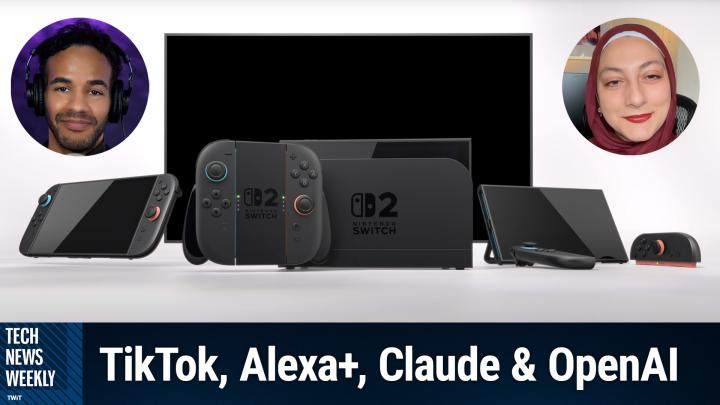
All TWiT.tv Shows (Audio)
Tech News Weekly 381: Nintendo Switch 2's Higher Price
00:54:35
Amazon & TikTok, Alexa+, Claude & OpenAI
Loading summary
Transcript88 lines
- [00:00]
Micah Sargent
Coming up on Tech News Weekly, Abrar Al Heati is here. We talk about Amazon maybe thinking about buying TikTok, then what the new Alexa can and can't do. Kyle Orland of Ars Technica joins us. He got some hands on time with the Nintendo Switch 2 and tells us his thoughts before we round things out with OpenAI and Anthropic both taking on the education market. Stay tuned for this episode of Tech News Weekly. Podcasts you love from people you trust.
- [00:35]
TWiT
This is Twit.
- [00:39]
Micah Sargent
This is Tech News Weekly, episode 381 with Abrar Al Heati and me, Micah Sargent. Recorded Thursday, April 3, 2025. Nintendo Switch 2's higher price. Hello and welcome to Tech News Weekly, the show where every week we talk to and about the people making and breaking that tech news. I am your host, Micah Sargent, and I am joined today on this, the first Thursday of April, by the wonderful, the amazing, the ever so sharp Abrar Al Heati. Hello, Abrar. Hello.
- [01:16]
Abrar Al Heati
How are you?
- [01:17]
Micah Sargent
I am doing peachy keen. How is your home state treating you?
- [01:24]
Abrar Al Heati
Yes, I am in Illinois visiting family. It's good to be back. Been. The weather's been awful, but the people are good. So that's why we're here. We'll take it.
- [01:34]
Micah Sargent
Yes, absolutely. I remember now us talking about. I couldn't. I have. There's, there's one person I talk to regularly who lived in Illinois for a time but was from a different state and I sometimes get those confused. But I remember now us talking about being Midwesterners apart and what that means.
- [01:51]
Abrar Al Heati
It builds character. I think it's personalities. Yeah.
- [01:56]
Micah Sargent
Just like the many seasons of the Midwest, we have a full range of personality.
- [02:02]
Abrar Al Heati
That's what it stems from. Yep, 100%.
- [02:05]
Micah Sargent
So for people who are tuning into the show for the first time, sadly, this is not a show where we talk about weather, but instead is a show where we talk about tech stories. And Abrar is going to kick things off with her story of the week.
- [02:20]
Abrar Al Heati
I am here to talk about TikTok. What else is there to talk about? We're always talking about TikTok sales and deadlines and all the, all the good stuff that comes with that. So you may recall back in January that Tick Tock was supposed to be banned. It was supposed, the ban is supposed to go into effect on January 19th. And then guess what happened on January 20th. Donald Trump took office and said, we're going to push this back. So it's been pushed back now to April 5th, which is this coming Saturday. If I've got my dates correctly. Yes. And so the TikTok ban is once again a possibility if the sale doesn't go through. Now what ByteDance needs to do, which ByteDance is based in China, needs to sell TikTok to a US based buyer instead. If TikTok wants to continue to operate in the US there have been some interesting people who have thrown their hat in the ring. We've heard about billionaire Frank McCourt, express interest. We know Oracle, Oracle is always kind of involved in these potential sales. I mean they're already, you know, hosting TikTok's U.S. user data and providing cloud infrastructure. So that's not a surprise there. But you know, lots of, lots of names here and there. We also heard about the OnlyFans founder also making a last minute bid as part of his startup Zoop, which I had not heard of before.
- [03:35]
Micah Sargent
Zoop, how's that spelled?
- [03:38]
Abrar Al Heati
Z O, O, P. Oh, how.
- [03:40]
Micah Sargent
I would think, who knew?
- [03:41]
Abrar Al Heati
Yes, very fanatic. So that would be part of a consortium that includes a cryptocurrency foundation. Lots of people are interested in TikTok because why wouldn't you be? Right? But I think the most interesting company that has said, hey, we're Interested at the 11th hour is Amazon. So Amazon reportedly said that it is interested in buying TikTok. This at first I was like, well that's an interesting choice. But then I was like, no, it makes sense because Amazon already has a lot. You think about what the most important thing to TikTok is and it's user data. Guess what? Amazon has a lot of user data. Right? We're all shopping on there. We're all letting it know what we're interested in and what we're not interested in, what we're buying. Think about how valuable that kind of data is, especially if you want to own TikTok. Apparently sources in the White House say that they're not actually interested in this deal, which is interesting. We know Jeff Bezos has kind of been cozying up to, and I know he's no longer the CEO but you know, still has been cozying up to Trump. And so it has been interesting to see this, this development in light of that. And then you know, Amazon Web Services is used for part of TikTok's cloud infrastructure. So again, not too much of a stretch there. But then the other interesting thing is that Amazon has tried to make its own TikTok sty shopping feed. This was called Inspire. It launched in December 2022. This was within the Amazon Shopping app. So it wasn't like a separate app or anything, but what it showed was short form videos and photos and basically shoppers could browse through and buy products that were featured by other content creators and brands that shut down earlier this year. So that did not work. But clearly Amazon still has some sort of interest because why wouldn't they? And the other piece of this is there are a lot of creators on TikTok who not only point to things in TikT, but who point to things on like their Amazon storefront or an Amazon product that they really enjoy that they will then get a cut of, you know, as you buy that product. So imagine if Amazon then has control of TikTok and how much more of an incentive there is then for creators to push products on Amazon and then for Amazon to benefit from that as well. So I'm, I'm really fascinated by the fact that the White House seemingly is not interested in this. I mean, I think the big thing that stood out to me is Amazon is huge. I think Amazon taking over TikTok would be like, wow, that is a lot of power in one company. But I mean, that's just the norm these days, I guess. But I don't know. But what are your thoughts of this? Do you think that's something that could. Because you also have to think about like, how does it affect users? And that's still so up in the air. But yeah, I don't know what your first impressions are there.
- [06:19]
Micah Sargent
Yeah, I mean, so I guess Amazon in some ways makes more sense to me than the early rumors of Microsoft looking at a TikTok acquisition. This, of course, that was way before there was even concern about it being banned, right? Well, maybe not, but it was, it was in the very, very, very early days of, oh, suddenly we're worried about this. And everybody that I listened to and talked to and heard all were like, Microsoft. What? Microsoft, Amazon. I hear it and I don't immediately go, huh, yeah, I more go, okay. I guess I could see that.
- [06:59]
Abrar Al Heati
Yes.
- [07:00]
Micah Sargent
From, from the perspective of like, you know, value and business alignment, it makes sense from the perspective of what you're talking about, of this, this knowledge base and this algorithmic. I mean, that is where it's like, you know, where that, that suddenly gets concern. Someone on the network was just talking to me the other day about how they had deleted Instagram from their device. Not because of any, you know, sort of desire to not have anything to do with Meta or anything like that, but because they were tired of, of getting tricked, they felt into buying things on Instagram and then finding that the product that they got was not as good as it seemed to be advertised. So it was a mixture of, like, Instagram is very good at advertising to me.
- [08:06]
Abrar Al Heati
Yeah.
- [08:07]
Micah Sargent
And the stuff that they're advertising to me ends up being junk and I can't resist it. So I'm getting rid of Instagram. I think about Amazon having this level of algorithm that we've seen do such a good job at. Truly, it's like you feel like people don't see you. Right. You want to. You want to be perceived. You want to be. You find the people who get you. And Netflix tries to figure out your taste and doesn't do a superb job of it does an okay, like all of these sites try to. But it feels like TikTok and maybe Spotify maybe have figured out, like, all of the aspects of a person's personality. And that's powerful stuff.
- [08:55]
Abrar Al Heati
Yeah.
- [08:56]
Micah Sargent
So, yeah, seeing Amazon have that, I think makes sense again from the business side of things, but from our side of things, the customers on the other end, that is a little concerning. Yeah. I mean, I guess I'm also a little weirded out, I guess, by thoughts that the government's not on board. Except that I know Trump and team have been talking about wanting, like, America to buy TikTok. And so I guess if Amazon buys it, then that's not the same. Maybe. I don't know.
- [09:33]
Abrar Al Heati
Yeah, no, that's so true. It's been so murky in terms of. And you know, what Trump has said is that they're. They have full faith that they'll meet that April 5th deadline, but has not shared, like, exactly who they're thinking as their top contenders. It's all just kind of come through reports and so it'll be interesting to see what surfaces there. But you mentioned the algorithm, and that's a really key thing here because. Because there's, there's two pieces to this. The one thing is it'll be really hard for any company to replicate TikTok's algorithm. That is something that China has said it's not going to let go of. And so any, any company is going to face that challenge of how do you, how do you mimic that? Because no one else has been able to really do it. And then the other piece of it is if Amazon takes over that algorithm, I'm just, I'm already dreading how much because I'm already sick of TikTok. Shop every three videos. Oh, my God. Imagine how much worse the product ads will be if every like two videos, you're getting an ad for an Amazon product that you should be buying instead. So I also wonder what that user experience will be like if it's owned by something like Amazon, where their goal is to sell you products. And it's not just about, you know, gleaning your data, but it's also about getting your money through those product purchases in the same way that TikTok does too. But, you know, TikTok shop is one thing, Amazon is another beast. So I'm really curious how, how that'll, how that'll shape up. But, but yeah, I think there's, there's been something interesting too, where there have been reports that TikTok's algorithm would be leased from ByteDance. And so this new US entity would be created and led by Oracle. And I don't know how that would work out because ByteDance would still retain that minority stake. At which point I'm wondering, what have we achieved according to what they're trying to accomplish? It just seems like a lot of, a lot of mess, a lot of work for something that I don't know if it will really lead to that foundational change that the White House seem be chasing after.
- [11:24]
Micah Sargent
So it seems to be like this. This agreement is just the federal government trying to follow the letter of the law.
- [11:32]
Kyle Orland
Right.
- [11:33]
Micah Sargent
Just saying. Well, we said it needed to be owned by a U.S. company.
- [11:38]
Abrar Al Heati
Right.
- [11:39]
Micah Sargent
But the fact that the algorithm itself is still owned by an outside entity and we're just leasing it doesn't really get at the heart of the issue.
- [11:47]
Abrar Al Heati
Yeah, exactly. And it seems like there's just a lot of pressure considering. You know, we've are, we've obviously heard about TikTok bans in the past, but this is the first time that this was, you know, signed into law unanimously upheld by the Supreme Court. There's only, I think, so much that can be done in terms of delays of, of a outright ban. And I wonder what companies like Apple and Google will do if April 5th rolls around and there isn't a sale? Will they again be scared of fines and penalties removed from the App Store again? Like, what is that all going to look like? Is the sale really going to go through? So is it a just like getting those boxes ticked and saying, okay, it's done, everyone relax? Or, you know, will there actually be that fundamental change? But it seems like something has to happen because apparently, legally, this is, this is what's happening and it's coming up.
- [12:37]
Micah Sargent
Saturday of all days.
- [12:39]
Abrar Al Heati
Yeah, exactly.
- [12:40]
Micah Sargent
It's just random. All right. We are going to take a quick break before we come back with my story of the week. I want to tell you about Drata, who are bringing you this episode of Tech News Weekly. If you are leading risk and compliance at your company, you are likely wearing tan 10 hats at once, managing security risks, compliance demands and budget constraints, all while trying not to be seen as the roadblock that slows the business down. But GRC isn't just about checking boxes. It's a revenue driver that builds trust, that accelerates deals, that strengthens security. And that's why modern GRC leaders turn to Drata, a trust management platform that automates tedious tasks so you can focus on reducing risk, proving compliance and scaling your program. With Drata, you can automate security questionnaires, evidence collection and compliance tracking. You can stay audit ready with real time monitoring. If you stay audit ready, you don't have to get audit ready. You can simplify security reviews with Drata's Trust center and AI Powered Questionnaire assistance. Instead of spending hours proving trust, build it faster with Drata ready to modernize your GRC program. Visit drata.com technews to learn more. That's drata.com technews to Learn more. Thanks so much to Drata for sponsoring this week's episode of Tech News Weekly. All right, back from the break and now it is time for my story of the week. It's actually also about Amazon. So recently Carolyn O'Donovan at the Washington Post earlier this week put out a piece about the current state of Amazon's AI assistant. I always spell it Alexa. Then no one gets mad that I'm triggering their devices. So this voice assistant of course recently got a whole new AI overhaul announced that would include the ability to sort of in theory better interact with your your device and have it kind of do more assistant style tasks for you. One example that they gave was you could talk to it about some cravings that you had and the device would respond with maybe a place to order takeout and then even go as far as to order that takeout for you. Being able to keep you up to date with what's going on in your home by connecting with Amazon's line of Ring appliances. So you would be able to have knowledge of who was coming and going from your home without necessarily needing to open the Ring app and check back to footage to see you know what has taken place. Well, as, as it stands, there was kind of an early rollout of the new Alexa features and these new features are kind of limited in comparison to what the company eventually plans to announce. According to internal documents that O'Donovan has had access to, the features aren't up to kind of what what Amazon would want for public release. And so one of those features is actually the ability to order takeout and for it to visually identify family members. So one of the examples that they showed was like at the very end of the video, a gentleman sits down in a chair and sort of starts to relax and then sort of pops up and is like, has anyone walked the dog today? Or no, has anyone taken the dog out today? And Alexa was able to respond and say, yes, the dog went out earlier or whatever that is not out yet. Now, that also includes a cool feature that I thought had some kind of interest, which was the ability for the device to generate a little story. So if you can imagine having a bedtime story and you have a silly story where you ask your kid, hey, what are some things that you'd want in this story? And then the device kind of puts it together and reads the story to you, I think that's cute and fun. Not ready yet. Now, that said, it will be able to give advice on what to cook for the people who got this early rollout. It will give or give give users the ability to order an Uber. And it also does have some of the kind of more basic communication features that are more conversational than what else is, you know, than what you would otherwise expect. So that is kind of a handy thing if you are attempting to show off like this is what the new can do. That said, it doesn't come to every device, so you are able to do that on the Echo show device. And despite that, it's not coming to yet. The Fire tv, the Echo Spot alarm clock, and a couple of other devices, they also announced Alexa.com at this event, which was basically kind of Amazon's own online chatbot that is also not available yet and we aren't sure when it will come. I wanted to kind of talk to you about your initial reaction to the Alexa stuff when it came out and kind of if any of this is of interest to you and if you're surprised to learn that many of the features announced have not yet made their way to people's devices.
- [18:50]
Abrar Al Heati
Yeah, I think it's high time smart assistants became smarter. I like to tell the story of how one time I asked my Google Assistant, what what's the weather? And it gave me a definition of the weather. That was a low point. That was wild. I wish I had caught that on camera. But but it, you know, it makes sense that it's time for I'll follow your example, Alexa to, to get a little bit smarter too. And I think the conversational angle is a really big thing too if you're, if you're able to have the back and forth. If you don't have to restate your question, that kind of little stuff is what these digital assistants kind of are meant to be and it' it's definitely time for that to happen. The thing that, when I saw this piece that occurred to me is there's an interesting pattern here where it's not just Amazon, but think of companies like Apple where they have these big showy events and they say look at all these new AI features that are coming and then they roll out very, very slowly and gradually. Like we still don't have the fully baked Siri, I'm sorry there I just triggered some. I did my best and then I triggered your guys devices. So that's not fully available yet either. And that's a very slow and gradual rol out too. Something that we might not see until 2026. Right. So it's really fascinating to see how much of this is. Okay, we need to talk about this development because everyone else is pushing ahead with AI and we need to also show that we're pushing ahead with AI but then also like we're not really ready yet. And so it'll come when it comes and we're going to, but we're not really going to talk about the fact that this is going to be a, you know, a gradual rollout. That said, it is, it is smart to be careful with this kind of stuff because AI makes mistakes and you don't want to just roll out something for the sake of rolling it out. But it is, there's still this, this disconnect between oh, hey, let's talk about all these new features and they're not actually ready yet. And we're going to say that in really tiny font somewhere. So. So yeah, that's just kind of follows.
- [20:49]
Micah Sargent
That mold and it feels like that's a return to something that hasn't been around for a while. I feel like we got to a place where companies were not for the most part showing off a bunch of stuff that was not at least three quarters baked. Right. Because Apple had introduced, I think Live Photos was an example a long time ago and some other things then that said, you know, coming later this fall and then it always did come later that fall.
- [21:22]
Abrar Al Heati
Yeah.
- [21:22]
Micah Sargent
And it was not to the extent that we've seen with all of this where you are, this feels like it's performing to the, performing for the shareholders and not for the consumers. And that's so frustrating because you then don't have trust that the, you know, that the things that are announced are actually going to happen. Yes. But at the same time, like you've said, you don't want those features out there until they are as fully baked as they can be. I imagine this would still be a cookie with a soft gooey center even though it is fully baked. But yeah, I just, I think that when it comes to this stuff, all of these companies are trying to put forth the idea that they're further along and that's yet to be proven that that's the case because time after time these features are shipping in very small, small, small increments and are so often so incredibly underwhelming.
- [22:35]
Abrar Al Heati
Yes, exactly, exactly. And you know, for people who are buying a device thinking that they are going to have a certain software feature and then they don't get it, like I think about people who bought, you know, just to bring it back to Apple real quick, people about an iPhone 16 thinking that they would have all these features baked in and they're not. And counterargument is always okay, well, you know, we want to make sure that it's good and companies like Apple and Amazon, I'm sure, want to make sure that when they roll this out, it has to be great. Right. It can only make very minimal mistakes. But like you mentioned, I mean, centering shareholders versus consumers, I wonder what long term impact and damage that will have. Because yes, it will become very boy who cried wolf. And people will say, okay, but will that future really roll out with this device? Will this software future really roll out in this month like you say? So that user trust is, is I think, going to face some, some damage.
- [23:26]
Micah Sargent
Absolutely. Yeah. And I don't think being able to have a conversation with my virtual assistant about my frustration at the lack of features that have been promised to me is going to make much of a difference at all.
- [23:41]
Abrar Al Heati
Sadly not. But that would be fun if you could vent with it. I think that would be unprecedented. Talk about sentient AI, that is.
- [23:47]
Micah Sargent
Yeah, that would be. Yeah. You know what? Our own, our own budget therapist.
- [23:52]
Abrar Al Heati
That's right.
- [23:53]
Micah Sargent
Dear Abrar, I want to thank you so for taking the time to join us on Tech News Weekly this week. If folks would like to follow along with the work that you're doing, where are the places they should go to do that?
- [24:06]
Abrar Al Heati
You can Find me on x I'm @lhet_3 and also on Instagram and TikTok at Abarl Heati no spaces. And you can find all my work on CNET.com and on CNET's YouTube. And thank you again for having me this week. I appreciate it.
- [24:19]
Micah Sargent
Absolutely. Thank you so much. Abrar. All righty, folks, let us take a quick break before we come back with the interview this week. I'm looking forward to it. It's sort of the elephant in the room, right? But let me tell you, this episode of Tech News Weekly is brought to you by Delete Me. If you've ever searched for your name online and said, oh my Lord, look at all of that information. I don't want all of that. I don't like that all of that's available. Yeah, it's not great. And then you find out your family's involved too. Maintaining privacy isn't just a personal concern. It's a family affair. Delete Me's family plans. You can ensure that everyone in the family feels safe online. See, Delete Me helps reduce risk from identity theft, from cybersecurity threats, from harassment and more. I have very happily used Delete Me to find how it has connected me to different family members and have Delete Me do its best to remove all instances of that because I. I've got a great security posture, right? I've got a lot of skepticism about links and things that come to me, calls, text, all of that stuff. But maybe some of your family members don't, and if they can find you and then find your family, well, that suddenly becomes an issue. Delete Me experts will find and remove your information from hundreds of data brokers. You can assign a unique data sheet to each family member, tailored to them with easy to use controls. Account owners can manage privacy settings for the whole family. Delete Me will continue to scan and remove your information regularly, including addresses, photos, emails, relatives, phone numbers, social media, property value and more. So protect yourself and reclaim your privacy by going to joindeleteme.com twit and using the code twit tw I t. That's joindeleteme.comtwit and code twit for 20% off. Our thanks to Delete Me for sponsoring this week's episode of Tech News Weekly. All right, we are back from the break and I am very excited. As I mentioned, the elephant in the room is of course, the announcement of the new Nintendo Switch 2. Joining us to talk about the device, someone who had some Hands on time with it. Ars Technica's own Kyle Orland. Welcome back to the show, Kyle.
- [26:35]
Kyle Orland
Thanks. Glad to be here.
- [26:36]
Micah Sargent
Yeah. So great to have you here. So, yes, Nintendo has officially unveiled the Switch 2. We've heard a lot about it. We've seen some real animations, some fake animations and everything in between. Set to launch in June. Can you start by kind of walking us through the biggest hardware upgrades in comparison to the Switch we know and love?
- [26:59]
Kyle Orland
Yeah. So as far as the unit itself, you notice as soon as you pick it up, it's slightly bigger than the original Switch, which will be very welcome, I think, to anyone with adult sized hands used to clawing them around the tiny Joy Cons, they're quite a bit more comfortable in your hands now. Also, the expanded screen size, 7.9 inches that you can get with that expanded screen. With that expanded space, it's really a revelation to see in person. If you're used to the old Switch or even the Steam Deck, this is a nice big screen and it doesn't come with all the bulk of something like the Steam Deck. It's heavier than the Switch, but still lighter than something like the Steam Deck and also a lot thinner. So it's not quite as heavy to lug around. As far as the hardware power itself. You've heard all the stats, I'm sure. You know, 1080p at 120 frames a second or 4k on the docked mode. It's got HDR colors now and it's just more powerful in general. The Switch, near the end, you were seeing a lot of games like Tears of the Kingdom especially, you know, start to stutter and really show the problems with handling modern games. And now the Switch two, you know, I'd say it's not going to compete with, you know, the PS5 or anything, but you're getting close to like PS4 Pro levels of performance based on what I saw there.
- [28:23]
Micah Sargent
Nice. Now, one of the standout new features, and one that I saw especially right before the event, was the inclusion of a C button. This is the new game chat system that has voice and screen sharing. Can you talk about how this does seem like a shift in terms of Nintendo's approach to online communication?
- [28:45]
Kyle Orland
Yeah, I kind of think what Nintendo realized is that a lot of kids, they're used to gaming on their iPad or, you know, just having an iPhone. And what people will, kids especially will do is they'll just set up a voice chat and put it in a picture in picture or put it on a second device and just chat with their friends while they're gaming. And Nintendo said, okay, we can do that too. Let's add a microphone, let's, let's add an optional camera and let's let people share their game screens really easily with their friends through the Switch. Hopefully this will be a lot easier to set up. It's just you hit the C button, you hit a few settings, and any of your friends that also have a Switch too, they can see what you're playing, they can see you, they can talk to you very easily. It does require a paid subscription, but it's not an especially expensive subscription as far as these things go. And also they didn't have that on hand to actually try out at the hands on event yesterday. So we'll have to see how well it works in practice, I guess.
- [29:42]
Micah Sargent
Yeah, absolutely. It's interesting. Nintendo seems to, to some level avoid the concerns that come with online chat and communication. Has there been any, any conversation about that, any acknowledgement about that? Or is it all very much like, look at this cool thing you can do. We're not gonna really worry about the toxicity.
- [30:09]
Kyle Orland
Well, it's kind of weird. They're kind of catching up to where the entire industry has been. You know, if you had an Xbox 360, you were doing this kind of stuff, you know, 20 years ago. Absolutely. But yeah, Nintendo has been a little shy about this in part because of, you know, stranger danger out there online. They don't want you to meet with some predator on an online gaming site especially. They're so family and kid focused. What they said is that these game chat features will only work with approved friends. You cannot just join a voice in video chat with any strangers. You have to both confirm each other, probably through the friend system like they had on the Switch. So I think with that and with the parental control systems in place, I think Nintendo has put in enough protections that they feel comfortable with that now understood.
- [31:00]
Micah Sargent
The inclusion of mouse mode controls using the Joy Con, that's kind of been an interesting addition. What kind of gameplay experiences does this open up on the Switch 2? Especially in comparison with what you can do right now on the Switch.
- [31:18]
Kyle Orland
Yeah, there were a few different games that used the mouse mode. Most interesting, I think, was Metroid Prime 4, where one hand you hold a joystick and the other hand is a mouse. And if you've ever played first person shooter on PC, it felt a lot like that. You're aiming and moving with the mouse. You can do just small flicks to really get precise and quick. Movement that compared to a joystick or the gyroscope controls you might use. It really feels a lot simpler and takes less time to get that precise aim. The only problem really with it is you need a nice flat surface to use it with. With. You know, if you're sitting in your living room on your couch, I don't know if you're going to get a lap desk or if you're going to crouch over a coffee table. Nintendo actually said you can use the top of your thigh and put it on top of your pants and move it around like that. But if you've ever tried to use a mouse on the top of your thigh, I don't know why you would. But if you do try that, you'll realize it's not really an ideal mouse pad. It's kind of, it's very narrow, it's kind of rounded. So, you know, I don't know how much use this is really going to get for the average gamer's usual living room setup, but I guess if you're setting up in tabletop mode or if you have the Switch connected on your desk to your monitor or something, you know, for people who really like that mode of control, they could take the trouble to get some use out of it, I guess.
- [32:49]
Micah Sargent
Absolutely. Now, interestingly, Nintendo is also enhancing some classic titles with the Switch 2 editions. What improvements should players expect when it comes to these re releases? And is it kind of about showing off the capabilities of this new, this new console?
- [33:09]
Kyle Orland
Yeah, I mentioned earlier how Tears of the Kingdom really seemed like it was pushing the Switch to its limits and really suffered from some frame rate and menu loading things. And they showed a version of the Switch 2 Enhanced Edition at the hands on event and it really feels like the version of the game, how it's meant to be played. It's a silky smooth frame rate. I don't know if it was 60 frames or 120 frames at all times, but it was definitely much smoother than you'd expect on the Switch. Menus load quickly, there's HDR colors on that nice bright screen. It doesn't feel like a completely new game. The gameplay is still exactly the same, but it's much more enjoyable when you don't have to suffer through that stuttering especially. That really takes you out of the moment and just reminds you that this is an artificial world. This is not looking at it on the Switch 2, it really feels more consistent and it's easier to get lost in, I'd say.
- [34:05]
Micah Sargent
Yeah, like your favorite startup's growth curve. T Mobile's coverage keeps scaling because T Mobile helps keep you connected from the heart of Portland to right where you.
- [34:12]
Kyle Orland
Are on America's largest 5G network Switch now keep your phone and T Mobile.
- [34:16]
Abrar Al Heati
Will pay it off up to $800.
- [34:18]
Kyle Orland
Per line via prepaid card.
- [34:19]
Abrar Al Heati
Visit your local T Mobile location or.
- [34:22]
Micah Sargent
Learn more@t mobile.com keepandswitch up to 4.
- [34:25]
Kyle Orland
Lines of your virtual prepaid card. Allow 15 days qualifying unlock device, credit.
- [34:28]
Abrar Al Heati
Service report in 90 plus days device.
- [34:29]
Kyle Orland
And eligible carrier and timely redemption required.
- [34:30]
Abrar Al Heati
Card has no cash access and expires in six months.
- [34:35]
Gilead
Honestly, honestly, honestly, no one wants to think about hiv, but there are things that everyone can do to help prevent it. Things like prep. Prep stands for Pre Exposure Prophylaxis and it means routinely taking prescription medicine before you're exposed to HIV to help reduce your chances of getting it. Prep can be about 99% effective when taken as prescribed. It doesn't protect against other STIs though, so be sure to use condoms and other healthy sex practices. Ask a healthcare provider about all your prevention Options and visit findoutaboutprep.com to learn more.
- [35:04]
Micah Sargent
Sponsored by Gilead so with the Switch 2 offering up up to 4K resolution dock and also that 120 frames per second, the 1080p HDR display, you talked a little bit about this. How does it stack up against the current gen consoles in terms of performance? Is it still kind of the further on down the line or are we starting to get where, oh, we've got a comparable console here.
- [35:33]
Kyle Orland
Yeah, you're not. Like I said, you're not going to get PS5 levels or performance, which is not that surprising. If you've seen the PS5, it's this huge beast that doesn't even have a display built in. Squeezing that into something the size of the Switch 2, even a few years after the PS5 came out, that just wouldn't be possible. So they're making some compromises to get things into that portable form factor. That said, if you compare it to other portables like the Steam Deck, I would say any game that you could play on the Steam Deck, you should probably expect a port would be able to run on the Switch 2 pretty readily. I would say that, you know, and they've announced games like Elden ring and Cyberpunk 2077. You know, these are games that people do love to play on their Steam Deck and now the Switch 2 is at that level of support. Now if it's, you know, a more modern Game, PC game like Starfield, you know, Indiana Jones maybe that really pushes PCs to their limit. You might struggle to get a well, good performing version on the Switch 2, but I think for the vast majority of releases, I think the Switch 2 will be able to handle it. Just like the Switch managed to get all the best games from other consoles a few years later for quite a while during its release run.
- [36:58]
Micah Sargent
Now there is a priority purchasing system. Can you tell us about that and like who qualifies for it, how it works?
- [37:07]
Kyle Orland
Yeah, I mean I don't have the whole list in front of me, but I think you had to be an online member for a year. You have to have played 50 hours or so, you have to have opted into some sort of data sharing program. It's basically all ways of confirming that you are an actual human and an actual existing fan of Nintendo systems. Because they are extremely worried about scalpers. And I can see why. If you look at the Pokemon card market, for instance, it's just overrun anytime a product comes out that the scalpers buy it up and then the only versions you can find are the ones that are being resold at twice the price, three times the price. You see this with video game consoles too. And it's pretty obvious that the first few million consoles Nintendo puts out, that demand is going to overwhelm any supply that Nintendo is able to make. It's going to take them a while for their production to catch up. So as an effort to make sure that these get directly into the hands of humans rather than people that are going to mark up the price, I think it's a valiant effort. We'll see how well it works in practice. But I can't blame Nintendo for trying.
- [38:21]
Micah Sargent
Right, right. It felt like there were quite a few titles, game titles announced at this, this event and seems to suggest a nice, I mean, which is kind of the case with Nintendo, a nice, you know, offering of first party content. Do you think if you had to predict, based on Nintendo's past behavior and where it is now, are we looking, do you think at a steady drumbeat of first party content or is it kind of like let's get all the first party content out there now and have everybody, you know, kind of go from there where occasionally we'll release things? Yeah, yeah. I just felt like there was a lot. But then does that save room for later?
- [39:10]
Kyle Orland
Well, a lot of the stuff in there was third party games, I feel in the direct. And a lot of those were. And a lot of those reports of older games, you know, we kind of got spoiled in the Switch Switch generation where a marquee Legend of Zelda game, a generation defining game, came out at launch. Really a system seller. And then a few months later you get Super Mario Odyssey, another great game. And they were able to dip into Mario Kart 8 Deluxe from the Wii U. So that first six months to a year was really stacked with just generation defining games. This time around they seem to really be counting on Mario Kart World to be that system seller. And Mario Kart is a huge franchise. It's sold 40 million on the switch, I think, or maybe more. And it is a game that people will come for especially. It's got all sorts of new features. It's got this 24 player races. It's going to be a big draw for sure. After that things are starting to look a little thinner. Donkey Kong Bonanza is a lot of fun. It's very cathartic to just bash through all the things and collect a lot of gold. Not sure it's going to be as big a hit as a true Mario game would be necessarily. Metroid prime is there for the hardcore shooter fans, but that's also going to be available on the original Switch. So it might not be a reason to upgrade right away if you're not willing to spend $450. And after that it's going to take a little bit more to see anything more. There's Kirby's Air Riders, I suppose, which we saw only a little bit of. So I don't know how far along that will be. And I think they're kind of keeping their powder dry. They know that they're going to probably sell anything they make through 2025. I guess the pent up demand for a more powerful Switch and just Mario Kart alone will probably carry them through their first holiday season. And then in 2026 we'll really see what else they've been working on and they're probably playing it close to the vest and we might see games that get announced and then released just a month or two later. Nintendo doesn't necessarily do these things long wind ups for their games anymore. So just because we haven't seen it doesn't mean Nintendo isn't working on a lot more behind the scenes.
- [41:23]
Micah Sargent
And to round things out pricing for the console itself and also for the games, it certainly seems to be that the games are reaching the territory of what you'd expect for PlayStation and Xbox and that has people a little bit shocked. Surprised. Tell us about that.
- [41:45]
Kyle Orland
Yeah, some of them, especially the $80 price for Mario Kart World really stood out to me. Now. Like, again, Mario Kart is this franchise. I feel like there's enough demand for it that people will pay that price. I also feel like they're bundling it in a bundle with the console itself, where you essentially pay $50 for the game. So maybe that's the $80 price makes the bundle seem like a little better deal. So for Mario Kart World, I kind of understand it. When you look at some of these other games where it's a remaster of a Switch 1 game, but with better graphics and maybe slightly more content. When you talk about that and charging 70, $80 for a game like that, that's where I start to balk at things. If it's not a marquee title in a major franchise that they know is going to sell, if it's just a re release of a Switch 1 game with slight improvements, that doesn't feel like a game that you can charge a pre that much of a premium price on. That said, you know, Nintendo's experimenting with it. I feel like if those things don't sell, we will see them respond to that. This is not them saying, we are going to charge $80, $90 for every game and you're going to like it or not. They will respond to the signals from the market. If, if people, even with Mario Kart, if it's not selling well at $80, they can say, okay, we're sorry, it's now $70, and probably give some sort of apology for that. A lot of people don't remember when the 3DS came out, it didn't sell as well as Nintendo thought. And a lot of people attributed that to the higher than expected price. And within a year, Nintendo completely reverse course. They lowered the price by $90, I think, which was a huge percentage. And they offered people who bought it early a selection of downloadable games to say, you know, we're sorry, this was not worked. This did not work.
- [43:46]
Micah Sargent
Wow.
- [43:47]
Kyle Orland
So, you know, if, if the $450 switch is not the success that Nintendo thinks it is, or if, if eventually it starts slowing down in sales, you know, they can and will lower the price. They didn't have to for the Switch because it sold 150 million units at $300 without any price drops for eight years. But history shows that these companies are willing to drop prices and make the hardware or the software more affordable if that will get them more sales.
- [44:18]
Micah Sargent
Absolutely. Wow. Kyle, I want to thank you so much for taking the time to join us today. I know you've been very busy, so we appreciate it. Of course folks can head over to Ars Technica.com to check out your work. Is there anywhere else they should go to follow along with what you're doing?
- [44:34]
Kyle Orland
I'm Kylor Land on Bluesky, which is possibly my favorite domain name that I've ever purchased and yeah, you can find my musings about all sorts of things there.
- [44:45]
Micah Sargent
Awesome. Thank you so much. We appreciate it.
- [44:48]
Kyle Orland
Thanks.
- [44:49]
Micah Sargent
Alrighty folks, real quick break here so I can tell you about Club Twit. At Twit TV ClubTwit, that is where you go to become a member of the club. It's just $7 a month with a two week free trial to kick the things off. When you join the club, you gain access to every single one of our shows. Ad free. It's just the content, none of the ads. You also gain access to the Twit plus bonus feed that has extra stuff you won't find anywhere else behind the scenes before the show. After the show, special Club Twit events get published there and access to the members only Discord Server. A fun place to go to chat with your fellow Club Twit members and those of us here at TWiT. It is a really good time. We've got special events that take place. Leo and I are talking about something coming coming up that we're going to be doing together, which I'm really excited about and it's going to be available only to club members. So as we have some more details there, you'll learn about it and know that the only way to get it is by joining the Club Twit TV Club Twit. Just $7 a month and we look forward to seeing you there. All right, back to the show.
- [45:58]
Gilead
Honestly, Honestly, Honestly, no one wants to think about hiv, but there are things that everyone can do to help prevent it. Things like prep. PREP stand for Pre Exposure prophylaxis and it means routinely taking prescription medicine before you're exposed to HIV to help reduce your chances of getting it. Prep can be about 99% effective when taken as prescribed. It doesn't protect against other STIs though, so be sure to use condoms and other healthy sex practices. Ask a healthcare provider about all your prevention Options and visit findoutaboutprep.com to learn more. Sponsored by Gilead.
- [46:29]
Shakeology
If you could do one thing this year that could help you lose up to 20 to 30 pounds without lifting a single weight and it would actually be good for you would you do it? And if it would actually improve your health and digestion and it tastes like a chocolate shake, wouldn't that be the ultimate win? Well, here it is. It's called Shakeology. Packed with vital nutrients, protein, probiotics, adaptogens and superfoods, it's the easiest way to reset your nutrition, curb cravings, and feel incredible all in under the two minutes it takes to make a simple shake. No meal prep, no guesswork, just a smarter way to fuel your body and start feeling your best. Shakeology isn't just a shake. It's a lifestyle upgrade that makes healthy living easy, delicious, and totally doable. Shakeology is all your vital nutrition made simple. You can get free shipping, big discounts, and a free Shaker cup when you subscribe@shakeology.com that's shakeology.com I am rounding things.
- [47:30]
Micah Sargent
Out with a little story that came from the Verge that was kind of a an umbrella of understanding of the current state of two of the big players in the AI space, OpenAI and Anthropic. Of course, OpenAI has Chat GPT Anthropic has Claude, and each of these companies has released a version of their tools and offerings for the education market. Claude for education and OpenAI for education, also known as chatgpt.edu. the idea here is that when a student is using one of these tools to write their story, to write their essays and to do their homework and this and that and the other, obviously there have been concerns about that, right? There have been ongoing distraught, like checks every step of the way to see if a student is actually doing their work or if it's being done for them, understandable what they're hoping to do. And by they I mean these companies, OpenAI and Anthropic, is to provide a tailored version of these tools that make it so that they kind of play in the education space. Here's what OpenAI had to say. ChatGPT.edu includes access to GPT4O, which of course works very well when it comes to coding, mathematics and text interpretation. Also the ability to build custom GPTs that can be used by the university itself, being able to have higher message limits than the free version of the program, improved language capabilities. So that means 50 languages supported, and then also data privacy and security controls and the knowledge that for sure, conversations and data are not used to train OpenAI models. So the idea is that an Edu, which is essentially an enterprise, would be able to kind of roll out chatgpt Edu for a campus and give students access to it with these tools and data analysis. Cloud for Education is a little bit different in its so of more feature focused approach. So with Cloud for Education they talk about learning mode. It's an experience that guides students reasoning process rather than providing answers. So it kind of will say, you know what, what led you to that thinking? Have you cited your sources where you know, what do you need to find to be able to prove the point that you're trying to prove or, or you know, support the point that you're trying to support. Of course then it does include the same thing of that university wide availability. So these universities can give access to students across the board, different partnerships so Internet two and in structure so that AI is embedded into teaching and learning, meaning that it becomes part of the process and then special student programs. So there will be Claude campus ambassadors that provide API credits for student projects. Again, the idea here is that rather than just giving the exact answer or response, this version of the program which would be made available to the students as part of their university membership, is going to not just provide those answers and give the students exactly what they're looking for, but instead lead them to make those decisions. I think it's an interesting take on the kind of initial fear that was in place whenever it came to the introduction of these generative AI programs where at one point we had these universities quickly scrambling to find any, any software, any service that would help them to detect if a student was using AI to complete their work. Let's have these companies work with the universities instead to hopefully lead a student to using what's available to them for free, free and the more powerful version of these programs without instead relying on their own personal memberships or purchases of these credits. So I think it's a great idea, it's there and students are going to use it. So let's figure out a way that they can use it and still develop those critical thinking skills and problems, proper research techniques, et cetera, et cetera. Claude, excuse me. Anthropic and OpenAI have both released press releases kind of detailing the specific education programs that they have. But most importantly, check out that link in the show notes from Kylie Robison over at the Verge, who looks at it from kind of the business perspective of these two companies. Companies facing off at the hopes of being able to kind of woo the education market and be the, the AI on campus. That's a big, big market. And if, if students who are learning the skills that they'll have for their careers lock into chat, GPT or Claude and have that at the basis of what they're doing. That's important. You want to be in that spot. And then also there are some lucrative deals when it comes to the money that is involved. So I am not surprised to see Anthropic and OpenAI setting their sights on the, you know, higher education market. But it'll see, it'll be interesting to see which of these two companies win or if they end up kind of being offerings both at these, at these different higher education locations. So again, check that out over on the Verge for kind of the full rundown of where things stand for these two big AI companies. That brings us to the end of this episode of Tech News Weekly. The show publishes every Thursday at Twitter TV tnw. That is where you can go to subscribe to the show in its audio and video formats. I mentioned Club Twit during the show, so just a brief Twit TV Club twit, $7 a month. We'd love to have you in the club and look forward to seeing you there. If you'd like to follow me online, I'm MaikaSargent on many a social media network where you can head to Chihuahua Coffee C H I H U A H U A Coffee where I've got links to the places I'm most active online. Be sure to check out My other shows, iOS Today, hands on Mac, Hands On Tech, which are published mostly today, so you'll see many of those today. And for those of you who like to tune into Hands On Tech Recordings, we are going to be recording our next set of episodes this Sunday, so tune in for that as well. Thanks so much for taking the time to be here with us this week and we'll catch you again next week for another episode of Tech Tech News Weekly. Bye Bye.
- [55:38]
TWiT
The tech world moves fast and you need to keep up for your business, for your life. The best way to do that Twit TV on this Week in Tech, I bring together tech's best and brightest minds to help you understand what just happened and prepare for what's happening next. It's your first podcast of the week and the last word in tech. Cybersecurity experts know they can't miss a minute of Security now every week with Steve Gibson. What you don't know could really hurt your business, but there's nothing Steve Gibson doesn't know. Tune in Security now every Wednesday. Every Thursday, industry expert Micah Sargent brings you interviews with tech journalists who make or break the top stories of the week on Tech News Weekly. And if you use Apple products, you won't want to miss the Premium Apple Podcast, now in its 20th year. Mac break Weekly. Then there's Paul Thurat and Richard Campbell. They are the best connected journalists covering Microsoft and every week they bring you their insight and wits on Windows Weekly. Build your tech intelligence week after week with the best in the business. Your seat at tech's most entertaining and informative table is Wait it@Twit TV. Subscribe now.
- [57:06]
Talkspace
You know when you're really stressed or not feeling so great about your life or about yourself? Talking to someone who understands can really help. But who is that person? How do you find them? Where do you even start? Talk Space Talkspace makes it easy to get the support you need. With Talkspace you can go online, answer a few questions about your preferences, and be matched with a therapist. And because you'll meet your therapist online, you don't have to take time off work or arrange childcare. You'll meet on your schedule wherever you feel most at ease. If you're depressed, stressed, struggling with a relationship, or if you want some counseling for you and your partner or just need a little extra one on one support, Talkspace is here for you. Plus, Talkspace works with most major insurers and most insured members have a $0 copay. No insurance, no problem. Now get $80 off of your first month with promo code space80 when you go to talkspace.com match with a licensed therapist today at talkspace.com save $80 with code space80@talkspace.com marketing is hard, but I'll.
- [58:09]
TWiT
Tell you a little secret. It doesn't have to be. Let me point something out. You're listening to a podcast right now and it's great. You love the host. You seek it out and download it. You listen to it while driving, working out, cooking, even going to the bathroom. Podcasts are a pretty close companion. And this is a podcast ad. Did I get your attention? You can reach great listeners like yourself with podcast advertising from Libsyn Ads. Choose from hundreds of top podcasts offering host endorsements or run a pre produced ad like this one across thousands of shows. To reach your target audience in their favorite podcasts with Libsyn ad ads, go to libsynads. Com. That's L, I B S Y N ads. Com Today.