← All TWiT.tv Shows (Audio)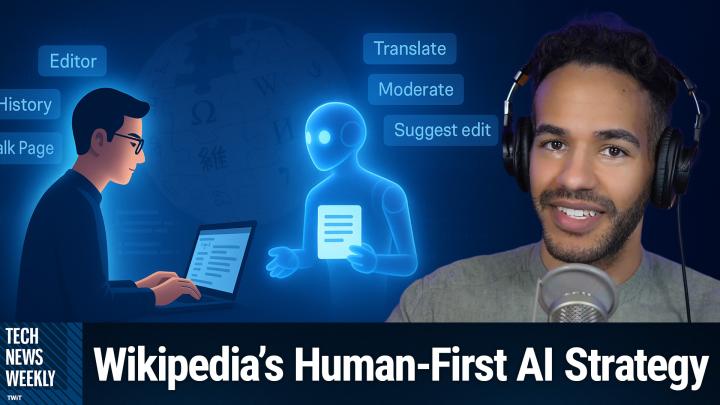
All TWiT.tv Shows (Audio)
Tech News Weekly 385: Wikipedia's AI Strategy Explained
01:04:37
Leila Zia on Keeping AI Accountable at Wikimedia
Loading summary
Transcript99 lines
- [00:01]
Micah Sargent
Coming up on Tech News Weekly, Abrar El Heiti is here. We talk about ChatGPT adding shopping to its search, then where things stand with Apple v. Epic and the App Store. After that, Leah Nylan, antitrust reporter at Bloomberg, stops by to tell us about the antitrust case with Google and its remediation portion. Before we talk to the head of research at the Wikimedia Foundation, Leila Zia, about Wikipedia's AI strategy. It's a fantastic so stay tuned for the episode podcasts you love from people you Trust.
- [00:41]
Abrar Al Heiti
This is TWiT.
- [00:45]
Micah Sargent
This is Tech News Weekly episode 385 with Abrar Al Heati and me, Micah Sargent recorded Thursday, May 1, 2025 Wikipedia's AI strategy explained. Hello and welcome to Tech News Weekly, the show where every week we talk to and about the people making and breaking the tech news. I am one of your hosts this week, Micah Sargent, and I am joined across the Internet by the wonderful Abrar Alhiti of cnet. Welcome back Abrar.
- [01:17]
Leah Nylan
Thank you so much. It's good to good to have you back.
- [01:20]
Micah Sargent
Yeah, I was gonna say it should be welcome back to me. Thank you so much for doing such a fantastic job hosting the show. I heard lots of great feedb that's maybe calls to just have you be there and I just go, I don't know ever, ever.
- [01:37]
Leah Nylan
No, it was an honor and it's. You set a high bar. So I did my best.
- [01:42]
Micah Sargent
I think you did wonderfully. Thank you so much again for doing that. So hopefully many of you are return guests and are very aware of how this works, but if you aren't, this is the first time here. Welcome. There's nothing under your seat, but there is certainly a lot to enjoy. So we kick off the show by talking about our stories of the week, the compelling, interesting, exciting things that we've seen in tech news that we want to talk about. And so without further ado, let's, let's hear about it.
- [02:15]
Leah Nylan
Abrar okay, so I am mixing things up by not talking about self driving cars for once or things in my usual wheelhouse. I realize there's more to technology, so I wanted to talk about ChatGPT Search's new shopping experience. And I'll caveat this by saying that I am not an avid user of chatgpt or chatgpt Search, but I was still intrigued by this because shopping is something that, you know, when we think of online searches for shopping, people tend to go to Google and see what comes up there and you click on products or you go to, you know, a website or an influencer or whatever it is that you choose to select a product that is the best fit for you. So now ChatGPT search wants to be that source for you. So you can search for whatever product you're looking for, compare options you can buy directly within ChatGPT. It'll, it'll show you those direct links so you never have to leave. And you get these, you know, the idea is it's supposed to know you pretty well, right? So you get these personalized recommendations, you get all these details and pricing and this is starting out with fashion and beauty and home goods and electronics and then eventually will expand to more categories. And you know, it'll remember this is the part where, you know, the magic and the craziness and the creepiness of ChatGPT comes in. It'll remember your past shopping experiences the same way that Google would. Right. And pick up on context from your previous conversations to give you that more personalized recommendation. So Maika, do you, are you an avid ChatGPT search user and is this something that you feel like you would use as an alternative to whatever you currently use to kind of find the best products for you?
- [04:03]
Micah Sargent
So a couple of things. I do use ChatGPT a lot. I do not like to use it for search. I don't like to use AI search at all if I can help it. Yeah, I continue to see compelling arguments that there have been improvements to the AI search, but anecdotally has not been my experience. And so just as it was the case when I tried Siri out for the first time and it disappointed me four or five times and I don't use it now. The same thing applies here where I just didn't like the results that I got. What I will say is that one place that I have seen AI do a great job in the sort of search area is the research functionality. And for anyone who hasn't tried that, it's essentially where you set it on a course of completing research for you across the Internet. And so I for example, tasked Google's AI search with, or excuse me, AI research with, helping me figure out the best cuttable sugar cookie that is also gluten free.
- [05:18]
Leah Nylan
Oh.
- [05:19]
Micah Sargent
And so our research plan in I say our because it kind of tells you what it thinks it should do and then you say no, no, I want you to do this involved me basically saying I want you to look at all of the different gluten free sugar cookie recipes that are out there and I want you to find commonalities between them so that we can make a sugar cook. That is because the problem with gluten free ones is that they often kind of like get runny. Yeah. So let's find the one that's the most stable and steadfast and then advice on how to make them even more stable. And so it was able to go to, you know, dozens upon dozens of websites and collect information from there. Collect information from the comments, that kind of a thing. So that is a really cool aspect. That's sort of like the search functionality. And I think that if it were to come to shopping, I would love that because I don't know, I would love to hear like your, your technique for finding products. But mine always starts at wire cutter. Yeah, they do a lot of research and I have, I don't think I've ever purchased something that was a wire cutter recommendation and then been unhappy with it. I know people have, but I have not been one of those people. And so that's my first source of truth and trust. Yeah. And then from there, you know, I just do what I can to try to find what I'm looking for. But if I could, there are times where Wirecutter doesn't have the answer. So if I could turn to. And in fact I tried to do that the other day. Now I think about it and yeah, I like the idea of it having kind of awareness of what's out there and then giving me some information based on that.
- [07:04]
Leah Nylan
Yeah, absolutely. I think my method as somebody, this is a true testament to how addicted to TikTok I am. But that's usually where I go because I, I like to hear from people who I can then see the product and then I can hear about it. But I'm also always skeptical of people who are like big time influencers. But you get such a range of content from videos that have like 10 likes to some that have like thousands. And so you kind of get this broad range of like this person just really enjoyed this product and decided to make a video about it. And it's already been on my mind so maybe that's something that you, I can dig into a little bit more. And, and then sometimes it really is just like going straight to Amazon. And, and that's the other piece of this that I thought about because Amazon had launched something very recently called Interests. And this is supposed to also kind of work in the background and give you recommendations about what you like based off of what it's learned about you. Right. So. Oh, this person's really into Football or whatever it may be, whatever sport, whatever. For me, it's going to recommend a bunch of Harry Potter stuff, whatever it's. And it will, you know, there's so much, there's so much stuff on Amazon. Right. And then obviously it's limited to what's actually on there, but it's so much, it's so broad and then it kind of tailors it based on your price limits and things like that. So I'm wondering, you know, it's twofold for me. It's how is Amazon feeling about this and how is Google obviously feeling about this? Because I think Google is already facing this reckoning of, okay, things like ChatGPT search and in other platforms are already starting to chip away at what I think they probably thought was, oh, like we, we rule this, this is our territory. But there are all these alternative means that people are, are turning not just for search but now for shopping. So, so I'm, I, I have a feeling this is, this is something that will resonate with a lot of people, especially given how many people love Chat GPT. And, and so, yeah, the other piece of this though is that OpenAI says it doesn't make any affiliate revenue off of this. And I have feeling this has to change. Right. Like at some point.
- [09:11]
Micah Sargent
Yeah, I was going to say if it doesn't change, then they are, what they're probably doing is sort of proof of concept idea where, because they are known for making deals with different organizations behind the scenes. Right. So even if they don't do it kind of in the foreground, I wouldn't be surprised if there is sort of a background of, hey, we're ending up going here and we're sending people here quite a bit. Let's talk about this. Yes. Because yeah, I, there's, there's some affiliate, there's some affiliate that plays into making things a little less trustworthy. Right?
- [09:58]
Leah Nylan
Yeah.
- [09:58]
Micah Sargent
And that, that plays a role for me for sure.
- [10:01]
Leah Nylan
Definitely. And then the other piece of that, I'm wondering, you know, you mentioned going to Wirecutter, I mentioned kind of going to people online. If something like ChatGPT is in charge of recommending things to you, how do you think it can and do you think it even matters? Is it a concern that people might be like, oh, well, is there any selectiveness or bias in terms of what it's suggesting? Especially as things like affiliate programs are launched through this, do you think it'll ever really replace that? You know, here's a person that's recommending this product, whether it's through an outlet or a social media platform that's having.
- [10:39]
Micah Sargent
A person do it and having a person who can show. Because there's a difference, right between, between synthesizing information that's available online versus real lived experiences. And that does like as things stand, until we get the robotic AI area where suddenly we're having a robot grab the handle of a vacuum and you know, run it across a floor and then it's able to pipe that into chatgpt and say, oh, this feels uncomfortable. As it stands, that's not a thing that's possible. And if the human being is, is testing this and feeling the pain points that a human being feels, that's going to play a role going on. And like we know with, with Wirecutter for example, I keep going back to it, but with many sites, with cnet, with our site, the stuff that we talk about has affiliate links and we make it very clear that that's the case. That's just kind of the what, what is a brass tax of a situation. But when it comes to, actually there's a, I guess there's a difference, I feel between humans who can make certain choices versus an AI, that what if the, based on the AI's training, it figures out that its role is to make as much money for the company as possible. You know, I mean, like there are all these little things that you just don't know that are happening in the back, happening in the background. And that's where it catches me off, where I'm going. Maybe I don't want to trust this for these decisions. Not because it's doing anything nefarious per se. It's not going to get, get me to buy a vacuum. It's going to explode in my hand.
- [12:31]
Leah Nylan
Right.
- [12:32]
Micah Sargent
Knock on wood. But because it's maybe not the best choice.
- [12:36]
Leah Nylan
Yeah, no, that's a great point. I think having, you know, a human be the one to kind of hedge that and say, no, I really, I really do like this product and my company cares if we make money. But I, I'm just here to tell you about this really cool thing. But, but yeah, the other, the one other thing I was wondering about was if, when you go on Amazon, if you're a frequent shop at all, if, if you ever tap into Rufus, which is always bothering me, but it's the, the AI powered assistant that pops up and is like, can I ask answer questions for you? That's another piece of AI that I'm like, do we want this?
- [13:10]
Micah Sargent
I have never used Rufus in Fact, I don't know how I was able to avoid it, but I don't have it popping up for me. However, because you mentioned it, I clicked on it and now it's probably going to pop up a lot.
- [13:21]
Leah Nylan
There you go. It's. It's the new. It's just gonna bug you for no reason.
- [13:25]
Micah Sargent
Let's see. How can I keep kids busy on a rainy day? That's very much something I need to know. I've been wondering. Best toys for a toddler who loves trains. I've got one of those and they do love trains. Best dog. Okay. Best dog treats for training. Let's see what they say about that. Rufus says. See? But yeah, is Rufus. Is Rufus being honest or is this what Rufus thinks is the best treat for training?
- [13:52]
Leah Nylan
Who knows?
- [13:54]
Micah Sargent
Oh, this contains soft lamb and salmon, which is ideal for puppies. Yeah, these are all prime items. Will it ever suggest non prime items?
- [14:04]
Leah Nylan
Exactly.
- [14:06]
Micah Sargent
Is this an antitrust case waiting to happen?
- [14:10]
Leah Nylan
We'll have to wait and see.
- [14:12]
Micah Sargent
Yes, there we go. The wait and see of it all. Well, I'm going to keep an eye on chat GPT search and see if that improves. I think I'll try to throw a few more tests at it when it comes to product recommendations and see what it spits out over time. But it. Speaking of time, it is time for us to take a little break. This episode of Tech News Weekly this week brought to you by. Delete Me. If you ever wonder how much of your personal data is out there on the Internet for anyone to see and then you went to look. Yeah, you probably realized it's more than you think. Your name, your contact information, your Social Security number, your home address, even information about your family members. It's all being compiled by data brokers and sold online. Anyone on the web can buy your private details. Anyone? I could. I'm not going to, but I could. This can lead to identity theft, phishing attempts, doxing, harassment. But now you can protect your privacy with Delete Me. As a person who exists publicly and is, as they say, extremely online, and especially as someone who shares my opinions online, I have to think about safety and security, and I've had to for years. But with Delete Me, it's easier than ever to find personal information and get rid of it online. That's why I recommend and use Delete Me. Delete Me is a subscription service that removes your personal information from hundreds of data brokers. You can sign up and provide Delete Me with exactly the information you want deleted and then Delete Me's experts take it from there. Deleteme sends you regular personalized privacy reports showing what info they found, where they found it and what they removed. And Delete Me isn't just a one time service. That's important because the data brokers are not just a one time service. They keep gobbling up your information. Delete Me is always working for you, constantly monitoring and removing the personal information you don't want on the Internet. I have been using this for a while now and one of the things that stood out to me was looking at my name before I started using Delete Me and seeing it listing my family members. That is concerning to me because there are lots of opportunities for people to get in touch with my family members and then say, oh, you know, this is, this is me, grandma, this is Micah, and I need you to send this amount of money to this place because I'm, you know, whatever it happens to be. There are those kinds of horrible scams and schemes that, that are at play and, and being able to kind of take control of that is important for those reasons. But I also think it's just important in general if you want just a little bit of satisfaction in fighting back at these companies whose sole purpose it is to collect your data and sell it to others. Ooh, boy, howdy, does it feel good when you get that little report saying, and we took this down, and we took this down, and we took this down. I say thank you, thank you, thank you. You are doing the work. It's wonderful. So to put it simply, Delete Me does all hard work of wiping your and your family's personal information from data broker websites. So take control of your data. Keep your private life private. By signing up for Delete Me at a special discount for our listeners today, you can get 20% off of your DeleteMe plan when you go to joinedeleteme.com twit and use the promo code TWIT at checkout. The only way to get 20% off is to go to JoinDeleteMe.com TWIT and enter the code TWIT at checkout. That's JoinDeleteMe.com TWIT with the code TWIT T W I t. And we thank Deleteme for sponsoring this week's episode of Tech News Weekly. All right, we are back from the break, joined by Abrar Alheati. This week on this, the first Thursday of the month, and it is time to talk about my story of the week. A federal judge has ruled that Apple can no longer charge fees or impose restrictions on purchases made outside iOS apps. This is a direct result of the company's long running legal battle with Epic Games. The ruling enforces and strengthens a 2021 injunction that Apple, according to the court, failed to follow. This is pretty big, which is why the headline from the Verge reads a judge just blew up Apple's control of the App Store. Basically what it looks like we have here is a rather upset judge. The judge looked at, you know, the original injunction, looked at what's come out of it, what has happened thus far, and said, Apple, you were not following the rules that we set. So here are some new rules for you. Judge Yvonne Gonzalez Rogers ruled that Apple may not impose, quote, any commission or any fee on purchases that consumers make outside an app, restrict style, formatting or placement of links to outside payment options, block buttons or other calls to action or interfere with users leaving an app beyond a neutral message apprising users that they are going to a third party site. So this is something else because up to this point Apple has had in its rules, in its like, rules for developers that you as an app developer cannot just have a straight up link to pop out somewhere else and make payments. And so this whole time there's been this, this, this sort of conversation about how different sites can do this. And you may have run into issues before when you were trying to buy a book or you are trying to get some other content where you couldn't get it in the app and you're going, well, what do I do? How do I get to it? And you have to go to the website in Safari or something like that. That's what this was up to this point point. Now this judge is saying, you can say, hey, you're leaving this page and going elsewhere, but that's the extent of it. The court found Apple in willful violation of the injunction. This is what Gonzalez Rogers had to say. In her words, Apple thought this court would tolerate such insubordinate. Wait, let me try that again. That Apple thought this court would tolerate such insubordination was a gross miscalculation. Can we talk about how that is like the opening of a great rap, like I want this to be turned into a musical or something that delight.
- [20:55]
Leah Nylan
That's the Hamilton. What are you talking.
- [20:57]
Micah Sargent
Yes, it is the next Hamilton. She also noted that, Apple acted, quote, solely to maintain its revenue stream and referred the case to the U.S. attorney for possible criminal contempt proceedings.
- [21:09]
Leah Nylan
That does not speak.
- [21:11]
Micah Sargent
Yeah, judge is not happy. A few other things apparently within the company. There was some, some conflict on which way things should go. Evidence suggests that Phil Schiller supported complying with the court's order. Judge Gonzalez Rogers wrote tim Cook ignored Shiller and instead allowed Chief Financial Officer Luca Maestri and his finance team to convince him otherwise. And I quote, cook chose poorly. There's also the 27% fee for commission for outside purchases. After being told in 2021 to allow developers to link to outside payment systems, Apple added a 27% commission on those links where there had previously been no commission. According to the ruling, quote, apple's response charge a 27% commission. Again tied to nothing. Apple's goal maintain its anti competitive revenue stream. Judging happy and honestly it's kind of hard to, you know, it's kind of sort of our job to figure out the scope of this and not make unfair conclusions. Right. But this is very compelling and I think that people who've been talking about this for a long time have been saying this for a long time that Apple's solution was one that kind of flew in the face of, of the spirit of what they were trying to do. But they, I mean the legal system trying to do and honestly it does feel a bit like Apple realizing that it can't just do that delay, deflect, double down approach that is, has been very common in big tech up to this point. Yeah. I wanted to ask you kind of your experience with, with payment platforms or you know, in app purchases and that kind of a thing and where you may have found these pain points and this frict and then just your, your general take about this. Are you, are you sipping the tea and eating some popcorn as much as I am?
- [23:40]
Leah Nylan
It's been years of this just unfolding and you see, oh, this is the next plot twist. So it is interesting to see this and the court is not ready to just let it slide. I was thinking about. So I am not a gamer but I've been following this specific case just kind of more from a distance. But in terms of my own App Store purchases, I don't, I don't, I don't think I'm someone who I'm like oh yeah, this is going to help me a lot. But I think it's more of the spirit of it of like reducing those friction points and making it easier and more open for various developers to just kind of facilitate that. I mean I think a 30% fee is ridiculous. I think that's such a hindrance and so the 27 wasn't much better. So I'm curious. I think I wanted to ask you actually how you think that you would be able to benefit from this. I don't think I tap into the App Store enough. I'm just like, I'm on social media too much. I don't think I take full advantage of all that my phone could potentially do. But how do you see this kind of helping your experience?
- [24:53]
Micah Sargent
Well, it's interesting because I would have had a very easy answer for you until I think mid last year, maybe a little bit later. Because I am a voracious audiobook consumer and I, I basically when my hands are free to do things and there's silence around, there's not silence around me, there's audiobooks. And so I am like always listening to audiobooks. It's how I fall asleep, et cetera, et cetera. And so. So up to this point, if you wanted to buy an audiobook, I use Audible, former sponsor of the network, I should point out I would have to go online and make the purchase there instead of being able to do it in the app. Amazon and Audible ended up sort of rolling over, but we don't know if there was a special deal. We don't know exactly. And finally started allowing purchases of book audio books within the app itself.
- [26:07]
Leah Nylan
I actually just did that yesterday. I realized now and it was like just double click and ready to go.
- [26:13]
Micah Sargent
It was seamless. And so that would have been in the before times when Amazon had not added that functionality. This would have been helpful because up to that point there was no button to be like, like, take me to this book title in the Safari web browser and let me buy it there. You literally had to just open up safari, audible.com do a search for the book and then you could get it. Yeah. So convoluted and annoying and friction.
- [26:42]
Leila Zia
Yeah.
- [26:42]
Micah Sargent
And so now that that change has happened, I don't really. There's not a whole lot of stuff, and I do have to say that. But there's something to be said for the way that Apple has set up its purchasing system in multiple ways. One, purchases made with your Apple Card are protected in ways that you wouldn't have if you just go to a random site and put in your information. Two, and I think most importantly, when it comes to subscriptions, no one makes it easier to cancel a subscription than Apple does. And yes, they're all right there in one list. I can change them from there from monthly to yearly. I can set up a notification that I get an email like that. Yeah, that is fantastic. And I love that and so in that way, I do worry about people, you know, using this, this new way of things that's definitely going to end up happening. And then there are more scams available. There's this and that. And I understand that that's the argument that Apple has made and that's, you know, that's the problem and et cetera. But if there's any grounds to it, I think that that is where I feel Apple is correct. But the fact is, everyone using this as a human being who can make their own choices and should not be stifled from being able to make those choices.
- [28:13]
Leah Nylan
Yeah, absolutely. I think I didn't even realize how much of a step forward my purchase yesterday must have been given all of this. So I usually, if I use audible, I usually just wait for my credit to roll in. But yesterday I was like, no, I need this audiobook. I'm going to pay the $15. And it took two seconds and it was painful, but it was worth it. Yeah.
- [28:33]
Micah Sargent
Yeah. You're like, dang it, I don't have it. But I really want. Yeah, I know. Sometimes I'm like, I get to the last chapter of the book and I'm looking and I'm like, oh, I don't get my credit for another. Another two weeks. Am I going to get the next one? Yeah, I'm going to get the next one in the series.
- [28:47]
Leah Nylan
I know. And then Libby takes too long, so you're like, ah, fine, I'll pay for it.
- [28:52]
Micah Sargent
Absolutely.
- [28:53]
Leah Nylan
But that was. Yeah. To think that it could be that seamless, you know, and, and easier and not take a chunk out of, you know, what other people could be making.
- [29:02]
Micah Sargent
Yeah.
- [29:02]
Leah Nylan
Platforms. That's great.
- [29:04]
Micah Sargent
Absolutely. Well, Abrar, I want to thank you so much for being here with us this week. And again, thank you so much for hosting the show while I was away. Of course. People can head over to cnet.com to check out the work that you're doing. Is there anywhere else they should go to keep up with what you've got going on?
- [29:21]
Leah Nylan
You can check, check out my account on Instagram. Abrar El Heti no spaces. Also on TikTok, same thing. Abrar lhetino spaces. And I'm on X every now and then. Alhiti 3.
- [29:31]
Micah Sargent
Beautiful. Thank you so much.
- [29:33]
Leah Nylan
Thank you.
- [29:34]
Micah Sargent
See you soon.
- [29:35]
Leah Nylan
Bye.
- [29:36]
Micah Sargent
Alrighty, folks, we're going to take another quick break before we come back with the antitrust reporter extraordinaire from Bloomberg, but we'll talk about that in a moment. I wanna tell you about this episode of Tech News Weekly. Being brought to you by Drata. If you are leading risk and compliance at your company, well, you're likely wearing 10 hats at once and boy do those hats look heavy. You're managing security risks, you're managing compliance demands, you're managing budget constraints, all while trying not to be seen as the roadblock that slows the business down. But GRC isn't just about checking boxes. It's a revenue driver that builds trust, that accelerates deals, that strengthens security. And that is why modern GRC leaders turn to Drata. It's the trust management platform that automates tedious tasks so you can focus on reducing risk, proving compliance, and scaling your program. With Drata, you can automate security questionnaires, evidence collection and compliance tracking. You can stay audit ready with real time monitoring. And you can simplify security reviews with Drata's Trust center and AI Powered Questionnaire assistance. Instead of spending hours proving trust, build it faster With Drata ready to modernize your GRC program? Visit drata.comtechnews to learn more. And we thank Drata for sponsoring this week's episode of Tech News Weekly. Alrighty, we are back from the break and I am very excited to say that we are joined by antitrust reporter extraordinaire Leah Nylan. Welcome back to the show, Leah.
- [31:18]
Leila Zia
Thanks for having me.
- [31:19]
Micah Sargent
Absolutely. So when you were last on the show, I believe we talked about the Justice Department's proposal to force Google to sell Chrome. Could you give us a little update on how that proposal has evolved since then and where things stand now in the remedies phase of the trial? And I have to know too, do you and all of your anti antitrust friends love the remedy portion? Because to me, that's so interesting.
- [31:44]
Leila Zia
I mean, it is fun because it's a little bit more like forward looking and talking about technology as it exists today and how it might exist in the future as opposed to like, you know, rehashing stuff that happened back in like 2009? But yes. So the Justice Department revised its proposed remedies a little bit in March. They are still seeking a divestiture of the Chrome browser browser, but they changed. The big change was they eliminated a portion that would have prohibited Google from making investments in AI startups that had been opposed by a number of AI companies, including Anthropic, which already has some investment from Google. They said it would really harm the AI ecosystem for Google not to be able to invest in companies, in part because a lot of the investment that Google has been giving to companies is in the form of what they call collaborative cloud credits. So they've essentially been giving them free access to their cloud infrastructure. And that's, you know, a really big part of what AI companies often have to pay for getting all of that computer space. So that was sort of where we started two weeks ago or a week and a half ago. When this remedies trial started on April 21. We are now a week and a half in. And the Justice Department just earlier this week, on Tuesday, finished its sort of presentation. So for the first week, the Justice Department presented testimony from a number of different market participants, along with a few Google employees, about how its remedies would sort of change the ecosystem. There are sort of like three big buckets. One of them is obviously the Chrome divestiture. The second big bucket is the Justice Department wants to force Google to share some of the data that underlies its search results. This it would have to give to what are called qualified competitors. So the government won't get to decide who it goes to. It doesn't get to go to just anybody. But if somebody is labeled a qualified competitor, they would get all of the data, the ranking signals and things that underlie Google search. The idea being that other search engines or other companies could use that information to either create their own search engines or improve their own search results. Or in the case of AI companies, it sort of gives them a leg up on trying to create large language models that might compete with Google. Google's. And then the third big bucket has to do with Google's contracts, which were sort of at the center of the original case. So Google had all of these exclusive contracts with smartphone makers and browser makers to make its search engine the default. The Justice Department wants to bar Google from paying companies for that position. And additionally, they want to bar Google from paying to make its end a AI app, Gemini, the default on browsers or phone makers. Google says obviously it's. It's not a big fan of that proposal. It says it's not really fair because AI is still a very burgeoning space and it has not been found to be a monopolist in AI, but that those are sort of the three big buckets of what the Justice Department has been presenting evidence for the past week and a half.
- [35:04]
Micah Sargent
Understood. Wow. I really appreciate you because of how, how well you take what is just these huge topics and make them easy for us to understand. So thank you. Sundar Pichai, of course, has testified at this point, calling the government's data sharing remedy, quote, a de facto divestiture of search. Can you talk about the tone of his overall testimony and how Google is positioning its defense at this point?
- [35:32]
Leila Zia
Yeah, it was very interesting. This is the third time that Sundar Pichai has had to testify in as many years in these antitrust cases. He, of course, testified during the original trial in this case back in 2023. He also testified in another lawsuit over the company's alleged monopolization of the Android system. And then now he's testified again. This was by far the shortest one. He was only on the stand for about an hour and a half, but he took a very serious tone in talking about how he thought this would like, ultimately damage both Google and the US's sort of stature in innovation and national security. So he said, you know, by forcing us to divest Chrome and give away this data that we have spent years building, it would ultimately undermine Google as a company because, you know, they have invested, you know, he said, millions and billions of dollars over the years in building up the search infrastructure and all of the things that go into the search engine. And the Justice Department would be requiring them to give it away not for free, but for very little money. And that that is going to hurt the company's ability to invest further in the future because it's not going to be earning as much money. It's going to have to face more competition from these other folks. That in turn, he said, could potentially harm national security because Google and the US are technological leaders, competitors. As of right now, the US has not put any limits on the nationality of qualified competitors. It hasn't said that you have to be a US company in order to access this data, though that could potentially in the future be a, you know, a condition. And then they also said that this would definitely damage their ability to compete in AI, because the Justice Department is seeking some of these restrictions on how it distributes its AI models model. Right now, we learned from the trial, actually that Google has created an agreement with Samsung in which it is going to be paying billions of dollars to Samsung to put Gemini as the default AI assistant on Samsung's new versions of phones. But Google has stressed repeatedly that these are not exclusive contracts, that these phone makers can also try and install another AI system their own or a different one on and users would have the option to choose between them. Some of the other AI companies that testified said, well, yes, you might be able to get on the device, but Google's contracts have actually been blocking them from getting the default. So we heard from Perplexity AI, which had actually reached an agreement with Motorola that on all of the new Motorola phones Perplexity is going to be installed in there. Both Motorola and Perplexity actually wanted the company to be the default AI assistant but Google's contract sort of prevented that. So Perplexity will be an option but not sort of the pre installed option that comes pre working on the phone. So there's been a lot of a little bit in the weeds about whether Google's contracts really prevent this or whether this is a misreading of them and it probably will end up being up to what the judge decides at the end of the day.
- [38:51]
Micah Sargent
Understood one, one kind of I think interesting part of this aspect because you talked about how we heard from other executives OpenAI perplexity, DuckDuckGo all came in to testify. What was the overall point I guess in terms of the court in understanding how Google's practices affect competitors? And does, does it seem like those testimonies have had an impact on the remedies portion of the case? Because speaking just from my own, I think it would be difficult to sort of figure out what remedies like to even, to even fathom what it means to find remediation in the situation. So is it often the case that competitors coming in to testify helps to kind of give the court somewhere to go when it comes comes to the remediation?
- [39:55]
Leah Nylan
Yeah.
- [39:56]
Leila Zia
So this is a little bit of a new proceeding. So what had happened? You know this case is very much based on the Microsoft case that happened 25 years ago. But what happened in Microsoft is the judge didn't have a remedies hearing and the court really ended up dinging the judge for that and said you should have had a separate entire hearing before you decided what to do. So here the judge is like a little bit breaking new ground with how to do this and what to do. So the Justice Department brought these witnesses in as you mentioned. OpenAI perplexity, DuckDuckGo and also Yahoo. Fun fact, Yahoo still exists. And what they had them testify about was one, how Google's current practices impact their business. So all of the companies talked about how Google contracts limit their ability to get distribution through their own contracts with manufacturers, which means that it's more difficult in their view for consumers to discover their products. And then they talked about how they think the proposals that the Justice Department put forward would help their business. So all of the AI companies and then the two other search engines sort of described how having either access to Google's data or the ability to in their view, more Fairly compete for defaults on search engines and browsers would sort of increase their ability to compete with Google, make, make it easier for consumers to discover them. And what was yet very, very interesting is all four of those companies said that they would be interested in buying Chrome. So I remember, I heard when, when it first came out that the government was looking to divest Chrome. All of these like analysts were like, nobody would buy it. Like, why would you buy this? It's really dumb. You could make your own browser. But all of these companies got on the stand and said yes, we would be willing to pay billions of dollars because so many people use Chrome. It is a built in distribution mechanism and it has been a very successful built in distribution mechanism for Google both in terms of search and now in terms of Gemini, its own AI app. Google has started to integrate Gemini, Gemini directly into the Chrome app so that sometimes, you know, right up there in the bar when you're typing, you're going to start getting answers from Gemini, not just from Google search.
- [42:18]
Micah Sargent
Now I wish, I wish I could keep you around longer. I want to round things out by asking you judge, the judge is expected to rule on remedies this summer. And this is the always the final question. What should we be watching for in terms of timing, in terms of next steps? Steps and how likely is it that we're going to see everyone's favorite word, an appeal?
- [42:42]
Leila Zia
Yes. So the judge has, we're having the remedy trial right now. It's supposed to wrap up next Friday. The judge then is waiting a couple more weeks before he's going to have closing statements. So then the government will sort of get to have a last chance to sort of wrap up all of their arguments for the judge judge along with sort of like their legal reasoning that will happen on May 30. And then the judge has said that he plans to rule by August because that would be one year from when he issued his opinion last year. And he felt it was very important that sort of we have this remedy in place within a year of when he made the original decision. And then of course Google has already cited plans to appeal. And so that means that we're going to have to go through this entire process where it goes before another court. Court that can take another nine months to a year. Though I will note the government has been pushing very hard that this is a very like the time is of the essence here. Right. They really don't want this lingering for a very long time. And in some of the other cases involving Google, such as the Epic case. People have argued that in order to expedite the appeal, that is to make it go a little bit faster than it normally would in the Epic case. They already had their arguments in February and the Ninth Circuit is sort of expected to rule at any time time now. So we might, you know, you could see that here in this case so that we might have a decision, I mean, maybe by the end of the year, but probably early next year.
- [44:11]
Micah Sargent
Understood. Well, Leon Island, I want to thank you so much for taking the time to join us today. Always a pleasure to have you on the show. If people would like to keep up with what you're writing about, where do they go to do that?
- [44:22]
Leila Zia
Bloomberg.com you can follow me and it will email you anytime I write a story or you can also follow me on Bloomberg Sky.
- [44:28]
Micah Sargent
Wonderful. Thanks so much.
- [44:30]
Leila Zia
Thank you.
- [44:31]
Micah Sargent
Alrighty folks, we have another great interview coming up in just a moment, but first let me tell you about Club Twit. Hey, if you haven't heard, Club Twit just added back the annual plan. Club Twit, of course, is our wonderful subscription service, our membership where when you join the club you gain access to ad free versions of all of our shows. You gain access to the Twit plus bonus feed that has extra content you won't find anywhere else behind the scenes before the show, after the show, special Club Twit events get published there and access to the members only Discord Server. A fun place to go to chat with your fellow Club Twit members and also those of us here at TWiT. It is a wonderful time in the club because we have special events that take place there. We've got my crafting corner. We have upcoming coverage of of all sorts of news including Leo and I doing our thing covering WWDC in June. We're looking forward to that. Plus so much more Google IO. That's just one other example. We've got a lot so be sure to be on the lookout if you are a member of the club. If you're not, we've got a two week free trial so be sure to try it out and join the club. And I look forward to seeing you there again. That's Twit TV Club Twit. All right, let's head back to the show.
- [45:52]
Unnamed Speaker
Like your favorite startup's growth curve, T Mobile's coverage keeps scaling because T Mobile helps keep you connected from the heart of Portland to right where you are on America's largest 5G network switch. Now keep your phone and T Mobile will pay it off up to $800 per line via prepaid card. Visit your local T Mobile location or learn more@t mobile.com keepandswitch up to 4 lines of your virtual prepaid card. Allow 15 days qualifying unlock device, credit service port in 90 plus days device and eligible carrier and timely redemption required. Card has no cash access and expires six months.
- [46:21]
Micah Sargent
Welcome to Combat Story. I'm Ryan Fugit and I serve warzone tours as an army attack helicopter pilot and CIA officer over a 15 year career. I'm fascinated by the experiences of the elite in combat. On this show I interview some of the best to understand what combat felt like on their front lines. This is Combat Story.
- [46:41]
Leila Zia
They were pinned down from a dishka.
- [46:43]
Micah Sargent
And the dishka was coming from the.
- [46:44]
Leila Zia
Third story of a second story apartment building and then we blew that third.
- [46:48]
Micah Sargent
Story out within like maybe a minute and a half or two minutes of.
- [46:51]
Leila Zia
Getting that nine line.
- [46:52]
Micah Sargent
We are back from the break and ooh, I am so excited about our next interview. Joining us on the show today, head of research for the Wikimedia foundation, it's Laila Zia. Welcome to the show Layla.
- [47:06]
Abrar Al Heiti
Thank you so much Maika for having me. Great to be here.
- [47:10]
Micah Sargent
Absolutely. So the Wikimedia foundation has put out a bit of news about the AI strategy for Wikipedia and I was hoping that you could start by giving us kind of a high level overview of this strategy and how it fits into the long term mission of Wikipedia.
- [47:30]
Abrar Al Heiti
Happy to do that. Indeed, we have decided to put out a new AI strategy and in this new AI strategy we are focusing our attention on reinvesting on the humans behind Wikipedia. The community of volunteers behind Wikipedia are the people who are the most unique element of the success for Wikipedia. Wikipedia is a project that for almost 25 years have been developed and cared for by these people and has become a central part of our lives on the Internet and web in a variety of ways whether we come to Wikipedia directly or use its content or not knowledge through other platforms. In the Wikimedia foundation we decided to invest more heavily with supporting these editors with AI. More specifically, we decided to invest do a targeted investment in four areas to support the editors. One is to support the work of moderators and patrollers to assure the integrity of knowledge on the projects. The other one is to focus on any task that is basically repetitive and does not require human judgment, basically a barrier for editors for doing the work that they're trying to achieve. We also decided to focus on investing in AI for Reducing the burden on editors for creating knowledge that already exists on Wikipedia in a given language and perhaps giving them pathways to bring their local perspective and knowledge to the world. And lastly using AI to who help the next generation of editors to become editors on Wikipedia through mentorship and assisted mentorship and helping them get onboarded to the projects. These are kind of the four primary areas that we would like to invest in AI in support of the editors on the projects with again, like a primary focus to be on the human agency and the editors being on the projects and supporting that.
- [49:33]
Micah Sargent
Absolutely. Now, I think we'd be remiss if we didn't talk about the public anxiety that exists around AI replacing in some ways human creators and editors. So I'd love to hear you talk about how this strategy reaffirms the role of Wikipedia's volunteer community in this age of generative AI, that the humans are first, as you've mentioned. To hear about how that actually plays out would be great.
- [50:04]
Abrar Al Heiti
Yeah. So the primary thesis of the strategy is that we are investing, reinvesting and focusing heavily on editors as humans who are behind knowledge. Really the reason for this is knowledge is socially constructed and humans are needed for creating knowledge. At the same time, we understand that there are a lot of repetitive tasks, tasks that do not require human judgment that are happening on Wikipedia with by our editors. So we want to invest in AI in areas that human judgments, deliberation, discussion and consensus building is not needed, and leave more time for people to do the things that people are best at if they choose to do so. That's basically the primary thesis for us, which is invest in humans. Give them the option to invest less time in areas that their AI can help them with, and then instead give them more time for things that are very uniquely human, which is around deliberation, consensus building and discussion.
- [51:15]
Micah Sargent
Understood. Now the foundation highlights AI assisted workflows for moderators and patrollers. I love to hear kind of some nitty gritty, what kind of tasks are you hoping to automate and how will that support content integrity on the platform?
- [51:33]
Abrar Al Heiti
Yeah, our moderators and patrollers are key to the success of Wikipedia. These are the people who make sure that the content in Wikipedia is meeting the policies that the communities, the content policies that the communities have put together. What we are primarily focusing on in this space is saying that these individuals are handling a lot of repetitive tasks on the project projects, and we know that AI can assist them in some of these repetitive tasks that don't require human judgment. Again, we're going back to that theme of where human judgment is not needed, or much less needed. Can we introduce AI to support these editors? The other thing that I want to bring your audience's attention to is that Wikipedia, while many of us read it in English, Wikipedia is a project that is available in many different languages. Languages, in fact over 300 languages. And these moderators and patrollers operate in all of these different languages. What our teams eventually decide to do in terms of supporting moderators or patrollers in a given language with AI also depends on the specific needs of that language. The needs of a language in which you have, let's say, less than 100 edits per day in that Wikipedia is going to be different than the needs of a language in which you have have a few edits per second in their Wikipedia and the affordances that you have for offering AI. To give you just one concrete example, maybe suppose you're a patroller and you want to update information related to a reference that is being used currently on a Wikipedia article. If you want to find all Wikipedia articles that are currently using this reference threats. This is a hard task right now, but the task of retrieval and discovery is something that we can support patrollers with and moderators with. So this is one area that we think AI can actually help moderators more effectively pull information that is already available and do their work more effectively on the projects.
- [53:42]
Micah Sargent
Understood. Now, one interesting aspect with Ian, you talk about this a little bit. The AI assisted translation to help editors share local perspectives more broadly. I'd love to hear the goals of this feature. And most importantly, because there's that AI anxiety again of sort of stripping the human context out of things. How do you ensure the cultural context is preserved in translation?
- [54:09]
Abrar Al Heiti
Yeah, excellent question. And this is a topic that, as you may imagine, we care deeply about. So a few things I can share here is that one again, going back to the thesis of this strategy, the focus is on humans and bringing AI in places where humans can do their job, support humans to do their job better on the projects, or more effectively on the projects if they choose to. So when we talk about the translation, it is still in the context of that primary thesis, which is we want to support humans. I think that's really important here. We are not talking about automatically translating content and just putting it in front of people, but we're talking about supporting editors for translating that content. At the same time, what we see in smaller Wikipedia languages in terms of article size, is that editors are under tremendous amount of pressure for creating vital knowledge, vital encyclopedic knowledge on their project before getting to the point of being able to bring their local perspective and knowledge to the projects. And this is a tension that we're trying to resolve with which is there is a list of vital articles every Wikipedia should have. Can we, for at least this list of articles, support editors with translation methods and translation power to more effectively translate and more efficiently translate this content in their languages and give them back time so that they can go and bring the knowledge that doesn't exist anywhere on the Internet today because they are the people who have that knowledge and knowledge perspective. So that is the idea behind translation component and where we talk about translation in this context.
- [55:57]
Micah Sargent
Understood. You have you being the foundation of emphasized values like transparency, human agency, multilingual inclusion. Just. Just hearing how those main things have played out in the decisions that you've made with a. I would be great. I think once again, I know we keep pulling it back to. But this is about out. You see the reaction that sometimes people will have when we hear, oh, this site or this service is adding AI. Oh no. But it sounds like there's a very thoughtful rollout that is taking place. So yeah, can you talk about that transparency, that human agency, that multilingual inclusion as these kind of core principles as you roll out these AI tools and maybe how you're continuing to check in on those principles being followed with this?
- [56:51]
Abrar Al Heiti
Yeah, this is a topic that is dear to our heart and that's why we talk about it in the strategy as well. I'll give you maybe a couple of examples and I'll be led by you if you want me to go through more details. One is on the topic of transparency. Our machine learning team has developed this concept of model cards. So every AI model that we put into production, or even be proposed to put in production, needs to have a model card page, which is effectively a page page which is publicly accessible. And you can go and check to see what is this model, what is the motivation for creating this model, what kind of use cases we had in mind for creating this model, who is the user that is the target for this model, what are the ethical considerations that we have had for developing these models, what are the caveats that we are seeing and all the technical details about which models we have used and what data pipelines we have used and all that. All of these are captured in model cards. Model cards are a requirement for any model going to production. And by making them a requirement, effectively, our machine learning team has built in the process for making sure that we have transparency around what model is going out and what do we know about the shortcomings and the great things that the model can do. When it comes to the topic of languages, I think we have developed some good understanding on this front and we are still on a journey to fine tune our understanding. Our general position right now is that we need to look at what are the needs of different Wikipedia languages to decide how are we going to use and if we are going to use AI in all of these languages or not. Again, for some languages that are very small, we may want to use AI in certain ways and we may not want to use AI in some other ways. So thinking about what is actually the need of that language language and is it useful to use AI or maybe there are other pieces of technology that are going to be more useful given where the project is at that point in time. The other principle that we have around multilingualism is about trying to not lock ourselves in a model that we cannot expand to more languages. So here the philosophy is being maybe if today we can't use it in 10 more languages Languages because these languages don't have need, let's make sure we don't lock ourselves because our principle is general, we should be able to go.
- [59:19]
Unnamed Speaker
To more languages like your favorite travel guide. T Mobile's network knows all the spots because T Mobile helps keep you connected from the heart of Portland to right where you are on America's largest 5G network switch. Now keep your phone and T Mobile will pay it off up to $800 per line via prepaid card. Visit your local T Mobile location or learn more@t mobile.com backslash keep and switch up to four lines of your virtual prepaid card. Left 15 days qualifying unlock device credit service port in 90 plus days device knowledgeable carrier and timely redemption required card is no cash access. It expires in six months.
- [59:52]
Micah Sargent
That's, that's wonderful. The, the model cards. I think in particular, one thing about, you know, Wikipedia in particular is this aspect that kind of anything that you want to dig into and see, see how this was built. There's, there's the, I can't think of the word for it right now, but essentially it's all checkable. It's all able to be kind of out there in the open. And so the idea of this model card being an aspect of that is, is really interesting and I think important and the, yeah, the transparency of it is I think going to be somewhat refreshing in comparison to perhaps some of the other ways we've seen AI used this last question that I have for you. I am very curious to hear what, what your thoughts are. You know, Wikipedia's content is, as far as we can tell, often used to train large language models. How does this strategy of, of, you know, AI being included in the work that is taking place place kind of position Wikipedia and the Wikimedia foundation in the evolving landscape of AI generated knowledge?
- [61:10]
Abrar Al Heiti
Yeah, for me there are two aspects that I consider when I think about positioning of Wikipedia with regards to AI with the lens of this strategy. One is our focus on the local perspective. I think this is something that we have tried to become really clear about. This is something that we see perhaps fewer companies or organizations currently investing in which is bringing in the local perspectives or the local knowledge of the communities from across the globe. And there are communities that are being left behind with the speed at which AI companies are operating and moving. So one way that we are thinking about this AI strategy is reaffirming the importance of this local knowledge and perspective and thinking about a Wikipedia that continues to be this model for bringing encyclopedic knowledge to the Internet for all of us for whichever application we are looking at, whether it's training an AI model or you know, getting an alert on our watch about what we should be, where we should be going next or what is the monument that is around us. Yeah, the other aspect is really the human centered approach in this. I think this is again what is differentiating the work of Wikipedia from a lot of other content that is available on the Internet and web. In an Internet and web that is being constantly polluted right now with machine generated content. Having this place of human curated and cared for content is going to be critical for all these AI models that need to be constantly retrained and built. And in that way I think Wikipedia is going to play, play an important role of human curated, generated and cared for content for AI.
- [63:08]
Micah Sargent
Layla, I want to thank you so much again for taking the time to join us today to explain kind of more about where the Wikimedia foundation is in terms of AI being used. I think that we've learned a lot today. Really excited to see these model cards, for example, and continue to watch this rollout. If people want to stay up to date of kind of where the project is, what, what they should be looking for. Do you have a place that they should go to do that that we.
- [63:40]
Abrar Al Heiti
Could include for the model cards? Specifically, if you just search in your search engine of choice? Model cards Machine Learning Team Wikimed Media Foundation. You will be landing there and you will see our model cards and from there you can be routed to our our places.
- [63:56]
Micah Sargent
Beautiful. Thank you so much for your time today and we really appreciate it.
- [64:01]
Abrar Al Heiti
Thank you so much for having me. Happy Good rest of your day.
- [64:04]
Micah Sargent
Michael you as well.
- [64:05]
Leila Zia
Bye.
- [64:06]
Micah Sargent
Alrighty folks, that brings us to the end of this episode of Tech News Weekly. The show publishes every Thursday at Twitter TV tnw. That is where you can go to subscribe to the show in audio and video formats. And as I mentioned during the show, if you would like to get all of our shows ad free, well check out Club Twit Twit TV Club Twit, the annual plan is back. We've got the monthly plan, $7 a month, $84 a year so be sure to check that out if you'd like to follow me online. I'm Ikea Sargent on many a social media network. Or you can head to Chihuahua Coffee, that's C H I H U A H u a Coffee where I have all of the places that I exist online. Be sure to check out my other shows including iOS today as well as Hands On Mac and Hands On Tech. Those are all places where I am publishing new shows. Thanks so much for being here this week. It was a great time. I hope you enjoyed it as well. And I will of course be back next week for another episode of Tech News Weekly. But until then I say goodbye to all of you.
- [65:16]
Unnamed Speaker
Stay on on top of tech trends without The Time Sink Twit TVs Short form podcasts are built for busy leaders like you, delivering essential insights in minutes. Hands On Mac and Hands On Windows provide quick tips for Mac and PC, while Hands On Tech quickly addresses common tech challenges to keep your operations running smoothly. If your conference room needs an upgrade, Home Theater Geeks explores the best screen and sound systems and and if you like watching the shows, join Club Twit to get full video access, ad free versions and more. Get technology that matters on your schedule. Download our short format shows now at TWiT TV or your favorite podcast player.
- [66:08]
Like your favorite travel guide, T Mobile's network knows all the spots because T Mobile helps keep you connected from the heart of Portland to right where you are on America's largest 5G network switch now. Keep your phone and T Mobile will pay it off up to $800 per line via prepaid card. Visit your local T Mobile location or learn more@t mobile.com keepandswitch up to 4 lines of your virtual prepaid card. Allow 15 days qualified unlocked device, credit service port in 90 plus days device and eligible carrier and timely redemption required card is no cash access and expires in six months.