← All TWiT.tv Shows (Audio)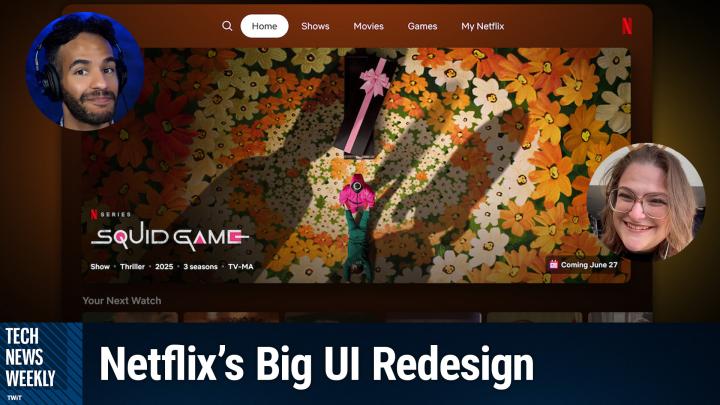
All TWiT.tv Shows (Audio)
Tech News Weekly 386: Netflix Update Aims To Keep You Watching
01:00:33
Netflix's Big UI Redesign
Loading summary
Transcript62 lines
- [00:00]
Micah Sargent
Coming up on Tech News Weekly, Amanda Silberling is here. Joining me, Micah Sargent. We kick off the show talking about Spotify updating its listening experience options, but also a little bit about algorithmic overload, then AI cheating in academia. Brian Westover of PCMAG stops by to tell us about Microsoft's new hardware. And last but not least, Netflix gets a UI overhaul aimed at keeping you watching and watching and watching. Stay tuned for this episode of Tech News Weekly. Podcasts you love from people you Trust. This is TWiT. This is Tech News Weekly. Episode 386 with Amanda Silberling and me, Micah Sargent. Recorded Thursday, May 8, 2025. Netflix update aims to keep you watching. Hello and welcome to Tech News Weekly, the show where every week we talk to and about the people making and breaking that tech news. I am your host, Micah Sargent, and I am joined across the Internet on this, the second Thursday of the month by the Amanda Silberling. Wow. If true. Hello, Amanda.
- [01:15]
Amanda Silberling
Hello. Welcome. From the other side of the Internet. I thought you were going to say the other side of the. The country, but other side of the Internet, Yeah.
- [01:24]
Micah Sargent
I mean, basically, if you have two people talking to each other, then you're on either side of each other. So totally the other side of the Internet. It almost looked like I was doing that thing where you look through your fingers and it makes a little hot dog in the middle. Anyway, so what do we do on this show? We talk about weird stuff? No, we kick off the show by sharing our stories of the week. These are the tech stories that we think are interesting that we want to tell you out there about, because they have been playing like worms in our brain telling us that they're of much importance. So it's a weird, weird episode. Anyway, let's kick things off with your story, Amanda Silberling.
- [02:10]
Amanda Silberling
So this week, Spotify announced that they're making some big updates to the app interface, which I can't really say how I feel about it because I haven't been able to use it because it hasn't pushed yet. But this is sort of just a way for me to talk about my ongoing moral dilemma that I've been having of should I switch from Spotify to Apple Music? Because personally, I feel like Spotify is too algorithmic to the point that it bothers me and I just want to type in my music and listen to it, and that's it. And, and on one hand, this is framed as giving users more control, which is what I want, but on the other Hand, there's like. Like the AI enhanced playlists in there is like, more like smart shuffle and like a bunch of, like, smart features that try to predict what you want to listen to. And that's the whole thing that's pushing me away from Spotify is that I. I feel like I don't have control over what I like anymore because the Spotify algorithm takes over.
- [03:20]
Micah Sargent
Yeah. So this is. I am. I am a fool who for many years at this point has maintained two subscriptions, one to Apple Music and one to Spotify. And that is because Apple Music is the place that I go for what you were talking about. I type in my music and I listen to it. I have had an Apple Music library for a long time. And. And basically when I'm. Most of the time when I'm listening to music, I'm almost always listening to albums. That's just the way that I listen to music. So I go and find a specific artist and then I click on one of their albums and then I listen through the album. Sometimes, sometimes when I'm feeling wild, I hit the shuffle button and I listen that way. I know, right? Whoa. But when I want the music to just come to me and be. Stuff like that perhaps also could be things that other people like, that's where I turn or have turned to. To Spotify. And so that's why I've always maintained these two subscriptions, because they each have provided something separate for me. And I think that that helps me to avoid the frustration that you are experiencing in that I don't have the part where, for me, Spotify is not giving me what I want when I want it, because Apple Music is that place for me. And Spotify instead is like, here's what I think you want. And I have to tell you, Apple Music is not. Has, in my experience, is not very good at like, randomly generated playlists and the autoplay features and things like that. And in fact, if you. This is something that I was recently talking to some friends about because they had kind of. They were. They were like, why are you. And I'll explain in a second. I. Let's say I said play songs by Rihanna or some people, you know her as Rihanna, but her name is pronounced Rihanna. So let's get over it. Play songs by Rihanna and it goes. And it plays like her top three best songs right away in Apple Music. And Apple Music does that always. And I'm like, I want that stuff mixed in. Don't just play all the bangers right off the top. You gotta Be smart about it and layer it in. Let's go to some B sides. Let's check. You know what I mean? And so when I am looking for like smart and on your own, Spotify has been that place. However, it is interesting what you're talking about because of the kind of continued revamping and redoing and re recommending of stuff. It is a little bit more complicated I want to though to talk about with this latest update. Like, what what will users see has changed for them? What are the features that are specific to this new update and is it going to make things more difficult for us to use?
- [06:39]
Amanda Silberling
So. Well, speaking of your comment about when you want like the right mix of things, something that I find very funny in this update is that they are making a hide button or like a snooze button, which I don't believe was in the app before, where if you're listening to some sort of like workout mix and then they keep giving you Sabrina Carpenter and you're like, that's not really workout music, then you can snooze it. And I just think the idea of snoozing a song from your algorithm is very funny. But I don't know, maybe that'll like, make it a bit better. Like personalized. There's like a create button where that sort of like, gives you a quicker access to all of the features that already exist in Spotify. Like making a blend playlist with a friend where you like, combine your music tastes and it makes a playlist for like the both of you. Basically just like all these kind of like the social features that make Spotify fun. Like, you can't do that on Apple music. Or there's like, like jam, which is the thing where you're at like a barbecue in the summer with your friends and then everyone's adding songs to the playlist, which I feel like is always a little bit glitchy, but maybe it'll get better. And yeah, like, it seems like there's an emphasis on like management of playlists, which maybe that would help the issue I'm having where, like, I just find that right now when I open the app, I'm getting like, recommendations for podcasts I don't listen to and I have to click like five buttons to listen to music that I want to listen to. But then even in the like, the hero image from Spotify that like, shows what's coming, it looks like they haven't changed that part of it. So I don't know. But I do also think, like, There is some truth to the sort of conspiracy theory of like, Spotify controlling what gets popular, which I don't think Spotify is like, they're like, hahaha, like, we're gonna make Chapel Road popular. But, like, I do think I have noticed sort of this thing where like, there are certain bands that all of a sudden you're like, I didn't know who this was. And now they're on every playlist I have. And it's not that Spotify's doing that, but just that, like the emphasis on the algorithm.
- [09:10]
Micah Sargent
Yeah, yeah, yeah, that's a good point.
- [09:12]
Amanda Silberling
Yeah. Even like, I think a really good example of this that I find fascinating was there was an article in Stereogum, like, years ago about how the band's Pavement, they're like popular indie rock band, but among like, the specific, like 90s indie rock people. And their most popular song now is a random B side that nobody cared about. Because for some reason the Spotify algorithm picked it up and was like, everyone, this song is good. To the point that apparently one of the guys from Pavement was like in a coffee shop and the song came on and at first he didn't recognize it as his own.
- [09:52]
Micah Sargent
But, like, that's pretty great.
- [09:54]
Amanda Silberling
I don't know. I'm just like, there's too many algorithms.
- [09:58]
Micah Sargent
Yeah.
- [09:59]
Amanda Silberling
Not that Apple music doesn't have any sort of algorithmic thing, but like.
- [10:04]
Micah Sargent
But maybe it's lack of emphasis on the algorithm is what makes it a. It makes it feel less AI overlordy y. Which when it comes to people who are. Because that's the thing. Like, I. I don't. I cannot tell you the last time I listened to the radio. I want to be in control of my music for the most part. In almost every case.
- [10:35]
Amanda Silberling
I know someone who only listens to the radio and then only downloads music from Bandcamp and like buy and puts it on his phone and it's crazy.
- [10:42]
Micah Sargent
Oh, bless and only E. Thomas and no, I'm just kidding. That's mean. That's mean. But it's. Yeah. So because of that, the idea that I'm not in control, I guess, of how. And Spotify is always. Even though with Apple music you're also. It's not yours if you're just doing an Apple music subscription, that music is not yours. It feels more like it's yours than on Spotify where, like, that's been the design language and the. The sort of ethos from the get go. And so that's, I think, part of what makes Spotify feel More robotic in a way, and less like you're, you know, you're flipping through vinyls and pulling one out to put on the record player and, like, sitting back with your music.
- [11:33]
Amanda Silberling
This might be a really weird comparison, but it feels like Apple Music is Vimeo and Spotify is YouTube, where it's like one of them is like, where you upload your art projects and one of them is, like, where you go when there's weird arguments in the comments, but also there's good stuff there and everything you want is there, but it is more of, like, a social experience than anything. Or do people even use Vimeo still? That's just where I would always upload my little film things.
- [12:00]
Micah Sargent
But I don't know if people are. Yeah, I mean, I've seen Vimeo. I know I'm like. Because I've certainly put stuff there whenever I. For whatever reason it did, it didn't make sense to put it on YouTube or YouTube was crushing it, but I haven't really. I think it. It ended up getting really expensive and that has caused some folks to not. Not make use of it as much.
- [12:25]
Amanda Silberling
Yeah, like Flicker rip, Flickr.
- [12:27]
Micah Sargent
Oh, we love you, Flickr. It is actually already, if you can believe it. Break time here on the show. So, you know, we'll. We'll continue to jam out on Spotify. We'll check in with Amanda to see if. Because you've been talking about this now for a little while, I'm curious if you end up leaving Spotify behind.
- [12:47]
Amanda Silberling
Well, I have time because I got a new phone recently, so I have the three free months of Apple Music. So I'm like, really easing into it. I think I'm about one and a half months in, so. We'll see. We'll see.
- [12:59]
Micah Sargent
Oh, all right. Well, we will find out. But let me tell you about Zscaler, who are bringing you this episode of Tech News Weekly. Zscaler is the leader in cloud security. Hackers. They're using AI all the time to breach your organization. AI powers innovation. It drives efficiency. But the problem is it also helps bad actors deliver more relentless and effective attacks. Phishing attacks over encrypted channels increased by 34.1%, fueled by the growing use of generative AI tools and phishing as a service kits. Organizations in all industries, from small to large, they're leveraging AI to increase employee productivity with public AI for engineers, with coding assistants, marketers with writing tools and finance, creating spreadsheet formulas, automating workflows for operational efficiency across individuals and teams. EMBEDDING AI into applications and services that are customer and partner facing and ultimately moving faster in the market to gain a competitive advantage. And so if you're going to be using AI there, well, those companies need to rethink how they protect their private and public use of AI and how they defend against AI powered attack. Chief Information Security Officer from the New York City Department of Education says, quote, with AI, I'm concerned about the usage of it, but I also love the innovation with it. How are employees using AI? Which AIs are they using? Zscaler can be a good partner there to help us find out the answers to those questions and to help us move faster when it comes to incident response and finding that needle in the haystack. Proactively finding threats to our network and our data. Traditional firewalls, VPNs, public facing IPs, they expose your attack surface and they're no match in the AI era. It's time for a modern approach with Zscaler's comprehensive Zero Trust architecture and AI that ensures safe public AI productivity, protects the integrity of private AI and stops AI powered attacks. Thrive in the new AI era with Zscaler Zero Trust plus AI to stay ahead of the competition and remain resilient even as threats and risks evolve. You can learn more@zscaler.com security that's zscaler.com security and we thank Zscaler for sponsoring this week's episode of Tech News Weekly. All right, speaking of AI, there was an interesting publication in New York Magazine. Across college campuses, a quiet shift has taken place. For many students, assignments are no longer something you complete. They're instead something you feed to an AI. From essays and study guides to coding, homework and reading reflections, ChatGPT and other generative tools have become academic co pilots. As one student put it, college is just how well I can use chat GPT. At this point, professors are scrambling to respond. But with inconsistent rules, unreliable detection tools, in an overwhelming culture of normalization, it's starting to feel like the foundational contract between teacher and student has changed and honestly maybe broken overnight. And here's the thing with this piece. What I like about it is up to this point we've had this sort of ongoing quiet fear. I can remember when generative AI was first taking off. In fact, I had some of the folks from OpenAI OpenAI researchers back in the day when the first version of Dall E. I think it was the first version. It was either the first version or the second version version came out. Had some of those researchers on the show and talked to them. And round about that time we started to hear about colleges getting nervous about generative AI and needing ways to detect it. And so there was this huge fear, right, oh dear, what's going to happen? And all of these detection tools came out and there wasn't really a lot of research at that point on how much it was actually being used and how it was being used in academic settings. This piece goes and talks to people and figures out that it's not just a matter of using AI for, for, you know, figuring out the answer to a question, but that it's just like become part of the culture. And as that one student said, it's like, how well can I just use chat GPT? That has become the test. And I think that this plays into the sort of overall question we have about whether it's time to sort of rethink the way that we are teaching and the way that we are analyzing what, you know, students work actually is and, you know, how to, to qualify it and say these tools are going to be here. Let's figure out what that means and how we can kind of move forward with that in mind. It's kind of messy. There was one, one particular interview, this is, by the way, by James D. Walsh. Intelligencer, which is the. The name of the publication within New York Magazine, spoke to one student who was writing an essay that was about how AI is resulting in students not using critical thinking skills anymore. And this person fed the prompt into AI and generated the essay and handed that in. And the author of the piece said, do we find some sort of irony in the fact that you're writing about this? And the student really was just kind of like. And that's concerning to me because I.
- [19:32]
Amanda Silberling
Think you could probably, you could frame that as like an art experiment. Like, yeah, you're, you could frame that as like a conceptual art statement.
- [19:41]
Micah Sargent
Well, yeah, exactly. But see, and that's the thing is that there's that creative aspect of it, right? There's that creative thinking, there's that, that, that, that time that you take to sort of formulate an idea. And that is a hard thing to, to get or to, to acquire without pushing yourself and challenging yourself. And here's the deal. I'm not going to be old man shouts at Cloud. I, I feel very much that, look, this stuff is here and we have to figure out a new way at least while it's around to kind of rethink our standard understanding of, of education and what it means. But with all of That I also do have a genuine concern about the loss of critical thinking skills. We haven't seen that play out yet. So I'm not saying that suddenly everyone's lost their, their critical thinking skills. We're not at that point, research hasn't been done. So I'm not going to make that claim that that's the case. But I, I feel like it's fair to say that that is, that's, that's a concern that I had. I'll say one last thing before we kind of open this up into a discussion. One of the students talked about how they would not even like really read anything that was given to them as a, as their sort of essay prompt, but simply would just dump it into chat GPT and then not even read what chat GPT spat out, but just copy and paste it and put it in. And admitted to 80% of every essay that this student had submitted being written by AI. So only did 20% of the essay work. There's of course other work. So the author of the piece said, just curious, why did you work so hard to get into Columbia and then not do any of the work once you got to Colombia? And the student said, and I quote, it's the best place to meet your co founder and your wife. All right, let's talk about this. Where do you stand as it is on the AI concern and you know, the loss of critical thinking and every college student is cheating? Is it all just sort of fear mongering or what?
- [22:16]
Amanda Silberling
Do you think I'm going to be more of an old man yells at cloud here where I do think this is an issue. I have friends that teach in colleges that are like, my students are all writing and suddenly the way that a college freshman writes has radically changed. And I wonder why. And like, I don't know, this is a really radical take, but I think that kids should do their homework. But I mean obviously it's more complicated than that. And in all seriousness, I think it's sort of like I remember when I was in school we weren't allowed to use Wikipedia as a source. And that's a little like, I don't know, I mean I think using Wikipedia as a source is an exercise in media literacy to begin with where like you know that anybody can edit it. But then also there's like maybe like verify like what, what the source is like. Yeah, everything is sourced.
- [23:12]
Micah Sargent
I was going to say, to be clear, for, for my school, we were told that as well. But all that the teacher meant and she made it Very clear that this was the case was you can't put in your bibliography or in your. Your. Your footnotes, Wikipedia as a source. But if you go to Wikipedia and you find how it is sourced from Wikipedia and you find that original article, you can source that. And so not using Wikipedia as a source just meant, don't be lazy and type in Wikipedia or type Google, find out where they found out that information and confirm it. And I think that's the big thing right when it. But here's the. Here's the, like, difference between, between that and what I see happening here. So much of the. The stuff that's being done is supposed to exercise that creative aspect of the mind. That's not as easy. I hate to use the word easy. That's not as cut and dry as simply, here's a thing that's been said. I'm quoting it. Boom. Where you can confirm it instead. This is like, I need you to wholesale come up with an idea, a concept of this or that, and then formulate your argument and give it back. And then students go, I don't want to do that. Then have AI do it for them. That is like, one of the best skills that I ever learned in high school and then honed in college was the ability to formulate an argument and sort of back it up and to think critically about a thing. Are we. Are we going toward a future, do you think, Amanda, where two people who are together have an argument, and instead of being able to articulate the way that they feel, they just have their chat bots communicate for them the way that they're feeling? That's scary to me.
- [25:10]
Amanda Silberling
Yeah, I mean, honestly, I don't think that's like, an outlandish fear. And I think that sometimes people try to compare this technology to past technology. Like, oh, well, I'm sure that, like, when Google came out, people were like, what are libraries going to be obsolete? Whereas now it's like, if you told me to write a paper and, like, only use the library and not Google anything, I'd be kind of like, that's a little pointless. But I think there's also sort of like the red herring of, like, whenever new tech comes out, people are like, oh, well, you don't want to be the person that said that, like, the Internet was stupid. And then now look how the Internet has changed our lives where, like, it's not that black and white. And the same thing happened with, like, oh, you don't want to be the person that didn't invest in crypto and then, like, you don't want to be the person that doesn't, like, buy the NFTs and like. Yeah, I don't know. Like, I feel like there's just always these narratives where AI is different because, like, there are really legitimate applications. Like, this is really impressive technology that is having, like, demonstrable effects on the world. But, like, there's a difference, I think, between being a software engineer who has taken coding classes, using AI to clean up the code code and help catch mistakes, versus being a software engineer but never learning how to code.
- [26:42]
Micah Sargent
Yeah.
- [26:44]
Amanda Silberling
I mean, I think it's also just that people are putting too much trust in AI itself when AI is not always accurate and it's not unbiased. Any technology is made by humans, and humans all have bias in one way or another. And I think that ChatGPT and similar tech gets sort of presented as this neutral, unbiased thing that is, like, gonna spit out just the most truthful thing possible. But, like, there's always bias there depending on who's making it, what it's trained on, especially when they're all trained on the Internet. And I mean, look at the Internet. That's. Yeah, have you seen the Internet before?
- [27:31]
Micah Sargent
It's that spongebob episode where he eats the sundae, but it's made of onions. The Internet is going, I'm ugly and I'm proud. It's very proud of itself for being ugly and, yeah, for training everything on the onion ice cream sundae, onion mayonnaise sundae. Look it up, people. If you don't know what I'm talking about, look it up. Then this is what we're left with. I do wonder, in the end, though, if we are going to have to redefine the definition of. Of sort of educational academic integrity. If there's going to be continued resistance, and if that means that professors and other types of teachers, educators, are going to have to spend three quarters of their time focused on getting people to not use these tools or trying to patrol these tools instead of actually being able to do. Do the education and the teaching. And that, I think, is. Is a problem for sure. So we will. I mean, as always, I feel like I say that at the end of almost everything, but it is true. We have to wait to see how this turns out as universities and other educational bodies continue to grapple with the. The question of how best to handle this going forward. Amanda Silberling, I want to thank you so, so much for taking the time to be here with us today. Of course, folks, can read your great work over on TechCrunch. But if they want to follow along with what you're doing and perhaps listen to your podcast, where should they go to do so?
- [29:10]
Amanda Silberling
I co host an Internet culture podcast called wow if True which comes out every other Wednesday. It is wherever pods are cast. Or if you Google Wow if True we should probably just come up which you can don't don't look us up on chatgpt. Look someone the less evil Google. But yeah, and then I am mostly posting on Blue sky these days. I'm actually wearing a Blue sky shirt right now. Unplanned. I just put on this shirt today. My blue sky is Amanda OMG lol. Because that's just a URL that I have and I think it's fun.
- [29:50]
Micah Sargent
It is fun and so are you. Thank you so much for being here and we'll see you again soon.
- [29:55]
Amanda Silberling
Cool.
- [29:56]
Micah Sargent
Bye bye. All righty folks, we're going to take a quick break before we come back with Brian Westover of PCMag, who is joining us to talk about the new Microsoft Surface hardware. Before that though, I want to tell you about Spaceship, who are bringing you this episode of Tech News Weekly. I got a big question for you. Why do we have to assume that simple and affordable has to mean basic and only for beginners? I mean, tech professionals want to save time and money too, right? That is the idea behind Spaceship, the pioneering domain and web platform that takes the pain out of choosing, purchasing and managing domain names and web products like shared hosting, virtual machines, and business email alongside below market prices, which is great for domain registration and renewals. Spaceship has some pretty fresh ways to deliver simplicity. There's Unbox, which is a place for connecting your Spaceship products to your domain and configuring it all in just a few steps. There's also alf, which is your very own AI assistant for making life easy. From domain transfers to updating DNS records, ALF takes care of that stuff and loves the stuff that you probably don't. Plus Roadmap, a place for exploring, suggesting and voting on new features and products so customers and the tech community get what they really need. While we were on the call with the folks over at Spaceship, I was able to find a domain, get that domain, set up that domain, set up a WordPress instance on that domain, all without leaving the call, without really being distracted because so much of it was just boop boop happening for me. It was fantastic. You can visit spaceship.com TWiT to discover exclusive deals on domains and more that's spaceship.com TWiT and we thank Spaceship for sponsoring this week's episode of Tech News Weekly. All right, we are back from the break and I am very excited for our next guest. It's Brian Westover of PCMag. Welcome, Brian.
- [32:00]
Brian Westover
Hey, thanks for having me.
- [32:02]
Micah Sargent
Yeah, pleasure to have you on the show. So I was glad to have you join us to talk about some new hardware. Microsoft just announced some new Surface devices. I was hoping you could kind of start by walking us through the key hardware updates in these models. Sure.
- [32:20]
Brian Westover
So there are two new Surface products. We're looking at a 13 inch Surface laptop and a 12 inch Surface Pro tablet. The big difference is there. I mean, some of these are superficial. You get new colors, they now come in blue and violet and platinum. The big changes though, is that these are both smaller and lighter than last year's models. The laptop shaves off about 4 ounces. It's a 13 inch instead of a 13.8 inch screen. The Surface Pro tablet drops 7 ounces. And in a tablet, that's the difference you're going to feel. The other major differences, they step up to Wi Fi 7 for connectivity, USB C entirely for connecting peripherals. And the systems both use the Snapdragon X plus processors instead of the X Elite chips they used last year. They're a little cheaper, they're more energy efficient, they're not quite as performant as last year's chips, but in day to day use they're going to feel very much the same, but with better but with better battery life.
- [33:33]
Micah Sargent
Understood. Now, both of these devices, as we discussed, are powered by Qualcomm's Snapdragon X plus chips and fall under that Copilot Plus PC category. It's been a while since we talked on the show since I've been able to talk to the folks about what qualifies a PC as Copilot Plus. So I was hoping you could tell us, remind us rather about that and then what AI features you can count on in these Surface in this Surface hardware.
- [34:02]
Brian Westover
Right. So Copilot plus and Copilot Standard is Microsoft's branding for an AIPC experience. So an AI PC is any device that's made to run AI apps on device or support AI features in other apps. You know, like Adobe, you already have on your system AI. The AI features will leverage some of that hardware. So we're talking about NPU hardware, which is processing dedicated to neural networks and their unique processing needs, and that supports features. I mean, in Copilot plus in particular, that Gives you the Copilot assistant, which is your little chat assistant on the system but also features like live captions and live translation, image generation and a bunch of chat based features like, you know, summarizing text and changing format and tone. Those things that you might be used to from, from other assistants like chat GPT but run on the device.
- [35:00]
Micah Sargent
And then one of you talk about this in your article. One of the more surprising choices, Microsoft's continued reliance on on Qualcomm chips instead of our dear friend intel or AMD in its consumer services. What reason does the company give for the loyalty it seems to Snapdragon?
- [35:21]
Brian Westover
Yeah, I mean it kind of shook things up last year when they announced that Surface was all going to be Qualcomm for the consumer models. But they haven't said much publicly. Last year I had a chance to ask them directly and they said, you know, Qualcomm was just the company that hit the thresholds. They needed first for like you know, 40 tops out of the NPU, the necessary hardware to support what they wanted to do with Copilot. That's not the case this year because intel and AMD both have chips out that support Copilot plus we have, we have those in the market already. So this year I suspect we're seeing, you know, this is part of an ongoing agreement between the two. They announced in 2023 a collaboration between Microsoft and Qualcomm to scale up AI capabilities and quote, bring best in class AI experiences. So the move to ARM and a partnership with Qualcomm is likely a multi year endeavor to do just that because it requires not just hardware but also a broader ecosystem. Developers need to work on this, features need to be introduced. That takes time. The ecosystem has to take root and grow and you know, Microsoft is likely investing in Qualcomm's roadmap and vice versa so that this, this pays off down the road with that sort of ecosystem growth. That's not something you get with a one off change of hardware for one year. That's something that happens over a few years.
- [36:51]
Micah Sargent
Understood the Surface laptop and the Surface Pro physically smaller than their predecessors. Does Microsoft kind of talk about the shift in this form factor and we're looking at changes in these devices and how they're used day to day because of this shift to kind of smaller. It's very interesting the sort of two sides it seems of the, the hardware argument, which is one where you're going for performance and so you don't mind if it's a little bit Thicker. And then the other side is like, let's make it as thin as we possibly can, as portable as we possib like and a small. Where does this kind of fit in that lineup?
- [37:30]
Brian Westover
It's definitely portability. Portability is easy to sell. You know, lighter, thinner, longer battery life. You know, that's, that's, that looks good in ad copy. But it also, you know, those changes are big. They do deliver something to the consumer. When you're talking about a product like the Surface Pro, you know, a lighter tablet is easier to carry and it's easier to use casually. It really makes the most of that form factor. There might also be a cost play here because both of these products are actually cheaper than last year's models by you know, 100 bucks or so. And you know that's going to be a more important competitive advantage in the coming months. You know, we've got tariffs, we've got other pressures that are going to impact pricing on the PC market and how people, how people select what they're going to buy. So I suspect there's some of that going on as well is a slightly smaller form factor gets them both of those sides of things.
- [38:31]
Micah Sargent
Got it. So we talk about those advantages, battery life and energy efficiency. But you also talk about in your piece some drawbacks perhaps to ARM based PCs. What are some of the compatibility or performance issues that users, it seems especially business users, might run into.
- [38:50]
Brian Westover
Yeah, I mean Microsoft, to their credit, they've gone to great lengths to make this ARM concept work and they're doing better at it now than they have in the last decade's worth of attempts. You know, we've got more native apps, you've got more robust emulation, but it's not going to work with everything. And compatibility with specific software is a big one, especially for businesses because industry specific apps that were built for x86 aren't always going to work even with the improved Prism emulator they have. So depending on your business that could be a deal breaker right away, you know, because businesses are often relying on niche tools that don't get broad support. They don't get frequent updates. You know, some of these are, you know, tools that are made for three companies to use and you know, and if it doesn't work and your company relies on it, it then it's just not going to work. Peripheral support is kind of the other big issue. Printers in particular, you need something that works out of the box with the equipment that you have. And with arm it's not always going to do that, but more than that, there aren't always solutions you can find. So particularly for companies that have those specific needs, you've really got to check compatibility and peripheral support first to make sure that it's going to do what you need it to do. As long as you don't have those issues, it's actually pretty great. I've been really surprised in the last year at how well the x64 approach is working with Microsoft's new support. I've been really impressed. And for consumers it's almost, you don't, you almost don't have to worry about the switch. But for businesses it's a sticking point.
- [40:42]
Micah Sargent
Now, I did kind of notice a broader theme in your piece about the competition in the chip market. How does this shift towards Snapdragon, perhaps reflect that changing dynamic between intel, amd, Qualcomm? Especially when we look at the chips that are being used in the AI PC category.
- [41:03]
Brian Westover
Yeah, I mean it's a huge opportunity right now for chip makers. Intel is still huge, but they're not as solid as they once were. AMD is more competitive than ever, but Qualcomm really is the up and comer right now and we're hearing rumblings about potentially stuff from Nvidia and Media Tech and who knows what's coming down the pike. But AI really is the major tech development of this decade. I don't think there's any argument about that. But it's one of the many, one of the many ways it's changing the tech space is that it's kind of reshuffling the deck for hardware manufacturers. AI PCs are an inflection point because the NPU hardware and then the software that takes advantage of it, that's a new area where intel doesn't have a built in advantage. And so I mean this, the Surface products with Qualcomm is a great example of that, that it's about supporting new experiences and new features that we haven't used before. And that really opens up a chance for any player that can deliver what they need.
- [42:08]
Micah Sargent
One thing that I really appreciated about the piece that you put together is there's a lot of analysis in it. And so I wanted to kind of ask you a stepping back question. What are your thoughts on what this reveals about Microsoft's strategy in the AR hardware? AI, excuse me, hardware space overall. And do these new, does this new Surface hardware suggest the company is kind of doubling down now on a longer term bet?
- [42:35]
Brian Westover
Yeah. So the Qualcomm partnership, like I mentioned earlier, this is a Multi year agreement. But for Microsoft, that's a short term bet. The bigger play is making AI on the PC a Microsoft branded domain with Copilot and Copilot plus you know, they want you to think Copilot every time you hear AI. But the biggest names in AI right now are companies like OpenAI and Anthropic and Google. That's all on the cloud and that has been a huge threat to Microsoft's consumer business because it kind of leaves them in the cold. So they've cozied up to OpenAI, they've gone full bore on Copilot and they're planting seeds with things like this Qualcomm partnership to let them own or co own major innovations for on device AI. You know, out at the edge in the devices people use. If they can own AI there, then it continues to be a major part that wins for them. So I think that's the long term play. Obviously, you know, I don't, I don't have any secret sources or Magic 8 ball here, but that's, that's what I can see from, from what we're looking at.
- [43:46]
Micah Sargent
Nice. I want to thank you so much Brian for taking the time to join us today on the show. Of course folks can head over to P pcmag.com to check out this article. We'll of course link it in the show notes. But if people want to keep up with what you're doing, is there a good place they can go to stay up to date with your articles and.
- [44:05]
Brian Westover
Sure, yeah. So I'm on Twitter. I eventually need to change to something else but I'm Brian at PC and I, you know I tweet out most of my articles there but really PC mag is the place to go because we're publishing a lot these days. I do a lot of laptop reviews but I also write a lot about AI. I thought you've got a, got a column about AI that we'd love people to read called Try AI. So check that out.
- [44:33]
Micah Sargent
Awesome. We will thank you so much for your time. We appreciate it.
- [44:36]
Brian Westover
Fantastic. Thanks Maika.
- [44:38]
Micah Sargent
All righty folks, we are going to take another quick break before we come back with a story of the week. I want to tell you about Cash Fly. You know Cash Fly? We're bringing you this episode of 10 Tech News Weekly. For more than 20 years Cash Fly has held a track record for high performing ultra reliable content delivery serving more than 5,000 companies in more than 80 countries. That's what we have been using Cash Fly for more than a decade and we love the lag free video loading, the hyper fast downloads, the friction free site interactions. And so do the people who download our shows. Cash Fly's proof is in the petabytes Events stream smoothly to millions of concurrent users worldwide. Online games start 70% faster. They scale instantly. They play without lag. Software downloads flawlessly during releases, patches and updates. HD video plays on demand with ultra fast sub second start on every device. Podcasts reach global audiences in record speed at any scale. Let me tell you that software one, really, I'm not going to say the app, but there's an app that I use that it gets updates a lot and I don't know what they're using but. But I know it's not Cash Fly because those updates take forever to download. And I'm going, I have such a fast connection. Why isn't this working? So knowing about that frustration and that friction, that is what you want to avoid for your customers, Cashfly can help you avoid that friction. Cashfly delivers rich media content up to 158% faster than other major CDNs and allows you to shield your site content in its cloud, ensuring a 100% cash cash hit ratio. And with Cash Fly's elite managed packages, you will get the VIP treatment. See, Cash Fly is like gaining an extension of your team. When your entire business model depends on delivering massive amounts of content, you simply can't afford to go it alone. You can count on personalized help anytime from a tenured expert who gets it. Engineer to Engineer 24. 7 Learn how you can get your first month free at cashfly.com 24twit that C-A C-H-E-F-L Y.com TWIT let's head back to the show. All right, we talked about AI, we talked about algorithms, and we're bringing it all together with this final story of the week. Netflix is rolling out a major redesign meant to keep you from leaving. And we're not just talking about the app, but keep you from leaving your subscription altogether. The new interface changes how you browse, what you see, and how recommendations are generated, all with the goal of one thing getting you to watch more for longer. And it's not just cosmetic, it's algorithmic. There's the word. As Netflix puts it, this update is built to respond to what you're doing as you're doing it, meaning the platform will try to keep you binging even when you're thinking about logging off. And that is a big step away from what we've seen in the past, given how I used to get annoyed and felt jud when Netflix would ask me, hey, are you still watching? Now it's like, hey, please still be watching. The UI itself is changing and one of the biggest visual shifts is actually the navigation. See, the navigation is going to move to a horizontal bar at the top of the screen. A new home. And my Netflix tab will split discovery from user curated lists. So what they want you to see or think you want to watch versus what you are actually adding to your Netflix. So you can jump to shows, to movies and games more quickly. But Netflix is positioning this new home tab as the place to surface the content it wants you to watch. So where before it was kind of all mixed in together, the Netflix home tab is now we're going to use the algorithms and we're going to suggest what you want. There are response or excuse me, responsive, not responsible, but responsive recommendations that are part of this kind of pivot. Netflix CTO Elizabeth Stone said the platform's new algorithm will update suggestions as you browse, not just based on your history. So one example, if you finish the show you and you search for more serial killer content, new titles will immediately start surfacing under categories like Love, Lust and Lies. So before it would kind of process in the background what you've watched and then the next time you launch Netflix, you would have some new suggestions based on what you'd seen before. No, no, no, no, no. It's always you. You're always watching Netflix, it's always watching you. You stare into the void and the void stares back and makes recommendations based on that. Again, the idea is just to keep you watching past the point you would normally grow bored where you'd see those suggestions at the bottom and say, I don't think I really need to keep watching this. But it does come with a deeper layer of personalization. The algorithm now considers factors like time of day, so your late night chill session may bring up very different options than what you see on a Sunday afternoon. Over time, this breathe in, breathe out may extend to ads as well. We've talked before about how Netflix offers the ad tier, not the ad free tier, but the ad tier, and how prices have continued to go up for that non ad tier, which many suggest is because Netflix is trying to push you to the ad tier, it becomes very expensive to not have ads for you, the end user. So you go to the ad tier, which ends up making Netflix more money because they can make a lot, it can make a lot of money off of ads. So those Ads can become more focused and personalized based on what you're watching. Netflix's chief Product officer Eunice Kim teased that the redesign offers, quote, flexibility to evolve the homepage and could, quote, drive outcomes for advertisers. Smile. There's also kind of a feed that will look very familiar to you if you've ever scrolled through Instagram or perhaps TikTok on mobile. Netflix is testing a vertically scrolling feed of short video clips. These are clips chosen to get you watching or sharing, you know, just like Instagram reels, but entirely driven by Netflix's recommendation engine. I think this is one of the aspects that I find most compelling because it I remember there was a. I wish I could remember the name, that's how bad it's been. But the company Floop went away. But it came out briefly and was supposed to be this mobile first idea of watching shows and they were filming it in vertical format. But the problem with it was you couldn't share any clips from the stuff. And that's like a huge aspect of what makes these shows take off. Sharing animated gifs, sharing, you know, clips and scenes. And so this idea that you see these short video clips and that you share that around is really powerful, especially if it gets mixed in with the other content that Netflix puts out. I follow some different Netflix sort of sub brands on Instagram and those have turned out to be some of my favorite Instagram accounts and lead me to watch new shows. So seeing all of that kind of mixed in together I think is a very smart thing to do. There's also going to be improved search. Netflix is experimenting with AI driven natural language search. So you can type things like something dark and funny but not too funny and the system will interpret that request. It's powered by OpenAI and it's rolling out to iPhones first. It is an opt in only feature. I think it will be something that I opt into just to give it a test. But again it is coming to iPhones, not to Netflix, you know, for Apple TV or in your browser or on your screen, smart tv wherever you happen to watch Netflix. And of course that's another thing to keep in mind is that there are places where Netflix can make changes a lot quicker and places where it takes a lot longer for Netflix to make changes depending on what smart TV you have, what the process is for updating apps on that smart TV based on what the manufacturer allows. All of that plays into when or if these changes will come to the platform. The partnership with OpenAI is really interesting and of course, has its own set of kind of implications.
- [53:12]
Eunice Kim
Asking the right questions can greatly impact your future, especially when it comes to your finances. So if you're looking for a financial advisor you can trust, certified financial planner professionals are committed to acting in your best interest. That's why it's gotta be a CFP. Find your CFP professional@letsmakeaplan.org Hey, it's Ryan Seacrest for Albertsons and Safeway this spring. Take care of your entire home, including the air you breathe, and save $5 when you buy $25 worth of participating products in store or online. Shop for items like Glade Plugins, Airwick Plugins, Glade Auto Sprays, Airwick Diffusers and Glade refills. And save $5 when you spend $25 on participating products. Offer ends May 20th. Restrictions apply. Promotions may vary. Visit albertsons or safeway.com for more details.
- [54:01]
Ryan Seacrest
Honestly, Honestly, Honestly, no one wants to think about hiv. But there are things that everyone can do to help prevent it. Things like prep. Prep stands for Pre Exposure Prophylaxis, and it means routinely taking prescription medicine before you're exposed to HIV to help reduce your chances of getting it. Prep can be about 99% effective when taken as prescribed. It doesn't protect against other STIs, though, so be sure to use condoms and other healthy sex practices. Ask a health care provider about all your prevention Options and visit findoutaboutprep.com to learn more. Sponsored by Gilead.
- [54:31]
Micah Sargent
Now let's talk about why it matters. Netflix's churn rate is actually lower than most competitors. Churn rate is, of course, the number of users who cancel subscriptions. So you are seeing a lot of other places where there's one or two shows that somebody wants to watch. They subscribe for that period of time. Afterward, they kick their subscription because their show is over. Netflix has a low churn rate because there's a lot of stuff on there and a lot of stuff for people to watch. Despite that, the company is still hyper focused on keeping subscribers engaged on keeping subscribers hyper focused. The overhaul is built to kind of fight that common behavior of signing up for a show, watching it and then leaving. I'll be honest, that has never been Netflix for me. It's never been a place that I I subscribed to, watched a show, and then left because there were eight shows that I could watch on Netflix at any given time. So I saw no reason to leave. I am getting to a place, though, where the cost of not having ads on Netflix is kind of ridiculous and therefore may result in some changes to that going forward because I don't watch enough Netflix to make that change. But as the article puts it, this is the tick tock ification of Netflix and there's no escaping it as far as it goes from our end. Perhaps this makes it more convenient, more compelling. But as Amanda Silberling was talking earlier in the show about Spotify, there, there is that little itch in the back of your brain right of that. Is there some aspect of this where Netflix is perhaps attempting to get control of an algorithm that will result in content that it wants surface to be surfaced? Perhaps. But with Netflix, this is a platform that primarily is stuff that Netflix is putting forth. So that kind of makes sense. As far as the TikTok style feed, if you are out there and you watch Netflix on your phone, I want to hear from you. That is fascinating. I think that, yeah, I mean, with us knowing that that's the first place that we're going to see that that sort of TikTok style feed, there's the question of is that going to turn people off? I don't know that it is because I think the people who would be avoidant in theory of that TikTok, TikTok style feed are probably not watching their content on their phone in the place first. First place. They're not watching Netflix on the front in the first place. So they'll be able to avoid that in general. It does make you wonder though. I've seen this happen before. A person starts to get suspicious of their own algorithm. They, they see the content that's being served to them. They're going, I no longer feel perceived. My Netflix doesn't know me. That's not who I am. And they want to reset their algorithm or they want to confuse their algorithm. Maybe it's getting them too much. Maybe it knows them too much. They can't let it be, let it exist. And so they go, I got to make a change. Will you be able to change the algorithm? Will you be able to reset it? What's going to happen there? And then last but not least, of course, we have to just figure out how is this going to affect Netflix's viewership and daily active user count overall and will this improve upon it? And if it does, then does. Is that one more sort of propping up of the idea that algorithms are where it's at? We'll have to. What do we have to do, people? We'll have to find out. But that is a little bit about Netflix. You can read more about the UI overhaul over on Gizmodo piece by Kyle Barr who talked about the upcoming change to Netflix and and its TikTok ification as he put it. Folks, that's going to bring us to the end of this episode of Tech News Weekly. This show publishes every Thursday at Twitter TV tnw. That is where you can go to subscribe to the show in audio and video formats. If you'd like to get all of our content ad free. Just the show, just the content, Nothing else. No ads. Well, can I invite you to join club twice twit twit tv club twit $7 a month, $84 a year yes, the annual plan is back and we have a two week free trial, so be sure to check it out when you join the when you join the club, you will gain access to, as I mentioned, ad free content. You'll also gain access to every single one of our bits of content that's released in the Twit plus bonus feed. That's stuff you won't find anywhere else. Behind the show, behind the scenes before the show, after the show, special club Twitter events get published there and access to the members only. Discord Server A fun place to go to chat with your fellow club TWiT members and those of us here at TWiT plus access very soon to a lot of the commentary that we're doing for press events, tech press events. So think about wwdc, Microsoft Events, Google Events. All of that's going to be X. Well much of that is going to be exclusive to the club. So if you want to watch those commentary and join in in the conversation, that's where you have to go to do it. So be sure to head there. Twit TV Club Twit to sign up. I look forward to welcoming you to the club. We love seeing new people joining the club. Thank you you so much. If you'd like to follow me online, I'm at Micah Sargent on many a social media network or you can head to Chihuahua Coffee, that's C H I H U A H u a Coffee where I've got links to the places I'm most active online. Be sure to check out my other shows including Hands On Tech. We'll be recording the rest of May this Sunday, the rest of the episodes for May this Sunday. So be sure to tune in on Sunday morning 11am Pacific time to watch that as excuse me. As well as iOS today, hands on Mac and I'm forgetting one but you can watch those shows as well, thanks so much for being here this week and I'll catch you again next week for another episode of Tech News Weekly.
- [60:57]
Scott Wilkinson
Bye bye for quick tech insights. Dive into Twitt's short form lineup From Hands On Mac, you can get helpful tips, great apps and awesome accessories for your Mac, iPad and iPhone. Hands On Windows offers essential advice and everything new in Windows. Hands On Tech zooms in on a specific theme with easy to follow advice that turns tech troubles into triumphs. Home Theater Geeks with Scott Wilkinson supercharges all things home entertainment and if you like watching the shows, join Club Twit and you'll get full video access to plus ad free versions and more. Get informed fast with all of TWiT TV's short form shows. Download and subscribe today on your favorite podcast platform.
- [61:53]
Eunice Kim
This podcast is supported by Talkspace.
- [61:56]
G
When my husband came home from his military deployment, readjusting was hard for all of us. Thankfully, I found Talkspace.
- [62:04]
Eunice Kim
Talkspace provides professional support from licensed therapists and psychiatric providers online. Military members, veterans and their dependents ages 13 and older can get fast access to providers, all from the privacy of their computers or smartphones.
- [62:18]
G
I just answered a few questions online and Talkspace matched me with a therapist. We meet when it's convenient for me and I can message her anytime. It was so easy to set up and they accept Tricare. Therapy was going so well, my husband and I started seeing a couples therapist through Talkspace too.
- [62:36]
Eunice Kim
Talkspace works with most major insurers, including Tricare. Match with a licensed therapist today@talkspace.com military go to talkspace.com military to get started today. That's talkspace.com military.