← All TWiT.tv Shows (Audio)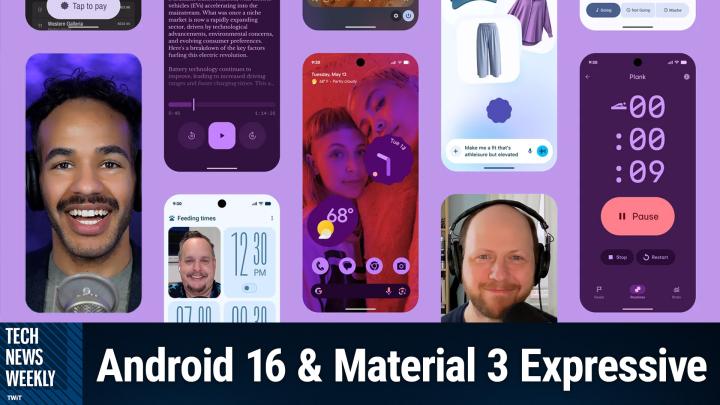
All TWiT.tv Shows (Audio)
Tech News Weekly 387: Android's New Design Language
01:04:06
Android 16 & Material 3 Expressive
Loading summary
Transcript64 lines
- [00:00]
Micah Sargent
Coming up on Tech News Weekly, CNET's Patrick Holland joins us to talk about Android's new design language and theft detection technology. Then who is Dan Moran? That's the guy who's joining me from Six Colors to talk about the Siri class action lawsuit and the new CarPlay Ultra. Before I round out the show talking about deep fakes in the workplace, stay tuned for Tech News Weekly.
- [00:27]
Dan Morin
Podcasts you love from people you trust.
- [00:31]
Patrick Holland
This is Tweet.
- [00:35]
Micah Sargent
This is Tech News Weekly, episode 387 with Dan Morin and me, Micah Sargent. Recorded Thursday, May 15, 2025. Android's new design language hello and welcome to Tech News Weekly, the show where every week we talk to and about the people making and breaking that tech news. I am your host, Micah Sargent and if you're used to us kicking off the show with our stories of the week, well, get used to change because this week, I'm excited to say, we are joined to kick off the show by the very awesome Patrick Holland of cnet. Welcome back to the show, Patrick.
- [01:15]
Dan Morin
Hey, thanks for having me. I'm glad to be here.
- [01:16]
Micah Sargent
Yeah, pleasure to have you on. So we just recently got a little glimpse right at what Google is bringing to Android and you had the opportunity to write more about that. Android 16 introduces the new Material 3 expressive design language. And for those who are just catching up, I was hoping you could describe the look and feel of this update, perhaps compared to previous versions of Android and the changes in the design language in particular.
- [01:50]
Dan Morin
Yeah, and Material three Expressif is just a lovely name for design and when you see it, especially on a phone, the elements have these really nice nuanced animations. It's very personalized as much as a phone piece of electronics can be, meaning that it takes up some of the compliments of colors and things from your wallpaper and things like that. But I think what's most impressive is probably some of the interactions. Whether you're swiping away an app to close, whether you are changing the volume on the phone, whether you're just trying to remove a notification. It's kind of like you're taking a stem off a cherry. There's just that little bit of resistance before it let go. So there's all this nuance and stuff and I think a lot of that from the fact that a lot of these Android phones have things like high refresh rate screens so you can actually see these things. And I don't think it's going to be like a radical change where it's going to Scare people off. In fact, I think what is interesting is Google and Apple as they do these like design overhauls, it's kind of like an opt. Been a little more of an opt in. Like we'll give you a little taste, but if you don't like, you can keep things kind of the same.
- [03:01]
Micah Sargent
That makes sense. Now. You did. I love that. The cherry stem idea, that's. That was really, really well done. You described the volume slider animation, the swipe to dismiss motion for notifications. These are kind of subtle but deliberate design touches. If you had to guess, like, why are these kinds of micro interactions getting so much attention from Google?
- [03:23]
Dan Morin
I think if you've like ever like hopped on TikTok, there's like that it asks you like your interest and there's one of them, like, you know, things that are just satisfying. I really think it just comes to down to that. I think on a conscious level, most people probably won't notice the cherry stem, like removal of a notification or the volume thing bouncing. But it's just that small detail that you want to feel it. It ties you to your phone more. It's kind of the opposite of that. For a long time we had that very minimal, that very stark interface, or going back to the early days, everything was like skeuomorphism. Remember I think the YouTube app used to be a TV set back in the day. So now we're at this place where it's more lively. It's. There's, I think delightful is the word that comes to mind. And it's not going to be like bouncing all over your screen and doing all that. It's very subtle, it's very nuanced. And I think there's just that satisfaction that you get, that same satisfaction you get like with a flipping a full flip phone closed. Right. Like there's something satisfying about it. Doesn't change how you close your phone. Not necessarily. And I want to be very clear when I say like opting in and stuff, like the animations and stuff, it's going to be there whether you want it or not. But it's not like it's going to like, I can't get rid of my notifications anymore because it has this little sticky feel to it. I think most people might not even notice it. And those that do will have that appreciation for it.
- [04:48]
Micah Sargent
It's not trolling you, it's not trolling you.
- [04:51]
Dan Morin
And it's not like iOS was it 7 and where it's going to be like very thin fonts and Driver one.
- [04:56]
Micah Sargent
You're like, I can't even. Just how do I even touch the right. Yeah. Google says the design system is meant to feel more personal and delightful. In your experience with the update, does it live up to that promise? I think in particular the personal aspect of it and how meaningful do you feel is that kind of UX shift for everyday users?
- [05:17]
Dan Morin
Yeah, that's interesting. The devices we saw it on were not our own, so the personal side, like one of the people showing us off was Rohan and his lock screen was a photo of his dog. And then it was neat to see how stuff kind of centered or framed his dog on the lock screen. Like there's a little pill that collapses notifications you've read with icons. There's the new. I'm going to say live updates. I feel like that's the wrong name for it. But essentially it's these updates that come on your phone. People are going to compare it to the iPhone so you can track things like an Uber ride or maybe you're getting directions and maps or whatever. So you have all that there. And I think for that kind of stuff it's helpful. But until we can actually put it on my phone and see how it interacts with my wallpapers and. And that it's hard to say like how personal is, but it seems like that's the way they're going. And to be very clear, this is going to be coming out in June, so we had a month to wait. Not that long.
- [06:20]
Micah Sargent
Oh, okay. Yeah, that's right around the corner. Material 3 expressive. Also coming to Wear OS. Very exciting. What kind of design choices did you see in the watch experience that take advantage of display and the smaller screen?
- [06:35]
Dan Morin
I have to say, even though I run like the. I'm mostly a phone reviewer, I have to say the wear OS stuff got me the most like, I can't wait to see it. We didn't see it on an actual device yet. That will probably roll out in August. And as someone who very much follows tech, you could probably remember that Google had a small Pixel event in August, so it's not hard to imagine that it'll probably debut on the next Pixel Watch. But what I like about where. Excuse me, that material 3 expressive on Wear OS. Again, it has a lot of that same language, but even something like scrolling through the notifications on a circular watch, it feels more intuitive, it looks more natural. I think that's one that I'm most excited about is there is a video and if you look at the video we did for CNET it's in there, but kind of imagine if you drew the letter X across a circular watch's screen. So basically kind of in like that 2:00 clock position, you could swipe and it would have more info there. And so you're able to kind of swipe in and pull this stuff in and out. So it's kind of like having these drawers that are invisible off the sides of your watch that you can swipe in and out without going. Because remember, swiping down and swiping up already does stuff. So now we're on the X axis or not the.
- [07:55]
Micah Sargent
I love that.
- [07:56]
Dan Morin
The diagonal.
- [07:57]
Micah Sargent
Yeah, it's sort of a new. Yeah, so it's a new axis there in between the x, Y axis. Yeah, that's really cool. I and it's all sort of conceptual, right. When you're thinking of like, oh yeah, there are these other pseudo pockets into which we could put more stuff. That's kind of delightful experience. Now this wasn't the only thing that you ended up covering. In fact, the, the piece that you have on CNN is titled We Stole a Phone from Google's Samir Samat and were dazzled by Android 16. First of all, could you give our listeners a little bit of understanding of why it's titled that? But then maybe you could talk about theft detection lock. What's new about it, how it works in Android 16 and how effective it seems to be in your. And I do mean the pun, hands on experience there.
- [08:52]
Dan Morin
Yeah. Okay. So it was, I love that we got invited by Google to talk with Samir Samat who's the head of Android and he was game for showing us demos and doing all these things, but they really wanted to show us theft detection. If you know this theft detection came out with Android 15 and it's not necessary that there's a new feature to it. I think it's the fact that it's kind of being lumped in with advanced protection. So if you go into that menu you'll have an option to do that. So remember, if your phone gets stolen, a lot of people think about the hardware, but all your data's on there, your apps are open, your passwords, so being able to lock that down quickly. So they arranged this scenario where in the Android mascot garden, Sameer Samat sat there with a pixel phone and another guy who worked at Google named Samir put his hoodie up and stole it. And that what was neat is it almost immediately locked the phone down. And I think that's just really impressive. And he not only did that once, he did it four times. A couple times for us and a couple times for another site as well. So yeah.
- [09:59]
Micah Sargent
Oh wow, that's pretty neat. So I think the sort of Find experience has been completely renamed and upgraded. Can you talk just a little bit more about the hub and all of that experience and what Google is kind of bringing to the table there, particularly as it competes with the likes of Apple and its large network of Find My devices?
- [10:26]
Dan Morin
Yeah, I think from Google's point of view, the Android system has 3 billion active devices, which is just wild. Obviously in the US we're very iPhone dependent and in terms of being able to find your phone, find your friends, find your other devices, we have that on Android. They're kind of repackaging it. It's called Find Hub now for Android 16. So you'll still be able to do that, but there's more privacy settings. There's also going to be things like the AB to connect that to satellite, which we did not get to see yet, but that's essentially what's going to happen there. And the thing that is interesting, we now have a lot more Android compatible trackers that are out versus last year. And the big one is we have phones that have ultra wideband, not the 5G technology, but that's kind of like the, you know the part that we love about airtags, right. Is just be able to do that in that last five or 10ft, be able to find an item. Probably the most common one would be keys. So we're still waiting for that stuff to be implemented. But yeah, findhub. Again it seems like we talk about material 3 expressive being about these personal touches and delightful things. It does seem like on the system side they're kind of combining things together and making things make more sense like advanced protection, theft detection lock. Excuse me. As well as the Find My Hub.
- [11:54]
Micah Sargent
Understood. Now lastly, Gemini, we know replacing Google Assistant across Android based on what you saw. How well does Gemini handle those kinds of real world tasks that people expect from a voice assistant today? The timers and the music. And what is the height of this actor that I'm looking at on screen right now versus the stuff that we've seen things like ChatGPT and other AI platforms do. Can it get the basics right from.
- [12:27]
Dan Morin
What we were shown? Yeah, it does a lot of the basics. Right. I did ask Samir about, obviously the thing that a lot of people think of was the AI overviews last year and telling people make your pizza with glue and he was really just Genuine in acknowledging that that can still be an issue sometimes, but that's really kind of more tied to search. And he was talking about the Google search team, not only seeing those things but trying to react to them and get ahead of them. I think there will always be that kind of conversation between users and the companies behind these AI in terms of accuracy and doing that. But in terms of basics, I can talk to Gemini almost like I'm talking to you, hopefully with less stutters and stammers. And it will understand that. Right? And it will understand follow ups and some just basic things that you do as a human. But then on another side of it, Gemini has like kind of all these kind of brothers and sisters that are also part of Gemini that could do deeper tasks. Like the one that I've been really enamored with is Gemini Live and the ability to turn on your camera and ask Gemini or Google in this case, more about it. So that is Gemini is now your Google Assistant. You can still say the Hey G word to activate it just like you did before, but it sounds compelling. And now that it's going to be. Did you pick up that it's also going to be on the Watch now and on a TV now and on your car. So it's wild to see that this is coming everywhere. Obviously things like the watch will be powered by the cloud and won't be on device like some phone stuff. So.
- [14:06]
Micah Sargent
Yeah, understood. I want to. First of all, as always, thank you so much for taking the time to join us today. Patrick. Of course folks can head over to CNET to read that fantastic article where you can learn more about stealing a phone from Google and so much more. If people would like to follow along with your work, where is a great place for them to go to do that?
- [14:30]
Dan Morin
Yeah, you can find me at directedbypatrick on Twitter and bluesky as well as Instagram or Trick Holland on some other sites as well. I have a couple of names.
- [14:41]
Micah Sargent
Awesome. Thank you so much, Patrick and I'm sure we'll see you again soon.
- [14:45]
Dan Morin
Take care, Micah. Thank you.
- [14:48]
Micah Sargent
All righty, folks. Up next, we will bring on Dan Moran, who will join us for our stories of the week. But first, let me take a quick little break to tell you about ZocDoc, who are bringing you this episode of Tech News Weekly. Excuses, excuses. When was the last time you needed to go to a doctor but you just pushed it off? You made the excuse, you know, you're too busy. Yeah. Maybe it'll heal on its own or you don't know which doctor to go to. Well, I think we've all been there. I've certainly been there. Booking a doctor appointment can just feel so daunting. But thanks to Zocdoc, there's no reason to delay because ZOC jock makes it easy to find and book a doctor who's right for you. ZocDoc is a free, yes, free app and website where you can search and compare high quality in network doctors and click to instantly book an appointment. And let me tell you, when I first moved here to Portland, I was just very confused about what doctors were available to me and I kept making that excuse of oh, I don't know what doctor to go to. I don't know, I don't know if my insurance is Zocdoc. I went, Micah, you know about zocdoc? You Zocdoc? I did. I found a doctor literally down the street from my house who has been incredible. And that's thanks to Zocdoc. We're talking about booking in network appointments with more than 100,000 doctors across every specialty from mental health to dental health, primary care to urgent care and more. You can filter for doctors who take your insurance, are located nearby, are a good fit for any medical needs you may have, and are highly rated by actual verified patients. Once you find the right doctor, you can see their actual appointment openings, choose a time slot that works for you and click to instantly book a visit. I love that too. Appointments made through Zocdoc also happen fast, typically within just 24 to 72 hours of booking. You can even score same day appointments. So stop putting off those doctor appointments and go to Zocdoc.com TNW to find and instantly book a top rated doctor today. That's z o c-o c.com tnw zocdoc.com tnw thank you Zocdoc for sponsoring this week's episode of Tech News Weekly. All right, we are back from the break and now it is time for our stories of the week. Joining me to discuss the wonderful stories is Jeopardy. Champion Dan the Man Morin. How you doing, Dan?
- [17:26]
Dan Morin
I'm doing great, Micah. It's an honor to be here as always and thank you for not making me answer any questions or anything. Answer in the form of a question.
- [17:34]
Micah Sargent
You're very welcome. We don't expect that from you here on the show, everybody. I think Tuesday was the day. So yes, two days ago was the day that everybody on the twit network who hadn't already found out learned about you having having been on Jeopardy. And we're very excited and so very happy to have you here with us today. We aren't talking about Jeopardy, unfortunately. Instead it is time for a PSA from me. And then we'll hear Dan's story of the week after our break. I wanted to let everybody know if you recently received an email titled Lopez Voice Assistant Class Action Settlement. Don't ignore that email. It could mean you're eligible for part of a $95 million payout from Apple. The settlement stems from a 2019 class action lawsuit alleging that Siri was recording private conversations and sharing them with third party contractors, even when it wasn't supposed to listening. Apple denies the allegations but has agreed to settle. Now this case, Lopez v. Apple Inc. Accused Apple of violating user privacy by having Siri record conversations that were not initiated with a hey voice assistant prompt and then sending those recordings to contract to contractors for review. If you're wondering if you're eligible, if you owned a Siri enabled device, an iPhone and iPad, an Apple Watch Home Pod Mac in the US between between September 17th of 2014 to December 31st of 2024 and you experienced Siri activating on its own during a private conversation, you may qualify. As far as how much you can get, it's going to depend up to $100 per person, $20 per device, with a maximum of five eligible devices. Of course, it always depends on how many people end up up also becoming part of the class action and getting their cut. There is a deadline, I believe it's July 2nd of this year to submit your claim and you should be looking for an email from info at lopez voice assistance settlement.com that has your name, your claimant's ID and a confirmation code. I know when I first got this email, Dan, I thought who is Lopez.
- [19:55]
Dan Morin
And Jennifer Lopez would like to send me money. What I wish.
- [19:59]
Micah Sargent
That's what I thought.
- [20:00]
Dan Morin
But I click click.
- [20:01]
Micah Sargent
Oh I thought I'm going to archive this. This doesn't mean anything. And then I opened it. I was like oh, it's one of those class action things now. Did you get this email, Dan?
- [20:10]
Dan Morin
I did get this email, yeah. I always wonder how they pull the list for these things. It always makes me scratch my eyebrows a little bit. It's like they have giant lists of everybody. But I did like you. I think it was spam filtered for me and I check my spam filter every once in a while because that sometimes that happens. And I saw this and was like this is interesting and read through it and and you know, I did not. I don't. It's always so weird when you strike about legal stuff. Right. I always feel like it's such a minefield. And so I generally read these things. I generally do not file claims because I always feel strange is about a person who covers Apple to like, I don't want to be involved in settlements with Apple in any way. But it was interesting to see this because this has been progressing for so many years. We've heard these stories for such a long time to see that it actually got to this point. And I. It will be interesting to see once the settlement actually pays out how that, how that shakes out. Because as you said, usually these are big classes, lots of people submit claims and you never know how much individuals end up getting as a result.
- [21:16]
Micah Sargent
Yeah, I. So I have tacked up on my wall, on a corkboard on my wall, a check from the New York Times. And that was because the New York Times got in trouble for renewing paper, newspaper subscriptions. I had the. Yes, folks, I did have a physical subscription to the New York Times. And because of the auto renewal that I didn't opt into, which actually did become a problem for me. I, I was not expecting it to auto renew. And they ended up taking one instance of me. Not because I had any time I do one of these kind of auto subscriptions, I will put it on a card that is like essentially a throwaway card, kind of like Our previous sponsor, Privacy.com but anyway, point is, it did not have funds on it to pay for it. And this is like what, $27 or something like that at the most. And the New York Times sent that to collections folks. They sent that to collections on me. And I thought, what in the world? And so then now they're paying me, which was a delightful little bit of schadenfreude, I will say. But we love, we love our newspapers. We want to keep them around. So I don't like that practice of having sent that to collections. But anyway, so. So when it comes to this kind of a thing, it is really kind of perplexing the way because it's essentially mandated, right, by the court that you have to reach out to people and that it has to be done this certain way. But it can look very different. And so when we've seen it in the past, a website gets set up and you have to go and you have to type in this information. I think for me, Dan, I, I read through this and I thought, okay, I don't know for sure yeah, that I had a device.
- [23:15]
Dan Morin
Oh, you and I. You're very, very simpatico in that way.
- [23:18]
Micah Sargent
Yeah. So I'm like, I don't, I don't want to do that. I mean for, you know, plenty of reasons. But I, I'm just, yeah, I'd be too concerned, like, what if I didn't have a device that actually activated in this way. Now what they're talking about, by the way, for people, because you might be going, when would a device activate? Activate when you didn't intend for it to like, because it could talk about it activating on its own during a private conversation. What we're talking about here is all. Any voice assistant that thinks that it hears you saying it's wake word or wake phrase and then activating. And Apple, Google, Amazon and insert other companies here who might have some sort of voice assistant. What they are looking for in those situations is what was the thing that activated it? And can we improve upon the technology by making sure that it doesn't accidentally activate when you say, I don't know, Tahiri, instead of the thing that you're actually trying to say. And in that instance, that information was being sent to human beings to listen and essentially transcribe. So it wasn't for nefarious purposes to figure out what people are saying in their private conversations, but instead was about trying to improve upon the technology. However, it's understandable that people would have a concern that this information is, you know, private conversations that are taking place. And I always think it's kind of a, it's a balancing. Not about. It's, it's a, it's a trade off. Right. If you want to have these devices that are activating in your home that can kind of respond to you when you need something, you are going to run the risk of them picking up on things whenever you don't intend for them to. And to the best of your ability, you can disable a lot of that functionality. And in particular the, the privacy part where you say, don't keep my recordings, don't do that. Are you pretty good about that, Dan, with the, the stuff that you have, do you say, don't hold on to my recordings?
- [25:27]
Dan Morin
When I remember I have a lot of these devices and so sometimes I don't, you know, know when I'm setting them up, I'm not thinking about it or I'm tapping through stuff and I try to remember, you know, to, to check off that box. But it, it can be difficult and, and you know, you pointed out like you said so this is about stuff activating when it shouldn't. It's kind of on the same, you know, it's a bell curve. Right. Sometimes you try to get the voice assistance activate and they don't activate.
- [25:54]
Micah Sargent
Yeah.
- [25:54]
Dan Morin
Which is the flip side. And the whole thing about this is trying to make sure that, that, that quality assurance is done to make sure both of those cases aren't true. Right. That you're getting activations. Correct. Getting the activations when you want them to be activated. And so it is, it is interesting and it's also worth reminding people that as like a settlement, this is an agreement. Right. That Apple has made where they aren't saying like we are, you know, hey, we did a, a terrible thing and we are copying to that. They are saying we've agreed with the courts that the best way for us to put this matter to bed is to not have it be a legal issue and we will just pay some people as a result of, you know, whatever damages they may have incurred. So yeah, it's, it's settlements like this are always a little, a little strange because it's like we're not saying it was a problem, we're saying we're giving you $20.
- [26:44]
Micah Sargent
Exactly. Exactly. Yeah. In this case Apple was like works as intended. They just said we didn't do anything wrong here, but here's some money. Go away please. And of course people, if I fail to mention this already, when you join a class action lawsuit and this is like the opt in part of it, you're essentially saying I'm not going to come after you independently. Yeah. So yeah, that's, that's the part that you give up for the, the payout that you may receive. I want to remind everybody too, if you decide to participate in this and you are, you know, eligible and you get your payout, remember to pay that payout or to cash that payout check within a certain period of time. If they do the check method, sometimes they'll do like a debit card sort of situation. But yeah, make sure you cash it because those checks do expire and I may or may not have in the past come across a check for a not insubstantial amount of money that I realized I never cashed from a settlement like this with another company, a health insurance company. And that's a bummer because I love to, to twist a little dagger in a health insurance company. Let me tell you what, too soon. Anyway, so yeah, that's, that's that on that. I think it's Time for us to take a little break before we come back with Dan's story of the week. Very excited to be telling you about Delete Me, who is sponsoring this episode of Tech News Weekly. If you ever wonder how much of your personal data is out there on the Internet for anyone to see, I'm not surprised. I wonder that too. And it's honestly, it's more than you think. Your name, your contact information, your Social Security number, your home address, even information about your family members are all being compiled by data brokers and sold online. Anyone on the web can buy your private details. This can lead to identity theft, to phishing, attempts to doxxing, to harassment. But now you can protect your privacy with Delete Me. Look, I'm a person who exists publicly online and especially as someone who shares my opinions online, who, who, who regularly espouses my thoughts. I have to think about safety and security and it's easier than ever to find personal information about people online. That is why I personally recommend and use Delete Me, and I do. Delete Me is a subscription service that removes your personal information from hundreds of data brokers. You can sign up and provide Delete Me with exactly what information you want deleted and their expert experts take it from there. Delete Me sends you regular personalized privacy reports showing what info they found, where they found it and what they removed. And Delete Me isn't just a one time service. Delete Me is always working for you, constantly monitoring and removing the personal information you don't want on the Internet. I have in the past had issues where people look for me online and then start to discover other people in my life. And I have seen, and this is, this is truly the case that at least last time I looked, if you type in my name, one of the suggestions that comes up is Micah Sargent Partner and so people looking into the people who I'm with and wanting information about that as well. I don't like that. I don't think anyone wants that. And so being able to kind of manage the parasocial relationships of it all is very important and this has been very helpful in doing that. Some of you have experienced things even more impactful than that, less impactful than that. But in any case, being able to have that control is nice. To put it simply, Delete Me does all the hard work of wiping your and your, your family's personal information from data broker websites. You can take control of your data and keep your private life private by signing up for DeleteMe at a special discount for Our listeners today, you can get 20% off your delete me plan when you go to joindeleteme.com twit and use the promo code twit at checkout. The only way to get 20% off is to go to JoinDeleteMe.com TWIT and enter the code TWIT. Twitter TWIT at checkout. That's JoinDeleteMe.com TWIT with the code twit. All righty, folks. We are back from the break, joined by Six Colors own Dan Morin, recent Jeopardy. Champion. Here to talk about what Dan?
- [31:29]
Dan Morin
Well, Micah, cast your mind back the day the year was 2022. Lots of things were different. Apple was just, just unveiling iOS 16. And as part of that, they talked about something called next generation carplay. Now, if you are a fan, as I am, of current generation CarPlay, which is the system by which you can hook up your iPhone to your compatible car unit and get a great interface on your little infotainment screen that's got icons like your home screen, you can use your navigation and music and all this stuff. Great. But what Apple was talking about at the time was, look, we want to take this further. We want to want CarPlay to be able to run every screen in your car all the way over to like the instrument cluster, right, with the speedometer and all that. And it will do climate control and it will do infotainment and all of the stuff that your car does. You can interact with all of it via this CarPlay system that is your phone that is running now. They said at the time, like, well, okay, late next year, which was then 2023, we'll start announcing cars that are supporting this. And they gave a whole list of companies they would be working of. And time came and time and none of those things appeared. Every once in a while a story would pop up saying, oh, next generation CarPlay, they're working with this company, they're working with that company. But no car company would actually be like, hey, we are shipping a car with next generation CarPlay to the point even where earlier this year there had been a thing on Apple's website saying, coming in like late 2024 and in 2025, they edited the website to remove that date. But here we are, it's May 2025. And Apple this morning announced, announced the first company to be producing next generation CarPlay, which they have now rebranded as CarPlay Ultra Ultra Ultra. I'm doing my own today. And if you were to guess, is it a really Expensive car company that doesn't make that many cars. You would be correct because it's Aston Martin, which is, I guess, you know, if you are an Apple follower. The former Apple chief designer Johnny Ives. Favorite car company, I believe. Believe. But Aston Martin has announced that new vehicle orders in the US and Canada starting today, as well as older models will support CarPlay Ultra. And they will bring this sort of integrated system throughout the entire car, including the instrument cluster, the infotainment screen, all of that interactions for climate controls, on screen controls, Siri integration, along with some customizability. So why did this take so long to appear? Well, tell me if there's one thing that you know about Apple, it's that it doesn't always. It struggles sometimes with partners it has a hard time working with, playing nice with other people. Some may say because Apple likes to do things its own way, it likes to have control. It feels very strongly that it wants to be the one to dictate what is a design look like, how does a thing work. And obviously a lot of these car companies have their own vested interest in maintaining not only their own look and feel right across all of the models in their lineup, but also the ability to move people towards their own potential products and services. We saw this with gm, right, last year where they said they would no longer support CarPlay and instead were designing their own system in large part because they wanted to be able to have people subscribe to certain services and whatever that would work with their GM cars. So it's not a shock that we've seen this push and pull, this, this struggle with, between Apple and carmakers over who gets to decide, like who gets control and who gets to decide how these things work. And Apple says, you know, and they put a lot of emphasis on this in their press release, we are working individually with all of these car companies so that we can help, you know, collaborate on a system that looks consistent with the way the car makers want to present things. But at the same time, again, a lot of these companies just don't want to seed control, right? They want the ability to say this is what the software is running on our cars and we are the ones who decide what's, what services are available there, you know, what things. It's in charge of, how our controls work, etc. So here's where we are. The Aston Martin stuff will start rolling out today. As I said, Apple in their press release cited three additional car makers which it said it would be working with soon. No dates given, no models given any of that. And Those are Hyundai, Kia and Genesis. Genesis basically being the upscale version of Hyundai. So two car companies really now, I mean, those are all good brands and they're all brands that have like, I think gotten a lot of popularity recently, especially in the EV markets. Hyundai and Kia especially, you know, they do a lot of electric vehicles and they've been very popular. Now, of course, we are in an uncertain economic environment when it comes to things like cars, etc that, which may provide additional challenges to these things. But it does seem like this is happening certainly slower, I think, than Apple would like, as well as those people who have been anticipating it. The real question here is whether it will go anywhere, whether it will get enough traction to continue spreading to other vehicles. And I don't know. I mean, I think it's a great goal. I don't think most people would say I love the software in my car, right. I. Carmakers are fundamentally not software designers. They just aren't. It's not their. It's not in their wheelchair wheelhouse.
- [37:00]
Micah Sargent
Oh, wow.
- [37:01]
Dan Morin
Hey, I know. Puns, all, so many puns. I have a Volkswagen from 2012. I put a CarPlay unit in it six years ago or so and I really love it. But it's also a tiny little screen that, you know, because it's a more than 10 year old car and CarPlay for me is a big draw. If I were buying a new car today, I would absolutely want it to work with CarPlay and preferably I'd want it to be compatible with the next generation of CarPlay. But also Apple has a lot of pushback here too, because they are working in competition with Android. I mean, not only mainly Android Auto, which is sort of the Android version of CarPlay, but I believe it's called Android Automotive, which is Android basically working with car makers at a very low level to help design the software from the ground up, which is not a thing. CarPlay is kind. The next generation CarPlay is kind of like that. But you know, in Android Automotive that's running generally separately from a phone. It's running on the car hardware itself. And Apple doesn't really do that in all of these cases. Cases it's still kind of dependent on you bringing your iPhone with you. But hey, it's your iPhone. You probably have it with you anytime you're getting in a car. And it's nice to be able to move back and forth between different cars and have a consistent interface. Right. Like I've rented cars in other, in other states and whatever and been like, hey, I just plug in my iPhone, I know where everything is. I know how the navigation works. I don't have to figure out a new system that is great. So car companies are just loath to give up, you know, that sort of. But it's our car and we made the software. Don't you like our software? No, we don't like your software. I'm sorry.
- [38:29]
Micah Sargent
It makes me wonder if the in house developers kind of quake in their boots at, at the thought of, of, you know, getting kicked out for the, the introduction.
- [38:43]
Dan Morin
I'm sure if I were them I would get a little miffed, let's say at the idea like you coming in here and just taking over all the stuff we do. But I also think that fundamentally while technologies become more and more a part of car platforms, obviously it's still kind of not the core competency and I think in some ways you should welcome people to bring their own devices and have the experience they want. They're still going to pay for your car either way.
- [39:07]
Micah Sargent
Yes. They still have to buy your car, which is expensive. Yeah, it's fine. Yeah, you're getting, you're getting your thing. Let them have their thing. I found it quite interesting that this goes back all the way to an iPhone 12. So if you have an iPhone 12 or later that's running iOS 18.5 or later, you will be able to use CarPlay Ultra. As Dan pointed out mentioned, this is a projection system where it is coming from the phone, you know, being blasted into your, your car in the different screens. I've been playing around with the carplay simulator that comes with like developer access and having it have the two screens. And in its current iteration it doesn't have CarPlay Ultra of course, but I'm curious to see what if Apple will update that soon so that people can start to develop for this. I also have an aftermarket installation of my car and feel the same way that you know, if I were to be going for a newer car, that's one of the things that is important to me because I like like the carplay situation that I have right now. And yeah, it's, it's nice to just go bring this with me. I can do what I need to do. It's got my music that I want and it's not like a whole different system I have to learn for figuring out how to navigate.
- [40:37]
Dan Morin
I will add. One of the real benefits of CarPlay and I can speak to this personally, is the fact that Apple does tend to update its software on a regular basis. When I bought My car. Car, there was a software bug in it. It would play. I could, it had a Bluetooth connection for audio and when I tried to play Bluetooth audio it had essentially duplicated the one channel on both sides. So it's playing like left channel audio through both the left and right speakers, which was really weird because there are some songs, if you have some songs like some older, you know, rock songs from the 60s or so where sometimes it has very distinct things happening in left and right.
- [41:14]
Right.
- [41:15]
You would not hear part of the audio. And trying to explain this to somebody in a dealership and then having to essentially go to a dealership to get a software update, you know, was very frustrating at the time. The idea, it's like, well if it was just on my phone, my phone gets updated and I've got new software.
- [41:31]
Micah Sargent
Right.
- [41:31]
Dan Morin
And I don't have to bring it to a dealer. I know there's more stuff with over the air updates and stuff now than there was maybe in, you know, 10 years ago when I bought my car. But still it is nice to have the responsiveness of a platform that is being constantly updated as opposed to what it feels like oftentimes is we sold you the car are good riddance and good luck.
- [41:47]
Micah Sargent
Yeah. And I will also say too that one of the things we cannot forget is the egregious data mining that we've seen from different car companies.
- [42:02]
Dan Morin
Sure.
- [42:03]
Micah Sargent
In the past several years that was the Mozilla foundation who did a great rundown research piece on the different car companies and what data is being collected. And I like that. I know Apple's privacy policy and sort of, even if I don't, I don't obviously don't know the privacy policy through and through, but I know it's policy on privacy I guess is what I mean. And so knowing that I feel more comfortable having all of that data filtered through CarPlay instead of being filtered through the built in system that a car might, might come with where we've got those different connections that are sending data here and there and everywhere. So yeah, that's a big aspect for me as well that I think is not something probably that everybody is thinking about first and foremost but ends up being sort of a side benefit to come along with it. So yeah, I'm looking forward to seeing how other companies go. Oh, actually us too, we're doing the CarPlay Ultra or they say say we're not and here's why. And then having to answer for that.
- [43:19]
Dan Morin
Yeah, I think that's true. Well, it'll be interesting to see how that plays out now that we actually have cars that are starting to ship with it. And I think we'll start finding out pretty soon is my guess.
- [43:28]
Micah Sargent
Absolutely. Well, Dan Morin, I want to thank you so much for taking the time to join us this week to talk about Lopez Voice Assistant and also CarPlay Ultra. Of course folks can head to 6colors.com to check out your work. Where are the other places they should go to keep up with what you doing?
- [43:47]
Dan Morin
Well, if you want to see everything that I am doing and it's many, many things, go to dmorin.com which is my website. There you'll find a link to my writing about tech, the many podcasts I do, including Clockwise every Wednesday with Micah Sargent and my many books in science fiction and fantasy, which you can check out dmorin.com awesome.
- [44:08]
Micah Sargent
Thanks so much Dan. We appreciate it.
- [44:10]
Dan Morin
Thanks Micah.
- [44:12]
Micah Sargent
All righty folks, we're gonna take another break before we come back with one more story of the week just from yours, T.R. i want to tell you about Drata though, who are bringing you this episode of Tech News Weekly. If you're leading risk and compliance at your company, well, first of all, let me say good work. But you are likely wearing 10 hats at once, managing security risks, compliance demands and budget constraints, all while trying not to be seen as the roadblock that slows the business down. But GRC isn't just about checking boxes. It's a revenue driver that builds trust, that accelerates deals and strengthen security. And that's why modern GRC leaders turn to Drata, a trust management platform that automates tedious tasks so you can focus on reducing risk, proving compliance and scaling your program. With Drata, you can automate security questionnaires, evidence collection and compliance tracking. You can stay audit ready with real time monitoring. You can simplify security reviews with Drata's Trust center and AI powered questionnaire assistance. Instead of spending hours proving trust trust, build it faster. With Drata ready to modernize your GRC program? Visit drata.comtechnews to learn more. We thank Drata for sponsoring this week's episode of Tech News Weekly. All right, we are back from the break and I've got one more story of the week for you here. In an era of remote work, AI generated video, and high stakes impersonation scams dropped trust has become a liability. Professionals now double check not just emails, but faces and voices on video calls. Welcome to what Wired calls the age of Paranoia where people are testing accents, checking timestamps and even Using code words to verify that the person on the other end is who they say they are. Yes. This wired piece of is something else we are looking at from Lauren Good. A piece about how now, with the age of AI deepfakes, how people are attempting to verify that they're truly talking to a human being on the other end of a phone call, a voice call, whatever it happens to be. And that's in large part because scams have escalated and therefore so have the stakes. AI is fueling a surge in job related and impersonation scams. In fact, According to the FTC reported, job scams tripled between 2020 and 2024, with losses jumping from $90 million to $500 million. So it's big right now. There have been a few instances of kind of the. Discussing the paranoia of the situation. One person who was interviewed for this piece, Nicole Yelland, says that now I do the whole verification rigmarole anytime someone reaches out to me. Another person said everyone is on edge and wary of each other now. And Daniel Goldman, who is a blockchain engineer, says it put the fear of God in me on learning that a colleague had been deep faked. Uh, so it's, it's, it's pretty big right now. It is something that people are having to really watch out for. Nicole Yellen, who we quoted there just a moment ago, thought she was interviewing for a legitimate job, complete with a polished slide deck, a familiar company name. But when the interviewer refused to turn on their camera and asked for her driver's license number, she realized it was a scam scam. So now when Yelland, you know, hears from a recruiter, she does this whole process of making sure that you are. The person on the other end, of course, is a real person. So we're kind of looking now at the impact right of, of what this looks like. If someone is trying to verify that you are indeed a real person. And some of the common verification tactics that they're seeing, seeing is forcing a video call with cameras on. So where in the past we may have been able to just do an audio call, I don't have to have my video on, you know, it's me, it's fine. Now there are platforms that can take just a small portion of a voice clip and create a whole synthetic voice that sounds like me. And then you pair that with a tool that is able to generate responses on the fly that are, are, you know, ostensibly human sounding. And suddenly you have a situation where you might not realize that you're just Talking to an AI. There are times where we're doing sort of live captchas. So asking location based questions, what's your favorite coffee shop in town? To see if the person is, is where they say they are. Requiring email confirmations during live calls. So maybe we can leave the video off. But I want you to email me right now to say yes, I am indeed on the call with you at this moment asking for this is, this is the wild one. Remember the newspaper photo? Yeah. Asking for timestamped selfies or real time screen mirroring so that you can say I truly am a human being. And then AI startups are actually kind of trying to figure this out as well. So we've got AI attempting to apply to fix an issue that AI is causing. Companies like Get Real Labs and Reality Defender claim to detect deep fakes, while Sam Altman's Tools for Humanity is building iris scanning hardware tied to blockchain based identity. So suddenly we're using our, our eyeball to make sure, oh yeah, I'm actually talking to a real human here. And honestly what this has resulted in is a of lot, lot of exhausted professionals. Jessica Ice, I believe is a researcher at Indiana University, said that her team now runs fraud checks before admitting participants to online surveys. So they check email patterns, they check time zones, they check odd demographic data before they allow them to participate in these online surveys that they're using for real research, stuff, studies. So making sure that this isn't an AI that is coming in and filling out these surveys is not as simple as just doing a captcha to prove that you're you. We were just talking about this the other day in our editorial meeting as we were kind of comparing captcha stories and some of the weird stuff that, that I think TikTok in particular has tried to do. You know what is something you would put on your head. And there are like six different types of hats, but only one is turned the right and they just seem to get vaguer and vaguer and more and more strange. Hey, let's take a quick little break because I want to tell you about StoryBlock. We're bringing you this episode of Tech News Weekly. You and I, we know the pain of legacy cmss. They promise these enterprise grade features, but unfortunately they deliver slow, clunky systems that need dev support for even the smallest update. You're always reaching out going, I just want to ask add I need to be able to put a semicolon here and it keeps messing things up and you gotta wait a week for it to Come in. Oh, it's so annoying when you're trying to move fast. It's a nightmare. Well, StoryBlock changes that. Unlike those monolithic CMSs, StoryBlock is headless, completely decoupling your back end from your front end. Developers can build in any framework, react, astro vue, et cetera. While marketers can use an intuitive visual editor to create and update content with without filing dev tickets. StoryBlock, by the way, it scales Whether you're a freelancer or part of a global enterprise. With a global CDN, AWS data centers in the US, Europe and Asia. It's built for performance at scale. Storyblock is enterprise ready with role based access control, enterprise SLAs and top tier security. That's the stuff that Fortune 500s demand. And it's the stuff that Storyblock provides. Provides. One global e commerce giant switched to Storyblock and cut content update cycles from weeks to hours. Another major brand empowered marketing to launch campaigns independently, which freed up those devs for the bigger projects they wanted to work on. Storyblock. This is super cool. When we were talking to the team at StoryBlock, they talk about this API first approach. It means you can get into the nitty gritty as a developer and do it so easily. With that API first approach, your content loads fast anywhere in the world. That means better ux, higher engagement and improved SEO. With a real time visual editor, marketers see exactly what their content will look like before publishing. So there's no more endless back and forth over minor tweaks. Well, the semicolon is there, but it's just a little bit off and I need to move it over to. No, they can take care of it so that you can focus on the big stuff that you're trying to work on. You. The devs get fewer interruptions, marketers get more autonomy. It's a win, win, win if you're an agency. By the way, StoryBlock offers multi client workspaces, flexible permissions and seamless collaboration tools so you can manage multiple projects without disrupting development workflows. So whether you're a startup, an enterprise or an agency juggling multiple clients, StoryBlock gives you the power and flexibility you need. Try it today at storyblock.com twitt25 and use code twit25. TWiT listeners get 20% off for three months on growth and growth plus plans. That's storyblock.com twittv25 with code twitch25 for 20% off the first three months on growth and growth plus plans. S-T O R-Y-B-L-O-K.com twitt T V-25 with code twit25 head there. You can always find the link in our show notes. And we thank you, thank Storyblock for sponsoring this week's episode of Tech News Weekly. All right, let's finish up that story on deep fakes, scams and the age of paranoia. And frankly, I think the big thing is the scams do seem to be getting bolder. Some impersonation attempts offer jobs with too good to be true perks, unlimited pto, high salaries, full benefits. You go into interview and they ask you for you. Your. Oh, well, we need your. Your driver's license, your Social Security number, of course, because you've got the job and we've got to get you set up with our hr. And it turns out they are just trying to get your personal information so that they can use that. So it's kind of. We're at a little bit of a, what a stepping off point. We're at a. At a crossroads, so to speak. Although I don't think that there's really not a cross in the road. We got one way to go, and that's probably entering an era where every interaction we have online is going to require some sort of trust protocol. Am I actually responding to a human on the other end of this chat, on the other end of this social media post? Is this a real person on Instagram or is it a bottle? Will biometric verification be the way that we figure this out? Is that going to be involved whenever? I mean, as we see an increase in remote work in particular and more people working from home, is that going to play a role in sort of speeding along more biometric authentication to say, okay, you are a human being and you are this human being on the other end of the call that you say you are, or even if you're not on the other end of the call, call just wherever you are in the world. I've worked at a company called Mobile nations, and it was called that because all of us worked all around the world, truly all around the world. And what if, you know, one of the writers was not really interested in doing their work, so they just used AI to do most of their work, being able to have that biometric verification that could play a role in it. And then, of course, trying to balance digital security with that, you know, human connection of. Am I able to just have this conversation address that? The person on the other end of the line is. Is who I think they Are or am I going to have to do what is arguably a little awkward and say, look, I think you're human, but I'm not 100%. So I really do need you to fill out this series of captchas in order for me to kind of move along with this conversation. In certain areas, in certain professional settings, there's conversation about everybody being on edge, being wary of each other. And it's a problem when it comes to trying to figure out these verification tactics. So one individual whose job it was to vet Spanish speaking Congress contacts, think about this. You've got someone who's pretending to be able to speak Spanish and they're using, you know, a translator to do that. An online translator Yelland talks about says, and I quote, I'll casually test their ability to understand and translate trickier phrases. So having to figure out ways to test this that we haven't had up to this point. One person says that some colleagues were even creating code words that in person they shared with each other. So that if you all are in a call together and somebody's asking for the ability to, or asking for a request to send money over, you go, okay, but what's the code that we came up with and being able to do that? Sometimes it does take that low tech approach in order to sort of balance the high tech instances of, of false AI individuals. Now of course it's all about, you know, working toward proving personhood. And the biggest increase that they've seen in AI being used for this fraud is with job scams. You know, they're refusing to turn their camera on. That's something to be on alert for. They make unusual quests for requests rather for detailed personal information. And also just knowing that we have an issue where if you, if it, if it seems too good to be true, maybe you want to double down and figure out that, oh, it's not, it's not real, it's not what I expected. Lastly, I'll just say it does seem like these folks are having to spend a ridiculous amount of time trying to figure out if people are real. And that has an impact. So will AI be the solution to this? More AI determining if it's a deep fake or not? I don't know. It sounds like these low tech methods are, are what really is working. So be sure to check out that Wired piece. Really good piece, thorough in depth and lots of great quotes over there. Deep fakes, scams and the age of paranoia as Wired calls it. Folks, that is going to bring us to the end of this episode of Tech News Weekly. The show publishes every Thursday at TWiT TV TNW. That is where you can go to subscribe to the show in audio and video formats as we always do. I want to mention and remind you all about Club Twit Twit TV Club Twit. When you join the club for our monthly plan or our yearly plan, you out there get some awesome benefits. Every single one of our shows ad free. So it's just the content, none of the ads. You gain access to the Twit plus bonus feed that has extra content you won't find anywhere else before the show. After the show, special Club Twit events get published there and access to the members only Discord Server. A fun place to go to chat with your fellow Club Twit members and those of us here at TWiT. I just had Micah's Crafting Corner last night. We had a great time. John Ashley joined me for building Lucky Bamboo. Leo Laporte was there as well. Hanging out in the chat we were chatting about. This is the thing we talk about all sorts of stuff. We were talking about milk in bags, we were talking about focaccia, we were talking about bagels. Somebody was making blueberry scones. It was a great time and that is something that you can check out every month as part of a member of Club Twitt. And the the club exclusive part is being part of the chat conversation and being able to share the stuff that you're working on as well. So if that sounds good to you. Plus access I know this coming week we've got a few shows that are Club Twit exclusive. The news coverage of some of the tech press events this coming week that is all only available to you as a member of Club Twit. So head there, sign up and I look forward to welcoming you to the to the experience. If you'd like to follow me online, I'm Icah Sergeant on many a social media network or you can enter Chihuahua Coffee that's C H I H u A H u a Coffee where I've got links to the places I'm most active online. Check out my other shows including Hands On On Mac, Hands on Tech and iOS today and I will be back next week. Actually I'll be back in two weeks. Will you? It's a special episode next week as I am out of the office. So tune in to be joined by Emily Forlini and Jennifer Pattison Tuohy who will be hosting the show next week with some I'm Sure. Great interviews as well in the second half. Thanks so much for tuning in and I'll see you again soon. Bye Bye.
- [62:43]
Patrick Holland
From Silicon Valley boardrooms to tomorrow's AI breakthroughs, if you need to keep up to date with tech, you need TWiT TV. At TWiT, we're tech experts who understand what's happening and can keep you in the loop. And we do it in a thoughtful, informed and fun way. Start your Sundays with this Week in Tech, a roundtable of tech journalists and people in the know with a rundown of the week's most important tech news. But that's not all. All week long you can stay ahead of Security Threats with Steve Gibson and Security Now. Keep up on all things Apple with MacBreak Weekly. Listen to the most informed Microsoft experts in the world with Paul Thurat and Richard Campbell on Windows Weekly. Our flagship shows feature tech's most respected voices, giving you the insight you need need to understand and benefit from the changing world of technology. We give you analysis you won't find anywhere else so you can make smarter business decisions and take advantage of the technologies transforming your world. Whether you're a CEO, IT professional, or simply passionate about technology, TWiT's network of shows gives you the edge you need in today's digital landscape. Don't miss a minute. Subscribe to Twitch today.
- [64:06]
E
Like your favorite startup's growth curve, T Mobile's coverage keeps scaling because T Mobile helps keep you connected from the heart of Portland to right where you are on America's largest 5G network switch. Now keep your phone and T Mobile will pay it off at the $800 per line via prepaid cart. Visit your local T Mobile location or learn more@t mobile.com backslash keepandswitch up to 4 lines of your virtual prepaid card left 15 days qualifying unlock device, credit service port in 90 plus days device eligible carrier and timely redemption required. Card has no cash access and expires in six months.