← All TWiT.tv Shows (Audio)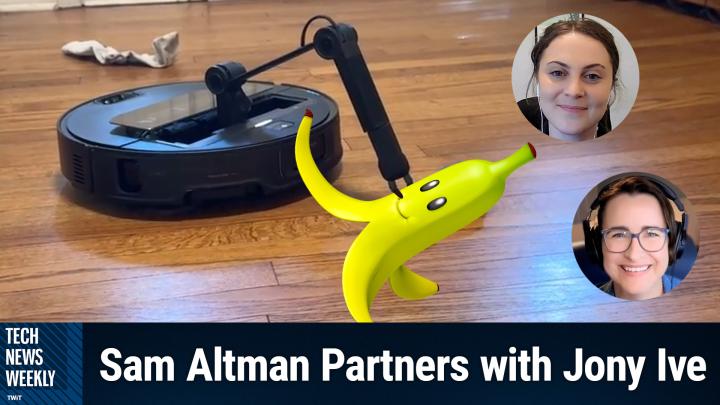
All TWiT.tv Shows (Audio)
Tech News Weekly 388: OpenAI's Big Bet on Jony Ive
01:12:25
Sam Atlman Partners with Jony Ive
Loading summary
Transcript191 lines
- [00:00]
Emily Forlini
Coming up on Tech News Weekly, I'm Emily Forlini from PCMag. I'm filling in for Mica. We're going to have Jennifer Pattison Tuohy from the Verge talk to us about a robot vacuum she tested with an arm that had mixed results at picking things up. Then we're going to talk about my story of the week, which is about what the heck is going on with Fisker EVs now that the parent company is bankrupt and there was a recent implosion with the two groups that were keeping those cars running. And we'll be back with Jennifer. She's going to tell us about some tech she did really love wireless charging for a smart lock which kept it on and no battery replacements or anything. Super cool. And finally, we have Lauren Good from Wired talking about a huge story this week which is the partnership between Sam Altman and OpenAI and Jony. I've former Apple design exec and they say they're going to build a new mysterious device that's going to change our world.
- [00:53]
Micah Sargent
Podcasts you love from people you Trust.
- [00:57]
Jennifer Pattison Tuohy
This is TWiT.
- [01:01]
Emily Forlini
This is Tech News Weekly, episode 388 with Jennifer Pattison Tuohy and me, Emily forlini. Recorded on May 22, 2025. OpenAI's big bet on Jony. I've. Hello and welcome to Tech News Weekly, the show where every week we talk to and about the people making and breaking tech news. We have some amazing reporters here today. I'm Emily Forlini from PCMag. I am filling in for Micah who is hopefully having a wonderful vacation. And with me is Jennifer Pattison Tuohy from the Verge. Hi, Jennifer.
- [01:34]
Lauren Good
Hi, Emily. Great to be here. Wish I was also on vacation, but.
- [01:39]
Emily Forlini
If not, we're here.
- [01:40]
Lauren Good
That's the second best thing.
- [01:43]
Emily Forlini
So are you like me where you have a segment every month on TWiT as well?
- [01:47]
Lauren Good
Yes.
- [01:47]
Emily Forlini
Okay, cool. So we're like soul sisters. We just haven't come together. Yes.
- [01:52]
Lauren Good
Perfect. Very nice to meet you.
- [01:53]
Emily Forlini
You too. So you did some really amazing testing. I was reading through your articles. You actually are testing the coolest smart home stuff, I think. So you are the woman to talk about this. Tell me about this robot vacuum that has an arm.
- [02:08]
Lauren Good
Yes. Yeah, I've had a wild couple of weeks in my, in my smart home. The. So I as I think a few months ago on, on this show we talked about Roborock releasing its first robot vacuum with an arm. They actually debuted it at ces and I at the time, I was like, yeah, right. As if this is going to ship. But it showed up at my house and I've been testing it for the last couple of weeks. And the concept here is this is a regular old robot vacuum. If you're familiar with them, they roam around your house, vacuum and mop. But one of the problems with robot vacuums is if you haven't tidied up after them, they may suck up a sock or get trapped by a wire. And this, the idea behind this Saros Z70 is it has a robotic arm that pops up from the middle of the robot and picks up things that are left in its path in order to be able to finish its clean. Which sounds both kind of wildly sci fi, but also really quite practical.
- [03:12]
Emily Forlini
Yeah, it's like robotics in a whole nother level of it. Plus the robot's already zooming around and now it's like taking actions with this arm.
- [03:20]
Lauren Good
Exactly. It's like this. It's a real evolution of what the robot vacuum can do. And, you know, the next step. Step, obviously legs and then, you know, taking over the world. But we'll get there. Yeah. Unfortunately, it doesn't work very well. Yeah.
- [03:36]
Emily Forlini
So what did you find that it was good at and what was it not good at?
- [03:40]
Lauren Good
So I just, off the bat, I have to say I was very impressed. Like, as I said when they showed this off at CES and actually another robot vacuum company, Dreamy, had one there too, that had an arm. So this was kind of, you know, a trend. And it's. It does look gimmicky. It sounds gimmicky. It's kind of fun, though. But it actually does. The concept makes sense. You know, even no matter how well you are, you do at tidying up your home or, you know, which I spend a lot of time picking up stuff so that my robot vacuums will run. Because I test a lot of robot vacuums. So, you know, I was like, actually, this, this does make sense. The problem is it only picks up three types of items, or granted ones that are quite common to be found on the floor. Socks, light shoes, like slippers and sandals. And then paper or like tissue. So, you know, this isn't quite limited.
- [04:35]
Emily Forlini
I mean, it might flurry when I walk in the door. Yeah. I don't know what I'm putting on the floor. It really could be any object, at least.
- [04:42]
Lauren Good
Yeah.
- [04:43]
Emily Forlini
Or something. Clothes.
- [04:45]
Lauren Good
And Roborock says, you know, this is, this is all still a work in progress. The arm will at some point be able to pick up more. It's powered by AI because robot vacuums do have many current ones have AI powered obstacle detection. So they detect obstacles and decide what to do about them. The most interesting way this has been used to date is with pet poop. So to make sure that they don't run over pet excrement. You are unfortunate enough to have that happen in your home. They can detect it and go around it, but versus detecting popcorn and be like, okay, that I need to vacuum. So this, this is sort of a step up. There's a camera inside the arm that detects and identifies the object and determines whether it can pick it up. So for example, there was actually a picture. Ah, well done. Thank you. That it saw my rug tassels and thought, oh, this is a sock and tried to pick it up. But then there's also a weight sensor because the arm can only lift up to 300 grams. And once it tried to pick up the entire living room rug, it realized that wasn't going to work, thankfully put it back down. So it's got some element of machine learning here and intelligence and it's. It just wasn't very accurate. It kept missing shoes. I only got to pick up a shoe once, which is kind of the biggest thing that I wanted because I have teenage kids, which means I have shoes all over my house. And it just wasn't any good at the shoes. It was good at the socks, but it would only ever pick up one sock on a one on a run. So the video is. Here's the video. Here it is. You see it's pretty strong, it's very slow, but it's methodical and it does what it says on the tin. Just not reliably and not enough like for this to be useful. And did we mention it's $2,600?
- [06:39]
Emily Forlini
Yeah.
- [06:39]
Lauren Good
To be worth spending that much money and it needs to do a lot more. I do think the potential is here. This is, you know, it is a beta project robot. Even though they're selling it, I mean essentially there it's a test case. People that get this are just doing it. If you buy this, don't expect it to clean up your home, but you will have some fun watching it. You can also remote control it. So, you know, you could get two and you could have full on robot walls if you just like to spend your money on crazy.
- [07:08]
Emily Forlini
Absolutely. Yeah. So where's I'm going to watch this video, it's putting it in a. In a B.
- [07:14]
Lauren Good
Yes. So this is the other part which I thought was, was really quite neat is you can Program it to tell it where you want the specific items it picks up to go. So socks and, like, paper and tissue could go in this bin. And then shoes are supposed to go in a designated shoe storage zone. And now this is where it failed me completely because the one time it did manage to pick up a shoe, it did not manage to get it in the shoe storage zone. If and when they managed to fix this concept, I would love. I mean, the idea is, you know, they put it picks up the shoes and puts it all by the front door, and everyone knows where their shoes are on Monday morning when it's time.
- [07:51]
Emily Forlini
To go to school, it labels them and puts a little present inside and hope you have a good day at school.
- [07:58]
Lauren Good
Oh, no. Then it's going to replace me entirely.
- [08:00]
Emily Forlini
No, it could never. So how did you tell it, the shoe designated zone, to take a picture and upload it to an app or how does that work?
- [08:08]
Lauren Good
So robot vacuums all come with an app. And actually Roborock has one of the best. And they map your home using lidar detector detection. And this actually, this robot has a really advanced form of mapping and navigation, which I was very impressed with. And it is actually a very good vacuum. I should mention that, but yeah. So the app basically maps your home, and then you choose the areas where you're going to put the box and where you're going to where you want it to put the shoes. You don't have to use the box, but the box is kind of fun. So, yeah, so it. It will put it in. In theory, it knows from the map where you want it. Yes. So here's my kitty. My kitty did enjoy the robot. My dog did not enjoy the robot. My kitty tried to play with it. My dog likes to eat our socks, not swallow them. Thank you. It was competition, basically, but it was competition, yes. He was not pleased that this robot was stealing his toy, taking his job.
- [09:03]
Emily Forlini
He got automated before our eyes.
- [09:06]
Lauren Good
But, yeah, it was fun to test. I'm really interested to see where they take this. I think there's going to be a lot of upgrades, firmware upgrades to it. Hopefully it'll get a little more intelligent. The hardware felt solid. It felt like it was. It was good. It was much better than I was expecting. It looks kind of spindly and like it might break. But, you know, Gus did have a go at getting the sock out of its claw and didn't succeed, so. But yeah, the software, you know, they need to get it in people's homes and. And improve the AI algorithms and Recognizing the. The items and hopeful expand to more items. It was it like my, it never picked up my slippers because it thought that they were pet poop. So my slippers are actually really nice. So yeah, quite offended by that.
- [09:59]
Emily Forlini
Yeah. Wow.
- [10:01]
Lauren Good
Different style.
- [10:02]
Emily Forlini
I guess.
- [10:04]
Lauren Good
So it's. I said work in progress. Exciting to see this sort of type of really quite advanced robotics be in consumer homes. Like this is something you can go buy if you have a spare $2,600. It was supposed to be cheaper. When it first came out, it was only $1,900, which sounds crazy, but is actually what the going rate for some of the top of the line robot vacuum. So Roborock wasn't charging a significant premium for what is a significant premium addition. But they said, as we've heard from a lot of smart home companies and other tech companies, that because of the tariffs the price had to go up. So 600 is, is a lot.
- [10:48]
Emily Forlini
Whenever I see that, it's just so disappointing and it's kind of scary because it's creeping up everywhere. And I have, you have no idea to know, like, oh, I'm paying like $600 more than I would have had to just last week. And then it's like, is it, does it match the percentage of the tariffs and where is this thing made? And you're just kind of. I'm just going through this whole set of operations and it just ruins the purchase process and just such a bad vibe, the whole tar of thing.
- [11:15]
Lauren Good
I know it's. And you know, it's interesting though because roborock hasn't, hasn't raised the prices of its other robot vacuums. It's only raised the price of this one. So it's interesting to see how the different companies are approaching this. I've seen a number of companies say that they're raising their prices soon, so go buy their products now. Which seems like good advice but also like almost like we're using the tariffs as a sales tactic. And yeah, it's definitely going to affect the smart home significantly. I've seen a number of companies, I'm trying to think off the top of my head, which one I saw just recently that has, that says everything's going to go up 70%. Oh, Lorex, which is a smart home security company.
- [12:00]
Emily Forlini
70 is a lot.
- [12:01]
Lauren Good
Yes.
- [12:02]
Emily Forlini
That's not a joke. That's like almost. I'm basically doubling the price.
- [12:07]
Lauren Good
Yeah, I think it was saying it was 70% from their current sale price, so not their current MSRP. But still, you know, you're going to be paying 70% more in a few weeks.
- [12:16]
Emily Forlini
It's all funny money. It's like, what.
- [12:20]
Lauren Good
I know. It's, it's, it's definitely something we've been watching closely. I've spoken to a lot of manufacturers who, you know, they're just bouncing all around because one minute it's tariffs or 140%, next they're 30%. And then it's like. Well, most of them, especially in the Smart Home company in Smart Home Realm, they a. A lot of them moved to Vietnam and other countries after the first round of tariffs. But now obviously they're seeing impacts there. So it's. Yeah, it's. It's a kind of a game of whack a mole for these companies right now. And we're waiting to just see how much impact it's going to have on, on the consumer.
- [12:54]
Emily Forlini
It's just this little robot vacuum is getting caught in an international trade war.
- [12:59]
Lauren Good
Right? Yes. Poor guys can defend itself.
- [13:05]
Emily Forlini
I kind of imagine it, like, speeding down the road, throwing socks behind it like bananas and Mario Kart.
- [13:12]
Lauren Good
I wish I could have got it to do something like that. Unfortunately, I'm sure some people are wondering if there's a concern around, could it pick up the wrong thing? Like, you saw, it did pick up the tassel on the rug instead of a sock. But I did try and trick it a few times with things that it really shouldn't pick up. And I think it's actually more inclined. It's programmed so sort of tightly. There's more likely to not pick up a certain type of sock because it doesn't, you know, it doesn't really fit its rigid algorithms. So they've, they've really focused on this being safe and not, not going to be great for TikTok videos.
- [13:51]
Emily Forlini
Right.
- [13:52]
Lauren Good
Doing crazy things. But I'll keep trying and I'll let you know, get it to do anything. So I wasn't going to be able to pick up my cat because it wouldn't stand still long enough.
- [14:02]
Emily Forlini
Yeah, this just opens up. I can imagine their engineers are like, putting all these random objects of it and putting safeguards. Like the way it interacted with your rug is actually smart. Like it had that little light tassel. It could pick it up, but then it hits a snag. It's too, too heavy. It just drops it like that worked pretty well, right?
- [14:19]
Lauren Good
Yes. Yeah, it did. And yeah, it had a couple instances like that where it realized it couldn't, couldn't proceed and was able to sort of retract there are safety buttons so you can press like an emergency stop button on the robot. So if it did happen to do something you shouldn't, you can stop it right on the device and then the arm itself, which is like a five point axis, it has sensors all along it. So if you put your hand above it or underneath it, it won't close or raise. But then this was another limitation. So it won't pick up anything that's under something. So it can't pick up socks if they're under the coffee table or it can't pick up a shoe if it's under the sofa. So again it's, you know, I would say it was probably about 40% successful in picking up things from my house, which just is not enough success for that price point. Even, even if it was a bit cheaper, it's still not enough.
- [15:12]
Emily Forlini
Yeah, well, I hope that somebody listening runs a sock factory and this is like the best product they've ever heard of. An expert sock picker upper. Just go around the factory floor like that might be best case scenario. All right, well, very cool. It's a really fun piece. Everyone should go read it. Jennifer Doing God's work in the name of science out here. We're take a quick break with an ad from Micah and then we'll be right back with my story of the week.
- [15:40]
Micah Sargent
Thanks so much Emily Forlini and Jennifer Pattison Tuohy for being here this week. I want to tell you about Melissa, who's bringing you this episode of Tech News Weekly. Melissa is celebrating 40 years as the trusted data quality expert. Whether it's manufacturing and supply chain management or the healthcare industry, AI has the power to boost efficiency, personalize customer experiences and spark innovation. But here's the rub. Using poor quality data can result in expensive, embarrassing mistakes. You need clean, real, verified data to train your AI in areas like healthcare. Using AI models with inaccurate data can result in a wrong diagnosis. A recent study found that only 4% of companies consider their data ready for AI models. Even the most advanced AI models cannot correct underlying data quality issues. Well, that is where Melissa comes in. Imagine having a data expert that never sleeps. Melissa's intelligence system verifies identity to prevent fraud in gaming operations, ensures valid patient and medicine information in healthcare systems, securely updates and verifies constituent data across government databases. And Melissa's Know youw Business enables verification and monitoring for financial institutions. Melissa guides you through complex data management with ease, making advanced data quality accessible to everyone from small businesses all the way up to enterprises with real time data Validation, comprehensive enrichment, cross reference verification with gold standard reference data and intelligent anomaly detection. It's no wonder why Melissa is the trusted data quality expert worldwide. Melissa securely encrypts all file transfers and has an information security ecosystem built on the ISO 27001 framework, adherence to GDPR policies and SoC2 complian. Melissa's team to learn how they can elevate your business and improve your data quality. Get started today with 1000 records cleaned for free@melissa.com TWIT that's melissa.com TWIT and we thank Melissa for sponsoring this week's episode of Tech News Weekly. All right, let's head back to the show.
- [17:57]
Emily Forlini
All right, thank you, Micah. Micah on high. Micah on vacation. So my story of the week is, I think, a crazy story. When I came across it, I was just like, this is so nuts. And it's about Fisker electric cars. Have you heard of Fisker, Jennifer?
- [18:14]
Lauren Good
Yeah. Didn't they go out of business?
- [18:16]
Emily Forlini
Yes. So they had like the most epic rise and decline. So it started like maybe 2015. A European Automotive entrepreneur, you know, is going to make this Tesla rival. He has a long track record. He raises tons of money. In 2020 at CES, they debuted the Fisker Ocean, their first car. And all these EV fanatics are like, oh my God, it's so cool. It was just like the coolest thing. And this is kind of around the time like Rivian and you know, Ford was starting to think about electrification. So this was a very exciting time for electric vehicles. And then they debut their first car in 2023, and by 2024 they are bankrupt and they had this stunning public decline. And so basically before they went bankrupt, they shipped 7,500 Fisker oceans to customers around the world. So US, Europe, I don't know, a couple other countries. So there's a bunch of people out there with these cars that they spent 70, $80,000 on that now have no parent company. So as part of the bankruptcy, they initially filed for chapter 11, which they would, you know, still be in the mix. The parent company would be involved. But they were in such dire straits, it eventually converted to a chapter seven. And now like, they're really just not. There's no Fisker, like put. But these cars are still out there and these people.
- [19:49]
Lauren Good
So this is like the ultimate nightmare in the smart home. Happens too often. But a car, right. This is not a small investment, but the cars still work, right? You just don't have.
- [20:01]
Emily Forlini
So I'll get to that. That's like, that's actually the story. But you're right, it's a cautionary tale.
- [20:08]
Lauren Good
It really is. And this is. I've wanted an EV for a while and I'm really interested in some of the more new companies. But my husband's always like, but what if they're not around in 18 months? Like, ah, this is. I don't want him to read this story.
- [20:21]
Emily Forlini
Yes, yes, but you should send it to him. But yeah, it's a cautionary tale. Like just the big issue is the software and that's why it applies to every product category. And you're right that the fact that it's a car, the stakes are so high. Of course, if you're buying a 70, 80,000 car, you're an early adopter. I think you have the money, but you're still pissed. So basically the cars are running. But a group of owners formed what they called the Fisker Owners association, and they partnered with this other company called American Lease, which is not very well known. It's just that they are a rental company and they, they rent out cars for taxis and Ubers and Lyfts. So just kind of like a car service. And for whatever reason in the courts they make this deal that American Lease is going to be able to get the licensing for Fisker's software and they're going to kind of vend it out to this Fisker Owners association and between these two parties, they are going to keep the software alive for all these owners. So it's been this like crazy renegade effort. The Fisker Owners association thinks it's pioneering a new form of car ownership where the actual drivers have access to the code base. They can actually make adjustments. And so they're like, like, wow, this is like crazy new and cool. American Lease is kind of like, these cars were cheap. And also this is cool. Let's like see what happens. So are you following Great that they did this?
- [21:52]
Lauren Good
I mean, and I've seen this happen once in the smart home as well, like where, you know, the owners, the users banded together. And this is something that we need to see more of with connected devices. And like, I think think that Stacy Higginbotham, friend of the network, has repeatedly talked about this being like, companies when they start up, they should like put their code in like escrow so that when something, when or if. And you know, I know companies when they first start up don't want to think about going out of business, but you know that the odds may be not in your favor. They need to plan for this type of.
- [22:26]
Emily Forlini
It's like a prenup. You know, you hope it doesn't happen, but, like, what are we doing if it happens? Yeah. So the story I wrote is basically, last week, there was a. Yet another stunning fallout in this whole Fisker saga where the Fisker Owners association and American Lease have soured the relationship. So much to the point, like, so much bad blood has happened that they have formally broken up. And American Lease abruptly pulled the plug on software access for the cars. So now the car runs. You can charge it. It cannot get OTA updates. It does not have. It used to have Internet through T Mobile, all these AWS Azure capabilities, all the fun stuff. The reason they bought the car. Now it's just a ticking time bomb rolling down the street in terms of if it needs maintenance, it can't get that software update. What you have is what you have. So I would say kind of screwed. They're just. So the story basically outlines how both parties now hate each other. Like, they. I had these crazy phone calls with both of them. The accusations were wild. Like, oh, the Fisker Owners association is trying to get money from people because they're collecting dues. And the Fisker Owners association is like, American Lease is like mobsters, and they're fraudsters, and it was nuts. Yeah.
- [23:51]
Lauren Good
Sounds like a sort of Hollywood melodrama. I think I noticed some people say. Some. You quoted someone saying, this could be a movie. It does sound like it would make a good one.
- [23:59]
Emily Forlini
It does.
- [24:00]
Lauren Good
Where's Fisker in all of this? Did the guy. Did they. Have they helped at all, or are they just like, we're done?
- [24:07]
Emily Forlini
Well, it's just so crazy. Yeah. Like, where is Fisker? And they're probably watching this. Eat the popcorn out, like, oh, somebody else is failing, you know? But it's really Henrik or Heinrich Fisker's fault to some degree. Like, he started this whole thing. He raised a bunch of money, he put these cars on the road, and they actually weren't viable. Like, it just within a year, collapsed. And now all these people are out here just trying to pick up the pieces.
- [24:34]
Lauren Good
Yeah. So what is their. I mean, what's the. What's the next step? Like, are they. Are they just screwed, or is there a way that these. I mean, it's great that they've formed their own association. So it sounds like they have some kind of collective bargaining power here perhaps to do, you know, salvage something out of this situation. It sounds like the number one rule here was that they should have had a contract.
- [24:58]
Emily Forlini
Yes. So Exactly.
- [25:00]
Lauren Good
Because this is where it kind of all went south. Like, no one was really. I don't know very much. They maybe weren't on the same page.
- [25:09]
Emily Forlini
No.
- [25:10]
Lauren Good
Which in this kind of scenario, when you're. And this is, you know, this is good lesson for any startup. You know, if you're. When you're creating the prenup, make sure you get all parties to agree because, yeah, this sounds like things really. I mean, trying to involve two organizations that really had nothing to do with the original product, to keep it alive and keep managing it was. It was such a. A great goal. I think it's wonderful that they tried to do this, but you can see how it was somewhat doomed from. From the start.
- [25:46]
Emily Forlini
You can see in hindsight. Yeah. And. Yeah. So basically what happened is in October, November, December, time frame, they. They figured out the software solution and really started working together in earnest. And then American Lease is footing the bill. So, you know, the FOA, which is what the Fisker Owners association, makes a $500,000 payment to American Lease in February. Timeline. But meanwhile, American Lease is just paying all these bills, like Azure bills, AWS bills. And in May, no, April, like last month, American Lease sends them an email. And they actually forwarded me the email chain. So I saw all the dirt on this whole exchange. And they. American Lease sends an email, all right, we've spent, like, over $800,000. Here's the breakdown. Like, you guys need to pay us because your. Your members are supposed to be paying. You do your dues, like, every month. And then you kind of are using those to pay me to pay my tech bills. And then they negotiate. All right, well, you're operating some of these cars for your taxi business, so we're not paying for that. Like, here's what we're going to pay for. They propose paying 515,000, and everyone's like, great. And then the FOA is going to pay. But then something happens at the foa, and this is where it's like, I know, power to the people. Like, good for them. But there is some disagreement in this organization because on the email chain, this one guy Guillaume proposes the 515. And then, like, kind of weeks go by, and American Lease is like, hey, guys, still paying your bills? Where's the money? Didn't get a wire yet. And then another one steps in and is like, oh, Guillaume's not a board member. He couldn't propose that. And now they're backpedaling. And they. Apparently they did not like American Lease. They had botched a Huge software upgrade left cars just bricked around the world. So they've lost full trust in American Lease. They're like, we don't have a contract and we're cool to pay you, but we want to check in with our members if we even want to keep working with you after that. So they're kind of stalling. They're like, oh, we're going to put it up to a vote. And it's just bad blood everywhere. And in that American Lease, just like, this is the final straw, they just pull the plug and the relationship. And so that was last Thursday.
- [28:05]
Lauren Good
Oh, so. So what's the state of the cars now? Everything's fine, but going forward there won't be. Although they bricked the cars in May.
- [28:13]
Emily Forlini
No, they work. They work. I realize I didn't answer your question about, like, what now? So, yeah, they work, but they don't have any of the premium connectivity and they can't get any maintenance. And a lot of. In an ev, a lot of the maintenance is software. So this is like, not. That's why I said it's a ticking time bomb. But now these two organizations, still feuding, they're not going to work together. But American Lease is going to work on its own connectivity plan. And the FOA has engineers in its core and they are, they say they've learned all about the cars ever since, like the recalls and the bankruptcy. They know how these cars work. They're engineers. They're going to tap into the system, they're going to build their own connectivity plan.
- [28:55]
Lauren Good
You know, they need to go and talk to Home Assistant. I bet Home Assistant would help them out.
- [28:58]
Emily Forlini
Out.
- [29:00]
Lauren Good
So it's an open source connected home platform, but yeah, there's a lot of connection between the home and the cars, obviously. But honestly, the foa, when you, when I first saw that, the first thing that sprung to mind was hoa, like a homeowners association and. And all the drama that comes with something like that.
- [29:17]
Emily Forlini
Exactly.
- [29:18]
Lauren Good
Got to be hard for. But this, I, I tell you one, take a key takeaway from this when, especially for anyone listening who pays, pays subscriptions for any of their services in their smart home and doesn't like it because I know many people complain about having to pay for subscriptions for like smart home cameras or for, you know, any of your services. These things cost a lot of money to maintain. And if you want those products to keep working, you're probably going to have to come to terms with the fact that it's not always going to be a one and Done purchase that you are going to have to help.
- [29:53]
Emily Forlini
And I think American Lease didn't realize how much it was going to cost. I don't think the FOA realized how much premium connectivity features really cost. And once the build hit, everyone was like, whoa, whoa, whoa, whoa.
- [30:07]
Lauren Good
Yeah, it's not cheap to have smart products.
- [30:10]
Emily Forlini
No, it's not. These are some of the most expensive cars, expensive products in the world. So yeah, I mean, I don't know. So this made me think like, am I an early adopter? Will I ever be? I don't know. Do you consider yourself an early adopter?
- [30:26]
Lauren Good
I'm an early adopter through my job. I'm not sure I would be if I was, you know, going out and buying just products for myself in terms of, you know, getting to test, you know, robot vacuums with arms and other kind of cool products. It does make me realize how much of this, especially in the connected world and now with AI is being released to consumers very much still in like a better state. You know, we're not, it's not like the products of old that, you know, gone through a lot of R and D and manufacturing before they were launched because once they were out there, companies couldn't change them so they had to be up to scratch, top notch before they got to the manufacturer, to the shop floor. But now we get products that again, you know, it's a good thing in many ways. So I may have a device that, like the Nest thermostat for example, when I first bought it didn't work with Apple Home and then it got a map to upgrade and now it can connect to Apple Home. So, you know, updates and product changes with connected devices can have benefits, but they can also have, have as we've seen a lot of negatives, but I also feel like a lot of companies have gotten to the point where they're shipping products before they're completely done because they want to see how they work and maybe get feedback and, and, and then sort of iterate and improve and I, I, there's, there's benefits as I said there, but it needs to be good first, then improve it. Don't send it out half done and.
- [32:03]
Emily Forlini
Such a good point.
- [32:04]
Lauren Good
Once it's out there, that's an amazing consumer. Yeah.
- [32:08]
Emily Forlini
I think for us and like everyone listening, it's just like, what do we accept? Because sometimes it's hard, they blur the lines, oh, you should like this because it's going to upgrade and you know, your car will never feel old. You can keep the same model but all the software will get better and it's kind of like, what are they selling us? And like what, where is this going? And it is so confusing.
- [32:28]
Lauren Good
Yeah, yeah. And it's, I mean it's a brave new world for manufacturers and for us, us as consumers. Because yeah, benefits pitfalls, but we've really got to always sort of keep that, that clear line. And I think it's fine to be an early adopter maybe with, you know, a robot vacuum, but I perhaps wouldn't choose to be an early adopter with a car just because, you know, the larger the, the product is, the more you're risking and the more danger. And obviously this didn't, this doesn't sound like it had anything to do with any concerns about safety, but, but I would be concerned about buying a vehicle that wasn't necessarily 100% tested or had software that might have some, some quirks that could cause some issues. I think there's levels that consumers are willing to put up with. And an interesting thing I've seen though I've been seeing a lot now just sort of in the vein of this is companies, well known companies launching products, products first on Kickstarter and rather than, you know, Kickstarter used to be for like strappy bootstrap boot. Yeah, strappy boots strapped startups. It's a lot of keys strapped to be built. And that was what it was all about. And originally but now I'm seeing companies like Eufy and Switchbot and this is in my space, well established brands who will launch their products on Kickstarter sort of being a bit more transparent about the fact that they're releasing products in sort of a beta state and then you can, you can adopt, you can choose to maybe pay a bit less and help them develop the product. I think that's a, I think that's quite a smart way of doing it because then the consumer is kind of like, okay, I've signed up for this and I kind of got a discount hopefully to help them out. And for early adopters that's fun to get to try these new products and give feedback. But yeah, it's, it's, it's a crazy world. Connected devices and software and I think we really honestly we're going to need, and this is something going on back to Stacy Higginbotham and she's now working for Consumer Reports and there's a lot of pressure or that Consumer Reports and a few other organizations are putting a lot of, lot of pressure on the government to come up with some type of legislation around how connected devices are regulated in our homes to help specifically with issues like bricking devices that are in our homes and that can, you know, use you bought a product and then a software update or a company goes out of business and they shut it down and you, it no longer works either at all or the way you expected it to. And we don't want to see more and more of that. We want to see less of that, hopefully.
- [35:06]
Emily Forlini
Exactly. Yes, exactly the point. All right, well, that's a cautionary tale for everyone. Your PSA for the week. We're going to take another quick break with an ad from Micah and then we're going to be back with Jennifer's second story of the week.
- [35:20]
Micah Sargent
Cutting in again this time to tell you about threatlocker, who are bringing you this episode of Tech News Weekly. We know ransomware is really rampant. It's harming businesses worldwide through phishing, emails, infected downloads, malicious websites and RDP exploits. Don't be the next victim. ThreatLocker's Zero Trust Platform takes a proactive, deny by default approach that blocks every unauthorized action, protecting you from both known and well, unknown threats. It's trusted by global enterprises like JetBlue and Port of Vancouver. ThreatLocker shields you from zero day exploits and supply chain attacks while providing complete audit trails for compliance. ThreatLocker's innovative ring fencing technology isolates critical applications from weaponization, stopping ransomware and limiting lateral movement within your network. ThreatLocker works across all industries, supports Mac environments, provides 24.7us based support, and enables comprehensive visibility and control. Mark Tolson, the IT Director for the city of Champaign, Illinois, says Threat Locker provides that extra key to block anomalies that nothing else can do. If bad actors got in and tried to execute something, I take comfort in knowing Threat Locker will stop that. Stop worrying about cyber threats. Get unprecedented protection quickly, easily and cost effectively with ThreatLocker. Visit threatlocker.com twits to get a free 30 day trial and learn more about how ThreatLocker can help mitigate unknown threats and ensure compliance. That's threatlocker.com twit all right, thank you, Emily Forlini. Thank you, Jennifer Pattison Tuohy. Let's head back to the show.
- [37:03]
Emily Forlini
All right, thank you, Micah. So for our next story, Jennifer, you tested something that you actually liked and you felt like was a positive advancement. So can you tell us about that?
- [37:13]
Lauren Good
Yeah. So my house, cutting edge technology over here. This is something that if you've been sort of following consumer tech for a while, you're probably it's sort of like the unicorn. You've probably heard about this for years and years and thought it's never actually going to happen. And this was one of the reasons I tested this to see if it really is real. And I can say it is. And it is something called wireless power. So this is a company called called Y Charge. I tested their wireless powered devices. This is a little black park that you can see in the picture there that power low powered battery powered devices over the air with transmitting wireless power. It's short range low power. It uses infrared lasers to connect to like a photo, a specially designed receiver, iron photovoltaic panel on a receiver. And there's only one commercial product that you can buy for residential consumer today that it works with and that is the Alfred smart lock. Alfred is a smart lock manufacturer based in Canada. So I got to test that smart lock with the Y Charge receiver. You can see it in that picture there. The little white sort of of thing in the ceiling is the Y Charge device sort of angled towards the the lock. And then if you zoom in and see all the smart home sensors on my door, you can laugh at me.
- [38:48]
Emily Forlini
Oh my goodness, what are all those doing?
- [38:51]
Lauren Good
That's because I test a lot of smart security systems. Smart all sorts of stuff. My house is Frankenstein. But yeah, a lot of the commentators comments on the article were about that photo. Yes. Welcome to my world everyone. Robots, lasers and sensors.
- [39:11]
Emily Forlini
Kind of looks like I've been watching Last of Us. It's like a cordyceps infection but it's smart home sensors.
- [39:20]
Lauren Good
But yeah, what, what this did for, for my scenario I test a lot of smart locks and one of the biggest problems with smart locks is battery life. They are a great, great in concept. I love having a smart lock. Being able to access your door with a key code, let anyone in and out with let anyone in remotely. With an app you can control the lock remotely. There are other ways it has it works with this lock specifically works with readers so you can sort of tap a little tag. There are a lot of great smart locks out there, but the majority of them need to be ready replaced. The batteries need to be replaced about every four to six months. There have been a few. It is and it may not. And for me I, I admit it's a bigger problem for me because I have a lot of smart locks I'm testing. So I find it very frustrating. But even you know when you first adopt get a smart lock and you're like oh this is great for two months and Then you get the battery warnings and you're like, oh, I'm going to change that, I'm going to change that. You never get around to it. And then one day you walk up to your door and. And it's dead.
- [40:26]
Emily Forlini
Which is totally unacceptable, by the way.
- [40:28]
Lauren Good
Acceptable. It should not happen.
- [40:30]
Jennifer Pattison Tuohy
Right.
- [40:31]
Lauren Good
It's like we all change our smoke alarm batteries right, when they start beeping, don't we?
- [40:36]
Emily Forlini
So.
- [40:37]
Lauren Good
And there are some workarounds. Like Yale has a little thing where you can use a 9 volt battery to kind of jolt it to life so that you can unlock it. And some of them now have USB C plugs outside. So if you have like a portable battery pack, you could. But the idea, ideally you do not let it die.
- [40:54]
Emily Forlini
Right.
- [40:54]
Lauren Good
And that is what this WI Charge device did for this Alfred Lock. I had that installed on my back door for nine months, which is the maximum amount of time that. Well, the minimum amount of time that the Alfred battery apparently will last. Because it's a Bluetooth smart lock, so it doesn't die as fast as some of the WI FI smart locks do. And at the end of the nine months, it was still at 100%.
- [41:18]
Emily Forlini
Wow. So it was beaming charge from the ceiling into the door and keeping the receiver. Yeah.
- [41:24]
Lauren Good
Powering the battery pack inside the lock. And this is what's so exciting for me about this technology, is that it could work for anything that's battery powered in your smart home. And whilst it currently would require, as it did for this lock, basically a complete redesign of the lock in order to incorporate the receiver, the company is working on easier ways of adding sort of like a dongle or something to a device so that you could power it with the receiver with the transmitter which is in the ceiling. You also don't have to put the transmitter in the ceiling, but that is sort of the cleanest install. And you can actually just put it in an existing can light. So you don't necessarily have to cut a hole in your ceiling. I did have to cut a hole in my ceiling.
- [42:11]
Emily Forlini
Yeah. So how much did it cost and then how much was the installation?
- [42:15]
Lauren Good
So this is the other thing. The we. The Y charge unit is not currently available to sort of just go buy off the shelf. You have to buy it through the Alfred Lock partnership. And it's again, it's like a better program and it takes, they told me it's between depending on your installation and your system and exactly sort of what your setup is. It's sort of between 400 and $700 to have it installed. It cost $400 for me to have an electrician add an extra hole in the ceiling and connect it to an existing wiring light system in my downstairs back hall there. And then the unit said would. There isn't a specific price for the unit, but somewhere between 400 and $700. And then the lock itself is a $300 smart lock, which is about. It's on the high end for a smart lock. But when you buy the wide charge kit, that 400 to $700, it comes with the new receiver for the back and a new battery, especially modified battery. So in total though, it cost me $1250 to do this, which is, which is not tenable obviously. But if I could use that, that receiver, a transmitter to power like the smart shades in my bedroom, which is right next door to that door to power another lock, maybe even power a video doorbell. Like there are so many devices, even.
- [43:43]
Emily Forlini
Your phone, like if it was just in the top like a ceiling light and just beaming out charge.
- [43:48]
Lauren Good
Yes, that is something they're exploring. Although that is a lot a bit more complicated than a low power single device that doesn't move right.
- [43:57]
Emily Forlini
And also you wonder, is it toothbrush.
- [44:00]
Lauren Good
Charger is the other thing. Yeah, that you see the. That's a great. This was a great use case because this is the bathroom. As you can see, I do not have GFCI outlets. Please don't tell my local council. But yes, a toothbrush charger. This unfortunately is not something you can buy. It's a prototype. But they say they are going to try and bring it to market. There's basically Y chargers partnering with companies to get them to develop their products to be able to work with their transmitters. And this was sort of a prototype that they built built and it was great, although it wasn't very waterproof. So it did die after a few months. But until then it meant no wires. You know, it'd be great for battery, for shavers, electric shavers, anything in spaces where you really would rather not have cables and wires. And you know, as a smart home reviewer who, as you could see from the sensors on the door, has multiple devices in my home that use batteries, anything. If I could, you know, install three or four of these around my house and not have to ever worry about changing a battery or charging a battery or buying batteries and then the e waste and it would be, it would totally be worth it if, you know, it could be a little more affordable and a little easier to do. But again, early adopter, but the concept is Great. And I was, I enjoyed the fact that I didn't have to worry about getting locked out of my back door for almost a year.
- [45:22]
Emily Forlini
Yeah, absolutely. And you tested it for nine months, right? That's crazy.
- [45:26]
Lauren Good
Actually for a year in total. So after the nine months I was, I took the battery, I took the wire charge device down to just to make sure that the current battery wasn't like a trick one, you know. So we drained it and then we left it to see if it would just recharge on its own. My editor was like, that's a photo. Photovoltaic panel. Maybe it's just charging with solar power and this is all a scam. It was not. It didn't charge. And then, then. So we tested it like that for a while without anything. And then I put the. We Charge. The Y Charge. I just want to call it We Charge. I'm sorry, I just call it We Charge.
- [46:05]
Emily Forlini
I think it's okay.
- [46:06]
Lauren Good
But it is. So then we put, then we plug the Y Charge unit back in and it took about a week but within a day it got it back up to 58%. Within a week it was back to almost 100%. So it powered it up, it powered it up pretty fast. And then it's also interesting because one of my other kids concerns was that it could, you know, if you're constantly powering a lithium ion battery, is there a safety issue? Is it going to degrade the battery? Like am I going to have to be replacing an expensive lithium ion battery every year or two? And the company, Ori Moore is the founder of one of the co founders of Y Charge and he said that. And actually I was talking to both him and Alfred Brad Cook, who is the, the one of the people that works at the Alfred Lot company and they said that they'd worked on sort of a charging algorithm that actually optimized the health of the battery. So that in fact if long term using one of these receivers and transmitters, your, the battery should actually last longer than it would do if you had been manually charging it. Wow. So basically could life last the lifetime of the lock? Which you know is another, another bonus. So, so yes, I was excited by this tech. I just feel like it's probably not something everyone's going to be using for a long time. Right.
- [47:24]
Emily Forlini
I'm excited about this tech too. I see this and I report on this for electric vehicles and they're testing it for that too. You know, these huge battery packs. And yeah, there are concerns about is it efficient or is it not how does it power up slower than plugging in. So these are all the same questions. And again, with the car thing, it's like on a bigger scale, but they're testing it and I think wireless charging, if it can be safe and efficient, would be a major, just usability breakthrough. So I'm definitely interested and I'm a little bullish on it. I think people would like it and that it'll be here in 20 years. I think I can safely say that.
- [48:03]
Lauren Good
Yeah, 20 years feels reasonable. I think Wycharge would tell you it's going to be sooner, but I think commercially we'll see it more. One of the other use cases they had is as they've actually deployed this in place is like, I want to say somewhere like CVS or Walgreens, but some kind of pharmacy. So they have the Y charge receivers, transmitters that send to little digital displays. So for updating pricing. So, I mean, I don't want them.
- [48:32]
Emily Forlini
To increase my prices. Wireless chargers. Hold on. Yeah, it's not what I'd be able.
- [48:38]
Lauren Good
Yeah, it helps them and, you know, display, like advertising in the billboards, digital billboards, those types of things. Things that are hard to actually wire. That. That sort of seems like a more viable use case in the short term. But in the long term, I would. I would definitely love to see wireless charging, wireless power come to the home. I've also tested, not tested, but seen. And I'd like to test soon. Key wireless power, which is where you. Which probably is. Is more contact. So I think this may be where. I don't know what. Where the EV situation is, but this is batteries in countertop appliances. So you have a specially designed countertop where you put your appliance, like your blender or a toaster on the countertop and it powers it up so you don't need cables. Cool. And that. I think I saw that demoed at IFA this last year and it's from the Wireless Power Consortium. The Key. Key charging. No Key. It's not. There's Qi and Qi.
- [49:41]
Emily Forlini
Oh, the Q. Qi.
- [49:43]
Lauren Good
Qi is for the phones. Yes. Key is for the kitchen.
- [49:47]
Emily Forlini
Ah, okay.
- [49:49]
Lauren Good
And that's. That's pretty. That's pretty neat. I could definitely.
- [49:53]
Emily Forlini
Right.
- [49:53]
Lauren Good
The keychain I could definitely see. I mean, I have too many cables in my kitchen, you know, for all the appliances in your kitchen. My kitchen. Not doing well with the talking today.
- [50:05]
Emily Forlini
I'm sorry. No, it's me. I'm like antagonizing you. I think it's funny.
- [50:10]
Lauren Good
I know it is. It is all fun. Ki Chi. We. We've got them all.
- [50:15]
Emily Forlini
All right, well, we're gonna wrap it up. Watch the space. Jennifer, you're brilliant. You're testing all the coolest stuff that we can't even get. So where can people find you?
- [50:25]
Lauren Good
Yeah, well, you can read all these stories and more on my author page@the verge.com and that's the best place to catch up with me. I'm also on the thread and X. And what's the other one? Oh, Blue Sky, JP2E or the Smart Home Mama on those various platforms. And great to hang out with you today, Emily. Glad we got to meet. And maybe Micah can stay on vacation and we can do this again sometime.
- [50:55]
Emily Forlini
Yeah, we should. We should. This is so much fun. Thank you. Yeah. All right, so we have another quick message from Micah and then we'll be back with another story that is pretty big in the news this week. So you're going to want to stick around.
- [51:09]
Micah Sargent
I'm back again this time to tell you about Deleteme, who is bringing you this episode of Tech News Weekly. You ever wonder how much of your personal data is out there on the Internet for everyone to see? Yeah. Honestly, it's more than you think. It was more than I thought. My name, my contact information, Social Security number, home address, even information about your family members. This is all being compiled by data brokers and sold online anywhere anyone on the web can buy your private details. And this can lead to identity theft, phishing attempts, doxing harassment. But now you can protect your privacy with Delete Me. As a person who exists publicly, especially as someone who, well, I share my opinions online, I have to think about safety and security and it's easier than ever to find personal information about people online. We know that. That is why I personally recommend and use Delete, and I do. Deleteme is a subscription service that removes your personal information from hundreds of data brokers. You can sign up and you just provide Deleteme with exactly what information you want deleted the experts, then take it from there. DeleteMe will send you a regular personalized privacy report that shows what information they found, where they found it, and what they removed. And Deleteme isn't just a one time service. Delete Me is always working for you. Constantly monitoring and removing the personal information you don't want on the Internet. And that's important because those data brokers are going to continue to scoop up that data. So you want to make sure that you're continuing to remove that data. I have had Situations in the past where someone has looked me up online because I am, as they say, extremely online and been able to find information about my family members and then use that information to reach out to family members. It's not fun. Even if it was harmless, it's not fun fun. And this is a great way to take care of getting rid of that data and getting that delete me email. That privacy report every month is so nice because I can go, okay, this is what's been removed. And also go, you are still trying to collect my data. These data brokers, I tell you what. But to put it simply, DeleteMe does all the hard work of wiping your and your family's personal information from data broker websites. So take control of your data and keep your private lab life private by signing up for Deleteme at a special discount for our listeners today. You can get 20% off your DeleteMe plan when you go to JoinDeleteMe.com TWIT and use the promo code TWIT at checkout. The only way to get 20% off is to go to JoinDeleteMe.com TWIT and enter the code TWIT at checkout. That's JoinDeleteMe.com TWIT with the code TWIT. All right, let's head back to Emily Forlini for the rest of the show. Thanks so much.
- [54:00]
Emily Forlini
All right, thank you, Micah. So up next we have Lauren Good from Wired, who's going to talk to us about a huge story this week. Hi, Lauren, how you doing?
- [54:08]
Jennifer Pattison Tuohy
Hey, Emily. I'm doing well. How are you?
- [54:10]
Emily Forlini
Good. So you wrote about this crazy, huge partnership between OpenAI and a former Apple executive. Jony, I've. So why did they partner? And what do we know about this so far?
- [54:20]
Jennifer Pattison Tuohy
Are, I think crazy and huge are the right adjectives to use to describe this. This was like a bomb dropping yesterday on Silicon Valley in a, in a good way, like a design bomb. A hardware, like a hardware announcement. You know, when's the last time we sort of got excited about one of those? So what we understand about this partnership is that it has been in the works in a sense, for a little while now. It was last spring when Jony Ives design firm first announced this entity called IO was sort of partnering with OpenAI to create this next generation of devices that serve AI as, like, as we know AI now in the modern era. By the end of late last year or by the end of last year, OpenAI had taken a 23% stake in this IO entity that existed and then yesterday we heard that OpenAI was buying that entity outright for something like $5 billion in equity. Essentially. It was one of the world's most expensive aqua hires in that they were hiring this incredible pool of talent. But the interesting thing is that Jony I've. While he is going to be leading the creative process of whatever hardware development comes from this, he's still going to remain independent.
- [55:41]
Emily Forlini
Why do you think that is?
- [55:43]
Jennifer Pattison Tuohy
I think it's because he's Jony I've. And I think given his history and his background and his pedigree as a designer and the fact that he does have this other design firm called Love from, which is something that he, you know, he created when he left Apple in 2019. I think he, he just, you know, he probably just wants to remain independent. It probably doesn't make sense for Jony I've, at this point in his career to become completely embedded in OpenAI. But he has really kind of structured this incredible deal for himself where he gets to work closely with Sam Altman and the team at OpenAI. He gets to have sort of design control over whatever ultimately out of, of this partnership in this merger now. But I'm sure he still has the ability to go work on other things if he would like to.
- [56:30]
Emily Forlini
Right, right. And what's he most known for?
- [56:33]
Jennifer Pattison Tuohy
I mean, Apple.
- [56:35]
Emily Forlini
Everything. Apple Everything.
- [56:36]
Jennifer Pattison Tuohy
Apple.
- [56:36]
Emily Forlini
The Apple design shot on iPhone. The whole thing.
- [56:39]
Jennifer Pattison Tuohy
Yeah.
- [56:40]
Emily Forlini
All those campaigns.
- [56:41]
Jennifer Pattison Tuohy
Yes, basically. I mean, he, he joined apple in the 1990s. At some point he became its head of industrial design. And he really helped define the sort of sleek, industrial, unibody aluminum era of Apple design that we really associate with the company's hardware over the past two decades. He's British. He is known for having very refined tastes. He's very exacting. When he was at Apple, there were some reports of the fact that he had such fantastical ideas around how our devices should look and feel and how thin they should be and how parts should be glued together and all of this, that sometimes it did sort of butt up against what engineers were sort of physically able to accomplish in designing the products. But, you know, I think we all, we all think of Apple products as having this incredible design and he's largely responsible for that. He was also, during his time at Apple, kind of meme worthy. Like, do you remember the. Was it unapologetically plastic when they made a plastic iPhone and everyone was like, okay, what does that mean?
- [57:50]
Emily Forlini
Like, it's too far?
- [57:52]
Jennifer Pattison Tuohy
Yeah, yeah, it was a little bit, yes, but, but that you know that that is Jony I've.
- [57:56]
Emily Forlini
Wow. So he's a legend. Sam Altman is a quickly made legend here. He's kind of like the new guard. And now they're both partnering. So what, what are the mix of opinions you're seeing about this? Like, are there the skeptics who are. Oh, they won't do. They're just dreamers, they won't do anything about this. Or people who are really excited, like, what's Spectrum?
- [58:18]
Jennifer Pattison Tuohy
Yeah, that is a really good question. There is certainly one potential outcome of this, which is that because of Jony, I've incredible background and history as a designer, that something comes to fruition here that really does feel innovative or changes the way that we use technology. And I think you could easily argue, we could all argue that the hardware market is ripe for that kind of disruption. We've all been using our glass labs for a long time now. They serve us really well. They're impossible to detach from. People have designers, technologists, engineers have toyed with different form factors. Now nothing has really taken off the way that the smartphone did. And so would it be interesting and fascinating to see something else emerge from this? Sure. And as Jony I've this legendary designer and Sam Altman with his billions and billions of dollars, venture capital and institutional funding, the right partner for this? Quite possibly. And so there's some folks who are feeling optimistic about it. On the other hand, the video that the duo released yesterday, the 9 minute, 22 second beautifully produced video of them hanging out in the legendary cafe Cafe's Zoetrope in San Francisco, they talked about the new era of computer that we're at, the new era of computing that we're entering with AI and how technology has changed their lives. They didn't really talk about the product that they're going to build.
- [59:55]
Emily Forlini
Right.
- [59:56]
Jennifer Pattison Tuohy
It was a lot of gesturing and hand waving and like, wouldn't this be great? And we don't really have a sense yet of what it is. Sam Altman has expressed ambitions in hardware before this. Jony I've obviously pretty much produces consumer tech designs and hardware. And also I think the Wall Street Journal reported late last night that Sam Altman did sort of give a speech to employees at OpenAI, giving some sketches of some outlines, some metaphorical sketches of what this thing might be, but we don't really know what it is yet. And so we'll believe it when we see it. Right. There's also that mindset because in Silicon Valley we, we can talk about the humane AI Pin I'm sure like what happened there, which was two former Apple employees who got together and raised a bunch of venture capital and kept promising this revolutionary device that was going to give us an alternative from our phones and it sort of crashed and burned and so it's a hard problem to solve.
- [61:02]
Emily Forlini
It absolutely is. And you're right, people have been experimenting. There was a humane pin. The rabbit pin glasses are really big right now. I saw my colleague is testing a one AI device that kind of goes in your pocket like almost like a pocket protector, but it's like recording your voice. And so there's all this experimentation in this space right now and it's like what lane are these guys going to pick?
- [61:26]
Jennifer Pattison Tuohy
Yes, exactly. Are they going to go with the screen? Are they not going to go with the screen? Is it just going to feel like an echo that sits, you know, an echo speaker that like sits on your desktop while you're working? In response to questions, is it going to go in your car? Is it going to have biometric sensors? Like there's so many and what value add is there? Right, because I think what we're seeing with some of hardware devices that are trying to capitalize on the AI moment is that they're purporting to solve a problem that doesn't really exist.
- [61:52]
Emily Forlini
Right.
- [61:53]
Jennifer Pattison Tuohy
And maybe are over engineered or in some cases even oversimplified. You also have to wonder about what happens then to the data set that is ultimately captured or generated from this kind of device. Because in a way who owns this next wave of hardware is also the person or the entity that owns our next wave of data. Like we're, you know, we're beyond the, the sort of sweet summer child phase of believing that technology is just a tool. All of these Internet connected devices are capturing information about us in the world around us and then processing it and, and can be, you know, sometimes misused. And so this is, it's not only can you get the hardware form factor right and it, is it something that people actually want to use, but how are you approaching the amount of data that being taken from us and processed?
- [62:45]
Emily Forlini
Yeah, and I think that's the big difference between when the Internet was first coming up and the first version of Silicon Valley. Now they have all this baggage and we all know all these problems and now they're trying to compare it to like the advent of the Internet. But that means, oh, oh no, like all these problems we've gone through since then, you're just going to put us through that again. And so I feel like it's like that innovation period, but it's a little heavier.
- [63:11]
Jennifer Pattison Tuohy
It is, it is. It totally is. It feels like, you know, I. This is my. My personal sort of feeling about this, and so I can't project this onto anyone else, but it feels like we're sort of in this morning phase, kind of, or a correction phase from the 2010s era of tech, when we're all sharing freely and trying all of the new gadgets. And the smartphone was really doing pretty amazing things in our lives. And. And it's like every time someone comes to, like, the, you know, the funeral and is like, okay, it's time. There's a new thing coming out, you're sort of like, well, wait, I'm still. I'm still literally processing what just happened with all of the data that we gave away. And also, you sort of have to ask and try to answer the question, well, then who should I trust next? Who can we trust to build this next generation of technology? And so, you know, Jony I've and Sam Altman with their beautiful black and white buddy photo that they put out.
- [64:10]
Emily Forlini
It's very glossy, like they hired a photographer's kind of engagement shoot vibes. Honestly, it really was.
- [64:16]
Jennifer Pattison Tuohy
It really was. Yeah. I saw. I saw a tweet last night. I have to admit. It was like a pretty good tweet where someone said, this is the. This is the. It said, like, you're a part of our family now. And the tweet said, this is. This is like, what the notice that you got just before your bid on a Pacific Heights home gets rejected.
- [64:33]
Lauren Good
So.
- [64:34]
Jennifer Pattison Tuohy
So, yeah, that's kind of what it looked like.
- [64:37]
Emily Forlini
Yeah. I mean, it's. It's all very exciting. I think there could. It could be nice to not carry around our phones all the time. I do think you're absolutely right that there is some innovation here. Like, it's not perfect. Like, we're all staring at these phones, we're hunched like chiropractors are getting a ton of business. There's carpal tunnel. I mean, it's. Sometimes I look around on the train and I see every single person on their phone and I. I'm like, what are we doing? You know, it just. It feels like there's a next step. It would have been nice if they had hinted at what they were going to do, right?
- [65:12]
Jennifer Pattison Tuohy
I. Yes, I think so. I think there have been hints along the way, and now it's just.
- [65:17]
Emily Forlini
What are your predictions?
- [65:19]
Jennifer Pattison Tuohy
Yeah, so Sam Altman seemed to indicate to staffers at OpenAI that it's something thing that you're not necessarily going to carry on your person but might be in a more stable environment. That makes me think something on the desktop, something that's at home. Which is why I referenced what if this just ends up being another version of an Echo? And my guess would be screenless is my thought.
- [65:48]
Emily Forlini
Yeah, that seems to be the trend.
- [65:50]
Jennifer Pattison Tuohy
Yeah. What do you think?
- [65:53]
Emily Forlini
I'm just thinking I actually had this crazy experience yesterday. I went to a brain implant company. Company and it was totally nuts. I'm actually still processing it. It's the first time I've spoken about it. But I'm writing a piece on brain implants and that is like the most futuristic thing I've ever seen. And it. It's kind of like all these devices, but it just. You just removes the device and it's just like in your brain and that, that is. It's like, you know, the glasses, your hands free. It's kind of like if you put. Put these new AI glasses, but they're like in your brain and there's a whole new data set. And the data set is like your thoughts and how they map to actions and stuff. So I'm just thinking about that because I'm like fresh off of that. But I agree, if you step way back from that, there's no screen, it definitely would be hands free. Like, you wouldn't be holding it. I think that's the sense I'm getting from the tech industry.
- [66:52]
Jennifer Pattison Tuohy
Um, is this Neuralink? May I ask what company were you.
- [66:55]
Emily Forlini
It was not Neuralink. Yeah, it was a competitor and it's. It's called Synchron and they, they have a much more like easy kind of installation, if you will. Um, and so, yeah, I don't know, like, I don't know.
- [67:12]
Jennifer Pattison Tuohy
Installation. Like it's window shades.
- [67:14]
Emily Forlini
I know. Yeah, I know.
- [67:16]
Jennifer Pattison Tuohy
Put a chip in my brain. Would you do it?
- [67:18]
Emily Forlini
No, I wouldn't. We went straight to the bar after this interview. It was like we got a. What is going on? So I, I definitely would need a minute. But I mean, I don't know if they're. I don't think they're going to go that far. I think they're probably many steps before that. Maybe. Yeah, something that goes in your pocket. I mean, maybe it could go in your skin. That'd be crazy. We talked about wireless charging earlier on this show, but I don't know.
- [67:50]
Jennifer Pattison Tuohy
It's interesting when you say that about the brain implant, because if this device ultimately serves what Sam Altman's vision of AGI is artificial general intelligence. That moment when AI supposedly will surpass human intelligence. Then what does it mean to have that sort of juxtaposed directly with our human intelligence? Do you want, want the brain implant? And now we're taking five leaps ahead. Do you want the brain implant that has AGI capabilities embedded in your very human, you know, basic.
- [68:25]
Emily Forlini
Right. Well, that's what he's saying. If he wants to truly achieve, like, how big are his ambitions? Because it does feel a little bit like just launching some rinky dink pen is like a little whomp, you know.
- [68:37]
Jennifer Pattison Tuohy
That has.
- [68:39]
Emily Forlini
Like, in echo, it's kind.
- [68:41]
Jennifer Pattison Tuohy
Of like $7 billion on. Yeah, yeah.
- [68:43]
Emily Forlini
Like, we'll let Amazon figure that out. Like it still can't set a timer properly. Like, let's let Amazon do its thing with the echo. And it's. I don't know, there's just. We'll see, we'll see. But I guess, I guess jury's out. We can, we can take guesses from anyone who's listening.
- [68:59]
Jennifer Pattison Tuohy
Yeah. I often like to say that some of these men in Silicon Valley, and it is often men are just, you know, racing to propose solutions to the problems that they have helped create. And so when you think about this idea that we're so surrounded by distractions, notifications around us, screens around us all the time, or we can't let go of our phones, we are a set of human beings who had enough ingenuity and creativity to create that thing. And so we've created this, we've put it into the world, and now there is going to be a new generation of people who are selling us on, solving it. And the idea of AGI is so fascinating right now. It's such a big topic of conversation and who believes it, who doesn't, who's calling it by a different name when it's going to happen. And I would just like to remind all of these men in Silicon Valley that we're all going to die anyway, folks. So you're all, you're all, you're all still going to die. I don't know how to tell you that, but there is your.
- [70:01]
Emily Forlini
Yes, that's true.
- [70:03]
Lauren Good
That is so true.
- [70:03]
Jennifer Pattison Tuohy
So maybe pick your head up from your screens sometimes and, you know, be kind to the person next to you and go touch some grass.
- [70:12]
Emily Forlini
All right, well, Lauren, thank you so much for coming on. Everyone should go read your article. It is so thorough. All of your work is really interesting. So if people want to keep up with you, where can they find you?
- [70:23]
Jennifer Pattison Tuohy
I am on Blue sky under Lauren. Good. With an extremely long handle because that's what Blue sky handles are. And if you have tips on anything you're hearing around Silicon Valley, not PR pitches, you can also find me on Signal. My Signal handles in all my bios.
- [70:37]
Emily Forlini
Okay, perfect. Thank you so much.
- [70:39]
Jennifer Pattison Tuohy
Thank you so much.
- [70:41]
Emily Forlini
That is the end of Tech News Weekly. This show publishes every Thursday at TWiT TV TN. That's where you can go to subscribe to the show in audio and video formats. I'm Emily Forllini, senior reporter for PCMag. You can find me all over the Internet, especially on blueskylyforlini and my bio page at pcmag. You can see all my work right there. Thanks again and Michael will be back next week. Bye.
- [71:07]
Unnamed Announcer
Hey buddy, are you a geek? Are you a tech enthusiast? Then I would love to invite you. Invite you to join a tech community like no other. You can gain exclusive access to our incomparable quality tech content with Club Twit as a member. You'll enjoy all Twitter shows ad free, plus access private video feeds for insider shows like iOS Today, home theater geeks and so much more. Dive into the members only Twit plus bonus feed for behind the scenes content club discussions and special events. But here's the best. Join our incredible Discord community to watch live show productions, chat with hosts and participate in exclusive members only activities. It's your backstage pass to the world of twit. Whether you're a tech enthusiast or a lifelong learner, Club Twit elevates your knowledge while entertaining your interests. Get two weeks free when you sign up now and unlock unparalleled access at TWIT TV Club Twit. That's Twit TV Club Twit. And from the bottom of my heart, thank you and welcome to the club.
- [72:26]
Like your favorite startup's growth curve, T Mobile's coverage keeps scaling because T Mobile helps keep you covered. Connected from the heart of Portland to right where you are On America's largest 5G network Switch now keep your phone and T Mobile will pay it off up to $800 per line via prepaid card. Visit your local T Mobile location or learn more@t mobile.com KeepAndSwitch up to four lines via virtual prepaid card. Allow 15 days, qualify and unlock device credit service port in 90 plus days device and eligible carrier and timely redemption. Required card is no cash access and expires in six months.