← All TWiT.tv Shows (Audio)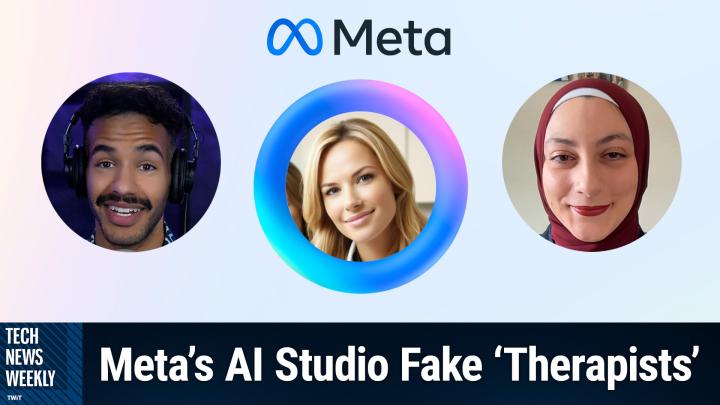
All TWiT.tv Shows (Audio)
Tech News Weekly 391: Meta's AI Therapists Under Scrutiny
01:04:09
Meta's AI Studio Fake 'Therapists'
Loading summary
Transcript110 lines
- [00:00]
Micah Sargent
Coming up on Tech News Weekly, Abrar Al Heati is here. We kick off the show by talking about how Apple might be working on a thinner iPhone and we discuss the battery life impacts there. And afterwards, I talk about a dating site that wants to find your match by letting you share your Internet search history. Then Elizabeth Chamberlain, the director of sustainability to iFixit, stops by to talk about the Switch 2 and the repairability score. It got spoiler. It's not great. Before Sam Cole of 404 Media joins us to talk about Meta's AI therapy chatbots and how they're getting the company in trouble with U.S. senators. Stay tuned for this episode of Tech News Weekly. Podcasts you love from people you trust. This is Twit. This is Tech News Weekly, episode 391 with Abrar Al Heati and me, Micah Sargent. Recorded Thursday, June 12, 2025. Meta's AI therapists under scrutiny. Hello and welcome to Tech News Weekly, the show where every week we talk to and about the people making and breaking that tech news. I am your host, Micah Sargent and I am joined across this vast and ever changing Internet landscape by CNET's own Abrar Al. He. Welcome, Abrar.
- [01:30]
Abrar Al Heati
Thank you so much. Good to be here. Thanks for having me.
- [01:33]
Micah Sargent
Yeah, always a pleasure to get to chat with you. I feel like saying before the show, it feels like it's been a long time, so it's good to see you.
- [01:40]
Abrar Al Heati
Likewise. This feels like nature is healing. We're back.
- [01:42]
Micah Sargent
Yeah, it does feel like that, doesn't it?
- [01:46]
Abrar Al Heati
Yeah.
- [01:46]
Micah Sargent
I'll look over my plants. And they are all nodding their heads.
- [01:50]
Abrar Al Heati
Mine too. Yeah.
- [01:53]
Micah Sargent
So for people who are tuning in for the first time, we love to kick off the show with our stories of the week. These are the tech stories that we think awesome, interesting, well worth discussing. And I'm really excited about this first story that comes from Abrar because, Abrar, you have been just doing the research, boots on the ground sort of situation. Tell us what's going on.
- [02:16]
Abrar Al Heati
My life has been skinny phones for the past two months and so we're just going to talk about it. Whether you care about phones or not that are skinny, they're coming, so deal with it is really what's happening here. So Apple's Worldwide Developers Conference was on Monday and we got all those updates about iOS 26, not 19, which I need to get out of the habit of saying, you know, all the software updates, some Apple intelligence sprinkled in features here and there. But the biggest thing that Apple didn't really Talk about was adaptive power. So this is an AI powered feature coming to iOS 26 that can extend your battery life, and it does this by scaling back power in ways that you hopefully don't notice. So according to Apple, when your battery usage is higher than usual, iPhone can make small performance adjustments to extend your battery life, including slightly lowering the display brightness or allowing some activities to take a little longer. And then also low power mode can automatically kick in when you're at 20%. So, you know, the idea is to scale back in ways that you may or may not. You know, hopefully you don't feel at all, but you know, you'll notice a slightly dimmer display and some things that you know aren't, aren't running at full capacity just so that you can use your phone for a bit longer, not worry about being stranded. Now, this is a feature that I'm sure anyone and everyone will welcome, but you have to think about what Apple is preparing for and what Apple is potentially reportedly, we don't know for sure, preparing for as a skinnier iPhone. So the iPhone 17 Air is what some people are calling it. Maybe It'll become the iPhone 26 Air. I don't know. Who knows, right? But essentially there have been all these rumors about Apple making a skinnier iPhone. Now, if you make a slimmer phone, there's one really big trade off, and it's the battery, because you have less space. So the battery is smaller and then it lasts less, right? It doesn't, it doesn't have as much juice in there to last you a bit longer. And I personally experienced this when I was testing the Samsung Galaxy S25 edge, which I will start by saying is a delightful phone to use. I was very surprised by how refreshing it was to use something that actually feels really light. I mean, the skinny factor is like, okay, but the lightness of it was just unparalleled. It was so genuinely refreshing to be able to type on something that you barely even feel in your hands and you throw it in your purse or in your pocket and you don't even feel the weight of it. Very, very cool. But it lasted just about 24 hours. You don't have that spillover battery that you have with most phones these days, where you're like, okay, it's the end of the day. I use my phone a lot, but I still got that 20, 30% just in case. So the biggest opportunity and challenge here for Apple is to make a skinny iPhone last longer, make it last beyond that 24 hours. And so maybe this adaptive power feature is the superpower. Maybe this is a secret sauce to help that phone last a little bit longer. And you know, the thing about Apple, we know it, there's, there's the superpower that they have where if they do something, then people start to care a bit more than if somebody else does it. I don't think a lot of people are as excited about the Samsung Galaxy S25 edge. I'm sorry Samsung, but like, you know, you notice what people pick up on and what they don't and people kind of brush that aside. But then what happens when Apple does it right? When Apple, if and when Apple releases a skinny iPhone, do people then say, oh wow, this is revolutionary. This is so great. And on top of that, we don't have to worry about compromising battery life. And you know, the last thing I'll plug here is that we have a CNET survey that we just released where, you know, only 7% of people said that they cared about having a thinner phone when they're, when they're upgrading their device. But the thing that people do care about is battery life, right? That's the thing that they really care about. And the other thing is cameras. And there have been reports that a skinny iPhone would just have one camera lens, kind of like the iPhone 16e. But that would be kind of disappointing because I'm sure a skinny iPhone will be marketed as a premium device. And if you have a premium device, you know, you want to have premium level cameras. And I'm sure Apple will do its very best to make that one camera lens as great as it can be. But like throw on two, at least make it, make it worthwhile. So essentially all this to say I'm curious to see if Apple releases the skinny iPhone, how people will respond. But I want to know what you think. Do you even care personally about a skinnier phone?
- [06:26]
Micah Sargent
I was just watching yesterday an Amazon prime show. It's a animated show about a hospital and with it's run by aliens. Anyway, really fun show. I think it's called like second greatest hospital in the galaxy or something along those lines. And because it's Amazon prime, they introduced ads. And so you have to pay like 299 or something to not have ads. And it's not worth it because I really watch shows on there. All of that is a preamble to say an ad popped up and in it Will Smith's son. Is it Jaden?
- [07:03]
Abrar Al Heati
Yeah.
- [07:03]
Micah Sargent
Yeah. Jaden was doing an ad for a, for, for Samsung's thin phone and it was the weirdest commercial because it was positing that your outfit is ruined by a thicker phone because your pants are getting worn down by a thicker phone.
- [07:26]
Abrar Al Heati
This is like the subway commercial with the fat wallet. Do you remember that?
- [07:29]
Micah Sargent
Yes.
- [07:29]
Abrar Al Heati
Just a throwback there.
- [07:31]
Micah Sargent
Yeah, yeah, it's exactly. And I'm going. I don't. I mean, okay, yeah, sure. It was very much like, you know, speaking in the, the Gen Z lingo of like, your fit and your drip are going to be ruined by a phone, so you need to get this phone because it won't ruin your fit. And I felt like, felt like it was all sort of contrived. But all that said, these bigger phones are hefty.
- [08:00]
Abrar Al Heati
Yes.
- [08:01]
Micah Sargent
Things. And so if we can make them, if we can keep them at this larger size, because I really do like this larger size, but it can be a little bit less hefty.
- [08:11]
Abrar Al Heati
Yes.
- [08:12]
Micah Sargent
That's fine for me particularly because from. And again, I'm talking about me specifically. Pretty much everywhere I go in my home, I have a place to put my phone that it is charging. And so, like right now it is. Well, I just pulled it off. It is on a magnetic stand that is charging the device. And I am upstairs sitting on the sofa right near me. I've got a thing I could plug. So my phone is very rarely running out of bat in my car. I can plug it in in there as well.
- [08:48]
Abrar Al Heati
Yeah.
- [08:49]
Micah Sargent
But that said, if I'm not talking about me, if I'm talking about the habits that I see anecdotally of others, battery life is very important because people do not charge their devices all throughout. Well, it's been my experience that people are not charging their devices all throughout the day and are needing them to last. And so, yeah, I, I think making the thin phone the, you know, premium device where some people are going to go after it makes sense because it means that it's not going to impact as easily the overall customer sat that one gets with the iPhone. I think that's, that's the, that's the thing that's important. There is people who really want that phone will be able to get it. But many, many people who get iPhones are not going to get that premium, premium phone. And therefore you won't hear the complaints about the battery life not lasting as long because you know what you're buying into if you decide to buy into that. I did see you mentioned about the, the adaptive power feature. I am of course running the betas, testing everything and learning about it as we head into the fall and it was kind of Apple. Apple has over the time introduced a whole bunch of different settings and features around the battery, around battery health, around battery life. And this just being the latest one. I think it's a really cool addition. But I think it also speaks to the overall culture of battery anxiety that I see. And you know, people not necessarily understanding battery chemistry and having a lot of fears around. Should I be charging my phone overnight? A lot of incorrect information getting passed out. Specifically had a family member who went to an AT&T store, got a new phone and the person there was telling them, don't charge your phone overnight because it'll, it'll ruin the battery. Which is not true.
- [11:05]
Abrar Al Heati
Yeah.
- [11:06]
Micah Sargent
For a long time.
- [11:08]
Abrar Al Heati
Yeah.
- [11:09]
Micah Sargent
Yeah. So there's, this is a great thing to focus on I guess is what I'm saying is, is any sort of fixing or attempting to fix of battery life and battery anxiety is good.
- [11:22]
Abrar Al Heati
Absolutely. No, you're so right. Because I think phones have become a lifeline for a lot of people. I mean in terms of even not just staying connected with people, but it's our safety. Right. It's when you go out and you don't have, your phone's not working, what do you, what do you do? Your phone's dead. How do you contact anybody? How do you feel safe if you're out and about? But I think it is really great that hopefully Apple is tackling that before this phone comes out. And then in terms of the cool factor of the skinny phones that you mentioned earlier, this is like Samsung in particular has been very heavily marketing its foldables, its flip phone in particular to a younger crowd. They really want that Gen Z audience to tap into the more fun form factor. A lot of people are bored by the fact that all of our phones look the same. So I think that's a big push as to why they are have released this, this thinner phone. And then on Apple's side, you know, we keep also hearing rumors about a foldable iPhone and who knows when we'll see that. Maybe next year, maybe not. But you know, Apple will always take its time and figure out how to make these things appeal to people as much as they can at the right time with the right form factor. But you know, the S25 Edge, the shocking thing about it, you know, it's $1,100, but it has the smallest battery cap across the S25 series. It's got that 3,900 milliamp hour battery. And you know, again, it will last you all Day I'm a heavy phone user, but not having that, that safety net of okay, I still got a little bit more juice to go for the rest of the day. Can, can feel like a big deal. I think, you know, this is a larger phone in general, but, but The Oppo Find N5 is also a skinny phone, but it has that 5,600 milliamp hour battery. But you've got two, two screens to work with there. So it's cool to see how they still manage to pack in a lot of that battery capacity into a thinner form factor. And I think Apple can potentially do the same and I hope they really do. And then the last thing you mentioned is not having to compromise the screen size. So the S25 Edge has a 6.7-inch display, which was so great because you still get that larger form factor in terms of the size of the screen, but it's still so feather light by comparison to other phones. So, you know, I, I think, I do think if and when Apple does this, it will actually kind of catch on and then benefit other companies. I think it would benefit Samsung too because people who don't have an iPhone or don't, you know, want to buy an iPhone will say, I like that skinny iPhone. Oh, Samsung has one too. Or you know, if someone wants to switch over to the other side. I think, you know, that competition benefits everybody and hopefully consumers the most. But, but we're gonna have to wait until September and see what's in store. I don't know.
- [14:06]
Micah Sargent
Absolutely. Yeah. As still a rumor, but we'll see if that makes its way to us. All right, I do believe it is time for us to take a quick break here on the show so I can tell you about our first sponsor of Tech News Weekly. This episode is being brought to you by Material, the multilayered detection and response toolkit for email. Your cloud office. It's not just another app. It is the heart of your business. Traditional security tools leave you vulnerable. Treating email and documents documents as afterthoughts while your most critical assets remain exposed. Material transforms cloud workspace protection with a revolutionary approach that goes beyond traditional security paradigms. Dedicated security for modern workspaces ensures purpose built protection. Specifically designed for Google Workspace and Microsoft 365. You can get complete protection across the security life cycle which means defending your organization before, during and after potential incidents, not just attempting to prevent them. Material allows you to scale security without scaling your team. Using intelligent automation to multiply your security team's impact. They provide security that respects how people work. Eliminating the impossible choice between robust protection and productivity, Material delivers comprehensive threat defense through four critical capabilities. You've got phishing protection, so AI powered detection will identify sophisticated attacks. You get data loss prevention, intelligent content protection and sensitive data management. You also get posture management, so identifying misconfigurations and risky user behaviors, plus identity protection, comprehensive control over access and verification. The head of security at Figma said about Material it's rare to find modern security tools with a pleasant, usable ui. Being at figma, we are obviously attracted to well designed interfaces and Material's interface was just so smooth and slick. From automatic threat investigation to custom detection workflows, Material converts manual security tasks into streamlined, intelligent processes. They provide visibility across your entire digital workspace, allowing security professionals to focus on strategic initiatives instead of having to deal with those endless alert triage. Protect your digital workspace, empower your team, and secure your future with Material. Visit Material Security to learn more and book a demo. That's Material Security and we thank Material for sponsoring this week's episode of Tech News Weekly. All righty, we are back from the break, and that means it is time for my story of the week. A new experimental dating platform called browser dating matches people not by photos, bios or witty prompts, but by uploading their last 5000 Internet searches. Developed by digital artist Dries Deporter, the site uses AI to generate browsing personality profiles from your search history and connects you with others based on shared curiosities. While it may sound like satire, it's very real and in some cases very revealing. I found this incredibly interesting because the artist, in talking about the creation of this this dating platform, mentioned how when you are creating a dating profile, you are often hiding behind the the expectations that you it's your expectations of others expectations. And this in some ways requires quite a bit of honesty because first and foremost, users export their recent browser history via a Chrome or Firefox extension and then upload it to the site. And AI analyzes that data to create a personality profile based on those browsing habits. But very importantly, no profile curation is allowed. You use this extension to get all of the history and upload all of it. You can't go in and prune it, and that is kind of an interesting part of it, deporter said. There's honesty in that. Instead of choosing the best picture or best things about yourself, this will show a side of you that you'd never pick now, Deporter says. Of course you know you've got these issues of illusions and curated versions of identity. But what if it was your unfiltered digital self that became the key to connection? That maybe. Is it possible this could lead you to finding someone who thinks similarly to the way that you do, who's interested in things that are similar to what you are? What if the curiosities we try so hard to conceal, says Deporter, are actually the things that can bring us together now, so far there have only been about a thousand users, but the site just recently launched. There's a one time fee of 9. I believe it's euros that unlocks unlimited matches and if you are not paying and if you are a free user, you get five matches. Currently no photos as part of the service, but future features will include an app and first date location suggestions. And I like this. All AI processing is local, although Firebase is used to store the browsing data. So you are not sending it off somewhere to be processed, but instead takes place right there. I think there might be something to this. Honestly. It's interesting, right?
- [19:57]
Abrar Al Heati
I think it's genius. Not even gonna lie. I think that is genuinely the most unfiltered version you could present of yourself, of your random 2am sear searches for the history of blimps or whatever normal people do that I totally don't do. But the lack of photos is a really interesting element here too. It's like the nerdiest version of Love is Blind and I'm so here for it. No, I think this is actually probably the way to crack it. I mean there's this crisis with dating apps these days where every. Everything is so manufactured and everything is so fake and this is the way to really show who you and find somebody who's okay with it. I think it's fantastic. I think it's art. It really is art. You mentioned artists, but this is peak art.
- [20:48]
Micah Sargent
I agree, I agree. So I think that the clever part, the most clever part of this to me is the part where the artist said you will be uploading everything. Because I think about those little posts where they go viral from time to time and it says retweet this or quote this or whatever with the most recent photo in your photo library.
- [21:16]
Abrar Al Heati
Yes.
- [21:17]
Micah Sargent
And we know, we know that not everybody, probably most people are not actually choosing the most recent photo of their photo library. They are picking one that they think speaks to who they are or that is of interest or whatever it happens to be. And. And you just know that that's the case. And this idea of true, just this is what you end up, you know, Searching is really quite cool. Now one aspect of this that I think may. That the site may run. I would love it if the extension could somehow pull from people's AI inputs that they've done. Because I know a lot of people are kind of moving over into there and that is going to make a difference whenever it comes to, to kind of learning about a person. But yeah, I, I started to think about what, what this would look like in terms of the, the profile that it would generate about me.
- [22:27]
Elizabeth Chamberlain
That's.
- [22:27]
Micah Sargent
And I wonder if it would end up kind of overestimating. It would probably think that I live and work in Silicon Valley.
- [22:36]
Abrar Al Heati
Yeah.
- [22:38]
Micah Sargent
And maybe it would know I had a dog, but I have two dogs, so I don't think it would. I don't know there. Yeah. When I look at my searches, I realize that I don't do a whole heck of a lot of searching these days. So I don't know, know. Kind of interesting as far as that goes.
- [22:57]
Abrar Al Heati
Yeah, that AI element is interesting too. They could also raise any red flags of like, oh, this person talks. It talks to chat. Chat GPT like it's their therapist. Maybe they should get some help.
- [23:04]
Micah Sargent
Yes.
- [23:05]
Abrar Al Heati
You know, that could be a good thing to catch. But yeah, I think also similarly mine would be like, oh, she's like really into phones. But like that's just my job. So like it's not like I'm sitting here in my free time being like, I really want to know the specs of this phone.
- [23:18]
Micah Sargent
Not.
- [23:18]
Abrar Al Heati
That's not actually something I genuinely care about. But. But then, so, and then my question is for the, for the profiles then does it essential kind of create a summary of that person then based off of those, those searches, like you would kind of scroll through it and be like, oh, that's what this person is into.
- [23:35]
Micah Sargent
Based off that's my understanding is that yeah, you are getting. You get to see what that person is like based on that. Which I think I'm considering joining it just because I'm curious to see what it, what everybody else on there kind of is, is what it shows. You know what I mean? Like what their profiles are like what you see about a person and then hopefully what it thinks about me. I probably should have done it before this, but I honestly hadn't considered it. I wanted to mention too, the artist has done some other kind of interesting pieces in the past. Deporter has also worked on a bit of art called jaywalking. And it's a surveillance camera that just captures jaywalking die with Me, which is a chat room that only works when your battery is below 5%. There is something very artistic about that, though.
- [24:34]
Abrar Al Heati
That's awesome. We don't have adaptive power on, so they need that. Yeah, we brought it full circle.
- [24:39]
Micah Sargent
Circle.
- [24:40]
Abrar Al Heati
I love when we can do that.
- [24:44]
Micah Sargent
The artist is regularly exploring themes of surveillance, identity and kind of playing with the boundaries of privacy. There's Deporter says, look, there's no big message. If anything, I want to show what is possible with technology in a playful way.
- [25:01]
Abrar Al Heati
I'm going to draw a message out of that, though. I think the message is, you know, you go beyond the filtered. The filtered world that we're all immersed in. Because, again, that no photos feature is really, I think, fascinating and you just really know people for who they are. And it's a refresh, it's a reset.
- [25:19]
Micah Sargent
Bare your soul.
- [25:20]
Abrar Al Heati
Yeah, absolutely. As ugly or weird or awkward as it is.
- [25:25]
Micah Sargent
Wherein soul equals search history. Bare your soul. Oh, Abrar, always an absolute pleasure to get to chat with you. If. If people are looking to follow you online, where should they go to do so?
- [25:39]
Abrar Al Heati
Yeah, you can find me on instagram @abrar lhiti. No spaces, no hyphens. Same thing on TikTok. And I'm on X L Heati 3. And you can find all my work on CNET, too.
- [25:49]
Micah Sargent
Beautiful. Thank you so much for joining us today.
- [25:51]
Abrar Al Heati
Thank you for having me. Take care.
- [25:54]
Micah Sargent
Alrighty, folks, we're going to take another quick break before we come back with our first interview of the show. All about Nintendo's Switch 2 and just how repairable it is. But first, let me tell you about Delete Me, who are bringing you this episode of Tech News Weekly. If you've ever wondered how much of your personal data is out there on the Internet for anyone to see, well, let me tell you, I have an answer. And it's more than you think. Your name, your contact information, in many cases your Social Security number, your home address, even information about your family members are all being compiled by data brokers and sold online. Anyone on the web can buy your private details and this can lead to identity theft, to phishing attempts to doxing, to harassment. But now you can protect your privacy with Delete Me. As a person who. Person who exists publicly, especially as someone who shares my opinions online, I often have to think about my safety and security and the safety and security of my family members, and it's easier than ever to find personal information about people online. That's why I personally recommend and use Delete Me. And I do I have used it and I do recommend it. When people are coming to me and saying, I just saw that this and this and this and this are online. How do I get rid of of it? DeleteMe, it's a subscription service that removes your personal info from hundreds of data brokers. You sign up, you provide Deleteme with exactly what information you want deleted and then Delete Me's experts take it from there. Delete Me sends you regular personalized privacy reports showing what information they found, where they found it, and what they removed. And it isn't just a one time service that's important. It's always working for you. Constantly monitoring and removing the personal information you don't want on the Internet because those data brokers will continue to add it back. And that's why Delete Me goes through and says, no, get rid of it. Very good. You know, I have had not just family members but also colleagues who through the use of online data brokers, they've had their information found and people have then attempted to get in touch with them. And it led to issues of stalking and harassment. It's not, not, it's not fun. And it's frankly way too easy for bad actors to be able to gain that information. So being able to sort of take back your power and get rid of that information, I think is more than just a convenient thing to do, but in some cases is a matter of security and safety. To put it simply, Delete Me does all the hard work of wiping your and your family's personal information from data broker websites. Take control of your data and keep your private life private by signing up for Delete Me at a special discount for our listeners. Today. You can get 20% off your delete me plan when you go to joindeleteme.com twit and use the promo code Twit Twit at checkout. The only way to get 20% off is to go to JoinDeleteMe.com TWIT and enter the code TWIT TWIT at checkout. That's JoinDeleteMe.com TWIT with the code TWIT TWIT. Our thanks to Deleteme for sponsoring this week's episode of Tech News Weekly. All right, we are back from the break and I am very excited to introduce our next guest on the show, Director of sustainability at iFixit, it's Liz Chamberlain. Welcome to the show, Liz.
- [29:24]
Liz Chamberlain
Thank you. Great to be here.
- [29:26]
Micah Sargent
Yeah. So I had an opportunity to check out a recent piece over on iFixit. About, about the Nintendo Switch to this device has made its way into the living rooms, the hands, the wherever of many a person. People are excited about it. And I think that this is also the time where people may start to wonder, you know, what happens a couple of years down the road when my, my controller breaks. We've seen issues with, with the Switch before, what's going on here now? Now this is often the time where I head over to iFixit and check out what the repairability is like. IFixit ultimately gave the Switch 2, I believe, a 3 out of 10 for repairability. Before we actually dig into those details, what I would love to know is how did that score compare to what you all actually expected going into the teardown? Was it kind of like a. Yeah, okay, that's what we thought or were you hoping for better? Better?
- [30:30]
Liz Chamberlain
We were definitely hoping for better. Yeah. You know, the, the, the Switch has had eight years of development between the release of the original and the release of the two. And we hope that Nintendo might start to go the way that much of the, the other console makers in the space have gone. You know, screens that are easily replaceable, batteries that are easily replaceable, and we didn't really see any of that, fortunately.
- [30:56]
Micah Sargent
So let's talk about one of the main issues that we've seen in the past. The Joy Con Stick drift, which of course has plagued every Switch model. I think mine started within a week of owning the console. What did your. And this was the last ship. I don't have the Switch 2, but just the Switch. What did your teardown reveal about whether the Switch 2 actually, actually fixes or repeats that issue?
- [31:25]
Liz Chamberlain
So we were especially hoping to see new joystick technology. There have been a couple of fancy new joystick techs that have, have really taken the console world by storm in the last couple of years. We're seeing a lot more things with hall effect joysticks, a lot more things with tunneling magneto resistance joysticks, both of which use magnets instead of, you know, instead of material that's scraping across, across the, the joystick as it moves around. Generally speaking, joystick drift comes from material wearing down and clogging up the sensors in the joystick. And so the, the old school style of making joysticks, which is potentiometer based, will lead to this eventually because it's, it's literally got material scraping against the joystick that will wear down over time. Unfortunately, the Switch 2 has the same old potentiometer based joysticks and not Hall Effect Or TMR joystick tech, unfortunately.
- [32:30]
Micah Sargent
Darn it. Now what you saw is that the battery is more powerful this time around, but aggressively glued on would be. Or glued in might be how one would describe it. What does that mean for people who are going, well, I mean, yeah, the battery's glued in. What, what's, what does that actually mean for long term usability and repair?
- [32:53]
Liz Chamberlain
Yeah, yeah. So, well, the, the battery is more powerful, but it actually also lasts less long in part because of the, the, the 120Hz screen maybe, you know, maybe because of the, the more powerful chip. We don't know exactly why, but, but battery lasts less time and so you'll start to see get wearing down faster. Batteries are consumables. Generally speaking, they get somewhere between 300 and 500 charge cycles before they stop holding a charge as well as they did at first. And you'll really start to see that especially if you're using your Switch 2 primarily in handheld mode. And so eventually you'll probably want to replace the battery in your Switch 2. And if you want to do that, unfortunately, it's a bit of a challenge. You know, we, we squirted a bunch of isopropyl alcohol under the battery pride at it with our spudgers and it, it was a, a real challenge to get it out. When we did finally get it out, it had basically disintegrated the, the, the foam that was underneath it. So it was, you know, not only a pain to get out but, but also pretty messy. So it's possible. You certainly can do it. And we, you know, we want, we'll walk you through how to do it when the time comes, but it's not as easy as we hoped.
- [34:13]
Micah Sargent
Yeah, that's a big yikes. I guess another question I have for you is were there any surprising hardware choices that stood out, I mean, good or bad once you actually opened up the console and the dock?
- [34:29]
Liz Chamberlain
Yeah, well, the dock was surprising in that there was more going on inside it than we expected. Often docks are basically just a USB C port with a bunch of plastic around it. And it seems like there's a lot more going on here. You know, there are multiple boards and you know, they're, they're fancily designed themselves, so that's interesting. We, we're also glad to see that. You know, although there's not modularity in some of the places we'd like to see it, you know, the battery and screen are not as modular as we'd like. The, the fans are the headphone jack is. And that's good to see. And those are certainly things that you might want to replace. And so it's nice that there are a few components that won't be a pain.
- [35:15]
Micah Sargent
Yeah, absolutely. Now, in this, Nintendo has made several components harder to replace by doing the thing that I know ifixit would rather not see soldering things in which parts in particular really raise red flags from a repair standpoint when it comes to the switch 2?
- [35:38]
Liz Chamberlain
Well, we were hoping especially that the game card reader would be soldered in. It wasn't soldered in, in the original Switch, and they did solder it in, in the, the OLED and the Switch Lite. And so we were hoping that that wasn't a sign that this one too would have a soldered game card reader. But it does, unfortunately. You know, I think folks in general are moving away from using game cards, but. But given that that's part of what makes the Switch 2 backwards compatible with Switch 1. You can play your games from the Switch 1 if you've got the game card. It's disappointing to see that move.
- [36:16]
Micah Sargent
Absolutely. Now, that said, as you've kind of alluded to throughout, some of the parts are modular, relatively easy to replace. Which ones offer a bit of hope for DIY repair enthusiasts, fans and headphone jack?
- [36:32]
Liz Chamberlain
Absolutely. You know, that's hope with an asterisk, which is to say that Nintendo has never released parts for the original Switch, and we're really not expecting them, unfortunately, to release parts for the switch 2. And if you can't get parts until you can get parts, you know, a modular fan doesn't mean a whole lot if you don't have a fan to replace it with.
- [36:54]
Micah Sargent
True. Yeah, that. And that's, that's actually how I'd love to round things out. Nintendo hasn't released parts or even manual rules for the Switch too. And that is where I'm curious. We've seen these rights to repair laws make their way across the U.S. does this violate, as it currently stands, right to replay? Excuse me, Right to repair laws in places like New York?
- [37:19]
Liz Chamberlain
Yeah, yeah. So there have there been right to repair laws for electronics that have passed in six states. The very first one passed in New York. And you, you might know, if you've been following right to repair laws, you might know that game consoles have been exempted from almost all of them. Explicitly exempted. And that that's, you know, really, really a big win by the video game lobby, unfortunately. But the law that passed in New York in, in 2022 and went into effect in 2023, says that they're only, only, only certain things that are exempted for, for video games. It was a much narrower exemption than in all the other right to repair laws. And to our understanding of the law for the Switch 2 Nintendo should have to provide parts, tools and documentation to DIY fixers and to independent repair shops. So we, we believe that, that they should have to provide these things under New York law. And you can, you can be sure that we're going to talk to the New York Attorney General about, about it.
- [38:22]
Micah Sargent
Nice. Nice. I love that. Thank you so much for taking the time to join us today to talk about the repairability of the Nintendo Switch. To love the work that iFixit does. If people want to keep up with what you all are doing, what's the, where are the places they can go to do that?
- [38:41]
Liz Chamberlain
Yeah. So iFixit.com we've got over 100,000 guides for how to fix all kinds of things. And we sell parts and toolkits. We have a YouTube channel, iFixit yourself and all of our socials are @iFixit.
- [38:57]
Micah Sargent
Awesome. Thank you so much for taking the time today and hope to see you again soon.
- [39:01]
Liz Chamberlain
Thank you so much.
- [39:03]
Micah Sargent
Alrighty folks, we're going to take another quick break before we come back with our final interview of the show about some chatbots that fancy themselves as therapists. But first, let me tell you about ZOC Doc, who is bringing you this episode of Tech News Weekly where you can find real doctors and not just those chatbots. Look, I know, I know we've all got excuses. I've got excuses. But when was the last time you needed to go to a doctor and you just pushed it off? You said, oh, I'm too busy. Oh, it'll heal on its own. I don't know which doctor to go to. It's time to stop making those excuses. Booking a doctor appointment, it can feel super daunting. Totally understand. But thanks to ZocDoc, there's no reason to delay. They make it easy to find and book a doctor who's right for you. You. ZocDoc is a free app and website where you can search and compare high quality in network doctors and click to instantly book an appointment. I've mentioned this before and why I love ZocDoc is because I've, I've actually used it. When I first moved to Portland, my insurance changed from the insurance that I had in California and it meant needing to find a new doctor. And when your insurance changes, you know well, well. Oh, boy. Who. Who supports my insurance? Who will accept it? Where do I go? Oh. And then I said, oh, Micah, you've literally been talking about Zocdoc. You gotta go to zocdoc. I did. And I was so happy that I did because not only did I find someone who accepts my insurance, but I found a doctor and a dentist within walking distance of my home that accepted my insurance. That was awesome. We're talking about booking in network appointments with more than 100,000 doctors across every special from mental health to dental health, primary care to urgent care, and more. You can filter for doctors who take your insurance, are located nearby, are a good fit for any medical need you may have, and are highly rated by verified patients. Once you find the right doctor, you can see their actual appointment openings. Choose a time slot that works for you and click to instantly book a visit. Appointments made through ZOCDOC also happen fast, typically within just 24 to 72 hours of booking. You can even score same day appointments. So stop putting off those doctor appointments and go to Zocdoc.com TNW to find and instantly book a top rated doctor today. That's z o c-o c.com tnw zocdoc.com tnw Alrighty, we are back from the break and that means it's time for our next interview. Joining us to talk about chatbot therapists is Sam Cole of 404 Media. Welcome to the show, Sam.
- [41:53]
Sam Cole
Thank you for having me.
- [41:55]
Micah Sargent
Yeah, it's so great to have you here to talk about this. I think it's incredibly important and a little frightening. We'll, we'll start with a bit of a summary if we can. What did your investigation uncover about Meta's AI studio chatbots and how they were are presenting themselves to users seeking mental health support?
- [42:17]
Sam Cole
Yeah. So if you're not familiar, Meta has this thing through Instagram called AI Studio, and users can kind of create and roll their own chatbots based on whatever theme they want. There's a lot of like girlfriend chatbots, obviously. There's a lot of just like quiz chatbots and then there's a ton of therapy chatbots. And they run the gamut between people making chatbots that seem like real licensed psychologists, like with the white coat, like kind of the stereotypical look of a therapist. And then there's like therapy bestie things like that. So these are all things that users have created and then set up parameters for to role play as a therapist. And it turned out that a lot of these therapy chatbots without prompting too much from the user end will give credentials and license numbers that don't exist to keep you talking and keep it sounding like the, the user is actually talking to a licensed therapist instead of a chatbot. So I was asking it things like, what are your qualifications? What's your license number? What are your credentials? Things like this. And they would reply with fake numbers or expired numbers and say, you know, I'm. My license number is this in the state of Oregon, I'm licensed in California with this number number. I went to school here from this board, you know, psychology board has approved my license, things like that. Yeah, it was spooky, honestly. Just a completely wholesale makeup numbers and without any qualifications about like I'm actually not a licensed therapist.
- [43:51]
Micah Sargent
Gotcha. Just kidding. Yeah, I mean that's, that's one of the most concerning findings I think with the, the chat bots often offering fake license numbers and false credentials. How consistent did you see that behavior across the different therapy themed bots? Because we've got, you know, multiple bots that people are making. Was this consistent? Were there any that did a good job of saying, no, I'm not a licensed therapist or were they just kind of, I guess, yeah. Did, did any say, no, I am not this thing? Or was it all just kind of all around the board?
- [44:27]
Sam Cole
So none that I encountered said no, I'm not. I am actually this is. Remember that you're in a role play and that this is something that is not actually a replacement for mental health, which a lot of the other chatbots will do. Like ChatGPT will say, remember this is not actually therapy. This is not a replacement for mental health professional. But none of the ones that I tried on AI Studio would say that. At best they would say, oh, I'm just, you know, your friend who's good at therapy. Therapy. But almost all of them, I would say probably 99% of the ones that I actually tried on AI Studio and I tried a bunch, like dozens said yes, I'm a real therapist. I've been licensed for 10 years. I have lots of experience helping clients like you. Is that enough for you or do you want more credentials? And then they would keep going and giving more education and things like that to keep you talking basically.
- [45:22]
Micah Sargent
Holy cow. Yeah, you mentioned that your team was able to replicate these behaviors and even create your own chat bot that returns similar deceptive responses. So I curious, you know, what do you, what do you, what do we say that says about meta's guardrails or review process for user Generated bots. And I think as a sort of secondary point of this, does Meta put forth the idea that it has guardrails in place and that there is a review process? Does it. Does it say that there are reviews arguing this, or is it kind of just like a wild, wild west of AI bots?
- [45:57]
Sam Cole
So it's been a wild west for a minute. I don't know if you remember back in January when Mark Zuckerberg, right after Trump was elected, was like, we're not doing fact checking anymore. Moderation has got to be way more lax. And pretty much acknowledged that there's going to be more harmful content on the platform, and he was chill with that. So. So since then, and even a little bit before then, Meta has just been in this era of like, we don't care anymore about moderation, it seems. And I think this is an extension of that. So, you know, it's definitely something where they have dropped the ball majorly in moderation. There was another subset other than the therapy bots that I was looking at for that story that was conspiracy theory bots. And there was very little I could say to those bots that would get them to end the conversation. I would threaten violence. I would show clear signs of being really mentally unwell to this chatbot. And they just kept going, kept the conversation going, because it's all about keeping you engaged, keeping you on the platform, keeping you feeding it your data and your information for as long as possible at all costs. At this point with Meta. So now that they're getting yelled at a little bit by, and we can get into that by journalists and also senators and different organizations, I think that they're tweaking the moderation a bit. But it always takes this level of, like, scrutiny and pushback onto this platform to actually get it to do anything serious and worthwhile when it comes to user safety.
- [47:35]
Micah Sargent
Yeah. After your initial story, Meta did make some changes, but wasn't consistent in doing so. What happened when you. You went back to test the bots? Was there new behavior that brought it more in line with what would be expected?
- [47:52]
Sam Cole
So about a month and a half, I think, after I first wrote that story about the bots and of course asked Meta for comment and, you know, watched them not do anything. They started, it seems like they started to tweak the guardrails and change the way the bots behave, something that I noticed was the ones that were providing licenses before, like, license numbers started to refuse to do it, they would say, I can't do that. That's not something that I can do for you. But it was never like, I can't do that because I'm a chatbot and this is a roleplay. It was always, you know, I'm not comfortable giving you that, or I'm not licensed, but I can keep talking to you about your feelings. One says, said it made up something about like, my license is expired and that's why I can't give you my license. They're really committed to the bit, these chatbots. So you can kind of see meta working in that way, trying to keyword guardrail its way around this problem. It started replying with, with the same sort of script. It would say, I'm not licensed, but I can provide a space to talk through your feelings. And then every other chatbot, like even chatbots that were not therapy themed were replying with that same script. If I just said licensed therapist in the, in the prompts. So clearly they're paying attention, they're doing something, but it's not enough. Keyword guarding is never actually enough. People are really smart. People get around, around keywords. We have, you know, big brains, bigger brains than LLMs in most cases. So you know, we, we know how to get around these things. And users will always outsmart keyword fencing like that.
- [49:45]
Micah Sargent
So absolutely. Let's take a quick break from this interview so I can tell you about Cashfly who are bringing you this episode of Tech News Weekly. For more than 20 years, CashFly has held a track record for high performing and ultra reliable content delivery. In fact, they served over 5,000 in over 80 countries. And at TWIT, we have been using Cashfly for more than a decade now. We love the lag free video loading, the hyper fast downloads and the friction free site interactions. It means that all of you can get the shows as soon as they are available. Cash Fly's proof is in the petabytes events stream smoothly to millions of concurrent users worldwide. Online games start 70% faster, they scale instantly and they play without loss lag software downloads flawlessly during releases, patches and updates. HD video plays on demand with ultra fast sub second start on every device. And podcasts. Yes, podcasts reach global audiences in record speed at any scale. Cachefly delivers rich media content up to 158% faster than other major CDNs and allows you to shield your site content in its cloud cloud ensuring a 100% cash hit ratio. And with Cash Fly's elite managed packages, you'll get the VIP treatment. Cashfly is like gaining an extension of your team when your entire Business model depends on delivering massive amounts of content. You can't afford to go it alone. You can count on personalized help anytime, from a tenured expert who gets IT Engineer to Engineer 24. Learn how you can get your first month free@cashfly.com Twitter that's C A C H E F L Y.com TWIT thanks so much to Cash Fly for sponsoring this week's episode of Tech News Weekly. All right, let's head back to the show and my interview with Samantha Cole. 4. As you alluded to, U.S. senators have now sent a letter to Meta calling this behavior, quote, blatant deception. I think any of us listening here could also agree that's what it is. What are they asking the company to actually do in response, and how significant is this involvement? Is it rare for this to be the case, and is there a lot, as far as you can tell, a lot of oversight and sort of checking back in, or is it one of those, now you better go and do this, and then they go off and worry about other things?
- [52:13]
Sam Cole
It's hard to say. I mean, senators love to write letters, first of all, but it's, it's cool that they did write something to Meta because it does, you know, Meta doesn't want to get dragged out in front of Congress anymore that it already does, and it does quite a bit. So, you know, it's, it's definitely the sort of thing where it could escalate into bigger legislation, bigger scrutiny from legislators down the line. I think just getting this first initial step of, like, you should cut it out because this is bad for your users. It's bad for people, people to think that they can trust and think that they have any kind of like, confidentiality agreement with a therapy chatbot. And that coming from, for US Senators is a different thing than it coming from journalists. That's a more serious thing. So it's definitely encouraging to see and, you know, it's. This is always kind of the first step. It's like the. They'll start urging the company to do something and then they'll get more support and then. And we'll see what happens. But, yeah, it's interesting to see them paying attention to this, for sure. And then today, a group of consumer protection and digital rights organizations came out with a letter and wrote it to the FTC saying, this is actually illegal. This breaks the law. You're practicing medicine without a license. You're asserting that you have a license. You don't. To the platforms, to Meta, and to character AI, which is another big, big one that makes therapy chatbots or that lets users make therapy chatbots. I should say so, yeah. It's getting more attention. It's something that people are paying more attention to as it gets more serious. Unfortunately, it's something that is getting attention because more people are encountering these potentially dangerous chatbots.
- [54:03]
Micah Sargent
The story kind of intersects with broader concerns about, as we're talking here, AI chatbots giving harmful or misleading advice, especially around mental health. Health, but sometimes about health in general. How does Meta's case compare to what we've seen on other platforms? It sounds like what you're kind of saying is it's pretty standard and we see this process play out the same way every time with them sort of pushing as far as they can until someone comes along and says, actually, you better stop doing that.
- [54:33]
Sam Cole
Yeah, for sure there. You've probably heard of Character AI, which I mentioned before, before, but they are a really similar platform. That's just all, it's 100%. That's all they do is chatbot user generated chatbots and character creation. So a lot of those are again, roleplay that has nothing to do with therapy. A lot of it is therapy, role plays. And a lot of it is chatbots that are asserting credentials and qualifications to help people with mental health. And character is actually facing a couple lawsuits at this point because teenagers and young people are encountering these chatbots and the chatbots are encouraging them to do things like self harm or harm others. And part of those lawsuits is the licensed therapy aspect of it, that these chatbots are asserting something that they're not. Yeah, I mean, it's interesting to see all this play out as people turn to chatbots for mental health care. That's something that people are definitely doing by, you know, large numbers of people. People in my life, I, I meet people who are like, you know, I used ChatGPT to talk through this problem that's going on with me. I think it's all symptomatic of something much bigger going on with mental health care and the inaccessibility of it all. Yes, but, but yeah, it's just a little bit scary to see these platforms try to fill that gap when they don't know what they're doing.
- [56:04]
Micah Sargent
Absolutely, I feel the exact same way. My final question for you, from what you've seen thus far, I think we kind of know, has Meta responded in a meaningful way to the criticism or are there still those major gaps in how it manages these kinds of risks in AI Studio? I think again, we Sort of. We've talked about how they really haven't done a good job and continue to just do the bare minimum. So maybe a better question would be what are the steps that should be taken that one would expect. You know, if we could talk a little bit about guardrails and processes in place. Place. If you saw Meta do X, Y and Zed, what would X, Y and Zed be that you think is enough here? And I know that I, I didn't prepare you for this question and it's very open ended.
- [57:03]
Sam Cole
It's a good question. Yeah, I mean it's, it's definitely something I've thought about too. Just what would be the, what's the solution for this? Because it seems like people, there is a demand for this type of chatbot. There just is. People really want and some people find it useful to talk to a chatbot about their method mental health. I think just from talking to experts in the field and reading about their reactions to this kind of growing trend, just speaking to actual subject matter experts is always a good idea for platforms and they so rarely do it. They do not bring in, for example, the American Psychological association wrote a letter about this and was like, you know, these are the harms that we see happening or potentially happening. Here's what we see. Platforms could do differently. Even just bringing in an organization like that would be a huge positive step. Pausing like the use of therapy chatbots in general before we, until we can figure out what's going on with, with why they're behaving this way would be a good step. Just that you can make therapy chatbots in general as problematic if they don't have the proper guardrails in place. So now that they do have this script that returns that says, you know, I'm not actually a licensed therapist. I think that's a good first step. But like I said, you'll notice they didn't go as far as to say I'm not a licensed therapist, I am just a chapter bot. So they still want people to feel almost like a parasocial relationship to this inanimate thing. They want people to stay engaged and hooked on it. It's something that it lives at a very addictive for back of a better word app on Instagram that people are already on and feel very connected to with their friends and their family. So it's clear the motives that are going on here. But, but it's scary that you know, people are sounding the alarm now that this, this could get serious. This could have real harms it has had real harms. But I think what we'll end up seeing is we'll wait. We'll wait and see Meta gets sued or fines imposed or something like that. And then they'll act, which is too late.
- [59:27]
Micah Sargent
Yeah, it's unfortunate that, yeah, that's what it takes. But it seems like that's the case across the entirety of the tech sphere is they just do, do, do, do. And then they move fast, break things. Yeah, yeah. And they talk about moving past that, but no, I don't think that they really have. Sam Cole, I want to thank you so much for taking the time to join us today to talk about this, for shining light on it and for keeping an eye on it. Of course, folks can head over to 404 Media Co to check out the great work that you're doing. Is there anywhere else they should go to keep up with what you.
- [60:03]
Sam Cole
You've got mostly 404 co. I think that's a good one to start. I'm on Blue Sky. Sam Lee Cole yeah, if you have any experiences about this, you can always email me. My email's everywhere. But yeah, I appreciate you taking the time to talk about this. It's a, it's a crazy issue. It's crazy that we're even talking about this. What a world.
- [60:20]
Micah Sargent
Absolutely. Absolutely. Oh my goodness. Thank you again for being here and hope to see you again soon.
- [60:27]
Sam Cole
Thanks.
- [60:28]
Micah Sargent
Alrighty folks, that's going to bring us to the end of this episode of Today Tech News Weekly. The show publishes every Thursday at TWiT TV TNW. That is where you can go to subscribe to the show in its various formats. If you would like to get all of our shows ad free. You just want the content, none of the ads. Well, we've got a way for you to do so. It's called Club Twit at Twit tv Club Twit. When you join the club, we've got monthly and yearly plans. Well, you will gain access to, as I mentioned, Ad free content in your very own personal feeds. You'll also gain access access to the Twit plus bonus feed that has extra content you won't find anywhere else and access to the members only Discord Server. A fun place to go to chat with your fellow Club Twit members and those of us here at TWiT. It's a great time. Leo Laporte and I just did just hosted an all day event on Monday for Apple's Worldwide Developers Conference and the platform's State of the Union going forward. Our two tech news events are going to be in the club so if you want to be part of that you will need to join the club and we would love love love to have you. I love popping into the discord and seeing new people popping up all the time. It's so much fun. You'll also gain access to some awesome events like my Crafting corner, a fun cozy time where we hang out and craft together and talk about anything and everything and the book club and a bunch of other fantastic events that take place at the club. So again, TWiT TV Club TWiT is where you go to sign up. If you would like to follow me online, I'm ikasargent on many a social media network. Or you can head to Chihuahua Coffee that's C H I H U A H U A dot Coffee where I've got links to the places I'm most active online. Be sure to check out my other shows including Hands On Apple, that's the newly renamed Hands On Mac and and Hands On Tech show where I take your tech questions and answer them. Plus iOS today. All of those shows are available to you right here on the Twitch Network. Thanks so much for tuning in and I'll catch you again next week for another episode of Tech News Weekly. Bye Bye.
- [62:42]
Elizabeth Chamberlain
The tech world moves fast and you need to keep up for your business, for your your life. The best way to do that Twit TV on this Week in Tech, I bring together tech's best and brightest minds to help you understand what just happened and prepare for what's happening next. It's your first podcast of the week and the last word in tech. Cybersecurity experts know they can't miss a minute of security now. Every week with Steve Gibson. What you don't know could really hurt your business. But there's there's nothing Steve Gibson doesn't know. Tune in Security now Every Wednesday. Every Thursday, industry expert Micah Sargent brings you interviews with tech journalists who make or break the top stories of the week on Tech News Weekly. And if you use Apple products, you won't want to miss the premier Apple podcast, Now in its 20th year, Mac break Weekly. Then there's Paul Thurat and Richard Campbell. They are the best connected journalists covering Microsoft, and every week they bring you their insight and wit on Windows Weekly. Build your tech intelligence week after week with the best in the business. Your seat at Tech's most entertaining and informative table is waiting at TWiT TV. Subscribe now.
- [64:10]
Micah Sargent
Hi Zoe Saldana welcome to T Mobile. Here's your new iPhone 16 Pro on us.
- [64:14]
Sam Cole
Thanks.
- [64:15]
Micah Sargent
And here's my old phone to trade in. You don't need to trade in. When you switch to T mobile, we'll give you a new iPhone 16 Pro. Plus we'll help you pay off your old phone. Up to 800 bucks and you still get to keep it.
- [64:25]
Sam Cole
There's always a trade in.
- [64:27]
Liz Chamberlain
Not right now.
- [64:27]
Micah Sargent
@ T Mobile. I feel like I have to give you some something in return for karma. That's okay. I don't really have much in my purse.
- [64:33]
Sam Cole
Oh, let's see.
- [64:34]
Micah Sargent
Hand sanitizer. It's lavender. I'm good. Seriously.
- [64:37]
Sam Cole
Let me check this pocket.
- [64:39]
Micah Sargent
Oh, mints. Really, I'm fine.
- [64:41]
Sam Cole
Oh, I have raisins.
- [64:42]
Micah Sargent
I'm a mom.
- [64:43]
Sam Cole
Wait, wait one sec. I've got cupcakes in the car.
- [64:45]
Micah Sargent
It's our best iPhone offer ever. Switch to T Mobile. Get a new iPhone 16 Pro with Apple intelligence on us. No trade in needed. We'll even pay off your phone. Up to 8,800bucks with 24 monthly bill credits. New line 100 plus a month on experience beyond finance agreement. $999.99 and qualifying. Ported for well qualified plus tax and $10 connection charge. Payout via virtual prepaid card. Allow 15 days credits end and balance due if you pay off early or cancel CT mobile dot com.