← All TWiT.tv Shows (Audio)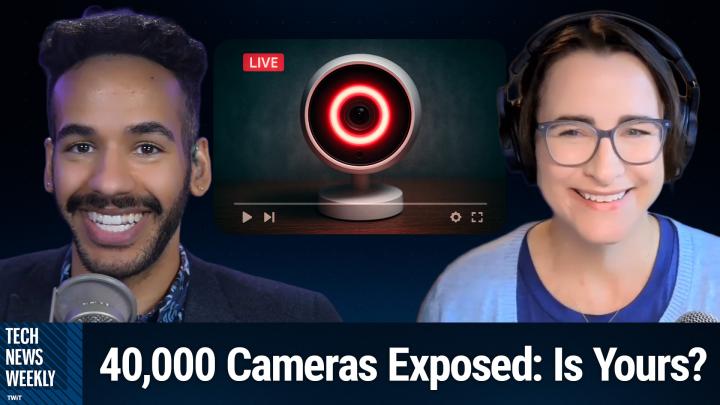
All TWiT.tv Shows (Audio)
Tech News Weekly 392: 40,000 Reasons To Check Your Camera Security
01:11:07
Baby Monitors, Hospital Rooms, and Your Privacy at Risk
Loading summary
Transcript154 lines
- [00:00]
Micah Sargent
Coming up on Tech News Weekly, Jennifer Pattison Tuohy of the Verge is here. We talk about how a bunch of cameras are exposed to the Internet and how wise is updating its security practices. Afterward, we talk about addictive tech use and its impact on mental health and round things out with a story about that Trump mobile phone. All of that coming up on Tech News Weekly. Podcasts you love from people you trust. This is Tweet. This is Tech News Weekly episode 392 with Jennifer Pattison Tuohy and me, Micah Sargent. Recorded Thursday, June 19, 2025 40,000 reasons to check your camera Security hello and welcome to Tech News Weekly, the show where every week we talk to and about the people making and breaking that tech news. I am one of your hosts this week. My name is Maika Sargent and today joining us for this episode of Tech News Weekly is Jennifer Patterson Tuohy of the Verge. Welcome back Jen.
- [01:11]
Jennifer Pattison Tuohy
Hello. Hello. Happy to be back. It feels like it's been a while was because you were on vacation.
- [01:16]
Micah Sargent
Exactly. Yes, that was what happened the last vacation. It was nice. It was good to take some time and get some R and R. But I am happy to be back and yeah, it does feel like it's been forever. So thank you for for here in my place at the time and now being here again. We've got a lot to get to this week. It's a story of the week packed show and I am really looking forward to talking to you about especially our first two topics because they fall into the the interests and in some cases passions that we both enjoy. So a sweeping investigation by cybersecurity firm Bit site, reported by 404 Media reveals that more than 40,000 Internet connected cameras, from office security systems to baby monitors and even hospital patient rooms are accessible to anyone with a browser and the right IP address. Many don't require hacking, they're simply left unsecured, often using default settings or login credentials. And the result? It's a staggering breach of privacy across homes and businesses and public spaces with footage surfacing on the dark web and being used in real world espionage and cyber attacks. So in looking at this report, this was kind of wild to see the Number Bitsite identified 40,000 plus live camera feeds open to the public. I mentioned hospitals, offices, data centers, jewelry stores, clinics, bird feeders. That one maybe makes a lot of sense, but it was just as often found in a large organization as it was found in a home. With of course the most egregious examples being the cameras. They found in hospitals and clinics that were actually monitoring patients. In this research, the report identified the most exposed devices in the US followed by Japan. And there were camera feeds found across all 50 US states. Even some protected cameras were also able to be accessed. And that meant that even though they had these protections in place that were supposed to keep the, the camera from being able to be accessed, it didn't matter because the researchers had ways of getting to those cameras. And I kind of want to talk about that because the, the research conducted was done so in a way to kind of mimic the ability of anyone with even the slightest bit of tech. Know how it wasn't any special hacking or trying to, you know, insert some package over packet, I mean over the Internet and, and hack into, or getting someone to plug in a flash drive. No, in many cases it just took an IP address and in some cases it doesn't even take that because there are websites and services out there that let you search for Internet accessible devices that people have in their homes or elsewhere. And so with all of that, they kind of looked into how to find things. Looking at cameras that operated over HTTP and in many cases those would have a built in web interface. They could then do something as simple as typing after the URL slash out period, jpeg. Because a lot of these cameras have similar firmware and so they work a lot alike and they output these little screenshots of what they're seeing. And if you get enough of those, you can really start to get a picture of what is going on. And then there were also the real time streaming protocol cameras that are more likely used in kind of professional systems and those also have very common paths like live SDP and slash MPEG4. And then the researchers were able to take that data and turn it into a series of images or video to be able to get that. So yeah, we'll talk a little bit more about what the researchers found in terms of how people were using these and everything else. But I wanted to get your early impression of this, Jen, because I know as someone who has been interested in the Smart home, I regularly hear from people who say, why would you put any of that stuff in your house? It's going to, you know, result in you getting hacked or someone's going to be watching you. What is your kind of response to that in general and then your reaction to hearing about all of these cameras?
- [06:37]
Jennifer Pattison Tuohy
So my response to the first question is choose wisely. There are cameras that you can buy that are far more secure and there are cheap cameras that you buy off the web for 30 bucks that are going to end up on someone's collection of streaming website, streaming video cameras that people sit and watch and eat popcorn and enjoy seeing into people's homes. And this is not new. So it is scary and awful to read this report. But if you even click into the report, it says, in 2023, we found the same thing. And in 2022, I mean, this has been going on for years. What is scary is that it is still going on. Like we should have learned, people should have learned, companies should have learned. This shouldn't still be happening. But it is common and it has been happening for a long time. Often when I talk to security researchers and I'm, the question I always ask is, you know, what is the biggest threat or concern users should have about using smart devices in their homes? Because it's a question I get asked a lot, not just around cameras, but around hacking in general. Because, you know, there's the whole concern around, like DDoS attacks or people getting into your networks and controlling your smart appliances. And so there's a lot of concerns around connecting devices in your home to the Internet. And yes, this, this is something that has been happening for a long time. And what they often. The answer that they always give me is, oh, well, security cameras are your biggest concern because there are literally websites you can go on to and just join and see live feeds from people's nurseries and their gardens and wherever else they've put security cameras. I mentioned gardens because one of my top tips with security cameras is keep them outside. Yes, but you know, baby cams, obviously there's a lot of use cases, pet cams, when you're away from home. There are reasons that people want these devices. But in terms of my. Your second question there, what can be done about it? You need to buy cameras with good security track records. If you notice, the two protocols that they mention in this report are HTTP, which is missing a very crucial letter from.
- [09:07]
Micah Sargent
Where's the S? Where's the S for goodness sake? Why is it not encrypted?
- [09:13]
Jennifer Pattison Tuohy
Thank you. And then R. Now, RTSP is not as bad, but it's the way you use it. It's actually quite a common tool in smart home cameras to stream to local storage. But if you're streaming to local storage, you're not going on the Internet. You're still somewhat vulnerable because if someone hacks into your network, they can, you know, that it's, it's more of an open channel, but hopefully you have much stronger protections on your network. And this is all about stronger protections and this is all about the devices that you choose to put into your home. Most of reputable security cameras you buy from reputable firms. Rep. Reputable companies that cost more than $30 most of the time. There are. You can get them on deals, but you know, that come with secure, come with subscriptions as well. That's some sometimes, you know, considered a downside. They put money, time, effort into securing and either end to end encryption or encryption in transit and at rest, which is what most cloud security services use, which encryption and transit and at rest, which means that it can't be hacked into as it's moving or when it's not being used. It is accessible to the company at some point so that they can process it for things like facial recognition or package alerts or those kind of features that some people value security cameras for. But yeah, that, you know, just don't buy cheap cameras off the Internet. And I don't know what kind of. I think the issue with some of these large organizations that hospitals and the others that are sort of mentioned in this report are using probably old technology. They haven't updated their cameras in years because it would cost a fortune to, you know, reinvest in that technology. And if it's working for them now, why would they change it? And they probably aren't alerted to these types of reports very often. So, yeah, I'm sure my local hospital wouldn't really have spent much time on, on these sites and figured out what's going on. So, yeah, there's these, are these. It's scary and it's bad, but it's not new and it's been going on for a long time. And that's, that's the scariest thing is why this is still happening.
- [11:28]
Micah Sargent
Absolutely. I mean, one of you, you very much hit on it. Legacy and abandoned cameras are still streaming online. And that was a lot of what. Not a lot, but that was some of what BitSite saw, particularly the legacy side. And here is what I really liked something that they talked about that I think people aren't thinking of first and foremost. Because when you hear about your camera being accessed or a camera being accessed, your immediate thought is privacy, privacy, privacy. Right. Someone's watching me through my camera. That's the bad thing and that's the extent of it. And honestly, that is enough to, to sort of pay attention to this report. But let's talk about businesses who, as you said, maybe you're going, okay, they can see people walking through my Store, I'm not going to update these cameras. They talk about what else is at risk here. With office cameras, you can suddenly expose confidential materials, employee activity, so you know you're suddenly gaining access to paper that are talking about the company's profit or whatever it happens to be. Retail cameras that are accessed will help burglars, time thefts or perhaps scope merchandise. In fact, there was one instance where they were able to look through and see a Porsche showroom that had some very fancy car in it. Factory feeds could reveal proprietary processes to competitors. And all of those are also reasons why you would want to have your camera situation figured out. And yes, so much of the time what they found was just that people were not changing the default passwords or if they didn't need remote access, but they left it on. So if you don't need remote access, as you were just talking about, make it a local area network situation. If you're going to be doing that rtmp, unless you do need to access it from external and maybe consult a professional. Use firewalls, VPNs. Of course, for corporate systems, you can also go about checking your own camera. Just hop on a different network and try to access it or use one of these sites. I'm not going to mention any specific site or service. It's very easy to find that does publish this information and, you know, shows these cameras that are kind of online. It's honestly not too difficult to get this sorted if you are taking a little bit of time and a little bit of attention to figure it out and you do those things that Jen talked about and that this report talks about of if you're going to do this, invest a little bit in it so that you aren't getting the cheapo devices that aren't going to be as concerned about security and the blowback therein and then go from there. And when we come back from the break, we're going to talk about a company that is a bigger company in the sense that when blowback was initiated, the company kind of had to repair from that. So let's take a quick break and we'll talk about. Oh, I should mention before we do take that break, we'll of course link the report in the show notes. You should go check out the report. It's got loads of great information in there and you can pass it along to any family members who don't like to change default passwords, change your passwords or buy the $6 camera. Right? Set up to a. Yes, absolutely. All right, let me tell you how appropriate about Delete Me, who is bringing you this episode of Tech News Weekly. If you've ever wondered how much of your personal data is out there on the Internet for anyone to see, and you went and looked, you were probably surprised that it's a lot more than you think. Your name, your contact information, in some cases your Social Security number, your home address, even information about your family members are all compiled by data brokers and sold online. Anyone on the web can buy your private details and this can lead to identity theft, to phishing, attempts to doxing, to harassment. But now you can protect your privacy with Delete Me. You know, I'm a person who exists publicly online and I do share my opinions and thoughts about all sorts of tech stuff. And because of that, I have to think about safety and security not just for me, but also for the people that are in my life. It's easier than ever to find personal information about people online. And that is why I personally do use and do recommend Delete Me. I have been very impressed with what it has been able to remove online because there have been a couple instances where someone decided to try to reach out to someone close to me to get more information about me. And this is a person I don't know that's trying to get information about me. And because of the way that data brokers collect those links between people, they were able to get this information. Not fun, not good. We need to be able to get that stuff removed. And that's what I've been able to do with Delete Me. It's a subscription service and there's a reason it's a subscription service because it removes your personal information from hundreds of data brokers and keeps doing it. And we'll talk about that in a minute as to why you can sign up up. You provide Delete Me with exactly what information you want deleted. Their experts take it from there. It sends you regular personalized privacy reports showing what information they found, where they found it and what they removed. And it's not just a one time service. This is the important part. It's always working for you. Constantly monitoring and removing the personal information you don't want on the Internet because those data brokers will continue to grab and hold on to and sell that information. To put it simply, Delete Me does all the hard work of wiping your and your family's personal information from data broker websites. So take control of your data and keep your private life private by signing up for DeleteMe at a special discount for our listeners. Today you can get 20% off your delete me plan when you go to join deleteme.com twit and use promo code TWIT at checkout. The only way to get 20% off is to go to JoinDeleteMe.com TWIT and enter code TWIT at checkout. That's JoinDeleteMe.com TWIT code TWIT. And we thank Deleteme for sponsoring this week's episode of Tech News Weekly. All right, we are back from the break, joined this week by Jennifer Pattison Tuohy of the Verge. And yeah, it's time for your story of the week.
- [18:07]
Jennifer Pattison Tuohy
Yeah, so my story of the week concerns a similar space which is security cameras. And it's, it's, but it's at a different level. Thankfully these security cameras are a little bit more secure than the ones we were just discussing, but that doesn't mean they were. They're completely fail safe. And what is, what has happened here is the security company Smart Home Company Wise, which has been around for several years and is well known for producing high quality, low cost smart home devices, primarily security cameras. But they also have a number of different devices in the smart home, including door locks and lights and scales. Yeah, everything they do a lot and they've always been a kind of interesting, quite innovative company and very popular because their cameras are originally were about $30 so hence my comment when we were talking about cheap security cameras earlier. These guys don't fall into the Chinese cheap categories on that you find online, but they have experienced several security issues in the last few years that caused a lot of backlash and concern from users. And just this week they came out with a new system, a new feature for their security cameras called Verified Few, which is supposed to fix. Well, they have fixed the problems they, they experienced earlier in 2023, 2024. But this is sort of like a fail safe proving to customers that if anything like that ever happened again, you still would be secure. Now what happened in those incidents is that other people will be able, were able to see your live stream footage from your cameras, which is the, the number one thing people are concerned about, about having devices like this in their homes. So that was a big issue. What happened was some type of third party cloud caching company that they used had a, had a failure and then there was another failure and it was kind of a domino effect and users when they logged into their accounts, saw other people's streams because there was some kind of cross on the back end and obviously no matter what happened, this is, this is the fear, this is what you don't want. So and so what this new Verified View feature is, is really kind of interesting. It takes your camera and it stamps your user ID metadata onto the camera so that now anytime any footage is generated by that camera, a live stream, a video or a photo, it stamps your metadata, your user ID metadata onto that. And then when you go to use it to view it with your app or through any other, maybe through a third party, like if you're watching on a smart display, it match, it has to verify verified view that you have, that you are that user using the embedded metadata. And this is actually quite clever and it's essentially. Does it sound familiar? Because do you want to know what I understand it's based on from some security people that I spoke to. What's it based on? Drm?
- [21:39]
Micah Sargent
Oh, no way.
- [21:41]
Jennifer Pattison Tuohy
So it's like you have to verify that it's you and it's. And it's basically uses a combination of a software and hardware and it's really kind of an interesting technology that you could see being applied in many ways in our new world where we're concerned about the various veracity of video and photos. Being able to sort of take this digital management tool elsewhere outside the smart home would be really interesting. But what WYZE has done here is basically, you know, this is just for their cameras and the idea being, you know, whatever you even if someone was able to hack or not hack or get access somehow to the stream because of a failure, so like the failure that they had with their cloud caching, they wouldn't be able to view your video because when they tried to access it, they wouldn't have your metadata. Now of course if they got access to your account then they would be able to. So it doesn't prevent that. So Wise, at the same time over the last few years since this happened, has been, has talked about how they have spent a lot of time and money and this is the key to security, is it does require time and it does require money. And companies that don't put in the time and the money are the ones that you should not be buying from. But they've put all this time and money into a slew of other features that most of which most companies are already implementing that are in this space. And I think Wise had a lot of these tools in place, but they've kind of beefed them up. So they now require two factor authentication. A lot of companies make it an option two factor authentication Means that if someone tries to get into your account you get alerted and it is a pain. I know I kind of avoid turning it on sometimes.
- [23:29]
Micah Sargent
Yeah, it's like oh boy. Another.
- [23:31]
Jennifer Pattison Tuohy
But this way, you know, I accompany constantly if you, you constantly get notifications that someone's trying to log you. Would you like to reset your Instagram password? No, I don't want to. I didn't ask to But I have two F8 turned on so every time someone tries to get into my accounts I, I find out. So you know, cameras should have. You need to have two FA turned on. They Wyze has also added a number of sort of back end features that you they're not front facing to the consumer but that will send alerts to the consumer if there is something trying to or someone trying to access their account and invested in a number of AWS tools that are kind of constantly scanning to see if there's any kind of network attack. So basically they're trying really hard to convince customers that their data is safe with them. Now their data compared to the companies we were just talking about, I would definitely say I would feel much more comfortable using a Wyze cam than using any of the cameras that the company. What was the research firm called? I'm trying to remember BitSight that we just talked about. But there are still, you know, there are still concerns and the reasons there are still concerns is because Wyze is a cloud based service. And this is something when you're talking about security cameras that you always have to kind of weigh. And Wyze is not alone in this. Most popular security camera brands out there today Ring Arlo Wyze, they all use cloud storage. There are some options for local storage with all of those cameras and others, but generally most consumers go with the easy route, which is the cloud. That is the easy route. There are a lot of benefits to the cloud. You don't have to run a local server, you don't have to worry about dealing with security. In theory it's all happening by the company that you're paying to do this for you. And that's generally you're paying a subscription service. They also the big benefit is the new advances we've seen with artificial intelligence in security cameras. So they are able to process more intelligently footage and send you much more detailed notifications which is, you know, kind of interesting. Like now from my Wyze cam I'll get an alert saying there's a chicken in your backyard as opposed to motion. So those kind of features you know, are a benefit of a cloud service. But I asked Dave Crosby, who is the one of the co founders of Wise and who I spoke to for this article, I said well you know, cloud services is great and you know, a lot of people love these features but, but there are a lot of people that would just rather have their footage end to end encrypted, which is what we talked about earlier. That is where the only person that can feasibly in any way access your footage is you using your device. It does create a little bit more friction in accessing your footage. It does, as he says, compromises the user experience. And their argument is that this verified view offers very similar protection to end to end encryption but without compromising that experience. But really it's down to your comfort level and also your technical knowledge of level. Because E2E does create as a bit more friction, doesn't have as many features, but is arguably and well even he said the holy grail for security cameras in terms of feeling secure with that in your house. And Apple HomeKit uses E2EE for its footage. But what, what the key difference that you need with E2EE is you need a local hub.
- [27:18]
Micah Sargent
Yes.
- [27:18]
Jennifer Pattison Tuohy
Apple Home uses local home hubs like a HomePod or Apple TV. And then there are some other companies like Eufy, who's also gotten into a fair amount of hot water with cloud issues in the past. They have a, a local device, a home based system that you can use. And there are, I mean I think Reolink and Lorex, a couple other companies will have like an NVR system that you can set up. Those use rtsp, which is what we discussed before, if you're using them on a local network. This is all so complicated.
- [27:54]
Micah Sargent
Yes.
- [27:55]
Jennifer Pattison Tuohy
And confusing and I can see why so many people, you know, get burned by security cameras. But honestly my, my advice from the start is the same now. It's like if you put, if you want these cameras in your home, pay the extra money to buy it from a reputable company, make sure that you change your passwords, you set up two fa, you do all of that and most just point them outside.
- [28:21]
Micah Sargent
Yes. That's, that's the main thing because then at the end of the day they're seeing your chickens but not much else. Right. Whenever it comes to, in a home setting, of course that's a different situation in a, at a store, clinic or something like that because even somebody walking outside, if they've got their discharge papers and the camera is able to zoom in on the patient ID number or whatever. Like that's where y' all have got to get your stuff together in those settings. There should not have been a single clinic or medical anything on this. That list from earlier I was going to mention too, funny enough, back in the olden days, you could actually go into your wise settings and turn on rtmp. And yes, you know, that's something.
- [29:05]
Jennifer Pattison Tuohy
And he's bringing that back. They said they're going to bring that back.
- [29:08]
Micah Sargent
Really?
- [29:09]
Jennifer Pattison Tuohy
Yes. That was a little.
- [29:10]
Micah Sargent
You heard it here a second. I missed that part because that's really cool. I didn't realize that that was going to be.
- [29:15]
Jennifer Pattison Tuohy
Yeah, he said that. So one of the other things we talked about was moving how much more he could. They could move locally because a lot of this AI stuff can be done locally. Locally. So you don't necessarily need the cloud for the AI processing as we're doing more and more on the edge. And they actually WYZE has a few cameras that can process certain things on. On the Edge. They're the more expensive cameras. But he was talking about how the way they're working with the cloud is bringing. They'll. They'll develop an. An AI identification model, use it in the cloud, refine it until they can move it to the edge and then use that on the edge. But so this is kind of, you know, a flywheel. So it's half to start in the cloud and come to the edge. Which is why he was saying we're always going to have a cloud component. Although you can use local storage for a WYZE cam and not use that cloud at all. But it is not as good of an experience as subscribing, mainly because they limit. There's like a five second or may even be a five minute cooldown between clips. So if someone walks by five minutes in between clips, you're not going to see them. So it's kind of.
- [30:20]
Micah Sargent
Yes, and that's important.
- [30:22]
Jennifer Pattison Tuohy
But just on the rtsp, he said, yeah, he knows our users want this and they are looking to bring it back. So there you go. You heard it here first.
- [30:30]
Micah Sargent
That is exciting. Also, I'm just now realizing that I said mp, I think, because the mounted police.
- [30:40]
Jennifer Pattison Tuohy
Oh, yay. Wait, what are the. What are they called?
- [30:42]
Micah Sargent
What are they called? The Something, something, mp. The mountain.
- [30:46]
Jennifer Pattison Tuohy
The bounties. Yes. Yeah, the Rocky Mountain. There was a TV show in like 90s.
- [30:52]
Micah Sargent
That's for some reason, that's what came to my mind. But yes, rtsp. I was going to say, before we do have to take another break There was one situation where I saw a person who clearly had knowledge about the limitations of a battery powered ring camera. This happened to me where the person knew the timing for what happens by default between clips such that I what they didn't know was that I had another camera in a different place that was not battery powered. But I watched they walk up and trigger the camera and then they waited and waited and waited and moved just within that frame of time before it picks up again because it's a battery camp. So yeah, that can that was pretty clever. And again, most people are going to set things at the default. So if you're trying to steal a package or something like that, they that's how they did it.
- [31:52]
Jennifer Pattison Tuohy
But yeah, that's really smart.
- [31:55]
Micah Sargent
I was honestly, it was clever. I thought, you know what, maybe you deserve this package because you take it.
- [32:00]
Jennifer Pattison Tuohy
I interview on my picture.
- [32:01]
C
Exactly.
- [32:02]
Micah Sargent
I wish I could have found them. I said, listen, you can have what's in there. I just want to talk. All right, we got to take a break. We'll come back with even more. Up next, we're going to talk about a study on mental health and youth Internet or youth technology use and some surprising results. All right, let me tell you though about Melissa, who's bringing you this episode of Tech News Weekly. Melissa is celebrating 40 years. Congratulations as the trusted data quality expert AI. It can transform businesses and industries of all types from manufacturing and supply chain management to the health care industry. However, even the most advanced AI models can't correct underlying data quality issues. If you start with bad data, what are you going to do? That is where Melissa comes in. Imagine having a data expert who never sleeps. Melissa's intelligence system verifies identity to prevent fraud and gaming operations, ensures valid patient and medicine identification and healthcare systems securely updates and verifies constituent data across government databases. And Melissa's Know youw Business enables verification and monitoring for financial institutions. Melissa's industry leading data validation tools are now available on Microsoft Azure. Through Azure Data factory organizations of all sizes can migrate existing SSIS packages to the cloud without disruption while accessing comprehensive data cleansing capabilities, you can scale data quality operations faster, reduce infrastructure overhead and maintain existing enterprise data workflows within Azure's elastic efficient maintenance free cloud environment. With real time data validation, comprehensive enrichment, cross reference verification with gold standard reference data and intelligent anomaly detection, it's no wonder that Melissa is the Trusted Data Quality expert worldwide. Melissa securely encrypts all file transfers and has an information security ecosystem built on the ISO 27001 framework. Adherence to GDPR policies and SoC2 compliance. Contact Melissa's team to learn how they can elevate your business and improve your data quality. Get started today with 1,000 records cleaned for free at melissa.com TWIT that's melissa.com TWIT all right, we are back from the break, joined this week by Jennifer Pattison Tuohy of the Verge. And we are moving along to a story of the week from yours. Well, it's not from me. It's one that I found that I think is well worth talking about. A major new study published in JAMA JAMA challenges one of the major, most entrenched assumptions about youth mental health, that More screen time leads to worse outcomes. Tracking over 4,000 kids from age 10 to age 14, researchers instead found no direct link between how many hours children spent on devices and suicidal behavior. Instead, the study identified a different culprit, addictive patterns of use, such as compulsively checking phones or feeling distress without access. In short, it's not just how long kids are online, it's how unable they are to log off. In this study, 4,285 children were tracked again from age 10 to 14. They were regularly screened for signs of compulsive use, the inability to stop or emotional distress when they disconnected, and by age 14. So again, for those four years that they were tracked, 17.9% of those more than 4K children reported suicidal thoughts, 5.1% showed suicidal behaviors like planning or attempts. And in this study, there was no direct correlation between the time spent on the screens and suicidality. But instead, there seems to be a link between when the children reported addictive behavior and reported feeling an addiction to the device that suicidality rates increased. It seems to be that this is the first study to look at addictive use as the root cause instead of just time spent. So when it came to screen time, they looked at different patterns of screen time. And even if a child spent more than typical hours on a device or fewer than typical hours on a device, if that child also reported that they were feeling the desire to get to their device or distress when they didn't have it, that was the actual common factor, as opposed to just using it later if they needed to. So feel whenever they looked at what actually counts as addictive use, feeling unable to stop using advice, needing to use it, more and more anxiety or distress when access is denied. And this was present across social media, gaming and phone use. Some children exhibited that addictive behavior even if their screen time was, in comparison, relatively Low. This doesn't surprise me that addictive use was more common among kids whose brains were still developing impulse control. I mean, that is a huge factor in this age range. And nearly half of the participants had high addictive phone use by age 11. So the risk of suicidal behavior, this is. According to Dr. Zhao, the risk of suicidal behavior clearly increased, increased to a doubling of the levels. And so they kind of had to recheck regularly in on. On these. These children. So again, was between the ages of 10 and 14, and by 11, that addictive behavior had already started. There, of course, is a lot to look at here in the long term, but it is important to. To sort of frame this in the discussion that we've seen up to this point, which has so much focused, I think, on just kids are using their devices and they're using them all the time, and they're using them at school, they're using them on the toilet, and they're using there, and we're using them there, blah, blah, blah, blah. And how. It's so much that there may be more to it than simply that. And finding sort of underlying patterns and causes is an important aspect of it. I am not the parent of children, and so I have not had the joy one must have in trying to figure out when and how and why and all of the. I just would love to hear if it's something that you want to talk about. Jen, how did you approach tech use and when did it come along for you and, you know, the. The conversation around screen time and everything else and, of course, your thoughts on this. This study?
- [39:29]
Jennifer Pattison Tuohy
Yeah, well, I think the study is very interesting because this is sort of something. And this is an internal, you know, family issue that we've had too, trying to understand the difference between screen time and benefits of screen time. And this has always been sort of. My argument is, is, you know, it's not about. I've always felt it's not about how long they're on it, it's about what they're doing on it. That. Because today, in today's society, especially with COVID 19, which my kids were smack in the middle of, with high school and middle school, you, it was impossible to do less than, you know, six hours of screen time a day because they're on their computers learning for school. I mean, that's not the type of screen time you feel like you need to limit. But we're being told that too much screen time is damaging our children. So, yeah, there's been so much parental guilt over the last five to ten years around screen time. And the onus has been so much on the parent to make sure that your child has, you know, spends all its time outside and not any time on the screen.
- [40:35]
Micah Sargent
Yeah.
- [40:37]
Jennifer Pattison Tuohy
And, and whereas now I think what this helps do is push the onus back onto companies and device makers and those people creating the content to be much more mindful about the type of content created for under, for children under certain ages as. And not. And to have some of these limits that, and we're starting to see this like limits that kind of will help you make sure, you know, there's not a lot out there that helps you understand what type of age range an app or a service is for. That's been like, like when we grew up with, with TV and movies, our parents were given the like rating system to help them make it clear what was, what was suitable and what wasn't. And anything that was unsuitable on TV wasn't shown until after 8pm you know, like there were much clearer guidelines for parents to understand what kind of content their children could, should be exposed to with apps. There are age ratings for apps, but they're very loose and they don't really provide a lot of detail and they're quite limited for younger ones. For example, like you can't download YouTube unless you have unrestricted app downloads. 17, it's a 17 or over. Which obviously because YouTube has all sorts of crap on it. But once you download YouTube you can put on age restrictions. So it's like this just needs to be more to help the parent at that, at the sort of interaction stage and not you should just keep the screen away from your child. It is, it's, it's a struggle definitely because there are the reasons that children in this society today, it is very hard to not give your child some form of communication device before the age of like 15 or 16. That when I, there was a sort of. There's a group organization movement called wait until 8th which is the idea, you know, don't. You shouldn't have to give your, don't give your child a phone until eighth grade. Which is. So my child just finished eighth grade. So that's like 13, 12, 13. But then both my kids played varsity sports. So they were with, when they were in seventh grade. So they were with a high, with high schoolers who were all communicating over like they communicated all of the sports.
- [43:01]
Micah Sargent
Information, all of the schedules, all of the, yeah, everything's taking place there.
- [43:05]
Jennifer Pattison Tuohy
And then they were going off on like seven hour trips, round trips to Sports. And what I'm supposed to just put them on a bus and say see you later.
- [43:14]
Micah Sargent
Right.
- [43:15]
Jennifer Pattison Tuohy
You know, in this, it was, it was hard. You know, you can lock phones down. We did that a lot, especially early on with my son. I scared him silly with a few Internet horror stories to keep to make sure he understood the dangers. But screen time limits that are built into phones are useless and crap and easy to break an apple, you need to fix that. And then, then what we are seeing now, which I think is a good shift, is screen time tools within apps so that parents can go in and put specific tool specific limits on specific apps inside the app rather than inside the ecosystem of the phone, which we need to see more of now. We're also seeing more of like teen account type services. Like Instagram now has a teen account. There are, you know, but my point being that this, this onus is, should not just be on the parent. This needs to come from the companies as well. And we do need to probably see some legislation and some lawmaking around understanding the impacts and how companies should approach, just approach their product and how they present it to children. Because right now I think there's a lot of, you know, get them young and then there'll be a customer for life. You know, it's very much akin to the cigarette industry in the 60s, 70s.
- [44:43]
Micah Sargent
Yeah.
- [44:44]
Jennifer Pattison Tuohy
I mean this just makes it even more so. Like it's proving it's about the addiction, not so much the time. And that's the scary part.
- [44:50]
Micah Sargent
Yeah, I. So when I look back at sort of the landscape of what would have been early tech, but really was like early media, radio and surrounding technologies, what we saw was the US Government seeing this public resource available and saying, okay, this is good, but also it needs to be regulated. And so the government came in and regulated these systems and put them in place. Hollywood started to become very popular. Movies, the moving pictures started to become very popular. And as that was happening, happening, they realized that they did not want to have the government regulating them. So they said, we will regulate ourselves. They introduced the rating system for films and held to that with every fiber of their being so that there was never, you know, an opening in the armor. Right. That the US Government could say, actually yes, have failed to regulate. So now we're coming in and that has worked. Then we saw the video game industry do the same to a certain extent. There was a time period where because of other things that were going on in the world, video games were being blamed for violence, et cetera, et cetera. Et cetera. And there was kind of even more pushback and more kind of changes to how video games are regulated. But again, an industry regulating itself because they feared the federal government coming in and doing it for them and holding to. And holding steadfast to these rules. And fast forward to now, and these big tech companies don't want to work together and figure out rating systems and hold to them because they're so big and they have so much money that not only do they not have to regulate themselves to keep the federal government from coming in and regulating them, them, but they can just pay the federal government to not come in and regulate them. And that is horrible. And this, this like you just get to do what you want and then you hope that the federal government doesn't come and give you a slap on the wrist. And yes, we are literally just now starting to see, or have just started to see kind of a change in that there's, there are bigger penalties and especially, thank goodness overseas, we are seeing more, more pushback there. But yeah, when you. No one is agreeing on how these things should. You know, you've got Apple doing its nutrition labels and implementing these things, but Google's not doing it the same. And Meta has its. All of these have their own rules and regulations. Even though it's all this big techosphere and arguably the worst.
- [47:42]
Jennifer Pattison Tuohy
I'm going to say that the big issue I had with tech, this wasn't phones, but was the quest too.
- [47:50]
Micah Sargent
Oh, really?
- [47:51]
Jennifer Pattison Tuohy
Okay, yes. And this is where it kind of all kicked because I. This was all during COVID And you know, this is, it even says in this report, you know, it's kind of elitist the way that they push screen time limits because there are parents that just don't, you know, they need, they need. It's a really useful tool to help keep your child occupied if both parents.
- [48:15]
Micah Sargent
Are working and working for longer hours than typical. And if you don't have the resources in place to understand how best to support your child, et cetera, et cetera. Yeah, go ahead.
- [48:25]
Jennifer Pattison Tuohy
Yes. And it was very. And this was the, this is what happened. I mean, I'm quite tech savvy and we got the quest to. I was thinking of it as like a video game device and this was during COVID So again, great, you know, to have a new experience, you know.
- [48:39]
Micah Sargent
We can step out into the world, so to speak, without actually doing it.
- [48:42]
Jennifer Pattison Tuohy
Yeah. And my daughter just loved it. She like glommed right onto it and was playing the games, you know, Beat Saber and all that. I was like, this is great. And then she started spending more and more, more, more, more, more time talking to people on it. And I was like, oh, who are we talking to?
- [48:58]
Micah Sargent
Oh, yeah.
- [48:59]
Jennifer Pattison Tuohy
And, you know, I'd always been with my son. I had always been super strict with, like, when he got an Xbox, I was like, you can't be friends with anyone you don't know in real life. You know, or at least is like, you know, someone that knows them in real life.
- [49:09]
Micah Sargent
Yeah.
- [49:10]
Jennifer Pattison Tuohy
And I. It. It was a few weeks before I realized that she had joined a game called. It's not a game, and I can't even remember the name now.
- [49:18]
Micah Sargent
Horizon Worlds.
- [49:20]
Jennifer Pattison Tuohy
No, but it's VR Chat.
- [49:23]
Micah Sargent
Oh. Just a game that's just called VR Chat. Oh.
- [49:25]
Jennifer Pattison Tuohy
And it's just built in to the quest is. I don't. I think you might have to download it. But it's like, like pushed. It's like a Met. It was. I guess it was. It is Zuck's sort of like, this is our world where we all hang out, but everyone hangs out in this place. And you, you know, you don't know who or what. I mean, it got nasty quick and I took it away. And she's never used this thing since. But, like, I had no idea. Like, there's no warning, no labels like this, you know, that there was no education out there. It didn't. It didn't. You know, even as someone that understands a lot about technology, I was sort of blindsided by this, this system. And I think it was my son who finally brought it up. He's like, do you know what she can do in there?
- [50:09]
Micah Sargent
Oh, wow.
- [50:10]
Jennifer Pattison Tuohy
I was like, no, I thought it was just a game.
- [50:12]
Micah Sargent
Yeah, exactly. And you're thinking, I mean, you're seeing Beat Saber, you sing those and you're not thinking. Especially because even if it is a chat, you would think you have to add friends. Who you or you. Yeah, something like that.
- [50:24]
Jennifer Pattison Tuohy
Global. Like a global skin. And there are just people there you're talking to. It was. Yeah.
- [50:28]
Micah Sargent
I don't even want that in real life. So I'm impressed that a bunch of people around. Come on.
- [50:36]
Jennifer Pattison Tuohy
Yeah. So that was. That was definitely an eye opener for me because it. And again, you know, there are so many great things about the meta quest device. Like, you know, there. It's not about the technology, it's about the, you know, the tools within it and what. The experiences you're having. And they're good and they're bad and it's just like the Internet. There is good out there and there's bad out there. So we need to, and we need more help from the companies for sure. There needs to be more industry regulation, especially helping educate parents on the type of content and some kind of guidance like rating system. I mean there is, it's there, but it's not granular enough enough to any extent. Like this app, VR Chat I believe is like a U, you know, anyone can use because there's technically it's not blood and guts. There's no, you know, none of the kind of the, the things that you would expect to kick into like a NR or an 18 or an over 16 kind of rating because it's just a like place to come and chat. But this needs, you know, we need those kind of like how open is this? You know, what kind of, of connections can people make is. And like, like Roblox, Roblox has done quite a good job with that in terms of parental controls. But again, you have to know to go in there and set all of these. So it's, it's a, it's, it's a lot. But parents, you know, if you're going to have, if your kids have these devices, parents need to be able to take these types of actions and companies need to be able to, need to offer better controls for parents for sure. Because these types of things can get addictive as they, this study that we're talking about explains that sort of dopamine hit that adults get too this not just for kids, I'm going to say because adults are addicted to that.
- [52:19]
Micah Sargent
We do as well. Absolutely. And that's, I think that's the, the difference is now we're seeing this come into play at a time when the brain is still developing and in particular when it comes to the ability or inability to delay gratification and how delayed gratification is such an important skill to learn when you're young. It's a coping mechanism and if you don't have the opportunity to do that, it can have such an impact. I'm glad that these studies are going on to kind of dig in deeper because it does mean that we can start to look at more legislation and in this case look at legislation that instead of just targeting screen access directly will also look at maybe the underlying factors that it's about more than just screen access alone, but could have to do with, with behaviors given the context of the conversation. If you or someone you know is struggling, you can call or text 9, 8, 8 in the US you can also head to find a helpline.com if you are outside of the United States to be able to reach someone who can help. We are going to take another quick break and then we'll be back for our final sort of silly story of the week. I want to tell you about Threat Locker, who is bringing you this episode of Tech News Weekly. Ransomware is harming businesses worldwide through phishing, emails, infected downloads, malicious websites and RDP exploits. You don't want to be the next victim. ThreatLocker's Zero Trust platform takes a proactive, deny by default approach that blocks every unauthorized action, protecting you from both known and unknown threats. Trusted by global enterprises like JetBlue and Port of Vancouver, ThreatLocker shields you from zero day exploits and supply chain attacks while providing complete audit trails for compliance. ThreatLocker's innovative ring fencing technology isolates critical applications from weaponization, stopping ransomware and limiting lateral movements within your network. ThreatLocker works across all industries, supports Mac environments, provides 24.7us based support, and enables comprehensive visibility and control. Mark Tolson, the IT director for the city of Champaign, Illinois had this to say about ThreatLocker. Threat Locker provides that extra key to block anomalies that nothing else can do. If bad actors got in and tried to execute something, I take comfort in knowing threatlocker will stop that. So stop worrying about cyber threats. Get unprecedented protection quickly, easily and cost effectively with ThreatLocker. Visit threatlocker.com TWIT to get a free 30 day trial and learn more about how ThreatLocker can help mitigate unknown threats and ensure compliance. That's threatlocker.com TWIT and we thank ThreatLocker for sponsoring this week's episode of Tech News Weekly. All right, we are back from the break and Jennifer Patterson too. Are you buying a new phone?
- [55:23]
Jennifer Pattison Tuohy
No.
- [55:24]
Micah Sargent
Okay, okay, fair enough.
- [55:27]
Jennifer Pattison Tuohy
Yeah, this is very interesting. I have I will admit I am interested in MVNOs, but probably not this one. I have been thinking about switching my entire family off Verizon because it's costing me a fortune. But if, but there is a new mvno. Well a new plan, a new service on sale from our President Trump mobile. The 47 plan which is 47.45amonth which if you're a Trump fan, the number joke.
- [55:57]
Micah Sargent
Oh dear.
- [55:59]
Jennifer Pattison Tuohy
And unfortunately so our our web my site the Verge did a lot of coverage of this this week and so of dove deep into this plan and the, the, the the headline was Trump Mobile is a bad deal. So there are much better deals for this type of service out there according to our Research, because there are many of these MVNOs that use different use some of the large networks and resell Service and apparently $47.45 per month is not a good deal. But the really interesting part about this, I think for most, most tech nerds is what is this phone? So he launched Trump Mobile launched with a new plan and a new phone that Trump Mobile says is fully made in America, which it's not. It can't possibly be.
- [56:49]
Micah Sargent
It couldn't possibly be made in America.
- [56:52]
Jennifer Pattison Tuohy
Proudly made America just said there. And we did some digging. Alison Johnson, who is our phone reviewer, went through all of the various inexpensive Android phones that can be found around the rest of the world to see which one it most likely is that that Trump Mobile has said it's going to be launching with this plan. And it's 499Iconsider was the price of the phone, which is relatively cheap. And it they, they said built in the United States. Though there were some comments from one of the Trump sons who is helping run this later, saying that the plan is to eventually build it in time. So we shall see if that ever actually happens. But yes, because there is a phone, there's one phone that's made in the U.S. and it's called the Liberty Phone and it's like $2,000,000. So the idea of a 500 phone being manufactured in the U.S. i don't know, maybe Trump's going to subsidize it for everyone. But yeah, there's some. A few guesses on our website. The Doge, it looks like a doge note 58 or a ulephone note 18. I have never heard of any of these. 7. The blue G84, that's the one I'm going for because it has like a nice marbly shiny back, which is what. But the photo on the release of this did look like a photo really badly Photoshopped phone. So it doesn't look like this phone actually exists yet. But.
- [58:26]
Micah Sargent
Oh, so not even, not even the gold look. And we don't even think that that's done yet.
- [58:32]
Jennifer Pattison Tuohy
I mean, does that look like a real phone to you?
- [58:34]
Micah Sargent
No, no.
- [58:36]
Jennifer Pattison Tuohy
I mean look at the lenses and where's the flash? And I was.
- [58:40]
Micah Sargent
Yeah, the lenses are cracking me up. That's a fidget spinner. Spinner stuck to the side of a phone.
- [58:46]
Jennifer Pattison Tuohy
But yeah, it's. It was kind of. And also I think if you read the fine print, it does actually say right at the bottom that this is not associate. Trump Mobile is not associated with the Trump Organization in any way or something like that. It's like. Oh, it's like a. What's the word? Like not a subsidiary but we've licensed the name.
- [59:05]
Micah Sargent
Got it.
- [59:07]
Jennifer Pattison Tuohy
So yeah, I mean if anyone wants.
- [59:09]
Micah Sargent
To license my name, get in touch.
- [59:11]
Jennifer Pattison Tuohy
It's been run by Eric though. I think. I think it's Eric. What's the other one called?
- [59:17]
Micah Sargent
I, I couldn't tell you. I tried to know as little as possible about them, but.
- [59:24]
Jennifer Pattison Tuohy
Yeah.
- [59:24]
Micah Sargent
Okay, so wait, it's run by one of the sons, but it has not.
- [59:28]
Jennifer Pattison Tuohy
Part of Trump organization.
- [59:31]
Micah Sargent
That's cool.
- [59:34]
Jennifer Pattison Tuohy
Yeah, there it goes. It says it somewhere down there. Yeah, Trump name. Yeah, it's. So it is just trademarks. It's not actually Trump himself, but Trump. It's like the Trump Bible, I guess. Right? That was right. These are, it's all like legal stuff I suppose. But people are going to buy this.
- [59:53]
Micah Sargent
Legalese. Yeah.
- [59:54]
Jennifer Pattison Tuohy
Yeah.
- [59:55]
Micah Sargent
Right.
- [59:55]
Jennifer Pattison Tuohy
And so who is going to buy this?
- [59:57]
Micah Sargent
This.
- [59:58]
Jennifer Pattison Tuohy
Who, who is the market for this? I guess you get, you get. What do you get for this? For 45, 47 you get 20 gigab gigabytes of high speed cell service and hotspot data. You get unlimited talk and text and international calling. But that does seem, I mean most.
- [60:18]
Micah Sargent
Except in countries that we don't trade with.
- [60:20]
Jennifer Pattison Tuohy
Right. But like, like Google fi, you get 30 gig of data for 35amonth. So you know, Boost Mobile, you get 30 gig for 25amonth. So this is not a particularly good deal. And then you buy the phone on top of it. I don't think you get any sort of benefit out of that. But I know I am not a cell phone plan data nerd, but my, my colleagues are. So there's lots of great info on the website if you on the verge, if you want to dig a little deeper. But yeah, this, this just, it just feels icky the whole being, you know, marketing the president and into you know, in products that you buy because you're a fan. It just, you know, that's fine for like Sabrina Carpenter, but not the president.
- [61:08]
Micah Sargent
The Sabrina Carpenter phone, Jennifer would be all on board.
- [61:14]
Jennifer Pattison Tuohy
I love it.
- [61:15]
Micah Sargent
Well, well, okay, so here's the thing. I, Yeah, I think now my biggest concern honestly is that I buy this phone and it doesn't even have 30 gigs of data. Because if we can lie about one thing, we can lie about any of the aspects of this. So I wouldn't even know if I'm getting that amount of data. And if that's. It's 40, 40, 46, 40 or. Yeah.
- [61:40]
Jennifer Pattison Tuohy
47. 45.
- [61:41]
Micah Sargent
47. Thank you. I don't know why I was an off by one error. 4745 his. His presidencies. And are there going to be a bunch of of added fees that we, you know, are prepared for? I wanted to say, though, back to your earlier talk because you also talk about how in this other piece, Alison Johnson, as you mentioned, talks about how Donald Trump and Ryan Reynolds can easily sell you phone plans and how it's about MVNOs.
- [62:06]
Jennifer Pattison Tuohy
It's become a thing. Celebrity fans.
- [62:09]
Micah Sargent
We should.
- [62:09]
Jennifer Pattison Tuohy
We should talk about Ryan Reynolds.
- [62:12]
Micah Sargent
We should talk about MVNOs though, for people who don't understand them. So we'll talk about that next.
- [62:18]
Jennifer Pattison Tuohy
Yeah.
- [62:19]
C
This episode brought to you by Red Canary. When cybersecurity threats hit fast, you need an MDR partner that moves faster. Red Canary delivers 24.7expert MDR support, total visibility and actionable insights. Plus it helps you detect four times more threats so you can stay ahead without burning out. Red Canary clears the noise and has your back every hour, every incident. Get the backup you deserve. Visit redcanary.com difference to learn more.
- [62:49]
Micah Sargent
Hi, Zoe Saldana. Welcome to T Mobile. Here's your new iPhone 16 Pro on us.
- [62:53]
Jennifer Pattison Tuohy
Thanks.
- [62:54]
Micah Sargent
And here's my old phone to trade in. You don't need a trade in. When you switch to T Mobile, we'll give you a new iPhone 16 Pro. Plus we'll help you pay off your old Phone up to 800 bucks and you still get to keep it. There's always a trade in. Not right now. @ T Mobile.
- [63:07]
Jennifer Pattison Tuohy
I feel like I have to give.
- [63:08]
Micah Sargent
You something in return for karma. That's okay. I don't really have much in my purse. Oh, let's see. Hand sanitizer. It's lavender. I'm good. Seriously.
- [63:16]
Jennifer Pattison Tuohy
Let me check this pocket.
- [63:17]
Micah Sargent
Oh, mints. Really, I'm fine.
- [63:20]
Jennifer Pattison Tuohy
Oh, I have raisins. I'm a mom.
- [63:22]
Micah Sargent
Wait, wait one sec.
- [63:23]
Jennifer Pattison Tuohy
I've got cupcakes in the car.
- [63:24]
Micah Sargent
It's our best iPhone offer ever.
- [63:26]
C
Switch to team Mobile.
- [63:27]
Micah Sargent
Get a new iPhone 16 Pro with Apple Intelligence on us. No trade in needed. We'll even pay off your Phone up to 800 bucks with 24 monthly bill credits. New line, $100 plus a month on experience beyond finance agreement. $999.99 and qualifying. Ported for well qualified. Plus tax and $10 connection charge. Pay off via virtual prepaid card. Allow 15 days credits end and balance due if you pay off earlier. Cancel CT mobile dot com. Yeah, so MVNOs are sort of riding on the services provided by the big mobile carriers. And because they kind of buy packages of data and cut costs in other ways, they can end up saving you money. My significant other uses Mint Mobile and has now for some time and loves it. It saves him.
- [64:15]
Jennifer Pattison Tuohy
That's the Ryan Reynolds one, right?
- [64:16]
Micah Sargent
That's. Yeah, that's a Ryan Reynolds one and that saves him. And I should mention Mint Mobile has been a sponsor on the network before for. So I just want to note that. But regardless, he loves the service and it's again saved him a bunch of money. Especially when I sit down next to him with my AT&T bill and go, I don't understand.
- [64:35]
Jennifer Pattison Tuohy
I still haven't figured out. I know I need to sit down and do the math. But yeah, the idea is it saves you money, but potentially you don't get like that. I think the biggest thing is right.
- [64:45]
Micah Sargent
Support is usually pretty bad.
- [64:47]
Jennifer Pattison Tuohy
Oh, okay. That's one I didn't know about because I haven't actually done it yet. But for example, I have. Verizon is our major carrier in this area. I mean, we have all the carriers, but you get the best reception on Verizon. So I've looked at moving to Xfinity Mobile because I also have to have their service for my Internet because it's my only option and they're an MVNO of Verizon. So if you move to Xfinity, you're getting Verizon service. But what can happen, and this is what they sort of say in the fine print is that when networks are busy, you'll be the mvno customers might be deprioritized or get, you know, exactly. Less access to the servers. And I live in an area where we have hurricanes and my husband is a firefighter and he actually, he really needs like, in fact, he gets priority service with forever.
- [65:38]
Micah Sargent
I was going to say, does he get like a registered. That's cool. I'd read about that somewhere that there's sort of a blessing that, that emergency folks can get that's really neat.
- [65:47]
Jennifer Pattison Tuohy
So that they can more likely to get access. I mean, in a hurricane, quite often no one can, no one will. But yeah, it's not even about volume. It's more about infrastructure. But still, you know, considering all scenarios, we've kind of stuck with Verizon for the. For that reason. But it does feel like a small reason when I look at my $230 a bill every month and I'm like, maybe I should switch us because there's four of us. Us on our. On our plan and it's very expensive, but yeah, they are great for. And the other. The other issue I've had with MVNOs, which seems to have got better, is that hotspotting was limited and I use hotspotting because I like to work.
- [66:25]
Micah Sargent
You use a lot. Yeah, I don't. You shouldn't switch then.
- [66:28]
Jennifer Pattison Tuohy
Yeah, that's what I've been. Yeah. So the last time I talked to Xfinity, they said that that's now unlimited, but I don't know.
- [66:35]
Micah Sargent
Unlimited at 0.2 kilobyte kilobits per second or something.
- [66:40]
Jennifer Pattison Tuohy
Yeah, I know.
- [66:41]
Micah Sargent
I. Maybe you could end up say I. Not that that's what this show is for, but maybe you could end up saving money by moving the. The family members who don't need that priority to. Yeah, don't tell them I said that.
- [66:57]
Jennifer Pattison Tuohy
Uncle Micah.
- [67:01]
Micah Sargent
And we actually thought he was cool until now. Yeah. But maybe that's how you do it because who. It gets so pricey and. Oh, that's the other thing. He has an Apple Watch. Cellular. Can't use it with the cellular. Apple Watch.
- [67:18]
Jennifer Pattison Tuohy
Interesting. Okay.
- [67:20]
Micah Sargent
I think that might change though, because it has been acquired by T Mobile and I think that that could potentially move it into that area. But yeah, that's been one of his frustrating.
- [67:31]
Jennifer Pattison Tuohy
It's a funny thing when you're like, like so the way they sell it too, you know, they're using the same line. So why wouldn't you pay less? Which is what the ads all say.
- [67:41]
Micah Sargent
Yeah. And you're going, why wouldn't I? Why am I not paying less? Yeah. And I'm having to confront it in.
- [67:45]
Jennifer Pattison Tuohy
Myself to dig down and. Yeah. I. I've generally heard. And you know, this is very biased and mean and I'm sorry. But it's great if you're single there. That's.
- [67:58]
Micah Sargent
Yes.
- [67:58]
Jennifer Pattison Tuohy
If you don't have other people phone. But for families, not so much because you do get a lot of benefits. Like breaks, deals with.
- [68:08]
Micah Sargent
Yeah, exactly. More devices that you have, the less expensive each new devices and all that kind of thing. And then also the deals for new phones and trade ins are often better because.
- [68:21]
Jennifer Pattison Tuohy
Yeah, my. We break a lot of phones.
- [68:24]
Micah Sargent
Oh yeah. You should stay where you are then. I think. I don't know how we got here, but I love it. I love talking with you, Jen. It's always a pleasure. So much fun.
- [68:35]
Jennifer Pattison Tuohy
We covered everything today.
- [68:36]
Micah Sargent
We did. We have the gamut of tech news. If people would like to follow you online and check out all of your prolific and wonderful work. Where do they go to do that?
- [68:50]
Jennifer Pattison Tuohy
So you can find everything that I write@theverge.com and then I also am on the socials mainly at Smart Home Mama. Although you might find me at jp2e at a couple places. Blue sky and Threads are probably my main haunts. But yeah, the verge.com and then this. I'm just gonna do a little plug for this summer. I'm going to be doing some guest hosting on the Verges podcast, the Verge Car.
- [69:19]
Micah Sargent
That's so exciting.
- [69:21]
Jennifer Pattison Tuohy
You can catch me on there some a couple episodes this summer so.
- [69:25]
Micah Sargent
Oh I'm looking forward to it. Awesome. All right, well thank you so much for being here and we'll see you again soon.
- [69:30]
Jennifer Pattison Tuohy
All right, thanks. Bye.
- [69:33]
Micah Sargent
Alrighty folks, the Tech News Weekly has wrapped. I don't know why that took me so long to say, but the show publishes every Thursday at TWiT TV TNW. That is where you can go to subscribe to the show in audio and video formats. I want to remind you all about Cloud Club Twit at Twitter TV Club Twit when you join the club, we have monthly subscriptions and yearly subscriptions you gain access to some awesome benefits. Every single one of our shows ad free. It's just the content, none of the ads. You also gain access to the Twit plus bonus feeds. Yes, that's right. Feeds including our clips, our news and our shows. And access to the members only Discord Server. A fun place to go to chat with your fellow Club Twit members and also those of us here at TWiT. There you also gain access to special Club Twit events. I just had my my crafting corner last night. We had another great time making more crafts, hanging out, having a good chat and you also can watch our live coverage of special tech news events. All of that is only available to you as a member of Club Twit. So join the club Twitter tv If you'd like to follow me online, I'm ikasargent on many a social media network. Or you can head to Chihuahua Coffee, that's C h I H U A h ua Coffee where I've got links to the places I'm most active online. And be sure to check out my other shows, many of which publish later today. Hands On Apple, formerly Hands On Mac, Hands On Tech will publish on Sunday and iOS today as well. Thank you so much for being here and I will see you again next week for another episode episode of Tech News Weekly. Bye bye.
- [71:10]
C
The tech world moves fast and you need to keep up for your business, for your life. The best way to do that Twit TV on this Week in Tech, I bring together tech's best and brightest minds to help you understand what just happened and prepare for what's happening next. It's your first podcast of the week and the last word in tech. Cybersecurity experts know they can't miss a minute of security now every week with Steve Gibson. What you don't know could really hurt your business, but there's nothing Steve Gibson doesn't know. Tune in Security now every Wednesday, Every Thursday, industry expert Micah Sargent brings you interviews with tech journalists who make or break the top stories of the week on Tech News Weekly. And if you use Apple products, you won't want to to miss the premier Apple podcast, Now in its 20th year, Mac break Weekly. Then there's Paul Thurat and Richard Campbell. They are the best connected journalists covering Microsoft and every week they bring you their insight and wit on Windows Weekly. Build your tech intelligence week after week with the best in the business. Your seat at Tech's most entertaining and informative table is waiting at TWiT TV. Subscribe now. Marketing is hard, but I'll tell you a little secret. It doesn't have to be. Let me point something out. You're listening to a podcast right now and it's great. You love the host. You seek it out and download it. You listen to it while driving, working out, cooking, even going to the bathroom. Podcasts are a pretty close companion. And this is a podcast ad. Did I get your attention? You can reach great listeners like yourself with podcast advertising from Libsyn Ads. Choose from hundreds of top podcasts offering host endorsements, or run a pre produced ad like this one across thousands of shows. To reach your target audience in their favorite podcasts with Libsyn Ads, go to Libsyn ads.com that's L I B S Y N ads.com today.