← All TWiT.tv Shows (Audio)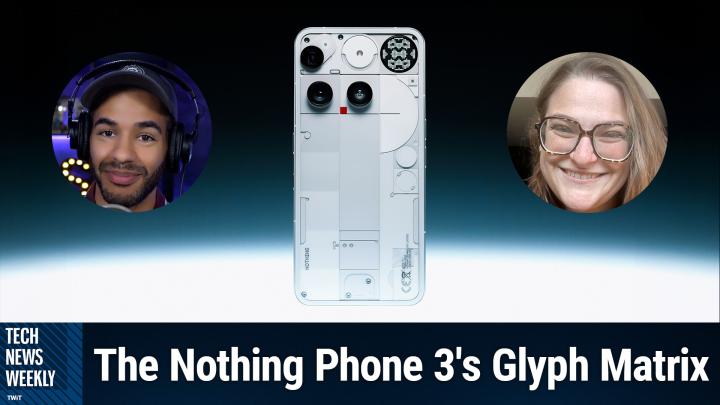
All TWiT.tv Shows (Audio)
Tech News Weekly 394: Why the Nothing Phone 3 Stands Out
01:02:29
Nothing Phone 3's Glyph Matrix
Loading summary
Transcript56 lines
- [00:00]
Micah Sargent
Coming up on Tech News Weekly, I, Micah Sargent, am joined by Amanda Silberling of TechCrunch. We talk about X working on a program where AI chatbots will generate community notes. Then we talk about how the Supreme Court has ruled on age verification for sites that could potentially harm minors. Afterward, I talk about what Microsoft is working on when it comes to diagnostics in medicine and diagnoses before rounding out the show with Andrew Langson of CNET, who tells us about his time with the Nothing Phone 3. All of that coming up on Tech News Weekly. Podcasts you love from people you trust.
- [00:47]
Amanda Silberling
This is Tweet.
- [00:51]
Micah Sargent
This is Tech News Weekly, episode 394 with Amanda Silberling and me, Micah Sargent. Recorded Thursday, July 3, 2025. Why the Nothing Phone 3 stands out. Hello and welcome to Tech News Weekly, the show where every week we talk to and about the people making and breaking that tech news. I am one of your hosts today. My name is Micah Sargent, and as is the way, I am joined across the Internet by the wonderful Amanda Silberling. Welcome, Amanda.
- [01:27]
Andrew Langson
Hello from the other side of the Internet.
- [01:30]
Micah Sargent
It's so weird how it works. It's just a series of pipes and or tubes.
- [01:35]
Andrew Langson
I am closer to the holiday weekend than you are.
- [01:38]
Micah Sargent
You are. And now I'm thinking, is a pipe a tube or is a tube a pipe? Or are they both each other?
- [01:47]
Andrew Langson
I don't know. Ask Mario. I'm just thinking of like the Mario pipes.
- [01:50]
Micah Sargent
If there's anyone who knows, it would be Mario. So for people who are tuning in, this is not a show where we discover whether squares and rectangles matter, but instead it is a show where we talk about our stories of the week to kick things off. Amanda, tell us about what you are bringing to the table today.
- [02:14]
Andrew Langson
Yes. So I'm bringing to the table an article about how X the everything app, as you can only call it Twitter or X the everything app can't call it X. X, the Everything app is piloting a program that lets AI chatbots generate community notes. I find this interesting because it's a way in which I'll just call it X for the sake of brevity instead of actually everything app. But X has kind of started a trend in social media companies of their community notes feature, which TikTok and Meta and I believe YouTube have also piloted like similar programs. Which is basically like when you go on X and you see, like someone will tweet, did you know that Micah's favorite fruit is an apple? And then the community note will be like. Well actually known famous podcaster Micah said in an interview that his favorite fruit is a strawberry. So that's, you know, gotta correct that. Obviously the, the actual contexts are about like politics and things like that, but it's very much like human driven, volunteer driven. So the idea of including AI in it, I think is interesting. Where the knee jerk reaction is like, why are we just further taking humans out of the content moderation system? Which it can be dangerous to have just AI content moderation without it being checked by humans. But then there is a research paper where these researchers that work on community notes were basically showing how this might work, where it might be that the AI note writers are proposing notes for posts and then they get read by the humans and then you still have that human oversight. But then also you get into questions of well, what AI are people using for this? Because they are planning to do it in a way where you can plug in something through the API. So then what happens if you have something like the overly sycophantic OpenAI model that was telling everybody this is a great idea no matter what, where then you end up with are the community notes going to be written from a specific perspective or more likely to be agreeing with what is in the actual content of the post itself? And I just find this interesting because it's not necessarily your typical question of can I do what humans can do? But if this is being done through an open API and a bunch of different eyes can be contributing to this, are we going to end up with problems like just all of the community notes are about like South Africa or something?
- [05:22]
Micah Sargent
Yeah, I mean that's the big thing, right? Is so okay, here's the deal, in my opinion, and I got to do that because this is my show. I think that there's something to be said for a more neutrally trained AI being able to provide context and community notes in this case for things that people maybe, maybe it's things that people like regularly get wrong. For example, dogs are allergic to chocolate. No, dogs are not allergic to chocolate. They simply cannot process the two nervous system stimulants that are in chocolate, which are caffeine and some like trip something something. They're not allergic it, they just can't process those things and therefore in their body they build up and it causes them to have strokes and seizures and da da da da, that kind of thing where it's well known, you know, fact based, scientific based knowledge that could provide for context that maybe a human like is just not going to go and look for every single time that someone's posted about dogs being allergic to chocolate and, you know, respond to it, although I'm sure there's somebody out there who would. So given that, I think that there. I don't necessarily have an existential problem with a I partaking in providing context, but we know that Grok in particular is trained in such a way that it is. It's not great in terms of what we've come to expect from AI and speaking with sources familiar with the matter, AKA someone who works in GROK training.
- [07:29]
Andrew Langson
Oh, you got to hook me up with sources.
- [07:32]
Micah Sargent
I specifically have been told that they and others are mind boggled by the fact that GROK does something that other AI systems don't do, and that is that GROK will sometimes ignore its, its own training and other AI bots, you know, that exist online, other chat bots will not ignore their training, but instead will be convinced and sort of hacked. Right. We've seen that before where it's sort of jailbroken, but that's because the human being is working toward figuring out a way to get it to go around what it's doing. No, GROK will just do that. So I don't want it fact checking. I don't want it, you know, figuring out what needs to be done. I get this idea of volunteer overload, particularly in the new way of X, the Everything app, where there aren't as many daily active users and there aren't people, I would say, as devoted to fact checking as there once were. So in that way I understand wanting to do something to in theory improve upon it, but so much of it feels like it's not improving upon actual facts. And that's the problem that I think we all have, is that if we can't even agree on what a fact is, what do we do?
- [09:08]
Andrew Langson
Yeah, I mean, I think that this is also interesting because AI and human content moderation working in tandem is not a new thing. Like this is how, like this is how social media has been operating for like decades. I don't just as long as I can remember. But the way it would work is let's say like you are on Facebook and you post a sexually explicit image because you're just doing some things on Facebook. And then the Facebook AI visually detects that is something that should not be on facebook.com and then it can flag it. And then if it is confident enough, then it'll just be like, nope, we are taking that down. Or if it's like more dubious, then it goes to a human moderator who then is like, yep, that should not be on here. But then Facebook also, or Meta generally is not using human moderators in the US in the way that it used to. But then the way that the AI works with something like using it on Community notes is different because it's not trying to recognize is this an image or are these certain words that are often used in contexts that violate platform rules? It's looking at like someone wrote that dogs are allergic to chocolate based on my training data. Do I know if that's true or not? And then you might end up in a situation where because this is such a commonly stated thing, maybe the AI will assume, based on its training data that it's correct that dogs are allergic to chocolate and then not go to like the one source from like vets.org I don't know, that's not a website. But the, the, the Conclave of Veterinarians discussing chocolate, they might not use that as the source and be like, actually all of these Reddit posts about chocolate and dogs are not quite correct.
- [11:21]
Micah Sargent
Yeah, well, and you've, you've really touched on the big thing there, right? The, the fact that the, like, training builds on itself. And that's the big issue. When you have human beings doing most of it. It's not sort of reinforcing itself like we saw with, what was it, Tay from Microsoft many, many moons ago. I, you know, it's in pilot. I just, there was a time where a pilot meant we're going to try it and if it doesn't work well or if it makes, if it's inaccurate or it's bad, then we'll stop doing it. But I don't have faith that this version of, of the social media network has any interest in approaching things from that perspective. Right. Like, I don't know what the goal is anymore at the company.
- [12:23]
Andrew Langson
They are piloting it for now. We'll see if it rolls out more fully. But yeah, I just thought it was kind of interesting too, because I kind of come in from a bias of being generally in favor of humans. But there are times in which AI is helpful at making things more efficient or doing things that humans don't want to do, which for something like content moderation, this often ends up being like using Facebook as the example again. You have low paid workers that are just being shown pictures of violence over and over again and their job is just saying, yep, that's violence. And that is very mentally draining and bad. So it would be cool if an AI can do that. But then also you're putting something very important in the hands of a technology that is not extremely reliable with this sort of thing.
- [13:22]
Micah Sargent
Yeah, yeah, we, you know, I don't spend a whole lot of time on X everything app, but I will be curious to see, as the pilot probably inevitably becomes a regular thing, how the AI does in terms of fact checking. And again, particularly when it comes to Grok. We do need to take a quick break here. As I mentioned joined this week by Amanda Silberling and I want to tell you real quick about our pals at Zscaler who are bringing you this episode of Tech News Weekly. Zscaler, the leader in cloud security hackers are using AI to breach your organization. AI powers innovation. It does. It drives efficiency but also helps bad actors deliver more relentless and effective attacks. Phishing attacks over encrypted channels increased by 34.1%, fueled by the growing use of generative AI tools and phishing as a service kits. Organizations in all industries from small to large are leveraging AI to increase employee productivity with public AI for engineers with coding assistants, marketers with writing tools and finance creating spreadsheet formulas. They're using IT to automate workflows for operational efficiency across individuals and teams. They're using it to embed AI into applications and services that are customer and partner facing and ultimately to move faster in the market and gain competitive advantage. Companies, they've got to rethink how they protect their privacy and protect their public use of AI to defend against AI powered attacks. Jason Kohler, chief Information Security Officer at Eaton Corporation, leverages Zscaler to embrace AI innovations and combat AI threats. It says data loss detection has been very helpful for us. ChatGPT came out, we had no visibility into it. Zscaler was our key solution initially to help us understand who was going to it, what they were uploading. Traditional firewalls, VPNs and public facing IPs expose your attack surface and are no match in the AI era. It's time for a modern approach with Zscaler's comprehensive zero trust architecture and AI that ensures safe public AI productivity, protects the integrity of private AI and stops AI powered attacks. Thrive in the AI era with Zscaler Zero Trust plus AI to stay ahead of the competition and remain resilient even as threats and risks evolve. Learn more@zscaler.com security that's zscaler.com security and we thank Zscaler for sponsoring this week's episode of Tech News Weekly. We are back from the break and it is time for my story of the week. The Supreme Court's ruling in Free Speech Coalition versus Paxton has upheld a Texas law requiring age verification for access to pornographic websites, and in doing so may have opened the door to sweeping changes in online privacy. Texas's HB 1181 law demands that any site with more than one third adult content verify the age of every visitor, framing it as a child protection measure. But critics argue that this decision invites intrusive surveillance, forces users to surrender anonymity, and risks chilling access to lawful speech, not just for teens, but for everyone. So let's talk about what the law actually says and what the court ruled. Texas's bill HB 1181 requires commercial websites with at least one third, quote, material harmful to minors. So that's kind of a broad definition to verify the age of all users. Now, the Supreme Court did uphold the law, ruling that this burden on adult users is a tolerable trade off for protecting children. You got to protect the youth. Justice Clarence Thomas equated it to showing ID at a liquor store, quote, the risks of digital age verification aren't meaningfully different from showing your ID at a liquor store. But there are some privacy concerns. Age verification requires users to upload sensitive personal data like government issued ID or biometric information. Unlike liquor store ID checks, where you show your id, they look at the date or they even type in the date, or sometimes they scan your card to get the date. And this data could be stored by third party verification vendors, which of course are ripe for breaches, surveillance or misuse. I, I mean, look at the different places where right now the tech companies don't want to do the work themselves in terms of verification, so they hire a third party company. I know that if I go to, I believe, the Social Security website or the IRS website and log in, I have to use a third party tool to verify myself that I am actually me. Not even the government wants to build its own verification method. These companies that are for profit organizations aren't going to want to take the time in many cases to do this. That's the argument that's being made now. The Verge notes that there are currently no federal regulations that currently protect this kind of user data. But the Electronic Frontier foundation says, quote, age verification systems are surveillance systems. The personal data disclosed via age verification is extremely sensitive. And this is the big thing, unlike a password, often cannot easily or ever be changed. So with it being upheld in Texas and setting that precedent, there's concerns about what critics are calling the end of online anonymity because the law effectively forces everyone, not just minors, to identify themselves before accessing legal adult content. Users without government id, especially marginalized undocumented people, could be locked out of accessing these sites. The ruling could also normalize. And this is the big thing. Digital ID checks across a wider range of online content. The Verge says, we know legislation limiting adult content has chilling effects even when the laws are rarely used, because once again, that's where it starts, but it can build out from there. And that's where those kind of chilling effects come in. Right. The law targets any site where one third of content is harmful to minors. But again, kind of that subjective standard. And the big thing that another big thing that critics are worried about is that if that is the definition, content harmful to minors, then website operators will probably err on the side of censorship in order to avoid legal risk. And depending on what state you're in, LGBTQ + content may be considered content that is, quote, harmful to minors, which would result in people not having access to access to resour sources that they would otherwise have access to. And that, of course, comes with its set of concerns. So this is kind of, you know, where we are right now. I wanted to ask you, Amanda, just in general, like, have you, and I'm not talking specifically about these kinds of sites, but I've been to lots of different sites where there's some sort of age verification process involved and where things used to be as simple as just putting in your date of birth. And then they go, well, we've done our job. Things are getting a lot more complicated than that. I guess it's a, it's a time for us to hearken back to the early days of the web when you just trusted that somebody was putting in, or not even necessarily that they trusted that you were putting in the right date, but that, that's all their job was to. That was all their responsibility was, was just to go, okay, you told us that's what we need.
- [21:57]
Andrew Langson
Yeah, well, I think similar to what you said, I've only really encountered that sort of thing with like trying to apply for like TSA PreCheck or something and using like ID me or one of those third party sites to verify your ID. And yeah, I mean, I think that when people hear about these age verification laws, they might think that it's the same thing as like when I was 11 and I wanted a post on the Club Penguin forums and I was like, ha ha, I'm 13. But it's basically in order to determine that someone's an adult, you have to or to determine that someone is not a minor, you have to determine that they're an adult. And then that just means that there's a potential for a lot of content, not just pornographic sites to age gated which as you mentioned there's language around the quote unquote one third of a website being quote, sexual material harmful to minors. And if you look throughout history there have been a lot of different ways that calling something sexual material harmful to minors, like that material. Like maybe today that is like actual pornography but in the past maybe that was like the existence of a happy gay couple going about their business and in a non pornographic way. And there's a really big difference between just like gay people exist versus like just age gating. Like you, like you can kind of make the argument, if you are, you can make the argument based on the wording of the laws that like basic resources about like sex education could be limited.
- [24:01]
Micah Sargent
Yeah. And that I think is, is my main concern with this for sure. I and I mean again I think a concern that a lot of people have. You know, we've seen how this has played out in other ways already. Some adult sites like pornhub have previously geo blocked access in Texas over similar laws. I wouldn't be surprised if once again it happens. Other states are expected to introduce or expand similar laws. And especially now that it's been upheld by the Supreme Court, we're likely to see that even more. And without those federal privacy protections in place that were once there, the ruling may accelerate. This is the concern the erosion of online anonymity for adults under the guise of child safety. This is something that has played out, we've seen seen in many places. It's not just about pornographic content, but as a whole we've seen this protect the kids. And again every, this is the thing everybody wants to protect the kids and no one is against protecting the kids. And so because that is so central to what any reasonable person wants, it is also a good way to push forward legislation that could otherwise maybe use a little bit more examination. And I think that's what we're seeing play out here. So it's, it's really, it, it's troubling. And you know, one thing that I would love to see happen, so Apple is one company that has been working for a while on these digital IDs that you'd have a driver's license and that it's a digital version and you can open it up in your wallet and that's great. But the good, the cool thing about it is in states where it's accepted, you can take your phone and tap it against the device that is checking for your age. And the only information that is shared is, yes, this person is over 21, or no, this person is not over 18. It doesn't even tell the system what your actual birthday is. Which is actually a lot more privacy protecting than even handing over your ID as we have it now, because the person at the cash register can see your address, they can see other things on your card. So this idea of becoming even more private, that all it's saying is a nod or a shake based on what you've been doing, it's. It's very good at being able to protect one's privacy. And so if we could see that as a means of, you know, doing this. Age verification. Right, but age verification, that is as simple as yes or no, as opposed to these systems right now where, yeah, you're having to upload, in some cases, you're having to record video of yourself. You are. It's, it's a liveliness check. All of that is just troubling. And I now worry with this legislation passed at the highest level of our legislative body, how this goes forward. So it's unfortunate.
- [27:37]
Andrew Langson
Yeah, And I think a fundamental difference too. And like the example that you mentioned about like Apple working on some sort of digital ID versus like uploading your ID to another website is that when Apple does these sorts of things like face ID and other, like biometric data verification, they're doing that on your device and it is not going through the cloud to Apple. And this is also something that, like the company that runs pornhub has been arguing that, like, they think that on device verification is a better answer to the problem of making sure kids don't see stuff they shouldn't see, while also not like making the whole Internet surveilled. And it's also interesting how their own response to this has been that In, I believe 24 states so far have legislation similar to the Texas law that was discussed in the Supreme Court. But in those states, pornhub literally just like, isn't operating because they don't want their users to have to upload their ID into something. And I think that kind of also goes to show that it's like this company is surrendering so much of its traffic and so much of how it makes money.
- [29:01]
Micah Sargent
Yeah, absolutely. And I think that when it comes to that, as we see, because ultimately there's still taboo, of course, around this and so you. It becomes more difficult, I think, to argue and get a lot of support behind it because people might not want to come out for and say, you know, stop banning pornhub or whatever it happens to be. You'll get some people who would do that, but it doesn't get that huge group behind it. Right. That's not going to be the case when it comes to some more mainstream, although I'm sure pornhub is rather mainstream. It's just no one's going to say that. But more mainstream and acknowledged sites that may also get have this get in the way and cause this, this drop in traffic. So I think that there's going to be pushback. It just hasn't hit the sites yet that will get that kind of roaring collaboration as they all band together, Les Mis Style and Storm the Barricades. Amanda Silberling, I want to thank you so much for taking the time to join me today to talk about these great stories of the week. Of course, folks can head over to TechCrunch to check out the work you're doing, but where else might they go, including giving a little listen to your podcast?
- [30:25]
Andrew Langson
Yeah, aside from TechCrunch, you can find me. I'm mostly on BlueSky at Amanda Omglol, which is a handle that makes me laugh every time I say it. And I also have a podcast called wow if True, which is about Internet culture and is co hosted with my friend, the author Isabel J. Kim. So kind of a bit of sci fi in there as well, but mostly Internet culture and just general the weird underbelly of tech.
- [30:57]
Micah Sargent
We love the underbelly. Thank you so much Amanda. We'll see you again soon.
- [31:01]
Andrew Langson
Thank you.
- [31:02]
Micah Sargent
Alrighty, we're gonna take a quick break before we come back with one more story of the week and then I've got a great interview for a very interesting phone after that. But let me tell you about Cashfly who are bringing you this episode of Tech News Weekly. For more than 20 years, CashFly has held a track record for high performing, ultra reliable content delivery serving more than 5,000 companies in more than 80 countries. You know, here at Cashfly has been with us for so long, more than a decade we've been using it and love the lag free video. Loading the hype. I should say not just we love it, you love it because you get to see the lag free video loading those hyper fast downloads. When the podcast is out, you can get it lickety split and friction free site interactions and Cash Fly's proof is in the petabytes because events are going to stream smoothly to millions of concurrent users worldwide. Everybody's tuning in and everybody's able to watch. You don't have those horrible outages we've seen from some of those other services. Online games start 70% faster. They scale instantly. They play without lag. Software downloads flawlessly during releases, patches and updates. Can I tell you, that's one of my main things? I can't stand it when an update doesn't just come immediately and I'm just going, come on. I just, especially when it's right before a show and I need my software to be ready to go and I do an update and it won't. Yeah, no, you're not going to have that. With Cashfly Plus HD video that plays on demand with ultra fast sub second start on every device and our heart, our love podcasts, they reach global audiences in record speed at any scale. Cashfly delivers rich media content up to 158% faster than other major CDNs and allows you to shield your your site content in the cloud, ensuring a 100% cache hit ratio. And by the way, with Cashfly's elite managed packages, you are going to get the VIP treatment. Cashfly. It's like gaining an extension of your team. When your entire business model depends on delivering massive amounts of content, you can't afford to go it alone. So with Cashfly, you can count on personalized help anytime from a tenured expert who gets IT Engineer to Engineer 24 7. Learn how you can get your first month free at cashfly.com TWIT that's C-A-C-H-E-F-L-Y.com TWIT and of course we thank Cashfly for sponsoring this week's episode of Tech News Weekly. All right, back from the break and I've got one more really fascinating story for you. I sometimes when I find these stories and I'm unable to get the researchers involved, we move on. But this is just so cool that I still wanted to take the time to talk about it. So Microsoft, yes, Microsoft, has unveiled a new AI system that tackles some of medicine's most difficult diagnostic challenges. And this is the big thing, outperforms human physicians at both accuracy and, and as you can imagine, cost efficiency. The model called the Microsoft AI Diagnostic Orchestrator, which is like my DXO, it's Mai DX0 isn't just answering multiple choice medical questions. It's actually simulating the step by step decision making that doctors use in real life. Tested on Cases from the New England Journal of Medicine. My DXO solved 85.5% correctly, which is more than four times the success rate of a group of experienced doctors. I think this has long been the promise of AI when it comes to health care. We have seen AIs use and sort of exciting outcome when it comes to protein folding, finding new medications, finding new ways of, of interacting with the body. But what we have not seen, I think is a real and true use of the contextual awareness that AI can provide to better provide an answer to these medical questions. Not too long ago, I remember watching every episode of House. I was sick and I needed something to do. So I was working on, in fact, the little House that's behind me. I was working on that and watching House. And the cool thing about House is you have a group of doctors and you're taking in this data. Here's what's going on with the patient, here are the symptoms, here are the things that they've experienced in life, here's where they live, here's all of this stuff. Let's figure out what's going on with them. And when AI started to become this generative AI craze that we have now, there was this immediate excitement that we saw where many experts and those of us who aren't as much experts but are certainly enthusiasts said, okay, hey, this is just like a diagnostician, the person whose job it is to take in data points and provide an answer. And this is very exciting because where a human being can only have so much that they are able to pull on at a given time, as long as the resources are there, the AI can kind of grow and grow and grow and have more and more information and use all of that contextually to provide an answer. Now here is the interesting thing about how Microsoft approached this. Rather than doing static quizzes, which we've had in the past, in terms of testing the medical accuracy of one of these systems, Microsoft built the sequential diagnostic diagnosis benchmark, otherwise known as SD bench. It's a simulation of real world diagnostic problem sol using complex case records, again from the New England Journal of Medicine. The benchmark allows the AI to iteratively ask questions, order tests, weigh cost and revise its reasoning before reaching a diagnosis. Now, I would argue that I want to leave out the part where it weighs the cost of things because let's just try to get the answer. But it does that too, and yet was still more accurate and saved more, more money than a group of doctors. Now, each requested investigation, of course, Incurs a cost. So it really talks about and, and bears in mind those real world health care expenditures. My dxo, it's not a single model, but here is what makes it unique. It's what they call a virtual medical panel because its job is to actually orchestrate multiple AI agents with different specialties and strategies. So it is working to guide each step of the diagnostic process, does follow ups, does test choices, does diagnosis, does cost checks, does self audit. And its job is to turn these different language models into a virtual panel of clinicians. So, so it goes to the AI systems that we know and provides the proper information. It gets back recommendations for tests, it looks at the cost for these different tests and provides answers based on what the actual outcome of the case was. And then they benchmark it against real doctors. So it was 304 cases from the New England Journal of Medicine. MyDxO paired with OpenAI's O3 model, correctly diagnosed 85.5% of cases. Now this was compared to a control group of 21 practicing physicians in the US and the UK. And this group of human beings averaged just 20% on the same tasks and with higher diagnostic costs. So as it says, MyDxO delivers both higher diagnostic accuracy and lower overall testing costs than physicians or any individual foundation model tested. So that's important to bear in mind too because you know, you may be looking at the option to say, okay, I'm going to take all of the information that I have about this case and I'm going to pop it into one of these large language models and look for what it suggests that we do next, what its responses are, et cetera, et cetera, et cetera, that's fine. But by working with multiple language models, it again is sort of building out its own system. A good question from Burke in the chat who asks, were the cases cherry picked? That is something that as you might imagine, Microsoft is not going to directly point out, but that is something that's worth looking into. It was published in a peer reviewed journal. And so in that case, you know, you do have at least that to, to count on. But again that would be something to, to look more into for sure. So the AI's decisions were evaluated not just for correctness, but for test efficiency, which of course is something that we have to bear in mind as human beings working in real health care systems and work to avoid over testing, which can help to regulate costs. So let's talk about how this could be used going forward. Microsoft says, look, we're still in the early Stages of research. This isn't FDA approved, it's not clinically deployed. No one's out there using this system. But they hope that AI can augment consumers so that, you know, we might be able to just upload a, oh, I've got this weird rash. Take a photo, upload it and get some information that you could then take to your doctor and say, hey, I ate this and I put this on my skin and this has popped up. Here's the context you need to help me figure out what's going on here. My recommendation, don't say, I asked ChatGPT what's wrong with me and this is what it said. That's not gonna turn out well. And clinicians of course can use this in routine and complex care. It of course needs to be tested on more typical everyday medical cases. So Burke, it sounds like were particularly difficult cases. If you're getting published at this point in the New England Journal of Medicine as a medical case, it's likely that what you're working with here are more mysterious cases, the house cases as it were. So I think in that sense it is a bit of a cherry pick because you're looking for kind of mysterious, hard to understand cases. But they say I could empower patients to self manage routine aspects of care and of course equip clinicians with advanced decision support for complex cases. So let's see it move from static benchmarks to dynamic clinical reasoning and from individual AI chatbots to this orchestrated system that's built for real world deployment. I remember a time where I had something going on that, that I could not. I didn't know what was going on. And my doctor at first thought it was shingles and I knew it wasn't shingles because it wasn't just presenting on one side of my body. And I had to do. I figured out what it was at the time AI was not where it was today. So I didn't use that. But I figured out what it was through a bunch of research I did myself and literally had to link to journals to share with my doctor and say, I'm almost certain that this is what's going on and this is the medication that despite not being, you know, on label, would help with this. And my doctor sent it off to the dermatologist who was like, yeah, I'm pretty sure that is what it's what he's got going on. We should give him this medication and it fixed it. And not everybody has the time and the resources and the wherewithal to be able to do all of that work and so being able to have a system in place that could help with that I think is a great thing. So go check out. We'll of course link the blog post about this. I think it's very exciting. I am. I'm definitely keeping an eye on this and seeing how it goes forward because I think that in a time where we already have a medical system that is so overburdened, this could be a helpful thing and may result in healthcare not being as expensive as it is as well, which is also a great thing. So that is what Microsoft has just published. All right, we will be talking to our next guest in just a moment.
- [45:03]
Amanda Silberling
This is Jana Kramer from Wind down with Jana Kramer. I love my Samsung appliances, especially because they're so reliable and with my busy schedule schedule, having reliable appliances has been a game changer. It's no wonder Samsung is the number one brand for customer satisfaction. That's why I'm excited to tell you all about Samsung's new line of smart appliances featuring their brand new Bespoke AI laundry combo. This incredible magic machine washes and dries in one machine. One load. No transfers, no timers, no re washing needed. You just toss in your dirty clothes and they go from dirty to dry in as little as 68 minutes minutes. It simplifies your entire laundry routine. Plus you can remotely schedule cycles from your phone so you have fresh clothes ready when you are. New Bespoke AI Appliances this is home living made simple. For more information, visit samsung.com bespoke 68.
- [45:54]
Micah Sargent
Minute cycle based on 27 inch combos based on using a super speed cycle only with a 10 pound doe load cotton 50 plus polyester 50. Individual results may vary based on actual load content. SmartThings app available on Android and iOS devices Wi Fi connection and Samsung account replacement required. This is Jacob Goldstein from what's yous Problem? When you buy business software from lots of vendors, the costs add up and it gets complicated and confusing. Odoo solves this. It's a single company that sells a suite of enterprise apps that handles everything from accounting to inventory to sales. Odoo is all connected on a single platform in a simple and affordable way. You can save money without missing out on the features you need. Check out Odoo at o d o o.com that's o d o o.com high key listen to High Key, a new weekly podcast. You better listen. That's literally the definition of being an Aries Moon. Just one little spicy off comment, that's all it takes everyone loves me at the cancer and then the Aries comes out and they said, who the is that? No, you. You're gonna come for me being an Aries and you have a sag Moon. Get outta here. But I'm a Capricorn Rising, so that honestly balances it out and makes me more likable.
- [47:07]
Jana Kramer
Okay, that is your Capricorn talking.
- [47:11]
Micah Sargent
Listen to High key on the iHeartRadio app, Apple Podcasts, or wherever you get your podcasts. All righty. We are back from the break and that means it's time for our guest joining us from cnet, it's Andrew Langson. Welcome to the show, Andrew. Andrew.
- [47:29]
Jana Kramer
Hey. Thank you for having me.
- [47:31]
Micah Sargent
Absolutely. So you had the opportunity to review what I find to be a fascinating device, the Nothing Phone three. And I read your review and thought it was really quite interesting. So I wanted to talk to you about it. You call the Nothing Phone three and I think the company does too. Kind of the company's first true flagship. So can you talk about what makes this phone stand out as a flagship compared to its predecessors?
- [48:00]
Jana Kramer
Yeah. So that's very much the language that they're using at the moment. I was down at the launch event on Tuesday, so I've been able to spend some time with it. But there's a lot of testing and things to be done before I'm going to be necessarily agreeing completely with their marketing messaging. But their flagship claims really kind of, as it always does, comes down to the specs involved on Nothing's previous phones. Like the phone 3A that it launched back in March. It's going for lower end processors, lower end camera units, all in the name of kind of finding that balance between performance and price. And so while previous phones were maybe between three and $400, this one is starting at 799. Now that's obviously a lot more money, but it is packing some extra power under the hood, let's say with the Snapdragon 8S Gen 4 chip, better camera units, so it says, and even some like interesting tech with using a new battery tech silicon carbon battery, which it claims will hopefully just give it a little bit more power and longevity.
- [49:10]
Micah Sargent
Interesting. So one of the things that I think sets Nothing apart is its design language across the whole system. I would love if we could start by talking about the glyph matrix, this dot matrix display. How does it kind of evolve Nothing's quirky design language and what kind of information or interactions can users expect from it?
- [49:32]
Jana Kramer
Sure. Yeah. So Nothing's previous phones, they've all had this sort of light up interface, these like scattering of LEDs on the back that the company's called the Glyph. And previously they've basically been a little bit functionally useless. They just sort of flash if a notification comes in, but otherwise there's not a whole lot of meaning there. And with The Nothing Phone 3, they've essentially clustered those together and put it into this little dot matrix display that sits in the top right hand of the phone. Because it's an actual little display, it can actually show things, little pictures, little bits of text and stuff. So it's functionally a lot more useful because it can actually show maybe the time, maybe it will show the name of an incoming call. But it's also thrown in what it calls the, I think the Glyph toys, various little kind of mini games that you can actually use to interact with the phone. One of the ones in particular that sort of stood out to me was a way of playing Spin the Bottle, just using the Glyph Toy on the back of your phone. Now maybe it's something that's sort of lost in translation, but for me, Spin the Bottle was a game you play at teenage house parties with a group of people. But they're very much like oh no, if you're splitting the bill with adults at a restaurant. And that's what you'd use it for. Okay, if you say so, guys.
- [50:53]
Micah Sargent
Yeah, yeah, that's interesting. I mean, yeah, I kind of want to talk about that. In general, if are these sort of differentiators in a crowded market, do you think it actually offers long term utility and maybe just kind of in general, how do you feel about these kind of. Here's what we're doing that's a little bit different and you know, we've added an extra button. Do people from your experience end up sticking with that and using that going forward and expecting that going forward? Or maybe nothing is just the brand that you go to to get an extra button or get a Spin the Bottle glue toy.
- [51:38]
Jana Kramer
Yeah, I mean, I'll be fascinated to know if, if being able to play Spin the Bottle from the back of your phone is the thing that really separates this out. I'd be surprised, to be quite honest. But I do think that like there is an element of these things and the previous lights being kind of gimmicks. But I do still think that it does separate them out. It is something now that the company is known for doing and at a time when most phones being launched are essentially the same Gray rectangular slabs. Certainly as a journalist observing the industry, it's nice to kind of finally a, have something a little bit different to say something that I haven't written about in previous reviews. So it's keeping me happy. If nothing else, in terms of long term longevity of these tools, I think some of them are actually quite useful. The basics of simply having the time on the back of your phone or being able to see an incoming caller when your phone is face down, certainly that could be quite useful. They're also opening the SDK to third party developers and their communities. So I imagine maybe things like, maybe a countdown to when your Uber is going to arrive, something like that would potentially be quite useful. So I think really it's going to have to be a case of wait and see, see how people get to get to grips with this kind of thing and of course see whether it makes much of a difference in their sales versus their competitors, I suppose.
- [53:04]
Micah Sargent
Absolutely. Now, one of the features of the phone is a triple 50 megapixel camera setup. That's, that's interesting. And of course improvements in image processing, which I think for many a modern smartphone is the differentiator, in many cases more so than the hardware. But how the images are processed, how do these changes stack up against the flagship competition from Apple, Samsung, Google? And how does it stack up against what nothing has offered up to this point?
- [53:37]
Jana Kramer
Yeah, I mean, on paper it looks pretty good. They're saying all the right things. It's obviously, as you've rightly said, it's not just about the megapixels, it's about the software. It's about how it is then integrated deeper into the phone. And so they have said a lot about how they've improved their ISPs. They've also talked about using larger image sensors and wider apertures, so it can gather a lot more light than its predecessors. Now that's great because those are things that make tangible difference to the photos that you take. It makes a big difference to the quality of your night mode photos and that's absolutely something that people are going to be looking for. How it actually stacks up against the iPhone 16 Pro, the S25 Ultra, I'll be honest, I'm very excited to find out and I cannot wait to put it side by side against those. It's too early for me to be able to have done that just yet, but I have hopes that it will do well. I would be surprised if we've got a new phone camera champion on our hands. The previous ones have been a little bit of a letdown camera performance wise. I think it's certainly one of the areas where they've maybe tried to save squeeze a little bit more off that bottom line in order to charge lower prices. The cameras have been okay for the money, but certainly you wouldn't buy it if you were especially keen on your photography. So definitely looking forward to seeing how the flagship model compares to the more budget options.
- [55:07]
Micah Sargent
Absolutely.
- [55:08]
Amanda Silberling
This is Jana Kramer from Wind down with Jana Kramer I love my Samsung appliances, especially because they're so reliable and with my busy schedule, having reliable appliances has been a game changer. It's no wonder Samsung is the number one brand for customer satisfaction. That's why I'm excited to tell you all about Samsung's new line of smart appliances featuring their brand new Bespoke AI laundry combo. This incredible magic machine washes and dries in one machine, one load. No transfers, no time timers, no re washing needed. You just toss in your dirty clothes and they go from dirty to dry in as little as 68 minutes. It simplifies your entire laundry routine. Plus you can remotely schedule cycles from your phone so you have fresh clothes ready when you are. New Bespoke AI Appliances this is home living made simple. For more information visit samsung.com bespoke 68.
- [56:00]
Micah Sargent
Minute cycle based on 27 inch combos based on using a super speed cycle only with a 10 pound doe load cotton 50 plus polyester 50. Individual results may vary based on actual load content. SmartThings app available on Android and iOS devices. Wi Fi connection and Samsung account required. This is Jacob Goldstein from what's yous Problem? When you buy business software from lots of vendors, the costs add up and it gets complicated and confusing. Odoo solves this. It's a single company that sells a suite of enterprise apps that handles everything from accounting to inventory to sales. Odoo is all connected on a single platform in a simple and affordable way you can save money without missing out on the features you need. Check out odoo@O-O-O.com that's o d o o.com High key listen to High Key, a new weekly podcast. You better listen. That's literally the definition of being an Aries moon. Just one little spicy off comment. That's all it takes. Everyone loves me at the Cancer and then the Aries comes out and they said noodles. Is that no you're gonna come for me being an Aries and you have a sag Moon? Get out of here. But I'm a capricorn Rising. So that honestly balances it out and makes me more likable.
- [57:12]
Jana Kramer
Okay, that is your Capricorn talking.
- [57:17]
Micah Sargent
Listen to High key on the iHeartRadio app, Apple Podcasts, or wherever you get your podcasts Now. I'm curious to hear how nothing handles software in particular this time around, because that's one of the, you know, one of the things that I think kind of sets these different phone manufacturers apart when it's outside of what Apple provides. Did you notice any changes in nothing OS that enhance the phone's personality or perhaps make it more practical to use or less practical to use or what. What was the. Are there, are there many changes in Nothing OS with the launch of this device?
- [57:58]
Jana Kramer
There's not a whole lot visually from previous models. What I would say is if there's anyone that is kind of considering this phone and has never used a nothing phone before, it is a very different experience simply because the company puts on quite a strong skin, as it were. It changes a lot of the visual interface. It relies on this very monochrome. There's very monochrome look. The apps themselves, even things down To Chrome and YouTube and other Google apps have been turned all black and white with this very stark look, which on one hand is kind of cool. You definitely have an interface that looks different to any other Android phone. It looks different to the iPhone. On the other hand, it's kind of annoying because you are just looking at just black and white apps and I don't know about you, but for me I really need those visual cues for me to be able to pick out certain apps and I spend half the time when I'm using the phone just going, hang on, which one was this? Is this one the gallery or load up? No, that's not the gallery. That's like the SIM tool or something. So I find it very confusing, but it's certainly an interesting look and I think that is probably something that people will enjoy looking towards.
- [59:12]
Micah Sargent
Absolutely. There's mention of AI integration which I think you can't make a modern phone and not mention AI until integration somewhere via nothing's essential space. What, what is that essential space and how does it factor into the day to day experience using the phone?
- [59:29]
Jana Kramer
The essential space essentially is a repository for your. It's basically a brain dump space as you have your stream of consciousness throughout the day that your essential space is kind of where you would put things down, kind of like in a journaling tool. It launched it on the phone 3A earlier this year, had a play around with it When I reviewed that phone and I actually think it's a good use of this kind of like semi AI sort of thing. There's a hardware button on the phone and as you press that in, you can record a voice note. That voice note then gets saved to your essential space along with maybe a screenshot. So let's say you're browsing the web, you found something you want to buy, you can kind of take the screenshot and record a little voice note you where with it, or you could take meeting notes or you could take a photo of something and it will save it in that essential space and then try and give you a summary of that later on. So it's sort of AI light in that it's the AI is there kind of picking out some of the key features. It is baking AI a little bit more deeper this time. And there's the, I think it's called the Essential recording that basically does voice transcript and will try and pull out the key points of, let's say a meeting that you're recording in order to kind of give you firstly reminders of that, but also like actionable elements, if that's maybe kind of booking a meeting or buying something or you know, anything like that. So it's kind of interesting to see how it's doing this. As a busy journalist having a very easy access voice notes tool that will summarize things. Give me the reminder later on. I'm kind of into that.
- [61:14]
Micah Sargent
Yeah, I mean, I gotta agree. I think that's kind of a cool feature. I'd like to have that on my phone. Now with the final question for you here. With a price point starting at 799 with that Snapdragon 8S Gen 4 chip, which is a mouthful and a promised seven years of security updates, do you think that this nothing Phone three hits the right balance of premium features, uniqueness and value?
- [61:43]
Jana Kramer
I mean, that is a. That is the question. I think they have, I think they have priced it very cleverly. It's actually at the same price as I believe the base Pixel 9. So it undercuts the Pixel 9 Pro, it undercuts the iPhone 16 Pro, but not by a huge amount. So it definitely will still feel premium. There will be that, that feeling that you are buying a more premium product simply because of that price point. I am expecting it to have good performance, certainly a lot better than its predecessors. Whether it is competing with the incredible benchmark scores of the S25 Ultra or the OnePlus 13, we'll have to wait and See, but it should do pretty well on paper. And for me, I think it's really going to come down to the camera performance as well. Cameras are pretty much the main way that many of the top phones are differentiating themselves. And, and if OnePlus, if nothing genuinely wants to call this a flagship, it needs to be competing with imaging at a flagship level. And here's hoping it will.
- [62:51]
Micah Sargent
Here's hoping. Well, I want to thank you so much for taking some time to join us today to talk about your review of the Nothing Phone 3. Really appreciate it. Of course, folks can head over to cnet.com to check out the work that you're doing. Where else could they go if they want to keep up to date with the stuff you're publishing?
- [63:08]
Jana Kramer
You could find me on Instagram with attoryhq. That's where most of my stuff goes. Otherwise it's all on cnet.com awesome.
- [63:16]
Micah Sargent
Thank you so much for taking the time today. We appreciate it.
- [63:19]
Jana Kramer
Thank you.
- [63:21]
Micah Sargent
Alrighty, we have reached the end of this episode of Tech News Weekly. The show publishes every Thursday at TWiT TV TNW. That is where you go to subscribe to the show in audio and video formats, of course. Course. I'd love to remind you all about our wonderful club Club Twit at Twit TV Club Twit. When you join the club, you can join monthly or yearly. And joining the club gets you access to some pretty awesome things. First and foremost, you gain access to our awesome Discord server, a fun place to go to chat with your fellow Club Twit members and those of us here at twit. You gain access to the Twit plus bonus feeds. Those feeds include our our our clips and bits. You also get our news events and you get our special club shows. And I think there's like more than a week now of content that exists in the club, if not more. And all of that is yours as soon as you join the club. So it's a great way to to like have a huge back catalog of really fun stuff. And of course you gain access, most importantly for many of you, to the ad free versions of all of our shows. So if that sounds good to you, head over to Twit TV Club Twit to sign up. If you would like to follow me online, I'm ikasargent on many a social media network. Or you can head to Chihuahua Coffee that's C H I H U A H u a Coffee where I've got links to the places I'm most active online. Be sure to check out my other shows including Hands On Apple as well as Hands On Tech. And if you've got time this Sunday, be sure to join me Sunday morning 11:00am Pacific Time as we record the for the month of July for Hands On Tech. We'll have a great time doing that and look forward to seeing you there. And of course you can also watch iOS today, the show that I recorded with Rosemary Orchard every week about all things iOS and iPados. Thanks so much for being here. Thanks so much for tuning in and we'll catch you again next week for another episode of Tech News Weekly. Bye Bye.
- [65:35]
Unknown
The tech world moves fast and you need to keep up for your business, for your life. The best way to do that Twit TV on this Week in Tech, I bring together tech's best and best brightest minds to help you understand what just happened and prepare for what's happening next. It's your first podcast of the week and the last word in tech Cybersecurity experts know they can't miss a minute of Security now every week with Steve Gibson. What you don't know could really hurt your business, but there's nothing Steve Gibson doesn't know. Tune in Security now every Wednesday. Every Thursday, industry expert Mark Micah Sargent brings you interviews with tech journalists who make or break the top stories of the week on Tech News Weekly. And if you use Apple products, you won't want to miss the premier Apple podcast, Now in its 20th year, Mac break Weekly. Then there's Paul Thurat and Richard Campbell. They are the best connected journalists covering Microsoft and every week they bring you their insight and wit on Windows Weekly. Build your tech intelligence week after week with the best in the business. Your seat at Tech's most entertaining and informative table is waiting at TWiT TV. Subscribe now. Marketing is hard.
- [67:04]
Micah Sargent
Hard.
- [67:05]
Unknown
But I'll tell you a little secret. It doesn't have to be. Let me point something out. You're listening to a podcast right now and it's great. You love the host. You seek it out and download it. You listen to it while driving, working out, cooking, even going to the bathroom. Podcasts are a pretty close companion. And this is a podcast ad. Did I get your attention? You can reach great listeners like yourself with podcast advertising from Libsyn Ads. Choose from hundreds of top podcasts offering host endorsements or run a pre produced ad like this, this one across thousands of shows. To reach your target audience in their favorite podcasts with Libsyn Ads, go to libsyn ads.com that's L I B S Y N ads.com today.