← All TWiT.tv Shows (Audio)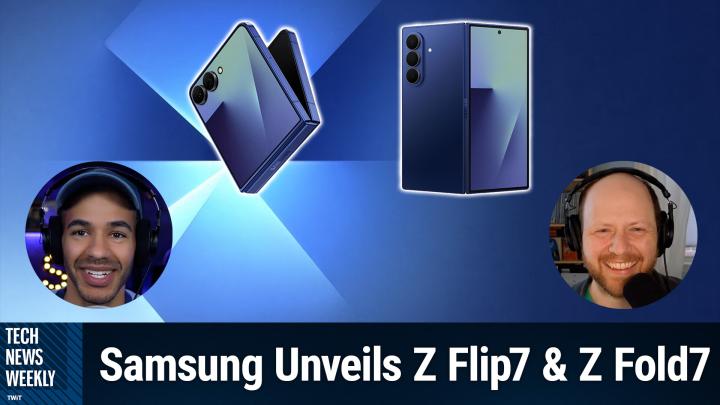
All TWiT.tv Shows (Audio)
Tech News Weekly 395: Galaxy Unpacked: Folds & Flips
00:58:26
Samsung Unveils the Z Flip7, Z Fold7, and Galaxy Watch8
Loading summary
Transcript72 lines
- [00:00]
Micah Sargent
Coming up on Tech News Weekly, Dan Moran joins me to talk about, well, rumors of an A18 Pro, MacBook and the iPhone 17 Air. Afterward, we talk about Samsung Galaxy unpacked. Yes, Samsung has held its event and there's a lot the company announced before Joe Supan of CNET stops by to talk about how AI is heading into the Internet to grab obituaries and make money money off of them. Before we round things out with the AI browser wars, OpenAI and Perplexity both working on an AI browser. Stay tuned for this episode of Tech News Weekly.
- [00:49]
Dan Morin
Podcasts you love from people you Trust. This is TWiT.
- [00:58]
Micah Sargent
This is Tech News Weekly, episode 395 with Dan Moran and me, Micah Sargent. Recorded Thursday, July 10, 2025. Galaxy Unpacked, folds and flips. Hello and welcome to Tech News Weekly, the show where every week we talk to and about the people making and breaking that tech news. I am your host, Micah Sargent, and I am joined this week by special guest host Dan Morin. Welcome to the show, Dan.
- [01:31]
Dan Morin
It's always a pleasure to be here, Micah. Thank you for having me on what is always, I assume, is special week. If I'm here.
- [01:36]
Micah Sargent
It is. It is indeed a special week if you are here because it is a week that is unlike a typical week and therefore it is special.
- [01:44]
Dan Morin
Ooh.
- [01:46]
Micah Sargent
For people who are tuning in for the first time, or for those of you who have forgotten since last week when we did the show, this is the time in the show where we share our stories of the week, things we've been reading about that we think are interesting that we want to share with all of you, and it starts off with you. Dan, tell us, what is your topic with me?
- [02:09]
Dan Morin
Well, let's talk rumors because I'm here and it's Apple rumor time. An interesting rumor that's been floating around the last week or two is the possibility that Apple will release a MacBook powered by the A18 Pro chip. Now, you're probably sitting there thinking, what's the big deal? But you also may be thinking, doesn't Apple power its Macs with M series chips? And you would be correct. The A18 Pro is. Is an iPhone chip. Dun, dun, dun, dun. Yeah, nobody saw that coming. So why might Apple decide that it wants to put an iPhone chip in a laptop? Well, there's a few possible reasons. One of which is, guess what? It's all about cost. And not just cost to folks like you and me who might want to buy said laptop, but cost to Apple for producing that laptop. Yes, let's be clear, that's the most important thing every time. How much will this cost Apple? The 18 Pro is the chip that is in the iPhone 16 Pro currently, and that is obviously one that they produce quite a few of, right? I mean, these, these iPhone chips get produced in huge scale and they are produced to be power efficient, they're produced to be cost efficient to a certain degree. And they have a lot of other benefits going for them. They're generally pretty good chips. I mean, anybody using an iPhone 16 Pro, which is the cutting edge, you know, for Apple iPhones at this point, you know, they're no slouch, obviously, but they still could be a little cheaper to produce than even the M1 chips that power the oldest Apple silicon Macs. And because Apple has started to move away from those M1 chips, right? I mean, those chips are five years old, right. The, the current generation is the M4 with the M5 expected to be on the way. And it's possible that Apple might want to phase out those M1 chips. You can still find those M1 MacBook Air is actually available at retailers like Walmart. Apple has been producing the older M1 MacBook Air at a lower cost, which is kind of interesting. And cost is not something that Apple tends to compete on. Right. You know, the base level MacBook Air, which is the cheapest Mac, you know, new quote, unquote, Mac starts at about $1,000. And they've been pretty consistent about hitting that 999 price point. But you know, the challenges are the competition. You know, there's a lot of Chromebooks out there that obviously go for a lot cheaper. There's a lot of PC laptops that go for a lot cheaper. And Apple's always been pretty content to seed that market. But the idea of releasing a computer powered by this A18 Pro iPhone chip might make it possible for them to target that sub $1,000 demographic. And obviously there are a lot of people who might be interested in such a thing. And there are a lot of markets where cost is the most important thing. I mean, I think particularly education is a great example where cost really drives decision making. And an A18 Pro powered MacBook might be something that's more compelling to large institutions, including education institutions. And there's a lot of people who just want the cheapest, you know, MacBook they can buy. And right now that's been again, $1,000, obviously a little bit less if you can find it on sale or if you're willing to go with that M1 Air the 18 Pro also in some cases would be as good as, if not better than the M1, which is again five years old. So there might be some trade offs to such a machine. It would likely support USB C, but not Thunderbolt. You know, there might be some other limitations in graphics performance or what have you, but generally it seems like it would be a pretty powerful device. Now we talked about scale a little bit before too, and I think that's an important part of this equation. Apple doesn't make nearly as many Macs as it does iPhones. Right? They sell millions upon millions of iPhones every single year. And so if you're producing something with a iPhone chip, you're producing that in very large quantities and therefore you have some cost benefits. Right, because the more you produce, the cheaper it often is per unit. So being able to move those chips into other devices such as a MacBook might produce some cost savings, especially if they want to, you know, ramp down the line producing that older M1. And it could have some benefits in terms of power efficiency. Obviously it's designed to be in a phone, right? So these things tend to be much more efficient. Not that the current Apple silicon level ones aren't already pretty efficient, but you know, adding in something that's designed to be in a phone might be even better, might make them lighter, you might be able to trade off for a little less battery capacity for efficiency. There's a lot of possibilities there with something like an A18 Pro powered MacBook. Obviously we don't know a lot about this product because this is all a rumor. And whether it would even be able to hit set a price point or whether Apple would still of course want to make a hefty profit on it? That will be remain to be seen. Yeah.
- [06:57]
Micah Sargent
Is there any precedent for Apple putting out a product that is lower powered and how the company goes about communicating it in such a way that it's not going going well. This is not as good as the other stuff that we have, but here is how it still is awesome. And does that make sense? Like what, how do we foresee Apple kind of selling this thing?
- [07:32]
Dan Morin
You know, it's not something they've done on the Mac recently. I think the best example to look at is something like the, the recent iPhone 16e and before it the SE line of iPhones. Those are phones that are explicitly designed to come in underneath the sort of base level cost of the quote unquote products that exist in those categories. So you know, if the iPhone 16 comes out, it'll Have a price point at what, like 8 ton, 800 bucks. So you can get an iPhone 16e, obviously for a bit cheaper. It comes with some trade offs, right? It's not as powerful, it has an older chip in, doesn't necessarily have all the bells and whistles, right, that a, that a brand new top of the line iPhone might have. And so that's something where they can kind of communicate. Look, this is something we're aiming at that's more potentially aimed at people for who you. The buying decision is not about how do I get the most power, how do I get the newest thing, how do I get the best thing. It's about how do I get the most affordable thing. And that's an important metric still. And it's not one that they've really taken with the MacBook or the Mac Wine at all. I mean the closest you have there is like the Mac Mini, which is also designed as a more affordable computer. But even that comes with trade offs, right? You got to buy a display or have a display, you got to buy your peripherals. So Apple has not really played that game a lot of times of like, hey, how can we make this a cheap product, right? Like there was that craze in the 2000s for netbooks, real cheap, small laptops, and Apple never really played in that, right? It made the MacBook Air, which was a very small, powerful laptop, but it wasn't cheap. And so I think it's interesting to see how Apple is going to potentially spin that. As you said, how do we tell the people this is a still a great Mac, right? It's still the best Mac that that amount of money can buy. And I think, you know, looking at Both the, the iPhone 16e and the Apple Watch SE, which is also sort of occupies a similar place, you can see kind of where they might make some trade offs. I think the, the base level iPad is a great example of that too, right? The $350 iPad, which is still a very, very competitive device, but it's a lot cheaper than going into say an iPad Air, which I think is over $500 now. So, you know, they, they do occasionally dip their toe there. It just hasn't traditionally been something they've done for the Mac. And I think they're realizing that potentially there's still a lot of upside for them to address an audience that they don't appeal to right now, or at least are appealing to in this very small subset by doing things like having that M1 air available through Walmart.
- [10:08]
Micah Sargent
Now that Is kind of one of the thin svelte options. Yeah, we're trying to figure out a.
- [10:17]
Dan Morin
Way to segue other thin svelte options.
- [10:23]
Micah Sargent
It's very easy to wedge it in because it's so thin.
- [10:26]
Dan Morin
I see what you're doing.
- [10:28]
Micah Sargent
So we've got, yes, the potential for a MacBook, and as always is the case with this tech stuff. We'll have to wait and see if it comes. But there's another rumor of another device that I hope you could tell us a little bit about and kind of where you like. How. How believable do you think this is?
- [10:49]
Dan Morin
This is the rum that there is a thinner iPhone coming with the iPhone 17 line this year. It has been sort of tentatively called the iPhone air because that's a word that apple really likes throwing on its products. And the sort of driving factor here is it seems to be a thinner iPhone than they've offered before. Now, where does this fit in the iPhone 17 lineup? Well, in the past, apple's experimented with trying different form factors for some of its other devices. Right. They're pretty set on the base level. IPhone 17, your iPhone, whatever number year it is, there's usually a pro version that is the same size, and then the pro version also has a max version, which is the same as the pro, but larger. Fine. In the past, we've had both the iPhone plus, then like the 16 plus this past year, which is the same as sort of that base level, iPhone 16, but larger. And if you go back a few years, we also had the iPhone mini, which was the same as the base level, but smaller. Neither of those seem to be huge sellers for apple. They've tried that a lot. But like, you know, playing around with the different screen sizes hasn't driven, I think, as many sales as they hope. So this year we're going to change a different dimension. Instead of making it bigger or smaller, we're going to make it thinner. With the hopes that people like thin, light phones. This will not necessarily be smaller. It will probably be. I think they said it's a little smaller than the plus model that we have this year, somewhere around 6.5 to 6.6 inches, which is bigger than the iPhone 17, 16, if you sort of assume those will continue in the same size but not as big as the larger one. Boy, you think this is going to simplify things and instead it's just more confusing. The other part that makes this a little confusing is that there's some theory that it may be more expensive than some of these base models. So and because it's thinner, it may have some trade offs in terms of what things it can have in it. Right. Like camera thickness. You know, it often makes a difference in terms of how many camera lenses you have or what kind of camera lenses you can have. Obviously it makes a difference in terms of battery life, in terms of how much battery you can fit in there. So it's unclear exactly what that's going to look like here and whether they're going to position it as kind of a fancier version of the iPhone that will compete more with the pro or whether it's just like, hey, you can get the base level iPhone, but you can get it thinner. So we don't. Again, we don't know. It is sort of speculated to be the thinnest iPhone that Apple has made for many years. Some people say it's thinner, maybe even than the iPhone 6, which is more than 10 years old. Obviously phones have changed a lot since then. You're scratching your head because you don't think the iPhone 6 is 10 years old.
- [13:32]
Micah Sargent
That just feels like a long time ago.
- [13:34]
Dan Morin
But also, it was a long time ago, Micah.
- [13:36]
Micah Sargent
It's an odd comparison, I guess, for me.
- [13:39]
Dan Morin
I think it's because it's the thing, thinnest iPhone that they had prior to sort of the modern era. They've, they've been getting thicker and thicker over the years as they've built up things like battery life to support all those additional features they've added. Right. Bigger screens, more vibrant screens, more cameras, you know, higher speed processors. All of that stuff means generally more thickness. But this is something where they're trying to really, I think, kind of see how small can they get it. And you know, going back to something like the iPhone 6, which I think was, I don't remember how big it was. 5, 6 millimeters. You know, those are much 6.9, 6.9 millimeters with the iPhone 6. The current 16 pros are about 8.25 millimeters. So we're talking, you know, millimeters obviously may seem very small, but percentage wise, you're talking a pretty big percent change from the sort of current level of thickness among these phones. Now, if that's enough to draw people in, that's unclear. Right. Like, is it going to be. Are people going to be willing to take the trade off? But like a lot of time, physical changes in the cases are something that draw drive adoption. Because people want something that looks new. Yes. So that's an advantage for Apple here. Yeah, they want something that looks different. They Want something that looks new and if it really has a compelling look to it that, you know, looks very different from what they're offering in sort of the standard models, different colors or different finishes or something like that. You know, it might be something that really peps up the, the iPhone line sales because it will convince people to upgrade.
- [15:10]
Micah Sargent
That makes sense as far as that goes. I mean, I. There's so much conversation around like whether there's a true shelf life for like foldable devices and what Apple would do there. And it's interesting to see where the company is, you know, reportedly going in spite of in some cases what the market might suggest. But also I think for Apple itself, what Apple's own market seems to desire. And I think there's always kind of a balancing act there and a bit of a bit of a game which I think is where it's helpful that Apple has kind of broken out this other phone that comes later kind of situation.
- [16:00]
Dan Morin
The other phone.
- [16:01]
Joe Supan
Yeah, yeah.
- [16:02]
Micah Sargent
Also we've got this.
- [16:04]
Dan Morin
Yeah. I don't know, I do sit there thinking maybe four phones is just too many.
- [16:09]
Micah Sargent
Like, I don't know, like a lot.
- [16:11]
Dan Morin
I, it's. I understand the idea of trying to cover all your angles right. And try to find, make something for everybody, but there is a point at which maybe you've made too many phones. Yeah.
- [16:23]
Micah Sargent
Yeah. All right, we need to take a quick break before we come back with my story of the week. I want to tell you about Acronis, who are bringing you this episode of Tech News Weekly. Acronis and the Acronis Threat Research Unit. You deserve fewer headaches in your life. Tell me about it. Even something as simple as watching TV can become a headache. When your favorite shows are scattered across different streaming services, it's nearly impossible to find one place that has everything you need. Well, Acronis takes the headache out of cybersecurity with a natively integrated platform that offers comprehensive cyber protection in a single console. And if you want to know what's happening in cybersecurity, the Acronis Threat research unit, or TRU, is the place to go. It's your one stop source for cybersecurity research. TRU also helps MSPs stop threats before they can damage you or your client's organization. Acronis Threat Research Unit is a dedicated unit composed of experienced cybersecurity experts. The team includes cross functional experts in cybersecurity, AI and threat intelligence. TRUE conducts deep intelligence driven research into emerging cyber threats, proactively manages cyber risks and responds to incidents and provides security best practices to assist IT teams in building robust security frameworks. They also offer threat intelligence reports, custom security recommendations, and educational workshops. Whether you're an MSP looking to protect clients or you need to safeguard data in your own organization, Acronis has what you need. It's all there in Acronis Cyber Protect Cloud, edr, xdr, Remote monitoring and Management, Managed detection and Response, email security, Microsoft 365 security, and even security awareness training. And it's all available in a single platform with a single point of control for everything, so it's easy to deploy and manage. If managing cybersecurity gives you a headache, it's time to check out Acronis. Know what's going on in the cybersecurity world by visiting go.acronis.com TWIT and take the headache out of cybersecurity. That's go.acronis.com twit and of course, we thank Acronis for sponsoring this week's episode of Tech News Weekly. All right, back from the break and yes, if you didn't know, Samsung just held its Galaxy or holding its Galaxy Unpacked event and Samsung introduced a full refresh of we just talked about a foldable phones and smartwatches. To be clear, smartwatches not foldable, just the phones are foldable with slimmer designs, brighter displays and a deeper infusion of Gemini AI leading the charge. The Galaxy Z Fold seven. The Z Flip seven, joined by a budget friendly Flip seven FE and two new Galaxy watches. But the biggest trend from this event wasn't hardware, it was how AI is being used to reshape the way these devices feel, respond and even look. Starting with a Galaxy Z Fold 7. It's thinner, it's lighter, and no, it doesn't have an S pen. It's Samsung's thinnest and lightest foldable to date at 8.9 millimeters. Folded weighs just 215 grams. It did drop the S pen support in order to slim down the design, so in order to make this screen thinner, removing that digitizer that makes for the thinner build. It uses a titanium frame with the new flex hinge for better durability and a less visible crease. And the display size has actually been bumped up to 8 inches. Internal upgrades include a Snapdragon 8 Elite chip and a much bigger battery. The camera system is led by a2 this is always so wild to me. 200 megapixel main sensor and updated selfie cams. They're no longer under the display and it starts at about $2,000. It comes with Android 16 out of the box and is shipping soon. In the CNET piece, they said part of the reason the new foldable is so slim is that the company was free to remove that digitizer that was needed to process stylus inputs. Now, I had hoped to have someone on the show to talk about Samsung Galaxy unpacked when I reached out to to people and everybody was there at the event or I had one person who was stuck at airports with storms after the event. So it was rough to do that. So that's why I'm giving you a nice little summary here. There was also the Galaxy Z Flip 7, which is bigger inside and brighter outside. The flex window, now stretches edge to edge. You've got thinner bezels and the brightness gets up to 2,600 nits. And the internal screen is 6.9 inches and has better water resistance as well with a 50 megapixel main camera, 10 bit HDR processing built in. Galaxy AI features including something called the now bar and the now brief, which can give you kind of up to the date, up to the moment, information about, you know, your calendar and all that kind of stuff. And it starts at eleven hundred dollars. And then there's the Z Flip 7 FE, which is a foldable for the rest of us, a budget take on the Flip six. It's got trimmed down specs, it's got Galaxy AI, don't you worry, or Gemini in this case, and comes with the Exynos 2400 chip. Smaller battery, fewer display flourishes, and you can only get it in white or black, but it's $900, so that makes it incredibly affordable in comparison. And then I want to mention real quick the Galaxy Watch 8 and Watch 8 classic. Thinner design, squircle shape, brighter AMOLED display with 3000 nits of brightness, bigger batteries. And it has this feature that's kind of interesting. It's called an antioxidant measurer. Uses the watch sensor pressed against your thumb to kind of give you insight allegedly into what you might need for antioxidants. So, you know, getting rid of those free radicals. And the Watch 8 Classic brings back the rotating bezel, available in 46 millimeters only. So. So let's talk a little bit about these devices. One thing that I've found interesting in the watch lineup in particular is how companies are because we've kind of laid the foundation right? You've got a watch that gives you notifications and then also tracks your basic Health metrics. So how do you make things that are new and stand out? It seems like features like the antioxidant measurement are perhaps something to make it stand out. The usefulness of that, I don't know. But yeah, I mean, what are you, what do you think? Do you, do you wish that the Apple watch had a, had a rotating face on it and a, an antioxidant measure?
- [23:57]
Dan Morin
I'm still stuck on the antioxidant measures. Like, I got too many oxidants. That's always my problem. We got to get some antioxidants in there. Yeah, I don't know. There's always a question, especially as they add more of these sensors, like how, how useful are they? Right. I mean, we have seen stuff like blood oxygen, for example, is a, you know, was it useful? It has its applications. There are some questions about reliability. Right. And whenever you have questions about reliability related to health and wellness features, you really start to ask some deeper questions about whether or not those things are useful if they're not reliable. And I think you've seen a bit of a topping out when it comes to people wanting to do things that are potentially more helpful from a health perspective but are a lot harder, like glucose or blood pressure. Like, those are hard problems to solve when you're dealing with a watch. And in the meantime, if we can find a way to, you know, measure antioxidants by putting your thumb against it, how many people are going to take their watch off every day to check the antioxidants by putting the thumb against it? Right.
- [24:56]
Micah Sargent
Yeah.
- [24:56]
Dan Morin
And I don't find that particularly plausible. That's, that's my feeling as far as some of the other stuff goes. I don't know a rotating. I know I remember when, like, you know, actual watches had like the rotating.
- [25:10]
Micah Sargent
I love a little fidget on my wrist.
- [25:11]
Dan Morin
Yeah, it's good. That's. And that's a great fidget, like spinner thing. But I just don't. I'm not sure how you useful that is with a digital. What like in analog watches, it used to mean something because you would like, you can kind of do time zones tracking by like, okay, I'm going to set the offset sort of here, but I'm not sure on a digital watch what that is for. So I think the arms race for smartwatches has gotten a lot harder just because it does feel like there are fewer things to add from sort of a hardware feature perspective. It's amazing all the stuff that's already been crammed in there Considering, you know, we're talking about something the size of a watch, obviously, and they have these incredibly complex, you know, systems on chips inside of them and all this functionality that's packed in there. But at a certain point I feel like we've hit a diminishing returns thing where every year it doesn't feel like, hey, we gotta, we gotta announce a new feature, we gotta have a new thing on our watch. And the answer is let's cram this sensor in there and maybe people want it.
- [26:11]
Micah Sargent
Yeah, yeah, that. And that's what it's feeling like. And it's trying to find sensor options that aren't going to get you sued and have the feature removed. Yeah, yeah, no, no. I've never heard anyone who has a patent on antioxidant detection. So good work there. I do think that I've, I've heard from the everyday people who are maybe not as techy who seem really enamored of the idea of a. Not with the watch, but with the foldable mindset and kind of going back in some ways to that flip and fold and all that jazz. I remain skeptical in the sense of if there's this potential for the display to end up having a crease in it and it doesn't last as long as one would hope, that doesn't seem worth it. And I'm also sort of, I put off by the idea that when I fold it in half it's two times as thick as it was when I already. Yeah, it doesn't solve.
- [27:21]
Dan Morin
I am laughing a little bit. Also these pictures of the, the Z Flip 7 and the Flip FE. Because those little displays on the outside with a little like widgets on them could not look more Apple like. I'm sorry, they are very, very Apple Apple. Like, you know, it's fine, whatever. I think I, I think you're right. I don't know. The, the. It seems to me that the ones that fold like, like old school style, right? Like our old flip phones used to be where they fold open like top to bottom. I don't see the utility in that one. That one strikes me as kind of strange because you have this little like widgety screen on the outside and then you flip it open and it's like a normal phone on the inside, but as you pointed out, it's twice as large and thick. It's like a big, big thick wallet you're carrying around with you. The ones that fold sort of side like book like I think are, are more interesting if only because the idea that Sometimes you might want something that has a larger screen. Like, oh, you know what? I'm watching video, I'm on the plane. Like, isn't it cool that I can flip this open and watch on a larger screen? But I think one of the things that's held that back on the Android side has been the Android tablet interface. Like, a lot of apps are not designed because Android doesn't have a huge tablet market. Like, a lot of the, you know, apps are not designed for tablet sizes. So I think that's, that's held that back a little bit. The hardware might be there, but the, the software isn't ready to quite support it. And to your point, depending on how visible that crease is, you know, it may or may not impact the utility of that larger screen. And again, how thin can you get it? This is one of the rumors about that iPhone 17 Air we discussed earlier in the show is that by making your base phone thinner, if you slap two of them together to get a foldable, it might be more, more palatable when you fold it together. So it's interesting and they keep pushing it forward. But yeah, I think right now it's still perhaps more of a solution. In search of a problem.
- [29:23]
Micah Sargent
Absolutely. Well, there was one other announcement that Samsung made that kind of stuck out, which is that Samsung Wallet has added buy now, pay later support. We've seen that kind of hit the swath of, of the the Wallet era or Wallet section in terms of Apple adding buy now, pay later options. And now Samsung joins the fold, as it were. I see what you did there, Dan. I want to thank you so much for taking the time to join me today on the show. If people would like to keep up with what you're doing, where's a good place for them to go to do that?
- [30:02]
Dan Morin
Well, if you'd like to read what I'm writing about tech, you can go over6colors.com where I cover all things Apple with my pal Jason Snell. I'm also on a bunch of podcasts, including Clockwise every week with Micah over on Relay FM and the Rebound, which you can find@reboundcast.com I'm also a science fiction author. If you want to find my books, as well as everything else I do, you can go to dmorin.com wonderful.
- [30:24]
Micah Sargent
Thank you, Dan.
- [30:25]
Dan Morin
Thanks, Micah. Bye.
- [30:27]
Joe Supan
Bye.
- [30:27]
Dan Morin
Bye.
- [30:28]
Micah Sargent
All right, we've got an interview coming up, but I want to take a quick break here to tell you about US Cloud. Bringing you this episode of Tech News Weekly. US Cloud is the number one Microsoft Unified Support replacement Now we have been talking for a few months now about US Cloud, the global leader in third party Microsoft support for enterprises now supporting 50 of the Fortune 500. Switching to US Cloud can save your business 30 to 50% over Microsoft Unified and Premier support. And it's faster. Two times faster. Average time to resolution versus Microsoft but now US Cloud is excited to tell you about a new offering. It's Azure Cost Optimization Services. So be honest, when was the last time you evaluated your Azure usage? If it's been a while, you probably have some Azure sprawl a little spend creep going on. But the good news is saving on Azure is easier than you think with US Cloud. US Cloud offers an eight week Azure engagement powered by VBox that identifies key opportunities to reduce costs across your entire Azure environment. With expert guidance, you're going to get access to US cloud senior engineers with an average of more than 16 years with Microsoft products. At the end of those eight weeks, your interactive dashboard will identify rebuild downscale opportunities and unused resources, allowing you to reallocate your precious IT dollars towards actually needed resources. Or invest your Azure savings in US Cloud's Microsoft support like a few of US Cloud's other customers and completely eliminate your unified spend. Sam, the technical operations manager at Bead Gaming gives us Cloud 5 stars, saying quote, we found some things that had been running for three years which no one was checking. These VMs were, I don't know, 10 grand a month. Not a massive chunk in the grand scheme of how much we spend on Azure. But once we got to 40k or 50k a month, it really started to add up. It's simple. Stop overpaying for Azure, identify and eliminate Azure creep and boost your performance all in eight weeks with USCloud. Visit uscloud.com and book a call today to find out how much your team can save. That's uscloud.com to book a call today and get faster Microsoft support for less. Thank you US Cloud for sponsoring this week's episode of Tech News Weekly. All right, we are back from the break and I am joined by Joe Supan of CNET who joins us to talk about, I think honestly when I reached out I find it to be a rather harrowing tale and so thank you for being here on the show today.
- [33:16]
Joe Supan
Yeah, I'm happy to be here. Thanks for having me.
- [33:18]
Micah Sargent
Absolutely. So let's kick things off you in your piece, kind of open with an example of a chatbot impersonating, in a way, the story of a deceased loved one using information scraped from an obituary. Could you tell our listeners a little bit about what happened here?
- [33:37]
Joe Supan
Yeah, so last year, my sister passed away, and she passed away early in the morning. And later that day, like that afternoon, my mom got a text from our aunt saying that she saw this obituary page appear. That was kind of weird. Seemed to have a lot of false information in it. So we. As soon as we got that text, we looked at it. And then I Googled my sister's name just to see if there was any other things out there. And like. Like right away, even just hours after she'd passed away, there were already four or five obituaries that we had no knowledge of that were right at the top of Google's search results. So they had really. I don't know, this process had happened just, like, really quickly, before we could even kind of wrap our heads around it.
- [34:31]
Micah Sargent
Yeah. So to be clear, this happened and no one in the family had written an obituary and passed it off to anyone, and it just simply, like, appeared out of nowhere?
- [34:50]
Joe Supan
Yeah, no, we had nothing to do with it. I mean, we were just reeling. It was the same day. And, yeah, writing this article, I learned that is just how this works. Like, when they're. These AI botnets will detect, like, a flood of words, like passed away or something like that, and the pages will just be created generally automatically. I mean, sometimes they have some human interference, but they really just kind of kick into gear. And if there's enough people talking about it, there will be more pages that are created it.
- [35:27]
Micah Sargent
Wow. So, of course, we know that many obituaries, when time is taken, are written with love and care, often by grieving family members. I kind of wanted to talk to you about your and perhaps your family's reaction to arguably the ethical issues that arise when AI models harvest this kind of deeply personal content. And as you talked about, get it wrong in so many ways. And I mean, something that really stuck with me in reading your piece was kind of like, this term gets used a lot, but there was almost a sense of, like, this gaslighting aspect of you even maybe going well. I guess that sort of makes sense, but that's really not how she. You know, like, it just seemed like a lot to process all at once.
- [36:25]
Joe Supan
Yeah, totally. And gaslighting is a good word for it. I hadn't thought about it like that, but that is what it feels like, because it is. I'm sure a lot of people who have had these, Seen these obituaries probably feel this, but it's like there are such personal details embedded in them because they are taken from these really sincere posts on social media. So it will get some things, like, eerily correct, but then other things will just be like, so off base and offensively off base in a lot of ways. Like if my, in my sister's obituary, they were saying, like, she died of autism and like she had all these health issues. And a lot of times when I was like, looking at these things, they, they would, like, they would really allude to kind of like a tragic cause of death or something. So I can imagine for many families it's like, wait, that's, that's, that's not what happened. I think people feel a lot of like, anger and, and hurt in those moments.
- [37:24]
Micah Sargent
Absolutely. And that anger and hurt, I think is one of the, the main aspects of why I wanted to talk to you about this because I was curious in doing, you know, in, in, in going through this and experiencing this, but then taking it and channeling it into a piece where you kind of share, hey, you're not alone if this has happened to you. But also be on the lookout for this. You know, we've, there's a, there's a challenge that pops up in the first place that if the family or whomever actually does write an obituary, these are often published and posted online with good reason so that people can learn about what happened and can, you know, share condolences. And the second that that's posted publicly, then it's out there and then the AI bots come in and I mean, do we know, did you, were you able to find anything that people can do to protect this information from being scraped? Because it sounds like even if, as you mentioned, even if you didn't post something, you didn't share an obituary online, yet somehow these bots are still gaining access to this information and posting it online.
- [38:37]
Joe Supan
Yeah, I think it's like, like, like by the time you've written the obituary, it's like too late. Once your obit, once the legitimate obituary is out there, it's like that will, that will appear on Google's results first. But that usually happens a couple, two, three days after someone passes away. So it's really that gap, like those first few days, that's where the, these bots are capitalizing. So like they're, they're just scraping social media comments basically. Like it's not, they're not formal obituaries. As far as what, what people can do to protect themselves from that, I don't know that there is anything they can do to stop their Their posts from being scraped. I would just say, like, the more you can report it when you see it to, like, Google, Facebook, wherever it's appearing, I think that will, like, lessen the reach of these kind of pages.
- [39:41]
Micah Sargent
Understood. Now you talk a little bit about some of the. Because people might be wondering why what is gained by posting these sites and these different, you know, obituaries. Can you talk about the motivation behind it? And a little bit, I think, about copyright rules as it pertains to this, which I found kind of surprising, I guess.
- [40:14]
Joe Supan
Yeah, yeah. The why I think is it's really just. It's ad sales. It's just getting. One click will add up to like a penny or two. And if you do it at volume, you will make some money. And I. I don't think it's very much. I think this is often happening in. In other. In countries. Like, one guy I talked to who runs a bunch of these pages was in Nigeria, and he said he makes about a hundred dollars a week on this. So it's not, like, crazy lucrative. They don't need to get a ton of views on these pages to make it worth it. It's just like, there's such a low bar for entry to create them that they can just do it at a huge scale. And in terms of the, like, copyright laws, it's. It. It's kind of. It's a. I mean, it's complicated. But basically what a lawyer I talked to told me is that a deceased person has a lot fewer rights than a living person when it comes to things like defamation or copyright. So it would be very hard to pursue legal action against any of these websites.
- [41:34]
Micah Sargent
You did mention, I think you talked a little bit about it, Google and Facebook making some changes to mitigate the issue. Maybe you could talk about that process. But also, are there any pro. Have you heard from any of the companies that are doing this, or I guess the smaller sites that are doing this about steps they're taking to prevent the inaccurate information from being published? Or is it really just a matter of kind of a wild west situation?
- [42:06]
Joe Supan
Yeah, you took the words right out of my mouth. It is a wild west situation. Like, these websites that are publishing these things are so small and like, they. They come and go so much. Like, even when I was tracking this over just a few weeks, and it was like one that I would see every day, that would be posting all the time, all of a sudden it wouldn't be there. And I mean, I think I counted about 25 of them just when I Was. Was looking at this, but I got the feeling that, you know, it is probably much larger than that. So I don't think these sites really have any kind of, like, responsibility to standards or inaccurate information. I think the responsibility really lies with the. The platforms that people are finding them on, namely Google and Facebook. And both of those companies told me that, like, yeah, they're getting better at detecting this stuff. Like, I sent them these examples, and they were like, we've taken those down. But as far as I could tell, like, I continued to check after they told me that, and it was like, yep, this process happens every single day. And it's. It's still showing up on those platforms.
- [43:23]
Micah Sargent
Wow. I want to kind of pull it back just because there's. There's a lot of conversation right now with AI in particular and its scraping of the Internet. You know, do you feel this is exemplary of the criticism surrounding AI bots scraping the web and perhaps when it comes in, particularly to these emotionally sensitive areas of the web and how. How it's being used in this way?
- [44:05]
Joe Supan
Yeah, I think it's, you know, it's. It's a small corner of this phenomenon, and I think most people I've talked to about this story had. Had no idea that this. This was happening. But it. I. I think it's like an evocative example of how, like, something really personal can be taken from you and used for harm, even though it might not be intentional. I mean, they're ultimately just trying to make money. But, yeah, it's. It just shows us. I don't know what. What can happen when so much of our lives are online and when there's. There are no guardrails about how that information can be used.
- [44:49]
Micah Sargent
Absolutely. Joe, I want to thank you so much for taking the time a. To write this piece to do this research, but also for joining us. If people would like to kind of keep up with the work that you're doing, are there places they should go to stay up to date?
- [45:06]
Joe Supan
Yeah, just cnet.com. yeah, you can check. I generally write about Internet, so you can check out all my work on there.
- [45:13]
Micah Sargent
Awesome. Thank you so much. We appreciate it.
- [45:16]
Joe Supan
Yeah, thanks for having me. Bye.
- [45:17]
Micah Sargent
All right, have a good day.
- [45:18]
Ryan Seacrest
This episode brought to you by Red Canary. When cybersecurity threats hit fast, you need an MDR partner that moves faster. Red Canary delivers 24. 7 expert MDR support, total visibility, and actionable insights. Plus, it helps you detect four times more threats so you can stay ahead without burning out. Red Canary clears the noise and has your back every hour, every incident. Get the backup you deserve. Visit redcanary.com Dirty Difference to learn more.
- [45:48]
Jana Kramer
Hey, it's Ryan Seacrest for Albertsons and safeway. Now through July 15th. Stock up on all your favorite personal care brands and earn four times points to use on later purchases for discounts on groceries or gas. Shop in store or online for items like Pantene Shampoo, Old Spice, Total Body Deodorant, Tampax Pearl Venus Razors, Head and Shoulder Shampoo, Olay Body Wash and Pantene conditioner, and earn 4 times points. Hurry before these deals are gone. Offer ends July 15th. Restrictions apply. Offers may vary. Visit albertsons or safeway.com for more details.
- [46:18]
Gilead
Honestly, Honestly, no one wants to think about hiv, but there are things that everyone can do to help prevent it. Things like prep. PREP stands for Pre Exposure Prophylaxis, and it means routinely taking prescription medicine before you're exposed to HIV to help reduce your chances of getting it. Prep can be about 99% effective when taken as prescribed. It doesn't protect against other STIs, though, so be sure to use condoms and other healthy sex practices. Ask a healthcare provider about all your prevention Options and visit FindOutAboutPrep to learn more.
- [46:47]
Micah Sargent
Sponsored by Gilead Alrighty folks, we are going to move along now to my next story that I want to tell you about. And this is this is really interesting because we have just heard about Perplexity working on a browser offering, and apparently there's another company working on a browser offering. The AI search wars are moving from the results page to your desktop. Perplexity has launched an AI first browser called Comet, which integrates its assistant across every part of the browsing experience. Meanwhile, OpenAI is reportedly working on a chromium based browser of its own, a move that would put it in direct competition with Google Chrome, Microsoft Edge, and to some extent Apple's Safari. Both companies are betting on a future where your browser doesn't just display websites, it reads, interprets, summarizes and acts on them for you. So let's start by talking about Perplexity's Comet. Because it's actually announced and real, it's the AI browser that wants to do it all. Comet replaces the traditional address bar with an AI chat box that is powered by Perplexity's assistant. So with that you're able to search the web, you can summarize articles or other content, you can draft emails using it, you can manage your calendar, and you can navigate sites automatically. According to Perplexity CEO, it's to create a browser that functions more like an operating system than a passive viewer. The CEO said this is our bet on building an os. Now, now this I find interesting in and of itself because we have seen to a certain extent companies attempt to integrate better with the operating systems that we have. So of course on Microsoft's side you have Windows, on Apple's side you have macOS. And we've seen, you know, ChatGPT app, we've seen some of these others create apps to try to integrate. But it's come down to those platforms being, I think, a little more locked down. In the case of Microsoft with it having its own, its own AI system. With Copilot so deeply integrated, it's hard to compete in that space and to get into that space. But I think for many of us, we do spend a lot of our time in the browser and that is a more open area for these companies to hop in and sort of latch on with their, with their tech. So where you have that block of getting to the base system level, if people are mostly using their browsers and you can just give them a browser that they can use, it is in some ways equivalent to building an operating system. And I think in that way it's a very clever means of gaining access to more of the user's information and data. For the sake of being able to give these features, users are prompted to connect their Google accounts, which will allow the assistant to read Gmail and Google Calendar and in doing so it can act on those and provide, you know, changes to your calendar or give you you summaries of your upcoming day. Now, according to Reuters, Reuters, Crystal Hu, Anna Tong and Kenrik Kai, OpenAI is reportedly working on a browser designed to showcase and deploy AI agents. Like its operator, these agents could perform tasks on behalf of users. So booking, travel, filling forms, summarizing articles directly within the browser. And like Comet, the browser will reportedly be built atop Chromium and expected to integrate tightly with ChatGPT and OpenAI's ecosystem. The browser will leverage OpenAI's agent like AI model and perform those features on behalf of the user. Now, according to this piece, OpenAI has reportedly hired several engineers who originally helped build Google Chrome. So you can imagine that in this way it is a much, much better created and better integrated system. We've seen a few other companies out there try to create browsers that just can't compete against Chrome in particular, but to a lesser extent, some of the other browser offerings like Safari and Microsoft's.
- [51:51]
Jana Kramer
Own Edge, hey, it's Ryan Seacrest for Albertsons and Safeway now. July 15th stock up on all your favorite personal care brands and earn four Times points to use on later purchases for discounts on groceries or gas. Shop in store or online for items like Pantene Shampoo, Old Spice, Total Body Deodorant, Tampax Pearl, Venus Razors, Head and Shoulders Shampoo, Olay Body Wash and Pantene conditioner and earn 4 times points. Hurry before these deals are gone. Offer ends July 15th. Restrictions apply. Offers may vary. Visit albertsons or safeway.com for more detail.
- [52:22]
Unknown
This is Jana Kramer from Wind down with Jana Kramer. I love my Samsung appliances, especially because they're so reliable and with my busy schedule, having reliable appliances has been a game changer. It's no wonder Samsung is the number one brand for customer satisfaction. That's why I'm excited to tell you all about Samsung's new line of smart appliances featuring their brand new Bespoke AI Laundry combo. This incredible magic machine washes and dries in one machine, one load. No transfers, no timers, no rewashing needed. You just toss in your dirty clothes and they go from dirty to dry in as little as 68 minutes. It simplifies your entire laundry routine. Plus you can remotely schedule cycles from your phone so you have fresh clothes ready when you are. New Bespoke AI appliances this is home living made simple. For more information visit samsung.com bespoke 68.
- [53:13]
Micah Sargent
Minute cycle based on 27 inch combos based on using a super speed cycle only with a 10 pound doe load cotton 50% plus polyester 50%. Individual results may vary based on actual load content. SmartThings app available on Android and iOS devices devices wi FI connection and Samsung Account required Honestly, Honestly, Honestly, no one.
- [53:29]
Gilead
Wants to think about hiv, but there are things that everyone can do to help prevent it. Things like prep. PREP stands for Pre Exposure Prophylaxis and it means routinely taking prescription medicine before you're exposed to hiv to help reduce your chances of getting it. Prep can be about 99% effective when taken as prescribed. It doesn't protect against other STIs though, so be sure to use condoms and other healthy sex practices. Ask a healthcare provider about all your prevention Options and visit findoutaboutprep.com to learn more.
- [53:55]
Micah Sargent
Sponsored by Gilead Both companies seem to be trying to displace Google as the default way people access information. Many of us I not myself, I use Safari, but many of us use Google Chrome as the as their web browser of choice. And what's Interesting is the way that these browsers are going to kind of work on search instead of indexing and ranking pages. These browsers aim to interpret and act on content directly, positioning the AI as the interface and not just the tool. By controlling the browser, OpenAI and perplexity could collect. And this is the big thing, richer behavioral data and more tightly integrate AI into everyday tasks. So there's the concern, right, that in, in creating these browsers and getting more behavioral data, if that's used for training, that's a little bit more information than perhaps we've given these companies in the past as they have worked on bringing AI to us and AI tools to us. It wants to challenge Google's dominance, but also I think take a little bit of a playbook out or a page out of Google's playbook, which is to provide access to, to information so that you can learn what people are interested in and how they go about doing it. Comets deep access to user data, having access to Gmail, to Google Calendar APIs that may set a precedent for how these other AI browsers will work. It makes sense. We've seen to a certain extent Amazon do this with its digital assistant. Not as AI as it could be, but still having access to our calendars for the sake of being able to tell us about what is going on. And of course OpenAI hasn't yet revealed, given that this browser is still just rumored to be coming out, it's data collection practices for the browser. But that of course has already come up with comet AI first. Browsers are kind of a fundamental shift where you don't just have the tab that has the AI system in it and you access it that way, but instead working as the viewport into the vast Internet. Right. And we know that Google is increasingly under pressure, not just from competing search tools, but from rivals who at this point are saying, don't use Google search, we can help you find things better. We've got a better means of searching the web and providing you information. Not to mention, Google also is under the spotlight of many a regulator. And in that way, needing to allow for competition in the space is something that Google is having to bear in mind. So whether users are going to hand over more control to AI assistance, especially ones that are fully embedded into the browser, that seems to be the next place we'll be looking. As these new browsers hit and people give them a go and see if there's an improvement. When the AI agent is more deeply integrated into what you're doing, it's something that I've wanted from Apple in particular for a while, something that I think has been for the most part a success on Microsoft's front. When you have that deeper integration and you're not having to do the heavy, heavy lifting of bringing the context with you to an AI chatbot and saying, okay, here's exactly what I'm dealing with. Here's what it looks like, here's what I want to do. That gets complicated if it can see see what you're doing and let you interact by simply asking a question instead of having to provide all that context. It's already a much more powerful system, so it's perhaps a win win with the understanding that more data may be shared with these companies than we've given them in the past. So Comet available OpenAI's browser perhaps coming soon that is going to bring us to the end of this episode of Tech News Weekly. Weekly. The show publishes every Thursday at Twitter TV tnw. That is where you can go to subscribe to the show in audio and video formats. If you'd like to get all of our shows ad free, just the content, well, we've got a way for you to do that. It's called Club Twit. That's what TV Club Twit. When you join the club, we love to have you as part of the club. We've got monthly and yearly plans. And when you join, you gain access to all of our shows, all of our content ad free. You gain access to our Twit plus feeds. There's the Twit plus News Events feed. So that's going to have our coverage of different tech news events that take place, like WWDC for example, bits and clips so behind the scenes, before the show, after the show stuff will be there. And the third feed, which is a feed of our our club Twitch show like Micah's Crafting Corner, that's me and some of our other great shows, book clubs, etc. That are available in the club. With that you also get a little key that you can unlock our discord. It's a fun place to go to chat with your fellow Club Twit members and those of us here at Twit and we would love to see you there. Every time someone new joins, they are sort of shown on the welcome page and I love going in there and going, oh my goodness, look. Oh, ooh ooh. So more and more of you are joining. We love that. Thank you for being a member of Club Twit. And yeah, Twitter TV Club Twitter. If you're not yet one. If you would like to follow me online, I'm at Micah Sargent on many a social media network where you can head to Chihuahua Coffee that's C H I H U A H U a Coffee, where I've got links to the places I'm most active online. Be sure to check out my other shows, which some of them will publish today, iOS today and hands On Apple published today and every Sunday. You can check out Hands On Tech as well. Thank you so much for being here and I'll catch you again next week for another episode of Tech News Weekly. Bye Bye.
- [60:37]
Ryan Seacrest
From Silicon Valley boardrooms to tomorrow's AI breakthroughs, if you need to keep up to date with tech, you need TWiT TV. At TWiT, we are tech experts who understand what's happening and can keep you in the loop. And we do it in a thoughtful, informed and fun way. Start your Sundays with this Week in Tech, a roundtable of tech journalists and people in the know with a rundown of the week's most important tech news. But that's not all. All week long you can stay ahead of Security Threats with Steve Gibson and Security Now. Keep up on all things Apple with MacBreak Weekly. Listen to the most informed Microsoft experts in the world with Paul Thurrod and Richard Campbell on Windows Weekly. Our flagship shows feature tech's most respected voices, giving you the insight you need to understand and benefit from the changing world of technology. We give you analysis you won't find anywhere else so you can make smarter business decisions and take advantage of the technologies transforming your world. Whether you're a CEO, IT professional, professional, or simply passionate about technology, TWiT's network of shows gives you the edge you need in today's digital landscape. Don't miss a minute. Subscribe to TWiT TV today.