← All TWiT.tv Shows (Audio)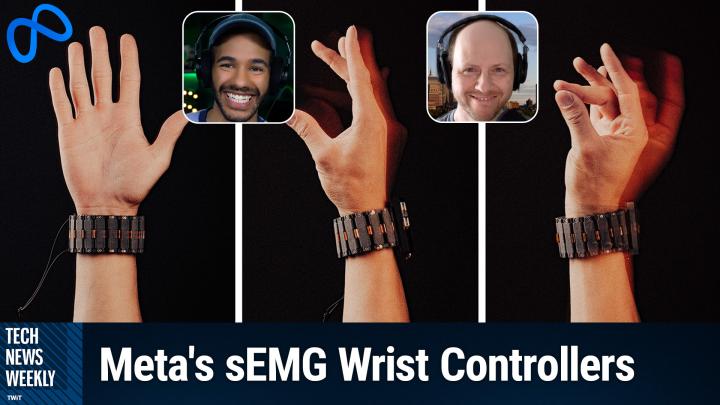
All TWiT.tv Shows (Audio)
Tech News Weekly 397: Meta's New Muscle-Reading Wristband
01:09:36
Meta's Prototype Wrist-Based Controllers
Loading summary
Transcript96 lines
- [00:00]
Micah Sargent
Coming up on Tech News Weekly, we kick off the show by talking about that Microsoft SharePoint vulnerability. Then Jeff Carlson of CNET stops by to talk about using satellite texting from T Mobile. Afterward, Dan Moran of Six Colors joins us to talk about AppleCare One, the subscription service and the public betas which just launched. Before I round things out with a conversation about being able to control our devices with impulses sent from our mind, stay tuned for this episode of Tech News Weekly. Podcasts you love from people you Trust.
- [00:40]
TWiT
This is TWiT.
- [00:45]
Micah Sargent
This is Tech News Weekly, episode 397 with Dan Moran and me, Micah Sargent. Recorded Thursday, July 24, 2025. Meta's new muscle reading wristband hello and welcome to Tech News Weekly, the show where every week we talk to and about the people making and breaking that tech news. I am your host Micah Sargent and we will be joined later today in the show by my guest host this week who is Dan Morin of Six Colors. Before we get there though, I have an interview coming up and before that I've got an alert, a warning, the cautionary tale and everything in between. So let's kick off the show by talking about security vulnerabilities. A critical security vulnerability in Microsoft SharePoint has rapidly escalated from a concerning discovery to a full blown cybersecurity crisis because hundreds of organizations worldwide have fallen victim to what researchers are calling actually one of the most significant zero day exploits in recent memory. The breach has compromised sensitive government agencies, including, you know, no big deal, the National Nuclear Security Administration and the National Institutes of Health, while security researchers warn that the scope continues to expand daily. What makes this particularly alarming is that Microsoft had no advance warning to patch the vulnerability before hackers began exploiting it, leaving thousands of organizations defensively scrambling against an attack that was already underway. So let's talk about this vulnerability kind of what, what we need to understand about how this happened. So it affects self hosted versions of Microsoft SharePoint. So you know on prem, you're doing it yourself. It's a collaboration software that companies use to store, to share, to manage internal documents. And this of course is unlike the SharePoint host in Microsoft's cloud. So where you don't have the on prem, everything's fine. But if you're doing on Prem installations where that means on premises, meaning that it's local, it's, it's in your office. These installations require organizations to manage their own security updates and configurations. Whereas of course if it's happening over in the Microsoft cloud, then Microsoft is taking care of that so when this exploit is used, the bug allows an attacker to remotely run malicious code on the affected server, permitting access to the files stored inside as well as other systems on the company's wider network. So basically it's coming close to free reign of, you know, that person's network. I think what's more concerning, iSecurity, the Dutch cybersecurity firm that first discovered the flaw, found that, quote, the bug involves the theft of digital keys that can be used to impersonate legitimate requests on the server. So that means even if you patch it well, that's not enough because organizations will have to rotate their digital certificates to prevent recompromise. So not only do you have the keys to the kingdom, but you have, it's almost like you had, you, you stole the royal key maker and the royal key maker is now making you more key should you need them. So instead what they're having to do is say, or rather should say, the royal lockmaker. You're stealing the royal lockmaker and so you're able to continue to do that. What's happening, what's going to have to happen is you got to get a new lockmaker, you got to change those certificates to stop bad actors from being able to continue to use this exploit. The vulnerability affects SharePoint versions that date back to SharePoint Server 2016. So that is a huge attack surface across organizations that haven't upgraded their infrastructure in nearly a decade. So let's talk about scale, right? Just how big and bad is this exactly? Well, the progression of the attack has kind of been one of the things that has brought this to the forefront. When iSecurity first published their findings on Saturday, they'd identified dozens of actively exploited SharePoint servers. But by the following week, that number had exploded to more than 400 confirmed compromises, with security researchers warning the actual number is likely much higher. So to be clear, this isn't just an instance where we have discovered that this exploit exists on someone's on premises system. No, these are more than 400 compromises, meaning more than 400 times that someone somewhere in used this exploit to gain access to these servers. So it's, it's not great. Michael Sikorsky, who's the head of Palo Alto Networks Threat intelligence division, that's unit 42, had this to say, quote, if you have SharePoint on premise exposed to the Internet, you should assume that you have been compromised at this point. Just assume that that's happened because clearly the bad actors, as we are want to call them, have been passing around this information to one that this exploit exists and, you know, doing a good job, frankly, of keeping it a secret enough that researchers only just discovered it. The US Cybersecurity Infrastructure Security Agency, that's cisa, moved quickly to sound the alarm, urging customers to take immediate recommended action and in the absence of patches, to consider disconnecting potentially affected systems from the Internet. Pull the plug, they said. I think the thing that sticks out the most to me at this point though, you know, because you hear about these and you're going, okay, there are lots of companies all over the place that probably weren't updating their servers, that weren't doing what they were supposed to do with their SharePoint, right? And that's bad, but it does feel like, you know, it's, it's sort of a disconnect from the everyday person. So we need to talk about who has been actually breached. No big deal. Again, just the heart of critical U.S. infrastructure and research capabilities. And NSA, that's the National Nuclear Security Administration, it's maintained it's responsible for maintaining and developing the US stockpile, maintaining and developing the US stockpile of nuclear weapons. And that organization confirmed, yes, it was compromised. The officials said that no classified information was affected. They say, and only, quote, a very small number of systems were impacted. Now that is sure, but understand that this agency helps keep 5,000 nuclear warheads secure and ready. So, you know, just chew on that a little bit. The National Institutes of Health, the country's biggest funder of biomedical research, saw at least one SharePoint server compromised, with eight servers ultimately disconnected from the Internet as a precaution. I'm imagining now just all of these people running around unplugging as many things as possible. I shouldn't laugh. It's not funny. The affected servers hosted websites for specialized institutes, including of course, the National Institute of Diabetes and Digestive and Kidney Diseases and also, you know, for my dear John, Ashley and many of my other colleagues, California's power grid. The California Independent System Operator, which manages most of the state's electric grid, was also targeted, though the organization maintained that, quote, there has been no impact to market operations or grid reliability. Now, of course, we're trying to figure out who is responsible for this, right? Who, which bad actor is actually at the heart of doing this in the first place? Well, Google, Google and Microsoft have both said that several China backed hacking groups are responsible for exploiting the vulnerability. Of course, the Chinese government has denied the allegations. The Chinese embassy questioned the strength of the evidence, stating that cyberspace is characterized by strong. Okay, I love that. But I had to add this quote because I love it. Cyberspace is characterized by strong virtuality, difficulty in tracking origins and diverse actors, making the tracing of cyber attacks a complex technical issue. In other words, you don't know who did this. You can't prove. Does follow a pattern though of Chinese attributed cyber attacks against Microsoft infrastructure because in 2021 the China backed group Hafnium exploited vulnerabilities in Microsoft Exchange servers which compromised more than 60,000 servers, not just in the US but world. And two years later, Chinese hackers stole a sensitive email signing key that gave them access to consumer and enterprise Microsoft email accounts. I remember that one. The geopolitical implications of course, are significant enough that Treasury Secretary Scott Besant announced the SharePoint attacks, quote, would be discussed during trade talks with Chinese officials in Stockholm next week. So they feel the evidence is enough to suggest that China was behind this. I hmm, interesting that our sort of the group in charge of making sure these cyber attacks don't happen, or if they do, that we get to the bottom of them, is at risk of losing quite a bit of funding. We also kind of have to talk about when it comes to these zero day vulnerabilities and announcing these vulnerabilities and understanding these vulnerabilities. It's a race against time. You know, the zero day nature is at the heart of what makes this so, so robust an attack. Microsoft had been alerted to a security weakness in SharePoint recently and had issued a fix. But hackers discovered that the fix was inadequate and figured out a way around it. So that left the organization in the impossible position of defending against an attack method that was unknown until it was already being exploited. Data suggests that hackers began exploiting the vulnerability as early as July 7, giving them a significant head start before the security community became aware of the threat. So Microsoft has since released patches for all affected SharePoint versions. But frankly, the damage was already done. And in particular because we talked about the fact that it wasn't just a vulnerability to get in and gain access, but get in, gain access and take some keys with you so you could keep accessing even after you've left. I think the big, another big issue here is the fact that this is not just a small, little isolated incident when you have so many companies and organizations and agencies making use of this technology. The incident highlights deeper systemic issues with cybersecurity infrastructure. Senator Ron Wyden delivered a scathing assessment saying government agencies have become dependent on a company that not only doesn't care about security but is making billions of dollars selling premium cybersecurity services to address the flaws in its products. So sort of an argument that it's a protection racket, right? You are selling the product and then you are also selling the software to protect the product and then the product still runs into issues. Is that not a problem? Cisa, of course, the lead US Agency for protecting civilian entities from cyber attacks. Dealing with huge budget cuts, DHS cut $10 million in funding to the nonprofit center for Internet Security. That of course routes cyber threat warnings to 18,000 state and local entities. And the resulting job cuts are reported to have slowed the notification of about a thousand members exposed to the weekend hacking campaign. So perhaps some organizations and agencies could have been alerted sooner, but due to budget cuts were slowed. So let's talk about then kind of looking forward, what do we take away from this as frankly it continues to play out well. Security expert Alex Stamos of Sentinel One said this. Nobody should be running Microsoft on premise products anymore. Saying that it should be cloud hosted versions that receive automatic security updates instead of doing it locally. And not updating your systems serves as a stark reminder of the vulnerabilities inherent in legacy on premise infrastructure. You've got a server in your basement and you're running it from there. As one security researcher noted, blueprints for attack methods have been circulating, including on public sites, so that the threat landscape is going to include not just these very sophisticated groups, but also other groups that are less sophisticated but suddenly have access to the information required to make use of it. For the hundreds of already compromised organizations, the work is just beginning. You've got to patch these systems, rotate the digital certificates, hunt for persistent backdoors, assess what data may have been accessed or stolen, and let people know that their data has been accessed and stolen. And as it continues to unfold, it's a look at not just this technical failure, but a look at how we kind of secure the digital infrastructure that underpins modern society. These are always reminders of, I think, just how rickety this situation is, right? That we've got these different backbones of infrastructure that you target them and suddenly, oh, things aren't looking good. So I think Michael Sikorsky, Palo Alto Networks had the right of it saying if you have SharePoint on premises exposed to the Internet, you should assume that you've been compromised at this point. So that's my first story. We are going to take a little break and then we will come back with my interview this week with Jeff Carlson of cnet. But first, let me tell you about zocdoc, who is bringing you this episode of Tech News Weekly. Look, Working out. It's a great way to take care of your body, but getting truly healthy takes more than hitting the gym because it takes consistent annual checkups with your doctor, getting things checked out that feel off or not normal, a quality nutrition regimen, and taking care of your mental health. ZocDoc makes it easy to start your health plan by helping you find and book doctors in your area that are right for you. Quick and easy. ZocDoc is a free app and website where you can search and compare high quality in network doctors and click to instantly book an appointment. With Zocdoc, you can book in network appointments with more than 100,000 doctors across every specialty from mental health to dental health, primary care to urgent care and more. What's great you can filter for doctors who take your insurance, are located nearby and are a good fit for any medical needs you may have. With hundreds of verified patient reviews, you can find the type of care and support you're looking for. From good bedside manner to fast wait times to doctors with the best listening skills. Once you find the right doctor, you can see their actual appointment openings. Choose a time slot that works for you and click to instantly book a visit. Appointments made through Zocdoc happen fast, typically within 24 to 72 hours of booking and more often than not you can even get same day appointments. When I first moved to Portland and had to change my insurance, ZocDoc came in handy for me. Finding my dentist and my doctor who are within walking distance of where I live and are both really great. And that was thanks to zocdoc making that part very simple because I don't know if you've ever if you've ever used your insurance as little databases to try to find stuff, but it's confusing, it's messy, it turns up all sorts of results and then you go there and they're like oh, actually we don't take that insurance anymore. Zocdoc was very helpful in making that not be something I had to deal with. So stop putting off those doctor appointments and go to Zocdoc.com te to find and instantly book a top rated doctor today. That's Zocdoc.com TNW Zocdoc.com TNW all right, we are back from the break and I am excited to be joined by Jeff Carlson of CNET who recently went on a little bit of a trip to test some new functionalities I guess a new service from T Mobile. Welcome to the show, Jeff.
- [18:40]
Jeff Carlson
Hey, great. Thanks for having me here.
- [18:42]
Micah Sargent
Absolutely. So let's start by talking about your piece. It's titled I Tested T Mobile Satellite Service. The hardest part was finding a dead zone. So can you start first by telling us where you went to conduct this test and kind of what you were aiming to find out?
- [18:58]
Jeff Carlson
Yeah. So T satellite requires basically that you don't have a cellular signal and it's getting harder and harder to find areas that don't have cellular coverage. So in my case I live in Seattle, so it blanketed. So I ended up driving two and a half hours northeast to the North Cascades and even like this is where we tend to go camping and had to drive even a little bit further than that to Lake Diablo. And at that point the bars finally disappeared and got the little satellite indicator and knew that then I could finally test this out. Because if you have any kind of Seattle, if you have any kind of, excuse me, cellular coverage, you can't use the satellite. You can do a demo test, but you can't actually really use it. So needed to get away from it all just to test it.
- [19:50]
Micah Sargent
Absolutely. Now we know satellite texting, it's not new. Apple and Google have offered similar features for a little while now, but based on your hands on experience, what makes T mobile's T satellite service feel different if it does from those other options?
- [20:08]
Jeff Carlson
So the big difference is that they're trying to make this as seamless and frictionless as possible. So when you're using say an Apple device and you're using Apple's built in service, you have to basically activate it. There's a little helper that will walk you through setting up a connection and you're basically pointing up to a satellite and making sure that you have a satellite connection. And then once that connection is solid, then you can text. With the T mobile service, they're using Starlink. So a lot more satellites flying up above. And so what happens, what should happen and what happened when I tested this is I turned on my phone and basically was connected so there wasn't that little dance to go through. It just knew that even though I was outside of cellular coverage, there were T mobile satellites that it could latch onto and it just did it. I mean, I don't want to say that, you know, it just works, but at first like, like really it just worked nice.
- [21:13]
Micah Sargent
Now you do describe the performance as mostly like normal texting, but sometimes slower. Can you talk about that experience and what was the Speed, like for sending texts versus sending a photo over the satellite connection?
- [21:27]
Jeff Carlson
Yeah, well, it's going to be slower just by the nature of it, because you're bouncing data up to a satellite versus to like a cellular tower or a ground station or something. So I found that sometimes texts would be like, you would get a little bit of a lag, sending a little bit of lag, somebody replying. But then there were other times when literally it just seemed like I wouldn't have even thought that I was connected to a cellular connection or, sorry, to a satellite connection. I was texting with my wife and it was just going back and forth, back and forth. Now the image portion of it right now that's only available on Android and that that is using the MMS service to send images and probably like, I think you can send small audio files and things like that. So I snapped a picture of where I was and I sent it to my wife and that took about two and a half minutes to go through, which, like, it's not terrible, but it's certainly a lot slower than what we're used to. And then I checked on her phone later and either the messages app on Android or maybe something in between had reduced the resolution of that. So it's. It wasn't sending the full, I don't know what it was 20 megapixel image that the Samsung Galaxy captured, but still the quality was perfectly decent. And I was able to say, look, this is the pretty place that I ended up.
- [22:57]
Micah Sargent
Nice. And you know, kind of going a little bit further into the testing, you did talk about kind of running into some confusing moments, knowing whether you were actually connected to the satellite, which I've experienced before with the iPhone using its satellite feature. Could you just talk about any of the challenges that you were facing as you continued to have to drive out for, oh, are we there? Is it cellular still? What was that like?
- [23:29]
Jeff Carlson
Well, it was interesting. Some of this is as much an interface issue as maybe a technology issue. So there are two things basically on the Android phone and maybe this is because this was a Samsung S25 Ultra. So it's got like a really high resolution screen, but there's a little menu bar icon that shows a satellite and it's got like little bars indicating like the strength of the connection. And that is very tiny in the menu bar. And so at one point when I was texting, there basically was no connection. Like it lost the satellite connection, even the T satellite. And I couldn't tell because basically when it's connected there are very thin black lines. When it's disconnected, they are very thin, dark gray lines. And so there was no indication to tell me, oh, well, you're not connected. Other than I think once I texted there was a little status that said waiting to connect or something like that. There wasn't anything that just said, hey buddy, you no longer have a connection. Maybe you need to do something about this. On the Apple side, when you're using Apple's service, it basically shows you in the dynamic island.
- [24:53]
Micah Sargent
Mm.
- [24:54]
Jeff Carlson
It'll show you that you are connected. There's a little green dot that indicates your status and it's really obvious to tell that, hey, you are now connected. So I did two things. So one, I had the Samsung running just T Mobile and then I had my iPhone 16 Pro that was running 18T as the primary provider, but I had also loaded the T Mobile beta as a secondary esim. And this is part of what T Mobile is trying to do because even if you're not a T Mobile customer, you can sign up for the T satellite service and run it basically as like a secondary service. So when I had lost connection using the T satellite service, the iPhone automatically switches to the next best thing, which would be Apple service. And that shows a little bit dark colored, just satellite icon, no little beams, but just little satellite icon in the menu bar. So I mistook that to mean, oh, well, I still have a satellite connection. When in fact what that really means is satellite is available and specifically Apple's satellite service is available. And for some reason I don't know if this is a glitch. And I should also point out, I mean, in full fairness, this was done three days before the actual launch. So technically this was all still in beta. But I didn't notice that I needed to take the steps to kind of reconnect or to connect to Apple service. So there was a little bit of just like confusion there on my part because I couldn't tell the status of things.
- [26:40]
Micah Sargent
That makes sense in terms. Doesn't make sense, right? Exactly, Absolutely. Somebody asked a great question in the chat. This of course is talking about using the T satellite to send messages and photos. Is there a satellite phone option or is this strictly limited here as it is now to texts?
- [27:04]
Jeff Carlson
Yeah, right now this is strictly limited to text. I don't know if they've actually promised phone stuff in the future, but it's definitely something that I think is technically possible. I know AT&T has talked about that as a possibility in. I think once a lot of this stuff gets Nailed down. We'll probably see that now. What T Mobile is doing is in October, they're opening up a service so that other apps can use the data stream. Because the biggest limitation here is you just can't push a lot of data back and forth between the satellites. But they're allowing developers to connect to an API so that, for example, one of their examples is the All Trails app. App you can get actual connection and be able to see the mapping and that sort of data as you're out hiking outside of cell coverage. Or maybe you use WhatsApp instead of messages. And so like WhatsApp could incorporate that as a feature, but be able to send it through the satellite because otherwise the phone is basically saying, look, satellite is a no go for Instagram or TikTok. None of those things are going to have access to it for now because there's just not the bandwidth for it.
- [28:27]
Micah Sargent
That makes sense. I also want to ask one of the most interesting aspects that you note works on most modern phones and satellite service, working for people who don't use T Mobile as their primary carrier. Can you talk about the significance of that and how it works?
- [28:45]
Jeff Carlson
Yeah, definitely. So one of the things that is interesting about this, not just the fact that it connects automatically, but because T Mobile is using the Starlink satellite network, they've actually set it up so that T Mobile is using like a small slice of cellular bandwidth. So you don't have to have a phone that specifically has satellite hardware. And I think this is part of the reason why once it sees that there's a satellite connection available, it can just connect to it, because the phone basically sees it as, oh, well, this is like a low slice of network that I already understand. So instead of needing say an iPhone 15 Pro or iPhone, I can't remember, 14 Pro maybe was the first one that introduced this. Instead of needing something that has specific hardware, as long as you have something, T Mobile says something in the last four years. So I think that's like the iPhone 13 and later, then it should be able to work with the service without you needing like a specific model, specific hardware, because it's basically just tapping into cellular technology at that point. It just happens to be much higher up.
- [30:03]
Micah Sargent
One of my favorite parts of this is you talking about meeting a couple from a rural area with poor cell, sort of broadly speaking. How do you think this technology kind of bridges the gap from being a neat feature that a hiker uses to being an essential service for people in remote communities?
- [30:22]
Jeff Carlson
Yeah, I could not have planned this Interaction if I had wanted to. These people literally just came up because of course I'm standing there juggling phones, looking very confused or techy or whatever. It turned out they live in a small town, northern Idaho, right near the Canadian border and they expl that, you know, they just have no cellular coverage or it's very patchy. And also when it comes to other Internet access, you can get, you know, some landlines and terrestrial Internet access, but when the power goes out, you're just cut off. So having something like this a, I mean top of mind is in case of emergencies. And actually T mobile turned on t satellite early for people who were affected by the floods in Texas. So that's like a good real world example. If you can't get to the regular infrastructure, this is one way that you could get emergency messages out. But also not necessarily like calling for first responders, but to send a text to say, your family in California and saying, look, the storm just came through. We don't have power or Internet, but we're all safe. I think just in terms of general communication, even in areas that we're not talking about emergencies, just real rural areas, this would allow people to make some of those essential communications. Even if it's just, you know, you're planning to meet up with someone, you're scheduling a delivery of farm equipment or like all of these sort of normal interactions that we take for granted when we're under this cellular umbrella. This opens that up and you don't have to think, oh, I need to communicate something to somebody and now I need to drive 20, 30 minutes in order to be able to do that or even to drive 40 minutes until I do have cell coverage. So it can, I think, make a big impact. It's not going to give you full blazing speed Internet access. That's probably something that will come later on down the line, but, but it gives you that connection that is either strictly for communication's sake or for more essential needs.
- [32:46]
Micah Sargent
And my final question for you, kind of looking ahead, you say it's easy to see a future where we don't. I mean you're kind of talking about there where you don't have to think about how the data is delivered, that it just, it gets there and that's all there is to it. Based on this test, how close do you think we are to that future and what do you think are the next steps for this technology to actually get there?
- [33:08]
Jeff Carlson
There? That is a good question. I think we are still in the first steps, maybe I guess more technically Maybe like the third steps. Right, because you know, Apple and I think Verizon, Samsung like setting up the ability to connect to a satellite the way we've been doing it. That was kind of the first step. Like, hey, this is possible and you don't need a big honking satellite phone right now. You can do it just with the phone that you have. And so now this takes us one more step which makes it a little bit easier, removes some friction, makes it more ubiquitous so that you are making an easy connection and not having to really think about it. So I can see this getting easier and I'm sure that you know, say five, six, seven, eight steps down the line, then we're going to have better bandwidth, better, hopefully improved latency. I know AT&T is talking about putting satellites up that will, you know, deliver dramatically more bandwidth. And right now what's actually up there is still really limited because I think up until now like this has not been a need and now suddenly they're demonstrating, well, this is a need, this is a market. This is something that actually T Mobile is charging for. Apple said that they weren't going to charge for a couple of years, so we don't know what their pricing is. But this is something that becomes more viable and is also more important to again, first responders and those sorts of situations.
- [34:48]
Micah Sargent
Absolutely. Well, Jeff Carlson, I want to thank you so much for taking the time to join us today. If folks would like to keep up to date with what you're doing, where's a good place for them to go to do that?
- [35:00]
Jeff Carlson
Go to jeffcarlson.com or go to cnet.com awesome.
- [35:05]
Micah Sargent
Thank you so much. We appreciate it.
- [35:06]
Jeff Carlson
Thanks for having me on.
- [35:08]
Micah Sargent
All righty folks. We have Dan Moran joining us in just a bit. But hey, can I tell you about Club Twit? Twit TV Club Twit. That's where you go to sign up for our club. We've got monthly and yearly plans available. When you join the club you gain access to some pretty awesome stuff. First and foremost you gain access to ad free versions of all of our shows shows. You also gain access to our Twit plus feeds that include behind the scenes, before the show, after the show, those kinds of clips. We also have our club shows that are published there and we also have our news events that end up there too. You know that the Made by Google event is just around the corner. Leo Laporte and I will be providing live commentary for that and I am currently in the early planning stages of a D and D actual play in the club. So if Dungeons and Dragons is your thing, now might be a time to head into the club and join up so you can watch hosts and contributors and perhaps even a club Twit member or two take on some sort of adventure. All of that in the Club Twit TV Club Twit Head there, check it out. Thank you. Let's map out this week's amazing destinations and travel tips.
- [36:27]
Dan Moran
Honestly Will, I didn't plan any trips, but I did switch to T Mobile with their new Family Freedom offer.
- [36:35]
TWiT
That's not the itinerary we're following.
- [36:37]
Dan Moran
Well, I'm departing from AT and T and embarking on a new journey with T Mobile. They paid off my family's four phones up to $3200 and gave us four new phones on the house.
- [36:51]
Micah Sargent
Bon voyage.
- [36:53]
T-Mobile
Introducing Family Freedom Our lowest cost will switch our biggest family savings all on America's largest 5G network. Visit your local T Mobile location or learn more@t mobile.com familyfreedom up to $800 per line via virtual prepaid card typically takes 15 days. Free phones via 24 monthly bill credits with finance agreement eg Apple iPhone 16128 gigabyte 82999 eligible trade in eg iPhone 11 Pro for well qualified credits end and balance due if you pay off early or cancel contact Team Imagine you're.
- [37:19]
Odoo
A business owner relying on a dozen different software programs, each one disconnected. More expensive and more complicated than the last, it can be incredibly stressful right now. Picture Odoo Odoo brings all the tools your business needs into one simple platform CRM, accounting, inventory, manufacturing, marketing, HR and more. All seamlessly connected. Everything works together, giving you the peace of mind that your business is running smoothly from every angle. Odoo's open source applications are user friendly and designed to scale with your business, saving you time and money. Say goodbye to juggling multiple platforms and hello to efficient integrated management. Stop wasting resources on complicated systems and make the switch to odoo today. Visit odoo.com o d o o.com and discover how Odoo can simplify and streamline your business operations. Odoo Modern Management Made simple this episode.
- [38:19]
TWiT
Brought to you by Red Canary when cybersecurity threats hit fast, you need an MDR partner that moves faster. Red Canary delivers 24.7expert MDR support, total visibility and actionable insights. Plus it helps you detect four times more threats so you can stay ahead without burning out. Red Canary clears the noise and has your back Every hour, every incident. Get the backup you deserve. Visit redcanary.com difference to learn more.
- [38:49]
Micah Sargent
We are back from the break and I am excited to say we are joined today by Dan Moran of Six Colors, who in the second half of the show will be joining us for stories of the week. Hello, Dan.
- [39:02]
Dan Moran
Hello, Micah. I'm here for the Stories of the Week week. I'm here for all the stories, all.
- [39:07]
Micah Sargent
The stories, all the great stories that are fit to spit because we're spitting out.
- [39:14]
Dan Moran
Is that saying.
- [39:16]
Micah Sargent
I didn't want to say print because we're not printing. Okay. So, Dan, hello. You, of course, are the Six Colors east bureau chief, and I'd love to hear about your. First of all, could it be two potential stories of the week?
- [39:35]
Dan Moran
Yeah. Yeah. Let's start with one that's near and dear to everybody's heart, which is subscription revenue. Oh, I'm sorry, that's near and dear to Apple's heart. No, near and dear to everybody's heart is you. We've all had it, right? We've broken one of our Apple devices. Maybe we dropped our phone. Maybe our laptop got stuck in the washing machine. I don't know where I'm going with this. Anyways, maybe you've broken something, a laptop, a phone, a watch, etc. And you thought to yourself, if only I had Apple Car Care. And maybe you have Apple Care, maybe you don't. Maybe you had to make some hard decisions, right? Like maybe you're like, I can't afford to, you know, pay for my Apple Care for my phone, but not for my Apple Watch. Well, Apple is attempting to simplify matter somewhat by adding a new subscription program called Apple Care 1, which is entitled to basically be. Sorry, intended to be a program by which you can cover multiple devices and with one flat fee. So for 1999 per month, you can cover up to three devices of any kind. You can pay for additional devices at 599 per month if you've got a fourth device, fifth device, etc. This comes with the benefits of Apple Care plus, which includes a variety of things, including replacements for accidental breakage, some theft and loss replacements, you know, all that sort of stuff that you can kind of, you know, the extended warranty style thing that we might have dealt with in the past. And yeah, I mean, it's, it's, the benefit is it's very streamlined, right? It's one fee for the most part, and you're just paying to cover your various devices. The other additional benefits to it are you can actually Add it onto older devices. In the past, the way it's generally worked is you have a 60 day window after you purchase a product to sign up for AppleCare. Otherwise you're basically out of luck. But with AppleCare One, they're accepting products that are up to four years old. Though in some cases they said it may require like a diagnostic check just to make sure it's in good working order already. Now the question is, because this is sort of a one fits one size fits all approach, is it cost effective? Right. Like that is, you know, a lot of big question for a lot of people. And it I found that I like looking at the math and looking at the way that these plans are kind of structured right now. It does kind of depend if you have cheaper devices, you know, your base level iPad or Apple Watch SE, an iPhone, 16e. It's very possible that paying for individual Apple Care plus plans will actually be cheaper in some cases because the costs are pretty low. For example, if you've got yourself, you know, a base level Apple Watch, the cost for that is, is $2 a year or sorry, $2 a month, $20 a year. So basically what that means is like, you know, if you're dealing with those smaller, you know, or less expensive devices, you may be able to cover, cover them sort of a la carte for cheaper. But if you've got a more expensive device, say for example an Apple Vision Pro or a Mac Pro, something of that ilk, you actually probably will save money with AppleCare with AppleCare One because for example, to cover the Vision Pro it's $25 a month, month. And AppleCare One out of the box is 20. So you're already, if you, if you just have like, you know, a Vision Pro or a particularly expensive laptop or something like that, if you have just two devices, you may save money. So it really does depend, you know, on your circumstances and what devices you're looking to cover. Now what you do get with AppleCare one is flexibility. You know, we mentioned already the ability to sign up for devices that are older and have those covered. But one of the other things that's nice about AppleCare one is that you can, can change it on the fly. So if you get a new device and you're like, oh, but that's my three device limit, you can take one of your other devices off the plan and swap your new device in whenever you want. It's all flexible so you don't have to sign up for a commitment in the same way that you might do with a standard Apple Care plan. And so that that adds a lot of benefits. You know, it certainly makes a lot easier when you're upgrading to devices to sort of be able to budget that. Because if, you know, like, hey, I've always got my $20 per month spent on this and as I change my device lineup, I can ensure that I'm still covered for the stuff that I want to be covered or the most expensive stuff without having to worry about I've got to cancel these plans or what have you. So there are a lot of benefits as far as that goes. There are some asterisks, as always, a lot of these things. It's an insurance plan, right? So even if you are paying this monthly fee, let's call it a premium, as it were, if you run into a circumstance where you need to have your device repaired or replaced, there is still going to be a cost for that. Right? You're not. This doesn't necessarily cover, like, hey, I can replace my device whenever I want. There is still a fee generally, but it's a, generally a flat fee, you know, like a service fee of some kind. And there are some things that are covered with no cost. For example, like Mac battery replacements is one example. Like if you go in and you're like, Mac battery health is below 80% of the original capacity, they'll just replace you for free as part of this plan. And you get benefits like sort of, you know, quicker access to repairs, you know, possibly even like people who are sending, you know, they send a tech to you or have somebody pick up your Mac, for example, rather than you having to schlep it to the store. So it does have some benefits along with it. But, you know, it's always worthwhile to read the fine print and make sure you know all the details of what you're signing up for.
- [45:06]
Micah Sargent
Now with what if I have, if we know what if I have a device that I have been an app, I've been paying for AppleCare up to this point for as long as I've had it. And four years goes by, so it's older than four years. But I have kept the AppleCare monthly subscription on it. Would I be able to add it to this? Or is it just a flat out four years? You can put it on there, there.
- [45:37]
Dan Moran
Yeah, that's a good question. I think in some of these cases that are kind of more like edge cases, you may need to contact, you know, Apple support directly to sort of figure that out. I ran into this question with the. I was curious about the iPhone upgrade program because that in and of itself includes Apple Care plus as part of the subscription fee. Yeah, and I was told that it is possible to get that, but you need to basically contact Apple support and unbundle the coverage before you can upgrade to AppleCare. One interesting. So there are some, some circumstances where you may need to have stuff, you know, kind of dealt with on a case by case basis rather than just being able to click a few buttons and sign up for things. But if it's something you're considering because say you, you know, oh, this makes a lot of sense for me, but I also want to get this older device covered. You may want to reach out directly to Apple to see what kind of avenues are available.
- [46:34]
Micah Sargent
That makes sense. Yeah. So there, there might be some edge cases that pop up with this. You, you point out like with Apple Vision Pro you're saving money and in some cases this is going to, to save you money. But you alluded to it sort of at the beginning. What, what is the, what's in it for Apple in this situation when it comes to Apple Care? 1 as far as you know, what you're, what you see whenever.
- [47:05]
Dan Moran
Sure, yeah, yeah, yeah. I mean that's a great question and it's always one that's worth asking whenever you're, you know, signing up for one of these services is what is, you know, why, why are they, it's not out of the goodness of their heart that they're doing this. And the answer is, I think a few things. One, it is recurring subscription revenue which falls under their services division. Services revenue is something that they have been talking more and more about increasing. So obviously the ability to have a very easy subscription program can potentially entice new subscribers for them. That looks good both from just number of subscribers as well as of course incoming revenue. The other benefits with it are, you know, in a lot of cases. Let's think about it this way. We don't necessarily privy to all the details. Apple certainly knows how many devices get broken, how much people take advantage of Apple care, how much they pay. Like how much the repairs cost to Apple. Right. All of these things are things they're taking into account account. They're doing math on all of this to figure out does it pencil out for us are the amounts that people are paying as those premiums in those fees, are they more than what we are paying out to get those devices repaired when people do take advantage of the coverage? And that is like any insurance program. Right. Like obviously at the end of the day it's got to benefit the company providing the insurance or they would not do it. So you know, this is good for them in the sense that, that they are surely looking at the numbers and saying like look, if a thousand people are paying $20 per month but only 250 of them end up needing repairs, the rest of that is pure profit for us. So we're looking at the odds and saying how often do people actually get their devices repaired and how much does it cost us to say fix their screens or just give them a new phone? Right like. So all of that is surely factored into Apple's announcement analysis in terms of what this is looking like for them at the bottom of the the page there.
- [48:55]
Micah Sargent
Absolutely. I love Everyone should go read this six colors piece where you have broken down the monthly and annual plans that are available as things stand for AppleCare, how it compares to AppleCare 1. And I I find it interesting just as an aside the one branding and where that kind of plays in things.
- [49:16]
Dan Moran
That'S well not included in. Apple does have of course its Apple one bundle.
- [49:20]
Micah Sargent
Right.
- [49:21]
Dan Moran
And that this has as far as I can tell, no relation to that whatsoever.
- [49:25]
Micah Sargent
So yeah, very interesting that part of it. I think that was but one of the two stories that I wanted to talk talk to you today talk with you about today because as we were gearing up for this show, you messaged me and told me breaking news.
- [49:48]
Dan Moran
I did exactly that just in. I did the noise, I did everything.
- [49:53]
Micah Sargent
He typed it out. It was really weird. I thought there was a cat on your keyboard. So tell me what else is happening in Apple land?
- [50:01]
Dan Moran
Yeah. So depending on how tuned into this you are, you may be aware that Apple of course announced its new operating systems back in June at its worldwide developer conference, which are the, the what they're calling the 26 updates. They've renumbered everything. IOS 26, Mac, OS 26, Etc. There has been a developer beta since that point as they sort of are are going through that process. But as of today the public beta is available and that is available publicly to everyone. To anyone who's interested in trying out the new version of Apple's operating systems. You can go check it out right now by just downloading it and installing it on your devices. Now of course, the caveat with that is it's still a beta. It's still something that is in progress. Apple is working on rolling, you know, developing this probably for release in the fall. Usually it arrives around the same time as new iPhones, which will probably be in September at some point. But you can take a look at it now and see if there are features that you want to take advantage of, you know. And this is true across basically, I think iPad, iPad, iOS, Mac, WatchOS and I believe also Apple TV. I'm not sure about that, but I think, I think they added that. I don't remember if homepods in the mix yet. I don't think it is. And so, you know, this is there, the opportunity for this sort of to go wider. And if, especially if you're somebody who feels strongly about these kind of things and wants to provide feedback, this is also a great opportunity to be able to have your voice heard if you feel like, hey, I'm going to use this for the next few weeks now, I don't like the way this works or this is broken. You know, this is the time that those changes often do get made. So it's the best opportunity you have to sort of, you know, put in your two cents.
- [51:44]
Micah Sargent
When you think about the public beta and people's use of the public beta and perhaps like the amount of feedback that is sent into Apple, if you had to sort of crystal ball the situation or I don't know, more like psychic read the situation. Do you feel that the public beta is more about sending automated crash metadata than it is about feedback? Or do you think that the feedback that comes in during the public beta period that is more, you know, suggestion based about changes that should be made? Do you think that?
- [52:35]
Dan Moran
Yeah.
- [52:35]
Micah Sargent
How much of an impact do you think that has? That's a good question versus the developer beta.
- [52:39]
Dan Moran
Yeah, I mean the developer beta, because it's aimed at developers. You know, I feel a lot of times it gets into the nitty gritty of some stuff, right? Like we publicly, you might see people talk a lot about, you know, user facing features, but a lot of times what they're there to look at is, hey, I am updating my app to work with these new systems and this under the hood system is not working correctly and that's really the opportunity they have there is to make sure that the, the apps that people are using can be updated to be compatible with the new system. When it comes to the public beta, it's a little different, right, because it's more user facing. You're going to end up with much more feedback from the just average user of these devices. Although even there I will asterisk that to say that the average user who installs the public beta is probably a bit more tech savvy than your, even your just Run of the mill user of these devices.
- [53:27]
Micah Sargent
Yeah.
- [53:28]
Dan Moran
So as far as things like suggestions go, I imagine those don't carry as much weight during the public beta because we are further down the line, we're closer to them shipping. Therefore, there's not as much time to make sort of really significant changes. I imagine what they're looking for much more is like, hey, we have a much less larger pool now of people using these. These platforms. Can it help us identify things like you said, like automated crash, you know, crashes and stuff like that? Can it help us find edge cases or things that we might not have known about otherwise that are pretty big deals? Like, hey, if this only affects 5% of users, you might not notice very quickly on a developer beta, but on public beta, you may, and that might be beneficial because by the time you release this to the public, we're talking tens of millions of iPhones. Right. And like, 10, 5% goes from being kind of a, like, okay, it's a meaningful amount to a lot of people who are affected by a particular bug. So it really is an opportunity for them to broaden the audience a bit and make sure that everything's in good working order. And I think you're more likely to see changes related to that than things related to direct feedback. But it depends on the magnitude. It depends on what it. It is. It's highly variable.
- [54:42]
Micah Sargent
Absolutely. Yeah. Thank you. That's something I'm always thinking about, and I am always curious to hear other people's perspective on that part of it in particular, because when I share that a public beta is out, I'm typically saying, this is your opportunity to do this and that and the other. But it is interesting to think about how much of an impact that makes. But it is also fun when someone does suggest something and enough people are suggesting a thing and then you see it change and you go, oh, I had an impact on that.
- [55:18]
Dan Moran
That's fun. And that does happen. I mean, even during this beta process, there have certainly been, you know, during the course of the first three or four developer betas, there have been changes and stuff is getting tweaked. So it's not as though it's like, hey, this is great. We're putting it out here just so you. You can, like, tell us how great we are.
- [55:33]
Micah Sargent
Right.
- [55:33]
Dan Moran
It's. Yeah, it's a circumstance where they're actually looking at what's going on and what software they're. They're making available and how the features work and how people like them, how they're received. So Yeah, I mean probably you've got another about another probably less a month at tops to sort of make your your feelings known because at that point they really do start getting ready to ship this on on those phones that are going to arrive in September.
- [55:56]
Micah Sargent
All righty, we have have one more story. My story of the week coming up next. Let's map out this week's amazing destinations and travel tips.
- [56:08]
Dan Moran
Honestly Will, I didn't plan any trips, but I did switch to T Mobile with their new Family Freedom offer.
- [56:16]
TWiT
That's not the itinerary we're following.
- [56:18]
Dan Moran
Well, I'm departing from AT&T and embarking on a new journey with T Mobile. They paid off my family's four phones up to $3200 and gave us four new phones on the house.
- [56:31]
Micah Sargent
Bon voyage.
- [56:33]
T-Mobile
Introducing Family Freedom. Our lowest cost will switch our biggest family savings all on America's largest 5G network. Visit your local T Mobile location or learn more@t mobile.com FamilyFreedom up to $800 per line via virtual prepaid card typically takes 15 days. Free phones via 24 monthly bill credits with finance agreement eg Apple iPhone16128GB8299 Eligible trade in eg IPH Pro for well qualified credits end and balance due if you pay off early or cancel contact T Mobile.
- [56:59]
TWiT
Alright, quick break. Knock knock. Who's there? Amazon Music Amazon Music who? Amazon Music where prime members can listen to top comedy podcasts Ad free. No awkward interruptions, just non stop laughs from your favorite shows. It's free, it's funny and hey, it's better than my knock knock jokes. Download the Amazon Music app and let the good times roll. Or go to Amazon.com adfreecopy that's Amazon.com adfreecomedy to catch up on the latest episodes without the ads.
- [57:29]
BambooHR
When you're in hr, it can feel like nothing is easy. From payroll to pto, from onboarding to benefits and everything in between, it's a constant juggle of tasks, systems and spreadsheets. But your HR software, that's the easy part. Meet BambooHR. Trusted by over 34,000 companies, it handles all your HR tasks, payroll, benefits and time tracking so your team and your company can grow as fast as well. Bamboo and Bamboo HR software is actually easy to use. One simple system that pulls all your people data together in one place. So you can ditch scattered systems and wasted hours on tasks that should only take minutes. Because when HR is easier, you can focus on what matters Most. Your people. HR is hard. Band Bamboohr is easy. Ready to simplify all your HR tasks? For a limited time, get a $100 Visa gift card when you complete a free demo@bamboohr.com giftcard again, that's bamboohr.com giftcard terms and conditions apply.
- [58:30]
Micah Sargent
All right, it is time for my story of the week. For decades, researchers have been working toward a simple, I think, but ambitious goal, controlling computers directly through our body's natural signals without needing a keyboard or a mous or even touchscreens. Meta's Reality Labs has now achieved a significant milestone in this quest with a wrist worn device that reads electrical signals from muscle contractions and translates them into digital commands. But you might go, hey, I know people that, yeah, that's been happening. People do that, everybody. What makes this breakthrough particularly noteworthy is that it works across different people without individual calibration. This is a challenge that has long plagued the field. Published in Nature, this peer researched article and the research represents what the authors call the first high bandwidth neuromotor interface with performant out of the box generalization across people. All of that means what I said before, you can use it and you don't have to calibrate it to an individual person. The technology opens new possibilities for accessibility, virtual reality interaction, and fundamentally different ways of engaging with our digital devices. So let's kind of first talk by breaking down the tech itself. The device, called an semgrd, which is a surface electromyography research device, works by detecting surface electromyography signals. That's the SEMG part, which are little bits of electrical activity that your muscles produce when they contract. As Thomas Reardon met as director of Neuromotor Interfaces explains, what we're trying to do with neural interfaces is to let you control the machine directly using the output of the peripheral nervous system, specifically the nerves outside the brain that animate your hand and finger muscles. This is crucially not akin to mind reading. It's not mind reading. You kind of have to think of it like this. You take many photos and you choose to share only some of them. Similarly, you have many thoughts and you choose to act on only some of them. When that happens, your brain sends signals to your hands and fingers telling them to move in specific ways. This is about decoding those signals at the wrist, the actions you've already decided to perform, and translating them into digital commands. It's good to do it this way too. Not just because there's a whole kind of fear about mind reading. We talked about that last week on Tech News Weekly. But also because there are fewer signals to have to deal with. And that's the big thing. When you're looking at the brain, you have to filter for signals a lot more than you do if you're looking at these peripheral nerves and just waiting for specific signals to make their way through. And the wristband itself is kind of, I thought it was a little bit fancy. 48 gold plated electrodes. Yes. Arranged in 16 sensing channels around your wrist. And there are different sizes to fit different wrist circumferences. It's wireless, it's battery powered. And you can just take it on, you can put it on and take it off in just a few seconds, which is kind of impressive to see in early stages because it tends to be that this stuff is, you know, wired to six different computers and hefty as can be. And they work on miniaturizing it later on on. They've done that process before. It was published in the journal. What makes the research kind of remarkable? Again, it's not the technology, but something kind of wild, the scale of the data collection. Because a lot of times with this research, you're working with as big a population as you can and you, you go and you look at a research piece and you see, oh, they worked on 500 or 1000 people or something like that. No. Over 11,000 participants across three main tasks. Wrist movements, discrete gestures like finger pinches and thumb swipes, and handwriting. For the handwriting task alone, they gathered data from 6,627 participants, creating what might actually be the largest neuromotor interface data set that we've ever seen assembled. The massive scale is then what allowed them to create models that work across different people without an individual collaboration calibration, something that of course has been part of the struggle in the field for decades. And these participants ranged in age and gender, in handedness and wrist circumference and physical abilities. So that the models could generalize broadly across the population. Typically when you start to generalize, the. And that filter gets a little bit more gauzy and blurred, if you will. But it can also mean, as they tried to do that, that calibration is not necessarily necessary. So let's talk about what you can actually do with this thing. Well, here's what they demonstrated. Its current capabilities include cursor control users achieved 0.66 target acquisitions per second in a continuous navigation task by controlling a cursor through wrist movement. So you kind of are trying to point at a target whenever it moves to a different place and you're just kind of flexing your wrists to get to that spot. It could do gesture recognition. 0.88 gesture detections per second. And so it recognized nine different gestures. Finger pinches, thumb taps, thumb swipes in four directions, which is pretty cool. You can imagine swiping up and down left and right, almost like your thumb itself itself is the joystick. And handwriting users could write text in the air at 20.9 words per minute just by mimicking handwriting motions with their hand. Of course, that's slower than a mobile phone where people average about 36 words per minute. Yeah, you don't have to touch anything. You're just moving your little finger through the air. Very cool. So this is really, I think, on its own, pretty fascinating and something that's kind of neat. As we talked about, no need for calibration, right? However, if you do calibrate, gets even better because it's built to get better with use. The team found that even a small amount of personalization based on limited individual data can improve handwriting recognition accuracy by up to 16%. Just 20 minutes of personalization data from a user could provide the same performance improvement as training the generic model on data from 7 times times more participants. So as you can imagine, Meta's Reality Labs team is looking at using this with its glasses and that kind of thing for input there. But I think this is super cool. And they are working on publicly releasing a data set containing more than 100 hours of SEMG recordings from more than 300 research participants across three to six distinct distinct tasks so that other researchers are able to build on their work. Let's map out this week's amazing destinations and travel tips.
- [65:59]
Dan Moran
Honestly, Will, I didn't plan any trips, but I did switch to T Mobile with their new Family Freedom offer.
- [66:06]
TWiT
That's not the itinerary we're following.
- [66:09]
Dan Moran
Well, I'm departing from AT&T and embarking on a new journey with T Mobile. They paid off my family's four phones up to $3200 and gave us four new phones on the house.
- [66:22]
Micah Sargent
Bon voyage.
- [66:24]
T-Mobile
Introducing Family Freedom. Our lowest cost will switch our biggest family savings all on America's largest 5G network. Visit your local T Mobile location or learn more@t mobile.com FamilyFreedom up to $800 per line via virtual prepaid card typically takes 15 days. Free phones via 24 monthly bill credits with finance agreement eg Apple iPhone 16 128GB829 99 Eligible trade in eg iPhone Pro for well qualified credits end and balance due if you pay off early or cancel Contact T Mobile.
- [66:50]
BambooHR
When you're in hr, it can feel like nothing is easy. From payroll to pto, from onboarding to benefits and everything in between, it's a constant juggle of tasks, systems and spreadsheets. But your HR software, that's the easy part. Meet Bamboohr. Trusted by over 34,000 companies, it handles all your HR tasks, payroll, benefits and time tracking so your team and your company can grow as fast as well. Bamboo and BambooHR software is actually easy to use. One simple system that pulls all your people data together in one place so you can ditch scattered systems and wasted hours on tasks that should only take minutes. Because when HR is easier, you can focus on what matters most. Your people. HR is hard. Bamboo HR is easy. Ready to simplify all your your HR tasks for a limited time? Get a 100 Visa gift card when you complete a free demo@bamboohr.com gift card again, that's bamboohr.com gift card. Terms and conditions apply.
- [67:50]
Micah Sargent
High Key Listen to High Key, a new weekly podcast. You better listen. That's literally the definition of being an Aries Moon. Just one little spicy off comment, that's all it takes. Everyone loves me at the King and then the Aries comes out and they said who the is that? No, you're gonna come for me being an Aries and you have a Sag Moon.
- [68:11]
TWiT
Get out of here.
- [68:12]
Micah Sargent
But I'm a Capricorn rising, so that honestly balances it out and makes me more likable.
- [68:17]
Dan Moran
Okay, that is your Capricorn talking.
- [68:21]
Micah Sargent
Listen to High key on the iHeartRadio app, Apple Podcasts or wherever you get your podcasts. So yeah, I mean we've seen some of this stuff in the Apple Watch. In fact, that was one of the big latest features that the Apple Watch provided that started as an accessibility feature but came later on, which is that pinch gesture. Yeah, but again the no need for calibration and the sort of what I love is that they're putting forth the fact and highlighting the fact that this is a diverse data set and that they're looking at how that impacts it. Because I as a left handed person am but a small subcategory of the many right handed people in the world. And so the fact that handedness was considered is one thing and that limb differences is another I think is great. But I really love the idea that my hand could just be down by my side and I'm just moving my little finger around to sort of navigate through a screen that's in front of me. Me Even if it's not AR VR. Like, what if I could control my Apple TV with my Apple Watch and my hands just down by my side? That'd be super cool.
- [69:41]
Dan Moran
That would be cool. I mean, the interesting thing about this too, and it's worth considering versus the Apple Watch, is the Apple Watch is using a different technology, right? I mean, it's mainly what it's using is like an accelerometer, a gyroscope. It has to do with motion. And what's intriguing about what MED is doing here is it's much more based on the alignment electrical impulses, which mean, as they say, I mean, in the article where they interviewed Dr. Reardon at the Times, New York Times, he said, in some cases you don't have to even move your hands, you have to just intend to move your hands because the neural impulses work that way. And like it can detect the neural impulses that are going. Even if you just like sort of think about moving your hand. Which is wild.
- [70:22]
Jeff Carlson
So wild.
- [70:23]
Dan Moran
Right? I mean, and this is very clever. And think about that. That in and of itself from an excessive mobility point of view is also huge, right? Because it's one thing to say you can manipulate this device or use this device with limited mobility. It's another to say if you are able to think about moving your extremities or then calibrate it in such a way that it can detect when you're thinking about moving your extremities, that opens up a huge host of possibilities. My questions about all these things and the research is always very cool, but my question about these things often regards how much of a product can you turn this into? Right. And this, this is very early stages at this point. Right. Obviously they've done all the technology, but this is. This seems a, a ways off from being a thing that's going to be a. A device that you buy, even a.
- [71:05]
Jeff Carlson
Right.
- [71:06]
Dan Moran
A device that works with something else that you buy. In some of its demos, Meta has shown this off, using it with their, their AR glasses, the Orion prototype. But that was the thing. They've already admitted that they aren't going to ship, basically because it would take years and be really expensive. Expensive. So what's it going to look like if we can actually adapt this into something that can be, you know, shipped and sold? It's probably several years away. But at the same time, you know, I take with this the same tack I take with the Apple Vision Pro, which is the technology in and of itself being that impressive is important because if this is how good it is now. Then five years from now, 10 years from now, think about where it will be, it will be smaller, it will be lighter, it will be better at what it does. And maybe you do get to a point point where this is something that can be commoditized. So yeah, I, the, the one other thing that I thought about when, when reading about this that I'm curious is the, the one lack that this interface has is tactile response, right? Like there's no, there's no feedback at least as currently only visual feedback.
- [72:14]
Micah Sargent
Right.
- [72:15]
Dan Moran
So, and again, having spent some time with the Apple Vision Pro, which is a very interesting device that has some similar, similar ideas in parts of it, one of the tricky things is like if you try to type on the keyboard in the Apple Vision Pro, it's a real mess because at best you're doing like two finger hunt and peck typing because it's just very hard to track where your fingers are and then to feel like you're actually hitting keys. So I'm curious to see what kind of, of accommodations or developments they would make in order to provide haptic feedback because it says, it seems to me that such a thing would be possible in terms of being able to have, you know, little motors. You know, you think about the motor that's in the Apple Watch and like the responses it can give you, which are actually pretty varied and pretty complex all the way up to like something like Sony's PS5 dual controller where it has these remarkably, you know, good haptic engines in it. And it's, it's not hard to imagine something like that could be integrated to take this to the next level. So it's very exciting. Again, a thing that is not going to be in anybody's hands for quite some time. But it's cool to see how the, the trajectory of this technology is going.
- [73:24]
Micah Sargent
Absolutely. Yeah. I, this is just the start and that is very cool to me. I, this, this is, this is the stuff that I, you know, like flying cars and scooters or skateboards that float above the road were the things that I thought about as a kid. And now this is the kind of thing that I still get to get excited about. Even though a lot of the other tech, like this wristwatch that does all this stuff, I drew one out with paper and put it on my wrist as a kid and thought I could walkie talkie into it. Now I get to be excited about this as something that is potentially in my future. And that's neat. That's Nifty. So good work to the team. Dan Moran, I want to thank you so much for taking the time to join me today. If folks would like to keep up to date with what you are doing, where should they go to do so?
- [74:21]
Dan Moran
Well, for all the stuff I write about tech, you can find me over@sixcolors.com. i should mention we've got our previews up of all the new public betas, the iOS, iPad, OS, Mac OS and watchos public betas. So if you want to read more about those, go check out 6colors.com. You can also hear me every week talking tech on Clockwise the podcast over at Relay FM with Micah as well as at the Rebound. And you can find links to those shows as well as my many science fiction novels and other writings over@dmorin.com beautiful.
- [74:51]
Micah Sargent
Thank you Dan and we'll see you again soon.
- [74:53]
Dan Moran
Thanks Micah. Always appreciate it.
- [74:56]
Micah Sargent
All righty folks, that is going to bring us to the end of this episode of Tech News Weekly. The show publishes every Thursday at Twitter tv. That is where you go to subscribe to the show on audio and video formats. I mentioned Club Twit Twit TV Club Twit is where you go to sign up. And of course, if you would like to, you can follow me online ikasargent on many a social media network. Or you can head to Chihuahua Coffee C H I H U A H U A Coffee where I've got links to the places I'm most active online. Be sure to check out my other shows that publish today. Hands on Apple and iOS today. And of course, Sundays you can check out Hands On Tech. Thank you for being here. Thank you for being you. And we'll see you again next week. Bye Bye.
- [75:40]
TWiT
From Silicon Valley boardrooms to tomorrow's AI breakthroughs, if you need to keep up to date with tech, you need TWiT TV. At TWiT, we are tech experts who understand what's happening and can keep you in the loop. And we do do it in a thoughtful, informed and fun way. Start your Sundays with this Week in Tech, a roundtable of tech journalists and people in the know with a rundown of the week's most important tech news. But that's not all. All week long you can stay ahead of Security Threats with Steve Gibson and Security. Now keep up on all things Apple with MacBreak Weekly. Listen to the most informed Microsoft experts in the world with Paul Thurat and Richard campbell on Windows 1 weekly. Our flagship shows feature tech's most respected voices, giving you the insight you need to understand and benefit from the changing world of technology. We give you analysis you won't find anywhere else so you can make smarter business decisions and take advantage of the technologies transforming your world. Whether you're a CEO, IT professional, or simply passionate about technology, TWiT's network of shows gives you the edge you need in today's digital landscape. Don't miss a minute. Subscribe to TWiT TV today.
- [77:03]
Micah Sargent
This episode is brought to you by Progressive Insurance. You chose to hit play on this podcast today. Smart Choice make another smart choice with Auto Quote Explorer to compare rates from multiple car insurance companies companies all at once. Try it@progressive.com Progressive Casualty Insurance Company and affiliates not available in all states or situations. Prices vary based on how you buy.