← All TWiT.tv Shows (Audio)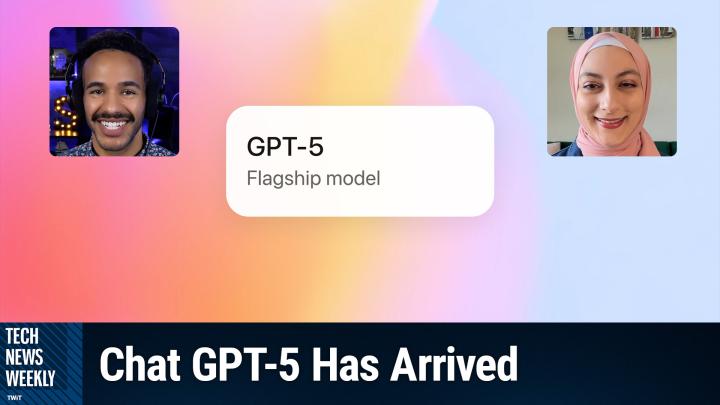
Loading summary
Transcript64 lines
- [00:00]
Micah Sargent
Coming up on Tech News Weekly, Abrar Al Heati is here. And we talk about Tesla being held partially liable for a crash in 2019 involving Autopilot. Then Project Ire, Microsoft's way of detecting malware using AI. Before I talk about age verification across the Internet, both in the US and around the world. And then Sabrina Ortiz of ZDNet stops by to give us the lowdown on OpenAI's new GPT5. All of that coming up on Tech News Weekly. Podcasts you love from people you Trust. This is TWiT. This is Tech News Weekly, episode 399 with Abrar Al Heiti and me, Micah Sargent. Recorded Thursday, August 7, 2025. OpenAI announces GPT5. Hello and welcome to Tech News Weekly, the show where every week we talk to and about the people making and breaking that tech news. I am your host, Micah Sargent, and given that it is the first Thursday of the month, wow. August is already here. We are joined by the wonderful Abrar Al Heati. Welcome back, Abrar.
- [01:22]
Abrar Al Heati
Thanks for having me. Wow, you have a great voice. I think everyone should sing my name whenever they introduce me.
- [01:28]
Micah Sargent
You know, I have a habit of singing. It must be with the microphone. It's just.
- [01:32]
Abrar Al Heati
Yes, it helps. Yeah, it's necessary that and asmr.
- [01:36]
Micah Sargent
Well, it's good to see you. And I have been watching some of your videos on Instagram. I saw you doing an unboxing the other day. Very cool.
- [01:48]
Abrar Al Heati
I'm tapping into the personal interest, mixing it in with the work stuff, you know, showing I have a personality. Every now and then it helps. Yeah.
- [01:54]
Micah Sargent
Not just a news personality, but a personality.
- [01:57]
Abrar Al Heati
Exactly, exactly.
- [01:59]
Micah Sargent
So for people who are tuning in for the first time, the start of the show always involves our stories of the week. These are stories that we have found interesting, or in some cases, stories we've written ourselves. It's never me having written the story maybe one day, but abroad. Tell us about your story of the week.
- [02:18]
Abrar Al Heati
Yeah, I wanted to talk about Tesla's autopilot troubles. So a few days ago, a jury found Tesla to be partly liable for a crash in 2019 that ended up killing one person and seriously injuring another. And as a result, Tesla now has to pay $243 million in damages, which is, you know, no pocket change here. So essentially what happened, the family of a woman who was killed sued the driver and reached a settlement. But then they ended up. The two families ended up filing a joint federal lawsuit against Tesla last year. And the allegation was that Autopilot didn't warn the driver that the road was ending. And essentially he was looking down to pick up a phone that he had dropped. And so when he did that, he ended up crashing into this couple. What's been interesting about this is, you know, when Tesla has faced similar suits, it tends to settle this out of court. And so now we kind of got to look at how Tesla handles a situation like that. So probably not, not too surprisingly, Tesla placed the sole blame on the driver. They, they said the company's terms and conditions deemed that the driver is ultimately responsible for the vehicle no matter what feature is engaged. You know, they pointed to the fact that the driver was reaching for his ph, that in any car what would have happened is what ended up happening here. And so then on the other hand, the plaintiff's attorney pointed to a lot of the things that Elon Musk has said about Autopilot, essentially touting how good it is, the quote, superhuman sensors and that it could see any object on the road, including an alien spaceship. So essentially very, very bold claims about the capabilities of Autopilot, which is nothing, something that Tesla has been accused of maybe overhyping for a long time. And there is a quote from the plaintiff's attorney that I thought was really good, which is in the Tesla showroom. It's the greatest car ever made. In the courtroom, they say it's jalopy. Jalopy. Jalopy. I don't know how to pronounce.
- [04:29]
Micah Sargent
Oh, jalopy.
- [04:30]
Abrar Al Heati
Yeah, it's one of those words that you read but don't hear. So which is a really interesting contrast there of, here's the two sides of the argument there. Which side is the truth here? Is this technology advanced enough? And so you know what they ended up finding? The jury ruled that the Autopilot technology was partially to blame for allowing the driver to kind of take his eyes off the road and not warning him that the road was ending. Tesla, of course, is going to appeal this and they say that the verdict is wrong. And then you hear about all this and then you think about Tesla's fully, truly, fully self driving robo taxi, that it's, that it's now rolling out in Austin and what that could mean for that, if any of that could spill over any of those concerns. So as I'm reading about all this, you know that the question that I'm now thinking is if, like this was a really tough battle for, for the plaintiffs, and so to think that there was such an uphill battle here to prove that this technology doesn't do all that it can do. It makes me wonder, is there, you know, even a point to having a technology like that if in the end, you know, so much of the blame is going to be pinned on the driver and it takes this much to prove that the technology itself should take a part of the blame. So I'm curious what your thoughts are about this case and the result of it.
- [05:59]
Micah Sargent
Yeah, so the first thing I want to say is it is, as you point out, wild. The difference between what Tesla has to say about itself versus what everyone outside of Tesla has to say. The jalopy versus, you know, I can see spaceships nonsense. Because the experts that I have talked to regularly talk about how Tesla is behind in sensing technology and that the, the way that the company has, it's almost like, it's almost like that relative that you have who refuses to be wrong and will continue to do something out of spite even though it is not good for the person. And Tesla sort of stuck to this sensing technology and continues to tout it as being the best. Meanwhile, other companies, and more importantly car manufacturers who have been doing this for a lot longer, by that I mean making cars a lot longer, have chosen other sensing tech that arguably are better at doing the sensing.
- [07:16]
Abrar Al Heati
Yeah, it is.
- [07:18]
Micah Sargent
It boggles the mind a little bit that Tesla is so stuck in its ways and so behind standing behind a technology that everyone outside is going, no, this isn't as good as it could be and using this instead or more sensors instead and different kinds of sensors would be better here. So that on its own really sticks out to me as just okay, Tesla, if you say so, sort of situation. But when it, when it's something as serious as this, then we've got a problem, right? Like this is not, not a simple situation where you can just sort of go, okay, you do you, no, you are actually potentially causing harm by insisting on your technology being so good in comparison to what else is out there. And that's not great. It's dangerous and perplexing. And I agree that there shouldn't be this much work involved in holding someone or holding a company responsible for what this is like. I think that the technology, sure, I do think that there's blame involved with the human being who chooses to not use this technology appropriately. But the argument that becomes, or actually the question becomes, did Tesla do enough or does any self driving technology creator do enough to make it clear to the end user that it is not something that can be done all on its own? And more importantly, not giving them the opportunity to do that is I think incredibly important. And so even if it means that the self driving car sees that you are not holding to the rules about needing to keep your hands on the wheel and look out the window and it uses all of these magical sensors, it has to look around and then find a way to come to a complete stop in a safe place and says, sorry, but you can't use Autopilot until you start doing what you require. You know what I mean? There could be more protections in place for this technology or maybe it's like a strike system. Like you have to, if you, if you use Autopilot incorrectly x amount of times, then the only way to re enable Autopilot is to go back to your dealer and have it re enabled there, there should be things in place that kind of discourage the misuse of this technology.
- [10:21]
Abrar Al Heati
Exactly, yeah. If there's, if there are no strikes, then why would somebody not depend on it if it's supposed to make that drive easier? And another piece of this is the argument was that Tesla was reckless for allowing Autopilot to function on a road that it's not designed for it. But then Tesla points to the owner's manual and says, well, it's up to you to really pay attention here. And the other piece of this that's interesting is the families told the jury that they initially didn't know that the driver was using Autopilot when they sued him. And then as time went on they realized they were and they used were two components in the accident. So you know, there's the driver and then there's the car. And so you have to, to think about, you know, it's, there's, there's two things at play here. And then to think that the driver, you know, the reason people engage that kind of technology is and what he mentioned was that, you know, it's supposed to be helpful and it's supposed to protect, it's supposed to be helping with moments where you might not be, where you might have missed something, a human failure and then it's supposed to catch that, but doesn't even do that. So, so if it had failed him in that regard, and there are many more instances of that where people think, oh, this technology is going to be helpful for me on longer drives and that's why I get a car that has this type of tech. But yeah, if people then become too dependent on that and there are no ramifications for what could happen based on that dependency, then yeah, it's just going to lead to more issues And I think one other piece is Tesla really, really likes to, its image is very important in terms of look how ahead we are. Right. And so when you look at whether it's branding something autopilot or full self driving, when it's not necessarily that, or developing robo taxis and saying we're going to solely depend on cameras, we don't need to do what the other guys are doing with their, you know, lidar and radar, whatever technology. We're going to be better, we're going to be cooler and sleeker. You have to think about what that means safety wise. You know, the buzzwords are one thing, but what, what are the results of, of those actions and how effective is that technology in reality? And I think this was a, a sharp wake up call.
- [12:26]
Micah Sargent
One hopes, you know, it is a lot of money, but will there be appeals, will there be reductions in the amount of money? That is like, that's, that's always the question. And then you also have to ask, is this, is this a slap on a wrist to a company backed by, in theory a multibillionaire versus if the company is sort of required to foot this bill out of what Tesla has, then it does become more than just a slap on the wrist, particularly with Tesla sales not doing super well, well at the moment. So it's a real kind of question of what kind of difference does this make? And I think more importantly for me, I really think that self driving technology, if done correctly, tested appropriately and rolled out appropriately, is allowed to flourish. That we could have a really good, really safe system and that would be awesome. And every instance of this stuff messing up because of the shortcuts that are being taken only makes that more difficult to happen. And that really grinds my gears.
- [14:01]
Abrar Al Heati
Yes, exactly. I don't think anyone's opposed to technology getting better and helping us with tasks like driving, but it has to be actually safe and effective. And yeah, this was a blow, but hopefully things get better and we take these kinds of things more seriously.
- [14:18]
Micah Sargent
Absolutely. Well, I think it's time for us to take a little break. Before we come back with my story of the week, I want to tell you about our dear friends at Zscaler who are bringing you this episode of Tech News Weekly. Zscaler, the leader in cloud security. We know hackers are using AI to breach your organization because AI powers the innovation, it drives efficiency. But there's the flip of that. It also helps bad actors deliver more relentless and effective attacks. Phishing attacks over encrypted channels increased by 34.1%. Fueled by the growing use of generative AI tools and phishing as a service kits, organizations in all industries from small to large are leveraging AI to to increase employee productivity with public AI for engineers with coding assistants, marketers with writing tools and finance creating spreadsheet formulas. It's also used to automate workflows for operational efficiency across individuals and teams. It's used to embed AI into applications and services that are customer and partner facing and ultimately to move faster in the market and gain competitive advantage. Companies need to rethink how they protect their private and public use of AI and how they defend against AI powered attacks. Steven Harrison, the CISO of MGM Resorts International says with Zscaler we hit zero trust segmentation across our workforce in record time and the day to day maintenance of the solution with data loss protection with insights into our applications. These were really quick and easy wins from our perspective. Traditional firewalls, VPNs, public facing IPs, they all expose your attack surface and frankly are no match in the AI era. So it's time for a modern approach with Zscaler's comprehensive Zero Trust architecture and AI that ensures safe public AI productivity, protects the integrity of private AI and of course stops AI powered attacks. Thrive in the AI era with Zscaler Zero Trust plus AI to stay ahead of the competition and remain resilient even as threats and risks evolve. Learn more@zscaler.com security that's zscaler.com security and as always, we thank Zscaler for sponsoring this week's episode of Tech News Weekly. All right, we are back from the break here on Tech News Weekly, joined by Abrar Alhiti. Time for my story of the week. Imagine, if you will, an AI system that can look at a piece of unknown software and determine whether it's malicious, not by comparing it to known threats, but instead by actually understanding what the code is trying to do. Microsoft has developed exactly that with Project Ire, an autonomous AI system that achieved nearly 90% precision in detecting malware that had stumped all other automated tools. This isn't simply pattern matching, it's true code comprehension at a scale never before possible. So when we look at kind of the situation right now, we were just with Zscaler talking about this. We're looking at code and code comprehension and malware detection, and the way things are right now has kind of hit a wall. Microsoft security teams face this overwhelming challenge because you've got thousands of suspicious files that automated systems simply can't classify. They call them hard Target files that require expert reverse engineers to manually examine human being. And as you can imagine, a very time consuming task. It's a bottleneck in an era where you got new malware appearing all the time because it's AI versus AI. And in this piece where they talk about Project Ire, one says the more demanding test involved nearly 4,000 hard target files not classified by automated system and slated for manual review by those expert reverse engineers. So you've got these signature based detection methods that only catch known threats because it's signature based detection, meaning looking for something that already exists and trying to pattern match. And then there's behavioral analysis. Sure, but it can be fooled by sophisticated evasion techniques. So Microsoft said, look, we gotta kind of throw out the playbook a little bit and start fresh, teaching AI to think like a reverse engineer. Project IER is a breakthrough in autonomous malware analysis because unlike conventional systems that look for specific patterns, those signatures, Project IRE actually decompiles and analyzes the code's functionality, understanding what the software does and not just matching it against known signatures. So how does it go about doing this? Well, first and foremost, it decompiles binary files into readable code. It analyzes function, behavior and system interactions. It identifies malicious patterns through code comprehension and then afterwards generates detailed reports explaining its findings. So being able to kind of not only do these things, but do them at scale with speed and accuracy, that's something that they haven't seen before. According to Microsoft's real world evaluation, Project IER achieved pretty wild results. 89% precision rate. So nearly nine out of ten files that Microsoft knew were malicious. This Project IR was able to identify. It had a 26% recall rate. So meaning it detected roughly a quarter of all actual malware in the test set and then had only a 4% false positive rate. So that's a pretty low error rate. That would mean that security teams could then go and look at and find those false positives and say, oh, this is a false positive versus, you know, up to this point where you might get a lot more false positives. It's impressive because the system was tested on files that had already stumped all other automated detection systems. And these, of course, were the cases that would normally require human experts. There are different kinds of malware that the AI worked on. And I thought this was kind of interesting. So one of the case studies was process manipulation malware. So it looked at a sample that exhibited evasion techniques, identifying functions for enumerating and manipulating system processes, detected HTTP communication capabilities for command and control, and then was able to discover these process injection techniques using entry point patching. So these are a lot of big words that basically mean it found malware that used kind of an ability to access a network, a server, whatever it happens to be, and communicates what it needed to do process manipulation so affecting these processes. Another case was an antivirus killer tool. So it found a tool that was designed to disable security software, detected code that targeted specific antivirus processes by name, identified process termination functions aimed at security software, and which is kind of cool. In doing so, it caught and corrected its own initial misidentification by using validation. So there's obviously potentially more here. And I think whenever it comes to Microsoft in particular, Microsoft already sells and creates one of the biggest operating system platforms that exists and in an interesting kind of way then also sells security packages for that software. So any improvements there I think are good, particularly when we've seen these breaches in the past have such an impact on infrastructure. But yeah, I kind of wanted to get your take abrar just in general on I find it interesting seeing AI being used in ways that kind of step outside of these classic concerns that we see people have. A way that it's kind of attempting to replicate creative human behavior where that's like a no go. But this instead being a very technical thing that frankly AI should be good at.
- [23:12]
Abrar Al Heati
One would think, yeah, less AI creating art, more AI catching this I think would be a very, very welcome change. Especially hearing things about how it could correct itself is very cool. I mean, I think this is really the epitome of how AI can be helpful without being threatening. I mean, of course there's still jobs that are currently and tasks currently run by humans that AI stepping in. But if it can be more efficient and can be more helpful and it's not tapping into the oh, here's a piece of literature written by AI or here's a piece of artwork. I think it's less off putting when it's, here's a technical application of AI where this can keep people safer and protect systems and actually be something that people, most people might be willing to actually get behind. I think that's, that's a very refreshing thing to see.
- [24:05]
Micah Sargent
Yeah, and I like too that this is once again a tool for augmenting the human. That is, that's what's so important because there is still human involvement at the end. It's just helping the human to focus on those tasks that are the most difficult. And in this case, you know, coming across the stuff that's the most difficult. That is nice that, that you. So it's almost a reminder when you throw something that we're seeing to be pretty capable at a problem. And in the most intense cases, you still do need a human to be involved in it. And I think that's pretty cool. In looking at where this is, this project ire, this binary analyzer, they kind of broke down some of the involvement like speed. So being able to do instant analysis of suspicious files without human bottlenecks, of course, scale being incredibly important to analyze thousands of samples simultaneously. Consistency, whenever it comes to fatigue involved in analysis, that is something that is not. As a former copy editor, that was always something that we had to watch out for, for was fatigue. Because your brain wants to automatically autocorrect to what you know is accurate. And having to come up with techniques to circumvent that human error from fatigue is really important so the AI doesn't get bored and can continue to just do what it needs to do. And then of course, the idea that it would be able to combat novel attack techniques versus again working on the kind of signature detection that we've had up to this point. So I think this is really cool. Microsoft is working on rolling this out into its kind of defender program and adding it to future security tools as well. And by golly, again, I think that if this is something that can help security researchers, but security organizations do the part that they do well, that is a great use of AI that I'm glad there are researchers kind of working.
- [26:33]
Abrar Al Heati
On that augment angle is really that key point. Yeah, exactly.
- [26:38]
Micah Sargent
Absolutely. I want to. Of course. Thank you so much for taking the time to join me today on Tech News Weekly. If people are looking to follow along with the work you're doing and watch those unboxing videos from time to time, where should they go to do that?
- [26:53]
Abrar Al Heati
Well, you should come join me on my Instagram Abrar Lheti, no spaces or hyphens. I'm also on CNET, on CNET.com, cNET's YouTube, CNET Socials and For Fun, also on TikTok, also Adrabar, Elhiti and I'm on X to Elhiti underscore three. All the places. Really, it's too much, but please follow along.
- [27:14]
Micah Sargent
Thank you, Abrar. We appreciate it.
- [27:16]
Abrar Al Heati
Thanks for having me.
- [27:18]
Micah Sargent
All righty, folks, we're going to take another quick break before we come back with a story of the week and then our interview after that with ZDNet AI Senior Editor very excited about that coming up as well. But let me tell you about Acronis and the Acronis Threat Research Unit sponsoring this week's episode of Tech News Weekly. You listen. You do. You deserve fewer headaches in your life. Even something as simple as watching TV can become a headache when your favorite shows are scattered across different streaming services. Where can I watch the show I want to watch? It's nearly impossible to find one place that has everything you need. Acronis takes the headache out of cybersecurity with a natively integrated platform that offers comprehensive cyber protection in a single console. And if you want to know what's happening in cybersecurity, the Acronis Threat research unit, or TRU, is the place to go. It's your one stop source for cybersecurity research. True also helps MSPs stop threats before they can damage your or your client's organization. Acronis Threat Research Unit is a dedicated unit composed of experienced cybersecurity experts. The team includes cross functional experts in cybersecurity, AI Threat Intelligence. TRU conducts deep intelligence driven research into emerging cyber threats, proactively manages cyber risks and responses to incidents, and provides security best practices to assist IT teams in building robust security frameworks. They also offer threat intelligence reports, custom security recommendations and educational workshops. Whether you're an MSP looking to protect clients or you need to safeguard data in your own organization, Acronis has what you need. It's all there in Acronis Cyber Protect Cloud, edr, xdr, Remote monitoring and Management, Managed detection and Response, email security, Microsoft 365 security, and even security awareness training. And it's all available in a single platform with a single point of control for everything. So it's easy to deploy and manage. If managing cybersecurity gives you a headache, it's time to check out Acronis. Know what's going on in the cybersecurity world by visiting go.acronis.com twit and take the headache out of cybersecurity. That's go.acronis.comtwit thank you Acronis, for sponsoring this week's episode of Tech News Weekly. All right, we are back from the break and I've got one more story of the week for you. This is kind of a overarching story of the way things are going right now. On July 25th of this year, the UK became one of the the first countries to widely implement age verification across the Internet, requiring sites like Reddit, Discord, x Blue sky to verify that Users are over 18 before accessing what was considered harmful content. But the early results have been nothing short of chaotic. While some services complied, others pulled out of the country entirely. Rather than face the risk and expenses, users have already found ways to trick the verification systems or simply bypass them with VPNs. And of course, as you might imagine, this messy rollout is just a preview of what's coming globally as lawmakers worldwide push for an age gated Internet, despite the warnings from privacy and security experts that the technology simply isn't ready for broad adoption. The Verge's Emma Roth wrote about the way things are going right now as we see the Internet adding age verification around the world. The current state of chaos is thusly and with the UK's implementation it's kind of shown that there are some problems, as we mentioned, pulling out of the country rather than having to worry about what it would cost to involve this. And you've got a patchwork of access across the Internet with easy ways of Getting entry via VPNs. One of the big problems here is that there's huge variation in the way that age verification is taking place. Some require payment cards, so if you've got a credit card then that would put you above a certain age. Government ID uploads, selfie verification, data estimation based on account creation dates and user connections. All of these are different means of being able to do age verification and they're all being used across different sites because the rules as they are put forth all are. There's, there's no specific rule on how it has to be done. And as you might imagine, most platforms are simply outsourcing this to third party services. One of those is Epic Games Kids web services that's used by bluesky, a service called Persona that is working with Reddit and Kid, which is working with Discord. But as you might imagine, with these different third party services being used, all having different privacy policies, all having different methods of verification, all having different people involved resolved, it's a privacy nightmare. The article quotes Cody Vensk, who's a senior policy counsel at the American Civil Liberties Union aclu. The current situation is a nightmare because there's no standardization of how age verification is supposed to take place. Some services promise to delete data after seven days. That's what Persona promises, but no guarantee that they're gonna follow through. Data breaches increasingly common. Last year one service, which is kind of it probably has a way of pronouncing it, but I can't tell by how it is it's AU10T I X. It's a service that's used by TikTok, by Uber and by X left user information and driver's license photos exposed for months. So when uploading your id, you're handing it over to a third party party, you're going to take their word, they're going to delete it or remove it after they're done using it. And in many cases they're not. Despite the fact that we're seeing these services fail to protect user data, there is momentum across the world. Governments worldwide are quote plowing toward the future of an age gated Internet. Anyway, the movement includes the European Union which is rolling out government managed digital IDs. Hey, at least it's government managed in that case Australia, which is age gating search engines. And the US where multiple states are requiring ID verification for adult websites. For now. The US legal landscape shifted dramatically when the Supreme Court overturned the precedent earlier in 2025, saying that adults have no First Amendment rights to avoid age verification if it protects minors from obscene content. So specifically, whenever it comes to obscene content, Alabama, Idaho, Indiana, Kentucky, North Carolina and Texas have all implemented these laws. I mentioned the EU's centralized approach. That at least is something a little different, right? That's good. The European Union, the EU is trying a different approach with its government managed digital IDs. The system allows users to upload their passport or their government ID card to a government built system. Kind of odd that you have to upload this given that it is the government itself. But anyway, afterwards it generates a proof of age attestation that gets passed to websites. So it of course solves some of these problems. But there are some concerns that folks have surveillance risks. Digital IDs may phone home to track online activity, accessibility issues which could restrict undocumented individuals from accessing content. And of course the privacy concerns. The EFF says if I pull up my ID at the liquor store, the DMV doesn't know that, but with digital identification there's potential for that. So again now you have a situation where the DMV could in theory keep track of of your trips to a liquor store. And does that mean that they could then use that information for, you know, implying that you are drinking and driving for example, or pass that information along to law enforcement to check on you to see. For some people maybe that's a thing that they think is a good thing. For others there of course are those privacy concerns. But it is, I think of all of the approaches the EU's centralized approach at least limits some of the privacy concerns one might have when it comes to farming out this to or passing off this age verification stuff to a third party. And then you have so many different third parties all with your data. So so there's a lot more about this. Steve Gibson over on Security now has talked a lot about this, but the zero knowledge proof being the kind of technical solution the EU is attempting to enhance the system with this zero knowledge proof ZKP technology. It's a cryptographic verification method that allows a service to prove something is true or or false without revealing any additional information. So again it just says yes or no and that's it. So yes, the person is passes the test of needing to be of a specific age or not not giving more information about that person's age or anything else. Google has built ZKP into Google Wallet and has open sourced the technology, but it is an advanced approach that has its own limitations according to EFF's Alexis Hancock. Hancock says, I haven't seen anything remotely promising at the moment that actually reels in verifiers. In particular, there's not a lot of scope restriction on who can actually ask for this and if it's even needed in some cases. So basically saying that that yes there's a zero knowledge proof, but does every site need to be able to ask the question of do they pass this age gate or not and should it be limited to only sites that need to do age verification based on the fact that they have content that is supposed to be age gated in the first place? Sites are choosing to just go ahead and add the age verification to protect themselves from potential lawsuits or fees from the government. And that in itself is a bit of a concern. It's how we have seen in the past different sites rolling out features, the cookie notices that pop up that maybe aren't actually necessary, and the types of tack on accessibility features that aren't as good as built in accessibility. All added to a site because it's about avoiding lawsuits as opposed to actually improving the technology to follow the rules that are set in place. Of course, lots of political push and justification for the ways that this is being rolled out. Lawmakers and regulators argue that the benefits continue to outweigh the risks. Melanie Dawes, who is the CEO of Ofcom, the UK's communications regulator, says prioritizing clicks and engagement over children's online safety will no longer be tolerated in the uk. As you might imagine when the question or when the target is sort of the rallying cry is protecting the kids. It's hard to argue against that. Senator Katie Britt said, putting in place common sense guardrails to protect our kids. There it is. Protect our kids from the dangers of social media is critical for their future and America's future. But as you might imagine, there are some trends involved with this escalating government digital surveillance that we've seen and continue to see attempts to declare expressions of LGBTQ sexuality, you know, essentially making drag shows obscene and therefore age gating or blocking access to that content. And we, and with that and the inclusion of personal data, especially from a centralized organization, that becomes more of the question. So I think that the kind of conclusion in Emma Roth's piece is perhaps the most important part of it right now. There just isn't any clear cut way to verify someone's age online without risking a leak of personal information or hampering access to the Internet. Until lawmakers stop and think about the bigger picture, everyone's privacy is going to be at risk. So we know the fundamental problem is that lawmakers are implementing these systems before the technology is ready, saying, you gotta do it and you better hop on it. But the tech isn't ready and the companies aren't ready to roll out the tech. And so it's a whole issue creating a perfect storm of privacy violations, security breaches, restricted Internet access, protecting children online. Of course I think that's important. You think that's important. Everyone thinks that's important. But the current approach in its current state may cause more harm than good. Even though there's a part of me that argues that the way that things have been done up until now with Big Tech is they would do a thing and then ask for forgiveness later. And therefore, unless you forced Big Tech to make a change, they're not going to make a change. So I understand that aspect of it of saying, no, we're setting a hard line here. You will do this and you need to do it now. It would be nice if we could come to a middle ground with this. So be prepared. To those of you, our dear listeners in the US and elsewhere, as age verification continues to roll out and more countries, and in the case of the US States that more and more acting like their own countries are hopping on board. All right, we're going to take a quick break before we come back with Sabrina Ortiz joining us to talk about the freshly announced OpenAI's GPT5. Let me tell you right quick about Smarty, who is bringing you this episode of Tech News Weekly. You can discover what's possible when address data actually works for you? Smartie is revolutionizing how you handle address information, bringing automation, speed and accuracy to processes that used to be manual, that used to be error prone, that used to be frustrating. With Smartie's cloud based address validation APIs, you can instantly check and correct address in real time so you don't have to worry about that. Bad data compliance risks undeliverable mail costly delays Add autocomplete to your web forms so your customers select valid verified addresses as they type. This will improve their user experience and yield much better data for you. Companies like Fabletics have drastically increased conversion rates for new customers, especially internationally with Smartie. If you want more than just clean addresses, well, Smartie's Property Data API unlocks 350 insights on every address, from square footage to tax history, automatically enriching your database. It's incredibly fast, 25,000 plus addresses per second and very easy to integrate. The Red Cross needed accurate address data to allocate resources. A project manager says the Smarty tool has been fundamental. I've never experienced any issues with the tools and they seem to be getting better all the time. The address verification really does make an impact. We're able to reach the communities we serve because we have good addresses. Smartie is a 2025 award winner across many G2 categories like best Results, Best Usability, Users Most Likely to Recommend, and High Performer for Small business. Smarty is also USPS Cass and SoC2 certified and HIPAA compliant. Whether you're building your first or modernizing an entire platform, Smartie gives you the tools to do it smarter. Try it yourself. Get 1000 free lookups when you sign up for a 42 day free trial. Visit smartie.com TWIT to learn more. That's smarty.com TWIT T W I t and yes, I did ask the folks@ smarty is 42 the reference? I think it is. And they said if you mean is it the answer to life, the universe and everything. And I said yes. I knew you were nerds. I love it. Smarty.com TWIT 42 day free trial thank you Smarty, for sponsoring this week's episode of Tech News Weekly. All right, we are back from the break and I'm very excited to be joined by Sabrina Ortiz, senior editor at ZDNet, who knows a thing or two about AI. Welcome to the show, Sabrina.
- [45:35]
Sabrina Ortiz
Hi everyone. I'm super excited to be here. Big day.
- [45:37]
Micah Sargent
Yeah, it absolutely is. So this is pretty cool. I originally was bringing Sabrina on to Talk, talk about OpenAI's open source platforms. And this morning I got an email and Sabrina said, you know, GPT5 is about to be coming out, right? And I said, can we talk about that instead? And you are ready to talk about it. So let's, let's kick things off. Yeah, I mean you, I imagine watching the, the announcement, could you tell us kind of what you expected going into it and what we're kind of looking at with this latest model?
- [46:13]
Sabrina Ortiz
Yeah, this is one of the rare cases where what you expect is actually what was released in the best way. Right. So basically what this model does, and the highlight of it is that it takes the guesswork out of the entire equation for the end user. So as you probably known or seen on ChatGPT, if you're using it, there's a model picker. If you were a paid user specifically too, there was a model picker and then you could pick amongst the Alphabet soup of OpenAI models, right? Like there's oh3, oh4 this, a mini that, and then you would ideally pick the one that was best suited for your own prompt. So if you were doing a really complex coding or math problem, you'd probably opt for a reasoning model like O3 or OH4, but then 04 kind of sounds like 4.0 and 4.0 is one of the GPT models that you could use for like mostly everything. So it's like an Alphabet soup and it's confusing. So basically what GPT5 does is it has two models already in it where it knows where it's either reasoning models or our standard, you know, like GPT all purpose general query model and it'll automatically be able to pick it from for you, depending on what you input. So this just makes it so much easier for the end user because now you don't have to guess. And now you get to either balance, you know, speed and quality in a much more optimized way where you're not guessing.
- [47:46]
Micah Sargent
Okay, that makes sense. Now when it comes to that, does that mean that if I'm using GPT5, I'll still be able to, to, for example, give it a photo and it'll analyze the photo properly. Or I can say generate a photo and it will do that, or I give it some code. It's like the all in one package, truly.
- [48:07]
Sabrina Ortiz
Yes, it's all in one. So basically everything you were able to do before, you'll still be able to do now. But the biggest highlight is that for both free users and paid users, you'll Also be able to do some of those those reasoning more or take advantage of some of those reasoning capabilities. Free users previously didn't have access to any of these reasoning models. Now because it's in GPT5 and everybody's getting access to GPT5, you'll be able to do the same queries used to do before, but now also do those bonus like really complex math coding problems and get that higher level assistance understood.
- [48:43]
Micah Sargent
Now one of the things that you talk about in this early piece related to GPT5 is performance improvements. And given kind of the bigger highlight about it being this all in one tool and taking out the guesswork, I think some of the other improvements fall by the wayside. Can you tell us about what we're seeing in terms of performance?
- [49:05]
Sabrina Ortiz
Oh yeah, all around it's going to be better performance, right? Like one of the biggest perks or advantages is taking out the guesswork. But like you mentioned, that's not to ignore the actual advantages of performance when it comes to coding, when it comes to health is a really interesting one. There's really, there's new benchmarks showing that it's way better at answering health related queries. And you know, a lot of people have been turning to ChatGPT to ask things like hey, I have these symptoms or hey, what best treatment plan should I take? And now we could better assess those. But altogether it is a the most capable model that they've released. It is smarter and it is faster.
- [49:49]
Micah Sargent
Understood. Another thing that you talk about, and again I think another important aspect, safety. And you say that there are improvements here in, in safety. What does it mean when an AI company that makes a chatbot a model, what does it mean in terms of safety? Because we're not talking about a robot robot, an automated robot that's suddenly picking up weapons. Right? What is safety for? For this, this GPT5?
- [50:17]
Sabrina Ortiz
Hey, that's a great question and also would like to caveat before we even talk about it, that we have to take it with a grain of salt, right? It is ultimately an AI company claiming that's making a model safer. But they're also in the interest of developing these super intelligent models that are prone to hallucinations and all sorts of things. So we have to take it for a grain of salt. But yes, when we're referring to AI models and safety, we're talking about things like hallucinations where it's just a term describing when they output information that sounds really plausible and sounds really real for, for lack of better. True. For lack of A better word and then it's false, just because they're trained to, you know, mimic human language and put out a plausible answer, even if it's not actually true. This model, however, is one of the safety aspects. One of the safety improvements is that it's more honest. So it'll try to tell you, hey, actually that what you just told me, I don't have the tools to give you the right answer or I actually don't know the answer. Again, we'll see how it actually performs. But there were benchmarks that OpenAI released to support these claims, and they also made their model safety card available, which is a really long PDF. But you could take your time and read it and go through all the different benchmarks and evaluations. So take a look yourself.
- [51:36]
Micah Sargent
Another thing that ChatGPT, or rather OpenAI announced are some personalities. For people who don't know, can you start by talking about what is a personality when it comes to this chatbot and what are the new personalities available?
- [51:53]
Sabrina Ortiz
I love that you mentioned this because this is one of those announcements I feel like it's easy to also ignore because GPT5 is like, like all the craze right now, but they also sprinkled some funner, I guess, ChatGPT customization tools. Like now you have the ability to pick a color in chat, which granted is not super, you know, groundbreaking, but fun. And this is one of those too, the personalities. So if you ever talk to ChatGPT, and especially with 4o, sometimes it was overly cheerful and you know, there's a ton of emojis and all of that kind of thing. Now with GPT5, OpenAI share that it's going to try to reel that excitement down a bit. And in addition to that, there's going to be an option to in custom instructions. So that's just like the tool, the feature which allows you to customize how you want the responses to be outputted. You could select different personalities and the personalities are just like the tone that ChatGPT speaks to you in. So there is an option for like, if you like more sarcasm and you don't want the overly hype excited chatbot that's just going to be like, yes, thank you so much for your answer, for your question. Great like analysis. Here's the response. If you rather it be more cut and dry, or if you'd rather it be more polite, you could choose from the four different personalities, the one that matches what you're more interested in.
- [53:14]
D
25 years ago, a small group of business and government leaders met in Washington, D.C. they envisioned the creation of an independent, independent nonprofit organization with a mission to help people, businesses and government mitigate the growing threat of cyber attacks. Today, the center for Internet Security embodies that vision. For 25 years, it's worked with a global community of IT and cybersecurity experts to develop the CIS benchmarks and CIS critical security controls. These proven security best practices defend against common cyber threats and and streamline compliance with industry frameworks, regulations and standards. Today, CIS provides cybersecurity services, threat intelligence, and critical resources to help public and private sector organizations alike strengthen their Cyber defenses. Visit cisecurity.org today. That's the letters cisecurity.org to find out how CIS can help your organization as we create content confidence in the connected world.
- [54:15]
Micah Sargent
Let's map out this week's amazing destinations and travel tips.
- [54:19]
Sabrina Ortiz
Honestly Will, I didn't plan any trips, but I did switch to T Mobile with their new Family Freedom offer.
- [54:27]
E
That's not the itinerary we're following.
- [54:29]
Sabrina Ortiz
Well, I'm departing from ATT and embarking on a new journey with T Mobile. They paid off my family's four phones up to $3200 and gave us four new phones on the house.
- [54:43]
Micah Sargent
Bon voyage.
- [54:45]
F
Introducing Family Freedom. Our lowest cost. To switch our biggest family savings all On America's largest 5G network, visit your local T Mobile location or learn more@t mobile.com FamilyFreedom up to $800 per line via virtual prepaid card typically takes 15 days. Free phones via 24 monthly bill credits with finance agreement eg Apple iPhone16128 gigabyte $829.99 Eligible trade in eg iPhone 11 Pro for well qualified credits end and balance due if you pay off early or cancel contact T Mobile.
- [55:11]
Abrar Al Heati
You say you'll never join the Navy, that living on a submarine would be too hard.
- [55:17]
Sabrina Ortiz
You'd never power a whole ship with.
- [55:19]
Abrar Al Heati
Nuclear energy, never bring a patient back.
- [55:23]
Sabrina Ortiz
To life or play the national anthem for a sold out crowd.
- [55:30]
Abrar Al Heati
Joining the Navy sounds crazy. Saying never actually is. Start your journey at Navy America's Navy Forged by the Sea.
- [55:41]
Micah Sargent
And that is very much a consumer feature right? When it comes to you and I making use of this, I'm kind of curious did this announcement because one of the fascinating things to me about OpenAI's announcements is they do feel very much laid back and kind of let me show you what this can do. When they showed the agent they were sitting there and having things go wrong and sort of laughing through that and I really like that authenticity. But we often have. It feels like sort of in these videos, a focus on the consumer. But a big part of OpenAI's business. Right. Is the API is being able for these different companies to use these tools. Is there anything with the new version? The new model that OpenAI talked about is for developers, is for the commercial aspect. Totally.
- [56:40]
Sabrina Ortiz
Yes. That's such a great point. They have so many enterprise customers and also developers that they also have to take care of that audience. And they did. So it is available in the API and because the model is, developers can take advantage of it because it is the most capable coding model. I don't know if you tune into Live Stream, you saw the live demo. I actually had the opportunity in a press briefing before the model even came out to see a demo of all the coding, new capabilities. And it's truly outstanding and amazing how fast it could build a website, a functional web app, from a natural prompt, like a language prompt that would take so long to do manually. Right. Like, I'm pretty familiar. Like I recently had to go through like building my own, like web app and using like JavaScript and CSS and all these different things. And it's just such a pain and it does it so quickly and so efficiently. So again, because of that, because of the less hallucinations that it is prone to, it's more accurate responses because of the fact that there are, you know, different tiers that you could select for better pricing, developers are definitely could take the best advantage of GPT5. And actually OpenAI said that for developers, GPT5 is the best option. So it is available for them too in the API. And there's different versions and selections they could make to make sure it fits their criteria the best for whatever they're working on. Yeah. So they're definitely benefiting from the release too.
- [58:20]
Micah Sargent
Lastly, I think I'd love to know, as you were watching the announcement, anything that you think we should know about with this that we may not have talked about yet, or even if it was something we talked about, just something that stuck out for you that you're looking forward to as things are rolling out?
- [58:39]
Sabrina Ortiz
Yeah. Well, first, I'm actually pretty stoked about this GPT5 release because again, I think it solves a very practical issue. I think when a lot of people are coming to an AI tool, a new AI tool, whether it's a chat bot or whatever, may be one interaction of it where it works, not, not to the level they're expecting, it will put them off forever, right? Or it'll be enough to be like, actually I don't trust this thing now with this option of it automatically selecting the best model, you'll be able to experience higher quality responses which I think will get more people to use AI. Not that that that's necessarily, you know, I'm the biggest proponent for like everybody must use AI, but I think there's some really good practical applications for people's everyday workflows and I hope that people are more open to explore it now that they will be getting higher quality responses from the get go and also combining speed and, you know, quality. So that's great there and that's what I'm really looking forward to is I think more people will be adopting it and I'm really excited to see what people come up with, right, like more people using it, more application, different applications and use cases. I'm excited to see that. And then from my end, something that I would just like to highlight from all the releases that also is easy to just get swept under the rug is that they made advanced voice mode available to free users too. And that's just their voice assistant that is, you know, super conversational and could pull information and deliver it in a very casual like you're talking to like a really smart friend. And I personally use that feature, feature, like all the time. It's one of my favorite features in ChatGPT and I. But I've been able to take advantage of it because I'm a ChatGPT plus subscriber. But now free users get it too. Granted, not to the same limit extent, but I thought that was really cool. They're replacing the standard voice mode, which I thought is something you should have done so long ago because it's kind of obsolete compared to everything else that they could, you know, provide users. So yeah, that was one of those features where I was like, wait, this is really cool. And I actually think I might write a breakout story on it because I'm like, this is sick. This is my favorite feature now everybody can use it now other people will.
- [60:54]
Micah Sargent
Know when you're talking, you're like, no, I talk to it. What they can actually see how it works.
- [61:00]
Sabrina Ortiz
Oh, exactly. No, everybody's going to be able to experience what my family and friends are like, are you talking to ChatGPT again? I'm like, yes, I am sorry.
- [61:09]
Micah Sargent
That's wonderful. I want to thank you so much for taking the time to join us today. Of course, course folks can head over to ZDNet.com to check out your prolific coverage of all of the AI. If people would like to follow along with the work that you're doing, is there anywhere they should go to keep up?
- [61:27]
Sabrina Ortiz
Yeah, totally. Actually my Instagram is probably where I post the most up to date of my everyday coverage. And that's just SabrinaFonextra A at the end. Ortiz Also, you could follow me on LinkedIn, Twitter, all the things. Well, I guess X all the things. I share all my content on there too.
- [61:44]
Micah Sargent
But yeah, awesome. Thank you so much for your time today. We appreciate it.
- [61:48]
Sabrina Ortiz
Thank you. I hope you have some fun trying out the tools too.
- [61:51]
Micah Sargent
Thanks. All right everybody, that brings us to the end of this episode of Tech News Weekly. Of course, our show publishes every Thursday at TWiT TV TNW. That's where you can go to subscribe to the show in audio and video formats. Now is the time where I remind you about Club twitter@twit tv club twit we start you off with a 14 day free trial afterwards, $10 a month, $120 a year gets you access to every single one of our shows ad free. Just the content. You also gain access to our Twit plus feeds, including our coverage of news events like this Morning's coverage from Leo on the on the ChatGPT OpenAI announcement. You also gain access to little bits and clips that we have and our Club Twitch shows like My Crafting Corner. I'm working on doing a D&D one shot adventure coming up. So if you like Dungeons and Dragons, now's also the time to join. We'd love to have you there and you gain access to our Discord, which is a fun place to go to chat with your fellow Club Twit members and those of us here at @Twit. My co host on iOS today, Rosemary Orchard, is always in the discord, sharing great tips and tricks and answering people's questions. It's a lot of fun and we love having you there. So I look forward to welcoming you to the club at TWiT TV ClubTWiT. If you'd like to follow me online, I'm ichasargent on many a social media network. Or you can head to Chihuahua Coffee that's C H I H u A H u a Coffee where I've got links to the places I'm most active online. Be sure to check out my other shows, many a couple of which published today iOS today and hands On Tech or excuse me, Hands on Apple. Hands On Tech publishes every Sunday. Thank you so much for being here. I'll be back again next week for another episode of Tech News Weekly. Bye Bye.
- [63:47]
E
The tech world moves fast and you need to keep up for your business, for your life. The best way to do that twit.com on this Week in Tech I bring together tech's best and brightest minds to help you understand what just happened and prepare for what's happening next. It's your first podcast of the week and the last word in tech. Cybersecurity experts know they can't miss a minute of security now every week with Steve Gibson. What you don't know could really hurt your business, but there's nothing Steve Gibson doesn't know. Tunein Security Now Every Wednesday, every Thursday, industry expert Micah Sargent brings you interviews with tech journalists who make or break the top stories of the week on Tech News Weekly. And if you use Apple products, you won't want to miss the premier Apple podcast, Now in its 20th year, Mac break Weekly. Then there's Paul Thurat and Richard Campbell. They are the best connected journalists coming covering Microsoft, and every week they bring you their insight and wit on Windows Weekly. Build your tech intelligence week after week with the best in the business. Your seat at Tech's most entertaining and informative table is waiting at TWiT TV. Subscribe now.
- [65:11]
Sabrina Ortiz
Foreign.
- [65:15]
Abrar Al Heati
This episode is brought to you by Progressive Insurance. You chose to hit play on this podcast today. Smart Choice make another smart choice with Auto Quote Explorer to compare rates from multiple car insurance companies all at once. Try it@progressive.com Progressive Casualty Insurance Company and affiliates not available in all states or situations. Prices vary based on how you buy.