← All TWiT.tv Shows (Audio)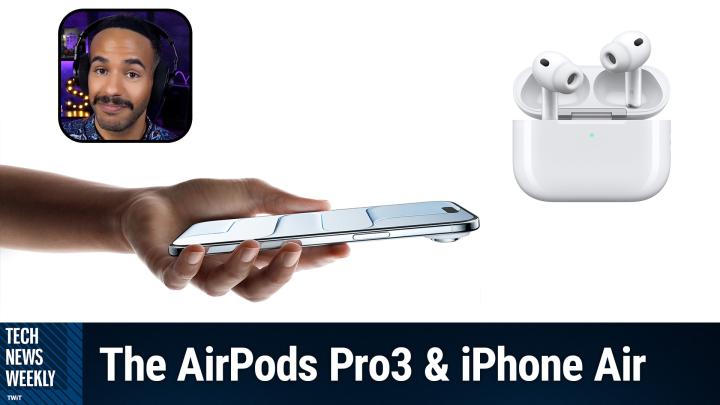
All TWiT.tv Shows (Audio)
Tech News Weekly 404: iPhone Air First Impressions
01:27:14
Hands-On With the AirPods Pro 3 and iPhone Air
Loading summary
Transcript99 lines
- [00:00]
A
Coming up on Tech News Weekly, journalist Jacob Ward joins me as co host this month. Jacob kicks off by talking about the cost of diffusion based generative AI. And then I talk about those wearable AI devices that are always listening and Wired's recent review and hatred of those AI devices. Afterwards, Zach hall of 9 to 5 Max stops by. Zach was there in person at Apple's all dropping event. So we cover every thing that Apple announced, plus stuff you might have missed because it came off stage at the event and later on. Stay tuned for this episode of Tech News Weekly.
- [00:46]
B
Podcasts you love from people you trust.
- [00:51]
A
This is Tweet. This is Tech News Weekly, episode 404 with Jake Ward and me, Micah Sargent. Recorded Thursday, September 11, 2025. IPhone Air First Impressions. Hello and welcome to Tech News Weekly, the show where every week we talk to and about the people making and breaking that tech news. I'm your host, Micah Sargent and we have something new, someone new today joining us, who will be joining us going forward as one of our regular co hosts on the show. Welcome though to Tech News Weekly for the first time. J. Jake Ward.
- [01:33]
B
What's up? Great to be with you. I'm really excited to be here. I was so flattered when you reached out and I, yeah, excited to be, to be part of the rotation.
- [01:40]
A
Yeah, me too. So before we get into it, people, some people will have likely seen you on this Week in Tech, but I like to imagine that not everybody has the time to listen to every single one of the podcasts on the network. Or maybe I don't like to imagine it, but I'm. But when I'm a realist about it, that seems to be the case. So for anyone who, who doesn't know a little intro about yourself before we get into the show, I really appreciate it.
- [02:08]
B
Yeah, in this noisy environment it is hard to stand out. So I don't blame anybody for not knowing who I am. So I am a technology journalist. I've done it for better part of 20 years. I've worked for Wired, I've worked for Al Jazeera. I worked for most recently NBC News as their technology correspondent, working for the Today show and Nightly News. I also wrote a book back in that came out in 2020 called the Loop how AI is creating a World Without Choices and How to Fight Back. That was all about the sort psychological mania that AI I thought would produce in People when it went commercial. I thought I was like five years early on that project. Turns out I was about nine months early because that's when ChatGPT came out. And so I spend a lot of my time right now thinking about and unpacking the fallout from this AI moment that we are in.
- [02:53]
A
Oh, wow.
- [02:53]
B
And I also, I also host a podcast called the Rip Current, which you can find at the rip current.com beautiful.
- [03:00]
A
Wonderful. So let's get into the show today. So as many of you know who listen to this regularly, this is the part of the show where we share our stories of the week. And I'm really looking forward to, Jake, you introducing us to yours.
- [03:14]
B
Well, so this being the first one, I was really wringing my hands over which one to kick off with. And I for a moment was looking at the Tuesday testimony in front of the Senate by the two whistleblowers out of Meta who wanted to talk about and spoke at great length about what they saw as some bad behavior on Metta's part when it came to how children are exposed to harmful content, they said on VR headsets. And we could have gone on and on about that. I'll just say two quick things about that I think are just really interesting. You know, one, remember VR, like, remember when the company renamed itself Meta because the supposition was that we were all going to be wearing these things, you know, that we would all be hanging out like this all the time. So that's funny. And then, you know, coming on the heels of Sarah Wynne Williams book Careless People, which I just finished, and for anyone who doesn't know, she was a top global policy person at Facebook who then spent a huge amount of time with Mark Zuckerberg and Shel Sandberg and the rest of the C suite there, her book and her Senate testimony revealed all kinds of careless behavior here. These whistleblowers, you know, also detail that. And in Blowing the whistle like they have, as I know, and Mike, as I'm sure you know, right. As a journalist, like when you, when you blow the whistle on that industry, you are out. They will never work in tech again, you know. And so whenever I see people blowing the whistle in that way, I always sort of, I really sit up straight because those people have truly blown up the rest of their career to say what they have to say. So anyway, I thought that was notable, but I didn't want to go on and on about that. So instead, in keeping with the AI theme that I think about so much, I got drawn in by this paper that came out from a couple of Canadian researchers that's one of several that have sort of been trying to quantify the cost, the Environmental cost of, of generative AI. And specifically what these guys are talking about is diffusion and the process by which we generate images and videos. And they are, you know, they have to be a little bit cagey, but they basically say in this, in this paper is the possible climate effects of blowing through as much energy consumption as we're going to, given the incredible appetite for AI generated imagery, could be, they say, a real problem. I'm looking for their specific language. They basically say that the energy. The paper estimates that if usage scales up heavily, if there are millions more users who are frequently asking for images and videos, the energy footprint becomes considerable. In the context of global emissions, it'll make up a big chunk of global emissions. Already we've seen the capital expenditures of these companies going into, you know, building data centers. I mean, that stuff is accounting for like, it's like 3% of GDP or something right now. It's some crazy amount of, of how much money is being spent in the United States at all. It accounts for like a third of the growth in GDP year over year from last year. So, like, the money being spent is enormous. And along with that are these huge climate costs. And so for me, I'm looking at this in the context of, you know, like, I think about the. And I've never done this before, so don't let me go on forever here. Mike.
- [06:31]
A
No, no, yeah, please jump in.
- [06:33]
B
Yeah, you jump, you jump in. When I have talked too long. But, but when, you know, I think back to that SAG Aftra strike that we all, you know, sat through. And one of the talking points I interviewed at one point, Justine Bateman, who, if you're old enough, you'll remember from Family Ties, she went on to be a, she was an actress who went on to be a computer scientist. And she became a spokesperson for the union at that time for SAG aftra. And one of the things that she said to me in an interview that was, I did for NBC News was the, the dream of studio executives is to have you come home and basically say, I want tonight I'd like to watch, you know, a Viking comedy starring Tom Hanks and Harrison Ford with like a little bit of sex, but not too much, you know, go. And that, that is the new paradigm. And already we've seen, you know, there's the, one of the, the son of one of the Saatchi Sons has launched a new company that's supposed to do exactly that, like on demand generated video entertainment. And what this paper is saying, what other papers have started to Say, is this a huge, huge problem, especially given the kind of technology that it takes to do this right now. So diffusion technology is just enormously costly because it takes like 50 to 100 passes per request. Every time you ask for a cute cat in an astronaut outfit, it does like 50 to 100 times. You know, that's, that's 50 CPUs, basically cranking through a separate process. And so for me, there's just something big and impactful that's starting to be measured here that I think we're going to really have to pay some big attention to.
- [08:03]
A
Absolutely. And I think that, that, you know, so much of what we've been reporting on lately, it was just last week and the week before, and maybe even the week before we were talking about the impact of artificial intelligence on youth in terms of some of the unfortunate incidents we've seen regarding suicide and regarding, you know, harming others and the sycophancy of artificial intelligence. Right. And that was one thing that we look at where we go, okay, we got very excited about these tools. Everybody needed to get to market as quickly as possible. Everybody needed to continue to improve upon these tools as quickly as possible. And now we're looking at ramifications therein. And it takes some sort of object lesson. Over and over again it's proven out that humans really have to have an object lesson before they ever slow down and go, hold on, what's going wrong here? What do we need to fix? What could be an issue? And I find this fascinating, sort of uniquely fascinating when we look at the climate implications, because we already are not doing enough to mitigate the upcoming incidences that we might see regarding impact to the climate. Right. And now we're adding this on top of it and we've got these studies that are starting to look at what might be at fault here. But when a human is presented with the ability to have a astronaut cat dancing around in front of them versus something that feels more nebulous of, you know, oh, at some point down the line, this could be bad for my, my, this person, my that person, my, you know, three times removed, great grandchild as they see it. Right. Then I want to see my astronaut cat dancing around, right? How do we, how, how do we sort of combat that? Because it's almost like each of these tool, it's like candy and the candy is very delicious. But inside there's a razor blade, but you don't see the, or you're told about the razor blade, but you don't quite believe the razor blade's. In there. And so you eat the candy and, you know, it's a, I don't know, it's a slow dissolving candy. And so it takes years for that razor blade to present itself, but you got to have that delicious piece of candy. Then we're like picking up these tools and using them while ignoring, in at least in the case of this, the study, looking at how this is impacting what's going on, it's kind of tough.
- [10:46]
B
It is tough. You know, for me, there's so many things that are, that are facilitating this, you know, getting worse. So I was just, I was poking around the other day about like, you know, what are, like what are the subcultures of generative art that are kind of popping off and art, I'm saying loosely here. This is a family show. There's a lot of stuff that, that you wouldn't want that people are doing with this stuff that we can't discuss here. But like, one whole category that I found is dragons making love to trucks. Wow. It's like a whole scene. I don't know who started it. I don't know what people get out of it, but it's like people are pouring these climate resources not into, you know, curing cancer, right? It is, it is candy, like you say, it is a weird kind of candy. And I think there are multiple things that are sort of facilitating that. One is, it's totally anonymous, right? So like once upon a time, the, the, the, you know, the consumption of a thing required you to present yourself for that consumption in some way. And the totally anonymous ability to, to ask for anything you want, we want through these channels is, you know, on the one hand, very much in keeping with our First Amendment and sort of privacy leanings in this country. But it also means that people can sort of ask for anything they want at any time and never, ever feel embarrassed about it. Which to me, I just wonder if there's, if there's something we can do about that. And then there are all these things that we used to talk in. I used to talk in this investigative group that I was in at NBC about future crimes, crimes that we thought of that. Things that were clearly wrong but had no criminal statute or legal liability attached to them. And, you know, one of them is that we're gonna, you know, I mean, climate is one of them, right? So, like, if you, if you do irreparable damage to our emissions goals by blowing through this stuff, then clearly somebody needs to pay for that. But there isn't really A statute for that right now. Now the other part that I, that I think about is the ways in which this is also creating a huge appetite for nuclear power, which is suddenly like the hot topic if you want to get, you know, when I talk to a, you know, a tech founder, a tech CEO or a CTO or anybody like that these days and I ask them like, what's a story that you think is undercovered? They either want to talk about the condition of the electronic grid in the country, in this country, or nuclear power, because they're so dead set on the idea that we need this much more futuristic infrastructure to carry the load that AI is going to put on it. And we're going to need endless power basically. And you know, we haven't had a new nuclear power plant in this country in decades. And, and there are now multiple that are being planned. Google, I guess, has some order with this company in Virginia called Commonwealth Fusion Systems that has raised $1 billion for a nuclear fusion plant.
- [13:51]
A
That's. This is the thing, right Jake? This is.
- [13:54]
B
We don't even have nuclear fusion. That's not right.
- [13:56]
A
We don't have fusion and we know how impactful it could be to have fusion, but because of the way that our, our country in particular, but overall it's a pretty capitalistic world and so it require that backing.
- [14:14]
C
Right.
- [14:14]
A
And I was about to say what we're talking about now is up to this point, it was just kind of a, okay, well we've got fission, that's enough. We use that when we need to, that's fine. But no one was putting their money where their mouth was in terms of fusion because there wasn't enough attention being paid. And now we're seeing money flow into that. I think in the same way that we're seeing some rekindling in the space, going to space and looking for resources there field because before it was just about, in a way, national pride and beating another country to the moon and to the rest of space, et cetera, et cetera, et cetera. But then it kind of fell by the wayside because it didn't have the backing of this necessity to make more money. And now it is continue please on talking about the future. But I just, that that is such a fascinating way that, you know, we work, you know, and I, and I.
- [15:15]
B
Want us to pursue something like nuclear fusion with the goal of, of with the sort of, you know, techno utopian goal of creating a clean, you know, endless energy source that won't kill off the planet. But I would have Wanted us to do that anyway. I don't want us to be doing that in response to the energy needs of, of an industry that's facilitating dragons doing it with trucks. You know what I'm saying? Absolutely.
- [15:45]
A
Yeah.
- [15:45]
B
You know, why is that?
- [15:46]
A
Why?
- [15:46]
B
It's not the path. Yeah, there's not the path I would have wanted to follow to make that kind of thing possible. Now we can argue, I think, in good faith about whether we think nuclear is a good thing or not. I have a. There's a nuclear weapons specialist that I used to go talk to a lot because he was. I just love sort of edge case thinkers, people who have really been right out to the edge of things. And this guy, he was one of the. He was part of the very first team that went into Iraq looking for nuclear weapons back when Saddam actually did have a nuclear weapons program that he was trying to pursue. He went in and had to like, stare down the guys with the sunglasses and the guns and let me through this gate and, you know, under a UN weapons inspection team. So this guy has, like, seen it. He has seen the damage that nuclear weapons can do, the danger of them. He's scared to death of him. He. And he says that the greatest mistake we ever made in this country was to sign the treaty that said we would never put nuclear waste into the ocean because we should have been able to put it into the bottom of the Abyssol Trench, which would have done away with it forever and we could have had nuclear power. Like, he's a guy who is, on the one hand fully committed to trying to avoid death by nuclear weaponry, but believes that there is a path to being smart with nuclear power. And that's the first guy, you know, that's a. That's the guy I will listen to, somebody who, who has a CEO position at a major foundational model company talking about how excited they are about nuclear power makes me. Makes me less. Less excited. Especially, especially as I see the. The purpose to which this stuff is being put. You know, the purpose to which this.
- [17:18]
A
Stuff is being put and also how little concern there is for impact there. It's all about that. We saw the situations happening. And I keep going back to this, but I think it's a huge thing, this child who ended up dying from suicide, who. In that way we saw the response from OpenAI saying, well, our safety tools failed in this instance. And so why is it not. In my ideal world, that's the point where the company says we are literally shutting down everything and getting it figured out. And Then we'll power everything back up.
- [18:09]
B
Like Toyota would do. Right? Isn't that the famous thing that Toyota does? Something goes wrong on the assembly line, the whole line shuts down and everyone that day is focused on solving that problem.
- [18:17]
A
On solving the problem, yes. Or even like at a sawmill, if something happens along the line, you gotta stop everything and get it figured out. And, and that to say, okay, this is our plan over the next 120 days while we keep everything running and while we're bringing this into more schools and having it affect more, that is, I'm, I'm not surprised by it. Not at all surprised by it.
- [18:42]
B
But it's so important to it. I think it's a software attitude, right. I think a lot of these people come up through software where software, you know, the ruling paradigm in software is that something scale solves your problems. Right? The more you, the more versions of it you can get out there, the more the crowd will help you work through the glitches and it'll solve your problems. That of course is not true in almost any other form of, of production, including hardware. Right. Like the scale actually makes your problems worse. And that, and in my case, I just think that this idea that, yeah, the, I mean this has been the thing that like people talk about, about edge cases as somehow being less important, especially when they are a smaller fraction of the total. I remember I interviewed the, one of the safety people at one of the big EV companies at Waymo, which here in San Francisco rules, you know, can, has a, has the right to roll.
- [19:36]
A
Around self driving cars all over self.
- [19:37]
B
Driving taxis, right, that can drive all over the city. And you know I'm, first of all I'm a big proponent of those. I think that they are actually going to be a huge lifesaver in, in the overall history of humanity. But getting from here to there is really ugly. And one of the ugliness, one of the ugly pieces is the safety guy. You know, we were asking, well, we were asking at the time there'd been a lot of like getting in the way of fire trucks, getting in the way of first responders because when there's a weird light flashing or horn going, the, the, the cabs, the self driving car's idea is to just stop. And so it was a real problem. And, and so I was asking like is, you know, how seriously are you taking this? And they basically said well, as a total, as a percentage of the total miles driven, it's a very small incidence. And I was like yeah, but the person of the ambulance doesn't feel that way. Like, you know, that edge case is actually really important and really a big problem. One other thing I'll just say on this subject, and then I know we're going to pivot to you as I'm excited to hear what you have to say. I'm so just again, I'm so excited to be here and I really appreciate you.
- [20:36]
A
I'm glad. I'm enjoying it. This is great.
- [20:38]
B
This is awesome. Great. So one other thing I'll just say is that this idea that if we just create a more efficient use of a thing, that we will use less of it. Right. Or that we will be more responsible in our use of it. In this case, power is not true. So come on. So there is a. I have a piece about the rip current, the rip current.com called efficiency will Take, not give. And in it I it call. I get to talk about this. I get to go down this rabbit hole I go down every couple months, which is this guy, William Stanley Jevons, who coined something called Jevons Paradox. And he was an economist In, I think, 19th century Britain, 18th century Britain, 19th century Britain, who basically was trying to figure out why it was that as they were using coal more efficiently, they were also burning more of it. And this was an existential problem for the British Empire. He said, because we were going to. They were going to run out of coal and suddenly, you know, they'd be plunged into darkness and it'd be chaos. So the paradox that he established and that. That people now cite all the time is this thing of when we do, when we create a more efficient use of a thing, it turns out we use more of it, not less. This is true of, for instance, water reservoirs. When we build, the more water reservoirs we build, the more more water it turns out we use. And in the piece, I make the case that this is true of our free time, that the more free time we get out of something like AI, the more actually we're going to just have that taken from us, I think, by employers and the labor market, you know, just by. By capitalism in general. But in this case, I just think it's really, really true of power that I don't believe that. I mean, it may be right. If we really get to fusion, where there's just. It's loose, literally limitless, then, okay, maybe we would get to that place. But that's what it would take, I think, for us to actually make more efficient use of power now. You know, the chips will get better and the hardware will get better and they'll become a little more efficient. But I think that as compared to the millions more people slapping like a big butt on a school bus or whatever they want to do with these models, diffusion models, I just don't, I don't see it. And I think something else is probably have to come in and get involved.
- [22:51]
A
Yeah, we've got a lot to see when it comes, a lot to see when it comes to this and how everything is going to play out. I am glad that there are researchers looking at this. Whether the companies decide to listen to them, of course, is another story.
- [23:06]
B
Well, the big thing I will say, just as a postscript, is that one of the big complaints that all these papers make is that there is not enough transparency on the part of the companies, that they need to know more from the companies. How much does it, how many users do you have, how much power are they using? More transparency. And so maybe one short term thing, if some lawmaker out there is listening to this, let's pass a law that says you got to show us the numbers. You know, you don't have to show us the secret code, you don't have to show us how the foundational model works, but you do have to show us how many people you've got and how much power is being used each day. I think that would be a, that'd be a good regulatory move.
- [23:38]
A
I agree. Because there will be a few people at the very least who see how much power is being used and then decide for themselves. I mean, when we think about recycling and the people who make the choice to do so. Wish there were more, but there are. There are some. All right, we do have to take a quick break before we come back with my story of the week. I want to tell you about Threat Locker, who are bringing you this episode of Tech News Weekly. Ransomware is harming businesses worldwide, but Threat Locker can prevent you from becoming the next victim. Threat Locker's zero trust platform takes a proactive deny by default approach that blocks every unauthorized action, protecting you from both no and unknown threats. It's trusted by global enterprises like JetBlue and Port of Vancouver. And ThreatLocker shields you from zero day exploits and supply chain attacks while providing complete audit trails for compliance. As more cybercriminals turn to malvertising, that's malevolent advertising. You need more than just traditional security tools. Attackers are creating convincing fake websites, impersonating popular brands like AI tools tools and software applications that are distributed through social media ads and hijacked accounts. Then they use legitimate ad networks to deliver malware affecting anyone who browses on work systems. Traditional security tools often miss these kinds of attacks because they use these fileless payloads that run in memory and exploit trusted services that bypass typical filters. Well, that is where ThreatLocker's innovative ring fencing technology can help. It strengthens endpoint defense by controlling what applications and scripts can access or execute, containing potential threats even if malicious ads successfully reach the device. Now, ThreatLocker works across all industries. It supports Mac environments, it provides 24.7us based support, and it enables comprehensive visibility and control. Jack Senisap, the director of IT infrastructure and security at Rednor's Markets, says when it comes to ThreatLocker, the team stands by their product. ThreatLocker's onboarding phase was a very good experience and they were very hands on. Threatlocker was able to help me and guide me to where I am in our environment today. You can get unprecedented protection quickly, easily and cost effectively with ThreatLocker. Visit threatlocker.com twit to get a free 30 day trial and learn more about how ThreatLocker can help mitigate unknown threats and ensure compliance. That's threatlocker.com, and we thank ThreatLocker for sponsoring this week's episode of Tech News Weekly. All right, we are back to the show. I am joined this week by Jake Ward and it's time for my story of the week. There's a new AI companion device called Friend which has hit the market, promising to be your always listening digital Buddy for just $129. But Wired writers Kylie Robison and Boone Ashworth discovered that this pendant shaped chatbot, created by 22 year old Avi Sho Schiffman, might be the worst friend you never wanted. With microphones that never turn off and a personality that seems pulled straight from the depths of Internet snark, the Friend manages to alienate both its wearer and everyone around them, raising serious questions about privacy, about social etiquette and whether we really need AI companions that judge our every move. So I want to talk about this a little bit because this is one of many AI pendants. What set this apart from the other AI pendants or AI always listening devices that we've seen is its training. It is a smooth plastic little disc that connects to your iPhone via Bluetooth. It's powered by Google's Gemini 2.5 model. It responds to voice prompts, it can send text messages through its companion app. And of course it has those microphones that are always Activated that listen to what's going on in your surroundings. The 22 year old creator Schiffman designed the friend to reflect his own worldview. Schiffman can be brash, snarky and vocally unconcerned, said the Wired Report. And it seems like that attitude has carried over to the device that he has infused with his essence. Now, I used a device called B. B was on the. The creators of Bee were on our other show, Intelligent Machines and there's an interview there talking to the creators. Bee was eventually snapped up by Amazon, but while I had it, it's a little wrist worn device and it had microphones on board. It was listening and the idea was throughout the day it would kind of listen to what was going on, summarize it, use AI to give you action items and remind you about things that you needed to do. I found it semi helpful when I limited my interactions with people because it meant that I was able to, or it was able to kind of sort me out from other things that were going on. And there were a couple of times where I had committed to something and forgot about it later and then was able to, with the help of the Bee, remember to do that thing. However, one of the moments where I said, okay, I'm done using this is I was watching a show, I think on Netflix and the one of the people on the show was approached by the FBI and accused of these different things and was ending up, you know, getting taken away. And the Bee at the end of the night said, oh, you had a horrible, harrowing situation with the foe and this, that and the other. And I thought, okay, at what point does is it B's responsibility as a company to go, this guy's hunted by the FBI, we need to tell somebody about this. There.
- [29:37]
B
I hear gunshots.
- [29:38]
A
Yeah, exactly.
- [29:39]
B
I need to bring a SWAT team to where he is immediately.
- [29:42]
A
Absolutely. That freaked me out. But then the bigger thing, and it's one of the things that the two authors of this piece who reviewed the device, Robison and Ashworth, talk about is how everybody around them saw this and those who knew what it was or likely was kind of kept their distance. So I wanted to talk to you a little bit. First and foremost, is there a situation or a world in which you see something like this being helpful to you? Something that is sort of your second brain, right? That is keeping track of what's going on around you and then kind of giving you. At the end of the day, here's what you said you would do and here's what other people asked you to do. And here's what you said today. Let me summarize that all for you. Does that seem like a helpful thing to you? And then sort of, what's your take on this? And if you would be into something.
- [30:41]
B
Like this, Well, I really appreciate this. Okay, so. So the thesis of my book, the Loop, which I happen to have a stack of right here, if anybody.
- [30:50]
A
You got to get one of those.
- [30:51]
B
Got them right here for you. Anyway, the Loop Loop is all about. It's all about the degree to which we are going to be ready to turn over our instincts and our habits to an AI system and the degree to which that AI system is going to make our habits and instincts better, like a better version of ourselves or a worse version of ourselves, because it's easier to sell us stuff when we're our worst version. And one of the themes that came up a lot is that first human.
- [31:18]
A
Of all.
- [31:21]
B
We have no idea how to solve some very big philosophical problems with this whole idea. So the book is based largely on a huge amount of research built around researchers that basically descended intellectually from this guy Daniel Kahneman, who wrote a book called Thinking Fast and Slow. And Kahneman basically identified over the course of 30 years these habits of mind and the ways in which they're very predictable. Even the mistakes we make are extremely predictable. And he actually went on to say that he thought, you know, that. That we could probably build an AI system that would be a sort of prosthetic, better version of ourselves, that would be one that would reinforce our better instincts, our more creative, cautious, rational instincts. But here's a problem, right? So I was talking to some early researchers, some early AI researchers. This is like 2018, I guess, and they're now scattered across the ecosystem of these companies. And they were talking about a problem that they had been arguing about internally called the heroin problem. The heroin problem is Micah, you clean living guy, that you are, unfortunately get addicted to heroin, and you have one of these devices, and that device is supposed to optimize for the best possible version of your day. So if you're addicted to heroin, what should it be doing? Should it be trying to get you off the heroin? Booking a therapist, Booking a detox program, Making excuses for your, you know, planning for you to take six weeks off work while you detox the rest of the thing? Or is it supposed to facilitate your addiction? Book the times with your dealer. Book your the times when it knows you're going to be junk sick in the morning. You know, you Know which one is it supposed to do? And they had no ready answer for that. Right. This is a huge philosophical problem, Josh. If you're willing to put up the picture of Avi Schiffman again, you know, I would just say like, you know, they're like, as, as a, as a group, as a society, some of the best academics in the world have not solved these problems. I'm just going to tell you right now, this guy right here, he's not solved these problems. Like, he doesn't, he doesn't know the degree to which, you know, a system like this is going to be helpful or harmful in your life. You know, so, so for me, I just think there is a, there, I understand the intention here, if the intention is to try and make you the sort of, the optimum version of yourself. But, but that's a big thing. The other thing I'll just say is that like as a journalist, you know, when I go out in the world and I'm going to point a camera at somebody, you know, at, in, in their day to day lives, we have to be very, very clear about who we're filming and why. You know, like we're, you know, there's, there's a legal responsibility and an ethical responsibility, for instance, not to, not to film kids. You can't record kids without an adult's, you know, permission. That's not okay. You can't, you know, you, you, you are, are putting people in real harm's way if you film people engaging in protest activities, let's say, you know, or, or anything else that might get them into trouble with the authorities.
- [34:21]
A
Right.
- [34:21]
B
Like that kind of stuff is really, really important and difficult. And so if you're just going to record everybody, no wonder people are recoiling from this thing. So I just think like we are. The hardware is so far out in front of the philosophical questions that this thing raises that I don't love it. I don't love it that we're going to market before we've, we've even really thought about these things.
- [34:41]
A
Exactly. Once again, we keep going to market before we figure out the more important questions and answers. And I think that this can only happen so many times before it actually does just all collapse in on itself like a dying star.
- [34:58]
B
Let me ask you a question, I want to ask you a question about this subject. So one of the things that I've been thinking about a lot recently is what's going to happen when the main interaction interface is voice, because. Right. This is what. So like Johnny, I've Right. Who created the nest thermostat and designed the original. A bunch of the original Apple products. And now he's been acquired, his company's been acquired by OpenAI and he's got this secret compound in San Francisco where he's doing big work for them and they're supposedly going to debut some kind of hardware interface and presumably it's going to be one that's not us being like, but instead know something you wear and speak to or who knows what it'll be. Right. And we saw already right, humane. Tried to create a pin like that and they couldn't really do it. And now you've worn the bee, these pendants and so forth. But one thing that we've seen in this other story that you were talking about in which kids are falling down a rabbit hole of believing that these sycophantic chatbots are, you know, a counselor or a friend or a lover. Right. We know that voice interaction is the, the quickest way to get lost in AI psychosis. And there's also a whole nerdy thing we go into about how it also, it also creates a huge amount more energy consumption because it's so much easier than typing and so people interact so much more and there's a lot more energy burnt that way. But like, you know, when, when you look at like, do you have a. Do you have an idea, Micah, about like what, what you would want the interface to be and if there should be, should it be as frictionless as possible or do we need to cook a little friction into it to keep people intentional about how they interact with the system?
- [36:38]
A
Interesting. Yeah. I will answer this question and then we will have to say goodbye as my interview guest is on the call. I love this question though, so normally I'd take a little more time to answer it, but I think I would say in this instance. I like what you sort of bake into that question there about adding a little bit of friction that keeps the thing on the other end feeling more like a thing. Particularly because we already have enough personification that we do. I mean, man's best friend. We have been personifying non humans for a very long time. I live in talk in my dog's.
- [37:20]
B
Voice all the time.
- [37:21]
A
This is what we do in the house. Got a dog's. Exactly. It's wild to say this because so much of what we do in this modern time is contrary to what our species has done for so long. And so you don't have a lot of these indications, but we've been personifying storms and plant death. And. And it is as instinctual as can be. And so I don't know that there's any level of friction that can fully keep us from making this feel like our little gods, because we just are built to do so. And that in itself is a little frightening because of the ways that we've seen it play out. In a bad way, I suppose. You know, one time, maybe long time ago, somebody was talking to a burning bush and thought it was telling them something they needed to do. And now the burning bush is in our phone, the burning bushes in our ear. And yes, if it is an easier conversation that's happening back and forth, perhaps that makes it so that more humans are pull, you know, pulled in, drawn in by it. But I don't think necessarily that there's anything we can do to stop that fully from happening because you're fighting instinct at that point. And we just have, you know, thousands and thousands of years of making something out of nothing. It's what we do.
- [38:50]
B
Final thing I'll say here, if you said all of that to a boardroom full of venture capitalists, they would slide you a check for a hundred million dollars right there.
- [38:58]
A
Well, I better hop in that boardroom, let me tell you. Thank you, Jacob Ward. If people would like to follow you online and keep up with all the great work you're doing to check out your podcast, where are the places they should go to do that?
- [39:10]
B
So for some reason, I'm biggest on TikTok. I don't know why, but for some reason I am. I'm by Jacob Ward. By Jacob Ward. At all on all the platforms and the rip current.com is where I spend a huge amount of my intellectual capital. I interview guests every week about the big invisible forces that have us in their grasp. I bring in experts on those forces. And Micah, I so appreciate you having me here today.
- [39:29]
A
Yeah, absolutely. I'm looking forward to seeing you again in October.
- [39:33]
B
All right, take care, brother. See ya.
- [39:34]
A
Yeah, bye. Bye. All right, we're going to take a quick, quick break, and then we'll be back with Zach hall of 9to5Mac, who joins us to talk about all the latest with Apple. But first, let me tell you about Pantheon. I know you know that your website is your number one revenue channel, but when it's slow or down or stuck in a bottleneck, it's also your number one liability. Pantheon keeps your site fast, secure, and always on. That means better SEO, more conversions, and no lost sales from downtime. But this isn't just a business win. It's a developer win too. Your team gets automated workflows, isolated test environment and zero downtime deployments. No late night fire drills? No. Well, it works on my machine. Headaches? Just pure innovation. Marketing can launch a landing page without waiting for a release cycle. Developers can push features with total confidence in your customers. They just see a site that works 24. 7, Pantheon Powers, Drupal and WordPress. Sites that reach over a billion unique monthly visitors. Visit Pantheon IO and make your website your unfair advantage. Pantheon, where the web just works. All right, we are back from the break and that means it is time for me to welcome our wonderful guest ZACH hall of 9 to 5 Mac. Thank you for being here.
- [40:56]
C
Hey, thanks for having me, Micah.
- [40:57]
A
Yeah. So let's kick things off. Apple held its all dropping event earlier this week and as I mentioned at the, at the start of this show, I, I like to believe that, you know, different people watch different shows on the network and therefore they may not have seen our earlier coverage of the Apple event. So now is the first time they're coming across it and now we can get it packaged up really nicely by someone who talks about this stuff all the time. So could you kick things off by telling us just kind of the, the rundown of the main products that app Apple announced at its all dropping event? Sure.
- [41:36]
C
By my count, there was one new pair of AirPods Pro, four new iPhones, and three new Apple watches. And being able to attend the event, I had a lot of opportunity to get my hands on with everything, try it out, you know, get some first impressions. So but yeah, AirPods Pro 3 is the AirPods that were announced. Apple Watch Series 11, Apple Watch Ultra 3 and Apple Watch SE3. And then on the iPhone side that was pretty exciting with iPhone 17, iPhone 17 Pro, iPhone 17 Pro Max, and then the all new iPhone Air.
- [42:06]
A
Yeah. So let's kick things off with the new AirPods. We saw Apple earlier this year make some iterations to its other AirPod offerings. But with AirPods Pro 3, what is new here? Because it does feel like quite a bit has changed in this third rendition.
- [42:28]
C
Yeah, the big thing is going to be the heart rate monitor, the heart rate sensor. So if you're doing a workout even without an Apple Watch, you can do a workout from your iPhone with the fitness app, for example, and it will track your heart rate as if it were an Apple Watch. And in some cases I believe the AirPods Pro with an Apple Watch workout, it will even Defer to the AirPods depending on what the workout type is from what I'm told. But the other thing is going to be battery life. AirPods Pro 2 are about three years old now, AirPods Pro 1 were three years before that. So they're really aging. So it's a big upgrade opportunity. But battery life is going to be longer than on any other AirPods Pro version before, which was already really impressive for what it was. But the big implication there is, you know, you can get through eight hours of use with active noise cancellation or transparency. And if you Remember last year AirPods Pro 2 added the ability to have a hearing aid functionality. And that's a really big deal for battery life because you know, it's okay to charge it in the case between uses, but if you're using it for something that is as important as your hearing aid functionality, then the better battery life you have, the better that experience is.
- [43:36]
A
Absolutely. So with those AirPods Pro 3, one of the things that stuck out for me, I have third party, I've tried two different third party ear tips for my AirPods Pro 2. I've used Comply and I've used a company called Spinfit and I'm currently using the Spin Fit. Something that stuck out to me that I was pretty excited about. Five different ear tips. First of all, did you get to being there try out the AirPods Pro? If so were you offered ear tip options? And more importantly to me, I'm looking and seeing different people trying on AirPods and I'm going, how are they keeping those clean? Before you stick them in your ears, tell me everything.
- [44:22]
C
So first you sign a waiver about dramps. No, I'm kidding. There's a hands on area and in that case you just take pictures and you can see them but you don't really try them. But later on there's an opportunity that we had to actually try them with an iPhone and a an Apple watch. They were all paired together and in that case I didn't get a chance to ask about what the tip size was or can I try a different tip size. But what they did have was several trays, almost like baked cookies but of AirPods Pro 3 in cases and after each use you would send one to the used pile and then replace it with one from the new pile.
- [45:04]
A
You know, I think it's going to.
- [45:06]
C
Come down to how is the ear fit? You know, do you have a really good seal? If so, then you've got the best experience feel. It's something that, you know, I don't think after experiencing the event and covering it in real time with 9 to 5 Mac, I didn't quite process with me. I didn't have it in front of my head. Oh, this is a different tip material. So more to say on that in the future. But I do think that over time, I is something people will notice sort of the subtle differences between the new foam tip and the previous, like, all silicone version. And of course, having, you know, five tips, you know, they started out with three, they went to four. Now five. It reminded me of, you know, like the razor, you know, doing five blades. But in this case, it's just. It's practical, you know, I love that.
- [45:53]
A
I love that.
- [45:54]
C
That was my comment in Slack at the time. They're doing five blades. Yeah.
- [45:58]
A
Now, what do you. For people who are just listening, they wouldn't see your ears, but you're wearing something. Are those Pro2 in your ears?
- [46:06]
C
I don't know if I can say. They're probably Pro2. Yeah.
- [46:09]
A
Okay. Yeah, fair. So the question that I had for you is, have you personally had ear tip fit issues in the past or have you been able to kind of rock the options that Apple provides?
- [46:23]
C
Yeah, for me, and it's different for everybody. But having the biggest ear tip possible seems to be the way to go. Whenever I've got all these choices, part of having five choices is, oh, which one's the right one? I'm not sure between these two, there's a feature within the Settings app on the iPhone where you can do a fit test and it'll tell you if you've got the right sort of fit for that. So that's kind of reassuring. But I think they keep going in the direction of smaller, which is great for me. The bigger option is always the best one, though.
- [46:58]
A
So that is AirPods Pro 3. Tell us a little bit about what we have seen in the Apple Watch. I think for me, I've seen some iteration of the lineup over time. I'm curious to hear. I would also say that the big story is the. The bringing up of the se. But I want to hear your take. Like, where do things stand with the Series 11, the SE's capabilities and then the Apple Watch. Ultra, ultra, ultra.
- [47:32]
C
Yeah, three ultras. No, I think you're right with the SC3 being, you know, it's basically like a series nine design with some series ten features. So there's a lot there. It's almost the first time for me where I can say, look at the Series 3 first. Unless there's something like visually about the Series 11. Or you know, functionally about the Ultra 3 that appeals to you. On the Series 11 and Ultra 3, the story there is both 5G connectivity if you use cellular and better battery life on each one. It's the first time the Apple Watch, the Vinny model, has increased from 18 to 24 hours of promised battery life. On the Ultra it was already much higher than, than the 18, I think maybe like 36 or so. And they're getting a few more hours of battery life on top of that. So I think for the Series 11 battery life will be the big thing. As they're pushing sleep tracking more. It just means you can go longer between charging. There are also improvements to fast charging so you can charge faster. I think you can do like 15 minutes and have enough to get through not just a night of sleep, but like some workouts and everything too. So the battery life story, that's the big one for series 11. Ultra 3 already had great battery life. So that big thing there is the satellite connectivity. If you're in an area without cellular coverage and you don't have your phone, maybe it was left behind or it was damaged in whatever accident that happened. That makes you needed an emergency satellite for help. That's part of the watch now. Service will be free for two years and that's for sending an emergency SOS ping to first responders so you can get help wherever you are. I've seen the process sort of demonstrated and it's not like instant, but it gets the job done. And then there are also two other features with satellite sharing location with Find my that you can do that every 15 minutes to kind of give an update on where you are. If you're off of cell coverage, that's pretty good. They've got some really nice features there. But it really is a story not for annual upgraders, but for first time customers looking at the SE3 or if you've got an older Apple watch, either, you know, series maybe like I don't know, nine or earlier or the original Ultra, then there are some nice things you'll get, you know, with the redesign from the Series 10 last year to better battery life this year. And there are a number of features like hypertension detection that come to older Apple watches, you know, and I've got to comment more on that later. But you know, the big takeaway for me kind of there is that there's a lot of features announced as part of the product announcements that are not just for the new products, which is always great. If you're not planning on Upgrading, you know, whether that's the watch or the phone or even AirPods.
- [50:18]
A
Now something that you touched on there, the two years of satellite made me think about something that I noticed. Apple for a while has sort of said we're giving you X amount of satellite communication and connectivity for free. And after this amount of time, what really said and it seems like they just keep add. It just keeps adding on. You know with a new phone you're going to get this. Do we have any indication of when or if the free satellite coverage is going to end and how much it's going to cost when it does?
- [51:04]
C
So if I think the if is yes, that it will end because they've extended satellite functionality for free for, for iPhone 15 and iPhone 14. So those were originally you've got two years free and they keep extending it. They even got like a buy date. I think if you buy by a certain date in September, by the end of the month and you qualify for that extended free trial for free use, not even a trial for those older iPhones. And it makes me think that there will be a charge eventually otherwise I don't know, be a little bit more quiet about that. And then on the watch side I mean they're saying two years. So it really does seem like in the next year or two they'll have some way of charging where there's to, you know, maybe Apple one as a bundle or a separate fee send alone monthly. But at least to me they haven't given up on the idea of that being a revenue stream. But they're still not ready yet to put a price on it.
- [52:03]
A
Makes sense. All right, let's take a quick break with Zach hall of 9to5Mac so I can tell you about US Cloud. Bringing you this episode of Tech News Weekly, US Cloud is the number one Microsoft unified support replacement. We've been talking for a few months now about US Cloud, which of course is the global leader in third party Microsoft support for enterprises, which by the way is now supporting 50 of the Fortune 500. Switching to US Cloud can save your business 30 to 50% over Microsoft Unified and Premier support. Oh, and it's faster. Two times faster. Average time to resolution versus Microsoft. But now US Cloud is excited to tell you about a new offering. It's Azure cost optimization services. So be honest. When was the last time you evaluated your Azure usage? If it's been a while, you probably have some Azure sprawl, a little spend creep going on. And this is super cool. Saving on Azure is easier than you think with US Cloud because US Cloud offers an eight week Azure engagement powered by VBox that identifies key opportunities to reduce costs across your entire Azure environment. With expert guidance, you'll get access to US cloud senior engineers with an average of more than 16 years with Microsoft products. At the end of those eight weeks, your interactive dashboard will identify, rebuild, downscale opportunities and unused resources, allowing you to reallocate your precious IT dollars towards needed resources or invest your Azure savings in US Cloud's Microsoft support like a few of US Cloud's other customers, and completely eliminate your unified spend. Sam, the technical Operations Manager at bead gaming, gives us Cloud 5 stars, saying, we found some things that had been running for three years which no one was checking. These VMs were, I don't know, 10 grand a month. Not a massive chunk in the grand scheme of how much we spend on Azure. But once we got to 40k or 50k a month, it really started to add up. Up. It's simple. Stop overpaying for Azure, identify and eliminate Azure creep and boost your performance all in eight weeks with USCloud. Visit uscloud.com and book a call today to find out how much your team can save. That's uscloud.com to book a call today and get faster Microsoft support for less. Thank you usCloud, for sponsoring this week's episode of Tech News Weekly. Let's head back to the show and then let's move on to the I think the big kahuna here, right, is the iPhone lineup. We've got the 17, we've got the Pro and Pro Max, and we've got the Air. Tell us about the 17 and the Pro and the Pro Max before we get to the Air. And in particular your experience having been at the event and at least getting to set your eyes, if not your hands on each of these devices.
- [55:05]
C
Yeah, I did get a chance to sit down and use each phone as part of the experience. And the takeaway for me for the iPhone 17, like the most obvious thing to demonstrate or try out yourself and you've got one in your hand if you're buying it and upgrading or you're just trying it out at a retail store is the front facing camera. Because now there's this feature where you can take a selfie and hold the phone in portrait orientation, you know, upright with one hand and with the tap of a button. You can change that to landscape to include more people or just show what's around you without you physically turning the phone over or around in your hand. So it's that's like, you know, if I'm talking about the iPhone 17, to someone who's like, what's new about it? That's the most demonstratable thing to me. I think that that's kind of a real use case and that applies to each of the new phones. And as well, I got to try that out and I was really impressed with it. When I heard it in the keynote, I was like, okay, sure, but it'll be a compromise experience in terms of quality, but I don't think so in using it. And there's also this center stage feature with all of the new iPhone front cameras, where if you're taking a picture and someone joins you, it'll expand and include both people. If they leave, then it reframes you on your own. So those. Those kind of things I think are like the features that people really appreciate about all iPhones in general. Just given how popular, you know, use case it is to take a picture of yourself somewhere or with a group of people. Even though the cameras on the back are, you know, have always been better overall, the selfie camera is just underrated and, you know, gets a lot of use.
- [56:40]
A
Yeah, I agree. I saw a lot of grumbling. Not a lot. I saw a little bit of grumbling about the number of selfies that Apple, you know, set on stage and the fact that this camera was getting improved in that way and that I thought the grumbling was silly. The fact is that's how people are using their devices. And it's, I think, cool that there's innovation taking place in something that feels a little bit more connected to my reality than some of the interesting features added to the pro line. That feels. It was just. That just felt a little odd and had me going, so who is this for exactly? Because aren't the real camera like the real filmmakers using not iPhones, and aren't the other people using, you know, DSLRs and what. Anyway, speaking of the pro line, the Pro and Pro Max, I mean, it's got. I forgot what it's called, that geolock dealy. Bob, what happened with the pro? Genlock. That's it.
- [57:51]
C
Genlock. Yeah. Yeah, that was an experience. I mean, I'm in the theater writing about that phone as it happens, and I just kind of throw an audible and say, I'm not going to explain what these things are. I'll mention them once, but not explain, because I don't know. I don't think that most of my readers are going to know either. I mean, There are movies that are shot like 28 years later. Used a lot of iPhone, if not all iPhone, but it's also something they showed in the keynote was like this gigantic rig of not just like two or three, but just tons and tons of these iPhones. So that's one thing. But I think in the everyday use, the big thing for the iPhone 17 Pro and Pro Max is going to be just heat management. Because the iPhone 16 Pro and 15 Pro with the titanium case and all glass back and just overall power amount that it uses to do, you know, everything, it's just more powerful, it gets hot fast. And my experience, especially you know, in South Florida at times it's like you go outside and you just want to get your directions down the street and you can barely make out what the screen says because it's not even like full brightness sunny, there are clouds, but you can't see the screen, it's too hot and it dims down. And there are a lot of reasons to at least believe that thermal management will be better with the new Pro phones and outdoor legibility will be better on all of the 17 phones with brighter displays, more anti reflectivity layers built into the screen and so forth.
- [59:21]
A
Anything else about the Pro and Pro Max? And actually if you could, what are your thoughts instead of that? I'll ask this. What are your thoughts on Apple's. Apple's. What seems to be a little bit of a change this year of making one camera or in some cases two cameras do the work of more. What are your thoughts on that? Do you think this is going to be something that we'll see going forward? Is it a compromise or is it sort of the reality of the situation that that with a good enough single lens you can do all of the things that you would want to do with a multi lens setup?
- [60:04]
C
Yeah, that's an interesting question. They've been down this road for a few years now since they've gone up to 48 megapixels, especially in the year two of that of that process, they decided that you can take sort of a 12 megapixel part of a 48 megapixel image and consider that a double zoom of whatever options optical length you are at. So for example, for the longest time it was 1x and then you'd have a 1x optical lens and a 3 or 5x optical lens on a different one. But you could get a 2x picture at 12 megapixels with the 1x camera. And I'm not so much of a purist to say that's not digital zoom. It counts as a good picture and iPhone quality picture. Once you get into digital zoom, which is anything above the highest, like optical lens focal point or in between optical and focal points, then you're in digital. And I think that is like, not, you know, it's practical if you need to get information or something off of a picture, but not for like your timeless snapshots, you know, that you want to keep for your memories. So. And this year they've gone from 5x as the most zoomed, you know, lens to 4x, but it has that sort of sensor crop down to from 48 to 12 megapixels, and then you get an 8x photo. And I think those do count. One thing they did last year or the year before was say that you can do from the one x, you can crop a little or a little more and change the millimeter focal point to sort of be a little bit more framed, not too wide. Those. I think it's okay to turn those off if you're not, you know, if you want like the best quality of photo, but if you're looking, looking for good quality photos that are just zoomed in beyond what you can do with really trashing the photo, then I think that 2x as being one of those options and then now 8x being another, I think those are actually really good quality photos because they're still 12 megapixels, which was sort of the baseline for sensors for the longest time on iPhones before going up to 48 sort of for this purpose.
- [62:10]
A
All right, and then last but not least, as far as this lineup goes, the iPhone air, the thin, thin, thin, thin, thin device. I saw on 9.5Mac a conversation about the USB C port and 3D printing, which I thought was interesting. But I'm also curious, did they let you put your hands on it? Sounds like they did the air. And what was that like? Was it as light as you imagined? Did you expect it would be lighter? Yeah, everything about it.
- [62:46]
C
Yeah. Yeah. Apple seems to be getting pretty good at 3D printing. I mean, even the Apple watch ultra this year, the whole case is 3D printed for the first time. And I got to see, like a skeleton of that and just how much of a reduction in material it requires to get to the final version of that. So I imagine they're learning from that process and taking it to the USB C port on the, on the iPhone air. But yeah, the first time I got to sit down and hold one, I was just thinking, you know, there's looking at it and you can, you can really appreciate just, wow, this really is thin. And you know, I don't think it's like the lightest iPhone, but it, but for that screen size and it's certainly the thinnest iPhone, it's really impressive. You kind of early on you get to the point where like, okay, but I'm still using an iPhone. It's still iOS, it's still all my apps. Like, the functionality of how you use your phone doesn't change. In fact, you might lose functionality if you're used to having the wide camera or the optical zoom camera lenses. So you're fixed to that one sensor physically on the back. And you know, that's a real trade off. I think if your iPhone's like your main camera and you like the sort of versatility of that camera, you lose that for the sake of thinness and just sort of having a really futuristic phone. I think the iPhone Air would be like a grand slam home run knock out of the park if not for the new pros. The pros just getting better at the things that they are weaker at makes them still compelling. And having a redesign this year with the unibody design, but the Air, I mean, it replaces sort of the plus model in the lineup that's gone years that replaced the many years ago. So I think Apple certainly found a hit with let's do something that's not pro or the base model that can have a real audience. And I think this is it. So I don't think this is going to be a one off or two off, you know, thing. I think this is not just, you know, a hit this year that people will be really impressed by. But you know, everyone expects it to be sort of of the framework for having a foldable phone that isn't too thick in the future and so forth. And maybe, who knows, maybe we'll get to a point where all iPhones are this thin without any trade offs in terms of camera or performance or thermals or whatever else this thing ends up being a little bit less good at than a pro model, for example.
- [65:00]
A
Yeah. All right, we're going to take a quick break before we come back with things that you didn't necessarily learn while you were on stage. No, I wasn't on stage while we were watching what was on stage at the Apple event. All right, I know there's a lot more to talk about with Zach hall, but I do want to take a quick break so I can tell you about Cashfly because for over 20 years, CashFly has held a track record for high performing ultra reliable content delivery, serving more than 5,000 companies in more than 80 countries. And here at TWIT, we've been using Cashfly for more than a decade now. We love the lag free video loading. We love the hyper fast downloads. I'm sure you love the hyper fast downloads and those as friction free site interactions and Cachefly's proof it's in the petabytes events stream smoothly to millions of concurrent users worldwide. Online games start 70% faster, scale instantly and play without lag. Software downloads flawlessly during releases, patches and updates, HD video plays on demand with ultra fast sub second start on every device and podcasts reach global audiences in record speed at any scale. Cashfly delivers rich media content up to 158% faster than other major CDNs and allows you to shield your site content in its cloud, ensuring a 100% cache hit ratio. And with Cashfly's elite managed packages, you're going to get the VIP treatment. Cashfly is sort of like gaining an extension of your team because when your entire business model depends on delivering massive amounts of content, you simply can't afford to go it alone. You can count on personalized help anytime from a tenured expert who gets IT Engineer to Engineer 24 7. Learn how you can get your first month free at cashfly.com TWiT that's C-A C-H-E-F-L-Y.com TWiT and we thank Cashfly for sponsoring this week's episode of Tech News Weekly. All right, alright, let's head back to the show. All right, we are back with Zach hall of 9 to 5 Mac. And I wanted to know since you were there at the event, Zach, kind of what you and the team discovered while there and getting to ask questions. I think I've been to one iPhone event, I've been to two or three Apple events, but one iPhone event and I remember getting to ask a couple of questions that I had that weren't on stage and that was something that was very valuable about being there in person. Anything that you all learned while you were there. And then we'll talk about some of the other coverage that 9to5Mac has had since then.
- [67:44]
C
Sure. So for me this year especially the value of being there is having that first opportunity to take photos of everything new and see it in person. Just as a fan of all this stuff, I like to to go to a retail store and check it all out on day one when it's new, even for things I don't buy. And being able to handle them for a little while was a bigger treat. But honestly, from a reporting perspective, it's easier to get those tidbits when you're not at the event because it's the bullet points and the line notes at the bottom of press releases and then product pages where you learn a lot more than what the keynote has to provide. You know, for me, some of those things was like the, the MagSafe battery. You know, it's iPhone air only, of course, and that's because physically it will not fit to another iPhone because of the camera bumps and the way that's designed. But I learned from Apple's product page for that that there's you can charge smaller things with a USB cable, you know, plug it into the battery first and then plug up your smaller accessory. So it's not strictly like an iPhone air only charger. It just feels like physically won't fit on anything but an iPhone air. So things like that, really learning about the different things like hypertension detection and live translation and sleep score, all these things that come to other versions of hardware that aren't the new things today. That's super helpful to know about. And even something subtle like for the iPhone Ultra 3, it has the ability now with its new display to show seconds ticking on the watch face, even when the watch face is dimmed and not active, which is something that came to the Series 10 last year and wasn't there on the Ultra last year. So things like that I always love to learn and gives us a fuller picture when you're at the event, you're like, you're not only trying to process what you just learned, but fit in the time for the things that require you to be there physically. And you kind of rely on your colleagues for picking up those smaller tidbits like that.
- [69:42]
A
Yeah. So I was excited to see that the MagSafe battery pack gets to at the very least be a little battery pack for charging some AirPods or something by plugging it in. Of course, in theory you probably would buy a third party one if you don't have an iPhone air and that that, that would just be left for the F1 air. There did seem to be some grumbling and sadness about not having a MagSafe battery pack for the rest of the world and the rest of the phones available. Tell us about your experience. If you had any with teck woven as opposed to fine woven with the coating. Did you get a chance to Take a Philly cheesesteak and rub it all over the case and see what stuck.
- [70:36]
C
I handled one, I saw one. Visually, it looks a lot like the Feinloven cases from a couple of years before. It doesn't have that sort of swipe one way, swipe across it one way, and it looks different than if you swipe the other way. It's sort of a fixed look to does feel more tactile in the hand. So I think they've got what they're going for with tech woven. There are still some fine woven accessories like air tag holders and watch bands and wallets. So they've still got that around in some capacity. But yeah. Another thing I found interesting with cases is the iPhone air bumper case. I think we'd all like a bumper for every model just for the air like the battery is. But man, that thing is difficult to get on and off. So it's, it's not quite like the iPhone 4 or 4s bumper. What like those were in terms of, you know, get a bunch of colors and soft them out. There's a sort of a science to taking it on and off, which is great because it's meant to stay on there and be durable and everything, you know, and it's in that thing, you know, I mean, it's got the camera control, it's got nice physical buttons and everything. Apple said all their buttons are better this year. That's, that's, that's good. That's, you know, that's great.
- [71:51]
A
Great.
- [71:52]
C
And then with other cases, the clear case for the air looks great. I think they've even got a dark version, if I'm not mistaken. And then the clear cases for the pro models have this white, not clear portion that takes up a lot of the back of it. And that's choice. It looks normal on the white phones, but if you've got an orange or blue pro phone, then you've got this huge white area that looks like a magsafe battery. That's not. It's just flat surface. That's a choice, I think.
- [72:21]
A
Yeah, definitely a choice. I saw a lot of combination photos being shown, particularly the orange phone with the green as master chief helmet and one of the ninja turtles and all that kind of stuff. So it's been fun kind of seeing people's responses to the colors that are available. I guess the last question I have for you, anything else that stuck out to you across the watch airpod or iPhone lineup that you and the team have discovered since the event or that you think bears mentioning as particularly as those iPhone pre orders kick off tomorrow as we record this on Thursday, September 11th. Sure.
- [73:08]
C
I mean, the big takeaway for me on that is if you're thinking about upgrading for one feature or the other, check and see if the thing you, the device you already have gets that feature. Because Apple's been super generous this year with iPhone, Apple Watch and AirPods with bringing new features advertised for new products to the older models. And I think that's, you know, Apple doesn't have to do that. It's kind of out of their interest to do that. But it's a better customer experience for everyone if you can keep using your device longer and get new features that are advertised with new products. The, you know, again, on the watch side, battery life is going to be the biggest thing if you're upgrading year over year, which is not very common. If you're upgrading from an older device, you're probably going to get a different look, you know, a thinner design and everything. And I, you know, that's just impressive on its own to go thinner one year and then increase battery life the next year. That's, that's impressive to me. But yeah, I mean, that, that's, that's my big thing is if there's one feature you like and you're like, I want an upgrade for this feature, well, maybe the phone in your hand will be able to do that with iOS 26 or whatever corresponding software update that's coming your way.
- [74:09]
A
That is wonderful advice. I appreciate that. And I have one bit of advice as well. I've heard from. This is starting to be a little bit of a narrative that people getting cases and they're going, okay, I got a new phone and I'm going to get a case for it. But now I've got an old phone and I traded that in that phone in and I got money back in order to get this new phone. But now I've got this old case and I don't have a phone for it anymore. What do I do with it? Apple will. In the US I can speak only for in the US it could be that it's also available elsewhere. Apple will send you a, will email you a little shipping label and you can send in your old case or old cases and they will responsibly recycle them for you. So if you've got an old case or more. One time I sent in, I don't know, like six of them and not all of them were even for iPhone and they recycled those and they'll also do Android recycling too. So if you're switching From Android to iOS and you have an old Android device that you're not passing on to someone else, you can go through the process of recycling it. So I just because the website's a little bit difficult to find. But if you type in Apple Recycle in your search engine of choice, then you will be able to find the recycling page that has all of that information for you. Zach hall, you have been such a wonderful help and given us so much information about Apple's all dropping event. If people want to stay up to date with the great work that you're doing, where should they go to do so?
- [75:48]
C
Best places 9to5mac.com. You know, hopefully I'm running there every day and our team certainly is. And also thank you for your patience as the South Florida weather has taken power a few times and more. So thanks for having me on. I really appreciate it.
- [76:02]
A
Yeah, absolutely. All right, well we'll see you soon.
- [76:05]
C
All right, bye.
- [76:07]
A
All righty folks, that brings us to the end of this episode of Tech News Weekly. The show publishes every Thursday at TWiT TV TNW. That is where you can go to subscribe to the show and audio and video form. This is the time where I remind you about the wonderful Club Twit. Twit TV Club Twit. That is where you go to subscribe when you join the club. $10 a month, $120 a year. You will gain access to ad free versions of each and every one of our shows. You will also gain access to our awesome Club Twit feeds. Those feeds include our news coverage so you can watch Leo Laporte and yours truly cover the Apple event, the recent Made by Google event, and many more. You can also get our bits and clips feed that has extra moments you won't find elsewhere. Behind the scenes, before the show, after the show and other stuff and then access to our Club Twit events. These include our wonderful shows that we do from time to time like Micah's Craft Craft and Corner and a few others. You know, book club in early October. I'm aiming for the D and D adventure, so very excited about that as well. By the way fans of Micah's Crafting Corner, we are going a week out this month to make room for some other stuff in the schedule. So where we would normally be having Micah's Crafting Corner on the I'm looking at the calendar the 17th. It will be on the 24th this month, so be prepared for that. And I think that's it. Thank you. Oh yeah. Thank you for becoming a member of Club Twit. Join us. You can also join the Discord, have wonderful conversations with us and the rest of the Club Twit members. And that's. That's that. If you'd like to follow me online, I'm ichasargent on many a social media network. Or you can head to Chihuahua Coffee, that's C H I H U A H u a coffee, where I've got links to the places I'm most active online. I'll catch you again next week for another episode of Tech News Weekly. Bye Bye.
- [78:16]
D
From Silicon Valley boardrooms to tomorrow's AI breakthroughs, if you need to keep up to date with tech, you need TWiT TV. At TWiT, we are tech experts who understand understand what's happening and can keep you in the loop. And we do it in a thoughtful, informed and fun way. Start your Sundays with this Week in Tech, a roundtable of tech journalists and people in the know with a rundown of the week's most important tech news. But that's not all. All week long you can stay ahead of Security threats with Steve Gibson and Security Now. Keep up on all things Apple with MacBreak Weekly. Listen to the most informed Microsoft experts in the world with Paul Thurrod and Richard Campbell on Windows Weekly. Our flagship shows feature tech's most respected voices, giving you the insight you need to understand and benefit from the changing world of technology. We give you analysis you won't find anywhere else so you can make smarter business decisions and take advantage of the technologies transforming your world. Whether you're a CEO, IT professional, or simply passionate about technology, TWiT's network of shows gives you the edge you need in today's digital landscape. Don't miss a minute. Subscribe to TWiT TV today.
- [79:39]
B
This episode is brought to you by Progressive Insurance. You chose to hit play on this podcast today. Smart Choice make another smart choice with Auto quote Explorer to compare rates from multiple car insurance companies all at once. Try it@progressive.com Progressive Casualty Insurance Company and affiliates. Not available in all states or situations. Prices vary based on how you buy.