← All TWiT.tv Shows (Audio)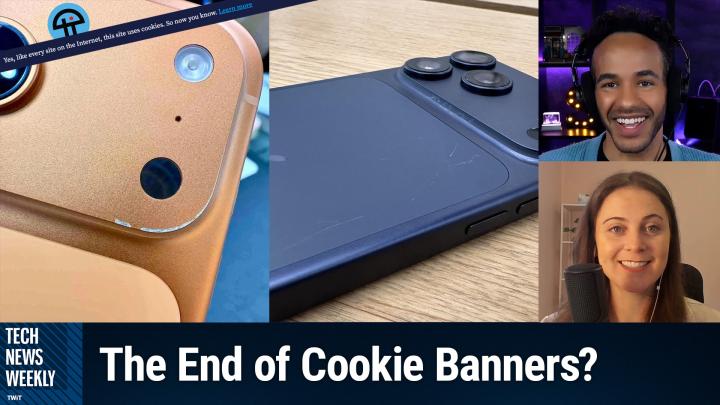
All TWiT.tv Shows (Audio)
Tech News Weekly 406: iFixit's Take on iPhone 17 'Scratchgate'
00:56:55
EU Considering Ending Cookie Consent Banners
Loading summary
Transcript93 lines
- [00:00]
A
Coming up on Tech News Weekly, Emily Forlini is here and we kick off the show by talking about how those cookie consent banners might be going away. Then I talk about Amazon settling with the FTC for dark patterns and Amazon prime subscriptions. Afterwards, Elizabeth Chamberlain of Ifixit joins the show. Very excited to talk about the iPhone 17 Pro and Pro Max, the teardown and tech woven. Can it be saved from your hot sauce fingers? All of that coming up on Tech News Weekly.
- [00:38]
B
Podcasts you love from people you Trust.
- [00:43]
A
This is TWiT. This is Tech News Weekly, episode 406 with Emily Forlini and me, Micah Sargent. Recorded Thursday, September 25, 2025. IFixit's take on iPhone 17, Scratchgate. Hello and welcome to Tech News Weekly, the show where every week we talk to and about the people making and breaking the tech news. I am your host, Micah Sargent, and I am joined this week by PCMag's own Emily Forlini. Welcome back, Emily.
- [01:19]
B
Lovely to be here.
- [01:21]
A
Lovely to have you here with us. For the people who are tuning in for the first time, or perhaps you've been here before, but just need a little reminder, this is the part of the show where we talk about our stories of the week. These are the stories that we found interesting. Sometimes these stories creep up on us early in the week and sometimes they're late breaking. And so I'm very excited because I do believe this is a story that was written by you, Emily. Is that correct?
- [01:52]
B
Oh, which one? The cookies or the.
- [01:55]
A
Yeah, yours. Yours.
- [01:56]
B
Yes, this was written by me. So, you know, cookie banners, you visit a website, it pops up. Do you accept all? Do you reject? Do you manage? And it's like this constant choice you have to make about this thing called cookies. So apparently that comes from a European law from 2009 called the E Privacy Directive. And I'm like, what Was happening in 2009? Do you remember? Like, Facebook was still maybe private.
- [02:27]
A
Oh, wow. Yeah, I guess I haven't. I. Wow. 2009 was a long time ago.
- [02:32]
B
Yeah.
- [02:33]
A
Yeah. I think you did have to have at the very least, like a college address, right?
- [02:37]
B
Yeah.
- [02:38]
A
Or maybe just changed. Yeah, yeah. Or it had just changed long time ago. Wow.
- [02:44]
B
What else? Like, people were probably, you know, still making Yahoo. Email accounts.
- [02:50]
A
You had Yahoo email accounts. You probably had online, like MySpace, sort of blogs where you would go and you'd make your own HTML for the page and. Yeah, that. What else would have been going on Tumblr? Yes, we were tumbling. We were maybe getting into posting at least photos online. I Don't think video was quite as popular as it is of course now. So it was the earlier, much earlier web.
- [03:23]
B
Exactly. It was a different time. And so we still have this law and of course intended for privacy to protect the user. So, you know, when you, when you do give over your cookies, as they're called, it could be like, you know, personal information about you. It could be sold to third parties, or it can be used to customize the ads you see on the page and things like that. So it is personal information, so it makes sense. But now basically that even the EU that, you know, restrictive EU as they are, are saying, you know, I think this might be overkill. I think we're going to reconsider this law which, you know, could get rid of these banners for everyone. And one of their solutions, which I think would be much better is just that you can set in browser settings just what you want to do on a given web page. Ooh, one time. So there are probably tons of details I couldn't even get into. But I, I don't like cookie banners. I don't know about you. Do you like them?
- [04:22]
A
I hate them, yeah. Because it makes me. I don't want to have to make a choice for every single website I visit and I don't want to, which, which is often the case for me, have to make a choice over and over and over again because my browser has protections in place that sort of remove those cookies that are supposed to be saved. And so every time I go there and it thinks I need to go and redo it and answer that question again. And then there's the idea that, like, you can also hit the X and not have the banner present itself. And that makes it more confusing because then it's like, why am I doing this in the first place if there's an option to sort of opt out of making a choice. It's so weird.
- [05:11]
B
It's so weird. And I just feel like I'm uninformed. I actually realized I get just the slightest, just the tiniest bit of anxiety when I see a cookie banner. I'm like, oh, no, my, like gonna get identity theft if I select Accept All. But if I select Manage now I have to go comb through all this stuff and it doesn't really work with the quantity of websites I have to visit for things like journalism, which is super research heavy, or even if you're online shopping, you're going to tons of websites and you have to make this choice. And it's like, I don't even Know what I'm doing? I'm just going to select the thing that's gets this banner away the fastest. And it's just kind of ridiculous. So when I saw they're going to reconsider it, I was like, good.
- [05:55]
A
Yeah. I think that the. Look, there are multiple tools out there that you can download to hide these cookie banners so you never have to see them and interact with them. And I've used a number of these tools before. But the funny thing is they don't always work. And so sometimes you'll still see one pop up and then you're going, okay, what is the exact dance I need to do here to figure out what I am comfortable with, what I'm not comfortable with? And then what ends up happening for me is I don't really care enough to take the time to think all of it through. And so then I'm like, you know what? Just, it's fine. I'll just say, give me only the necessary cookies. But then I come to find out that this one of the pages that is always sort of responsible for this auto parts websites. And so like an O'Reilly or an advanced auto and annoying to have to every time say, okay, this is my car model, this is my make, this is this, this is this. And so let me give you the proper cookies, right, to save this. And then I go back to the page and then it's asking me it again. That doesn't happen all the time, right. I'm not always buying new car parts, but the times that I have, it's annoying. And I'm going, well, maybe this is of the places where I want to allow for more cookies, but you have three different options instead of just two. And if I choose all three, is that the one? Right. That is going to be the tracking me across different sites. And it's just, yeah, it adds more, I think, anxiety than needs to be there. I would argue, not just for us as website visitors, but also the main reason we started to see these pop up across, I mean literally pop up across the web is because companies were just trying to cover their bases, frankly. It's also why we see a lot of accessibility overlays here in the US Especially is because companies heard about a company getting sued for not providing the proper accessibility. And from that point on, then everybody said, oh, I need my website to have this. Frankly, that was at the heart of having privacy notices on pages as well. Like to have that Terms and Terms of Use and privacy Policy all has to do with just people. Companies avoiding being sued. And so in that way, it's just a. Anytime one of these bits of legislation goes forth, right, this, this requirement, dozens of companies pop up that just offer, here's how you can get in compliance with this specific ruling or this specific law. And it's always bare minim, never what you want. And that, I think, is what's particularly frustrating to me. It's just kind of like you could be doing so much more, right.
- [08:56]
B
I'm not a fan of things that companies do to kind of COVID their own tracks, but don't actually empower me. This has been on all these websites and it's preventing them from getting sued, but I don't actually even really know what I'm doing as average Internet user doesn't know what they're consenting or not consenting to when it pops up. So really it feels not totally in my interest because it's not. It's designed for me to just press accept because I don't want to spend the time to manage and select. So it's really designed for the company to cover its butt while just me, me still giving over my information. And I don't like that. But I do like some things the EU has given us. My favorite thing ever, which is the iPhone chargers, you know, the EU legislation.
- [09:46]
A
Yeah, yeah, yeah, yeah. So that one's a good one.
- [09:49]
B
That one's like too good to be true. I still can't believe that even happened. And now you can charge your iPhone with any cord, like, thank you, European Union. But this one, the cookie banner, I think it's got to go.
- [10:02]
A
I think that, yeah, I'm okay with this being set up in the, again, the way that it is, the way that they're going with it. Right. It seems to make sense. And it at the time provided the.
- [10:18]
C
Proper.
- [10:22]
A
For the understanding of the web, at the time, it provided what was needed. But as the web has advanced and as browsers have advanced and as our understanding of the Internet has advanced, I think again, you point out something that is really at the heart of it, which is that it causes confusion and it causes anxiety. And that I think is, if there's one thing I could say about the eu, it's that they really do. It does really feel like an organization that aims to, to focus on sort of the spirit of the law. Right. And by that I mean it's about making the, in these cases, the life of its citizens better. And I think that's pretty cool. And I like that the, you know, the EU looks at. Okay how can these things change over time? How can we make them better? And in that way it feels forward thinking to to make changes as are needed.
- [11:28]
B
So yeah, yeah. Also just when you said that, it made me realize like, yeah, it was good from the start, but was it good from the start? The word cookies has been confusing people forever. Like why is it a cookie? Like I put the Cookie Monster as the photo for my article. Like just the word cookie. I don't think there's different types of them. There's one that stores your password, but then there's the one that stores some demographic data and sells it to who knows where. I mean, the whole thing, now that I think about it, has actually been quite confusing from the average person from the beginning. So privacy good. Confusing banners that talk about baked goods bad.
- [12:11]
A
Well put. All right, we are going to take a quick break so I can tell you about our first sponsor before we come back with my story of the week that has a late breaking component. So pretty exciting. There is talking to Emily this morning and said this is going to be my story. Emily said there's more to it and quickly kind of shifted. So let me tell you though first about Starlight Hyperlift bringing you this episode of Tech News Weekly. That is an exciting name. Starlight Hyperlift, which is Spaceship's new cloud deployment platform for launching containerized apps with zero infrastructure headaches. You can go from code to cloud fast with GitHub based deployments, real time logs and pay as you go pricing. No servers, no YAML files to worry about, no DevOps, just your project in the cloud in seconds. You've probably already heard us mention Spaceship. They're a domain and web platform that simplifies choosing, purchasing and managing domain names and web products, including hosting. I talked about how I was able to during the call with the folks at Spaceship, set up a Spaceship domain in no time and Even get a WordPress blog up and running. While we were having the conversation, it was very easy to do with hyperlift. Now Spaceship takes that same philosophy and brings it to cloud native deployment. It's made for devs, indie hacking, hackers and innovators who need to test fast, iterate faster and ship Smarter. Go to Spaceship.com TWIT to find more info about Starlight Hyperlift and get custom deals on spaceship products. That's Spaceship.com TWIT and we thank Spaceship for sponsoring this week's episode of Tech News Weekly. All right, back from the break, joined this week by Emily Forlini of PC Mag. And now let's Talk about what's going on with Amazon, because Amazon has agreed to pay arguably a staggering $2.5 billion settlement with the Federal Trade Commission. This comes just days into what was expected to be a month long civil trial over allegations that the e commerce giant deliberately tricked customers into signing up for prime subscriptions and made cancellation unnecessarily difficult. The settlement, which includes a $1 billion civil pen, largest in FTC history by my reckoning, and a $1.5 billion consumer refund fund, represents a significant moment of accountability for one of the world's most valuable companies. Now, beyond the financial implications, Amazon will be required to fundamentally redesign its prime subscription interface, including creating what the FTC calls and I'll add a. Finally here, finally, a simple way to cancel this resolution comes after years of investigation that began during the first Trump administration and intensified under FTC chair Lina Khan, marking a rare instance where a tech giant has chosen to settle rather than do what we've seen so many times before, fighting allegations and sort of dragging on cases, but instead chose to settle instead of dealing with this allegation of using manipulative design practices against its own customers. Now, let's talk about the kind of financial components of this, because again, $2.5 billion, that's a whole lot of cash. And it's split up, as I said, between these two areas, the $1 billion civil penalty and the $1.5 billion fund that will pay back consumers who were allegedly deceived into prime memberships. We'll have to see kind of how that part plays out. You know, who will all be involved in this huge settlement and whether people who continue to have a Prime membership are or aren't when you got your prime membership, that kind of thing. And also Amazon having to work to now change its interface so you can change it, change your, your subscription very easily. Something kind of wild. The way that they were able to argue this one, one way at least, is that the FTC put forth the. The evidence around what regulators call dark patterns. We know these to be the way that you kind of go to a website and you follow and it kind of misleads you about what decisions you're making and those that you mean to make and those that you don't. So making it simpler to subscribe than it is to unsubscribe or call to unsubscribe. But then you also have to wait for an email to come in that says, are you sure you want to unsubscribe? And then you have to follow through with that, all those different practices of just making it difficult. According to the FTC's trial brief, Amazon employees internally described the enrollment issues as an unspoken cancer because fixing the clarity problems would lead to a drop in subscribers. This internal acknowledgment became a key piece of evidence suggesting that Amazon knew about the deceptive nature of its practices. And by the way, what did they call the unsubscription process? They called it the Iliad flow. So people familiar with good old Homer will know about the Iliad and the Odyssey and this huge journey that is a 4 page, 6 click 15 option journey required to cancel a Prime membership. So it sounds like the FTC had a pretty good case. Emily, I, I'm interested that the company chose to just settle out. And what I've seen is that analysts are suggesting that a big part of why could be because this was a trial case instead of just, excuse me, a jury case instead of just involving a judge making decisions.
- [18:22]
B
Yeah, I don't know because it happened quickly. So the article you sent me from NPR was just two days ago and it said they're going to trial. And then I woke up today and I had an email from the FTC to my inbox. We settled like, oh, okay. What happened in the past two days? You know, some serious, serious crap like went down. Inboxes were flowing, like phones were ringing. I don't know what, but it is big. And I think one thing that's really cool is they actually named two Amazon executives in the FTC press release and they said they charged them as well. So it's not just this generic Amazon, which is massive, one of the biggest employers in the U.S. they named two guys Neil and actually other guy's name is I think Jamil. So they rhyme and they name these two guys who are an SVP and a vp. And I think that really sends a message to executives who are in meetings at these companies who are approving business directions like these guys were, you know, based on their titles. And it's saying, you know, you can't hide under the COVID of this organization. Like you as an individual, if you greenlit this strategy, if you signed off, you will also be named publicly as someone who deceived customers, which is huge.
- [19:44]
A
That's a good point. Yeah, that, that adds even more to it because that's going to follow you. Right. And people will see you directly and know that this is, this is part of it.
- [19:54]
B
They didn't say what's happening to those guys though. They just like. Because there's the 1 million civil penalty, the 1.5 to customers. And then it's just also these two guys. So it's like, I don't know, it's certainly a reputation killer.
- [20:08]
A
But yeah, but yeah, they at the very least name and we'll see about shame. Amazon did argue at the beginning that the law, the FTC law doesn't specifically define dark patterns. And so it was kind of the FTC painting with a broad paintbrush. And in that way it was not fair to accuse Amazon of using dark patterns. The company claimed that evidence of, quote, a small percentage of customers misunderstanding, prime enrollment or cancellation didn't prove legal violations. One of the things though that was in this case that I think perhaps resulted in some kind of bad blood. Judge Chun, who was set to be the judge on this and is working with the, the larger FTC case with Amazon, admonished Amazon's lawyers in July for what he said was conduct tantamount to bad faith. Because according to the judge, Amazon had hidden potential, potentially incriminating evidence by improperly marking documents as privileged and then withdrawing almost all of the privileged claims on the documents and producing 70,000 documents at the last minute. So sort of overloading the court with a bunch of documents and then also saying originally that these were privileged documents be shared elsewhere. But then it just confusion and mess and all of that is something that the judge considers to be kind of trying to, to, to cause tumult, to make it more difficult to, to make a ruling here. Now there was a Pennsylvania State University law professor who said the question is when design crosses the line into a situation where a reasonable consumer does not have a fair shot of understanding what's going on. So again, this is kind of trying to define what a dark pattern is, what this means for the subscription economy. Ultimately, for me, what I hope happens is the promise that we've heard, I think it was from the fcc, not the ftc, that we would have a click to cancel sort of mandate across the web. That would be wonderful. I would love to have that. I think that that is how things should be and I think that it is good that we're seeing companies have to answer for these. A company, of course, is going to say, what's a dark pattern? I don't know what a dark pattern is. You can't just say dark pattern. And we. This also feels like an earlier ruling from, I believe the FCC where they said, you know it when you see it. Anyone who knows what I'm talking about there, if you know, you know, and this also falls, as far as I'm concerned, into that you know it when you see it, or I guess you know it when you don't see it.
- [23:18]
B
Because there's an example. So one example that the FTC listed was their button to decline a Prime subscription at checkout. Said, no, I don't want free shipping. Do you know what I mean? Do you catch that?
- [23:33]
A
Oh yeah, yeah, yeah. No, I don't want free shipping.
- [23:35]
B
Right. So you're, everyone wants free shipping. So if you, if you're not paying attention, you might click, yes, I want free shipping. And then all of a sudden you've enrolled in prime and you don't know that it's going to renew. You don't, you don't know. You just spent money or maybe there was some fine print or it was just confusing. So that's one thing that they talked about. So it could be a deceptive enrollment practice. Now you're in prime and also you don't know how to cancel and you didn't even sign up properly. So you're like, where do I even go to cancel? I don't even know where I signed up. So there. And part of what Amazon has to do is make it very clear where you sign up and also have the cancellation be in the same place. So you just go back and do that. Which sounds so simple. Like how is that this is the big conclusion that that's it. So I mean, there's a couple different actions Amazon has to do. One is to hire a third party auditor to basically babysit them and make sure that they do it and Amazon has to pay for it.
- [24:36]
A
And I think that again, that's good. Yeah, yeah, I want this. But again, I want, ultimately for me it's about making people aware of the things that they're signing up for. You know, the New York Times got in trouble for resubscribing people to the, to the subscription, like the, I believe it was the paper subscription. And you basically had signed up for a certain amount of time and it should have been that after that it, you at least got prompted, hey, do you want to cancel this? And so I ended up actually being affected by that. I had gotten New York Times physical paper subscription for a while and I remember that I had expected it was going to be, you know, whatever I did, six months, right. And I had set it up with an email address that I ended up, it was part of a domain that I decided not to keep and forgot that this was part of it. Right. So later I got this Letter in the mail and it was from a collections company. And it was like, you owe the New York Times $54, only $54 and you sent it to collections. Come on. And then later on I ended up as part of that, you know, class action settlement or whatever and they ended up paying me for what I had technically owed them, which was good. But yeah, that, that really, that, that was not great. And, and I don't think that it's good for any company to be, to be doing these kind of dark practices. One that seems to be able to kind of go through. I don't know if you've seen this. Certainly I have. You put something in your cart and it says it's in 15 other people's cart right now. And then it also will say there are only one or two left, so you need to hop on it before another person gets it. I look at that every time and go, okay, yeah, I definitely believe that. And then, you know, a lot of the time it sits in my cart for a while and then I decide, okay, yeah, I want to get this thing. And it's in stock. And they, I don't, I don't believe it. Whenever those, those, that sense of urgency I feel is fake for sure.
- [27:04]
B
Yes. That's a really good one actually. We should, you should do that, that lawsuit next.
- [27:09]
A
Yeah, I'm gonna hop on it. That, absolutely. So here we're going to see kind of how things play out with Amazon going forward as it hires this outside watchdog to focus on these changes. I'll be interested to see how my. Because I do have a subscription to Amazon Prime. I'll be interested to see how that changes. If I start getting emails like, hey, your Prime's about to renew. Are you sure you want to do this or how easily or if you get money. Yeah, we're fine.
- [27:37]
B
Who's going to get some money? It'll probably be $6 exactly. They're so un. Anticlimactic.
- [27:45]
A
Yeah. The number of people involved with like that have Amazon prime subscriptions is so high. And the. I mean there's always a subset that end up doing the class action, but still it's. Yeah, I imagine it won't be very.
- [27:59]
B
Much that you're not going to be able to buy a new house with your Amazon.
- [28:02]
A
Darn it.
- [28:02]
B
You might be able to buy a sandwich maybe at a fancy sub shop. Amazon Whole Foods.
- [28:09]
A
Right.
- [28:09]
C
Back to Amazon. Perfect.
- [28:10]
B
Just buy something on Amazon with it.
- [28:14]
A
They actually, they'll offer an Amazon gift card. No, Right.
- [28:16]
B
It'll be like rebate to your account. You'll be like, why not, you know.
- [28:20]
A
Yeah, go toward my next Amazon prime renewal. Emily Forliti, I want to thank you so much for taking the time to join us today. If people would like to follow you online and check out all the great work you're doing, listen to your other show or shows, where should they go.
- [28:33]
B
To do that so you can find me on all the socials? Emily Forlini is the name. It's not too hard. And then of course at my PCMAG bio you can see all my recent work and then you can get a little more personality about my work on my podcast, Super Intelligent Podcast, which we record over the weekends. So that's a fun one while you're folding laundry. So check that out.
- [28:57]
A
Awesome. Thank you Emily. We appreciate it. Alrighty folks, we're gonna take a quick break before we come back with a really interesting story or set of stories regarding the new phones and ifixits hands on. Before that though, let me tell you about Smartie bringing you this episode of Tech News Weekly. This is Smarty Discover what's possible when address data works for you Smarty is revolutionizing how you handle address information, bringing automation, speed and accuracy to process that used to be manual, error prone and frustrating. With Smartie's cloud based address validation APIs, you can instantly check and correct addresses in real time. No more bad data compliance risks, undeliverable mail or costly delays. Add Autocomplete to your web forms so your customers select valid verified addresses as they type. This will improve their user experience and yield much better data for you. Companies like Fabletics have drastically increased conversion rates for new customers, especially especially internationally. With Smartie, you want more than just clean addresses. Well, Smartie's Property Data API unlocks 350 plus insights on every address from square footage to tax history, automatically enriching your database. It's incredibly fast, 25,000 plus addresses per second and very easy to integrate. The Red Cross needed accurate address data to allocate resources. A project manager says the Smarty tool has been fundamental. I've never experienced any issues with the tools and they seem to be getting better all the time. The address verification really does make an impact. We're able to reach the communities we serve because we have good addresses. Smartie is a 2025 award winner as well across many G2 categories. Best results, Best Usability, Users Most Likely to Recommend and High Performer for Small Businesses. Smartie is also USPS Cass and SOC2 certified and HIPAA compliant. Whether you're building your first form or modernizing an entire platform, Smartie you the tools to do it smarter. Try it yourself. Get 1,000 free lookups when you sign up for a 42 day free trial. Visit smarty.com twit to learn more. That's smarty.com twit. Thank you Smarty, for sponsoring this week's episode of Tech News Weekly. All right, we are back from the break and I'm so excited about our next guest guest Liz Chamberlain from iFixit.
- [31:34]
C
Welcome.
- [31:34]
A
Welcome.
- [31:35]
C
Thank you. Great to be here.
- [31:36]
A
Yeah. So as always, was very excited, sort of refreshing the iFixit page as everything was coming, coming through with, with Apple's iPhones this year and very excited when boop up popped some tear down magic. And so I wanted to start by Talking about the iPhone 17 Pro Pro Max situation because during that teardown you discuss the durability issue with the IPH17 Pro's camera plateau. We've heard reviewers call it scratch gate. I was hoping you kind of walk us through what's actually happening when these phones get scratched and why that camera bump or the edges of that camera bump are particularly vulnerable.
- [32:20]
C
Yeah, yeah, absolutely. So as you may have heard, Apple switched from titanium to aluminum in the construction of, of most of their phones at this point. And they have anodized that aluminum, which means that they dip it in an electrochemical bath to build a layer of fancy corrosion, basically. And what people have been noticing is that that corrosion, that anodization layer kind of scratches away more easily than it probably should and it's worst at the edges of the camera bump. So Zach over at JerryRigEverything showed that, you know, the scratches on the body of the phone weren't that significant, but right at the edge of the camera bump stuff was really flaking away. So we knew we wanted to look closely at that and that's what we did in the teardown.
- [33:15]
A
Yeah. And I think, you know, every year you kind of are wondering what the gate is going to be and also, at least for me, sort of trying to sort out what might be an individual's experience versus what might be something that a lot of people experience. And it's hard because you, you are quickly looking at what's happening right away, but then you want to wait a little bit to see what else is coming through. And that's one of the things I really appreciate about iFixit is you can dig in and do the research to kind of say, okay, here's what we're seeing and here's why, even if you maybe haven't seen a lot of instances of it, or if you've seen plenty of instances of it, why this might be at the root of it. I mean, you brought in the material scientist to help investigate the scratching problem. What did that analysis reveal about the anodization process? And if so, like, could there have been some changes made to reduce the opportunities for scratchgate?
- [34:16]
C
Yeah. Yeah. So we brought in David Niebuhr, who runs Niebuhr Metallurgical Engineering, and he also teaches at Cal Poly, which is the university down the road from us. And he came in and helped us with run some scratch tests to make sure that we were doing it right from a material science perspective. And he, he told us that at edges, anodization doesn't work as well. So at sharp edges, basically the anodization layer is supported only by other, the rest of the anodized material. So instead of being the, the stronger aluminum underneath and the anodizing on top, where they can sort of deform together at edges, sharp edges, like at the edge of the camera plateau, the anodizing flakes away. And he said that's called spalling. And we were seeing it at the edges of the camera plateau and not on the back of the phone. So anywhere that you know that the anodizing was applied flat or applied on a smooth edge, it seemed to hold up relatively well. But at that sharp edge, at the edge of the camera plateau, it would flake. And David Niebuhr said that Apple could have prevented it by having basically a smoother edge to the camera plateau. So if it wasn't as sharp, it wouldn't be doing this.
- [35:39]
A
That is interesting. So in that way, it kind of feels like a, a design decision that is in this way, sort of looking at something that looks nice. What is it? It's form over function in this situation, which is perhaps something Apple has been accused of in the past once or twice. So, moving from durability to repairability, the iPhone 17 Pro introduces something that we, as far as I know, hopefully you can confirm, have never seen in an iPhone before, a screwed in battery. It also resulted in me reading a whole lot about Torx plus because there are 14 Torx plus screws of this. What is the significance of this change? And especially for, you know, an everyday user who doesn't nerd out about Torx plus as much as I do, who just might need a battery replacement?
- [36:37]
C
Totally. Yeah. So we've been saying for a long time that batteries can be screwed in that we don't have to have these, you know, crazy glues that, that are challenging for people and leave residue and mean you have to get new glue, new adhesive to be able to do a battery repair. And Apple has proven it. You can change this battery with just a screwdriver. You don't have to release the adhesive, which is, you know, it's a, it's a huge deal for repair. And the sense that, you know, it just, it really simplifies things. It makes it a lot more repeatable and, you know, as excited as we were to see the electrically debonding adhesive where you, you know, you apply 9 to 12 volts and it, it releases over a period of time. It's cool, really exciting from a nerd perspective. But again, you know, a lot of people, a lot of people are kind of intimidated by that. I think a screwdriver is a lot less intimidating. And we don't know yet. Apple hasn't released parts of yet. So we don't know for sure if they're going to sell just the battery and, you know, and tell people to use the same electrically debonding process they used before or if they're going to sell it with the frame. But their official repair manual for the 17 Pro shows removing the whole tray, so doing it with, with the screws. So it seems like they probably will sell the battery attached to the tray.
- [37:56]
A
Ooh, interesting. Well, we'll have to see how that goes.
- [38:00]
D
Hey, it's Ryan Seacrest for Albertsons and Safeway Cough. And cold season is coming, so make sure you're prepared and stock up on your family's favorite personal wellness products. Now through October 7th. Shop in store and online for savings on products like Mucinex, Kickstart Combo, Zyrtec Allergy relief tablets or liquid Gels, Halls cough drops and Mucinex Fast day and night, so you and your family are armed and ready for the season ahead. Offerings October 7th. Restrictions apply. Offers may vary. Visit albertsons or safeway.com for more details.
- [38:30]
C
You can make a difference in someone's life, including your own, with a job in home care. These jobs offer flexible schedules, health care, retirement options and free training. They also provide paid time off and opportunities for overtime. Visit oregonhomecarejobs.com to learn more and apply. That's oregonhomecarejobs.com.
- [38:59]
A
The iPhone Air. So moving from the pro and pro max is in theory, Apple says it's its thinnest iPhone ever, at what, 5.6 millimeters? Yet interestingly it did receive the same repairability score, tentative repairability score as the, the thicker pro model. And some thought that in the rumors leading up to this, I heard it time and time again. Oh well, that one's going to be a nightmare. That one's going to be a nightmare. However, taking it apart, interesting that it got that seven as well. How does making a phone thinner in this case actually help with repairability?
- [39:44]
C
Yeah, I mean, as you said, we were scared when we first heard about the air, like, oh gosh, it's going to be going to be a bear. And it, it wasn't. We were really excited to see that a bunch of the repair friendly things that Apple has been doing in iPhone designs in the last few years were all in the air. So it, it has a dual entry design so you can open it from the front or the back, meaning that you can replace a battery without having to go through the display, which is huge. And because it's thinner, you know, it's, you, you open that back panel and you can, can basically see all the components that you might want to repair. Things are not stacked up on top of each other. And it, you know, it. To do that and do it well requires some really clever use of the space and Apple has done that. So the, you know, the logic board is pushed up above the battery and then the, the camera plateau is up above that. But you know, for the most part, components don't get in the way of each other and that's, that's, you know, it's possible with thin design. It's challenging, but we're excited to see that that's the reality in the air.
- [40:53]
A
Yeah. And I mean, people were kind of initially a little bit upset. It seemed that the MagSafe battery pack that Apple introduced was specific to the iPhone air and that, you know, you couldn't really use it with any of the other phones, save for plugging it in and using it. Like a USB C kind of battery pack.
- [41:20]
C
Yeah.
- [41:21]
A
Can you tell us a little bit about what you Learned about the MagSafe battery pack and perhaps why it pairs so well?
- [41:29]
C
So we got our hands on a MagSafe battery pack a couple days before the iPhone release. And we couldn't help tearing it apart, of course, because we're ifixit and that's what we do. And we realized when we opened it up that it had this weird shape and we guessed, is this the same battery that we're going to see in the air? Because it had the cutout that looked like it was making Room for the logic board. And sure enough, when we took apart the iPhone air immediately we had the batteries side by side on the teardown table. And it was obvious they were exactly the same size and shape. They had all the same markings on them. And sure enough, when we put the battery pack from the magsafe battery pack into the air, we were able to boot, we were able to run repair assistant. And it's the same battery. It's exactly the same.
- [42:23]
A
Wow, that's really cool. Another interesting component of this Apple appears to be using 3D printing technology for the USB C port housing in the iPhone Air. You looked at that under a microscope. What did you observe about this? And why might Apple be turning to this additive menu manufacturing process for these components?
- [42:43]
C
Yeah, yeah. So we passed it to some, some material scientists. We know people working in 3D printing and they, they say it's, it's doesn't quite look like any, any metal 3D printing they've seen before. It's a little bit different in structure. You know, we're not, we're not materials scientists, so we're, we're still having a lot of conversations with them about what exactly that means and what we're seeing and what we can say definitively about the process that Apple's using here. It seems like it might be related to some patents that they inherited in metal 3D printing back in 2015, but we're still, we're still sort of digging into it. The best guess I've heard about why they're doing this in this case, both, you know, both for the USB C port, which is 3D printed in, in the air, and then also for the, the case of the, the Ultra 3, the Apple Watch. Best guess is that titanium has some geopolitical challenges. My understanding is that most of the titanium that we source is, is through Russia and that has become more challenging to obtain, more expensive. So that's our best guess.
- [43:54]
A
Interesting. That adds a whole nother wrinkle to a, an aluminum unibody design for the iPhone being sold as this sort of. It's better at heat dissipation and this and that and the other. Is it. Or could you just not get the titanium? Anyway, we'll have to ponder that. But I wanted to mention that both of These phones scored 7 out of 10 for repairability, despite having very different internal and of course, external designs. So can you tell us just a little bit about what earned them that score? And then I'm always curious to hear what could Apple do better to get an even higher score.
- [44:36]
C
Yeah. Yeah. Well, I mean, so first of all, one of the biggest things that we're looking for is are our parts available? And Apple has promised yes. Are repair manuals available? They are. Day one, we're so excited still to see day one repair manuals for things Apple's putting out, then looking at repairable design. You know, obviously there were a lot of different choices in the Air and the Pro and we were disappointed in the Pro in that it, you know, it lost the dual entry design. That means you don't have to go through the screen to get to most things. Excited to see that in the air. But the Pro brought this screwed in battery which is huge. And still, even though you know you have to go through the screen, the main thing we're looking at is how long does it take you to do a repair. And still, you know, through clever use of space and through modular design, the vast majority of things you would want to replace in the Pro are, are still modular and relatively easy to access without being buried under other components. So, you know, when we say that Apple has been improving their attention to repairability and design, that's really what we're talking about, that they're, they're making it so that parts don't bury other parts. You can replace parts when you need to. And it, you know, even though there are some, some different choices in, in the two designs of the phone, they, they both seem to be keeping repair in mind.
- [46:09]
A
Absolutely. All right, that is what we, what I wanted to ask you about the, the 17 lineup and teardowns there. We're going to take a quick break and then we're going to talk about the current state of the woven accessories from Apple. Stay tuned.
- [46:30]
D
Hey, it's Ryan Seacrest for Albertsons and Safeway. Cough and cold season is coming, so make sure you're prepared and stock up on your family's favorite personal wellness products now through October 7th. 7th shop in store and online for savings on products like Mucinex Kickstart Combo, Zyrtec Allergy relief tablets or liquid gels, Halls cough drops and Mucinex Fast day and night so you and your family are armed and ready for the season ahead. Offerings October 7th. Restrictions apply. Offers may vary. Visit albertsons or safeway.com for more details.
- [47:00]
C
You can make a difference in someone's life, including your own, with a job in home care. These jobs offer flexible schedules, health care, retirement options and free training. They also provide paid time off and opportunities for overtime. Visit oregonhomecarejobs.com to learn more and apply. That's oregonhomecarejobs.com all right, we are back.
- [47:31]
A
With Liz Chamberlain of iFixit, who is here to tell us now about fine woven versus tech woven. Thank you again for your time today, Liz.
- [47:42]
C
Glad to be here.
- [47:43]
A
Yeah. So let's start with this. I would love to hear kind of what prompted the iFixit team to do such a deep dive into Apple's new tech woven cases and comparing it to the fine woven of yesteryear.
- [47:57]
C
Yeah, so two years ago, Apple came out with this new material they were calling fine woven, which was supposed to replace their leather case lineup with the goal of, you know, using more recycled materials and moving away from, you know, animal materials in their cases. And so it was supposed to be sort of a premium feel fabric material that would also be durable, you know, and also provide protection for the phone. And we, we had our, our microscope from our friends at evident. We wanted to take a look closely at this material, see what was happening. And we figured we'd put it through some tests. And so we, we, we put oil on it and coffee and hot sauce and looked closely at what happened when we did that. And embarrassingly, the case could not handle greasy fingers, could not handle hot sauce fingers. Basically everything would stain it and would get deep into these fibers and, and even with, you know, rubbing with, with isopropyl alcohol and cleaning it in various ways, it would not come back. And so this case that you're showing here is our tech writer Arthur. His wife bought a used iPhone 15 Pro, and it came with a fine woven case, and it does not look very good after a couple of years of use. Gross.
- [49:23]
A
Oh, it's so gross. And so this is what's interesting. I, of course, I ran my fingers across the newer tech woven and that. And I also, I think I. What did I do? I did one other thing where I could sort of look closer at the fabrics, but that was the extent of my analysis of it. Your team did a microscopic analysis. Can you tell us about the key differences between the tech woven and fine woven between those thread structures and the coating?
- [49:54]
C
Yeah, yeah. So there are two major things that are different about tech woven from finewoven. One is the fibers themselves are bigger. So, you know, we've got some pictures of the same magnification, and you can see that the strands themselves are bigger than the fine woven in the tech woven. Also, it's got this coating that, you know, some kind of resin coating that's over the top of the fibers that Keeps things from, from soaking into it. And what we found is that it's pretty effective for the vast majority of the case. Like, we tried the same test. We put oil and hot sauce and coffee and even nigiri on it, and we were able to, able to wipe off the residue. It did a pretty good job of handling that.
- [50:43]
A
Now, while it did do a better job than the case, again, the fine woven case, your team did discover that there were some vulnerabilities at the edges and also vulnerabilities when physical damage was involved. Can you talk about the significance of these sort of weak points for the everyday user who, you know, puts a case on a phone so that it can, you know, be protected?
- [51:10]
C
Totally. Totally. Yeah. Well, so with, with fine woven, we were able to scratch it with keys, which is also frightening. You know, most people keep their phone near their keys at some point. This time, tech woven, we couldn't scratch with keys, but we could scratch with a knife. We were partnering with Zach from JerryRigEverything and we used his knife on it. And sure enough, we, we were able to scratch it with the knife. And when we did that, the, the, the fibers stopped being as well protected from coffee and oil and so on and stuff would seep into it. So it seems like once you breach that, that protective resin layer on top, the case doesn't do as good a job at stopping things from staining it. And we saw the same thing at the edges of the case less dramatically, but it seems like at the edge where the fibers kind of poke through the resin, they, they're more vulnerable to, to getting damaged by oil. Coffee. Yeah, yeah, exactly, exactly. It seems like there's some wicking now.
- [52:14]
A
So the question I kind of have with this is the article says that it feels less like fabric than fine woven and more like textured plastic. In looking at this, can you tell us, is this an overall improvement to durability by kind of foregoing that fabric feel, or does it kind of defeat the purpose of having a case made of textile that is meant to replace leather in the first place?
- [52:49]
C
Yeah, so we haven't done any durability tests in the sense of if you drop your phone, how well does the case do? And that's really the main reason people put cases on phones, especially phones as pretty as iPhones. And so we can't really say how well this case will hold up or if there are differences in how fine woven and tech woven handle drops. But, you know, at least durability wise, seems like this is a, excuse me, cosmetically this is, this is better than fine woven. So, you know, it's, it's, you're, you're less likely to stain your case with hot sauce fingers. That's what we can say.
- [53:28]
A
Yes, that. Yes. So if you, if you're a big hot sauce fan, perhaps this was a little bit better for you. Unless you're also a big utility knife fan, which it's not so great. Based on your team's findings, what advice would you give to consumers trying to decide between tech woven and other case options, especially those who experience those fine woven issues firsthand?
- [53:53]
C
Yeah, I mean, I'd say if you were happy with your fine woven case other than the hot sauce finger problem, then then tech woven might be a good option for you. And otherwise, you know, you, I think it's, it's probably not as likely to hold up well as a case that's fully sealed. Those, those edges worry me. I wouldn't, I wouldn't personally buy a tech woven case at this point.
- [54:20]
A
Well, Liz, I want to thank you so much for taking the time to join us today. There's lots more information, but I think even cooler and better, lots of photos and interactive components over on iFixit website. We'll have links in the show, notes to the articles. Thank you for being here. If people would like to keep up to date with what you and the team are doing, where are the places they should go to do that?
- [54:44]
C
So we're on YouTube is iFixit yourself and every other social media platform as iFixit or of course@ifixit.com awesome.
- [54:53]
A
Thank you so much. We appreciate it.
- [54:54]
C
Thank you.
- [54:56]
A
And with that, we have reached the end of this episode of Tech News Weekly. Of course, you can check out the show each week and subscribe at TWiT TV TNW. That's where you go to get the audio and video versions of our show. I talked about it during the episode, but just a quick reminder again, Twit TV Club twit. That's where you go to become a member of the club. $10 a month, $120 a year, and so many awesome benefits. If you'd like to follow me online, I'm ikasargent on many a social media network. Or you can head to Chihuahua Coffee. That's C H I H U A H u a Coffee where I've got links to the places I'm most active online. Be sure to check those out. Thanks so much for tuning in. And we'll be back again next week with another episode of Tech News Weekly. Bye bye.
- [55:44]
D
Hey, thanks for tuning in to TWiT, your tech hub for intelligent, thoughtful conversations. If you want to take your experience to the next level and support what we do here at Twit, say goodbye to ads and say hello to Club Twit. With Club Twit, you unlock all our shows ad free. You also get exclusive members only content. We do a lot of of great programming just for the club members. You also get behind the scenes access with our Twit plus bonus feed and live video streams while we're recording. And don't forget the fantastic members only discord. It's where passionate tech fans like you and me hang out, swap ideas and connect directly with all of our hosts. It's my favorite social network. I think you'll like it too. Club Twit. It's not just a subscription. It's how you support what what we do and become part of the Twit family. Your membership directly supports the network, helping us stay independent and keep making the shows you love. If you're ready to upgrade your tech podcast experience, head to TWiT TV club TWiT and join us today. Thanks for being here and I'll see you in the club. Marketing is hard, but I'll tell you a little secret. It doesn't have to be. Let me point something out. You're listening to a podcast right now and it's great. You love the host. You seek it out and download it. You listen to it while driving, working out, cooking, even going to the bathroom. Podcasts are a pretty close companion. And this is a podcast ad. Did I get your attention? You can reach great listeners like yourself with podcast advertising Advertising advertising from Libsyn Ads. Choose from hundreds of top podcasts offering host endorsements or run a pre produced ad like this one across thousands of shows. To reach your target audience in their favorite podcasts with Libsynads, go to libsynads. Com. That's L, I B S Y N Ads Com Today.