← All TWiT.tv Shows (Audio)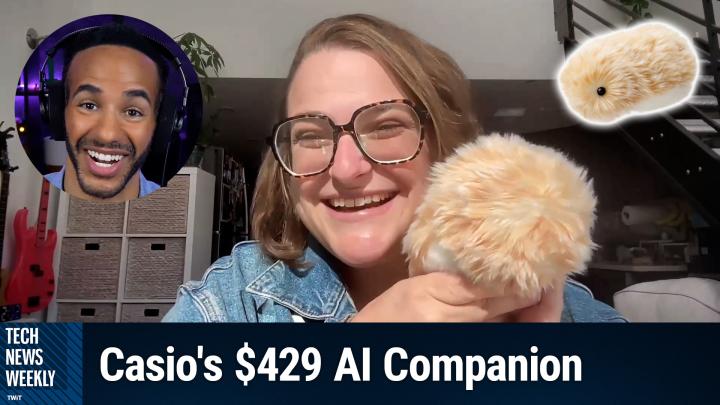
All TWiT.tv Shows (Audio)
Tech News Weekly 408: OpenAI DevDay: ChatGPT OS?
01:10:56
Meet Casio's Smart AI-Powered Companion
Loading summary
Transcript94 lines
- [00:00]
A
Coming up on Tech News Weekly, Amanda Silberling is here and so is her AI pet. Then I briefly talk about how the UK is still trying to get into iPhones through backdoor methods. Afterwards, Sabrina Ortiz of ZDNet stops by to tell us what was announced at OpenAI's Dev Day and I round things out with a cautionary tale about buy now, pay later services. All that coming up on Tech News Weekly. Podcasts you love from people you Trust. This is TWiT. This is Tech News Weekly. Episode 408 with Amanda Silberling and me, Micah Sargent. Recorded Thursday, October 9th, 2025. OpenAI Dev Day. ChatGptos hello and welcome to Tech News Weekly, the show where every week we talk to and about the people making and breaking the tech news. We are here on Thursday, October 9th and I am joined this week by the wonderful, the amaz, the ever so cool Amanda Silberling. Hello Amanda.
- [01:08]
B
Wow.
- [01:08]
C
I've never been called cool in an intro, so I'm very honored.
- [01:12]
A
Well, it's true and it's real and it's happening and I am so glad to see you. It has been a while, so it's good to get to chat with you once again. For people who are tuning in for the first time or perhaps you've been here before and you just need a little reminder. We kick off the show by talking about our stories of the week. These are the stories that we think are interesting and would love for you to know about them this week. Amanda hit me with a last minute curveball that I am very excited about. Amanda, do you want to do a little intro before I ask you a billion questions?
- [01:49]
C
Yes. So originally we were going to talk about the Sora AI social app from OpenAI, which is making a bunch of deepfakes of historical figures and also Sam Altman. But it's fine, we don't need to talk about that because what we do need to talk about is that I have an AI pet.
- [02:10]
A
What?
- [02:11]
C
He's a star.
- [02:13]
A
First, so many. Most of our subscribers, our followers are listeners. So would you care to describe what one would be looking at if they were watching the video of this show?
- [02:31]
C
Okay, imagine like, like an orange haired guinea pig. Like orange, like the color of like an orange cat. Not like bright orange. It has eyeballs, but it has so much hair that it's hard to see the eyeballs.
- [02:45]
A
Oh my goodness. It does have eyeballs.
- [02:48]
C
I feel like. So I'm not familiar with Star Trek, but people have been saying that it's a tribble from Star Trek.
- [02:54]
A
It's very tribbly. It is very tribbly. I find your guinea pig comparison to be far more accurate than even a tribble. It is a guinea pig. It is a long haired guinea pig. Guinea pig that is moving. And you called it an AI. I mean, it's literally moving right now. And it looks, it's reminding me of when I've gone to the Ren Faire and somebody has one of those like dragons on their shoulder. And I'm going, but you're doing that. That's not what's happening here. It's doing that, isn't it?
- [03:23]
C
Yeah, no, it is doing it, basically. So I was sent from Casio to review. They have an AI pet now called the Casio Mofflin. And normally I do not play around with stuff this long before writing it. So I haven't actually written about it yet. Yet. It is still my story of the week. But the reason I haven't written about it yet is because apparently it takes 25 to 50 days to quote, unquote, develop a personality. So I am waiting for it to develop a personality. I'm probably gonna write a review soon because I think, like, I've, like, I don't know, I've been making a lot of TikToks and my editor is like, but what if you wrote about that on checkcrunch.com and I'm like, that's a great point. I should do my job.
- [04:13]
A
Okay, so there's so much to talk about here. First and foremost, it's, it's Casio Mofflin. Do you give it a name separate from Mofflin?
- [04:23]
C
Yes.
- [04:24]
A
Or is Mofflin. Its name is Mofflin the breed.
- [04:28]
C
See, now I'm going to do the worst thing anyone's ever done, which is plug my podcast while holding an AI pet. But I was, I was talking about this in my podcast Discord, which is called wow, if True. It is a good podcast. And somebody suggested the name of Mishmish, which is the Hebrew word for apricot. So this is Mishmish.
- [04:49]
A
Mishmish. It's so nice to meet you. I am honored to meet you. And that. What a great name. So now let's talk about when you say AI Pets, because look there, we've seen Furbies in the past. We have seen Tamagotchi, we have seen the Nintendogs. I have some sea monkeys. Those aren't. Those are actually real, though. Like, these are mine. I don't know why I brought up sea monkeys. That doesn't work for this analogy. But in, in what we've seen before, right. A Furby could technically be an AI pet because depending on how you, you interact with it, it will change its behavior. And so it using some programming to kind of figure out what it needs and what you want. That's not the same thing as what we are calling now an AI pet. You said it needs to develop a personality. Is that on its own or is it based on input? Like what's going on here?
- [05:51]
C
I think it's based on input, but I don't know exactly what I am doing. But there are like four personality bars, like a video game because there is an app that it connects to via, via Bluetooth. And also it's like the obvious question here is like, is it stealing all of my data? We will get to that. But first, yeah, so I guess how I interact with it informs its personality. And I mean, I've been interacting with it, but I haven't been like obsessively using it. Like over the weekend I didn't touch it at all. And yet my bar is full under the personality attribute of energetic.
- [06:35]
A
So you're telling me that you have walked past your beautiful Mofflin and you're not like it's sitting somewhere and you're.
- [06:46]
C
Oh yeah, he has a bed.
- [06:48]
A
Okay, that's fantastic.
- [06:49]
C
This is the charger. It looks like an egg.
- [06:52]
A
Oh my goodness. But you're not carrying it with you everywhere at all times, every single moment of every day and telling it your deepest secrets and telling it how much you love it.
- [07:02]
C
So I was shy about bringing it in public because it's really weird. Like having an AI pet and bringing it around is very odd behavior. But I did bring it to my Pilates class last night because it's like private enough of a space that like, I know all of the people and like they know that I write about tech and that like I do weird things for work sometimes. But it's like public enough that it's not like I'm like, these aren't like people that I've already told, hey, look, it's my AI pet. I'm just like, hey, look at this guy. Yeah. So I don't know, people are generally just like, what is that? Is it spying on me? How is it AI? I also introduced Mishmish to my friend's dog, which is a five pound Yorkie named Winnie. And Winnie, like didn't really want anything to do with him at first. And then she was like sniffing him and then he moved a little bit While. While she was sniffing him and she, like, jumped back.
- [08:06]
A
Wow. So it. The. Now, it doesn't tell me about, like, what's built into it. Does it have sensors? Does it. Is it got a gyroscope in there? Does it have a camera? What. What do we have? What don't we have?
- [08:21]
C
It doesn't have a camera. It does have, I believe, two microphones, and it has a gyroscope and it has, like, sensors. So it knows, like, when I'm petting it, like, it'll react. This is really cruel. But another interesting thing about this guy is that he does not like to be on his back. And that's the only way you can elicit a negative reaction that I have found thus far, because I know it is. I know this is fake. But, like, I'm someone who I'm afraid of, like, my animal crossing. Animals getting mad at me for not logging into my switch for too long. So I can't hurt this guy. But when he goes on his back, he does get upset.
- [09:03]
A
Oh, that's. That's sweet.
- [09:06]
C
See, now he's upset.
- [09:07]
A
Sad. Like, please pick me up and put me the right way. Now. Forgive me if you already said it. Does it make sounds or is it all just motion?
- [09:18]
C
Oh, it's making sounds. I don't know if you can hear, but it's making.
- [09:21]
A
I do not hear the sounds. Is it squeaky? Is it.
- [09:25]
C
I'm holding it next to the microphone now. I don't know, but, yeah, it's kind of like.
- [09:32]
A
Yeah, I can't hear it.
- [09:34]
C
That's my impression.
- [09:36]
A
I think that it must be that. That zoom is just saying those are sounds we don't want to hear, honestly.
- [09:44]
C
Probably.
- [09:44]
A
Yeah. Which makes sense, I guess. So interesting that Casio, which is known for making, like, watches and I think calculators, is the company behind the. This. This device. Has the company talked about sort of its vision for why this is. This is the way that this works? Like, what is what, why?
- [10:18]
C
Yeah, I think that they're trying to market this as, like, something for kids that can't have a pet or, like, a hypoallergenic kind of thing, or maybe something for, like, elderly people in memory care. Like, it's not really clear to me who the target consumer is. And I don't know if it's clear to Casio either right now, because this, like, just came out, like, only the last week or so. I think you can literally buy one. I've had mine for two weeks because journalist privilege.
- [10:52]
A
But I'm going To jump in for a second. But here, listen very quietly. I think it's making some noises. Ferret. Yeah. Now I can finally hear it. I was hearing it do a little bit of a. Which is wonderful.
- [11:04]
C
Yeah. We didn't mic him up before going live, which. That's my. We didn't get him a little ear mic.
- [11:12]
A
Now let's talk about. I think sometimes you can tell what a company is going for based on imagery, for example, that you have that you've seen and that can. Like the. The sort of corporate images that are part of the press release. Who's this supposed to be for the.
- [11:38]
C
In the images on the press release, it looks like it's like. Like 20 somethings, which I don't know. I mean, I'm having fun with this as a thing that I got for free to review for my job where instead of writing about like. I mean, I am still writing about the horrors, but instead of writing about the horrors. Some people would consider this a horror, but it's a fun one.
- [12:06]
A
Yeah.
- [12:07]
C
So I've. I've been having a great time. But it does retail for. Do you want to guess or did you see it on the website?
- [12:14]
A
I have not looked at the price yet. I want to say if I had to guess, I would say if it. It makes sound, it moves its head and body. It doesn't tell me the time or keep secrets for me or serve as a journal or, I don't know, feed my pets, my other pets. So I'm gonna say $200, 430. Wait, wait, wait. Sorry. What? Nearly $500?
- [12:50]
C
Ye. Like $20 less than buying a Switch 2, which I've been. I've been thinking about this because I'm finally gonna buy a Switch 2. Like, I knew when it came out that I was gonna get it eventually, but eventually is now because there's a new Pokemon game coming out. So I. I gotta pull the trigger. But it's like you can get a Switch 2 or you can get this and can this. Play games if you're really creative with it. I define games.
- [13:23]
A
Yeah, exactly. I. Okay, look, I. As much as I think this thing is adorable and I want it, I don't want it for that price. I have to say I'm sorry, but that seems. That's too expensive for. I mean. Okay, let me ask you this. Let's live in a world for a moment where the Switch doesn't exist. And that comparison that you made, which is a very good one, was not made. You didn't get this for Free. You go to a store and you see this there and it's doing its thing and you learn all about what it can do. And then you hear the price so far in your use of this, this object. Is it anywhere near worth that cost?
- [14:17]
C
I mean, I don't think so because basically, like, anybody watching the video of this is sort of seeing the extent of what it does, which, like, it is. It is cute. It is, like, nice to pet, but it's. It doesn't feel that more. That much more like, advanced than like a fur. Real friend or a furby or something like that. Like the. The personality development. I think it would be interesting if I could see, like, somebody else's mofflin, then maybe I'd be like, wow, look how different they are. That's crazy. But, like, yeah, I. And I feel like in a way, like, I would be a target audience for this in theory, because I'm someone who, like, I love animals, but I just know that, like, I am not at a point in my life where I can commit to, like, having a dog or a cat or anything. Like, I just. I don't want to clean up poop. It's just not worth the commitment to me at this point in my life. So having. I've always said, like, if only I could get a pet that doesn't poop and doesn't eat food because I find the smell of the food to be abhorrent. That's this guy. But also, he's like, not a pet. He's like a toy.
- [15:34]
A
You are a toy. Yeah. I don't know if I find much sort of interaction back. Right. It's not as if it's. Because, okay, I think of a real pet and by. Oh, I shouldn't say a real pet. A live pet, a living, sentient creature that gets to know me more over time and sort of like, runs toward me and hops in my lap and has a lot more autonomy. Maybe that's what it is. It's the lack of autonomy. I suppose this isn't that much different from having a goldfish. There are going to be people who love goldfish out there that are like, how could you say this? But this. Yeah, this is falling in the territory of goldfish. Fish to me, or frankly, most fish, where. And then this one, you don't have to worry about walking in and it's upside down in the tank, which is kind of nice as well, so. But I don't have to spend $450 on a goldfish.
- [16:30]
C
Yeah, but you also don't have to clean this guy's tank.
- [16:34]
A
That's true. That's true. Is it worth the extra cost? And I am looking forward to. Actually, let's take a quick break and then I want to talk a little bit about your plans going forward with this thing as you are sort pushing past just the Is it cute? What can it do into? Let's talk about the data practices of the company. All right, let me tell you first and foremost about Pantheon, who are bringing you this episode of Tech News Weekly. Look, you know what I know at your website, it's your number one revenue channel. It's where you make the money. But when it's slow, when it's down, when it's stuck in a bottleneck, well, it's also your number one liability. Pantheon. It works to keep your site fast, secure and always on. It means better SEO, more conversions, and no lost sales from downtime. But this isn't just a business win, it's a developer win too. Because your team gets automated workflows, isolated test environments, and zero downtime deployments. You don't have to worry about those late night fire drills. You don't have to worry about those well, it works on my machine headaches. It's just pure innovation. Your team can do what it needs to do when it wants to do it. And, and that is going to lead to better results for you. In the end, marketing can launch a landing page without waiting for a release cycle. Developers can push features with total confidence. And your customers, well, they just see A site that works 247 Pantheon powers Drupal and WordPress. Sites that reach over a billion unique monthly visitors. Visit Pantheon IO and make your website your unfair advantage. Pantheon, where the web just works. We thank Pantheon for sponsoring this week's episode of Tech News Weekly. Back to the show. And we are joined by Amanda Silberling who has introduced us to the really interesting world of AI pets with Cassio's Mofflin. Now, Amanda, of course you are reviewing this $429 pet that is supposed to be an emotional AI support animal that changes over time as you are interacting with it. Now, one of the things that you are kind of looking into because this is a Bluetooth connected device, so assume that it works with an app. You know, you never know when your AI pet needs firmware updates. But much like our televisions that connect to the Internet and then send off lots of information to the Internet, it is a question of what data is being exchanged between this safe and non judgmental robot. Companion, as Casio puts it, and Casio itself. And that is fascinating to me because again, I'm looking on the Casio website right now. Watches, digital pianos, calculators, and some medical devices. Now there's an AI pet like, it's in. Where does this fit into the lineup? And what is the company's sort of skin in the game? Right? Especially at this price. It's not like Amazon that charges a little bit of money to get these Echo devices into more people's homes, and then they're more exposed to more Amazon stuff and then they buy Amazon stuff and blah, blah, blah, blah. $429 is going to mean that this is not an everyone product. And so then you're wondering, like, who is, who is the market for this and who is going to be able to kind of enjoy this? And I think for me, most importantly, how long is Casio going to continue to support this product before it decides, okay, that was a failed experiment. That's fascinating to me. But you wanted to look at the sort of security aspect of it. Can you talk a little bit about your plans for that and where your review and kind of your take on this is going?
- [20:52]
B
So.
- [20:55]
C
First things first, you don't have to actually connect it to the app in order to use it. The app helps, but it, it is not mandatory. So I started testing this at the end of September and the app didn't come out until October 1st. And so once I got the app, I was just more able to be like, oh, here's the progress on its personality development, but you don't need it, so you don't have to connect it to any device you have. But then there's the question of, like, well, what data is this collecting? Like, it's listening to me all day. It sits on my desk. And on the Casio website, they say that they collect data on what your voice sounds like, but it's encrypted, so they're not collecting, like, what you say, but it is learning your voice. And then there's the question of, like, well, if it connects to the Casio app, then is Casio getting information about this? And with our cybersecurity editor, Zach Whitaker, we looked at the app itself and the app itself. Like, we were like, using like, open source tools to look at the traffic in and out of the app. And it wasn't anything shady that we saw at least now, but, like, we didn't see anything that, like, raised alarm bells. But we still have yet to look into what is transmitted from the Mofflin to the phone. So in a few weeks, plug for TechCrunch Disrupt. When I am with Zach in person, I'm going to bring the Mofflin and. And he's gonna show me how he does his wizardry to find out more information about the security aspects of this guy. But it was promising, though, that the app seemed like, pretty benign because sometimes when you run tests like that on apps, it's like they're collecting. Like, where did you tap on the app? And like, where are you scrolling? And how much time are you on it? And just like a bunch of information. And this was kind of bare bones in a way that was like, pleasantly surprising.
- [22:58]
A
Yeah, this is a fascinating little device. It's weird because part of me wants to anthropomorphize and sort of make it more real than it is in the sense of it's alive. And so me calling it a device is kind of goofy, but at the same time it is. It's a gadget. I mean, even Casio itself calls it a robot, and that is because that's what it is. But it is an adorable little robot and I am curious to see again, if, Cass, how long Casio continues to support it, if it ends up being, you know, an ongoing product line for the company and if these end up being something where. Because Casio already has roads in inland with. With health care and perhaps there's a situation where a child would benefit from an interaction, but can't that, you know, the support isn't there to offer something like an actual dog or cat, you know, I mean, like there, there are loads of places where this could go in, in the long run. And we've already seen some of the loneliness epidemic among older individuals being helped by AI companions in, in. In speaking with them. And I could see something like this being a possibility as well. So, yeah, it'll interesting to see how the company moves forward this. And I'm looking forward to that TechCrunch bit about what we can expect when it comes to that coming soon.
- [24:35]
C
At some point. I'm having too much fun playing with it.
- [24:40]
A
Absolutely. Yeah. He's so cute. I want to mention really quickly a story that I thought, you know, bears repeating. Bears mentioning. The UK government is still attempting to work in a back door for iPhone and of course, other smartphone devices. It's renewed its controversial push to access encrypted Apple cloud backups. But this time it's doing so a little bit differently. They're only targeting British users data that was the Mistake they made the first time was targeting more than just British users data after a previous attempt to demand global access had that diplomatic crisis with the Trump administration administration and threatened to derail US and UK trade negotiations. While the Home Office issued a new technical capability notice in September that narrows its scope to just British citizens as ongoing battle highlights the fundamental tension between government surveillance demands and user privacy. With Apple withdrawing its most secure cloud storage service from UK users rather than just full on compromise encryption standards that protect millions worldwide. I think part of the argument here is the fact that even if you are just targeting British citizens, if British citizens are communicating with citizens in other countries, then it is inherently also going to involve non British citizen data and that's the problem here. As the EFF's Thorin Klosowski explains, this law quote would likely be used to demand Apple spring spy on its users. The Financial Times reports that the UK Home Office demanded in early September that Apple create a backdoor in a user's cloud storage service said that the order applied to British citizens data but it's still an issue here where more data is likely to be involved. Apple on its part said look, as we have said many times before, we have never built a backdoor or master key to any of our products or services and we never will did have to make the choice to not provide advanced data protection in the UK due to this change. And of course we saw that kind of diplomatic fallout that took place between the US and the UK where according to the Financial Times, Trump likened the UK's request to Chinese state surveillance. And then Tulsi Gabbard told the publication in August that the UK had agreed to drop the demand for access to to the protected encrypted data of American citizens. But this local order still has a global impact because weakening encryption anywhere means weakening encryption everywhere. And so having that be at risk of course is going to have an impact worldwide. I have my advanced data protection turned on. I know many people who have iOS and have come across a TikTok video or something that showed them hey, this is how you do it, this is what you do and have turned it on. What is at risk here though is sort of even more steps back from having this advanced data protection in place and the kind of ongoing battle for encryption. I suppose if there's one refreshing thing here, one, one good thing here, it is surprising to me that the US chose to be more protective of citizens than was protective. But it was a happy surprise. I was very glad to see that, you know, we were working toward maintaining encryption on our behalf. So this will be something that we continue to wait and see because I want my advanced data protection turned on in case my little AI pet decides that it wants to send my data off to somebody else. Amanda Silberling, thank you so much for being here. It is always a pleasure to get to chat with you. If people would like to keep up with what you're doing online, where should they go to do so?
- [28:59]
C
Well, if you want to keep up specifically with my adventures with the Maflin, I have been posting some TikToks on my TikTok which is at a Silb writes and more broadly I hopefully soon we'll actually have this Review written for TechCrunch and you can find me writing stuff all the time over there and mostly I am on Blue sky where I am Manda omg lol.
- [29:30]
A
Awesome. Thank you so much Amanda. We'll see you again soon.
- [29:33]
C
Thank you.
- [29:34]
A
Alrighty, let's take a quick break before we come back with even more. I've got an interview all about OpenAI's recent developer conference with ZDNet's Sabrina Ortiz. But first let me tell you about ThreatLocker bringing you this episode of Tech News Weekly. You know ransomware is harming businesses worldwide. We talk about it all the time on all of our shows and perhaps it's been something that you have had to deal with with your own business. Ransomware harming through phishing, emails, through infected downloads, malicious websites, RDP exploits. You do not want to be the next victim. ThreatLocker's Zero Trust platform takes a proactive deny by default approach that blocks every unauthorized action, protecting you from both known and unknown threats. It's trusted by global enterprises like JetBlue and Port of Vancouver. ThreatLocker shields you from zero day exploits and supply chain attacks while providing complete audit trails for compliance. So you know that when it comes time to to answer to those compliance moments that you have all of the information you need. Threat Locker's innovative ring fencing technology isolates these critical applications from weaponization. So that way it stops the ransomware limits lateral movement within your network. I remember speaking to the folks at ThreatLocker about that ring fencing technology and hearing about how this is sort of core to what they do and me kind of going, yeah, this should be the way that it's done. Threat Locker works across all industries. IT supports Mac environments, it provides 24.7us based support, and it enables comprehensive visibility and control. Mark Tolson, the IT Director for the City of Champaign, Illinois, said this Threat Locker provides that extra key to block anomalies that nothing else can do. If bad actors got in and tried to execute something, I take comfort in knowing Threat Locker will stop that. So stop worrying about cyber threats and get unprecedented protection quickly, easily, and of course, cost effectively with ThreatLocker. Visit threatlocker.com twit to get a free 30 day trial and learn more about how ThreatLocker can help mitigate unknown threats and ensure compliance. That's threatlocker.com twit. And of course we thank ThreatLocker for sponsoring this week's episode of Tech News Weekly. All right, we are back from the break and joined this week by Sabrina Ortiz of ZDNet who is here to give us the lowdown, the rundown on Dev Day. Welcome back to the show, Sabrina.
- [32:13]
D
Yeah, hi y'.
- [32:14]
A
All.
- [32:14]
B
It's great to be back and I'm excited to talk about this really fun event that just happened beginning of the week.
- [32:20]
A
So yeah, OpenAI Dev Day 2025 kind of meant several announcements that were for developers, but you were able to see what was going on, hear about what was going on. Can you kind of walk us through what you consider the most significant reveal or reveals from the event and why it matters kind of for the rest of the techosphere?
- [32:43]
B
Yeah, as, as much as I was really hoping that we would get something a little bit more consumer focused ideally that a hardware a product that we're really excited with. OpenAI and Jony I've collabing with, we did didn't hear anything about that, but we did get some developer news that will affect everybody and that's just the existence of now apps and ChatGPT. I think that's the most noteworthy thing. It's kind of similar to GPTs, if you were familiar with those when those launch. It's like an evolution of it really. It's basically allowing different developers or like these app companies like think about Spotify or Canva to build an experience within ChatGPT so that you could kind of of access everything you would in the app as a standalone experience, but within the chatbot with the added perks of ChatGPT. And I'm happy to give you some examples too if that helps break it down a little.
- [33:34]
A
Yeah, well, I think we'll, we'll, we'll get into that because this was interesting. This as far as I am aware, is the first time that OpenAI has invited the media as part of the Dev Day events. And, and also I think it's the biggest one yet. 1500 or so attendees. Can you kind of talk about the energy in the room during these announcements? I think for some of us we think of developers as relatively not somber, but quiet, introverted folks. And how do developers react to what they were seeing?
- [34:10]
B
Yeah, it's always really, really fun getting to go to any of these developer conferences because developers like you mentioned are, are by nature a bit more nerdy about all this stuff and are really excited to get to build also because building for them is not only a lot of them are motivated by bringing really great experience to users, but also there's some monetization incentives. Right. There's, there's a lot there. So they're typically very excited to be there. And that energy was felt this time as well. You could hear when some of the news Altman was on stage dropping the latest announcements like some oohs and oz in the audience from the developers who were sitting up front. So it was, it was a fun vibe.
- [34:47]
A
Nice. Now let's get into the apps. The apps SDK remark represents a fundamental shift in how chat GPT functions. I wouldn't, you know, fundamental in, in this very specific aspect, but also you mentioned it kind of touches on what we've seen before. How does this new capability differ from those attempts like GPTs? And then in your observation of the live demos, did it convince you that this is more than just an incremental update on the dev side?
- [35:20]
B
Yeah, so a lot of good stuff there. Let's start with I guess the demos and what it is. So the way it's different is that beforehand if you ever wanted to activate a GPT, you were kind of limited still to like, even if you invoke the GPT to like inline question answer experiences, it didn't really get much further than, than still what you're used to seeing in the ChatGPT interface. Where now when you open an app like let's just say I'm calling on Spotify, it will actually show you a window that now you could expand to full screen if you want and you kind of get the exact app interface within the chat GPT conversation. And the reason that's really helpful is like again if you're using the canva integration, which was one of the demos that was really, really impressive, is basically you could say like hey, at call on Canva in ChatGPT, can you create a poster for me? And then it'll create, I'll take some time create the post for you right within the ChatGPT interface and you can open it full screen without even leaving ChatGPT. So. And in that instance, it'd be useful to see, like, details like text or pictures and graphics and all that. And then if you want to tweak it, or if you want to share and move forward with that, click on something that sends you to the actual application once you're happy with it. But you could keep kind of creating and iterating within ChatGPT, which, again, is a really big help because it's combining the apps that you already know and love, like Spotify for listening to music, or Canva for creating any visual design, but combining of ChatGPT's natural language processing. So you could just conversationally do things like I could conversationally ask it to make the post or conversationally ask it to make a playlist. So it's like you're getting best of both worlds. Sorry, that was a lot there.
- [36:59]
A
No, no, no, that's. That's great. Yeah. I was especially curious because I'm thinking, what. What do I need to do in. What am. Of course, what am I creating in Spotify, but playlists. Yeah. So I can say to the. To Chat GPT, I am. It's. It's a. It's a beautiful, crisp morning, but I'm a little stressed out and I need to get work done. Make a playlist that's perfect for that and then built in, it'll be able to do that.
- [37:26]
B
Exactly. And I was actually testing the feature out today, so one of the really cool parts is that you're connecting it to your Spotify account. Right. So you could say something like, based on the songs I've listened to, or based on this playlist I've created, because it's connected to what you listen to, and then it. Create a playlist from there. And then also once it creates a playlist for you and you open it in Spotify, because it is connected to your. To your account, technically you could just save and start playing it from there as if it was a playlist you made yourself.
- [37:54]
A
That's pretty neat. So, yeah, this is a new way of doing things. And I think definitely now I'm seeing the difference between it and something like the GPTs, because I've created a few of these GPTs for people who haven't tried that technology. You were kind of sort of custom programming a version of ChatGPT for your own use, and so you could give it a little bit of data, give it a little bit of some documents or whatever, and then say, I want you to do all of that. Take all this information in and give me specific outputs for it. It's. That's not, I would argue, as powerful as what we are seeing now. And I could understand why developers in particular would be pretty excited about this. Were there other. Were there so Spotify and Canva, big demonstrations for the company? I'm curious because it was Nick Turley, I believe, who described chatgpt's evolution toward becoming more like an operating system, which now makes sense. You're talking about this sort of full screen experience based on what you witnessed there. How realistic is this vision and if you had to guess what's the timeline like for this, this transformation from, from sort of input output to full on operating system.
- [39:14]
B
Yeah, I love this question. I actually love this question so much. I was the person who asked early during the media Q and A like hey, like where. Where do you see ChatGPT going? My exact question was like, we've seen a lot of movement towards agentic AI or like AI that could do stuff for you this year. We've seen a lot of movement towards multimodal AI, but I'm like, so what? Or do we see ChatGPT actually looking like in your future? And that's when he, when he said the operating system and how. And then he get. He said it could be as soon as like a, you know, a six month window where and in his words, when chatgpt would feel meaningfully different. I think that's really exciting. Do I think that right now we're there? Not quite like even testing the apps. I was like, well these are great but some things, you know, you can only do so much like the Spotify playlist and made me. At one point I'm like, can you make me a Taylor Swift Swift playlist about having a crush on someone? And I want all the songs to be like throughout her discography but an emphasis on this. And then like she's. There were songs on there, one of the songs about her like Grandma who passed Away. And I was like, well that's just not what I, what I was asking at all. So I think there's promise. I think what we're really doing is laying down the foundation right now. And I think six months is plenty of time for developers to get building and for it to act more as a proper operating system. And I don't see why companies wouldn't want to opt into developing an application for ChatGPT and integration of ChatGPT because it does seem like such an easy way to leverage both the strengths of what your product offers and what ChatGPT offers and kind of mesh it for an even better experience for the audience.
- [40:53]
A
Nice. Now, the agent kit, which I just love, that demonstration showed an agent being built and deployed in under seven minutes. What impressed you most about this process and how do you feel like this could speed deployment? Or rather, how do you think that this kind of speed of deployment will help businesses approach AI integration if they're, you know, not building these full experiences, but instead are going kind of that. That agent route of this new. The buzz phrase, of course is agentic AI, right?
- [41:31]
B
Yeah, that demo was really something. I think everyone even like, because I was sitting with media, even media folks who aren't developers were like, whoa, that was a cool demo. Like you mentioned, it took it from like zero to the entire way through in matter of minutes. And I think that's the appeal, right? The appeal is that it places the ability to build in more people's hands and the ability to build more quickly and more efficiently, or ideally in its prime form. That's what it should do. Altman did I watch a podcast that he did with the rundown AI Rowan Chung. During the event, he was saying that he wishes that he had these tools when he was building because he would have built so been able to build so much more or like the scope. So I think that's the appeal there. And I, and I, of course it still takes a certain level of expertise. Like, I don't think like at one point I was getting lost or in demo, okay, I see lots of lines of code. I don't know if, if I could quite get there, but I do think there's a lot of promise there and in the right hands, it will accelerate a lot of new just not only experiences, but also, again, help businesses be able to scale quicker.
- [42:38]
A
Understood. Now, during the demos, we talked a little bit about this throughout our conversation here. We did see these integrations with major platforms like Canva, like Zillow, like Coursera. You did mention canva being one of these. That really struck you. Were there any other implementations that you felt were kind of a transformative use case and perhaps if you had to look at it and say, hey, these industries should also be looking at this as that full integration as an app, as opposed to just sort of working ChatGPT or OpenAI's technology into their own apps?
- [43:15]
B
Yeah, I like this question because I think a lot of times when we think of AI, we're very conditioned to thinking about creating something new. So if Spotify, we're creating new playlists with Canva, we're creating a poster. But I think what stood out to me was the integration of Zillow, because with the Zillow integration, you're obviously, you're not building a home or creating a new home, but what you're using is like ChatGPT's processing of conversation, like your natural language, to like, narrow down the results of, of your search, which, if you've ever been on any type of search, we're just talking about. But before this call, I just moved into a new apartment. I spent an endless amount of time in Zillow. You're toggling everything. You're toggling different things, you're looking at different areas. You're trying to. So being able to use that, like just a conversational search to narrow down your. Your results is very helpful in itself. And I think that's where, like, I think more industries need to start thinking about how can I use AI in a way that's not necessarily just creating something new, but actually creating an experience that's easier for the user to navigate. Whatever. Whatever your product is. Right. And I think there's space for that everywhere. Whether you're a content creator and again, you want to help creating new content, or you're literally just selling a product and you want to help people navigate your website better, that's still a really powerful application.
- [44:36]
A
Lastly, interesting that Sam Altman called the AI sector bubbly at the event, and I don't think that's a positive term in this case, given everything you saw announced at Dev Day. Do you think OpenAI is contributing to hype or actually delivering genuine innovation that justifies the current excitement?
- [44:55]
B
Ooh, that's a good question. Yeah. So there's no denying that when there's something this big, this big of a. Like, you know, not only trend, not only a boom, not only a craze, it's really just. Just shifting even markets. Right? Like, this is a big transformation in the tech space, that there are going to be some pitfalls, there are going to be some, you know, bubbles that pop. And even to Altman's point, and in his full statement, that was really his point too. It was like, some people are going to, and I think he said, lose a lot of money on, like, stupid companies that, like, you know, that don't really invest on money and stupid companies that don't really do much. But I think there's also going. It's going to shake out and there's a lot of room and I don't think we're Ever go back to a world where AI isn't really included in some capacity and everything. I think OpenAI is helping help people distinguish what is a hype and what is actual value. Do I think everything they're putting out is in the value camp? Not necessarily, but I think because they're the first ones doing it and they're doing it really well and they're moving really quickly, they're helping as an industry. Everybody realize like, oh, that was actually really helpful. Let's move forward with that. And then we've seen projects from them before, it's like going to be the next big thing. And then it's like, oh, like for example, ChatGPT search. We all thought that was going to be a moment and then it ended up being like, oh, maybe there wasn't actually a need for this after all. Maybe people are still going to use, you know, Google, Google still the most or even Google AI overviews and that kind of thing. So I do think that they're helping by developing things so quickly, which they are. They are absolutely helping distinguish what is bubbly and what is actually here to stay. And their contributions are huge in the space.
- [46:47]
A
Wow. Well, I want to thank you so much. It's always a pleasure to get to talk to you about these whatever is going on in the AI space. Of course folks can head over to ZDNet to ch out your work. How do they keep up to date with what you've got?
- [47:02]
B
Yeah, I love posting all over my socials with everything I'm working on. My latest edition has been threads actually been posting on there a ton. I even posted a ton of content live from the event. So that's just the same as my Instagram handle which is just Sabrina for double A at the end. Dot Ortiz and I'm also everywhere else you can find me LinkedIn, Twitter, all the things. But yeah, excited to just keep coming on a show and hopefully talking more if you soon, soon.
- [47:28]
A
Awesome. Thank you so much. We'll see you again soon.
- [47:31]
B
Yeah, totally.
- [47:33]
A
All righty folks, we're going to take a quick break before we come back with one more story. I think a really important one that I certainly in seeing I said oh, we got to talk about this. Before we do though, I want to tell you about Cashfly who are quite literally bringing you this episode of Tech News Weekly. For more than 20 years, Cash Fly has held a track record for high performance, ultra reliable content delivery, serving more than 5,000 companies in more than 80 countries. At TWIT, we have been using Cashfly for well over a decade and love the lag free video loading, the hyper fast downloads, the friction free site interactions so you can join companies like Adobe, Microsoft, lg, the NFL, and many more that rely on Cashfly. Cash Fly's proof it's in the petabytes Events stream smoothly to millions of concurrent users worldwide. Online games start 70% faster, scale instantly and play without lag. Software downloads flawlessly during releases, patches and updates. HD video plays on demand with ultra fast sub second start on every device. Podcasts reach global audiences at record speed at any scale plus 100% availability in the past 12 months. CashFly delivers rich media content up to 158% faster than other media major CDNs. It also allows you to shield your site content in the cloud, ensuring a 100% cash hit ratio. Never pay for service overlap again with flexible month to month billing for as long as you need it and discounts for fixed terms. Once you're happy, design your own contract when you switch to Cash Fly, Cashfly is like gaining an extension of your team. When your entire business model depends on delivering massive amounts of content, you can't afford to go it alone. You can count on personalized help anytime, from tenured expert who gets IT Engineer to Engineer 24 7. So learn how you can get your first month free at cashfly.com TWIT that's C-A C-H-E-F-L-Y.com TWIT and as always, we thank CashFly for sponsoring this week's episode of Tech News News Weekly. All right, I saw this story New York Times Magazine. Incredibly important story Looking at the Buy now, pay later market, the promise is seductive. That designer handbag, those concert tickets, that new tech gadget, or perhaps even tonight's dinner. All yours right now, with just a fraction of the cost up front. Buy Now, Pay later services like Klarna, Afterpay and Affirm have exploded from a wee $2 billion industry in 2019 to $120 billion in 2023. Capturing half this is wild, capturing half of all Americans and especially young consumers under 35. But as this New York Times Magazine investigation reveals, what starts as as some people call it, a cheat code for affording lives. Luxuries can quickly spiral into a confusing maze of automatic withdrawals, hidden interest rates up to 36%, and mounting debt that users joke about on TikTok even as they sink deeper into financial trouble. I want to start by saying when I bought my first When I bought my first mattress, it was a casper mattress. I was not working at Twitter at the time and I don't think Casper was a sponsor on any of my shows at the time. But I had been listening to shows where Casper was a sponsor and I bought my first Casper mattress and the way that I was able to afford it was with Affirm. I've used Buy Now Pay later services in the past. My first desk that I bought that I sort of invested in my standing desk from I can't remember what the company is called now, but it was the Jarvis Sit Stand desk. Also got that with Buy Now Pay later. And so I have had experiences with Buy Now Pay Later I they were enabling services for me, meaning that I was able to get something that I needed slash wanted to some extent without having to foot the cost upfront. And it was helpful, but it can become a slippery slope very easily. In this article, in this piece it talks about Alicia Berman, who's a young professional in New York that discovered Buy Now Pay later services when looking for a 430 or when going to purchase a $430 designer handbag bag. So with it, this was a story of a person who grew up in a neighborhood with lots of wealthy kids but but was not wealthy herself and or rather sorry, grew up going to school with lots of wealthy kids because the neighborhoods nearby were wealthy, was not wealthy herself and then later in life still working jobs where not making a lot of money but being in New York, saw a lot of people with a lot of stuff wanted this bag, went to find it for $430 and said oh there's no way I could afford that and then suddenly boop up, pop this thing that said split it out over four payments. And Berman did the service promised to democratize luxury, allowing users to enjoy these purchases immediately while spreading out those payments over weeks or sometimes month months. We know about Klarn Klarna. It is just one of the services and it offers frankly massive credit lines. Berman, who had a credit card limit of just $2,000, signed up for Klarna to buy this 430 designer handbag and was granted $12,000 of what amounts to credit. But it's not the exact same thing, but $12,000 of buy now Pay later money to work with. And these kind of reading through this, the numbers are rather staggering because these Buy now or BNPL purchases have grown 60 fold in just those four years. Two thirds of the attendees who went to Coachella used used Buy Now Pay later services to buy their Coachella tickets. Users can finance everything from something as small as like a burrito all the way up to buying a monster truck or renting a monster truck. You can, you know, pay for a vacation with afterpay Airbnb flights. And as we've talked about, the depressing thing where every time I go in, because I use Instacart for most of the I started using it during the, you know, the heights of the pandemic and continue to use it now and every time I go to pay right there is split this up into four even payments and it's an affirm or Clara, I don't remember which service it is, but it's one of them. And frankly it appears according to the article that this, this, these services operate in what's called a regulatory wild because they don't have the same oversight as traditional credit products. It's different because regulators don't quite know how to define and categorize these, these services. University of Leeds professor Dionysus Ang which can we talk about how great a name that is explains that Buy Now Pay later services do exploit consumer psychology using what is called temporal reframing. Because what you can do is make a $365 payment feel a whole heck of a lot smaller by calling it a dollar a day. And then of course the other part of this is that these services are specifically marketing themselves and positioning themselves as something other than what are credit cards? They're the anti credit cards. They seem more transparent, they seem kinder. And because of that, research shows that consumers are 9% more likely to make purchases with Buy Now Pay later options and spend 10% more than not using a Buy Now Pay later service and spending 10% less. And also talks to these interesting TikTok trends where overspending is kind of re scoped so that it is seen as self care or you're investing in yourself. Right? And that is an aspect of Buy Now Pay later that is resulting in people where normally you might have this kind of, this caution. And if we're being frank, a bit of shame, right? About buying or paying or spending past your limit. You suddenly look around and see that other people are doing oh, everybody's doing it, it's fine.
- [57:03]
D
And now a next level moment from AT&T business. Say you've sent out a gigantic shipment of pillows and they need to be there in time for International Sleep day. You've got AT and T5G so you're fully confident, but the vendor isn't responding. And International Sleep Day is tomorrow. Luckily, AT&T 5G lets you deal with any issues with ease. So the pillows will get delivered and everyone can sleep soundly, especially you. AT&T 5G requires a compatible plan and device coverage not available everywhere. Learn more@att.com 5G Network.
- [57:33]
A
Berman's experience also talked about the kind of debt spiral that's involved with this. I have a qualm with this portion of the piece. It is not the piece itself, but the quotes from Berman. Because Berman says in it, kind of talking about how this goes, quote, $17 first thing Monday, $250 later that night, and then talks about no clear balance tallies and payments that felt, quote, totally arbitrary. Says you never know what's going on. You can't budget because you don't know what's leaving your account on what, what day. I don't agree with that. Part of was my experience using at least two different Buy now, pay later services over time that these services make it very clear about what you owe and when and even give you like calendar, calendar readouts that show this is the amount of money that's going to come out on this day. This is going to come out on this day. This is going to come out on this day. I would imagine that if you start adding these up over time and you've got a bunch of them across different apps, which is the experience that Berman had, it can be difficult to figure out what's going on. But to assert that it's totally arbitrary, that there are no clear balance tallies, that you know, that you never know what's going on, that you can't budget because you don't know what's leaving your account on what day. While that can be the personal experience that you had, that you're not sure what's leaving your account on what day, I disagree that it is not provided to you. You can go in and look at it. Berman ended up tallying everything owed about $20,000. And according to Federal Reserve research, this is kind of a, I mean, what I'm about to read, I think many of you go, oh yeah. The article cites Federal Reserve research that shows that Buy now, pay later users have lower. This is, quote, lower overall financial well being. Yeah. If you, that's, that's why you would use a Buy now, pay later service. You can't afford to pay for it all now. And so you, you split it up into payments. I did not have good financial well being, you know, living relatively paycheck to paycheck at the time. And so this was my way of being able to afford that mattress but it's a regulatory vacuum because these services operate with minimal oversight. They skirt the Card act of 2009. They skirt the Truth in Lending act because they structure loans to avoid triggers for regulation. The Consumer Financial Protection Bureau tried to apply credit card rules to Buy Now, Pay later efforts, but they were reversed after Trump's second term began. Now FICO does plan to start including Buy Now, Pay later history and credit scores. And this is the thing, it's going to shock a lot of people who've been treating this debt is a bit of a joke on social media. There are loads of different posts where people are posting their notifications from Klarna saying, you know, you've got this, you've got this, you've got this, and you're suddenly, and you're like comparing the amount that you owe Klarna and you want the higher amount. No, you don't want the higher amount. Speaking also from personal experience, I have a family friend who fell into something very similar to this individual who racked up a whole heck of a lot of debt by switching between the different services, switching between Klarna, between afterpay, between a firm, between other options. Given that much of this is currently not tracked by fico, is not tracked by some of these other services. And so that is what is at issue here. So definitely something that I recommend sort of looking out to your family, your friends and, you know, checking in on how people are making use of these Buy now, pay later services. I think some people who are in a good place financially or in a great place financially, we'll look at these services and look at the people using these services and kind of look down. That's been, you know, I've seen that at work. And so I'm very careful in saying and expressing that I have made use of these in a very positive way for me and they can be used in a positive way to give people access to things, especially as things get more and more, more expensive that you might not otherwise be able to gain access to. And do not get me started on sleep in sleep science and how investing you might go, well, you just need to go get, you know, John's looking at me like, please don't you just need to go get some eggshell containers from egg crates from the store and put them on, on a flat piece of concrete if you can't afford a good mattress and blah, blah, blah, blah, blah, blah. Don't use a buy now pay. No, I, there are situations where these things are worth the investment, even if it's not an investment that you can technically make all at once. And so I'm not looking I will not look down on people making use of Buy now pay later services. I will look down on how buy now pay later services can be incredibly predatory. So just something to be mindful of and please go read this piece from New York Times Magazine. It's far more in depth and I think is something that should be shared around with other people. With that we've reached the end of this episode of Tech News Weekly. Of course our show publishes every Thursday. TWiT TV TNW is where you can go to subscribe to the audio and video versions of the show. If you'd like to get all of our shows ad free just the content, can I invite you to join our club Twit TV Club Twit is where you go to sign up. When you join the club you gain access to to some awesome things ad free versions of all of our shows. Love you. Also gain access to our feeds. These special feeds that have our live commentary of tech news events. Also our club specific shows like My Crafting Corner, Stacy's Book Club, Camera Time, Coffee Time, the Up We've we've started to make moves in the Dungeons and Dragons campaign. A one shot adventure that I'm going to be doing that's going to be there. Plus so much more bits and clips and behind the scenes stuff all published to the club as well as access to the members only Discord Server. Shout Out. Thank you for your support and we do appreciate you for being a member. If you are. If you're not, again, Twit TV Club Twit. You got to sign up and you can kick it off with a two week free trial. Be sure to to check it out. All right, if you'd like to follow me online, I'm ikasargent on many a social media network where you can go to Chihuahua Coffee that's C H I H u A H u A Coffee where I've got links to the places I'm most active online. Be sure to check out my other shows including iOS today, hands on Apple, Hands on Tech Tune in this Sunday. We'll be doing some more episodes for the live stream on Sunday, so be sure to be there or be square. Sorry. All right, I'll talk to you all later. Bye bye.
- [65:41]
E
Mint is still $15 a month for premium wireless and if you haven't made the switch yet, here are 15 reasons why you should 1. It's $15 a month.
- [65:51]
D
2.
- [65:51]
E
Seriously, it's $15 a month 3. No big contracts 4.
- [65:56]
F
I use it 5.
- [65:57]
E
My mom uses it Are you. Are you playing me off? That's what's happening, right? Okay, give it a try@mintmobile.com Switch upfront.
- [66:04]
C
Payment of $45 for three month plan $15 per month equivalent required. New customer offer first three months only, then full price plan options available, taxes and fees extra.
- [66:10]
F
See mint mobile.com Marketing is hard, but I'll tell you a little secret. It doesn't have to be. Let me point something out. You're listening to a podcast right now and it's great. You love the host. You seek it out and download it. You listen to it while driving, working out, cooking, even going to the bathroom. Podcasts are a pretty close companion. And this is a podcast ad. Did I get your attention? You can reach great listeners like yourself with podcast advertising from Libsyn Ads. Choose from hundreds of top podcasts offering host endorsements or run a pre produced ad like this one across thousands of shows. To reach your target audience in their favorite podcasts with Libsyn ads, go to Libsynads.com that's L I B S Y N ads.com today.