← All TWiT.tv Shows (Audio)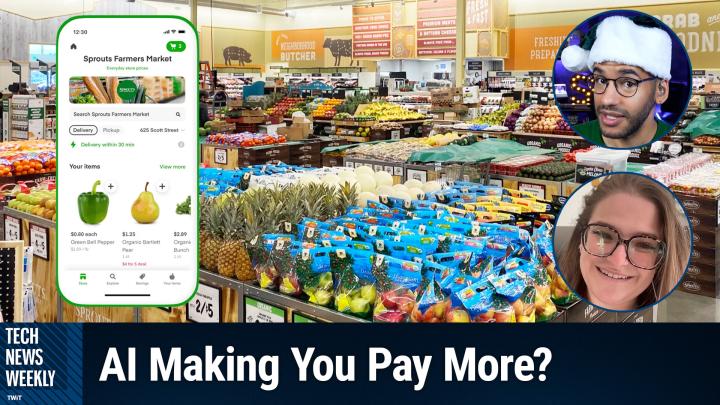
All TWiT.tv Shows (Audio)
Tech News Weekly 416: AI Pricing on Instacart
01:08:21
Is AI Making You Pay More for Grocery Deliveries?
Loading summary
Transcript81 lines
- [00:00]
Micah Sargent
Coming up on Tech News Weekly, Amanda Silberling of TechCrunches. Here we kick off the show by talking about how Hinge's CEO is now working on an AI dating app. Then I talk about a little finger worn device from the makers of Pebble. Afterwards, we talk about how AI companies are working together on the model context protocol before rounding out the show with Derek Kravitz of Consumer Reports, who has all the details about how Instacart is charging people different prices and and you might be getting price gouged. Stay tuned for this episode of Tech News Weekly.
- [00:38]
Derek Kravitz
Podcasts you love from people you trust.
- [00:42]
Micah Sargent
This is Tweet. This is Tech News Weekly. Episode 416 with Amanda Silberling and me, Micah Sargent. Recorded Thursday, December 11, 2025. AI pricing on Instacart. Hello and welcome to Tech News Weekly, the show where every week we talk to and about the people making and breaking that tech news. I am but one of your hosts of this show. My name is Micah Sargent and this week on the second Thursday of the month, we are joined by Amanda Silberling. Welcome back, Amanda.
- [01:22]
Derek Kravitz
Hello.
- [01:22]
Amanda Silberling
You are very festive and I am jealous that you have the Microsoft Christmas sweater.
- [01:28]
Micah Sargent
This is the only one that I've purchased because, you know, for people who don't know, Microsoft comes out with these pretty much every year. I haven't seen the one for this year. I don't know if they're doing it this year.
- [01:37]
Amanda Silberling
Every year I am so tempted. But TechCrunch used to be owned by Yahoo and we did get some very like retro Yahoo 30th anniversary swag at one point.
- [01:51]
Micah Sargent
That's super cool.
- [01:52]
Amanda Silberling
I think the sleeve is actually hanging off of my ledge there because it. Because I need to do laundry and that's just where laundry lives.
- [02:01]
Micah Sargent
I had to get this one because Clippy. Yes. So yeah, this is the only one that I said I'm investing money in it. And you know what, as someone who works with, with, with yarn in, in different ways, it is a very well made sweater. So it was an investment that I'm happy about. In any case, this is sad sweater talk. I wish it was. But this is instead Tech News Weekly, which means it is time. Oh no. This year's has Clippy on it too. Dang it. Oh, and it's so ugly. I have to have it probably. Anyway, back to the show. Yes, please. So what am I talking about? Oh, right. The way this show works, we have two stories to kick things off. Our stories of the week that we care about to share with all of you. And I believe this week, Amanda, written by you as well.
- [02:56]
Amanda Silberling
Yes.
- [02:57]
Micah Sargent
All right, tell us about it. Cool.
- [03:00]
Amanda Silberling
So my story of the week is about the CEO of Hinge stepping down to start Overtone, which is an amorphously described company, which is an early stage dating service focused on using AI and voice tools to help people connect in a more thoughtful and personal way.
- [03:25]
Micah Sargent
Oh. So let's talk about this because. Okay, we have. It's been a while since I've been on the apps, but it was my understanding, and correct me if I'm wrong, as far as, you know, with your understanding of the Internet culture, that Hinge was a pretty good one. And again, you'll have to correct me if I'm wrong. And so it's kind of interesting to me to sort of have this pivot right from something that is, as far as I understood, doing pretty well and has a level of authenticity applied to it to switch to something a little bit less authentic, arguably, and a little bit more cold and a little bit more tech minded. But maybe I'm wrong in all of it. Like, is it all just in the background? Pretty cold and tech minded. And I just have rose tinted shades on. Is that what's going on?
- [04:24]
Amanda Silberling
Yeah, I think you probably have not been on the apps for too long. Yeah, I have not been on the apps for a shorter period of time than you, but I remember I'm like. I feel like I'm a war veteran, but I think over time, Hinge got. I don't know if I can say the word, but the Cory doctor A.
- [04:48]
Micah Sargent
Word about how things tech are getting worse certification.
- [04:51]
Amanda Silberling
Yeah. The npoopification of tech, where I think it was Rebecca Jennings and Vox wrote a feature at one point about the concept of rose jail, which is like, on Hinge, there are, like, standouts, which are people that Hinge's algorithm thinks that you are, like, most likely to find attractive or want to match with. And it puts them under the standouts thing. And you have to use a rose to. To message them. And you only get one rose a week or something like that. But you can buy more roses for $4 a rose. So it's like they have your best matches essentially behind a paywall. And then also you have to be like, I liked you so much that I gave you my rose. And so there's been like. I think this article was about how women have tried to, like, trick the algorithm into thinking that they like people that they don't like so that they can break their better matches out of quote, unquote, rose jail. Which is to say that hinge still is very popular and it is considered one of the better ones, but it's like one of the better lumps of coal in a pile of coal for the thematic metaphor.
- [06:11]
Micah Sargent
Okay, so that makes sense in the sense that it's. It doesn't by that, like, okay, so tell me then, what is the. What's the. The what's the pro of having this new way of doing things? Is there not rose jail in an AI powered app? Like, how does. What. What's the. The value prop of it all?
- [06:37]
Amanda Silberling
I think it's interesting because it seems to me like dating is something that people would not want to have AI interfere in. Where it's like, yes, I would love to use, like, help me erase the background of a photo or something. But, like, do you want AI to be telling you who to date? But there is such fatigue with, like, the dating apps, with, like, me saying that I feel like a war veteran. Like, it's like, it's like people are really exhausted by just this constant, like, swiping and talking to so many people at once and being like, ah. So I think maybe the argument is that, like, people would have to put in less effort if things are AI powered. And I also found this interesting because then Whitney Wolfe Heard, who was the founder of Bumble, also has, like, proposed the idea of creating, like, a spin off of Bumble that is, like, AI driven in the same way that this app that the CEO of Hinge left to now work on was, like, incubated within Hinge and funny by the Match Group, which owns Hinge. So it's interesting that both of these founders of very successful dating apps are both like, we are going to spin out and create our own side AI apps now. And then Whitney Wolfe Heard went sort of viral in a negative way last year when she was like, what if I had an AI and my AI could talk to your AI? And then we don't even have to go on a date to know if we're compatible because our eyes went on a date for us and it's like.
- [08:19]
Micah Sargent
A joke.
- [08:19]
Amanda Silberling
Was that, oh, no, she's serious.
- [08:22]
Micah Sargent
What? So is it okay? No, that's like, okay, that's sad. Is that not sad?
- [08:31]
Amanda Silberling
That is, I feel like, I think, like, I remember Amazon had a product where you could, like, scan your hand to pay for something. And I remember tweeting like, oh, this is like black mirror.
- [08:42]
Micah Sargent
And.
- [08:42]
Amanda Silberling
And then I always think about that where I'M like, oh, how innocent I was when I was like this. Hand scanning, like scanning your hand to pay for groceries seems quaint compared to like, my AI is going to go date for me.
- [08:55]
Micah Sargent
Oh, so this is interesting, right? Because in theory, one would assume that why someone feels the need to have an AI data in AI is because they don't have enough time in the day. They're busy. They're busy, I don't know, unicorning their second round and, and micro dosing their latest funds and whatever else it is.
- [09:24]
Amanda Silberling
On Sigma grind set.
- [09:25]
Micah Sargent
They're on their Sigma grind set. And so given that, then you just are saying, yeah, I just don't think that there I've got the time to sort of sort through what I consider to be the cruft. But then I wonder, do you have time for a relationship if you do find someone that it almost becomes. I just. Yeah, I don't understand it. I don't understand it at all. What are they actually looking for?
- [09:57]
Amanda Silberling
I think it's maybe that, like, ideally, in a perfect world, a romantic relationship should be rewarding, whereas the experience of using the apps is not rewarding. So it's like you technically have time for it. But when I was dating, I found it very frustrating that it was like, I have such little free time and if I'm gonna dedicate a night to hang out with someone, I would rather hang out with my actual friends who I haven't seen than a stranger. But yeah, so it's like on one hand, like, I think this is ridiculous, but I could see how people are. Like, it would be cool if some magical thing happens where like, the person I want to date just appears out of thin air. But I think that isn't how AI works. And that's like, like, AI isn't magic. And I think sometimes people treat it as though it is. And like, I mean, also, like, part of why I was interested in this story too is that already, like, dating apps have been increasingly coming out with AI features that, like, one of them that Hinge came out with earlier this week was called like, conversation Starters, where I think the example they used was, let's say, like, you have a picture of yourself in your clippy sweater and then instead of just liking the picture, then someone can be like, oh man, like, what's, what's your favorite old school video game or something. Like, they're just trying to like, make you actually start conversations with people. But then it's also like, we should be able to talk to people.
- [11:42]
Micah Sargent
Yes, that's the thing like, because I don't want to get to the date, and then I find out that this person can't even hold a conversation. And instead the conversation, the great conversationalist that I was speaking with ended up being not them in the first place because we already do enough. I think of when I was dating. I remember plenty of times where everybody that's come into. You're putting your best self forward. Right? You are. Ideally. Ideally, yeah, that's true. I. I can't speak for everybody's experience. I'm sure that some people just put themselves forward and sometimes the self they're putting forward is not. But in theory, you're trying to put your. I don't know, maybe that's not. Now that I'm thinking about it, maybe that's not the common experience.
- [12:39]
Amanda Silberling
Well, maybe if you have two people that both think that having their AIs meet each other would be cool, then maybe that is, in essence, compatibility.
- [12:49]
Micah Sargent
True. You've met your partner for sure, if that's the vibe for you.
- [12:54]
Amanda Silberling
Yeah.
- [12:55]
Micah Sargent
Well, I'm sure there will be more AI dating stuff going on going forward.
- [13:02]
Amanda Silberling
It's a lot more fun to follow when you're not implicated by it.
- [13:05]
Micah Sargent
There you go. Exactly. I just get to watch from over here and not participate. And I'll knock on wood that it stays that way.
- [13:13]
Amanda Silberling
Yeah.
- [13:14]
Micah Sargent
All right, we're going to take a quick break before we come back with my story of the week again, joined this week by Amanda Silberling of TechCrunch. I do want to tell you about our sponsor this week, it's Vention, bringing you this episode of Tech News Weekly. We talk about AI. We just did with the. With the AI dating. And you know that the whole thing with AI is that it's supposed to make things easier. Unfortunately, for most teams, it's made the job harder. You've got people shouting, we need to AI this and AI that. And then you're going, but I don't know how or why or what should be done or how it should be done or if it should be done. Well, ventions, 20 plus years of global engineering expertise, comes in to help out. Because Vention builds AI enabled engineering teams that make software development faster, cleaner and calmer, clients typically see at least a 15% boost in efficiency. And that's not through hype, but actual real engineering discipline. They also have these fun AI workshops. I remember talking to the team at Vention about these workshops that help your team find practical, safe ways to use AI across delivery and Q&A it's a great way to start with Vention and then test their expertise. So whether you're a CTO that is shouting for AI being added, or tech lead, or a product owner who has been shouted at to add AI, you won't have to spend weeks figuring out tools, architectures, models. Instead, Vention will help you assess your AI readiness, clarify your goals, outline the steps to get you there without the headaches, and if you need help on the engineering front, well, worry not because their teams are ready to jump in as your development or consulting partner. So of course this is the most reliable step to take after your initial proof of concept. Let's say you've built a promising prototype on Lovable, for example, and it runs well in tests. Now you're going what's next? Do you open a dozen AI specific roles just to keep moving? Do you bring in a partner who has done this across industry, someone who can expand your idea into a full scale product without disrupting your systems or slowing your team? Obviously it's the second one, Vention. It's real people, real expertise and real results. Learn more@ventionteams.com and see how your team can build smarter, faster and with a lot more peace of mind. Or get started with your AI workshop today at ventionteams.com Twitter that's v e n t I o n teams.com twit and we think Vention for sponsoring this week's episode of Tech News Weekly. All right, back from the break. As I mentioned, joined this week by Amanda Silberling, it's time for my Story of the week. Eric Majakovsky, of course, is the founder of pebble and the driving fort. We've had Eric on the show before, the driving force behind the smartwatch brand's recent comeback. In fact, I believe we talked to Eric about the comeback of pebble has actually announced a new product back with a new wearable, and this time it's not for your wrist, it's for your fingers. Wrist Writing for the Verge David Pierce introduces us to the Pebble Index 01, a $75 Smart R designed to be worn on your index finger. Unlike the AI powered smart rings that are flooding the market right now or have been part of the market for a while, this one is a bit minimalist. It has a microphone, it has a button, and it has nothing else. There's no health tracking, no always listening AI assistant. It's just a simple way to capture voice notes and send them to your phone. Mizikovsky has been Working on the index for over a year, he says, and he's positioned it as, quote, an external memory for your brain rather than another agentic AI gadget. It's an interesting counter programming move in an industry that's obsessed with doing everything everywhere all at once. Now, when it comes to the index 01 again, it's meant to be worn on your index finger. It's intentionally spartan. You get this press and hold with a button and you're supposed to kind of use your thumb to do that and then you sort of whisper in that audio that syncs to the pebble app on iOS or Android via Bluetooth. The ring includes about 5, 5 minutes of local storage. And it also does have an on device transcription model. So even if it's disconnected from your phone, it can reconnect and kind of pass that text over. This is where I want to start and then I want to talk about something a little bit frustrating about it. So yeah, first and foremost, I, for the longest time have had a little applet on my watch called Just press Record. And Just Press Record is an app that lets you do with your wrist what this is talking about doing. With the ring you are able to kind of whisper into your, your watch and have it take your, what you're saying and pop it over to your phone. However, one would think that this would be a thing that I would use regularly because for me I'm oftentimes walk around and having, having a thought pop into my head and then going, you should write that down. And then I never do and then I forget it and then I come up with it later and then I go, you should write that and it's just repeat, repeat, repeat. So just press record seems like a great idea, right? You, you, you would use this on your, on your watch. I had it installed and I never used it. And so then I saw this product and I thought, okay, it's a little bit more hands free where just press record. If I was driving, for example, I would feel like I couldn't use it as easily. But this I just could press with my thumb on my finger while it's, you know, I'm steering the car or whatever. Seemed like a great idea and I thought this could be something that I would actually use. I wanted to hear your thoughts on first and foremost, where do you stand in terms of all of the AI pendant type stuff out there? The AI wrist wearable, the always on, always recording stuff. And do you feel like this is a good direction to combat some of the complaints about that before I get into the quibbles that I have with this.
- [19:31]
Amanda Silberling
So I normally would be like any sort of AI wearable, I'm out. Like, I think things like the friend pendant that are always on, always recording are really creepy to me. And also just any sort of AI that is trying to make you think that it's your friend is upsetting to me. So I was surprised that I really like this idea of the index ring because I, similarly to you, I am always running around and I'm like, oh, I need to remember that I need to like go to the post office tomorrow or something. And like so I was like genuinely like about to order it because right now you can pre order it for 75, which is like not a bad deal. And the only reason I didn't was because I was in a coffee shop and I was like, I don't like buying things over public wi fi just because.
- [20:36]
Micah Sargent
Nice, smart.
- [20:38]
Amanda Silberling
But I'm glad I didn't because then I figured out that there is an app I was already using for like just like a productivity app, that it just works the way that my brain works.
- [20:54]
Micah Sargent
Oh, do you want to tell us what the app is?
- [20:56]
Amanda Silberling
Akiflow.
- [20:57]
Micah Sargent
Aki Flow. Yeah, I've never heard of her. Yeah, how's that spelled?
- [21:03]
Amanda Silberling
Aki Flow.
- [21:06]
Micah Sargent
Okay.
- [21:07]
Amanda Silberling
But I realized that they have sort of like like a natural language bot where it's not like a chat bot, but it's like you can be like, hey, can you remind me that at 6pm on Friday I'm having dinner with Zoe and then it'll like make you an event. And I realized that I could program the action button on my iPhone to open up Akiflow and have it directly go to the voice note thing. So I've been using it to be like remind me to go on twit at 2pm Eastern time. But yeah, like the only thing is I still need to figure out how I get it to write notes just in a way that's like, oh, remind me that I wanted to write about like insert thing here where it's like a reminder but it's not like a time pegged reminder. But yeah, I almost was like, I'm gonna buy it and then I am now happy with my phone situation also because honestly I usually have my phone on me. Like I can't pretend that I'm like, oh, I'm gonna be so free. Which that is one of the arguments for the ring where it's like, oh, you don't even have to have your phone on you like, you can just be like out walking in the woods or whatever. But I'm like I, I always have my phone on me.
- [22:33]
Micah Sargent
Yeah, yeah. If I'm being realistic. Exactly. So when it came to this, again, I think we had sort of similar mindsets and I honestly, I was close to going, well, let me go and buy this. And then I saw my, my eyes were opened to the fact that. And this was really disappointing to me. It is a one, one. I don't know how to put it one time use, but it's. You could use it more than once. It does not have a rechargeable battery. It, it does not let you charge it at all. And so what this means is according to Mitchikovsky, should last a couple of years with typical use if you're recording a few seconds a few times a day. That said, you could record 15 hours straight and then kill the battery right away. It's really disappointing the fact that it is, it's a one. You buy it and you use it and then it's dead. It is then not as environmentally friendly and it becomes E Waste and it. I just was really kind of disappointed to hear that. Especially these days we already are kind of trying to move away from E waste as much as possible. And so to have a company that I really do like and you know, a team that I think does great things, I think there wasn't necessarily an absolute need for this to be here, be here now, as it were. So why not take a little bit more time and make it rechargeable? Because if I pull out my pebble right now, I've got an old pebble and I can show you the cable that connects to the pebble. It's proprietary. So the pebble team knows how to make, you know, a custom charger for a device. And I just wish that that was the case for this, that it did have recharging because I think that if it did, I would be buying it. Pre orders are open now at $75. It's going to be $99 as is everything ever when it starts to shipping in March of this coming year and.
- [24:59]
Amanda Silberling
$10 shipping, which I know because I almost bought it.
- [25:01]
Micah Sargent
You see, There you go. Yeah. So ultimately I like the idea of a, a I'm not always listening, but I listen when you need me situation. And there is something to be said for having it on my finger rather than having it on my wrist where it just requires a little bit more dexterity, I guess on the, the wrist and a little bit More sort of hand freedom, as it were, to be able to access it on the wrist. This not needing that is, I think, a clever design. And who knows, maybe they'll come out with a version later on down the line that does recharge if enough people kind of keep complaining about the fact that it does not recharge. Yeah, I just, I wish that it did. Ultimately then, though, like, when it comes to this kind of tech, I think we're going to continue to see, we're going to continue to see more and more of these devices make their way out. And I would like to see stuff that falls more into the I call upon you and then you come rather than, hey, I know exactly what you're saying, I know exactly what you're doing. And at the end of the day, I'm going to give you a transcript of everything that anyone has said to you. So everyone's going to stay away from you.
- [26:30]
Amanda Silberling
Yeah, I mean, I think anything that has recording in it has the potential to be a privacy nightmare, but it seems like this was designed with a bit more of at least trying to make it like maybe it's not a privacy dream, but it's not a nightmare because, I don't know, like anything with a recording people can do bad things with, but it seems a lot less potentially dangerous than always on always listening, like friend pendant that's texting you about, like your feelings or something.
- [27:03]
Micah Sargent
Yeah, I, I agree again, March 2026 is when the device ships at the full price, but until then, you can get it for the less expensive price if you so choose. Amanda Silberling, I want to thank you so much for taking the time to join us today. Always a pleasure to get to chat with you. If people would like to follow along with your work, where online should they go to do so?
- [27:29]
Amanda Silberling
You can find my writing at TechCrunch. And I co host the podcast wow of True, which is an Internet culture podcast. And these days I am mostly posting on blueskymanda omg. Lol. Which is always amusing to say on this podcast.
- [27:48]
Micah Sargent
I always love it. I have a little LOL moment every time. Thank you for your time, we appreciate it and we'll see you again soon.
- [27:54]
Amanda Silberling
Cool, thanks. Bye.
- [27:56]
Micah Sargent
Bye. Bye. All right, we're going to take a quick break because it's time to tell you about my next sponsor of the show. This time it's Threat Locker, bringing you this episode of Tech News Weekly Ransomware. You've heard a lot about it. I've heard a lot about it. I'M always reading about it and it is time to talk about how it's harming businesses worldwide through phishing, emails, infected downloads, malicious websites, RDP exploits. It's everything. You don't want to be the next victim. Well, I can tell you how to stop yourself from being the next victim. It's Threat Lockers Zero Trust platform that takes a proactive, deny by default approach that blocks every unauthorized action, protecting you from both known and unknown threats. It's trusted by global enterprises like JetBlue and Port of Vancouver. Threat Locker shields you from zero day exploits and supply chain attacks while providing complete audit trails for compliance. ThreatLocker's innovative ring fencing technology isolates critical applications from weaponization, stopping ransomware and limiting lateral movement within your network. ThreatLocker works across all industries. By the way, it supports Mac environments and it also provides 24.7us based customer support. It also enables comprehensive visibility and control. Mark Tolson, the IT Director for the City of Champaign, Illinois yeah, the entire city of Champagne says Threat Locker provides that extra key to block anomalies that nothing else can do if bad actors got in and tried to execute something. Well, I take comfort in knowing threatlocker will stop that. Stop worrying about cyber threats. Get unprecedented protection quickly, easily and cost effectively with ThreatLocker. Visit threatlocker.com TWIT to get a free 30 day trial and learn more about how ThreatLocker can help mitigate unknown threats and ensure compliance. That's threatlocker.com TWIT and for a limited time you can use the code ZTWIT26 to save $200 off registration for Zero Trust World 2026. Get access to all sessions, Hands on Hacking Labs, Meals and an After Party the most interactive hands on cybersecurity learning event of the year is happening March 4th through the 6th in Orlando, Florida. Be sure to register with code ZTWIT26. That's Zero Trust World. ZTW TWIT26 thanks so much to ThreatLocker for sponsoring this week's episode of Tech News Weekly. All right, we are back from the break and yes, you can guess that if I'm doing a story of the week, there's a good chance it's about AI. Because that's what all the news is about these days. There's a new acronym that some of you may have heard about. It is quietly reshaping how AI systems connect to the wider Internet, and this week it officially became an industry wide standard. Writing for the Verge, Senior AI reporter Hayden Field explores MCP if you've seen MCP and you're going, what is that? It's not icp, it's MCP Model Context Protocol, a technology that started as a passion project from two Anthropic engineers and has since been adopted by nearly every major AI company you can name and some you can't. Anthropic is now donating MCP to the Linux foundation and along with OpenAI, Google, Microsoft and and others is establishing a new organization called the Agentic AI foundation, the aaf. What is the goal? Well, it's to create a standardized way for AI agents to access apps, tools and information across the Internet. There's one executive who calls it a quote, ping pong of intelligence. If it sounds like the plumbing of a new Internet era, well, that's because it might be exactly that. This is a new way for AI systems to communicate with all of the stuff we're already using. That's the big thing that's happening right now, right? It's not about the AIs talking to each other so much as it is about an AI system being able to access the content on the different devices that we have. MCP Model Context Protocol tells AI models which external tools, data sources and workflows they can actually access. It establishes that connection, it performs those tasks. So when you use Claude to send a Slack message, for example, MCP is what authorizes and manages that handoff between services. So it's a little bit like, I don't know if any of you have used these tools, but I imagine you have, even if you haven't realized it there. There are a couple of really popular fintech financial tech protocols that allow banks to communicate with one another and also fintech companies to communicate with banks. And so oftentimes when you are trying to connect one service to another, you're actually in the background using one of these services to connect your bank to that. This is the same thing. It's also in the same ballpark as what matter is for the smart home in terms of a means for one system to connect, communicate and understand another. Connor Kelly, who is a product marketing manager for MCP at Anthropic, says, it's essentially a show me what you've got. So when the AI system goes to say, hey, what can I do with you, Slack? Slack can pop up. Here are all of the different options that you have available from the user's perspective. It just makes these services like Slack and Claude work together seamlessly. So it's not something that you're almost not meant to see it. It's supposed to be this thing that exists in the background. Now here's the kind of cool thing, the origin story that I wasn't aware of whenever it comes to mcp. It began as an internal experiment by two Anthropic engineers. That's David's Soria Parra and Justin Sparr Summers. Their original goal, it wasn't a build an industry wide protocol. They just wanted Anthropic employees to use CLAUDE more in their daily work. So the idea here was like, look, we, we want it so that you don't need to go to the CLAUDE website and access, you know, copy and paste things in there, but that instead it'll actually kind of just work directly with these different programs. So to the outer world, this is from Soraya Para. To the outer world that you actually deeply care about the things you interact with. That's what he felt like was missing from the chatbot experience again, of going in and typing stuff into a chatbot as opposed to just going, yeah, this is all the stuff that I use. Why can't you just talk to it directly? It was originally called Claude Connect and it gained momentum at an October 2024 internal hackathon at Anthropic where nearly everyone used the protocol for their projects. So it ended up being that everybody was like, okay, I'm doing hackathon stuff, but I need it for what I'm doing too. Now, the protocol was released publicly just before Thanksgiving of 2024, so a little over a year ago. And it was timed so that people could explore it during the holiday break shortly after. That was a surprise to Everybody, but especially MCP's creators. He says his dream case was getting just one other frontier AI lab to adopt it. Right, so we've got it at Anthropic. I want to see just one other big name use it. But it ended up coming from lots of places. On March 19, Microsoft announced MCP support in Copilot Studio. Well, since Microsoft announced it for Copilot Studio, not surprised to hear that one week later, OpenAI's CEO Sam Altman posted quote, people love MCP and we are excited to add support across our products. And then four days after that, one week later, Google CEO Sundar Pichai posted a poll asking, quote, to MCP or not to mcp. That is the question whether it is no blur in the mind to suffer. No, he didn't go on. Sadly, the protocol has even gotten billboard advertising in San Francisco. Hints of MCP support appearing in beta versions of iOS. So we could even see Apple sort of integrate at this deeper level, which would allow Siri to communicate a little bit better with, with these protocols. Now here's kind of the the latest with that surprise right of of it being this internal product that others started to adopt, surely Anthropic is going to hold on to it and be in control of how it works going forward, no? This week marks a significant transition because Anthropic is donating MCP to the Linux Foundation. Several major companies are establishing, as I talked about the AA, they actually call it the AAIF, the Agentic AI foundation to govern its development. So that's OpenAI, Google, Microsoft, AWS, Block, Bloomberg, Cloudflare. Other donations to the foundation include Block's open source AI agent, that's Goose, and OpenAI's agents MD, which describes code bases to agents. So it's not just mcp, it's a lot more than that because there are multiple protocols and multiple kind of standardizations that are all taking place as part of this agreement. I honestly have to give kudos where kudos are due in the sense that we're seeing companies working together quickly and really well. Whereas think about the smart home and how long it's taken for that to sort of figure itself out. And even today the Bluetooth Special interest group always having issues being able to pass new technology along. I was just talking about AuraCast yesterday on my other podcast, Clockwise, and I had not heard of auracast, which is this technology that's been built into Bluetooth for years at this point that basically allows certain Bluetooth devices to act almost like a radio broadcast. So you, as a Bluetooth like speaker or headphone owner, can tune into that, that specific channel without needing to go through the pair process. You're not having to climb on top of a ladder, hold down the button on the back of the tv, do the pairing. No, the idea is that it's broadcast out and you can connect to it. Really cool idea. You could connect at airports and be able to hear announcements directly in your, your AirPods or whatever, you know, headphones you have. Anyway, my point is that technology, which as I'm describing it now, I'm sure many of you are like, hey, that's a pretty neat thing. So many companies not hopping on board. It's hard to get companies to hop on board. So I'm surprised but delighted to see how these companies are working together. Jim Zemlin, which is a great name by the way, CEO of the Linux foundation, overseen standards development for over two decades. But just like me very surprised by MCP's grassroots momentum, Zemlin says. I've never seen anything like this. I can barely keep up with the number of inbound calls from organizations who want to be a part of this. Usually I'm trying to convince someone or scratching and clawing. This is really the reverse. So why does this matter? Well, the article goes on to kind of talk about how there's an interesting parallel to the Web 2.0 era. Apps and services were opening their APIs to one another, which underpinned the explosion of mobile apps. MCP's webpage aspirationally kind of compares itself to USB C. It's just a universal standard that works across the board. You don't have to kind of worry about how things are interacting and communicating. And the idea is that it operates at the speed of an LLM. You can issue 10 queries in parallel, says Krieger. You can do a data deep dive versus navigating the web as was built for humans. So we'll continue to keep an eye on how MCP makes things easier, what new capabilities it provides. But of course we have considerations about security and so much more. There's a lot more in this article from the Verge, so you should definitely go check it out to kind of get the whole rundown on MCP and now its ownership by the Linux foundation and where things stand going forward. Let's take a quick break so I can tell you about Pantheon bringing you this episode of Tech News Weekly. Look, you know what I know at your website, it's your number one revenue channel. But when it's slow, when it's down, when it's stuck in that bottleneck, then it becomes your number one liability. Pantheon is there to keep your site fast, to keep it secure, and to keep it always on. That means better SEO, more conversions, and no lost sales from downtime. But this isn't just a business win, it's actually a developer win too. Because your team gets automated workflows, isolated test environments, and zero downtime deployments. No late night fire drills. No while it works on my machine headaches. It's just pure innovation. Marketing can launch a landing page without waiting for a release cycle, and developers can push features with total confidence. And your customers? Well, they just see a site that works 247 Pantheon powers, Drupal and WordPress sites that reach over a billion unique monthly visitors. Visit Pantheon IO and make your website your unfair advantage. Pantheon where the Web Just Works thanks so much to Pantheon for sponsoring this week's episode of Tech News Weekly. All right, we are back from the break and I have to tell you, I am very excited to be talking to our next guest about a topic that I think is incredibly important and fascinating and perhaps a little bit frustrating as well. Joining us today is Derek Kravitz of Consumer Reports. Welcome to the show, Derek.
- [41:59]
Derek Kravitz
Yeah, thanks for having me.
- [42:00]
Micah Sargent
Yeah. So this is a story that I came across about Instacart and I have to tell you, I am an Instacart user, have been for some time and seeing this and seeing the undertaking that you all went to under is pretty wild. I wanted to ask, as we get into kind of the differences in pricing that you saw in this study, first and foremost, I would just like to know what was it that actually led the team across Consumer Reports and, and the rest of the group who worked on this, what was it that led them and you to investigate Instacart's pricing practices in the first place? Because I don't think think I would have necessarily thought about what you all found. What made you suspect that shoppers might be seeing different prices for the same items?
- [42:54]
Derek Kravitz
Yeah, so it all came about in about six months ago. We had just published an investigation about Kroger, a big grocery chain. Most U.S. states have, you know, King Supers or Kroger eponymous grocery chain in most US states and territories. We had just published an investigation about pricing practices there. Right. And so paper labels being out of date or expired and them reaping the profits from that, that's a long standing thing that happens at grocery stores. Thousands of labels to switch out, paper and plastic labels and it can take a long time to do that and sometimes they get out of date. And because you can make money from that practice, a lot of companies are loathe to fix it or correct it. We did a second investigation looking at how Kroger also collects a lot of personal data about you, so who you are and through their loyalty program. And they drive most purchases through the free loyalty program. And so the data that they collect was, you know, a lot. Name, address, phone number, email, all the, you know, device id, all the things that companies collect. But then they make inferences about you, right. So how likely you are to be in the market for a new or used car, how likely you are to be ready for a domestic or international vacation, how likely you are to, you know, have a pet dog or a cat. Very basic things. And you know, it was surprising because the inferences that we saw were largely incorrect. So we shared them back with the people that Requested them for us to see what, you know, they had on them. And the inferences were wrong in many cases. And we did a story about that. So then fast forward. We do this big policy roundtable in D.C. where we bring in, you know, experts and lawyers and advocates and all these other folks that know a lot about this issue. And one of them, Katie Wells over at Groundwork Collaborative, came up to us and said, you know what? We should look at Instacart. The same stuff you're seeing at Kroger, the same things that you're trying to highlight. It's happening there and we can prove it, but we need a lot of people to do it. We need hundreds. And we need it very tightly controlled, all organized, all sort of well thought out and planned. But we could, we could figure it out. But we need, and we also need time, we need months to do this.
- [45:31]
Micah Sargent
So we were like, yeah, this, this is the part that is, I think, really cool to me that you. And this is my next question. I would love to, I would love for the audience to hear about the process of figuring out how to go about testing this, how to then conduct the study, the mechanics of getting so many shoppers to do what you're. You have them do. I'm kind of trying not to spoil it because I just think it's so cool. Yeah, tell us about what all was involved in what feels like a bit of a logistical nightmare.
- [46:06]
Derek Kravitz
Yeah, I mean, it's, it's sort of like a cool participatory, you know, volunteer led project where you, you know, we asked all of our subscribers and members, would you be interested in joining us for live video experiments and if so, you know, respond and join us during one of our calls. So we did, and, you know, we developed a run, a show, sort of a very tightly controlled, again, plan in which they would open up Instacart or download the app for the first time and then start putting items, specific items, the same items in their carts, all from one new location that we gave them, setting their home address for one location and doing it at a specific store. And all of us were doing it together at the same time. So the idea behind all of that is to try to remove all the other factors that might present, you know, or, or make the data a little bit more noisy. Right. We wanted something that was clear and definitive. And so we, we did that with 437 people over four sessions. Different areas of the country we, we targeted. So we did a experiment in Ohio, we did one in Washington, D.C. we did one in Seattle, out of Washington, St. Paul, Minnesota, and found same things. Right. So we, we looked at Target, we looked at Safeway, then we did a confirmation test and looked at 15 different other retailers, and we saw signals where people were being sorted into specific price buckets and very, very specific, down to the cent. And for whatever reason, these folks were being placed into, you know, groups that all got the same price for the same exact items at the same exact time. And it was very, almost even distributions among some buckets. And for us, that raised a lot of questions or alarm bells. Why are we seeing this? Why isn't it more diffuse? Why isn't everyone getting a little bit, you know, either. Different prices are all the same game, right?
- [48:15]
Micah Sargent
Yeah.
- [48:16]
Derek Kravitz
And when we looked at one place, Snook Markets, everyone got the same price. No noise, no. No variants, no nothing else. But then when we looked at and same thing for Sam's Club and a few others, but then we looked at Target, Costco, Kroger, Safeway, Albertsons, all tons of noise, tons of signals everywhere. And you know, for. From a data perspective, from, from like an investigative, creative journalism perspective, that's exciting because then you're like, oh, okay, well, this, we have something in hand. Now we got to find the answer. Now we got to find out what this all actually means.
- [48:53]
Micah Sargent
Yeah. And that, I think, is a fascinating point that I want to kind of focus in on, which is it's important for people to understand that you had them all put in a specific address, which then, as you said, kind of took out that factor, made that, that factor a control. And so instead it was based on some other set of data points and trying to figure out what those are. The study found 74% of grocery items had different prices for different shoppers priced up to 23% higher than others. Can you talk a little bit more about the price variations and like, what those actually looks like for specific products? If there's sort of a category or a set of categories where you saw this more than. I think that's especially helpful for people to kind of latch onto. Oh, so you're charging me this for eggs and them that for eggs? What were the differences that you saw in that way?
- [49:54]
Derek Kravitz
Yeah, so if you check out our website, this is actually on the homepage, so consumerreports.org if you go a little bit down the page, you'll see the story. About halfway through the story, we have this, what they call a scrolly telling graphic where you can you scroll down and it sort of of text appears and New visuals appear and it, it really lays it out in a way that sometimes text or even audio or video can't really do clearly. But we basically highlight a particular test, right? In this case it's Seattle and we're looking at a Safeway. And this is September and we're all shopping for the same 20 products. And that's apples and baby carrots and Cheerios and corn flakes and eggs, 12 pack of eggs, Wheat thins, Heinz ketchups, Skippy peanut butter, Clif bars, you know, Ruffles potato chips. All these things that Americans really like to buy. Both name brands and then some, also some in house store brands. So the, the Safeway select, you know, brands which are supposed to be a little bit cheaper, right? And in that test we saw people with five different, different basket totals, right? Ranging from about $114 all the way up to $124. Might not seem like a lot, $10. But if you extrapolate that over the course of a year, if you're buying this every week, that's real money. That's we, we found maybe twelve hundred dollars for a family of four. And so that's about a 8% difference, right. When you, when you do the percentages. So when you break out the, the actual products, right? So you're looking at each individual item in that cart. Some products had no variance, right? So for whatever reason, Instacart and, and the retailer Safeway have determined in this particular case, let's not experiment with the prices, let's leave them be, right? Premium saltines, Heinz ketchup, Barilla Farfalle pasta, no variants, right? So then you go to the middle tier. So suddenly you have, you know, two price buy pockets. For whatever reason, these products have two different prices and some people, a lot of people get the higher price and a few select people get the lower price. Cheerios, Ruffles, potato chips, Lucerne eggs, all had about an 8 or 9% difference. Then there were products that had a ton of variants and multiple different price points. Just using an example, Skippy peanut butter, really popular, 23.4% variance. The high, some of the highest variances, we saw a lot of people at 299, smaller group of people at 323, a slightly larger group of people at 349, similar group at 369. Right. And no pattern necessarily as to whether they're loyalty members, particular area of the country, whether they're wealthy, whether they're, you know, raised race, gender, nothing else mattered. They want to test the prices to see how people would react. Right? And it's all a big price experiment. And that data informs then future price right? And Safeway can take that data and set their own in store prices using these numbers. And it's incredibly valuable data. It means hundreds of millions of dollars in additional revenue for these companies. So that's why the do it.
- [53:21]
Micah Sargent
All right, let's take a quick break so I can tell you about the sponsor for this week. This episode of Tech News Weekly brought to you by Cash Fly. You know Cash Fly. I know Cash Fly. We know Cash fly. For over 20 years, Cash Fly has held a track record for high performing ultra reliable content delivery. I mean serving more than 5,000 companies in over 80 countries. And at TWIT, we've been using Cash Fly now for over a decade. We love love love the lag free video loading. You love the lag free video loading, the hyper fast downloads, the friction free site interact interactions. You can join companies like Adobe, Microsoft, lg, the NFL, and many more that rely on Cash Fly. Cash Flies proof well it's in the petabytes. Events stream smoothly to millions of concurrent users worldwide. Online games start 70% faster. They scale instantly. They play without lag. Software downloads flawlessly during releases, patches and updates. HD video plays on demand with ultra fast sub second starts on every device. Podcasts they reach global audiences at record speed at any scale plus 100% availability. In the past 12 months, CashFly delivers rich media content up to 158% faster than other major CDNs and allows you to shield your site content in the cloud, ensuring a 100% cash hit ratio. You never have to pay for service overlap again with flexible month to month billing for as long as you need it and discounts for fixed terms. Once you're happy happy you can design your own contract when you switch to Cash Fly. Cash Fly it's like gaining an extension of your team when your entire business model depends on delivering massive amounts of content. Well, you can't afford to go it alone. You can count on personalized help anytime from a tenured expert who gets IT Engineer to Engineer 24 7. Learn how you can get your first month free at cashfly.com TWIT that's C-A C-H-E-F-L-Y.com and as always, we thank Cashfly for sponsoring this week's episode of Tech News Weekly. Let's head back to the show. Wow. So yeah, you in the study and the reports talk about how instacart acquired a company called Eversight in 2022. It enabled this kind of AI powered price experimentation as part of what the app could do. You then the team talked to the company what, or you know, at least tried to understand what the, what the companies, what it was hoping to do with this. Can you talk about what they say the technology is designed to do and then how does that compare to what your research actually uncovered?
- [56:00]
Derek Kravitz
Yeah, so, you know, Instacart's pretty upfront about this. You know, they say to online and to business clients and participating grocery retailers, hey, we have this tool, tool, it's called Eversight. It is a product, software product that we offer to you retailers or consumer, packaged good companies, brands, craft, Heinz, those places, if you take this product, it'll help you price goods, right? And we'll be able to learn from these experiments and help you make more money. And you know, they also, on the flip side, they told us, hey, look, this also helps with affordability in some cases prices. You know, if a retailer knows an ideal price point, the willingness to pay for someone, they might lower a price in order to sell more. Right. Supply and demand. And so, you know, it can work out to your benefit. But at the end of the day, it's a service for retailers and brands to figure out these ideal perfect high price points on individual products. And Instacart told us, yes, this is happening. Yes, your tests reflect what we're doing, you know, some difference in, in terms of, you know, who's doing it. They told us 10 retailers are doing it. We want to know which 10 retailers, of course, because that's like a follow up question you would ask, ask where is this happening? They wouldn't tell us the 10. So of course, as you know, journalists and researchers, we want to know that. So we did our own confirmation test with as many retailers as we could, trying to figure out who the 10 were. Sort of like a game of Battleship. And we did, we found out, you know, six of them, Kroger, Albertsons, Safeway, Costco, Target, and we went to all of them and we asked them what's going on and they, you know, said, hey, yeah, we're sure we're doing this in, in some cases or we don't really want to, you know, comment about it or, or talk more about it. But you know, we're, we're partners. In one case Target, they said, no, we don't have a business relationship at all with Instacart. So what you're seeing, we think is them scraping our data from publicly available websites and then putting an extra markup on it. It in order to offset their technological and operational costs is how they describe it. Basically a markup. Right. A little bit of extra on top of the target prices. And we went to, back to Instacart and said, hey, you say only 10 partners do this target saying they do it and they're not a partner. So what say you? And they said, oh, okay, yeah, they do do it and we do do it there and we do have these price experiments there, but they've ended, that's over with. So that, no, that's not happening anymore. And we do, we, we scrape the website and we, we offset it with an additional charge. So for us, that's of course as journalists and researchers, that's okay, that's interesting. We want to know more. So that's where we sort of landed when the story published and. But we're still investigating, we're still trying to figure out, you know, unanswered unknowns, you know, things that we see in the data that don't really have an explanation.
- [59:28]
Micah Sargent
Yeah, that's the big thing, right, Is that as you point out, there doesn't seem to be any. Because one would think when I first read this report, I was thinking myself and how especially around the holidays, the different holidays that involve making things, that's when I really like to use it because then it means I don't have to go into the very crowded store. And so then I was thinking, thinking I've got some big bills on Instagram or Instagram Instacart. And so then I'm going because I have had these instances where I spent a lot of money versus what you would maybe normally do. If you're just doing your weekend or your week shopping, I wonder if then they're up charging me because of that. But yeah, as you point out, it seems like there's no tie to it and they're not being very clear about that. I guess then, because I want everybody to go and read this report so we won't get too much more into it. But I would love to hear your take in terms of then impact on. Let's talk about the real world impact of what this does and especially given that there's such a randomness to it as far as what you've seen thus far. What do people do? Is there anything that they can do when it comes to this? Or is it just a matter of, of the awareness that if you're using this service, you may be getting a different price from what someone else gets.
- [60:59]
Derek Kravitz
So two things worth, you know, talking about on this one is one is that, you know, one thing we, we can sort of tell from the data is that, you know, shopping history and buyer behavior is really important to these companies. Every economist we speak speak, we spoke to, every grocery industry consultant we spoke to, they all say the same thing, that your shopping history and your behavior, you're more likely to do an impulse purchase for, you know, an item at Friday at 5pm and also maybe get a, you know, some alcohol and maybe some, you know, chips and various other things all at the same time, you know, on that particular day of the week. That behavior really informs forms sort of how these companies view you as a customer. And we, we went through patents, patents. In the US you have to file a patent whenever you have new tech or a product that you are offering. And you want to protect that intellectual property, right? That's, that's yours and you don't want anyone else to steal it. So we pulled the patents from Instacart and Eversight, the company, they acquired about 302 patents I believe, exactly over the course of the last decade. And in a lot of those patents, it's very clear what they're doing. They're grouping people in what they call sub populations in order to figure out, you know, this group of shoppers responds to this type of promotion or discount in this particular way. So let's group them together and offer them this price. And this group of shoppers responds to this particular price in this way. So that is the, the takeaway. Right. So we, it's invisible to us. We can't really tell which group we're in. But we do know that's why. And we do know that again, shopping history, buyer behavior, those are the best leading indicators. It's not demographics, it's not your wealth, it's not, you know, race or ethnicity. It's, it's really, you know, how you, you spend your money and the factors that go into a particular type of purchase. And so the big takeaway for people to maybe learn from this is even if you don't use Instacart, their data, they sell it to everyone. They sell it to a lot of big grocery retailers and also food companies, brands that sell, that create the products and then sell them in the grocery store. And this type of data is unique because they're essentially creating the market in economic terms. They're sort of creating the data out of thin air and then they're selling that data back to companies Then those companies can use that data to set their prices and offer promotions and discounts. So it's incredibly sophisticated. It's really novel. When we, we spoke to regulators, Lina Khan and others, they're like, you know, we need to have a first order conversation is what she's told us. Do we even want this as a thing? Should we allow this type of price experimentation or dynamic pricing or optimization, whatever phrase you want to call it, should we allow this at all to happen? And should we regulate at the federal level or this hodgepodge of state laws that might come up around it? And so that's the open question. Regulators are playing catch up so they don't know how best to deal with this, but that's what consumers are now faced with.
- [64:37]
Micah Sargent
Wow. I am just always in awe of Consumer Reports and the work that you all do on our behalf. Thank you so much for taking the time to join us today, Derek, to talk about this. And yeah, everybody will of course have it linked in the show. Notes, notes. Go check out the this report and many more over on the site. If people would like to stay up to date with the work that you're doing, where are the places online they should go to do so?
- [65:04]
Derek Kravitz
Yeah, consumer reports.org great, great spot for ratings and reviews and also investigative journalism. We do a lot of research, things that we can't quite figure out through a rating or review. We need a lot more time, a lot more, you know, patience and, and resources behind that. All of our investigative journalism is free, not paywalled. So check it out on our website.
- [65:28]
Micah Sargent
Awesome. Thank you. We appreciate it.
- [65:30]
Derek Kravitz
Thank you.
- [65:31]
Micah Sargent
Alrighty folks, we've reached the end of this episode of Tech News Weekly, which means it's time for me to say goodbye to you all. If you would like to help support the show, if you're not already subscribed, well do that. If you are already subscribed, have someone else subscribe. Head to Twitter TV tnw. That's where you'll get the show and audio and video formats. Another way to help support the work that we do here on the network, it's Club TWiT. TWiT TV Club TWiT is where you go to sign up. When you join the club, you will gain access to many a benefit including ad free content. All of our shows ad free, just the content. You also gain access to some special feeds that you don't get anywhere else. That includes a feed that has bits, clips behind the scenes before the show, after the show. You'll also get access to our feed of live news coverage, our commentary on tech news events that take place each year, and access to a feed that has our special club shows like My Crafting Corner. We've also got Stacy's Book Club. We've got so many more great stuff there as well. And one of my favorite places to be every week, the Club Twit Discord. A fun place to go to chat with your fellow Club TWiT members and those of us here at TWiT. We'd love it if you joined TWiT TV Club TWiT to check it out. We've got some promotions going on right now for the holiday season, so now is the time if you'd like to follow me online. I'm ichasargent on many a social media network. Or you can head to Chihuahua Coffee that's C H I H U A H U A Coffee, where I've got links to the places I'm most active online. Be sure to check out my other shows including iOS today, hands on Apple, Apple and Hands On Tech, which publishes every Sunday. Thank you all so much and I'll see you again next week for another episode of Tech News Weekly before we are done for the year. Wow. One more episode this year and then that's. That's it. That's. That's wild. Bye bye everybody.
- [67:53]
SoFi Advertiser
High interest debt is one of the toughest opponents you'll face unless you power up with a SOFI personal loan. A SOFI personal loan could repackage your bad debt into one low fixed rate monthly payment. It's even got super speed since you could get the funds as soon as the same day you sign. Visit sofi.compower to learn more. That's sofi.com power loans originated by SoFi Bank NA member FDIC terms and conditions apply. NMLS 696891 high interest debt is one of the toughest opponents you'll face unless you power up with a SOFI personal loan. A SOFI Personal loan could repackage your bad Debt into what? 1 Low fixed rate monthly payment. It's even got super speed since you could get the funds as soon as the same day you sign. Visit sofi.compower to learn more. That's S-O-F I.com p o w E R Loans Originated by SOFI Bank NA member FDIC terms and conditions apply.
- [68:50]
Micah Sargent
NMLS 696-891 stop wasting time scrolling through.
- [68:54]
Amanda Silberling
Endless clickbait, social media and emails trying to keep up with the news. Instead, listen to all the news you need in just 10 minutes. Welcome.
- [69:02]
Micah Sargent
Welcome to the Newsworthy.
- [69:04]
Amanda Silberling
The Newsworthy podcast makes it faster, easier and more enjoyable to get unbiased news on the go. It helps us navigate the news without.
- [69:12]
Micah Sargent
Feeling overwhelmed, even when my time is limited.
- [69:15]
Amanda Silberling
So much detail and information in 10 minutes. Listen now by searching the Newsworthy in your podcast app or go to thenewsworthy.com.