← All TWiT.tv Shows (Audio)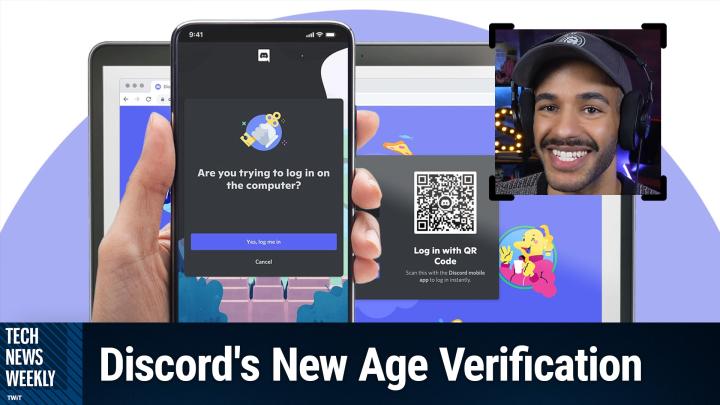
All TWiT.tv Shows (Audio)
Tech News Weekly 424: Face Scans on Discord?
01:00:28
Discord's New Age Verification Process Sparks Privacy Concerns
Loading summary
Transcript95 lines
- [00:00]
A
Coming up on Tech News Weekly, Amanda Silberling is here. We kick off the show by talking about, yes, a Stanford student who's trying to optimize matching between partners. Then I talk about how Instagram is currently defense. Well, Meta really is defending itself in court by way of Instagram's Mosseri. Afterwards, we have an interview with Emma Roth, who joins the show to tell us about what the current state is with discord and age verification. And Scott Stein of CNET stops by to tell us about his experience with the virtual boy and a talking flower. All of that coming up on Tech News Weekly. Podcasts you love from people you trust. This is Tweet. This is Tech News Weekly, episode 424 with Amanda Silberling and me, Micah Sargent. Recorded Thursday, February 12, 2026. Face scans on Discord. Hello and welcome to Tech News Weekly, the show where every week we talk to and about the people making and breaking that tech news. I am your host, Micah Sargent. And today on this, the second Thursday of February 2026, if you can believe it, we are joined by the wonderful Amanda Silberling. Welcome back to the show, Amanda. Hello.
- [01:22]
B
Happy middle of February, everyone's favorite month, a normal month.
- [01:29]
A
It's a normal sort of month that does month things. So speaking of a normal sort of thing that does things. Yeah, great segue, am I right? Tech? How do you do it? What do you do? This is of course the part of the show where we share our stories of the week. These are stories we find interesting, I think are worth talking about and want to share with all of you while we chat about them together. So, Amanda Silberling, without further ado, tell us about your story of the week.
- [02:01]
B
Yeah, so my story of the week is about. I'm sure no one's ever heard of this happening before, but a Stanford student starting a startup and then it's crazy. But no. So this is a startup called the Relationship Company that the product that is making waves right now is called Date Drop and it's something that an AI computer science grad student at Stanford made where it matches you with one student per week in like a dating match. Not just match, like yeah, it's a dating app, if that's not clear. And I just think it's really interesting in contrast with like how much time everyone in tech is spending thinking about the non human side of AI. Like I was doing a lot of research into malt book and like the idea around like people pretending to be AI and AI pretending to be people and like, blah, blah, blah. So I thought this story was like, AI, but make it human. Like AI, but how can it help people? Maybe. But I just also, just in that vein, am just very fascinated by like dating apps and dating culture and how it's evolved over time because, like, nobody likes dating apps. And so I joke about like, oh, there's a Stanford student with a startup. Whoa. But this actually to me makes a lot of sense as an area for a Stanford student to be trying to disrupt. Because a lot of the users of dating apps are college age, grad student age people. Nobody likes them. There's clearly room to build on it. And then I guess, yeah, literally I do think like an actual statistic I found was that like 78% of people felt disillusioned with dating apps. That was from Forbes. I don't have it in front of me, but it. I saw that this is great journalism I'm doing here, but trust me, nobody likes dating apps.
- [04:18]
C
Wow, that's.
- [04:19]
A
Yeah, that's quite a few. Quite a few people that are not into the whole app situation.
- [04:24]
B
Yeah. And so what this is doing differently, which it is similar to another Stanford startup from a couple years ago called Marriage Pact, where there's a very detailed survey and students fill it out. And then the founder, Henry Wang, is like studying like matching algorithms, which from my understanding of doing some research about this, is mostly a principle that comes up in economics in terms of. It's just the kind of algorithm that underlies Tinder, Hinge, Bumble, all of that. But he was just studying this particular type of matching algorithm. He created his own major at Stanford to study this specifically.
- [05:15]
A
Okay, that is wild.
- [05:18]
B
Yeah. Okay, so another thing, another wild thing about this though is so we are showing on the screen a Wall Street Journal article. I am also working on an article about this. I just. It's not done. So look at this other article about it. But I wanted to talk about it because I. It's on my mind. It's what I'm working on, like right now. But in. I'll give you a sneak peek into my very cutting edge reporting, which is that I noticed on his LinkedIn that it said that one of the classes he took was Intro to Clown.
- [05:52]
A
Excuse me.
- [05:53]
B
Yeah, so obviously I asked him about that because how do you not. And I'm doing really important work here. And then he sort of gave like. And here's what I learned about B2B. Sass esque response, but, like, it does seem earnest where he was like, I.
- [06:11]
A
Can'T wait to read this article. Don't tell us the quote. Don't tell us the quote. Got to make people go check it out. Like, I gotta. I. I'm very curious to hear about how clowning has anything to do with. Anything to do with anything that is this.
- [06:27]
C
I.
- [06:28]
B
So this is the Amanda Silberling journalism guarantee. Is that. Am I always gonna beat the Wall Street Journal? Maybe not. Will I always have the exclusive clown quote? You bet.
- [06:42]
A
And that's what we love. You know, this is interesting, I think, from the perspective of. You talk about the disillusionment. I also, you know, there have been. When we look at the history of the way that humans are sort of working right, where at one point what would happen is you pretty much most people, because not everyone was royal, most people would wake up at the. At sunrise and they would go out and farm their fields and tend to their. Their animals and. Or the. The king's animals or the Lord's animals. And then they would have dinner of some sort, and then they would go to bed, and then you would start over the next day. And so we have this. We have this. This, like, condition as humans to sort of romanticize the past in a lot of ways. And so there's this idea that because humans used to do one task or, you know, one sort of group of tasks each day, but because that work was getting done each day, that there was more productivity at that point than there is now. But what we've discovered is that we are actually far, far, far more productive, although it's a toxic productivity today than we ever have been, because humans are now expected to do so much more than we ever had to in the past. There's so much more in a day that we are all required to understand and interact with. And so all of that. All of that preamble is to say that, y', all, everybody's busy. And so I'm not surprised at this opportunity to optimize the getting to know you system where, you know, there's something to be said for what if the two of us have an underlying compatibility and now we get to move forth just getting to know each other with that sort of anchor there of, well, the system says we're probably compatible and then kind of get to move forward from there. I think there's something to that. I think a lot of times this stuff gets sort of couched in the tech, bro. Optimize everything. Micro dosing, you know, nonsense that is involved with that.
- [09:31]
D
That.
- [09:31]
A
But if we can sort of peel back those layers and look at things from the perspective of opportunities for people who may not otherwise have those opportunities or even like have it be front of mind. Because one of the things that the sophomore at Stanford said was a lot of people at Stanford place so much emphasis on success in other areas aside from social interaction. So it just naturally falls to the wayside. People just struggle with striking conversations in general, let alone romantic interactions. So if it's helpful for people, look, I'm not trying to, to, to archetype a Stanford Stanfordian, but at the same time, or a Stanfordite, I don't know what they, what they call themselves, but yeah, the chances of a Stan Stanfordian being a little bit socially awkward or you know, I think arguably probably higher than maybe at other more party style schools. Given that if there's something that can sort of ease that part of it, I think that's cool as long as it's authentic and it's, you know, people are putting the work in after the fact, then I think this could be something interesting.
- [10:52]
B
Yeah, Yeah, I think something that's interesting about this too is both. One, the fact of like we're seeing a lot of growth of how can we incorporate AI into dating? Like what if there was an AI that could date for, for you? Which is like there's some interrogation that maybe should be done there. Not really sure if we're there yet or if people want that. But so there's that aspect where this is not necessarily like using tech to take away the human aspect, but using tech maybe to alleviate some of the mental overload of swiping and just feeling like you're constantly like I could be doing more. Whereas this is just they give you a match a week and you go from there. But also what I find interesting is that while it is easy to be like, oh, the apps suck, everything is the app's fault, like tech is ruining everything. What's also interesting here is that apparently like an unforeseen problem that they're encountering with this is that getting people the matches is one thing, but setting up a literal date or setting up a second date is another thing. Which, you know, Stanford kids are busy. There is a, the founder of Fizz, which is a social app that came out of Stanford, like told me once that a way that he would socialize with friends was that to make sure they had like a standing appointment every Friday morning at 6:00am they would get pancakes. Six.
- [12:28]
A
Okay, okay, we're getting pancakes. Okay, that's fair. Yeah, so I'm like 6am I'm not my best self at 6am no, but.
- [12:34]
B
Like Stanford kids are so busy that they're like doing 6am pancakes. But I don't think this is just a standard Stanford kid thing. I think this is just like dating is hard and like, it's like people are so busy that it's like if you have a night where you're not doing anything, are you gonna like go on a date with a stranger? Or are you gonna like hang out with your friends who you probably haven't seen? Or are you gonna like read a book and go to bed early? Like, going on a date with a stranger seems so unappealing. So that's a problem that just humans have to solve is how do you get yourself to go on the date?
- [13:07]
A
Yeah, exactly. And this might be the way too to make it happen. All right, let's take a quick break so I can tell you about our sponsor of this week's episode of Tech News Weekly. It's Modulate. Every day, enterprises generate millions of minutes of voice traffic, including customer calls, agent conversations, and fraud attempts. Most of that audio is still treated like text. It's flattened into transcripts. It's stripped of all tone, of intent and of risk. But Modulate exists to change that. First proven in gaming, Modulate's technology has supported major players like Call of Duty and Grand Theft Auto in separating playful banter from intentional harm. At scale today, Modulate helps enterprises, including Fortune 500 companies, understand 20 million minutes of voice per day by interpreting what was said and what it actually means in the real world. This capability is powered by Modulate's newest elm, called Velma 2.0. Velma is a voice native Behavior aware model built to understand real conversations, not just transcripts. It orchestrates 100 plus specialized models, each focused on a distinct aspect of voice analysis to deliver accurate, explainable insights in real time. Velma ranks number one across four key audio benchmarks, beating all large foundation models in accuracy, cost, and speed. It's number one in conversation understanding, number one in transcription accuracy and cost in deep fake detection, number one in emotion detection. Built on 21 billion minutes of audio, Velma is 100 times faster, cheaper, and more accurate than LLMs at understanding speech, including Google, Gemini, OpenAI, and X AI. Most LLMs are a black box. Velma doesn't just assess a conversation as a whole, but breaks it down for greater accuracy and transparency by producing timestamped scores and events tied to moments in the conversation, meaning you can see exactly when risk rises, behavior shifts, or intent changes. With Velma you can improve your customer experiences, reduce risks such as fraud and harassment, detect rogue agents and more. So go beyond transcripts and see what a voice native AI model can really do. Go to Modulate's live ungated preview of Velma at Preview. Modulate AI. That's Preview. Modulate AI to see why Velma ranks number one on leading benchmarks for conversation understanding, deepfake detection, and emotion detection. Alrighty. Thank you so much to Modulate for sponsoring this week's episode of Tech News Weekly. Let's head back to the show. Alrighty, folks, we are back from the break and that means it's time for my story of the week. Of course. I'm joined this week by Amanda Silberling. A landmark tech addiction trial is underway in Los Angeles and this week saw Instagram's chief executive, Adam Mosseri take the stand to defend Meta against claims that its platforms are designed to addict young users. In test testimony covered by the New York Times, Mosseri argued that social media is not, quote, clinically addictive, comparing any habit forming qualities to those of a good television show rather than something more serious. Plaintiffs attorneys, however, pushed back hard, presenting internal company documents showing Meta executives, including Moss Area himself, had been warned about features that could harm young users and chose to move forward anyway. Now this case is part of a wave of lawsuits that could fundamentally reshape how social, social media companies operate and potentially expose them to billions in damages. So let's talk about this because there's something really interesting at play here when it comes to how these things are litigated and depending on what you're working on, how these, these things kind of move forth. And in fact, Jake Ward, who was on the show recently, kind of talked about how law, how the, the legal system is kind of looking back to big tobacco as the strategy here. So it's, it's one of the most significant threats that social media companies have ever faced. We saw some of that with changes, with potential changes to law that would have made companies responsible for showing copyrighted content. That kind of fell through. But this now coming forth, Save the Kids is definitely, you know, something that, that these social media companies are kind of looking at head on. These lawyers are looking at the tactics that were used against cigarette manufacturers in the 1990s. And they're arguing that Meta, YouTube and others created products that they actually did know were addictive and harmful, particularly to children. Now this is by way of a plaintiff, a 24 year old California woman who we know as KG, who sued YouTube, TikTok Snap and Meta in 2023 because she claimed she became addicted to social media as a child and experienced anxiety, depression and body dysmorphia because of it. Now Snap and TikTok have already settled for undisclosed amounts, but Meta and YouTube continue to remain as defendants. The there's a professor at Fordham Law School who is a law expert on these particular types of cases, Benjamin Zapiersky, who said this is a cutting edge case of our gargantuan and very powerful companies that have so far managed to avoid liability far better than many other industries. They may face some accountability here. Now before we kind of break this into a discussion, I mean I want to mention sort of what Mosseri's defense is. So when Mosseri kind of jumped up to talk about Instagram, he sort of painted it as a responsible platform that will carefully test features before showing them to youth and basically said that there's a distinction between casual overuse and clinical addiction. Saying there's all this is a quote, there's always trade off between safety and speech. We're trying to be as safe as possible and censor as little as possible. Now Mosseri was pressed on whether social media could be addictive and Mosseri said people could be addicted to social media in the same way that they could be addicted to a good television show. But he went on to say that it didn't mean they were clinically addicted and of course said that that was far more serious. Here's the thing. We've seen now internal documents that suggest that the companies were warned that some of these features like beauty filters could be harmful and you know, result in things like the body dysmorphia that was talked about. Despite warnings the, the, these companies chose to proceed with the technology. So yeah, I kind of wanted to get your take, Amanda. You followed social media for a long time and I'm sure you've seen some of these lawsuits flying by. You know what's your, your, your current take on? Because there's there's arguably good points on both sides of these arguments. These specific arguments related to perhaps an over scare about the effect of social media. But then there's also sort of point to anecdotal examples of how social media may have impacted individuals. So it's very much kind of I'm of two minds about a lot of this when it comes to how we move forward and try to protect, protect our youth online.
- [21:10]
B
Yeah, I feel similarly that I'm kind of of two minds about this where on one hand it's like we have a lot of evidence over, like, decades at this point of ways in which social media use has had negative mental health outcomes for youth. We've seen in the Frances Haugen leaks from a few years ago that there was literal research coming from inside of Meta that Instagram knows that its product was negative toward teen girls or like, made them feel worse about themselves. But I think what's key here is that this is an argument over is social media addictive? And not necessarily is social media contributing to adverse outcomes for youth? And in terms of the is it addictive case, I, like, I hate to say it, but I kind of see where Adam Oserri is coming from, where.
- [22:09]
A
I didn't find myself saying that.
- [22:13]
B
It'S like heartbreaking. The Onion article where it's like heartbreaking the worst person, you know, is a good point. He's not, he's not the worst person, but, you know, he's tech execs. But like, I think there is a big difference between something like tobacco that chemically, like, biologically addicts you. Whereas with social media, I don't think people are having withdrawal, withdrawals in the same way. But I think that there's a lot more societal pressure to be on social, social media than there is in society right now to smoke tobacco. So I feel like my take on it would be just anecdotally, I'm not sure if it's an addiction thing so much as it is that we have created a society where not being on social media means that you have less opportunities to socialize in a lot of cases. And, and that's really difficult when you're like 16 and your friends are making plans via like Snapchat, DMs or whatever. And then you're getting left out because you're not on Snapchat. But also, like, I don't know, my, my general take on these things is I do think there needs to be stronger parental controls. I think that parents need to be more educated about how, how to effectively use those parental controls, which I hate to put that pressure on the parents because this shouldn't be yet another thing that parents have to worry about in the very complex world of parenting. But yeah, this case in general is just very interesting because just the way the legal system works is like, there's not going to be a ruling here on is social media bad for you? It's just, is it addicting? And I don't know if that's really helpful in the same way that rulings around what materially can be changed to make things maybe less enticing to continue using. Does disabling Infinite scroll do anything? Is there any research about what design features have what effects on people and their dependency on these apps? There's a lot going on. I also think it's interesting that TikTok and Snap settled, but maybe we'll learn more about that in the future.
- [24:41]
A
I also thought that that was an interesting little tidbit there. I said, oh, okay. Wonder how much for. In any case, one day we'll know.
- [24:50]
B
Maybe.
- [24:51]
A
Yeah, perhaps one day we'll know. What I do know is that Amanda Silberling, you are wonderful and it's always a pleasure to get to chat with you here on the show. If people would like to follow work online, where should they go to do so?
- [25:05]
B
You can find my work on TechCrunch, where I'm publishing several times a week about various social media AI. How does tech influence people at large? Sorts of topics and I'm mostly on blueskymanda, omg lol, which is a real URL. And also I have a podcast, wow, if True, which is an Internet culture.
- [25:30]
A
Podcast and everyone should go check it out. And if you don't, you'll be hearing from me. All right, thank you. Thank you so much, Amanda. We appreciate it.
- [25:41]
B
Yeah, thank you.
- [25:43]
A
Bye bye bye. All right, we're going to take a quick break. Before we come back with my story of the week, I want to tell you about Bitwarden, who are bringing you this episode of Tech News Weekly. Bitwarden is the trusted leader in password, passkey and secrets management. Bitwarden is consistently ranked number one in user satisfaction by G2 and software review. With more than 10 million users across 180 countries and more than 50,000 businesses. Now, whether you're protecting one account or thousands, Bitwarden keeps you secure all year long with consistent updates. With the new Bit Warden Access intelligence, organizations can detect weak, reused or exposed credentials and immediately guide remediation, replacing risky passwords with strong, unique ones. This closes a major security gap. Credentials remain a top cause of breaches, but with access intelligence they become visible, prioritized and corrected before exploitation can occur. Also introducing Bitwarden Lite. Bitwarden Lite delivers a lightweight self hosted password manager built for home labs, personal projects and environments that want quick setup with minimal overhead. Bitwarden is now enhanced with real time Vault Health alerts. This is so great. And password coaching features that help users identify weak, reused or exposed credentials and take immediate action to strengthen their security. You might not know that something has been breached, so having that alert you is really helpful. Bitwarden now supports direct import from Chrome, Edge, Brave, Opera and Vivaldi browsers, and it's a good idea to get your passwords out of the browser and into something more secure. Direct import copies or imports credentials from the browser into the encrypted vault without requiring a separate plain text export. This simplifies migration and of course helps reduce exposure associated with manual export and deletion steps. G2 Winter 2025 reports that Bitwarden continues to hold strong as the number one in every enterprise category for six straight quarters. Bitwarden setup is easy and supports importing from most password management solutions. The Bitwarden open source code is regularly audited by third party experts. Bitwarden meets SoC2 Type 2, GDPR, HIPAA CCPA compliance and ISO 2700-12002 certification. So get started today with Bit Warden's free trial of a teams or enterprise plan or or get started for free across all devices as an individual user@bitwarden.com TWIT that's bitwarden.com TWIT and we thank Bitwarden for sponsoring this week's episode of Tech News Weekly. All righty folks, it is time for our next story. This time an interview. Discord is about to force some users to make a choice to verify their age using a face scan or government id, or use the platform with restricted features. There's lots to dig into here. Joining us today to talk about it is the Verge's own Emma Roth. Welcome back to the show, Emma.
- [28:40]
D
Hi, thanks so much for having me again.
- [28:42]
A
Yeah, it's a pleasure to have you here. So you have been covering this. Discord recently announced that it's rolling out age verification requirements for users worldwide starting next month. Can you kind of walk us through what exactly is changing and what users can expect?
- [28:58]
D
Yeah, so it's a pretty big change and users are going to be placed into a team by default account. This is only going to apply to some users, which I'm sure we'll get to later. But they will be like limited, have limited access to certain features. Like they won't be able to access age restricted channels or servers. And some other features will be limited or just have kind of restrictions on them like messaging. And it's going to be, it's going to be more of a protected experience. But users can verify their age if they are above, if they are not underage, they can verify their age with a government ID or a face scan okay.
- [29:49]
A
So, yeah, in fact, you. You mentioned a little bit there that Discord has said most people aren't going to need to do this face scan or the ID upload. But what is the process by which the company is sort of determining who needs to verify and who doesn't? How does that actually work? Is there a chance that I would end up seeing, hey, you need to verify your age?
- [30:14]
D
Yeah. I mean, Discord is saying that it's going to be running a machine learning age estimation model.
- [30:21]
A
Surprise.
- [30:23]
D
And what this is going to do, it's going to look at your account tenure, your activity, it's not going to use any of your messages, but it is going to try to use some of this information about your activity on the platform to determine what age group you might be in. And if it determines with like a high level of confidence that you're an adult, you're not going to have to go through the process. And Discord, I said the majority of users won't have to go through this, but I think we'll have to see about that next month.
- [30:55]
A
Yeah, absolutely. You also mentioned in your piece that Discord isn't the only platform moving in this direction. I think that's kind of the big conversation here. Right. What are some of the other major services that have implemented age verification and do their approaches differ at all or are they pretty much the same?
- [31:12]
B
Same.
- [31:14]
D
So far, we've seen sites like Reddit and Blue sky and even Xbox implement age verification in response to laws in the UK and Australia. And in those locations, the process is pretty much the same or similar. But other than that, we've seen companies even here in the US like Google and YouTube and also Instagram, they use that age prediction model. So if they think that if their system picks up that somebody might be under the age of whatever their platform requires, they might put them into like a teen account where they won't have access to certain features.
- [31:59]
A
Ah, I see. Okay. There's also been quite a bit of user backlash to this announcement. I. I saw. This is how I actually found out about it at first, through friends of mine saying, oh, I just canceled my nitro today. Can you kind of talk about what are the main concerns that you're hearing from the Discord community or even in the larger scale of things, what are the concerns that people are having about age verification online In. In general?
- [32:31]
D
Yeah, there's a lot of concerns floating around right now, and I think it's completely valid because anytime you put your personal information or submit it anywhere online, it Definitely is. It does raise some alarm bells, I think, but a lot of people are concerned that like basically about privacy, security. And Discord actually had one of its third party vendors experienced a data breach last year. And as part of that breach the discord said some IDs were leaked. And I think that too is adding to like people freaking out about this.
- [33:17]
A
Definitely, yeah. Now last year Discord had a data breach. As you, you know, we just have talked about, I mean using these third party vendors seems to be pretty popular because it's hard within the time period to roll out age verification that like is internal, that the company is making itself. Do, do we think, I guess how big of a role do you think the data breach has played in this? Is this the, the sort of crux around which the conversation is based or is it more about just privacy in general and sort of, you know, a bigger conversation than, well, you've messed up before. So I don't want to give my stuff over this time.
- [34:06]
D
Yeah, I think the breach is definitely a big part of it, but I do think people would be upset about it anyway. And because it is a huge deal, I mean it's basically you have to give your information in order to use a service without restriction. And I think that's just, it could like bar some people from accessing the site without limits. And I think it's just, it is like a, a threat to our freedom on the Internet in the future.
- [34:40]
A
Yeah. Now you, you, you're doing a great job of kind of helping us roll into the next parts of the questions here because speaking of freedom online and, and sort of privacy online, you spoke with the Electronic Privacy Information Center. What is that perspective on whether age verification is actually an effective approach to online safety? And more importantly, kind of, we've seen, we've seen messages from the eff, we've seen messages from, you know, epic and, and it's kind of, it seems to be a very clear answer. Right, so what is that perspective and do we think the companies are listening about that?
- [35:32]
D
Yeah, I mean, I think that age verification is just being pushed so hard right now by lawmakers and regulators. And I think the technology behind it, the security behind it, it's just not fully developed yet. I don't think there's like one, there's not one good way to do it. And one of the privacy experts I spoke with noted that it's better to just make the app like, make the app in a way that reduces harm using design, the design of the app itself, I mean, and that makes total sense. I think that it's age verification wouldn't be necessary if we did have those protections in place by default.
- [36:21]
A
Yeah, yeah, absolutely. Now, final question for you here. Pulling back and looking at the bigger picture. What does Discord's global rollout tell us about where the Internet might be heading when it comes to age gating and identity verification? Because for me, I was kind of surprised that this, what I've always seen is a sort of scrappy platform, alt platform in not. Not alt in the modern parlance where it's kind of like a scary thing, but alt in the good way of being separated from all of the craft. Discord has always felt very much like group oriented. And so if even Discord is having to hop on the age verification thing, where do we think the Internet is headed?
- [37:05]
D
Yeah, I think we're definitely going to start seeing more of this. I forgot to mention that Roblox has also implemented some age stuff too. So I think it's definitely, I think more platforms are going to be adding it and like, if not age verification, definitely the age prediction models, even OpenAI is using the age prediction models with ChatGPT to limit users that it detects as underage. And I think we're definitely going to start seeing that seep into other areas of the web and that might just be a stepping stone to full blown age verification later on, but we're going to have to find that out.
- [37:52]
A
Absolutely. Well, Emma, I want to thank you so much for taking the time to join us today on the show. Always a pleasure to get to chat with you. If people would like to stay up to date with the work that you're doing, where should they go to do so?
- [38:03]
D
Yeah, you can reach me at emroth08 on X or blue sky.
- [38:07]
A
Awesome. Thank you so much and we'll see you next time.
- [38:10]
D
Thank you.
- [38:12]
A
Alrighty, folks, if you can believe it, it's time again to take a break. Before we come back with our final interview of the show, I want to tell you about Delete Me bringing you this episode of Tech News Weekly. Have you ever wondered how much of your personal data is out there on the Internet for anyone to see? Well, it's more than you think. Your name, your contact info, your Social Security number, your home address, even information about your family members are all being compiled by data brokers and sold online. And anyone on the web can buy your private details. This can lead to identity theft, to phishing attempts, to doxing, to harassment. But now you can protect your privacy with delete Me like I have because the phishing attempts, the, the, the ability, especially now with AI to sort of make custom targeted attacks on a person that you want as little information online about you and your connections as possible. And you know, like, I'm a tech insider, I'm a host of a show, and given those things, I, yeah, of course I know how little privacy we have and how much personal information is out there that can compromise my safety, my security, and yours too. That's why I personally recommend and use Delete Me to solve this problem and help keep me protected. I've actually gone now for many months each month getting a notification saying, hey, here's what we removed from the web about you. And I said, why is that on there? Why are my siblings on there? Why is my, my grandparent on there? It's very frustrating, the stuff that's, that's collected out there. Delete Me. Delete Me is a subscription service and that's very important here because it removes your personal information from hundreds of data brokers and continues to do so. You can sign up and provide Delete Me with exactly what information you want deleted and then Delete Me's experts take it from there. Deleteme sends you regular personalized privacy reports showing what information they found, where they found it and what they removed. And Delete Me isn't just a one time service. Instead, Delete Me is always working for you, constantly monitoring and removing the personal information you don't want on the Internet. To put it simply, Delete Me does all the hard work of wiping your and your family's personal information from data broker websites. So take control of your data. Keep your private life private by signing up for Delete Me at a special discount for our listeners today. Get 20% off your delete me plan when you go to JoinDeleteMe.com Twitter and use promo code Twit at checkout. The only way to get 20% off is to go to join delete me.com twit and enter code twitter twit at checkout. That's joindeleteme.com twit code twit. Thank you, Delete Me for sponsoring this week's episode of Tech News Weekly. Alrighty, we are back from the break and it's time for my final interview. Today, Nintendo is diving deep into its own history with a new accessory that brings back one of its most infamous hardware experiments. The Virtual Boy. This plastic visor turns your switch into a retro gaming machine so that you can experience a library of games from that ill fated 1995 console. While they were at it, Nintendo also announced an interesting little toy that's kind of themed after Super Mario Brothers. Joining us today to talk about all of that is CNET's own Scott Stein. Welcome back to the show, Scott.
- [41:41]
C
Hey, thank you. I kind of look like I'm inside a virtual boy right now. I'm talking to you.
- [41:47]
A
Are we playing Tron?
- [41:49]
C
They know.
- [41:51]
A
So the virtual boy is one of Nintendo's most infamous hardware releases from the 90s. Do you want to talk a little bit about that and then tell us what exactly is this new Switch accessory and how does it bring that experience back for modern players?
- [42:07]
C
Yeah, so I actually never had a virtual boy even though this would have been like the perfect thing for me being into VR when I was in high school and college. But it was a proto modern VR device that had a tripod and only did 3D red and black stereoscopic gaming. So back in 1995 that was about the best you could do for the price. And it played basically like 3D Game Boy games. And you wouldn't turn your head around, you just stick your head in the little tripod, stand and play with this controller. It was extremely short lived. I think it had like 14 games that ever came out for it it and now Nintendo is bringing it back as a Switch accessory.
- [42:50]
A
Wow, fun. You talked about leaning into that, literally leaning into the tabletop goggle setup rather than actually putting on your head. It's not like other VR headsets. What was that physical experience actually like? And did you like it more in terms of comfort or any of that than perhaps what you would get otherwise?
- [43:15]
C
So it was weirdly comforting I said in the story and that may sound really odd to say but it, you know, if you ever go to like, like a museum or you, I think Disney had these where you like the old like Nickelodeon 3D films you'd kind of play and you like from you know like the turn of the century that you'd, you'd do like a flip book and turn. It feels like you're looking into a museum exhibit. You know, you're putting your head in, in and the goggles are wide enough that they feel like they black out everything. And then you're looking at this weird kind of black with red kind of Tron like graphic retro graphics. And it's very simple. But I actually really appreciate the simplicity. I don't think it's going to be for everyone. And Nintendo is only selling it online right now, so it's kind of a collector's item thingy. I just find it amazing that they're even doing this because I'm also a big game and watch fan and I love that they released those old game and watches in the past. I like these way off the beaten path bits of playable memorabilia and that's what the Virtual Boy feels like. I like that recreation of the tripod thing, but it is a hundred bucks to stick your Switch into. They're also selling a $25 cardboard one, which is probably more practical, but not as fun looking.
- [44:36]
A
Yeah, now I'm thinking of like Google Cardboard. Now with this, you talked a lot about it. The Switch's display becomes the virtual voice screen. Tell us about the 3D effects. Do you think that, I mean, arguably this would make sense that the higher resolution switch 2 display would in theory improve upon 3D effects from yesteryear. Now you said you didn't try the Virtual Boy back in or you didn't have a Virtual Boy back when it came out. But I'm kind of curious. Did Nintendo show you what old Virtual Boy experiences looked like how. Yeah, tell us about that.
- [45:15]
C
Yeah, so unfortunately that is the big bummer here is that I don't have. This is a rare moment where I don't have firsthand experience to immediately call on and think about. Some people do have them. That original Virtual Boy apparently had a really fast refresh rate rate due to its unique kind of LED screen technology. It was really its own unusual thing. Now I'd be curious between the two switches, which would be best in my demo with Nintendo at the time, I think I did it with Switch 2, which has a higher resolution also faster refresh rate. And I don't know if they're tapping into those that much. What it looked like to me was it definitely felt like I was looking through a. A not fantastic screen. But it was good enough. But it was good enough that because you're only having so many pixels, it worked. Plus there are a few settings where you can adjust your eye. They actually have thing to accommodate eye distance. Like so you could.
- [46:06]
A
Oh, nice shift.
- [46:08]
C
Yeah. You could shift the relative interpupillary distance for eye comfort, which is more than I would have expected from them. And, and it, yeah, it fills up the screen and you, you know, you're, you're playing Game Boy resolution type games, pinball game, a boxing game where the fists are kind of coming like this. And it's really like if you want to play retro Nintendo games, here are like 14 that you like have probably never played. And just kind of get into the Gwiz part of that. But I'm also curious why they're doing this. I'm always curious how Nintendo seems to keep revisiting this VR AR space every once in a while.
- [46:47]
A
Yeah, okay, that's actually a really good question is because this is the thing for me, if I saw Apple doing this, and we have seen Apple, I'm sort of trying to lead into where I'm going with this without revealing it too much. But like we've seen, for example, the watch. There was an accessibility feature that let you pinch your two fingers to interact with the watch.
- [47:15]
C
Right.
- [47:16]
A
And we came to find out that part of that was testing eventually to see that come out. But. But when I hear Nintendo do these things, my first thought is not Nintendo is testing something that they might come out with later. And I don't know if it's just because Nintendo is like this quirky, fun thing in my head. And so it's just like, maybe they're just having fun. Is that your take or like. Yeah, where do you stand on that?
- [47:40]
C
I feel like it must be a bit of both because I, you know, I don't have much insight into what's going on. Nintendo is always a bunch of secrets and magic and mystery stories. But as much as they like to explore things that you go, why did they do this? It does feel like they're kicking tires on this idea. And they had Labo VR, which was that cardboard construction kit. They made this limited VR functionality in 2019 for the Switch and that was just a one off. And now they're back exploring it, but for a retro fun thing. And I got to speak with Shigeru Miyamoto at the opening of Epic Universe last year, and I will. People always ask about VR and AR with those things. And it was great to talk to him and he acknowledged that there was interest in these things, but maybe it wasn't for everyone yet. And that Mario Kart ride at Epic and at Super Nintendo World has that visor that came out five years ago. Plus there was that little race car, that little Mario Kart Live around 2021, that had AR through your Switch screen as it drove around a real course. So I kind of look at these things, I go like, what is Apple? What is an Apple? You're saying, what is a Nintendo kicking the tires on? I wonder if they're trying to kick the tires on. How comfortable the experience is and how shareable. One thing that struck me, at least, even if they're not doing that one thing about Virtual Boy I did like is I feel like when I finally do set it up at home is you could kind of set it up like a little mini arcade cabinet. Everyone could dip their head in and play for a bit and, you know, have it just kind of stand up there and just go, do you want to play? Do you want to play? And I think that's fun versus, oh, it's just going to be sitting on my face.
- [49:18]
A
So maybe, yeah, there's less of a commitment too. I think that I would find kind of relieving where if I'm getting into VR, I'm strapping something to my face. Just being able to kind of walk up and pop my eyes in, you know, for the most part feels a lot more doable and, you know, a temporary experience versus like I'm committing to this moment here, like safety too. Yeah, yeah, yeah, that's true. Now there's. There's got to talk a little bit about the. Oh, no, I'm sorry. There was one question that I missed. I did want to hear more about the games. What? Was there any game that you said, you know what if I had one of these, this is something I'd be playing regularly. Were there any that you kind of thought, yeah, no, it's no surprise. We haven't seen this in a while. How was that?
- [50:18]
C
They're a little between like classic game and watch games and old Game Boy games. So if, like you're into that type of a thing, I think there are some that are really fun to revisit. Like, I never played this game, Red Alert, I think it was called, which is kind of like Star Fox. It's like a really old wireframe Star Foxy type prototype game. And the telluroboxer is like Punch out, but 3D but with robots. And there's a Wario game that has different 3D levels. There's a pinball game that's 3D. A 3D Tetris was actually pretty fun because you actually are dropping in actual 3D layers. You don't need that to be literally 3D, but it's fun to have that. But like you said, I don't know if there's one game that I would be like, oh, wow, you've got to play this. But it was a fun random treasure chest of oddities. And I think they're coming out with two later this year that were never released, which is fun as a collector's thing. You just don't know when Nintendo is going to release retro games that you want to play. There are still ones on the virtual console that haven't hit and you wait for those shoes to drop and sometimes they don't. As a, as a, as a super B side collection, this is fun. I think it is a specialized collector type purchase though for, for the, for the one who wants the interesting Nintendo hardware.
- [51:43]
A
My day kicks off with a refreshing Celsius energy drink. Then straight to the gym pre K pickup back home to meal prep time for my fire station shift. One more Celsius. Gotta keep the lights on when the three alarm hits. I'm ready. Celsius Live Fit. Go grab a cold refreshing Celsius at your local retailer or locate now@celsius.com.
- [52:05]
D
Experience.
- [52:06]
B
A membership that backs what you're building.
- [52:08]
D
With American Express Business platinum unlock over $3,500 in business and travel value annually with statement credits on select purchases from brands like Dell, Hilton and Adobe and other benefits. American Express Business Platinum there's nothing like it. Based on total potential value of statement credits on select purchases and other benefits, enrollments required monthly and other limits and terms apply. Learn more@americanexpress.com Business Platinum we heard you.
- [52:36]
A
Nine years of bring back the snack wrap and you've won.
- [52:39]
B
But maybe you should have asked for more. Say hello to the hot honey snack wrap. Now you've really won. Go to McDonald's and get it while you can.
- [52:51]
A
Speaking of hardware, there's a talking flower. Tell us about the price, what it does, who's it for? Is it worth? Looks cool. I kind of want it. How does it work?
- [53:08]
C
It's totally ridiculous. The docu, you know, alarmo came out a while ago now, but like over well over a year ago. And that was this whole, you know, kind of ambient. It measures your sleep and can make music. Talking flower is just a talking flower. Like it, it's got a little button you can press and it's going to say something. It's the flower that's in Super Mario Wonder with that same kind of cute, annoying voice. And it's like this little interactive toy, like a talking Amiibo almost. But it's not an Amiibo and it does apparently talk every hour or every, every period of time. I haven't didn't get a chance to try that yet. I just, when I demoed it, I just got to press the button and there is apparently a music mode that kicks in where you can do some rhythm game thing with it. And apparently it has a thermometer, so I don't know how that gets used Very Nintendo, where it may tell you the relative temperature in the room, but all the things they're promising are not really very useful by design. Like, I think it's. It may give you the time, but it may not be accurate.
- [54:14]
A
Oh my God.
- [54:15]
C
It might say it's 9:00 clock and no, no, sorry, it's 10. I didn't. Yeah, I didn't get to experience that. I do think there are some general wake up modes you can do with it. So you could kind of use it, I think as a very basic alarm clock perhaps, but it really is just a novelty. What I think it's interesting is Nintendo is selling more and more of these souvenirs that almost feel like we get at a theme park. And you know, thinking about Disney, thinking about Super Nintendo World, I feel like going to Epic Universe last year, I feel like I would have gone into a gift shop there and like come out with a talking flower. And then like I bought this. I did. It's sitting on my shelf. So it feels like maybe they'll sell it at the park. Maybe. I'm sure they will. Maybe this is them exploring other little fun things. They already have a lot of amiibo. I mean, 35 is more than I'd want to pay, but it's also not as much as I thought it would be. So it's right in that middle zone where you might be like, I might get it because Alarmo was 100. And that much like the Virtual Boy is a little hard to justify, but $35 is that perfect little, like, I'm just going to get you this random thing price.
- [55:27]
A
Yeah, yeah. I would be thrilled to have that as like a little, a fun little gift. You kind of spoke about going there, going to the event and seeing these things. Nintendo does seem to be expanding. Movies, theme parks, little home products. The Alarmo and the talking flower that doesn't know what time it is. What do you think this signals about where the company is heading beyond just game consoles? Is this expansion mode or is this just test mode? What's the future for Nintendo? From Scott Stein's Crystal Ball?
- [56:03]
C
I think it's definitely expansion mode. And if you're super into games, that could potentially be frustrating because are very much about the entertainment experience Collective. With the next Mario Galaxy movie coming out and the theme parks, I think this is a big thing and the stores and the merchandise, that feels like the big collective push that the company's doing and the games. But it's interesting because I think that collective thing makes even more sense thinking about the Switch too, because I've seen a lot of commentary now. The Switch 2 has been, you know, we're not too far away from the one year anniversary of Switch 2 and inevitably not everyone has one. It's a system that a lot of people are still playing the original Switch and I think it's going to take a while for Nintendo to make it essential because they don't want to alienate. I'm sure all the 100 million plus people that have a Switch that don't want necessarily upgrade and they don't have all the games. So they're filling it in with all these other things, the movies and the toys and the other things. I kind of feel like it's like both bridging the gap and kind of like filling out the stuff so that you kind of live with Mario through a lot more different types of things. It makes sense. It's very Disney. I think that's going to be more and more where the company goes. It might influence the way the games are developed too. Could there be a Super Mario Galaxy game because of the movie? Will that change? You know, some people might like want the games to. I'm sure they're going to still experiment with games. I'm totally speculating, but I do think that that's been a vibe from Nintendo now for a little while.
- [57:47]
A
Yeah. Okay. Well, of course, as we often say when we're talking about tech, we will just have to wait and see what happens. I know you will be watching. Scott Stein, thank you so much for being here today. If people would like to keep up to date with with all of the great work you're doing, where should they go to do so?
- [58:06]
C
Well, you can find me on Bluesky, you can find me on cnet and you can find me on a newsletter that I have on Beehive called the Intertwixt.
- [58:13]
A
Awesome. Thank you so much. We appreciate it.
- [58:16]
C
Yeah, thank you. Great to be on.
- [58:18]
A
Alrighty folks, that brings us to the end of this episode of Tech News Weekly. You know this show publishes every Thursday at Twitter, tv, tnw or you can search Tech News Weekly wherever you get your podcasts and subscribe there. If you would like to gain access to some pretty awesome things, can I tell you, you have a moment to talk about Club Twit, Twitter, tv. Club Twit is where you go to learn more about the club and sign up. $10 a month, $120 a year gets you quite a bit. First and foremost, a warm fuzzy feeling. Knowing that you are helping to support the work we do here on the network. If you like the shows on the network and you want to see them continue keeping on keeping on, join the club. It is the best way to help out Twitter TV Club Twit. Now let's talk about what you get. First and foremost, all of our shows will be ad free for you. Just the content. You also gain access to a special set of feeds. There's one feed that covers our bits clips before the show, after the show moments. There's one feed that covers our live commentary on tech news events and there's one feed that has all of our special club shows like My Crafting Corner, Stacy's Book Club and so much more. If that's not enough, well, don't you worry because I've got one more thing that you get which is access to our members only. Discord. We were talking about that during the show. Fun place to go to chat with your fellow club Twitters and also those of us here at TWiT. Especially for me during Crafting Corner, the Discord is a fun place to hang out while we share our crafts as we kind of work along together. Small so if you have yet to join the club, what's going on? Join the club. You get a. You get to start it out with a free trial and then from there I think you'll want to stick around. Let's check out the welcome page today. Welcome to Boston Explorer. Who has joined. Welcome to Accordion Guy. Hi Accordion guy. Welcome to WardMB and welcome to Sonic Tonic. I like that name. That's a good name. Thank you for joining the club. As I mentioned, it's always fun to go in there and see new people joining all the time and of course our regular wonderful folks who are there as well. That's how you join the club. TWiT TV Club TWiT. If you would like to follow me online and check out the work that I'm doing, you can head to Chihuahua Coffee, that's C H I H U A H O A Coffee, where I've got links to the places I'm most active online. Be sure to check out my other shows, some of which published today. You can check out iOS today, hands on Apple and tune in this Sunday as John and I will be recording more episodes of Hands On Tech Live on Sunday. Thank you so much for being here. Tell your friends about the show, Share an episode Share a clip from the episode all that Jazz. It's all very helpful. Thank you. Thanks so much and I'll see you again next week for another episode of Tech News Weekly. Bye Bye. USAA knows dynamic duos can save the day like Superheroes and Sidekicks or Auto and Home Insurance. With usaa, you can bundle your auto and home and save save up to 10%. Tap the banner to learn more and get a'@usaa.com bundle restrictions apply.
- [61:51]
B
Wanna see your brand on TV?
- [61:54]
D
Roku Ads Manager makes it easy to.
- [61:56]
B
Launch targeted ad campaigns in minutes, track.
- [61:58]
D
Results in real time, and drive on.
- [62:00]
A
Screen purchases with just a click of the Roku remote.
- [62:03]
D
Get a $500 match on your first.
- [62:05]
C
$500 spent with code ROKU500@ads.roku.com that's code R O-K U500. Terms apply.