← All TWiT.tv Shows (Audio)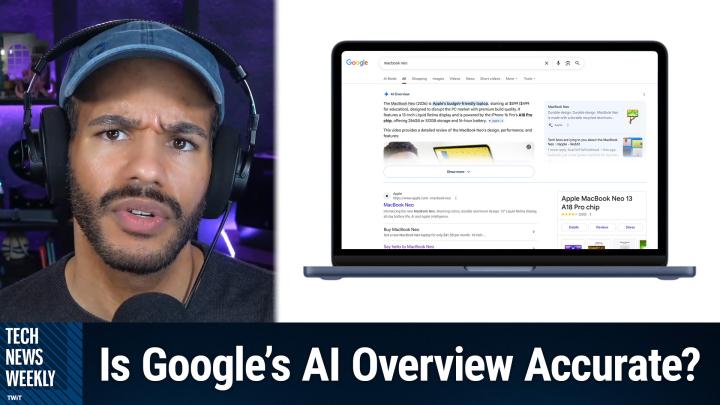
All TWiT.tv Shows (Audio)
Tech News Weekly 432: How Wrong Are Google's AI Overviews?
01:41:58
Is Google's AI Overview Reliable?
Loading summary
Transcript158 lines
- [00:00]
A
Coming up on Tech News Weekly, Amanda Soberling of TechCrunch is here we talk about Google's AI overviews. It's a New York Times piece looking at the accuracy of the tool as well as a question of AI's use in journalism. Then Rod Pyle of this Week in Space and at Astra magazine tells us all about Artemis 2. And Scott Stein of CNET joins us to talk about Apple's next 50 years. Stay tuned for this episode of Tech News Weekly. Podcasts you love from people you Trust.
- [00:40]
B
This is TWiT.
- [00:44]
A
This is Tech News Weekly, episode 432 with Amanda Silberling and me, Micah Sargent. Recorded Thursday, April 9, 2026. How wrong are Google's AI overviews? Hello and welcome to Tech News Weekly, the show where every week we talk to and about the people making and breaking that tech news. I am your host Micah Sargent and this week I am joined across this vast and ever changing interweb by the wonderful Amanda Silberling. Hello, Amanda.
- [01:13]
C
Hello Micah.
- [01:15]
D
How are you doing?
- [01:17]
C
Well, I have two drinks on my desk right now, so that's two drinks
- [01:22]
A
and only one of them is alcoholic.
- [01:24]
C
No, no, one of one of them is caffeinated, but neither are alcoholic. It is 2pm in Philadelphia.
- [01:32]
A
I had coffee, it's empty and I have water and it is not empty. So I'm also sort of a two drink, two beverage kind of person.
- [01:42]
C
This morning I have an unbranded carbonated water because they have to pay twit if you know, if they not sponsored.
- [01:54]
A
So for folks who are tuning in for the first time, welcome. If you've been here before, well then you know how this works. We start with our stories of the week and this week I'll actually be kicking things off Google's AI overviews. Many of you are probably familiar with them at this point. The AI generated answers that sit at the top of the company's search results look authoritative, they feel definitive. But a new investigation from the New York Times takes a hard look at just how reliable those answers actually are. Working with an AI startup called maybe it's called U Me. It's O U M I U Me. The Times put Google's AI overviews through a widely used benchmark test and found that while the answers are right about 91% of the time, that remaining margin of error when applied to Google's more than 5 trillion annual searches actually translates to tens of millions of wrong answers every single hour. And frankly, it gets thornier from there. Even when the answers are correct the sources backing them up often don't actually support what's being said. That's the big thing here. Right. So let's look at kind of the numbers when we look at an accuracy problem, depending on who you're talking to and what their intentions are, you may hear the term rounding error used. And I could see Google trying to do that in this case. But these are big numbers. Umi tested Google's AI overviews across 4,326 searches and did so in two rounds. Once in October when the system ran on Gemini 2, and then again in February after it was upgraded to Gemini 3. Accuracy did improve from 85% to 91%. But again, when you have that many people doing Google searches, 9% is an enormous rate of error. That's 5 trillion searches per year, of course. And again, that's tens of millions of wrong answers per hour, which is hundreds of thousands per minute. Google's own Internal testing of Gemini 3 found the model produced incorrect information about 28% of the time when operating on its own. The company argues that AI overviews, which of course layer search results on top of the model's output, performs better than the raw model. But it can't escape this fundamental limitation that today's AI systems use mathematical probabilities to guess the best response. They do not use a strict set of rules defined by human engineers. So I want to ask you, Amanda, first and foremost, just your general take on Google's AI overview, whether you make use of it when you're doing a search. And also I'd love to hear sort of people around you, right? We. That that's one of the things that that's fascinating to me is like, what are people saying about their use or lack thereof of Google's AI overviews?
- [05:05]
C
Yeah, I think this reminds me of like, a couple days ago, I have been playing Pocopia, the new Pokemon game. And the mechanic in which your character sucks up water is kind of like glitchy and weird. And I was trying to Google if there was a way to do it better. And I Googled sucking up water. Pick a pia. Because I just was typing fast and spelled Pecopia very wrong. And then Google Overview was like, Pikopoeia is the name of the sensation in which you suck up water and it gets lodged in your throat or like,
- [05:40]
A
I don't know what.
- [05:41]
C
So it's like. And then. So it doesn't surprise me that it's wrong at this rate. Like, it's definitely gotten better over time. Like, I remember when it first rolled out and we were all being like, hey, Google, like, how do I make cheese stick on my pizza better? And they're like, put glue on your pizza. And that was the whole thing. Like, it has improved. But I still feel like it's at a point where whenever I get data from Google AI overviews or just like, if I'm reporting anything and any sort of information comes to me through like a Google AI overview, I'm like, okay, now let me go to the actual source and find what the source is and make sure the source isn't like some random website I've never heard of that Google decided is trustworthy when it's like some guy's blog.
- [06:33]
A
Yes. And here's the thing. So my experience has been that for the Google AI overview, I rarely ever read it. I just scroll right past. Because for me, I'm not usually looking for answers to questions when I'm doing a search. I'm looking for. I mean, I am looking for answers in some ways, but it's more about, like, what is the website that I need to go to to find whatever it is I'm looking for? I'm doing searches. And so it's a little bit different how some people will use it as sort of a question and answer box. So I'm already kind of a person who scrolls past it. But something that ended up being, I think, one of the most heinous sort of issues here, they decided to look at how Google's AI overview was displaying information. And here's the thing, when you think about it, right? If. If the AI has an answer within its sort of global context, the information that just exists in its own mind, so to speak. So I don't know the four plus two equaling six, right? It has this information because of all of the training that it's done, it knows four plus two equals six. And so you could search that, it would give you the answer. And then I think this is. That maybe is a little bit too easy. Let's go with something like male seahorses carry the children. Carry their children in their little seahorse pouch. Right?
- [08:21]
C
And that is true, right?
- [08:22]
A
That is yes, as far as I know.
- [08:24]
C
I was like, I feel like this could be one of those, like, urban legends that people talk about on, like, elementary school playgrounds. I don't know, we gotta have like marine biologists come in and see. Let's ask, let's ask Google, see what
- [08:40]
A
its AI says of National Geographic. All the way back in 2002, seahorse fathers take the reins in childbirth. My point is, my point is, in its training, it has learned that male seahorses carry the babies. So it knows this. And that way that means that it can display this answer in Google's AI overview. But what it doesn't necessarily mean is that when it links to a source, that source actually says that thing because it is trained to provide sources, but it isn't necessarily trained to provide sources that are accurately representative of the answer. So what that means is it can get the answer right because it knows it, but when it's linking to stuff, it doesn't necessarily mean that those links are actually relevant. Relevant to the answer that it gave. And that's an issue because people are more likely to believe that it is giving the right answer because it has cited its sources. So they're calling this ungrounded as, as the sort of answers, responses that might be technically correct but linked to sources that don't fully support them. In October, 37% of the correct answers were still ungrounded. But here's what's wild. Even though it got better at answering questions, the questions were more accurate or the answers, excuse me, were more accurate. After that upgraded Gemini 3, 56%, more than half of the answers were ungrounded. They pointed to sources, but those sources did not actually have the answer when you went to it. And so this is a problem. It's not necessarily going to be the right answer. And even if it is the right answer, then you can't confirm that it is. And so people are just trusting this system. And that's what I think. That's what's sort of upsetting to me is I don't understand putting a tool that may get things so very wrong at the, at the top, at the top of something that like so many people around the world experience day to day Google search used by so many people. And to have that just be like, you know what, we're gonna, we're gonna roll with this. Even though more than half of the time it can't even properly cite its sources. But. Oh, well, okay. Why? It's not helping me, it's hurting me.
- [11:25]
C
Yeah, it kind of reminds me like when you mentioned the statistics at play here, it reminded me of. In October, OpenAI published a report that was like they were addressing how they've been like, under a lot of scrutiny for negative mental health impacts and like, stories of like people talking to ChatGPT about suicide. And then OpenAI said, well, 0.15% of conversations are about suicide. And that sounds like really small. But then you remember that at the time, and probably more now. But as of October, OpenAI or ChatGPT had 800 million weekly users. And 0.15% of that is more than a million. So that's millions of people that are talking to ChatGPT about things that perhaps they should be talking to with a professional or a friend or someone who is not a computer.
- [12:30]
D
Mm.
- [12:32]
C
And it's just the scale at which these AI tools are being deployed is just so vast that even if it's inaccurate like 0.1% of the time, or it hallucinates like such a tiny fraction of a percent. Like the numbers are even bigger with Google than with ChatGPT because people are googling more things a day than they are having conversations with ChatGPT. And the numbers are just so large that like any tiny percent of error is so magnified and impacts so many millions of people in a way that is alarming.
- [13:06]
A
It's very alarming. This is, it's, in my opinion, an irresponsibility that is not okay. Like that's. This is way. This way too many, way too many errors. The. One of. One of the things that's in this, it talks about sort of when it would get the right answer but get the details wrong. The article documents several cases where AI overviews got part of the answer right, but fumbled the supporting details. When asked how old the relief pitcher Dick Drago was when he died, the system did get the age correct, 78, but then repeatedly misstated the date of his death and the additional context. In another case, Google was asked about Yo Yo Ma's induction into the Classical Music hall of Fame. It got the link to the organization's website correct. It listed 165 inductees, including MA. But the AI generated answer said there was no record of his induction. It'll find the right source, but misinterpret the source it will. So asked about the river bordering the west side of Goldsboro, North Carolina, and it identified the. A different river which is southwest of the city in the actual answer though, the little river which feeds into the bigger river. And it said that the river ran through the city, but Google system incorrectly inferred that it ran along the western border. So those details are what's wrong about it?
- [14:29]
C
So I'm.
- [14:30]
A
Yeah, right. I'm confused.
- [14:33]
C
Yeah, I'm just laughing because like, as you mentioned the baseball related thing, I was like, I wonder if I like ask it a question like, how quickly can I get it to mess up and I didn't get it to mess up. But it was funny that I asked it when was Bryce Harper inducted into the hall of Fame? And he has not been inducted into the hall of Fame, which I know he is still an active player. And Google did tell me that he has not been inducted into the hall of Fame, but then it just gave me a list of other athletes named Bryce. So there's a Bryce Drew was inducted into the Indiana Basketball hall of fame in 2024. Bryce Cotton inducted into the Providence College hall of Fame. So, yeah, that's definitely what people that are Googling Bryce Harper are looking to know is other athletes named Bryce.
- [15:22]
A
Wow. Wow. Yeah. So this is, you know, something that we're just having to watch and go, okay, well, try not to pay too close of attention to these. And that's. I think that's what I've seen my friends who exist outside of sort of the techie techosphere scroll past the AI overviews in almost every case. I don't know if that's the same for you, but it sounds like from what you're nodding, that in many cases that's what it is. I think I've seen sort of elder Millennials into Gen X area anecdotally, not scrolling past the AI overviews. That's. I know. Now this will be the time where everyone who watches this show who falls into those categories will message and go, not me. I know. Not you. Y' all are tech folks. You understand?
- [16:18]
C
Yeah. Everyone who listens to this show has never done anything wrong in their life, ever.
- [16:23]
A
Exactly. You get it. So, of course it says, the fine print beneath every AI overview reads, AI can make mistakes, so double check responses. But the fact that it's prominently placed at the top of the doggone screen doesn't encourage anyone to be skeptical. Like, I think that there should be. You do a search and then there's one of those sort of like, you know, in discord, how you can make something be blurry and then it reveals it should be like that. And it should say, here's our AI overview. It might be wrong. So really, is this worth your time at all? Is really what it should say, but
- [17:00]
C
that would be good for the shareholder value. You're not thinking about the shareholders.
- [17:04]
A
You're right. What am I? I'm. I'm thinking of people over profit. And that's just a foolish fool thing to do.
- [17:11]
C
That. That is a. A fool's errand.
- [17:14]
A
Why. Why would I ever think that that's how we should be thinking about this stuff? Not at all, sadly. All right, let's go ahead and move along. We'll take a quick break before we come back with Amanda's story of the week that will continue talking about AI and we'll continue doing so in a skeptical manner. But first, let's take a quick break so I can tell you about Framer, bringing you this episode of Tech News Weekly. Your marketing website sets the tone for your brand and is the one touch point every single one of your customers has. If you still struggle to make small changes and simple updates, well, you're leaving opportunity on the table. That's why so many companies from early stage startups to Fortune 500s are turning to Framer, the website builder that works like your team's favorite design tool. Framer turns your.com from a formality into a tool for growth, helping businesses build better websites faster with real time collaboration, a robust CMS with everything you need to get great SEO and advanced analytics that include integrated AB testing. Your designers and marketers are empowered to build and maximize your dot com. From day one I was given access to Framer to create a site and I have to tell you, one of the first things that I noticed about Framer was just how much control you're given, just how much you can actually access. I have another tool that I have used to make websites and with that tool I don't, I didn't have much control over everything. The fact that I can like really dig in and get at analytics that it's thinking about how I was reading some of the support documents and it was very aware of how you have to set up special files on your site whenever you're doing things like Apple Pay or you're trying to get Google Adsense running. That's what I really liked about this. You have as much control as you need. Changes to your Framer site go live in the web in seconds with one click and without help from engineering so that your team can actually reduce dependencies and reach escape velocity. Framer is an enterprise solution. It truly is. With premium hosting, enterprise grade security, 99.99% uptime SLAs that give the world's leading brands like Perplexity, Miro and Mixpanel the confidence they need to build their websites in Framer. Whether you want to launch a new site, test a few landing pages or migrateyourfull.com, framer has programs for startups, for scale ups and for large enterprises to make going from idea to live site as easy and fast as possible. So learn how you can get more out of your.com from a framer specialist or get started building for free today@framer.com TNW for 30% off a Framer Pro annual plan. That's framer.com TNW for 30 percent off framer.com TNW rules and restrictions may apply. Thank you Framer for sponsoring this week's episode of Tech News Weekly. All right, moving right along. As I mentioned, joined this week by the wonderful Amanda Silberling. And now we're talking about, well, journalists and AI and where things are going with the blurriness, the line that's being blurred there. Amanda, take it away.
- [20:48]
C
Yeah, so this is sort of a continuation of your story of the week, but through another story. But I wanted to point to another recent New York Times investigation that came out yesterday from John Carreyrou, who is the journalist that broke the Theranos story and wrote the Theranos book. And it's just a very like well known and respective investigated journalist. And he claimed to have found possibly the identity of Satoshi Nakamoto who is the pseudonymous founder creator of Bitcoin. And this has been sort of like a mystery in the tech world for decades. And I don't so much want to talk about the story itself. The like TLDR is, he thinks that it is this guy Adam Back, who is like a longtime cryptographer who was like working on digital payments since like the 90s and just the kind of guy that would know the information you would need to make Bitcoin and who has been involved in these spaces. And then the guy said no, it's not me. Which that doesn't mean it's not him. But he denied the report anyway. But the reason that I think this is interesting to talk about is the way that, that they are using AI in this report which is that there are these like very, very large, just massive quantities of emails, like emails from various cypherpunk crypto email lists for decades. And Satoshi, even though he's like a mysterious figure, he still would like comment on these. And he was someone that people like talked to. They just didn't know who he was. And so what he did was he went through those emails and he found certain turns of phrase or misspellings or certain things that came up in Satoshi's writing. And then he took the rest of the emails and put it into a large language model to try to figure out like, like can the large language model identify what are like someone else that is having like common spelling errors to Satoshi or like similar turns of phrase or just sort of like what looks like it was written by the same person. And I think that's just like a really interesting way of using AI in journalism in a way that like, like on one hand you can't actually prove anything with that. Like you can make an educated guess. But I feel like especially in the last few weeks there's been a lot of discussion in journalism about how AI should or should not be used in reporting. And in one case Max Zeff at Wired wrote a report where he interviewed a bunch of journalists that are using AI. Like, like prominent tech journalists like Alex Heath, who is independent now. And in the case of these independent journalists, a lot of the time they're like, yeah, I'm running a one person show and I need to be able to expedite my work. So if I put my notes into Claude and it writes a draft for me and then I edit the draft, then like what's wrong with that? And of course a lot of people think there's something wrong with that. That and there's like an interesting divide happening right now in tech journalism where you have a couple of these people that are like if you're not using AI to draft your stories, then you're falling behind. And then the Wall Street Journal wrote a story about an editor, I believe at Fortune, who was using AI to like significantly increase his output. And just like, like, because like we, we get so much news that we can't even cover and if I tried to cover every single thing that got emailed to me every day, I would have to write like 20 articles a day, if not way more. And that's just not feasible. But technically if I took the press release and put it into some LLM that is like fine tuned with my writing, could I technically output put something that's like vaguely what I would write about it? Yes, but also doesn't that defeat the whole purpose of writing? So these are basically just the debates that people are talking about in journalism and AI and how we should or shouldn't use it right now. So yeah, I guess on one end of the spectrum you have like, it's really interesting what John Carreyrou did of a human would never be able to go through like 30,000 emails and find like, like really nitpicky similarities in text versus like is there a difference between doing that and like putting some press release into Micah GPT
- [25:48]
A
and okay, so this is a tough one from the perspective of, because look, when it comes to ethics, ethics in journalism it's obviously something, at least for me, you know, going to journalism school and. And being inundated with the sort of belief from the ground up about ethics and journalism. And, you know, I still do hold to a lot of those ideals. I think something that can sometimes get lost, that perhaps schools don't do a good job of focusing on, and perhaps commentators don't do a good job at times of remembering is where the dynamics of a work environment, the requirements of being alive and everything else that goes into that comes into play. And when you are not the editor and chief of a news publication or someone working in the business side of things, and you are simply one of many writers working for a site, and you are being strongly encouraged to use these tools. And when you're not using these tools, then you become like, there's so much that's involved in this that I think sometimes we have to make a little bit of space for or just have that understanding in that context of those are the questions that I want to know. Were you sort of pressured into using these tools? And do you feel like, you know, the difference between you getting a raise versus the other person is that they're faster because they've used AI to draft things? And to be clear, I don't think that that is the way that it should be, but I think reality versus idealism, when it comes to that are two different things. Right. And that's something that I just am mindful of. What I hate, though, is how often we hear after the fact that AI was used in the creation of this or that, and that it is not always explicitly laid out and made clear. That frustrates me. I think that we need to be upfront and honest about that. And in doing so, then you are sort of cleared to. To proceed.
- [28:45]
D
Right.
- [28:46]
A
You're using this tool. You're making it clear that you're using this tool. Now I have the choice whether I support this, you know, journalism by reading it or not. The idea that any of this has to be discovered afterward, or that there are. There need to be studies being done that reveal that AI was used in the making of this or what have you, that's troublesome. I don't think that it should be that way.
- [29:11]
C
Yeah, I think that we're at such a interesting moment where there aren't really norms set around how people do or don't use AI in journalism. And I think that there's a lot of really obvious don'ts. Like, I don't think you should use AI to write a story. We know that AI hallucinates. We also know that AI just is going to produce boring writing because that's just how it works, that it's going to produce the next most probable word. And that's not always the most exciting writing that you can produce when you are a professional writer. But then at the same time, there's times where it's like, if I want to know how much money did Meta spend on Reality Labs Labs in 2023, if I Google that, I'm not going to get an answer. If I ask ChatGPT, that I will probably get an answer that I can then go back and fact check and make sure that it's accurate. I think also sometimes I think about it like, maybe this is not a right way to think about it. But my hypothesis right now is that maybe ChatGPT, like and like the main LLMs in general are sort of comparable to Wikipedia. When you're in high school, where everybody tells you that Wikipedia is not a reliable source and you're like, okay, yeah, like, I know that anyone can go in and edit it, but also if I go into Wikipedia and the answer is right there, and then I can see, oh, they're attributing it to this article in a trusted journal. And then I, I can click on that and go to the trusted journal if it is expediting the time you spend looking for the piece of information. I don't know if that is the worst thing for writers that are on tight deadlines, but I also am like, I think it is like, appropriate to use a slippery slope argument here where it's like, all right, well, when you use AI for one thing, like, what are you going to use use for
- [31:10]
A
it next or give a mouse a cookie.
- [31:12]
C
If you give a mouse a cookie, will the mouse then accidentally publish falsehoods on the Internet? I've also heard of people using it, like, giving it a prompt, like, you are an editor whose sole job is to check that this is dramatically correct. You are not going to suggest any changes unless if you notice something that is factually inaccurate or grammatically not correct. And I don't really mind that as just like a extra layer. But then of course you get into like, on like enterprise versions of these products, they don't train on what you input. But if you're like a freelancer just using like free chatgpt and you put your stories into that, than like, you're giving open AI your writing to train on, which I don't know if we want that to happen.
- [32:07]
A
Yeah, I don't, I, I don't know. You know, we've heard, I think it was, I, I can't remember who it was, but it was somebody who talked about AI as kind of like a teenager driving your Ferrari.
- [32:26]
C
Yeah.
- [32:27]
A
And so it's. The Ferrari isn't the problem, it's the person driving it who may not be skilled in driving a stick doing so. And it was, oh goodness. It was somebody, Lichtenberg who said, and I can't remember the person's first name, but regardless, I'll just say this is what they were talking about. They said, well, now I've lost that too. Lord have mercy. They say, oh, here we go. Compares AI to a sports car that you can crash if you're not careful, saying you've got to be like a Formula one driver. And that's what I'm thinking is an important aspect here is too many people perhaps using these tools without fully understanding them. And understanding there's so much skepticism that I just have by default when I use these tools and I see people using them without that skepticism and thinking it's sort of just we can solve this quickly situation. And that is, that's what leads to issues like, like that's, that's where we're making mistakes. That's where this stuff is no longer of use. But there was a study from the European Broadcasting Union and the BBC that found almost half of all AI generated responses had at least one significant issue with news integrity. University of Maryland study found that roughly 9% of newly published newspaper articles were either partially or fully AI generated. And the number of AI generated articles on the web surpassed human written ones in late 2024, which is also not surprising. That often is just a bunch of the cruft that's out there. But you know, there are people who I think I've seen use these tools in interesting ways, being able to. I think I was talking to Abrar Al Heechi last, I think it was last week, about one of my favorite aspects of AI that is genuinely helpful. And it's the, it depends on which tool you're using. But I think on for Google it's called deep research. For Claude I think it's just called research. And I'm not sure what it's called for OpenAI because I don't use ChatGPT.
- [34:54]
D
But
- [34:56]
A
in both of those cases it goes out onto the web, finds a bunch of different sources and then combines them together into a research report. And so one thing I did was, I said and I, it was around the holidays, I want to make Christmas cookies. That's the one that, you know, that happens to be the holiday I celebrate. I want to make Christmas cookies and I want them, they have to be gluten free because I'm gluten free. The problem that I've always had is that they don't hold their shape. Even when I chill them, they don't hold their shape. I think it's because of the fact that they're gluten free. What I want you to do is go out on the web, not only find the best gluten free sugar cookie recipe, but also find comments and blogs and other information about what it is that could possibly make the cookies hold their shape better. And then let me know what you find. And I was able to get back a report that had not only a great sugar cookie recipe, gluten free sugar cookie recipe, I mean, but. But then dozens of quotes and synthesis to provide me with the stuff that I needed to do to make the cookie better. Happened to be xanthan gum and chilling for even longer than you typically would to get these cookies to turn out. And boy howdy, did they turn out. That's a cool thing, right? That's a neat way of using it. Helpful.
- [36:28]
C
This is what AI should be used for. AI needs to be used in circumstances where if it fails, the worst thing that happens is that your cookies Crumbly.
- [36:37]
A
Exactly. Yeah.
- [36:38]
C
Although I guess also it could tell you like put bleach in your cookie.
- [36:42]
A
But it could, it could. And if it did tell me that, that, see, I would go, well, no, we can't do that. And I want to believe that everybody would do that, but maybe there's someone out there who would go, well, it must know.
- [36:53]
C
Yeah.
- [36:53]
A
And I guess, I don't know.
- [36:56]
C
Yeah, I think in terms of journalism, like the John Carrey Roo story that like him using this to analyze like an absurd amount of data that he wouldn't be able to do himself. Kind of reminds me of in 2021 when there was Frances Haugen, the Facebook whistleblower, who just released a trove of documents of like the quote unquote Facebook files, where while she was working at Facebook, she just took pictures of as many files as possible and was just like indiscriminately like, I don't know if this is anything. I'm just quickly going through and taking pictures so that I can like have this information. And I remember at the time, like I was working at TechCrunch then too, and TechCrunch always has been a bit smaller of a staff than like, the New York Times or, like Wall Street Journal. So there were reporters at the New York Times where they had, like, set teams, where it was like, your job right now is to go through the Facebook files and find interesting things. And at TechCrunch, we just decided not to do that because we just didn't have the bandwidth to set up a whole team to do that. And then I wonder now, how would that be different with AI? If could you put the documents into an AI and be like, pull documents that involve discussions about children's safety? I don't know how effective that would be because we haven't tried it, but I guess. I don't know. I think that I want to be as skeptical as possible about how AI is used in journalism, because I think that this could go horribly wrong very, very, very quickly. But then also, as someone who like, reports on tech and knows that this technology often can be good at things, is there a way where we can take advantage of the fact that. But you can very quickly synthesize a lot of data really quickly?
- [38:52]
B
All right.
- [38:54]
A
There's obviously quite a bit that is involved in this in such a way that it's a little difficult to encapsulate the nuance of using these tools in a way that sort of passes muster, and then using these tools in a way that leads to people going, now what is it that you're doing there? And why are you doing that? It's wild, seeing I didn't know that there was going to be, during my lifetime, something that is having such a profound impact on the stuff that I care about. Right. Like, I knew that there would be technology that I would find interesting, but it was always sort of hardware based. In my mind. I would grow up and one day I'd be. It'd be really cool that I've got a wristwatch that I could talk into like Dick Tracy. But the fact that this is so transformative across all of the industries that are important to me, science, technology, and journalism, it's. It's wild. And I just. I never would have guessed that that's where, you know, where I would be, what I would be doing. And I'm glad that we. That many of us are still keeping a level head about things. I think that's important when it comes to this.
- [40:33]
C
I also think that as much as I'm thrilled that you were able to get a good cookie recipe, I don't think that either of us are like, yes, building a lot of data centers and contributing to climate catastrophe and creating these large companies that are just taking over the world. Is that worth the cookies?
- [41:00]
A
And to me, it's. It's not worth the cookies. It's not.
- [41:03]
C
I don't know how good are the cookies though?
- [41:05]
A
I mean, they were pretty good, but you know, sort of like world ending versus cookies.
- [41:12]
C
Yeah. Like you want Sam Altman to be the world supreme king ruler, but you get cookies.
- [41:18]
A
But you get cookies. Welcome to the dark side. We have cookies.
- [41:23]
C
Wow. In any case, we got there.
- [41:24]
A
We got there at the end. I want to thank you so much for taking the time to join us today. If people would like to keep up date with the great work that you're doing, Amanda, where should they go to do so?
- [41:35]
C
Well, you can read my writing on TechCrunch and I, in terms of social media mostly, am posting on bluesky, Manda, omglol, which I always am. Like, every time I say this, I'm like, I can't just say it. I have to be like, haha, isn't that funny? And then also I have a podcast called wow, if True, which, which is co hosted with science fiction author Isabel Jae Kim, where I talk about the horrors from a nonfiction standpoint and she talks about the horrors from a fiction standpoint. So together we have all the horrors. That was a bad piece.
- [42:10]
A
All the horrors are covered.
- [42:11]
C
This pitch is in progress. You know, it's more of a funny show than a horrific show, but boy are the horrors present.
- [42:19]
A
And when they're present, you got to acknowledge them. The horrific elephants in the room, as it were. Amanda, thank you so much for your time today. We'll see you again soon.
- [42:29]
C
Yep, thank you. Goodbye.
- [42:31]
A
Bye.
- [42:31]
D
Bye.
- [42:32]
A
All right, we're going to take a quick break before we come back with a wonderful interview I'm very excited about. But first, let me tell you about Bitwarden bringing you this episode of Tech News Weekly. Bitwarden is the trusted leader in password, passkey and secrets management. With more than 10 million users across 180 countries and more than 50,000 businesses, Bitwarden is consistently ranked number one in user satisfaction by G2 and software reviews. With Bit Warden access, intelligence organizations can identify weak, reused or exposed credentials and take action immediately, while vault health alerts and password coaching surface risks to individual users in real time and guide them to fix issues on the spot, turning one of the most common causes of breaches into something visible, prioritized and fixable. And now Bitwarden is introducing the new Agent Access SDK, a powerful way for developers and teams to securely integrate controlled credential access into applications, automation workflows and AI agents. This release does not incorporate any AI functionality into the Bit Warden solution and does not grant AI systems persistent or unrestricted access to vault data. The Agent Access SDK is a separate open source development toolkit designed to enforce secure, human approved and scoped credential access for teams that leverage AI agents in their workflow. Available now in early alpha phase for testing, the Agent Access SDK introduces a secure framework for how agents request, receive and use credentials, helping define a model for safe credential interaction in agent driven systems. Bitwarden now enables Passkey login for Windows 11, by the way, securely unlocking devices at the OS level, and is working with Microsoft on native passkey support while extending SSO to automatically log users into more apps, making credential management across devices more seamless than ever. For those who want a lightweight option, Bitwarden Lite offers a self hosted password manager designed for home labs, personal projects or quick deployments with minimal overhead. Bitwarden's open source code is regularly audited by third party experts and it meets SoC2 Type 2, GDPR, HIPAA, CCPA and ISO 270012002 standards. So get started today with Bitwarden's free trial of a teams or enterprise plan, or get started for free across all devices as an individual user@bitbitwarden.com TWIT that's bitwarden.com TWIT and we thank Bitwarden for sponsoring this week's episode of Tech News Weekly. All right, we are back from the break and that means as promised, we've got an interview planned for you. It's one of those weeks where you look up at the sky and you remember that we are once again a space faring species. NASA's Artemis 2 mission has sent some astronauts around the moon, believe it is the first crude lunar flyby in quite a while and along the way shattered some space flight records. We will talk more about that. Here to break it all down is Rod Pyle, Editor in Chief of Ad Astra magazine and of course the host of this Week in Space. Hello Rod.
- [45:46]
B
Hi Micah. So good to see you again.
- [45:48]
A
It's good to see you too. Also your head headphones are amazing. Oh those are so cool.
- [45:52]
B
These are ancient pioneers,
- [45:56]
A
just like delightful. So for folks who maybe haven't been following this as closely, could you start by kind of walking us through what the Artemis 2 mission actually is? Why it matters that we're sending humans around the moon and sort of what's up.
- [46:12]
B
So we haven't left Earth orbit since 1972, which is a very long time time. I'm old enough to remember the last time we left Earth orbit and actually the first time, which is Apollo 8. So this mission was a bit of a follow to Apollo 8, if you will. It was specifically just to go past the moon, not land on it. And, you know, we've tried this country, we've tried to restart a lunar program a couple of times, once under the first President Bush, and again under the second, but they never really gained traction. And it wasn't until 2016 when Trump came into office. At that point, we were working under something that President Obama had implemented to do an asteroid rendezvous that wasn't really getting a whole lot of positive feedback from the press or the public or in some circles of science. So Trump said, let's go back to the moon. Now, in some ways, we can thank China for this, because we were hearing the earliest rumblings of the them planning to land their astronauts on the moon. And I think we all have observed that America seems to be at its best when it's challenged by something. And so I think that's what it took to get us going again. So this particular flight, first crewed flight of the Orion spacecraft, and this is really an engineering mission, as you pointed out in the message you sent me. You know, it's, of course, getting great acknowledgement from the public and there's a lot of romance to it. You know, we're exploring again, we've moved out of Earth orbit again and all that. But the core here is we have to test this machine. So this is a whole new spacecraft, looks a lot like Apollo, but isn't at all like Apollo, which was a child of the 1950s in a lot of ways, with early 60s technology. And I'm working on a book project with Jerry Griffin, who's a flight director from the Apollo era era. And as we went through our 60 or 70 hours of interviews, we both agreed that we're kind of amazed that Apollo worked as well as it did, because we were just out of vacuum tubes then and transistors were about the size of your thumbnail, you know. So this is a very, very different mission. But what they're looking to test here is the trajectory, which is different from Apollo. It's just a flyby, not an orbit, not a complete set of orbits anyway. And you got to test life support, which they've been on for nine days. Now, which is critical. And a lot of those systems came from the space shuttle. Of course, as the press jumped all over. We're testing a new toilet, which is very cool. It's actually a little compartment in the floor of the spacecraft. We can go in and close the door and kind of hunch in there and do your business. And they finally got the bugs mostly worked out of that. And to a very large extent, we're testing ground control. You know, the people at NASA have never overseen a crewed mission leaving Earth orbit. And it's different. It's really different. I mean, when you're at the space station or in an orbital capsule, you can get back within hours or maybe a day or so. Whereas from the moon, if something bad happens on the way out, like Apollo 13, you've got days and days before you can get back. So this is really a test of the systems and the people on the ground to make sure that they can put pull this off for these longer missions coming up. Artemis 3 and of course Artemis for the first landing, which we hope will happen in 2028. That's the plan.
- [49:35]
A
Fingers crossed. Yeah, this. So this launch, of course, happened April 1. Critical translunar injection burn, which we can talk about and kind of. Can you tell us a little bit about the sequence, what it looks like, what were the big milestones that they had to hit along the way to go. Okay, we're good, we're good. Here's the next step. Here's the next step. How does that work?
- [49:57]
B
Well, the first milestone was this being the first crewed launch of the Space Launch System, the sls, which has gotten pilloried pretty heavily over the years by the press and a lot of people in the community for being old tech. It's expendable. It's nothing like Starship. But of course, Starship isn't really working yet and this does. So this is the moon rocket we've got. It's expensive. Expensive, but it works. So launch was a big deal. And normally when you launch a new system like this, you know, you have holds, you have scrubs, you have hydrogen leaks, like we saw during some of the testing and all that kind of thing. So really none of us were prepared for it to leave that day. We thought, okay, well, it'll slide to the third or the fifth or something, and they'll have these 24 to 48 hour stand downs while they detank it and figure out what's wrong. It didn't happen. They had one 10 minute hold, which I think was planned, and then off they went, and cheers erupted all around. So the launch was a big deal. Then once they're in lunar orb, excuse me, in Earth orbit, they have to fire up that upper stage, it's called the icps, and get them into a higher orbit, which went perfectly. So they, unlike Apollo, which just departed from low Earth orbit, this went to a much higher orbit orbit and departed from there. I think it was about 1200 miles at its highest. And then at that point, they had already cut loose from that upper stage of the rocket and they did some maneuvering exercises which were not critical, but were very cool. That's to test the handling of the spacecraft with the maneuvering thrusters. And then they fired the service module engine, which is the little cylinder on the back of the Orion capsule. It's not very powerful. It's about £10,000. So maybe, I don't know, a sixth of what a jet engine would be on a, on an airliner, but it was enough to kick them out of this high orbit. So the upper stage had done the majority of the work getting them up there, and then this just nudged them out of there. So that's the translunar injection burn. I think it was just under six minutes and again worked perfectly. And what sort of shocked me was usually once you've made that, that, that insertion, you have to do a number of corrective burns to make sure you're in exactly the right trajectory. Because in this case, since they're not going into lunar orbit, they had at that point to try and get as close to the right trajectory to fly past the moon and come home as they could. That's called a free return trajectory. So it's one shot loop the moon. And as I said in the movie Apollo 13, Isaac Newton's in the driver's seat and he's bringing you home, right? So from that point when you're leaving high Earth orbit, you have to be more or less prepared to come back to the earth within about 2 degrees. If you're higher than that, you could bounce off the atmosphere and see you later. If you're too steep, you could come in and actually the heat shield would fail. So that was a critical maneuver. They had six other small rocket firings in the schedule to do if they needed them. But as of now, I think they've done three, all pretty short. Again, not a very powerful engine. One of them was maneuvering thrusters. So they really nailed it on this thing. This is kind of the miracle of the 21st century. You know, you're not using these banks of IBM 360 mainframes and all that. You're using modern computer technology. It shows inside the spacecraft with all the glass panels instead of gauges and all that stuff. Steam powered stuff they had in Apollo and they just nailed it. So at this point, after this pass behind the moon, which we'll talk about a little bit, they're just coming back. And all things being equal, they should hit the atmosphere tomorrow afternoon and they'll come down about 100 miles off the coast of San Diego.
- [53:37]
A
Wow. Wow. Gives me goosebumps. Speaking of goosebumps, I think record setting is something that's anybody can, can, can understand, right. When you hear, oh, a record has been set, it very quickly is like, oh, that's a cool thing. I want to pay more attention to that. My understanding there were some records broken. What was that moment like to watch unfold for you? How significant is it? I mean, have we done something truly sort of. Did you think we would get there eventually or was this kind of like a, oh, wow, this is. We've finally done it.
- [54:16]
B
So again, you know, being my age, I'm within a few months of Leo's age. I've seen this before, right back in the 1960s and as a young man then there were these interminable delays. I mean those missions, once it got going, flew as often as every two months. But we had the delay after the Apollo fire and we had the delay with the lunar module not being ready, which is why Apollo 8 flew without one, and so on and so forth forth. So I was expecting a lot of delays in this program. Not quite as long as they turned out to be. We were supposed to be doing this a number of years ago, but we got there. There was a lot of stuff to overcome on the way. The heat shield is not behaving as they had expected, so they had to mix accommodations for that. And of course again, the SLS rocket, you know, we had those hydrogen leaks and helium leaks and so forth. But you know, once they got going, you're right, it starts to actually backing up these records. So first time we left Earth orbit in 54 years. Furthest flight out. Now it's kind of interesting the range of this. The reason it's so far out is because this system was designed the, the rocket and the upper stage and so forth were designed before Artemis was a thing. They were really kind of designed and started back in the Constellation era, which is a program that bush number two started back in the early, early 2000s. So that upper that that rocket propulsion unit behind the capsule isn't as powerful as Apollo's was. So because of that and a couple of other reasons, they couldn't go into a low orbit, so they had to go into this high orbit behind the moon. So they broke the record. We were, we were not in mission control at that moment. We were in the press center because, you know, they don't want a bunch of looky loos standing in the observer's gallery, you know, pressing against the, the glass and cheering and all that. But there was a message read up from mission control, and then there was a message read back from the crew. And, you know, it's funny, in the Apollo years when you heard this chatter from the ground loop and from the astronauts back and all that, you know, those guys were test pilots. So they were talking like this. We're very proud to do this for our nation and so forth. It was all kind. It was like listening to a sports guy, teams pulling together. Go team. You know, so. So it was kind of like that. And then the guys on the ground were mainly just speaking tech speak. This time there's a scripted message going up to the crew, a scripted message coming back. But you could tell that the crew was having a blast. It sounded again like the moonwalkers did in the 1960s, early 70s. They were really enjoying themselves. So they read back a message about what this record meant. But, you know, it was really one of those things where irrationally, if you're an observer, you're sitting there waiting for, okay, what am I going to feel here? And it just kind of went by. You know, it was a scheduled event, but when they started actually doing activities behind the moon, as they were looping behind it, and they were only out of touch for about 40 minutes. And in Apollo, when they went behind the moon, they had to either fire a rocket engine to slow the in lunar orbit, or critically fire the rocket engine to get them out of lunar orbit to come home. There's only one engine on Apollo 8, so if that failed, they'd still be there. In this case, they were just cruising. So, you know, there wasn't a lot of pencil chewing going on while they were behind the moon. But there were some, some really beautiful moments. One of them was naming a crater after Reid Weissman, the commander's wife, who's a fellow astronaut who had died in 2022, leaving him to raise his two teenage kids. And I guess the crew had come up with this idea while they were in quarantine the week before.
- [57:50]
D
Oh, wow.
- [57:50]
B
And the other three crew members came to Reed and said, we think we ought to name a crater after your. Your deceased wife. And he said, that's fine, but don't expect me to say anything because I'm not going to be able to get through it.
- [58:01]
A
Oh.
- [58:02]
B
So I think it was Jeremy Hansen that actually, actually read down the request, and they said, we'd like to name this. This crater after Reid's wife, Carol. So that was. That was really one. There was not a dry eye in the house. And even in mission Control, you saw, you know, those stalwart people kind of doing.
- [58:19]
A
Yeah, yeah, they had them over, like, that was big.
- [58:22]
B
And a couple of other really memorable moments. As they were heading to the moon, Charlie Duke, who's an Apollo 16 moonwalker, sent up a recorded message telling him, you know, we're handing the torch to you, and so forth, which was moving. But the big one was a message from Jim Lovell of Apollo 8 and Apollo 13 fame, who died last year. But somebody had the foresight to have him record a message for them before that. And he started with, welcome to my own neighborhood. And then he closed it with don't forget to enjoy the view. And that man, that got everybody. And. And you can see the crew up there just kind of got going. We didn't expect this. This was a big deal. So that was. That was really, really wonderful.
- [59:08]
A
That's awesome. That is so cool. So you mentioned this, right? The crew, they're on the other side. They. You sort of, at that point, are letting them do their thing. Was this a mission that involved any new learning as far as what we know about the moon or other? Because I know, obviously, as you talked about engineering here, we're making sure that life support works, et cetera. But there were images sent back. You mentioned the naming and everything. Did we learn anything new as far as celestial bodies go, or was it all just our own science?
- [59:51]
B
You know, it's an interesting question because we've been to the moon a bunch of times with the Apollo program. We've had orbiters there, multiple countries, us, China, Japan, others photographing the moon for decades. So it's really well mapped and it's pretty well understood. We have 850, roughly, pounds of lunar samples that came back from Apollo, more that came back from sample returns by some robots. So it's pretty well understood. So the viewing and science program they had for that backside turn, NASA made quite a deal about, you know, they were looking for, okay, what's new about this that the press can latch Onto right, because that's a struggle they have all the time. And really the message they kept putting out was it'll be the first time that the upper and lower attitudes of the far side will be seen by human eyes. So they've been photographed, but the point was made by the science team that the human eye can discern things that photographs can't. So because they were so high above the moon, about 4,200 miles, as opposed to the Apollo orbits, which were between 60 and 100 miles, they were able to actually see from the, from the top to the bottom. So we didn't really know what to expect. One thing that did come out of it was they saw six white flashes while they were there. And these have been been seen from the near side of the moon telescopically before. But they were, were apparently meteorite impacts on the moon, small meteorites hitting, and then this big burst of energy as they, as they melt when they strike because of the high temperatures. So that was notable. And then of course, there was a solar eclipse as they came around the far side where the, the, the sun was blocked from their view. Now, normally on Earth, if you've ever seen a solar eclipse, they're three to seven minutes, they're pretty short. But the Earth, or excuse me, the Moon's diameter exactly blocks the sun. So you see all of the corona and all that, that activity going on there. In this case, the, the sun was much smaller than what was blocking it. So it took almost an hour, I think it was 53 minutes to come from one end to the other. But what they were able to see was the outer corona, which is a very different view than seeing the entire corona. And also one thing they were looking for on the science program was to see if they could get an idea of how much dust is in the lunar exosphere. So the Moon has a very, very slight atmosphere, almost nothing. But because it's a very electrostatically rich environment, when the Apollo astronauts were there, they were covered in lunar dust all the time because their spacesuits were acting like mechanics, magnets just sucking all this dust up. So one thing they want to understand better is how much of this stuff is in the atmosphere. And a way you could do that is by rear illuminating it. So they got that. But mainly they would just take a picture, picture, picture, picture. You saw the video. They darkened the capsule so that they could see out the windows better. I think they had four Nikon F5s, which is interesting, or D5s, which is their top end camera. As of about 2016. But apparently that change chip was determined to be the best thing they could use and then a couple of others. And weirdly, this is a complete aside, but I kept waiting for Nikon to make a big deal out of this. We're going to the moon again, just like we did with Apollo. And I didn't see much, you know, and I thought, wow, what's up with your PR team?
- [63:13]
A
But yeah, that's weird.
- [63:15]
B
Those were kind of the big moments. And now they're headed back. They just did one more burn to try and optimize this 2 degree window window. And tomorrow afternoon, 5,000 degrees and 13 minutes or so of re entry, they'll be coming in about that. By the way, they have three sets of parachutes that have to work perfectly. They have drogue chutes, which are the little ones that pop out first, do a little bit of slowing of the capsule and then serve to pull out the pilot chutes and then finally the three main chutes come out. And the reason they do it that way is because if you, if you just pop the main chutes out going the speeds they are, they tear and get destroyed. And parachutes, if you talk to engineers, parachutes are like wild animals. You never know quite how they're going to behave exactly. Even though we've done this a bunch of times. So there's a lot of things that have to happen properly. There's been a fair amount of concern about the heat shield, which you may have read about in the media. On the first flight of the orion capsule in 2014 14, which went up on a Delta 4 rocket, there was a little more ablation than they had planned for. So the, the idea behind these shields is they char and as they burn, that wicks the heat away and you survive reentry. So it's different from the shuttles tiles which just resisted the heat. There was a little more charring and a little more removal of material than they were comfortable with. Then in the Artemis 1 flight which took place a couple years ago, they had the same problem. Now they're using the same stuff to make the heat shield they did in the 1960s. But I talked to the chief of that program in 2014 about it. The chemistry had to be altered because of EPA rules. And if you're my age, you remember spraying models with Krylon spray paint and they dried like that, hard as a diamond. Now it's a little slower and takes longer to cure. And it's the same basic issue with this heat shield. So what they figured out was that as the spacecraft was reentering and the heat shield heated up, there was outgassing inside. There was actual gas pockets being created in these blocks of material, heat resistant material, and it was causing them to pop off in bits. Not the whole tile, but pieces of them before they would have liked them to. So for this particular mission, they're going into a steeper re entry, which means it'll be hotter, but for a shorter period of time. And kind of counterintuitively, the extra heat. And this is all on a graph somewhere that I can barely understand. That's why I'm a journalist, not an astronaut.
- [65:48]
A
Right.
- [65:48]
B
But it heats it faster and that allows for the gas to escape in a timely fashion. And they think they're going to be just fine. And in either of the test flights, said the shield burned through. I should note it just eroded more than they wanted it to. So everybody's pretty, pretty confident this is going to work out just fine.
- [66:08]
A
Wow. Okay, wow. Something else that I was kind of curious about. Of course, we've got this again, looking at life support systems, looking at the spacecraft, making sure that all of that is working as they go forward. But looking ahead, this is supposed to be right, the foundation for the lunar presence and even more after that. Where does Artemis specifically go from here? And what do we think sort of success on this mission unlocks for what comes next?
- [66:48]
B
So that's a very timely question because it was just a few weeks ago that Jared Isaacman, the new NASA administrator, came out with this event called Ignition. And there was a couple. There was a press conference a couple of weeks before where he kind of kicked over the apple cart and said, we're changing how we do business here. This has been too slow, too expensive. So Artemis 3 was supposed to be the first landing within a year and a half or two years. Now Artemis 3 is going to be an Earth orbital mission with an Orion capsule. And whichever one of the two lunar landers is ready to go, they're going to do rendezvous and docking tests. So one's the SpaceX Starship lunar version, which hasn't been progressing nearly as well as everyone had hoped. And my money's on the Blue Origin version, which is a more traditional design, kind of like an Apollo lunar lander on steroids, but a lot bigger and more capable and it can stay on the surface longer. So Blue Origin flying one robotically later this year as a test, and then they hope to have one ready for the Artemis 3 mission. Then Artemis 4 is intended to land on the moon in 2028. At that point for 5, 5 and 6, they'll still be using the hardware they have now after that, at least according to what Isaacman said, they want to start using commercial hardware, including commercial rockets for launch because they're less expensive than the SLS, which is about 4 billion a shot. Which, you know, if you look at it through the eyes of the Apollo years, that's not terribly expensive because the Apollo missions I think all in, you know, these numbers are kind of flimsy because it depends on what you include and so forth, but about 300, 250 to $300 billion in today's money. So far this program, Artemis has cost under half that. So they're trying to do a lot with less. But the, the overall idea is, look, we've got to get the pace of these launches up. We want to launch more than one per year, maybe even as often as six months once they get going. And the big idea is to build a base on the moon. They were working on this thing called Lunar Gateway, which is going to be a moon orbiting space station that's been on again and off again for years. They finally officially mothballed it now and so that's going to be put on the back shelf. They'll either try to figure out how to land because they build hardware for it. They may land some of that hardware as a moon base, but probably they'll try sending it off to Mars robotically as a test for an ultimate Mars mission. And at this point they want to put money, they've got I think 200 billion year mark now. Of course, that's future appropriations depends on the NASA budget, which changes every year to build a lunar base base. And again, why are we doing this? We've been talking about it for an awful long time, just like we've been talking to going about going to Mars for a long time. But China said, hey, not only are we going to land people on the moon, we're going to build a lunar base with the Russians and other aligned nations. So it's this competition thing. So we've always wanted to do it, but I think that's what lit the fire under this idea.
- [69:52]
A
That makes sense. Wow. Rod, I want to thank you so, so very much for taking the time to walk us through what's going on here and more importantly, anything. Get excited about where this goes next. It's always a pleasure to get to chat with you. Of course, people should head over and check out this week in space. But where else should people go to keep up to date with the work you're doing?
- [70:13]
B
Well, most of what I do for my day job is with the National Space Society, which is@nss.org and then I'm the editor in chief of Ad Astra magazine, as you mentioned, which is@adastramagazine.com awesome.
- [70:28]
A
Thank you so much, Rod. We appreciate it.
- [70:30]
B
Thanks. Take care.
- [70:32]
A
All righty, folks, we're going to take a quick break. Before we come back with my final interview, I want to tell you about Delete Me bringing you this episode of Tech News Weekly. If you've ever wondered how much of your personal data is out there on the Internet for anyone to see. And then he went and looked and said, oh no, it's more than you think. Your name, your contact information, social media security number, home address, even information about your family members, all being compiled by data brokers and sold online. Anyone on the web can buy your private details and this can lead to identity theft, to phishing, attempts to doxing, to harassment. But now you can protect your privacy with Delete Me. You know, as a host of of tech shows, obviously I have an understanding of, of how little privacy we have online and the unfortunate reality of having so much of my personal information out there, how it can compromise my safety and my security. And that's why when Delete Me offered the chance to use the tool, I was blown away by how much of it it was able to remove. And I continue to recommend and use Delete Me to solve the problem. It helps keep me protected online. Delete Me is it's a subscription service that removes your personal information from hundreds of data brokers. You can sign up and provide Delete Me with exactly what information you want deleted and then their experts take it from there. And that's important because you want to be able to say, oh yes, get rid of that. But no, you can leave this. You need to be able to say what needs to go, and then they know from there to proceed with that. DeleteMe will send you regular personalized privacy reports showing what information they found, where they found it, and what they removed.
- [72:16]
D
Removed.
- [72:17]
A
And then Delete Me, of course, is not just a one time service. That's incredibly important because those data brokers continue to gobble up your data. Delete Me is always working for you, constantly monitoring and removing that personal information you don't want on the Internet. To put it simply, Delete Me does all the hard work of wiping your and your family's personal information from data broker websites. So take control of your data and keep your private life private by signing up for Delete Me at a special discount for our listeners today. Get 20% off your Delete Me plan when you go to JoinDeleteMe.com TWiT and use the promo code TWIT at checkout. The only way to get 20% off is to go to JoinDeleteMe.com TWIT and enter the code TWIT at checkout. That's JoinDeleteMe.com TWIT code TWIT. Thank you, Delete Me for sponsoring this week's episode of Tech News Weekly. All right, hey, we are back from the break, and this final interview actually took place earlier today, but let's head into it and give it a listen. Apple just recently turned 50, and while the company has spent the last five decades reshaping how we interact with technology, from the Mac to the iPhone to the Vision Pro, the next 50 years might be even more unpredictable. With AI disrupting the landscape and. And of course, having new technologies, spatial computing still finding its footing, economic headwinds reshaping. Who can even afford this premium tech? The road ahead is anything but certain. CNET took a big swing at mapping out where Apple might go from here, pulling in futurists, expert opinions, and a whole lot of informed speculation. Here to walk us through it is CNET's Scott Stein. How you doing, Scott?
- [74:05]
D
Hey, good to talk to you. Pretty good. Uncertain about the future as always. It feels like a really weird time to be thinking about the future with the present feeling so unstable.
- [74:18]
A
Absolutely it is. And yet we have jobs to do. It's so odd. It's so odd. I just want to hit a pause button and go, hold on. But what do we do? Honestly, though, I will say, when I saw this piece on cnet, I was absolutely an insta read for me. I thought, oh, yeah, this is a great idea. What made you, though? Because then I thought, oh, man, scary stuff. Because it's just. Yeah, it's a lot to try to process and think about. What made you want to take on the challenge of looking ahead at where Apple might be in another 50 years? And then frankly, how did you approach a question this big?
- [74:56]
D
Well, first it started with colleagues saying, hey, Scott, do you want to take this on? So honestly, Because I was like, yeah, this is.
- [75:04]
A
This is a lot.
- [75:05]
D
And I love thinking about future tech, but I like looking at the tendrils of the present. So, I mean, I wrote a piece about a fun, kind of jokey piece about CES in the future back in 2017, if you can find that on Google. But this is, you know, this is a lot. And 50 years is an absurdly long span of time. And so I. I approached it with dread.
- [75:29]
A
But also
- [75:31]
D
I thought, well, what do I know about what I'm using right now at the fringes of the tech that's out there and where do I feel it's going? And that may only be, like, the next 10 years, but it also, I know that tech takes a long time sometimes to get where it's going. So the thing I realized is that while 50 years does seem like a long time, I kind of had this perspective, honestly, my own age, where I go like, okay, how many decades have I been around and how long have I been at cnet? And even when I started at cnet, I thought that laptops would be gone, and they're still not gone. And for over a decade, I thought the iPad and the Mac would merge, and they still haven't really fully done that. So maybe that's the right time span to look at for some of these things where I'll say, oh, it's coming. And it could be taking a lot longer than that to actually get here.
- [76:22]
A
That makes sense. Now, one of the kind of threads that you have running through the article is a tension, right, that exists between Apple's premium pricing and the growing wealth gap. You spoke with futurist Annie Hardy about this. I'm curious to hear kind of, what is her read on who Apple will be building for in the decades ahead? And does she think that the company can serve both ends of that spectrum?
- [76:50]
D
Yeah. So I met any at south by Southwest when I went out there just recently for. For a trip. And I should also say, like, what did I do when I tackled this piece amidst my panic? I thought, well, I should also immediately talk to someone who's a futurist. And I spent a long time talking to her when I was out there, and I thought, well, this would be a great person to chat with. And I kept it mostly just that conversation. And we talked for. For a while, riffing about, about all these things. And one thing, not to speak on her behalf, but to say one thing she really impressed on me was not being a futurist myself, that futurists look at possibilities and possibility landscapes. It made me think of Dr. Strange and, you know, the multiversal paths and that it's not a. It's not an absolute set of predictions, but. But you look at these, you look at these different directional thoughts and that's part of the game of futurism. So I don't even know if I really fully represented that in the story either. But we tried to kind of approach it as we chatted. What she thought about with that was one of the first things we brought up was the idea of who will it be serving? Who will Apple be serving? And she brought up this thought about which I've often thought about is that who can afford the tech and would this be a company that. I mean we always talked about Apple going towards higher end design and appealing to higher end prices and sensibilities. And then there are products like the Vision Pro that are. That literally are that and you know, $800 wheels for computers and whatever. But Apple is also a company that is in the mainstream and has a lot of. I mean iPads are very affordable. The MacBook Neo is extremely affordable. IPhones can be affordable with trade in plans. You know, it's not like that. It's clearly not. Nobody can afford these. Every, everyone affords these. So I wanted to put that in perspective too. But I think the thing that was interesting was that if there's one of the possibility sets is if there's an increasingly bifurcating divide between the rich and people who are poor, which is already happening now. Science fiction books think about this. Are we in this point where there's an oligarchy of people that are increasingly at the high end. Are there companies that cater to that? Who are those companies? This feels like cyberpunk territory. But you know, if we're thinking about this, where does Apple land in that space is something that we were, you know, we were bringing up for sure. I think they feel like they're straddling it, you know, where it's, it's still pretty mainstream but, but it's also, you know, she brought up a lot of people in studies they can't necessarily afford things won't go with iPhones, they'll go something that's more affordable, an Android phone or something like that. So that's something we want. I put at the forefront.
- [79:42]
A
Absolutely. Now it's also the case that the article kind of makes I think a very. It takes a good look right at, if you could forgive the pun, the spatial computing, the visual Vision Pro, camera tech, Gaussian splatting for people who maybe aren't familiar with these terms and you know, everything that's involved there. Can you kind of walk us through what Apple's doing with its cameras with its sensors right now? That could actually change how we capture and revisit memories.
- [80:18]
D
Yeah. And I thought about, am I getting too bubbled here? You know, one thing after my head was, you know, if I'm talking about what I'm looking at, I'm looking at AR&VR, is this guy just going to be, you know, talking about all things he sees and then, you know, is that, is that too, is that too blind or always a possibility? But at the same time, over my course at cnet, I've looked at a lot of different categories of tech. And so, you know, I looked at like laptops and tablets and phones and watches. So I'm saying that as a preface to. I was wondering about this myself, how much spatial will really be a factor. But I think what's interesting to me is the more I look at the spatial landscape and think about it, I remember from the very beginning learning from companies that it had tendrils in other areas. I remember going to a Microsoft HoloLens 2 event where Alex Kimman was talking about like the edge compute picture of things. And that that's where it began to get in my head. The idea that headsets and cars and robots and Nvidia gets into this too when they talk about things like Omnivore Universe, that a lot of these things are, are kind of solving for each other. And that's what got interesting to me is that yes, there are VR headsets, yes there are smart glasses, but when things start increasingly recognizing the world, scanning the world and being able to understand that contextually with you, with visuals and audio and other sensors, then that can be done for other things too. And self driving cars use lidar. Headsets use lidar. Robots will use SLAM navigation, headsets will use slam. You know, it's like, so there's, there are similar sets in computer vision, all these things. And so I think now as AI has been the ultra hype territory, I was hesitant about, well, how much is AI part of the. This AI feels almost like the Internet where it's like, yes, it will be there, but what are the things within it that will be interesting? That a lot of stuff now in the AI landscape is talking about world models and contextual AI, things that like, oh, we understand the world and we understand what to do with it. And I kept thinking this sounds like the stuff I was thinking about with VR and AR headsets, that it was the same conversation. And I, it's no accident. I think it's pivoting to stuff that probably might have more applications or there might be more investments for that. But it's like once you solve for one, you might also be solving for the other. So a lot of that spatial stuff seemed pretty big. And I think that's why you see people like Tim Cook and others talking about spatial, is that I don't think it's just about what's on your face. But some of the tech I see too, that really blows my mind. One of them is Gaussian splats. And this is the sort of stuff where you don't really see it a lot in the everyday world or may not be aware of it, but it's 3D scanning. It's been around for a little while, but it's becoming more mainstream. It's the true sense of capturing stuff that feels like you're in the space. Like a real 3D capture a lot of things now from people who do it well. You can see it in Google Maps, you can see it in Apple's Vision. Personas use it. Meta had it in this app for the headset where you can look around your room and then capture it in 3D. And it feels like you're stepping into a space that gets increasingly more detailed. And there are ones that are doing this, mixing in video too. There's some video splats. So it starts to feel like a holographic capture. Where I think that's really interesting is that it goes to something that we didn't quite talk about yet, but. But Apple is a company that's really into camera tech. Like, I didn't even get into this to the degree that I probably could have. But like computational photography and cameras, I mean, there's the Artemis mission with the iPhone. Like everything they're doing, even on the Vision Pro is shooting things in immersive. They're very camera focused. And I think that their evolution of the camera tech is going to be a huge part of the future, especially since their idea of memory capture right now, like spatial 3D spatial stuff is really just like stereoscopic right now. But if they can get to the point where those cameras are doing consumer level, like Gaussian things, where they can, you know, really scan your room and have a memory that you can revisit that stuff that who knows what you'd have something you could live on a headset or pull out pieces of it like Blade Runner where, you know, it's like in zoom and enhance and, and. Or have things that, you know, could. Could have like value for training or recognizing your environment or robots could use it. Or again, there's a lot of interesting Zone for. I talk forever about this, but. But that's why I got so excited about it is I see a lot of, A lot of tendrils now.
- [85:11]
A
I think that one of the most interesting aspects to me is that the. You've got all this new tech. Right. But Apple really is the iPhone company. And so looking at the future of the iPhone itself, do phones disappear? Do they evolve? Do they just keep being the center of everything where that's. That seems to be arguably one of the hardest crystal ball questions to ask. And I don't know if there is a crystal ball out there that any of us can know for sure. But. Yeah, what's your take on that?
- [85:47]
D
Yeah, I feel like when it comes to like, things that people have versus stuff that's in the cloud, like actual, like edge computer, things that people own, it's. It's hard to supplant stuff. You know, it's like as much as I go, oh, the future is going to be this and it's going to be this. History shows that, like, stuff really sticks around, you know, whether it's like TVs or cars or, you know, they change. But it's like laptops, which again, like, I thought those would be gone and no, yeah, they're still, still really useful. Phones are so essential right now. I just don't see how they will disappear. And the reason I think that is that, you know, people talk about stuff. Oh, glasses may be replacing phones. I mean, potentially, but we're not. The thing that's interesting about phones is that it's our bridge to the online and the digital. It's our like, little. It's our little pack to interface with that because we're not cyborgs yet. I mean, hopefully I don't want implants. I'm sure that will be explored in the next 50 years, but I don't want implants. And then the phone is the way to run stuff locally. So I've talked to a lot of people who cover VR and AR and smart folks, and I think there's a lot of consensus about that. That's a lot to overcome. And even the next wave of smart glasses that we're going to be seeing are probably going to be increasingly powered off our phones. And so I think there's no real getting around that, not for a while. And maybe it's something I thought I got much more interested in the idea of, like, does the phone just kind of sit in your pocket? And then you have a lot of these peripherals that are interfacing with it. And it's like your power pack, which is your glasses and your rings and your. Whatever you might have, you know, the eye pins. Yeah. Or, you know, it's like it. It runs it. Which is what Meta was showing with. With Project Orion a couple of years ago. And Google has. With their project Aura is kind of a similar model that's coming out this year. So I thought, yeah, but then you have all these folding phones like you've. Then some people are like, oh, no. The phone unfolds and becomes. Becomes like in the Westworld movies. It's transparent or whatever. It's. It grows pieces. I feel like it could be both, you know, but this. That suggests to me that, like the phone. I saw Neal Stephenson commentary recently, which I think was very. I got kind of triggered me. It was very specific about kind of like the headsets are over and, you know, phones are what everybody has. And I think he was going on a very particular point. But I felt it was kind of silly because. Because it's a. Yes and versus a binary thing to me in that the phones, as they get more advanced, will power a lot of things you may optionally wear. But yes, the phone will still exist, but I don't think the phone in 20 years will look like a phone we have now. I don't even think most people want that. Most people are like, I'm sick of that's the funny thing is people talk about, oh, everyone is so used to looking at their rectangles. But most people are currently sick of looking at their rectangles and. And feel kind of disgusted. Social media or they feel like, oh, I need this. But. So I don't think it's a perfect device. And that's why I think it's going to change. Because I think if it was perfect, sure, But I don't think anyone has acknowledged that it's perfect.
- [89:10]
A
Yeah.
- [89:12]
C
K Pop Demon Hunters, Haja Boy's Breakfast Meal and Hunt Tricks Meal have just dropped at McDonald's.
- [89:16]
D
They're calling this a battle for the fans.
- [89:19]
C
What do you say to that, Rumi? It's not a battle. So glad the Saja boys could take breakfast and give our meal the rest of the day.
- [89:26]
A
It is an honor to share.
- [89:27]
C
No, it's our honor.
- [89:29]
A
It is our larger honor.
- [89:31]
C
No, really, stop. You can really feel the respect in this battle. Pick a meal to pick a side
- [89:40]
A
and participate in McDonald's while supplies last.
- [89:42]
D
Predator Badlands now streaming on Hulu and
- [89:45]
B
Hulu on Disney
- [89:47]
D
Here.
- [89:48]
C
You're not the predator.
- [89:49]
D
You're the prey. Pray, pray, pray, pray. Critics are saying it's epic, stunning and breathtaking. Many have come here. None have survived. Badlands, now streaming on Hulu and Hulu on Disney.
- [90:10]
A
Rated PG13
- [90:14]
B
OSC.
- [90:14]
C
If you used Babbel, you would Babble's conversation based techniques teaches you useful words
- [90:19]
A
and phrase to get you speaking quickly
- [90:21]
C
about the things you actually talk about
- [90:23]
A
in the real world.
- [90:24]
C
With lessons handcrafted by over 200 language experts and voiced by real native speakers, Babbel is like having a private tutor in your pocket. Start speaking with Babbel today. Get up to 55% off your Babbel subscription right now at Babbel.com Spotify spelled B A B-B-E-L.com Spotify rules and restrictions may apply.
- [90:42]
A
Spot on. There. There's a, in your piece, there's a section on wearables, on health monitoring beyond what the Apple watch does today. And I think it's one of the other places where there's a lot of exploration, assistive tech, neural interfaces, smart fabrics. When you were doing this and sort of conceptualizing the future there, what are some of the most exciting or unexpected possibilities that you came across?
- [91:07]
D
Well, one thing that kind of haunted me and haunts me now, and of course we're all going to be thinking about the things that we're dealing with, but I think about getting a whole older and I think, okay, well, you know, I've been covering this for a while and here I am, I'm going to be aging into a landscape that could be like the, you know, is the singularity going to happen? Or is it not? Or is it, or is this already kind of sort of the singularity? Like, are we already. Is is the acceleration of tech going to keep getting weirder? And what I was thinking is that there's a lot of comfort in tech. Like when I talk to my mom about using the phone, she wants to be able to understand it. She wants, she, she, she likes what she likes. She likes the MacBook Air for what it does. And we're having generations now that are now have grown up natively with the products. So this is all getting around. What you were saying is that I think we're going to have people that have lived in this comfort of the tech for a long time. And Apple will have an audience of people who are like real legacy people that they're catering to. And so part of the caring and the digital tech is also like how much data and how much stuff you may already have now going Back Like I've been weighing myself since 2013 on a smart scale. But like, you will probably, you'll get to the point where you have decades of Apple Watch data and what do you do with that? And so part of it, I think about smarter systems that can know your whole like life arc, which is kind of creepy, but also like Apple's already into stuff like using the Apple Watch to monitor remotely and a lot of safety and awareness things fall detection, you know, afib or hypertension. But Annie was bringing this up too. Like, you know, the ability for them to get into intelligently designed smart care that might keep an eye on you or help you out or be your companion. And there's a lot of companion AI tech out there. And I think a lot of what she was bringing up, and I was thinking about too, is that Apple often gets into categories late versus early and then they will aim to do a kind of thoughtful, intelligent and trustable design for it. And so I think this is one of those areas that's certainly like that where how do you feel comfortable putting faith in something to. Let's say there are cameras that, you know, monitor you or, or things that are increasingly sensor based where it feels like you might be under surveillance. And is that creepy or is that useful? It depends. Like if it means you didn't have to have. If you could live more independently and feel like something was, was monitoring you and helping you. I don't know. It's interesting. I think we're already in that, in that space and in the next 50 years that seems like where a lot of health tech and preventative health tech, you know, might be going. And they have the, they have the watch already, they have all the health research things they're doing and there's already a lot of stuff in that zone.
- [93:55]
A
I think in a way that does answer my final, final question for you. In some parts you kind of closed the question about whether Apple could simply fade away and what makes companies survive over decades. In talking through that with the Futurist, what did that reveal to you about Apple's odds of still being a major force 50 years from now?
- [94:21]
D
Yeah, we don't have any clear answers, which you'd expect. There's no absolutes or anything, anything. But I was thinking about it both from talking to Annie and also thinking about like companies that have come and gone and, and also like companies like Nintendo that have been around for so long but have changed, sort of changed their identity, yet staying true to things. And then I even talked to my it was just, I put in the story.
- [94:45]
A
I love it.
- [94:45]
D
It was like a, a moment at the end where I was Talking to my 13 year old and I was like, yeah, where do you think Apple's going to be? And they're like, they'll be dead. And I was like, I think he said dead. And I was like, what do you mean? He's like, I don't know, they won't be around, you know, and, and for him it's just like an iPad, you know, it's so, it's not like when I talk about Apple it feels like a huge company. And for him he's like, okay. I mean, I don't know. I, yeah, I don't, I don't, I don't know if that really matters. And generationally, it's an interesting question. You know, at one point I think about that with social media, you know, what point will social media possibly just not matter to a new generation? They just don't really care and it's past action out. I think there's also questions like, I remember hearing this and this is like saying where I'm anecdotally remembering this about when things stop becoming a, a fad and have long term hooks. I think it's like you have to survive 15 years. Like when you, when something like the Transformers or you know, Super Mario, like when, when things eclipse and become something that becomes timeless. Which Apple obviously has crossed over that at 50 years. Like well, well, well, many times over. But I, I would think they're still going to be around.
- [95:56]
A
Yeah.
- [95:56]
D
For the sheer financial size and the number of, of footprints they have in tech. But Annie brought up too about creatively destroying yourself in order to move forward. And I thought that was interesting. I think it's something that Apple's already done in some ways. I think about the ipod and I think about out. I mean, I don't know if that's the right definition of it, but to me it's like, you know, they've had moments, they've, they've gotten rid of their own tech to transform other pieces of tech. And so it wouldn't surprise me that Apple has several surprising transformations in those decades where it's not like I kept thinking about like, are they going to be making furniture? You know, are they like, are they just going to be making like, like shoes or that aren't even tech? And I don't know, but I think they're already involved in film and TV and music.
- [96:52]
A
Yeah.
- [96:53]
D
Yeah. And like I wouldn't have thought 30 years ago that they'd be making TV shows. Like, that's not at all what. It just seems so strange to me. So I think it's hard to tell what, what becomes of interest. Like when Annie brought up smart fabrics, I've been thinking about that too. And maybe the Defin, they already make a lot of very advanced fabric design and material design for things like the watches and the Vision pro bands. I mean, like, you pay attention to it and they, they take great pride. They, you know, they always, like, go into like kind of a. It's like a kind of a joke where they go into all that detail about. I don't know if I care about it. Right, right. But it shows that they have, like, incredible amount of focus on that. And so I don't know where that goes. And that becomes very interesting. But I think that their. Obviously, the future is flexible. One thing we didn't talk about, because I know we talk about the future, but, like, I'm wearing an AirPod in my ear. We didn't even get into that. But it's like that still to me is like one of those proof points of, like, when I looked at AirPods in 2016 and they were like a meme joke of, hell, no, I'm not wearing those. It's ridiculous. And then everybody's wearing.
- [98:06]
A
Everybody's wearing them.
- [98:08]
D
Right. And then I think for me, the feeling about tech and when changes happen is kind of like nobody's doing it and then everybody's doing it. And it's like when I look at things like smart watches, that felt like that. And then some things like VR don't quite hit that, but you never know. Like smart glasses. Oh, yeah. I'm not freaking wearing those. And then maybe suddenly everybody is or not. So I think that's the interesting path for Apple is like, where they hit those moments. Yes. Because those become things that, like the ipod that last like decades or decade plus. And that's where I think about their survival. I don't know how long they're going to do TV and film, but their presence in services is interesting. Like, that's stuff that. How. How dependent do we get on that and how much do they keep building that out? How much do they interconnect with other things becomes also how essential they are and where they get involved with AI, Although I still feel like with AI, it's. I don't know, AI is tough for me. I feel like a lot of it doesn't interest me. And then. Yeah, yeah. And then it's like Honestly. And then some of it's intriguing, but it feels like glue. It feels like maybe it's the infrastructure for stuff that people will come up with applications for. To me, it's like, why smart glasses are interesting. That's why. Or if Apple's trying to come up with like, oh, this is what. Or even Sora was like, oh, this is what you can do with AI may seem stupid, but, like, this is a thing. I feel like it's hard to find those things. Claude code is like, a thing, but I think that'll be interesting, too. Is like, when do companies find those things? That. And computational photography is like that, too. Like, AI knitted together with visual capabilities is going to go in all sorts of totally wild directions that I don't think are about generative AI. I think they're about, like, other things, too.
- [100:15]
B
Too.
- [100:15]
A
Huh? Wow. There's a lot.
- [100:17]
D
I don't know. A lot.
- [100:18]
A
There's a lot.
- [100:19]
D
And who knows? Yeah. Like, Scott, what are you talking about? Like I said, I'm just. I'm just. I've just lost it. But, yeah, I know there's a lot to talk about. And it both makes me excited to have written this and also going, my goodness, I'd love to hear somebody else's thoughts.
- [100:32]
A
Yeah, yeah.
- [100:33]
D
You know, after I wrote mine, I flipped through David Pogue's book to see, like, what did he say? And then I was curious and I was like, okay, you hit upon a couple of those things. Do. And so that was good to know.
- [100:42]
A
Yeah. I was going to say, it's nice to not feel alone. The validation. Right. When it comes to future, future thoughts is. Is. Is, I imagine. Nice, Scott. It is always a pleasure to get to chat with you on the show. If people would like to keep up with all the great work that you're doing, where are the places they should go to do that?
- [101:03]
D
Oh, yeah, well, goodness. Definitely seen it. I have the profile page there and keep checking it out and go to CNET and check things out. Also seen on YouTube. Blue Sky. I'm always there. And I also have a fun newsletter called the Intertwix, which is my own musings on tech and art and things which you can find on Beehive. It takes some. Takes some Googling to find it, but you'll see me linking to it occasionally.
- [101:31]
A
Nice. Thank you so much. We appreciate the time. And we'll see you again soon.
- [101:35]
D
Soon.
- [101:36]
A
All righty. That brings us to the end of this episode of Tech News Weekly, which means it's time for me to remind you that you can find the show TWiT TV TNW subscribe to audio and video formats. I also want to remind you to join the club at Twit TV Club Twit when you join our club, $10 a month, $120 a year, you help support the work we do here. But you get ad free content for help helping us, so be sure to check that out. Along with that you'll get some access to special feeds we've got before the show, after the show feed that has special bits and clips. We've got a feed that has our live coverage of tech news events like the upcoming Apple wwdc. And of course we have our feed that has our special club Twitch shows like my crafting corner plus so much more, Stacy's book club, coffee time, etc. Etc. If you would also like to join our Discord, that's something else. You get access to our Discord where we have folks who are part of the club and also those of us here at Twit chatting with one another. So be sure to head to Twitter TV Club Twit to check it out. If you'd like to follow me online, I'm ikasargent on many a social media network where you can go to Chihuahua Coffee that's C H I H U A H u a Coffee where I've got links to the places I'm most active on online. Be sure to also check out my shows that are published later today or may have already published, including iOS today, hands on Apple and also check out Hands On Tech which publishes every Sunday. Thank you so much for being here. I'll catch you next week for another episode of Tech News Weekly. Bye bye.