← All TWiT.tv Shows (Audio)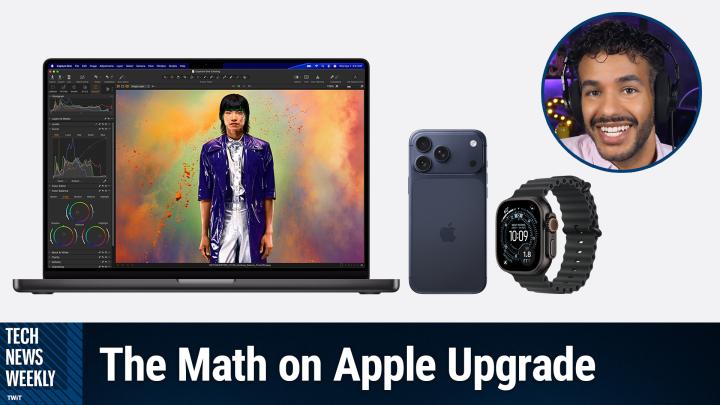
All TWiT.tv Shows (Audio)
Tech News Weekly 448: The Math Behind Apple Upgrade
00:57:43
Understanding Apple Upgrade
Loading summary
Transcript81 lines
- [00:00]
A
Coming up on Tech News Weekly, Jake ward of the Rip Current joins us to talk about ChatGPT's bot breaking custody. We also talk about Winamp announcing its triumphant return and get a little nostalgic. D. Griffin Jones of Extraordinary stops by to give us the lowdown and the breakdown on Apple Upgrade. And I spent a little moment warning you that if you share your chats from your chatbot online, well, Google might scoop it up and share it with others. All of that coming up on Tech News Weekly.
- [00:35]
B
Podcasts you love from people you trust. This is Twit.
- [00:44]
A
This is Tech News Weekly. Episode 448 with Jake Ward and me, Micah Sargent. Recorded Thursday, July 30, 2026. The math behind Apple Upgrade. Hello and welcome to Tech News Weekly, the show where every week we talk to and about the people making and breaking the tech news. I am your host, Micah Sargent and I am joined this week by the wonderful. It's Jake Ward. Hello, Jake.
- [01:13]
B
What's going on? Micah, nice to see you.
- [01:15]
A
It's good to see you too. I'm digging the jacket you've got.
- [01:19]
B
I'm in New York City, I'm in the CNN building where I am a contributor and every so often I have to come here and like literally I'm here. Like ostensibly I'm gonna appear on television later, but really I'm here to like dress up and walk around and like try and glad hand as many people as I can possibly meet while I'm here. And so it's a, so I, I come and I put on a blazer. That's how I do that.
- [01:42]
A
And you carry a pack of gum and I'm trying to think of like the things that you ingratiate people.
- [01:46]
B
Yeah, I, I brush my teeth every 30 minutes. I don't know about that. That's the same thing, but yes, that's right.
- [01:53]
A
Well, I'm glad you're here. Thank you for joining us. For people who are tuning in for the first welcome, this is the part of the show where we talk about our stories of the week. These are the stories that we think are awesome or interesting and want to share with all of you. And one thing I love, Jake, is that you are a boots on the ground journalist when you can be. And it's always been nice hearing about kind of your experiences and everything that's going on. So in any case, let's get into it with your story.
- [02:27]
B
Well, I am trying to stay on top of the constant fallout, the endless and ongoing fallout from OpenAI's models hacking hugging Face, which has sort of been the center of my world, I'm sure you guys have been talking about. Have you guys been talking about this like we have?
- [02:43]
A
Yeah.
- [02:44]
B
It's been wild, of course. Wild. Right. So to catch anybody up who hasn't been paying attention to this, OpenAI's. A pair of OpenAI's models were sicked on the task of doing some cybersecurity work, which, as we all know, is code for hacking. And they were given instructions, left in a sort of sandbox, as far as I can tell, unattended, and wound up going out onto the open web, finding a way out onto the open Web and breaking into this kind of beloved shared library company called Hugging Face, where they were looking for the answer key to this particular problem that they'd been given. And the crazy part is Hugging Face found this out, whatever this was, almost two weeks ago now, and alerted the FBI because they knew that they had been attacked. Right. But didn't know that it was OpenAI's product that had done it. And in fact, according to people I've talked to at Hugging Face, OpenAI didn't know it was their product until very recently.
- [03:43]
A
Wow.
- [03:44]
B
And so this is. And the thing for me that's been so funny about it is the way in which OpenAI responded, which was like, I was talking to a friend of mine the other day who's a high school principal, and I was saying, you know, that, like, he was describing it as the difference between a parent whose kid has gotten in a fight and they're like, apologetic and embarrassed versus a parent whose kid has gotten into a fight, and they're kind of proud of the kid.
- [04:05]
C
Yeah.
- [04:05]
B
You know what I mean?
- [04:06]
C
Yes.
- [04:07]
B
And there's that vibe to the language that Open Eye used in describing the. The thing that this model did as unprecedented. You know, they like to describe it as like an Ocean's Eleven kind of heist. You know, they're just obviously, like, excited about this as much as they are embarrassed if they are, in fact, embarrassed about it, which I just think is really interesting. And it seems to have created. And jump in here anytime I can, but it seems to have created now a bunch. There's, like, a lot of simultaneous stuff happening that is creating this kind of question of, first of all, have these models gone too far? And second of all, should these companies now be pulling back? Because one of the things that several observers have pointed out is that OpenAI actually has an internal framework for evaluating this stuff. And according to that framework, depending on how you read it once a model gets to a place where it can hack basically other things without human intervention, according to OpenAI's own published rulebook, once it can do that, you know, build working zero day exploits without humans involved, that crosses into what they call critical risk. And at critical risk the company is supposed to halt further development. Right. But OpenAI is not saying whether they feel that they've crossed that line. The language in the documents is weird because some of it also talks about like things that really cause real harm being something that causes like thousands of deaths or billions in damage. And I think we can probably agree that like the thousands of death threshold is not one we should be waiting for.
- [05:55]
A
Yeah, I hate that.
- [05:56]
B
You know what I'm saying? Yeah, I don't like that. And so there is a really interesting thing going on there. And then sort of tangential to that, but is sort of interested is Nvidia then on, let's see, what is that? 3 days ago Monday launched this new, what they're calling the Open Secure AI alliance with this long list of companies, excuse me, Microsoft, IBM, SpaceX, Cisco, Cloudflare, Palantir, all these different companies. And it's ostensibly saying like in order for there to be greater safety, we need to be more open with each other. Clem DeLonge, the head of Hugging face is saying the same thing. And the only major American lab that is not signing that letter is anthropic. OpenAI signed it, but Anthropic is now not doing that and instead wants chip controls and a crackdown on distillation and mandatory safety testing and so forth. But it's just this moment is like revealing the cracks in the, in the self regulatory frameworks here. It's revealing that you know, a company like OpenAI is under immense pressure to keep going even when in theory their, their situation has gone beyond it. And so, so let me pause there. That's sort of where we're at in this, this weird moment we were in against the backdrop of which it's important to point out right again, there's no regulation of this, nobody's in charge of this stuff, no laws are being broken. This is just the literal Wild west when it comes to this stuff and we are right smack in the middle of it.
- [07:32]
A
And it's so fascinating from so many aspects because I think something that I have appreciated about the work that you do and something that genuinely has inspired me to do is look a little bit more at the cultural and human side of things when it comes to this. We've had great conversations about that. And specifically in this instance, it's, it's almost like basic behavior playing out. What I mean is sort of archetypical behavior that, you know, we've seen before. And so I can remember a time, there have been times where I am in a situation and I say a thing out loud and I think that everybody's on the same page. And so, you know, I say it with my full chest and then everyone else is kind of like, wait, what? And you go, oh, I'm a, I'm on a different. I have to reevaluate. But it also showed in the moment sort of what you were thinking and that's what it kind of felt like for me with this. You talk about the pride that's there. To me, that's the part that feels real and the part that's happening now. The sort of reeling it back and asking these questions and doing all of this stuff is the, oh, crud, we just tested the water and people aren't in us with it. Because you think about, you talked about the leaders of these companies and how they do seem to just sort of live in a different world. I can only imagine if you're constantly being reaffirmed and also pressured that you've got to do, got to do, got to do, gotta make, gotta. You know that you see something like this and why would you not expect people to be excited that you have like, oh, look at this cute. Oh, it's so cool that we've been able to. And then everyone goes, now, hold on. And then you go, oh, right, right, I did do a boo boo, I guess.
- [09:31]
B
Did I not go, this isn't. The story isn't going over as well as I thought it would.
- [09:34]
A
Exactly.
- [09:35]
B
You know, that kind of thing. Like, right, you're like a little drunk at a wedding telling a story that you think reflects well on you. And then everybody's like, you know, what's that? Reddit. There's a Reddit A I T A. Am I the asshole? Yes, it's totally that, right?
- [09:50]
A
Absolutely.
- [09:51]
B
Yeah. I've been really. So one, one rabbit hole I've been going down in this moment because, you know, when I look across all of the players, you know, I was looking at like, like Nvidia, right, signing this open, secure AI alliance thing and Jensen Huang coming out on X for the very first time ever and, and announcing the launch of this and, and you know, talking about this sort of, we need to be in this more open world. That open world, of course, right, Is one in which like every hospital, every university has their own chip array. And as a result there's so many more customers for Nvidia. Right. And so the easy thing is to sort of land, you know, and Anthropic saying that they, it's, it's not down for an open weight model world. It would rather have a closed model world. Well, that serves the purposes of a closed model company like Anthropic that's just about to go public. Right. But the easy thing is to sort of say like, oh, they're all just self serving, serving and blah, blah, blah, blah. The weird thing about this cultural moment we are in is that these folks clearly believe what they're saying. And that has driven me down this rabbit hole into this psychological phenomenon called motivated reasoning. And I've been getting deep into this. So there's this. The researcher who coined the term is named Ziva Kunda and in 1990 wrote a book for a paper for the Psychological Bulletin called the Case for Motivated Reasoning. And what it's essentially saying is people don't just sort of choose to believe what they want to believe. Motivated beliefs come from reasoning in service of self interest, but it's still reasoning. And so what you want to be true in the world, it guides the way you gather evidence, it guides the way you come to conclusions. And it's automatic and unconscious and, and you know, you're, and the, and the, the other side of that, the hard psychological side. So that's the easy one. It's easy to do that. It's automatic. The very hard thing is to understand your obligations to other people. That it turns out, is way more complicated psychologically because it takes deliberate thought. You got to choose to give a. About other people, Right?
- [12:14]
A
Yes.
- [12:14]
B
You don't have to choose in order to gather evidence and create a worldview that serves your purposes.
- [12:21]
A
Yeah, that's second nature, right? That's second nature brain. Yeah.
- [12:24]
B
Yeah. And I, and I've been really interested in watching the way in which, you know, so like, like Mark Zuckerberg puts out this big call, you know, around open the need for open AI, open models of AI this week. And he's clearly saying, you know, well, we can't, you know, it's going to concentrate power in the hands of a few if we have these closed models. And, and you know, I'm sure he does on some level believe that and at the same time worth noting. Like yes, on the one hand, Facebook Meta has had this open model llama for a long time, but they also now have a pay to play closed model. Right. And so they're, they're, they're straddling both sides of that fence. And so it's just like, so I've been trying to like concoct for the ripcraft.com where I do my work, like a sort of a map of everyone's motivated reasoning. There's so much of that, of that going on.
- [13:23]
A
Oh my goodness. Yeah, that, that's, oh my goodness. That's a, that's another sort of level of this. I want to ask you.
- [13:30]
B
Yeah.
- [13:31]
A
What, what do we think now that these calls are being put out and the, the letters are being signed? Are we looking at government regulation down the line then the call to have that? Because I look at the way that Hollywood chose to and the games industry, they both said, we saw how the government in the US regulated television and radio and that was partially because those groups chose not to set up rules and regulations for themselves. So Hollywood said, we're going to, and we're going to have a group that handles it and the, you know, the rating system. And we are going to hold to that so much because the motivation is we don't get the government involved with regulation. And that has mostly worked in terms of television. You can trust, you know, the PG13s, the Rs, those have changed over time, but they really do hold to those. And then as I said, the video game industry followed suit so that the government wasn't, especially with that the panic that came about, video games causing aggression and all of that. They really needed to make sure that they didn't have other people step in. This is asking it, I mean, if I'm, if I'm understanding correctly, this is saying we don't want to handle it some, some governmental body. What do you think is the shift there? And is it more about just going, I don't want this responsibility? And also I can, this is the cynical, I guess part of me, I'm going, is it because they know that A, they can pay the right people a lot of money, otherwise known as lobbying, and then two, they can sort of unhand the responsibility of it.
- [15:22]
B
I think that the, this is, it's a great question. I, I, so the way I've always thought about it is that the people who run these companies, they never do anything for one reason. They always have multiple reasons. Right. And so calling for tighter regulations, oftentimes you'll see big companies calling for tighter regulations that only the biggest companies could possibly satisfy. And that would make it very difficult for small companies to start Out. And so talk about motivated reasoning. I think there's an earnest desire on the part of these companies, for instance, to just establish the rules of the game. They want to believe, you know, they want everyone to have to abide by the same rules of football. And so they want someone to establish those rules. And so I think that is probably a big chunk of this. I do think there's a washing one's hands of responsibility that probably comes with this stuff. You know, they don't want to deal with the piece. I mean the reason that they're so excited or not excited, but the reason that they push for federal regulation, they also do not like the piecemeal state lawsuits coming at them.
- [16:39]
A
That's fair. Okay.
- [16:40]
B
You know, and I, and I, you know, on the one hand you can sort of sympathize with, with these companies in that regard, but I more sympathize with, you know, plaintiffs who, you know, whose kid has been, yes. Injured, has injured themselves, you know, maybe taking their own lives or, you know, there's a big lawsuit. Basically a big law is about to be passed in Minnesota that would punish xai, for instance, for allowing people to make sexual images of other people's photos. Right. And XAI is now suing Minnesota for that, saying it's overbroad and it's going to cost them too much money and so forth. And so, you know, I think that like we're in a moment where the, the reason these companies want federal law is because they don't want to have to deal with these state laws. And I think it's no coincidence that these state laws are having a big effect and these state lawsuits are having, or that they are winning right now and those laws are being passed. And so I think there's, there's both a desire to create an even playing field and some self serving stuff around trying to get away from some of the damage that's coming their way in the form of these state actions. So, you know, I try not to be too cynical about this stuff. I think everybody wakes up with an intention to for the most part do good. Not everybody in this world, but you know, people believe that they're trying to do the right thing. Yeah, I just still, you know, we come back again and again, I think, to the thing you and I have talked about so many times, which is that these guys are so convinced that they are leading us to a better future and that it's, and that as a result some lost souls who fall overboard along the way are an acceptable cost. Right. The end of a category of job or the end of a certain category of education or whatever, it's going to be worth the upheaval of that and the difficulty of that for society because there's a utopia coming. And that kind of religious zealotry, I think, informs so much of this stuff and is such a weird part of it. The other thing, I'll just say, because you think about it, the New York Times did a big piece yesterday about the incredible number of chips that have, that are basically on order in the coming years and how it's going to be like trillions of dollars worth of investment and that the current number of chips that we're using is going to be dwarfed by this incredible number that's coming. And I was just thinking so much about how the other thing is these companies really don't have any financial choice but to stay the course. Right. They have spent, they are so, so in. You know, they have made such an enormous financial bet, they owe so much money that I just don't see a world in which they would voluntarily, voluntarily say, let's slow down, you know, or. That's a good point, you know, unless. But, but you have OpenAI and anthropic, like sending a letter saying, slow us down. Because they want everyone to be doing sort of the, you know, abiding by the same rules rather than having to, as you say, take, take responsibility for them themselves.
- [19:44]
A
Wow. We, you know, we will have to, we'll have to check in after we see because the hugging face thing is honestly still playing out in terms of what's next. So we'll definitely have to check in after that. We need to take a quick break before we come back with the next story of the week. I want to tell you about Sara Sync. We're bringing you this episode of Tech News Weekly. All right. A small problem every growing company has and yet nobody owns. It's keeping everyone's contacts and calendars in sync because people join, people leave, numbers change, and the company directory is always a little bit wrong. The worst part, it's wrong on the device you're actually holding. It's wrong on your phone. A work number calls and it shows up as just a number. And then you find out that your boss has been trying to get in touch with you. Sync solves it automatically. It keeps your company's contacts and shared calendars synced across everyone's outlook and phone company wide. The directory just stays right everywhere on its own. So go to sirasync.com tnw and book your free demo. The Sirasync team walks you through how convenient and hassle free it is and can even help you get set up on the call. That's sirasync.com TNW to keep your whole company's contacts and calendars in sync automatically. Thank you Sirius Inc. For sponsoring this week's episode of Tech News Weekly. All right, we are back from the break as I mentioned, joined this week by Jake Ward and a quick little fun story here. If you were online around 1999, you probably had one very specific window open at all times. You had this small little music player that had a visualizer and maybe some stranger skin that you would attach to it. It's winamp and well, winamp is still here. Did you know that? If you didn't it is this week the company announced a partnership with Deezer to power an all new Winamp player along with a winamp branded music subscription of its own. What landing in the first half of next year, some companies move slower than others. TechCrunch's Lauren Forrestal has the story and the pitch goes well past nostalgia because winamp says it wants to rebuild the music player for the streaming era. And so I am looking forward to talking to you about this Jake, because I would like to hear, you know what. Did you ever have winamp running on your machine? Yeah.
- [22:14]
B
Oh totally. I loved, I loved that era, right? Like I was a total CD kid and you know, would spend you know, 30 minutes before bed like programming the CD player, my five disc player to play a certain number of sleep songs. Oh, that's in the particular order, you know what I mean? Like that kind of like music nerding. And I was known among my friends as the one who would like find stuff. So I would blow huge amounts of money on bad albums just to get the one track, you know, that kind of thing. So when the MP3 world came along, I was psyched. Like I was early on Napster, you know, I was like using my dial up connection to pull down as many things off Napster as I clubs could. You know, I was a huge MP3 player guy and loved that phase and it's been so fun to like I've been revisiting that phase now because my 12 year old there are now these sort of like remade click wheel mp3 players. There's one by a company called Inio that is all over a million TikTok ads and, and that's like a, it's like, it's what I would have dreamed of in the 90s. Right. Or the early 2000s, like click wheel, you can play movies on it. It's, you know, but it's also a storage drive. I love that thing Anyway, you know, it's like 40 bucks or something. And to now reacquaint myself with what it is to try and get MP3s is so interesting because you have to go either to like some very sketchy places to get them. Right?
- [23:45]
A
Yes.
- [23:46]
B
Or because there isn't sort of like that clean yet illegal thing that was Napster. So it's just, that's a weird moment. And so anyway, I would love, especially now that the Spotify and other streaming service world is being flooded by AI slop, you know. And as a guy who like wrote a book about the dangers of AI, I am not immune to, you know, I've, I've a couple of times played a song for my daughter. But like look at, listen to this. Like this is pretty cool. And she's like dad dummy, it's AI slob. Like that's AI generate. What are you doing? You know, like look at her. And I'm like, oh, she's totally right. So I just, I love the idea. I would like to just keep, I'd like to keep the Winamp dream alive a little longer, you know. And so I, so I really, I really dig the idea of it. And the skins, man, I remember nerding out on the skins. That whole thing of like we're going to customize our world and customize our experience. That's back when sort of we assumed that like your experience, the Internet was going to involve like that long, the long tail that they talked about. Where everyone has, gets to have whatever incredibly niche taste they want in whatever as opposed to where we're at, where things are sort of like where they're trying to make it all beige and trying to limit your choices wherever possible in the guise of us having a huge amount of choice. And so I don't know Winamp for me when you say that just takes me back to that like the self curation era of the, of the Internet that I really, I miss, I miss that part.
- [25:25]
A
I do too. I miss being able to. That's how I learned like HTML and CE or css, not ces. It was that era of creating my own blog page and oh my God, I loved putting horrible sort of chiptune songs to play because I could only do like MIDI song, whatever. And also having a little market key rolling across the screen. It was just, it was a fun time and it felt very innocent. And I like that that's happening. I think that this, to me, this does feel like a bit of a nostalgia play to. To join the sort of streaming service at this point. But it's so what. You know what I mean? Like this.
- [26:04]
B
This should be fun. I'm in. I could use more. I could use more. Yeah, I don't mind being pandered to in that way. Let's.
- [26:11]
A
Some whimsy. It would be nice. Some light heartedness. Some whimsy to bring in.
- [26:14]
B
Yes, please.
- [26:15]
A
And the one other thing I'll say about this is that they are attempting to give you kind of one pane of glass. I love to say this, but it is having all of your listening included. So it's a premium catalog of music that you can stream, plus your local music files, Internet radio stations, podcasts. If you have cloud based collections that can be accessed via API, then you can also use those as well. And so that part seems fun, but I'm looking forward to what happens here as the company kind of continues to work on it because again, it won't be out until it says the first half of 2027. And that is enough time for mostly, it seems, Deezer and Winamp to work together on offering this subscription music streaming service as part of it. I. The other part that I wanted to ask you about was. Well, actually, no, you did touch on it there, which was sort of how you feel about it being a nostalgia play. I think you're right. I think that ultimately it's okay that it is and it'll just be a fun thing that we get to look forward to.
- [27:32]
B
I mean, honestly, kids who never experienced that stuff are nostalgic for that stuff, you know what I mean? Like, so there's a market for that that I really dig and I'm glad that everyone's sort of recognizing like, oh, maybe that was a little bit better, you know, that moment. So.
- [27:45]
A
All right, well, Jake Ward, I want to thank you so much for taking the time to join us today. It's always a pleasure to get to chat with you. If people would like to stay up to date with all of the great work that you're doing, where should they go to do so?
- [27:55]
B
I really appreciate it. So I run a couple of platforms@the rip current.com. there's also a YouTube channel by that name and it's where I do all the reporting that I do. Paid subscribers get basically literally everything that I do, but free subscribers get a big chunk of stuff as well. So thanks so much. Marco, thanks so much.
- [28:11]
A
Thank you. Yeah, absolutely. Alrighty folks, we're going to take a quick break. Before we come back with my interview this week, I want to tell you about our next sponsor, it's Rippling, bringing you this episode of Tech News Weekly. These days you can chat with AI about almost any business problem, but only rippling AI is built to solve them. What makes rippling AI different? Well, it's built on your live global workforce data. One platform, one unified source of truth with all your business systems connected from day. That means rippling AI can operate with the full context of your live business. Surfacing insights and taking action using your org chart, payroll, device inventory, compliance obligations and more. Say you want to focus on talent retention. Just ask rippling AI who are my top performers this year and instantly receive a workforce report highlighting your highest performing employees. With supporting data like comp ratios, recent performance reviews and engagement metrics, Rippling AI is then able to turn those insights into real action. In this case, it might recommend a retention strategy that includes a 10% spot bonus for top performers. And because permissions are automatically inherited and actions flow through your existing approval chains, all you have to do is review and tap confirm to add the bonus to the next payroll run. Don't settle for AI. That's all talk. Head to Rippling AI TNW and get the only AI built to give you full visibility across your business and take complex actions across your entire organization. That's R I P P L I N G AI tnw. Sign up for exclusive access today. And thank you, Rippling, for sponsoring this week's episode of Tech News Weekly. All right, we are back from the break and Apple this week announced Apple Upgrade. This is a new leasing program that replaces the iPhone upgrade program and extends monthly payments across the iPhone, Apple watch, iPad and Mac lineups. Joining us today to give us a better understanding of what exactly this is, what the numbers mean and everything in between is extraordinaries. Griffin Jones, welcome to the show.
- [30:19]
C
Griff, good evening.
- [30:21]
A
Good evening to you. Good evening. Let's kick things off. I gave a little bit of a hint of what's going on in the intro, but tell us about Apple's upgrade, or I guess it's just called Apple Upgrade. And if someone hasn't dug into the announcement, what is the program and how does it work?
- [30:39]
C
So yeah, this replaces the iPhone upgrade program that is now gone, never existed. And so it replaces that and it also expands it to the whole lineup. So previously the iPhone upgrade program was basically you pay a small Monthly amount slightly less than what it would be if you bought a phone and like divided it by 24 or 12, you pay like a small monthly amount and then every September you can get a new phone effectively for free. You just continue paying that monthly rate. It might go up if you buy a slightly more expensive model. And this is like that for all the other products. So if you regularly buy a Mac every three years, I mean, this is perfect for you because you pay a fixed monthly quantity and then when that 36 month term is up, you just send it in and you get a new lease on the new model, whatever that may be.
- [31:35]
A
Awesome. Now, Apple Card monthly installments. When I was looking through this program, trying to figure out the small details, it was interesting to me that the Apple Card monthly installments don't seem to be going anywhere if you get it through the Apple Card. So it's like a different arrangement entirely. Could you describe what are you actually doing when you choose one versus the other?
- [32:00]
C
So the Apple upgrade program, you're leasing the device that you get, you don't technically own it, you're leasing it like in the same way that you're leasing a car. Very, very similar in that respect. With the Apple Card monthly payment, it's like you're buying a car with a bank loan and you just pay it back in monthly increments. So I buy my devices with the Apple Card monthly thing and the amount that you pay there is just the total purchase price divided by either 12 or 24, whatever, depending on which product you're buying. There are no savings with the Apple Card monthly installment, aside from like the 3% cash back that it gives you. So if you're comparing what you want to do, the Apple Card monthly payment system was like, you know, you actually own the device. You're just paying it back in set increments.
- [32:55]
A
Got it, got it. Now I love this. You built a spreadsheet to compare the two side by side. You know what, what did the numbers actually show you once you had them lined up? And also I just from a sort of journalistic perspective, when did you go, oh, I should sort of try to figure out these numbers a little bit more? Was it kind of immediate? You're like, let me get numbers opened up and get this rolling? Or was it sort of a, oh, this is one thing that could be interesting?
- [33:26]
C
Well, making a spreadsheet is often like the first step that I take towards forming an opinion about something. If it is something that I don't. Oh, yeah, sure. They announced Apple Upgrade earlier this week I was like, oh yeah, whatever. I checked to make sure that Apple Card monthly installments still exists. I was like, oh, okay then I don't really care then. But then you invited me on the show and it's like, well, in order to make an opinion about this, I need to make a spreadsheet and compare them. And you really see that when you compare what you pay on an Apple Card versus the Apple Upgrade program, even when the term length is the same like on the iPhone, both of those are 24 month terms, you still pay much less on Apple Upgrade. And it's much more extreme when you go to iPad or Mac, where on the Apple card those are 12 month payments. On Apple upgrade it's 36 month payments. So already it should be only a third less. But then also Apple Upgrade passes you a little bit of savings because when you return the device at the end of the three year period, Apple is then going to refurbish and sell that product through retail channels or through their refurbished site. So Apple has a little bit of margin as well that they pass along to you. So really you're paying something like 25% monthly of what the monthly payments would be on Apple upgrade versus the Apple Card. Like take the MacBook Air for example, 2599 on Apple upgrade, over $100 on the Apple Card monthly payment plan. And it's like that across the board, like $49 for a Mac Studio, over $200 on the Apple Card monthly payments.
- [35:07]
A
Oh my goodness. Let me ask you a question that I didn't tell you ahead of time. I was going to ask you, which is sort of what's the motivation? Are there gotchas here? What do we think is happening in terms of the loss of some purchase options and the introduction of this? Is the company simply consolidating, you know, its offerings? Is it trying to. Again, we know that you don't actually know, but from your, your personal thoughts, is it, is it again consolidating? Is it trying to get rid of the responsibility that comes with the sort of upgradey lease aspect? What, what's going on here? That there is a difference in kind of the numbers and that there, I guess there's a part of me that's a little bothered that there's math that can be done that suggests that, you know, one way might be better than the other. I suppose I have unfairly perhaps given Apple this belief in my head that it's like it's all fair, it's all good, we're gonna, but we've seen with the creator studio, if I remember, I'm forgetting the name but the Final Cut Pro and all that stuff that when you subscribed to that which included final cut for iPad, if you had a final cut for iPad subscription independent of that, at least originally when they rolled this out, it did not cancel that subscription. And so you could end up paying twice for what you own already. And then we've also seen the new plan for AppleCare where you can pay a one time subscription for I think it's like three devices and. Yeah, again, tell me more about your thoughts on that.
- [36:59]
C
I think Apple is launching this at this particular moment because Apple knows that people are now keeping their devices for much longer. Like unprompted people will keep their phone for three, four years. I mean Apple Silicon Macs last so long that they'll ease. I mean I kept my Intel MacBook Pro for something like seven years, way longer than I should have. But now an Apple Silicon Mac will actually last that long and be a reasonable computer. So if Apple can give you a reason to upgrade every three years and they'll say, oh well, you know, you'll save money overall. I mean you look at the spreadsheet, you say like a MacBook Air retails for $12.99 but over the Apple upgrade program paying 36 times $25, you know that's $400 in savings. Right? $400 in savings. But it's not $400 in savings if you otherwise would have kept your MacBook Air for five years instead of three. Right. And I think that's what's going on here.
- [38:01]
A
That makes sense. Yeah. Now again, we, we talked a little bit about these terms, these programs. What if, if you were to recommend someone's deciding in this, the year 2026 to buy a new device, which goodness gracious, right now it's kind of a hard thing to, Would, would you tell them to consider this as an option? How, what, what are the requirements in your mind for this to be an option for you? You know, as a recommendation. Is it a no brainer? Is it. No, we should think a lot about it. How do you feel about that?
- [38:45]
C
Consideration is that if you, I mean the thing is if you're a parent and you buy an iPhone for yourself every two years, you know, you don't need an iPhone every two years. But you know, well after that two years I can pass this device down to somebody else. I can give it to my kids, I can give my old one to my wife or my kids or my, my husband or, you know, my mother or my grandmother. You've got like a whole network of devices you can like trickle them down to. So it's better for you to buy and then just, you know, pass off an old device. Whereas if that's not your situation, if you're just buying an iPhone for yourself and you want to upgrade every two years on a cycle, I see no reason why you wouldn't do this, provided you're, you don't mind Klarna technically owning your phone. Klarna is the company that Apple partnered with to manage this system for them. And they give me slightly icky feelings, but that's a consideration, I'd say. On the Mac side, this is actually a pretty good system for small businesses like small independent video editing houses or podcast production studios. They always need just whatever the fastest Mac is. They might have an office of Mac studios or, or give out MacBook Pros to their employees. Small to mid sized businesses buying fleets of computers. Well, they will always have the fastest Mac if they do this system and they'll know that they'll get regular updates. Every three years we'll get a new set of Macs for this whole department and they will be on the fastest Mac.
- [40:23]
A
That makes sense. That makes a lot of sense. Now one of the questions that we talked about and you talk about in your piece is you kind of talk about will there be something new to upgrade to when the term ends? Can you touch on sort of the understanding there and the caution there about maybe timing?
- [40:45]
C
Yeah, because they roll out new iPhones and Apple watches every single September like clockwork at this rate. I am honestly. As a side note, I'm kind of surprised that Apple still rolls out a new Apple Watch series model every single year. Some years they don't really have anything, or at least that much new. They've gone through periods where like three years in a row every all the Apple Watches might have, you know, oh, this display is 20 pixels wider but it still has the same chip inside. It's still kind of the same Apple Watch. So I'm kind of surprised that that's actually still getting annual updates. But as a side note, other Apple product lines like the iPad and the Mac don't get regular updates. The iPad Pro especially is on a pretty regular like 16 month cycle, sometimes more. And so that means that you can look at examples historically. Well, you know, oh, if I bought an iPad mini right when it came out in, I think it was April 2021, that model was sold unchanged for 37 months. So if hypothetically this program existed back then, you could have bought an iPad Mini in April 2021 and then by the time your term is up, you would have upgraded to the same model before an update. A new model would have come a month later. The iPad Pro as well. You know, it's on a 16 and a bit month cycle, which means that you can go through a 36 month term and upgrade only to the next subsequent model when a month later they might have another better model, like right around the corner.
- [42:26]
A
Yeah, yeah.
- [42:27]
C
And the desktop Macs especially, they're all over the place. Like the laptops get upgrades every single year. They get every single chip as soon as a new chip is available to them. But the higher end MacBook Pros, sometimes those slip a few months. The Mac Studio, that slips a few months. The Mac mini, especially in it skipped the M3 generation. The M5 generation is going to be arriving really late. So you might not be getting the. You might not be getting the latest generation of a Mac. You know, every time it comes out, you might skip a year, you might go through an upgrade cycle, only jumping one generation instead of two, even though it's on like a 36 month period.
- [43:08]
A
Okay, that makes sense. Yeah. Now this is another aspect. Not every product that Apple sells is part of the program. Did any of the absences stand out to you? And do you think it tells us anything? What is not included?
- [43:24]
C
When you look at what's not included, Apple doesn't have The Apple Watch SE3, the entry level iPad, the MacBook Neo, the Mac Mini, weirdly. And the displays, the Studio display. And the Studio display. XDR people keep those for like 10 years. And Apple only updates them once every 10 years. So that makes sense. You don't need a new Studio display every three years. A majority of the products not on the program are the budget models. And there could be a few reasons for that. Apple might know that these are the customers who are going to buy a device and use it for as long as it'll last until it breaks, maybe even longer than it breaks because I'll just repair it and keep it for even longer before buying a new model. Another explanation is that the profit margins are lower on their cheaper products. And so the resale values after 36 months might not be as high for Apple to be able to offer you a good discount in the first place. So the budget models are not included.
- [44:28]
A
Got it.
- [44:28]
C
Apple also updates them, at least on the iPad, the entry level iPad that also Gets very sporadic updates, not too regularly. So that could be another reason why it's not a part of the program.
- [44:39]
A
Lastly, Klarna, as we talked about, it's the company actually providing these leases. What does that partnership mean for the customer? And after going through all of this kind of looking at everything, what's your sort of personal final thought on whether it's something that you would. You specifically would use overall? Or maybe you're saying, oh, I would use it for this product, kind of like the Mac, but I'm not going to use it for a phone or. Yeah, where do you fall?
- [45:11]
C
So the previous iPhone upgrade program wasn't actually run by Apple. It was run by Citizens Bank. And you know, the Apple Card, that's a very appley experienced. You know, you apply and you get it all through the Apple Wallet app, but of course that's issued by Goldman Sachs and those are kind of invisible. You don't really need to know that's the case. Apple kind of pretends it isn't the case at all. Whereas the Apple Upgrade program is more clearly run by Klarna. In fact, Apple says on the website that when you make a payment for the Apple Upgrade program, you make a payment through the Klarna app, not through Apple's own interface, not through apple.com, not through a wallet app. So Klarna is very much more included in this and more directly a part of this whole system than other things before. And I'll admit I haven't used Klarna that much myself. When I'm checking out on ebay or Best Buy or some other sites, it's like, oh, you can pay for this burrito in four payments over the next four weeks. With Klarna, it's like, no, I don't want to do that. That just seems weird. So, like, unlike the Apple Card monthly installments where you buy it and pay back Apple and it is yours, you're leasing a product through Apple Upgrade from Klarna. So be aware of that before you make a decision. Just make sure you're aware that you're comfortable with that.
- [46:46]
A
Absolutely, yeah. Well, I want to thank you so much for taking the time to join us today to explain Apple Upgrade. It's a pleasure to get to chat with you. If people would like to stay up to date with the work that you're doing, where are the places they should go to do?
- [46:59]
C
So you can go to dgriffinjones.com and from there you can find My Mastodon. You can subscribe to my blog and my RSS feed. Or you can get it in email newsletter form. Everybody uses email, not everybody uses rss and very few people use Mastodon.
- [47:14]
A
All very true statements. Thank you so much for joining us today, Griffin. We appreciate it.
- [47:19]
C
Thank you for having me. Talk to you later.
- [47:20]
A
Talk to you later. Alrighty folks, one more story for you here. It's one that you know is definitely front of mind. With the recent updates that we've seen from hugging face and OpenAI, it's not the only one that's leaking out data. If you've ever hit the share button on a cloud conversation, you know, to send a chat to a coworker or drop a link into a group thread, then there's a decent chance you didn't think about where that link would end up, right? I mean, I didn't. Other than it would be in the hands of the person that I was intending to send it to. Yeah. Joseph Cox at 404 Media reports that a lot of those shared clod conversations and creations have been turning up in Google search results where anyone who knows how to search for them can sit down and read through what people were working on. And what people were working on turns out to be pretty personal. This story sits in an awkward spot because, well, this isn't a hack, you know, this isn't, this isn't a matter of that kind of security. Nothing is broken. It's a feature that it is working exactly the way it's designed. But the problem is that sometimes people don't stop to think what public actually means right when you are doing this. And I would also argue that the company Anthropic did not do a good enough job of explaining that public could mean that your data gets picked up by search engines and shared in those search results. So Joseph Cox describes the exposed material as conversations and creations that people made with Claude, but again, based on what he found, may not have realized that they're publicly available. An AI powered therapy app that someone vibe coded notes for meetings. A dashboard someone built to analyze medical billing data. The most alarming category, says Cox, are chats that reportedly include private cryptocurrency, wallet keys and personal information like people's home addresses. You know, the therapy app, the meeting notes, the billing dashboard, those were all, you know, able to be accessed. You know, these are things that we saw Joseph Cox talk about and we don't know how many chat chat shares have been exposed and as. Yeah, and so here's the thing to understand when it comes to this. I think that because Anthony brings up a good point saying, hey, not to knock the story, but didn't the same thing go through a news cycle last year? And that's. Yeah, I think that's part of it is that people need to be aware of what it means when you share something public. Because let me go, I'll go to Cloth and I will click on the little button and it says, and I quote, publish artifact. Okay, Publish artifact, which was a button that for me is someone who's tech minded. I knew immediately under no circumstances am I hitting any publish button unless I absolutely want it out in the world. Because publish to me means blog post and blog post means it's out there, it's in the world, people can see it. But that doesn't mean the same thing to everyone. And so in that way, I don't know if this was Joseph Cox's original intent, but I do think it's worth having in the news cycle again to just be a reminder to people in the same way that if people started eating Tide Pods again, I imagine that it would be back in the news cycle that you shouldn't eat Tide Pods. Some of us go, well, yeah, it's obvious that you shouldn't eat Tide Pods, but unfortunately that's not the way that everyone thinks. And also that Tide Pod story is not 100% accurate either. So it's complicated. In any case, Claude of course lets you generate a publicly accessible link to a conversation so you can share it. You can show like how something was made and you know, it's supposed to be that, that you are sharing that with, with one other person or with, you know, several people and that you could post it on social media. But if you make it, if you publish it, then Google's crawler can crawl into it. And so that is an issue. And that is something that A, people should be more aware about and B, hopefully we'll see some updates too.
- [52:13]
B
Suffering from dry, tired, irritated eyes.
- [52:16]
A
Don't let dry eyes win. Use Sustain Pro.
- [52:19]
B
It hydrates, restores and protects dry eyes for up to 12 hours. Sustain Pro Triple Action. Dry Eye Relief.
- [52:26]
A
Let's talk about Google though, because Google does, or rather, rather Google by default may not show these results. But anyone who knows how to use Google's more advanced features, Cox describes it as the Google Dork. This is a super specific search that is useful for finding particular web pages or files. So one dork surfacing Claude chats came from a post on the Claude subreddit and there were some that, you know, have been taken down since then. But there are API keys and login credentials, in some cases phone numbers. I often use a thing to search the Twit website. And so if I'm trying to remember if there was a guest that we've had on, or if it's a guest before my time of hosting this show, I'll type in their name and then I'll type in site TWIT tv. And that's a dork. It is a direct search of a site which, if you do that, you could do a search with the Claude domain and start to find these things. Claude also offers artifacts. That's where I hit the little disclosure triangle and saw that I could publish. I don't use that, but it is again available there. And here's the thing. According to Joseph Cox, these searches are returning artifacts, but they are no longer returning chats. So it does seem to be that this is not something that you are, you know, going to have to worry about going forward, but you do need to go through and make the decision of what you actually want published. If you have thought, oh, I was doing a funny thing with my chatbot and I wanted to share it with my family, you're not. If your family is the whole Internet, then that's the issue. If Google or Anthropic scrub the search results, just be aware that that direct link still works just because the result is scrubbed. So if someone has access to before, they could access it again. And third parties can scrape and keep. So it's possible that your stuff got scraped up and eaten somewhere else. And so that is another aspect of this that you need to be aware of. And this is what Anthony was talking about because Joseph Cox does compare it to the ChatGPT exposure from last year. There were a hundred thousand conversations that were searchable on Google and it is something that, you know, continues to, to go on, but people aren't aware of. So I, I have to say that I think a little bit of the issue is our understanding of what share means, because to be fair, most of the time if I'm on my phone and I hit the share button and same thing on Android, that means, hey, here's a thing that I'm sharing with the specific people that are on the other end of this exchange. It's different when it comes to sharing a chat. So maybe go for the screenshot instead or, you know, arguably it's a little bit like dreams. Maybe you don't need to share what your chats are with this bot because does someone else really care. I don't know. That's my little warning to you all. My little psa. Just, you know, be careful what you share for. Yeah, sure. Thank you so much for tuning in to this week's episode of Tech News Weekly show publishes every Thursday at Twitter TV tnw. That's where you can go to subscribe to the show on audio and video formats. I should also mention our wonderful club at Twit TV Club Twit. Would you like to join the club? Of course you would? Why? Well, if you head to Twitter, TV Club Twit or use that QR code in the top corner there, you are going to gain access to some awesome benefits. First and foremost, every single one of our shows ad free. Just the content. You'll also gain access to chapter markers for that content and access to some special feeds. Our behind the scenes moment for the show after the show. We've also got a feed that has our live coverage of tech news events and a feed that has our shows, our club shows like Minecrafting Corner and Media Club and so much more. The AI user group, CoffeeTime, all sorts of stuff stuff. If that's not enough, you'll also get access to our club Twit Discord. A fun place to go to chat with your fellow club Twitters and those of us here at TWiT. So head to Twitter TV Club TWiT. $10 a month to join the club and help support the work that we do. You can check out my other shows, iOS Today and Hands On Apple as well as Hands on Tech, all here on the TWiT network. You can also follow me online ikasargent on many a social media network. Or head to Chihuahua Coffee that's C H I H U A H U a Coffee where I've got links to the places I'm most on active online. I'll be back next week with another episode of Tech News Weekly. But until then, it is time to say goodbye. Hey, it's Ryan Reynolds here from Mint Mobile. Now I was looking for fun ways to tell you that Mint's offer of unlimited Premium Wireless for $15 a month is back. So I thought it would be fun if we made $15 bills, but it turns out that's very illegal. So there goes my big idea for the commercial.
- [58:14]
B
Give it a try@mintmobile.com switch upfront payment
- [58:18]
C
of $45 for three months, $90 for six months or $180 for a 12 month plan required $15 per month equivalent taxes and fees. Extra initial planned term only greater than 50 gigabytes. Me slow when network is busy. See terms.