← All TWiT.tv Shows (Audio)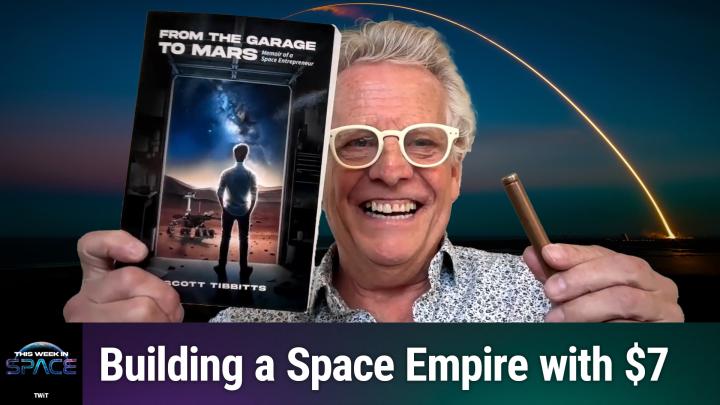
All TWiT.tv Shows (Audio)
This Week in Space 138: From the Garage to Mars
01:15:25
With Space Entrepreneur Scott Tibbetts
Loading summary
Transcript291 lines
- [00:00]
Rod Pyle
On this episode of this Week in Space, we're talking to Scott Tibbets, an entrepreneur who made $7 worth of spare parts into a vital piece of Mars probe tech. Join us.
- [00:12]
Scott Tibbets
Podcasts you love from people you trust.
- [00:17]
Rod Pyle
This is Twitter. This is this Week in space, episode number 138, recorded on November 22, 2024, from the garage to Mars. Hello, everyone, and welcome to another episode of the very special this Week in Space, the from the Garage to Mars edition. I'm Rod Pyle, editor in chief, Bad Astro magazine, and I'm joined, as always, by the inexpressible Tarek Malik, editor in chief@space.com with a monogram sweater. How are you, my friend?
- [00:51]
Tarek Malik
I'm doing well, Rod. I'm doing well. Happy Thanksgiving early, by the way, like T minus seven days away as we're recording this.
- [00:57]
Rod Pyle
And let's give a nod to your brilliant life, brilliant wife for knitting you that extraordinary sweater for those of you watching on video. Let's see. Yeah, he's got a T for Tarek. She actually did it, I happen to know, so that when he got lost, somebody would able to tell who it was and call her and say, hey, your husband's over here. Come get him.
- [01:18]
Tarek Malik
Yeah, go ahead and keep him. Right.
- [01:21]
Rod Pyle
Okay, today we'll be speaking in a few moments with Scott Tibbets, who was the author of a new book called from the Garage to Mars, and a polymath engineer who. Origin stories don't get much better than this. Took $7 worth of parts from the hardware store, basically a copper tube and some wax. And created from that a company that worked in the space sector with NASA, JPL, and other places to make millions. And an incredible company with over. What did he say? How many employees?
- [01:57]
Tarek Malik
150 at the. I think at least. And they went to Saturn and Cassini.
- [02:02]
Rod Pyle
Yeah, man.
- [02:02]
Tarek Malik
Worked on Chandra. Lots of fun stuff.
- [02:04]
Rod Pyle
Okay, but. But we don't want to phone in the third act. So before we start.
- [02:10]
Tarek Malik
Yes.
- [02:11]
Rod Pyle
Please remember, do us a solid and be sure to, like, subscribe and all the other good podcast things on the podcatch or service of your choice, because we're counting on you. And now, speaking of space detritus, our weekly space joke, this one from David Robeson.
- [02:31]
Tarek Malik
Dave Tarek. Yes, Rod?
- [02:33]
Rod Pyle
Why don't scientists trust atoms?
- [02:35]
Tarek Malik
Why don't scientists trust atoms?
- [02:38]
Rod Pyle
Because they make up everything, including our space jokes. I like this one.
- [02:43]
Tarek Malik
I like. That's a good one, Dave. That's a good one. I think I've seen that on a show shirt before but I like it. It's still good.
- [02:49]
Rod Pyle
Don't say that.
- [02:50]
Tarek Malik
No, I think it's good. It's a good one. It's a good one.
- [02:52]
Rod Pyle
And whatever you saw in a shirt probably wasn't impugned on our space jokes. Now speaking of which, I've heard that some folks want to turn us into spare parts when it's time for a space joke on this show. But you can help as David did. Send us your best worst or mostly different space joke at twistswit tv. And now it's time for headlines.
- [03:15]
Tarek Malik
Headline news.
- [03:21]
Rod Pyle
I love it. Anthony was on the switch for that. So it's hard not to start with anything but starship test flight number six, which. Number six, not a catch this time but they did hit some other milestones.
- [03:37]
Tarek Malik
Yeah. So it's in the can. SpaceX has launched their sixth test flight for Starship. It was a pretty good success. Now as you mentioned they did not actually land or catch the rocket, the super heavy booster. They actually said they would go for it and then I guess at the last second there was some commit criteria that went red and so they just.
- [04:00]
Rod Pyle
I read about that. It was that the or Elon made a statement about that later. It was that the rocket apparently lost telemetry with the, with the Mechazilla.
- [04:10]
Tarek Malik
Yeah, yeah.
- [04:11]
Rod Pyle
Couldn't talk to the landing pad anymore. Right, yeah.
- [04:13]
Tarek Malik
And so, so they decided just to go ahead and divert, you know and it went out, did a pretty smooth soft landing. We got video of it here if you're watching this stream later of it like launching into space. Gorgeous, gorgeous day. They launched at 5pm at night Eastern time which was the first time they've done like an evening launch which was great because for the first time we saw the starship land in daylight in the Indian Ocean which was absolutely spectacular. It took about an hour as very same profile as Flight 5. So everything else seemed to go well. They tested new bits of heat shielding in different places to record the heat there. They did use an older type of heat shield. They said that the new one, Flight seven will have a new different design of flaps that are going to be a little bit better on the heat resistant on the way down. But it was interesting to me that they didn't have any burn through that I could see that we've seen on the last, the last couple of flights. And they put heat shielding in what looked like where you would expect windows to be, which I thought was pretty interesting. Like are they testing for like what the windows are going to have to. You're talking about up on the nose.
- [05:20]
Rod Pyle
Yeah.
- [05:21]
Tarek Malik
And ask me about bananas.
- [05:23]
Rod Pyle
Rod, do you have any bananas today?
- [05:27]
Tarek Malik
Yeah. Well, SpaceX sure does because for the first time they launched a payload on Starship. Starship. And again, Starship is like the world's biggest rocket. It's 400ft tall. It's like bigger than it's more power.
- [05:38]
Rod Pyle
Man, seeing that shot. So I don't remember seeing a shot of the interior of ship the upper stage before. But it's the banana was the only thing that gave any perspective. It's really large, it's their first payload.
- [05:51]
Tarek Malik
And they send up a stuffed banana for scale. And you have to imagine this massive cavernous space with a single banana suspended by four different cables inside. That's what they did. That was their first payload. And they said it was good practice going through the FAA about how to go approve payloads. And they also had the little PEZ dispenser spit out structure that they're going to use to stack all the starships or starlinks on in the future. And then the starship is going to just spit them out like a PEZ dispenser instead of releasing them all in a big stack. So. So they did a lot of that. They also relit the Raptor engine for the first time in like near orbital speeds. Yeah, in a vacuum. And they had a very smooth like landing like they were able to touch down in the Indian Ocean as planned. So very smooth flight. I think it would have been nice to see the super heavy booster like get caught. We're seeing video of it here now of its soft landing in the ocean. And the sad part is that right after SpaceX cut away from the super heavy booster splashing down, it exploded like in a wonderful fireball and they cut away before we could watch it happen. So. But there, there are photos of it that Getty and other folks took. So it's pretty good. It's pretty good to see. So I think it's a big notch. They got FAA approval for 25 flights at least next year. So. All right.
- [07:18]
Rod Pyle
And just to put a point on that, there have been other rocket engines that reignited in a vacuum before, I mean as early as certainly Apollo, when the upper stage and the S4B had to reignite, but they had not done it with this engine.
- [07:32]
Tarek Malik
Exactly.
- [07:32]
Rod Pyle
So that's something that has to be proved before you can move forward with most the intended missions for starship.
- [07:39]
Tarek Malik
And it would not surprise me if we see an orbital flight before this year is out, or at least an attempt, you know, where they actually circle the planet. Yeah, yeah, there's the, the year is still young. They got a month left. They got a bajillion of those starships and super heavies at Starbase right now. So we'll have to see how it all shakes out.
- [07:55]
Rod Pyle
Yeah, that's true. It looks like an old Ford lot.
- [07:58]
Tarek Malik
And I will, I will say one last thing. They said during the broadcast, they are looking at being able to pump out a ship every eight hours eventually at Starbase. Can you imagine that? Every eight hours?
- [08:12]
Rod Pyle
Frankly, I can't.
- [08:13]
Tarek Malik
20, 20 ships a month.
- [08:15]
Rod Pyle
Recently said they wanted to do 400 launches in three years. I think it was.
- [08:19]
Tarek Malik
Yeah, it is insane if they're able to hit that rate.
- [08:21]
Rod Pyle
So, yeah, bully to them. But let's ask the people down at Boca Chica how they feel about that. Speaking of which, the faa, which has been, I wouldn't say glacial, but kind of molasses, like in terms of granting these flight licenses, which are kind of important and they're not the only agency they have to deal with down at Starbase. They have to deal with Fish and Game and FCC and others, but FAA has kind of been the big one. Appears to have changed their tune. Maybe because they see an incoming administration that could say, hey, step it up. What do you think?
- [08:54]
Tarek Malik
Well, an incoming administration that's going to say, hey, step it up. And also a dire need by NASA to have these test flights complete so they can launch these flights over time. So by the way, both of these stories are all from Space.com, but I mean, you can find them from your preferred space news, you know, hopefully space.com, but yeah, on Wednesday. So one day after SpaceX's successful Flight 6 launch, the FAA put out a new draft environmental assessment is 160 pages that says that instead of SpaceX's kind of current license where it says that they can launch five starships a year, now they're going to increase that up to 25 at least. And so that kind of gives them like a note that's easily two flights a month, right, to be able to ramp up their testing. And they might have gotten a bit of a, bit of a nod from their most recent Flight 5, Flight 6, where they had a license for multiple launches as long as the profile wasn't too different and the, there weren't any, any strange anomalies. So. So it does seem like there's a bit more relaxing of the rules now that they've got Six of these under their belts to, to say, okay, we understand what you're doing now you can go ahead with your testing campaign, etc. And because NASA really wants to land astronauts on the moon by, what is it, by 20, 26, if they can. And they, they need. How many, did we say? 15, 12? Like a bajillion, like a, dozens of the tanker flights of these tanker flights, at least. And of course you're going to need another order of magnitude of testing.
- [10:38]
Rod Pyle
Smallest number I've seen is 15. The highest number I've seen in print was 24. Yeah, that's a lot of orchestrating.
- [10:44]
Tarek Malik
Yeah, that's a lot. Yeah. And you know, and it's not just Boca Chica alone. This, this slice, this is, these are from south Texas. This FAA document is about launching from Starbase. SpaceX has already built a tower, or they're, they're finishing the tower at the Ken center, where they have a lot more flexibility about when and how often they're going to be able to launch as long as they have the range. There's more complexity there because they're not the only game in town. You've got your ULAs, you've got your, your, your space forces there that they're going to have to deal with.
- [11:12]
Rod Pyle
Okay, but, but let's be honest for a second. How often are they going to have to stop for ULA launch? I'm not besmirching ULA, but at this point it's like, oh, it's the 42nd of November. I guess we have to stand down for ULA launch.
- [11:26]
Tarek Malik
Well, well, I mean, also, also you got new Blue Origin coming in with new Glenn right out of there. So, so, so there is that too. So that'll be exciting to see.
- [11:35]
Rod Pyle
They might have to wait once a year. Okay, so we got two more stories here. Pick your favorite.
- [11:40]
Tarek Malik
And let's real quickly, just a quick, a quick note that speaking of all sorts of private spaceflight, the day of this recording is Blue Origin's NS28 launch. They launched it earlier this morning and it was their ninth crewed space flight. This actually came from Robert Perlman over at Collect Space, by the way, because it has a little bit of space history in it. They launched Emily Calandrelli, the quote unquote space gal, Emmy Award winner and a big STEM advocate. And you might have seen her on exploration space, on tv, et cetera. But yeah, she became the official hundredth woman to fly in space with this NS28 new Shepherd launch on Blue Origin, including, you know, they they had a, a few other people, Mark and Sharon Hagel, former passengers as well, and, and a couple of other folks, J.D. russell, an entrepreneur, and Hank Walfund, the CEO of a Canadian investment firm. So, you know, big successful flight for them. And congratulations to Emily Calendrelli, you know, a, a space media person. Getting, getting to Space Rod. So there's, that means that there's hope. There's hope for you and I. We'll get there. Maybe we can get on one of these flights together and do a podcast in space.
- [13:00]
Rod Pyle
Look at that picture and tell me there are about 10,000 reasons that other people like Emily are going to fly for you and I do. For one thing, you could fly four of her for the mass of me early. Other reasons.
- [13:13]
Tarek Malik
Let's, let's hit the gym, you and I, Rod, we'll get there. We'll get there one day.
- [13:16]
Rod Pyle
I keep hitting the gym and the problem is it hits back. All right, so, so everybody will be back in just a few moments with Scott Tibbets, inventor extraordinaire. So go nowhere. This episode of this Week in Space is brought to you by Veeam. Without your data, your customers trust turns into digital dust. That's why Veeam's data protection and ransomware recovery ensures that you can secure and restore your enterprise data wherever and whenever you need it, no matter what happens. As the number one global market leader in data resilience, Veeam is trusted by over 77% of the Fortune 500 to keep their businesses running. With digital disruptions like ransomware strike, and strike they will, you can't be too prepared. That's because veeam lets you back up and recover your data instantly across your entire cloud ecosystem. Proactively detect malicious activity, remove the guesswork by automating your recovery plans and policies, and you can get real time support from ransomware recovery experts. Listen, data is the lifeblood of your business. So get resilient with Veeam. Go to Veeam.com to learn more. That's V E E A M dot com to learn more. And we thank Veeam for supporting this Week in Space. And we're back with Scott Tibbets. Thank you for joining us today. Scott, how is your time?
- [14:40]
Scott Tibbets
Absolutely. It's been good. It's actually been. I've gotten a lot done, so it's been a good morning.
- [14:46]
Rod Pyle
Okay, well, that's good. A morning buffered by apple pie, as you told us before we came on, is always a good morning. And if I could get away with doing that at night, without weighing 300 pounds, I'd do it every night.
- [14:57]
Scott Tibbets
Well, yeah. I mean, getting up at 2 in the morning, eating half an apple pie. Yeah, I can't be doing that on a regular basis, but yeah, it was.
- [15:07]
Rod Pyle
Sure you can't.
- [15:07]
Tarek Malik
It's early Thanksgiving. Thanksgiving's almost.
- [15:09]
Rod Pyle
Yeah, exactly.
- [15:10]
Scott Tibbets
So time to go to Thanksgiving week, isn't it? We are officially. We are officially in that week before Thanksgiving period. You're right.
- [15:18]
Tarek Malik
That's right. It's taste testing. So that now when push comes to shove, you know which apple pie to get. I totally. I mean, that's valid. That's valid.
- [15:25]
Scott Tibbets
I like pies.
- [15:26]
Rod Pyle
I think that it's the time of year that you go to Costco and buy those pumpkin pies the size of a manhole cover for $6. Yeah, but I don't understand is why there's oil pooled on the top of them. But anyway, let's. Let's move on to more important things. So, Scott, you have a kind of an amazing story to tell, which you've been telling for a while, and now you've written a book called from the Garage to Mars, which is a fun read, but I can't figure out how to encapsulate you. So can you describe yourself?
- [15:56]
Scott Tibbets
That wasn't on the list of questions you're going to ask me.
- [16:00]
Rod Pyle
Well, that's the joy of it. Yeah.
- [16:02]
Tarek Malik
He always has two lists, Scott. He has two lists.
- [16:04]
Scott Tibbets
I know the secret, the surprise list.
- [16:06]
Rod Pyle
It's the same way I do accounting for my company, you know, I understand. Yeah. How do you. I mean, surely when you go on stage, you have that moment where you say, you know, here's. Here's who I am.
- [16:16]
Scott Tibbets
Yeah, it's actually a really good question, and it's taken me longer in life to later in life to figure that out, but definitely was an inventor and entrepreneur when I was in sixth grade, making up stuff and selling to my classmates, getting in trouble for that. That kind of thing. So I've got that piece of it. And, you know, the entrepreneur side love space. But the thing that I've started to realize that's kind of in my DNA is I have a tremendous sense of fun to the embarrassment of my kids, where my inner child is like, right there on the surface. You know, they're always rolling my. Their eyes and saying, dad, for God's sake, no, just. No, just don't do that. But then the other thing I found is the other piece is human connection. I just love connecting with people quickly at a deep Level. And I did not realize that those things would come together to kind of be the foundation of why the company took off. And it's taken me a while to look back and realize, yeah, that's, those were the things, all those things coming together. So that's, that's how I'd answer that one.
- [17:22]
Rod Pyle
So would you say primarily inventor, primarily engineer, primarily entrepreneur.
- [17:30]
Scott Tibbets
Ah, good question.
- [17:31]
Rod Pyle
Not of this world. You know, you can pick your.
- [17:35]
Scott Tibbets
These are actually really good questions. You know, it makes you think. What I think of is, the way we can answer that is what do we lead with when we meet people in our lives? If you said, how would you describe Scott? Probably the top of the list would be, he really loves people. He's a great friend. Great. It does that. Have you guys seen this one?
- [18:00]
Tarek Malik
Oh, I love it.
- [18:01]
Rod Pyle
Whoa.
- [18:02]
Scott Tibbets
I didn't know there was accident.
- [18:04]
Tarek Malik
Yeah. For people listening, Scott is walking us through the hand gestures for Zoom.
- [18:09]
Rod Pyle
I turned mine off.
- [18:10]
Tarek Malik
That are special because you're on a Mac then, right?
- [18:12]
Rod Pyle
Because I was going to say that's not even zoom. That's just part of the operating system.
- [18:16]
Scott Tibbets
Yeah, part of the operating system you.
- [18:17]
Rod Pyle
Can turn off if you want to.
- [18:19]
Scott Tibbets
Well, cool.
- [18:19]
Rod Pyle
Okay.
- [18:20]
Scott Tibbets
But finishing up that question, people would say that I, I connect with people. I'm a very caring, loving person and I'm the party bus. So the fun and the loving is how people would characterize me and the rest is sort of the details.
- [18:36]
Rod Pyle
So that sort of reminds me of the fun bus I took up to Las Vegas once as part of a timeshare offer. And I'm pretty sure you're more fun than that was. Tarek has a question that he's burning to ask. Yeah, as always here.
- [18:51]
Tarek Malik
Well, I should ask because I don't think we touched on it before. But Scott, you know, obviously entrepreneur, your company Starsys research grew to 150 people and launching little model rockets, which I'm going to ask about in a bit, but all the way up to, I think by reading through your Description, something like 3500 devices in space with zero failures. Which is crazy, right?
- [19:16]
Scott Tibbets
Which is extraordinary. And we want to make a point of talking about how that came to be.
- [19:20]
Tarek Malik
Exactly. Yeah. I just wanted to give people like a preamble that, you know, you've done all this work in space, but sometime in the past space got its hooks like into you. Right, Scott? So like, when, like, was it like little Scotty out there with, with their own SD's, rockets or whatnot? Or was it something that you fell into later on, either like in college or later on in life where you really got bit by the space bug to start building like hardware for actual space type things.
- [19:50]
Scott Tibbets
It came from a really interesting direction. My dad is, was a professor of horticulture at the University of Wisconsin, where I'm from. And he loved space and managed to pivot his career and in 1967 started working with NASA to fly the first plants in space, which was his experiment. And so that's when I got hooked on space that tracked. And then he kept working with NASA on, on shuttle and was the first person to grow crops in space. He grew potatoes, which was the basis for the, the early scene in the Martian.
- [20:29]
Tarek Malik
I was gonna say, like Mark Watney.
- [20:31]
Scott Tibbets
Like Mark Watney. That's my dad's research and I know it was coming and I saw the movie and imagine what that's like going, that's my dad, you know, pride, you know, just out of the blue. And I actually got a hold of, you know, Andy Weir, the author, and told him about that. And so we went back and forth a little bit, but that's where that came. I had the space thing at the entrepreneur ship, coming from selling cinnamon toothpicks to my classmates and then those intersected in about 1988.
- [21:06]
Rod Pyle
Well, I hope when you talked to Andy, you told him that it would be a very bad idea to have a bunch of Mars dirt inside your compound whether or not you're growing potatoes and whether or not you're addressing the question of how you fertilize them. But the perchlorates in there.
- [21:19]
Scott Tibbets
Anyway, there's a couple of technical poison dirt. Yeah, yeah, A little bit of a stretch, but it wasn't bad. I was impressed.
- [21:26]
Rod Pyle
We had an interview. May have been on the podcast for this one with Jim Green years ago, who was the NASA chief scientist when that movie came out and he was an advisor on the film. Yes, I sort of had to a little bit with, okay, the inciting incident, the windstorm of the non existent atmosphere on Mars. He goes, I know, I know, yeah, yeah. So anyway, that's not part of the story. So track porous, if you will. You came from background nuclear engineering, but moved aggressively into entrepreneurship after having this sort of, I don't know, the challenging entrepreneurship experience a lot of us had when we were younger. The difference is you press through it and made it work instead of saying this is too much trouble, so kind of walk us through that, that path.
- [22:18]
Scott Tibbets
Well, a little bit of the front end, you know, graduated in chemical engineering. I was on Probation, you know, it took. It was kind of a challenge to get through. And then went to Jackson Hole and was a ski bum for a year and a half and lived with six women in this house at the base.
- [22:35]
Rod Pyle
Well, okay, wait a minute. SOUND OF SCREECHING BRAKES oh, no. A little more detail here.
- [22:42]
Scott Tibbets
I was going to stop there. I'm not going any further. I'm just telling you my backstory, guys.
- [22:48]
Rod Pyle
I know. I'm loving it. We'll do that for Tark After Dark.
- [22:57]
Scott Tibbets
That's a nicely alliterative title.
- [22:59]
Rod Pyle
You like that?
- [22:59]
Scott Tibbets
Yeah, I do like that. Yeah. But then I got hired here in Colorado at what was called the Rocky Flats plant, doing nuclear weapons engineering, which was fascinating technically, but I was not destined for corporate America. Had authority issues, as a lot of us entrepreneurs do. Don't do well with people that you don't think should be in that position. And had a friend that had just started a company making inventing new water heaters for homes. And I joined him as his chief and only engineer. Just the two of us and place with the garage. And this invention came out of it for a water heater that. And I've actually got the original one here. It's. It's this guy and this. I mean, this is what started the company. And this was used in a water heater by having wax inside here. And the wax melts, and when it melts, it pressurizes to about 3,000 psi. And then Darrell came up with a really special seal arrangement that then translated that into mechanical work. So this extended 2 inches with, you know, 40 pounds of force. And it was this amazing magic trick. You could put this in a cup of hot water and you looked at it and said, there's got to be another use for this. So very different. You know, most entrepreneurial companies start from solving a big problem. You know, you see a big problem like, I gotta get packages overnight somewhere. And you go, well, FedEx every once in a while. They start from a technology that you find a place to apply it. And interestingly, things like sticky notes were that Teflon was that. But this was that it was too cool not to do something else. And so I went off to find another use for it and just randomly started cold calling companies medical. Maybe you could use it for injecting insulin with the heat of a heat of your body, right? Or maybe you could use it to passively point solar panels. They could just track the sun like a sunflower. And then somebody mentioned spacecraft. And I had this idea, like, I know I know what it is. We're going to have this. When the spacecraft gets hot, it will open up the windows and cool it off, so to speak. And I was certain that's what I'd found. And I cold called NASA as stop.
- [25:33]
Rod Pyle
Right there because that's where it gets really good. But we have to go to break and I don't want to interrupt.
- [25:37]
Scott Tibbets
Absolutely.
- [25:38]
Rod Pyle
So hang tight everybody. We'll be right back after this short break. Go Nowhere this episode of this Week in Space is brought to you by US Cloud, the number one Microsoft unified support replacement. US Cloud is the global leader in third party Microsoft enterprise support, supporting 50 of the Fortune 500. Switching to US Cloud can save your business 30 to 50% on a true comparable replacement for Microsoft unified support. US Cloud supports the entire Microsoft stack 247365 responds faster and resolves tickets quicker for clients all around the world. And you always talk to real human beings. Check out their proven track record. They have expert level engineers with an average of 14.9 years of experience and that's for Break Fix or DSE. They have 100% domestic teams. Your data never leaves the United States. They have financially backed SLAs on response time and initial ticket response averages under four minutes. In 2023, 94% of US Cloud's clients reported saving 1/3 or more when switching from Microsoft unified support to US Cloud. From Fortune 500 companies and large health systems to major financial institutions and federal agencies, U.S. cloud ensures that vital Microsoft systems are working for over 6 million users globally every day. And big brands trust US Cloud, including Caterpillar, HP, Aflac, Dun and Bradstreet, Under Armour and Keybank. Even the IT folks at Gartner have chosen US Cloud for their Microsoft support needs, a Director of Information Technology said. And within an hour US Cloud responded with I want to say four engineers. So not only did they bring the right guys to the call, but they brought the cavalry. I just felt like, wow, this was amazing. That was unlike anything I'd experienced with Microsoft in my eight years of being with Premier. We made the right choice, you know. When it comes to compliance, no one gets it more than US Cloud, ISO, GDPR and ESG Compliance are not just regulatory requirements, but they are strategic imperatives that drive operational efficiency, legal compliance, risk management and corporate reputation. These standards foster trust and loyalty among customers and stakeholders. They attract investment and they ensure long term sustainability and success in a competitive global market. Visit uscloud.com and book a call today to find out how much your team can save that's uscloud.com to book a call today and get faster Microsoft support for less. Okay, this is the good stuff.
- [28:18]
Tarek Malik
Yeah. He cold calls NASA.
- [28:20]
Rod Pyle
Yeah, I know. I mean, I don't want to say the hubris because of course that's what you do. But the challenge of, you know, probably in the day looking through the Rolodex or the online text only listings of NASA, all 19,000 of them, it's like, yeah, huh, who will I call? And you figured it out.
- [28:39]
Scott Tibbets
There's. I spent a lot of time mentoring college students that are in entrepreneurship classes. And there's. And I'll just go there for a little bit because for anybody wants to be an entrepreneur, there's two things that are often missed. One is customer discovery, and the other one's product discovery. And a lot of people start companies just from, hey, I got a cool idea. I'll bet I'll just start marketing it. And that is folly compared to surgically finding the customer and asking him, what is it you really want? And, you know, NASA's filled with XAV club and chess club nerds like me. And I just kind of was just, gosh, gullies and golly, guys, I got this cool thing and they recognized me as one of the nerd tribe. So it really was a matter of just looking through the phone book. And, you know, there's a bunch of your viewers that have no idea what that is, but you just riff.
- [29:38]
Rod Pyle
Yeah.
- [29:39]
Scott Tibbets
And, oh, here's the guy that's head of space mechanisms. I'll give him a call. And this goofy guy's calling out of the blue. Nobody does that. So he took the call out of curiosity. His name was Carl Marchetto. Went on to run Kodak, actually, and he said, come on out. We might be able to use this. We're going to Saturn and we got some problems. So I put this thing in a box and fortunately my partner said, put a heater on one of them, maybe they'll need that. Thank God he did that, because I'd have a different life if he didn't. And you know, the, the hubris of an invent inventor going, I know what this will be used for. Almost brought me down. So I fly out there and I've got this little cardboard box and I'm walking through JPL and smells like eucalyptus.
- [30:25]
Tarek Malik
And so JPL is where you flew out. Okay, that's good. I was going to ask, like, which, where did you go?
- [30:30]
Scott Tibbets
Jpl. And for a bunch of reasons, my point of view, JPL was perfect. Love them for a whole bunch of reasons. I went into this room with a bunch of guys and I, and, and I think part of the reason I succeeded is I took a 25 pound weight with me in my luggage so I could demonstrate this. And there was so much pity for me that they gave me the time to demonstrate it. I mean, what kind of idiot carries a 25 pound weight? But it made for a dramatic prototype, you know. You know, it's right in front of them. They said, we don't, we couldn't care less about cooling our spacecraft, but we're trying to replace explosives. And the reason is twofold. It's a huge problem for us. One is we never test the one we fly, right? And so you do it statistically, you blow up a hundred of them. And the joke at NASA is, you know, the technicians go, well, I would have been a good one to use. That would have been a good one to use. So it's statistics. And then the other thing is you've got a sensitive instrument having a shotgun shell go off by it. So now you got to make that instrument handle that. And so now you've got $100,000 problem sometimes. So this thing that was made with hardware store parts notionally, could solve a 50 or $100,000 problem with this piece. And that's why we succeeded, is we had such an effective solution for such a huge problem that created the ability to drive a company from somebody that wasn't a rocket scientist because I was bringing something that was, you know, world changing for them. And the spacecraft was Cassini. You know, it used to be called Mariner Mark 2 way back then. And we did fly about 20 mechanisms on it. I managed to sneak my kids into the lab. And don't tell NASA, this isn't like. This isn't being brought.
- [32:33]
Tarek Malik
It's between you and you and us. Scott. NASA's not listening right now.
- [32:36]
Scott Tibbets
Yeah. All right, good.
- [32:38]
Rod Pyle
We found out that's not true, but go ahead.
- [32:40]
Tarek Malik
Yeah, okay, he's talking.
- [32:44]
Scott Tibbets
So I had it. You know, I remember this vividly having my, you know, hands around my 7 year old son as he etches his name on, you know, one of the covers.
- [32:54]
Tarek Malik
Wow.
- [32:54]
Scott Tibbets
Now, we analyzed it properly and it thought we followed all the rules, but it wasn't something we actually, you know, necessarily told NASA.
- [33:05]
Tarek Malik
That is so awesome.
- [33:06]
Rod Pyle
Well, they know now because they know now headquarters before. And I should just mention for people who most of our listeners and watchers know for sure, but NASA has used since the 50s explosive squibs, small Devices that have a little explosive compound in them to either actuate apart, separate apart, blow fairings off the top of the rocket, or sometimes just initiate an instrument. Or like in the case of Viking, as I recall, that's what was supposed to release the pins in the seismometer cage. Didn't in one case. And anyway, so these are kind of a one shot deal. And if you're out at Saturn in the great big dark cold and your explosive actuator goes and doesn't happen, it's a really bad day.
- [33:53]
Scott Tibbets
Yeah. And there's lots of stories.
- [33:57]
Rod Pyle
And just before I let Tarek loose on you. So because of the nature of paraffin being this incredible pressurizer in effect.
- [34:08]
Scott Tibbets
Right.
- [34:09]
Rod Pyle
Can you cycle that? If it doesn't work the first time, can you heat it a second time and cycle?
- [34:13]
Scott Tibbets
This is what got really cool. And it was almost an artifact of how this worked out. So this could operate a thousand times. A thousand. And we could test the living daylights out of it. I mean, you want to test other times? Go ahead. So now the statistics flip. Instead of I've tested one, I've tested 100 of them. I hope this one works. Now you've taken the one you're going to use and tested 100 times. The number of nines you get from that is extraordinary. It just works. And everybody knew it just would work.
- [34:47]
Tarek Malik
Wow.
- [34:48]
Scott Tibbets
But the thing, there's a, there's a nuance of this that I think you'll appreciate it. The way the seal works is it's not an O ring seal. It's what we call a squeeze boot. And this is what Daryl, my partner, invented. It's a long piece of rubber that's like squeezes and pops this out just like you'd squeeze a banana and pop a banana out. But we put a very special lubinant so that when it pressurized it equally distributed and became a pure hydrodynamic lubrication with no friction. So even though you're squeezing it, it was ridiculously efficient. We got 98% of the energy out as mechanical work. And if you didn't have that lubricant, it just would have squeezed and blown up. And so the key to it was that lubricant. Anyways, I digress a little bit, but.
- [35:41]
Tarek Malik
There'S, I'm still trying to wrap my head around it because I didn't think we're going to actually see it like exactly how it, how it works. And I just, I was reading the book and I got to the like wax in Space. And I still couldn't picture it, like, until you showed the. The little. Yeah, the little Scooby thing there. So. So it's just. It's just insane. Insane.
- [35:58]
Scott Tibbets
And I forget about that Tarek, that it really. That part of it everybody wants to know about. They don't want to just go, oh, yeah, cool invention. Tell me about the company. I'm realizing I need to have, like, an animation and really explain that because people lean in and go, oh, I get it. That's cool. So thanks for that. Thanks for reminding me of that.
- [36:18]
Tarek Malik
Yeah. And, like, I think the part that you hit there is that this is something that you could demonstrate works over and over again, but in space, it really only has to work the one time to open the door, to open, you know, deploy this thing or that thing. And I'm still very jealous that you got to see Cassini before it flew because, as Rod knows, I missed my chance because there wasn't enough room in the car to get me. And so I had to stay back at the campus while the whole.
- [36:49]
Rod Pyle
Hey, hey. Okay, wait a minute. Speaking as the guy who took the zero G flight that I was supposed to get from you as from space.com and yes, I'll never forget. Hey, that means that being late for Cassini is nothing. So we gotta go for another break, which is how I'm gonna shut you down on this.
- [37:07]
Tarek Malik
I don't know, Scott. Zero G flights are a dime a dozen, right, Scott? I mean, you and your whole company went on it a few times, right?
- [37:13]
Scott Tibbets
There's a good story there when we come back.
- [37:16]
Tarek Malik
Let's do that. Let's do that.
- [37:17]
Scott Tibbets
I'm gonna grab a glass of water.
- [37:19]
Rod Pyle
Okay. And I'll just sit here and feel very small. All right, we're going to break. We'll be right. Today's show is brought to you by Progressive Insurance. Do you ever think about switching insurance companies to see if you could save some cash? Progressive makes it easy to see if you could save when you bundle your home and auto policies. Try it@progressive.com Progressive Casualty Insurance Company and affiliates. Potential savings will vary. Not available in all states. It's better over here at&T customers switching to T Mobile has never been easier. We'll pay off your existing phone and give you a new one free. All on America's largest 5G network.
- [38:00]
Tarek Malik
Visit t mobile.com carrierfreedom to switch today.
- [38:04]
Rod Pyle
Pay off up to 650 via virtual prepaid MasterCard in 15 days. Free phone up to 130 via 24 monthly bill credits plus tax, qualifying port and trade in service on go 5G next. And credit required. Contact us before canceling entire account to continue bill credits or credit stop and balance and required finance agreement is due. And we're back. Tarek, take it away.
- [38:20]
Tarek Malik
Well, yeah, so we were just talking about zero, like traveling in zero G and how, you know, most people, most, most of the people on this call have had that luxury. But I guess some of us have not Rod. But, but, but no, Scott, you said that you had a story because, you know, in the book there's, there's, there's photos of you and like the team, you know, testing, testing stuff, but also enjoying, I guess what was officially the vomit comic because there wasn't like a zero G company back then. So tell, tell us about like that, that, that experience and, and what story that you wanted to tell. I assume it's about testing but also having a little bit of fun.
- [38:56]
Scott Tibbets
There's probably. Well, I'm going to tag it back to my dad in nine. When the 747 started flying, I was like 11 years old. We were on our first 747 flight. We got into super heavy turbulence and my dad said, hey, nobody's looking. Follow me and unbuckled.
- [39:13]
Rod Pyle
I like your dad more and more.
- [39:15]
Scott Tibbets
Oh yeah, my dad's amazing. He. Yeah. But anyways, we went into the galley where nobody was, and when we hit wind shear, really heavy vertical wind shear, we jump up and float up and then come down. That was my first experience of it. And then we went back into our seats and giggled. But when we started testing, we found certain things we needed to. We're wearing benefited from testing in zero G. And like the two of you, I die and go to heaven to have that experience. So we found this technique that was a little manipulative. But I go to a customer like at Ball Aerospace and we'd be building a cover for certif this, you know, the IR spacecraft. And I'd say to the customer, you know, we really need to test this in zero G. And they would say, well, how much does that cost? And I'd say, well, about 50k we could do it. And they'd say, oh, we don't have the budget for that. They'd be like, no, you don't understand. We have to take a customer observer with us on that flight. And 50k happened like that. So we probably flew a customer observer.
- [40:25]
Tarek Malik
Who, I mean, I assume it's going to be you, I think is how you describe it. I think it's Going to be.
- [40:30]
Scott Tibbets
We said, you get to select who that is. And so we. We probably flew a dozen times on there. We had, you know, we, we. We tried to get everybody on the. On the company, on the plane as best we could. So anybody could put their name in a hat. We'd take two or three people, could be the front desk person or whoever, and we take them down there because that was a way to give them an experience of being an astronaut. You know, as close as you're going to get. And it is, you know, there's things that cost money in life that you go, boy, that was a waste. I don't think flying on the zero G is that. I think it's an experience of a lifetime that's worth the money you pay to zero G. Oh, that's awesome.
- [41:07]
Tarek Malik
That's awesome.
- [41:08]
Scott Tibbets
Yeah.
- [41:08]
Tarek Malik
There's hope for us yet, Rod. So you think? I think so.
- [41:12]
Rod Pyle
Yeah. Yeah. Doing this podcast, maybe not. So let's just step back for a second. I mean, you kind of went through this, but if you just give me a little more on the story of, you know, here's a guy. So you're an engineer, and, you know, you. You understand you've got something in the bag here with this cool little device, but you're a guy working at a water heater company, right. Somehow that translates to, oh, I'll call jpl, that there's a little bit of a. I think, more of a story there.
- [41:44]
Scott Tibbets
Well, you got. You got to remember, I'm a high tech guy, and I realized as I, you know, through life, I'm high tech. And so I just thought of myself that way. There's an interesting thing that happens in an entrepreneurial mindset. It's almost like a compulsive optimism that has a danger to it. And when you have something that you absolutely, in your heart of hearts, feel the person you're talking to, if they only understood it, they would want this. Then when you call up somebody, you're coming from this really genuine place. It's like you're calling up the head of the CDC saying you've come up with a cure for Covid. You know, that's exaggeration, but you have this belief.
- [42:32]
Rod Pyle
Sorry.
- [42:34]
Tarek Malik
We're not supposed to get political anymore. We're not supposed to get political.
- [42:38]
Scott Tibbets
Yeah.
- [42:41]
Rod Pyle
Sorry. I shouldn't have broken in.
- [42:43]
Scott Tibbets
Yeah, hold on.
- [42:44]
Rod Pyle
Let me punish myself.
- [42:45]
Scott Tibbets
What were you gonna say about. What were you gonna say, Rod? About neurodiverse people. Something about neurodiverse people. I don't know what it was. We'll get to that later.
- [42:54]
Rod Pyle
Yeah, one of the few traits we share.
- [42:57]
Scott Tibbets
Yeah, I think there's more.
- [42:59]
Rod Pyle
But that's a really good point because, you know, whether you're an entrepreneur, an engineer, an inventor, an author, TV guy trying to go in and do a pitch. I remember doing a pitch for the Science Channel for a very good show idea. And I went in with an executive producer who was a very close friend who had done like 5000 hours of top rated television and this 27 year old executive of the month because they rotated through there about every six months. Sitting there listening to us with this heavy Brooklyn accent. And I can't repeat exactly what he said, but he basically said that we had to somehow sexualize science to get on his network.
- [43:44]
Scott Tibbets
Yeah, well, except it was, it was.
- [43:46]
Rod Pyle
Worse than make it sexy. And I just sat there looking at this, this donkey clown, like, wow, you are so beneath protozoa. And you know, I, we tried and we tried and clearly we weren't closing the deal with that elevator pitch. And so this is kind of what you're talking about. It's like going in and saying, this is the greatest thing since coffee creamer. And they're going, what?
- [44:08]
Scott Tibbets
Yeah.
- [44:09]
Rod Pyle
So clearly you've learned how to do that. And, you know, neurodivergence may be a part of that discussion.
- [44:14]
Scott Tibbets
I absolutely do think that was that.
- [44:17]
Rod Pyle
People with adhd, we know that when we get an idea, it's like I'd say having a tiger by the tail, but it's kind of like the tigers got us by our hindquarters and we just have to tell the world about it. And surely you can see that. And this is what I think about 24 hours a day. Why aren't you something like that?
- [44:35]
Scott Tibbets
Well, I'm going to go deep on that because you're bringing up a really interesting point. Adhd, I mean, there's all kinds of things that make it challenging, but one of the blessings, the superpowers of it is the ability to bring together widely disparate things and see patterns in them. How a rose petal is like this. And so there's an ability to bring that together, which also allows you to have a pretty good sense of when you're onto something special. Because when you have something and you're bringing everything together, you can very quickly go, there's nothing like this. And that sort of informed the idea of, I knew I had something nobody else had. It just was a matter of explaining it. And if they didn't get it, it was Because I didn't explain it good enough. Maybe I'll do it better next time. And after 20, better.
- [45:25]
Rod Pyle
More forcefully, perhaps.
- [45:29]
Scott Tibbets
My style was always a little. Yeah, I was. Yeah, whatever. A little gentler. But I, you know, I would. Yeah, you'd learn the things that people would lean in on. You could see them, they'd be sitting and you'd say certain elements. And there was a body posture that changed. And actually it wasn't actually leaning in. It was usually sitting back and going, huh? And so you'd learn when you picked up those clues in people, that's the hot buttons. And then you'd start putting those together and making a more concise pitch. And after cold calling, 20 space guys saying, NASA says you might need this. I got a guy, Dick Casper, God bless him, December of 1987, said, I want three of them. How much do they cost? And I knew it.
- [46:18]
Rod Pyle
Let's see. Space rated hardware, $5 billion. Let me check with my friends at Boeing and see what I can get away with. Yes.
- [46:26]
Scott Tibbets
Yeah. So that's what I did. I said, hey, Dick, I'll, I'll get right back to you on that. Let me do an accurate costing. And I called up JPL and I said, how much can I sell them for? And I said, oh, 5,000 easily. Because that's what an explosive squib cost. I couldn't believe that. Called him back and said, hey, Dick, that'll be $16,187. Because we all know significant digits mean you did an accurate costing and you're not making much money.
- [46:50]
Rod Pyle
Right?
- [46:51]
Scott Tibbets
And found out. He said, yes, I found out I'd left about 30 or $40,000 on the table.
- [46:56]
Tarek Malik
Wow. Oh, my gosh.
- [46:58]
Scott Tibbets
And here, okay, so everybody, that's a space company, here's the secret. You know, this secret decoder ring. You say, oh, dick, that'll be $5,000 apiece. Oh, whoa, whoa, whoa, whoa. Wait, did you say half an inch of stroke? Oh, geez. That's another 50. But they're only. And that was the keys to the kingdom that I finally figured out.
- [47:23]
Rod Pyle
Well, see, that's good to know. Tarek, next time we're negotiating on this podcast. Well, never mind.
- [47:28]
Tarek Malik
Well, no, I mean, this brings to mind. I mean, we've seen this recently in the commercial space sector, just with human spaceflight, too. I mean, we know for a fact how much that SpaceX is charging NASA X for launches and Boeing is charging X plus, like a billion, whatever it is, Right? I'm not, I'm not trying to be Mean, I'm just trying to like, like when, when those documents came out, it was like stark, you know, for the difference because just like, like you were saying, it's like they didn't know what to charge at the beginning, like what was, what was good. And so they made a sense, like, what do we want to charge? Okay, that's great. Not, not like what you were just saying about how you left all that money on the table just because it was such a new thing for them to do. So that is really interesting that that kind of challenge is something that I guess all entrepreneurs have to do.
- [48:21]
Scott Tibbets
Yeah. But dropping into that one you're bringing up because there's some interesting nuance to that. Elon is all about how do we make a good profit while we're doing this over and over again. And so his whole paradigm is very different than Boeing's where it's, well, we're only going to make 8% profit, you know, or 10, but we're going to put a lot of people to work. And, you know, so Elon maybe could have charged more, but his whole point was, I'm going to give you a price point that has you going. You had me at hello.
- [48:58]
Tarek Malik
Yeah.
- [48:58]
Scott Tibbets
And I'm going to do it in a way that make a ton of money eventually. And it's brilliant. You know, it's, you know, wow.
- [49:07]
Rod Pyle
Well, and the fact that he's got these massive rockets basically on a conveyor belt and we have to take one more break, so. Tarek, hold that thought. We'll be right back. Today's show is brought to you by Progressive Insurance. Do you ever think about switching insurance companies to see if you could save some cash? Progressive makes it easy to see if you could save when you bundle your your home and auto policies. Try it@progressive.com Progressive Casualty Insurance Company and affiliates. Potential savings will vary. Not available in all states.
- [49:41]
Tarek Malik
It's better over here.
- [49:42]
Rod Pyle
Now at T Mobile get four 5G.
- [49:45]
Tarek Malik
Phones on us and four lines for 25 a line per month when you switch with eligible trade ins. All on America's largest 5G network.
- [49:54]
Rod Pyle
Minimum of 4 lines for $25 per.
- [49:56]
Scott Tibbets
Line per month with autopay discount using debit or bank account.
- [49:58]
Rod Pyle
$5 more per line without autopay plus taxes and fees and $10 device connection. Charge phones via 24 monthly bill credits for well qualified customers. Contact us before canceling entire account to continue bill credits or credit stop and balance on a required finance agreement due bill credits end if you pay off devices early. CT mobile.com all right, Tarek, take it away.
- [50:13]
Tarek Malik
Well, no, I was going to say that Scott just said you had me. Hello. I think that's our first Jerry Maguire quote on the show in a while. I wanted to ask about the culture at Stars is. And what. What kind of. What you see as an entrepreneur keeps your team both focused, but also, I don't want to say like, relaxed, but like, in a way where, like, you were just talking about the zero g getting people on those flights so that everyone would have an experience. I was really struck, I think, at there's a story in the book which I don't want to spoil, but it's like, you know, you've. You've had an actuator that's been failing some tests, and they gave you one more chance to do it, and everyone's like, waiting at a picnic table. And of course it's successful because, you know, we wouldn't be talking to you if it wasn't. And you celebrate with some model rocket launches that then become like a tradition to do it, which of course grabs. It's very endearing to me. I've got these model rockets right behind me. You can't see it here, obviously, but there they are right there. My SLS and my Falcon right there.
- [51:23]
Scott Tibbets
Yeah, I get it.
- [51:24]
Tarek Malik
I see it. And so I'm really curious about how those types of traditions or just like those kinds of activities really impact a team that is trying to innovate, that is trying to kind of find the niches that you and Stars were able to do and continue to do in your other endeavors. Yeah, but maintain that. That. I don't know if it's a stress level or just that, that. That balance of energy to keep going forward.
- [51:59]
Scott Tibbets
I'm going to start actually, you know, current time here. What has really astonished me when the book came out was how many people came up and how many people have acknowledged how that culture was so unique and they've never seen it replicated anywhere. And it came about organically, it wasn't crafted, and it actually has impacted half dozen. A dozen space companies in Colorado, where the power of that type of culture and you can walk into companies and go, yeah, these are people from Stars. But coming back at the front end, it came from me creating a company that I wanted to work for. And as we talked earlier, the two key elements of who I am are fun and connection, human connection. So those started coming into the company the way we did it, and the thing that made it work is everybody that came into the company. I sat down with when I hired them. And I had an acronym that I had on the board and it was our primary value. And I think you might have seen in the book, I'll trace you I N S H W I S was the acronym. And I'd ask them and they'd say, what's that? And I'd say it absolutely no has to work in space no matter what. And they'd laugh a little and I'd explain, if our stuff doesn't work, a NASA program could be canceled or an astronaut could be killed. And I'm serious. And we have systems, but they only go so far. And you're going to be in situations where it's up to you and you have to stop. And no matter what it takes independent systems, it has to work in space. And that was branded on people. And because it's, I mean, because it's spacecraft, people get it viscerally. I mean, they own that, you know, lives are on the line. And then within that, we pushed really hard into fun and family because you've got this anchoring that's it's got to work in space. But within that, now that we had that anchored, we just played, played the others to such an extreme. We had 40 things we did that, we called them games. We celebrated blunders in the company. And if you screwed up, we voted who was the worst screw up. And everybody applauded them. And they could win a balloon ride for their family.
- [54:35]
Rod Pyle
Wow.
- [54:35]
Scott Tibbets
If they were top of the list. Well, we celebrated wins and heroes also. But we celebrate them equally. Saying being honest and transparent about our mistakes is as important as, you know, being heroes. We do things like that. We had masseuses in the company that would come in on Fridays and when the company hit their financial goals every other Friday, everybody could sign up and get a 15 minute massage from, you know, somebody at the bowl at the massage school across the street.
- [55:07]
Rod Pyle
Tarek, you and I have to renegotiate.
- [55:09]
Tarek Malik
I know, right?
- [55:10]
Rod Pyle
Yeah, that, that, that isn't happening around here. I just want to jump in for a second because you touched on something that I thought was very interesting from our earlier conversation, which is the idea of intuitive nudges. And I'm sure that's something you addressed in your speaking quite a bit. Would you mind just talking about that for a minute? What are they? How do they happen and how do you respond to them in a way that is productive?
- [55:35]
Scott Tibbets
This is, there's a real something that developed over time was how serendipity is created. And this Kind of ties into that. But when I came back from NASA, jpl, and I drove into Boulder, I realized I had this chance to start a space company, which was totally crazy and unreasonable. And, you know, my brain say, no way. I mean, that stuff doesn't happen. But I personally get this sort of goosebump feeling when my intuition is saying something else. And I got that. And by the time I got to the bottom of the hill, there was. I was saying, but why not? And it was from that. That intuitive flush, you know, I'll always regret never having found out. And so as. As the company developed, I started to become more aware that I need to take this phone call or I need to sit next to that person on the bus or when I go to the symposium. Don't try to find the people to get business from. Just let the winds guide you to the people that you want to be with. And as time went on, those became more and more obvious to me, to the point that now when I get that goosebump feeling, I just immediately go, I need to go down that path. And I'd say probably four out of five times, the intuition's right on. And I swear, miracles happen. I can tell you miracles, you know, that are just from my intuition going.
- [57:09]
Rod Pyle
Scott, so when I was reading your book and, Tarek, I'm sorry, I'll let you jump back in here, but one of the things that occurred to me when you're talking about this is it's a little bit the. Is it the inverse or the obverse of what you just said? But when I was still working in Hollywood, I remember people coming to me and saying, we have to create a cult film. So this is right after Blair Witch, which was a big deal. It was a big surprise. It was a mistake. You know, it was a POV found footage, quote, unquote, drama, horror film that really took off. And so, of course, everybody wanted to create the next cult hit. And it's like, guys, you can't create a cult film. You know, it happens. It's serendipity, like you say. Although you do occasionally get that idea when you're specking out your next job, hopefully, where you think. But you get that little chill, you know, it's like, oh, that's a good one. Sometimes that resonates with people.
- [58:09]
Scott Tibbets
Yes.
- [58:10]
Rod Pyle
In Entertainment. The other 98% of the time, it doesn't. But what is that moment exactly that you're talking about? And how does that translate into an engineering reality?
- [58:21]
Scott Tibbets
Boy, that's an interesting one to take it to engineering, because I tend to think of it from business and human connection side. But there really is this. And to your point, you might be talking about a design, and somebody says, well, why don't we use metal bands instead of gears? And your intuition has so much more available to it in terms of all the things that it's known and maybe even things it picks up that are a little supernatural. And there'll be this aha of that's it. And there's a that's it moment. You know, goosebumps are an aha. And. And, you know, I don't know if you know this. I'm going to go to the nuclear weapons side of things.
- [59:05]
Rod Pyle
Sure.
- [59:07]
Scott Tibbets
There was an aha that happened for Teller to how to make the hydrogen bomb. And he was just sitting out looking over in arroyo, and they were trying to get hydrogen bombs to squeeze, and they couldn't get it to work. Fission weapons. And all of a sudden, in probably half a second, he had this boosh of that's how you do it. And that was what, you know, changed our world in terms of hydrogen bombs. Necessary for a good thing. But science is full of those little. Where the heck did that come from? It just was downloaded to me instantly. Instantly. And Rod, you know this. The same thing happens in. In the music industry where people talk and in film people talk about. It wasn't me. It just came to me and the whole song was there out of my fingertips. I don't know where it came from. And I think that's all one and the same thing.
- [59:56]
Rod Pyle
Which is why we're pretty sure Mozart was an extraterrestrial, because nobody should be able to compose that kind of stuff when they're.
- [60:02]
Scott Tibbets
Yeah.
- [60:02]
Rod Pyle
No way. He started when he was 4 or 7 or something.
- [60:05]
Scott Tibbets
Yeah.
- [60:05]
Rod Pyle
And you look at his career, and he didn't last that long. He died fairly young. And you see all this stuff, you know, symphony number 40, which there were 39 before that. By that, I don't know what. How old was it he died? Like 32 or something. I mean, it's just uncanny. Sorry, Tarek, I've completely usurped you.
- [60:21]
Tarek Malik
No, I was just gonna. I was gonna ask about that intuition thing. And if that's. If that's the same for you, Scott, or different than, like, just trusting your gut, that kind of a thing. But, you know, it sounds like you get the tingle. And then, you know, now to follow the tingle.
- [60:39]
Rod Pyle
So.
- [60:39]
Scott Tibbets
Yeah, follow the. This goes back to the six women in the house at Jackson Hole.
- [60:44]
Rod Pyle
Whoa. Following the Tangle. Okay.
- [60:47]
Scott Tibbets
Oh, I'm sorry. I digress.
- [60:49]
Rod Pyle
I'm clearing the decks. Go ahead.
- [60:51]
Scott Tibbets
Back on track. I think it is different than that because it is something I've never.
- [60:56]
Rod Pyle
It's.
- [60:56]
Scott Tibbets
You're bringing up another good point, which is, what's the time frame when you get those kind of nudges? It's probably a quarter of a second. You know, it's. It's something that happens like this, which is very different than trusting your gut, where you go, what should I do? What should I do? You know what my gut's telling me to do this. It is very much almost a supernatural feeling thing.
- [61:19]
Rod Pyle
So you came up with the device ultimately, and a market for it, which is two smart things. Third smart thing is there was immediate return on investment. And so much of what we see in new space now is, hey, invest today and profit 20 years from now. And even for smaller hardware bits, you know, there are people working on things that may not catch on for a long time, or if they do, you know, very few people come up with a quantum computer that works with a little bit of wax in a copper tube.
- [61:53]
Tarek Malik
Right.
- [61:53]
Rod Pyle
It takes massive amounts of investment, all that. So, I mean, do you think in some ways we've crossed this threshold where it's going to continue to get harder and harder to have a near term ROI instead of 10 years out, or is it just a matter of your idea and how you capitalize on it?
- [62:11]
Scott Tibbets
The way I, the way I see that is when I started the company and all my contemporaries, the other folks, all my friends that started their companies, it was always self funded, bootstrapped, and it wasn't daddy's money, it wasn't anything like that. It was. We were able to convince a customer that it was worth investing in the development. And that's one thing that's really extraordinary about the US in our ability, the SBIR program. Other countries just, you know, would die and go to heaven for that. But what it did is it was a tremendous separating of the wheat and chaff because you had to have a great idea, it had to be able to make money right away. You had to have customers adopt it. So it was like this really severe evolutionary pressure that meant that the only companies that survived were ones that were really set up to succeed. So that this is all 20 years ago now with people investing in new space. It's a great or it's a attractive concept that might attract 10 or 20 million dollars. There's a couple problems with that. You know, when you're at PowerPoint slide or things like that. There's a lot of steps before you have a business. VC pressure tends to have people get very aggressive in. When I can deliver, you know, VC will say, well, I'll give you 10 million, but you have to deliver in a year. Well, I can deliver in a year. So there's a lot of pressures there. The other thing that's happening is you have to go through a very steep hiring curve. So I got to put 50 people on the team space. Talent is priceless from experience, not from schooling, because we've screwed up 50 times and we know the silly little things like don't use that lube or don't have any hooks. Here's one. Don't have any hooks on the outside of your spacecraft, because that's where something can snag and keep your antenna from opening these. These really nuanced knowledge wisdom things. And when you hire 30 people out of school that haven't been in space, you have none of that. You have really talented engineers and the stuff looks easy to do, but it's not. So there's a fair amount of companies that I'm aware of getting into trouble, and I'm going to go entrepreneurial on you. A smart VC saves 50% of their money and they put it in their back pocket. And the way they work, it's a little predatory. And they're not all like this is they know that the entrepreneur is going to exaggerate what they can do, the optimism. And they know that they're going to run into trouble and run out of money. And at that point, they're going to come in and say, well, we've got the money for you, but now your company's worth a quarter of what you thought it was. And they come in and can take control of the company at that point. And it's sort of the, you know, the circle of life, so to speak. And I'm watching a number of companies kind of get to that point and it's. It's hard to watch. It's a, you know, it's very different than our organic, take it Easy grow at 20% kind of curve.
- [65:14]
Rod Pyle
But having been an entrepreneur, it's heartbreaking to see. It is, it's funny you say the circle of life. It is a little bit like watching those documentaries where the lions chase down that poor gazelle. It's like, oh, Bambi, what's happened?
- [65:26]
Scott Tibbets
Yeah, I had a. I had a VC sit down with me once and I talked about the predatory behavior and they're like, well, School hard knocks. Eventually, by the third time, they'll figure it out. I'm not going to tell them, you know, I was like, yeesh, I'm gonna just go a little further with you and then I'll come back to it. I spent a dozen years outside of space doing a distracted driving solution in partnership with Verizon and Sprint and American Family Insurance. This was not the space biz, it's business. And when you get back into the space biz, you realize it's full of people that are there because they watch Star Trek and Next Generation. And then we're here for the top of Maslow's hierarchy of needs for self actualization, money, secondary and my gosh, it's a much, much more life giving business market to be in than a lot of other things out there.
- [66:25]
Tarek Malik
Well, you know, I wanted to ask about that, just the entrepreneurial part of it because you know, you have that whole background behind you now. You have not only kind of the work that you do with feature entries, but you have the book from the Garage to Mars as a memoir. And I'm curious, what is different? And maybe this is time for our last question. What is different that entrepreneurs need to, or future entrepreneurs need to think about? Now, that perhaps wasn't an issue when you were making your initial forays, or is it just, is it always the same game, new time, you know, and that they have the same challenges that entrepreneurs have faced, you know, throughout time.
- [67:12]
Scott Tibbets
Oh, that just triggered an interesting way of thinking about it. The piece that entrepreneurs across the board really miss is this piece of customer discovery, product discovery. There's an arrogance in an entrepreneur that this is so brilliant. I don't need to find out if anybody wants it. Obviously it will be you. Laugh, but believe.
- [67:34]
Rod Pyle
No, it's, it's familiar pain. I'm, I'm vibing with you here.
- [67:38]
Scott Tibbets
So if you can do the customer discovery, product discovery, then you've created the bridge that if you have investment capital, you know you're going to get to the other side. So now you're coming in and saying, listen, I've got Lockheed, they've told me I have an MOU. They're going to buy 100 of these things for $10,000. All I have to do is get rid of the technical risk, give me $5 million and I'll make that. So you've just de risked that by a factor of 10. And now you really are down to technical risk, which we know and you can manage because you've got the product risk handled and it's like the old adage, spend all your time sharpening your axe versus chopping. It's inexpensive to do customer discovery, a few slides and work your way around the industry. And it's also a great way to kill the idea quickly so you don't waste your time. If they're saying, oh, yeah, maybe I'll buy it, well, then kill it. If they're saying, when can I get it? Here's how much I'll pay for it. What do I need to do to help? And maybe I'll be a partner and be the one that invests.
- [68:41]
Rod Pyle
Take the money, and we'll take 10,000 of them. I guess, kind of as my closing thought here. Yeah. I wanted to ask. You've got this notion of which I love. Stop doing what you suck at. Can you explain that? Because that would have saved me about. Let's see. Yeah. 40 years off of frustrating ventures. So I'd love to hear what you got to say.
- [69:03]
Scott Tibbets
You know, it's true for all of us, but particularly entrepreneurs. We think we can do it all because we have to. But it doesn't take much of an honest assessment to realize the most important thing is first, realize what your brilliance. What are the things you do that are like knife through butter, that people look at you and go, how do you do that? And embrace the brilliance? But once you embrace the brilliance, you can realize it's okay to be sucky at other stuff. And like, for instance, me, I'm horrible at quality control. I'm. I just am, you know, good enough. But, boy, am I good at making connections to customers.
- [69:44]
Rod Pyle
Well, but that's interesting because quality control is like. And again, speaking as a fellow neurodivergent here, it's like, I don't want to do the same thing over and over for the next 40 years.
- [69:55]
Scott Tibbets
Not at all.
- [69:55]
Rod Pyle
There are people that can work on assembly lines. That's qc. What you want is novel experiences and stimulation, right?
- [70:03]
Scott Tibbets
Yeah, yeah. Things that. And connection and things that are with people. Yeah, yeah, yeah, yeah. And so, you know, for me, the. The thing that made sense was to bring in the people that could do those things. And they love what you hate. I mean, they love it, and they hate what you love. And the big problem with technical entrepreneurs, the big one is technologies in general suck at operations and business. They can write proposals really well, and that's the piece. If you can get a Steve Jobs to partner with a Steve Wozniak, that's where the power comes from. And you can look out there and when you find that partner, that's when things take off and when you think you can do it all. Okay, yeah, maybe Gates did, but it's a rare, rare animal that pulls it off that can do it all.
- [71:01]
Rod Pyle
That's an interesting point. And it makes you know, you can't look at the news for seven minutes without seeing a new Elon Musk story these days. But he kind of does seem to do both, which makes him novel and highly neurotic, I think, in my estimation. This has been a real pleasure. I want to thank you and everybody for joining us for this episode number 138 that we like to call from the garage to Mars with Scott Tibbets. Where can we buy the book?
- [71:31]
Tarek Malik
Oh, boy.
- [71:32]
Scott Tibbets
It's funny you mentioned that, Rod.
- [71:33]
Rod Pyle
Yeah.
- [71:34]
Scott Tibbets
Just happened to have it in my hand right here.
- [71:36]
Rod Pyle
That was good timing.
- [71:38]
Scott Tibbets
I would love for you to buy it on wwdevoscottibbets.com which has all kinds of cool things, including the stories I tell in third grade, which we didn't get to. But you can also just get on an Amazon and all you have to do is Google space entrepreneur Scott Tibbets or, you know, it'll be right there.
- [71:54]
Rod Pyle
And how do we spell Tibbets just for those.
- [71:56]
Scott Tibbets
Oh, with too many T's. That's why I say spell space entrepreneur. Put space. But it's. Yeah, I gotta come. I gotta come up with a better branding for my name. But it's T I B, B I, T, T S. So a lot of teas.
- [72:09]
Rod Pyle
See, it's hard to misp. People do manage to throw an eye.
- [72:14]
Tarek Malik
So where's.
- [72:15]
Rod Pyle
Besides buying the book, which we know all our loyal listeners are going to do because they love us, where's the best place to keep up with your future ventures? And Tarek wants to know if you're going to fly on either Blue Origin or Virgin Galactic. What are these? When you go to space at somebody else's expense, preferably.
- [72:32]
Scott Tibbets
Yeah. I mean just my point of view is four minutes aren't enough. You know, Orbital Space would be. Would be doing it otherwise. Yeah, I'm not. Not as.
- [72:43]
Rod Pyle
Just stick with VR.
- [72:45]
Scott Tibbets
Okay.
- [72:46]
Rod Pyle
You gave us our website, so your website. So.
- [72:49]
Scott Tibbets
And to your question, there's a group of people I've gotten together. We call it Level six Space. It's kind of like Ocean's Eleven. And these are all people that have exited from companies. We have a combined total of about 200 years of experience and some of the smartest people in the world. And we Just don't want to retire. We want to keep helping out. And so I'm having huge fun. You can also find that under level six space. Bringing this, you know, 18 oceans, 11 group to the hard problems around the world. So that's where that's what I'm doing now is I'm really enjoying that. Helping people with the hard problems.
- [73:26]
Rod Pyle
Well, that. When the second you said that, I kind of thought of muscle cars and cigarettes, but I realized it's a little more than that. So that's cool. Tarek, where can we find you? Throwing your life away with your PlayStation these days?
- [73:37]
Tarek Malik
No, I don't have a PlayStation. I'm a PC person. Rod, you know this. I built my own computer.
- [73:44]
Rod Pyle
Oh, don't give me that. I've built 30 of those.
- [73:47]
Tarek Malik
No, you can find me@space.com as always, also on the Twitters at Tarek J. Malik, this weekend you will find me in our fare Nations Capital, Washington D.C. because I'm going to the center of my taekwondo instructorship and we're going to go get master instruction from there. This weekend. Yeah, it's gonna be great.
- [74:06]
Rod Pyle
I haven't heard anything about this.
- [74:07]
Tarek Malik
No. Well, no. Yeah, well, you know, I'm a. I'm a. I'm a first degree brown belt, right. So in taekwondo. So I don't know if I've talked about that before, but not much. I can break.
- [74:17]
Rod Pyle
I can break three boards with like my fire truck.
- [74:19]
Tarek Malik
I can break three boards with my foot. So I'm trying. We're on the road to black belt. Maybe in a couple years, you know, or three. I can actually say that I can do that. So we'll see.
- [74:28]
Rod Pyle
I want to see a smash cinder blocks with your forehead. But that's just me.
- [74:31]
Tarek Malik
Okay.
- [74:31]
Rod Pyle
Not.
- [74:31]
Tarek Malik
Not there yet.
- [74:32]
Rod Pyle
And of course you can always find me at pilebooks.com or@astormagazine.com do remember, you can always drop us a line at TwistWit TV. That's Twicewit TV. We welcome your comments, suggestions and ideas and we answer each and every email. New new episodes of this podcast publish every Friday, so make sure to subscribe on your favorite podcatcher. We don't care which one. Just make sure you give us five stars or thumbs up or a wag of the tongue or whatever it is that they want to see to let the world know how much fun we are. And while you're at it, don't forget you can get all the great programming with video streams for the ones that don't normally provide it. On the Twit network ad free on Club Twit, as well as some extras that are only available there for just $7 a month. Now I ask you two gentlemen, what else can you get for $7 a month? That's as cool as what we just sat here and did today.
- [75:23]
Tarek Malik
That's not even a month to think of it. Not even a month of Fortnite.
- [75:27]
Scott Tibbets
You get a space actuator a month. These were $7.
- [75:30]
Rod Pyle
Oh, that's. Oh, what a good alignment.
- [75:33]
Scott Tibbets
Yeah. Wasn't that called a callback in improv?
- [75:35]
Rod Pyle
Yeah, that was much better than what we were. Than where I was going. And I completely forgot to ask you about your career in stand up comedy. But we'll get to that next time.
- [75:44]
Scott Tibbets
We'll get to that next time. Yeah.
- [75:45]
Rod Pyle
You can follow the Twittech podcast network at Twit on Twitter and a fake Facebook and Twit TV on Instagram. Thank you, Scott. Appreciate very much having you here. And thanks to Leonard David for introducing us. And we'll see everybody next time.
- [76:00]
Tarek Malik
Happy Thanksgiving.
- [76:09]
Scott Tibbets
Can I give you very high compliment? You guys are big. You guys are big fun. This is the funnest I've had in a podcast cast in a long time. Thank you.
- [76:16]
Tarek Malik
Oh, thank you.
- [76:17]
Rod Pyle
That's better than five stars.
- [76:19]
Scott Tibbets
Thank you very much.
- [76:21]
Tarek Malik
All right. Is that spaceship?
- [76:23]
Rod Pyle
Is.
- [76:23]
Tarek Malik
Is that. Oh, sorry, I thought we were done. I thought we were done.
- [76:28]
Rod Pyle
We're not done. We're not done. Keep rolling. Well, you guys are just so there.
- [76:33]
Tarek Malik
There's everyone's signatures on the rocket. It's in the book.
- [76:35]
Scott Tibbets
That's the one. Yeah, yeah, yeah.
- [76:38]
Rod Pyle
Estes Alpha.
- [76:39]
Scott Tibbets
This was the one that I had everybody sign when we. When we sold the company and it was the last rocket launch we had coming back to.
- [76:48]
Tarek Malik
Yeah, and then. Is that spaceship One behind you too? Yeah.
- [76:53]
Rod Pyle
I'm sorry, Tark, did you want to get into a second hour?
- [76:57]
Tarek Malik
No, no. I noticed all that stuff in the background there. It must be in my add that was there. And of course, that balloon that's been. So it's all the technologies for getting in space all in one grow.
- [77:08]
Rod Pyle
Wow.
- [77:09]
Tarek Malik
All right, all right, that's it. Thank you so much, Scott. Thank you.
- [77:13]
Rod Pyle
Today's show is brought to you by Progressive Insurance. Do you ever think about switching insurance companies to see if you could save some cash? Progressive makes it easy to see if you could save when you bundle your home and auto policies. Try it@progressive.com Progressive Casualty Insurance Company and affiliates. Potential savings will vary. Not available in all states. It's better over here at and T customers. Switching to T Mobile has never been easier. We'll pay off your existing phone and give you a new one free, all on America's largest 5G network. Visit t mobile.com carrierfreedom to switch today. Pay off up to 650 via virtual prepaid MasterCard in 15 days. Free phone up to 830 via 24 monthly bill credits plus tax, qualifying port and trade and service on go 5G next and credit required. Contact us before canceling entire account to continue bill credits. Your credit stop and balance and required finance agreement is due.