← All TWiT.tv Shows (Audio)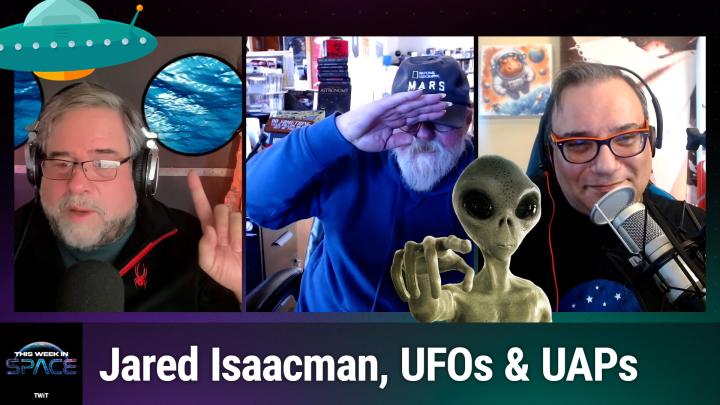
All TWiT.tv Shows (Audio)
This Week in Space 139: Look to the Skies
01:22:19
Leonard David, Jared Isaacman, UFOs & UAPs
Loading summary
Transcript261 lines
- [00:00]
Rod Pyle
On this episode of this Week in Space, we're talking to our old friend, OG space reporter Leonard David, about Trump's pick to run NASA. Elon, Musk and UFOs. UAPs, do aliens walk among us? Stay tuned. Podcasts you love from people you Trust.
- [00:21]
Tarek Malik
This is TWiT.
- [00:24]
Rod Pyle
This is this Week in Space, episode number 139, recorded on December 6, 2024. Look to the skies. Hello, and welcome to another episode this Week in Space, the look to the Skies edition. And that will have a special meaning for those of you who remember movies from the 1950s. I'm Rod Pyle, editor in chief, Bad Aster magazine. I'm joined, as always, by the Knock knock. Tarek Malik, editor in chief of Space.com who's having his house remodeled. Hello, sir.
- [00:55]
Tarek Malik
Hello, Rod. Hello, everybody. Hello, Internets. Hello, space fans.
- [01:00]
Rod Pyle
So. So you're sure you're having your house remodeled? It's not some relative that you walled up banging on the wall from the other side?
- [01:07]
Tarek Malik
No, you are. You are correct. You know, six months ago, my kitchen sink exploded and like, ruined the floor in the kitchen. And we are finally getting it repaired after jumping through all those insurance hoops. So I'm very excited, although it's very cold because the death to keep coming in and out. So. All right, if you hear knocking, dear listeners, that's what that is.
- [01:27]
Rod Pyle
Just. Just go with it. Yeah, so, but more importantly than either of us, today we're talking to Leonard David, the one and only OG space reporter, and we're going to be talking about number of things, Trump's pick to run NASA, Elon Musk and his, well, let's call it influence for the sake of conversation and an update on UAPs, because we all love us some UAPs. How are you, Leonardo?
- [01:51]
Leonard David
Good. Good to go. Yeah. I'm ready to discuss today, tomorrow and 2025, which is going to be really exciting.
- [02:03]
Rod Pyle
I hope so. Yeah.
- [02:05]
Leonard David
As long as I'm alive, I'm always.
- [02:09]
Rod Pyle
It may not be exactly what we're looking for, but it'll certainly be exciting.
- [02:13]
Leonard David
I'm hanging on the ledge. I'm hanging on the edge. All right, 2025, let's move on.
- [02:22]
Tarek Malik
That's right.
- [02:25]
Rod Pyle
Note to John Ashley. I just upped my gain a touch. All right. But before we start, okay, please don't forget to do us a solid. Make sure to, like, subscribe and do all the other podcast things, whether you're listening to audio or on YouTube. Click the relevant buttons to do the same things. Because we want your love. We love You. We need to know you love us back. And we're counting on you. And now, more space junk. Otherwise known as our weekly ecclesiastical space joke from Simon Allen.
- [02:56]
Tarek Malik
Simon.
- [02:58]
Rod Pyle
Hey, Tarek.
- [02:59]
Tarek Malik
Yes, Rod?
- [03:00]
Rod Pyle
You hear about the little boy that went up to the priest and said, did God invent gravity?
- [03:06]
Tarek Malik
No, I didn't. What'd he say?
- [03:07]
Rod Pyle
The priest said, of course. That is why we celebrate mass. That's actually one of the good ones.
- [03:16]
Tarek Malik
That's pretty clever.
- [03:17]
Rod Pyle
Yeah.
- [03:17]
Tarek Malik
Yeah.
- [03:18]
Rod Pyle
Thank you, Simon. And Simon, feel free to send in your jokes anytime. Now, I have heard that some folks want to run to confession when it's time for a space joke on this show, but you can help send us your best, worst or most indifferent space joke at Twists. At Twists. Twit tv. Leonard, do you have any jokes for us today other than just continuing to live at our age?
- [03:40]
Leonard David
I'm trying to be serious. In the last month of the year and, you know, I just had my birthday. I'm.
- [03:47]
Tarek Malik
Happy birthday, Leonard.
- [03:49]
Leonard David
Yeah, I just. I just survived one more year. That spin around the sun and you know, it is really taking its toll on you. No, the spin around the sun. I mean, I'm. Yeah, it's taken a toll, man. I'm sitting here trying to gauge life. You know, you start to get philosophical.
- [04:13]
Rod Pyle
See, you're thinking too much. That is always a bad thing. By the way, I thought he was.
- [04:19]
Tarek Malik
Saying that his birthday took its toll on the spin around the earth there.
- [04:22]
Rod Pyle
Yeah, I was trying to figure out how that would change. Speaking of mass, by the way, for anybody watching YouTube, this background is because we're talking about UAPs, and as we know, they all dive into the ocean. Now we have the ocean. All right, let's get on to some headlines while we're still thinking about it. So, by gosh, the one for the week that has to stand out for me was the surprise announcement of Jared Isaacman as Trump's pick for the new NASA chief. That's right, because he wasn't on the short list that was going around for NASA administrator, nor was he actually even on the long list.
- [05:01]
Tarek Malik
You didn't have billionaire entrepreneur, private astronaut, first private spacewalker on your bingo card into the next NASA administrator or very.
- [05:10]
Rod Pyle
Very sweet looking space Jesus. It looks like he's actually 17 years old. Yeah, yeah.
- [05:16]
Tarek Malik
This was an interesting choice. This happened, what, like, like about, like a few days ago, as we're, as we're recording this, where Trump announced through Truth Social and of course on Twitter that he picked Jared Isaacman as his nominee for, for NASA administrator. Now they don't, they all have to be confirmed. But this is one of the earliest I've seen an incoming administration name their pick five NASA administrator. I mean, when Obama was first elected, I think it took nigh on a year, if memory serves, like to get an actual one because, well then Chris Scalise like was interim for a while. It was a long time and. But this is an interesting pick in Jared Isaac. Man, it does sound like it's very much informed by Elon Musk and like the advisory role he has with Trump right now. Jared Eisenman is kind of SpaceX's tenant customer for private spaceflight. He's a lifelong space fan and pilot. He has his own kind of private air force that trains, I think military pilots, if memory serves, and they do stunt flying. And of course he's the CEO of Shift4, which is where I guess he made his mega billions and is also noted at philanthropist. He's raised millions of dollars for, for pediatric cancer research through both his own private efforts and of course the inspiration for Polaris dawn missions there. Our space listeners might recognize him most as the person that bought SpaceX's Dragonflight for Inspiration4 back in 2021 and who did the first private spacewalk in September of this year as we're recording at 2024. And he has actually two more private missions on the books under that Polaris program that SpaceX will fly for him, that he will fly. And the first of one of them is supposed to be the first crewed flight of starship too. So what's really interesting is, you know, first of all, is there a, is there a, an openness, you know, on the, on Congress's part to confirm him and then also, you know, will he still go through with those flights over the next four years if he is actually serving as NASA? Here's a person who is one of the chief private customers of NASA's primary contractor, now in charge of NASA. It's kind of mind bell, like a big circle to try to wrap your head around. But that's going to be interesting to see how that shakes out.
- [07:47]
Rod Pyle
Yeah, it was a bit of a shocker, although I have to say, along with most of the space community that I'm engaged with. Anyway, it was a pleasant surprise if you know the guy. I don't know him well, I've had one on one with him twice, I guess. But he's, he's kind, he's friendly. We had him at our conference and he of course accepted the award. We were giving him and we had a lunch talk. But he also spent hours talking to the kids in attendance and was really engaged with them and happy to answer questions and afterwards and so forth. So I'm not saying that other NASA administrators haven't been that way, but he's more that way than any that I know anyhow. Leonard, what's your take on the Isaacman pick? What's that mean?
- [08:32]
Leonard David
It's fascinating, you know, I was surprised myself but you know, the idea about him getting through the gauntlet in Congress without self serving SpaceX or you know, that kind of thing, that's going to be interesting to watch how that plays out. And I met the guy, I like.
- [08:57]
Tarek Malik
Him, he's a nice guy.
- [08:59]
Leonard David
Yeah, he's a great guy, but he's sharp too. Now let me back up because I'm old. I've met pretty much every administrator of NASA and he's definitely a different kind of guy. The only thing I can remember that would be comparable was frosh, kind of an R and D guy. Dan Goldin was probably the most bizarre administrator that NASA has ever had.
- [09:30]
Rod Pyle
He's going to come up later, by.
- [09:31]
Leonard David
The way, and he's going to come up all the time. He's still going. And he's a fascinating character in this, you know, maybe it's time for that kind of guy to get in there with the quote unquote new space umbrella that NASA has got to face. And so he may be the right guy at the right time. He may be the wrong guy at the wrong time, I don't know. But let's see if it gets confirmed and you know, more power to him. I listened to Bill Nelson yesterday and Bill Nelson's already talked to him and you know, they seem to be in some kind of mutual agreement about, you know, the issues that NASA is going to face, which is significant way beyond this guy's capability. So he. What the. Probably the thing to watch is the second in command, the deputy.
- [10:26]
Rod Pyle
Yeah. Because they need somebody with some political bare knuckle skills, I think.
- [10:32]
Leonard David
Yeah, yeah.
- [10:32]
Rod Pyle
Because that, I mean if you look back over the administrators, at least my take on it, I think you probably have done more looking than I have. But it seems like from James Webb on the administrators who had some brass knuckle political experience were the ones that were really effective like Bill Nelson and some of the others, particularly astronauts, love astronauts. But I don't know that they make the best administrators because that's just not, you know, they understand the realm well, at least for human space flight. But in terms of really knowing how to knock heads in Congress and get things done, this doesn't seem like it goes as well. So I think Jared needs like a real thug.
- [11:14]
Tarek Malik
Yeah.
- [11:15]
Rod Pyle
In the deputy director role. Sorry, Tart, go ahead.
- [11:17]
Tarek Malik
Oh, I was going to say like one of the things that will be really interesting to see how it develops. You know, let's say that he is confirmed and he does, you know, take, take charge, you know, there as a private astronaut, Isaacman was really trying to, you know, push as part of the Polaris dawn flights with SpaceX, this potential of going back to Hubble, for example, and either giving it a boost to extend its life or something like that. It would be interesting to see if there's any wiggle room there again or if it is indeed. Because NASA decided to say thanks, but no thanks, and we've talked about that on the show before, if that gets dusted off there and I would be very interested. And Leonard, maybe you might know, I'm wondering if he even gets to do these other two flights that he has with SpaceX, if, if he's the NASA administrator, I mean, is that a clear conflict of interest or is that.
- [12:16]
Rod Pyle
I don't know if it's a conflict of interest, but do you really want to be sending up your, your prime guy on this rocket that's a head scratcher?
- [12:24]
Tarek Malik
Well, I mean the visuals of that are like, they're unmistakable. You know, people will look up and.
- [12:32]
Leonard David
Say, whoa, I think you're right. I think there's something in there. And you know, we've had post flight people, Nelson included, Bolden Truly, Richard Truly, you know, our ex astronauts that ran NASA, so. But this collision between okay, you've flown, so what? And what's your administrative skills? I don't know enough about his entrepreneurial skills to know if he can dance between the different divisions at NASA, including space science and planetary exploration and a lot of other aeronautic issues. I mean he may be great, but yeah, I'd say the second in command would be really important. But I'm not going to discount the guy. I liked him a lot. I'm with everybody else. He may be the right guy at the right time.
- [13:29]
Rod Pyle
Well, friend of the show Greg Autry was on the shortlist that's been traveling around for the last month or so and might end up being number two or number three and if so, I think his brass knuckles are well polished. Let's jump to a break real fast and we'll be right back. Stand by for more. This episode of this Week in Space is brought to you by US Cloud, the number one Microsoft unified support replacement. US Cloud is the global leader in third party Microsoft enterprise support, supporting 50 of the Fortune 500. Switching to US Cloud can save your business 30 to 50% on a true comparable replacement for Microsoft unified support. US Cloud supports the entire Microsoft stack 247365 responds faster and resolves tickets quicker for clients all around the world. And you always talk to real humans. Check that out. Look at their proven track record. They have expert level engineers with an average of 14.9 years experience and that's for Break Fix or DSE. They have 100% domestic teams so your data never leaves the United States. They have financially backed SLAs on response time and initial ticket response averages of under four minutes. Try and get that with the DMB. In 2023, 94% of US Cloud's clients reported saving 1/3 or more when switching from Microsoft unified support to US Cloud. From Fortune 500 companies and large health systems to major financial institutions and federal agencies, U.S. cloud ensures that vital Microsoft systems are working for over 6 million users globally every single day. And you know, big brands trust US Cloud, including brands like Caterpillar, hp, Aflac, done in Bradstreet, Under Armour and keybank. Even the IT folks at Gardner have chosen USCloud for their Microsoft support needs. In fact, a Director of Information Technologies recently said and within an hour US Cloud responded with I want to say four engineers. So not only did they bring the right guys to the call, they brought the whole cavalry. I just felt like wow, that was amazing. That was unlike anything I had experienced with Microsoft in my eight years of being with Premier. We made the right choice. And when it comes to compliance, no one gets it more than the US Cloud. ISO, GDPR and esg. Compliance are not just regulatory requirements, but strategic imperatives that drive operational efficiency, legal compliance, risk management and corporate reputation. These standards foster trust and loyalty among customers and stakeholders alike, attract investment and ensure long term sustainability and successful in a competitive global market. Visit uscloud.com and book a call today to find out how much your team can save. That's uscloud.com to book a call today and get faster Microsoft support for less. Okay, now we had a press conference from NASA yesterday. Now I have to tell you, things always start off the same, which is you sitting on there, it's five minutes after the hour, it's 10 minutes after the hour, you're listening to this cheesy elevator music. And then finally it comes on and there's always a mic squeal or an echo or a please stand by or something. And it's unkind to say, but it's like, guys, you know the old joke stands. You can send a man to the moon but fill in the blank. And me filling in the blank is. But you guys can't get a press conference going with the same technology that even organizations like the NSS use successfully multiple times a year. I just don't get it. And a few years back I was at jpl, I think it was for the death dive of Cassini when it was sent into Saturn. And I was sitting in Von Kameren Auditorium at Jeff Polson Laboratory and they're having all these AV problems and I see the then director of the comms department, Blaine Baggett, jump up and go stomping to the back of the room because he's going to have a piece of somebody. And I just. Anyway, I'm sorry, I took a real diversion there.
- [17:50]
Tarek Malik
But for people who don't, who don't know what Rod's talking about. The start of NASA's Artemis 2 update press conference was plagued by audio and all sorts of delay issues and everything.
- [18:01]
Rod Pyle
Press conference over the last decade, like.
- [18:04]
Tarek Malik
It was underwater for like a while. It was crazy.
- [18:06]
Rod Pyle
They had an echo and anyway, so yeah, they could talk to the moon. They can't talk to each. Can't talk between a few buildings as guys. Grissom said. So, yeah. So Taric, what's the upshot here? We got delays again.
- [18:19]
Tarek Malik
Yes, yes, yes. Surprising perhaps everyone, and yet no one at all. NASA has pushed back the launch of Artemis to its next crew, its first crewed mission around the moon since, well, of the 21st century, you know, since the Apollo era. And this happened, as Rod mentioned, it happened yesterday at NASA headquarters where you had Bill Nelson and all of the leaders talk about how, and I'm going to quote, space is demanding and they need more time to make updates and whatnot to the Orion spacecraft for its heat shield. One of the big issues here that we've seen from Artemis 1 was that the heat shield had a lot of cracks on the way back down. Rod, I know you have thoughts about this.
- [19:04]
Rod Pyle
Well, we saw it on the EFT flight too back in 2014, and it took them 10 years, at least as far as I could tell. And somebody commented on this yesterday in the press. It took them 10 years to talk about the fact, to talk about why the heat shields challenge, at least in some respects. And yes, I do have something to say about that, which is. Ten years ago, I had a chance to have a short interview with the project manager for the heat shield. Now, this heat shield is made from avcoat, which is what they used on Apollo, but it's made differently. Two big differences. One is it's not a honeycomb structure over a substrate. It's just layered on there. As I understand it, made based basically as a monoblock. And that's partly because it's cheaper. And this is another one of those false economies on Artemis, just like the SLS and the SRBs are. But also, the knowledge base from Apollo was gone and they really didn't know how to do it again. And they. This is what they said yesterday. And they just don't have the resources they did back when NASA's budget was about 10 times what it is now. However, more importantly to me, and more insultingly, the EPA regulations now prevent NASA from using the original formulation for avcoat. And as the project manager, and you guys have heard this before, if you've been listening to the show, as the project manager described to me, so remember, you were a kid, by the way, that was a really long time ago as a kid, Just a little after Leonard was said, remember when you were a kid and you used to use Krylon spray paint and it hardened up like a rock at about 15 minutes? I said, yeah. He said, now it takes about a day, right? And I said, yeah. He said, that's because we can't use those toxic chemicals that they used back in the 60s. And I said, wait a minute. You can't get a waiver to have this made, like, you know, five miles south of me in Mexico or something. And he said, no, we can't. We have to do it the right way. So apparently part of the formulation problem is EPA regulations. Leonard, why the heck can't they get a waiver? You've been doing this longer than anybody.
- [21:15]
Leonard David
I don't know, you know? Yeah. I mean, when you were talking, I'm thinking, you know, this is. Well, let's see if I can glue this together. I remember when a guy named Fred Singer and I were talking, he was one of the first early space scientists that we could have the Singer radiation belts, not the Van Allen belts. He pulled me to the side and he was so upset about the solid rocket motors and EPA inclusion in there. And he was trying to blame Al Gore for changing the EPA rules or something. It's one of those. The chemistry of spaceflight is really interesting, and it's One that frankly, very paranoid about the reentry and some satellite debris and a lot of other things. I'm not. I'm not answering your question because I have no clue about what. I'm just thinking of fragments. But, you know, we. We do have a kind of an odd thing going on here with EPA and I think the FAA and a lot of the government regulations that are. That I think that Elon and the Trump folks seem to be honing in on, because I think it gets to what I thought we were going to be doing, the uap, UFO thing. What is the government role in all this? What is the regulations? Are they overburdensome? Are they protecting us? Are they overdoing it? So we're at a disadvantage globally. And all I know, and I've been writing this for years, China is coming. This is a very interesting moment in time. This is a Sputnik effect. This is nothing very much different from in my mind between a beep, beep, beep of 184 pound satellite, a Sputnik one that shook the world up, and China's coming. And you heard Nelson at the very beginning of his talk, once again, we gotta get there before China. You know, I mean, you heard the plaintiff call. Well, yeah, using it as a, you know, a card to play.
- [23:53]
Rod Pyle
And he explained why this time.
- [23:55]
Leonard David
Yeah, there are things going on here that are way so fascinating for writers right now. You know, we should.
- [24:04]
Tarek Malik
So we, we actually, we forgot to mention. So what the delays actually are. We said just that Artemis is delayed.
- [24:10]
Rod Pyle
But no, actually we interrupted you, so I apologize.
- [24:13]
Tarek Malik
That's right, Rod.
- [24:14]
Rod Pyle
All right, get on with it.
- [24:15]
Tarek Malik
You know who's interrupting me is. Man, all this work going on downstairs. I don't know if you guys can hear.
- [24:19]
Rod Pyle
No, we're fine.
- [24:20]
Tarek Malik
It is loud.
- [24:20]
Rod Pyle
Okay, so what else?
- [24:23]
Leonard David
Lift your feet.
- [24:24]
Tarek Malik
Yeah, yeah. So. So just, just so that you know, if you're. If you're marking your calendars like I was, I was already going to start the big Artemis 2 campaign for Space.com. it was supposed to launch in September of 26 of like next. Next year or 25. September 2025, with. With Artemis 3, the moon landing to follow in 2026. Both of those had already been delayed by like a year or so. And now Artemis 2 won't launch until April of 2026 at the earliest. So let's hope it's around my birthday, Rod. That'd be fun. We could. We could celebrate it in Florida. And Artemis 3 has been pushed out to sometime in mid-2027. That means that for the second time in a row, if there are more delays, a Trump administration may not see a moon landing in within its four year term. Mid 2027 is already pushing it for that.
- [25:21]
Rod Pyle
So we're going to. Yeah, Donald's not going to be happy. Oh yeah, that's like Nixon watching his glory evaporate. So I guess he'll probably push on that.
- [25:30]
Tarek Malik
So there's two things, there's two things to watch on this because they said some very interesting things. Bill Nelson did and he was there with pal Melroy with this new moon to Mars office that they've got going on there too. And, and they said that they might try during Artemis 2 to do a bunch of other things to check, check tests off the board. One of them could be a quote unquote parallel flight test around the moon of not just Artemis and its orion spacecraft and four astronauts, but possibly like a SpaceX Starship flying like in conjunction with it as they do proximity operations around the moon. That could be something to see, right? That could be pretty amazing. But still it is yet another delay and pushing, you know, the moon and likely Mars just that much further out. So.
- [26:23]
Rod Pyle
Well, I guess we'll see what happens. We're going to jump to another ad break right now. We'll be right back with the next headline. Standby. This episode of this Week in Space is brought to you by Veeam. Without your data, your customers trust turns into digital dust. That's why Veeam's data protection and ransomware recovery ensures that you can secure and restore your enterprise data wherever and whenever you need it, no matter what happens. As the number one global market leader in data resilience, Veeam is trusted by over 77% of the Fortune 500 to keep their businesses running with digital disruptions like ransomware Strike. That's because Veeam lets you backup and recover your data instantly across your entire cloud ecosystem, proactively detect malicious activity, remove the guesswork by automating your recovery plans and policies, and gets real time support from ransomware recovery experts. You can't ask for more than that, you know, data is the lifeblood of your business. So get data resilient with Veeam. That's Veeam V E E A m. Go to veeam.com to learn more. All right, so Tarek, actually we kind of combined two into one. Do we have another headline?
- [27:44]
Tarek Malik
I thought we were going to talk like at length about all that stuff. Unless you want to talk about.
- [27:50]
Rod Pyle
No, we can We've got time. We can go where you want to go. I do have to, by the way, though, have a show note here. I got an email. We got an email from listener David Eckert. Did you see it?
- [28:01]
Tarek Malik
I saw it. David. David, David.
- [28:03]
Rod Pyle
So he takes exception to Space.com's headline, quote, Asteroid the size of 3 million elephants to pass close to Earth, or whatever it was you said at the end. But the 3 million element part, I mean, really, you know, as he said in his email, just tell me the diameter. You know, I will give you that. You're at least going for volume here. But I mean, come on, seriously.
- [28:32]
Tarek Malik
No, it's fine. You know, God forbid we try something new@space.com. rod.
- [28:37]
Rod Pyle
It's not. No, wait, wait, wait, wait. Hold on. It's not new because Lori Garver, under Lori Garver's NASA, which he was deputy administrator, they had the. I don't know, what was it? 200,000 elephant thrust of SLS or whatever.
- [28:52]
Tarek Malik
And they use it at ULA all the time, too, which was goofy.
- [28:55]
Rod Pyle
But why would you guys pick it up for an asteroid instead of saying your usual is the size of a nuclear submarine or something?
- [29:02]
Tarek Malik
I think it was the size of a stadium, actually.
- [29:05]
Rod Pyle
Well, that was what the responsible outlet said.
- [29:12]
Tarek Malik
I'm all open for when. When they, the writers like to try something new. And I will stand behind it. You know, I think the original headline was something like 180 million capybaras. That's a little bit of a stretch.
- [29:23]
Rod Pyle
Perhaps Chupacabras. What?
- [29:25]
Tarek Malik
Capybaras. You know what's a capybara? A capybara. The world's largest rodent.
- [29:30]
Rod Pyle
Right, Leonard? Did you know that?
- [29:33]
Leonard David
No. This is why I. Stay tuned to Space.com.
- [29:37]
Tarek Malik
Wait, you've never seen a capybara, Rod?
- [29:39]
Rod Pyle
I've seen a Chupacabra.
- [29:40]
Tarek Malik
Oh, you have not?
- [29:42]
Rod Pyle
And I saw Bigfoot, but other than that.
- [29:45]
Tarek Malik
All right, well, you got to get yourself to San Diego. Go see the capaberas there, you know, but, but no, you know, I'll tell you, asteroid flybys, people, people. Oh, pardon me. People get really interested in them. And my, My. My personal rule this is, there's a capybara, Rod.
- [30:03]
Rod Pyle
There you go.
- [30:04]
Tarek Malik
Thank you, John. So my personal feeling is that if an asteroid isn't any closer than the moon, like when it flies by, I don't really give notice, and I like to write about them. If it's going to be within the orbit of the moon.
- [30:21]
Rod Pyle
Yeah, Exactly. Because then 11 million miles or Something it's like, oh, yawn.
- [30:26]
Tarek Malik
And so these ones, like, I don't really care to track, however, this one was getting a lot of steam and folks were doing it. So I was like, well, all right, let's try something new and see like what's what. And that's what we did. So, David, I take the criticism. I understand. I'll pick a larger animal, maybe like some whales or something. Next.
- [30:48]
Rod Pyle
Clickbait. Clickbait. Yeah. How many, how many giant blue whales would it be?
- [30:53]
Tarek Malik
There is. There actually is a small, a small asteroid that's going to fly by on Saturday as we're. So tomorrow that's going to be like about a hundred thousand miles away. And so, you know, we get. By the way, we get flybys like that all the time, like at least once, twice a day. And we just don't. Don't talk about them. And people talk about them because NASA puts these flybys on a short list and they actually have a bigger list too that tells you when, when they're going to come through it, through their near Earth object detection thing. And there are sites that just like to run that and say that every single one that's going to come by, Even if it's 11 million miles away and has no chance of intersecting with our planet, is going to kill us all. You know, and so just take all those headlines with a grain of salt, too.
- [31:35]
Leonard David
Yeah, but you put, you know, I saw the early headline of it's larger than 10,000 tarantulas, which is not. That doesn't help.
- [31:47]
Tarek Malik
I thought we were going to talk about UFOs on this thing.
- [31:52]
Rod Pyle
Well, we should, but do we want it before. Tail to tail, before we take our next break? Is there anything. Good Lord, somebody pass a laughing Gas first.
- [32:05]
Leonard David
Mr. Malik, you better start laughing.
- [32:08]
Rod Pyle
Is there anything we want to cover about? Because I know we're going to do this in another episode. Tarek. But is there anything either you guys want to say about what we, you know, in the broader perspective, what we expect out of a Isaacman slash Musk cabal? Well, possibly for 20, 25, at least.
- [32:28]
Tarek Malik
Yeah. I wanted just to say that I think that this combination of the Artemis delays and like a new. A new. A new administration. Because we always expect when there's a new administration that the agency's priorities are going to get changed. Isaac man himself has actually been pretty critical of the Space Launch System. I had actually expected NASA's big press conference to be like a reminder that SLS was here to stay. And no One should be worrying about.
- [32:56]
Rod Pyle
It going to be a cancellation call.
- [32:59]
Tarek Malik
Yeah, well, no, no, I didn't think it was going to be that at all. I didn't. I had a delay on my, on my bingo card for that one, but not the cancellation. But I think that you could see some serious discussions about, like, how central do they want SLS to be now in that program for it, we know, could they put Orion on a different vehicle? It's built for SLS right now and SLS is built for that. But will I Isaacman, you know, push and push to do it. And I'm also very curious to see where the split and the line ends between Isaacman as a SpaceX customer and Isaacman as a NASA administrator. I think he can do it. Right. And then where SpaceX as a provider and then SpaceX as like a client or whatnot of the NASA administrator. So I'm curious what's going to happen on those two pending Polaris dawn flights that Isaacman has either contracted Space X for or has, you know, signed the letter of intent to buy? And do those get pushed out beyond this term now or what else happens with that? Does he forego them? Because I don't know. I don't know what that means. You know, I don't think we've ever been in a situation where a potential incoming new NASA administrator has a private spaceflight booked with a company that the agency now is their primary human space contractor.
- [34:26]
Rod Pyle
Yeah. Or that clearly favors a company that could easily become a monopoly. I mean, I guess you could argue to some extent that North American Aviation, slash Rockwell was kind of becoming a monopoly during the shuttle years, even though the SRBs were. And engines were built by other people. Well.
- [34:42]
Tarek Malik
And will oversee SpaceX rivals for contracts and bids and that kind of thing.
- [34:46]
Rod Pyle
But question for Leonard, you know, if you've got Elon in the background, I don't know how to characterize it. I don't want to say. Well, yeah, at least from what we've seen of him, he. Let's just say he has the potential to try and be a puppet master. I don't think he'd succeed at it given the people involved. But, you know, is he going to be smart enough to encourage NASA and others to continue supporting Blue Origin and so forth for competitive bids, or is he going to try and swing the SpaceX?
- [35:20]
Leonard David
No, those are great questions, but, you know, in my view, we've got a study that nobody paid attention to, which is the Academy of Science Crossroads at NASA. NASA at a crossroads.
- [35:36]
Rod Pyle
I Saw that that was a huge.
- [35:37]
Leonard David
And nobody paid attention to this report. This is another one of those early warning signs about the health of NASA. And I recommend that study for people to look at because this guy's coming in in a NASA that is in trouble. The budget is not there, the infrastructure to do space is, you know, depending on if you believe what they put in the report. It's held together by Velco. You know, we got problems. I mean, there are really serious issues about the governmental NASA that we all have loved over the decades. And you know, we got j. And you can comment on this, Rod, about the JPL layoffs and that round of those. Yeah, I mean, you know, we're, we're in a, you know, in a government spiral down capability. And you know, I listened to Nelson yesterday and if I got on there, you know, which I couldn't, there was too many good reporters, you know, doing their stuff. But, you know, you know, I don't care about delays. You got more fundamental problems, buddy. You got some NASA pains in the groin. I just don't know how this is going to resolve itself given the budget dollars and the public interest in space which we're missing totally. Do they care about NASA? I mean, in the federal, in the big picture, you still have to ask whether or not NASA fits into what the public expects of it and can they deliver. And when you have delays like this and heat shield issues and all these other problems, you start wondering, you know, okay, this is not, you know, certainly not my NASA one. Never mind my father's NASA. My NASA, I, I see a downward spiral.
- [37:52]
Tarek Malik
And well, I think that the public, I think that the public's interest though is there. I mean, they, they, they fly the first helicopter on Mars and people notice, you know, that they, they talk about.
- [38:03]
Rod Pyle
Asteroids that are the size of 3 billion elephants.
- [38:06]
Tarek Malik
Oh my gosh.
- [38:07]
Rod Pyle
Okay, but so just to back up a step and, and I, my context here is I'm writing a book with a senior NASA official, a former senior NASA official right now who, you know, he's very polite, but he's not pleased to see what NASA is becoming, which is somewhat fossilized is a strong word. But, but organizations, you know, tend to stiffen up as they get older, additional layers of bureaucracy. And I think his main point is the decision making. Too much decision making has been moved up to headquarters as opposed to being at the field center level, which is what made Apollo work so well. And if we can back, you know, I can't stand the idea of the waste of giving up on what's already been spent on SLs and that God awful mobile launch tower which, you know, billions really. But if you toss that, you don't have to pay close to. I think the last estimate I saw all in was about 5 billion. Close to 5 billion a launch for SLS if instead Starship or New Glenn or Falcon Heavy. Obviously for New Glenn or Falcon Heavy, multiple launches obviously for Starship, you know, maybe 500 refueling launches or something, whatever it takes. But that's still cheaper than sls, no matter how you slice it. I mean, does that solve part of the budget problem you're talking about, Leonard?
- [39:36]
Leonard David
Well, how you slice it is a lawn showing that he can do these things. You know, I think we got a NASA that is going to have to. What I thought I heard and I'm not sure I heard it right, but you know, I mean I'd bank on blue origin. I'm not, I'm not sure Ron is going to be able to cough up the goods on getting us to the moon with, with, with the starship. You know, it could have all kinds of developmental problems. And I at the same time like everybody, I'm amazed at what he's done so far. So I can't discount that he can do that. But you know, if you're, you know, at the end of the day, I don't care how we get to the moon, we got to get to the moon. You know, if it's a giant rubber band that somebody comes up with and just shoots everybody there, I'm up for it. And you know, as long as they got helmets on and they can land and they got retro packs, it's fine. But you know, at the end of the day you're talking about something much larger government in the world political scene. You have China coming and watch Russia. I'm not discounting Russia. They got a bunch of new things going on sub level there. Always an economic turmoil and Putin and all the other stuff. But I keep an eye on those guys. India coming on strong and all those.
- [41:16]
Rod Pyle
Players have mostly lower labor rates and don't have to worry about unions.
- [41:21]
Leonard David
Yeah, it's really again the dynamo of the space exploration agenda for the 21st century as we turn the corner on this year is really going to be fascinating. I mean it's just, it's just. And then we have the clips and the NASA private landers on the moon and what is that going good? I don't know. My guess is I don't like it right now. I think it's been a two for two problem. Yeah, and we'll see how they do with Firefly and Intuitive machines and X Flight out and. But you know, it's exciting. I mean, from a reporter standpoint, couldn't ask for more. You couldn't ask.
- [42:16]
Rod Pyle
Well, that's a good point. But your point also is taken that we have not had a lot of success with Clip so far. No. And these are small operators and it may take, I don't know, five more years for them to get it right. If they get it right. I mean, it may just be. I hate to say this because none of us want to see it happen, but it may be at some point that they kind of have to find some kind of hybrid bridge between cost plus and fixed fee. But let's save that discussion for another time. I want to jump to a quick break and then I want to come back and talk to you about UAPs. Oh my God and stuff.
- [42:51]
Leonard David
I see them overhead.
- [42:52]
Rod Pyle
All right, stand by. We'll be right back. Now AT T Mobile get four 5G.
- [42:58]
Tarek Malik
Phones on us in four lines for 25A per month when you switch with eligible trade ins. All on America's largest 5G network.
- [43:07]
Rod Pyle
Minimum of 4 lines for $25 per line per month with auto pay discount using debit or bank account, $5 more per line without autopay plus taxes and fees and $10 device connection charge phones via 24 monthly bill credits for well qualified customers. Contact us before canceling entire account to continue bill credits or credit stop and balance on a required finance agreement due bill credits end if you pay off devices early.
- [43:23]
D
CT mobile.com the holidays are here and so is the IKEA Winter Sale. Now's your chance to make the holidays a little more magical and less expensive. Save up to 50% off on select items in store and online now through January 7th. Plus IKEA loyalty members get an extra 10% off on sale items. And if you spend $2.99 or more on a single order before December 10th, enjoy free delivery. Need help managing the clutter of decorations? IKEA Storage Solutions will keep your home tidy from toys and tinsel. Having extra guests over checkout offers on select dining furniture to make more room for the people who matter most this time of year. Don't wait to finish your winter wish list. Shop the IKEA Winter Sale in store or Online now until January 7th. Visit ikea-usa.com wintersale for more details. Terms Applied Offer validates may vary US only, while supplies last selection may vary by store and online. See store in ikea-usa.com wintersale for complete.
- [44:17]
Rod Pyle
Terms restrictions apply so, Leonard, we've had some recent activity here. First I thought that was the. The carpenters at Tarek's house. Wow, you transported me back to my childhood in the 60s.
- [44:42]
Leonard David
Here we go. We finally got to the topic that we. I was asked to do.
- [44:48]
Rod Pyle
That's okay.
- [44:52]
Leonard David
I'll shut this off now.
- [44:54]
Rod Pyle
Please do.
- [44:55]
Leonard David
I'm ready.
- [44:56]
Rod Pyle
All right, there it is. Kill it. Kill it. Kill it. Okay, so just up front, you know, we've moved from UFO, which, which we are all familiar with from the 50s on, certainly. And now we call them UAPs. So at first they were Unidentified Aerial Phenomena. Now that's been changed to Unidentified Anomalous Phenomena. Is that right?
- [45:20]
Leonard David
Pick one.
- [45:21]
Rod Pyle
Yeah. What does that really mean and why the nomenclature change was that just to get away from the baggage that UFO carried From years of wild speculation?
- [45:31]
Leonard David
It seemed to be that, you know, I, you know, I'm going to go back and I'm going to hold on to things I maybe have said here before, but I'm a little, I'm always annoyed a little bit, and maybe I'm wrong, but I don't like UFO and UAP glued together. I think we got two different kind of phenomenon that may be involved here. And, you know, I'm old enough to UFOs, to me, were crashed, flying saucers going overhead, things coming in. Uap. Okay, now we got a bunch of other kind of people that are experts. They're. Are they drones? Are they from another country? Are they et? Is it us coming back in time? You know, there's a lot of variation here. And that is really aggravating to me as somebody that at the end of the line, I'm almost convinced, and I'd say I'm pretty convinced, I probably am convinced that we've had some intrusion by a alien visitation. I only need one. If it was Roswell, great. I don't need them coming here all the time. I don't want out of control. You know, people that didn't have the DMV license, you know, running out of brake fluid, crashing all over the place.
- [47:09]
Rod Pyle
That's a good point because we've talked about this before the show, but yeah, it's like, so you guys are thousands or tens of thousands or hundred thousands or millions of years in advance of us. You could travel interstellar distances or fold time in space or whatever, and yet you keep crashing into our planet. I mean, really, that reminds me of myself when I was 16 and drove around without a Decent master cylinder in my car and kept running into things.
- [47:36]
Leonard David
I think you're still doing that, aren't you?
- [47:38]
Rod Pyle
Well, probably, but let me just shift the question a little bit. In one of your columns in the last few months, you wrote about the Milligan, the Milliken Milligan study, and I'll quote from that. It is increasingly clear Milligan feels that belief in alien visitation is no longer just fun speculation, but something that has real and damaging consequences. So he's not, as I read what you wrote, he's not claiming one thing or the other. He's merely pointing out that this perception, which is fairly widespread and I guess increasing of actual alien visitations and possibly them being walking among us and all that has kind of knock on damaging effects to the public psyche. Is that what you took from that?
- [48:26]
Leonard David
Yeah, I think there are beginnings to be a lot of different people looking that frankly have a background to look at it because there's a lot of extraneous people that seem to be sociologists all of a sudden giving us opinions about, you know, we're in good stead with UFOs and ET walking around. Yeah, that, that's one point. I am on the edge of sending SPACE.com my new article. I wrote a piece that's going to come out. I ask, really, the top five or six people that in are investigating UFO, UAP, what has to happen in 2025 to make this more real? That was the premise of the question. And you should, you should listen. I mean, you're going to read on the article what these people came up with. It's pretty interesting because, you know, we've had several congressional hearings in the last month or so. And you know, and you know, those are not making the difference. There's got to be. If you're going to be a scientifically based investigator looking at this issue, it's got to move the needle into science data. There's uniform agreement that we're not there yet and this kind of hearsay. I knew a guy in World War II that saw one and you know, I got a memo and that is not cutting it, you know, for jumping in.
- [50:19]
Rod Pyle
But even some of the recent testimony from people that were widely regarded as being responsible, responsible actors, you know, military officers and so forth.
- [50:27]
Tarek Malik
Yeah.
- [50:28]
Rod Pyle
If I read correctly, even some of that was a friend of a friend of mine said X and you know, they're testifying before Congress and Congress is saying, well, what about your direct experience? Well, I heard a thing that's not helpful, is it?
- [50:44]
Leonard David
No. And let me Just do. I hate to do this to you, but I spent some time doing this this morning because I woke up worried about the show. And I went back and looked at all my emails from all the people that I asked, oh, what a guy. And you know, it's about seven years ago that New York Times had a Leslie Keene article she co authored that really spun up a lot of this activity. I got people going. It's a new modern era of ufo, uap. What's needed is disclosure with a capital d. Skepticism. The DoD, all domain anomaly Resolution Office. This has to do with the government that people now today don't trust. Everything points to. We don't really believe the government telling us anything. This poor guy that just got this job, I like him. He's different than the first guy that ran the job and he's testifying before Congress and, and he's trying to explain a lot of these videos and all these other things. Anyway, he's doing his job. There's need for NASA and National Science foundation funding on this topic. More congressional hearings will not be much help. The wild card is the Trump administration. They seem to have a bias toward declassification. Will they declassify UAP related documents?
- [52:22]
Tarek Malik
Well, that's what, that's what Donald Trump said on the campaign trail. Right. He said that he would, if he was elected, he would declassify that.
- [52:29]
Leonard David
Well, no wonder he won.
- [52:31]
Tarek Malik
Yeah, I guess so.
- [52:33]
Rod Pyle
This brings up an interesting point, just to wrap up on the Milliken study. He points out that much of it seems to be rooted in public mistrust of, quote, the elites and quote, cabals. And that is certainly a theme with Donald Trump. Yeah, because he's anti elite. Some might feel anti a lot of things, but, but anti elite, although he may be a cabal into himself. I don't know. I guess we'll find out. But whatever the case may be, that kind of those play in together, don't they?
- [53:06]
Leonard David
Well, you know, it's a, it's a secret government. You know, I mean, there's so many. I mean, just looking at Internet today, I just went on and looked at before we got on. I look at, you know, what people are reporting on these websites. Weird rotating UFO filmed over San Antonio, pulsing lights in sky near Dallas. Odd UFO filmed and photographed at British Airport. You know, it goes on and on. And, you know, now you've got people with really capable software to mimic UFO sightings. And, you know, I think one thing that we ought to get into is whether or not the government should Find people that actually fake on purpose a ufo. You know, there has to be some, you know, kind of guidelines here. If we really gotta. If we really are trying to get to the bottom line and try to get the scientific foundation of something that we may not know about, I find those people guilty as charged. If they have faked, you know, imagery, and it's pervasive on the Internet and it. And then you get the people that are criticizing. What do they call it? Well, you know, we're all part of some kind of media. What is that thing with the general media or whatever it is? The mass media.
- [54:45]
Rod Pyle
Yeah, yeah, yeah. Well, you know that nobody trusts you. Yeah.
- [54:49]
Leonard David
There is no mass media. Are you kidding?
- [54:52]
Rod Pyle
There hasn't been for 20 years.
- [54:55]
Leonard David
Well, you know, and, you know. You know, and so it's feeding on itself, and it's a. It's a one. It's a cottage industry. There's a lot of people that want to believe in this phenomenon that we're visited all the time, and that's fine. But there are people making money on this, you know, rightly or wrongly, and, you know, podcasts every which way. Everybody's got new videos and all this.
- [55:21]
Rod Pyle
Oh, my God, an Alien Con. I mean, I mentioned this before.
- [55:25]
Tarek Malik
Haven't you been there?
- [55:26]
Rod Pyle
I was invited because I had done Ancient Aliens and William Shatner's Unexplained. So I said, oh, come give a talk at Alien Con. So I go to Alien Con, and I'm used to both going to conferences and planning conferences, as I do every year, and, you know, we're lucky if we get 900 or 1100 people, 10,000 people plus show up at Pasadena Convention center, walking around with the little springy balls on their head and green makeup and all this stuff, and they're selling keychains and, you know, alien sound makers and things. I'm like, wow.
- [56:03]
Tarek Malik
I mean, I don't know. It sounds like you're part of the system, Rod. Sounds like you're part of the system.
- [56:08]
Rod Pyle
It's beyond. Well, it's beyond a cottage industry. So I gave a talk on planetary science, which actually was fairly well attended, and the people were really normal. But then I went into the keynote, which is what's left of Erich Von Daniken being rolled up to a table. And there were 3,300 people in that one. When the auditorium was packed, there were people hanging off the balcony, standing by the doors. And, you know, I read Von Danica's books in the 60s, but even as a kid, I thought, this guy's a loon, you know, but that's just me, you know, the whole. Ezekiel. Oh my God. It's aliens. Yes, Sorry, go ahead.
- [56:48]
Tarek Malik
I was going to say. Can I ask? It is. I mean, it's. It's just crazy. It's 2024 and there's government commissions about UFOs and UAPs and.
- [56:57]
Rod Pyle
And yet.
- [56:58]
Tarek Malik
And. And yet. And I. It's like there's two things that always come to mind when we talk about this on the show. And number one is like, what's stopping anyone from just setting up like an actual scientific network that just tracks the sky and then everyone can see it publicly because we have this cloud, you know, and everyone has a phone, you know, and then using an AI to sift it because it seems like that, that, that's just. Just keeping an eye on things will solve everything once and for all.
- [57:27]
Rod Pyle
But isn't that what Avi Loeb's trying to do with Project Gemini or Galileo?
- [57:31]
Leonard David
He's one of them. And, you know, Avi is doing it and I keep in touch with him and how he's doing. There are other networks that are being set up, including the DOD aaro. They have their own sensor network that they've established.
- [57:50]
Rod Pyle
Oh, is that Gremlin or whatever it's called?
- [57:52]
Leonard David
Gremlin. Exactly. And it's being set up in a classified area to look at the sky. And, you know, no one's going to.
- [58:01]
Tarek Malik
Listen to that because it's in a classified area. And then, you know, it should be a network that is just live streaming for everyone to see. Even then no one's going to listen, I think.
- [58:11]
Leonard David
Space.
- [58:14]
Tarek Malik
Right?
- [58:15]
Rod Pyle
We have billions of self of smartphones on the planet.
- [58:18]
Tarek Malik
Exactly.
- [58:19]
Leonard David
Yet.
- [58:20]
Rod Pyle
And yet the images and movies of UFOs slash UAPs have not gotten any better since they were in the 60s when we had Brownie cameras with film.
- [58:29]
Tarek Malik
I don't know. These drones in New Jersey are putting the fear of God and everyone over here.
- [58:33]
Rod Pyle
No, but I mean, where's the imagery? Where's the proof? Where's the, hey, I saw an alien walking down the street the other. Other day. I mean, it reminds me a little bit of a movie which I sort of hated to love, which was they Live, starring Rowdy Roddy Piper, who is.
- [58:50]
Tarek Malik
Here to kick butt and chew bubblegum.
- [58:53]
Rod Pyle
Yeah, but it was, it was.
- [58:55]
Leonard David
I listened to a guy today that, you know, I. Which I like. A very good journalist, very interesting character in this whole scene. And, you know, it's almost like we're under attack. And if you listen to some of these things and the amount of reporting and you know, drones and people seeing things. We must be under attack. And there is a sub theme of, you know, that the government is afraid to let you know that we're not under attack. And you know, whether it's pervasive. UAPs coming in there are drones from other countries. Are they ET lobbed in? I don't know. But I mean you got a paranoia level in the UFO community that's building and the whole black government and you know, the super secret thing. And it really is pervasive and fascinating. But there is a sociological hook here that I'm really trying to follow. Meanwhile, you've got exoplanet detection, you've got James Webb space Telescope, Hubble, you've got new online ground telescopes that are going to give us a whole new view of the universe as a crowded place. It's not that we're alone, it's crowded out there. There are civilizations out there. Now you got to parse that away from. Are they here? Is it because we're so special? They're pervasive out there. There's so many civilization, people are flying everywhere. Can't be just one kind of alien coming in. Probably multiple things are happening. And so it's a great time to be a movie maker and try to do a really solid movie about man. We're in Close Encounters. I mean, we're here, we're here. We're Spielberg when I need him, he's still around.
- [61:18]
Tarek Malik
Oh man, oh man.
- [61:21]
Leonard David
Well, can you try to ramble?
- [61:23]
Rod Pyle
Sorry, Tarek, do you have a question or should I move on?
- [61:27]
Tarek Malik
No, we can move on. We can move on. I just, I just, I, I don't, I don't see a way that this whole conversation advances the way that it's going, you know, with all of these hearings and whatnot. Well, there's some kind of fully transparent and as Leonard, you say scientific monitoring that everyone can see and everyone trusts it because like doing all the stuff with classified programs or in classified areas, like there's always this air of deniability where they're just still hiding something or someone, they're not telling us the truth or, or whatever. And I don't, I don't know if there's actual aliens out there or not. I think the universe too big, you know, for us to be all by ourselves. But I also think that we might just be like a little bit of backwater out here in the Orion arm, you know, and that, and that we're far away.
- [62:17]
Rod Pyle
And we're pretty young. We're pretty young.
- [62:20]
Tarek Malik
Exactly.
- [62:22]
Rod Pyle
But wasn't this whole point of global disclosure day was to bring some transparency? And as they were quoted at this point, it switched around in their opinion. Instead of the true believers having to prove they're real, it's up to the government to prove they are not real. What's that mean?
- [62:41]
Leonard David
Yeah.
- [62:42]
Rod Pyle
What was global disclosure day?
- [62:47]
Leonard David
I just, I looked at that and I love those guys. I loved looking at their website. It's a great thing. We should begin now to establish clear definitions of near earth technosignatures, communication protocols and responsible and ethical sharing of knowledge gained from such contact. You know, I mean, everybody's sort of moving toward that direction, but I'm not sure we're ready. You know, we're living on a planet with what we got 10 billion of us on this damn thing. 11. How many people are on this damn thing?
- [63:25]
Rod Pyle
I think it was eight.
- [63:26]
Tarek Malik
I thought it was still eight.
- [63:29]
Rod Pyle
Maybe somebody got busy, I don't know. Oh, it's all the aliens. It's the extra aliens.
- [63:34]
Leonard David
I don't know. They're intermingling. There's more than we thought. But you know, we can't get along with each other. I mean, just in our cultures, our societies, our. You know, it's amazing to me that, you know, we kill life to go look for it out in the universe and try to be profound about it. You know, on this planet we're doing nothing but killing each other and we have the audacity to want to go look for life elsewhere. That there's something wrong there, I think, I don't know, I'm just getting old. But you know, I don't robes on yet, but I mean, I'm getting there.
- [64:18]
Rod Pyle
Platoon tried to tell us how to live our lives and threatened us with annihilation if we couldn't get along with the interstellar community back in the day. The Earth still. But there is the original not.
- [64:29]
Leonard David
There is a scene that runs through a lot of these ufo, UAP groups that, you know, their peace now, world peace. You know, somehow we're going to hunker down with the aliens and, and we're going to be calm. You know, it'll, you know, they're obviously looking at our nuclear weapon sites and there's drones are flying over or UAPs are doing something and looking in. You know, it's, you know, benevolent aliens coming in to help us out. You know, I don't know. I didn't have a really long conversation with Frank Drake before he died. And, you know, you know, he was, he was one of my go to people. It was an amazing character in this and, you know, his whole life was, you know, wondering about alien intelligence and, you know, the benevolence of it all, you know, who was out there, what was coming. And then you kind of balance that with Steve Hawking. Stephen Hawking, you know, go don't, you know, we don't want to be engaged. And so somewhere in there, the star wire bar exists and there's going to be a lot of different kind of alien intelligences and how this meshes up with our society and as a group on this planet that has been broken up by continents and, you know, and we have cultures that are in disarray, governments that are out of kilter. You know, I, I don't know how that fits in. I, I just, I am a little worried about how that, what this means to society and will, you know, whether or not we can even adapt or adopt it. Adapt or adopt.
- [66:36]
Rod Pyle
All right, well, that was certainly more profound than I was prepared for.
- [66:41]
Leonard David
So sorry.
- [66:43]
Rod Pyle
Speaking of being profound, let's cut to one of our beloved sponsors and we'll be right back. Stand by.
- [66:50]
Tarek Malik
After investing billions to light up our network, T Mobile is America's largest 5G network.
- [66:55]
Rod Pyle
Plus right now you can switch keep your phone and we'll pay it off up to $800. See how you can save on every plan versus Verizon and at and t@tmobile.com KeepAndSwitch up to four lines via virtual prepaid card. Allow 15 days qualifying unlock device credit service ported 90 plus days with device and eligible carrier and timely redemption required. Card has no cash access and expires in six months.
- [67:19]
D
The holidays are here, and so is the IKEA Winter Sale. Now's your chance to make the holidays a little more magical and less expensive. Save up to 50% off on select items in store and online now through January 7th. Plus IKEA loyalty members get an extra 10% off on sale items. And if you spend $2.99 or more on a single order before December 10th, enjoy free delivery. Need help managing the clutter of decorations? Ikea Storage Solutions will keep your home tidy from toys and tinsel. Having extra guests over. Check out offers on select dining furniture to make more room for the people who matter most most this time of year. Don't wait to finish your winter wish list. Shop the Ikea Winter Sale in store or online now until January 7th. Visit ikea-usa.com wintersale for more details. Terms apply offer validates may vary us only while supplies last selection may vary by store and online. See store and ikea-usa.com wintersale for complete terms. Restrictions apply.
- [68:14]
Tarek Malik
You know, we've been talking about stuff in the air and like, talking about my drones in New Jersey, you know, it's not me, by the way. I'm not behind it, I promise. Right. So. But you know, Rod, you mentioned this earlier, and Leonard, I'm very curious what you think about, like, this other part of the Earth that people should be looking at, which is of course like the oceans. Now NASA, like, they had their whole big UAP committee, you know, primarily for aerial stuff. And I think that's before they even changed it to anomalous instead of aerial. Right. But I'm very curious what, what your take as Leonard on like this push to open up, I guess the, the ocean. If anyone's seen that movie Cocoon, that's like the whole point. Like the aliens come and they drop little people in cocoons in the ocean and then go on off. But I mean, this is something that.
- [69:08]
Rod Pyle
People are talking about. Cocoon. Wasn't Cocoon about the old people in the.
- [69:12]
Tarek Malik
Yes. Oh, my gosh, I just dropped more stuff.
- [69:15]
Rod Pyle
Yes, but they think you dance about griffids or something.
- [69:18]
Tarek Malik
No, no, it's about like. It's about aliens that come to the Earth, go out on the ocean, collect their cocoons, bring them to an abandoned pool, leave them there, and then the old people find it there and then get all rejuvenated. Then they all go back out into the ocean and go up into the. But then, of course, you have the Abyss by James Cameron. That was a big one.
- [69:37]
Leonard David
That's right. That's the one.
- [69:39]
Tarek Malik
And so I'm really curious if we're limiting our imagination and ourselves in thinking that it all has to be from off the planet, you know, and, and coming around where.
- [69:53]
Rod Pyle
Well, the military is not limiting themselves. I mean, they're the ones that have been talking about this trans medium objects now. Right?
- [70:00]
Tarek Malik
Yeah. Well, you have a whole thing here, Rod.
- [70:02]
Rod Pyle
You.
- [70:02]
Tarek Malik
I don't know if you want to ask, ask about the, the Puerto rico event from 2013. So.
- [70:08]
Rod Pyle
Well, so, yeah. So, Leonard, there was. I'm sure you saw some recent stuff. Well, actually, I know you saw because it was in your. You had written about it. So there's a 2017 go fast incident, which is the thing that was moving, you know, 10 billion miles an hour over the ocean as they were doing a look down with their flur. And at the time Timothy somebody whose last name I can't remember, said within the first week, look, this kind of instrumentation doesn't give you all the information you need to know about distance and speed. And parallax is a very tricky thing, which is the apparent shift of objects away from you if, if they're contrasted against each other at close range or great range. And the. His evaluation and the military's evaluation was. I guess this was in the Pentagon report from a few months ago that was actually at 13,000ft, not near the ocean. So it makes more sense regarding speed and probably not as weird as it looks now. I was less familiar with the port, so I was familiar with that and the tic tacs and so forth. Less familiar with the Puerto Rico event, quote, unquote, which is a trans Medium event, where, correct me if I'm wrong, an object appears to fly into the ocean, then out of the ocean after splitting into two. And their explanation was, look, this is an artifact of the fact that it's a thermal imaging system and an ocean and air temperature that was close enough that it conflicted, cause conflicting observations. And it was maybe a balloon or a plastic bag. I mean, what do you think?
- [71:45]
Leonard David
Well, I think you're talking about Mick West. His. He's done a lot of video analysis, the former game designer, and he's pretty sharp and people hate him because he tried to discount a lot of these videos and.
- [72:04]
Rod Pyle
Right.
- [72:05]
Leonard David
Turns out that he was pretty accurate on that particular one. I think, I think a. But again, you get back to, you know, do we believe the government, you know, kind of thing? But yeah, okay, they're coming in out of. They're going down in the water. You know, I don't, you know why and what, who, what's going on down below. I mean, the earth is 75% water. I mean, you know, we got a lot of our terrain is water, you know, it's submersible. So if they, if they're flying in the water, I don't know, you know, that to me is not the. I'm not too concerned about the underwater people. You know, we'll see. I hope they have aqua lungs and they can dive around and have a good time. But, you know, there's something about us wanting to believe all this that I get back to. Why is it. And I think it has a kernel of truth. That's the thing. Something is going on here that is probably extraterrestrial or some kind of, you know, sprite kind of some kind of other phenomenon that we're not aware of and our time machines. I'm still fascinated about us coming back in time, you know, I don't know. I think that's something that we ought to be paying attention to. I don't know how you get. Pay attention to it, but something is really awry here and I just see.
- [73:46]
Tarek Malik
Or is it just that we want to feel better about the vastness, you know, of the void. So. So we need to have, like, that's.
- [73:55]
Rod Pyle
Why we need to have Pascal Lee come back on to give us his Drake equation. N equals one talk where he says basically we're it. So don't get your homes up. I mean, you just. You want to end up sticking a poker in your right eye every time you hear him give that talk. It's a good talk, but it's like, oh, so we're it, right? Thanks.
- [74:14]
Leonard David
Well, it doesn't look that way to me. A Rare Earth, you know, that book kind of skewed us a lot, you know, I think we know more now about exoplanet evolution and what's going on out there. It just doesn't make sense, you know, after you look at what's coming, the trend, you know, of more, you know, more observations of exoplanets, variations on the theme, ocean worlds. I just wrote about Uranus the other day, you know, whether or not their moons are icy. Are we talking about Europa? Like, I mean, you know, not finding life in our own solar system. It would be bizarre. I think it is going to be.
- [75:02]
Rod Pyle
But even if we don't, it's a tiny, tiny sample, right?
- [75:06]
Leonard David
It's there. It's there. I'm convinced it's on Mars. It's everywhere. It's pervasive. We'll probably find organic material and life promissory notes on the moon or on Moon. So, you know, it's going to be pervasive. And, you know, to really consider us as some kind of specialized cases is a little moronic. It would be kind of stupid. And everybody, Sagan, including everybody, you know, has always said that. But. So, you know, but it is, you know, what it is. And what it is, is, you know, us adapting or adopting that we're not alone. It's very crowded out there. And how we accept that.
- [75:55]
Tarek Malik
But who has to. Who has to accept it? Is it me, You? As like accepting it personally, Leonard, or does not maybe not the government, but some other trusted agency have to be the police makers, I guess, of that, the gatekeepers, to say.
- [76:16]
Leonard David
Who would that be?
- [76:17]
Tarek Malik
I don't know. I don't know. So NASA that's. This is like, you know, in like the, like all those old sci fi movies in, like the 50s and like the 60s. You know, the UFO lands and the army is there and they're like, yeah, we're not alone. And everyone's like, yeah, okay, you know what? Let's shoot them. What's the next thing I know.
- [76:34]
Leonard David
That's the first thing we do. We shoot the guy. But, you know, we shot. You know, we try to board up Gort before he ran around a mock. You know, we try to do a lot of stuff. And that, that George Powell movie was pretty powerful for its time. If you ever hear George Powell talk about how he made that movie.
- [76:53]
Rod Pyle
Which movie?
- [76:54]
Leonard David
Days.
- [76:55]
Rod Pyle
Yeah, that was Robert.
- [76:56]
Leonard David
Oh, man, it's really telling. And, you know, I love the fact that Gort was the guy that they hired from Grumman's Chinese Theater that was like 7 foot tall or something.
- [77:12]
Rod Pyle
Locke Martin was his name. He couldn't lift up Patricia Neal, so they had to put over a slide wire.
- [77:20]
Leonard David
And they didn't want to show the seams in the back of his uniform or his suit. But it's a great. You know, that was an early. You know, and, you know, if you're a super government and you were trying to coax the public into starting to appreciate where we are with this, we're not alone. They must have footed the bill on a lot of those movies because they kind of pushed us down the road, you know, particularly Spielberg. You got, you know, the E.T. movie and close Encounters and all that.
- [77:55]
Tarek Malik
I just, I don't. I don't understand how anyone will trust any message one way or another if, like, if, like, the government, the, you know, the National Science foundation or NASA come out and say, we can say definitively no UFOs have ever come to Earth, like, flown by aliens.
- [78:14]
Leonard David
So you land on what?
- [78:16]
Tarek Malik
Or if they say that, they can prove it, you know, there are going to be people that just do not believe it one way or another. We've seen that just with elections here. You know, watch people watch things live on TV and then say it didn't happen.
- [78:32]
Rod Pyle
You know, maybe that's why the time travelers are coming back to this period of time. Because 500 years from now, they can't believe we were that screwed up.
- [78:40]
Tarek Malik
What if someone threw that time traveler party? You know, they advertise it and then they go there and, like, no one shows up, like, what happened? But, like, they just. They were really there, but they were invisible, just trying to, like, mess around with Everyone, I mean, that would be awful, right? So.
- [78:55]
Rod Pyle
I have a wrap up question here, Leonard, do you. I get asked this all the time and I'm hoping you know, because I haven't found a whole lot on it, but people ask about do world governments have a plan for first contact? And I know that there are some primarily military plans that include notions like that. But I have yet to find anything, at least in the United States that says, okay, if we meet aliens or if we're contacted by aliens, or if we know they're coming, here's what we'll do. A, B and C, anything.
- [79:30]
Leonard David
I think there has been some movement by some groups to signal the United nations to start considering this possibility. And so. And it has been breached at the UN numbers of years ago. I think even Gordon Cooper, Mercury astronaut, actually kind of moved that forward. If I remember right, I may be gluing stuff wrong here, but so, yeah, the un, you know, and then, okay, you know, it's like everything else, you know, who's going to leave the UN? Who's going to take the UN's word? We got enough problems, you know, people don't like the un. Some people love it, you know, and so you're back to square one. So it's a public attitude about this. And this, you know, Home Alone philosophy is not going to hold. We're not there. You know, it's a crowded. It's a crowded universe and how we accept this or adopt it or whatever, it's going to happen. It's coming.
- [80:46]
Tarek Malik
What if the world just rolls their eyes?
- [80:49]
Rod Pyle
I have the solution, you guys. It has to be announced by Tom Hanks.
- [80:53]
Leonard David
Okay?
- [80:56]
Rod Pyle
He's the trusted dude. We love him.
- [80:59]
Leonard David
Yeah.
- [81:00]
Rod Pyle
All right, well, we've solved so for Tarek. For the first time in 140 episodes, we've solved a global problem.
- [81:09]
Tarek Malik
There we go.
- [81:09]
Rod Pyle
We figured.
- [81:10]
Tarek Malik
So you write, we've found the Nash. We found the global spokesperson.
- [81:14]
Rod Pyle
All right, so I want to thank everybody for joining us, especially you, Leonard, for episode 139 known as look to the Skies with Leonard David. Leonard, where's the best place for us to keep up with what you're doing?
- [81:26]
Leonard David
Leonard David. Inside Outer Space.
- [81:32]
Tarek Malik
Okay, he's got sound effects.
- [81:34]
Rod Pyle
Tarek, where can we find you transubstantiating these days?
- [81:37]
Tarek Malik
Well, you can find me@space.com as always. Also on the Twitter at tarekjmalik if you like watching video games, you can watch me on YouTube at Space Drawn Plays Fortnite OG comes back. I'm hoping for some OG astronauts. That'll be really exciting. And I guess this weekend I'll be on the hunt for these drones over in New Jersey. You got to find out what's going on. They're buzzing our reservoirs, man.
- [82:00]
Rod Pyle
You know, there are times in my life where I look at myself and think, dude, you really should have stepped it up a couple decades earlier. That would just become worse if I started watching you play video games online.
- [82:11]
Tarek Malik
So you can play. You should play. We'll do a duo, man. It'd be fun.
- [82:15]
Rod Pyle
I could. No, I could barely do a crossword puzzle at this point. And of course, you can find me at pilebooks.com or@astermagazine.com the National Space Society's quality quarterly print and digital magazine, which Leonard occasionally writes for, but Tarek doesn't because he's a snob. Remember, you can always drop us a line at Twist Twit tv. That's twice Twit tv. We love hearing from you. And we answer our emails and send a space joke. Darn it. I've actually got a little bit of a surplus for the first time in a year.
- [82:47]
Tarek Malik
Living large, Rod. Living large.
- [82:49]
Rod Pyle
Yeah, but we always like new ones, new episodes. This podcast published every Friday on your favorite podcatcher. So make sure to subscribe, tell your friends and give us reviews. We'll take five stars or a thumbs up or three little alien heads or whatever you want to give us, as long as you say you love us. And don't forget, we're counting on you to join Club Twit this holiday season. Represent. Besides supporting TWiT, you'll help keep us on the air, if that's a good thing in your estimation, and bringing you great guests like Leonard, David and my horror jokes. And of course, you can get all the great programming with video streams on the Twit Network. Ad free on Club Twit, which is great. And some extras that are only available there I won't mention. My favorite for just $7 a month. And you know, honestly, what else can you do that's legal for $7 a month? Just as much fun as sitting through this show. And for a limited time, you can refer new subscribers and get free time for your own Club Twip subscription. So it's a win. Win all the way around. You've heard Leo talk about tough times facing podcasters. So step up and be our Santa and. That's right. And help cover John Ashley's lavish lifestyle in. Yeah, well, he's got it. You have a Very nice Christmas tree behind you. So, clearly things are working out okay. But that wasn't Club Twit money. That was your own. Finally, you can follow the Twitter Twitter tech podcast network at Twit on Twitter and on Facebook @Twit TV, on Instagram. Gentlemen, I thank you for your time today. Tarek, go have your meeting.
- [84:27]
Tarek Malik
Thank you.
- [84:27]
Rod Pyle
And Leonard, we'll catch up again soon because we're going to have you back on early in the new year to talk about China. And what was the other thing you want to talk about, Tarek?
- [84:38]
Tarek Malik
I thought we were talking about Starship or the new. I don't know what we're going to talk about now. That's like. That's so 2025, Rod.
- [84:45]
Rod Pyle
I think it was. I think it was actually China and Starship, but we'll tease that out.
- [84:49]
Tarek Malik
Or maybe it was. Maybe it was UFOs then with Trump.
- [84:52]
Rod Pyle
I don't know. All right, rolling on. See you guys later. Take care, everybody. Bye bye. It's better over here at&T customers switching to T Mobile has never been easier. We'll pay off your existing phone and give you a new one free. All on America's largest 5G network. Visit t mobile.com carrier freedom to switch today. Pay off up to 650 via virtual prepaid MasterCard in 15 days. Free phone up to 830 via 24 monthly bill credits plus tax. Qualifying port and trade and service on go 5G next and credit required. Contact us before canceling entire account to continue bill credits or credit stop and balance and required finance agreement is due. You say you'll never join the Navy.
- [85:42]
Tarek Malik
Never climb Mount Fuji on a port.
- [85:45]
Rod Pyle
Visit or break the sound barrier. Joining the Navy sounds crazy. Saying never actually is. Learn why@navy.com America's Navy forged by the sea.