← All TWiT.tv Shows (Audio)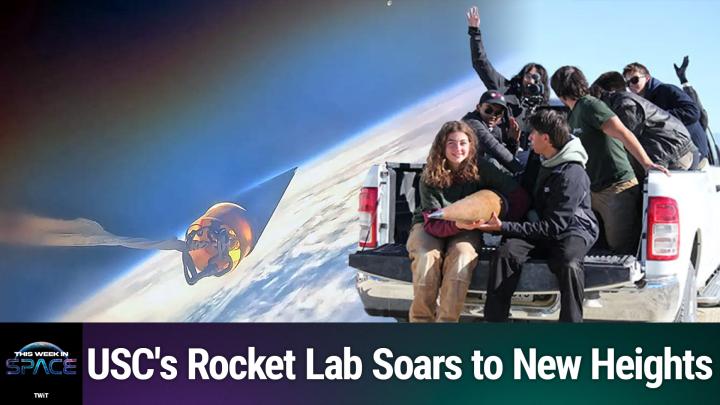
All TWiT.tv Shows (Audio)
This Week in Space 140: University Rocketeers
01:13:01
USC's Rocket Lab Smash the Amateur Altitude Record
Loading summary
Transcript268 lines
- [00:00]
Rod Pyle
On this episode of this Week in Space, we're fighting on with the University of Southern California's Rocket Laboratory team of students who just set a brand new record for an amateur high flying rocket out there in the Black Rock Desert. So tune in, lift off and we're going to get into it. It's better over here.
- [00:17]
T-Mobile Ad
ATT Customers Switching to T Mobile has never been easier. We'll pay off your existing phone and give you a new one free, all on America's largest 5G network. Visit t mobile.com carrierfreedom to switch today.
- [00:31]
Pay off up to 600 FE $50 via virtual prepaid MasterCard in 15 days. Free phone up to $830 via 24 monthly bill credits plus tax qualifying port and trade in service on Go 5G next and credit required. Contact us before canceling entire account to continue bill credits or credit stop and balance and required finance agreement is due this holiday season.
- [00:46]
Live Nation Ad
Surprise everyone on your list with the best gifts tickets to see their favorite artists live. Choose from thousands of concerts and comedy shows, including Mariah Carey, Mary J. Blige, Matt Matthews, Metallica, Thomas Rhett, Trans Siberian Orchestra, Sarah Silverman, and share a memory together or give a gift they'll never forget. Find the most exciting gift for every fan@livenation.com gifts that's livenation.com gifts Just a.
- [01:15]
Purina Ad
Few years ago, only 3% of domestic violence shelters accepted pets, meaning many abuse survivors had to choose between staying in a difficult situation for their pet or leaving their pet behind. One in three women and one in four men experience domestic abuse in their lifetime, and nearly half of survivors delay leaving because they can't bring their pets with them. Purina believes in the healing power of pets, particularly for survivors of abuse. They believe pets and people are better together, which is one of the many reasons they started the Purple Leash Project. Through the Purple Leash Project, Purina is helping break down one of the many barriers abuse survivors the lack of pet friendly domestic violence shelters. Purina has helped increase the amount of pet friendly shelters across the country from 3% to nearly 20% through the purple Leash Project. With more pet friendly domestic violence shelters, survivors and their pets can escape and heal together. Visit purina.compurple to get involved.
- [02:18]
Tarek Malik
Podcasts you.
- [02:19]
Live Nation Ad
Love from people you trust.
- [02:22]
Tarek Malik
This is tort. This is this Week in Space, episode number 140 recorded on December 13, 2024 the University Rocketeers hello and welcome to another episode of this Week in Space, the University Rocketeers Edition. I'm Rod Pyle, Editor in chief of AD Astra Magazine. And I'm joined, as always, by Tarek Malik, editor in chief@space.com and apparently for those of you not watching the video, because he will never let us forget USC graduate and he was in the band.
- [03:01]
Rod Pyle
Oh, my gosh. No, no, no. This is the. We're going to talk about why this is the USC episode forever. I'm very excited, very excited for today, Rod. Doing well, doing good. How are you?
- [03:12]
Tarek Malik
Oh, I'm fine. Today when we get to the good part, we'll be speaking with Dr. Dan Irwin and his student Ryan Kramer from the University of Southern California's undergraduate rocketry team, who recently broke an altitude record with an amateur rocket flight. And when I say broke, like by a lot, like 90,000ft and a 20.
- [03:34]
Rod Pyle
Year record at that, we should point out.
- [03:35]
Tarek Malik
So this is a rocket that's like giving off sonic booms at two seconds after launch and stuff. So this isn't your father's Estes model rocket. But before we start, don't forget to do us a solid. Make sure to, like, subscribe and other cop podcast things to let the world know that you love us and keep us here because we love you. All right now, amidst more space junk, our weekly high altitude record space joke from Richie O'Shea in Ireland.
- [04:05]
Rod Pyle
Richie, hello.
- [04:08]
Tarek Malik
If I could do an Irish accent, I'd try, but I'll spare you all. Hey, Tarek.
- [04:13]
Rod Pyle
Yes, Rod?
- [04:13]
Tarek Malik
What did Mars say to Saturn?
- [04:16]
Rod Pyle
I don't know. What did Mars say to Saturn?
- [04:18]
Tarek Malik
Why don't you give me a ring sometimes?
- [04:22]
Rod Pyle
I love it. I love it. Isn't Jupiter closer to Mars than Saturn? Oh, sorry.
- [04:30]
Tarek Malik
I don't want to deflate our own stuff. All right, now, I've heard some jokes want to stick some jokes. I've heard some folks want to stick their face into a burning rocket engine when it's time for a space joke on this show. But you can help by sending us your best, worst and most different space joke to Twist Twit TV. That's TwistWit TV. And now, wait a minute. I feel an audio cue coming. It's time for headlines, headline news. Thank you, princes. Whoever, whoever you're supposed to be. So this, this story warmed my heart. Ingenuity lives on.
- [05:14]
Rod Pyle
That's right.
- [05:14]
Tarek Malik
A Little helicopter did 78 flights, right?
- [05:18]
Rod Pyle
I think sounds about right.
- [05:19]
Tarek Malik
A lot.
- [05:20]
Rod Pyle
A lot of flights. A lot of.
- [05:21]
Tarek Malik
Yeah, I think it was 72. So our little low budget, 80 million dollar, which does a lot for a drone, but not much for a Mars first Mars aircraft that flew for a number of years and many, many times, and helped guide perseverance where we needed to go, and proved all kinds of new concepts for flying on another world and all that. Last year, made its last flight, landed hard, snapped off part of a rotor, but fortunately landed upright. And now we've come to understand that it May last another 20 years as a weather station and fixed camera, which is pretty cool.
- [05:59]
Rod Pyle
Yeah. Yeah.
- [05:59]
Dr. Dan Irwin
This.
- [05:59]
Rod Pyle
Actually, this story came from Space.com's own Brett Tingley.
- [06:04]
Tarek Malik
Hi, Brett.
- [06:05]
Rod Pyle
Hey, Brett. Yeah, but it was announced at. It was announced at AGU this week, American Geophysical Union meeting, where NASA basically had like a. Like a. What is it? Like, an accident analysis. They called it, like, the first accident crash on another planet. And they were talking about how they think that they figured out, like, what really went wrong and whatnot. But. And, you know, there is a story there. Basically, Mars looks too boring for the camera on ingenuity to be able to parse out different details, and it all looked the same, so it didn't have enough information to. To, you know, understand the texture of the surface and, you know, where it was and, you know, how it could land safely.
- [06:48]
Tarek Malik
They basically looked down and saw, like, a sheet of yellow construction paper and said, okay, yeah, like, is it.
- [06:54]
Rod Pyle
Is it really, really close or is it really, really far? Oh, it was really, really close.
- [06:58]
Tarek Malik
It's like jumping into a pool that you thought was seven feet deep from a diving board, and it turns out to be 8 inches and empty.
- [07:04]
Rod Pyle
Right?
- [07:05]
Tarek Malik
Yeah, that's true.
- [07:07]
Rod Pyle
But. But one of the really interesting things in Brett's story is, is not the fact that they know, you know, what. What happened to the. To the helicopter. You know, they had some. Some nice diagrams about how they think that it. Like how it landed hard, how it snapped the rotor, et cetera. But. But the fact that. Because as you mentioned, it landed upright, the solar arrays are actually on, like, they. They face up underneath the rotors or above the rotors. And so. So they. They are able to. To keep this little helicopter powered and use its camera as a weather station, essentially, they can know what the conditions are like at this spot. And according to Brett's story, it could last something like 20 years. Yeah. And if the dust conditions allow, which is crazy because, I mean, it's already been on Mars for over three years. And so the fact that it could last a lot longer than that, it's just like. Like amazing that they've got this tool. And this is. I mean, we talked about it before.
- [08:15]
T-Mobile Ad
It's.
- [08:15]
Rod Pyle
It's a mission that almost Never made it to Mars.
- [08:17]
Tarek Malik
Yeah, but this is jpl, so usually amazed, these are the guys that took a 90 day Rover mission and drove it for 14 and a half years.
- [08:27]
Rod Pyle
That's right. That's right.
- [08:29]
Tarek Malik
All right, this isn't a big story, but it, but it's a good one for today since it's happening tonight. Tomorrow the Geminids are here. So if you want to go freeze your little meteorites off, head out to the desert or somewhere dark. Although you don't have to worry about it being as dark as you usually would because the moon's going to be up. But apparently today's. This weekend's going to be a promising time for them.
- [08:51]
Rod Pyle
Yeah. This weekend is the peak of the Geminid meteor shower. That annual rain of space dust that comes from asteroid Phaethon. It's got the numbers in front of it. What is it, like 3200ft? Something like that? 3200 Faeton, 3200 Phaethon.
- [09:05]
Tarek Malik
Everybody knows that.
- [09:06]
Rod Pyle
I know. Right. So. And, and of course, as always, there's a caveat. So in order to see any kind of meteor shower, you have to be very far away from, from city lights. You don't want to be like on your suburban street with the street light out in front, like on my street. But you could see up to 120 meteors an hour. This normally from the Geminids, which is always really great. And the sad part is that those meters are actually still there. But the full moon peaks on Sunday.
- [09:34]
Tarek Malik
As we're full this weekend.
- [09:35]
Rod Pyle
It's going to be a full moon this weekend, so it will wash out a lot of the faint ones. But you could still see, you could still see some really bright ones. In fact, we were talking about Brett earlier. Brett said this morning that he saw like three or so overnight. Even with the full moon or the nearly full moon.
- [09:50]
Tarek Malik
Did he actually stay up to see them?
- [09:52]
Rod Pyle
Yeah, well, you just stay up at night and he's looking up at the sky and saw them.
- [09:55]
Tarek Malik
I mean, it really picks up after midnight because you're.
- [09:58]
Rod Pyle
Yeah, well, because after midnight the sky lets it all hang out. Right? Right.
- [10:03]
Tarek Malik
No, after midnight, the earth turns into its orbit and slams into a fast.
- [10:06]
Rod Pyle
Okay, so that's a song for every Rogers. Like skipped right over it?
- [10:10]
Tarek Malik
No, I just skip over it. My musical knowledge stops at 1939. That's my problem among many. One thing I wanted to add about the Geminids, because, you know, any meteor shower other than the sporadics that you just see on random nights is The Earth going through a part of its orbit where an asteroid or a comet has gone by and left this gravel bank basically that we slam into. This one I guess has some slightly unique characteristics or elements in the asteroid Phaeton because there's a lot of green and different colors in the larger fireballs. I remember once seeing a, basically a horizon to horizon bolide, which is a fireball, you know, come up over the east and set in the west. It was like watching a fast motion sun. Amazing. And it was bright green and it blew off fragments and stuff. I mean it was breathtaking. And that was a Geminids beast, probably the size of a basketball or something. So that was pretty cool.
- [11:11]
Rod Pyle
All right.
- [11:12]
Tarek Malik
I'm sorry, I'm.
- [11:13]
Rod Pyle
Well, no, no, it's good. The reason I think it's really good to point that out because there's always been like a back and forth of is faith on even an asteroid or is it a comet or is it something in between?
- [11:22]
Tarek Malik
Well, it said asteroid.
- [11:23]
Rod Pyle
Yeah, so. So now we know what's.
- [11:26]
Tarek Malik
But you know, as we found the last few years, a lot of asteroids aren't big rocks. They're big gravel that are just held together by mutual attraction. Sort of like you and me, Tarek, as they travel through space. Stuff can come off and that's what we slam into. All right. Oh gosh, another NASA update. So yeah, I don't mean to sound discouraged, but this is kind of like. So it's a humans to the Moon and Mars update because Moon to Mars is their mantra now, at least until. Till the new administration comes in where they might do something else. This feels kind of like a DRM light. So over the years we've seen. Let's see what I say. Since 1988, there's been 12 major studies, including Design Reference Mission or Design Reference Architectures, which are these big formal, expensive studies they do to say, okay, how are we going to get to Mars someday when we finally decide to go? They come, they go, they come, they go. Prior to 1988, there was probably another, I'm thinking six or seven since Ron Braun back in the 50s major studies. So if we just stack the paper, you know, going from these studies, we could just walk to Mars.
- [12:44]
Rod Pyle
I know, right?
- [12:45]
Tarek Malik
But we keep doing them. So here's another one. Although it didn't, it didn't appear to be. To be as major as a D as a formal drm, but it talked about using nuclear reactors for power on the moon and Mars, which you assume they would. There was a bunch of other Stuff that I thought I wrote down here, but I didn't.
- [13:05]
Rod Pyle
Oh yeah. Well, we should point this out.
- [13:06]
Tarek Malik
Cargo, landers, habitats and so forth. Yeah, sorry.
- [13:10]
Rod Pyle
Yeah. So this, this comes straight from NASA, everybody. And this is their, their, their big moon to Mars architectural review. So it's a 2024 update to their big architecture about how we're going to get to the moon, how we're going to get to Mars in 20 someday or whatever, you know, oh my gosh, it's like been forever. And to do that, they have these 12 new white papers that touch on very specific either needs or capabilities or something that they think is either lacking now or needs to be improved. And that, that covers everything. We've got lunar surface cargo, we've got lunar quote unquote mobility, drivers and needs. So that's like we need things to truck cargo and people around on the moon. You have Mars crew complement considerations. What do you need to actually have a crew safe to go to Mars? And then surface power needs. And I think part of that is nuclear fission. You know, they're talking about nuclear systems and power plants. I mean, everything that you would think of, you would need. There's like a white paper for these things, you know, ascent propellant, you know, what do you need to get off the planet? Because getting there is, you know, half the battle. So they're touching on like everything. And I think the frustrating part that I'm picking up from you, Rod, and please correct me if I am wrong.
- [14:25]
Tarek Malik
The frustrating part you're picking up is I turned into an old man waiting for artists to go back to the.
- [14:30]
Rod Pyle
That's what I was going to say.
- [14:31]
Tarek Malik
That's what's frustrating is that it's, it's.
- [14:34]
Rod Pyle
It'S, it's, it's just a lot of. It's, it's more iteration and more fine tuning for a program that's, that seems to just really be spinning and spinning and not really getting off the ground. And I think that's really going to be a challenge that we see not just NASA but the United States face as we come up to on a new administration with a new NASA administrator. They're going to inherit this architecture and then there's going to be more changes or tweaks as they refine different priorities once that administration gets underway. So we will, I mean, it's good that they have this update now so that they've got the, I guess the basis of all the considerations that need to be done when they start to make those changes then. But how much this is really going to reflect what actually happens in the next, say, 10 years to get people back to the moon, or 20 to get people to Mars. I think it's still uncertain because that new administration, that new NASA chief, that new agency is going to put its stamp on this, this outline, if you will, in this architecture.
- [15:40]
Tarek Malik
Okay, so I'm going to write Jared Isaac a letter after I get off the show. I'm going to say, jared, you know, I'm 30 years older than you or something. I think he was born 84. And so I'm old enough to have seen the space race. I'm old enough to have seen a time, admittedly with more money and resources, but with much more primitive technology that we started from zero and got to the moon in eight years.
- [16:07]
Rod Pyle
Three different crewed spacecraft, dude.
- [16:09]
Tarek Malik
Don't forget now, this program that we're currently undertaking started in one form or another in 2000. 2004.
- [16:18]
Rod Pyle
2004, that's right.
- [16:20]
Tarek Malik
Constellation.
- [16:21]
Rod Pyle
Constellation.
- [16:22]
Tarek Malik
So it's been 20 years, following years with lots of money, with much more advanced computer modeling and engineering techniques and metallurgy and all that, and not very smartly, in my opinion. Using legacy hardware from the shuttle that's incredibly expensive to update and maintain and so forth, instead of buying engines from Blue Origin or SpaceX, but whatever, they weren't ready at the time. What is the holdup?
- [16:50]
Rod Pyle
I don't know, man.
- [16:50]
Tarek Malik
And let me just say one more thing, if I can. Mobile launch structure. $325 million. And now it's, I think, extended out that it's going to be 2.2 billion.
- [17:03]
Rod Pyle
Yeah. This is the carrier for SLS's exploration upper stage.
- [17:11]
Tarek Malik
It's just unfathomable, which is why, and.
- [17:14]
Rod Pyle
We'Ve talked in the past, are they going to cancel SLS anyway or not? Then they've built all this stuff for what? For what? So I don't know.
- [17:21]
Tarek Malik
It's really like Captain Kirk from Trouble With Tribbles there.
- [17:25]
Ryan Kramer
What?
- [17:26]
Tarek Malik
What?
- [17:27]
Rod Pyle
What?
- [17:27]
Tarek Malik
Storage cabinets. Storage cabinets.
- [17:29]
Rod Pyle
Why we're out here. Right. So.
- [17:31]
Tarek Malik
All right, so I have one more item here, which is a question from beloved listener Darren Cusano. Dear Tarek, what is up with the Jersey drones? And from what I saw, we don't have any real answers. One expert thinks they're military swarms, although the military has said, not us. And the main thing the Feds are saying, don't shoot at them because they're big and they may crash. Now, I've looked at the videos, I've seen the reports. There's a lot of people saying, oh, it's the size of a, of a school bus, you know, suv.
- [18:06]
Rod Pyle
Yep, yep.
- [18:07]
Tarek Malik
And it's like one thing that came up during UFO hearings starting in the 60s was even if you talk to military aviators, especially if you talk to military aviators, it's really hard to guess the size of an aircraft because you have very few. It's like same thing I experienced up in the Arctic when it was just sand and rocks and sky. You have no real points of reference. You don't know how big that rock is over there. And if you're looking at a clear horizon, say over the ocean, you don't have any idea how big that thing is because you don't know how far it is. So your brain is. You don't realize it until you've gone somewhere like that Arctic base. But your brain looks for comparative objects and guesses based primarily on haze, like how hazy and how soft and how faded out it is. And we don't have any haze or road signs or street lamps or anything. As I did, your, you know, 80 foot rock suddenly becomes 12ft high because it's a lot closer than you think. So, you know, I don't think I trust the size estimates on these things, but they do appear to be flying in formation. They have marker lights, which if they were, you know, Chinese spy craft or something, you probably wouldn't have marker lights on. And these days you could do that with something the size of a bumblebee. So why the heck are these things the size of maybe of Chevettes?
- [19:26]
Rod Pyle
Yeah, I've heard SUVs is what I've seen. So case in point, I live near us like, like New York City. I was going to say usc. I got us. So, so, you know, I'm in New Jersey, but just outside of New York, so I'm in northern New Jersey. And a lot of the sightings are all like in the New Jersey and like the coast. So maybe it's a different kind of place down there. I don't know. I haven't seen any of these drones personally myself, and I'm sure there's a mundane explanation for them. In fact, I think I, I mentioned this to them too because I, you know, to me it seems like it would either be something that's either military or maybe there's like some super secret film being filmed out there, you know, and they're trying to keep it on the DL. I don't know, I don't know.
- [20:11]
Tarek Malik
But it is just being reported in Oregon. And San Diego, I think.
- [20:16]
Rod Pyle
Well, that is so weird. I don't know. I don't see, like, what's stopping the government from, like, especially when they fly over these military bases to just go up and catch one, do an intercept. I'm sure they can just get up there with another drone that has a net on it and catch it. Right? I mean, it's like the pigeon. Well, I mean, no, you got to.
- [20:32]
Tarek Malik
Make sure it's not over somebody's house or a business or something, so. But I fully plan to go down to the boat on Sunday and spend a couple of very cold evenings out there because, you know, Long Beach Harbor.
- [20:43]
Rod Pyle
Cold in Long beach, right? It's like 27 degrees outside right now, Rob.
- [20:48]
Tarek Malik
Well, that's because you live in the wrong part of the country. Okay, chilly, but I've got 100, almost 180 degrees of visibility. You know, it's, it's, as you know, it's, it's lit pretty brightly at night, but if there's something flying around, I should be able to see it because I'm dying to see one of these things because they do appear to be quite big. And they're large.
- [21:06]
Rod Pyle
They're large. Are they in charge? I guess we're going to find out. So. Right.
- [21:10]
Tarek Malik
Large and in charge. Talk about ourselves. So I have a great kind of a work through the question and explanation thing, but I'm going to save it for next week so that I can bore Anthony and everybody else on our special episode. Ooh, nice cocked eyebrow from him. All right, let's go to a quick break and we'll be back with Daniel and Ryan in just a few minutes to talk about big amateur rockets from usc. From usc. Yeah, says the guy who flunked calculus and was in the band. Okay, stand by.
- [21:48]
Rod Pyle
We'll be right back.
- [21:53]
T-Mobile Ad
After investing billions to light up our network, T mobile is America's largest 5G network. Plus right now you can switch. Keep your phone and we'll pay it off up to $800. See how you can save on every plan versus Verizon and AT&T. @t mobile.com KeepAndSwitch up to four lines.
- [22:12]
Via virtual prepaid card. Allow 15 days qualifying unlocked device, credit service ported 90 plus days with device and eligible carrier and timely redemption required. Card has no cash access and expires in six months.
- [22:22]
Purina Ad
Just a few years ago, only 3% of domestic violence shelters accepted pets, meaning many abuse survivors had to choose between staying in a difficult situation for their pet or leaving their pet behind. One in Three women and one in four men experience domestic abuse in their lifetime. And nearly half of survivors delay leaving because they can't bring their pets with them. Purina believes in the healing power of pets, particularly for survivors of abuse. They believe pets and people are better together, which is one of the many reasons they started the Purple Leash Project. Through the Purple Leash Project, Purina is helping break down one of the many barriers abuse survivors face. The lack of pet friendly domestic violence shelters. Purina has helped increase the amount of pet friendly shelters across the country from 3% to nearly 20% through the purple Leash Project. With more pet friendly domestic violence shelters, survivors and their pets can escape and heal together. Visit Purina.compurple to get involved.
- [23:23]
Tarek Malik
We are back with Dr. Daniel Irwin and Ryan Kramer of the University of Southern California. That other school in Southern California.
- [23:33]
Rod Pyle
Just fight on USC. Woo.
- [23:35]
Tarek Malik
I'm outnumbered here. Yeah. So now Dr. Irwin is a professor of astronautics and aerospace mechanical engineering at USC at the Bitterby School of Engineering. And Ryan is an undergraduate student, which is interesting because you don't find a lot of undergraduates reading leading things like the USC Rocket Propulsion Lab. You know, usually that gets saved for the. For the grad students slaves. So it's pretty cool that as an undergrad you get to do that. And I know the second I release Tarek, who's wearing his USC shirt today, and it's going to make a bunch of noise about being in the band and all the other.
- [24:10]
Rod Pyle
Also my Hawaiian shirt too. It says usc.
- [24:12]
Tarek Malik
Yeah, yeah. All the other things that he and I did that did not get us into being in the technical end of space. Tell me a little bit about how this got started, if you would.
- [24:25]
Ryan Kramer
Well, if you want to talk about the club's founding, Dr. Irwin can definitely tell you about that.
- [24:30]
Tarek Malik
Okay, that'd be good.
- [24:32]
Dr. Dan Irwin
Okay. Well, the whole thing started when a young student, a freshman, his name is Ian Whittinghill, came into my office in fall of 2004. And he told me that he had spent his youth in a kind of an aerospace family and he launched a lot of rockets with his dad. And he'd kind of done everything he could do just as a. Basically by himself and in his family. And his goal was to start a rocket group out of college. And since he was there at usc, he wanted to start a rocket lab at usc. And as it happens, I had an open. We had just remodeled and redone our research lab, and I had an open side. And so I thought, okay, let's do this. And so the following spring in 2005, we actually put out a call for some students. I got a little bit of funding from the School of Engineering. We bought some stuff, we used some things I had sitting around and we got started. And Ian's initial prediction was that they would get to space in about a year and a half, but it was off by a factor of 10. It took actually till. Till 2019 to make it happen.
- [25:43]
Tarek Malik
Well, I feel bad. That sounds a lot like the Artemis program, so I think that's right. I just, I just have one quick follow up, which is I have described myself in the past as an amateur rocketeer to people, but my experience, other than, you know, the SDS toy rockets and all that many of us did as kids, maxed out with I think an F engine rocket, which I built in my 20s. And I didn't like kits, so I decided, well, I know better than the instructions how to design this thing. So I added some retaining tabs the top to hold the nose cone in, not realizing that one would fold back and cause it to fly in a ballistic arc onto the first baseline of a Little League game that was currently in play. The fathers there did not find the little charred crater I made at all amusing. And that was the end of my rocketry career. I assume you're doing something a little larger and more powerful than what I did.
- [26:34]
Dr. Dan Irwin
Just to give an idea, the current rockets have a thrust of around 1500 pounds. Ryan can correct me on the numbers, but you could use a couple of them to pick up a car if you wanted to. They're unbelievably loud.
- [26:51]
Ryan Kramer
Yeah, so you mentioned that you flew an F motor and the power rankings go on kind of an exponential scale. So each next letter, uh, it, it's like times two. Right. Uh, so we fly like the largest motor that we fly is an R motor. Um, and yeah, like Dr. Irwin said, that means like 50,000 pound force seconds. Oh, yeah, yeah, there it is. Um, and then the 1500 pounds force, that's like on our smaller scale stuff now, but yeah, £4,000 stuff like that, it can get. Obviously, if we were to send it ballistically like a missile, then it would be possibly more than a crater, which is why, you know, you gotta be safe playing around with these.
- [27:39]
Tarek Malik
Yeah, that would probably end the Little League game for sure. That's impressive rocket. So for those who are listening and not watching the video, on the video stream, we have a clip of their. How many 4000 pounds, you said for.
- [27:54]
Ryan Kramer
This one or 1500, it peaks a little under 4000. This one.
- [27:59]
Dr. Dan Irwin
You can read it on the thrust tab up top.
- [28:01]
Tarek Malik
Yeah. Oh, well, if I was an engineer, I'd know that. But it's called shockwave, I think, which is, which is whimsical and fitting. That's something Elon would probably like. And it's a solid rocket, right?
- [28:15]
Ryan Kramer
Yeah, all solids.
- [28:17]
Tarek Malik
Okay, Tarek, I'll shut up now because I know you're bursting at the seams.
- [28:20]
Rod Pyle
Well, I just want to ask my standard question that I always ask every guest on the show. And maybe Daniel, we could start with you first, but then, Ryan, please feel free to jump in. And that's basically what's your path to either space or to engineering, you know, doctor, whichever you'd like to start with. You know what got you there? Was it something that like grabbed you when you were a kid, or is it something that happened through an evolution of interests and academics? I'm just curious what that path was that led you to this moment where now you've got a history making rocket under your belt.
- [29:06]
Dr. Dan Irwin
I did draw astronauts and space stations when I was a kid, but I had relatives were largely doctors. And I just assumed as a kid I was going to be a medical doctor. But then I hit 9th grade biology and dissection and oh no, that's not for me. So meanwhile I was realizing that I, what I actually could do was math and science. So I, I did, I did applied physics as an undergrad and I majored in electrical engineering as a grad student. So still nothing to do with arrow and rockets. But then in, as a young professor, we were in a place where the Apollo generation was starting to retire and the industry, Hughes and trw, those kind of companies were around then. This is in the 90s. They told USC that we needed to amp up our space research and education and we started a whole astronautics group. So I started teaching rocket propulsion, which was a big change for me. And I still probably wouldn't have started a student group on my own. It really took the students like Ian. And then a year later, another guy came along, a guy named David Reese, who was really good at solid propellants. Ian was good at structures. And between the two of them, they got the whole thing started. And then we've been lucky. Every couple of years, a couple of really new students come along. I mean, really new, really good students come along and we've kept the thing going for, for now 20 years. We're gonna have our 20th anniversary celebration this coming February.
- [30:36]
Rod Pyle
Oh, that's exciting. Five years too late. Five years too late. So, Ryan, how about you? Was space always in your veins there? Or is it something that you found later when you got into college?
- [30:51]
Ryan Kramer
Honestly? Yeah, I've always been interested in engineering. The funny story I like to tell is, in kindergarten, they did this, like, career day, you know, where you can choose what you want to do, like, for college or whatever it was. And you could. There's, like, a bunch of different options, like, you know, art and painting and cooking and chemistry. And then. So I wanted to do cooking because you got a free cake out of it.
- [31:21]
Tarek Malik
How people make their career choices. I like it.
- [31:24]
Ryan Kramer
But then because I was a kindergartner and I couldn't read, I chose chemistry because it started with a C, and then I just got into STEM from there, and then I didn't really. I wasn't interested in space much specifically. I thought engineering was cool. When I actually got to usc, I was still thinking I might do electric vehicles or something like that. We have a good electric racing team here. But then I found the Rock Propulsion Lab, and it was kind of sold from there. You know, this club is super cool, and I can't imagine myself doing anything else now.
- [32:03]
Tarek Malik
Okay, Tarek, do we want to spend any more time whining about where were these opportunities when we were that age, or shall we just move?
- [32:10]
Rod Pyle
Well, I wanted to say that Daniel had the reverse experience that we had. Right? I know, right? Whereas you and I hit that differential equation wall and that ended our. Our engineering or science careers.
- [32:22]
Tarek Malik
He sailed through it.
- [32:23]
Rod Pyle
Right, right. But. But biology was.
- [32:25]
Tarek Malik
Was.
- [32:25]
Rod Pyle
Was his Achilles heel. I was going to point out that, Ryan, we're all in good company because, as we know, not only is USC home to Dr. Dan, you know, here, and yourself, Ryan. And of course, it was, you know, me and the marching band. It was amazing.
- [32:41]
Tarek Malik
But also always got to work the marching band in there somehow.
- [32:44]
Rod Pyle
Neil. Neil. I was. I played trumpet in the band, everybody, so it was a lot.
- [32:48]
Ryan Kramer
Oh, I played trumpet, too.
- [32:49]
Rod Pyle
All right.
- [32:50]
Ryan Kramer
See, not in the band.
- [32:51]
Rod Pyle
I'm liking this, guys.
- [32:52]
Tarek Malik
Get a room.
- [32:53]
Dr. Dan Irwin
We've had a whole bunch of students in the band.
- [32:56]
Rod Pyle
That is great. That is great to know. But of course, of course. Neil Armstrong, graduate of USC School of Engineering, too. So it's a big plaque for him and everything. It's great. It's great. You're welcome. You're welcome, America, for your moon lander. Right? Usc. All right. Okay.
- [33:13]
Tarek Malik
I don't think he designed them. That's fine. So let's jump right in. Now that Tar had his way with all of us. Aftershock 2 is the name of the rocket, correct?
- [33:24]
Ryan Kramer
Yeah.
- [33:25]
Tarek Malik
So if you, I'm sure that you know, you iterated up to this point. If you could just tell us about this particular rocket and I don't mean to oversimplify this but really since we're kind of starting at ground zero. Chuckle chuckle. What differentiates this from say what I'd see from, you know, a mid level hobbyist out at Blackrock, the Blackrock range or something?
- [33:48]
Ryan Kramer
Yeah, so you know, that's a good point as well. We launch out of the Blackrock desert similar to, if you're familiar with the balls competition or I guess it's not necessarily a competition as much as an event where you know, a lot of hobbyists get together and launch their high performance experimental rockets. We launch out of there because it's high performing. But I would say what kind of differentiates us from those? Is that the way probably that I see the club has developed its rocket over time is you know we, we started you know, 20 years ago basically like Dr. When mentioned with hobby rocketry experience. But since then we have kind of been developing on the side our own design over those 20 years and each year we make it, you know, slightly better and better. Some years we make it worse and then it blows up and then we make it better. So I would say one of the big things is just the continuity of those 20 years and basically optimizing one continuous design. Not perfectly continuous, but then also of course as a team you can get a bit more funding than somebody on their own could do. And it, it's great to work as a team because you can kind of accomplish more, spread yourself thinner because there's more people to handle all this stuff.
- [35:11]
Tarek Malik
Well, you sound like you're primed for SpaceX but we're going to talk about that later. In fact, before we talk about that we're going to go to a break from one of our beloved sponsors and we will be right back. So hang tight.
- [35:23]
Rod Pyle
It's better over here.
- [35:25]
T-Mobile Ad
AT&T customers switching to T Mobile has never been easier. Easier. We'll pay off your existing phone and give you a new one free. All on America's largest 5G network. Visit t mobile.com carrierfreedom to switch today.
- [35:39]
Pay off up to $650 via virtual prepaid MasterCard in 15 days. Free phone up to $830 via 24 monthly bill credits plus tax. Qualifying port and trade in service on Go 5G next and credit required. Contact us before canceling entire Account to continue bill credits or credit stop and balance and required finance agreement is due this holiday season.
- [35:55]
Live Nation Ad
Surprise everyone on your list with the best gifts. Tickets to see their favorite artists live. Choose from of concerts and comedy shows including Mariah Carey, Mary J. Blige, Matt Matthews, Metallica, Thomas Rhett, Trans Siberian Orchestra, Sarah Silverman, and so many more. Share a memory together or give a gift they'll never forget. Find the most exciting gift for every fan@livenation.com gifts. That's livenation.com gifts.
- [36:24]
Rod Pyle
So, you know, and I'm not sure if we mentioned that BlackRock is in Nevada, but I mean, you have launched right out of the like the Mojave as well, or at least the program has. Correct. In the past. Back in 2019, there was like a big launch there with Traveler 4 too. So I'm really curious, by the way, Traveler is the name of the mascot, the horse that rides out during the games. And so I'm curious, compared to that launch, what were the big advancements that you and the team were trying to make or that you did make? Right, for Aftershock 2 to kind of hit the targets that you were able to. I'm not sure if we talked about how high everything went. We didn't rod. Right. So maybe, Ryan, that's a good place to start. Let's. You're here to talk about this record launch. What happened, right? What happened with Aftershock 2? Walk us through it.
- [37:23]
Ryan Kramer
Kind of like Dr. Wen mentioned is it took them 15 years after the club was founded to launch Traveler 4. And the goal with that was like so far in 2004, actually, I don't know if maybe Ian was inspired by the Go Fast launch, but in 2004, a group of amateur hobbyists, they were adults, kind of all in their careers already, they got together and launched a rocket called go fast to 380,000ft. Space, like the boundary of space. The Karman line is like, like around 330,000ft. So, yeah, it took our club 15 years to do that. And they launched to basically 340,000ft with Traveler 4. That was actually out of Spaceport America in New Mexico. We launch all of these videos that you're showing right now, like our smaller vehicles. Those are the ones that launch out of Mojave. Got it. And then we get the bigger rockets in more. More remote locations, basically. But yeah, then after Traveler 4, you know, the pandemic struck pretty soon after, and we wanted to go back as soon as we could. But then, you know, because the club relies on transfer of knowledge. We just needed to make sure because you know, people are graduating. That's one of the main challenges with the club is people are graduating. We wanted to do something bigger and better, but it just took us a bit of, you know, honing our skills, passing on the knowledge. All those people who had been there for the time of travel before taught us everything they know. And then it took us like another five years but we got there and it was like, so I mentioned go fast was 380,000ft and Aftershock 2 went to 470,000ft. And that's like the. Those are the only three rockets by amateurs that have made it to space. So we think we crushed the record pretty well. So, well almost that we don't know if we should attempt to beat it because it might go over the legal limit.
- [39:25]
Tarek Malik
And they're beating Virgin Galactic and I think Blue Origin, so that's pretty impressive. Those guys have a little more money. So. Dr. Irwin, I have a question. Oh, and I want to mention, you know, it's comforting. I was watching the video yesterday, it was comforting to see that from your little inside camera that the nose cone came off to release a parachute just like my rocket did before it slammed into those kids playing Little League who just stood there with a shocked look on their faces. Anyway, I'm sorry, getting carried away. It's unusual for a lab like this or program like this to be run and staffed by undergrads, isn't it? This sounds kind of, kind of groundbreaking.
- [40:07]
Dr. Dan Irwin
Well, here's the thing. It's undergrads who have time and motivation to do things that are kind of for glory or for their own purposes as opposed to grad students who are busy working for a typically a PhD thesis. And so grad students have a lot less spare time. Now undergrads, you have to realize that when they graduate and they go out into industry, the industry people interview them and you can't really tell from somebody's grades how good they're going to be. What you really want to see is what they've actually done. So students who have worked on hands on student projects like Rocket Lab, there's a whole bunch more by the way in the school of Engineering. But the Rocket Lab is perhaps the most famous now. But students who have worked in Rocket Lab and can show what they've done have kind of a golden ticket into industry. The experience is very, very valuable. And there are a lot of student groups that are designed around national competitions. So USC has for example, and the Aero Design Team that flies aircraft for a national competition run by the Aeronautics and Astronautics association, aiaa. But RPL is unusual in that there's no specific competition. They were founded with the goal of being the first student group to get to space, and that they pursued the goal single mindedly all these years. So it isn't actually unusual like you think. In fact, it would be more unusual if this were a grad student organization.
- [41:42]
Tarek Malik
Let's do.
- [41:44]
Rod Pyle
You know, I'm curious where Aftershock 2 lines up in the programs, like achievements. You know, you mentioned that you, you passed the Carmel and you kind of shattered it. I think you hit like 90 miles, which is crazy, right? So that's actually higher than Blue Origin too, now that we think about it. Right. So, yeah, and, and, and I think it's, it's what, it's about 13ft tall, 330 pounds. And then you, you were able to reach like what, 3,600 miles an hour or so. Just, just over that. Yeah. Where, where does that line up, you know, in, in, in the vehicle evolution? I mean, you know, is, is, did the rocket just get bigger and bigger and that's what lets you get higher and faster? Is it lighter? Is it smarter? How, like, where does it line up for the evolution there?
- [42:32]
Ryan Kramer
Yeah, so if you look actually at Traveler 4 and Aftershock 2, you know, our two kind of biggest, most successful rockets, they have the exact same outer dimensions. Meanwhile, Aftershock 2 went like 1.4 times higher than Traveler 4. And there's like, you know, there's a lot of things. It looks basically the same on the outside, but everything on the inside is essentially what allows it to go higher and some, you know, more thermal stuff on the outside. But you know, we, it's actually used a completely new propellant that we formulated, our club formulated. And you know, we cast that propellant it uses kind of. We, we kind of squeezed together all the rest of the systems so that we could fit more propellant in there. And then we, you know, made everything lighter that we could. And yeah, it's just, it's, we actually didn't work entirely by making the rocket bigger. It was mostly by optimizing things because we actually have like a kind of limit on how big we can make things just based on the infrastructure we have in our lab space. And actually in the future, we're considering making our rockets smaller but still achieving the same height. So we'll see how that goes.
- [43:50]
Tarek Malik
So one of the problems I had in my brief and unimpressive career as an amateur rocketeer, like many, because there were no electronics involved at the time, because I'm old, was tracking the thing downrange. The pair goes up, you lose sight of it, parachute pops, you kind of might track it for a second, then it disappears. And because I was doing this in Southern California, down Orange county, it was critical to find it quickly because they tended to start fires. And of course we were always launching in the summer and push. And that did happen a couple of times while we put it out. I assume you had some kind of radio tracker on this so you could go track it down.
- [44:28]
Ryan Kramer
Yeah, we have a lot of different tracking systems. The, the main ones that like were successful on this flight were GPS based, so they, you know, they talk to the satellites wherever they are on Earth. Of course, GPS actually locks out if you're going so fast and so high because the government doesn't want people using GPS for missiles or anything like that. So we're only able to get a GPS data low to the ground, which is important because, you know, that's where you want to find the rocket. And yeah, it talks to the satellites and then radios us back that information as well. So the satellites tell us and then the radios tell us. We have a system that tries to trilaterate the rocket. You know, basically from the launch point, we send a few groups of people out a few miles away, each in different directions so they can point radios, point antennas at the rocket. And based on, you know, the time that it takes for the signal to go to the rocket and come back, you can tell how much distance the radio signal traveled and that way you can get a position on the rocket. It didn't work on this flight, unfortunately, but it's worked before. And where. That's like one of the cooler things we're hoping to get working in the future for sure.
- [45:45]
Tarek Malik
So you talk science. I was going to say when you know how to do math and you have like computers more advanced than those crummy calculators we had, they can triangulate things.
- [45:55]
Rod Pyle
I was gonna say when I launched my Estes rockets. That's like the funnest part is just to go run after it. Most fun. I shouldn't say funnest. That's not a word to go run after it and try to catch it out of the air. But I guess something that's £330, you wouldn't want to be underneath that when it came back to Earth. Um, you know, Dan, I'm curious. This launch of this record setting launch was on October 20 and October is like the start of the school year and that's when people are, are just like getting their, their feedback for academics and whatnot. And I'm curious how the program and like the students that you oversee adapt to that schedule. I mean, is this something that's just always going on in the background that you have students that you're overseeing like throughout the summer and the year or is there like a really specific time where you have to get them into gear and with like Ryan and the rest of the members to go out, to go out to Nevada and BlackRock too to have everything ready. I mean, I'm curious how you kind of wrangle those cats to get to space when, when, when they have finals and everything else to worry about.
- [47:02]
Dr. Dan Irwin
You're, you're acting as though I'm in charge of the students. Actually the students are very self motivated. They, they pretty much schedule their own, their own trips. But by the way, October is not the start of the school year for us. That's more of a UCLA thing because we start in August. So, so by October we're well where some of the students are taking midterms by that time. So we don't do much over the summer. By the way, the summer is kind of a downtime for the Rocket lab because the students are all off doing their summer internships. So the, the lab tends to be fairly empty. But fall and spring semesters are when, when everything really happens. One year they, they were a little late in their, in their launch work and, and they, they actually did a launch during finals week that was a really.
- [47:44]
Rod Pyle
Oh my gosh.
- [47:45]
Dr. Dan Irwin
That worked out very badly and we made a rule that that could never happen again. But in general when students are going to go out and by the way, this is a big group. I think Ryan, correct me if I'm wrong, but I think about 150 students attended this launch.
- [47:58]
Tarek Malik
Wow.
- [47:59]
Ryan Kramer
Yeah. 130 came out here this time.
- [48:01]
Dr. Dan Irwin
Oh, I had a little. Okay, I was a little overestimated, but still a pretty big group and they have to miss class because it isn't just a one day trip. It's a long drive. Plus they camp, they set up, it's a multi day trip. The launch is actually on a, over the weekend but they, the earliest people leave in the early part of the week so they miss a bunch of classes and in some cases they had to miss midterms. So part of my job is to, is to write to their professors and say this is a USC thing. It's considered very important by the School of Engineering. Would you please do the extra work that it takes to give these students makeups or do something to accommodate their missing the work. And the other professors are universally very nice about it because it is extra work and they gladly do it because they've. I don't know how it is for other clubs, but Rocket Lab gets really good press and I think all across the university people have heard of it. So the students get a lot of leeway.
- [49:02]
Tarek Malik
Well, didn't. Good lord. His name is Casey in the moment. The guy that started Relativity Space came out of your program as well.
- [49:08]
Rod Pyle
Tim Ellis.
- [49:10]
Dr. Dan Irwin
There were two, and they were both from Rocket Lab. One's Jordan Noon and the other was Tim Ellis.
- [49:15]
Tarek Malik
Okay.
- [49:17]
Dr. Dan Irwin
Wow.
- [49:17]
Tarek Malik
That's a. That's a respectable. That's a respectable crew there. All right, we're gonna go to another break and we'll be right back. So hold your launch until we return.
- [49:27]
Rod Pyle
It's better over here.
- [49:29]
T-Mobile Ad
AT&T customers, switching to T Mobile has never been easier. We'll pay off your existing phone and give you a new one free. All on America's largest 5G network. Visit t mobile.com carrier freedom to switch today.
- [49:43]
Pay off up to $650 via virtual prepaid MasterCard in 15 days. Free phone up to $830 via 24 monthly bill credits plus tax. Qualifying port in trade in service on Go 5G next and credit required. Contact us before canceling entire account to continue bill credits or credit stop and balance and required finance agreement is due.
- [49:57]
Purina Ad
Just a few years ago, only 3% of domestic violence shelters accepted pets, meaning many abuse survivors had to choose between staying in a difficult situation for their pet or leaving their pet behind. One in three women and one in four men experience domestic abuse in their lifetime. And nearly half of survivors delay leaving because they can't bring their pets with them. Purina believes in the healing power of pets, particularly for survivors of abuse. They believe pets and people are better together, which is one of the many reasons they started the Purple Leash Project. Through the Purple Leash Project, Purina is helping break down one of the many barriers abuse survivors face. The lack of pet friendly domestic violence shelters. Purina has helped increase the amount of pet friendly shelters across the country from 3% to nearly 20% through the purple Leash Project. With more pet friendly domestic violence shelters, survivors and their pets can escape and heal together. Visit purina.compurple to get involved so the.
- [50:59]
Tarek Malik
Other major I don't know if you want to use the term amateur because you guys are semi professional In a way, but non professional rocketry guy that we've had on this show is Steve Jurvetson who is a big investor in SpaceX and many other things, Tesla and so forth. And his idea of going out and flying a hobby rocket, as least as he described it to me, was yeah, I get my first stages by buying surplus cruise missile booster stages which I thought was interesting. I don't think it's as powerful as what you're doing, but you know, it's kind of scary when you hear it that way. So what kind of licensure do you need? Clearances, monitoring? Is that tough? I mean we know, you know the pains that Elon has described with the faa. I assume yours is less stringent, but still you're going high. A lot of airplanes can be up there.
- [51:51]
Dr. Dan Irwin
Okay.
- [51:52]
Ryan Kramer
Yeah, exactly. We, we, the license, the main license that we need is the faa. They give a certificate of authorization, you know, for, for you to fly however high you say you're going to fly. They, you know, they do give, we give them details on the rocket, on where we predict it's going to land, how high it's going to go. And yeah, they, they have to approve it. We have to send them all the, all of our like data and stuff like that. And then the other group we have to work with is really just the Bureau of Land Management who owns the Blackrock or who like, you know, oversees the Blackrock Desert. So we need a land permit from them and we need a flight permit from the faa. And then once we have the flight permit from the faa, then we go and talk to air traffic control and we're like, hey, I'm going to be launching on this day. Can you set up a no fly zone around our launch site so that you know, no planes come in. But then as it turns out people ignored the no fly zone a lot of the time. So then we have to wait until the airplanes are out of our space before flying.
- [53:01]
Rod Pyle
Not even the students are safe from.
- [53:03]
Tarek Malik
You wouldn't want to hit one of those Jersey drones. I know now showing up over some of the California and Oregon.
- [53:10]
Rod Pyle
We don't know what's causing them.
- [53:11]
Tarek Malik
Oh, aliens. Stop, stop.
- [53:15]
Dr. Dan Irwin
Can I, can I jump in here? I want to say something about, I want to say something about Jordan Noon who was the head of rocket lab at the time they did the first space shot. So in addition to doing the engineering lead stuff and there was a lot of stuff that only Jordan could do, reprogramming stuff over a weekend and anyway, but one of the things that he actually did was because it was the first space shot, he actually had to get the bureaucratic infrastructure going. He was the guy who talked to the bureau of land Management and talked to the faa, and this was a new thing for them because student groups don't normally get permits to go to space. So he had to figure all that stuff out. But ever since that time, the students have made sure to kind of keep up the politics. And when new students graduate or the FAA guy retires and the new one comes along, they make sure to renew the relationship and send along a case of whiskey or whatever it might be to keep the relationship up, which is not bribery.
- [54:16]
Tarek Malik
It's simply encouragement.
- [54:17]
Rod Pyle
No, it's not working.
- [54:18]
Dr. Dan Irwin
I'm joking.
- [54:22]
Rod Pyle
I have to ask, both as a supervisor, as a teacher, Dan, and as a student about the dangers involved in this kind of rocketry. I was stunned just in finding out that hobbyists like folks like the Joe Barnards and whatnot on YouTube are making solid propellant in their garages and those types of things. Boom. And it seems to me that when you're actually talking about rocket science with these students and making their own propellants, that there's some inherent dangers that you have to, you know, set up safety guidelines for and appropriate safeguards. And, you know, what are, like, the dangers involved? Or is it as easy as ordering a fuel from the Internet? But now, Ryan, you mentioned that you came up with a new mixture. So I'm just curious. How dangerous is it to put this stuff together and then. And then make sure that no one, you know, makes a mistake? A pretty costly one.
- [55:33]
Dr. Dan Irwin
Okay, first of all, the. The solid propellant itself is. Is not just stuff you can casually mix in your kitchen. One of the key elements, for example, is powdered aluminum. You don't think of aluminum as something that burns, but that's because it's big and doesn't have much surface area. When you grind it up into a tiny powder, tens of microns, then it has so much surface area, it's actually an explosive. And you can't just buy it without a permit from Bureau from alcohol, Tobacco, and Firearms.
- [56:03]
Tarek Malik
Powdered aluminum.
- [56:04]
Dr. Dan Irwin
Powdered aluminum. Yeah. So powered aluminum is the stuff that actually burns in the rocket propellant. And then to go along with that, you need an oxidizer. And the kind of oxidizer that's needed is kind of like, what. What. What was the guy's name? Timothy McVeigh, who blew up the building in Oklahoma City?
- [56:26]
Tarek Malik
Yeah.
- [56:27]
Dr. Dan Irwin
He filled his Penske truck with. With Our rider truck, I forget, with a whole bunch of fertilizer. It's basically the same stuff. So. So basically, you mix powdered aluminum, an oxidizer, and something to hold it together, a binder, and that makes something kind of liquid, kind of doughy like. And it has to be mixed and cast, and then it becomes solid. And this cannot be done. Well, okay. It can be done by yourself in your kitchen, but it's very dangerous. In fact, the rocket lab students do it under professional supervision at a. At a company that does this for a living. The company's called X Quadrum. There's a lot of driving involved because they're way out in Victorville. So the students have to put a ton of miles on their cars going out there.
- [57:08]
Ryan Kramer
And even though we. We do it under, like, supervision, a lot of people always try to nitpick us and be like, well, okay, you're just buying the motor then, right? But it is still like our formula, and it's supervised. But all of our students, we send out about a dozen students, and they're the ones actually doing the mixing. It's mostly a safety thing that we, you know, we go out there and we just want to be, you know, safe and professional about it while still getting the learning experience. So that's like that. Yeah, that's what we do. And it, like Dan Erwin said, it involves a lot of driving.
- [57:41]
Rod Pyle
Is it like a certification that you need then? Like, do you have to be rated to be able to handle that stuff? Or is it the supervision is what lets you. What lets you proceed? Because everyone knows what the safety requirements are or the protocols are.
- [57:59]
Dr. Dan Irwin
Well, the supervision has to be done by a licensed pyrotechnic operator. And that's part of what the professional company provides, as well as the appropriate equipment for making sure that if anything goes wrong, any fires or explosions can be contained. By the way, the solid motor, once it's completed, the solid itself is not that dangerous. You can take a piece of it in your hand, you can light it with a lighter. It just kind of sparkles a little bit. But on the other hand, if it gets hot and under the presence of high pressure atmosphere, then it burns very rapidly. That's a whole different story.
- [58:37]
Tarek Malik
That's kind of like the weird thing about plastic explosives, the C4, that you can actually mold it, eat it, light it on fire, use it to cook your dinner. Just don't put a plastic cap in it. You know, Tarek, it's funny. I'm having trouble visualizing this from everything you've told me about your time at usc. I have this picture of students in their Maybachs and Bugattis and Aston Martins driving out to Victorville to pick up the rocket. Is it still like that or have we kind of rounded the curve into more, more normal?
- [59:06]
Rod Pyle
What? Is it still the University of spoiled children? Is that what you're asking? Right, I say that. I'm just saying. I'm just, I'm getting that vibe. I'm getting that vibe. I don't know. I think Ryan and Dan are probably better. You know, I was at USC back in what. When did we go to the, the conference? Was that last year?
- [59:21]
Tarek Malik
10.
- [59:22]
Rod Pyle
Right? The, the, the.
- [59:23]
Dr. Dan Irwin
We.
- [59:24]
Rod Pyle
We were back there. I was on campus and it's, it's so much different now than it was when I was there in, you know, 2000 graduating. Jesus. And, and what, Dan, where did you.
- [59:37]
Tarek Malik
Go to go to college, if I may ask?
- [59:40]
Dr. Dan Irwin
I was an undergraduate in the late 70s. I graduated in 1981 and then I went to, to grad school in the. From 82 to 86. My wife laughs at me because all this stuff from the 80s, I don't even know about it because I was Busy being a PhD student.
- [59:57]
Tarek Malik
So represent. So I started at UCLA in 74, was invited to stop attending in 77.
- [60:07]
Dr. Dan Irwin
Because I had like that I had.
- [60:10]
Tarek Malik
Racked up too many units and I was taking so many classes. They said you're not going to be able to graduate the way you're going. I was like, but what do you mean I can't stay? I didn't realize that if you hit a maximum number of units, they just said you're out of here. We got other students want to come in and actually finish stuff. So not to to get into a long boring story, but it ended up taking me 17 years to get bachelor's degree. But I took a lot of classes, which is really cool. And speaking of taking things, we're going to take one more break and we'll be right back. And Tarek, you're up. So get your baseball ready.
- [60:41]
Rod Pyle
It's better over here.
- [60:43]
T-Mobile Ad
AT&T customers switching to T Mobile has never been easier. We'll pay off your existing phone and give you a new one free. All on America's largest 5G network. Visit t mobile.com carrier freedom to switch.
- [60:56]
Today pay off up to 650 via virtual prepaid MasterCard in 15 days. Free phone up to $830 via 24 monthly bill credits plus tax. Qualifying port and trade in service on go 5G next and credit required. Contact us before canceling entire account to continue bill credits or credit stop and balance and required finance agreement is due this holiday season.
- [61:13]
Live Nation Ad
Surprise everyone on your list with the best gifts Tickets to see their favorite artists live. Choose from thousand of concerts and comedy shows including Mariah Carey, Mary J. Blige, Matt Matthews, Metallica, Thomas Rhett, Trans Siberian Orchestra, Sarah Silverman and so many more. Share a memory together or give a gift they'll never forget. Find the most exciting gift for every fan@livenation.com gifts. That's livenation.com gifts.
- [61:42]
Rod Pyle
Well, I had a question and Dan, you kind of mentioned this early on, but what the atmosphere is like for, for one of these launches. You, you mentioned that the students go on out. You had over like 100 folks there. 130, I think Ryan said, and that they camp and, and whatnot. And that paints a picture to me of like a Burning man atmosphere, like around, around a pyre that will hopefully go, go to space. And so, you know, I know that this is a student project as a student club and I'm wondering what that atmosphere is like because it's very high tech stuff that you want to go. Well, you have to make sure that everything is set up properly. But you're out there in the desert and you know, is it just a bunch of campers? Is it tents? You know, everyone has to bring their food. What is that like to, to kind of have that, that atmosphere and then what's it like on launch day to know you're gonna go to space?
- [62:45]
Ryan Kramer
Well, yeah, it's. Dr. Could give you kind of what it might have used to be like I wasn't there in the old times. I would say I'll preface his story with we've probably got a lot more boring than it, than how it might've been at other days because we want it to go well. But I'm curious to hear what stories he has.
- [63:10]
Tarek Malik
Well, I think he's censoring right now. In his head. He's saying, let's see, which one do I want to tell. Sorry, go ahead.
- [63:17]
Dr. Dan Irwin
Well, okay, there's two parts. There's the part where during the, mostly during the day when the students are actually setting things up, doing large amounts of technical work. And there's the time at night when, when there's campfires and students are sitting around shooting the breeze. And I will neither confirm nor deny that there was alcohol consumed at that time. I will say something though about modern times compared to old times in years ago when students would go to Launches, there'd be a ton of work, last minute work to do basically because there were always delays in getting the rocket finished. And so there's a bunch of work to do out at the launch site. In recent years the students have gotten so much better with, with their organization and a bunch of things which we collectively call systems engineering, which is kind of a long word for getting things, for planning and getting things right that there's much less to do actually at the launch site. So they, they actually finished their rocket with a little time to spare before their, their launch trip this time. So Ryan, is that, did I say the right thing or there?
- [64:27]
Tarek Malik
Wow.
- [64:28]
Ryan Kramer
Yeah, you said whatever and I, yeah, the thing is like we used to probably have more fun about things, you know, because it's a camping trip at the end of the day. Right. But, but then we realized like maybe things will go better if unfortunately we, we don't have as much fun and we do focus more on just not messing anything up. I can, I can deny that currently we, we don't do any drinking. And then, and I, and then we, yeah, it's a lot of like script following now. We, we made a script. We follow like all the correct procedures for, for getting it right and then there's still a lot of you know, shooting the breeze. There's a soccer ball. You know, people are playing soccer in their spare time at this past launch because obviously 130 people, there's not going to be work for everyone. But yeah, it's, it's very exciting. Of course then on the day of launch, once you've done all the annoying grueling work to, to see it go up.
- [65:32]
Tarek Malik
So I have a question for both of you. So for Ryan for the short term and Daniel for the long term, future prospects for the club, future plans. When do we see a Trojan going aloft on one of your rockets? What, what's the trajectory here?
- [65:51]
Ryan Kramer
I mean, yeah, I'd say the big thing we're working towards right now, I guess there's kind of two big things we're working towards. One is just continuing to optimize our rockets performance. We're making more energetic, a new propellant formula, a better burning geometry. Our structures are going to be lighter. There's even a chance that so Aftershock 2 was 8 inches in diameter. There's a very strong chance we could make a rocket work and go to space of 6 inches in diameter with all of our optimizations. But then the other thing and the probably more like forward thinking thing that we're going towards is payloads. So we're going to be launching any sort of scientific research devices. Currently we're mostly testing the infrastructure for that. We're not going to do any of it in the immediate future like on our, on a flight that we're planning for this April actually. We're going to be deploying a little capsule that looks like a mini space reentry capsule, like a dragon or like the capsules they would use in the Apollo days. And it's going to come down after apogee and then fall down on its own, ideally. So that maybe in the future we could put some roll control on it or something that allows it to point at a certain star or whatever somebody wants to do research with. That's kind of the exciting future because not only would we then be the only student group to have reached space, but then we would be the only non professional supplier of, you know, space payload slots.
- [67:32]
Tarek Malik
Wow. You know, Tarek, he looks substantially lower mass than either of us. But I think we both volunteer to go. Sorry, Daniel, your turn. I didn't mean to usurp your answer. Big picture.
- [67:46]
Dr. Dan Irwin
Well, yes, the idea of launching scientific payloads I think is quite an exciting thing because there's a big role for scientific experiments that go up briefly into space. And if you have hundreds of millions or billions of dollars to spend, then you do it on a spacecraft that orbits and might have a mission duration of, of 10 years or more. But if you have really a lot less money and a much smaller experiment, then you can be on the tip of what's called a sounding rocket, which is something that goes basically just up into space and then back down again like the rocket lab vehicles do. And once you're above the boundary of space, you're outside the atmosphere and you can do the kinds of experiments that, where you don't have the intervening atmosphere. So you can do X ray astronomy, you can look at the sun, you can do all kinds of things that, that you cannot do from the ground. And with the advances in miniaturization of electronics, there's good science you can do with a very tiny payload. Now at the moment it would be, the risk factor would be intolerable because you want a success ratio well up into the 90% in order to be insurable, be spending your money. Well, right now RPL launch vehicles, space shots have, we're at what, 25 or 30%, I think.
- [69:11]
Tarek Malik
Also there's a little story there about private prior efforts. Huh.
- [69:15]
Dr. Dan Irwin
Well, in the video you showed, which showed a bunch of A sequence of missions all the way from 2006 all the way up. They were mostly successes or partial successes. You did show Traveler 1, which we didn't talk about it at the time, but it blew up, and there have been a lot of failures. And the majority of motors that are tested on the ground, the majority of rockets that go up, they result in big fireballs and pieces go everywhere. But the cool thing about this, it's often said as a cliche that you learn more from failure than successes. But for the rocket lab, that's really true. It's kind of a joy to see when there's kind of a letdown, when there's some kind of failure or explosion. But on the other hand, the students go. They find everything. They find all the charred pieces. They diagram it like an airliner crash site. They figure out what happened, and every single time within a few days, they figure out what happened, and they move on from it and fix whatever went wrong.
- [70:20]
Ryan Kramer
Yeah, like, you know, Traveler 4 is the one that worked, and Aftershock 2 is the one that worked. That might make you what happened to travelers 1, 2, and 3 and then to aftershock 1, which is. None of them worked. So, yeah, it's like you said, it's not even a cliche. We learn the most about engineering. When one of our things doesn't work, we realize kind of how stupid we might have been, and then we fix that.
- [70:49]
Tarek Malik
Well, and just so it said, and I'm sure Daniel knows all about this, but I wrote a book years ago that included a chapter about the development of the F1 Rocketdynes F1 engine for the Saturn V, that big 1.5 million pound thrust beast. And I don't remember the exact number, but I think the number of engines destroyed in the development of that thing was something up in the 50s or 60s. They would just fire this thing up, tremendous thrust, huge exhaust plume, and it would shake itself to death and explode. And, you know, the engineers, their slide rules and their mechanical pencils and stuff would go stumbling around the field and pick up the smoking pieces and say, well, it looks like this one bent before that one did. They finally got ahead of it by putting an explosive charge in it so that they could decide when to start the acoustic vibration that was destroying the engine. But so, see, you're way ahead of the curve. It only took you four or five. Turkey gets the last shot.
- [71:46]
Rod Pyle
Well, yeah, I just, you know, you asked that question about, like, what's ahead for the club, and I'm just curious if. If Folks want to get involved, either future students, current students, or you know, Dan, someone to support the club. Like if, how, how can they get involved, you know, to either help raise funds to kind of COVID all of these expenses that I imagine you have to fund to build the rockets themselves. You know what, where would you send people to try to get involved with the club?
- [72:18]
Dr. Dan Irwin
Okay. To begin with, I would be remiss if I didn't give a shout out to the dean's office of the School of Engineering because they've actually been dominant in funding the rocket lab all these years. And we do get a fair number of donations from companies so like Boeing and Lockheed in places will give us a few thousand dollars every year or two. And if you, as you might expect, it's actually quite easy to funnel your browsing toward giving to usc. They work as hard as they can to make sure it's an easy thing to do. So if you just Google give to USC or something similar, you'll be directed to a site where you can find all sorts of places to direct your money and you can endow scholarships. There's all sorts of line item things. And the rocket lab is there. You can say, I want to support USC rocketry and you can, you can give money.
- [73:13]
Ryan Kramer
Yeah.
- [73:15]
Tarek Malik
Oh, sorry, go ahead.
- [73:16]
Ryan Kramer
I was just going to say to make it Even easier, on USCRPL.com we have a link for that.
- [73:23]
Rod Pyle
There you go. There you go.
- [73:24]
Tarek Malik
Excellent. Tarek, as an alum, you need to get this Week in Space on that donor page.
- [73:31]
Rod Pyle
That's right.
- [73:32]
Ryan Kramer
And then you asked about like students getting involved maybe. And I mean, yeah, anybody, if you're listening to this and you're, you know, applying to colleges, you're going to be applying to colleges. Unfortunately, the only barrier to interest to entry of being in this club is being a student at usc. I wish I could admit students directly to the club, obviously, because there's a lot of people who reach out to me who want to join and they're passionate about it. But then, yeah, just USC is a great place to be and we're happy to have you if you're here.
- [74:06]
Rod Pyle
Do alumni count? I'm asking for a friend. Right, but that's great, that's great. Thanks so much.
- [74:15]
Tarek Malik
Well, I want to thank everybody for joining us for another episode, episode 140 of this Week in Space entitled the University Rocketeers. Gentlemen, I think you've mentioned already, but one more time, where's the best place online to keep up with your spectacular effort efforts?
- [74:32]
Ryan Kramer
Instagram, USCRPO and then USCRPL.com our website.
- [74:38]
Tarek Malik
Okay. And Daniel, do you have any other work you're doing that would be of interest? I'm sure you do.
- [74:45]
Dr. Dan Irwin
Oh, I have bits of research progress research projects here and there, but they would take too long to even say what they were and they would. You would be bored at the end. So I won't even go there.
- [74:54]
Tarek Malik
Okay, we'll just bring you on again so we could talk about that. Tarek, where can we find you playing. Playing with the toy rockets these days?
- [75:01]
Rod Pyle
Well, you can find me@space.com as always, on the X as well at Tarek J. Malik, also on Blue sky now. But I have to figure out how to learn how to use that. So it's a whole new thing. And. And then, you know, the big, big thing that we're looking for is like the holiday season, getting ready for Christmas in space.
- [75:20]
Tarek Malik
Product placement, that fun thing.
- [75:21]
Rod Pyle
Yeah.
- [75:22]
Tarek Malik
So you've got two weeks of product placement to look forward to. And of course, speaking of that, you can find me at pilebooks.com at astromagazine.com or at the National Space Society at nss.org where you can buy Christmas memberships in our organization, which will get you, among many other things, copies of the wonderful magazine I put together every quarter. And we should do an article on these USC guys. Make sure to drop us a line at twistedtwit TV if you have complaints, suggestions, comments, love sonnets, whatever you want to send. Jokes, please, and we love getting them. And Tarek will answer all the emails because I've been doing it for two years. New episodes. This podcast publish every Friday on your favorite podcatcher, so make sure to subscribe. Like give us thumbs up, flying rockets, whatever you want, icon. Just to tell the world that you love us. And speaking of love, don't forget we're counting on you to join Club Twit this holiday season. Besides supporting Twit and Twists, you'll help keep us on the air and bringing you great guests and horrid space jokes. And of course, in addition to that, you get all the great programming with video streams on the Twit Network ad free, as well as some extras that are only available there, which I won't talk about this time for just $7 a month. You can't even buy a crashed rocket for $7 a month, so look into it. And for a limited time, if you refer new subscribers, you get free time for your own Club Twit subscription. I think that's how it works. And you've Heard Leo talking about how important this is to the organization. So please step up and be counted. You can also follow the Twittech podcast Network Twit on Twitter and on Facebook, at TWiT TV on Instagram. Gentlemen, thank you very much. It's been a real treat talking to you, Dan. Boundless administrative admiration for your work and administrating this thing, because I'm sure that's not easy. And Ryan, congratulations for the accomplishment for you and your team, your large team and. What's that? I hear? A little birdie saying something about a Future job at SpaceX. Double congratulations. That's about as cool as it gets.
- [77:36]
Ryan Kramer
Thank you.
- [77:37]
Tarek Malik
And by the way, I haven't gotten a tour down there for seven years, so once you're there, please put in a good word.
- [77:43]
Rod Pyle
Me too, me too. I never got one. It's been 20.
- [77:46]
Ryan Kramer
If you're willing to go to Texas, then that's. That's where you'll find me. But lots of our members too, so.
- [77:54]
Rod Pyle
Yeah, because. Are you going to Starbase or you going to.
- [77:57]
Tarek Malik
I have plans to go down to Brownsville pretty soon, so I'm. I may show up.
- [78:02]
Ryan Kramer
Are you gonna watch the launch?
- [78:04]
Tarek Malik
Well, this is like in a year, six months to a year. See, Tarek and I have this long held fantasy. No, I have this long held fantasy that Tarek and I. This is starting to sound kind of weird.
- [78:16]
Rod Pyle
I don't know where you're going with this, Ryan.
- [78:18]
Tarek Malik
No, we're gonna rent a condo down there as our executive editor in chief's retreat, so we can go see launches and drink and stare at the birds or whatever. Because, you know, we run these two publications and they should pay for that.
- [78:34]
Rod Pyle
Yeah, the beach is nice there. The beach, the Boca Chica beach is very nice. So. So we'll be looking for you. We'll be looking for you, Ryan, out there. So it's a fun place to be.
- [78:42]
Tarek Malik
Thanks very much. Oh, and by the way, does. Does. Is there like a viewing range for the public when you're doing these things, or is it a closed range for USC for your test launches?
- [78:56]
Ryan Kramer
Yeah, I mean, no, we don't really hope to have a lot of public attention, but technically people could come, but yeah, it's really just. We go out to the desert, we do our own camping trip. It's in the middle of nowhere.
- [79:10]
Tarek Malik
Yeah, so there's not like a little corral, like if you go to a press conference at SpaceX, they've got this enormous facility and they cram 100 journalists into a space that's about 30ft by 30ft with their elbows pinned in. You guys should do the same thing to set up a corral and charge.
- [79:26]
Rod Pyle
The whole desert with, like, a square foot of, like, ropes.
- [79:30]
Tarek Malik
And they could sell souvenirs because Tarek would buy a USC hat with a little rocket sticking out of it.
- [79:38]
Rod Pyle
I know.
- [79:39]
Tarek Malik
Okay. Sorry, gentlemen. I need to let you get back to. Get back to. I don't know what I'm gonna do with you, son. Your day. Thank you very much for joining us. It's been a pleasure. We'll see you again.
- [79:52]
Ryan Kramer
Thank you.
- [79:53]
Rod Pyle
Thank you.
- [79:54]
Tarek Malik
Take care.
- [80:05]
Rod Pyle
It's better over here.
- [80:07]
T-Mobile Ad
AT&T customers, switching to T Mobile has never been easier. We'll pay off your existing phone and give you a new one free. All on America's largest 5G network. Visit t mobile.com carrierfreedom to switch today.
- [80:21]
Pay off up to $650 via virtual prepaid MasterCard in 15 days. Free phone up to $830 via 24 monthly bill credits plus tax. Qualifying port and trade and service on Go 5G next and credit required. Contact us before canceling entire account to continue bill credits or credit stop and balance and required finance agreement is due.