← All TWiT.tv Shows (Audio)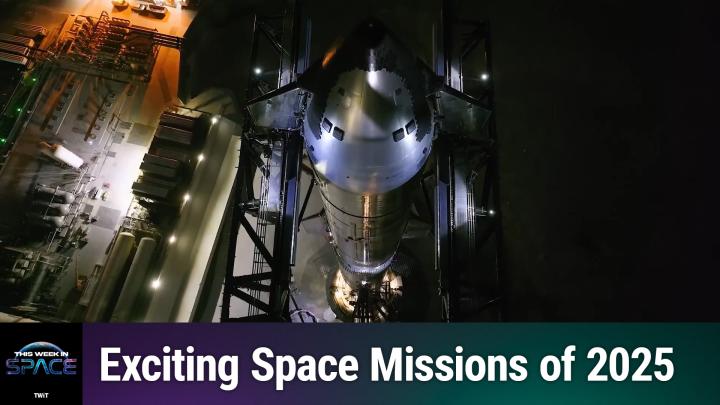
All TWiT.tv Shows (Audio)
This Week in Space 142: 2025 in Space
01:13:36
The Year's Most Anticipated Space Missions & Developments
Loading summary
Transcript279 lines
- [00:01]
Brad Pyle
On this episode of this Week in space. It's 2025 and we're looking at the coming year in spaceflight. That means maybe 25 flights of Starship trips to the moon, maybe even out to Venus. But tune in and see what's coming up.
- [00:17]
Unknown
Podcasts you love from people you trust.
- [00:22]
Brad Pyle
This is Turret.
- [00:25]
Tariq Malik
This is this Week in space, episode number 142, recorded on January 3, 2025. 2025 in space. Hello and welcome to another episode of this Week in space, the 2025 in space edition. I'm Brad Pyle, editor in chief, Van Aster magazine, as always, and I'm joined as always by my good friend, the beheaded Tariq Malik, editor in chief of Space.com 2025. It's here bringing, bringing credit to his career achievements with that cool hat. So tell us what your cool hat is. It's not Mickey Mouse gone robotic.
- [01:04]
Brad Pyle
No, it's. It's a Northrop Grumman Cygnus spacecraft that we got from one of the Antares launches way back when out of Wallops, when they were still launching Antares rockets out of Wallops there. So I may have taken it from my, my child.
- [01:18]
Tariq Malik
You may have stolen it from your daughter. Come on, soft pedal it.
- [01:22]
Brad Pyle
She was given it, she was given it, given it by, by the president of Space, Northrop Grumman Space Systems, back when, I think it was still orbital. It was a long time ago that she got it. When we're eating rocket fuel ice cream at the local ice cream shop in Wallops.
- [01:39]
Tariq Malik
So you know how to live.
- [01:40]
Brad Pyle
You know, I tell you, I tell you they make it with cayenne pepper. If you, anyone ever goes to a Wallops launch, go to Chincoteague island and go to the ice cream shop. There you'll get, you'll get rocket fuel.
- [01:49]
Tariq Malik
Or come to la. Small flavored ice cream.
- [01:51]
Brad Pyle
And the most, it's the most festive hat that I have that doesn't say anything because I Forgot to buy 2025 glasses or something for this episode and I, I regret it now. I have regrets, so.
- [02:02]
Tariq Malik
Well, you'll have to make up for it by just being extra engaged in the headlines. Now, before we start, even though he kind of already did, please don't forget to do us a solid. Make sure to, like, subscribe and do the other podcast things because we need your love. Also, it's time for the 2025 TWiT audience survey. This is the annual survey that helps us understand our audience so we can improve your listening experience. It only takes A few minutes. So go to TWiT TV survey to take it. Don't wait. Take it before it closes in mid January. And thanks for helping us make twit even better. But now, as our New Year's gift to you, a space joke from Tom Melton, who happens to be national space society member 2053109.
- [02:52]
Brad Pyle
All right.
- [02:53]
Tariq Malik
Actually sent me his membership number with the joke. Are you ready?
- [02:57]
Brad Pyle
I'm ready. I'm ready, Tom. Lay it on me.
- [02:59]
Tariq Malik
Why was the request for a donut shop on the International Space Station denied?
- [03:04]
Brad Pyle
Why?
- [03:05]
Tariq Malik
Because it would be full of holes.
- [03:08]
Brad Pyle
I get it. I get what they did there.
- [03:10]
Tariq Malik
Wow, that was the smallest laugh bump. Nicely done. All right, well, before we sink too far, let's. Oh, hey, I missed. Oh, here we go. Now, I've heard that was a bad segue that some folks want to drill holes in the nearest Soyuz capsule when they hear our jokes. Your best, worst, or most different space joke to us at Twisted Twitter tv. Okay. Wow. Just go ahead and step in it, Rod. Headline news.
- [03:44]
Brad Pyle
It's a brand. It's brand new. Brand new. Headline news. Headline news.
- [03:52]
Tariq Malik
Thank you, Bethany, or whatever your AI name was. So did you go through these? I don't know if you had a chance.
- [03:59]
Brad Pyle
I did. I went through the whole thing. You always doubt me, you always tell me, but I come in clutch. That's like my. My modus operandi, right?
- [04:07]
Tariq Malik
Like I'm sliding at the last second.
- [04:09]
Brad Pyle
I may have been adding things like in the last five minutes. I don't know. You don't know, Rod, you don't know. Right.
- [04:15]
Tariq Malik
Clearly. Clearly I barely even know you. Who the heck are you? The Parker solar probe did its big thing, which is.
- [04:22]
Brad Pyle
Oh, yeah.
- [04:24]
Tariq Malik
Yeah. And. Okay, so I want you to give us the whole story. But. Well, just give us the whole story.
- [04:31]
Brad Pyle
Yeah. Well, this is from Space.com, but also from NASA and the Johns Hopkins University. In fact, since you and I first map this out, there have been developments in the last day, too. But as we were all getting ready for Christmas on Earth, here on Christmas Eve, NASA's Parker Solar Probe made the closest ever. And fastest.
- [04:52]
Tariq Malik
And hottest.
- [04:53]
Brad Pyle
And hottest. Yeah. Whipped by the sun. It. It flew within, what is it, about 3.8 million miles of the sun. We're 93 million miles from the sun, if memory serves. So that's the closest that we've ever get. It's the closest that any human made object has gotten to the sun. And it's as close as that Parker solar probe is going to get. It was its 22nd flyby and it was kind of like one of those, what does JPL like to call them? Like the seven minutes of terror type things. Except this was like over a week and a half. Because on December 20, four days before this flyby Parker solar probe went into like an automated mode, it sent a ping back to mission control, which is over at John Hopkins Applied Physics Laboratory in Laurel, Maryland. And it says, all right, I'm starting my approach. You know, my trench run. If this was Star Wars. Oh, wow, that's really apt, right, because it's a star, right? It's the sun. You see? You see? Are you, are you, are you picking up what I'm putting down there, Rod?
- [05:51]
Tariq Malik
Right.
- [05:51]
Brad Pyle
Anyway, so I'm sorry, I was taking.
- [05:52]
Tariq Malik
A little nap, but pray continue.
- [05:55]
Brad Pyle
So, so it accelerated up to 430,000 miles an hour, which is absolutely crazy. And it did this not just in this flyby, but over the course of seven different flybys of Venus. And then the other 21, like ever closer approaches that it made over the last years. I think it launched in 2018. So it's been quite some time to make this journey. And the really interesting thing is that like you said, it got, it got hot. 1800 degrees is what they were expecting to see at this point as it flew through the sun's corona. It's the hottest bit of the sun. So it's flying through the atmosphere. They call it kissing the sun or touching the sun essentially. And it has this really thick heat shield on the front that's super advanced in a way that all of the instruments, 110 pound package behind that heat shield is kept at room temperature. So it's as comfortable as, well, I don't know like how you run your house, rod. So it's cold. 60 cold.
- [06:52]
Tariq Malik
Like my 5 degrees.
- [06:55]
Brad Pyle
It's about 65 degrees here. I don't know if it was like that, that cool because we run a cold house. But. But it survived. And they didn't find out if it did. It was all automated. They had a lot of, a lot of confidence because of how the spacecraft has performed to date. But they didn't hear anything until December 27, when at midnight, it sent like a beacon home, like, boop. Which means, you know, hey, I'm, I'm still here. That's literally all they got. But they were like, hey Tones, this is great. Our spacecraft is beeping. And, and then just actually yesterday they got all the telemetry down, so they got the download that says this is how fast I'm at. This is where I'm, you know, where I am right now. I'm on track for two more flybys at the same distance and speed and whatnot. And, and now the long process of getting all of that data that it collected from the flyby is going to begin. They don't expect to start getting it until like the end of the month of January as we're recording this 2025, but a smashing success for something that we've never done before.
- [07:57]
Tariq Malik
And at its top flyby speed of 430mph, if it took a straight line home, which it wouldn't because it would take a long chunk of a spiral, but if it did, it would reach Earth in nine days at that speed.
- [08:10]
Brad Pyle
Nine days. That's great.
- [08:12]
Tariq Malik
How about that, huh? I even had my calculations checked by a real honest to God engineer. Yeah, yeah. I'm still a little curious and I meant to see if I could look it up, but I ran out of time. But being that it dipped into the corona. Correct, yes, Corona, Photosphere. Corona.
- [08:34]
Brad Pyle
Well, yeah, the outer, outer layer.
- [08:36]
Tariq Malik
Yeah, yeah. I mean, that region. I'm trying to remember my, my solar regions because the sun's really weird. You know, it's got these areas that are hot and then cool and then really hot. And I thought the area it was going was, had hot ambience beyond just the solar radiation part. Which means that the instrument package behind that shield would still be exposed to fairly high temperatures, but apparently not.
- [09:00]
Brad Pyle
Well, they, they were, they were hoping that the speed that they went through would, would kind of counteract that because you are right. The corona actually is really weird. And this is one of the mysteries they were hoping that this mission is going to uncover. It's hard for me to take myself seriously with the hat. While we're talking about the news, I'm gonna take it off.
- [09:17]
Tariq Malik
And we're taking you seriously because Anthony just wrote we're not going to get through all these stories today. I know, reflecting of your, your long answers. But you know what?
- [09:26]
Brad Pyle
Well, I mean, we've never done this before. This was a historic thing. So.
- [09:30]
Tariq Malik
Yes, and this is one of the mysteries.
- [09:32]
Brad Pyle
Why is the corona so hot? Why is it hotter than the surface of the sun?
- [09:34]
Tariq Malik
So we should let you have your, your answers. Okay, moving on. Hey, we got a new rocket coming up. New Glenn. After 24 years of all that stuff going into that factory, finally a big thing extruded out the back. And it's the new Glenn rocket. And it's on the pad. The recovery vessel was dispatched, I think yesterday. Right?
- [09:58]
Brad Pyle
Yeah. Jacqueline, named after Jeff Bezos's mom. Yeah, it is. It is on the. Well, that's the Atlantic.
- [10:03]
Tariq Malik
Okay. That's the tug. But the actual platform has a SpaceX worthy goofy name that I can't remember.
- [10:09]
Brad Pyle
I thought it was called, I thought. It's called Jacqueline. It says Jacqueline right on the top of it. They wrote it on there.
- [10:14]
Tariq Malik
You talk about the boat, of the platform.
- [10:15]
Brad Pyle
The platform.
- [10:16]
Tariq Malik
Because it, I saw another name, like, you know, pray to Jesus it'll come.
- [10:22]
Brad Pyle
So you think there's a chance it's the name of the booster? It's the name of the rocket.
- [10:26]
Tariq Malik
Oh, yeah. Oh, that's okay. Okay, well, thank you for that correction.
- [10:30]
Brad Pyle
Yeah, yeah, that, that's what I'm hearing at least. So.
- [10:33]
Tariq Malik
Okay. No, I think you're right.
- [10:34]
Brad Pyle
We haven't heard much from Blue original. We were talking about this while you were, you know, getting your dog and the answering the door earlier, before we started recording the episode. I was talking to our fellow Discord folks about it.
- [10:45]
Tariq Malik
But.
- [10:46]
Brad Pyle
Yeah, so this is, this is the big moment over the holiday break. Blue Origin got an FAA launch license for their first New Glenn rocket. They did a hot fire as well of all. Of all seven first stage engines. And it went swimmingly, which, which is great. You know, you, you want to see that happen. And I believe they did a hot fire of the second stage a few weeks prior. So it seems like all of their ducks are in a row. They said all they had to do now was encapsulate their Blue Ring adapter demonstration payload because there isn't an actual payload. There is not Jeff Bezos car on this flight. They want, they want it to be taken seriously so they can get qualified for military launches later in the year. And so, so it seems like they're really set to go. The FAA license gives them several different windows that open on January 6th, the Monday. And so. So that'll go through. Through. I'm getting the hook here. Yeah, that'll go through January 12th. And we're waiting to find out what the actual date's going to be. So, Anthony, by this time next week, we should be talking about an actual launch rod.
- [11:51]
Tariq Malik
Well, I hope so, because it's been an awful long time and I know I whine about this continually, so I apologize. But when you see the process, the progress the SpaceX has made in the time that it's been around, which is two years less than Blue Origin, it's been a real head scratcher. To watch New Shepard launch and then launch some more and they get grounded and then start launching again. But given the scale of what they've been working on and given the fact that they're actually selling their rocket engines to United Launch alliance in a form of coop petition to let them launch first, it was just a real head scratchers to what took so long. But there we go.
- [12:27]
Brad Pyle
I think that they, yeah, they, they, Blue Origin just. I don't mean to interrupt, but they have a very different ethos than, than SpaceX. Space SpaceX is really pushed by Elon to, to test it first and if it fails. All right, but you know, let's, let's learn from it and make sure it doesn't fail again. Blue Origin tends to do everything behind the scenes and then announce something once it's successful. In fact, when they did their first ever suborbital hop, it didn't even go into space. They announced it like a year afterward or something like, like three months afterwards, something crazy like that. Because they wanted to wait till everything was done and they understood what had happened. Now the delay though has been very lengthy. It's why you saw a leadership change at Blue Origin in recent years and Jeff Bezos kind of leave Amazon's helm and then come in so that he can spend more attention on it to get to this point. So there has been a bit of whip cracking I think, to get things on track so that they can get where they need to go. Because this is the vehicle that will launch the bulk of their Kuiper satellites for Amazon and they want to have it up there to be a competitor for I guess, Starship and, and the Falcons of the world.
- [13:32]
Tariq Malik
And yeah, it's, it's, as I recall correctly, it's lifting capacity is somewhere between Falcon Heavy and Starship. Right?
- [13:40]
Brad Pyle
It's between F Heavy in Starship just because Starship's the biggest rocket ever built. It does have a wider fairing size. I think it's like 7 meters instead of the normal 5. And, and it has, it's designed to be fully reusable as well, if memory serves. So eventually. And so you know, as opposed to Falcon 9, which you, you throw away the upper stage. They eventually want to be able to, to bring that upper stage back, if memory serves. I could be wrong about that though, if they've changed their plans.
- [14:09]
Tariq Malik
Well, in that case, why are we doing this podcast if you're not an expert? Well, expert, I could be wrong.
- [14:16]
Brad Pyle
I remember them saying that, but, but yeah, we'll see.
- [14:18]
Tariq Malik
Well, and, and to be fair to both of us as writers, they do change their tune from time to time, these new companies, and they don't always update us on the news, but it's nice to see not just this rocket, but news coming out of Blue Origin, because for a long time it's been getting news out of North Korea, and that's difficult too. All right, so Elon announces on Twitter X that they're working on the last crew Dragon or Dragon capsule. It might not have been crew Dragon, it might have been cargo at Hawthorne, California, before they move everything to Texas.
- [14:52]
Brad Pyle
I didn't see this tweet. I did not. When did he tweet this out?
- [14:55]
Tariq Malik
I checked the date, but I saw it yesterday, so it was probably the day before. The story's been out for a while, which is why I put that note in there for you, which is that we knew they were moving to Hawthorne. I guess he just wanted to rub it in a little bit to us Californians who will be losing. Using every trace of SpaceX.
- [15:13]
Brad Pyle
I, I was really surprised to hear that because when they said they were moving to Texas, I found it really hard to believe that they would. What's that word? Untrenchify Decamp. Decamp. The whole manufacturer. I don't know what you call it. Yeah, yeah, the full manufacturing apparatus out of, out of Hawthorne.
- [15:33]
Tariq Malik
Because Hawthorne's a big operation. It's huge.
- [15:36]
Brad Pyle
Yeah, yeah. And, and you know, as far as I know, that was where they were building everything, you know, and cranking everything out now. Now if they moved.
- [15:45]
Tariq Malik
Not Starship.
- [15:46]
Brad Pyle
Yeah, if they move the Raptor engine out to, to Starbase, then that would explain a lot because they're, they're building like they want to build. I think one of those an hour is what they said, I think back in November.
- [15:59]
Tariq Malik
Yeah.
- [16:00]
Brad Pyle
So it's something crazy like that.
- [16:02]
Tariq Malik
Well, if he's going to relocate everything to Starbase, let's just tap him on the shoulder, remind him he can't keep using those big Kevlar tents because they get Hurricanes there.
- [16:12]
Brad Pyle
Oh, they don't have those anymore, though. They, they, they have, they built like all buildings and there's like four VABs and all that stuff there.
- [16:19]
Tariq Malik
Yeah, but aren't. Aren't the main fabrication plants still those big, like. What's the name of the company they built?
- [16:26]
Brad Pyle
No, they have, they have, like, really low, like, manufacturing structures there now. Yeah, there were these big aviation tents when I was there, but that was 2019. Now they actually have a lot of physical structures there because you get to.
- [16:38]
Tariq Malik
Go to those things. All right, last story, and this is a quickie. We saw Ingenuity the Mars helicopter fly once again at the Rose Parade this year.
- [16:47]
Brad Pyle
Did you see this? Did you go to the Rose Parade?
- [16:50]
Tariq Malik
No, I. It's what it takes me 10 minutes to get up there. You crazy? No, I wouldn't. I went a lot as a young person, and to do it over and over, especially if you spend the night out there, is enough. But this was the float for Flint Ridge Lock and yada, if I'm correct.
- [17:05]
Brad Pyle
Yeah, yeah. This is from robert frman@collectspace.com he's the one that. That found this story. But, you know, we always look for. Actually, I miss this flow. I actually. Fun fact. I have marched in the Rose Parade before.
- [17:16]
Tariq Malik
Please.
- [17:17]
Brad Pyle
When USC went to the Rose bowl in 1996 on January.
- [17:21]
Tariq Malik
Yeah, well, you had to wait till university. My high school band marched the Rose Parade because. So anyway, so they have a float that has the. The perseverance Mars Rover on it or a semblance of it stubbed with flowers and seeds and all this.
- [17:37]
Brad Pyle
And an astronaut riding it like wee.
- [17:39]
Tariq Malik
And astronaut looks like he's about ready to fall off. And a real drone flying from the front and then coming back and flying for the front and coming back. Now, the interesting thing about the Rose Parade is you really want to be in the first half mile where it starts in the west end of town. Because by the time you get to midtown, half the floats are broken and being towed by tow trucks. And all the little armatures just stuck in one position because they don't work anymore. But you know, when you're building something out of wireframe and chicken wire and covering it with seeds and flowers and all that stuff they do, I mean, it's an amazing effort and fee. And every time I go to a regular parade, it's like, oh, these floats are just like, painted. They don't have flowers on them. So I find that disturbing. Anyway, yeah, so that was cool. And they are. I believe up through the end of today, these floats are still viewable at the east end of Pasadena. If you go over and pay some probably quite a massive fee to go see them, you can walk around and stare at them. Inert.
- [18:37]
Brad Pyle
Yeah, there were. There were two space floats this year, which is really cool. There was this one, and there was another one with a little astronaut guy on a little rocket guy. It was really fun. So.
- [18:44]
Tariq Malik
All right, well, let's go to a quick ad break to give our. Our listeners some relief and we'll be right back. So don't go anywhere.
- [18:51]
Unknown
If you have a locked AT&T phone, we're here with bolt cutters. T Mobile will help pay off your locked phone and give you a new 5G phone for free. All on America's largest 5G network. Visit t mobile.com CarrierFreedom via virtual prepaid.
- [19:06]
MasterCard in 15 days. Free phone up to 830 via 24 monthly bill credits plus tax and a 10 device connection charge. Qualifying port and trade in service on Go5G next and credit required. Contact us before canceling entire account to continue bill credits or credit stop and balance on required finance agreements. Do you bill credits and if you pay off devices early?
- [19:21]
Cascade Natural Gas believes a warm home, hot water and natural gas energy should be available to everyone. That's why Cascade established the Oregon Low Income Bill Assistance and Energy Discount Programs. These programs provide income qualified applicants a discount on their monthly bill and if needed, help with past due balances. Qualifying for assistance is easy by calling Cascade or any of our partner community action agencies. Get complete bill assistance info@cngc.com help all.
- [19:53]
Tariq Malik
Right, it's 2025 in space and our resident space expert Tarek Malik here without his hat.
- [20:03]
Brad Pyle
I took my, I took the hat off.
- [20:04]
Tariq Malik
Yes, you did and but you still look devilishly handsome. God bless moms because they like us no matter what dumb thing we do, right? So let's start with Starship, since that's a big story. We'll be talking about this in more depth next week, I think, but very appropriate.
- [20:23]
Brad Pyle
I got Starship news that just happened before we set to record today too.
- [20:26]
Tariq Malik
Well, go for it.
- [20:27]
Brad Pyle
Mr. Well, yeah, so, so actually we just found a story at space and you might have seen other folks talking about too, about 2025 being the year of Starship. I think that what you flagged here is that SpaceX currently has an FAA launch license to fly maybe 25 Starship launches.
- [20:45]
Tariq Malik
Is it, has the license been granted or is it out for public comment? Because I don't think it's actually been.
- [20:51]
Brad Pyle
I think, I think that, I thought that it was fine like there. I think that they have like a license to fly the same type of mission, like basically as long as they don't make any changes. And so like the Flight 6 and Flight 5 test flights that we saw in October and November were very, very similar in what their profile is, which means, you know, they're going to try to do for cats, but they may land offshore. They're going to, you know, splash the starship down in the Indian Oce. And, and because they're the same, they can use the same license that's good for five years as long as they can get the, you know, the sign offs scheduling.
- [21:24]
Tariq Malik
So excuse me, but at least one outlet reported that they were angling to also get a license to land the ship Upper stage. Yes.
- [21:32]
Brad Pyle
And we're going to talk about that.
- [21:33]
Tariq Malik
Yeah. Okay. Because you're catching the big one of the Mechazilla.
- [21:37]
Brad Pyle
They're gonna catch the upper stage with.
- [21:39]
Tariq Malik
What, the second pad?
- [21:41]
Brad Pyle
With, with the second pad or with the original pad? After leaving the upper stage up there, we're so, so here's the big news, right? So, so the big thing for Starship is there's that SpaceX wants to launch a lot of them. They launched like three last year. They launched one year before. They want to launch up to 25 this year. If they can like as you say, get through all of those, those, those FAA hurdles. Trump's going to be President, Elon Musk is going to be uh, this whatever efficiency driver. So I think they're going to get whatever they're going to get for that. So, so the big issue is that of course they have to start flying and the next flight is Flight 7 of Starship. And just before you and I sat down, in fact I was having lunch today as we were getting ready for it. SpaceX basically dropped the entire profile and plan for Flight 7. That means that they're probably like a few days away to a week away from planning the flight itself. And I've heard some days like January 10th or 11th, like thrown about, which would be next Friday, last Saturday as, as we're recording this and this is going to be a brand new ship. So you're saying that you're hearing about them wanting to land the ship at Starship at the Starbase facility. Well, they're flying prototype like, they're like, they're like strut things like that. They would catch the catch little things. Yeah, catch points on, on the spacecraft. They're not flight worthy. Like they're not designed to actually catch the vehicle. They're going to see what the heating environment is on reentry to see how strong they have to make them. So we know that they're going to want to catch this thing, which is interesting because you think because it's, it's, they've, they're experts at vertical land and they want to land it, but no, they're going to do that. They've moved the flaps up on, they've made all these upgrades. Brand new avionics and flight computer to try to enhance how long the ship itself can stay up. It's got a new heat shield with a backup layer. Beneath that heat shield, a lot of things. And, and this is what I think is the most exciting. They're going to deploy a set of like. Like, what are they. What is that called? It's like a. It's like a simulated starlink. Satellites. They're going to deploy satellites, which means they're going to start spitting them out with that PEZ dispenser thing that they've done.
- [23:57]
Tariq Malik
So Flight seven is going to carry a load of starlinks.
- [24:00]
Brad Pyle
It's going to carry a load of. Of like a simulator. So because they're not going to keep them in space, they're going to. They're going to spit them out with this PEZ dispenser thing they've got, and then they're going to fly a similar trajectory behind the main ship, which means that the ship's going to, you know, try to land in the. The ocean and soft land, whereas these things will burn up on the way back down, kind of on the way down behind it. So they're calling this like a new version, like a. If, you know, they like. Like the current crew, crew Dragon is Dragon V initially called. This is like Starship V2 or a new variant of it that they're. They're hoping is going to be either a major step forward, if not like the big definitive vehicle for the. For the next few test flights.
- [24:43]
Tariq Malik
Okay. Hey, Anthony, look, it's not even the half hour yet, and we're through two of our 25 stories. There we go.
- [24:50]
Brad Pyle
There we go.
- [24:51]
Tariq Malik
Look at us. All right, let's skip over new Glenn, because I already talked about that.
- [24:56]
Brad Pyle
Yeah.
- [24:57]
Tariq Malik
And this isn't really a 2025 story, but it will take place during 25, 26, 27, which is. China has announced, not that they're working on spacecraft for their crewed lunar mission, but that they're ready.
- [25:11]
Brad Pyle
Really.
- [25:12]
Tariq Malik
Which should be sending shock waves through the halls of the government and the Hill.
- [25:18]
Brad Pyle
They did show off like a lot of hardware at the end of 2024.
- [25:23]
Tariq Malik
The guy said, this stuff's ready, which may have been. You know, that may be a bit of a rounding up of a statement, but, you know, so just to backtrack for a second, we just finished an op ed for my magazine, which will soon be in your online magazine. Myself and one of my key writers named John Cross about why getting Back to the moon first matters. And that's a debate. You know, you could say that matters, you could say that it doesn't. This op ed and kind of straddles the line of it matters scientifically and it matters for geopolitics, but it also matters for how we look at ourselves. Because I'm old enough to remember the space race the first time around, not old enough to remember Sputnik, but certainly old enough to remember the fact that the United States got poked in the backside and decided, hey, we want to get to the moon, because the Russians have beat us at everything else. That was back in the 1960s. Now many people perceive the same kind of race, quote unquote, going on with China. It's a very different thing, but depending on how you look at it, the geopolitics are not dissimilar. And I think part of what, what John was really going for in this op ed was just how we look at ourselves. You know, we like to be first in everything. We really aren't anymore, depending on what part of our global endeavor you're looking at. But that's okay, you know, there's room to share. But the moon's kind of a big deal and there are concerns about what might happen if a less western aligned nation got there first and said, okay, this is an exclusion zone. You go land at the equator and that's really the big thing people are worried about.
- [27:05]
Brad Pyle
So yeah, I think what you're, what you're dancing around is the big question is, does the, does the treaty for outer space hold up if, if, if someone is actually living on that, that other planet? We've never tested that. So that's what we're, we're wondering how.
- [27:19]
Tariq Malik
That'S going to, well, or living or even if there's just a robotic base setup that's in operations extracting resources. Can somebody then use that as logic to try and twist an argument of well, I know what the Outer Space Treaty says, but we all know the Outer Space Treaty which was signed in 1967 by the then flying space faring nations, is, is kind of thin. You know, it's not as specific as we'd like. The US has tried to sort of augment that argument politically by saying, well, it is okay to take resources out of the moon, but not everybody's agreed to that. So we've got, you know, us with the Artemis Accords trying to leverage what we want, and we've got China and Russia with the International Lunar I Research Station trying to leverage their goals. Saying, no, no, we want to do science. It's those, I think the.
- [28:11]
Brad Pyle
Since we're talking about the moon, because, like, you know, you mentioned that China said that their spacecraft are ready, but like a landing by 2028, 2029 is what I think is you were alluding to. There still, still is pretty far beyond 2025. What we wanted to see in 2025 is Artemis to send astronauts back around the moon in September. And we know that that's not happening. I think one big appointment.
- [28:35]
Tariq Malik
I thought I remember somebody telling me that we're going to land on 2024.
- [28:40]
Brad Pyle
Well, technically, weren't we supposed to land in 2020? That was like the whole big thing. I don't, don't get me started. We've had that discussion, like, so many times. Rod, so annoyed.
- [28:52]
Tariq Malik
Okay, well, let's leave this one behind because that's really not a 2025 story. I just wanted to sort of squat on that for a minute. But in 2025, we are going to have a new NASA administrator that at least putatively is Jared Isaacman. So far, that's been Trump's recommendation. So unless he changes his mind. And we have. In the video, we have a cool picture of Jared looking longingly at the stars in his cool SpaceX helmet. And it's impossible not to like this guy.
- [29:21]
Brad Pyle
Yeah, he's a nice guy. I met him.
- [29:23]
Tariq Malik
He's good looking. He's very nice. We both met him. I think I met him more than you, but that's okay. And he's.
- [29:29]
Brad Pyle
Well, I met him, like, once.
- [29:31]
Tariq Malik
He's incredibly charitable. He's kind. He's great with kids, for God's sakes. I mean, it's like, you know, as I've said before, space Jesus. So if he's in charge, how is this different than what we've seen with Bill Nelson and people like Bridenstine? Because this is a huge step outside the traditional circle of nature.
- [29:50]
Brad Pyle
It is, it is. We've seen this type of a departure before, right, when, when you got into faster, better, cheaper for an asset back in the 90s, right.
- [30:00]
Tariq Malik
Dan Golden.
- [30:01]
Brad Pyle
Yeah, that was, that was, that was a change at that point in time.
- [30:04]
Tariq Malik
It was a change that left a lot of people kind of unhappy, you know?
- [30:07]
Brad Pyle
Yeah. And. And I would say after dan. Sean.
- [30:13]
Tariq Malik
Sean O'Keefe.
- [30:14]
Brad Pyle
Sean O'Keefe also was a bit of a departure to me, at least from. From what I would think. And then, and then, of course, they swung around a Charlie Bolden, and not Charlie, but Mike Griffin, who Really, I think, like, got. Got the shuttle program on track for its ending. And I think that had Mike Griffin been given the paycheck that he said that they needed from Congress, then he would have gotten us up to the moon by 2020, like Constellation would have done. But anyway, I think it's really too early to tell. I think that the intention, like, the good intentions are there. I think that the, the passion is clearly there. This is a. A man who not, you know, founded. Left high school to found a. A payment system that has made him a multi. I guess it's, I would assume a multi billionaire if you can afford more than like one private mission. I think about Jared, I think every day when I check out at the counter because I see that shift four machine that I waive my credit card on and I'm like, that's. Thank you, Jared. You know, so, but, but I think, I think we'll have to wait and see. Now, of course, later this month is the inauguration. That's when Trump will become the 47th president. After that, all of the nominations are going to flow out and then they all have to be. They all have to be approved by Congress. I would expect that. I mean, on paper, there really isn't too much controversial about Isaac man, except that he's a businessman. You know, he's flown to space, he has a good grasp. He's. He's overseen a very complex aviation as well as business aspects. So we'll have to see how that, how that, how that plays on Capitol Hill. So. So, you know, I would, I would be optimistic if. I would. If. Optimistically speaking, I would expect there to be a NASA administrator in place by June, most likely before. But June seems pretty safe to, to not bet the chair on, I guess, if, if we'll do that.
- [32:21]
Tariq Malik
Right. Well, and if they can. I mean, this is the earliest suggested.
- [32:25]
Brad Pyle
Yeah.
- [32:26]
Tariq Malik
Nominee we've ever seen, at least in modern times. All right, let's do the exciting thing. We're going to roll to a commercial for one of our beloved sponsors and we'll be right back. So stay in your seats.
- [32:37]
Unknown
If you have a locked AT&T phone, we're here with bolt cutters. T Mobile will help pay off your locked phone and give you a new 5G phone for free. Free. All on America's largest 5G network. Visit t mobile.com carrierfreedom via virtual prepaid.
- [32:52]
MasterCard in 15 days. Free phone up to $830 via 24 monthly bill credits plus tax and a $10 device connection charge. Qualifying port in trade and service on Go5G next and credit required. Contact us before canceling entire account to continue bill credits or credit stop and balance on required finance agreement as deal bill credits and if you pay off devices early.
- [33:07]
Cascade Natural Gas believes a warm home, hot water and natural gas energy should be available to everyone. That's why Cascade established the Oregon Low Income Bill Assistance and Energy Discount Programs. These programs provide income qualified applicants a discount on their monthly bill and if needed, help with past due balances. Qualifying for assistance is easy by calling Cascade or any of our partner community action agencies. Get complete bill assistance info@cngc.com help so.
- [33:39]
Tariq Malik
Here'S kind of a twofer that I'd like you to comment on. We've got Trump coming in with Elon Musk hard in his ear, you know, saying, hey, do this, do that, here's the best way to go about things. And there are some that have expressed concern about the specter of the monopoly of SpaceX, which to be fair, it's kind of hard at this point anyway for it not become a monopoly because they're doing most of the work, they're getting most of the payloads, they're moving faster, better and cheaper than anybody else to invoke the golden Spirit. And you know, they've taken over half the global launch market, at least a little bit more, I think. So, you know, they kind of almost can't help sliding into the status of a semi monopoly.
- [34:24]
Brad Pyle
Yeah.
- [34:25]
Tariq Malik
But then we have Blue Origin coming up with the new Glenn, which NASA and others have confirmed that they're going to use and also possibly launching their first lunar lander Pathfinder this year, we hope the Blue Moon Mark one. So how do you see that playing out?
- [34:41]
Brad Pyle
Well, I think that, I think that it could really kick start like a much wider market. It does depend on if these vehicles are successful and if they can fly them at the rate that SpaceX flies. I mean, as we were speaking, SpaceX is counting down to launch their first mission of 2025, the Thrive 4 communication satellite for Space 42 out in the UAE. This is a rocket that they're using that has made, it's making its 20th flight. And this is a company that just finished 134 Falcon flights. Just Falcon flights in 2024. Right.
- [35:13]
Tariq Malik
And so they're looking at Starship. So you're talking about Falcon 9, right?
- [35:16]
Brad Pyle
Falcon 9, yeah. And so, and they also launched a Falcon Heavy or two over the year. Over the year. So I mean they launched quite a bit last month and they were the, not only like the, the smashing their own records. They were the leader in the U.S. they were the leader in the world. And in fact they're, because of their Starlink flights, they raised the global record to its highest ever, according to a Space News analysis that came out this week. So I think it's really hard to make your mark when they've got that rundown now. They will finish at least a nominal Starlink Constellation at some point in time and they will have to ease back on that launch rate and just go to replacements and whatnot. So that a lot of that launch rate is SpaceX losing money because they're launching their own stuff into space and paying for it themselves. So we have to put that into perspective. There's a lot of other missions out there. I think that New Glenn has at least eight that already, they're already trying to get qualified for national security payloads. That's a fast track type of a thing that usually takes a lot of time. They're thinking ahead on that. So I think they're going to chip away at it. And they're not alone. Rocket Lab. And I've got it on the list for later on, but we can talk about it now. Rocket Lab is going to launch their own kind of answer to the Falcon 9 and that's their neutron rocket. That's a, a, a crazy rocket that has put the second stage inside the first stage and it's going to spit it out like a hippo mouth when it gets up to altitude. And I'm really excited about that one because, well, because it has a hippo mouth. I think, I think that's, and I think that that's amazing. So you're a strange. I don't think, I don't think, I don't think that SpaceX has a monopoly. It's just like they're the ones that have all the stuff to launch as much. If you take away all of the Starlink missions and there are many dozens upon dozens, you are left with maybe 40 or 50 like, like customer flights again. They win it because they have the success and they can sell less, but they're not undercutting prices yet because they have to recoup everything that they put into the Falcon 9 to make it reusable. And I think they're still doing that, if memory serves. So Elon Musk has said, I think in recent years that they're not going to do it for at least five years or so on Twitter that until they can get, get, get that sorted. So, so this is, this gives them some breathing room because eventually they'll stop launching as much because of the Starlink stuff. And, and then the customers like OneWeb, like Kuiper, which is gonna be flying.
- [37:44]
Tariq Malik
Which is Amazon's own constellation.
- [37:46]
Brad Pyle
Exactly, yeah.
- [37:48]
Tariq Malik
So is OneWeb still a business?
- [37:51]
Brad Pyle
I. Yeah, I thought so. They just actually recovered one of their satellites. It got, they lost communications with it for two days, so. Which you don't really want in a mega constellation generation. So. But they were able to get it back.
- [38:04]
Tariq Malik
All right. Boy, there's a lot of juicy stories here, but we just got to talk about this one.
- [38:11]
Brad Pyle
So we got a shotgun through them. You know, the bar sample return is next. Let's talk about that.
- [38:15]
Tariq Malik
You of all people, we have to shotgun through them. Let me give you an answer that's a sentence 10 minutes long.
- [38:21]
Brad Pyle
I'll do my best.
- [38:22]
Tariq Malik
Mars Sample Return. So just a bit of backstory as listeners, regular listeners will know Mars Sample Return has been going on for years trying to develop this thing. It got hung up. I mean, actually it's been under development since the 70s in one way or another, both here and in the Soviet Union, but started seriously about a decade ago. Okay, we're going to go, we're going to take samples with perseverance rover, we're going to drop them in certain places and keep some on the rover and then we'll go collect them, bring them home, record scratch. They sent in a memo to NASA upon NASA's headquarters request saying how much is going to cost? They said, well, between 6.5 and 11 billion, which the NASA administrator decided to announce at a press conference. Well, I'm looking at that as 11 billion and that's too much. So hey, private industry, step up and save this mission. So so far to my knowledge, that hasn't happened. Then the Chinese say, hey, you know, we've been doing really well on the moon and we've done pretty well on Mars and we think we're going to be able to do a sample return by 2027. So we got to make a decision this year whether we're going to continue with Mars Sample Return as the possible runner up in 2030 x somewhere in there or if we just like hand it away.
- [39:40]
Brad Pyle
That decision is going to come sooner than you would think. Basically, Bill Nelson, just at the close of 2024 said that they are looking to refine their plan for Mars Apple return before the next administration takes charge. That means sometime this month, in the next couple of weeks, before January 20th or what or Whatever. When the inauguration is, NASA should be releasing some sort of new updated plan Now China's Plan 2027. Not like inconceivable when you see how they did sample return for the moon. They launched a, an orbiter, a return vehicle and a lander that had its own return vehicle that they landed, they scooped some dirt, they put it in the sample container, it launched off. Very, very tight, very quick, very succinct. The current Mars sample return plan as it is at NASA is, hey, we sent a big rover there, it collected a dozen samples, it dropped a bunch of them in a big pile, you know, and, and it also has other ones on it. So then we can go and, and scoop those ones up. Maybe we'll use a helicopter. No, we're not going to use a helicopter now. You know, we'll, we'll, maybe we'll send two rovers, Noble to send one rover, it's very complicated. You know, you could just say we're going to land, scoop some dirt and then come back, you know, and, and I think that's the decision that they're looking to make because that stuff is still there. They could always go back and go get it eventually. I don't know, I don't know. But that's what we expected to get a refined update within the next few weeks perhaps.
- [41:04]
Tariq Malik
So in the next week to kind of, excuse me, to kind of just zoom in on a couple of things you said. So China basically grabs a contingency with the equivalent of an Apollo contingency sample. It comes back, contingency sample is when Neil Armstrong got down the ladder, was looking around going wow, this is cool here. And NASA's going Neil, Neil, get the contingency sample, come on. Which is basically, look, just grab something in case you have to come home right away. At least you make it worthwhile. We got some dirt, put it in.
- [41:32]
Brad Pyle
The Maggie, put it in your pocket and you know.
- [41:35]
Tariq Malik
Yeah, and I'm simplifying it. I mean China's sample was better than that. But again NASA makes these big complicated multi stage plans which, I mean they're good for science, but to have this rover driving around for five years now and when it was launched we didn't even have approval for a budget for Mars sample return. It was still kind of in head scratching state at least in the halls of government. And last time I saw JPL, what was that, 2017 maybe. I was doing a write up on the lab that was working on the six degrees of freedom arm that they would have to have for the fetch rover before they were going to use a helicopter, which would land on the Mars sample return craft, drive over to Perseverance, have this very involved multiaxis arm that would be able to extract the samples, because that's very hard to do, and also be able to drive, if necessary, over to wherever the samples that have been dropped, had been dropped, pick them up, which means being able to reach under rock overhangs and around boulders and that kind of thing. So I don't want to say it wasn't well thought out, because there are a lot of very smart people working on it. Yeah, but it was.
- [42:48]
Brad Pyle
And they know those samples, those samples. They know those dozen, whatever. They know exactly what's in them. They know where they got it from. And they're very varied. They got maybe more than they. They. They would have just land in one spot, you know, just build a reverse sky crane and catch it. Just bring the whole, the whole rover back, you know, with the samples aboard and everything. You know, that. That'd be great.
- [43:07]
Tariq Malik
So I think there's between 30 and 30 to 40 of them, but that includes. What do they call the ones they have, like, ground truth samples that they bring from Earth. There's a phrase for those, I can't remember, but basically it's like, okay, you know, here's Earth air. Let's make sure that that is compared to this and so forth. So anyway, yeah, so that's frustrating and we're probably going to lose that one. But that's okay. You know, it's good for science no matter who brings it back. And of course, there is the conversation on the side from Mr. Musk about, well, why would you do all that when I can send an entire spacecraft the size of a big rig to Mars? And you could lower a robot out of that because he's building robots too, right? So he could lower a robot out of that cargo hold by rope if he had to have it stomp around and pick up some samples and stick it in its mouth and bring them back.
- [44:01]
Brad Pyle
So I think make that, make that a contest. Make that a commercial challenge. Who gets there first to get those samples back? You'll get something. You'll get some ideas, right? You'll get something.
- [44:13]
Tariq Malik
Yeah. And disturbingly, and I just want to extend the story very quickly, you know, so we've seen what probably is the demise of Mars sample return in this decade, along with the really aggravating device of the Viper lunar rover, which is supposed to land in the South Pole this year and go collect samples of Resources, or at least try and prospect resources, see if they're there for volatiles like water and so forth. And you know, the head scratcher, as we've talked about, is it was built, it was finished, it was tested, everything seems to be going right. Then it gets canceled because it's going to do a budget overrun. Well, hello, how many NASA pro big programs have had budget overruns? We have new rules said it can only be, what, 33% or something. But come on, guys, you built the thing. So then you do a press. Another late Friday afternoon press conference saying, yeah, it's working really well, but we're gonna cancel it and take it apart and give the pieces to all comers who want to send them on commercial flights. What?
- [45:18]
Brad Pyle
Yep, very irritating so far, not, not a lot of takers on that either. So we'll have to wait and see how that goes.
- [45:23]
Tariq Malik
So well, and I wrot somebody who's kind of an insider about this and he was saying, you know, it just didn't have a lot of. Which I found interesting that he said, anyway, it didn't have a lot of support within NASA because it didn't really align well with the Artemis goals, which I don't completely understand, but, you know, whatever.
- [45:48]
Brad Pyle
Well, speaking of moon missions, we should talk about that for 2025. Or are we going to go to a break?
- [45:54]
Tariq Malik
What do you want, Anthony? Are we, are we due for a break? Oh, I like that he knows where to point. This is like Carol Merrill in an old game show. Go Go forth, young Tarik.
- [46:07]
Brad Pyle
Yeah, so you were just talking about Viper, and that was like a mission that I think we all had a lot of hopes for 2025. On actually for 2024. It was slated to fly by the end of 2024, before it kept getting delayed and pushed back, yada, yada, yada.
- [46:22]
Tariq Malik
By the delivery company, not by the, by the rover itself.
- [46:26]
Brad Pyle
Exactly, exactly. By Astrobotic, the builders of the Griffin lander that were supposed to do it. In fact, I don't think that they're done yet with that. So we're still waiting to figure out what's going there. But 2025 is going to be a year of the moon of sorts, much like what we saw around this early part of the year. In 2024, we're seeing another flurry of commercial and international missions to the moon. In fact, this month, Firefly is supposed to launch their Blue Ghost mission. I think it's launching on a SpaceX rocket, if memory serves. But they're going to Launch their Blue Ghost lander to fly different cots things and whatnot there. And plus Intuitive Machines is launching their IM2 mission near the south pole too. And I think they might be launching.
- [47:12]
Tariq Malik
On both, I think Firefly and Jax's.
- [47:16]
Brad Pyle
Hakuto r on the same one. Right.
- [47:18]
Tariq Malik
Are both flying on the same Falcon 9. I yeah. Think Intuitive Machines are different for flight.
- [47:23]
Brad Pyle
Yeah. And so, so, so you've got at least three like, like quick missions already. And then there's another mission, I think in the background there is a Japan's M2 mission to the moon which is going to fly on an Epsilon, is that right? Or is it a, is it a H3? I'm not certain which one that's, that one's flying on, but that Listen, listen.
- [47:44]
Tariq Malik
To us, the experts. Yeah, we should just have the listeners come on and say well I think it's gonna fly.
- [47:49]
Brad Pyle
The fact that, the fact that we, that, that I'm unclear is because there missions. Right. And, and so that's the exciting part is that while we don't have a Viper, which I really think, like you were saying, it's a tragedy that we're going to take this thing that has been built and it's ready to go and just say, you know what, scrap.
- [48:07]
Tariq Malik
It because we changed our mind.
- [48:09]
Brad Pyle
Yeah, exactly. But, but there are these other ones that are waiting in the wings. Will they be 100% successful? Experience says no. Right. We saw that last year with Astrobotic with a few others but, but it does seem like the momentum is definitely there and I think that if you've got four at least going in one year, one of them is going to succeed at least. And that's what we saw. We saw Jax's kind of auger in type approach with their moon lander really succeed and deliver some striking pictures of what a nose plant on the moon looks like with their lander. But it was still able to do stuff so that's pretty cool.
- [48:50]
Tariq Malik
Well, and the first Intuitive Machines mission of course toppled over because when the landing legs collapsed. This Intuitive Machines flight, by the way, and then we'll go to our break will be landing near the south pole and has a mass spectrometer which is a very valuable thing when you're looking for things like resources or organics and a 1 meter drill package which is pretty cool. So this is all, it's a pretty small and light machine and as far as I could tell it's, it's, it's static so it's not going to be driving around and drilling. And I don't know how we assure that it's inside a permanently shadowed region, which is where you want to look for these things. But they must have sufficient navigation capability to make adjustments at the last minute. And I do see in the notes here I wrote down it is carrying some hoppers. So while they aren't going to be able to, I don't think get samples, at least they should be able to characterize regolith nearby the landing site. Okay, let's go to another break because we love these and we'll be right back to blast through our last handful of stories. Stand by.
- [49:56]
Unknown
If you love your phone but not your carrier, just switch to T Mobile. You can keep your phone, keep your number and we'll help pay it off up to 800 per line. You can also use our savings calculator to compare our plans and streaming benefits against Verizon and AT T. So switch and keep your phone, keep your number and keep more of your moolah. @t mobile.com up to four lines via virtual prepaid card.
- [50:18]
Allow 15 days qualifying unlock device credit service port in 90 plus days with device and eligible carrier and timely redemption required. Card has no cash access and expires in six months.
- [50:27]
Cascade Natural Gas believes a warm home, hot water and natural gas energy should be available to everyone. That's why Cascade established the Oregon Low Income Bill Assistance and Energy Discount Programs. These programs provide income, qualified applicants a discount on their monthly bill and if needed, help with past due balances. Qualifying for assistance is easy by calling Cascade or any of our partner community action agencies. Get complete bill assistance info@cngc.com help so.
- [50:58]
Tariq Malik
I'm going to skip a couple because I want to make sure we include this story about vast. So Vast, we've had people from VAST on the show before.
- [51:06]
Brad Pyle
Vast max out the CEO.
- [51:08]
Tariq Malik
Yes, thank you. Vast is a company, another comer in the space station area to replace and or augment in this case replace the ISS when it's decommissioned around 2030. But what's interesting about Vast is they're pouring, oh can I say it, Vast amounts of capital into building their Haven One space station without one of the NASA contracts that companies like Blue Origin and Voyager have received. So they're getting money, those two, to design and test space station replacement modules. Vast is doing it on their own and they're actually apparently going to be the first to launch this year with their first.
- [51:52]
Brad Pyle
That's really exciting. That's really exciting.
- [51:54]
Tariq Malik
It's kind of amazing actually.
- [51:55]
Brad Pyle
Full disclaimer you Know, as we have talked about on the show, my sister works at Vast, so I don't get insider knowledge from her. I made sure that she's really careful.
- [52:04]
Tariq Malik
Why not?
- [52:05]
Brad Pyle
I know, right, right. But, but this is really exciting. The Haven one, you know, space, they've been. They've been building their own module, basically, like a free flying module for a station. But they could also, if they, you know, wanted to attach it to something else. That's something that. That is. That is potential. We heard Max talk about that. But. But it is fully modular too, that they could put it together with other things. And, and they did contract with space that. Which is why you see in a lot of their animations a Dragon vehicle visiting it because, you know, they've got that, that relationship in place already. And I think that this would be like a big game changer. The big open question right now is what is next for space stations? NASA and Russia have both committed to an end of life of around 2030. But that could change for the International Space Station. They're going to burn it up in a fiery blaze of glory over the Pacific Ocean. What is that? Point Nemo? Isn't that what they call it?
- [53:03]
Tariq Malik
Yeah, that piece of nowhere in between land masses in the vast Pacific. We think it's safe to crash these things. However, you and I are going to get on my boat and drive out there so we can watch it.
- [53:15]
Brad Pyle
Let's go.
- [53:16]
Tariq Malik
So this will be that experience where you see the white dot in the sky that gets bigger and bigger but doesn't move to the side. And then you realize the last minute, oh, that means it's coming right at me. So we'll be there.
- [53:25]
Brad Pyle
You know, fun fact, When Mir, the Russian space station, fell out of space in. What was that? In 99, in 2000? Anyway, it was right when SpaceX or Space.com was like a little baby. And I have been told that they chartered a plane to chase mirrors reentry and they missed it. They didn't see anything. And that was sad. That was sad. But let's hope that you and I can get on a jet or a boat and watch this thing come back. Anyway, I'm getting sidetracked. Wow.
- [54:02]
Tariq Malik
You're going to include me in one of your junkets. How nice. That's.
- [54:05]
Brad Pyle
But Haven, the big thing about Haven, though, is that if they're able to get this up this year, if they're able to even get a crew to it in the next year, right. Then that is a viable replacement or a destination, an overlapping destination that NASA could have access to. They can't have access to the Chinese space station right now. They don't have those partnerships in place. That's the only other destination currently. Russia has said they're going to build their own thing or maybe they'll take like the existing parts of the space station, split them off. I don't know how that would work. Well, they don't have the power system.
- [54:40]
Tariq Malik
Excuse me, but that would be interesting. So they have the power and propulsion unit and the life support unit, right?
- [54:46]
Brad Pyle
Yeah, Zarya and one of them, those are the primary modules. They also have a bunch of docking compartments.
- [54:50]
Tariq Malik
But let's bear in mind the one that's having the, the cracking problems right now, which if they're going to reuse it, they got to undock it and probably weld up those cracks. Was built in 1985. It's much older. It's bad enough the space station is 25 years old now closer to 30 if you count when pieces were built. But the Russian stuff is really old and creaky and it was built from Mir 2. So the idea of reusing that, even if you're a Russian who has a much, let's say a wider tolerance for hardware, legacy hardware, I'm being kind. That's crazy.
- [55:26]
Brad Pyle
You know, I suspect that they would build something new with some sort of.
- [55:30]
Tariq Malik
Well they supposedly were but last I read their space budget was down to about 19 cents.
- [55:36]
Brad Pyle
Yeah, yeah. I don't know. But that's why I think this mission is really important to be able to have that crossover station, that crossover destination is really important to continuing the momentum of your space for your spaceflight program. So. And it might put them in real hot demand. Right. To have the onely like the only new game in town that they might be able to tailor to customers for, you know, oh, we'll launch this rack up for three months for you or, or whatever because they can, they can deliver it with SpaceX, I don't know. Be very interesting.
- [56:06]
Tariq Malik
So going completely off the ranch here, will it be armed? Because the Russians did that once, which I thought was remarkable. I only read about this, I don't know, years ago. Yeah, the Almaz Slash Salute, which is one of their earliest space stations. One of them was launched with a Gatling gun mounted on the end same thing that was used on the back of I think their bear propeller driven bombers.
- [56:32]
Brad Pyle
They fired it about a 33.
- [56:34]
Tariq Malik
Well so they wanted to test it and the crew said no, let's do it after we leave. And so control Says, okay, so those guys packed up and left in their Soyuz and then they test fired it. And according to calculations, those slugs that they fired from that thing, I think it was about 30 rounds have probably ran by now. But what a great way to add more pollution to low orbital environment. Right?
- [56:59]
Brad Pyle
That's right. It's like you think if you watch all the sci fi from the Expanse when they're shooting the, the, yeah. Point defense systems, all that stuff is still out there in deep space, just.
- [57:07]
Tariq Malik
Like hurtling, still speeding along. Right. And this did work, although apparently it rattled the station pretty badly. But you know, it was, it was mounted monolithically. So basically you had to reorient the whole station to aim the gun. So unless something large was coming at you very slowly, it just didn't make any sense. But you know, somebody's got to try crazy things. So in lack of elon, we have the Russians.
- [57:34]
Brad Pyle
Space Force turned five last year. We didn't talk about that. That'd be good.
- [57:37]
Tariq Malik
Well, okay. So yeah, well, it's on here. It's the last story. So why don't you, since you just aggressively moved at the top, go for it. Space Fester. Inside Space Fest. Space Force. And there was some question, there was a story I saw recently. I don't think it was one of yours. Sorry. That was basically saying, hey, the public wants to know what Space Force has been up to. And I think that's interesting. What I think is more interesting is how much money are they getting? Because there's the budget, we see that. The budget, we don't. But there's a lot to be said about Space Force.
- [58:11]
Brad Pyle
So, yeah, the Space Force. And Patrick. Well, Cape Canaveral Space Force Station in particular sent out an announcement at the end of the year to say basically that they have been more active than ever before. They had more launch launches from Florida, from the Space coast that the Space Force oversaw. And so they're, they're expecting like a much busier 2025.
- [58:33]
Tariq Malik
Excuse me, but same with Vandenberg.
- [58:34]
Brad Pyle
The same event. Yeah, Hugely busy.
- [58:36]
Tariq Malik
We see a couple launches a week.
- [58:38]
Brad Pyle
Frequently and most of them are SpaceX too. Yeah. So the, the. But I think, I think there's two kind of open questions. Number one is, as we have said, there is a new administration coming in. Trump has actually mentioned the Space Force a few times. Remember, Trump was the one that started the Space Force in his first term as 45th president. And, and he has said that, that, you know, space security is going to be a bit of a, a Focus that he wants to ensure that all of the, the assets and whatnot that we have in space are protected. So you could see more investment come through that, that goal, that, that discussion as well. And then also just the fact that we have so much more infrastructure, even, you know, six years or so since Trump started the fightful five years. Right. Since he started the Space Force, you could see much more development in that sector, too. One thing that will be very interesting though, is to find out how Space Command will be settled out. There's a lot of discussion right now about is Space Command staying in Colorado, are they moving to Alabama? That's been heating up since the Trump administration was elected, you know, or since Trump was elected back in November. I'm not sure if that's going to pan out, if they are going to say that they're going to move space for Space Command out of Colorado to Alabama to try to do things. But similarly, as we expect some sort of reorganization at NASA because of this efficiency push that that Elon Musk is going to be bringing to the administration with Vivek Ramaswamy, I would expect some sort of fine tuning on that score as well. Right. Where they're going to say, hey, stop talking about this. We're going to, we got a mission to do. Or they're going to say, yes, we're going to do it and this is why it's more efficient. But we'll have to see how that pans out.
- [60:34]
Tariq Malik
Yeah. And what you're kind of driving at the NASA side is the possible consolidation of a couple of field centers and the possible closure of the remaining field centers left behind. The ones I've seen on that possible list were Ames. What was the other one? Not Goddard?
- [60:53]
Brad Pyle
Lewis Marshall.
- [60:55]
Tariq Malik
No, I think it was Ames. Lewis Marshall would be part of the new Space Force operation, wouldn't it?
- [61:01]
Brad Pyle
Well, they've got. They've got. Was it Goddard then you're talking about?
- [61:06]
Tariq Malik
No, I don't think it was. I think it was Lewis and Ames.
- [61:08]
Brad Pyle
Yeah. Yeah.
- [61:09]
Tariq Malik
Which I don't know much about Lewis. I've been to Ames. I've never been to Lewis. But anyway, I mean, you could expect, expect NASA and parts of Congress to fight that tooth and nail. But you know, we got a lot of field centers and these things were stood up in the 50s and 60s and it may be that it's more efficient not to have that many. Let's take our last ad break and then come back with International because we really owe some.
- [61:32]
Brad Pyle
We should talk about this stuff. Yeah.
- [61:33]
Tariq Malik
Credit to the international sector. We will be right back at T Mobile.
- [61:38]
Unknown
We'll give you four free 5G phones and four lines for only $25 per line per month with eligible trading. And no, it's not a contest. It's every day for a limited time. Everyone's a winner on America's largest 5G network.
- [61:49]
Minimum of 4 lines for $25 per line per month with autopay discount using debit or bank account. $5 more per line without autopay. Up to $830 off each phone via 24 monthly bill credits plus taxes, fees and $10 device connection charge for well qualified customers. Contact us before canceling entire account to continue bill credits or credit stop and balance on required finance agreement too. Bill credits end if you pay off devices early.
- [62:05]
CT mobile.com cascade Natural gas believes a warm home, hot water and natural gas energy should be available to everyone. That's why Cascade established the Oregon Low Income Bill Assistance and Energy Discount Programs. These programs provide income qualified applicants a discount on their monthly bill and if needed, help with past due balances. Qualifying for assistance is easy by calling Cascade or any of our partner community action agencies. Get complete bill assistance info@cngc.com help we.
- [62:37]
Brad Pyle
Got one minute in the hour to do this, right? One minute. We'll get it all done.
- [62:42]
Tariq Malik
So just because it's got a cool name, tell us about European Space Agency. Space Writer.
- [62:48]
Brad Pyle
Space writer. Yeah, I love that. That's big Space Rider. I want to be the space writer.
- [62:53]
Tariq Malik
Right, so you're a space writer.
- [62:58]
Brad Pyle
No, but Space Rider is actually like a reusable space transportation system. I don't want to call it a space plane because it doesn't have like wings and a tail and all of that stuff. It's kind of like a lifting body. But this is really supposed to be kind of their, their next generation space vehicle that they'd be able to use for many different things. Things like experiments, orbital experiments. That it would be autonomous robotic laboratory. It's about the size of. I think you have here two minivans, I think. And I've been told that the space shuttle had about as much internal space as like a minivan, a big minivan. So, so that would be some size.
- [63:41]
Tariq Malik
You know, you're talking about this pressurized space.
- [63:43]
Brad Pyle
Pressurized space.
- [63:44]
Tariq Malik
Pressurized space, yes. So it's not, not a crude vehicle.
- [63:47]
Brad Pyle
No, this is, this is robotic. And, and the idea is that they would launch it on I think a Vega rocket is what they have shown and they would be able to load it up with experiments, they would stay up, it could loiter for a bit with its orbital module and then it would reenter and they could collect everything back in space. And then that could be a foundation for using it for other types of things, not just being a free floating platform in space or scaling it up in. In the future. It's been a long road for this. They. They did test some prototypes in the past and, and they were fairly successful. But they, they have seen. It just seems like we were going to get this a few years ago and. And it still didn't come back in. But it's got like, payload doors. It can carry up payloads, it can deploy satellites, it can bring them back. It'll be very interesting to see how it comes back. It looks very similar to Dream Chaser, the Sierra Nevada space systems vehicle, except that it doesn't have that kind of twin tail that they've got on that thing or the foldable wings. It's really much a lifting body.
- [64:45]
Tariq Malik
Yeah. It almost looks a little bit like a biconic thing. And it. Capability wise, although it may be a little larger, it doesn't look completely dissimilar from the X37B, which is very.
- [64:57]
Brad Pyle
The concept is very similar. Yeah. And it's not. It's one that we've seen proven out too. Right. The X37B, built by Boeing for NASA and then given to the space Force, you know, has those wings. It's a very much mini space shuttle. China's Shenlong is a very much influenced copy of that. I'm not sure how much of it is homegrown or not, but. But this one is fully like. They've been developing it throughout the time that I've been here@space.com for a good long time. And it just seems like they're finally getting.
- [65:30]
Tariq Malik
Oh, so wait, this thing comes back by parachute.
- [65:33]
Brad Pyle
It has a parafoil. Yeah.
- [65:35]
Tariq Malik
Huh. As a lifting body. I assumed it would just land like all the other lifting bodies that have been tested. Okay.
- [65:41]
Brad Pyle
Yeah. It's very interesting. Rod is referring to our animation that is playing on the video.
- [65:46]
Tariq Malik
On the video, which you should be watching if you're watching the show or listening to the show. All right, let's jump. Because we're. We're getting cramped here. Make sure we get the China. They've got an asteroid sample return mission coming.
- [65:58]
Brad Pyle
Tianwen 2. It's a very interesting mission because it's gonna. It's going to launch to a near Earth asteroid, like one of the ones that kind of accompanies us in our orbit, collect some samples and send those back to Earth. And then it's going to go off to the belt, to the main belt to look at some other asteroids too, which is a very ambitious mission. And if they're able to get all of that off, even the asteroid sample return up first for them, that would be a big one. And Tianwen is the family of planetary missions. So Tianwen 1 was the Mars Lander rover orbiter that they sent. And so this is kind of their sequel to that. So, so that'll be, that'll be really interesting to see if they can get all of the asteroid goals put together for that because of the fact that they're not just going to visit one asteroid, they're going to visit one, land there for some time, collect the samples, return those, and then the, the primary vehicle. Yeah, the, the target is called, I'm going to say this wrong, Kamo Alawea I think is the name of it. And once they get that back, then they're going to go out to the main belt to look at some other targets. I think it's a comet. They're going to go see Comet 311P Pan stars, but they won't get there until the, the2030s or so. So they've got two big ambitious check marks for this one.
- [67:14]
Tariq Malik
That's pretty neat. Yeah, that's pretty exciting and also incredibly unique. And, and I really want to make sure we get this one in because it's just so wild. Private companies have talked about planetary robotic missions before, but appears that Rocket Lab will be the first to do it. And I just have to say I know a very small handful of billionaires. I don't know them well, I'm dying to ask them all, especially the ones that have many billions. Why don't you just have your own space program? Stop, you know, put us out of our misery. Watching NASA cancel Viper and all that, you could afford to do it yourself. I would, but that's why I'm not rich, because I spend my money foolishly. So Rocket Lab's talking about a Venus Life Finder mission. That's very cool.
- [68:05]
Brad Pyle
Yeah, this, this is a mission that that Rocket Lab CEO and founder Peter Beck announced a few years back when they also announced that they had like their, their free flying kind of a vehicle, like a bus to carry these types of things on. And Venus Life Finder is a mission that they're teaming up with, with mit, I believe too. But he, Peter Becker, I remember saying that he thought Venus was cool. That's why he wanted to go there. I think so too.
- [68:30]
Tariq Malik
But not to stay, right?
- [68:32]
Brad Pyle
No. Well, you know, you wouldn't want to live there, but it'd be a nice place to visit. Right. And Venus Life Finder is one of those missions where it's fairly interesting because it's a dedicated mission to go to Venus to look for like, look through its atmosphere, its clouds, for you know, signs of ingredients that would be necessary for life. It will drop a probe into the Venus atmosphere to scan for organic molecules, which is, you know, an ingredient that we, we, that we expect like life would need. And it would test a lot of other things we haven't done that we haven't gone.
- [69:06]
Tariq Malik
Not a lander, just to be clear.
- [69:08]
Brad Pyle
No, no, it's, it's like a, it's going to drop like a, like a probe into the atmosphere itself. So I think they should bring back a sample. But that's just, that's just me, you know.
- [69:18]
Tariq Malik
You know, but the surface is a really horrible place. It's so much worse than just dipping in the. I mean there are parts of the atmosphere, as we've discussed in the past with the whole idea of Venus settlements, quote unquote, meaning floating cities or floating compounds. There are parts of the atmosphere at certain altitudes that are actually very much like Earth, except for the fact the atmosphere is toxic. But in terms of atmospheric pressure, temperature and all that, if you can float in the upper cloud layer, you can actually hang out there. That's pretty cool. The surface is nasty, Bill.
- [69:51]
Brad Pyle
Yeah, yeah. And, and Rocket Lab built this photon vehicle to be kind of an all purpose like tug. So they could put, it could be. It could carry payloads out beyond your low Earth orbit. It could be used the kick stage and whatnot. That's what would carry this payload to Venus itself. And, and it would be Fairly, fairly light, 45 pounds. I mean very small type of a thing. But the, and a $10 million at that. A steep right when it comes to interplanetary. So you know, DaVinci and Veritas were two NASA missions that are kind of on troubled waters, if not outright gone, that were each going to be like half a billion dollars. And so we'll have to see about the success of this. But it could, I mean we were talking about private space programs. If it's that affordable and they've got the backers for it, it might make it a lot easier for different types of this. They have a universal bus, launch it to the moon, launch it to Mars, that, that kind of a Thing that you could see. We should do a story about how Elon Musk is is an episode about how Elon Musk has turned into Dan Randolph from the Ben Bova books because of the fact that he's built his own reusable rocket program out of South Padre Island. I think that's a well key point there.
- [71:04]
Tariq Malik
But stepping back to your point about the affordability of this, if this works and of course you know you're using off the shelf components so you're not paying half a million dollars for a single outdated processor chip and all that like you do if you're the flight rated stuff. If that works, it could really change the way JPL does business too. Say okay, just take the Russian approach, throw five of them at the planet instead of just one and let's hope that it works. All right, this is your chance for the big wrap up story.
- [71:34]
Brad Pyle
I have one last one. I mean there's a few others that we had hoped to talk about east.
- [71:38]
Tariq Malik
Now we'll get to them.
- [71:39]
Brad Pyle
Europe's Juice mission is going to do some Venus flybys. The Lucy mission is going to, you know, keep going and I think that what's the one we just launched to Europa? The Europa Clipper is going to do a Venus a Mars flyby later this year. Those are ones to watch. But there, there is a new mission from Japan, Destiny plus that I wanted to flag just because I think it's really, really cool. They are going to launch a Spacecraft to asteroid 3200 Faith on Phaethon. Is that, am I pronouncing that right? Faithan. And the reason I think it's cool is because Faithan is the source of the Geminid meteor shower, one of the most prolific meteor showers of every year. And it's a weird asteroid that kind of off gases and we've talked about in the past. Some people used to think it was a comet, now they know it's an asteroid, yada yada yada. But this is their, their mission. And I just think that if there is ever a mission that has really stretched the use of an acronym, it is, it is this one, right? Because space people like their acronyms but man. So this is called Destiny plus with a plus sign and that stands for demonstration and experiment of space technology. So that's the dest part for interplanetary. That's the in voyage. The Y is the Y in the middle of the word with faith on flyby. The L in flyby is capitalized for I don't know why and dust. Oh, this is the plus. So Phaethon is the P, the L in flyby is the L and Dust, the U in dust is the U. And then sign science.
- [73:12]
Tariq Malik
So use what we call tortured acronyms.
- [73:14]
Brad Pyle
Really, really went for it, you know. But hey, hey. And it's interesting because they're going to use ion engines to basically launch it into orbit, increase that orbit over time until it gets it does a moon flyby and then flings itself out into deep space to get to Faith. And, and that'll be really, really cool to see if they can make that work. And then what Phaethon's going to look like up close, I, I'm just. And they're going to use their Epsilon like solid rocket too, which is cool to launch it. I mean, it's just a lot of weird things about this mission that I really hope go well because I don't know, Faith find is an interesting target. Destiny, they've really worked hard to make that acronym work. You want to see that succeed just.
- [73:58]
Tariq Malik
For the acronym makers. All right, well that was a good one. Thank you for that wrap up. And I want to thank everybody who's listening, watching and hanging out out for joining us today for episode 1422025 in spaceflight. Mr. Malik, where can we find you polishing your high fidelity Vulcan rocket model these days?
- [74:18]
Brad Pyle
Well, you can see it right behind me, but no, you can find me at space.com as always on the Twitter @tarikj Malik on YouTube at Space Drawn plays a lot of good, good games. It's a new year which means new games to play, Rod. So if anyone has recommendations, I got a few that I want to try this year.
- [74:37]
Tariq Malik
I work for a living so I.
- [74:38]
Brad Pyle
Would give me a shout. But most, most importantly, looking forward to will New Glenn fly on January 6th? Will it fly next week at all? That is what I am waiting for.
- [74:49]
Tariq Malik
So yeah, that's what, Monday, right?
- [74:53]
Brad Pyle
Yeah, it's sometime, sometime next week. By the time you and I talk, it may have gotten off the ground.
- [74:58]
Tariq Malik
So by the time you and I talk with Leonard David.
- [75:01]
Brad Pyle
That's right. Coming up next. Ooh, spoilers.
- [75:04]
Tariq Malik
That's right. All right. And you can find me at pilebooks.com or@astermagazine.com or I was looking last night just to make sure nobody was impugning me the first 18 pages of my Google listings. Do remember to drop us a line if you feel like it@TwisTWIT TV. That's Twis. Twit TV. We welcome your comments, suggestions and ideas and one of us will write you back because we're nice people and we love our listeners. New episodes of this podcast publish every Friday on your favorite podcaster. So make sure to subscribe, tell your friends, give us reviews or thumbs up or thumbs in the eye or whatever works. You can also head to the website at TWIT TV Twists. And don't forget, we're counting on you to join club twit in 2025. Besides supporting Twitter, you'll help keep us on the air. I think that's a good thing. I hope it's a good thing. And bringing you great guests and horror jokes because we're good at both of those. You can also get all the great programming with video streams on the Twit Network ad free on Club Twit, as well as some extras that are only available there for just Can I hear it from tarik? How much?
- [76:15]
Brad Pyle
7. 7. $7. $7.99.
- [76:17]
Tariq Malik
$7? No, 77. Even. $7 a month.
- [76:21]
Brad Pyle
Month?
- [76:21]
Tariq Malik
What else can you get for $7 a month that's as much fun as this? I ask you. I'm asking.
- [76:28]
Brad Pyle
Are you asking me? Yeah, Apparently. Apparently a Stanford banner to put on your astronaut, which I just noticed after recording this whole session that that's new for the 2020.
- [76:40]
Tariq Malik
No, it's been there for about six weeks, but that's okay. And. And it was a lot more than $7, by the way. But that's, you know, that's just how it is with college collectibles, as you know, because you went to one of the most expensive ones in the world.
- [76:52]
Brad Pyle
I will show you my letterman jacket from USC that I brought back from.
- [76:56]
Tariq Malik
Don't you dare. Save it for next week. We appreciate it. 7 bucks a month well spent. And it keeps the processes warm and the electrons flowing to you. And you've heard Leo talk about how tough it's gotten with the. The advertising drought. So be our supporters and step up and be counted. Finally, you can follow the Twittech podcast, Network IT on Twitter X and on Facebook and Twit TV on Instagram. Thank you gang, it's been great and we'll see you next week.
- [77:37]
Unknown
If you love your phone but not your carrier, just switch to T Mobile. You can keep your phone, keep your number, and we'll help pay it off up to $800 per. You can also use our savings calculator to compare our plans and streaming benefits against Verizon and AT&T. So switch and keep your phone keep your number and keep more of your moolah@t mobile.com up to 4 lines via virtual prepaid card.
- [77:59]
Allow 15 days qualifying unlock device, credit service port in 90 plus days with device and eligible carrier and timely redemption required. Card has no cash access and expires in six months.