← All TWiT.tv Shows (Audio)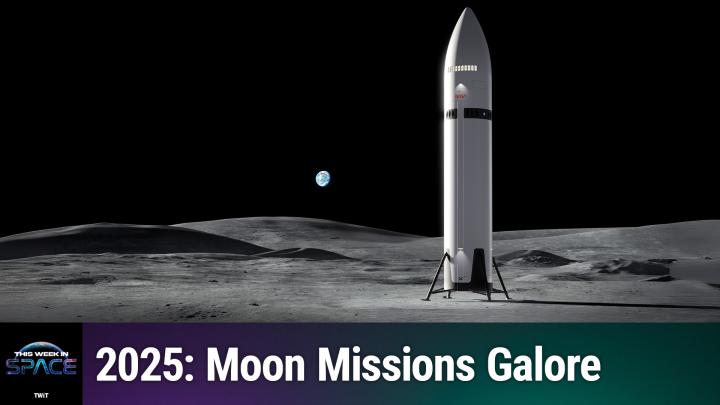
All TWiT.tv Shows (Audio)
This Week in Space 144: The Great Lunar Armada
01:15:57
2025 Will Be a Big Year Moon Missions
Loading summary
Transcript305 lines
- [00:00]
Tarek Malik
On this episode of this Week in Space, we are going to the moon with the great private lunar armada to see who's going to the moon, when they're going to get there, and when do we get to go?
- [00:12]
Rod Pyle
Podcasts you love from people you trust. This is Turt. This is this Week in space, episode number 144, recorded on January 17, 2025. The great lunar Armada. Hello, and welcome to this Week in Space, the Great Lunar Armada edition. I am, of course, Rod Pyle, editor in chief, Mad Aster magazine. I'm joined to my chagrin by Tarek Malik, chagrin, editor inchief@space.com. hello, sir.
- [00:46]
Tarek Malik
Hello, Rod. Hello, Rod. Happy Friday. Happy podcast day.
- [00:51]
Rod Pyle
This is actually the highlight of my week, I have to tell you.
- [00:54]
Tarek Malik
Oh, I'm getting all warm and fuzzy inside.
- [00:57]
Rod Pyle
So that's it.
- [01:00]
Tarek Malik
Well, what? Oh, it's the highlight of my week too, Rod.
- [01:03]
Rod Pyle
There you go. Very well said. I've had. I've had three people write me in the last month saying that clearly it was the highlight of your week, so I'm taking that as gospel. All right, before we get cracking here, as, as always, I ask you to do us a solid. Make sure to, like, subscribe and do the other podcast things that will keep us feeling warm and loved and on the air. And also, Anthony, is the audience survey still going? Yes, it is. All right, that means it's time for you to take this last chance to take the 2025 TWiT Audience Survey. This is an annual survey that helps TWiT understand the audience that we're talking to so we can improve your listening experience, which, believe it or not, despite what you hear on this show we worry about all the time. It only takes a few minutes. It's quick and easy. If you go to TWiT TV survey, you can take it. And please don't wait. Take before it closes at the end of this month, because it'll help make TWIT even better, and that will make them come to us with torches and pitchforks and make us even better. Speaking of getting better, it's time for the space joke.
- [02:15]
Tarek Malik
Hey, yeah.
- [02:16]
Rod Pyle
From this week's Joke Armada, this week's groaner comes from Nate Tanner. Hey, Tarek.
- [02:23]
Tarek Malik
Yes, Rod?
- [02:24]
Rod Pyle
What did the gantry say to the SpaceX Starship booster as it took off?
- [02:28]
Tarek Malik
What? What did it say?
- [02:30]
Rod Pyle
Catch you later.
- [02:33]
Tarek Malik
Very appropriate.
- [02:34]
Rod Pyle
Did we use that one before? I don't know. Familiar. But I. I really did like that.
- [02:39]
Tarek Malik
If we did. I like it. Thank you, Nate.
- [02:41]
Rod Pyle
Yeah, thank you, Nate. That was Definitely worth a revisit if.
- [02:43]
Tarek Malik
Yeah, we should reserve the right to use it again too.
- [02:45]
Rod Pyle
And that was a good one. Well, probably end up cycling through all the good ones twice eventually. Yet I've heard that some jokes want to expose themselves to a lunar vacuum when they hear our jokes. But you can help send your best, worst or most based joke to us@TwistWit TV. Now let's do some headlines.
- [03:06]
Tarek Malik
Headlines, boy, headline news. I love it.
- [03:15]
Rod Pyle
Thank you, Australia. And Alice, it's probably not hard for regular listeners to guess what our first headline would be. We had an explosive display with Starship's test Flight seven yesterday.
- [03:29]
Tarek Malik
That's right.
- [03:30]
Rod Pyle
And you know, it was halfway good. They caught the booster.
- [03:35]
Tarek Malik
Yeah, well, yeah, well, this was, this was. I think all of our news stories this week are from Space.com but they were very widely covered by other folks. But just a day before our podcast recording, SpaceX launched their Starship Flight 7 test flight. So this is their seventh test flight. It's also the first flight of a brand new starship vehicle. I don't think they're calling it V2, but they kind of had the pro and the con. You know, they successfully caught the booster again, this time with really awesome camera views of the booster coming down from the gantry arm itself, which was crazy. And that seemed to have go very, very well.
- [04:10]
Rod Pyle
But.
- [04:11]
Tarek Malik
But shortly after that, they lost contact with the ship itself. And. And so the ship, they think had a fuel leak as of the, the initial. Like, what is that? Analysis from Elon Musk. And it started a fire that then blew up the vehicle. And we know it blew up because we've got video of the debris falling over Turks. And do you say kakao? Is that how you pronounce kaikos? I think kaikos, yeah. And I actually got called by a news writer from there last night.
- [04:41]
Rod Pyle
Video.
- [04:41]
Tarek Malik
I know, isn't it in this, in this video that people are seeing on our, on our video stream? It's. It's like cell phone video of the rocket going up and then it just explodes. And then in another clip you see just this huge, massive, fiery debris. I mean, the starship is like 120ft tall. It's really big and it's just all coming down over these, this like the kind of palm tree area. Really, really tropical, really lush. Other videos I've seen are people working where it's passing right over their house or over ships and boats that they're on. So there is an FAA investigation into this now because this is different than the Standing FAA license approval that for failures that they have, which means that, you know, there's no threat to loss, there's no threat to life, there's no threat to property. When you have debris passing over populated areas, there is that threat, I would assume. So we're going to have to see how this investigation goes. But it was a brand new version of Starship. Lots of different changes. More propellant, 25% more propellant, new flight computer, different flap design, a lot of new reentry heat tile technology. Somewhere some, you know, something caught fire and, and they're going to have to figure it out.
- [05:53]
Rod Pyle
Well, so the specifics I read at least these are the musings of Musk was that the fuel leak was in the inner tank area. So it would be between the methane, the liquid oxygen tanks and that they think it caught in there. So when asked what he would do, he said we're going to put a sensor and a fire suppression system in there, which I guess that'll work. You know, you think you could just expose it to the vacuum. But whatever the case, that's how he plans to deal with it. And there's been a certain amount of pushback from, you know, on social media about, oh, you know, Elon takes a giant step backwards and look at, look at new Glenn and how well that flew and slam. That's true but you know, this was a brand, as you point out, a brand new version of Starship. It's longer, it's got more fuel, it's more powerful, it's more capable, carry more payload, so on, so on. So you know, it's basically a new rocket with new systems in it. It's not, not everything scales one to one, right? So you have to give it a break here.
- [06:58]
Tarek Malik
And I would just, I would just remind everyone, and this is a company that lost a NASA payload rocket, you know, and then six months later, you know, return to flight. SpaceX has been building these ships at scale. It's not like they don't have another one like already complete and ready to come out to test again.
- [07:15]
Rod Pyle
Or another five.
- [07:17]
Tarek Malik
Yeah, exactly, or five. So they are going to come back from this. I think that the big question now is how much of a hit will the FAA investigation into this because of the reentry over clearly populated or near populated areas. Will that slow things down more than past failures, you know, have, have done? And we'll have to see because that is like a really big concern that the FAA has had since they are fairly close to a populated area where they Launch from with the world's largest rocket, you know, and so we're going to have to see how that all goes. But it's interesting you mentioned New Glenn because I think that's next on our list of big stories. So.
- [07:55]
Rod Pyle
Yeah, and I'll just say, you know, once they start launching from Kennedy, I think they can avoid populated areas going in an equatorial trajectory. It's that weird Texas launch site that sends them out, you know, over Florida, of course. And then, you know, you have to make a decision. Do you go straight and go out through the Caribbean where all the friendly countries are or do you arc south and say, oh that's Cuba, we don't care. Which would be mean. But you know, this is Mr. Musk, you never know what he's going to do or say.
- [08:27]
Tarek Malik
I think rule number one is don't, you know, build your rocket so it doesn't blow up and then you don't have to worry about a lot of that stuff. Right. Because it'll, it'll get to space pretty easy.
- [08:36]
Rod Pyle
So I'm just a bit cold hearted.
- [08:40]
Tarek Malik
I'm not trying to be mean. I mean this is, this is the iterate, right?
- [08:43]
Rod Pyle
Yeah.
- [08:44]
Tarek Malik
They revel, they revel in their failure so that they can look, I mean pretty soon there's going to be a super cut of all the starship failures. Yeah, yeah, Elon will do.
- [08:51]
Rod Pyle
And, and that's okay. Just don't do it over, over occup. People get hurt. That's all we're asking Mr. Musk because I, deep in his heart, I think he really does like humanity in some cold way. All right, next up.
- [09:05]
Tarek Malik
Watch yourself, Rod. We're gonna get letters.
- [09:08]
Rod Pyle
So hey all, all PR is good pr. Next up is Blue Origin finally launches New Glenn. Let me just preface this by reminding our, our lovely listeners it's been as of this month, 25 years since, since Blue Origin started even earlier than SpaceX by a couple of years and it's a long time in coming. Clearly what they've done is taken the more established legacy aerospace approach to get everything perfect before the launch. So they started working with their little tourist rocket, the new shepherd that's flown.
- [09:47]
Tarek Malik
40 times, I think 20, right. They're not on 30s, are they? Okay, they're in the 20s.
- [09:54]
Rod Pyle
It's flawed a bunch of times and let them work out, you know, some of the concepts here. Different engine, different design, but it is flying a rocket. So you learn a lot doing that. And their, and we first flight of this one was remarkable.
- [10:08]
Tarek Malik
Yes. Like 17 hours before SpaceX launched Starship, it was all on the same day. You know, it was a really crazy, crazy day.
- [10:15]
Rod Pyle
But and let me just add for SpaceX, that was right after they launched a Falcon 9 with of the two lunar payloads that we're going to be talking about a little later.
- [10:25]
Tarek Malik
That's right.
- [10:26]
Rod Pyle
And other rocket activity this week. So they just, you know, SpaceX just really knows how to roll in volume. Sorry, go ahead.
- [10:34]
Tarek Malik
No, no, the, the, I would point out that Blue Origin hasn't been spending 25 years on like developing the new Glenn rocket. They announced New Glenn in like 2015, 2016, something like that. So it's, you know, it's been a good chunk of time.
- [10:48]
Rod Pyle
But same year Starship was announced.
- [10:50]
Tarek Malik
Yes, that's right, that's right. It was the same the same year Starship was announced. And, and so, so it's a larger rocket. This is a new heavy lift rocket for, for Blue Origin that has a 7 meter diameter. So it's like 23ft bigger than most everything else except for Starship that's out there right now. Starship's at nine meters, I believe. And, and for all intents and purposes, aside from the fact that we got no views from the upper stage, you know, the rocket got to orbit just fine on its debut flight. They did try to catch the booster. It's supposed to land on an offshore ship just like SpaceX's rockets, but they had some sort of issue on the way down and they lost the booster. So, so that, that attempt failed. But that was kind of gravy, as all rocket landings are allegedly are for SpaceX too. They always say that that's not the core, but now they try to assure that, that it'll be successful before they launch and they'll delay. So, so that'll be the end game to help cut costs for this new rocket. But this will be really interesting to see how the next flight goes and if they're able to successfully land these, these huge rockets too. So, but big, big, big kudos because it seems like it went completely fine all the way up with these brand new BE4 engines, the BE3U engines that there's two of them on the vacuum stage. Jeff Bezos tweeted out a picture of the Earth from the, from the upper stage. It's pretty cool.
- [12:14]
Rod Pyle
So, so interesting when you start looking at the numbers. So the BE4 is about half million pounds of thrust, which is about a third of what the Saturn 5F1 engines were. Depending on which version of those, you're talking about and about the same as a new generation Raptor. I think the Raptor is actually more like 550 or 570,000 pounds of the rust. And then you've got of course the rocket structure, which because it's going to be reusable, has to be a little more substantial than an expendable rocket. And you have to of course have enough fuel to fly back. So it's interesting trying to compare the numbers between these rockets. You really can't because Starship and New Glenn are so different. I do have a soft complaint if I may, because we're media guys.
- [13:02]
Tarek Malik
Yes.
- [13:03]
Rod Pyle
And if you watch the first launch attempt, the commentary was so lightweight and social media and oh, this is so cool. And you know, Tiffany and Amber were going back and forth with their comments and I realized I'm sounding like a grumpy old man. And I have to confess again, going back to the Apollo era, which I do all too frequently, you know, we had before launch and right during launch we had Jack King who was the voice of launch control and it was just telling us how it was. You know, the arm is retracted, the crew says it feels good doing the countdown, all engines running, all that stuff. I liked that I did not like. Wait, wait, I did not like when NASA started doing these paragraph long commercials every time something launched saying a new dawn for heavy industry in orbit or whatever it was. But now we've gone to this kind of third extreme, which is like the rocket wives of Orange county talking about, you know, I think how cool.
- [14:14]
Tarek Malik
The ones. I take your point. I take your point.
- [14:16]
Rod Pyle
Okay, I'll stop on that.
- [14:17]
Tarek Malik
But let me just add, you're getting close to digging yourself into a hole.
- [14:20]
Rod Pyle
Yeah, I know, I know. All right, but let me just add. So that was one thing. Another thing was they kept cutting away to the rocket itself and then the voice circuit went dead and we just stared at it for three to seven minutes at a time with no voiceover, which was weird. And then the real strange one for me, and they only did it on the first attempt. I don't think they did on the second. Instead of doing a launch hold like we were used to with NASA and SpaceX, everybody else, the numbers would just suddenly punch up so it's like T minus 5. No, wait, just kidding. T minus 25.
- [14:55]
Tarek Malik
So I. Okay, defend my friend. I'm not going to defend. I think there's, there's a lot that Blue Origin can learn about running an orbital class launch webcast. Right? They, their Blue Origin, New Shepherd Flights are very short, you know, 10, 15 minutes. The webcast, you know, from like the launch part point of view, they don't have to be that involved. I think that you raise some really valid points from like the media and the public awareness site. In the first half an hour of the live stream they kept talking about how it was launch day, launch night, launch night and they did not give an actual launch time whatsoever and only.
- [15:34]
Rod Pyle
Or any other facts really Exactly.
- [15:36]
Tarek Malik
It was just about how exciting it was. And yeah, and again I think that that's, it's because it's the first one and so they really need to, to see like what, what's what and there. So it was a lot of, of of kind of commercial, you know, stuff about how great Blue Origin is. But there wasn't a. All right, you know the rocket is, is on the pad. It's this tall. We're launching at this time. We're currently at team. Let's hear the background of the audio loop from mission control going in the background which I think would be very helpful for a lot of that. They did have a separate clean out feed that media could, could get, you know, by, by asking which would.
- [16:07]
Rod Pyle
But the public wasn't hearing it.
- [16:08]
Tarek Malik
But the public wasn't going to hear all of that. And, and I think that would, that, that would have gone a long way to do it because then you would know when they call a hold when they would do this. And, and I think it's a little bit more dynamic that way. But it is a private company and they might want to keep that kind of stuff internal, you know, to their, to their employees or whatnot. Maybe they want to make sure that really proprietary. But I take the point, I take the point well. Just I think that it's beginner jitters and maybe you'll get better as things wear on. So.
- [16:38]
Rod Pyle
Okay, but, but can you really claim beginner jitters when they've done at least a couple of dozen flights of their tourist rocket and you know, and I've got issues with SpaceX, SpaceX's coverage as well, but at least I didn't see him the last time I watched. But they had that engineer on who, although he had kind of a funny voice for radio, you know, he gave you the technical aspects of. Okay, and here we're coming up on Miko and that's when the main engines cut off because we're worried about Max Q and all that kind of stuff. I mean he explained things and they kind of did. I shouldn't completely shortchange Blue Origin. I mean, the, the, the host did kind of explain some of that, but the giddy factor just really caught me on, on the back foot. And the last complaint, the guy they had down with the crowd on the beach.
- [17:29]
Tarek Malik
I mean, at Cars park there was that. Is that Cars park, right?
- [17:33]
Rod Pyle
Yeah, yeah, that's. I was having like serious hipster overload there.
- [17:37]
Tarek Malik
Cars park is like a huge park near like on Merritt island on the way out to the, to Cape Canaveral, whatever, where it's just a big public park. But I, Yeah, I think that they, they rented that out or whatnot for their own big.
- [17:53]
Rod Pyle
Yeah, they had, because you couldn't get.
- [17:54]
Tarek Malik
There, the media site. We had a writer for the, out there for the, for the first attempt. And the media site was like 10 miles away at some hotel on the beach. I mean, you could get closer like on your own to try to get it. So I think, I think there was a, there was a lot to be desired there that they're going to have to probably like, look, I know that there's like our writer that was there mentioned that there was like no one there to talk to let them know what was happening. And he was finding out about new launch times by our launch updates in our internal chat that we were following. So I hope it gets a bit smoother going forward because eventually they'll be launching payloads for customers, not just Amazon, and they're hoping to launch a moon lander for NASA with this thing after like Artemis 4 or 5, something like that. And we'll have to see how it progresses. And I think that, I think that it will, but it's a valid point. I think that you should have more cameras on the upper stage of the vehicle that are public. You know, there might have been tracking station concerns where they don't get all the signal down all the time because it did sound as if the people in mission Control and other. Other people watching a different feedback were able to see a lot of the events that we couldn't see in the public broadcast, but we weren't able to see them there. And I think that might have been some sort of tracking station like issue or whatnot because they don't have Starlink. Maybe once they have their Kuiper belt thing, they'll have it.
- [19:21]
Rod Pyle
We talked about this a little bit on slack during the week, you and I, but I think it was spaceflight now. I get them and NASA spaceflight mixed up. But I think it was spaceflight now that was given a very. What's the word. I don't want to say constrained, but a very matter of fact. Blow by blow. Yeah. Very matter of fact. Those guys are happening next. Yeah. And I thought, okay, that's, that's how it's done. And these are people, you know, they're, they're entrepreneurs that are doing this. They're not funded by anybody except their, their viewers. So I was very, very impressed by that. We got to go to break in a second. But just to whine about this one more time, I know I've done it on the air before, but I was at a launch out at Vandenberg, out on this windswept, rocky bluff in the freezing cold, waiting for a Falcon 9 to take off. And there was like nothing. It was just a dirt bluff. There was no speakers, no monitors, no countdown, no nothing. We're just sitting there, you know, trying to listen on our. We couldn't get cell signals. So, you know, if you didn't have a radio station covering it, you were sort of done. So finally this Air Force, this beat up old Air Force truck shows up when some young, young people in uniforms get out and they start laying out cable. I mean, it looked like something from World War II. You know, they're rolling out cable and they bring out this big speaker on casters and stuff. So we finally are getting the voiceover, but it's the. Sorry, their narrative. But it's like one channel from mission control that had like, you know, valve updates every, every two minutes or something. So that wasn't helpful. So finally the young lady who's the PR liaison gets out and starts giving a talk. So all the cameras swing that way and as she's still talking, I hear this gasp and turn around and the rockets taken off. And we all miss it because she was jabbering in the middle of it. And it's like, well, lesson learned. Don't let them handle it.
- [21:11]
Tarek Malik
One thing that I would point out is that there is a trade off when private companies are running their own launches. And technically they don't have to provide any of this stuff if it's not in their.
- [21:23]
Rod Pyle
They can just push the go button.
- [21:25]
Tarek Malik
Right? So I am just grateful that we have these launch webcasts. Whatever gripes we might have about, you know, picture or whatever, let's just make sure that we let everyone know we don't want them to stop. Right? So we won't ever know what's going on. So we'll have to see how that goes. Because that's what Virgin Galactic did. They stopped Webcasting you know, and you just find out about it when they tweet about it.
- [21:48]
Rod Pyle
So soon they may start flying, stop flying altogether. But we'll see. All right, we're gonna go to a break, so everybody go in standby mode. We're on a launch hold for the next number of seconds.
- [21:59]
C
If you love your phone but not your carrier, just switch to T Mobile. You can keep your phone, keep your number, and we'll help pay it off up to 800 per line. You can also use our savings calculator to compare our plans and streaming benefits against Verizon and AT&T. So switch and keep your phone, keep your number, and keep more of your moolah. @t mobile.com up to 4 lines via virtual prepaid card.
- [22:20]
D
Allow 15 days qualifying, unlock device, credit service port in 90 plus days with device and eligible carrier and timely redemption required. Card has no cash access and expires in six months.
- [22:29]
E
I'm no tech genius, but I know if I want my business to crush it, I need a website. Now. Thankfully, bluehost makes it easy. I customized, optimized and monetized everything exactly how I wanted with AI. Within minutes, my site was up. I couldn't believe it. Plus, Bluehost keeps me protected 24 7. No more worrying about hackers. I just relax and focus on my customers. So whatever your hustle may be, secure your online presence in 2025 with Bluehost. Head to bluehost.com to start now.
- [23:04]
Tarek Malik
I see what you did there, Rodney.
- [23:05]
Rod Pyle
I like that.
- [23:06]
Tarek Malik
Okay, very appreciated.
- [23:08]
Rod Pyle
So India is doing it now, man. They've, they've reentered the competition.
- [23:14]
Tarek Malik
Yeah, yeah. This, and this will be really important for our talk about, like, the moon missions coming up, but this week, actually, India became the fourth country to successfully perform a docking in space, where with their Spot X mission. Spot X is actually, is an acronym that is short for Space Docking Experiment. And this was their first attempt at, at an uncrewed automated docking system. So you've got a target vehicle, a chaser vehicle, and the chaser just over time, approaches, gets closer, does an automated rendezvous. This is something that SpaceX does with their Dragon. It's what Russia does with Progress and Soyuz. And it's kind of the approach du jour for future missions. And for a country like India, this is going to be a key independent technology that they need for, for the future of their space ambitions. They want to build a astronaut space station around the moon. They want to do a sample return mission that we'll talk about later. From the moon. And to do that they need this technology. And there's a bit of a slow go a bit after launch because it was only supposed to take a few days before they did it. But they saw that they were seeing higher than anticipated movement rates after it finished its maneuvers. Like it would keep moving when they thought it would stop. And they had to study that for a little bit. But it seems like they got all of that dead to rights and they were able to make this happen pretty smoothly. So that's really exciting. They will have more approaches and more tests over time. And they also have a whole separate free flying science platform on their Poem 4 module that is testing robotic arm work. An Inchworm like arm like on the Space International Space Station, a space debris capture arm. A lot of really crazy stuff that they're going to want to use on future missions.
- [25:04]
Rod Pyle
So if they're interested in a lunar station, I, I can make them a great deal on a not yet used but slightly aging lunar Gateway. That's right. You think? Because it doesn't appear to be going anywhere. And I'm. I can't believe. Assuming that the incoming administration gets its way with human space flight, I.
- [25:27]
Tarek Malik
They won't want to wait. That's good for Gateway before they go there. Yeah, we'll have to see. They've already sold services though, for. They've already bought services. SpaceX is, is, you know, building the, the cargo thing for that and Northrop Grumman's building other parts. So I don't. That'll be interesting to see how those agreements go forward.
- [25:43]
Rod Pyle
So I wonder how much they've spent on that because we know how much they spent on sls, but I haven't seen the expenditures of Gateway yet.
- [25:50]
Tarek Malik
Yeah, I do not know. We have to figure that out. We should do a whole. We should do another episode on Gateway.
- [25:54]
Rod Pyle
Right, There we go. Oh, who are we gonna get to come on and talk about that? To take somebody hostage.
- [26:02]
Tarek Malik
But yeah. All right. Tip of the hat to India Space Research Organization. Yeah, well done. Look forward to bigger and better things in the future.
- [26:10]
Rod Pyle
Well, and their crude flights are picking up pace.
- [26:14]
Tarek Malik
Yeah. We should be getting hopefully a potential prototype of an astronaut vehicle launch by the end of the year. That's a goal with the first flight next year or so.
- [26:25]
Rod Pyle
All right. And now coming down from the heights of new space to the misery of living on Earth. Need to talk a little bit about the fires in la. Of course. We talked about this last week probably. I think the closest Fireline got to me was about five miles. But unfortunately a lot of people at JPL can't say the same. JPL emerged unscathed, except possibly for some smoke, some residual smoke damage. But the neighborhood around it, it's incalculable. So I drove up to that area. We're seeing an aerial on the video now from KBC News 7 chopper. I drove up to try and deliver some supplies to a friend of mine who stayed put, kept like a fool and was hosing down his roof. He did manage to save his house. Many in his neighborhood were not saved. But of course then the water pressure went flat and it was just sheer luck that he didn't get taken away. Anyway, that whole air. I was trying to take some food and water up to him because they have no services at all and pass it over the, the barricades set up by the National Guard and I expected them to be up in Altadena, but they were not. They were like three miles south of there and that's how big an area they were afraid was going to burn. But at this point it looks like it's somewhere between seven and nine thousand structures destroyed, most of which are single family homes, most of those are turn of the century, early 20th century houses. It's a fairly old neighborhood. So besides the absolute staggering loss of that, we've got what effectively is the world's largest Superfund site because there's a ton of toxins there. There's asbestos, there's arsenic, there's. There was a lithium battery storage yard that burned out. There's lead pipes, there's all this stuff. So just the air we're breathing is terrible. So it's just a big mess all the way around. But more to the point, Caltech and JPL set up a disaster relief fund and we'll put the URL in the show notes because it's pretty long. But they, it's a reputable, reputable effort. And let me just look at the URL here. Come on, come on up. I would say should and with.gov so you know that you're either got.gov or.edu let me look. Go ahead. Sorry.
- [28:54]
Tarek Malik
No, I was going to say that the impact of the fires was very much felt where I was at the national harbor meeting of the American Astronomical Society because many of the scientists, of the engineers, of the researchers from the Southern California area were supposed to actually present, you know, their career defining research at this conference. And, and that is something that they build their whole, their whole work, their whole lives around being able to present and show what they've done in their field as experts, as thought leaders. And, and there was, there was a very noticeable absence because those people have been affected by, by the fire. They don't have homes to go to or they're trying to just, you know, sort things out. It came up during the NASA town hall where they were talking about the Deep Space Network. We talked about that last week with, with Leonard. First time in 60 years that there's no one in mission control at JPL. They're doing it out of Monrovia, apparently a backup site right now, which they didn't have before. So, so it's just, it's just a tragedy across now for the people that were affected by the, that were, that hope to go to aas. They gave, they at least gave them some refunds and so they don't have to worry about that. NASA has relaxed their deadlines for funding research. So that's future career work that these people who have, you know, don't have homes or have lost everything, you know, they want to ease the stress of that kind of professional deadline too. They're going to, they're going to give them some consideration for the future. So at least there's like small things that people were able to do to help the careers of these people that are imperiled by the fire. But this funding is, this fundraiser is very, very helpful just to get them some basic things that they need for life.
- [30:42]
Rod Pyle
And so to make sure you're on the right website for giving, the prefix section is giving Caltech Edu and then slash areas to support relief and so forth. But just make sure on the Caltech Edu server when you're doing that so you're not given to the wrong folks. You know, the one thing that really, this isn't space news, but it's frustrating to me anyway. Besides, all the things that usually happen in this kind of a crisis is the state came out and said, hey, you know, we're, we're not going to take, I guess it's county, we're not going to take full property tax from you if your house burned down. So the people went, oh, that's a relief. But then they continued to say, we'll remove the value of the structure and you just have to pay on the property. Well, in Southern California, your property value is about 80% of the value of the entire shebang. So here are all these people that have had their entire lives taken from them in some cases and who have to find another place to live in an already overheated market and the prices are going up because people are gouging even though it's not legal to do so. And they're still going to have to pay tax on the dirt and ashes where their house used to be while FEMA comes in and tries to figure out it's probably going to take between a year and 18 months to bulldoze and take all this stuff out. So to me, that just adds misery to tragedy. You know, I think it's really a shameful thing, but that's the county for you. All right, Anthony, do you want me to take a break before we move on? Yeah. Okay. So we'll be right back after this short break. Don't go anywhere because the excitement's about to begin. Stand by.
- [32:26]
C
If you have a locked AT&T phone, we're here with bolt cutters. T Mobile will help pay off your locked phone and give you a new 5G phone for free. All on America's largest 5G network. Visit t mobile.com carrierfreedom via virtual prepaid.
- [32:41]
D
MasterCard in 15 days. Free phone up to $830 via 24 monthly bill credits plus tax and a $10 device connection charge. Qualifying port in trade and service on Go5G next.
- [32:49]
Rod Pyle
And credit required.
- [32:49]
D
Contact us before canceling entire account to continue bill credits or credit stop and balance on required finance agreements. Deal bill credits. And if you pay off devices early.
- [32:57]
F
Hi, I'm Cindy Crawford and I'm the founder of Meaningful Beauty. Well, I don't know about you, but, like, I never liked, oh, wow, you look so good for your age. Like, why even bother saying that? Why don't you just say you look great at any age? Every age. That's what Meaningful Beauty is all about. We create products that make you feel confident in your skin at the age you are now. Meaningful Beauty. Beautiful skin at every age. Learn more@meaningful beauty.com.
- [33:32]
Rod Pyle
The great moon armada is embarking.
- [33:35]
Tarek Malik
That's right. Again. Right. Well, we had that last year, too. Had a fleet of them go out last year, too. But now, now it's. Now it's really going to happen. Now this is.
- [33:43]
Rod Pyle
Well, you know, fingers crossed. This is the. The age of. Of commercial ventures, and I really, really, really would like to see a completely successful landing this year.
- [33:54]
Tarek Malik
Yeah.
- [33:54]
Rod Pyle
So we've got two tries going off, one from a private company and one from Japan that left last week or earlier this week. Excuse me.
- [34:04]
Tarek Malik
On the same rocket. They left on the same rocket on.
- [34:06]
Rod Pyle
The same Falcon 9. So that's exciting.
- [34:10]
Tarek Malik
Yeah.
- [34:11]
Rod Pyle
Right.
- [34:11]
Tarek Malik
Yeah. Well, do we want to talk about, like, what would actually happen and before we start putting it into concept, concept, con, context. I got there. I got there in the end. Whoo.
- [34:23]
Rod Pyle
All right, we could do that or we could sort of give a background or of how all this commercial stuff.
- [34:28]
Tarek Malik
Kicked off really, really, really quickly. The reason we're talking about the lunar armada is because this week space X's Falcon 9 rocket launched to count them two. Two, two private missions to the moon. One of them is Firefly Aerospace, is Blue Ghost, which is supposed to arrive, I think, in March 2nd memory service. And the other one is the Resilience lander by icepace from Japan. And we're going to talk a little bit more about those two in a bit, but that's the background. That's why we want to talk about that, because they are not the only ones going to the moon this year and not by a long shot. So. All right, where did these missions come from? Leonard? Leonard. Wow.
- [35:17]
Rod Pyle
Let me put on my. My mountain man beard.
- [35:21]
Tarek Malik
Oh, I mean, Rod. I mean Rod.
- [35:26]
Rod Pyle
I'm sorry, what's that, Mortimer? So years back. Yeah, years back, Google in their. In their vision, and I give them credit for this, set up the Google Lunar X Prize where they were going to give. I think first it was 20, and then it expanded to $30 million to the first private entity that landed a. That landed on the moon with hardware and was able to traverse 500 meters. And whether that was done on wheels or jets or whatever was up to you. I don't. Did it have to pick up a sample? I don't think so.
- [36:03]
Tarek Malik
No. It was just.
- [36:04]
Rod Pyle
You had to move. Yeah.
- [36:05]
Tarek Malik
And you had to have pictures.
- [36:07]
Rod Pyle
So, you know, a lot of people jumped in on this from all over the world, and a lot of progress was made, but nobody actually got off the ground in time. And finally Google ended the thing and I think 2019.
- [36:20]
Tarek Malik
Yeah, yeah, they. They just. They closed it. Nobody won. Nobody got the money, and they got.
- [36:25]
Rod Pyle
To save their 30 million bucks. However, a number of other contenders continued and did manage. Some of them got money from their respective governments. Some just continued plotting away. A lot of them folded up shop and gave it up because there was no. No golden pot at the end of the rainbow. But that was the genesis of. Was it one or both of the ones that went off this week? I don't think that's what started Ice Base. Maybe it was, but certainly the.
- [36:58]
Tarek Malik
The other one was with the Fireflies. I thought I. Space was a progenerate from there, so.
- [37:06]
Rod Pyle
It might have Been See, I get I space and I capital S space mixed up. They're Chinese. Yeah, definitely. They weren't part of it. So I guess the Japanese one may have been.
- [37:15]
Tarek Malik
Yeah, because I know that Space Il was and that Astrobotic was a big contender for their. We'll talk about them in a little bit too.
- [37:22]
Rod Pyle
Yeah.
- [37:22]
Tarek Malik
And then Blue Ghost came as Firefly solidified their, their spacecraft approach beyond their rocket approach.
- [37:30]
Rod Pyle
So, so as long as you brought it up, why don't we talk about those two missions?
- [37:35]
Tarek Malik
Yeah.
- [37:35]
Rod Pyle
What are they going to do? And by the way, I just discovered yesterday our friend of the show, Steve Jurvetson actually has a payload on the Blue Ghost lander.
- [37:44]
Tarek Malik
Oh wow.
- [37:45]
Rod Pyle
He like made his own payload. I don't know how you do that, but he did it.
- [37:50]
Tarek Malik
So. So yeah. So which one do you want to start with first? Firefly or Blue Ghost? Blue Space Ghost. They should have called it Space Ghost, right?
- [37:57]
Rod Pyle
Take your pick.
- [37:59]
Tarek Malik
Well, let's start with Firefly Aerospace. Just because it's called Firefly and Blue Ghost. I think that that's a lot of fun. But, but this is, you know, an evolution from that Google Lunar XPRIZE is the lunar commercial payloads program that NASA runs Their, their clips Commercial lunar payloads. Pardon me, their clips program. And, and last year in 2024 we saw a few missions launch with under that guys. And this is the first of this year to launch there. So Firefly has a contract with NASA to land a probe on the moon that has carrying a bunch of payloads for, for customers of them are a lot of NASA experiments as part of their Artemis program. So that's what's happened. This is the Blue Ghost mission one Blue Ghost is the spacecraft, the lander that they've developed and their mission for this one is called Ghost Riders in the sky because I guess, I guess that's how we're naming missions Now I'm not against it by the way. I think it's really great that's getting them. But as Rod said, it's one of two, two missions that are, that are on board, that were on board the Falcon 9 to launch. And this one it's going to test, it's going to measure solar wind particles in Earth's magnetic fields, going to test radiation resistant computer hardware use, you know, GPS systems for navigation around the moon. And, and then once it actually gets on the surface, it's going to study the regolith, the heat flow on the moon, electrical conductivity under the surface, things like that. So it's Pretty, pretty slick. All of the, the things that they're going to do.
- [39:30]
Rod Pyle
Excuse me. But if they're studying heat flow, that means they've got to make that drill work, right?
- [39:34]
Tarek Malik
Yeah, that, that's, that's because we've been.
- [39:37]
Rod Pyle
Trying to study lunar heat flow since Apollo or 15, I think.
- [39:41]
Tarek Malik
Yeah, yeah. I mean, and they've got reflectors on there too. There's, there's quite, quite a bit on, on, on this mission, it seems like. And they're hoping that this is going to set the stage for it. They've got like, how many different experiments on board? I've got this, this big roundup that we have here and it's a lot. It's too many for me to count right now. And so the hope is that this is going to defy maybe some of the previous commercial attempts and actually land fully successfully. We talked about a couple of that in the past. And hopefully this will set the stage for what's coming up later this year. So resilience, which is a lot. Yeah, yeah, there's a lot. Resilience is a separate effort though. Like it's, they have some experiments on there which I think, I think NASA has one or two if memory serves. But it's primarily like an I Space full, full mission. And this one is really interesting because I Space did try to fly to the moon with their Akuto, our rover or platform before, and that was. That one failed. And so this is kind of their, their return to it. So it's a landing platform and then it has a little rover on it that's going to do things. They want to collect moon samples as well of, of the regolith. And I think they're, they're, they're developing a program like as NASA has asked for. NASA wants to buy lunar regolith samples of that. So I think that this sample collection is going to be part of testing the hardware to be able to eventually bring it back and then sell it to NASA or whoever wants to buy, I guess, some, some lunar regolith for science before the, instead of getting there and, and then it has a little micro moon rover that's going to jump like it's called tenacious. It's going to drive around with a little shovel to collect those samples and, and then take pictures of them with this camera. So it's pretty cool. It's got a water experiment to see if it's feasible to make oxygen and hydrogen from lunar water resources. It's going to. An algae food production module on and other Things. There's a plate, a commemorative plate. We too came here, you know, from, from, from Earth. And I think it has a. A charter of universal century from Gundam. Right. Which is a Japanese anime cartoon, which is.
- [42:05]
Rod Pyle
And I think the Blue Ghost has a hopper, if I remember correctly.
- [42:08]
Tarek Malik
You know, it's possible there's a lot.
- [42:10]
Rod Pyle
On this, which is interesting because I, I thought that a hopper would be nitrogen powered, but it's. At least. The one I read about is hydrazine. Using nasty old hydrazine, which we've been using for, you know, no ignition required reaction rockets since, well, since before Mercury. I think the thrusters on some of those early moon probes are hydrazine, not stuff you want to mess with. Very bad for you. No, but, but yeah. So they got at least one hopper going up to. Let's see. Let me look at the count here. I guess we should throw it another break because I want to come back and talk about the beginning of all this because I think the first one was Beresheet. Correct?
- [42:53]
Tarek Malik
Yeah. Bear sheet is, Was the space IL one. Yeah.
- [42:57]
Rod Pyle
So after the break, I should point.
- [42:59]
Tarek Malik
Out there's a vacuum on Blue Ghost too. They're going to use compressed air to try to collect wound samples. I think that's going to be really fun to watch. It's called, it's called Lunar Planet Vac.
- [43:10]
Rod Pyle
Is that direct deployment from the lander or on the rover?
- [43:12]
Tarek Malik
It's on. It's on the lander. It's on the lander, yeah.
- [43:14]
Rod Pyle
So that'll be cool. All right, stand by. We'll be right back.
- [43:17]
C
If you love your phone but not your carrier, just switch to T Mobile. You can keep your phone, keep your number and we'll help pay it off up to $800 per line. You can also use our savings calculator to compare our plans and streaming benefits against Verizon and AT&T. So switch and keep your phone, keep your number and keep more of your money. Moolah@t mobile.com up to 4 lines via virtual prepaid card.
- [43:39]
D
Allow 15 days qualifying unlock device, credit service port in 90 plus days with device and eligible carrier and timely redemption required. Card has no cash access and expires in six months.
- [43:47]
E
I'm no tech genius, but I know if I want my business to crush it, I need a website. Now. Thankfully, bluehost makes it easy. I customized, optimized and monetized everything exactly how I wanted with AI. Within minutes, my site was up. I couldn't believe it. Plus, Bluehost keeps me protected 24, 7 no more worrying about hackers. I just relax and focus on my customers. So whatever your hustle may be, secure your online presence in 2025 with Bluehost. Head to bluehost.com to start now.
- [44:23]
Rod Pyle
So this armada, the tip of the spear as it were, was the Israeli company SpaceIL to set up Beresheet Lander, the Bereshielander, which was another Google Lunar X prize venture in April 2019. And it was pretty simple. It was mainly a time capsule with a bunch of cultural stuff on. It did have a magnetometer and a laser retroreflector because, gee, I guess we need another retro reflector on the moon to see how far away it is. I mean there's about seven of them now. Yeah, we know how far it is. But of course the concept now was.
- [44:57]
Tarek Malik
We know how far it is for now, right? It's.
- [44:59]
Rod Pyle
Yeah, but the Apollo reflectors still work just fine and they're like 2ft by 2ft instead of these little things, 3 inches across, easier to hit anyway. But the controversy came up, but it was made public that the last minute they had included tardigrades and I water bears the other day. Yeah. And of course the concern about tardigrades is they can sit there for we don't know how long, thousands of years anyway, in basically an inert freeze dried state, like brine shrimp that you feed your fish.
- [45:34]
Tarek Malik
Don't you mean water monkeys?
- [45:37]
Rod Pyle
And then you add water a million years later and they kind of stretch and wake up and go, oh, what's up? So there was concern about that, but they're encased in a block of Lucite so it's hard to imagine how that would happen. You know, A and B. Of course whenever we talk about planetary protection protocols, it's the moon. I have not yet, not yet talked to a scientist that has said anything other than don't worry about it because it's in a pretty inert state. I mean the best thing that ever happens on an afternoon on the moon is that it turns to night or vice versa and you get micrometeoroid impacts and radiation and that's kind of your day.
- [46:18]
Tarek Malik
You know, you seem Team Tardigrade Rod like as opposed to Team Preserve the Moon. Is that, is that the case?
- [46:27]
Rod Pyle
No, I'm team, let's get on with it and stop worrying quite so much about.
- [46:31]
Tarek Malik
I don't know, in Apollo 18 they had those moon spiders, you know, so. Which I find absolutely horrifying. But if, if true.
- [46:41]
Rod Pyle
Yeah, that was a dumb movie.
- [46:43]
Tarek Malik
Okay. I tried to like, I Highly disagree.
- [46:46]
Rod Pyle
But yeah, but you probably liked Iron sky too, right?
- [46:49]
Tarek Malik
I. I thought Iron sky was pretty funny. Yes.
- [46:52]
Rod Pyle
So a friend of mine who I hired early on in my, my producing days at Disney Educational wrote that and I, I suffered through it and, and wrote him a note saying, mike, what happened? He said, I lost control. I said, you lost control of yourself? He said, no, I lost control of the script. And it just went. Because as you saw, you know, it goes in this wacko direction of what's her name from Alaska is now the President and she's got this force of dirigibles that are going to go up and shoot down the German Nazi planes coming.
- [47:30]
Tarek Malik
I think you're assuming that everyone knows what Iron sky and I don't know. I don't know if we want to really get into that.
- [47:36]
Rod Pyle
It's not worth going into.
- [47:37]
Tarek Malik
It is moon related, though. I mean, it is. So I could see, like how that could be part of it. They made a sequel to that too, by the way.
- [47:44]
Rod Pyle
Yeah. Which was no better than the first. Anyway, sorry. So bear a sheet. So we've got tardigrades on the moon that we have to worry about coming to life and, you know, growing ten times their size. No, sorry, a million times their size because of lunar radiation and attacking the first settlers. But we'll worry about that when we get there. That is starting discovery.
- [48:04]
Tarek Malik
They have a giant tardigrade that powers their warp core in that one.
- [48:07]
Rod Pyle
So there you go. But mainly I bring it up because it was an offshoot of the Google Lunar X Prize. So that's as close as it came to succeeding. And that one unfortunately crashed and it did.
- [48:17]
Tarek Malik
But they, it was a really novel. They were actually able to get off the ground and approach the moon before they had that, that failure. And that was. You're talking about private missions. They had their own big press conference ahead of the launch, fully independent, you know, like having experts available. I remember that Hanukkah Widering was writing for us at that time, and she went down there and like cover the whole thing, soup the nuts when they got off the ground. And so, you know, at least they were able to, to make the attempt. And you know, they were trying hopefully to. To come back from that. But they're not the. They're not the only ones. They didn't stop there. So that's good.
- [48:56]
Rod Pyle
Yeah. And then next we have Astrobotics Peregrine, which went up last year, Peregrine. And unfortunately suffered a propellant leak on the way. And I guess I'm Trying to remember the details of that. These are a lot of the subsystems they're using are commercial buys and I think that was one of the concerns about perhaps how that propellant leak started.
- [49:21]
Tarek Malik
Yeah, you know, the man you have to do mental gymnastics to try to remember as well. You know, I think that this was, this was really something, that it was a new vehicle. They thought they had tested it all the way through. They got up into space and conditions were a little bit different. You know, it gets all shaken around during launch and things can happen. They had the thruster leak and then they were able to control the vehicle because of it and they were able to restore some control. But by that point they had used so much propellant that, that they weren't going to be able to do like, like as have the finer control that they were going to need for, for the landing itself.
- [49:58]
Rod Pyle
So to be good custodians of the cosmos, they let it come back to earth and reenter.
- [50:02]
Tarek Malik
That's right. So it did decide to come back home and say, you know what, it's not worth it this trip, you know.
- [50:08]
Rod Pyle
So then you already talked a bit about Intuitive Machines. Im one mission which launched February 2024.
- [50:15]
Tarek Malik
I think you mentioned it earlier. Yeah, because we talked a bit about how 2024 was like the first Vanguard. These were all clips missions. These, these were the first ones to fly and intuitive machines I think also their, their Odysseus probe launched on a Falcon 9. Correct. Right. Yeah, I think, I think so. Everybody does. And apparently, you know, as one does and intuitive machines like got, got farther than, than most, you know, in terms of these commercial missions. Japan also had a separate mission too slim. The slim one. And that one has its own. But that was a Jackson mission. It wasn't a commercial mission. But intuitive machines got close, got close. They were, they landed a bit harder than they thought. And then the rover tipped over. So it was the lander. Yeah, pardon me. The lander tipped over and, and this one was a little bit sad because I was just at AAS and there was a, an like a, a radio telescope experiment on this one with five different antennas on the way out there. They got stuck. They didn't roll enough, you know that barbecue roll. And apparently because it got so hot, one of their antennas just like popped out on its own and they were like wow, that's interesting. We deployed early and they were able to do extra science because of that. But, but they were able to get five minutes of data at least for that experiment from despite having this, this rover tip on its side is a picture of it here. I keep saying rover man, I think I really want.
- [51:50]
Rod Pyle
But it had more rovers on the moon. It had any rover. It did deploy it.
- [51:54]
Tarek Malik
It did. It just couldn't because it was. It was tipped over. They think one of the legs got caught on a rock and it was like one of the legs was sticking up because one of the photos showed the legs.
- [52:04]
Rod Pyle
Did they actually quantify that? Because last time I looked at it, they were still kind of scratching their heads over exactly what happened. But when you look at. And I'm not an engineer, fully admit, but having looked at an awful lot of landers, both in photographs and in person, mostly NASA stuff, all robotic, I'll add, except for the lem. Looking at the leg structure of the intuitive machines for that tall vertical body. It looked like Tinker toys that were so thin, but they weren't strong enough.
- [52:34]
Tarek Malik
I think. I think that was. That was part of it. Right. They landed harder than they thought. Then you have these legs that were built a bit. A bit spindly again. They were confident that this was going to work. So maybe one of them crumpled a bit. And then because it crumpled and the whole thing tips over, maybe it landed. You know, it had a lot of stress on it, but it hit a rock because they were coming in a little bit sideways. That's very possible too. And then you pitch over a bit. They could see that the legs were sticking up in the air. So they knew that. That it was on an angle. One of the five antennas of the experiment that I was in a session at AAS was crushed because it was facing the ground now. And a few others did pop out and they were able to get like, as I mentioned, that five minutes of data from the moon.
- [53:15]
Rod Pyle
So I hate to interrupt, but Anthony gave us both a little reminder in the discord. So we have maybe 10 or 15 minutes left here and we have to get to the topic at hand, which is what's coming up. So why don't we start off with. You've talked about Blue Ghost a bit. Is there more to say about that?
- [53:37]
Tarek Malik
Well, I just. I think that this is going to be very interesting to see how Blue Goat goes, because this is actually the first of what they hope are going to be a series of moon Moon Moon landers and. And other other missions by. By Firefly. And I think. I think I'm a little bit excited to see their sample collection stuff like, because if they can demonstrate that they can successfully collect the lunar regolith with this vacuum thing, then that'll be another kind of economy, another kind of opportunity that they'll be able to open up going forward. So now it is going to try to catch the lunar dust to that level. You know what Cernan talked about, that glow on the moon horizon. They're going to try to use a 360 degree camera to see that, that weird stuff too, on, on the, on the surface. But they only get two weeks there. It's a lunar day. That's the, that's the length of this mission. So we're gonna have to hopefully see how long they're going to be able to last.
- [54:41]
Rod Pyle
Yeah, just, just got a comment. You know, we're still struggling and I get that these are early, early efforts, but we're still struggling with something that can last lunar night. When we had ALSEP experimental packages up there, admittedly they were deployed by astronauts in the 60s and 70s. Some of those outset packages lasted I think four to five months.
- [55:01]
Tarek Malik
Yeah.
- [55:02]
Rod Pyle
Not more. Because they're powered by. Because then we would just throw plutonium chunks anywhere to power these things. It's unfortunate we don't have very much left. All right, and before we go to our last break, let's talk about whatever else you've got on I Space. The. Just a quick history of them. They're part of a company called White Label Space, which I guess was originally out of the Netherlands. And again this was, was founded to respond to the Google Lunar X Prize, but they closed out the Netherlands side and the whole thing went over to Japan. So Hakuto R1 launched in 2022. That was a soft crash you talked about. And then Hakuto R2 Resilience just launched with Blue Ghost in January 15th. But that's going to take five months to get there. Yeah, long slow cruise.
- [55:50]
Tarek Malik
Yeah, that one gets there later in the year, by the way. We didn't say, But I think March 2nd is the targeted landing date for Blue. March 2nd. Yeah. So. But this Resilience is what this one is called, this lander. And it's, it's a bit more arty than Blue Ghost because it has arty, you know, like it. For example, we talked about the fact that it has a commemorative plate for the Gundam anime. Right. From Bandai Namco Research Institute.
- [56:20]
Rod Pyle
So that how could they bypass Godzilla san for that, you know?
- [56:24]
Tarek Malik
Well, I mean it's, it's. I think there's a moon base. There's a big base on the moon in that anime. I just started watching it, by the way. But they also have like, like the, the, the, the rover is carrying this small red house framed all in white.
- [56:40]
Rod Pyle
Yeah.
- [56:41]
Tarek Malik
By Swedish artist Mikhail Genberg. It's called the Moon House. And it's just, it's an art installation and it's going to be riding a tiny rover that is about a foot, it's about a foot foot wide. 10, 10 inches tall and about 21 inches long, you know, so it's, so.
- [56:57]
Rod Pyle
It'S a, I think it's about two thirds the size of Pathfinder back.
- [57:00]
Tarek Malik
Yeah, yeah, it's a, or like this.
- [57:02]
Rod Pyle
Little house, like right down front. Right.
- [57:04]
Tarek Malik
Yeah, it's like right on top of it.
- [57:05]
Rod Pyle
Yeah, it's really wild.
- [57:06]
Tarek Malik
And so, so it's going to be very interesting to see how all of that ties in to the science mission too, because you have this, this, this, you know, this test to produce food from algae, to make air and stuff from, from water. And then you have this little rover that's going to drive around with its little camera to try to scoop up samples. And then you've got the house, you've got this commemorative plaque. So there's a bit more of a, of a, of a ethereal tie that I think is really fun for that mission itself. And then part of that is that they're also going to do a deep space radiation experiment to monitor radiation levels on the Earth to Moon trip, which is really valuable to know both about the health of your spacecraft, which you have to safeguard them as well as your astronauts themselves too.
- [57:55]
Rod Pyle
So. Anthony, do I have permission to go one more story before we break?
- [58:00]
Tarek Malik
Sure.
- [58:02]
Rod Pyle
A shrug is better than, better than thumbs down. Okay, so IM two intuitive machines. IM two will be launched in February and this one's exciting because they have a, I think meter deep drill, a mass spectrometer, and they're aiming at Marsden Crater near the lunar south pole, where a lot of these things intend to aim eventually. This is the one, I'm sorry, this is the one that has a gas powered hopper which carries a neutron spectrometer. So specifically that can look for hydrogen signatures that may be indicative of water ice. Yeah. And excitingly, although the Chinese beat us to it, it also has a small lunar orbiter called Trailblazer to act, I think, as a relay, but also to search for water signatures on the surface. So this is kind of a, a whole bunch of things in one. This is kind of a potpourri project and it's an interesting combination of Lockheed Martin and JPL putting this together. And so it's, it's it's more of a government project than private industry. But because intuitive machines involved, it's kind of a conglomeration of all three. So it's still submission.
- [59:10]
Tarek Malik
And that, that, that drill, that's the prime one drill that, that NASA's really interested in and they really want to see it. By the way, the intuitive machines landers are called Nova C. Isn't that cool? Yeah, but no, Nokia, Nokia also has a 4G terminal they want to test like moon cell service on that, on that mission. That'll be pretty interesting to see how communications evolve on the moon as well. And, and that's a neat kind of thing to look at I think as well.
- [59:37]
Rod Pyle
And finally they have a Japanese mini rover called Yaoki, I think if I'm pronouncing it right, and a device from MIT called Micro Ant. So let's go to our last break and then we'll come back and wrap this up with all the other cool stuff that'll be happening later in 2025.
- [59:56]
C
Stay with us at T Mobile. We'll give you four free 5G phones and four lines for only $25 per line per month with eligible trade ins. And no, it's not a contest. It's every day for a limited time, everyone's a winner on America's largest 5G network.
- [60:10]
D
Minimum of 4 lines for $25 per line per month with autopay discount using debit or bank account. $5 more per line without autopay. Up to $830 off each phone via 24 monthly bill credit plus taxes, fees and $10 device connection charge for well qualified customers. Contact us before canceling entire account to continue bill credits or credit stop and balance on required finance agreement too. Bill credits end if you pay off devices early.
- [60:26]
F
CTMO.com the New Year's here. It's the perfect time to refresh those household essentials and score some cash back rewards with Colgate olive. From toothpaste to dish soap, chances are you've got Colgate Palmolive products on your shopping list and in your house. Right now we're talking brands like Colgate Soft Soap, Palmolive, Irish Spring, Fabuloso and Tom's of Maine. And right now you can get up to a $10 digital Visa prepaid card when you buy up to $30 of Colgate Palmolive products. Here's how it spend $20 on their products, get $5, spend $30, get a $10 reward. All you do is shop your favorite brands, snap a pic of your Receipt and upload it to cprewards.com it's so easy. That's cprewards.com so grab what you need or maybe try something new and get rewarded just for doing your usual shopping. And start your year fresh by earning cash back rewards with Colgate Palmolive rewards available while supplies last limit supply us only 1125 through 331.25. For full terms and conditions, visit cprewards.com.
- [61:27]
Rod Pyle
Blue Moon Pathfinder Mark 1.
- [61:30]
Tarek Malik
That's right, that's right.
- [61:32]
Rod Pyle
You know, finally we were just talking.
- [61:34]
Tarek Malik
About New Glenn and its success and so kind of on the docket and that's if they're going to progress is their, their Mark 1 Pathfinder Lander, which.
- [61:44]
Rod Pyle
Blue Origins.
- [61:45]
Tarek Malik
Yeah, yeah, this is Blue Origin. Pardon me, which is supposed to be their, their big push to, to do moon services. And this is a, a big lander that can deliver up to like £3,000 of stuff or mass.
- [61:56]
Rod Pyle
So it doesn't mean it's, it's bigger than everything we've talked about, but very small compared to what they're ultimately going to do, right?
- [62:02]
Tarek Malik
Exactly.
- [62:03]
Rod Pyle
About 10 times the capacity.
- [62:05]
Tarek Malik
Exactly.
- [62:05]
Rod Pyle
Kind of the proving proving ground for their lander contract because they are getting NASA money to do this.
- [62:13]
Tarek Malik
Yeah. And the goal is to see if this works. And then some of the other renderings of like future giant versions of the lander can like carry a rover on like a little hinge thing that'll, that'll be able to swivel it down after it gets down there. And of course Blue Origin wants to build a crude lander as well as a second option to Starship in the Artemis 4 or 5 time frame. And they're working on that. They would need this technology to be able to do it.
- [62:41]
Rod Pyle
Yeah. And it's, it's cool looking. It's kind of a, I don't know, it kind of harkens back to the lunar module a bit I guess without the, the pressurized volume above. But I think what's interesting is, you know, on the SpaceX side. So SpaceX and Blue Origin are the two contractors that NASA's made deals with to ultimately land Artemis crews on the moon. You know, SpaceX is all in with the lunar version of their starship from Blue Origin. I think I've seen at least three, maybe four different designs. The small one to the early Blue moon with which sadly I don't know if it was before or after their original unveiling. But you see the pictures, I think you ran them with Space.com, you know, had that glorious big cylinder or spherical fuel tank up front.
- [63:27]
Tarek Malik
Yeah.
- [63:28]
Rod Pyle
And then a few hours later it was deflated and hanging there like.
- [63:31]
Tarek Malik
Well, I saw, I saw it at the International Astronautical Congress way back when in 2019.
- [63:36]
Rod Pyle
Oh, name drop. Go ahead.
- [63:37]
Tarek Malik
Yeah, they had a, they had a live, they had a life, a life size version there. Yeah.
- [63:40]
Rod Pyle
But it wasn't deflated. You saw it, right?
- [63:42]
Tarek Malik
It was not. No, it still looked, it still looked cool spherical.
- [63:46]
Rod Pyle
But I guess my point is, you know, they seem to be looking at a variety of platforms and configurations to best suit the needs of that mission or that era of missions, which I think is, is very smart. Still scratching my head over lunar Starship, you know.
- [64:01]
Tarek Malik
Yeah.
- [64:02]
Rod Pyle
Very tall, very tippy on a very uncertain surface. And it's almost like you want to say, hey blue origin, you go first to build a landing pad and then we'll bring this thing down.
- [64:13]
Tarek Malik
Yeah, I mean I think it's like 126ft, I guess more depending on what they, I mean which they're flying. It depends on what version they're going to finally fly because when Shotwell has, has said that it's going to get bigger but, but they, they already testing the elevator that the astronauts are going to have to use to, to take down like the side of it. So that'll be interesting.
- [64:33]
Rod Pyle
I grew up with the whole elevator outside of the tall banana shaped rocket thing in the 50s and we all know you just throw out a rope with knots in it.
- [64:43]
Tarek Malik
Right.
- [64:44]
Rod Pyle
Astronauts climb down because that's what they did.
- [64:47]
Tarek Malik
I thought that there's like a little hatch supposed to open up from the bottom of the rocket. Isn't that like the sci Fi thing?
- [64:52]
Rod Pyle
Yeah, they climb down a ladder next to all the fuel tanks.
- [64:55]
Tarek Malik
Exactly.
- [64:56]
Rod Pyle
Because the great thing about sci fi rockets in those days was, you know, 80% of it was crew capacity. And then they had these little fuel tanks in the back and you're thinking that would not even get you to Glendale. All right, so that, that will be flying. We're supposed to have a starship human landing system lunar demo this year.
- [65:16]
Tarek Malik
I don't, I don't know man. I don't know.
- [65:19]
Rod Pyle
Because that is the one that would require multiple, many multiples of retankings. Right?
- [65:24]
Tarek Malik
Yeah. To get to the moon you need 15 plus right. Flights and you need to be able to refuel 1624 by the estimates. I like saying 15 just to be optimistic, but I guess, I guess, yeah, but in order to, I mean they only want to fly 25 times maybe this year. And they haven't done the refueling test yet. They haven't done any of that stuff. They haven't even flown in orbit yet. So I don't think we're going to see that this year is I think what I'm trying to say.
- [65:52]
Rod Pyle
So well, and I hope to, to good graces that the FAA does not decide to rewrite their license agreement for the year because of this failure.
- [66:04]
Tarek Malik
Yeah, well, I, I think that what it says is that in the event of a failure with no impact on, on property or people or life, you know, then they, they can, they can keep flying. So this may be just a one off and not for the, you know, for every other, other thing. Maybe SpaceX like you said earlier, changes what they fly over for the next flight as a way to avoid it. We'll have to see.
- [66:32]
Rod Pyle
Let's find a way to launch over Russia. Astrobotic will soon be flying the Griffin, which is their next generation larger landing platform.
- [66:41]
Tarek Malik
This is the one that was going to take Viper to the moon and then it didn't. And I'm salty about it still stab into my heart.
- [66:48]
Rod Pyle
Yeah, there's a lot of people that are salty about.
- [66:51]
Tarek Malik
Yeah, so I mean, hopefully they'll be able to get off now. They were looking, they were looking for other payloads to get there. They're going to need that as well. And then they're going to have to see where they're going to be in the, in the ride schedule for SpaceX for that.
- [67:05]
Rod Pyle
Can I be childish for a moment? Like, different.
- [67:08]
Tarek Malik
Go ahead.
- [67:09]
Rod Pyle
You know, the delays on this lander are probably what cost us the Viper mission. Now I have since been informed off the record that there was not as much support for Viper at NASA as one might have thought and that it was actually, it may very well actually have been a case of oh good, we could finally get rid of this thing, which I find very unfortunate, especially after spending half a billion dollars on it. But yeah, I mean, at least ostensibly the excuse that was given was oh well, the lander's not ready, let's just cancel it. And of course we all know they could have kept it. It would have cost money to keep it in mothballs and keep staff on for another year or so. But again, compared, this happens a lot with NASA missions and it's always a head scra badger compared to the loss of, and waste of junking it. You know, the continuation costs are minor and it's kind of going to be, I think, the same discussion around SLS you know, it's not a good value to launch, but we got a couple of them in, in the making and we spent, I think last I saw 25 billion on that thing.
- [68:17]
Tarek Malik
Yeah.
- [68:18]
Rod Pyle
Over the last 20 years. So maybe you just use them for something.
- [68:22]
Tarek Malik
Yeah, yeah.
- [68:23]
Rod Pyle
Because they're there.
- [68:24]
Tarek Malik
Or don't cut it for scrap. At least, you know, at least find someone that wants it, you know.
- [68:29]
Rod Pyle
So, hey, this podcast could buy it. Well, yeah, hey, I've flown rockets. How hard could it be?
- [68:36]
Tarek Malik
Donate to www.no, no, no, no, no.
- [68:40]
Rod Pyle
Not in this, not in this climate. All right. China. All right.
- [68:44]
Tarek Malik
Yeah, yeah.
- [68:46]
Rod Pyle
So of the lunar armada, China stands out as having really astonishing successes since 2007 with their first impactor. Very steady, you know, they followed this as they will do. They followed this tried and true model that the Soviet Union US did in the 1950s and 60s, which is, look, let's just start by, by throwing a mass of the moon and see if we can hit it. So they did that in 2007 and then since then they've had orbiters, landers, rovers, sample return, landing on the far side, core CO orbited, relay satellites and a lot of other stuff. That much of what we did, and some of which we didn't, we never did a robotic sample return, we being the US and we never managed to get relay satellites up because we never landed on the far side. So, you know, kudos to them. They have stayed a course, steady and true. And in the next couple of years I think they're going to be setting up their first kind of little mini foundry operation, aren't they?
- [69:45]
Tarek Malik
Yeah, they have, I believe Chungus 7 is coming up. That's the next one and that's the one that's supposed to go to the south pole of the moon. Then they're planning Chang'e 8, which is I believe, a far side sample return mission, if memory serves. And, and, but each of them are carrying different technologies to bring, you know, they're all based on this lander rover orbiter trio setup that they've really perfected with these latest series of missions. And then from that they're going to be able to do some ever more ambitious in situ resource discussions like you're talking about there. They want to look for water with the drill on, I think Chang'e 7. And so it's going to be very interesting to see how that evolves.
- [70:32]
Rod Pyle
Yeah. And ultimately, unless they've changed their plan the last year, the last report I read, this all is aimed towards eventually putting together the international Lunar Research Station, which they're doing at least nominally with Russia. Yep. Russia actually contributes anything which will at first be a robotic complex on this, on the lunar south pole, and then eventually a, a crude complex on the lunar south pole. So we'll see. You know, I mean, that does bring us down the next line, which is Russia still planning Luna 25. Oh, no, wait. Oh, Luna 25 was the one that they lost contact with, but, but did impact, you know, and their budget now is so small. I think the last thing I read it was down to something like the equivalent of 2 billion U.S. it had been in its height, about 11.
- [71:21]
Tarek Malik
Yeah.
- [71:22]
Rod Pyle
And they're not building anything. You know, they're talking about this flying more crewed missions. But a lot of what they talk about is either the production on it has been held up because of everything that's going on with Ukraine and so forth, or it's old hardware that has been sitting around like how we started the space station. You know, that main module was built in 1985 and not flown until almost 2000. Or it's stuff that just exists on paper, but they haven't had a good record lately.
- [71:57]
Tarek Malik
No. And they've tried to get to the moon. They tried to get to Mars as well and.
- [72:01]
Rod Pyle
Oh my God, how many times.
- [72:02]
Tarek Malik
Yeah. And each time it's, it's. So, you know, I do hope that, that they will be able to get back into that flow because you do want to see that science continue at least one way or another.
- [72:15]
Rod Pyle
Out of sync on Discord did mention that the, the failure of the SpaceX launch did disrupt a lot of commercial flights for that afternoon, which is.
- [72:25]
Tarek Malik
Oh, wow.
- [72:26]
Rod Pyle
Forgotten about you.
- [72:26]
Tarek Malik
I hadn't, I hadn't seen that. I hadn't seen that. So, yeah, again, I've been technically like on vacation the last two days, so.
- [72:31]
Rod Pyle
I, I, you're always halfway on vacation. But they, somebody put up on social media. I can't remember where I saw it, but it was a map of how many flights diverted. And it was, you know, because if you look at a flight map for a given day, there's lines covering the planet, you can barely even see the planet underneath, but there's this big ey shaped diversion around this fallout zone.
- [72:51]
Tarek Malik
Oh, man. Thank you. Thank you. Out of sync. That, that's very helpful to know.
- [72:54]
Rod Pyle
So, yeah, probably more than they needed to do, but always good to be safe. India you already talked about.
- [72:59]
Tarek Malik
Yeah.
- [73:00]
Rod Pyle
But they have plans for robotic lunar sample return again, you know, this is 2028.
- [73:05]
Tarek Malik
Yeah.
- [73:05]
Rod Pyle
A country that's been making great strides. I think this year they're going to fly their Pathfinder crude orbital flight.
- [73:12]
Tarek Malik
Yeah, that's, that's, that's the plan that they're going to launch the, an initial version of the module and then, but the, the reason that we talked a little bit earlier about Chandrayaan in India for their moon mission is because this docking technology is vital for their moon sample return mission. They will need to launch a return capsule off the surface of the moon, dock it to a return vehicle, bring that back and then undock it and toss it back, you know, so it'll land where they want to go retrieve it. So very good to have that technology now under it. Now they can go focus on the other technologies that they're going to need for that mission which are pretty substantial.
- [73:47]
Rod Pyle
And do they have a, have they published a big picture lunar vision like everybody else? Because they're not part of their, their part of Artemis. But I mean do they have a separate.
- [73:58]
Tarek Malik
So I do believe that the lunar exploration plan includes not just this Chandrayaan 4, but additional robotic missions and then their, their space station and I'm not even going to try to pronounce it because I know I'm going to butcher it, but their space station there, they want to build that around like in lunar orbit by 2040. So that's like a time that they're shooting towards with this, with this assembly of a space station for astronauts to use to explore the moon.
- [74:29]
Rod Pyle
And last but not least, Beresheet returns. We've got bears.
- [74:34]
Tarek Malik
Maybe, maybe I just, I put it here because we were talking about it earlier. Yeah, yeah, but maybe, you know, as of 2023 it was facing funding concerns according to Space News. And so we're not sure like if it's actually going to happen or not. But there were science agreements at least in place about how to, how to do the follow up that they would, they would do some experiments on it. But the last I heard they're still trying to figure out how to get it funded.
- [74:55]
Rod Pyle
So I think we ought to take.
- [74:58]
Tarek Malik
Up a collection dish for all of these or for a twist, a twist moon mission. Yeah.
- [75:06]
Rod Pyle
Hey, if Steve Jurgenson could do it, why can't we? He only has 3 billion on us. How hard can that be? So, and we've left off some, some that were beyond 2025 and we did mention some that were beyond 2025. So this is a bit of a potpourri, but there just isn't time to discuss everything that's in the planning by all the companies that are doing so, and there's a lot of steps that need to be taken before most of these programs are really played out successfully. And that's all I've got. Do you have anything else, partner?
- [75:37]
Tarek Malik
I just think it is, like, a really, really exciting time to be a space fan, you know, because you have all of these different things happening all at the same time. And, like, no matter where you look, we're going that we're going to get something new on the moon this year, one way or another. Right. And. And I just. I just think it's really exciting. And they're all different ships and they're all different vehicles, and we're going to get new photos and all sorts of fun stuff. So.
- [76:03]
Rod Pyle
Well, and more subjectively, it's so thrilling again, because. Because I. I watched the. The great Slowdown after the end of the Apollo program. It is so thrilling. It's a. It's a very small thing in a way, but. But any given week, if I stay up to the right hour, I can watch a SpaceX rocket take off from Vandenberg. And that's just Vandenberg. That's maybe, I don't know, 40% of their launch activity, the rest happening at the Cape or at down in Texas. That's astonishing because if it was back to the ULA days, we might see, well, especially now, what, one or two launches a year?
- [76:39]
Tarek Malik
Yeah, yeah. Someone told me at AAS how much they really wanted to go see a rocket launch. I really wanted to see one. I just want to see one. I said, man, go to Florida any given week. You stay there more than three days, you're going to see at least two different SpaceX launches.
- [76:52]
Rod Pyle
Well, if you time it right, you can see two in the same day like I did, which is pretty amazing. But, you know, at this point, I have to admit, as thrilling as they are, it's like, oh, another Falcon 9 launch. I want to see a Falcon Heavy launch or a starship launch or New Glenn launch now.
- [77:07]
Tarek Malik
Oh, that's funny. I've seen a Falcon 9 launch, a Starship launch, and, And a Falcon Heavy launch. Rod, I've got three out of four. That ain't bad.
- [77:15]
Rod Pyle
So have I told you how much I hate you recently? All right, we should go.
- [77:20]
Tarek Malik
We'll go. We'll go for New Glenn. That'd be fun.
- [77:22]
Rod Pyle
Okay, so you keep saying, Mr. Junket. Thanks, everybody, for joining us today for episode 144, the Great Lunar Armada. Tarek, where can we find you mooning these days.
- [77:34]
Tarek Malik
Well, you can find me@space.com as always on, on X at Tarek J. Malik also on, on the Blue sky and, and on Saturday and I don't know if, I don't know if we're able to bring this link up. Anthony, put it in the, in the, in the slack chat. But on Saturday at 8:30pm I will be giving a talk about these giant rockets for the Astronomical League of the Philippines. Alan Hale is going to talk about comets too. And that's totally free if you want.
- [78:02]
Rod Pyle
Alan Hale of Hale Bob.
- [78:03]
Tarek Malik
Yeah, that Alan Hale. That's right. If we keep scrolling down, you'll see them there too. So they're going to talk. He's going to talk about comets and other things to see in the sky this year. And I invite to, to go ahead and, and, and come and talk about it so we can talk about giant rockets. I, I dig it.
- [78:18]
Rod Pyle
I dig it. You got your slide deck done yet?
- [78:22]
Tarek Malik
No, I don't. I don't. I'm almost done. I got to the Vulcans now I'm talking about Vulcan rockets and then SLS and I'll be done.
- [78:28]
Rod Pyle
Oh, let's talk about Vulcan rockets and not Vulcans. And of course you can find me at pilebooks.com or@astromagazine.com and please, in your copious spare time when you're not listening to us, be sure to check out the national space society@nss.org there. NSS guys, did you hear me say it? Go to the website nss.org and remember, you can always drop us a line at Twisted Twit tv. We welcome your comments, suggestions and ideas. And we do respond to all our emails eventually. New episodes of Pop Podcast publish every Friday on your favorite podcaster. So to make sure to subscribe, tell your friends and give us reviews. We'll take whatever you got. And don't forget, of course we're counting on you to join Club TWiT in 2025. Besides supporting TWiT in general, you'll help us stay on the air and forever bringing you great guests and horror jokes because everybody has to have a specialty and that's mine. You can get the great programming with video streams on the Twit Network ad free if you're in Club Twit, as well as some extras that are only found there for.
- [79:32]
Tarek Malik
799. 799.
- [79:34]
Rod Pyle
No, $7 a month.
- [79:38]
Tarek Malik
I spaced out there for a minute.
- [79:40]
Rod Pyle
I just want to see if you're awake. And we really appreciate it and it helps keep the processes warm, the electrons flowing over here. And you've heard Leo talk about it enough, so I don't need to tell you all the things that he does so eloquently. But this is really a time of need. Advertising is falling and unfortunately they can't run this the way I run at Aster magazine, which is definitely not at a profit. Finally, you can follow the Twittech podcast network at Twit on Twitter and on Facebook and Twitter, TV on Instagram. So make sure to click that thumbs up and subscribe button wherever you happen to be. Thanks, guys. It's been a slice.
- [80:18]
Tarek Malik
Yes, thank you. Also, happy birthday to my sister. Yes, me. And it was her birthday this week. I'll call you later. I'm wearing a Vast T shirt in her honor.
- [80:25]
Rod Pyle
Do you think she's actually listens to this thing?
- [80:27]
Tarek Malik
Well, we're gonna find out, right? Okay, I guess.
- [80:30]
Rod Pyle
There we go. All right, thanks, everybody. See you next week.
- [80:43]
C
If you have a locked AT&T phone, we're here with bolt cutters. T Mobile will help pay off your locked phone and give you a new 5G phone for free. All on America's largest 5G network. Visit t mobile.com CarrierFreedom via virtual prepaid.
- [80:58]
D
MasterCard in 15 days. Free phone up to 830 via 24 monthly bill credits plus tax and a 10 device connection charge. Qualifying port in trade and service on Go5G next and credit required. Contact us before canceling entire account to continue bill credits or credit stop and balance on required finance agreements. Deal bill credits and if you pay off devices early.