← All TWiT.tv Shows (Audio)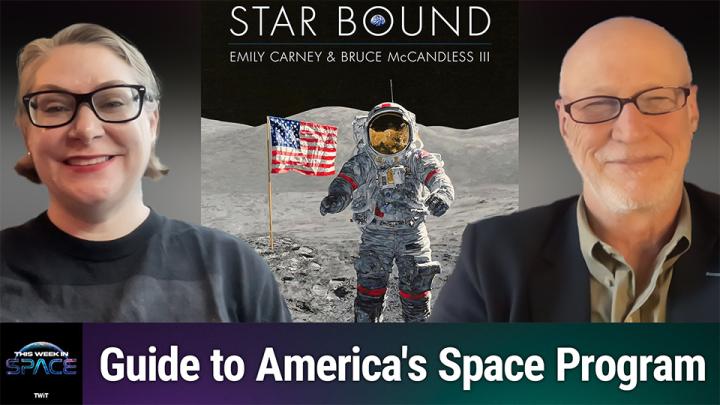
All TWiT.tv Shows (Audio)
This Week in Space 145: We're Star Bound!
01:16:30
Authors of 'Star Bound: A Beginner's Guide to the American Space Program'
Loading summary
Transcript343 lines
- [00:00]
Rod Pyle
Coming up on this Week in Space, we'll talk with Emily Carney and Bruce McCandless III about their new book, Starbound, and whether we're going to the moon, Mars or somewhere beyond. Plus, a big sneak peek at the American space program. And also Trump wants to go to Mars and more. So tune in.
- [00:17]
Tarek Malik
Podcasts you love from people you trust.
- [00:21]
Bruce McCandless III
This is truth. This is this Week in space, episode number 145, recorded on January 24, 2020 25. We're Starbound. Hello and welcome to another episode of this Week in Space, the Starbound edition. I'm Rod Pyle, editor in chief, Bad Aster magazine, and I'm joined, sadly, by Tarek Malik, editor inchief@space.com. hello, my friend.
- [00:47]
Rod Pyle
Hello, Rod. Hello, Rod. Sadly, he says as he with a big old smile.
- [00:52]
Bruce McCandless III
So it's, you know you love me. I always smile at him.
- [00:55]
Emily Carney
Right.
- [00:55]
Bruce McCandless III
You know, I was looking the other day at that picture we took at the Economist Summit last year when you have your hat halfway off and you're laug and I'm laughing as I'm pointing at you and stuff. That's my favorite picture of us. Okay. With clothes on. Anyway.
- [01:08]
Rod Pyle
Oh, my gosh.
- [01:09]
Bruce McCandless III
Oh, whoa, whoa, whoa. This week we'll be talking with the authors of a fine new book called Starbound, Emily Carney and Bruce McCandless. And yes, it's that Bruce McCandless. His dad was the other. That Bruce. Bruce McCandless. He was Bruce McCandless II. This is Bruce McCandless III. And I can't say that more than twice in a row without, without fouling it up. But before we start, please don't forget to do us a solid. Make sure to, like, subscribe and all the other cool podcast things to show the world how much you love us. And this is your last chance to take the 2025 TWiT audience survey. This annual survey helps us understand the audience so we can improve your listening and viewing experience because we care. It only takes a few minutes, so if you would do so for us, please go to Twitter TV survey to take it. But don't wait because we're in the closing minutes here, metaphorically speaking, and it'll help help us to make the show and twit even better. Now we are joke bound jokes. This week's this week.
- [02:12]
Rod Pyle
Oh, I see what you did there.
- [02:13]
Bruce McCandless III
This week's joke from Adam. And Adam says, I tried to start a hot air balloon. I tried to start a hot air balloon mission on the moon, but it never took off. Adam, I'M sorry I sort of mangled your joke. I, I, I, I didn't write it properly, so I was having to interpret as I, as I read. All right. Now I hear, though, that some people want to go beyond starbound and leap into a white dwarf when they hear our jokes. But you can help set us your best, worst or most indifferent or unique space joke at Twist TV. These are PG13 rated, so just bear that in mind because we've gotten a couple that weren't. And now it's time for headlines, headline news. Well, we have a new president. We have a new administration. We have a new NASA administrator.
- [03:16]
Rod Pyle
Yes.
- [03:16]
Bruce McCandless III
Or will soon. We have an interim. Right now.
- [03:18]
Rod Pyle
Well, we, I mean, technically that's new, right?
- [03:21]
Bruce McCandless III
Yeah. And we have a president that wants to go where.
- [03:25]
Rod Pyle
All right, well, we are going to Mars, apparently. So this week, this week, that's one of the big stories of President Donald Trump now the 47th as well as the 45th president of the United States in his inaugural address on Monday of this week, said that, that he wants to see astronauts, quote, plant the Stars and stripes on the planet Mars. He called it our manifest Destin. And, and as he said, Elon Musk, who was there in attendance at the Capitol of Rotunda, pumped his fist up and gave two thumbs up in probably the cheesiest smile that I've seen, but very, very appropriate. He's excited that we're gonna go to Mars and that's what he wants to do.
- [04:08]
Bruce McCandless III
Yeah. And we've been talking about this since 1949. Yeah. At least formally with Von Braun's Das Mars Project book, later published in English in 53. And we've been talking about it since before the, the Mercury program. We were talking about it during Apollo, during the shuttle program. We've had all these design reference, reference missions that have come and gone and we've flown this, this mission and file cabinets for decades. It would be nice to really go.
- [04:38]
Rod Pyle
Yeah, it's very interesting because during the actual campaign to become president, Trump said a few times that he would like to see astronauts land on, on Mars, like by the end of his term or that, you know, he, he said that he would like to see the, you know, the United States land on Mars by the end of his term, which was, you know, you can say, okay, launch a mission to Mars. It'll get, you know, you launch on the 20, in the 2026 window, it'll get there in 2027. That could do it. But he didn't say it's 18 months away. Yeah, yeah, he didn't, he didn't, he didn't say, he didn't say if he wanted to have astronauts on that flight. But then he said that he would like to. You know, he says, and I quote in the, in the inauguration, and we will pursue our manifest destiny into the stars. Launching American astronauts to plant the Stars and Stripes on the planet Mars. Now, he doesn't put a date in that one. So, you know, in the earlier two comments, it was, we'll get to Mars before the end of my term. But it wasn't like astronauts. And now he's saying astronauts, but not a date. Now that would, that would mean that you have until what, January 20, 2029, put astronauts there. There's a lot that would have to happen to get astronauts there by 2029, a full shift away from the moon, for one thing, and some sort of big vehicles to get there. But, but it's interesting and it might be like a hint of what's to come. You know, one thing we didn't talk about in this, this discussion is that, you know, you mentioned the new asset administrator. Trump has picked Kennedy Space Center Director Janet Petro as the interim NASA administrator, skipping over Associate Administrator Jim Free in, you know, a big proponent of Artemis in Washington. So that was a, like a unexpected twist this week.
- [06:19]
Bruce McCandless III
Skipping over with a bit of a hiccup. They did announce Jim Free and then they announced Petro.
- [06:24]
Rod Pyle
That's right. That's right.
- [06:25]
Bruce McCandless III
Within a couple hours.
- [06:26]
Rod Pyle
Yeah. NASA actually changed their website to say that, that Jim Free was the acting administrator and then had to change it again to say that. No, he's actually still Associate administrator. Janet Petro is the acting administrator.
- [06:37]
Bruce McCandless III
So. Well, I, I want to share something with you for those who are watching the stream. This is the new mug I got from loyal listener, an old friend, Martin Lawler. Martin, my new Space Thugs mug. And it's kind of the, the other space hipsters, except it's only got two members so far, me and Martin.
- [06:56]
Rod Pyle
Grand Pooba. You have a Grand Pooba mug?
- [06:59]
Bruce McCandless III
Yeah, well, that. So that's my horrible illustration. But anyway, I kind of feel like we're headed that way in some fashion. Do you want us, do you want to do line two next or go to line four?
- [07:12]
Rod Pyle
Well, I guess the one thing that we would mention just because we are talking about the administration change, is that there are, in addition to having an interim NASA chief, there are already other echoes being felt or reverberations from the administration. Many listeners may have heard about the the, the, the Trump executive orders to end all DEI operations. Diversity, equality, and is it, or is it equity, equality, equity inclusion and inclusion initiatives across all the agencies. NASA was not immune to that. And there was a letter that went out from Petro's desk that basically quoted a form letter that the administration sent to all of the agency directors that would, that would say that everyone has to stop. So, so they've, they've shut down their whole, whole operation or are in the works of shutting that whole thing down now too. And it's the first of what we expect to be many different changes to come at the agency as the new administration and eventually their pick for a new administrator take root.
- [08:08]
Bruce McCandless III
Now, there was some talk, I don't remember, it was, I think it was in the Atlantic maybe about this also releasing either some individuals or some positions. Now, I assume if you work in a DEI related office, that that's going to get closed. Yeah, but how else does that affect the workforce?
- [08:29]
Rod Pyle
Well, the executive order does say that they have until January 31st to roll out the plan to, to let the people that are employed by those offices go. So it's very clearly like there will be departures from NASA, from all of the agencies if they have a specific office that was geared at that, that sort of program. There's also a whole thing about they have to inform on other people if they may have changed the name. There's a whole. It's a big mess.
- [08:54]
Bruce McCandless III
You know, that's a little more uncomfortable. But yeah, but hey, if there's money in it, give me a phone number. I'm just joking. I'm just joking. One of Earth's seven weirdo quasi moons was recently named after a competition. This was a head scratcher.
- [09:11]
Rod Pyle
Yeah.
- [09:12]
Bruce McCandless III
Because it was named after the goddess of door hinges.
- [09:15]
Rod Pyle
That's right. That's right. That's right. This was a story that@space.com from Monisha Revisetti, our astronomy editor. But yeah, they named it Card. I think I'm going to pronounce it right. Cardiac Cardia, the goddess of the Dorian. And it was named by Clay, I think Chilka. Man, I'm really bad with names. At the University of Georgia because they won the naming contest with the iau, which is of course in charge of naming objects. The object is called 2004GU9. And the. They, the IAU ran a naming contest with the radio lab, another, another science radio show to see exactly what they would, they would call it. And this is the name that won. So, you know, Cardia Door hinges so.
- [10:09]
Bruce McCandless III
Well, next time I want to be named after the goddess of spark plugs or sponges or something.
- [10:14]
Rod Pyle
Well, I mean, laugh at you, but it's better than 2004 GU9, you know.
- [10:18]
Bruce McCandless III
True. But you could just call it Jeff and be done with it.
- [10:22]
Rod Pyle
Now that's a good name for any object, you know, in space.
- [10:27]
Bruce McCandless III
So I've got a couple of objects right over here in my bathroom that I named Targ.
- [10:31]
Rod Pyle
Oh, my God. No, no, it's too early. It's too early in the episode.
- [10:35]
Bruce McCandless III
But enough about my plunger. You picked the last one.
- [10:41]
Rod Pyle
Yeah. So, you know, we gotta pick. Well, we did. We talked about Elon. Okay. No, let's go talk.
- [10:49]
Bruce McCandless III
Wait, you could do both of them. You're the one that always grinds on me about red. We're going too long.
- [10:53]
Rod Pyle
All right, all right. Well, a couple, A couple of things very, very, very fast. We're going to keep them in order. There was, there was a really fun story from, from.
- [11:03]
Bruce McCandless III
From.
- [11:03]
Rod Pyle
Well, not just from space. Space.com. but, but across. About the first meteorite impact caught by a doorbell camera.
- [11:10]
Bruce McCandless III
Isn't that something?
- [11:12]
Rod Pyle
And you can hear it. So it's like you're. You're looking at someone's doorstep and then all of a sudden like, poof, like something falls out of the sky. There you go. That's the sound.
- [11:23]
Bruce McCandless III
Something metal. Right?
- [11:25]
Rod Pyle
Well, it hit the. It hit the concrete. I saw a different angle. And it hits like the walkway up to the house is what it looks like. And then.
- [11:33]
Bruce McCandless III
But it looks like it would hurt.
- [11:34]
Rod Pyle
Yeah, it left a big impression, like a big mark. I love it. I love it. And that was in Prince Edward island by homeowner Joe. I think I'm going to pronounce it right. Velladium. Who noticed this? This like a chalky mark, you know, that, that what we now know is this meteorite impact. And he went back and looked to see what it was and saw the video of it. And it's not something they've ever heard before. They've, they've, they've, they've. It's a brand new thing. And so the University of Alberta went and confirmed it that it was a meteorite. And. And now we've. He's. I wonder if he's going to loose sight it over so you can have like the impact on it, you know, like forever preserve. That's what I would do.
- [12:14]
Bruce McCandless III
So you could charge an extra $500,000 for the house. And it goes up for.
- [12:18]
Rod Pyle
There you go.
- [12:19]
Bruce McCandless III
Last one.
- [12:20]
Rod Pyle
Last one is just a note. SpaceX launched three Falcon Nines this week, culminating in a January 21st launch. Actually, they launched one hours before our recording. What was their 400th Falcon landing ever? 400. So it feels like not too long ago we were doing 300, you know, halfway through last year and now we're at 400 already, which is absolutely crazy.
- [12:42]
Bruce McCandless III
So I mean, it's amazing that a company like that can even launch 400, much less land them and bring them back. I keep waiting for them next ULA launch and I still haven't heard any news about when they're planning to launch the Vulcan again.
- [12:55]
Rod Pyle
I heard that it's going to be sometime in the spring.
- [12:58]
Bruce McCandless III
They still for sale?
- [13:00]
Rod Pyle
I haven't heard anything on that in a while, so. So we'd have to, we'd have to see. But, but I heard, yeah, the next Vulcan rocket is going to be sometime in the spring for it's going to be a Space Force National Security launch, which is what they wanted to get accredited for. So. So, yeah, so that 400. 400 landings, that was a Starlink mission. 27 Starlinks in space. Many more. I think They've launched like 60 into space this week, which is crazy.
- [13:28]
Bruce McCandless III
Well, and before you know it, we'll have the same number on Starship.
- [13:33]
Rod Pyle
Yeah, yeah, hopefully.
- [13:35]
Bruce McCandless III
All right, well, stand by everybody. We will be back in just a few moments with Emily Carney and Bruce McCandless to talk about Starbound. All right, welcome back everybody. We are here with Emily Carney. Take a bow, Emily. Emily is the co author of the book we're going to be talking about today. And the grand czar, mistress whatever of space hipsters, 60,000 members strong on Facebook, which is a remarkable group. Definitely the place to be if you're interested in all things space. And with her is our co author, Bruce McCandless III. God, I almost said the second. I'm sorry, the third, who is famous in his own right. And is your primary purpose in life as a lawyer other than the author?
- [14:21]
Emily Carney
Yeah, I was a lawyer for 25 years and retired back in 2019. And so since then I've been writing.
- [14:28]
Bruce McCandless III
Yeah, retired. What's that like?
- [14:31]
Emily Carney
Yes, sir. Well, I, I am still working.
- [14:34]
Bruce McCandless III
But you retired into working harder.
- [14:36]
Emily Carney
Probably a little less anxiety. I mean, you know, practicing law is a. Is an all consuming sort of thing and it's hard on the nervous system. I'm enjoying writing a lot better.
- [14:50]
Bruce McCandless III
Well, after the show, I'm going to have to talk to you about the switch in revenue from lawyering to Authoring. Because it was certainly a wake up call for me moving from television to writing books.
- [15:00]
Emily Carney
That's funny. My wife wants to talk to me about that too.
- [15:02]
Bruce McCandless III
Really? Will she be joining us today?
- [15:05]
Emily Carney
She'll be joining the conversation as well. Yeah.
- [15:08]
Bruce McCandless III
So Emily had Bruce have written a wonderful new book called Starbound, which you should definitely check out if you get a chance. And I. I guess I haven't told.
- [15:18]
Rod Pyle
You guys, I think you're shortchanging it. It's Starbound a beginner's guide to the American space program. From Goddard's rockets to Goldilocks planets and everything in between. Let's say the whole thing. Come on.
- [15:29]
Bruce McCandless III
Publishers love their subtitles and we'll be writing a review on it in Ad Astra coming up next quarter. And it's very, very favorable. Deservedly so. There it is. Let's see that cover.
- [15:42]
Emily Carney
Very good.
- [15:43]
Bruce McCandless III
All right, bring that into your memory, viewers and listeners, because you're gonna want to go find that on Amazon if.
- [15:50]
Tarek Malik
You can find it. Wherever, Bookstore, Amazon. We'll take the sales anywhere you can, anywhere you buy it from.
- [15:58]
Bruce McCandless III
Who's the publisher?
- [16:00]
Tarek Malik
University of Nebraska Press.
- [16:02]
Bruce McCandless III
Oh, okay. Okay. Is it. But it's not part of the Outward Odyssey series. It's a standalone thing. It is.
- [16:07]
Tarek Malik
It is indeed part of the Outward Odyssey.
- [16:09]
Bruce McCandless III
My God, you broke the COVID convention.
- [16:12]
Rod Pyle
We did.
- [16:13]
Bruce McCandless III
You're the first ones.
- [16:15]
Emily Carney
I think there was a pitched battle in that regard. And we managed to score this great painting by Chris Cowley that is not in the painting, actually. The background is more of a purple color. And that was going a little too far for the UNP folks. So they wanted it. They made it black, as you can tell. But we're so excited to have that image. It's such a beautiful painting. And of course it is. It's the artist's take on. On Gene Cernan's Apollo 17. Famous, famous photograph of Gene Cernan.
- [16:50]
Bruce McCandless III
I like that Publisher has just done such wonderful things over the years. I mean, it's an incredible series working with great authors, great editors. I don't have a book through them yet. I've negotiated with a few times, but everything I've heard has been just glowing reviews in terms of working with them. That said, covers are always difficult.
- [17:12]
Emily Carney
Yeah, well, yeah. This one, we're hoping folks judge this book by its cover because it turned out really well and we're pleased with it.
- [17:26]
Bruce McCandless III
And we should mention for viewers who may not know, there may be two or three of you out of the tens of thousands that watch and Listen, every week that Bruce's father was an astronaut, and in fact was Bruce McCandless II the first astronaut to fly free and untethered? Which I remember watching that back at the time and feeling this growing pit of terror in my stomach because, you know, the way, I mean, the way it was portrayed in the news, it's like, oh, this is exciting, it's new, it's different. He's flying freeze, testing out this little one man spacecraft and all that. And I'm thinking, there's no rope.
- [18:05]
Emily Carney
Yeah, exactly. Yeah.
- [18:07]
Bruce McCandless III
I imagine you may have been thinking the same thing as a young man.
- [18:10]
Emily Carney
You know, I was, I was 22, I guess at the time. 20, maybe almost 23. I was in Great Britain studying. I was doing a master's degree over there and I was sitting in a bar basically with some, some buddies watching it. So I didn't feel a whole lot of terror. I remember being interested, amazed by the whole process, but I wasn't scared. Dad had spent 20 years or so working on that thing and we were just glad he's finally getting a chance to test it out. He was confident in it and as far as we were concerned, if he was okay with it, we were okay. But I will echo your sentiment that while NASA portrayed it as not such a big deal, there were others like Rick Calculator who said NASA was, was, was sort of peddling a line there that wasn't completely right. It was a pretty dangerous thing to be doing. And, and maybe that's why we're not doing it anymore, you know? Yeah, yeah.
- [19:11]
Bruce McCandless III
And what year was that?
- [19:12]
Emily Carney
It was 84.
- [19:13]
Bruce McCandless III
Four. Yeah. So that was two years before Challenger. And I was talking to somebody the other day in a conference about the IMAX film the Dream is Alive.
- [19:23]
Emily Carney
Oh, yeah.
- [19:23]
Bruce McCandless III
Narrated by Walter Cronkite. And what a sunny. That takes take that was on the shuttle, you know. Oh, it goes up all the time. It, you just, you know, you land it, you, you hose it off, you gas it up and off you go. And then after Challenger, suddenly I think we all got a serious dose of reality.
- [19:42]
Tarek Malik
Yeah, I, I love, I'm sorry, I feel like I'm interrupting. I love how you put that because I never thought of it. It was very optimistic, wasn't it? And that movie was one of my gateway drugs when I was a kid into like the space.
- [19:56]
Bruce McCandless III
I want to get into your book, but state that first time seeing the first launch in that movie where they don't do the countdown, there's no voiceover, it's just the sounds of nature, couple of shots of alligators swimming past. The next thing you know, the kaboom, the shuttle igniting, and off it goes. And I just. I had tears streaming down my face.
- [20:18]
Emily Carney
Yeah, that's the very beginning of the movie. Right? That's. And then how it starts.
- [20:21]
Bruce McCandless III
It actually starts with a. I think it starts with a landing.
- [20:25]
Emily Carney
Okay. All right.
- [20:25]
Bruce McCandless III
I'm coming in on that little tiny Runway. But, yeah, it's. It's a remarkable film, and I still love it, along with Hail Columbia. But good luck catching them at the IMAX theater. Okay, I need to shut up about this and get into your book.
- [20:38]
Rod Pyle
We just talk about the episode of what we're talking about.
- [20:41]
Bruce McCandless III
It's a great. It's a great read. It's a fun read. I won't insult you by calling it breezy, but it. But it's easy. You know, it's an easy access piece, which I suspect is exactly what you were going for. So, Emily, I know you're a space historian, but this book feels like it was written not just by space historians, but by historians in general. I mean, your context, your take on history overall. So which one of you is the world history historian? Or was it both?
- [21:12]
Tarek Malik
I think it's a mix of us both, honestly. God, Bruce is going to kill me for saying this. Bruce is a couple years older than I am, and he probably has a. A better perspective on. I see. Okay. I love the 1970s in space. That's kind of an era that I focus on a lot. You can definitely see a lot of my imprint on that in that chapter in the book. Fun news flash. I wasn't alive for most of the 1970s.
- [21:45]
Bruce McCandless III
Right.
- [21:45]
Tarek Malik
So. And really, in this, I feel like this sounds awful. It's not ageism. But as far as Bruce's concern, you know, it's been really cool picking his brain about certain things that happened during the decade, because I don't have sort of a perspective on the 1970s culturally, because I wasn't there, you know, and, you know, and in this. And I wanted that to be a part of the chapter, sort of, you know, okay, this is what was happening in space, but this is what was happening in the background. You know, you had political scandals in the United States. You had, you know, inflation, a lot of sort of upheaval, you know, socially and politically. And also in the background, you had, you know, the women's rights movement, you had the civil rights movement going on and things like that. And it was cool to talk to Bruce because he had a Lot of perspective on that that I really didn't have, frankly, because I didn't really live through that era. So I. I don't know what it felt like really, at the time, if that makes sense. So I think both of us had a lot of input, and I can't speak for Bruce, but I think he would agree that we wanted the book to sort of have a cultural, you know, sort of have, you know, okay, this is what was happening in space, in the time, but culturally, we wanted to talk about what was going on in the world and in the United States because obviously that does affect what was happening in space policy as well. Like, if you look in, you know, and there are certain. I won't go too deep into it. Unpleasant truce that we sort of delved into as well, that, you know, it happened, but you have to sort of discuss it. So I hope that answers the question.
- [23:33]
Bruce McCandless III
Yeah, it does. And one of those ugly truths is going to be that Bruce actually mentioned the movie Iron sky, but we'll talk about that later, which was written by a guy who I hired for his first production job. And I called him after I saw the movie and said, michael, what happened? Anyway, we'll talk about that another time. Bruce, do you want to. You want to jump in there before Tarek asks his burning question?
- [23:56]
Emily Carney
Oh, about history and context? Yeah, that's. That's, you know, Emily and I aren't engineers or scientists. We're. I think we could describe ourselves as cultural historians, and that's how we sort of come out the subject. And. And I was interested in talking about space as reflected in films and books and. And as she says, in politics. So. So that's, you know, I think we do a pretty good job of grounding various space missions and decisions in what was going on in the. In the US and the world during the time.
- [24:28]
Bruce McCandless III
Yeah, it's really. Sorry, Tarek, I'm jumping you one more time. But it's. It's kind of a remarkable blend of really fun detail and the general overview, which isn't easy to do.
- [24:40]
Emily Carney
Yeah, well, it is not easy to do. We were aiming for, actually, for a much shorter book along the lines of Colin Burgess, Soviets in Space, and just didn't. We missed miserably because it ended up being much longer, and we ended up foregoing an index and a glossary and various things for the sake of the narrative. And frankly, we could have written another 75,000 words easily. But, you know, along the lines of creating a beginner's guide, you want to at least strive for some, some brevity.
- [25:13]
Bruce McCandless III
So, yeah, well, I, I, I, I, I do resonate with that. And the last book I did, I did write another 75, 000 words and ended up thrown back in my face. Do we need to go to a break or are we okay to continue? Anthony, you can just give me a nod. Okay, let's go to break and then we'll be right back. Tarek, you're up at bat. Stand by. Attention, taxpayers.
- [25:35]
Rod Pyle
The IRS is intensifying collections in 2025. If you owe $10,000 or more or have unfiled tax returns, it's time to take action. Tax Network USA's experienced lawyers have saved.
- [25:47]
Bruce McCandless III
Clients over a billion dollars.
- [25:48]
Rod Pyle
They're ready to negotiate with the IRS on your behalf.
- [25:51]
Bruce McCandless III
Don't risk wage garnishment, property seizure, or losing your home. Call 1-800-958-1000 today.
- [25:58]
Rod Pyle
Get the help you need at 1-800-958-10000.
- [26:01]
Bruce McCandless III
Or visit tnusa.com if you love your phone but not your carrier, just switch to T Mobile. You can keep your phone, keep your number, and we'll help pay it off up to $800 per line. You can also use our savings calculator to compare our plans and streaming benefits against Verizon and AT&T. So switch and keep your phone, keep your number, and keep more of your moolah. @t mobile.com up to 4 lines via virtual prepaid card. Allow 15 days qualifying unlock device, credit service port in 90 plus days with device and eligible carrier and timely redemption required. Card has no cash access and expires in six months.
- [26:34]
Rod Pyle
Well, I kind of have a twofer because I usually always start off our interviews with a basic question, Emily and Bruce about, like, when you ever got interested in space. But it seems in this case, Emily, you're a return, a return visitor. And Bruce, you know, you seem to have a lifelong attachment to the program. But I guess just to start, there was there one driving force that grabs you about space exploration either as a kid or as an adult that got you into it? Or, or is it just something that, that evolved over time?
- [27:09]
Bruce McCandless III
I think I can guess Bruce's answer.
- [27:10]
Rod Pyle
I know, right? That's why I feel silly asking the question because it's like, so obvious.
- [27:14]
Bruce McCandless III
How did you get interested in space, Bruce?
- [27:16]
Emily Carney
Well, there's actually more to it. I mean, I wasn't tremendously interested as a, as a kid. I actually got interested when I started writing the My dad, toward the end of his life, had decided, okay, maybe my story is worth telling. I'm going to maybe write an autobiography. But he'd waited a little too late, and by the time he really got started, he was already ill and wasn't able to do much on the story. So I decided I'd try and do it for him. And that necessitated a grounding, at least in some space history. And. And the more I got into it, the more excited I got about it. And things that I had heard as a kid started to make sense and resonated with me a little more. And I would really say that that's when I got interested in space, despite the way we grew up down there around jsc. And that was only five years ago.
- [28:11]
Bruce McCandless III
Boy, you picked up a lot of knowledge in that time. I feel a bit chagrined, Emily.
- [28:19]
Tarek Malik
Well, I think I've told this story before, but I'll tell it again that my gateway entry into space flight was in 1981. I lived not very far from Kennedy Space Center. And as a kid, you know, the space shuttle was brand new. And one day my mom was like, hey, the space shuttle is going up. You know, And I was like. And I had a peripheral knowledge of what the space shuttle was. You know, I'd seen pictures of it, I'd seen probably it on tv, stuff like that. And sure enough, we go outside and we look over to the east and there's the space shuttle. I mean, there you could see it from where we were. We were probably about 120 miles out, and you could see, you know, these orange flames kind of going up. And I was like, oh, my God. And I couldn't get over the fact that there were human beings on top of that. I mean, that just blew my mind. So that, for me, was the aha moment. And later I was like, man, what year was that? You know? And I triangulated, because I was real little when that happened, and I sort of did some digging, and I was like, that was STS2, because we had just moved to Oldsmar, Florida at the time. So it was STS2 with Engel and Truly. So that was my gateway. And it was real cool, because I think it was 35 years to the day of STS2, I met Joe Engel. General Joe Engel, rest in peace. He passed away last year. And also Truly also passed away last year. I never got to meet him. But, yeah, that was my like, oh, my God, I'm obsessed moment. And I've been into it since I was a little kid, you know, and it's just. I've just loved it. Since I was a child, and it's always been a passion for me. Yeah. So I hope that answers it.
- [30:01]
Bruce McCandless III
It does. And I think you were there when you met Angle that was at space fest, right?
- [30:06]
Tarek Malik
I think I met him actually for the first time. I did see him at space fest, but I've met him at an astronaut scholarship foundation event. It's a funny story. I was at a. I used to drink. I was at a tiki bar. Of all. I was at a tiki bar in cocoa beach, and the ASF event was taking place there. Me and a friend of mine were at the bar, you know, drinking as one does. And we look over and there's freaking Joe Engle just sitting there with his wife Jeannie, who's also wonderful. And I'm like, oh, my God, it's Joe Engel. It's my lifelong hero. And my friend's like, just go say hi to him. And I was like, no, I want.
- [30:47]
Emily Carney
To say hi to him.
- [30:48]
Tarek Malik
I'm going to start crying and stuff. And my friend's like, just say hi to him. So I was like, okay. So I went over and of course, I said something stupid like, general Engel, you're one of my heroes. You know, you got me into space, blah, blah, blah. He. He and genie were as nice as could be. They were very tolerant of my ridiculous.
- [31:08]
Bruce McCandless III
Joe was very engaging and easy. And I think Genie, I would describe as more tolerant.
- [31:13]
Tarek Malik
Yeah, she was nice.
- [31:15]
Bruce McCandless III
She was. But she's cool about it because she. She understands. I mean, she thought he was the hottest thing too. But, yeah, I met them in 2010 and we spent. I was working at JSC for a while, so we spent a fair amount of time together. And I kept saying, you know, we ought to write a book on you. And. And, you know, I think if you ask, not so like this, but particularly Joe with that kind of homespun down home, oh, heck, gosh, golly shucks kind of thing. It's like nobody wants to know about what me. What I did. I said, no, they really do. You flew the X15, for God's sakes. Did a barrel roll in it, among other things. But he was just like, so we never got it together, but it would have been fun because it's a hell of a story.
- [31:59]
Tarek Malik
Yeah, it was awesome. Go on.
- [32:02]
Rod Pyle
I'm sorry. Well, no, I think that that's. It helps put kind of the book in perspective for, I think, our listeners and our readers if they kind of know that history and where you come from. Plus, I dig it. I just, I love everybody's stories about, about space when, when they, they got bit by the bug. But that does lead me to my next question. Bruce and Emily, about why now? For the book, obviously, as we're recording this episode, this was NASA's big week of remembrance, you know, for the, for the tragedies. But I know that that's not why the book was coming out. I'm just curious why. Why choose to release the book and, you know, at this point in our grand space adventure right now.
- [32:44]
Emily Carney
I'll give that a shot. One, There's a couple of different reasons. One reason is that I just read Collins book Soviets in Space, and I thought, you know, this is, this is fantastic. This is a great introduction to things like Lunokhod and Vostok and, you know, these crazy names that you see and are sort of intimidating. But you read Collins book and things sort of start to fall into place. And I thought, you know, people are really excited or getting excited about the American space program, not only because of Elon Musk and SpaceX and Blue Origin and that sort of thing, but also at the time, Emily and I were very excited about Artemis, which had just sent Artemis. One had just gone around the moon. And we were thinking that fall of 2024, we might be seeing more excitement about Artemis and it might be a great time to release a book. And that didn't work out. We're waiting, obviously, on Artemis too. But generally speaking, you could say we saw a market opportunity and we saw an educational opportunity, you know, sort of fill a niche that wasn't being filled. There are a couple of, you know, there are some other books that are general histories of American space exploration, but they tend to be longer and they're a little bit out of date, I think. So there was that. But there's also a feeling, and this is something that informs Emily's group, Space sipsters, the feeling that this enthusiasm, this fetishization almost at the American space program is a nice antidote to a lot of the corrosive political bickering we see in the United States. I mean, this is something we can all be proud of, we should all know about. I know lots of people who can recite every statistic possible about the New York Yankees or about the men's professional, you know, men's soccer team, our national team, but can't tell you the difference between Mercury and Gemini programs. And I think that's a shame. I think this is something that we all need to learn about and take pride in. And you Know, wears a sort of national merit badge. That's sort of, sort of a nutshell, I think, why we wrote the book.
- [34:53]
Bruce McCandless III
That's, that's very well put.
- [34:56]
Tarek Malik
Well, I don't have anything to add. That's really great how Bruce put it. The only thing I might have to add is that, you know, we wanted something to be. You said breezy earlier and I actually like that. We wanted something that was kind of easy to read, that was approachable. We didn't want like a textbook basically because. And that's not a slam against any other writers. I've read probably thousands of space books in my life and, and a lot of them are fantastic. Some of them are more like reference guides. You know, they have a lot of statistics, numbers and stuff on them, which is.
- [35:28]
Bruce McCandless III
They're written by engineers.
- [35:31]
Tarek Malik
Yeah, yeah. And in my day job I work as. I'm a technical writer for my day job. And one of the biggest challenges is translating stuff written by a software engineer into like actual English, you know, for a user to understand. That's a big. That can be a challenge, you know. And we wanted to do something that sort of translated, you know, this stuff for just anybody, you know, we, we feel our book is for everyone, you know.
- [35:57]
Rod Pyle
Yeah. It really feels like you're having a conversation. Right. Not. Not that you're reading like a history or like an encyclopedic entry. I was really struck by that tone and the self referential nature. I bet there's like some bits where you talk about that you're writing the book and we're not going to do that in this book because we're here to talk about this and we're done with this subject. And I thought that that was very engaging in a way that I hadn't seen in a recent space book, I think as a way to put it.
- [36:28]
Emily Carney
Well, good, good. And I will say that one other space book I know of that is. Is engaging and not written by an engineer. It's one of my favorites. It's Rod's book, Amazing stories of the Space age which shocks. You got a plug. Unbelievably entertaining and interesting about some of the hijinks that our military services were up to the pre NASA days especially. And Rod, so kudos to you. That's a great book.
- [36:59]
Bruce McCandless III
I appreciate that. And, and I was having a moment of that feeling when I was reading your favorite space conspiracies and I loved. Was Neil Armstrong a Robot? You guys made that up, right? Just checking. Okay. Because that was a really good one. I thought, man, we do our Next Best Conspiracies episode, we're gonna have to include that.
- [37:19]
Tarek Malik
But I guess I have some good ones that I've researched in the past. I don't think this one didn't make it to Starbound. There was the STS1 clones. One they didn't launch Young and Crippen, but they launched like robot clones of Young.
- [37:36]
Rod Pyle
Oh, I love it. I love it.
- [37:37]
Tarek Malik
Or something. I'm dead serious. This was an actual conspiracy theory, and it was released on cassette tape.
- [37:44]
Bruce McCandless III
Wow. And so these were supposed to be meatbag clones, not robots, right?
- [37:49]
Rod Pyle
She just said robots.
- [37:50]
Tarek Malik
I don't know. I don't know if it was a meat bag or a robot. I need to look. It's been a while since I research this one, but it was that my main memory of it was it was on cassette.
- [38:01]
Rod Pyle
It gets better than eight track, right?
- [38:03]
Emily Carney
So I have to say, Tariq, I also read Space.com's 25 Greatest Space. I have to say, I'd never heard the Black Knight Conspiracy. Oh, yeah, I don't know.
- [38:17]
Rod Pyle
That was a new one. That was a new one for me as well when our writer found that one. Because, you know, I. I was always like, I'd always heard the one about the Air Force has one, but I didn't know that there was a whole Black Knight thing that was separate from that.
- [38:32]
Bruce McCandless III
Oh, my God. It's its own religion.
- [38:36]
Rod Pyle
We should do a story that.
- [38:38]
Bruce McCandless III
Oh, Dr. Clickbait, you calm down. Okay, we got another break to go. Sue. Stand by, everybody. We'll be right back. AT T Mobile, we'll give you four free 5G phones and four lines for only $25 per line per month with eligible trading ins. And no, it's not a contest. It's every day for a limited time.
- [38:55]
Rod Pyle
Everyone's a winner on America's largest 5G network.
- [38:58]
Bruce McCandless III
Minimum of 4 lines for 25 per line per month with autopay discount using debit or bank account. $5 more per line without autopay. Up to 830 off each phone via 24 monthly bill credit plus taxes, fees and 10 device connection charge for well qualified customers. Contact us before canceling entire account to continue. Bill credits or credit stop and balance on required finance agreement too. Bill credits end if you pay off devices early.
- [39:14]
Rod Pyle
CT mobile.com I'm no tech genius, but I know if I want my business to crush it, I need a website.
- [39:21]
Bruce McCandless III
Now.
- [39:22]
Rod Pyle
Thankfully, Bluehost makes it easy. I customized, optimized and monetized everything exactly how I wanted with AI. Within minutes, my site was up. I couldn't believe it. Plus, Bluehost keeps me protected 24 7. No more worrying about hackers. I just relax and focus on my customers. So whatever your hustle may be, secure your online presence in 2025 with Bluehost. Head to bluehost.com to start now.
- [39:51]
Bruce McCandless III
So we've got a lot of other stuff to cover here, but I just wanted to jump back in on the. I guess it's a conspiracy theory. I don't know, that they actually put an interior lock on the shuttle door. Tell us that story, because I thought that was fascinating. I mean, they're all fascinating. But that one really caught my attention.
- [40:11]
Emily Carney
Well, yes, from what I can tell, this is, this is a true story that one of the. One of the missions, a payload specialist became very frustrated with his machinery not working the way it was supposed to. He'd spent a lot of time and had a lot of people depending on him to get some results from this equipment on the flight and became so despondent, he threatened. I'm paraphrasing here, to leave the ship. And the way you do that is you open a hatch of some sort and that's not a good thing to do at 160 miles up above Zambia. So it was decided that there should be some sort of way to secure the orbiter. And it's been a while since I looked at this, but I think there was actually a lot put on for at least some of those missions that the commander would have to. Would have authority over. And, you know, I don't think that's apocryphal. I think that actually was the case. I've gone down a couple of rabbit holes and it seems to. Seems to be the truth.
- [41:15]
Bruce McCandless III
Wow. It's amazing that somebody would consider leaving the shuttle and yet those cosmonauts hunched down in the Mir space station for all those many months and years, which, from your telling of it, was a little bit of a flying junkyard, a little bit of a space slum, if you will.
- [41:36]
Emily Carney
Well, that's right, yeah. So I think. Where did I get that? That was Brian Burroughs book, Dragonfly. I think he's talking. Is it Gary? Who? Gary. Is it Leininger? Is that who I'm thinking of? He had some.
- [41:51]
Tarek Malik
Jerry Leninger, Leininger, yeah.
- [41:53]
Emily Carney
He had some bad things to say about Mir. Now you can read. You know, Shannon Lucent, Shannon Lucid spent a bunch of time on Mir as well, and she has a pretty benign view of the whole thing. So I don't know, it depends on who you believe. But there are certainly reports that it was a very unpleasant place to live for any length of time.
- [42:13]
Rod Pyle
I heard those stories about smoking. Those are the ones that I've heard on mirror. I have to say, I have to say I was always struck about the story about locking the shuttle doors because when I was a wee 15 year old at Space Camp for the first time and met one of my best friends who is now an aerospace educator at Penn State. Her name is Sarah. Hey Sarah, you do your simulator at Space Camp on the shuttle. And she drew the go Space crazy card and trying, was trying desperately to open, open the hatch and we had to like duct tape her down to the mid deck seats to get her, to get her to stop. Oh my God. And, and, and I just remember this being struck. But why would anyone ever think that they would want to open the door? So anyway, that, that was a little bit of a. I did not know.
- [43:06]
Tarek Malik
That was a card you could pull.
- [43:07]
Rod Pyle
Yeah, you know, they, because they can't. I've been, I mean, Bruce, did you go to Space Camp? Emily, you surely did at one point.
- [43:14]
Tarek Malik
I did not. I wish I had. I'd love to do it as an adult. I'm hoping I can sign up for that at some point today.
- [43:20]
Rod Pyle
Yeah, yeah, it's, it's, it's great. Plus when you're, when you do the adult one, you can actually like have like a dinner with a bar and then go into your simulation, which is a great mix, I should say.
- [43:29]
Bruce McCandless III
Says you. But when I went, we had to eat chili Mac and sleep in the kids box.
- [43:35]
Emily Carney
Oh wow.
- [43:36]
Rod Pyle
Oh, but no, I went, I went, I went four times for four weeks as a kid and then once.
- [43:42]
Bruce McCandless III
We're here to talk about the book.
- [43:43]
Rod Pyle
Yes, yes. Well, we were, we were. But I did want to ask. Well, I have a whole shuttle follow up too and I think that this is a question that Rod put down. But you know, Emily, you mentioned earlier about how, you know, you got bit by sts2 and like the space shuttle. You and I, I think are both of an age where we, we kind of feel a bit left out. We miss that whole big push to the moon with, with Apollo and whatnot. And I actually like.
- [44:08]
Bruce McCandless III
But Bruce and I didn't.
- [44:10]
Rod Pyle
I know, right?
- [44:11]
Bruce McCandless III
Envy us.
- [44:11]
Rod Pyle
No, but I also like, I had like multiple space shuttle models made out of wood, made out of paper, made out of plastic, whatever I could get my hands on. And somewhere around here is a Buran poster. I don't Know where. But so I had many versions of the. And so I guess the question is, you know, a lot of people think, oh, meh, the space shuttle was a big bus to space or whatever, but it has a special place, I think, for the three of us, you know, maybe not Rod. I don't know. And what really made it special, because of course, now they're in museums. And I'm just curious about where that program really stood out for the two of you, because it did seem like it had a bit of a special position to you personally.
- [45:05]
Bruce McCandless III
Excellent.
- [45:07]
Tarek Malik
I'll get started. Well, I think I. I'm saying this, you know, I'm aware that the shuttle wasn't perfect. Since I became more interested in, like, space history, I've done research. I've talked to people who are bonafide spatial experts, people who. Like Dennis Jenkins, you know, that he's like the space shuttle guru, you know, people like Jennifer Lavasseur at Smithsonian, things like that, you know, And I've talked to them and I've gotten more of a view of, you know, what the shuttle was viewed when it was being designed versus what it was when it actually went up, you know, and as we know, when it went up, you know, we did not get the return on the investment, probably as was promised. You know, it was more expensive and more complicated than anybody imagined during the 1970s. In the 70s, it was being built as. This is the answer to everything, you.
- [46:01]
Bruce McCandless III
Know, 54 flights a year, easy.
- [46:03]
Tarek Malik
Yeah, exactly. 500 flights by 1992. Like we're going to, you know, from both sides of the coast. And this is. And it's going to make payloads so cheap that everybody will be able to have a satellite, you know, and you and I can fly on the shuttle. It's going to be that easy. It'll be like an airplane. Didn't quite happen like that. But I do view. I view the space shuttle as the people. There's this book I think by. I hope I'm not running. Her name, Amy Kaminsky. I think that's her name. The people Spaceship. I do view the shuttle as the people spaceship because it did launch, you know, the first astronauts, the U.S. astronauts who really represented the country on it. I view it as the people's spaceship. It ushered that era in, which was incredibly important, especially to somebody like me growing up who was like, wow, there's women astronauts. You know, there's. I was obsessed when I saw the Dream is Alive, we talked about the movie. I was obsessed with Judy Resnick. I wanted to Be her as a king.
- [47:02]
Bruce McCandless III
I did, too.
- [47:03]
Tarek Malik
Yes.
- [47:04]
Bruce McCandless III
She had awesome hair.
- [47:06]
Tarek Malik
She was gorgeous. And she was killing it, you know, as an astronaut. And I was just like, God, I want to be like that someday. She's so badass. Excuse my language. So that was tremendously inspiring, not just to me, but to probably thousands and thousands of kids all over the world, not just in the U.S. and also, I know, you know, there were obviously two major accidents for the shuttle, and I'm not trying to minimize that by any stretch, but it did do so many amazing things. Look at what, you know, Bruce's dad was able to do. He was able to bring a vehicle that he'd been testing for, like, 20 years forth, and it. It's still. It. It may have not been used forever, but it. It's still, to me, an amazing accomplishment because it showed that could be done. That's something we could do in the future. Still. I think it's incredible.
- [47:56]
Bruce McCandless III
Excuse me, but I think that's really an important point, which is, I mean, they've been trying to do this since the Gemini days when Gene Cernan was supposed to test something similar. But, I mean, obviously in our future, we're gonna have to have 1, 2, 3 person propulsion units. So, Bruce, your dad really kind of pioneered the way for that. And with great courage, I might say.
- [48:18]
Emily Carney
Well, yeah, thank you. And last time I looked into this, there was a company in Colorado that was doing some. Had actually received some sort of a contract from NASA to start looking at ways to build an improved jetpack. Because I agree with you, something like that's going to be needed. I mean, not every company that goes into space is going to have the resources available, a shuttle orbiter that can maneuver as freely as that one did, and they're not going to have the. Maybe not have the time or money to have droids that can go out and fix things. And if nothing else, you'll see jetpacks used the same way. Maybe Segways or Scooters are used now for tourist purposes, if we have space hotels and that sort of thing. So I think there's a place in the future for jetpacks. Unclear exactly what it is, but I think we'll see them again.
- [49:11]
Rod Pyle
I should, I should point out, by the way, we've been talking about this propulsion unit, we never called it the Man Maneuvering Unit, the mmu. Right. For. For a while, that's what we've been referring to for everyone that's been wondering about it. And, and there are. There are safer thrusters I think on some of the. The spacesuits that the astronauts use now as an emergency weight.
- [49:30]
Bruce McCandless III
Well, would you say safer? That's an acronym. You.
- [49:32]
Rod Pyle
That's an acronym.
- [49:33]
Bruce McCandless III
Explain that. Yeah. So basically, if you get into a tumble or drift away or something, you hit that, and as I understand it, it automatically takes you back, right?
- [49:41]
Emily Carney
Well, that's a good question. I would say that the MMU lives on and just that it's safer these days. Now, whether it has some sort of homing capability, I don't know. I've read where Draper was trying to come up with something like that at one point that would, you know, it automatically get you back to the space station or wherever. But I'm not sure the SAFER units they have now have that capability. I know they have propulsion capabilities, but I'm not sure they have. Have any sort of a, you know, automatic return feature.
- [50:10]
Bruce McCandless III
I guess they must have some kind of control over it.
- [50:12]
Rod Pyle
Yeah. One of the things that, Bruce, you bring to mind is that there. There were designs with some of the private stations for that tourist eva, but the jetpack is like an. It's like a little bit of a ship. So you're in a dub, a bubble rod. They're like those old Von Braun pods from the Disney special. That's what they look like. No one's like snow cones. Yeah, they, they. And, and, and the whole thought is.
- [50:34]
Bruce McCandless III
Little robotic arms out the front. Front.
- [50:36]
Rod Pyle
Exactly. And it pops out and it goes around and it comes back, and then you've done your spacewalk, so. All right, that's enough of my interrupting rod. Go ahead. Go ahead.
- [50:44]
Bruce McCandless III
No, I mean, actually, now that you're throwing back to me, it's. It's time to go to a break. So very opportune. And we'll be back in a moment. Stand by. If you love your phone but not your carrier, just switch to T Mobile. You can keep your phone, keep your number, and we'll help pay it off up to $800 per line. You can also use our savings calculator to compare our plans and streaming benefits against Verizon and AT&T. So switch and keep your phone, keep your number and keep more of your moolah. @t mobile.com up to 4 lines via virtual prepaid card. Allow 15 days qualifying unlock device credit service ported, 90 plus days with device and eligible carrier and timely redemption required. Card has no cash access and expires in six months.
- [51:24]
Rod Pyle
Have you made the switch to nyx?
- [51:26]
Tarek Malik
Millions of women have made the switch.
- [51:28]
Rod Pyle
To the revolutionary period underwear From Nyx, that's KN I X period panties from.
- [51:34]
Tarek Malik
Nyx are like no other, making them.
- [51:37]
Rod Pyle
The number one leak proof underwear brand in North America.
- [51:40]
Tarek Malik
They're comfy, stylish and absorbent. Perfect for period protection from your lightest to your heaviest days.
- [51:47]
Rod Pyle
They look feel and machine wash just like regular underwear, but feature incognito protection.
- [51:53]
Tarek Malik
That has you covered.
- [51:55]
Rod Pyle
You can shop sizes from extra small to 4xL. Choose from all kinds of colors, prints and different styles. From bikinis to boy shorts, thongs to high rise. You've got to try nyx. See why millions are ditching disposable, wasteful period products and have switched to NYX. Go to knix.com and get 15% off with promo code. Try 15. That's nyx.com promo code. Try 15 for 15% off life changing period underwear. That's K N I X dot com.
- [52:28]
Bruce McCandless III
So I've got a bunch of other stuff I want to ask, but I do have to direct a question to Emily and this may apply to both of you. There is a very specific and it's not overwhelming to demonstrate in the book, but just because I know you, Emily, and I follow hipsters, there's a very deep interest in Skylab, which is something that a lot of people kind of overlook. So because of my age, of course I was fascinated by Gemini and Apollo. The time Skylab came along, I was, well, I was in college, but shortly to head off to wasting a decade in the entertainment industry. So that was a different thing. But it really didn't get the kind of coverage I thought it deserved. And I forget which book it was, but I was writing a chapter on the Skylab 2 mission which is where the astronauts went up to repair it because it was quite imperiled in space and the off the books, I guess I'd call it courage or perhaps near insanity that Pete Conrad showed in getting that solar panel swung out. When I really looked into that, I thought, holy crap. And years later I was talking to Jerry Griffin and I said, for those who don't know, he's a flight director during the Apollo years. And I said, I know you weren't on console then because you were in dc, but it. Did you ever hear anything about like the reactions of mission control from when Conrad was like not saying on the radio exactly what he was setting up to do, which is a long story. But basically they tied a cable out the solar panel and got their backpacks underneath it and stood up real fast and it snapped and the panel deployed and they went hurling off into space. Fortunately, they were tethered. But it must have given the guys on the consoles heart attacks to see that. Yeah, but. But you do have a keen interest in Skylab.
- [54:17]
Tarek Malik
Yes, it's kind of. It's been pointed out to me that my interest in Skylab is borderline obsessive and strange, just because, you know, there were no. Obviously, there were no women on Skylab, and it happened before the crewed missions happened, before I was alive. So I don't have the perspective of having been around at the time. But I've done a lot of research. I've talked to pretty much all the remaining Skylab involved people, including the astronauts, the ones who are still alive. I think I've talked to everybody except Conrad, unfortunately. I would have loved to have talked to him about that.
- [54:54]
Bruce McCandless III
Me, too.
- [54:55]
Tarek Malik
But I love Skylab. I first got into it as a kid because I, of course, I was a nerd. I didn't have a lot of boyfriends or a social life when I was little, when I was younger and stuff. But I remember I saw a picture of it in one of my space books, and I think I ripped the picture out and just put it on my wall because I just thought it looked cool. It looked like. You know, and I didn't know back then it was sort of spare parts of Apollo. I had no idea. I just thought it looked really cool. And. And I just always thought it was so interesting. I was like, wow, people lived in space in the 70s. That's so cool. You know, I mean, that's so, like, wow, you know, that's neat. And as I got older, I began to appreciate it, because I really believe. This is why. Honestly, this is why I have such a passion about the program. I really believe it's the link between Apollo and the shuttle. Because if you look at, you know, the final mission, Skylab 4 or 3, some of them call it 3, you know, somebody like Ed Gibson, the science pilot, he was doing things sort of like at the Apollo telescope mount, he was doing things that were kind of analogous to what they were planning to do on the space shuttle, you know, which. It was very long kind of observations and shifts, things like that. And that really taught NASA, you know, and really, space flight in general, you know, how are we going to work in space for, you know, extended periods of time? And how are we going to work in an online lab or an. On orbit. I'm sorry, laboratory, you know, like the space shuttle, which by that point, in 1973, 74, they were envisioning the shuttle to do those things. And of course, we saw later in the shuttle, they had, you know, space lab, they had neuro lab, they had space Hab, which was also sort of a small onboard scientific laboratory. So. And obviously later we saw people living on Mir, and. And now we have the iss. The ISS sort of is a direct ancestor, I should say, or direct descendant, I should say, of the Skylab. And I think Skylab. David Hitt has a really excellent. He wrote Homesteading Space, the wonderful Skylab book, which is also published on the University of Nebraska. But David Hitt has a great talk about what Skylab taught me about Mars. And that kind of says it all. I think Skylab is really going to teach people the lessons they learned from Skylab, medically, scientifically, and otherwise is gonna. It's gonna teach people how to live long term on, you know, the moon or Mars, which is where obviously places we're looking towards. So I hope that summarizes it. But, yeah, I just love it. And plus, there was a ton of drama with Skylab. People don't. There was so much drama with that program that some of it's a little petty. It's funny, you know, and I just. It's just a wonderful story and we just don't look at it.
- [57:53]
Bruce McCandless III
Wasn't there a mutiny of some kind? Just had to go there. Just had to go there. No need to respond.
- [58:02]
Tarek Malik
Wow. I screamed kind of. I was like, yeah, yeah.
- [58:06]
Rod Pyle
There was cursing on spacewalks too, back then, Rod.
- [58:09]
Bruce McCandless III
So, yeah, it wasn't a mutiny. It was a disagreement.
- [58:15]
Tarek Malik
It was a workflow issue. I. I try to.
- [58:18]
Bruce McCandless III
Yeah, it was well put.
- [58:19]
Tarek Malik
Yeah.
- [58:21]
Emily Carney
Aren't they all, though? Really?
- [58:23]
Tarek Malik
That's what I. I call it that at work when I'm at my day job. That's what if you have a disagreement with a, you know, a project manager on how something should be written, you have a workflow issue. It's a beautiful way of putting.
- [58:35]
Bruce McCandless III
Without saying disagreement better than an airflow issue fight. So, Bruce, do you have a favorite, a favorite era?
- [58:45]
Emily Carney
Well, my. The funniest era is Skylab. I like talking to Emily about that because I like talking about the. The fashions and the, you know, the brown. The. The.
- [58:55]
Bruce McCandless III
Oh, my God, the pumpkin colored.
- [58:58]
Emily Carney
At one point, there was talk about putting an entertainment console in Skylab, and we like to talk about what would have been, you know, what would have been included. Herb Albert and the Tijuana Brass would have been playing, I suppose. And, you know, there was a. There was a shower and, you know, there's some. Some beefcake photos of Jack Lousma looking out of the shower. And so I like talking about that. I like Gemini as well, just because I like those heroic spacefares and their, you know, their chewing gum wrapper pressure suits. And some of the photography from back then is so cool. You know, the Ed White spacewalk in particular, and. Yeah, yeah. So I like that. I think. I think. I think Skylab and Gemini would be my favorites.
- [59:42]
Rod Pyle
I think that film of them running around the perimeter, the interior, barely able.
- [59:47]
Bruce McCandless III
To maintain foot contact. I was at KSC recently, and I was wandering through the museum and got to. I forget which Gemini capsule it was. It was one of the Gemini capsules. And I'm looking in that thing thinking about those two guys sitting in there for two weeks. And for anybody who hasn't seen the inside of a Gemini capsule, if you can imagine the smallest British sports car you've ever seen, like an MG Midget, where your shoulders are almost touching, and add to this, in this case, you've got a hatch that's just about touching the top of your helmet. In their case, their helmets were soft, but, I mean, I can't even begin to imagine. This doesn't include the conversation about elimination of waste materials and eating and moving around and stuff. Wow.
- [60:36]
Tarek Malik
I mean, opening bags, you know.
- [60:38]
Bruce McCandless III
Yeah. Those guys were true Superman.
- [60:41]
Tarek Malik
Yeah. This is. I was talking. I'm not gonna say who it was. I was talking to an Apollo astronaut years. As one does years ago, and he was discussing one of his crewmates just floating by with a bag on him. And I'm like, why'd you tell me this? Like, I. And then at the same event. So every time I see this guy walk by, I'm like. Like I think of him attached to a poop bag.
- [61:04]
Bruce McCandless III
I believe it was called the Top Hat.
- [61:06]
Rod Pyle
Yes, yes.
- [61:08]
Bruce McCandless III
For reasons that we don't need to go into. Okay, Bruce, before we run out of.
- [61:12]
Rod Pyle
Time here, we should do a whole episode on that.
- [61:14]
Bruce McCandless III
On the top hat. With the top hat with the built in glove. For other reasons we won't discuss, Bruce, I want to ask you about your other books. You've got either one or two novels. And of course, the cool book Wonders all around, you wrote about. About your dad.
- [61:29]
Emily Carney
Yeah, Wonders all Around, sure. That's a book about Bruce McCandless II and his career and of course, the MMU flight and his work on deploying the Hubble Space Telescope, which, as you know, continues to send us some very cool images. There was an image of the Andromeda Galaxy released this week, which was made up of not new photographs, but old photographs stitched together, I guess, or old images stitched together from Hubble. And it's pretty astounding to see the level of detail they managed to capture in that sort of photo montage or however you would describe it. So it talks about that and his career as a fighter pilot and also as a conservationist. He was a big environmentalist, conservationist kind of guy. And then my other foray into space related matters is a science fiction novel called Sour Lake, which I wrote several years ago. And it involves the Tunguska incident back in 1908 and conspiracy theories and that sort of thing.
- [62:33]
Rod Pyle
So I was gonna say talk about conspiracy.
- [62:35]
Bruce McCandless III
Yeah.
- [62:39]
Rod Pyle
I'm gonna look that one up.
- [62:41]
Bruce McCandless III
Yeah.
- [62:42]
Emily Carney
So thanks, Rod. I appreciate you bringing that.
- [62:44]
Bruce McCandless III
Oh, sweat. And thank you for the shout out about the Project Orion chapter in your book. I was very pleased to see that because I think that was my favorite to write.
- [62:52]
Emily Carney
Yeah. How fascinating was that? That's the. The idea of pulse nuclear blast to propel a spaceship. Right? Is that. Am I remembering? Yeah.
- [62:59]
Bruce McCandless III
And on the high end, you know, on the low end, this thing was going to be able to be lofted on the upper stage of a Saturn V, but on the high end, they were talking about something between 100,000 or a million tons, which is basically like launching a neighborhood. I mean, so you could imagine all these guys in their barco loungers there, you know, getting drinks from the stewardess and that kind of thing. I mean, this was the 50s and 60s, after all. And, you know, it could have worked. The only problem was it, you know, would have killed probably 20 or 30,000 people every time you launched it, because nukes. Okay, Tarek, I'm sorry.
- [63:32]
Rod Pyle
You know, fun fact, fun fact. Larry Niven and Jerry Purnell built an Orion spaceship to help save the world from elephant creatures in the sci fi novel Footfall, which was really exciting. So.
- [63:44]
Emily Carney
Okay, I didn't know that.
- [63:45]
Bruce McCandless III
Yeah, well, they had their characters, but.
- [63:48]
Rod Pyle
Well, the characters built it. Yeah, yeah. They also, they also like put space shuttles. They like welded them into the. The ship and then they could deploy them like little space fighters. It was really exciting. When you get to that part in.
- [63:59]
Bruce McCandless III
The book, Shades of Moonfall. Oh, by the way, before you, before you ask your wrap up question, I have to say there was a quote that really stuck out to me. And I don't know which one of you came up with this, but it was about Isaac Asimov. Do you know what I'm going to say.
- [64:14]
Emily Carney
Yes, I do know what you're gonna say.
- [64:16]
Bruce McCandless III
The science fiction science fiction writer Isaac Asimov, a prolific fantasist and colorless prose stylist who could make even the most exciting ideas seem like an early dinner with the in laws.
- [64:30]
Emily Carney
Sorry.
- [64:31]
Bruce McCandless III
No, I am so glad you said. Because I read tons of Asimov as a kid and people worshiped it like they did Heinlein. But I thought, you know, Asimov is to written science fiction. Boy, are we going to get hate mail for this. Is to written science fiction as Stanley Kubrick is to science fiction movies. I don't think these guys really like people very much. They just kind of wanted us out of the way. Yeah. So these cold, you know, they're good, hard science fiction, but they're cold.
- [65:00]
Emily Carney
Oh, yeah. And, and there are lots of Asimov chauvinists out there. So I'm sure you'll get some letters. But, you know, and I had to deal with them all through, through high school and college, you know, people who'd say, well, you just don't understand what he's talking about. And that may have been true, but I wasn't interested in finding out because it, because it just wasn't compelling. But anyway.
- [65:17]
Bruce McCandless III
Yeah, well, and that's a good point because you will get into conversations sometimes with engineers who will look at you and you know, what they're thinking is, oh, you poor little insect. You know, that's right. It's as much a personality thing. I apologize. This is not all engineers a handful, but I work with a lot of them and it's a little bit more of a personality thing than it is us. Okay, Tarek, I'm sorry.
- [65:40]
Rod Pyle
I was gonna say I was very, I was very frustrated with Isaac Asimov because I played that Rendezvous with Rama video game in which he has a live action character that whenever you die, like the real life Isaac Isimov pops up as like a, like a guide to say, oh, you died because you got the puzzle wrong. And I was like, you know, I.
- [65:58]
Bruce McCandless III
Gotta blast you with my magic mutton chops.
- [66:00]
Rod Pyle
Isaac. Isaac, I'm done. I'm done. Anyway, that was like.
- [66:07]
Emily Carney
Was he gloating? Was the character gloating that you.
- [66:09]
Rod Pyle
He was just kind of saying that, that, that you really should do better, you know, and, and maybe look at this next time. So I was, I got frustrated because I got, I got stuck in that.
- [66:17]
Bruce McCandless III
Okay, dude. Anyway, anyway, your question, because we've only done about a third of them. A lot left to go here.
- [66:23]
Rod Pyle
I don't know why you're surprised, Rod? It's like that every episode I prepare, I tell you. Yeah, well, it dawned on me that Starbound comes out at a very interesting time in terms of space exploration. You know, we've been talking about how it's a chronicle of the American space program and all of these great programs. We landed on the moon, we had the space shuttle, fabulous machine. And. But now we're kind of at this big crossroads bit. You know, we've got Artemis 1 2. You mentioned you were hoping that it was going to go to the moon, and there was a question coming, I swear. But. But it just seems like it's very on, on, on point now and that your goal of kind of getting people up to speed seems like a very appropriate message for this. And I'm curious where you see this area because, you know, in two years, 20, 27, we're going to be at 70 years of the space age. And, and I'm just wondering, look, where you see the book fitting in. And are we in, like a new renaissance of sorts where it can be a foundation for a new generation that has their own progression to go?
- [67:32]
Emily Carney
Yeah, yeah, no, that's a great question. And I think you're onto something. I think that, you know, the newfound prominence of Mr. Musk and Mr. Isaacman, and frankly, I think President Trump, for whatever reasons, maybe personal visions of grandeur, would really love to see, as he said, the American flag planted on Mars. So I think there's going to be a lot of activity, a lot of talk about space and where we're going and whether we're going to the moon first or going to Mars first. And this is a great book for someone who wants to get sort of caught up and inserted into that conversation. Yes, it is, I hope, anyway. And, you know, I think I'm probably like you guys, and I'm just fascinated to see what's going to happen in the next six months to a year in terms of where we're going with Artemis and, you know, how much influence Elon Musk is going to have on the administration and what the President decides he wants the space program to look like.
- [68:42]
Tarek Malik
I pretty much, much agree with what Bruce said. You know, I think our book is kind of. There's this great article years ago I read by David Cloud, you know who he is, right about, it was called Space History. I think at the handoff in a, in a relay race, you hand off the. Someone else.
- [69:01]
Bruce McCandless III
David, David Clow, who doesn't realize what a gifted writer he is. I keep Telling him. And he just kind of goes, yeah.
- [69:08]
Tarek Malik
I love that article. But I thought the metaphor of the handoff was great. Like the relay, you know, the person with the baton handing it to someone else. And I think we're kind of at the, our book is sort of at the handoff, if that makes sense, because we're sort of like, okay, this is where we're at right now. You know, we're at the sort of a precipice, and we're just leaving it there. I don't know if we'll ever write a follow up, but we're sort of at a precipice where, you know, we got a lot of stuff happening. We're not sure if we're going to go to the moon or Mars right now, but I think it kind of leaves it at a nice spot, you know, as long as we don't end up destroying ourselves in the process.
- [69:46]
Emily Carney
Right.
- [69:46]
Tarek Malik
And that's all I'll say.
- [69:48]
Bruce McCandless III
I don't know if we're writing a follow up. Did I hear you say that?
- [69:53]
Tarek Malik
I'm saying this because I have other projects I'm interested in. I just don't know if Bruce would ever write with me again or I don't know if he'll ever write with me again or if we'll ever.
- [70:05]
Bruce McCandless III
Bruce, you can send us an email.
- [70:09]
Tarek Malik
No, I say that just because, you know, whenever you write with people, you know, you're always like, man, will they ever work with me again? You know, afterwards? But no, seriously, it was, it was awesome to write the book with him, but I think if we just leave the book where it is now, you know, I, I, it kind of just sums up where we're at at the moment. Sort of a precipice in history, which I think is a nice way to leave it it, you know, I ask.
- [70:33]
Rod Pyle
Myself that same question about Rod every week.
- [70:35]
Bruce McCandless III
So how is that, what did I.
- [70:39]
Emily Carney
Miss about whether he'll work with me.
- [70:40]
Rod Pyle
Again after every week?
- [70:43]
Bruce McCandless III
You're my hero.
- [70:44]
Tarek Malik
I think I'm like, oh, God. They probably are like, front. They. Yeah. If they ever want to work with me again. But no, my, my thing more was, I think we left it in a nice, yeah. Kind of a nice.
- [70:55]
Emily Carney
You guys, you guys don't need to break up the partnership because you're doing a great job. I enjoy it.
- [71:00]
Bruce McCandless III
Oh, thank you. But yeah, we, we like to wear it loose. Yeah. You know, it's interesting because you wrote about a lot of present day stuff, but you were smart about it because you didn't automatically I'm gonna put this. Put. Put trick date triggers in there.
- [71:16]
Rod Pyle
Date yourselves.
- [71:17]
Bruce McCandless III
Yeah, yeah, because I found about two years after Space 2.0 came out, I suddenly realized, oh, my God, this thing's horribly out of date. You know, as of now, SpaceX has flown 16 times or something. And unfortunately, that happened right before the pandemic. This is a $20 book. And I went back to the publisher and they said if we did a second edition, it would be 60 bucks. I went, oh, and I imagine. I don't know if you'd face the same thing or not because you don't have as many color plates. But it's daunting dealing with the publishing industry, and I think Nebraska is about as good as it gets.
- [71:53]
Emily Carney
Yeah, they're very good, but they have their own financial restraints just like any other publisher. And Rod, I mean, to be honest, I mean, our book was out of date, you know, 30 minutes after it was published. I mean, so much is happening these days. We did try to avoid being specific in some respects, but we've got that embarrassing list of predictions at the end that I know are all going to be wrong.
- [72:18]
Bruce McCandless III
Well, you know, it's interesting you mentioned that.
- [72:20]
Tarek Malik
Years I'm going to be like, oh, God.
- [72:23]
Bruce McCandless III
As I was reading it, I thought, these guys are doing a pretty good job of future proofing themselves, right? Until I got to the point where you were talking about NASA 2025. And I thought, well, who could have guessed, right? You know, now that the grenade's been rolled, I guess we'll have to see what's. What's happening. Emily, do you have anything you want to promote while we got a few seconds here?
- [72:45]
Tarek Malik
No. You did mention space hipsters. Yep. All I'll say is we got. I think we got almost 66,000, 000 people in the group now, which is freaking crazy to me.
- [72:58]
Bruce McCandless III
Hey, everybody who's a member, send a dollar a year to Emily. Okay?
- [73:03]
Tarek Malik
You don't have to know. We have the Hipsters book prize, Facebook Live event on Saturday. Tomorrow you can see the. The banner here for that. Yeah. If you have any interest in space flight, past, present, future, space for everybody. We don't. We do not. We want everybody to be in the group, regardless of your level of knowledge, where you're coming from, your background.
- [73:26]
Bruce McCandless III
We.
- [73:26]
Tarek Malik
We welcome you. So feel free to join us. Look us up. We are on Facebook, but yeah, we have our own guidelines. We allow anybody, race, sex, creed, whatever.
- [73:40]
Bruce McCandless III
As long as you behave. Yeah.
- [73:42]
Tarek Malik
Come on. Yeah.
- [73:42]
Rod Pyle
Love space.
- [73:44]
Bruce McCandless III
The good thing is you can drop almost any question in there and somebody's going to have an answer, which is really cool. And then the next fun thing is somebody else is going to come behind and say, that's not right. It was like this because there's a rivet counter in every room. But you know, that's part of the fun.
- [74:00]
Tarek Malik
Exactly. And no, but yeah, we got, we welcome you into the group. We're very equality focused. Just be nice to each other, follow the rules. And then that's one thing I do love about the group is if I have a question, because obviously, I mean, I don't know everything. I, I know I'm trying to get into astronomy, but I'm a total novice at it. And yesterday I asked a question about something and within like 10 minutes somebody had an answer and I was like, holy crap, that's amazing. So it is a wonderful resource. So that's, that's really all I've got.
- [74:35]
Bruce McCandless III
If you ask them why you can't see an eclipse of Saturn, they'll be happy to tell you. Bruce, do you have any other things coming up or coming out we should know about?
- [74:44]
Emily Carney
No, working on a couple of things. I'm actually working on a book about the second World War right now. So that's not, I guess that's not really germane to our program today, but that's what I'm up to. But in the meantime, I'm working on promoting Starbound and I'm going to the award ceremony that the everyday astronaut's putting on here in Austin. I'm gonna go check out and hear Charlie Booth Duke speak on Sunday.
- [75:10]
Bruce McCandless III
So is Your World War II book Pacific theater or European or both Pacific?
- [75:16]
Emily Carney
Yes sir.
- [75:17]
Bruce McCandless III
Oh, we have to talk.
- [75:19]
Emily Carney
I'd love to talk to you about it.
- [75:20]
Bruce McCandless III
I went out in the 90s and shot a documentary of all those God awful islands.
- [75:24]
Emily Carney
Peleloo and Tarawa and Saipan, Guam, Tinian, all that stuff. Yeah, I'm right in the middle of all that stuff. Yeah.
- [75:32]
Bruce McCandless III
Okay.
- [75:33]
Emily Carney
I'd love to talk to you about it.
- [75:34]
Bruce McCandless III
Yeah, yeah, that'd be fun. Fun. All right. Well, I want to thank everybody for joining us today for episode 145 that we'd like to call Starbound. Emily, beyond your Facebook group, do you have somewhere online we should be looking at?
- [75:48]
Tarek Malik
You can find me on pretty much every social media except X. I'm not on X. But I'm sorry, that sounds really bad.
- [75:57]
Bruce McCandless III
Believe me, it's a trend.
- [75:59]
Tarek Malik
Yeah, no, I'm on Blue Sky. I'm on Facebook. I'm on LinkedIn if you want to do businessy conversations. I'm on LinkedIn, pretty much Instagram, wherever you can find me. I'm. I'm online, so.
- [76:14]
Bruce McCandless III
And Bruce, you have a cool website. What's it called?
- [76:17]
Emily Carney
Yeah, thank you. So I. I'm on various social media sites, but I don't do very much on them. But I do have a website and I'm glad you brought it up because you can find source notes. Source notes on sources for the book on www.brucemcanlis.com and hopefully that's helpful. If you're interested in reading more about Wernher von Braun or the Mir space station, we've got some sources for you. So go check that out.
- [76:47]
Bruce McCandless III
That's great. I was having a conversation with somebody that I work with about von Braun the other day, and it wasn't an argument, but we did get into a little bit of a shoving match because there was the age old question of, well, he was bad in Germany and all that. And then I like to remind people. Yes, but he was. He was NASA's first champion of civil rights in the workplace and squared off against George Wallace. So give the guy a break. Tarek, where can we find you flying untethered these days?
- [77:13]
Rod Pyle
Well, I just noticed, by the way, that if Bruce had a P in his name, you could spell space with your name. That'd be awesome. So, I'm sorry, I thought I was.
- [77:21]
Bruce McCandless III
The one here with ADD. Good Lord, no.
- [77:24]
Rod Pyle
You can find me@space.com. as always, I am on the X. Also on Blue sky and Instagram and LinkedIn too. I always forget about LinkedIn. But no, it's pretty important. And I guess if people are interested, I will be trying desperately to become Godzilla in Fortnite this weekend because of the spawn rate where you can actually become a towering Kaiju monster. So I'm very excited about that.
- [77:48]
Emily Carney
Wow. Okay.
- [77:49]
Bruce McCandless III
That's so sad. Says the guy with the T on his sweater so people remember his first initial.
- [77:54]
Rod Pyle
This is so I remember my name. What are you talking about?
- [77:57]
Bruce McCandless III
All right. And of course, please remember you can always drop us a line at TwistWit TV. That's TwysWit TV. We welcome your comments, suggestions, ideas, criticisms, pushback, whatever you want, just send it along. New episodes of this podcast publish every Friday on your favorite podcatchers, so make sure to subscribe. Like, give us five stars, thumbs up, spit in your eye, whatever it is you want to send our way, we'll take it. Don't forget, we're Counting on you to join Club TWiT in 25. This is our big goal side supporting TWiT. You'll help keep us on the air and God knows everybody wants to do that. Okay. And my sister did well see bringing you great guests and my horrid space jokes. And if you do join Club Twit, you get all the great programming with video streams on the Twit Network ad free on Club Twit, as well as some extras that are only available there. But it's a secret, so you'll have to join up to see them. $7 a month. What else can you get for $7 a month? I ask you, what else can you get for $7?
- [78:59]
Emily Carney
That's a good question.
- [79:00]
Rod Pyle
I think you can get like a. Maybe like half a lane at the bowling alley.
- [79:03]
Bruce McCandless III
Yeah. Or one large latte, a couple of gallons. Blooming onion, hold the cream. Bring me the soy. Oh, blooming. I know blooming onions are more than seven bucks now. I have not too long ago. Anyway, it's a tough time for podcasters, so sign on up and send us your dough. Finally, you can follow the Twittech podcast network at Twit on Twitter and on Facebook and Twit TV on Instagram. Thank you everybody. Thank you, Emily and Bruce. It's been a real treat. And if you're not going to do another book within the next year or two, we're going to need to have you back on so I can ask the other 18 questions I had.
- [79:42]
Emily Carney
I'd be happy to rejoin you guys. Thank you very much. It was a lot of fun.
- [79:46]
Bruce McCandless III
Pleasure. All right, see everybody.
- [79:50]
Rod Pyle
Wait, do we have to get a screenshot?
- [79:52]
Bruce McCandless III
Yeah, but we have to end the show first.
- [79:53]
Rod Pyle
Oh, yes, yes. Oh, sorry, sorry, I thought we were done. Bye.
- [80:09]
Bruce McCandless III
At T Mobile, we'll give you four free 5G phones and four lines for only $25 per line per month with eligible trade ins. And no, it's not a contest. It's every day for a limited time.
- [80:18]
Rod Pyle
Everyone's a winner on America's largest 5G network.
- [80:22]
Bruce McCandless III
Minimum of 4 lines for 25 per line per month with auto pay discount using debit or bank account. $5 more per line without autopay. Up to 830 off each phone via 24 monthly bill credits plus taxes, fees and 10 device connection charge 4 well qualified customers. Contact us before canceling entire account to continue bill credits or credit stop and balance on required finance agreement too. Bill credits end if you pay off devices early.
- [80:38]
Tarek Malik
CT mobile.com hey there, Ritual.
- [80:41]
Bruce McCandless III
Here to give a big shout out to you for making it through the hectic holiday season.
- [80:45]
Tarek Malik
The magic of those family moments, that was you.
- [80:48]
Rod Pyle
And now there's new milestones to Prep.
- [80:49]
Tarek Malik
For in 2025 this new year.
- [80:52]
Rod Pyle
Check Clean Quality Pregnancy Nutrient Support off your to do list with Ritual, we've.
- [80:57]
Tarek Malik
Done the research to create science backed pregnancy support like our prenatal multivitamin, natalcholine and fertility support. All designed to be taken alongside each other. But don't just take our word for it. They're also third party tested for microbes and heavy metals and Clean Label Project certified. So whether you're trying, thinking about trying or already there, we don't have to.
- [81:18]
Rod Pyle
Tell you that prioritizing yourself can be the hardest part.
- [81:21]
Bruce McCandless III
That's why we're helping you get started.
- [81:23]
Tarek Malik
Today with 30% off a three month.
- [81:25]
Bruce McCandless III
Supply for a limited time@ritual.com podcast.
- [81:30]
Rod Pyle
These statements have not been evaluated by.
- [81:32]
Bruce McCandless III
The Food and Drug Administration. This product is not intended to diagnose, treat, cure or prevent any disease.