← All TWiT.tv Shows (Audio)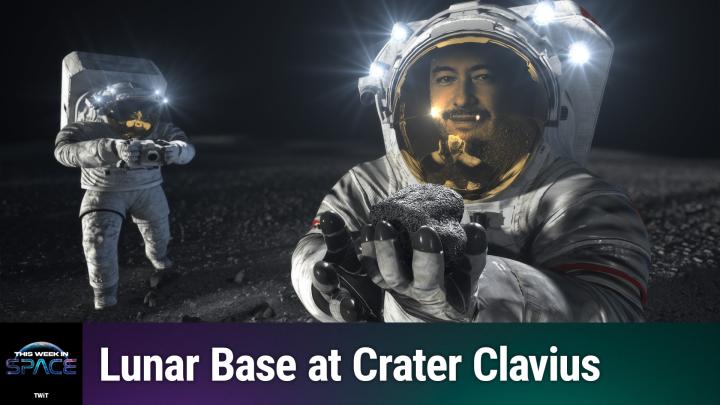
All TWiT.tv Shows (Audio)
This Week in Space 148: Clavius Base
01:03:04
Why Clavius Crater Is the Best Spot for Nasa's Moon Base With Dr. Pascal Lee
Loading summary
Transcript169 lines
- [00:00]
Tarek Malik
Coming up on this episode of this Week in space, we get Dr. Pascal Lee back in the chair to talk about the best place to land on the moon and build a base. And it's not the South Pole. Tune in. You're going to want to find out where it is.
- [00:14]
Rod Pyle
Podcasts you love from people you trust.
- [00:18]
Pascal Lee
This is trit. This is this Week in space, episode number 148, recorded on February 14, 2020 25. Clavius Bass. Hello, and welcome to yet another episode of this Week in Space, the Clavius Bass edition. I'm Rod Pyle, editor chief, Bad Astor magazine. I'm joined by my bestie, Tarek Malik, editor in chief, award winning editor.
- [00:44]
Tarek Malik
Award winning.
- [00:45]
Pascal Lee
Stack up another1@space.com. hello, partner.
- [00:48]
Tarek Malik
Hello, Rod. How's it going? Happy Valentine's Day, Rod. Happy Valentine's Day.
- [00:51]
Pascal Lee
Happy Valentine's Day, Fred.
- [00:53]
Tarek Malik
Will you be my Valentine? My space Valentine?
- [00:55]
Pascal Lee
Moving on, we're joined by the ever impressive Dr. Pascal Lee, whose scientific reputation is growing faster than the kudzo on SLS's mobile launch structure. Hello, Pascal. How are you?
- [01:07]
Tarek Malik
Oh, too soon.
- [01:09]
Rod Pyle
I'll take that as a compliment.
- [01:10]
Unknown
Hi.
- [01:10]
Rod Pyle
Hi, everybody.
- [01:11]
Tarek Malik
Hello.
- [01:12]
Rod Pyle
Thank you.
- [01:13]
Pascal Lee
Before we start, as I always say, please don't forget, do us a solid. Make sure to, like, subscribe and all the other podcast things because we love you and we need to know you love us just as much. So keep us fat and happy and we'll thank you forever. And now, from the uncertain mind of me, with a nudge from Mark R. On Facebook.
- [01:33]
Tarek Malik
Mark.
- [01:33]
Pascal Lee
Hey, Tarik.
- [01:34]
Tarek Malik
Yes, Rod?
- [01:37]
Pascal Lee
In the spirit of renaming bodies of water near Florida, what has Elon decided to rename Mars?
- [01:43]
Tarek Malik
I don't know. What? What has he decided?
- [01:45]
Pascal Lee
Planet X. I get it.
- [01:49]
Tarek Malik
I get it, get it.
- [01:52]
Pascal Lee
You're not laughing much.
- [01:53]
Tarek Malik
Okay, well, I mean, I get it. Do I want to laugh? I don't know.
- [01:58]
Pascal Lee
I've heard that some people want to rename us to something unflattering when it's joke time in this show, but you can help send your best, worst or most indifferent space joke to us at Twist tv because obviously we need the help. All right, let's do some headlines. Pascal, feel free to jump in anywhere you wish.
- [02:17]
Tarek Malik
Headline news. I did it. I did it.
- [02:22]
Rod Pyle
Pretty good.
- [02:23]
Pascal Lee
Yeah, but you didn't do it with an Australian accent. Hey, what's going on at Blue Origin, buddy?
- [02:29]
Tarek Malik
Yeah, your. Your guess is as good as mine. But it's really sad that we found out that they decided to lay off 10% of their workforce. There's A, a bunch of reports out this week. Uh, the one that we've got cited here is from, uh, Karen Weiss and Ken Chang over at New York Times. Either both K names. That's interesting. But, but they, they, they got this, this memo from Dave Limp, the CEO of Blue Origin, who basically said they're gonna cut 10% of their workforce about a thousand. A thousand jobs is what it looks like, in order to I guess refine or, or cut what they see as excess now that they need to shift into true operational flights. You know, just, just last month they launched their very first New Glenn rocket. They did not stick the landing. They're trying to launch the next one in maybe like the spring is what we found out because there was a commercial space conference in D.C. this week where, where Dave Limp was talking and that's what he said there to, according to our writer Mike Wall. But I guess to make that goal, they're going to scale up their manufacturing and launch cadence and reduce what they see as like, overages in management, in design and research and that sort of thing.
- [03:48]
Pascal Lee
It is very upper management, they said.
- [03:50]
Tarek Malik
Right, exactly. Yeah, they said, oh, I just had it here. But it's like upper upper management and a lot of like the, the research types of things. But they don't, I guess they don't need that anymore because they've got the rocket that they're ready. And allegedly Blue Origin is planning to launch like a moon lander by the end of the year. Right. To show that they can do it and it's a cargo version of it and they want to focus on that right now. And there was a very interesting citation in the story and then we can move on. But they were talking about why New Glenn was so delayed and why they brought in Dave Limp because he replaced the previous CEO to try to turn things around. And the, the observation from Chad Anderson at Space Capital was that Jeff Bezos was just pumping in a billion dollars a year into it. They didn't have to rush anything because they had all this money that they were flushed for research. And so they were like locked in a, in a, a permanent, like, R D phase and they didn't feel that urgency. That's what Dave Limp was brought in to change. So this could be part of that to get them to catch up to SpaceX, because SpaceX is Falcon Markets. And now with Starship has such a lead on them in commercial markets.
- [05:04]
Pascal Lee
All right, moving on to the next story, which is space.com? yes, scientists are alarmed as the Vera Rubin Observatory Changes the biography of the astronomer Vera Rubin after which it is named. Amidst the current administration's push to streamline dei. I'm being polite to eliminate references to DEI on anything NASA and government. Did I get that right?
- [05:34]
Tarek Malik
Yeah, this is a really disappointing. But this was actually first reported by ProPublica as well last month. But our writer Sharmella Kutner followed it up with some really great interviews with scientists. They're extremely upset because as we all know we're in this new administration with the Trump office and they did issue that executive order to all federal government agencies to scrub their DEI programs to end them or whatever. And part of that been to change or remove websites and pages and, and that sort of thing that, that celebrate any kind of diversity, equality etc types of programs, equity. And what ProPublica found and our, our writer followed up on is that the Rubin Observatory, Vera Rubin has a bio her biography there. It's named after the famed astronomer and they've actually altered the biography to reduce to, to kind of remove all of the mentions of how the, the observatory is working to reduce barriers for women and other historically.
- [06:35]
Pascal Lee
Excuse me and significantly to rewrite but streamline the history in which it was said she was a champion for, for women in the engineering workplaces of engineering sciences workplace. Which that was really the part that got me.
- [06:52]
Tarek Malik
Yeah. And like when ProPublica went went back and forth through what the a bio used to say and what it says now there are things taken out like a phrase of, you know, how she advocated for women in science. It's removed. You know, there was a, another paragraph that read that you know, science was, was still predominantly like a male dominated field and they, they took, they took things like that out too. And, and it's just, it's just really strange because it seems, it seems very petty right to go that granular because like who, who is really being affected by that when you're trying to tell what is, you know, the, the, the actual accurate history of what happened. And I think that's what a lot of these scientists are very concerned about about the, the kind of reworking and rewriting of, of that science history that really doesn't paint a picture of what it actually was. What barriers actually did have to be overcome in fact even to this day. So it's, it was a very interesting story. I really recommend people to not just check out this story on space.com but also the ProPublica one because it's a very detailed deep dive to see how science is being affected by all of this Trump stuff.
- [08:01]
Pascal Lee
All right, let's, let's keep moving quickly here. And by the way, it's, it's diversity, equity and inclusion just for people who. I said equality about that kind of stuff. Yeah. Which is different. This is right down Pascal's alley. We have iridescent clouds on Mars captured during Martian twilight in a robot.
- [08:19]
Tarek Malik
These are great. I just, I kind of wanted after that really heavy one to find something that was really fun. And actually, if you scroll down, there's a video here, Anthony, that you can see. And these are from the Curiosity rover, NASA's Curiosity remover on Mars. And they saw these red and green tinted clouds, these night shining clouds way at the top of Mars's atmosphere. And it's just spectacular that you can see these types of colors on another planet. I mean, I've only seen night shining clouds maybe once or twice in my actual life on Earth. And the fact that we can see them on Mars, just as another example of how wondrous that planet is, they are noctilucent clouds. We do have them on Earth as well. And I think that what they did is they took a bunch of pictures over about 16 minutes or so, and then they sped them up something like 480 times the actual speed of these clouds. This is not how fast the clouds were moving on Mars themselves, but they're about 37, 50 miles above the surface and it's a lot colder up there. So very, very interesting to see. And I don't know, maybe astronauts will be looking at this one day in the future.
- [09:26]
Pascal Lee
I was going to say I expect Pascal to be one of the first to be up there and see them.
- [09:30]
Tarek Malik
That's right.
- [09:32]
Rod Pyle
You know, it's really beautiful. And for your listeners who might not remember, noctilucent clouds are clouds that are simply lit from below when the sun is actually below our horizon. So after sunset or before sunrise, the sun rays can actually hit clouds that are very high up in the atmosphere. So this would work both on the Earth and Mars and other places too. And the clouds acquire this transient. So it doesn't last very long, but beautiful glow to them. And this is what's being captured here.
- [10:04]
Pascal Lee
All right. And as our Valentine's gift day to everybody. Well, if you live far enough north, we give you the Aurora Borealis.
- [10:12]
Tarek Malik
That's right, there is a Valentine's Day Aurora alert because this week there was a coronal hole, and this one that's been a hole in the magnetic field. So a lot of charged particles come out and it triggered a G1 geomagnetic storm this week. So if you're in the United States, maybe in Michigan or Maine, you might be able to see some amplified northern lights north of that, of course. And it's just a reminder to keep looking up because according to noaa, this storm might actually get more intense or be repeated as that coronal hole rotates more to face the Earth over the next few days to a week or so. So keep. And hopefully it'll get down to New Jersey again, where I can see it, so it's not raining the whole time.
- [10:55]
Pascal Lee
And if you are going to look up, go somewhere dark.
- [10:58]
Tarek Malik
Very dark. Yeah.
- [10:59]
Pascal Lee
And just a reminder, you know, this. Speaking recently to friends who had seen the last round of this, and it's not like it looks on the cell phone videos. That's pretty faint, you know. All right, a couple of quick housekeeping items ran, and Jones sent in a question. Why shouldn't we worry more about the 2032 asteroid? And as we've discussed a little bit on the show, it's not unusual for the first sighting to have a certain percentage of chance of an impact with Earth, and then for the next sighting, it'd be a little higher. But as JPL and others continue observing and charting this thing and figuring out its trajectory, those numbers traditionally have gone down. That doesn't mean it absolutely will, but it probably will. And I would add this thing's actually only about 35 or 40% the size of the asteroid that the Dart mission changes trajectory of. So we do know now it's a couple hundred feet across. Darts was almost 600ft across Dimorphos. So as we know now, we can change the trajectory of these things. So if it became a risk and if we caught it early enough, a big slam or a nudge or a tractor engine or however you want to do it, would push this thing far enough off that it would probably go somewhere else. Hopefully not onto the Moon, but that would be spectacular to see. So. So even erring on the side of caution, I don't think it's something to worry about. And we probably should have made that clear.
- [12:24]
Tarek Malik
Yeah. Just be careful at the headlines, because you're going to see a lot of headlines that say the odds of impact have doubled. And that's right, because they've gone from like 1% to 2%. So there you go.
- [12:36]
Pascal Lee
You know, it doesn't mean 50%. Yeah, yeah. Second thing, which is for you, Tarek, we got a question from Brett Wesley, who I think is a recently retired engineer who wants to see a starship launch. But he says it's hard to spot when they're going to schedule them, although you do put them up on Space.com and he's wondering where the best place to view it is.
- [12:56]
Tarek Malik
Well, so, you know, thank you. Thank you so much, Brett, for the, for the, for the note. If you're really looking for, like, up to minute, like, what's happening at Starbase, NASA's spaceflight is probably like the best site to look at. They have actually live cameras of what's going on there all the time. Plus they've got some dates when they think the launches are going to happen based on a lot of different sources, like the county commissioners when they do road closures and that sort of thing. SpaceX tends to not announce the launch target until very close to it. So, like about a day, maybe a two days, sometimes a week if they, if they, if they're feeling generous. I would say, though, that if they've got a rocket on the pad, you can get very close to it almost all of the time when the roads aren't closed because you can pull up right across the street from the spaceport and look at it. The place that I would recommend watching from is from South Padre Island. It's right across the bay from the place and there's a lot of hotels there. And you can actually walk from the hotel down to the launch site, avoid some traffic. It's not very far, but you can also get it from. There's like a campground around there, the Boca Chica area. But the Boca Chica beach itself gets closed off, so you can't, you can't go there. But there's a Boca Chica camping ground that has very clear views. I've seen people camp there during the launches and watch it there, too. I like South Padre Island. And if you're flying, McAllen, Texas is the better airport. It's got more cars for rental cars it's easier to get into and out of.
- [14:26]
Rod Pyle
So.
- [14:27]
Pascal Lee
All right, if you have any other questions, just drop us an email and see to it. The Tarek response. Let's go to a quick break to one of our beloved sponsors and we'll be right back. Stand by.
- [14:37]
Unknown
Attention taxpayers. The IRS is intensifying collections in 2025. If you owe $10,000 or more or have unfiled tax returns, it's time to take action. Tax Network USA's experienced lawyers have saved clients over a billion dollars. They're ready to negotiate with the IRS on your behalf. Don't risk wage garnishment, property seizure or losing your home. Call 1-800-958-1000 today. Get the help you need at 1-800-958-10000 or visit tnusa.com Listeners, are you looking.
- [15:08]
For a shortcut to better auto insurance for you? Something that takes all the research off your plate. Something that's easy, something that matches you with lower rates, Something genius. That's where NerdWallet comes in. Their nerds already did the work for you. Just answer a few questions and ta da, you'll be matched with top insurance providers in your area. Find the right rate for you@nerdwallet.com after all, using NerdWallet is more than smart, it's genius. Not all applicants will qualify for the lowest monthly payments. NerdWallet Insurance Services Incorporated, CA resident license number OK 92033.
- [15:37]
Pascal Lee
All right, we are back with speaking of beloved things, our beloved Dr. Pascal Lee, who's a planetary scientist at SETI, director of the Mars Institute, founder of the Houghton Mars Project, explorer, artist, raconteur, registered Francophile, I guess by, you know, by long affiliation and discover of Martian glaciers and volcanoes. Did I miss anything, my friend?
- [16:00]
Rod Pyle
Yes, but that's. They'll do it for today.
- [16:03]
Pascal Lee
Okay, I did get artists in there, so. Okay, well, that'll do.
- [16:06]
Rod Pyle
I love dogs and my dog Apollo here is Apollo taking a nap.
- [16:12]
Pascal Lee
Apollo, the polar bear warning system. Yes, hello. That dog a treat that, that dog has left more little nips on your heels than anything else I've seen. So we're here today to talk about moon based sighting and your. Your favorite location for that, which you've worked out pretty thoroughly is the crater Clavius. Now when we think of Clavius, of course, most of us at least of a certain age, think of 2001 A Space Odyssey where we have a massive lunar base in which the Orion spacecraft, not the Orion, we know The Orion from 1968 lands the Panama. No, that's the Pan Am gets to the space station and then arrives the moon shuttle, young man.
- [16:56]
Tarek Malik
Sorry.
- [16:56]
Pascal Lee
And, and moon monoliths and moon buses and all kinds of other cool stuff. So maybe you can Pascal, just sort of give us a general orientation and primer on Clavius and why it's important.
- [17:11]
Rod Pyle
Yeah, well, first of all, let me preface this whole discussion with the notion that I think Artemis right now is on course to achieving great things. The idea of pushing for base anywhere on the moon, including at Clavius, is not to suggest that we should stop Doing what we're doing with Artemis and somehow shift gears in a dramatic way. But I think that we should nudge the program as early as possible to really focus on having humans set up, having American astronauts and our partners set up a base on the moon and at an off polar site. The polar regions are terrible to set up an exploration base, you want to set up a mine there. If you find water that you can extract economically, you don't want to set up an exploration base from where you want to roam around a lot. So. So therefore, we've been looking for a place to set up potentially an Artemis base camp that we. That would be at an off polar site. And so here are some criteria. We wanted it to be on the near side of the Moon so that you can see the Earth from it at all times. You want it to be in a place that is inherently geologically very interesting. So, ideally, covering a long expanse of lunar history, you want it to be a wide open space where you can land and expand your base and also do lots of traverses without running immediately into a lot of terrain challenges. You want a place that can give you access to capes, because that's really what we want to do ultimately on Mars. And so for that reason alone, it's a good idea to start practicing as early as possible cave exploration on the Moon. And so if you combine all these criteria together, Clavius rises to the top very quickly. Wow. Beautiful. Yeah, thank you. So you're looking at Clavius from the south. It's this giant basin. It's 263km across, which is the distance between Washington and Philadelphia. The large, fresher crater that's sitting on its rim in the foreground is Rutherford. And both inside Rutherford and on the ejecta blanket outside of Rutherford, there are caves, pits and caves. And the bay site that we're proposing at least to check out robotically first, of course, before you start moving a whole bunch of assets, there is right to the west, in other words, to the left of Rutherford, in that flat spot in the foreground on the floor, Clavius Crater that you see here at the bottom of the page.
- [19:48]
Tarek Malik
Pascal, if I'm looking at the Moon, like, because it's a full moon this week, for example. Right. It's a great time to look at it with telescopes. Can I see Clavius like you mentioned? So where, where, like, is it in the center? Dead. Dead heart for people.
- [20:03]
Rod Pyle
Lower left.
- [20:04]
Tarek Malik
The lower left, yes.
- [20:06]
Rod Pyle
If you look at the lower left of the Moon, at least from the Northern hemisphere to the lower left.
- [20:09]
Tarek Malik
Right.
- [20:09]
Rod Pyle
If you're in the southern hemisphere, it's the other way around. But you will see a very bright impact crater with bright rays, ejecta rays, that's Tycho. And straight south from there, a few Tycho diameters away, you have Clavius. So Clavius, seen from the Earth is. Appears to be almost at the edge of the Moon, although it's still quite clear of it. If you were at Clavius, you would see the Earth well clear of the horizon, but near the horizon still. And that would be really a beautiful sight.
- [20:38]
Tarek Malik
Yeah, that would be an awesome picture window for sure.
- [20:41]
Rod Pyle
The latitude of Clavius is 60 degrees south. So that's actually considered to be high southern latitude on the Moon.
- [20:51]
Tarek Malik
And so just. Oh, go ahead.
- [20:54]
Pascal Lee
Are we likely to find ICE PSRs there, or would that be further south?
- [20:59]
Rod Pyle
In fact, this is actually the limit where you still have permanently shadowed regions. They're not as big and cold either, probably as the ones that are at the South Pole or the North Pole, but they are still PSRs, permanently shadowed regions. And they are essentially tucked at the base of the inner walls of craters, of impact craters on their northern side. And so there are therefore places where, on the floor of Clavius where, Where the sun don't shine. And the thing I wanted to add is that Jack schmidt, you know, Apollo 17, Apollo 17, astronaut, hero and geologist, has been advocating, along with Noah Petro, who is heading the Lunar Reconnaissance Orbiter mission, that we, we actually go to a place like one of these craters that are within the area of Clavius to actually learn how to explore PSR permanently shadow regions and get back into the flow of lunar exploration with humans before we tackle something as challenging as the south polar regions. So, again, I think it's possibly too late to pull the plug on what Artemis 3 plans to do, which is the first human return with two astronauts at the surface of the Moon. With the scenario that we're on right now, but very quickly, I wish we could shift gears towards setting up a base, because human astronauts are really not ideally suited to search for water in these permanently shadow regions. I mean, they're extremely cold. The south polar regions are extremely rough and steep. It's the lunar highlands. They, they have shadowing. That is, shadows roll in and out very quickly and very dangerously. If you're caught in one of these shadowed regions, you could be trapped in, in shadows for, for, for, you know, along several weeks sometimes. Yeah, and that is very bad news for temperature and surface operations. It's on the other hand ideally suited for robotic exploration. So if I, if I, you know, have things my way and I would do more robotic exploration in the south polar regions, target all these places where we're considering finding, possibly extracting water someday and assessing them systematically with robots and then have humans beyond the first maybe landing to symbolically mark a return to the moon, shift gears towards setting up habitats and then pressurized doing pressurized rover traverses, but from a base that's a lot more manageable, you know, logistically operational and.
- [23:40]
Tarek Malik
Pascal, Pascal, have we ever like actually landed anything on Clavius? Because as we're speaking, you know, Firefly announced that their Blue Ghostlander officially successfully entered orbit around the Moon. And if all goes well, they will land on Mere Crisium, the Sea of Crises on like in early, in early March. Meanwhile, in a couple of weeks Intuitive Machines is launching the IM2 mission. And of course I space's lander is resilience is also making its way. It seems like we're sending a lot of stuff to the moon, but have we actually landed anything on Clavius at.
- [24:17]
Rod Pyle
All is still untouched China. There's the rumor that they are targeting a landing, if not their first landing with humans on the floor Tycho, which is a very recent but very rough terrain wise and, and steep in some places. Impact crater Clavius, nothing yet. And as Rod and you guys are pointing out, Clavius has been on the map, so to speak, for a long time thanks to 2001 and Space Odyssey. But the, the reason why Arthur C. Clarke picked that spot was, was just based on, you know, the general knowledge that this was a wide open space from which you could see the Earth in a very spectacular way with the Earth low on the horizon, as opposed to like we had at the Apollo sites overhead essentially. But there was otherwise very little known about the place at the time when it was proposed. And so, but since then a lot of things have been found at Clavius. I just mentioned the lava tubes and pits. I mentioned the PSRs, primarily shadowed regions, but there's for example water, molecular water, unlike at the poles where we're detecting mostly hydrogen first and then inferring that it's H2O at Clavius, the Sofia mission, NASA's airborne observatory that does infrared astronomy, which is now defunct, it's no longer being operated. But during its, its test run it detected up to 418, I think parts per million water molecule at the surface, at the surface of, on the floor of Clavius.
- [25:57]
Tarek Malik
So there could be more underneath.
- [25:58]
Rod Pyle
There could be more underneath. It's unclear where the. What, what the origin of that water is. People like Pete Schultz, who's a plantry scientist, was well known at Brown University, suggested that the Rutherford Crater, which is relatively recent, was formed by the impact of a water rich asteroid or even a comet. And so it could have just dumped a lot of water then, which you're seeing as a residual of that. But what that means is that the caves and the PSRS could actually have trapped some of this water if it's somehow concentrated there. And so lots of things for us to look into. And then in a recent study I did with a student of mine, Aaron Sampson, who's at the University of, who's a sophomore at the University of Colorado, Boulder, we find some potential volcanoes on the floor of Clavius that would be really exciting to explore. And then the different craters that you see across the floor of Clavius are of different ages. And so they've, they themselves are going to inform us about, you know, how the terrain and subsurface of the Moon evolves over time by, by exploring their different geologies.
- [27:08]
Pascal Lee
So we need to go to a break, but just very quickly. Tarek, mares or horses? Mares. Or, or moon seas.
- [27:15]
Tarek Malik
Oh, wow. Calling me out just so it's. I thought I was award winning, Rod.
- [27:20]
Pascal Lee
Wow, you are. And we're just about to give you another one. In fact, it's the same one that both Pascal and I got.
- [27:25]
Rod Pyle
Plural is Maria, not Maria.
- [27:28]
Pascal Lee
So. So, Pascal, I have to figure out a way to present Pascal's. Excuse me, Tarek's award that will best the way I presented yours by. By pretending to drop it on the stage. That'll be. I'll have to think of that. Maybe I'll bonk him in the head or something.
- [27:45]
Rod Pyle
Okay, so congratulations, Tariq. You big time deserve it. I'm really happy.
- [27:50]
Tarek Malik
Thank you. Thank you very much.
- [27:52]
Pascal Lee
All right, you guys knock it off here. We're gonna go to a break real quick and we'll be right back with my next question. Standby.
- [28:00]
Unknown
Attention taxpayers. The IRS is intensifying collections in 2025. If you owe $10,000 or more or have unflinching filed tax returns, it's time to take action. Tax Network USA's experienced lawyers have saved clients over a billion dollars. They're ready to negotiate with the IRS on your behalf. Don't risk wage garnishment, property seizure, or losing your home. Call 1-800-958-1000 today. Get the help you need at 1-800-958-10000 or visit tnusa.com listeners.
- [28:30]
Are you looking for a shortcut to better auto insurance for you? Something that takes all the research off your plate. Something that's easy, something that matches you with lower rates. That's where NerdWallet comes in. Their nerds already did the work for you. Just answer a few questions and ta da, you'll be matched with top insurance providers in your area. Find the right rate for you@nerdwallet.com after all, using NerdWallet is more than smart. It's genius. Not all applicants will qualify for the lowest monthly payments. NerdWallet Insurance Services Incorporated, CA resident license number OK 92033 Pascal.
- [29:01]
Pascal Lee
You and I have talked a lot, mostly in the Martian context, but I think it applies the moon too, about sort emissions versus longer stay permanent or semi permanent habitats of one size or another. And I'd like to get your collective thoughts on why that matters and how to accomplish it best probably at Clavius.
- [29:23]
Rod Pyle
Yeah, well, you know, sortie missions is what we did with Apollo, right? We, we, we the nation had the commitment to landing a man on the moon and returning him safely by the end of the decade. That was achieved with Apollo 11. But then there were, you know, some hardware developed and there was an exciting momentum there to do a little more on the Moon, especially lunar rover came on the line. So we went all the way to Apollo 17. And it was never the goal for Apollo to establish a permanent human presence on the Moon. That wasn't what was at stake in the competition in the Cold War. And so what was done was sortie missions. You land here and then next time you go to another interesting place, like next time you go to some other place where you went didn't matter to the geopolitics of it, but it mattered a lot to the scientists. And so by landing in different places, you were sort of doing the science buffet of sampling what the geology of the moon has to offer. But it's really not an efficient strategy, even if you're a scientist, but especially if you're considering other things like geopolitics of being on the Moon. The, the sort of our strategic presence, our long term ability to explore the place, just a logistics chain of going back to the moon each time you really want to get into a mode where you are setting up an infrastructure as fast as possible. And so the analogy of course are the Antarctic or Arctic bases. You set up a base, but the base in itself is not enough. A base would just anchor you to one point. It's a base plus a mobility system. So ways to travel from your base to sites of exploration, sites of mining, eventually on the moon, sites of possibly tourism. So the idea of a base is really very important because it creates an infrastructure, a shelter, safe haven for you at the surface of the moon where your operations are. I mean, some people propose a base in lunar orbit, but that doesn't really help with building infrastructure to increase safety in your surface operations. And, and then once you have a base, everything is possible. So, you know, with McMurdo in Antarctica, we can, we, we can roam the continent, the entire continent, with different mobility systems. C130 airplanes for long range, helicopters for short range or twin otters, snowmobiles for, you know, on the ground surface. Short roaming, short range roaming. And what I think should be decoupled is the idea that we do want a base on the moon, but we don't want it in the south polar region, because the south polar region is being focused on, because we're looking for water ice there mainly. That's sort of the main draw for being there. And we don't know where we want to set up chanter yet, or if at all, ever. And even if we found a place to extract water that was economically viable to extract, well, what you would want to set up there is a mine, not an exploration base from where you would roam around to explore other places. The terrain is just too difficult, the lighting too crazy and risky. And so those are two different things. And you know, you can look at the Arctic or extreme environments on Earth, you set up a town, but then you have different minds, you serve by, by roaming from there. So I mean, I'm pushing for Clavius because I love the place at this point, now that we've studied it quite a bit. And, and the other beauty, of course, is that from clavis you have a very nice gentle sloped corridor down which you could drive. And within a few days you're at the south pole of the moon, which is not true for a whole bunch of other high latitude sites on the near side or the far side. The lunar polar regions are very, very hard to sort of break into. They are surrounded by a fortress of very steep crater walls that are contiguous. And all of a sudden there's a break. If you're at the south pole of the moon and you drive northwest, you can break out of the polar regions on the near side of the Earth of the Melan, and reach the first big basin and that's Clavis Crater. So I call it the Northwest Passage.
- [33:39]
Tarek Malik
And you said it would take a few days to drive, to make that drive. Two days.
- [33:43]
Rod Pyle
Not the original reconnaissance, of course, that would take a little while. But once you flag the route and you know that rain is safe and yeah, it's a few days.
- [33:52]
Tarek Malik
Well, I'm curious about where everything is in Clavius, depending on where you would want to set up a shop because you mentioned that there's like a lot of other things. So you've got the water on the surface, maybe water underground. You're within driving, you know, like a two day drive, a road trip, a weekend road trip to the, to the moon south pole. You mentioned that there are caves and pits and stuff like that. And then we saw in the images that we've got on the screen for folks tuning in that there's a lot of interior younger craters as well. And I'm wondering if there's like a specific spot in Clavius that is the very sweet spot that you see that it's like it makes all of these different environments within reach. Because I think even I, you know, I'm not a geologist, but I can see the advantage of being able to reach different types of, of terrain, different types of features. Yeah, relatively. Stevens. It's why when I go to the supermarket, I go to the one that's right by the target. Right. Because I got more options. So, so I could see, I could see this for, for the Moon too. But how close is everything else in Clavius if it's between Washington and Philadelphia?
- [35:01]
Rod Pyle
So the candidate site, the candidate spot that we have in mind, you can see it on this picture again. The big round ancient crater that you're seeing, that's Clavius. All of it is Clavius. And then Clavius has a relatively flat floor, as you can see. And again, the crater that's fresh in the foreground a bit to the right of it, straddling its rim is Rutherford Crater. And the site, the spot that we're thinking about is immediately to the west of Rutherford in that relatively tight but flat spot on the southern floor of Clades. So that's where it is. And the beauty of that place is that you're now within just a few hundred meters to a few kilometers from caves you are from several caves. You actually can drive up and out of Clavius Crater. Right there in front of you, there's a breach in the southern rim of Clavius that's Very drivable with slopes less than 15 degrees, which is what the Apollo lunar rover could handle. And then from there you drive on south and the road to the South Pole is right in the middle of your screen there. It disappears below you, right above the date. Friday the 14th, right above 14. Keep driving south that way towards yourself. You're headed south. So it's an, you know, whereas if you were in the eastern part of Clavius, you can see that there's some pretty steep hills and cliffs and other places that are not so easy to get out of Clavius from. But it'd be a, again, a lot more site certification has to be done before we, we sort of say, okay, this is the spot, but yeah, and then it's right next to volcanoes as well.
- [36:52]
Pascal Lee
So lest anybody second guess Pascal's expertise on these images, I can personally attest the fact that this guy can stare at lunar or Martian images for 10 hours at a time, studying and memorizing everything while I'm trying to remember my middle name. Let's jump to a quick early break because I'm going to come back with a question that I expect a lengthy answer for. So stand by.
- [37:17]
Unknown
Attention taxpayers. The IRS is intensifying collections in 2025. If you owe $10,000 or more or have unfiled tax returns, it's time to take action. Tax Network USA's experienced lawyers have saved clients over a billion dollars. They're ready to negotiate with the IRS on your behalf. Don't risk wage garnishment, property seizure or losing your home. Call 1-800-958-1000 today. Get the help you need at 1-800-958-10000 or visit tnusa.com Listeners, are you looking.
- [37:48]
For a shortcut to better auto insurance for you? Something that takes all the research off your plate. Something that's easy, Something that matches you with lower rates. Something genius. That's where NerdWallet comes in. Their nerds already did the work for you. Just answer a few questions and ta da. You'll be matched with top insurance providers in your area. Find the right rate for you@nerdwallet.com after all, using NerdWallet is more than smart. It's genius. Not all applicants will qualify for the lowest monthly payments. NerdWallet Insurance Services Incorporated, CA resident license number OK 92033.
- [38:17]
Pascal Lee
Okay, so specific to a, let's say a medium sized long term habitat. So something that would house 12, 20 people, something like that. And I picked that number by the way, dipping in my memory back to the U.S. army plans for Project Horizon from 1958, because they were going to send 12 to soldiers to the moon to live in their base that they thought they could construct in less than two months, which was absolute fantasy. Oh, and for $6 billion, all in. But enough about that. So sighting and construction and shielding, are you talking in your mind? Are you talking mostly about building on the surface or maybe something of the surface split between the surface and down in a lava tube or one of the other? How do you shield it against radiation and so forth?
- [39:07]
Rod Pyle
Yeah, that's a good point. To me, the solution to shielded habitats are modules that you lay down at the surface, possibly on struts, like what NASA is actually thinking about for its first module in the Artemis program. So it's a bit off the ground, but it's on landing legs, if you will. So modules at the surface. And of course, to add radiation shielding, you sandbag them as opposed to burying them, as opposed to somehow inflating them inside a lava tube. All of those things, I think are fraught with risk, uncertainty. And even though you might gain in radiation shielding, now you have all kinds of logistical issues for getting out of those places. So I see as a reasonable approach to building a base to just do it at the surface and then over time, you sandbag it, you sandbag the modules. Sandbagging is easy. I mean, we do that already with robotic systems on Earth, you know, around river or oceanfront levees. You know, they scoop sand in the front and they poop a sandbag at the back, and they're very, very movable. And, you know, so if you really want to reconfigure your base a bit, move things around, you can just, with a robot, take off the sandbags and put them back on. It's, it's quite, it's, it's quite manageable.
- [40:33]
Tarek Malik
That feels like a job for the intern, right? All right, go out, fill some, fill some, some moon dirt bags, right?
- [40:41]
Pascal Lee
And actually that's a job for you and me because we go up there and they say, okay, what's your science background? We just stand there with a sad look on our face, remembering our failures.
- [40:50]
Tarek Malik
I would do that job in a heartbeat. Pascal, if you need, like a sandbagger from, for the moon, I don't, I'm not promising to do more than, like, being able to do sandbags, but I can do that also.
- [41:04]
Pascal Lee
Probably be careful because he does a lot of this kind of stuff on Earth, and he may recruit you to Go up and do it somewhere here.
- [41:10]
Rod Pyle
Sandbag carrier. But so, and you know, here's another thing. Clavius being so old, it's, it's a nick, it's nectarian in age. So roughly, you know, between 3.9 and 3.85 billion years old. It has a very well developed regolith, very broken down. It's going to be the easiest stuff in a relative set to sort of scoop up and harvest for bagging.
- [41:37]
Pascal Lee
I never thought of that. So on the pole there would have been a lot fewer impacts, right?
- [41:42]
Rod Pyle
Well, the poles, you have a lot of impacts too, except that they're in the lunar highlands. And then a lot of the craters at the polis also will have, you know, dug up a lot of chunky pieces of dirt, including relatively recent craters. Clavius is very old. Of course, there are some recent craters in there, but it's, you know, my, I don't anticipate there being a problem finding sand, so to speak to, to bag. You know, a couple things I think need to be of course brought up, which are the, the power, okay, at the polls the claim is that you can use currently sunlit areas, but then when you think about it, you can't, you can't really seriously think of powering a base, let alone a mine with a farm, a solar farm at the surface of the moon with all the dust that's going to be kicked up, the starship landings and launches. Solar panels are really fine for relatively small and initial infrastructures, but it's not the way to power a base. So to, to have a base, you need to go nuclear. And that's basically the solution for, at Clavius, where you no longer have the permanent sunlight, you have 14 days of daylight followed by 14 days of night. And to survive the lunar night, you need nuclear power. So I think we should, might as well go down that road early. We need that for Mars and that's recognized already. Now. The NASA Moon to Mars architecture workshop and team has already identified nuclear power on Mars as something that we have to develop for long term presence on Mars.
- [43:15]
Tarek Malik
Let me, let me ask about that real quick because I know that we've sent probes to, to Saturn, to Jupiter, out, out of the solar system entirely with, with those radio isotope generators as RTGs, you know, and that's what I think a lot of people think about when they think about, oh, a nuclear battery for space. The Curiosity and Perseverance rovers have them. What kind of nuclear power are we talking about? Because the ones here, you know, At Three Mile island are ginormous. And so there's one on the, on the, on the beeline down to, down to the ksc. You can see the smokestacks. Can we even build a small one that would power the base like this?
- [43:54]
Rod Pyle
Yes, we can. In fact, McMurdo, the American base at the South Pole was initially powered by a nuclear power reactor.
- [44:02]
Tarek Malik
I did not know that.
- [44:03]
Rod Pyle
And in fact it was hard to control, it was down half the time. So for a variety of reasons. And then also the US wasn't wanting to encourage other nations in Antarctica to sort of go nuclear either as well, so the plug was pulled on that. But we have powered bases in places where solar panels at the time at least were not up to speed yet. And so we're talking about a small nuclear battery, so to speak, and then a nuclear reactor, efficient reactor. And you know, I grew up in France where 90% of power is produced by nuclear reactors. So I'm, I'm over the, the psychological barrier of nuclear power, but I think it's sort of the way to go really. It's this.
- [44:49]
Tarek Malik
Now I'm not saying we should fear it, it's just I've only seen it, these ginormous things. You know, I've never seen what a compact fission reactor would look like. Right, except maybe like a NASA rendering.
- [45:01]
Pascal Lee
They're small.
- [45:02]
Rod Pyle
I, I also, I also think space based solar power has some future, especially for small dispersed infrastructures. I mean, if you have an outpost temporarily somewhere or it's a relatively small operation, then you, you could have space based solar power like a, you know, essentially a solar farm in orbit, beaming down some power to you because you have a lot of scattered assets. It doesn't become practical anymore to have, you know, nuclear power them, each one of them. But, and then of course space based solar power can handle a bit of power support across the lunar night. But I, I don't see space based solar power as being a solution that's practical once you have a growing base that's substantial in size, let alone on Mars. So, so I mean, that's just my take on it, but I'm not an expert.
- [45:49]
Pascal Lee
Well, and looking at the discord here out of sync, mention naval nuke subs in subs and ships, those are fairly small reactors that create a lot of power. In fact, I remember, I didn't think about when there was a hurricane in Hawaii years ago and the power went out. I think it was in Kauai, which isn't a huge island, but it's got a Large population. An American nuclear sub pulled up and ran cables out of a hatch and powered the whole island for a couple of weeks. They got their power back up. And the Soviet Union, back in the dark days, the Cold War, early Cold War 60s were sticking nuclear reactors everywhere. A lot, most of them are still there. They're just kind of rotting away because they never took them out. But all over the Antarctic and up in the Arctic, north and so forth. So, and that, that was in the dark days when these things could just like go bonkers. So they've come a long way since then for smaller ones. And of course we've got the DoD working on. Is it called Kilo Power, the compact reactor that they've been working on for quite a while.
- [46:57]
Tarek Malik
Would you want a nuclear power like a rover? I want to. Because then you could like go off for like a month at a time or like to go to all these different sites, go down to the southwest, come back.
- [47:09]
Rod Pyle
I mean, a robotic rover could sort of use an RTG type of approach to power it. Although I think currently pressurized rovers for, for crude missions are thought of as being powered by fuel cells, you know, and that might be the way to go for now. And of course you would recharge them somehow at some point.
- [47:27]
Tarek Malik
I think about Mark Watney in the Martian.
- [47:29]
Pascal Lee
Well, in an rtg, so you're talking about a, a nuclear fuel pellet that isn't actually fissioning, it's just sitting there having heat converted electricity. But it have to be massive for a crude rover, wouldn't it?
- [47:43]
Rod Pyle
Yeah. So I won't comment further on that, but it's a very. Lots of applications are possible, lots of options are available as well. But let me say something.
- [47:55]
Pascal Lee
Sure.
- [47:56]
Rod Pyle
I think I don't want to just miss that, which is that why are we even thinking of setting an infrastructure that's off polar if we really think there's so much potential for mining and resource extraction, especially water at the South Pole? And I think the reality check that I want to sort of throw out here is that yes, there, you know, there is plenty of water at the South Pole. We now know from the Shadowcam mission, which is an American camera on a, on a Korean orbiter, that even these permanently shadowed regions don't seem to have a lot of exposed ice in them. And so the ice is most likely buried, you know, at least within the top meter of the regolith, the soil, and possibly extending further down. But from what we can tell from these orbital surveys with neutron spectrometry, which measures how much hydrogen the soil contains the equivalent amount of water in the places where you have the highest concentrations of hydrogen. Therefore, water only reach a level of about 0.5 weight percent of water equivalent hydrogen. So what that means is that if you, if you dig out one metric ton of lunar dirt in one of these areas that has the highest concentration of hydrogen, you get 5 liters of water at most. If you don't lose, if you don't lose any of it. Out of that 5 kilos, 5 kilos per metric dirt to the starship when it launches, holds, you know, something of order 1000, I think it's even 1200 metric tons of fuel. If you wanted to refuel a single starship, let's say 1,000 metric tons of water in the form of hydrogen and oxygen split up, you would have to dig up, excavate a football, 26, sorry, 25 football fields down to a depth of 1 meter to get 1,000 metric tons of hydrogen.
- [49:55]
Tarek Malik
That, that is not a job. That is not a job for this intern. I will not be doing that part.
- [50:01]
Rod Pyle
Well, and my point here is that this is why I don't know if the water on the south pole of the moon, even though we say that, of course, in total it amounts to 100,000 Olympic swimming pools or whatever the number is. I don't know if it will ever turn out to be economically viable. And of course the competing approach is bringing the water from the Earth. Any single landing of a starship could land 100, say, metric tons of clean, purified water sitting where you want it with a tap at the bottom of the rocket. It's a water tower. And I don't know when we will have that on the moon with water extracted from the moon of Eber. And it's not just a matter of excavating the water. You have to, you know, extract filter it out from the dirt, you have to contain it, you have to pipe it, in other words, transport it from the extraction site to wherever you want it, which means they have to, to warm it up. That's very power intensive to thaw ice at 50 Kelvin, that's -270 Fahrenheit, 370 Fahrenheit. So I mean it's, it's a monumental task to, to liquefy the water and to transport it. I'm not saying it's not possible. The question is, will it ever be economically viable? And to me it's at the very least, huge question mark. Throwing all our assets and setting up a base and all this with not knowing the answer to this question, if it will ever be economically viable to extract the water on the moon, we should really decouple the two things establishing our permanent presence and a base resupply from the Earth and explore the Moon, including the South Pole regions, and then keep prospecting for water with robotic assets at the South Pole.
- [51:54]
Pascal Lee
All right, let's go to our last break and we'll be right back. Go nowhere.
- [51:58]
Unknown
Attention taxpayers, the IRS is intensifying collections in 2025. If you owe $10,000 or more or have unfiled tax returns, it's time to take action. Tax Network USA's experienced lawyers have saved clients over a billion dollars. They're ready to negotiate with the IRS on your behalf. Don't risk wage garnishment, property seizure or losing your home. Call 1-800-958-1000 today. Get the help you need at 1-800-958-10000 or visit tnusa.com Listeners, are you looking.
- [52:29]
For a shortcut to better auto insurance for you? Something that takes all the research off your plate, Something that's easy, something that matches you with lower rates, Something genius. That's where NerdWallet comes in. Their nerds already did the work for you. Just answer a few questions and ta da, you'll be matched with top insurance providers in your area. Find the right rate for you@nerdwallet.com after all, using NerdWallet is more than smart. It's genius. Not all applicants will qualify for the lowest monthly payments. NerdWallet Insurance Services, Inc. California resident license number OK 92033.
- [52:58]
Pascal Lee
You know, every time you talk about flying up a starship filled with water, I think of this massive 300 foot. No. How tall is Starship?
- [53:08]
Tarek Malik
400Ft.
- [53:09]
Pascal Lee
No, Lunar Starship.
- [53:12]
Tarek Malik
It's two something. Right?
- [53:14]
Pascal Lee
I think it's 180 or whatever. But this huge coffee urn with a little tap at the bottom that I would run out from my lunar habitat and fill up a cup of water and try and run back in the habitat and drink it before it freezes or, or sublimes. All right, so you kind of alluded to this earlier, but this is not NASA's favorite favored plan. And that it isn't.
- [53:37]
Rod Pyle
I've had discussions from folks at NASA headquarters this week. Some, some were telling me, yeah, we were very concerned about rsr. It's not, you know, I mean, NASA actually did not choose to go to the South Pole. This was something that was directed or at least guided by the National Space Council at the time. And again, I think it was, on paper, it looks good. And it sounds like you're making the right move. I mean, everybody's so obsessed with living off the land and somehow making that the way to go. You have to really be very pragmatic about how much exactly are you talking about being able to extract and at what cost and when and buy when. And all of these things, I think, were not really fleshed out before the whole bandwagon got moving towards sending people to the South Pole.
- [54:29]
Pascal Lee
Well, and you wonder, regardless of the source of South Pole. South Pole, South Pole, how much of that is engineering driven? How much, if any, of that is science driven, which it doesn't sound like it is, and how much of it's geopolitically driven, which sounds like the majority of the. The cause celeb, if you will.
- [54:48]
Rod Pyle
Yeah, I think it's a geopolitical decision, which, I mean, the engineers are faced with a novel challenge, but I think if it was just setting up a base on the Moon and returning there, it'd be as challenging, but maybe more permanent, more durable, more meaningful in the end. The scientists, of course, are not pushing back too strongly because at some level, wow, again, it's the same Apollo attraction. We're going to land in a different place every time. Instead of setting up a base, let's do the buffet science approach of sampling as many places on the moon as we can. But the truth is, if you understand how fuel science works in Antarctica, it's a godsend to have a base. A base is actually a good thing for science. It does not anchor you down. It's a springboard to other places. And so this is not necessarily understood by all of my science peers. It's just one of those things where you don't convince yourself of the value of this unless you've experienced working in Antarctica or the Arctic, places where you need a base really to be safe and productive, well, you'd know more about.
- [56:02]
Pascal Lee
That than most of us. Tarek, you got one more?
- [56:05]
Tarek Malik
Yeah. I'm just wondering if there's one thing, Pascal, one thing about Clavius that you, when you get there, are going to go see first. Is it a specific.
- [56:16]
Pascal Lee
He's going to look for the monolith?
- [56:17]
Tarek Malik
Is it a cave? Is it just digging your hands in the moon dirt? What's the first thing you want to do when you land at Clavius and hop off the lander in your spacesuit and, you know, I guess give a stretch because it's a long Trip. But anyway, after that, what's the first thing you'd want to go look at, either scientifically or personally?
- [56:39]
Rod Pyle
You know, personally, I think I would like to run up that hill that's a little bit to the south and look at our infrastructure in the foreground down on the floor of Clavius, and basically take the equivalent picture as what was portrayed in 2001 A Space Odyssey. Maybe I can call that up as my. I have that background picture as well. I don't know if I can. After the next break, I can put it up. But just because, you know, here's another. Here's the thing that turns out to be really interesting. We did not choose klavius because of 2001 A Space Odyssey. We chose Klavius because it had some really good attributes as a place to set up a base. And. But however, this amazing connection that it would have with this movie and the movie was a lot more than just some artist concept. It was a real vision in our early steps in space exploration. The fact that reality would end up meeting fiction in such an amazing way. It's a bit like launching from Cape Canaveral and Kennedy Space Center. You know, comparing that with Jules Verne's from the Earth to the Moon, where he had predicted that launches would be from Florida. It's sort of at that level. If somehow we could start building a base at Clavius, it would be very attractive, I think, for the public to see that grow over time.
- [58:11]
Tarek Malik
See that. That's a very altruistic and, like, picturesque desire for what you do. I would probably just write my name in the moon dirt and just write, tarik was here. You know, with a Z instead of.
- [58:21]
Pascal Lee
An S. You know, W U Z.
- [58:24]
Tarek Malik
Take a selfie.
- [58:25]
Pascal Lee
Let's not forget that Jules Verne also suggested that in that little tiny spacecraft that was accelerated to about 900 GS as it was fired out of the big cannon, you were also supposed to take a bunch of chickens. And I do not want to fly three days to the moon with a bunch of chickens flapping around. My last question is, what are we going to see from you in the near future in terms of new research papers, new artwork, any books in the planning? What have you got?
- [58:52]
Rod Pyle
So Aaron Sampson is presenting our Geological Map and Human Exploration Target Sites paper at the upcoming Lunar and Planetary Science Conference in Houston next month.
- [59:04]
Pascal Lee
I love the picture you just put up.
- [59:06]
Tarek Malik
Yeah, this is what he wants to see. That's what he wants to see.
- [59:09]
Rod Pyle
So the Earth is too low on the horizon. There because this would almost be a polar view of the Earth. The Earth is more like where the lunar module that's landing and the Earth would be a little less big. But anyway, since Aaron is presenting the geological map of Clavius, Daniel Sykes, who's a senior at University of Kansas, has discovered a bunch of caves inside Rutherford. Aaron found several outside of the Rutherford Crater. So one thing that we plan to flesh out in the near future is this route to drive from the south rim of Clavius all the way to the South Pole. We have a rough route plotted already, but we're talking about now, you know, looking exactly which boulders we're going to go around to get there. It's a lot of fun.
- [60:07]
Pascal Lee
Pretty cool. Now if I. Sorry, this is actually my last question. If you were to pick somewhere on Earth that would make sense for testing mobility systems for this region, the Moon, where would you pick?
- [60:21]
Rod Pyle
A place on Earth where we would test mobility systems for the Moon.
- [60:25]
Pascal Lee
Something. Yeah, like. Like this?
- [60:27]
Rod Pyle
Yeah. I would pick, obviously an open, rocky desert with geologic features that are similar to what we would see on the Moon. I mean, I work on Devon island every summer, so of course I have a soft spot for that place. But there are a few places like the Atacama Desert, like even the Sahara Desert, the rocky parts of the Sahara Desert, you know, like Chad, Mauritania. Regardless of what's going on geopolitically there, they are from a landscape standpoint, very relevant to the type of terrain. And in fact, this is actually a nice opportunity for countries that don't necessarily have a high tech space program to offer. They have in their backyards amazing desert scapes. They can really be part of this global community that's going back to the Moon and offer their, their backyard as nesting ground.
- [61:20]
Pascal Lee
That's a really good point because there has been a lot of talk about surrounding the Artemis protocols and the Artemis agreements of. Okay, you got us to sign up. What can we do now? So contributing real estate for research efforts would be a good thing. It's time for us to go think about Moon bases on our own time. We've spent enough time with you now and have enjoyed every minute of it. And I want to thank you, Pascal, for joining us and our audience for joining us today for episode 148 that we like to call Clavius Base. Because it sounds cool. Pascal, remind us of all the online places we can track your adventures, if you would.
- [61:58]
Rod Pyle
Yeah. Marsinstitute.net HMP for the health and Mars Project, we're also creating A new webpage for the HMP at the SETI Institute. It's not online yet. Pascali.net for my personal stuff. Some artwork as well, if you're interested in that. I'm otherwise on social media on X and LinkedIn, so that's pretty much it. All right, I'll come input and questions.
- [62:29]
Pascal Lee
Great. Tarek, where can we find you writing your name in the soil these days?
- [62:33]
Tarek Malik
Well, you can find me@space.com, as always, of course. Uh, it's Valentine's Day, so maybe I'll. I'll be doing something nice for my wife. That'd be good and, and better. I know. And, and of course, of course you can. If, if you're. If you're looking for video games, you can find me at. Well, you can find me on X and, and. And most places at Tarek J. Malik there. And if you like video games, you'll find me @spacetronplays on YouTube. This weekend there's a live event in Fortnite. Very excited. It's going to be a little small thing, but we're coming up on the end of the season. Very excited for that.
- [63:05]
Pascal Lee
Oh, sorry.
- [63:06]
Tarek Malik
It's all about space.
- [63:07]
Pascal Lee
Yes. How exciting. And of course, you can always find me at pilebooks.com or adastramagazine.com where we encourage you to go download a free issue of Ad Aster magazine. And there'll be an article concerning Pascal coming up, the next issue, actually. And maybe join the National Space Society if you see that as being appropriate. And of course, remember, you could drop us a line anytime @twist.twistwit tv. That's tw I. S @twitt tv. We always welcome your comments, suggestions, ideas, complaints, whatever you got. And Tarek will answer every one of them. New episodes publish every Friday, and your favorite podcaster, so make sure to subscribe, tell your friends like us and give us reviews. We'll take whatever you got. And don't forget, we're counting on you. Yes, you. Looking at you. To join Club Twit in 2025, we need your support. The Twit Network needs your support. And besides supporting TWiT, you'll help keep us on the air and get all kinds of cool extra things that you can only get in Club Twit, including the community there, which is fun and interesting and cool. And there's a lot of fascinating people there who have actually been commenting on our discord. And we love every one of you. So thank you so much for coming along for the. For the ride. You can Also follow question.
- [64:27]
Unknown
Sure, yeah.
- [64:28]
Rod Pyle
Sorry. What about you? Where would you like to land and see the moon from the surface?
- [64:35]
Pascal Lee
Oh, my God, I just want to go back up to your arctic base again.
- [64:38]
Rod Pyle
No, no, the moon I'm talking about.
- [64:40]
Pascal Lee
No, I know, but see, when I was up there with you, I was on Mars, except I could breathe, I had normal gravity, and I wasn't being fried by radiation, at least not inordinately so. And I thought that was every bit enough. But if I had a choice, I don't actually, I'd want to go to one of the last three Apollo landing sites, I think, because I'd want to see the hardware I want to go over and not touch, not touch for all moonkind, but just look at those artifacts in those first missions. Because when you really start, if you read about the space race days and remember exactly what we had at our disposal technologically when Apollo flew, not only is it amazing that it worked, but it's kind of terrifying in terms of how primitive that technology was. You know, the very first portable computers and all that kind of thing. It's just, it's jaw dropping to me. And I'm actually, the new book I'm working on has some of that in it. And the more I think about it, the more I'm amazed that it worked. Let me just say. You can also follow the Twitt tech podcast network at Twit, on Twitter X and on Facebook and Twitter tv, on Instagram, Pascal. Thank you so much for joining us today. You're always a crowd favorite.
- [65:57]
Rod Pyle
Well, what about you, Tariq?
- [65:59]
Tarek Malik
Oh, where's the orange dirt? The Apollo astronauts found the orange dirt. I wanna, I wanna see the orange dirt on the moon. That's what I wanna go. Yeah.
- [66:09]
Rod Pyle
So thank you guys. Thank you, guys.
- [66:10]
Unknown
Good choices.
- [66:11]
Pascal Lee
Thank you.
- [66:12]
Tarek Malik
Thank you.
- [66:12]
Pascal Lee
All right, take care, everybody.
- [66:13]
F
See ya at Twit tv. You don't have to choose between Apple and Microsoft. You can get it all in one place. Tune in to MacBreak weekly, iOS today, and hands On Mac for up to the minute. Apple news, app tips and in depth event breakdowns for the Microsoft enthusiast. Windows Weekly delivers top coverage on Windows Surface, Xbox and more. And Hands On Windows offers practical real world advice. Security now gives you the latest in cybersecurity security insights for both. From product launches to software updates and all those great events, Twit TV covers it all. Discover the best of both Worlds at TWiT TV. Subscribe today.