← All TWiT.tv Shows (Audio)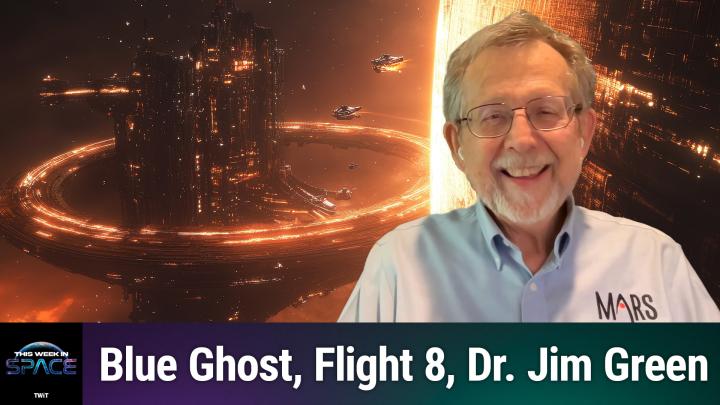
All TWiT.tv Shows (Audio)
This Week in Space 151: In Search of Alien Megastructures
01:16:05
With Former NASA Chief Scientist, Dr. Jim Green
Loading summary
Transcript203 lines
- [00:00]
Rod Pyle
Coming up on this Week in Space, we've got moon landings galore, SpaceX's Starship explodes. And former NASA chief scientist Jim Green is here to tell us all about alien megastructures, Mars sample return and so much more. So stay tuned.
- [00:15]
Tarek Malik
Podcasts you love from people you trust.
- [00:19]
Rod Pyle
This is Turt.
- [00:22]
Jim Green
This is this Week in Space, episode number 151 recorded on March 7, 202025 in search of alien megastructures. Hello and welcome to another episode of this Week in Space, the Alien Megastructures edition. I'm Rod Pyle, editor chief of Bad Aster magazine. I'm joined by my extraterrestrial partner, Tarek Malik, editor inchief@space.com.
- [00:48]
Rod Pyle
Hello, Rod. Hello. How are you doing today?
- [00:51]
Jim Green
Well, I'm doing fine. How are you?
- [00:53]
Rod Pyle
It's exhausting. It's been a crazy week in space, my friend. Crazy.
- [00:57]
Jim Green
It has. Normally this would be where I'd say, oh, don' whine to me. But I, I was thinking while I was watching these stories cascade this week and we were debating whether we were doing press releases about them and it's, you know, it's getting to the point where, you know, starship is still news to us, but when it comes to the press cycle, it's like it flew, it blew up, you know, it's kind of done. So. Yeah.
- [01:19]
Rod Pyle
Well, you say that you.
- [01:21]
Jim Green
I felt for you.
- [01:22]
Rod Pyle
It's nice for you to say that. You know, I was the one working till 11 o'clock last night getting the photos. Hold on, hold on, hold on.
- [01:28]
Jim Green
Wait a minute.
- [01:29]
Rod Pyle
Oh, yeah, yeah.
- [01:30]
Jim Green
Oh, I got a tear for everyone.
- [01:32]
Rod Pyle
Ron's knowledge. Fifteen minutes before we started recording this, I had to file an emergency story about one of the moon landings we're going to talk about today.
- [01:38]
Jim Green
So let me see if I get a tear out of the other eye. Okay, good.
- [01:41]
Rod Pyle
Not all of us get to run a quarterly that publishes once every four months, Ron.
- [01:46]
Jim Green
Quality quarterly that has just doubled its distribution, I might add.
- [01:49]
Rod Pyle
But congratulations.
- [01:50]
Jim Green
Thank you.
- [01:50]
Rod Pyle
Congratulations, Ron.
- [01:51]
Jim Green
But I digress. The important thing here today, as opposed to you and me, is the fact that we will soon have Dr. Jim Green, who among many other titles was a former chief scientist at NASA. And I'll let him run down his, his long resume, but really brilliant guy, great public engagement speaker and of course, you know, chief scientist for NASA. I mean, it doesn't get much better than that. And he's going to discuss a lot of things among the Mars sample return and how to best hunt for extraterrestrial.
- [02:20]
Rod Pyle
Civilizations and the moon landing stick around.
- [02:23]
Jim Green
Technical signatures and all those moon landings. So stick around because it's going to be a good one. Before we start the trademark reminder, please don't forget, do us a solid. Make sure to like subscribe and all the other cool podcast things because we need your love now. Drum roll. From my own archive of space dad jokes.
- [02:45]
Rod Pyle
I'm ready.
- [02:45]
Jim Green
Hey, Tarik.
- [02:46]
Rod Pyle
Yes, Rod?
- [02:47]
Jim Green
Why did the moon run out on its bar tab?
- [02:50]
Rod Pyle
I don't know. Why? Because it's a cheapo?
- [02:53]
Jim Green
No, because it was down to its last quarter.
- [02:58]
Rod Pyle
I love it.
- [02:59]
Jim Green
Oh, we're getting live effects from the back room here.
- [03:02]
Tarek Malik
Good.
- [03:02]
Jim Green
Now I've heard that some people want to send us system when we do our jokes on this show, but you can help send us your best, worst or most different space joke to Twist at TWiT TV. And now headlines. So I think we have to, we're, we're missing a sound effect this week, everybody, so bear with us.
- [03:29]
Rod Pyle
Headline news. There we go.
- [03:31]
Jim Green
Headline news. So I think we need to talk about moon landings.
- [03:35]
Rod Pyle
Yes, we do.
- [03:37]
Jim Green
This has been all moon landings all week.
- [03:40]
Rod Pyle
I'm so tired, Rod. I'm so tired.
- [03:42]
Jim Green
Just, just tell us.
- [03:45]
Rod Pyle
Well, okay. Yeah, so, so we started strong. Started strong because as we're recording this week started with the Firefly Aerospace blue ghost moon landing, which is like a, like a, like a midnight moon landing. Actually, I think it's the second link I have on here on line 22, John. But it seemed like, if you want to talk about a flawless landing, having this first attempt by Firefly Aerospace, it was absolutely spectacular. In fact, the link that we have here is a video of the descent down to the plains of Mare Chrisium. So it's kind of like a mare. Mare. Oh my gosh.
- [04:25]
Jim Green
You know, when the moon hits her eye, like a big piece of pie, it's a mare.
- [04:31]
Rod Pyle
Yeah. So they touched down, it was very, very smooth. They seem to have a textbook touchdown. They had images very soon, about a couple hours after the landing. And they've got this great video that we're seeing if you're watching the stream now as it descends slowly. And then it captured this haunting picture of its, its silhouette or shadow on the surface with the moon or the earth up above. And so far it seems like that mission, you know, it's a 14 day mission, the lunar day, it's been going pretty well. They've tested this vacuum sucking to collect regolith, which is part of a NASA experiment, has a. I think it has 10 different NASA experiments as part of the CLPS program. And it seems to be working great. And I think that they're, you know, they're really primed for using this template for all of their future missions to the moon too. So just absolutely spectacular to knock it out of the park like that. And, and the, the views are spectacular. Not so much. Four Intuitive Machines. That's the second spacecraft that landed on the moon this week. In fact, as we're recording it, the landing was yesterday. It was one day earlier on March 6th and they landed their Athena moon lander. This is line 22 or 21 John. They landed their Athena lander at the near the south pole of the moon. And this was actually a really audacious mission. And if folks don't recall, last year in 2024 Intuitive Machines landed their I Am One Odysseus Moon Lander. But it landed too f broke a leg on the way down and tipped over on its side. This time they had new cameras, new navigation systems, all sorts of stuff on it. Plus they had NASA's ice drilling prime one drill. They had a two small rovers, they had a hopping spacecraft called Grace, lots of different things, plus a Nokia Labs cell tower, a bunch of other stuff. Very audacious. Going to the moon south pole, digging for that water ice. The approach seemed pretty good, but they had what they think, a lot of noise in their navigation radar system and they did hit the ground and tip over. They don't know if it tripped over, you know, we don't know that yet. But they've got photos of it kind of sticking legs up almost like a cartoon character with the moon or the Earth half lit, Earth above. And sadly they're in a crater which you know, we know it's really harsh at the south pole of the moon. The lighting angles are very, very unforgiving. So they're not getting the power they need. The batteries have run out. They're not getting the charging that they need to keep the spacecraft alive for the lunar day that they were hoping to get. So it seems like that mission is over. Not the end of Intuitive Machines. They've got plans for IM3 next year. I AM4 is in the contract of $117 million contract with NASA in 2027. So they're going to learn from this. They said that they' committed to getting it and they're going to stick it hopefully next on the next on the next attempt.
- [07:32]
Jim Green
It would be interesting to have them on sometime because I would love to find out because I've been Talking to a number of engineers about this and scientists, including our friend Pascal. You know, it's a very. The center of gravity is high on that lander. It looks like R2D2.
- [07:47]
Rod Pyle
It looks like it's high. But they said actually that it's lower on this lander than it was on the first one.
- [07:52]
Jim Green
In fact.
- [07:52]
Rod Pyle
It was. It was, yeah. Tim Crane, their chief technology officer, said during the post landing press conference that the center of gravity is lower than it looks like, and it's actually harder for them to control because of that. But they tried to make it as low as they could to keep it from tipping over. And it seems like just the rugged nature of the south pole of the moon worked against them this time.
- [08:14]
Jim Green
Well. And I also suspect they're stuck with the basic bust they have. They can't do a whole lot of adaptation quickly. But if you look at, at the Blue Ghost lander, it's very squat, it has a very wide stance. And I mean, we Learned in the 60s with Surveyor, with that series of landings on the moon that you wanted really wide legs and a very low machine. But hopefully they'll get it right next time.
- [08:35]
Rod Pyle
Yeah.
- [08:35]
Jim Green
Tell us about Starship. We're kind of tired of seeing these things streaming through the sky in pieces.
- [08:40]
Rod Pyle
Well, I heard that starships were made to fly, but sadly, SpaceX is having trouble with their new design. So they launched Starship Flight 8. Yes. Yesterday, was it? Yeah, it was yesterday. Oh, my gosh. Everything was this week. And if you might recall, this is the second starship of the year. They managed the catch. They caught the booster for the third time. It was absolutely spectacular. They seem to have that process down, but they lost the ship again about 20 seconds before the end of the ascent burn. They lost a bunch of engines. There's six different vacuum engines on the upper stage of Starship, and they started to lose a bunch about 20 seconds before they were supposed to stop burning. And then the ship just wildly careened out of control. We saw it tumbling in space. It did explode. It showered debris again over the Bahamas, Turks and Caicos, Dominican Republic. We got sightings from the mall, including Space.com's own contributing freelancer, Stephanie Waldeck, who was on vacation in the Bahamas and just watched as the debris rained down over the beautiful pristine waters there. So, you know, I heard from the FAA today that they did have to close some airspace, delay some flights for a while until that debris dissipated. And an investigation is underway. But it must be frustrating because this is supposed to be like the new and Improved larger version of Starship. It's 52 meters tall, it has 25% more propellant on it. And, and this is supposed to be the next evolution and they seem to be having problems just after separation because this is a very similar thing happened on the January flight too. So we're to wait and see how they evolve. And it's only been like two months between these flights. Will it take that long? Will they be able to iterate quicker for the next one? It's unclear right now, but I mean the booster catch, they seem to have that down now, so. So we'll have to see how that develops over time.
- [10:38]
Jim Green
Well, just so it's said, I mean, what they're trying to do is, is insanely hard. It's revolutionary. We haven't seen a development pace like this since the Apollo program. And in more conventional approaches from aerospace, you know, these kinds of failures would engender a three year stand down and.
- [10:54]
Rod Pyle
Here we're, or a cancellation outright, you know.
- [10:57]
Jim Green
So yeah, they're doing it on a fraction of the money. So this is all terribly impressive but, but I want to move on the Voyagers, this is an unkind way of saying it, but the Voyager probes got their wings clipped again. They're very far from Earth. They're, they're nuclear power batteries, if you want to call them that. RTGs are getting old. They're approaching half life I think. And you know, they don't have much electricity left to work with. So they're starting to shut down more instruments. So each one got, I think, one more instrument shut down.
- [11:29]
Rod Pyle
Yeah, that's right. In fact it, so it was kind of a twofer of shutdowns for the Voyager spacecraft. Voyager 1 and Voyager 2 each had an instrument shutdown because if they didn't, and this is, this was really surprising to me. But Suzanne Dodd, NASA's Voyager project manager, said that if they didn't turn these instruments off, they would only have enough power for like a few more months on either of the spacecraft and have to declare an end of the mission. And so yeah, it would be really sad. You know, the, you know, Voyager 1 of Voyager 2 are pretty much twins. They each have about 10 different experiments on them to study the solar system environment. The planetary flybys that they did. Of course, Voyager 2 did that grand tour that I have all these great posters around. Maybe one day I'll, I'll put them back up again. But I got them all from JPL for, you know, for its tour of the solar system. But both of them are in interstellar space. Voyager 1 crossed out there in 2012, Voyager 2 in 2018. And you know, the, like you said, the battery life isn't infinite. So they turned off Voyager 2's Plasma Science Instrument back in October. And I believe the cosmic ray like system on Voyager 1 was the most recent. It was a kind of a connection of three different telescopes to study cosmic rays, of which I'm sure there's a lot out there in interstellar space.
- [12:54]
Jim Green
Nothing. But that's the whole definition of crossing the heliopause.
- [12:58]
Rod Pyle
Yeah. And that system is the one that helped scientists prove that Voyager 1 indeed had left the heliosphere and was out there in, in interstellar space back in 2012. So it is kind of sad to see that one turned off. But they are going to turn off another instrument on Voyager 2. This is the, the second one, the energy Charged particle instrument there. And that's what tracks cosmic rays, electrons, other ions across the solar system and galaxy. And they're going to, it's got two different systems, but it'll help them save a bunch of power to keep the other systems going on both of these spacecraft.
- [13:38]
Jim Green
All right, Finally, Secretary of US Space Force X37B space plane breaks new ground.
- [13:45]
Rod Pyle
That's right.
- [13:46]
Jim Green
So I didn't break and hopefully not knows first.
- [13:50]
Rod Pyle
No, no. So we had a question from a reader last, last episode, your last listener, Readers on the Brain. We had a question from a listener last episode about X37B and what was it doing? And it turned out to be a very well timed question because literally today, just before we started recording this, the Space Force sent out a blast to announce that the X37B finally returned to Earth. After 434 days plus in space, it's back on the ground and it seems to be doing okay. It landed autonomously under the COVID of night in the wee hours of the morning at Vandenberg, at Vandenberg Space Force Base. And this was a big mission for the Space Force because they tested a new orbit. They launched it on a Falcon Heavy instead of a Falcon 9 or previously to that Atlas V. So they were able to go into a highly elliptical orbit. In fact, they released a photo of the full Earth from that kind of the high point of their orbit. And they tested aerobraking with this kind of winged design. It has heat shield tiles just like the Space shuttle to slow it over time, which allows them to do orbital adjustments and navigation at a much more, I guess, economical rate when you take into account propellant and stuff. So they could change their orbit or adjust it and make refinements. So they clearly seem to have gotten a lot out of this mission. They're still not saying what they were looking at or what other stuff they were doing. Right, but. But very interesting they were able to prove this out. It'll be interesting to see if the next one launches on a Falcon heavy. They have two of these X37Bs and they alternate them for missions. This is the seventh mission over time, not the longest. In fact, it's only longer than one other mission, the very first one, which was over 200 days. All the other ones have been longer than this flight. So this is kind of short compared to the other ones. I think the longest was 908 days. That was the OTV6 mission from the most immediate one prior to this one.
- [15:45]
Jim Green
All right, and my last item is the recently released list from Skyscanner via Planet Cruise, which I got a release on yesterday, of the top 10 locations for Dark skies to do stargazing and such. We go from 10 to 1. Only ones in the US sadly. Kittela, Finland. Next one is He Juan Mountain in Taiwan. Next one is the Gantrish dark sky zone in Switzerland, which I've never even heard of. Next one is Lapland, Finland. We all know about Lapland. That's where Santa Claus lives. Next one.
- [16:21]
Rod Pyle
And the auroras.
- [16:22]
Jim Green
Yeah. Oh, yeah, sorry. The auroras were a big part of it, too. Leknes, Norway. Salar de Uyani, Bolivia. Maunakea, Hawaii.
- [16:33]
Tarek Malik
Yay.
- [16:33]
Jim Green
United States. Glacier International Peace park in Canada and Reykjavik, Iceland. And finally, in spot number one, Interlochen, Switzerland. Wow. And that's your list. So if you don't live close to any of those places, you're out of luck.
- [16:54]
Rod Pyle
What's the criteria there? Like, is it. Is it that Interlaken in Switzerland is the. The darkest sky you'll get on the planet? Or I guess which is other things.
- [17:02]
Jim Green
Because you'd be fairly certain that being out in the middle of the Transvaal in Africa would probably be the right.
- [17:07]
Rod Pyle
Place to be in the dark.
- [17:08]
Jim Green
Or offshore, a couple hundred miles. I'll take my boat out and let you know. All right, everybody, hold on to your ejection seats because we're going to be back in just a moment with Jim Green, former NASA chief scientist. Go nowhere.
- [17:24]
Rod Pyle
Tired of restless nights at Lisa. They know good sleep is essential for mental, physical and emotional health. From memory foam mattresses to hybrids that keep you cool all night long, Lisa's mattresses offer exceptional comfort and Support with free delivery and 100 nights to try out your mattress in the comfort of your home. Go to leesa.com today and get 20% off all mattresses. That's L-E-E-S-A.com and use code iheart for an extra $50 off your purchase. Remember, no matter who you are, there's a Leesa just for you.
- [17:57]
Ameca Insurance
At Ameca Insurance, we know it's more than just a car. It's the two door coupe that was there for your first drive, the hatchback that took you cross country and back, and the minivan that tackles the weekly carpool for the cars you couldn't live without. Trust Ameca Auto Insurance Amica. Empathy is our best policy.
- [18:28]
Jim Green
And welcome back. We are here today with one of my favorite guests, Dr. James Green, former chief scientist for NASA, among many other appellations. Jim, I think you got your PhD. We were doing the math on this the other day. You got your PhD when you were about 12, is that right?
- [18:47]
Tarek Malik
Not exactly, but yeah. 1979, I spent one year postdoc at Iowa and by 1980 I was at Marshall Space Flight Center.
- [18:57]
Jim Green
Wow. So my first question, and then Tarek has his. He has a trademark question he always asks, but my first question, I guess I'd like to know what a chief scientist does at NASA, because that's the all encompassing term.
- [19:11]
Tarek Malik
Sure.
- [19:11]
Jim Green
And then if you would just kind of walk us through your career because you had a lot of really impressive positions over the years.
- [19:21]
Tarek Malik
Well, bottom line on the chief scientist is it's really pretty simple. The chief scientist is, has a direct report, that is the administrator, and so any. And he or she has zero money. So the chief scientist has no stake in any one particular activity. You know, unlike the division directors, you know, which I was a planetary science division director, you know, it's planetary first above everything. You know, there's a, there's that nice tension going on. Chief scientist is really looking out for the health of the entire agency and all the science activity that's going on and advises the administrator on any science question from an independent perspective and point of view. And this can range from, hey, please review this press release and tell me what you think of it, to taking me along and talking to congressional staffers about new elements in the program and what will be funded next year that they are interested in and how would we do that. But another role the chief scientist has is really looking after the health of the scientist in the agency. This to me was one of my best, funnest things to do. You know, we have scientists in so many aspects of the centers that are doing all kinds of stuff. You know, from building instruments to managing vacuum chambers and testing out instruments and spacecraft, writing scientific papers and managing data. I mean the whole entire data stream. We have scientists involved in it. And so, you know, how are they doing? What are the problems they're running into? What can the agency do to help them do their job? And that makes a much more attractive area for other scientists to come into. They wanted to work for NASA not just because of the name, but because of the environment. So there are things that happen at centers with scientists that are there that need the attention of the administrator. And once I know what they are, I can walk right into that office and sit down and talk to the administrator and say, we have this problem. Here's how I think we should solve it and get the approval to go do something about it. So that to me was a very, very important part of my job.
- [21:56]
Rod Pyle
It's a lot of hats.
- [21:58]
Jim Green
A lot of hats.
- [21:58]
Tarek Malik
Yeah.
- [21:59]
Rod Pyle
It's a lot different than like being, I mean I thought you were like Mr. Spock too. Like the administrator is Captain Kirk at NASA. But it sounds like it's a lot more than saying fascinating and raising an eyebrow every now and then.
- [22:09]
Jim Green
So.
- [22:10]
Tarek Malik
True, true. Although I have played that role before with, with Jim Bridenstine when, who I work directly with. And, and, but yes, that does happen also when the administrator is so busy they can't pull off all the events that are happening. Jim would call me up and say, Jim, can you go to this meeting? Or I need you to go to Europe and work on this and you represent me in this bilateral or this event. So those things are very important. And the key, key to that whole position is it's agency wide. Now I love that because, you know, my background is, you know, magnetospheric physics, which means I never met a magnetic field I didn't like. Okay. And, and, and then I did a lot of work on Aurora, a lot of work on Earth's Earth related space, plasma physics, space weather, you know, sun interactions, solar physics, and then gradually move planetary science. Working on Voyager data at Jupiter and looking at all the phenomena that happens in that fabulous system. And then as a planetary scientist, you know, I had a huge desire to learn what other, other scientists in that area are doing. Planetary atmospheres, you know, Pluto, Wow. Kuiper Belt object. We're going to fly by it for the first time. What does that look like? You know, a whole new era of challenging missions. That we really pulled off and I think a real golden era planetary science exploration that happened over those 12 years. I was a planetary division director, so as chief scientist, I needed to know about what's the science on space station, what's happening in other areas. I'm familiar with astrophysics and heliophysics and earth science too, but I need to know more about each of these areas. And so I really spent a lot of time studying about the science that the agency does because I have to represent that.
- [24:39]
Rod Pyle
Yeah.
- [24:40]
Tarek Malik
So I got really fascinated in so many aspects of it that right now I've got. I'm working with Oxford on an experiment that's up on the International Space Station now. And we're working on another piece of it that's going to go up in April. So. So who would have thought that, you know, I would have something to do with an experiment on the International Space Station? In my career, I never would have, but that's what it led me to.
- [25:05]
Jim Green
I would have thought that. I also wanted to note that you, for a period, if I read your bio correctly, were running the National Space Science Data center, nssdc.
- [25:16]
Tarek Malik
I did.
- [25:16]
Jim Green
Which was where those of us, you know, involved in trying to convert space science to media was the place to go. The archive for increasing planetary images and surface and all this stuff. What a collection that was. When were you there?
- [25:33]
Tarek Malik
So I was there from 1985-92, when I then had the opportunity to create an entire division within the Space Science Directorate at Goddard Space Flight Center. And I included the National Space Science Data center as one of the three branches. So the NSSDC was part of my portfolio from 85 to about 2004 when Ed Weiler, the center director at Goddard Space Flight center, called me up in a panic and said, I need to have you create a new organization. And what was happening at that time was we were moving into an era that's called full cost accounting. This was something new for the civil servants. The civil servants had to be able to propose and win money to pay their salary. Okay. And the reason why he called me up is I happen to be one of the most successful proposers. Now, as a civil servant, I didn't need to propose, but I had so many friends, you know, when I graduated at the University of Iowa, and many of the science friends that I, that I met at Marshall Space Flight center, at Goddard Space Flight center that were on what we call soft money. That means they have to completely have their salary made up of winning proposals. And I was involved in those Proposals and I wrote proposals. And sometimes I was a PI and sometime I was a co. I now as a civil servant during that time period, I didn't need to create money for my salary. Okay. I was doing that because I was interested in the science and it went to help support them if we won, you know, that money went to them, didn't go to me. So that worked out great. And I got to learn how to write proposals. And there were several others at Goddard, but. But indeed Ed said, you know, your record is great. I was winning. I wrote, let's see, I think I was. I wrote 52 or three proposals and won about 25 of them. So I was running, I was running 50, 50. Whereas it's really good if you get one in three and sometimes when the money's really tight, it's one in six. Well, that's terrible. So I helped pull an organization together that then began to train the Goddard scientist on how to write a proposal that's successful and that group is still there at Goddard. I was doing that when I was asked to go down to NASA headquarters and be activ acting as head of planetary science. So that was 2006 and I liked the job so much that when the opportunity came up to apply for it, I applied for it and I got it.
- [28:37]
Jim Green
Wow, you almost make it sound like fun. All right, we're going to go to a quick ad break. We'll be right back with Tarek's trademark question in just a moment.
- [28:46]
Lenovo
The battlefield is set. The stakes are high. The only thing standing between you and victory. Nothing. Ascend to the pinnacle of gaming greatness with Lenovo, Legion laptops, towers and the new award winning Legion Go. The world's first officially licensed handheld. Powered by SteamOS. Legion relentlessly pushes gaming technology forward with towers built for raw untamed power. Laptops with best in class AI tuning that sharpen your reflexes. And the Legion goes a handheld for serious gaming on the go. Stay ahead with lightning fast responsiveness on a stunning 16 inch PureSight display. Keep your cool with cold front thermal technology engineered for marathon sessions and with all day battery life. The game never stops until you say so. So check out lenovo.com legion Lenovo Lenovo empowering creators everywhere.
- [29:45]
Ameca Insurance
At Ameca Insurance we know it's more than just a car. It's the two door coupe that was there for your first drive. The hatchback that took you cross country and back. And the minivan that tackles the weekly carpool for the cars you couldn't live without. Trust Ameca Auto insurance. Amiga empathy is our best policy.
- [30:17]
Jim Green
Tarek, you're up.
- [30:18]
Rod Pyle
Great. Well, my favorite thing to do. I feel like you really are overselling the question from, from this one, but.
- [30:26]
Tarek Malik
It better be good. Really probing.
- [30:29]
Rod Pyle
I am always interested in the space origins of the people that come on the show, Jim. Like, what, what is the key driver like? For me, it was my cousins watching a scary movie. So I ended up going to watch Star Trek in someone like my aunt's garage, you know, that, that, that, that hooked me in space exploration or whatnot when I was a little kid. But I'm curious, like, where you fall in that. Like, was the space bug something that bit you when you were a little kid? Was it something you found through your studies or, you know, what, how did you kind of get the ball rolling to reach the heights that you did? Sure, sure. That you have so far?
- [31:12]
Tarek Malik
Well, I was immersed in space. You have to recognize that, you know, I was born in 1951. And so in the 60s, you know, we were going to the moon. All right, so that whole thrust, you know, Sputnik was up there. Now, although as a young kid, you know, I was eight years older, seven or eight years old at the time, I never saw Sputnik, but the parents were talking about it and the neighbors were talking about it, you know, and, wow, it's space, you know, and I watched the original Star Trek from episode one on.
- [31:49]
Rod Pyle
Okay, wow.
- [31:50]
Tarek Malik
You know, and so by the time I got into high school, I took chemistry as a, as a, as a, I guess I was a sophomore at the time. And the teacher who was teaching chemistry ended up with the keys to the observatory that the high school had. And that, that Observatory was a 12 inch Alvin Clark refractor. This is a wonderful telescope. I mean, the tube is 15ft long. Okay, 12 inches lens. Okay. It's a refractor. And he wanted, you know, students to get involved in it. So I got very involved in that astronomy. I did all kinds of astrophotography. I built instruments in the back of it. You know, I learned how to print things the old way. I mean, there wasn't GIFs or JPEGs, you know, digital data. You, you had an analog negative you had to make.
- [32:51]
Rod Pyle
This is high school. I mean, I, I want to point that out.
- [32:54]
Tarek Malik
This is high school.
- [32:55]
Rod Pyle
My high school didn't have an observatory. Where was I?
- [32:59]
Tarek Malik
Yeah, so I was down at the school all the time. Okay, so don't tell anybody, but he even gave me the keys to the, to the high school because the, the the telescope was on the roof. So at night I'd, you know, two in the morning, I'd be down there observing, you know, some phenomena, you know, and taking pictures. And, you know, and the next day come in and. And, you know, make the negatives and then start making prints. And then I sent them in. The sky and Telescope. I have things that I took with that telescope in sky and Telescope, I was gonna say.
- [33:33]
Rod Pyle
So when you were in high school, you're sending photos into sky.
- [33:36]
Tarek Malik
Yeah, now, now that was no big deal. I mean, you know, because that's when sky and Telescope was totally an amateur magazine. You know, everything in it, you know, was planetary astronomy. Because what was happening there was no such field as planetary science. It was planetary astronomy. Everything that you knew about a planet you got from the back end of a telescope period. Okay? And so that, you know, I was immersed in that. So I, you know, I had sky and Telescope subscription. And then. And then in 69, when I graduated, you know, we landed on the moon. I went to the University of Iowa and I took Astronomy 101 from James Van Allen. All right. Yeah, I walked. I walk into, you know, the first. The first. His first lecture with 450 students. I mean, the place was packed. Okay. And so I did good that semester. And second semester, I took not only Astronomy two, I also took a course called Readings in Astronomy taught by staff. Okay. Now, Van Allen didn't teach the second semester astronomy course. I was taught by someone else. And I took this Readings in Astronomy because I had just a 2 credit hour available in my. In my course curriculum. And, you know, it said, you know, go to room 704 in Van Allen Hall. So I go up to 704, walk in. It's a corner room, open the door, and it's a huge room, and it's got tape racks and it's got printouts. And I'm standing in the hallway with this bookcase right next to me, and I'm going through the course catalog. Did I get the right room? And Van Allen leans from behind the bookcase and says, yes, Jim, you got the right room and you're my only student.
- [35:30]
Jim Green
Whoa.
- [35:31]
Tarek Malik
Yeah, whoa. I'm a freshman.
- [35:33]
Jim Green
That's a little more attention than most of us wanted in our freshman year.
- [35:36]
Rod Pyle
Yeah, yeah, yeah.
- [35:38]
Tarek Malik
Well, now I knew. I knew of Van Allen before I went to Iowa. I have to tell you, because in high school, I was a senior. I took physics. And one of the great things that they made you do is every week you had to read a scientific American article and write a two page summary of it and turn it in. I love that. You know, I really loved that. I thought, God, this is so great. One day in my career I'm going to write for. I'm going to write an article for Scientific American that was, you know, so that was my high school objective. Wow. And then, and then, of course, I. Van. Van Allen wrote a wonderful article about Van Allen Radiation belts in the magnetosphere. That was in Scientific American that I reported on. So, you know, I was really into what he was doing. And so he learned what I did by using this telescope. And one of the things I did is I took a picture of the sun every day for six months straight. Didn't miss a day. Okay. Now, sometimes I would set up the telescope and it had a filter on it so the sun's light would shine through, but only, you know, in a degraded way such that you still got an image, a really great, beautiful image, but you didn't get all the light from the sun. Sun. And it was actually a Questar filter. Questar was making telescopes with filters at the time. We just got the filter and then we made. Made a mask for it and put it on the telescope. So we're constantly making stuff. Okay. And then, and then this, you know, I would wait sometimes hours for the sun to just peek out between the clouds to take a picture. So I made 35.35millimeter color slides out of this whole set. And I told Van this, and Van says, oh, you got to bring it. Let's see that. So I went home that weekend, and the next, next, my next class with him, I said, this is what I got. He goes, wow, let's do some research on this. You've got all kinds of data. And I said, research? What's that? Okay. And so we figured out what we could do since it was sunspot maximum was sunspot rotation.
- [37:47]
Rod Pyle
Yeah.
- [37:48]
Tarek Malik
And so I had many months where I had three or four sunspots that rotated three times. I had, you know, a dozen or two dozen sunspots that went around twice. And then, you know, and then 50 or more that, you know, you watched going across the disc. And so I wrote a paper, you know, had the title, an abstract, an intro. He, you know, he was telling me how to be a research scientist. So at the, you know, I got it all together with my references and my figures. I did data analysis. I had error analysis. I did. And he was the referee on the paper.
- [38:30]
Rod Pyle
Wow.
- [38:31]
Tarek Malik
You know.
- [38:34]
Rod Pyle
You and I had very different astronomy introductions. I overwrote an entire week's worth of solar data and was put on the kiddie computer that wasn't connected to anything. So I am. I'm in awe.
- [38:47]
Jim Green
And I think he also passed Calculus.
- [38:49]
Rod Pyle
I was gonna say differential equations too, Rod. I'm pretty sure he passed that well.
- [38:53]
Tarek Malik
Yeah. Yeah. Well, I was good in math. I was good in math and I was good in science, but I have to tell you, not all math is created equal. I hated geometry.
- [39:06]
Jim Green
Well, we have something in common. All right, we're gonna go to one more ad break and then I'm gonna come back with my fun quiz question. So stand by.
- [39:15]
Lenovo
The battlefield is set, the stakes are high. The only thing standing between you and victory. Nothing. Ascend to the pinnacle of gaming greatness with Lenovo Legion laptops, towers and the new award winning Legion Go, the world's first officially licensed handheld. Powered by SteamOS, Legion relentlessly pushes gaming technology forward with tapping towers built for raw untamed power. Laptops with best in class AI tuning that sharpen your reflexes. And the Legion Go, a handheld for serious gaming on the go. Stay ahead with lightning fast responsiveness on a stunning 16 inch PureSight display. Keep your cool with cold front thermal technology engineered for marathon sessions and with all day battery life. The game never stops until you say successful. So check out lenovo.com legion empowering creators everywhere.
- [40:14]
Ameca Insurance
At Ameca Insurance, we know it's more than just a car. It's the two door coupe that was there for your first drive, the hatchback that took you cross country and back, and the minivan that tackles the weekly carpool for the cars you couldn't live without. Trust Ameca Auto insurance. Ameca empathy is our best policy.
- [40:46]
Jim Green
So, Jim, we have a lot of science to talk about, but I have to bring up something. So I think the second encounter I had with you was in 2015. Ish. I was working at Caltech, I was writing there and we got this big long memo, I think it was nine pages or something from NASA headquarters about how we should discuss the Martian, the movie the Martian. And you were the scientific consultant on that. And I think I wrote you an email saying, can you tell me more about this inciting incident of this non existent 200 mile an hour wind that would be kind of a breath to a feather on Mars threatening to blow over the spacecraft. And they took off. And you said something the effect of. Well, well, they didn't listen to everything I said.
- [41:29]
Tarek Malik
Yeah, that was really another accident in my life, so to speak. If you think my early career Was made up of one accidental occurrence after another. I was head of Planetary, and in that group had three branches. One of the branch was the Mars Exploration branch, okay? This was run by Doug McQuistion. And that branch, that person that leads that branch is commonly called the Mars Czar. Now, why we call that person the Mars Czar is that he or she. In this case, it was Doug. Doug oversaw every asset at Mars in terms of how they're coordinating what they're doing how we have to move satellites to get imaging in certain areas how we have to support landings or getting other spacecraft into orbit how we do relays, everything. So that's why that person. That one person is called the Mars are. Prior to Doug, it was Orlando Figueroa. And prior to Orlando, it was Scott Hubbard. But what happened after we land Curiosity that, you know, and Andy Weir was developing the novel, et cetera. Doug retired, and so I was now acting Mars Are. So I was doing all the Mars stuff and I was doing all the other planetary stuff, you know. And so I was working like 16 hours a day. It was terrible. I hadn't worked so hard, you know, to get. Keep everything going while I'm trying to hire somebody to be the Mars Are. In the meantime, Ridley Scott calls up NASA headquarters and says, I want to talk to somebody that knows something about Mars. So they must have gone down the phone book. And they said, okay, here's the Mars Exploration Bridge branch. Jim Green acting here. Get. Call him. So Ridley Scott, you know, calls me and didn't. Hadn't read the book. And. And the call was arranged by Bert Ulrich. Everything goes through Bert at that time for. For media whether it's music or film or documentaries. And so Bert set it up, which was wonderful. And I had a wonderful conversation. By the time I got done with the conversation of talking to Ridley and about five or six of these other people about Mars. I mean, all we did was talk Mars facts, talk about propulsion. Everything from ion engines to spacesuits to, you know, walking on Mars. You name it, they were all over the place. And there were a couple things I couldn't answer. And I said, I don't want to mislead you. I don't know the exact answer to that, but I know who does is, okay, so we'll. We'll make those connections. And so before the. Before the conference was over he'd already emailed me the script, okay? So this was like Wednesday or Thursday, okay? And on Monday, there was a big meeting in the communication group where they were going to Talk about what they were going to do relative to this movie. So I thought, okay, I better read the book. So I got an ebook. So that weekend I read the script and read the ebook. Monday I walk in and sit down to the big meeting where we're going to talk about what NASA should do relative to the Martian. So NASA gets a couple hundred requests for support on all kinds of things from documentaries to movies. And so they have to be picky. They can only do so much. And so they're running around the room, what about this documentary? What about this? And then they came to me and they said, jim Green, what do you think we should do about the Martian? And I said, we need to be all in. Whatever Ridley wants, we need to make sure he gets it. This is fantastic. Ridley wants to make it as realistic as possible. You know, we can't have a better opportunity to tell the public the look and feel of the red plan planet. And it all went like this. And then David Weaver, the head of communication, says, great, we'll do that. And you're going to lead it. Oh, Jesus, now, God, you know, I'm.
- [45:57]
Jim Green
Already working 17 hours a day.
- [46:01]
Rod Pyle
We should remind people for like the three people who are listening who don't know what the Martian actually is. It's a. It's a film starring Matt Damon as a stranded astronaut. A real one, Rod. A real stranded astronaut on Mars.
- [46:17]
Tarek Malik
This is what we mean by stranded. Yeah, that's right.
- [46:20]
Rod Pyle
Based on a book by, By Andy Rear.
- [46:22]
Jim Green
Well, and interestingly, that book was originally just fan fiction published online.
- [46:29]
Rod Pyle
Self published. Self published.
- [46:30]
Jim Green
Jim, I have to tell you, I think you might remember this because we're of a similar age. I. I left the Martian and I was kind of satisfied. But I felt after I'd seen the movie, I thought, I've seen this before. And I went home and loaded up my laser disc of Robinson Crusoe on Mars and reminded myself that the first two thirds of that movie was great. And then when the creepy aliens show up and it got kind of weird, but it did. There was a similarity there. Okay, sorry, Tarek, I know it's your.
- [46:59]
Rod Pyle
Well, no, I was gonna say, though, and Jim, I think that the enthusiasm was not just warranted, but it really comes clear because if our audience doesn't recall, the Martian came out as kind of like the third film in a trifecta of real space based films. You had Gravity, which was Senator Bullock stuck on the space station after it gets destroyed by space debris. You have Interstellar about, you know, a dying Earth and we have to find another planet. And in both of those films, gravity. We've talked about this before, Rod and I. Gravity and. And interstellar. They don't want to be in space. No one wants to be in space. In fact, Sandra Bullock says that she hates space. But in the Martian, that spirit that I have seen scene. And I'm sure you have to write Jim, from the astronauts and the scientists you talk about, about there was. They would still be there. That they. He loves being Mars even though he's stuck there. It was the first one where the joy, I think, that I see from folks like yourself science from the astronauts really came through. And I think that that needs to be celebrated just a little bit more, especially these days.
- [48:05]
Tarek Malik
Well. Well, I got a couple things to tell you about that because my. My absolute favorite scene in the movie is when he's sitting on the rock and he's composing in his mind the letter he's writing to Commander Lewis. And I went back to the script because I didn't. I didn't remember everything that. That he said was in the script. And it wasn't. He. You know, he. Whether it was Ridley or. Or. He just let me that riff a little actually added some really nice parts to that. And so when he sits there and talks that way almost a tear comes to my eye, you know. So that's the drive he had, you know, he said he may die on Mars. And I am okay with that because of what it means to explore in this manner and why we need to be on Mars to continue to do so. So it was. It was a wonderful experience. And. And. And I had a wonderful time doing it. And. And it about killed me. But that's the way that went. That's okay. I went to the premiere. They invited me to go to the premiere. So Ridley calls up NASA headquarters and says, I want Jim to come to the premier. I'm going to send a plane for him. And NASA headquarters went berserk. You're not going to send a private plane for him. He's going to sit in economy on some jet, you know. And then. And then Ridley said, well, we've got this hotel in Toronto. It's a Toronto Film Festival. So the can of the. Of the Americas is the Toronto Film Festival, okay? That's when it's all shown. And he says, we're in this hotel. I'll put him up in this hotel. That's way over per diem. You can't possibly be in that hotel, you know, so they put me in this Hotel, you know, miles away because everybody's there, you know, at the premiere. So the, you know, the premiere was great. You know, I had to walk the red carpet. That was shocking. I wasn't even wearing my best suit, you know, tell me these things right? And then we, we spent the rest of the day, the next day rather talking to reporters and I was on panels with Ridley, in panels with, with, with Andy Weir. Talked to Matt in the hallway and you know, just had a, just had a great time.
- [50:39]
Jim Green
All right, we are going to go to one more ad break, last one. And then we'll be right back with Tarik's next big question. Stand by.
- [50:49]
Lenovo
The battlefield is set, the stakes are high. The only thing standing between you and, and victory. Nothing. Ascend to the pinnacle of gaming greatness with Lenovo Legion laptops, towers and the new award winning Legion Go, the world's first officially licensed handheld. Powered by SteamOS, Legion relentlessly pushes gaming technology forward with towers built for raw untamed power. Laptops with best in class AI tuning that sharpen your reflexes. And the Legion Go, a handheld for serious gaming on the go. Stay ahead with lightning fast responsiveness on a stunning 16 inch PureSight display. Keep your cool with cold front thermal technology engineered for marathon sessions and with all day battery life. The game never stops until you say so. So check out lenovo.com legion Lenovo, Lenovo empowering creators everywhere, everywhere.
- [51:49]
Ameca Insurance
At Ameca Insurance we know it's more than just a car. It's the two door coupe that was there for your first drive. The hatchback that took you cross country and back, and the minivan that tackles the weekly carpool for the cars you couldn't live without. Trust Ameca Auto Inside Insurance. Amiga empathy is our best policy.
- [52:22]
Rod Pyle
One of the reasons. Sorry, I'm leaving. We were having some discussions offline everybody, so I'm dying over here. But one of the reasons, Jim, that Arad and I hope to get you on here was to get your thoughts about things like alien megastructures and what they mean about advanced against ET civilizations that are out there. Because I heard that you have thoughts and you were just, you were just hinting about it for interstellar. So we're, you know, we're, I think for, for the people who are listening. I first even knew that alien megastructures and techno, what is it called? Techno, Techno signatures could be a thing when people were talking about boy Julian's Star way back when. I didn't know that it was even a concept back then.
- [53:07]
Tarek Malik
But.
- [53:07]
Rod Pyle
But. But tell me. Tell me your thoughts, Jim, because obviously, NASA gets asked about this stuff all the time, and I'm sure you've got a gripping answer that will solve everyone's questions. Right.
- [53:17]
Tarek Malik
Well, let me give you a little backstory, if I may. You know, so SETI came along, and NASA was involved in developing radio receivers and doing a number of things that would look for the search for extraterrestrial intelligence through code, radio signals that might be captured in our new radio dishes. The key to that is to have them on, look out and gather that data and see if we can find a civilization that's doing that, because we do that when we created TV and radio and all those radio waves leave Earth. So we're just leaking radio waves like crazy. So it's a good idea. And started in the 90s, and NASA started working in that direction and then got congressional direction to get out of it. All right? And that meant that seti, search for extraterrestrial intelligence, was going to be done via radio signals by the private sector, with private funding. So NASA, you know, particularly in planetary science, we're going after biosignatures. Let's look for real life beyond the surface. We invented planetary science because instead of the back of the telescope, we're on the surface. We're measuring the atmosphere, we're, you know, looking around, we're digging in the dirt. You know, we're doing that science right there. And so we have an opportunity to, you know, create concepts on what life might leave if it was there and died, or what signatures might tell us life is there but under the surface. So all that was coming to play, but what was happening is there was a big push in Congress, particularly by Lamar Smith. Smith, to help fund SETI, to really, you know, get NASA more involved, bring NASA back into the search for extraterrestrial intelligence. And so I was chief scientist at the time when Jim Brynstein called me and said, come down to my office. I'm talking to Lamar Smith and he staffers. And we started talking about the money they want to give NASA to look for intelligence, extraterrestrial intelligence. And I suggested we do a workshop. We bring in the community, we talk about all the other things that could be seen now that we're really looking for, you know, looking at exoplanets and finding them all over the place. What are those technologies that could be developed by another civilization that we actually could observe and maybe we have in our data if we allow an opportunity for our scientists to think about how to dig that out of the data, and that would be technosignatures. And so, so we had a wonderful workshop report came out and Indeed, NASA got 10 million bucks started that. And we are still doing research in technosignatures. Now it's not just radio. It's looking for structures, megastructures. What are the options in megastructures? Well, Freeman Dyson in the 60s wrote a wonderful paper about really advanced technologies and civilizations are going to want to capture all the energy from its dying sun. And so that would be called a Dyson sphere, something that would surround a sun.
- [56:38]
Rod Pyle
I saw that in Star Trek. Right. They found Scotty crashed on one of those.
- [56:43]
Tarek Malik
But there's other things. You know, O'Neill had an idea, also inspired by the Impala program, that what you want to do is you want to have huge space stations. And those space stations, you want to bring. Bring Earth to them. All right? So you want to grow food. You want to. You want to be able to have a living environment in space. You want to preserve the environment of the Earth by having it also work in space. The key to that, I mean, it's like if you saw the movie Elysium, that was an O'Neill structure that, you know, once again, Matt Damon, I'm going.
- [57:25]
Rod Pyle
To say we've mentioned Interstellar, too. That's all three Matt Damon space films that came out years.
- [57:30]
Tarek Malik
Yeah, true, but he was a baddie in Interstellar. But to me, Interstellar missed the boat by not going through an O'Neill structure concept. So we all know our star evolves. We all know what will happen to our star over time. It gets brighter. It goes. It burns up its fuel and then it shrinks, and then it goes through a massive change by expanding its surface, while interior, it changes the way it creates its fuel instead of hydrogen coming together and creating helium, they now take helium and have it come together and create carbon, you know, and so that puffs up the surface and all the planets will, you know, die. But we'll have all kinds of heat problems from the sun in another 800 million years. Okay, well, 800 million years, we're going to get twice the amount of heat from the sun we get today day. We'll get the same amount of heat Venus gets in 800 million years. Well, Venus, we know what that's like. You know, that's that. That the surface is hot enough to melt lead. It's way too hot. And so if you want to preserve Earth and you want to be able to create a controlled environment, you Want to create a structure that's more Earth. Like it has to be big, you know, it's, you know, it's like biosphere in space. You want to be able to have a self sustaining system. And all those are wonderful technologies. And so I think they have a place, a real place in our future. And that is as we become technologically more capable to then develop large structures, we will save the best parts of our and put it there.
- [59:22]
Rod Pyle
I like that.
- [59:22]
Tarek Malik
That also gives us the flexibility to move further away from the sun. So I think technosignatures are. Could be observed really big. Really big. O'Neill structures could be observed in the data that was taken by Kepler and Tess and many scientists are looking for it now.
- [59:42]
Rod Pyle
That's great. I would, by the way, just to remark on something Jim touched on. For any parents out there, there avoid mentioning the death of the sun to like your really young children because they.
- [59:55]
Jim Green
Stay up all night.
- [59:56]
Rod Pyle
When my daughter was, when my daughter was five, it was one of the most difficult existential concepts conversations I ever had was when I, we were reading one of those kids books that tells you the life cycle of a star and it tells her how the sun will go out. And then just an immediate realization that everything ends before you're ready to deal with it. So just an advice, but I, I.
- [60:17]
Tarek Malik
Did probably get hit by a ne before then. Yeah.
- [60:21]
Rod Pyle
Oh my gosh. It was really.
- [60:22]
Tarek Malik
You didn't tell her that, did you?
- [60:24]
Rod Pyle
No, no, but I have flashbacks when you're talking about the death of the sun. About that whole discussion, I wanted to ask about just the search for both the techno signals and techno signatures. Is there like a plan? Like did you help create or did they show you like the secret plan when you become chief scientist of what NASA is going to. Going to do when they have something that's conclusive? Well, like Contact, right. We're talking about space movies and books and Carl Sagan's Contact, you know, with Jodie Foster in the film. They've got a whole reaction, you know, about how humanity has to react to it. Is there a plan like that?
- [60:58]
Tarek Malik
No, actually Mary Boytek, who's the head of the astrobiology group within Planetary Science, and now it's David Grunspoon working with Mary together on that activity. But when it was just her, she and I had quite a bit of discussions of, okay, we might have an opportunity in this generation to find signatures of life. Okay, whether it's technosignatures or whether it's actually certain biosignatures on Mars that Lead us to an understanding that it's life. Okay, what are we going to do next? How are we going to relate to that? What's going to happen in terms of how we get the word out? Because we know how that's going to happen. NASA's going to. The freight train is going to move so fast, taking those results, getting them to a point where we can do press releases and press conferences and interviews on the Hill and interviews with, you know, space news. You'll be right up there, you guys. You'll be, you know, instead of me, it'll be, you know, Scientist X in the future.
- [62:06]
Rod Pyle
But I call dibs on first question.
- [62:08]
Tarek Malik
So, yes, okay, you can. But. But that next big step. Wow, it's a big one. And I don't think we've worked it out.
- [62:16]
Jim Green
Well, I. I want to have the alien himself or herself on the program or them.
- [62:22]
Rod Pyle
We don't know why you got to have two genders. Right.
- [62:24]
Jim Green
One over my shoulder. Well, that's true. That's true.
- [62:27]
Rod Pyle
Or any genders.
- [62:28]
Jim Green
Before we run out of time here, I would really like to hear your. Your thoughts on Mars sample return and where we are with that, where we might go. Because I know that's something you thought about. I mean, you think about endless things, so I can't keep up. But that's one we've talked about a lot on the show. We had Rob Manning, the chief scientist over JPL on.
- [62:46]
Rod Pyle
Right.
- [62:47]
Jim Green
About it. We've had others, but it's frustrating to watch from here.
- [62:52]
Tarek Malik
It is, it is. And, you know, in terms of. You want to talk about the next alien, it actually might be right here. Okay, this is. This is.
- [63:00]
Jim Green
He has the first sample from Mars.
- [63:03]
Tarek Malik
Well, it's actually from Earth. It's a piece of granite, but it's from their engineering unit out of jpl. So this is. This is the kind of samples we want. And it's got, you know, a history here. There's a stratigraphy of what happened and how that rock was built. Yeah. And then that is placed into a container like this. This. And then that container is either laid on the surface or will be handed over to a rover or an arm that will place them in a rocket and then return. Well, 10 years ago, when we were constructing the idea of. Well, we know now with Percy, we're building, we're going to get these samples. Now we got to figure out how to bring them back. We were really limited because what. What we had were rockets capable of only allowing us to land about a one and a Half metric ton, whatever, rover, whatever. Well, in this case it would be a Mars ascent vehicle. But what's happened today is that even though that plan 10 years ago was okay then, today we have all kinds of new ideas that we need to bring in all kinds of new capability like the SLR or even starship in the future. Any super heavy lift launch vehicle that can bring large masses to Mars, we have the opportunity to land. We could land a 20 ton MAV, which is a Mars ascent vehicle, and then bring all these samples to the MAV and take off and bring them right back to Earth. Direct to Earth. That makes it much simpler. It uses the agency assets that we have today day. There's so many positive things about it. Plus that MAV could be evolvable to the point where we end up with a MAV for humans. Now this relates to the Martian. And the reason why is Andy Weir didn't get, didn't explain the most difficult thing. He already just assumed it was there and that was the mav. How did that nav get there? You know, here it is, we're just going to go to Ares 4 and the MAV will be there. Well, that is one massive rocket, you know, that's probably pushing 80 metric ton. But we've got to be able to do a variety of tests on the surface to get to the point to bringing the astronauts back or we won't have humans on Mars anytime soon. And I think Mars sample return will be our right now would be what I would suggest is our first big opportunity to develop the capability that could develop into humans returning from Earth, from, from Mars to Earth in a, in a very large structure like that.
- [65:54]
Rod Pyle
I'll do it. I'll go, I'll go and I'll get those samples and bring them back. I promise. Right. I'm sure I can.
- [66:01]
Tarek Malik
Now you know why we decided to lay them on the ground.
- [66:06]
Rod Pyle
Well, I thought that's because, you know, we, we have to take littering to the cosmic frontier, right? No. Is that.
- [66:11]
Tarek Malik
No. Well, here's the deal. When we were developing the concept for Percy, we were assuming, okay, we're going to take all these samples, we're going to stick them in a can, and then the can reside on the rover and then we'll have another rover coming up and then reach in there and get the can and take it to the mav. Well, the problem with that is because of the rover and the difficulty and getting those samples off the rover, that obligates NASA to be able to do that. But if we create samples in a tube and lay them on the ground. Any nation can bring them back.
- [66:55]
Rod Pyle
There you go.
- [66:55]
Jim Green
Interesting.
- [66:57]
Tarek Malik
Yes. And now that mission is sellable, now I can convince omb, the Office of Business and Management to. Office of Management Business to provide, provide support for that administration to propose to Congress for us to do. Percy, all that worked because it didn't obligate NASA to do the next mission. Well, right now the samples are there and we're going to bring them back, and no other nation is there to pick them up. So in a way, we are going to do that. But the bottom line to that is the idea was very flexible and could have, you know, it could have been India, could have been jaxa, could have been, you know, many other different types of.
- [67:43]
Rod Pyle
Jim, what if a super villain builds his own private moon lantern, goes and takes the samples for themselves? What do we do then?
- [67:50]
Tarek Malik
Well, we will. One, we will know about it. Two, we will have international agreements to be able to share the knowledge. Let me tell you something about these samples. You know, here on Earth, Earth, you know, these are rocks. Rocks have, you know, the mineralogy of how atoms are arranged in a lattice to create the rock. Okay, that's, that's what we have here. And here on Earth, we have 5,700 minerals that we've identified, but 349 of those are only made with dead life. So getting a rock record back and interrogating the mineralogy over time. Time is a big hint to us on whether life existed on the surface of that planet or not.
- [68:38]
Rod Pyle
Okay, well, that's awesome. Well, you know, I do have one more question, and I know that we're running a little short on time, so hopefully I could squeeze it in. But we talked a little bit about the news segment earlier, Rod and I, about some of the other planetary science stuff that was going on this week. We had two moon landings, two in one week, which was exhausting. One really successful. And actually, a few minutes before the start of the show, I published a story about how the intuitive machines lander had felt had fallen over, sadly. So that mission is, is over. But I'm, I'm just wondering how as, as, as someone with your science background, you know, you're feeling about this, this kind of onslaught. It seems like year after year now we're having these moon landings, or moon landings attempts. In fact, Japan, we're talking about international agreements, has its own lander resilience on the way to the moon for a landing this summer. And I'm just curious, is it. Is this exciting? Is it, is it the norm or is space kind of hip and where it's at again like when you were a kid seeing things launch all the time that you were talking about there?
- [69:44]
Tarek Malik
Well, I have to tell you that as head of Planetary, if I wanted a big rover or I wanted something new that wasn't in the program, I had to create the information and get it sold not only to the administrator of NASA, but the, the administration, the president and Congress before I get the money to build something new. That's called a new start. And new starts I managed were Curiosity, perseverance, including the helicopter, Dart, Europa Clipper and Clips. So you're asking the guy that helped put, put the whole future program together on the moon, you know, the commercial lunar landing activity that, that is part of clps. And why did I do that? Because indeed that's the wave of the future. We want to be able to have more commercial activities. We want to be able to bring on some new companies knees, get them up to speed on, on, on doing these hard things, making them more routine. And as you can see, you know, you know, we've had some failures. NASA had four, maybe even five missions to the moon. The first five, four or five were all failures. I mean, I think one of them was trying to hit the moon. And we missed it. Now we missed the moon, you know, so how could we do that? But it's hard, you know, and now, now we have companies that are coming on and are able, able to do that. Well, the moon is a, is a resource for us in space. Now that we know so much more about the mineralogy of the moon, the kind of precious metals that are there, the amount of water and other volatiles that are there, you know that the moon is an enormously important resource. And I think by exploring that the way the government does through natural NASA and bringing along the commercial environment will speed up the process of allowing us to be able to live and work on the moon, learn how to do that on a planetary surface, and then take that knowledge and go to Mars. So it's, I think, one of the big first steps we have as a country and of course the world to look at how we should be living and working in space. Because I firmly believe we as a species are not going to survive very long if we give up going into space. We've got to utilize all activities in space, from communication to observations to resources, you name it. Our big future is space. And so let's get on it.
- [72:35]
Jim Green
Let's get on it. That's why we asked Dr. Green to write the capstone chapter for the National Space Society's upcoming book on advanced ideas in space settlement. Before we let you go, Jim, I wanted to ask you about two things. First, about your new education initiative that you're working on, which is very exciting. And second, if you wanted to mention the Mars book that you co authored.
- [73:00]
Tarek Malik
All right. Okay. Well, what I've been doing is teaching in the Metaverse. Okay. I got this idea by going to several space agencies. You know, as my role of chief scientist, I was there talking to them about, about various things like the Artemis Accords. When I graduated the University of Iowa and I started space career in the 70s when I was getting my degree, there were four big space agencies. Russia, ESA, NASA and the Japanese. Those four, there are now 70 space agencies. And if you go to those countries and talk to them, they want to have the space agency run, managed and done by people living in their country. The problem is they don't even have aerospace classes in their universities. So you got to be able to inspire these kids. I mean these kids walk around, here's my cell phone and I'm going to this place and that place, and I'm using Google Maps, not realizing that that's facilitated by space. Just about everything they do in their life has a space component to it. Even Uber uses space to get you where you need to go and calculate everything from how long it's going to take to, to departure and arrival times. Bottom line is this, this is so important to then inspire the youth that the only way to do it is in virtual reality. You got to go where they are, okay. And they play games. They put on their Oculus, which mine is over there. I won't reach and get it just to show you. But you know, it's a, it's a capability that I connected with several people that, that are gamesters and, and they developed a spaceship that orbits the Earth. That's where I teach. We beam down to the moon, we walk around the Apollo sites, or we beam down to Mars and we rock around the Curiosity sites on Mount Sharp. And then these are, and this is real data, you know, that we've imported. It's three dimensional around and, and by teaching in the Metaverse, it's really connects. I've had 20 or more teachers in five time zones teach students all over the world. And so we're, we're still doing that. I, in fact I'm teaching in another couple weeks, a series of classes on Saturday. So we're also Trying, trying to teach during the, during the school year, but instead of during the summer, we teach on Saturdays. Now with that said, I also enjoy outreach in terms of telling people what we're doing. And I had a wonderful opportunity several years ago when Tashin called NASA and said, I want somebody to help develop a book about Mars. And Bert called me up, Bert Ulrich called me up once again and said, jim, do you want to do it? And I said, you bet. And the end result is now out. It's this book.
- [76:14]
Jim Green
Wow, look at that thing. What shelf did they put that on? I guess that goes up top, right?
- [76:23]
Tarek Malik
Well, if you notation, they do a wonderful job in many different areas. You know, art and structures and architecture and they're really into visuals and stories about those. And so Rob Manning and I also Margaret Whitkamp from Air and Space Museum, Emily Lakdawana, we all got involved in making this book happen. And it's a coffee table book. It's beautiful pictures, but it's got some great stories in it that we wrote. And so once again, it's one of those things that I wanted to do that reaches out to people that gets them excited about what we see and what we've done in our solar system. Interestingly, you know, when I was taking solar system physics in University of Iowa, I wrote a paper on Mars using a Mariner 9 image, you know, and that to me was just such a huge advance from what I was doing just five or six years earlier when I was only looking at Mars through a telescope. And now we're really looking at Mars from our orbiters. Well, now we're looking at Mars by roving on it and really digging in the dirt. It's a wonderful set of visuals, vistas. The mountains are higher, the valleys are deeper, the volcanoes are unbelievably huge. Why? Because Mars has less gravity and so they don't crunch down. And these vistas are just, wow, really inspiring. So I, I think I wanted to get that message out and I hope more and more people really, you know, take that in and enjoy, enjoy it just like us scientists do.
- [78:25]
Jim Green
Well, kudos to you because getting deals for coffee table books these days is not a trivial thing. I did one in 2019, but I don't see many in my future. I want to thank everybody, especially you Jim, for joining us today for episode number 151 we call Seeking Alien Megastructures. Where's the best place for us to keep up with your many new ventures online? Jim?
- [78:49]
Tarek Malik
Ah, good question. Well, I haunt Facebook. I haunt LinkedIn. You know, I try to post some things that we're doing. And that's the best two you can do.
- [79:04]
Jim Green
Excellent. Tarek, where can we find you? Being a game console astronaut these days?
- [79:09]
Rod Pyle
I haven't played a video game in two weeks. Rod, it's been crazy in space for you. You can find me@space.com, as always this weekend, you know, we just. We had the two moon landings. We had starship explode, which we talked about. And this weekend Sphere X is going to launch. So you'll find me watching that launch this weekend. Hopefully it's been delayed for about a week plus, but we'll see how that goes on on the Twitter. As always, tarekjmalik. Also on Bluesky and on YouTube. Blake, Rod always likes to say asdronplays is a new event in Marvel Rivals. Free skins.
- [79:42]
Jim Green
A lot of great stuff in what rivals?
- [79:45]
Rod Pyle
Marvel Rivals. They're all astronauts in there. You know, the Fantastic Four. That's how they got their powers. They went to space, my friend.
- [79:51]
Tarek Malik
Actually, they did. They did. And they got hit by a solar storm.
- [79:55]
Rod Pyle
That's right. Cosmic radiation. We talk about it.
- [79:57]
Jim Green
Everybody into a weirdo. Okay? And you can of course find me at broadpile books.com or@astromagazine.com where you can also get more information about the National Space Society, where I base my home. Groove. Remember, you could drop us a line at TwistWit TV. That's TW I S at TWIT T TV. We welcome your comments, suggestions and ideas. And don't be shy. New episodes publish every Friday on your favorite podcaster. So make sure to subscribe. Tell your friends, give us reviews. We'll take five thumbs up or five alien heads, whatever you got. And don't forget, you could join Club twit for just $7 a month. What a deal that is. Can either of you guys think of anything better you can get for $7 a month and access to all these shows without ads? I can't.
- [80:42]
Rod Pyle
No. Never.
- [80:43]
Jim Green
No. And it helps keep the electrons flowing your way. Because we love you and we want to stay here. Finally, you can follow the Twittech podcast network at Twit on Twitter and on Facebook @Twit TV on Instagram. Gentlemen, this has been a real pleasure. Jim, we're going to have to have you back because we just don't have enough time to cover all this stuff.
- [81:01]
Tarek Malik
You've done a lot.
- [81:03]
Rod Pyle
I think we. I think we call you back later this year when Fantastic Four comes out because it sounds like you've got thoughts on. On on on that movie?
- [81:11]
Tarek Malik
Yeah, Flame On.
- [81:13]
Jim Green
All right, well, and I hope it's better than that awful one that there was some B level movie they did a Fantastic Four where they actually had baggy costumes on which I thought, let's not go there. All right, thanks everybody. We will see you next time. Take care.
- [81:28]
Tarek Malik
Thank.
- [81:39]
Rod Pyle
Geico's motorcycle expertise gives me the coverage I need.
- [81:42]
Tarek Malik
Like 24. Seven claims I'm on cloud nine.
- [81:46]
Jim Green
Disclaimer Clouds are wholly unable to support.
- [81:48]
Rod Pyle
The weight of an adult human.
- [81:49]
Tarek Malik
What's happening?
- [81:49]
Jim Green
Furthermore, clouds are not numbered. Even if you procured a jetpack and searched, you'd find no cloud numbered nine. However, at that altitude, you'd likely befriend a flock of migrating snow geese. Geese who'd encourage you to leave your trip 24. 7 GEICO motorcycle claims insurance behind as they would take you in and even share their dinner of crickets and clovers with you. GEICO assumes no liability for any indigestion that may occur from a clover cricket dinner. GEICO Expertise for your motorcycle.