← All TWiT.tv Shows (Audio)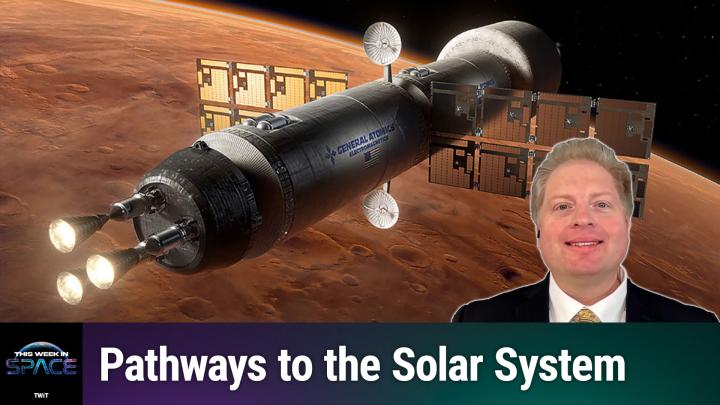
All TWiT.tv Shows (Audio)
This Week in Space 152: Atomic Rockets II: Nuclear Electric Boogaloo
01:04:13
Pathways to the Solar System
Loading summary
Transcript140 lines
- [00:00]
Tarik Malik
Coming up on this Week in Space, Saturn has more moons. That relief mission is finally launching to the International Space Station. And when do we have our nuclear wessels in space? We've got Rob O'Brien from the University Space Research association center for Space Nuclear Research to tell us the tale. Tune in.
- [00:18]
Unknown
Podcasts you love from people you trust.
- [00:23]
Rob O'Brien
This is turked.
- [00:26]
Rod Pyle
This is this Week in space, episode number 152, recorded on March 14, 2025. Atomic rockets, two nuclear electric. Boogaloo. Hello and welcome to another episode of this Week in Space, the atomic rockets edition. Can you put some reverb on that part? I'm Rod Pyle, editor in chief of Ad Aster magazine. Yeah, theremin time. And I'm joined by my baby face pal, Tarik Malik, editor in chief at the one, the only, the indispensable space dot com. How are you, sir?
- [00:59]
Tarik Malik
I'm doing well. I shaved this week, so that's, that's why you look so, so fresh and pink and, and ready for. Ready for the day. I also slept. I slept until 10am today, so it's all sorts of things lounging around.
- [01:13]
Rod Pyle
So, wow, put that in the column of things we didn't need to know. And we will soon be joined by a fantastic guest, Dr. Robert O'Brien, who's the director of the center for Space Nuclear Research, which is another initiative of the great University Space Research association, which is at USRA Edu and the communications director there. Soraya, has been sending us a string of great guests and we're very appreciative of that. Before we start, however, as always, please don't forget to do us a solid. Make sure to, like, subscribe and do the other podcast things that will make us feel loved and make us popular. So we can keep bringing you this lovely show because we're counting on you. And now it's joke time.
- [01:55]
Tarik Malik
Jokes.
- [01:57]
Rod Pyle
We occasionally have a sound effect, but today we'll make our own. There you go.
- [02:05]
Tarik Malik
This is.
- [02:05]
Rob O'Brien
I'm gonna name.
- [02:07]
Rod Pyle
There we go. Found the push button. This is from Listener and I'm. I apologize in advance for mispronouncing your name, I'm sure. Jason Adamstick, I think Jason. A, D, A, M, C, Z, Y, K. You know, when you get all those consonants clumped together, I always fail. All right. Hey, Tarik.
- [02:26]
Tarik Malik
Yes, Rud?
- [02:28]
Rod Pyle
Why was the Star wars release order 4, 5, 6, then 1, 2, 3.
- [02:35]
Tarik Malik
I don't know why.
- [02:36]
Rod Pyle
In charge of scheduling Yoda was.
- [02:41]
Rob O'Brien
Really.
- [02:42]
Tarik Malik
It's a Yoda. I love it.
- [02:43]
Rod Pyle
I like that. 1. Okay, let me try again in charge of scheduling. Otherwise.
- [02:48]
Tarik Malik
Oh, wow, that's. That's even better. Oh my God.
- [02:51]
Rod Pyle
Now, I've heard that some people want to encase us in carbonite when it's joke time on this show.
- [02:55]
Tarik Malik
You're really good.
- [02:56]
Rod Pyle
You can help send us your best, worst or most different space joke as so many have at twisted Twitter tv. And we'll be sure to give you a call out on the air so that people can blame you for the jokes instead of us. Now let's do some headlines.
- [03:12]
Tarik Malik
Headline news.
- [03:15]
Rod Pyle
Another sound cue there. Headline news staring at us like, what are you talking about? Okay, that's all right. We'll leave the Australian lady till next time. So finally, after months of, and I'm quoting here, stranded abandoned astronauts on the ISS, Crew 10 gets to go pick them up, which of course was in planning for a long time because these people were never stranded or abandoned. They, they were busy doing work on the iss. And as I like to say, every time this comes up, I have yet to meet an astronaut that doesn't say, I would love more time in orbit. Not gee, I really wish I could come home because my socks are dirty. Tell us the story.
- [04:01]
Tarik Malik
Well, yeah, this will be a real quick one, but we wanted to give everybody an update that NASA's Big Relief mission to the International Space Station to set the stage for the return of astronauts Suni Williams, Butch Wilmore as well as two other astronauts will be launching soon. As we are recording this episode. They're supposed to Launch tonight on SpaceX's Crew 10 Dragon Endurance at 7:03pm they are launching a bit late on this mission. They supposed to launch in February. Originally NASA pushed it to March because of issues with the Dragon spacecraft. It wasn't the one that they're using now. Endurance, the veteran of SpaceX's fleet four time flyer, it was supposed to be a new version that apparently had some battery issues or whatnot is what SpaceX has said. So, so they swapped that out. They're launching now. If everything goes according to plan, the crew, nine astronauts, Sonny Williams, which more will may return to earth on Sunday, May 16. However, this launch was delayed from March 12, which is earlier in the week as we're recording this. So it's unclear if that landing is going to get delayed. But the last I had seen it was still 16th, so.
- [05:10]
Rod Pyle
So success back on Earth at last. Yes, and it'll be interesting here and we will be having an astronaut on the show in the near future from not. Not Not Butcher Sonny. But from that current crop, we gotta.
- [05:24]
Tarik Malik
Play our cards right, though. We gotta, we gotta hope that all pans out so well.
- [05:28]
Rod Pyle
If you're looking at me to be a card player, you're in trouble because I'm terrible at it. Now, from that uplifting moment to a less uplifting moment, the NASA layoffs continue. What the heck is going on?
- [05:39]
Tarik Malik
Yeah, so this week we actually got word from NASA that in order to comply with Trump executive orders, as well as what I believe is DOGE workforce reductions, that NASA executed a reduction in force an RIF to shut down a few specific offices. So the Office of Technology Policy and Strategy is going to be shuttered. By the way, these stories are from Space.com right now, the Office of the Chief Scientist, which is really strange because we didn't. We just have a chief scientist on board with Jim Green recently. Really weird that they're going to close that office there because what does it mean for science?
- [06:18]
Rod Pyle
It is worth noting he's a climatologist.
- [06:20]
Tarik Malik
Well, yeah, there is.
- [06:21]
Rod Pyle
That might have something to do with it, but they're also shuttering that directorate.
- [06:25]
Tarik Malik
Yeah, it's like the whole area. As well as of course, the Diversity, Equity, Inclusion and Accessibility branch of the Office of Diversity, Equity and Inclusion. I guess it's a whole extra office because they're shutting all of that down from the Trump executive. The anti DEI orders that Trump has put out. My suspicion is that a lot of these, a lot of these agencies had some kind of diversity or climate bent that the administration doesn't like, and that's why they're going to shut it down to try to save money. I didn't, I didn't get a specific number about how many employees are affected, but it doesn't sound like it's like on the thousand list like there was before. So something somewhat smaller than that. But we'll have to wait and see how this affects science decisions and other missions in the future. Not having these offices in place as they have to make decisions for budgeting, etc.
- [07:17]
Rod Pyle
All right. And I have to just say completely personal opinion. But, but shuttering the Science Directorate is just crazy because that is, that's a pillar of what NASA does. It's what's kept them vibrant and relevant for years. And you know, one casual interpretation without a whole lot of data points could be, hey, we just want to route all this money to Artemis and get people back to the moon, then worry about science. But that isn't what it really feels like. So it's hard to tell all right, I know you're burning to do this one. Saturn is breeding. What's going on up there?
- [07:53]
Tarik Malik
This is exciting. This is probably one of the most exciting space like science news stories of of the week. But a new study came out and it turns out that Saturn has a lot more moons than we thought. Even though. So we thought that, that it had what, 146 moons. That's already a ton of satellites. And what this new study that came out this week found out is that there are actually 128 other moons. So that's a grand total of what, 274 moons. That's a lot of, lot of moons.
- [08:24]
Rod Pyle
You know how to.
- [08:25]
Tarik Malik
So I tell you this is from Space.com. that's why I can do it. I don't have to do the math, you know. But it means that Jupiter, the king of our solar system with 95 planets is now just like a meager wannabe when you compare it to the queen ring holder of our, of our solar system Saturn. So and a lot of these, these were discovered by astronomers in Taiwan using the U.S. france, the Canada France Hawaii Telescope. CFHT. It's out in Hawaii. And they found them all in 2023 by just I guess staring at the planet. Who doesn't want to stare at Saturn really, you know.
- [09:04]
Rod Pyle
Well, doesn't it seem unfair that Saturn already has the rings and it gets the crown for all the extra moons?
- [09:10]
Tarik Malik
I know, I know. I think that one of the interesting things from this study though is it is starting to bring up the question of what actually qualifies as a moon.
- [09:19]
Rod Pyle
Right.
- [09:19]
Tarik Malik
Because some of them are just super, super teeny tiny like a few miles across.
- [09:25]
Rod Pyle
Whereas captured asteroids maybe.
- [09:28]
Tarik Malik
Yeah. And maybe are they ring fragments? Are they, are they particles that just kind of found a stable orbit around the Death Star? That explains. I know Saturn's rings by the way. And one of the moons on Saturn is where an alien statue was, was discovered signal out in a sci fi book.
- [09:47]
Rod Pyle
But thank you for calling. Wow. I thought we were going off at uncharted territory.
- [09:53]
Tarik Malik
No, that lead, it was, it was a. They have like a, like a, like a detective slash pilot person. Oh man, it's a good. I can't remember the author. I'll, I'll see if, I'll, I'll see what I can do later on. But it's a great writer, Jonathan McDowell. That's who it is. So.
- [10:08]
Rod Pyle
And I bet for a wrap up you probably want to talk about the eclipse.
- [10:12]
Tarik Malik
Yes I do.
- [10:13]
Rod Pyle
Which I missed because I was Staring at the bottom of rain clouds.
- [10:16]
Tarik Malik
Yeah, well, there was, as we are recording this, last night. It was there, actually. This morning was the first total lunar eclipse of 2025. And it was visible across the Western Hemisphere. So if you lived in the United States, in North America and South America, you got full on coverage of the blood moon eclipse. I did not because there were clouds over New Jersey right at totality, which is very frustrating to watch the moon disappear and then not get any payoff from it. But luckily the moon's still there, so it came back. You know, maybe that my, my late night coffee ritual did that, but you can see all sorts of amazing photos@space.com as well as wherever you get your news and keep. If you, if you end up living in Asia or Australia, mark your calendars for September 7th and 8th. That's when the next total lunar eclipse will be visible to that hemisphere. And of course, every lunar eclipse accompanied by a solar eclipse. So in two weeks later this, this month, we will have a partial solar eclipse visible over really high bits of North America and, and Europe. And we'll be covering that too@space.com and.
- [11:20]
Rod Pyle
It'S a much bigger personal crisis when your solar eclipse gets clouded out the window, eclipse gets crowded out, which is what happened to me last time. All right, did you have anything else or is that.
- [11:30]
Tarik Malik
No, I think, I think, I think we could probably wrap it up there. I would say that there is a new billionaire that is entering the space arena. Eric Schmidt, Google founder and CEO, is now the CEO of Relativity Space, the 3D printing company taking over from Tim Ellis, the founder and a USC alumnus. Fight on, Tim, to take Relativity Space into the next, I guess the next level. They're building a, a Terran rocket. They announced that they're going to shift from that initial small rocket to the new Terran reusable rocket. This came from Space News, by the way, I think at satellite 2025 conference this week, which is going to aim for a fully reusable medium lift vehicle. And then we'll see what their business model will be for that to see, like what their customers might be. So very interesting to see yet another billionaire after Jeff Bezos and Elon Musk and Sir Richard Branson jump into the fray. We'll see what Eric Schmidt wants to do and, and then we'll take it from there.
- [12:31]
Rod Pyle
When I become a billionaire, I'm going to do it too. All right. We will be back after the Short break with Dr. Robert O'Brien, the director of the center for Space nuclear research to talk about. Can I say it again? Atomic rockets.
- [12:45]
Tarik Malik
Rockets, rockets.
- [12:46]
Rod Pyle
Standby.
- [12:50]
Unknown
It can be hard to get along with family. And even harder if your twin wants to kill you.
- [12:56]
To Gina, it was a diabolically perfect plan. She would kill her twin sister, assume her identity, and no one would ever know it happened.
- [13:06]
On Killer Kin, a podcast from id, you'll hear true stories about family members who turn against each other. Find out if evil is a family trait. Listen to Killer Kin on Apple Podcasts, Spotify, or wherever you get your podcasts listeners.
- [13:22]
Are you looking for a shortcut to better auto insurance for you? Something that takes all the research off your plate. Something that's easy, Something that matches you with lower rates. Something genius. That's where NerdWallet comes in. Their nerds already did the work for you. Just answer a few questions and ta da. You'll be matched with top insurance providers in your area. Find the right rate for you@nerdwallet.com. after all, using NerdWallet is more than smart. It's genius. Not all applicants will qualify for the lowest monthly payments. NerdWallet Insurance Services Incorporated, California resident license number OK 92033.
- [13:52]
Rod Pyle
And we are back with Dr. Robert O'Brien of the center for Space Nuclear Research, where he's the director doing some incredible work that was just a mere twinkle in our eye a few decades ago. So, Rob, welcome. Thank you so much for coming on today.
- [14:10]
Rob O'Brien
Thanks for having me. Great to meet you both.
- [14:13]
Rod Pyle
Likewise. Now you have a PhD in nuclear engineering. I got to read the resume because these things always knock me out. They make me feel about an inch tall. PhD in nuclear engineering and Physics of Radioisotope and Nuclear power propulsion Systems for space Exploration from the University of Leicester. Is that how it's pronounced?
- [14:32]
Rob O'Brien
Leicester? Yeah. University of Leicester in the uk.
- [14:35]
Rod Pyle
Yep, in the uk. Okay. And a master's degree in Physics and Space Science and technology. He holds several patents and patents pending from. And is a Fellow of the Royal Astronomical Society. Sorry, my. My rundown disappeared for a second. You're an accomplished man. And this is the point at which Tarek and I usually do our big mea culpa about both having intended to have science degrees when we were in university, but we both met our Waterloo at Differential equations become storytellers instead. So that's a fantastic background. How did that get you to the center for Space Nuclear Research?
- [15:19]
Rob O'Brien
Well, that's a great question, and I'll just say, you know, PhDs, masters, they're not the only route to Success, of course, there's the University of Life, which, you know, we're all on that journey for and through. So, you know, my journey was through both an academic approach to study and then focused on actual deployment and testing of nuclear systems. And that's what brought me out to the center for Space Nuclear Research. I've spent a lot of time, a stint of my career, in the Department of Energy national Labs, doing some pretty neat work and helping restart old reactors, and as we're doing now, restarting and regaining traction in some technologies that I think are going to be absolutely vital for human exploration and successful operations in both near space, cislunar space, and then beyond into the outer planets and including exploration of Mars and the outer solar system.
- [16:19]
Tarik Malik
I feel like we should, because we're here talking about propulsion and whatnot, that we should be calling you Chief O'Brien, like from Star Trek, right, Who kind of, like, was responsible for all the. All the new advancements and all that. And here you are looking into what hopefully, or what I guess logically would be the future of space propulsion later on. I have to follow Rob's question, Rod's question with my own, which is pretty much about the kernel of space for you personally. Like, is it something that you jumped into through your university experience there that really kind of grabbed you, or were you on a space kick? Well, before that, what was kind of your first, I guess, inkling or exposure to space as something that was both a personal interest that would then evolve into a career there?
- [17:12]
Rob O'Brien
Yeah, great, great question. You know, I think for me, it started as a spark as a kid. I think it was probably growing up in the 80s and being a child of the 80s, that was really. There was a lot of space presence on TV and in movies. You know, Star wars is a big, big driver in some of that inspiration. But also just growing up, you know, after the Apollo era, seeing the great accomplishments there, and then living through the space shuttle era, just how inspirational the science, engineering and technology demonstrations were through those programs and seeing it on TV as a kid, I think that was something long before I became a professional scientist or engineer. I knew I really wanted to work in space and help us get beyond what we're doing right now and what we were doing back then. And I think one of the first bits of engineering was probably model rocketry and amateur rocketry. As a teenager, that. That got me into, you know, being able to really understand not just the math or the. The equations and the models that are out there now, but actual practical experience and That's. That's what I'm excited about. This next era of. Some of the work we're doing is really about deployment, testing, and, you know, really putting things into production now. So started at an early age.
- [18:31]
Tarik Malik
Big, big model rockets, right? Big ones.
- [18:33]
Rob O'Brien
That's right.
- [18:34]
Rod Pyle
So I have a question about model rockets, if I may, because this tells us a lot about a person. Were you one of those guys that followed the instructions, or did you build them the way you wanted to?
- [18:44]
Rob O'Brien
You know, I think I started following instructions. And, you know, I did things with my dad as a kid, putting models together. And, you know, he was a technologist and a professor in technology and electronics. And so I was able to do a lot of that learning from him. But then, you know, I started to put my own ideas into my projects as an older kid, and I started building my own designs, I suppose, and really going off the design or instruction sheet and thinking about why we need to do things and how we can solve problems. And that was also in manufacturing, as well as just the assembly. So how to make new materials, I think composites as a teenager was something that I learned, and materials really became a focus then through some of my career. You know, it's about making things, solving the technical, technical problems, but the real materials behind those solutions is something that I probably started at that early age, heading off the instruction sheet and doing my own sort of innovating.
- [19:53]
Tarik Malik
But to succeed, right? To succeed, right.
- [19:56]
Rob O'Brien
Exactly.
- [19:57]
Tarik Malik
Not to just see an explosion like some of my friends when we were growing up.
- [20:01]
Rod Pyle
Hey, I take that personally. What's. What was your involvement with the Idaho National Laboratory? They're kind of the eastern US Equivalent of Lawrence Livermore. Right.
- [20:13]
Rob O'Brien
In fact, so. So I spent about 14 years at Idaho National Laboratory working for the Department of Energy here in Idaho, and I was part of the Transient Reactor Test Facility, or TREAT Reactor Restart. That was the first reactor that went operational again since about the early 70s, since about 1974. And so we also. I led advanced manufacturing for the IDO national Lab, again focused on materials, trying to solve problems for general nuclear energy. And, you know, now at the center for Space Nuclear Research, really taking some of those experiences and connecting those as well as other capabilities at the other national labs, in industry and in academia, which is really the importance of whole of government, whole of nation being able to solve these problems and pulling them together to really engage these endeavors in advanced power and propulsion that we really need.
- [21:17]
Tarik Malik
Well, that is. That is awesome. But you're also. I mean, I guess there's other stuff that's going on at the center right now for space nuclear research. I mean, you're doing like the, the obvious research there, but you also have educational outreach and that type of thing to I guess get a new crop of engineers to take us to the stars.
- [21:37]
Rob O'Brien
Yeah, I mean, I think, to quote some of my colleagues, space nuclear expertise is kind of unicorn capabilities and expertise at the moment. And we're actually working to resolve that issue. Talent pipeline for all energy, as well as nuclear energy in space is something that we have to work as a nation to really push forward and develop. So at the center for Space Nuclear Research, we do things differently to the traditional university approach to talent pipeline and talent development. We do things hand in hand with the programmatic needs, the drivers that are moving the development and deployment of nuclear technologies for space, hand in hand with the teaching and learning experiences for undergraduate, graduate and then early careers staff, and then helping our center staff move the technologies forward. So it's that combination of all of the above that really drives success. And some of these technologies that we're talking about here push the envelope of materials and, and the physics that, that make it even possible. And so we think outside the box and redefine what the box is by working with the best, the brightest from around the world. And that's, I think, really an exciting avenue to work in. Right now.
- [23:08]
Rod Pyle
I think we're going to jump to an early break because my next question is the meat and potatoes and I want to have a clear flight deck for this. So let's go to a quick break and we'll be right back. Standby.
- [23:20]
Unknown
Listeners, are you looking for a shortcut to better auto insurance for you? Something that takes all the research off your plate, Something that's easy, something that matches you with lower rates, Something genius. That's where NerdWallet comes in. Their nerds already did the work for you. Just answer a few questions and ta da. You'll be matched with top insurance providers in your area. Find the right rate for you@nerdwallet.com after all, using NerdWallet is more than smart. It's genius. Not all applicants will qualify for the lowest monthly payments. NerdWallet Insurance Services Incorporated, CA resident license number OK 92033. Hey, prime members, are you tired of ads interfering with your favorite podcasts? Good news, with Amazon Music, you have access to the largest catalog of ad free top podcasts included with your prime membership. To start listening, download the Amazon Music app for free or go to Amazon.com adfreepodcasts that's Amazon.com ad freepodcast to catch up on the latest episodes without the ads.
- [24:19]
Rod Pyle
All right, so the part that, that got me excited about having you on here is talk. And I grew up in the 60s, so I'll use the phraseology of the double features of the day, talking about atomic rockets, because atomic rockets sounds very cool.
- [24:35]
Tarik Malik
Watch out, he's nuclear, you know.
- [24:36]
Rod Pyle
Yeah, so. So the, the big areas of investigation, as I understand it at this point, is looking at nuclear electric propulsion and nuclear thermal propulsion, both of which appear to be very promising for different uses because they have very different characteristics. And at least one of them is something that we researched quite a bit in the past. But maybe you could just sort of walk us through what the differences and advantages of those two kinds of systems. Systems are, if you would.
- [25:06]
Rob O'Brien
Absolutely, yeah. Of course, nuclear electric propulsion is something that can couple immediately with high TRL electric propulsion systems. The only nuance here is that we're generating electricity to feed those propulsion systems from a nuclear reactor or nuclear power source. And it doesn't just have to be a reactor. It could be a radioisotope system, which is 1950s technologies. And now we're trying to regain traction to enable 1960s technologies coupled to nuclear electric propulsion. And so some of the nuances here is that with nuclear electric propulsion, you can maintain steady propulsive operation and over a period of time, build up total change in velocity or Delta V that could indeed leave the Earth's, Earth's gravity well and go to the outer planets with electric propulsion. And, you know, there's different scales of power requirements for nuclear electric, there's robotic scale, and then there are power levels that push us towards exploration of Mars. For example, that could be enabled with nuclear electric propulsion that requires, you know, many megawatts of electric power. So whether we're talking about a robotic mission to cislunar space or human exploration to Mars, that's the nuance, that's the difference in power level. We actually believe there's a hybrid role between nuclear electric propulsion and an importance for nuclear thermal propulsion. And nuclear thermal propulsion is different because just like a conventional rocket, we exhaust a propellant through a nozzle. And that propellant, instead of burning it through a combustion process, we preheat it or heat it through a nuclear reactor itself. So just like we use water on Earth to cool a reactor, we use hydrogen or another propellant like ammonia or helium to cool that reactor. But in doing that, it too becomes a propellant, and we expel it through a nozzle and that gives us thrust like a conventional rocket. The only difference is the efficiency is at least several factors greater than conventional chemical rocket systems. So the scale here is that we can have sustained agility and sustained maneuver with electric propulsion and then agility for more impulsive needs using nuclear thermal propulsion. And so there is a hybrid role to play with, with both nuclear electric and nuclear thermal for all of the things that we're going to be doing in space, both for space operations in near space, cis lunar space, and then to, to enable the exploration missions of the moon and Mars and beyond.
- [27:59]
Tarik Malik
But Rob, haven't we launched like nuclear? I assume that we're talking for these big propulsion systems, these big engines, like having some kind of a reactor on board the vehicle itself. Because you mentioned the rtgs, the radio thermal, radioisotope thermal generators, that, I get that right, like the one that was on Cassini, the Voyagers, etc. And I know about those ones, but I feel like in the heyday of like the, the, the, the ramp of the early decades of space exploration, you know, we did as humanity send some kind of reactors into space. And so we don't see a lot of that anymore, you know, and I'm curious, what experience have we, you know, to have these kinds of at least the reactors themselves in space and then how do we need to evolve that technology for a future, you know, trip to Mars, etc. You know, for these other big, these other missions there? Because it seems like if we had that back then, shouldn't we have it now? You know, I don't know. I don't know how it works.
- [29:05]
Rod Pyle
That's a story.
- [29:08]
Rob O'Brien
That'S both a sub story and you know, it's also an inspiration point for us. It sets the bar of where we need to get back to with reactor systems. So to your question, we have flown a reactor system from the US SNAP 10A. As the reactor was flown in the mid-1960s, it was successfully launched. Absolutely. And that's why I said earlier, you know, reactors are 1960s technologies and radioisotope power is 1950s technologies. You know, we face challenges with changes in policy and procedures and capabilities. I think the capability changes over the last few decades is what's a little concerning. But it's nothing that can't be solved with engineering and hard work. And you know, that's what our community of practice is, is actively engaged in, is regaining that capability to build reactors and to sustain radioisotope power development. And despite some of the atrophy that we've had across the nation we're working towards solving those problems. And of course that requires investment and continued investment. But the sort of return on that investment is incredible. What we can do when we regain the traction of being able to launch 1960s reactor technologies and then pave the way to 2000s technologies that are going to allow us to maneuver without regret, to be able to move quickly through the regulatory space. That's always been a huge hurdle, especially for the commercial world. But as we look at in space, manufacturing in space, propulsion, being able to generate propellant either on the moon, Mars or from near earth objects, that is going to be really important that we have these technologies. And so we've got to regain that.
- [30:59]
Tarik Malik
So it sounds like if I'm understanding right, in the 60s it was can we do this? Can we put a reactor to power a spacecraft into, into space or orbit? And now it's like what can we do with I guess 40 plus years more than that, 60 plus years of, of, of technological advancement to make it work for us to get to Mars faster, to power a moon base indefinitely, that sort of thing. Is that kind of where we're at in terms of technology development?
- [31:27]
Rob O'Brien
It is, you know, in the Apollo era, the nation invested incredibly in several programs. And you know, that to name a couple of them is the Rover Nerva program that saw real nuclear thermal rockets tested to a significant technology readiness level and to develop an understanding of how to operate those reactors on the ground. What kind of test infrastructure is needed to be able to do that? The regulatory space has changed and we certainly will not test nuclear thermal propulsion systems in the future or today the way that was done in the 1960s or in the 1970s. Indeed. But you know, we know that that investment was made, we know what we need to do again. And so that sets a roadmap, along with some of the study areas that have been performed over the last few years, where we need to regain traction in infrastructure. So Rover Nerva was a great example. And then the SNAP program that involved both radioisotope power and fission systems and actual flight testing under the Snapshot mission for a nuclear electric propulsion system. And the only reason that mission ended was absolutely nothing to do with the nuclear payload, the nuclear system. It was all to do with a voltage regulator on one of the payload systems. And so the system was safely shut down and put into a long term orbit. We can do the same. And I think what's really exciting is moving ahead from those old technologies forward, there's ways to make the Systems even safer than was tested and higher performance than was tested in those, those early programs.
- [33:08]
Rod Pyle
All right, just really quickly could.
- [33:11]
Tarik Malik
If someone had a recovery ship, could they go and find that snap spacecraft then and restart it? Or is it like hard stops, you know, like no one can crack it at all? If it's up there in a graveyard orbit, someone knows where it is, right?
- [33:25]
Rob O'Brien
Absolutely. There's a few, few expertise out there that know how to actually restart that system. It would require a rendezvous mission like you suggest, probably robotic or could be a human expedition. Remember now, it's been several decades, so it's certainly cool enough from a radiological perspective to. For a crude mission to go ahead and reattach some key components to make that system work again.
- [33:53]
Tarik Malik
I'm just saying that there's tethered. Yeah, there's someone on this call who has effectively restarted a nuclear. But anyway, anyway. Okay, Rod, go ahead.
- [34:02]
Rod Pyle
All right, we're gonna run to a quick break and then we're gonna come back to talk about one of my favorite stories briefly, which is Rover Nerva. So we'll be right back. Stand by.
- [34:13]
Unknown
It can be hard to get along with family and even harder if your twin wants to kill you.
- [34:18]
To Gina, it was a diabolically perfect plan. She would kill her twin sister, assume her identity, and no one would ever know it happened.
- [34:28]
On Killer Kin, a podcast from id, you'll hear true stories about family members who turn against each other. Find out if evil is a family trait. Listen to Killer Kin on Apple Podcasts, Spotify, or wherever you get your podcasts listeners.
- [34:44]
Are you looking for a shortcut to better auto insurance for you? Something that takes all the research off your plate, Something that's easy, something that matches you with lower rates, Something genius. That's where NerdWallet comes in. Their nerds already did the work for you. Just answer a few questions and ta da. You'll be matched with top insurance providers in your area. Find the right rate for you@nerdwallet.com. after all, using NerdWallet is more than smart. It's genius. Not all applicants will qualify for the lowest monthly payments. NerdWallet Insurance Services Incorporated, CA resident license number OK 92033.
- [35:16]
Rod Pyle
So, Rob, you mentioned the Rover and Nerva program, and it's a story I've been fascinated by since I was a kid. Because we did have atomic rocket engines at one time that we were testing on the ground, and if fairly, I think, by the standards of the day, a fairly threadbare program. It wasn't like they were throwing tons of money at it like they were Apollo, because Apollo was going to get us there now and this was something for the future. But just to be clear, you kind of touched on this back in the day, in the 60s and early 70s when they tested nuclear thermal propulsion. They did an area lovingly called Jackass Flats out in Nevada. And if I remember correctly, they'd pump up a cavern or a space behind the engine and then start, start the reactor and then let whatever they, I don't know if they're using hydrogen or xenon or what flow through the reactor. And they tested it, but they tested it by blowing the exhaust out across Jackass Flats, which is something that you would absolutely not do today. So I'm presuming you have other methods to work on this, right?
- [36:27]
Rob O'Brien
Absolutely. So, yeah, they performed what we would call open air testing. The regulatory space was, was actually being defined as the technology was being developed back under the Rover Nerva program. So, you know, there, there was a lot of learning and the lessons learned. And thankfully new policies and environmental protection orders that were put in place for public protection that's absolutely key to future development are now in place that mean we would not do open air testing. Instead, we're actively working on key technologies to capture the exhaust, provide enclosures and full containment. So we have a source term hold up that is attributed to the system so that even if the system catastrophically failed, it would not be a release to the public. We can protect them. And we do that with both containment, engineering controls and then distance from the public. That's absolutely critical. There's only a handful of places to test and certainly there's no decision on where the programs of today and tomorrow will be testing. But what we have to do is work towards those common goals in technology development while protecting the public. It's the public that want us to go to space and will ultimately benefit from human exploration and return of materials from space and enrichment with life from systems and technologies in Earth orbit. If we think about satellite technology alone, that's improved the lifestyles of humans around the world and, and made the world a smaller place and, and so that's why we do this. But we've got to remember that public protection is absolutely essential.
- [38:13]
Rod Pyle
And just to kind of cap this on Nurba, I mean, it's a long story, but by the time they were done testing it, and this is with materials science, the state that it was the 1960s, which has advanced a lot since then, they're running these things for hours, as opposed to chemical rockets that run for minutes. Correct.
- [38:34]
Rob O'Brien
Their tests were minutes to hours in length. And so that demonstrates the endurance and agility of these systems and ultimately the agility of a platform that could use the technology, ultimately cutting the mass required to propel a human mission to Mars to maybe one third or better than would be required for chemical propulsion. But in doing the testing, the testing that was done under rover Nerva, although it was ours, it would be absolutely no different to what we're planning to do with nuclear thermal propulsion. As we move forward, we need to ultimately quantify the margin to failure and that is done through extended testing in prototypic environments, Testing the nuclear systems, the subsystems, and how everything plays together. That, that we need to learn and ultimately work towards both robotic flight demonstration and then human exploration that will be enabled by human rating of an engine. So that, that does require a lot of testing, but most importantly, learning from those tests, doing the post mortem analysis, what we call post irradiation examination on nuclear fuels to help us understand the margin to failure.
- [39:48]
Tarik Malik
You know, Rod found a great image of a Nerva engine on display. It's on line 51 John, there at the Marshall Space Flight Center Rocket Park. And I was just curious because we talked a little bit about kind of the frustration of you know, having done certain stuff in the, in the 60s, etc. And then having to relearn all of that. I'm curious what it, what it feels like for you as kind of a scientist, you know, pioneering this, this, this, this plan to look back and see like that, that engine that they built, you know, 60 years ago and knowing that had we just kind of stuck to it or at least I guess kept that, that focus where we could be, you know, today. Because I've seen Nerva mentioned specifically in several recent sci fi products like sci fi movies and TV shows, both animated as well as a international, which was really exciting to see. But, but I'm just wondering kind of how that feels like and I guess at least seeing it in those sci fi shows brings you some hope there about the support there.
- [40:54]
Rob O'Brien
Well, ultimately these technologies are not just a good idea, they're going to be essential. And it's great to see that the science fiction world is also acknowledging the scientific facts of reality, of space, propulsion and power needs. So you know, it's exciting to see it. And ultimately, you know, we need people to understand the technology, not be hidden behind some veil of mystery that it suddenly works. We need the public that ultimately for a public mission or the commercial world that will ultimately sponsor these technology development areas to understand what the technology is, why we need to adapt it and adopt it for deployment purposes and then really embrace it, not be afraid of it, but actually with a little bit of knowledge about how these systems work, really get passionate about it and support the technology.
- [41:49]
Tarik Malik
Yeah. I think if our listeners are interested, the Nerva instance that I'm thinking of was in Apple's TVs for all mankind. There's a whole long arc about the testing of that engine on the moon. Which seems like a safe place, Rob, that we can test these engines. Right. Because there's no public to worry about there.
- [42:09]
Rob O'Brien
Well, that's right. The question is, how do you learn from the test? Right. So we could do this in the depths of a really secure facility that was buried deep underground or on the surface in a containment with exhaust scrubbing, or you could do it on the moon, but you ultimately don't just want to turn it on. We don't want a binary answer. Yes, no, it worked or it didn't. We need to know the real engineering and science behind the materials, capability to survive, the system, ability to operate and how long it can endure operation to understand that sort of margin to failure overall. So we have to be able to do the post mortem analysis. And it's that infrastructure that engages both the sort of industry base, the national labs, as we talked about before, there's several national labs that have hot cells. But the journey between the test and the science that's accomplished in those industry and national lab bases and in academia is really what we need to focus on next. It's that infrastructure that's our next journey. So whether you test it on the moon or you test it in some new facility, you need to be able to take the engine apart safely and be able to package the materials and put them either over the road or on rail to some of these other facilities in a secure transportation package that can accommodate any kind of scenario that you might be concerned about from a safety perspective in transportation and get the science done once the materials at the existing science base.
- [43:48]
Rod Pyle
Well, and speaking of safety, and you kind of touched on this, but I think it's important to let people know Nerva wasn't stopped because there was that disaster. It wasn't stopped because there was some massive problem with the technology and it was operating on relatively slim budgets. I mean, when you look at pictures in the time, there's a lot of pickup trucks and lonely guys out there in a anti contamination suit kind of dragging Things around with ropes and so forth. But it was stopped because of environmental, the environmental movement and political concerns. Is that correct?
- [44:22]
Rob O'Brien
I think the real driver for stopping the rover Nerva program is because we did not continue on to Mars. Wernher von Braun knew that we needed to invest in nuclear technologies. In fact, at NASA Marshall Space Flight center, one of our great collaborators, the team there on the Space Nuclear Propulsion program and project area, have access to some hot cells there that were built by Wernher von Braun's team that actually knew that they needed to learn, needed to do the science, to understand the margin to failure on nuclear materials and support equipment. So the knowledge was there. But that team didn't continue on to Mars at the end of the Apollo program. I think that's really why we saw the sort of demise of the rover Nerva program. I think it's a coincidence. There were other concerns with Three Mile island and the way that the information was shared with the public. And really that veil of mystery created a shadow of doubt. And that's why as we move forward, we have to educate. We need everybody that wants to work on this to understand and be able to communicate what the technology is effectively so that there's no veil of mystery. There is a clear path forward.
- [45:38]
Rod Pyle
And we're going to go to a break in a second. But just to, to, to terminate this part of the conversation. When we talk about just in general terms, nuclear thermal and nuclear electric, we're talking about moving very large masses around deep space in the fraction of the time it takes with conventional chemical rockets, correct?
- [46:03]
Rob O'Brien
That's right. And probably the other detail to say is maneuver without regret. When we look at space operations, the regret comes when you make an unplanned maneuver or you have to burn too much propellant. You leave nothing in reserve that could lead to regret. So maneuver without regret is going to enable both Department of Defense or Space Force Space Command operations, as well as human explanation exploration, robotic exploration with margin to change and depart from the planned mission. I think that's what's really exciting about this, is this gives us the best chance to get people to Mars and bring them home quickly, to cut down on dose and radiation dose that the people might pick up with a long duration transport and transit to the destination.
- [46:53]
Rod Pyle
Okay, I'm going to get some T shirts made up with maneuver without Regret on them because I think that's a great term. We will be right back after the the short break with Tarik's next burning question.
- [47:02]
Unknown
Standby listeners, are you looking for a shortcut to better auto insurance for you. Something that takes all the research off your plate. Something that's easy. Something that matches you with lower rates. Something genius. That's where NerdWallet comes in. Their nerds already did the work for you. Just answer a few questions and ta da, you'll be matched with top insurance providers in your area. Find the right rate for you@nerdwallet.com after all, using NerdWallet is more than smart. It's genius. Not all applicants will qualify for the lowest monthly payments. NerdWallet Insurance Services Incorporated California Resident License Number OK 92033 hey Prime Members, Are you tired of ads interfering with your favorite podcasts? Good news. With Amazon Music, you have access to the largest catalog of ad free top podcasts included with your prime membership. To start listening, download the Amazon Music app for free or go to Amazon.com ad freepodcasts that's Amazon.com ad free podcasts to catch up on the latest episodes. Without the ads.
- [48:02]
Tarik Malik
Maneuver without regret. Rod feels like like normal, you know, like, like, like some kind of next gen, like fan, space fan, you know, mantra to keep around. You know, I was curious Rob, because you had mentioned how technology and systems have changed since the first inquiries or experiments with space nuclear propulsion. And one of the big talking points that Rod and I have talked about in the past is how will like this up and coming, up and coming. I say investments in artificial intelligence and whatnot affect space exploration in general. Everything from helping cut down development time for new technologies to keeping astronauts sane on really long missions in space. And I'm curious if through your research at, at the center for Space Nuclear Research with the usra, you know where you see that AI technology falling in either the development of a future nuclear propulsion system or testing or modeling to streamline that process to make it either more acceptable to test on the ground or ensure more success when you do go to flight test and that kind of thing.
- [49:23]
Rob O'Brien
Yeah, I mean that's a really interesting emerging field. And science itself, I think whether we like it or not, science and engineering, commercial products, manufacturing and then ultimately operation of systems, including nuclear systems of tomorrow are going to have to engage and will be engaging in uses of artificial intelligence, machine learning. And I think that's both exciting, it's not daunting. I think these tools can help us accelerate access to advanced materials, optimize manufacturing. And when we think about spaceflight, what we optimize for often is strength and mass for overall efficiency. And so if you think about optimization of structural components as an example. AI machine learning can help us design systems that are better from a mass performance perspective. But then if you think about controls, if you are looking at robotic missions or deep space missions that have a ground control element, the time to send a command, receive that command, perform an operation, can increase, of course, the further away from that control center. If it's Earth based, that will be a huge challenge for systems that respond quickly to conditions, whether they're nominal, changes in power profile, power demand, or if there's an off nominal event like a micrometeorite impact on a radiator panel. How does a system respond to that? Having a degree of autonomy that can control and close the control loop before human signal needs to intervene, I think is both exciting and very promising. And then if you think about cyber security, if you have a system that is aware of its own limitations, shall we say, or has its own machine learning experience of where the margin to failures are and understanding the influence of different actions that it may choose or the system may choose to perform, I think is really interesting. And it's very important because if there was a rogue signal, for example, asking a reactor to scale up to 1000% power, the system knowing that that's not a good idea. Sorry, Dave, I can't do that. Hal's sort of response I think is probably where there's a good use of machine learning in the control strategy of tomorrow. So that's what we're excited about. USRA has invested a lot of time and expertise in developing quantum computing, machine learning, not just large language models, but also on the technology front as well. I think that's where we're going to see a lot of use of these capabilities, capabilities in the coming decades.
- [52:19]
Tarik Malik
I think all the, all the benefits of HAL without the being a psychopath. Right, So I think that's good.
- [52:24]
Rob O'Brien
Exactly.
- [52:25]
Rod Pyle
That's good, yeah, yeah. And without the limitations of she who shall not be named A L E X A M, your commands.
- [52:36]
Tarik Malik
Not Siri, not Siri.
- [52:39]
Rod Pyle
You just woke up my phone.
- [52:40]
Tarik Malik
Oh, no, no.
- [52:43]
Rod Pyle
I will get a lot of email and none of it friendly if I don't give you a chance to talk about the future potentially of nuclear fusion propulsion. And that was mentioned in some of the documents I was looking at, what kind of work is going forward with that. And if you, if you don't mind looking into a crystal ball, because it's always been, to me, it's always been neck and neck with the conversation about boots on Mars, you know, 20 years out, 30 years out, but it feels like we're getting a little closer.
- [53:12]
Rob O'Brien
It does, doesn't it? And I think that's because there's an international investment in fusion science and technology that's been persistent over the last few decades. And ignition is one of the fundamental challenges with fusion. Sustained ignition, sustained fusion. How you fuel a fusion system of tomorrow, I think is an interesting topic and thread to pull on in a moment. But I think if you just look at the types of technology, there's a lot of good investment there. I think generating electricity is one front. There's direct use of fusion for propulsion. And we all recognize that these advancements are going to come with industry and other investments from the governments around the world that are looking at fusion science. So that is going to help tomorrow's propulsion system. Today, of course, the focus is on nuclear fission and radioisotope power. We got to accelerate the testing of those systems first. But in the background, there's a lot of promise for fusion for space applications and indeed beyond just propulsion and power. How you can do science with fusion, for example, a neutron beam line of specific energies that can be derived from a fusion source. Space use of fusion energy in space may be maybe coming sooner than many realize for interrogation purposes of, for example, on the lunar surface. If you want to understand the composition of some of the geology there. Being able to explore and prospect materials, I think is going to be very interesting with both X ray, gamma and neutron sources, what we call neutron activation analysis, as something that could be enabled with a very compact, electrically powered fusion system. So my crystal ball says we're going to need a lot of energy no matter what we're doing. So fission first, perhaps fission, powering a fusion system to derive neutrons, or a combination of both, providing their neutron sources to explore fuels of tomorrow. And, you know, that's something that I think prospecting is going to lead to more energy enrichment of tomorrow, which is finding sources of fusion fuel as well as advanced fission fuel. Thinking about things like thorium on the lunar surface, we know it's there, and then helium 3 for fusion systems tomorrow.
- [55:45]
Tarik Malik
You know, I did want to kind of circle back, I guess, because we haven't talked too much about it, but you have touched on it, about the public concerns for all of this stuff, especially like you said, getting stuff off the planet in the first place, because I, I recall when New Horizons launched, you know, to, to Pluto, that there were protests. When Cassini launched, there were protests, you know, and I would expect that similar type of, of concern to come up and there was a point where NASA was running out of fuel and they restarted the process and they were able to get it at least for rtgs, for, for the future. And I. And that's how we get curiosity and perseverance and huzzah, you know, years on Mars. But do you feel that now there is either more awareness about the care and the process that goes into it, or is that something that the scientists and the engineers that develop the next system to be tested in space will have to address through some kind of a public campaign of awareness and education to really lay things out in a way, because it seems like there are more tools now to do that than there may have been for the previous missions. Just from the breadth of news and social media types of ways to reach people.
- [57:04]
Rob O'Brien
Yeah, I think education is the key. The concept that in the vacuum of information, people create their own narrative, I think is an important remark to think on. So the science and engineering community, the teams in the government and commercial space that are going to use nuclear systems of tomorrow and in the coming months and years, as we see flight demonstrations take place and all the work on the ground that will lead to those flight demonstrations, I think is really key, is that we communicate with the public and not treat everybody as though they have no clue what a safe system looks like or what their concerns are about safety. People need to be understood about their concerns and they need questions answered or information ahead of time provided so they can really understand and not fear what the science and engineering community is doing. And that, that veil of mystery that seemed to be the standard MO for how things were done in the past with a smaller world, with the Internet, with social media, no government organization or industry can hide behind silence. And so education is going to absolutely be part of the communication strategy as these systems move forward.
- [58:28]
Rod Pyle
That's very well said. And as I recall, there was at least one unintended reentry, I think, by the Soviet Union of nuclear fuel elements at one point. But it's pretty well understood certainly by today, of how to encapsulate these things into casks that are re entry proof and are not going to think they atmosphere.
- [58:48]
Rob O'Brien
That's right.
- [58:49]
Tarik Malik
I think they recovered that too. I think they recovered the material from the. From the sea in that one. Yeah.
- [58:55]
Rod Pyle
All right.
- [58:55]
Rob O'Brien
There have been a couple of accidents where the Russian Cosmos spacecraft came back. I think what's really important to say is for radioisotope systems, the systems are engineered for impact, to protect the materials from being released to the public. And then fission systems of today and tomorrow are engineered so that they don't become critical. And that's some of the cutting edge work that we're doing, is that if they land on wet sand or are submerged in water, those systems are engineered not to become a critical configuration, that they fail safely. And that's really key. That's where the engineering has come along, enabled by advanced modeling and simulation tools. Today we can put systems together that we understand will be inherently safe through all operations.
- [59:43]
Rod Pyle
Okay, well, so I've already expressed my fanboy predilections towards nuclear thermal propulsion. But there's one more area that I just can't wait to talk about, and that's Project Orion. Not the Orion spacecraft that's going to the moon, but Project orion for the 50s and 60s, which was nuclear pulse propulsion or atomic rockets, where you had spacecraft of various sizes that ejected small nuclear warheads out the back. And as those exploded, it pushed on this big shock absorber pressure plate. This is all in theory. And you could reach, according to Freeman Dyson, who was working on it for years and years, you could reach such velocities, as he put it, Mars by 1965 and Saturn by 1970, which didn't happen, of course. But I did write about this in a book I wrote a few years ago and I think I called the chapter, referred in it to Barca loungers in space, because I mean, they were talking about anything from the size of a small, very small unit that could fly on top of Saturn 5, 2. And I had to check this about five times to make sure I got it right. 8 million ton, not 8 million pound, 8 million ton spacecraft this the size of Glendale, California, that would fly 150 people potentially at interstellar speeds and so on and so on and so on. So you don't want me talking about this because I'm not an expert and I get carried away. What are your thoughts on nuclear? Because studies seem to come back about every five years from various universities in Europe and the US and the east in Asia about, you know, this would probably work. It's icky to launch because you don't want to poison a bunch of people on Earth with fallout. But in terms of an in space system, it seems like it would be a real breakthrough.
- [61:33]
Rob O'Brien
I think that's, that's safe to say that there's very little to no interest today in launching a system from the Earth's surface propelled by nuclear devices. But for in space, interstellar space, for example, you know, there could be some rationale to look at Pulse nuclear detonation propulsion. And that's something that I think has to be looked at not just from a back of the envelope or a calculation, but actually from a feedstock perspective. A chain of devices that can be effectively stockpiled on the system or safely stored. And then how you string those devices and operate them, I think that's challenging. And just remember that with spherical pulsed events, there's isotropy in where that energy goes. So when there is a pusher plate, for example, on one of these big spacecraft that we saw proposed under the Orion program, only a fraction of the energy that is generated by each device is actually captured on the system. So there's a lot of waste. You know, at least 60% waste energy goes out to the other part of space. So it's only that momentum transfer between the device and the pusher plate that can propel us forward. So I think when we're really down to the wire on efficiency, there's lots to do with it. It certainly was tested with chemical explosives that pulse propulsion works by the Naval Research Lab. Actually, there's some videos on YouTube for anyone interested in seeing that. You can watch some of the old videos there where it was actually tested as a chemical system, not with nuclear. But, you know, I think. I think it's an interesting concept.
- [63:30]
Rod Pyle
Well, and for anybody who wants to look that up, it was called Putt Putt, which was. Was very cute.
- [63:36]
Tarik Malik
They also. They also use the Orion engine, nuclear engine. In sci fi's miniseries Ascension, which we've got a picture of that ship on line 65 there, John, as well as in Larry Niven's footfall. That's what human Rod and I were talking about this when we were planning the episode. That's how humanity fights back as they build a giant ship and then launch it with an Orion pusher plate. They put the space shuttles on. It was like a big space aircraft carrier. It's pretty cool. So. But not the wave of the future like Rob is telling us with the other engines. I think that these other ones sound a lot better.
- [64:10]
Rod Pyle
He's damped down my expectations. Okay. Well, Rob, I want to thank you so much for joining us today for episode 152, which we like to call call atomic rockets, with a big exclamation point and lots of reverb. Where's the best place for us to keep up with what you're doing at your various research and advancements?
- [64:29]
Rob O'Brien
Well, take a look at our website. It's USRA Edu and our center is csnr usra. Edu Keep your eyes of course, on the NASA Space Nuclear propulsion project pages and publicity information that's that's coming out. I'm really excited to see the continued investment by the nation in the program that will ultimately get robotic and human presence to Mars and the moon efficiently and give us preeminence in operation I think tomorrow. So keep an eye on those websites and of course the government program releases.
- [65:13]
Rod Pyle
Go and say it to the mountain. Nuclear propulsion. Tarik, where can we find you reaching critical mass these days?
- [65:19]
Tarik Malik
Well, hopefully not. I start with the trainer tomorrow. So we're going to kind of pair that, that, that bit back. But no, you can find me@space.com as always on the social medias at Tariq J. Malik if you like video games, you can find me on YouTube at Space Tron plays where I have a whole video about the blood moon eclipse in both real life that we saw and in Marvel Rivals, which is a lot of fun. So hope to see you there. And if anyone, if anyone wants to hang out, let me know.
- [65:48]
Rod Pyle
Just want to point out Tarek that I don't recall any of our PhD carrying guests talking about their video games on the show. But that's okay. And pursuant to that, listeners, if you want to drop us a line, you can do so at twistwit tv. That's twyswit tv. We love getting your comments and one of us will answer each and every email. New episodes of this podcast publish every Friday on your favorite podcaster. So make sure to subscribe, tell your friends, and give us reviews. We count on you for your reviews. 5 stars or thumbs up will will do just fine. And don't forget, we're counting on you to at least consider joining Club Twit in 2025. Besides supporting all the great programming that Twit does, you'll help keep us on the air and sending electrons your way about our great guests and my horrid space jokes. And it's only $7 a month. And as always, I ask the room, what else can you get for $7 a month? Really? I mean that's, that's one fancy coffee at Starbucks and some people do that every day. Finally, you can follow the Twittech podcast network Wit on Twitter Slash X and on Facebook and Twit TV on Instagram. Thank you, Rob. It's been a real pleasure. I hope we can have you back.
- [67:03]
Rob O'Brien
Thank you for the time, Tark.
- [67:04]
Rod Pyle
Yep, thank you, your director of congratulations, Raya, and thank you audience. And we'll see you next time, take care.
- [67:13]
Unknown
For quick tech insights, dive into TWiT's short form lineup. From Hands On Mac, you can get helpful tips, great apps and awesome accessories for your Mac, iPad, and iPhone. Hands On Windows offers essential advice and everything new in Windows. Hands On Tech zooms in on a specific theme with easy to follow advice that turns tech troubles into triumphs. Home Theater Geeks with Scott Wilkinson supercharges all things home entertainment. And if you like watching the shows, join Club Twit and you'll get full video access too, plus ad free versions and more. Get informed fast with all of TWiT TV's short form shows. Download and subscribe subscribe today on your favorite podcast player.