← All TWiT.tv Shows (Audio)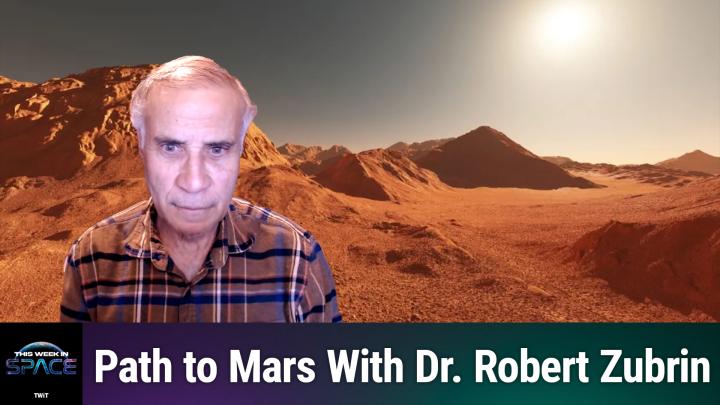
Loading summary
Transcript160 lines
- [00:00]
Rod Pyle
On this episode of this Week of Space, we talk to Dr. Robert Zubrin of the Mars Society about Pathways to Mars. Stay with us.
- [00:10]
Tarek Malik
Podcasts you love from people you Trust. This is TWiT.
- [00:17]
Rod Pyle
This is this Week in Space, episode number 153, recorded on March 21, 2025. Pathways to Mars. Hello and welcome to another episode of this Week in Space, the Pathways to Mars edition. I'm Rod Pyle, editor in chief, Mad Astor magazine. I'm joined by my possibly a Martian pal, Tarek Malik, editor in chief@space.com. hello, Tarek.
- [00:41]
Dr. Robert Zubrin
Hello, Rod. Happy spring. Look, I got my flower shirt on because it's spring. I got my Mars shirt on because it's Mars.
- [00:47]
Rod Pyle
You're just trying to sneak USC colors in there because I have my Stanford flag over the alien in the background. I know how your mind works. But more important than our discussions of alma maters, today we'll be joined by Dr. Robert Zubrin, who's a very well known figure in the space community, founder and current president of the Mars Society, has authored multiple books which are very worth checking out on space exploration, other topics, and whose Mars Direct mission proposal years back helped NASA formulate its own human Mars exploration strategies. So this is going to be a big one today. Before we start, please don't forget to do us a solid and make sure to like, subscribe and other cool podcast things to keep our masters happy and keep us coming to you and in. Thanks for that. Today, in a sharp right turn, I've got Mars Haiku.
- [01:39]
Dr. Robert Zubrin
Mars haiku. I was. That was not on me Bingo card today. Rod, are you ready? He did. By the way, everyone, he didn't clear this with me earlier, so I don't know what's coming at all.
- [01:49]
Rod Pyle
So by design. Okay, you ready?
- [01:51]
Dr. Robert Zubrin
Yes.
- [01:52]
Rod Pyle
Let me see if I can get my haiku voice. Red desert planet, a lonely rover crosses the sand, dreaming of Earth's blue skies.
- [02:02]
Dr. Robert Zubrin
Oh, that's so sweet.
- [02:06]
Rod Pyle
Oh, my groupies.
- [02:08]
Tarek Malik
Wow.
- [02:08]
Rod Pyle
Okay, wow. And now, to spoil the moment, I have a space dad joke.
- [02:12]
Dr. Robert Zubrin
Okay, I'm ready for that one. Leave that one on me.
- [02:14]
Rod Pyle
Yes, Rod, Why don't cell phones work in Martian orbit?
- [02:18]
Dr. Robert Zubrin
I don't know. Why? Why not?
- [02:20]
Rod Pyle
Because it's zero G.
- [02:25]
Dr. Robert Zubrin
I love it. I love it. Better than 1/6 I should tell you. Or one third.
- [02:29]
Rod Pyle
Now, I've heard that some people want to hit us with a Martian death ray. Was joke time of this show. But you can help. Always feel free to send in your best, worst or most indifferent space joke at Twistswit tv because that one was mine. And I'm sure you can do better. All right, let's go to headlines because we interesting headline news.
- [02:48]
Dr. Robert Zubrin
Oh, I missed it.
- [02:50]
Tarek Malik
He's back.
- [02:51]
Rod Pyle
He's back. Crew nine landing. And I know you want to talk about certain aquatic mammals as well.
- [02:58]
Dr. Robert Zubrin
Go stranded no more, right? Or I guess maybe there's.
- [03:04]
Rod Pyle
You put quotes around stranded, right? Because if you're not, I'm going to slap you.
- [03:08]
Dr. Robert Zubrin
No, no, you'll see this one. So all our stories come from Space.com this week, largely because that's where I work and so sometimes that's where I look for things. Except for one. There's one from space, but yeah, Butch and Sunny. Butch Wilmore and Sunny Williams are back on Earth. They landed Tuesday night as we're recording this. So a few days ago, never stuck Starliner astronauts. That's from Robert Pearlman, my colleague over at Collect Space, to make it really clear that they weren't, they weren't really stranded, not since September when they've had their return ride the entire time it's been there. So politics aside, it was just great to see these astronauts return home. They came back on a SpaceX Dragon, the freedom Dragon with Nick Hague and Russian cosmonaut Alexander Gorbunov. And you know, I've seen a lot of SpaceX splashdowns, and this one off the Florida coast in the Gulf was one of the most spectacular splashdowns I've ever seen. It was just absolutely stunning skies. And on the next line there, John, you'll see they had dolphins swimming around their capsule to welcome them back. And just from soup to nuts, it seemed like a picture perfect reentry. In fact, Sunny Williams, Butch Wilmore, there's the dolphins right there. If you're watching the video that were just there was a whole pod of them around during the recovery operations, which was just absolutely stunning and surprising to see. And they were all smiles, they were waving. In fact, later that day that they arrived at Houston and they were walking around, so they seem, even though they were up there for nine months instead of 10 days, to be in pretty good shape. And I really hope, hope NASA learned something about having backup and different vehicles and, you know, interchangeable spacesuits and stuff from this whole lesson to try to avoid a similar issue in the future. So welcome back Butch and Sonny.
- [05:04]
Rod Pyle
So we're glad they came back. Or did they? No, gotta go to it. So, and Anthony tagged me on this. I hadn't seen it, but I looked up both fake, fake crew Recovery for Crew 9 and Fake Dolphins and blah blah blah. So there's a conspiracy theory because isn't there always a conspiracy theory that maybe this wasn't real because the dolphins are too perfect and if you look at the way they move through the water and all that and I can just say, having taken out a large boat many times, dolphins like to come around boats and things of the water because they're curious and they like it and guys, it's real. This was a UK tabloid I looked.
- [05:50]
Dr. Robert Zubrin
At the Daily Mail is from the daily mail line, 26 others and you.
- [05:54]
Rod Pyle
Know, if you've ever spent much time with the Daily Mail between the girly shots and the weirdo stories they have and it isn't quite the weekly world news from back in the day, but you know, it's a tabloid and of course all they're doing is reporting though on a general movement towards yet another conspiracy. Because even though we've been to space, I don't know what 400 times now in total or something, why would we think that this one was real? Because they didn't come home. Maybe they're freeze dried up. I mean it's just makes my head.
- [06:28]
Dr. Robert Zubrin
Hurt every now and then I like have that wake up in a cold sweat. What if it was all a big sham? Like what have I been going to Florida watching launch off this planet? Because I'm there with my eyes, I see them roll the shuttles out, you know, I was, I was there. But what if, what if it was all a big show? A big show and it was like all not real? No. But then again we're all living in a simulation anyway.
- [06:50]
Rod Pyle
I was going to say so my three hours crawling around the inside of Discovery when it was a turnaround at Edwards Air Force Base wasn't a real space shuttle.
- [06:59]
Dr. Robert Zubrin
It was. I'll tell you though, I think that the, I think that the reason this got ticked off is because this one got picked up is because I, I, what I think happened is that either NASA or SpaceX because SpaceX likes to use these really high resolution drones for their launches. I think they got something like that from the recovery ship and the landing video that NASA showed was from that and it looked so much different and so high resolution than anything we've seen before that it, the SpaceX stuff. You mean the SpaceX stuff it went, it was absolutely, that's because I wanted to be there.
- [07:35]
Rod Pyle
I bet they're shooting 8K and I think NASA moved on from 720p but they were using 720p as a standard up until, I don't know, five years ago or something.
- [07:44]
Dr. Robert Zubrin
Yeah, it was, it was. I've never seen just such stunning re entry. The parachutes billowing in the wheat in the. After the splash. It was spectacular. Everyone should go back and watch the video of the landing. It's really great.
- [07:55]
Rod Pyle
When we host our this Week in Space party down on Long beach, we'll take everybody out for a dolphin cruise to prove that it was real. What do you want to do next?
- [08:05]
Dr. Robert Zubrin
Well, let's do. Let's do just. We talked about a landing, let's talk about a launch. This is a brand new one on land line 23. Isar Aerospace is just days away. This is from Space News from the first ever orbital launch from Europe. They are launching their new rocket from Norway of all places, on a mission that they're calling Going Full Spectrum Now Space News as when they wrote this story, they said that the launch could happen as early as March 20, which of course is the day prior to us recording this podcast. I've heard from our spaceflight reporter that right now the target is going to be March 24, which is on a Monday, but it has. They have. They've been developing a new rocket called Spectrum from medium launch to launch into orbit from. Where is this place in Norway? It's the Andoya spaceport in northern Norway. And so there's not gonna be any customer payloads on board. But whenever there's a new rocket, I get really excited because I'm like the spaceflight person and here's one launching from Norway of all places. And I've always been wondering, is Norway going to get it before the one in Scotland? And I guess we're going to get our answer on Monday, whether or not they get off the ground.
- [09:19]
Rod Pyle
Now why would you say Norway of all places? I've been to Norway. I gave talks in Norway. They're very nice, very industrious people who are rapidly moving away from being a petro state to a sustainable energy state.
- [09:31]
Dr. Robert Zubrin
But I'm just saying that it is. I equate Norway with the northern lights, not with a bustling spaceport for rocket launches. Right.
- [09:40]
Rod Pyle
Northern European chauvinist or anti chauvinist?
- [09:42]
Dr. Robert Zubrin
I don't know. I've never. I've never been to Norway.
- [09:45]
Rod Pyle
And actually, you know something interesting about Norway, they almost caused a massive nuclear exchange between Russia and the US Years ago. Do you remember that?
- [09:54]
Dr. Robert Zubrin
No, no, I do.
- [09:55]
Rod Pyle
They launched a sounding rocket. Pretty sure it was Norway and. And somebody in the chain somewhere probably Not a Norwegian, probably. Somebody else screwed up the notification system. So both the US and Russia saw this, this heat bloom coming from the general area of northern Europe and said, oh, weapons launch release on detection. Unfortunately, nothing happened. But that's why, that's why it's good to have people in the chain, because what would I have done? And if people want to know more about that, they can listen to Leo Laporte's Intelligent Machines on this here very network.
- [10:31]
Dr. Robert Zubrin
Ooh, nice opportunity there, which is a.
- [10:35]
Rod Pyle
Good show, by the way. I was listening to it last night. Okay. I wanted to.
- [10:39]
Dr. Robert Zubrin
Oh, I'll just, I'll point out. I'll point out one last thing. This isn't the first orbital launch attempt from Europe that was Virgin orbits launcher. One rocket from Spaceport back in 20. Cornwall. Back in the one that put them.
- [10:52]
Rod Pyle
Out of business, right?
- [10:53]
Dr. Robert Zubrin
Yeah, yeah, the one that failed. So Jeff F. Points it out in his Space News article. So that was back in 2023 that failed. They did not reach orbit. So if they reach orbit with Isar Aerospace, they could get to be the first ones to actually reach orbit. Okay, sorry.
- [11:05]
Rod Pyle
Okay, I'm going to give you the last story, but I just want to make a little editorial comment here. So this one's on me. But this whole Crew 9 faked thing along with. Wasn't the first Falcon Heavy launch faked? Because look at how those two rocket boosters came back together. That can't happen and all that. This is like a firestorm of ignorance in our time and it just drives me nuts. But what I loved about this tabloid article was it quoted an inquiry to Grok, which is Mr. Musk's AI service question. It said dolphins. So Grok's response was dolphins swam near the capsule, a natural occurrence in the Gulf of Mexico, even noted live by NASA's SpaceX staff. Gulf of Mexico, huh?
- [11:54]
Dr. Robert Zubrin
Funny.
- [11:54]
Rod Pyle
Grok. Okay, enough of my editorializing. Wrap us up.
- [11:59]
Dr. Robert Zubrin
You're gonna get us all sued, you know. Anyway, no, let's wrap up with tied.
- [12:05]
Rod Pyle
Up and left in a room somewhere.
- [12:06]
Dr. Robert Zubrin
We've been on a roll with SpaceX, so let's end with SpaceX there, because on line 25 there, SpaceX just set yet another record for spaceflight, I guess not content with launching the most ever things in a year now and using first stage boosters for 25 times when I think they were 10 or 20.
- [12:30]
Rod Pyle
And the best we ever got before was one.
- [12:32]
Dr. Robert Zubrin
I know, right? So now they have flown a booster twice within nine days, which is the shortest turnaround time that they've ever had. And so that's really exciting to see them really pare that down because as you might recall, they really want to amp up the starship reusability eventually and to be able just to gas it up and go within like a day's turnaround. It's why they land at the launch pad and get caught again. So that they can literally plug it back in, refuel it, and get it ready and refurbished within a record amount of time. So they keep hedging this down, plus they keep upping the number of times they can fly it. And I guess they're just going to push these reuse boosters to the limit to see how far and how, how many times they can fly them and how short the turnaround time they can. Because wouldn't it be great if we could all board them like a, like a spaceliner, you know, or an airplane and, and cut that trip around the world or up to the space and in record time.
- [13:32]
Rod Pyle
You forgot that part from my childhood where they cleaned out the ashtrays in the passenger seats before the next flight. That's right. Smell like an ashtray. So I guess the other thing that, that I'm gonna be looking for is the day that they do. I don't think they've done it yet, have they? Three launches in a day, if you count both coastlines. Sorry, all three coastlines.
- [13:54]
Dr. Robert Zubrin
I believe the eastern range has some limits as to how many hours have to be between one launch and the next.
- [14:02]
Rod Pyle
They do. But when I was in Orlando last time, they launched about six hours apart. Two SpaceX launches. One was from, I think 39, and the other was from 41. Or whatever, whichever.
- [14:14]
Tarek Malik
Other.
- [14:15]
Dr. Robert Zubrin
40. 40, yeah. Space Launch 40 at Cape Canaveral. Space Force, basically. I, I think they've done it before, Rod. I want to say that they have or they got close to doing it, you know, so. Yeah, I mean, I don't know. I don't know. And now they'll have four. Right. Because they'll have starship. So that day is coming.
- [14:31]
Rod Pyle
Yeah.
- [14:32]
Dr. Robert Zubrin
When they're going to launch from all four of their pads. Eventually. Maybe not quad anymore. Right. Because I don't think they have that lease on that.
- [14:40]
Rod Pyle
Don't get insider ball on us. Quadrillene Atoll in Pacific, which I've been to.
- [14:47]
Dr. Robert Zubrin
I've never been. I've never been anywhere.
- [14:49]
Rod Pyle
Highly recommend it. Okay, so we will be right back with Dr. Robert Zubrin. So go nowhere and stick with us.
- [14:59]
Dr. Robert Zubrin
Hey, prime members, Are you tired of ADS interfering with your Favorite Podcasts Good news With Amazon Music you have access to the largest catalog of ad free.
- [15:08]
Tarek Malik
Top podcasts included with your prime membership.
- [15:11]
Dr. Robert Zubrin
To start listening, download the Amazon Music.
- [15:13]
Tarek Malik
App for free or go to Amazon.com.
- [15:17]
Dr. Robert Zubrin
Adfreepodcasts that's Amazon.com adfreepodcast to catch up on the latest episodes without the ads.
- [15:25]
Unknown
Ready to level up? Jumbo Casino is your playbook to fun. It's free to play with no purchase necessary. Enjoy hundreds of casino style games like bingo, slots and solitaire anytime anywhere with fresh releases every week. Whether you're at home or on the go. Let Shumba Casino bring the excitement to you. Plus get free daily login bonuses and a free welcome bonus. Join now for your chance to redeem some serious prizes. Play Chumba Casino today. No purchase necessary. VGW Group void where prohibited by law 18/ TNC supply.
- [15:57]
Rod Pyle
Welcome back. We are here today much to our delight with Dr. Robert Zubrin. Now this is a long resume so I'm just going to abbreviate a few things, but at the very least, you are a nuclear and aeronautical engineer with a doctorate in I believe, aeronautical engineering. Correct?
- [16:15]
Tarek Malik
Nuclear.
- [16:16]
Rod Pyle
Nuclear, that's harder. And a founder president of the Mars Society and the founder of Pioneer Astronautics and a holder of multiple patents. How many patents do you have now?
- [16:27]
Tarek Malik
About one.
- [16:29]
Dr. Robert Zubrin
I don't even have one.
- [16:30]
Rod Pyle
I was going to say having applied for one, I find that very impressive. So thank you for coming on the show today. We're going to be talking about Mars, but as always at this point in the show, Tarek has his favorite question to ask.
- [16:43]
Dr. Robert Zubrin
Yes. Well thank you so much for coming on. You know, my big question that I like to start off with is kind of your first, I guess, introduction to space, I guess also to Mars maybe. What made that stand out? Like was it something that really grabbed you when you were like a kid or or is it something that you found later in life through your professional studies or, or even work there?
- [17:09]
Tarek Malik
No, it's from when I was a kid. I was 5 when Sputnik flew and it's the first major world event that I can remember in terms of hap happening in my lifetime and experiencing it and while to the adults. But it may have been terrifying because it meant the Soviets could hit us. To me as a five year old kid who was already reading science fiction, it was absolutely exhilarating because what it meant was that all these stories about space travel were going to be true. Okay. And so I wanted to be part of that. So you know I'm much. Well, I'm about 10 years younger than Homer Hickam. He was a teenager when Sputnik happened, and people know the story of how it impacted him and his friends and. But even down to age 5, it had that impact. And. And my parents encouraged my interest. My father bought me a telescope. I did drawings of the moon through the eyepiece, and I read all the science I could. And it rapidly became clear to me, however, that of all the planets that were within reach, Mars was the place that was by far the most interesting. It was the place where we might discover life, and it was the place that we might settle. And so, really, from a very young age, I became interested in space and wanting to get involved in it.
- [18:33]
Dr. Robert Zubrin
Oh, that's great. That's great.
- [18:36]
Rod Pyle
I remember sometime around 1968, I surprisingly, actually, given the lack of rigor in my process, won the science fair that year and got a book certificate to Romans Books in Pasadena and ran in there and got von Braun's Mars project, because I thought, this is going to be the epic read of my life, only to discover it was mostly numbers and formulae descriptions of a mission. Do you remember the first time you picked that up?
- [19:06]
Tarek Malik
I actually didn't pick up the Mars project until, like, the 80s. I. I found it in a used bookstore in Seattle. But, so, But I mean, I was certainly aware of the general scheme of the von Braun with the wheel space station and space shuttles and building things at the space station to send giant spaceships off to Mars with small landing crafts and so forth. And I actually never thought that much of it. That is, I. I never thought highly of it, actually. And when I first got involved with space professionally, I set myself the task of coming up with a mission architecture that I considered far more practical. So.
- [20:04]
Rod Pyle
Right. You mentioned Mars Direct, which is one of your trademark things. And if you could just give us some background on that and what. What made it what it is today.
- [20:15]
Tarek Malik
Sure. In 1989, on the 20th anniversary of the moon landing, the first President Bush got up on the steps of the Air and Space Museum, flanked by Armstrong and Algen and Collins, the Apollo 11 crew, and said, you know, this is the 20th anniversary of the moon landing. That was great. That's what America's all about. And therefore, I, as president, they're committing us to go back to the moon and on to Mars and this time to stay. It's great stuff. And so in response, NASA went off and conducted a gigantic study which took 90 days to do. And so the report was called the 90 Day Report on how this might be accomplished. And what they went with was a variation on the von Braun mission architecture, which was build a giant space station to use the giant, construct gigantic interplanetary spaceships and also lunar bases and so forth, and then sell this thing off to Mars. And they set a 30 year timeline on this and a price tag of $400 billion, which immediately tanked the program in Congress from sticker shock. And I and a number of other engineers at the Martin Marietta Company, which is where I was working at that time, went to the management, we said, look, you know, this doesn't make any sense. They're designing the most complex mission they possibly can in order to make everyone's pet program mission critical. And it's killing the program. And unless someone comes up with a more sensible plan, there will be no initiative. And management agreed. And by the way, that was very brave of them because the conventional wisdom in the aerospace industry is agree with whatever NASA is saying, no matter how stupid, because they don't want to be contradicted. But the Martin management at that time said you're, you're right. And so they pulled together a team of 12 people from the whole huge Martin company, which was like a hundred thousand people, so it was 12 of us, I was one of them and it was called the scenario development team. And we were charged with coming up with an alternative plan. And because there a lot of creative spirits in this group, we could not agree with each other. And we actually came up with three different plans. And management once again thinking very clearly, did not try to reconcile all three plans into one to come up with a company line because the plans had very different philosophies behind them. They really couldn't be reconciled. And they just said, okay, we're going to float all three and we'll see which one catches fire. And the one of them that did catch fire was the one that was developed by me and another engineer named David Baker, which was the Mars Direct plan. And this was a complete break with the von Braun architecture. It was didn't need any space station, any on orbit assembly, any advanced propulsion. It was direct flight to Mars with two launches of a heavy lift vehicle comparable in capability to a Saturn V. The first would send to Mars an Earth return vehicle with no one in it. And it would then make its return propellant, methane, oxygen out of CO2 and water which is available on Mars. And then once that is done, then you shoot the astronauts out to Mars in a Hab module that flies one way to Mars. And you land it near the Earth Return Vehicle. And they use it as their house on Mars for a year and a half until the launch window opens up to go back to Earth. And then you get in the Earth Return Vehicle and you fly home. And each time you do this, you add another habitat to the base. And before you know it, you have the beginning of the first human settlement on a new world. And there was frankly nothing in this that was beyond the technology of the 1990s looked at in 1990, which is when we first set this thing forth. This was humans to Mars by 1999. And, you know, we were invited to go brief this at a variety of NASA centers. And to our surprise, actually, but very pleasant surprise, we got a very powerful reception, including at places like Marshall Space Flight center, which we have the most conservative center in NASA. They liked it precisely because this was radically conservative. They had already seen all these briefings from other people showing in giant solar electric spacecraft with kilometer square solar panels doing this and that. And they said, that's science fiction. This was Apollo times two. And in 1990, there were still a lot of people in NASA who actually had done Apollo, okay? And they said, this is something that we could do. And so it caught fire. But then it became controversial because the space station people were very upset because they felt we were de. Justifying their program. At that time, the justification being advanced for the space space station was that it was a necessary platform to build interplanetary spaceships on, and we weren't using it. So there was a big pushback. And what started as a blitzkrieg turned into trench warfare, but nevertheless, it made an impression. And then a couple of years later, Mike Griffin became associate administrator for exploration at NASA and he liked the plan. And he had me go back to Johnson Space center and say, I want you to brief them on this again and I'm going to tell them they have to listen. And they did. And so they then went and composed their own version of Mars Direct, and it was altered somewhat. Instead of two ships, it was three ships. And instead of a crew of four, it was a crew of six. And they had more of different kinds of equipment, but fundamentally it was the same philosophy. Direct flight to Mars, no on orbit assembly, no advanced propulsion, use of in situ resources, starting on the very first mission. And then the same team that costed out the 90 day report at $400 billion, costed out this new architecture at 55 billion. And then, you know, and I was there saying, well, you know, you don't need this and you don't need that. And we could get it down to 30 billion. And Carl Sagan actually intervened and he said, look Bob, it doesn't matter whether it's 50 billion or 30 billion. It matters that it's tens of billions, not hundreds of billions. Okay? And so I said, okay, yeah, okay, sure. So, and, and, and, and there, and there it was and that by Carl Sagan. And you can actually see the result of that study. That was NASA Devant Design Reference mission number three. And it's the best.
- [27:20]
Rod Pyle
Second Robert, because I do want to ask you more about the DRMs that we have to go to a real break now. We'll hold on.
- [27:28]
Unknown
Big shout out to you for making it through the hectic holiday season this new year. Get clean quality pregnancy nutrient support off your to do list, including Ritual's best selling essential prenatal multivitamin designed with 12 traceable key ingredients to support a healthy pregnancy. With big changes coming up, take the small steps now and start today with 30% off a three month supply@ritual.com podcast. These statements have not been evaluated by the Food and Drug Administration. This product is not intended to diagnose, treat, cure or prevent any disease. GEICO makes it easy to get affordable renters insurance in as little as 90 seconds. That way you have more energy for harder things like the laundry. Why is it so difficult to fold clothes? They just end up wrinkly anyway or on the floor in a pile that just sits there taunting you. But with renter's insurance through geico, at least you know that those clothes and the other things you love are covered. Get more with geico.
- [28:28]
Rod Pyle
So just before the break you were talking about the Design Reference missions. Can you tell us a little bit, if you could just back up a step, what the point of the Design Reference missions and Design Reference architecture is and how they adopted parts of your plan?
- [28:42]
Tarek Malik
Well, the Design Reference missions was attempts by NASA to design a Mars mission so as to see what technologies are actually needed to do it. And there were elements of DRM3 that in my opinion were not necessary because you always have this effect when you have large NASA teams that there are people there who want to make sure their pet technology is included in the script. And so there was some of that happening in Design Reference 3 Design Reference Mission 3, but much less of it than what happened in the other DRMs and the. And this is really important because this is the whole problem in NASA. If you want to know, this is the problem in Artemis right now. Okay. There's two ways NASA does things. In one case, they have a purpose driven approach in which they spend money to do things in. In other cases, they have a vendor driven approach in which they do things in order to spend money. And the vendor can be an aerospace company, it can be a NASA center, it can be a technology program, it can be a congressional district. Okay, but in other words, are you running your company to please your vendors or do you simply make minimum use of your vendors to get from them what you need to do, what you want to do do? Okay, and the problem with the Artemis program, you see, is that unlike Apollo, which was mission driven, where they said we got to get to the moon by 1969, what's the simplest way to do it? Okay, here's the plan. Lunar Orbit Rendezvous. We can do it with a Saturn 5, a command module and a LEM, and we'll design this whole thing as one piece and it all will fit together and it's going to go okay. That's how Apollo was designed, okay? They, they didn't do Apollo in order to give business to the LEM people, okay? Right. Now Artemis, on the other hand, is, for instance, has five primary flight elements, which is the sls, the Orion capsule, the Starship, the National team lander, and the Gateway. And these are five separate projects which each have been funded for their own reasons, for their own terms. And they're trying to create a mission architecture that somebody will give everybody a part in the play, okay? So it's like trying to rewrite macbeth to give the ballerina and the football star a role, okay, in the school play. And, and, and that's what you get. So it, and it becomes extremely inefficient. That is, the Artemis, unlike Apollo, is a vendor driven program, okay? And if you look around NASA at various programs, well, unfortunately it is the human space flight program which has deviated most in the direction of being vendor driven rather than purpose driven. Whereas the Science Directorate, for example, they didn't land Spirit and Opportunity on Mars in order to give money to the airbag people, okay? You know, the big airbag consortium was. No, they just for that mission, they felt the airbags was the right landing system and so they gave it to them. And if they thought they could do it cheaper with something else, they would have chose something else.
- [32:07]
Dr. Robert Zubrin
Well, I'm glad you brought this up because you actually lay a lot of, of of those points out in your recent piece in, in the new Atlas there. It's line 38 there, John too, where you Talk about how this, this Mars dream is back, but also that there's issues which a lot of them you just kind of laid out right there about NASA's, NASA's role and, and like vendors versus like the purpose and whatnot. And I'm, I'm curious where you see the, the push, the drive or the opportunity for, for, for the human exploration of Mars now given that as you point out, both in that piece and as I've written a story about it too@space.com that it came up in the inauguration speech itself. It came up again in the, I think his joint session speech or the President Trump that it's very much back at the forefront. So is this a sweet spot now to really crystallize that effort so that, you know, we don't look back at 1999 and think, man, we could have been there, Rod. We could have been there and watched the Matrix on the surface of the moon in, in 1999. That is so frustrating. So I mean, is, is this like a, a hot, a hot button? Like this is like it's like now or never to, in order to get.
- [33:29]
Tarek Malik
I know about now or never, but yeah, we've had particular chances to get people on Mars. If Apollo had been followed through, he could have had people on Mars by 1981.
- [33:38]
Dr. Robert Zubrin
81.
- [33:39]
Tarek Malik
If. If. Yeah, that's what NASA's plan was at that time. They just. Nixon administration canceled the Apollo follow on. Okay, if 1989, 1990, if the Bush administration had forced NASA to take a mission driven approach, a purpose driven approach to Mars instead of a vendor driven approach, which fundamentally was the difference between Mars direct and the 90 day report. They designed the most complex mission they possibly could in order to give everybody apart. We designed the simplest mission we could in order to get to Mars as fast as we could. Could. And, and now we have this opportunity now. Okay, look, you obviously have the. Elon Musk is a Mars advocate and is an extremely powerful position right now. He has the President's ear without question. And we've heard that Musk has said I want to get people on Mars. Okay, so there's an opportunity now to get a humans to Mars program going. However, there is also. This is fraught with peril because the Trump administration and, and Musk are far more polarizing than say John F. Kennedy was. And Apollo was the nation's program. It wasn't a Kennedy hobby horse. Okay, Or I mean there's no comparable figure to, to Musk in 1961, but it wasn't, you know, Von Braun's hobby horse or Walt Disney's hobby horse or whatever. I mean, it was the nation. Okay? And the so and, and especially since, yeah, they are so polarizing. This has got to be made a national program, not a must deal. Okay? So, so I, I disagree strongly with those who say, well, look at what a mess NASA made of Artemis. Let's just give the Mars program to SpaceX. That would absolutely kill it because the conflict of interest would be over the.
- [35:42]
Dr. Robert Zubrin
Top and, and administrations are fleeting. Right. You got, he's got four years and then we see a flip flop in, in, in, in space policy. They're going to say, let's go to Venus next and then what do we got? Right.
- [35:55]
Tarek Malik
Right now? Furthermore, the intellectual basis of the program has to be broader than Musk's personal desire to have a city on Mars to preserve the light of consciousness after the Earth is destroyed. Okay, I, I don't think that idea has a lot of buy in. I, I think it actually puts a kind of a skunk essence on, on the program, actually. The, the, you know, it's like white flight or something. I mean, or, or the Mask of the Red Death where you have people hiding in a castle while everybody else dies at the plate. I don't think people want to go to Mars for that reason. I don't think they should want to go to Mars for reason. We don't go to Mars out of despair. We go to Mars out of hope. And we go to Mars for the science, for the challenge and for the future. Now the most people right now who are thinking about Mars are thinking about the science now. So we got to make this program something that will be shown to be of enormous benefit to science. Now, I do not believe it is possible for them to land a starship on Mars in the 2026 opportunity. I don't think that's realistic at all.
- [37:01]
Dr. Robert Zubrin
Oh, we should point out, yeah, Elon has said he wants to launch to Mars in 2026 with uncrewed, and then 2028 with crude. So. Sorry, I didn't mean to interrupt. People know that if they weren't following.
- [37:11]
Tarek Malik
That, I would double the time spans on both of those. I would say that if we do this right, if we are aggressive and if a lot of things are done and we're a bit lucky, we can have a uncrewed starship on Mars in 2028 and a crewed expedition to Mars in 2033. Okay. Eight years from now. Eight years is the same amount of time from Kennedy's speech to Apollo 11 moon landing. And we are closer today to being able to send humans to Mars than they were to being able to send people to the moon. Okay, so this is doable, although it, it's a much more aggressive schedule than NASA in recent years has been used to to embracing. Okay. The, the. But nevertheless, this could be done. However, however.
- [37:57]
Dr. Robert Zubrin
Say, don't get a start on an sls, right, Rod.
- [38:00]
Tarek Malik
Right. Do not. So the thing is this though. We should land a starship on Mars or try to land a starship on Mars in the 2028 opportunity, but we don't land there a Tesla robot mannequin. Okay. You know, I mean, it's all fun to send a Tesla car on interplanetary trajectory to show that the Falcon Heavy could do great stuff. Okay. But if we're sending something and landing it on Mars, it's got to be a bona fide science expedition. And if you can land starship on Mars with anything like the payload that Musk claims for it must claims 100 tons. Let's give them 30. Okay. That still be good. Okay. Because the Curiosity landing system is all these by Perseverance can land one. We land 30 tons on Mars. We can land 15 rovers and 15 full size helicopters. Not little ones like Ingenuity, but big ones that are carrying five or seven instruments each. And so we got rovers going out in all directions, helicopters going out in all directions, bringing back samples. We have a well instrumented lab in the starship lander itself. And so you got what I call a robotic expedition to Mars that in terms of its capability as a science mission is two orders of magnitude more effective than anything that, you know, JPL and company have been able to do up to date.
- [39:28]
Dr. Robert Zubrin
So now that's crazy.
- [39:30]
Tarek Malik
Well, no, it can be done.
- [39:31]
Dr. Robert Zubrin
In other words, I mean, crazy. That'd be awesome to see. I mean they would probably put some optimus robots walking off the thing too.
- [39:39]
Tarek Malik
We can have that too. But what we really have to have is a powerful science expedition so that we can show the science community the gains they can get out of not only this introduction of heavy lift that we now have here starship, but heavy landing capability. Okay. That Mars science can be improved by two orders of magnitude doing this. And now you get buy in from the science community and the university based science community. Tilts left. Okay, so now you can get Democrat support for this. Because if this is just about Musk landing his mannequin on Mars, as soon as the political fortunes of war shift, this program is dead. Okay. And by the way, this cannot be done. Musk's Mars architecture, which is a derivative of the Mars Direct mission plan, involves making your return propellant methane, oxygen on Mars out of Martian water and CO2 that requires power on the surface. And if you do it with a return vehicle as large as the starship, which is six times as large as the Earth Return vehicle that I designed for Mars direct, instead of 100 kilowatts of power, you need 600 kilowatts of power, means you got to have a nuclear reactor on the surface, surface of Mars. And that can certainly be done. We had nuclear power in this country before we had color television, okay? But it's a new development and it involves controlled materials, which means it's not going to happen at SpaceX. It needs government involvement. And so this has got to be a public private partnership. We got to bring the country together around this. And preferably I'd like to bring the free world around this, but at least we got to bring, make this bipartisan within the United States. And so by making it about science rather than Musk's fascination with the, you know, the Isaac Asimov foundation series where they put the colony on the planet Terminus so that when the Galactic Empire falls, I mean, Musk actually calls his Mars colony Terminus, you know, okay, the, the, the, the. So we get, we get out of Asimov and we get into something that the nation can buy into and in fact the world scientific community can buy into and we show everyone really a great thing that we're doing. And yes, we also, as Apollo did, astonish the world with what free people can do and re establish American leadership in space and on Earth.
- [42:11]
Rod Pyle
Okay, let's take a quick break again and we'll be right back with our next question, which is one that I hold dear. So stand by.
- [42:20]
Dr. Robert Zubrin
Hey prime members, are you tired of ads interfering with your favorite podcasts?
- [42:25]
Unknown
Good news.
- [42:26]
Dr. Robert Zubrin
With Amazon Music you have access to the largest catalog of ad free top.
- [42:30]
Tarek Malik
Podcasts included with your prime membership.
- [42:32]
Dr. Robert Zubrin
To start listening, download the Amazon Music.
- [42:35]
Tarek Malik
App for free or go to Amazon.com.
- [42:39]
Dr. Robert Zubrin
Adfreepodcasts that's Amazon.com adfreepodcast to catch up on the latest episodes without the ads.
- [42:46]
Unknown
Ready to level up? Shumba Casino is your playbook to fun. It's free to play with no purchase necessary. Enjoy hundreds of casino style games like bingo, slots and solitaire anytime anywhere. With fresh releases every week. Whether you're at home or on the go. Let Shumba Casino bring the excitement to you. Plus get free daily login Bonuses and a free welcome bonus. Join now for your chance to redeem some serious prizes. Play Chumba Casino today. No PURCHASE necessary. VGW GROUP VOID we're prohibited by law 18/ DNC supply so I just want.
- [43:18]
Rod Pyle
To change trajectory for a moment because I think you were kind of leading up to this point possibly. There's been a lot of discussion about, you know, when you talk about building any kind of facility on Mars, whether it's a landing pad, a small habitat or a city, you're talking about introducing humans, human processes, possibly human bacteria and all the things that go with a base, whether it be nuclear reactors, waste, whatever it might be. There is a not insubstantial group of people that feel that we shouldn't, quote, make the same mistakes we made on Earth, unquote, quote. And they've been called the rocks have rights crowd versus the, you know, Mars is probably a sterile dead planet. And I'm simplifying here, obviously. And something that human beings need to utilize to their best advantage. And I'm pretty certain you have an opinion on that.
- [44:15]
Tarek Malik
Yeah, I do. These people are not arguing ethics, they're arguing aesthetics and they're adopting an anti human aesthetic. Okay, you know, what a beautiful planet there would be if not all these ugly life forms were here, you know. You know, it's sort of like the aristocratic aesthetic. Oh, what a beautiful country this would be if not for all these ugly little shacks. This is an anti human point of view. It is not valid. Human values need to be based around human flourishing. Okay? And look, okay, they're taking a anti interference argument and they're extrapolating it into a domain where it does not work, okay? What I mean by that is, okay, when I was a kid, Christopher Columbus was a hero, okay? We had Columbus State, okay, that, you know, to the world he gave a world that that's what it. On the side of the monument to Christopher Columbus in Columbus Circle. And now in the more recent period, the people have questioned that. They said, well, you know, Columbus is pretty brutally treated. The Indians in the Caribbean, pretty bad. And look what he led to. The destruction of the Native American cultures in North America and the exterminate or near extermination of the bisons and the redwood trees and all this, okay, Now I will concede the point that in the colonization of America, for example, by Europeans, that there was a lot of value that was destroyed. There were the Native American cultures, the bisons, the redwood trees, the carrier pigeons, all that kind of stuff. On the other hand, something was Created, okay? A nation of 330 million people committed to liberty, which has invented steamboats and telegraphs and light bulbs and airplanes and nuclear power and the Internet. Okay, that. So something was destroyed. Something was greater. I happen to believe that more was created than war was destroyed. But I will admit that something was destroyed. However, if there had been nothing here when Columbus landed except an absolutely barren desert with no Native Americans, no bison, no redwood trees, no grass, nothing but some bacteria in the groundwater border, and from that we built this continental nation committed to liberty, which made all these inventions and set up all these universities and used bookstores and stuff. Okay? Would there be people picketing Columbus Day parades today? I don't think so. Okay, so this is. And, and furthermore, look, everyone, and I'm certainly with the Sierra Club on this one, if anybody proposed that we take Earth as it is now and turn it into a planet that looks like Mars, that this would be crazy. This would be a crime against life and everything. Okay, sure, I'm with you on that. And it would be an act of environmental devastation and civilizational devastation. Well, if that is true, if we take something that looks like Mars and turn it into something that looks like Earth. Earth, okay, that has got to be a tremendously constructive act, okay? If humans can make the environment worse, humans can make an environment better. Okay, you, you can't just say that whatever we do, it's wrong, okay? That's simply anti human bigotry. What? Whatever you do, any change is. Makes things worse. Okay, no, that, that has, has no validity. Now, as far as the planetary protection is concerned, there is one argument that they bring up which it's not insane, which the previous argument was, okay, but it's simply wrong, okay? Which is that it will hurt Mars science if humans go to Mars because we will let loose bacteria and then you'll never know if the microbes you found on Mars were native or if they were introduced by you. Okay, now this is a rational discussion. Russian. But they are mistaken, okay? Because look, if you go to Mars and you find microbes that are different either fundamentally or even superficially than Earth microbes, then you know you didn't bring them, okay? Now if you find microbes that are identical to Earth microbes, if they are native, they will have created residues, biomarkers, fossils. This is how we know there was life on Earth before there were people, okay? We, because we. They left behind records. This is how if you fly to Paris, you know, the French were there before you got there, because there's all these buildings Here.
- [49:12]
Dr. Robert Zubrin
Okay.
- [49:16]
Tarek Malik
But on the other hand, if you go there and you find E. Coli on Mars and no evidence of any past, no biomarkers, then it means you brought them. It's that simple. So, and now. So that's how you know the difference. But furthermore, if you have people on Mars, you can do vastly more science on Mars than if you don't. I mean, what's the planet we know the most about? It's the Earth. Why? Because we're here. And we'd know a lot less about Earth if we weren't here.
- [49:46]
Dr. Robert Zubrin
I think Steve Squires once told me that if they, he had had like a human, human geologist on Mars, that they would accomplish basically in a week what the whole mission accomplished in like 10 years, because they could have just, they could just do it all themselves or something like that. So I totally see the relevance of like, that having someone on the ground.
- [50:07]
Tarek Malik
Yeah. Now I do want to bring something up though, which is important because I want to come back to the, the Trump musk Mars opportunity. And you know, I, I've talked about something that needs to be done as part of it, and now I need to talk about something that must not done if it's to succeed, which is the massive cuts planned for the NASA space science program by the Trump administration. They're talking about a 50 cut, okay? So this means losing Hubble, this means losing Curiosity, maybe even perseverance. It may even involve losing Web only a few years after it was launched. And if you come on and you say, look, what are you worried about Hubble and Web for? We're giving you the planet Mars, okay? You know, you're going to get a Bronx cheer from the science community on this. And you know, and, and, and as you may know, in 2005, when Administrator O'Keefe tried to abandon Hubble and it, you know, passed it off saying, well, hey, I'm doing the Moon and Mars. What are you worried about Hubble for? You know, the Mars Society and I led the assault saying, no way, okay? No way, way. We are not giving up the science we have for science we might have. We are not, you know, and furthermore, look, if you're afraid to send a human crew to repair Hubble, there's no way you're going to the moon or Mars. So just don't give us that stuff.
- [51:31]
Dr. Robert Zubrin
And it came up again also with spirit and opportunity. I mean, they were in deep extended missions when budget cuts were proposed for those ones, and they ended up going like, I think another, like many, many more years. Beyond that, when that reverse that decision, like, didn't go through.
- [51:47]
Tarek Malik
Absolutely. And, and it would have been incredibly wasteful to curtail them a decade prior to their final demise. And, and, and Look, I mean, O'Keeffe wanted to terminate Hubble in 2005. And here we are, it is 2025 and it is still working 20 years. And the, the, and, and it's a better telescope, by the way, than it was in its first 15 years because they, the repair mission also upgraded it and now Webb's going to be harder to upgrade. But certainly we don't want to turn off working spacecraft. We don't want to turn off the Voyager probes that are proceeding into interstellar space or the New Horizons probe, you know, or Juno or any of this. Okay. These things are expensive to have created and, and, but they're not that expensive to run and to lose them, to lose the exoplanet telescope. So, you know, no, and there's, there'd be nothing more certain to put the mark of Cain on this program to than to have it used as a cover for wrecking NASA's existing space science program. So if you care about space science or if you just care about this program, you got to insist that these cuts be absolutely reversed.
- [53:06]
Rod Pyle
Reversed or at least moderated to the point that they might be a few surgical cuts. I mean, it always kind of dings my heart. And you know, the Voyager probes are a very emotional conversation for a lot of people because they've been there so long, we've anthropomorphized them and so forth. But I'm sure you've been to Voyager Mission Control. I mean, it's a couple of banquet tables, a couple of old sun workstations and a handful of people. It's not expensive to run those things. And they're still doing great science out there with what they have left. So the idea of cutting that, or dare I say some of the, some of the Earth science work that NASA does.
- [53:42]
Dr. Robert Zubrin
Well, I mean, which.
- [53:43]
Rod Pyle
They're not a big fate. There are many that aren't fans of the administration. Something else. Tarek, hold that thought. We got to go to our last break and we'll be right back. Standby.
- [53:52]
Unknown
Hey there, Ritual here to give a big shout out to you for making it through the hectic holiday season. The magic of those family moments that was, yes, you. And now there's new milestones to Prep for in 2025 this new year. Check clean quality pregnancy nutrient support off your to do list with Ritual We've done the research to create science backed pregnancy support like our prenatal multivitamin, natalcholine and fertility support. All designed to be taken alongside each other. But don't just take our word for it. They're also third party tested for microbes and heavy metals and Clean Label project certified. So whether you're trying, thinking about trying or already there, we don't have to tell you that prioritizing yourself can be the hardest part. That's why we're helping you get started today with 30% off a three month supply for a limited time@ritual.com podcast. These statements have not been evaluated by the Food and Drug Administration. This product is not intended to diagnose, treat, cure or prevent any disease. Geico's motorcycle expertise gives me the coverage I need. Like 24, seven claims, I'm on cloud nine.
- [55:00]
Dr. Robert Zubrin
Clouds are wholly unable to support the weight of an adult human.
- [55:02]
Unknown
What's happening?
- [55:02]
Rod Pyle
Furthermore, clouds are not numbered. Even if you procured a jetpack and searched, you'd find no cloud numbered nine.
- [55:06]
Dr. Robert Zubrin
However, at that altitude, you'd likely befriend.
- [55:08]
Unknown
A flock of migrating snow geese.
- [55:09]
Rod Pyle
Geese who'd encourage you to leave your 24.7geico motorcycle claims insurance behind as they would take you in and even share their dinner of crickets and clovers with you.
- [55:15]
Tarek Malik
GEICO assumes no liability for any indigestion.
- [55:17]
Dr. Robert Zubrin
That may occur from a clover cricket dinner. GEICO expertise for your motorcycle. No, yeah, I was just going to say, I mean we were talking about all the things that are on the table right now and you and I discussed on the show, Rod, just before that and Robert just mentioned it, James Webb still in the very active mission phase, facing 20% cuts potential, you know, and which is unheard of, you know, not even in an extended phase for, for that Hubble facing the same amount right now there to Chandra on the chopping block, you know, if, if, if that actually holds out. So, so we'll have to see how that all evolves over time, you know, because you see that trade, you know, it's, it's not, it's not, it's not the best.
- [56:01]
Tarek Malik
So no, it's, it's foolish and, and frankly it's criminal. It's a crime against science and a crime against civilization in a way, way because you know, Hubble and Webb are not just world class scientific instruments, they are cultural symbols. They are what the gothic cathedrals were to medieval civilization, which was a symbol of their highest ideals in, in their case Christianity, in our case, they search for Truth through science. And for us to abandon that would be like, like blowing up our own gothic cathedrals. And it means complete abandonment of our own ideals. And this is something we, we absolutely cannot afford.
- [56:55]
Rod Pyle
So kind of pursuant to this, I would like to get your point of view on the question of US China competition. You know, we're were facing down the idea that they may get back to the moon before, or get to the moon with humans before we return to the moon with humans. And there is a camp that says this absolutely cannot happen because it's a geopolitical disaster for the US in terms of non aligned nations and all that. And then there's the camp that says, look, we've already been there, it doesn't matter that much. And then there's a third camp that says, finally skip the moon and go to Mars. So my, my real question, I guess is how do you feel about the idea of competition versus possible coopetition or even outright cooperation in the big picture with China and other powers?
- [57:41]
Tarek Malik
Well, I think that we should cooperate with our true allies, which is the rest of the free world. And unfortunately, the Trump administration seems to have some difficulty in distinguishing between people like Canada and people like Russia, you know, because like one of them wants to kill us and the other one has been running an early warning system for us for the past 80 years. You know, so there's a difference there. But we, I, I'd like to cooperate with the other parts of the free world. Canada, Europe, Australia, Japan, South Korea, from other countries, Israel, okay. On this, I think we should compete with China and to the extent they're still players, Russia. It can be an Olympic spirited competition for honors in terms of who can do the most to advance human knowledge of the solar system. And then with respect though to the particular issue of the moon that you brought up, I believe that if we go to Mars with the correct mission architecture, we can use the same hardware to do the moon. And that is starship plus star boat. Boat.
- [58:58]
Dr. Robert Zubrin
I was gonna ask that. Yeah.
- [59:00]
Tarek Malik
Okay. And I discussed this in some length in this article in the New Atlantis that you showed the, the listeners. Okay, the, the starship is a great reusable launch vehicle and it could be a great tanker to put into lunar orbit or Mars orbit, but it is actually defective to use as an ascent vehicle from either of those places because it is so heavy. Heavy. Okay. This is the weakness in the SpaceX mission architecture. One size fits all. And what is needed here to make this work right is something that's a lot like a Starship, but about a factor of 5 or 10 smaller. So I call it the star boat. And so, you know, I mentioned that you. If you want to get a starship to take off of Mars and fly back to earth, you need 600 kilowatts. If you used a star boat to take off Mars and go back to earth, you need 100 kilowatts. If you use the star boat to take off of Mars and go to Mars orbit. To rendezvous with a starship, you need 50 kilowatts. Okay? And the. To make the propellant. And similarly, if you put a starship in low lunar orbit and then you go back and forth to the surface with the starship starboard, which is a methane oxygen vehicle, it would use the same propellant as starship. Okay? So the starship could be a tanker for Starboat. And you go up and down with that. We could get five times as many missions for a given amount of launch activity as you can with the current architecture. You know, instead of each mission requiring, you know, four, 14, excuse me, Starship launches, you could do it with two or three and the. And do much more competent exploration of the moon. Now, I believe the system should be designed for Mars. And then you say it's designed for Mars, it can also do the moon. So therefore, the star boat would have thermal protection, which it does not need on the moon, of course, unless it wanted to actually take off the moon and fly all the way home to Earth, which is what it might do on certain occasions. But the idea is, look, in Apollo, we didn't need a space station to do Apollo, but we did use the Saturn 5 to launch the Skylab space station after we went to the moon. Interesting. So there were all these people who are running around saying, you can't go to the moon without a space station. And we said, phooey, we certainly can. And we did. But nevertheless, the space station has certain value in its own terms, okay? And by designing the Apollo hardware, we were able to do the moon and also, incidentally, do Mars. Okay. Excuse me. Also incidentally, do the space station station. Okay? And so similarly, you know, you might buy a car for certain purposes, but you can also, you know, sleep in it overnight by the side of the highway if you don't want to check into a motel. That's not why you bought the car, but it's something that it'll. You can do with it. And the, the similarly, we designed this mission architecture. Starship plus Starbucks boat gives you Mars. Starship plus Starboat gives you the moon. And we don't need the Gateway and we don't need SOS and we don't need Orion and the national lander. I believe that contract should be turned into a Starboat contract. Okay? It was ridiculous for NASA to get, okay, national team got that contract because they had sufficient pull that when the human landing system was given to starship, they yelled and they screamed, demanded they get a contract too, or they would hate NASA. And the. And so they said, fine, here's your contract. Have a good day. And NASA didn't even have the guts to say to the national team, we'll give you your, your $3 billion, but you got to use methane oxygen, so we could use you as a landing craft refueled by starship in orbit. They allowed it to be an incompatible lander, which is crazy. Okay? Since they were already funding starship, you know, it's, it's like someone going to the Air Force and say, got a new fighter plane for you, but it uses cleaning as fuel in the Air Force, instead of saying, no, we use jet fuel, saying, sure, do whatever fuel you like. So this is what you do. Okay? You, you, you, that, that contract needs to be rewritten into being a Starboat contract. And it has to be made compatible with starship in terms of the connectivities and everything to allow it to be refueled off a starship. And then with those two mission elements, you got the moon and you got Mars. Mars.
- [63:54]
Dr. Robert Zubrin
Yeah, yeah, that was gonna be my next question. I was gonna ask all about starboat and the 21st century case for Mars, but you did it.
- [64:01]
Rod Pyle
Well, you already got me there. You nailed it. So this is your, your wrap up comment. If you've got something you want to tell it to the mountain here we are all.
- [64:09]
Tarek Malik
Yes, well, a couple things. As people know, I'm the head of the Mars Society, and the Mars Society is as, as about to launch a campaign in alliance with the Planetary Society to stop these cuts in the NASA space science program. This, the science program needs to be defended in its own terms. It is the jewel in the crown of NASA and frankly, it's one of the jewels in the crown of America. Okay? That, that's what it is. It's, it's one of those things. America is controversial in many ways, but one thing we do that is universally admired is our space exploration. And it's by far the most effective part of NASA because it's the part of NASA that is purpose driven as opposed to vendor driven. Okay? So we want to save that for its own purpose. But also if it is allowed to be cut, it will, it will put the mark of Cain on the Mars initiative that Musk is trying to start. He may not see that. He is apparently a bit drugged with power right now. But believe me, this is so we, we have to make this program one that says this is not something that was used to destroy science. This is something that is going to be used to greatly increase our science beyond anything we had ever thought we could do. And so there's that. And so we want people to support that campaign. And people could start supporting that campaign right now by calling or writing their congressman and say, say no to the cuts in NASA science budget. Okay, that's, it's crazy. It should not be done. Okay, we paid for Hubble, we paid for Webb. Destroying them is an act of vandalism against America's property and against America's reputation and against science. And then secondly, the Mars Society is having its next conference at the University of Southern California, which is in Los Angeles. It's going to be October 9th through 11th. And we actually have, our call for papers is posted on the Mars Society website, mar. Society. Org right now. And so you can register for the conference and if you have an idea you want to talk with about to the conference. And we are taking abstracts on everything from near term ideas for, you know, life detection experiments to be landed on Mars or instruments, instruments to how to do a human Mars mission to how to have a human Mars city on Mars or you know, you know, in, in what the form of government should be or how to terraform Mars, everything from the near term to the furthest out. We're interested in hearing about you. You write an abstract of 300 words and if you're accepted, you get a chance to talk to the convention and, and, and possibly have be published in proceedings as well. And finally, one last thing is if you haven't read it, of course the book that explains most of my ideas on how to do missions to Mars is my book the Case for Mars. But I also have a new book out this year called the New World on Mars, which is my ideas on colonizing Mars. That is because we soon will be able to go to Mars in significant numbers. And the big question is going to be what are we going to create once we're there? And that's what I address in my book, the New World on Mars, which is on Amazon.
- [67:37]
Rod Pyle
Excellent. And if it's like the rest of your books, it's very worth reading. So please check it out. I want to thank everybody, and especially you, Robert, for joining us today for episode 153 that we like to call Pathways to Mars. Robert, where's the best place besides the Mars Society site to keep up with your activities and what you're working on?
- [67:57]
Tarek Malik
Well, for me, it's. It's just, I mean, well, the Mars Society site, but I do have a page on Facebook and Twitter and blue skies and so forth.
- [68:06]
Rod Pyle
Great, Tarek, where can we find you kerbling into space these days?
- [68:10]
Dr. Robert Zubrin
Oh, I can never get my Kerbal rockets off the ground. Rod, you know this and you're saying it just to hurt me so. But no, you can find me@space.com as always, on the X and. And Blue sky at Tarik J. Malik. And if you like video games, as Rod's eyes roll back of his head, you can find me on YouTube at Space Tron Place.
- [68:32]
Rod Pyle
So. And of course you can find me at pilebooks.com or@astromagazine.com or hiding with a handful of others behind the curtain at the national spacesociety.org yes.org and remember, you can always drop us a line at TwistWit TV. That's twice TV. We welcome your comments, suggestions and ideas. I ask you to try and be nice, but it's not mandatory because we answer every single one. New episodes publish every Friday on your favorite podcaster, so make sure to subscribe. Tell your friends to give us your reviews. As long as it's five of anything, you can choose your review icon and we'll be happy with it. Thank you very much everybody. You can follow the twittech podcast network at Twit on Twitter and on Facebook and Twit TV on Instagram. We will see you next week.
- [69:19]
Dr. Robert Zubrin
Hey, focus up. That is what I said to Hands On Tech when we looked at the relaunch.
- [69:25]
Tarek Malik
It is time for us to focus.
- [69:27]
Dr. Robert Zubrin
On one one topic at a time.
- [69:30]
Tarek Malik
And make sure we're answering that question.
- [69:32]
Dr. Robert Zubrin
I am answering that question as thoroughly as possible.
- [69:35]
Tarek Malik
If you are a member of Club Twit, you can watch the video version of this show completely ad free. Of course, listen to the audio version ad free.
- [69:43]
Dr. Robert Zubrin
If you're not a member, the show.
- [69:45]
Tarek Malik
Will still be available to you in both ways. You can watch the video on YouTube with ads, or you can watch the audio as you always have.
- [69:54]
Dr. Robert Zubrin
I mean, listen to the audio as you always have in our feeds.
- [69:58]
Tarek Malik
In any case, you gotta tune in to Hands on Tech because I guarantee.
- [70:03]
Dr. Robert Zubrin
There'S going to be a question you're going to want to have the answer to.
- [70:07]
Tarek Malik
And from time to time I also.
- [70:09]
Dr. Robert Zubrin
Review a gadget, a gizmo or something.
- [70:12]
Tarek Malik
Of the sort you gotta check out Hands on tech and I can't wait.
- [70:16]
Dr. Robert Zubrin
To get your question.
- [70:28]
Unknown
Hey there Ritual here to give a big shout out to you for making it through the hectic holiday season. The magic of those family moments that was you. And now there's new milestones to Prep for in 2025 this new year. Check Clean Quality Pregnancy Nutrient Support off your to do list with Rachel We've done the research to create science backed pregnancy support like our prenatal multivitamin, natalcholine and fertility support. All designed to be taken alongside each other. But don't just take our word for it. They're also third party tested for microbes and heavy metals and clean label projects certified. So whether you're trying, thinking about trying, or already there, we don't have to tell you that prioritizing yourself can be the hardest part. That's why we're helping you get started today with 30% off a three month supply for a limited time time@ritual.com podcast. These statements have not been evaluated by the Food and Drug Administration. This product is not intended to diagnose, treat, cure or prevent any disease.