← All TWiT.tv Shows (Audio)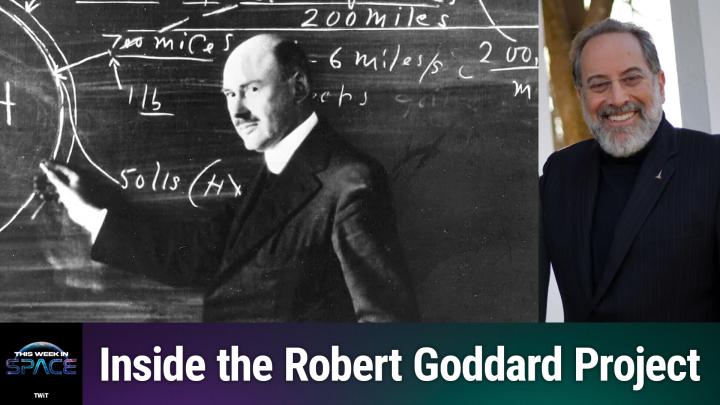
All TWiT.tv Shows (Audio)
This Week in Space 160: The Amazing Dr. Goddard
00:57:52
With Charles Slatkin
Loading summary
Transcript141 lines
- [00:00]
Rod Pyle
Coming up on this Week in Space, a Soviet Venus probe is crashing back to Earth. NASA's Roman Space Telescope is coming together. But is it going to fly? And Charles Slatkin, the primo cheerleader of Robert Goddard, is going to tell us why the father of American rocketry is so important then, now and in the future. So tune in podcasts you love from people you trust.
- [00:26]
Tarek Malik
This is trit. This is this Week in space, episode number one 60, recorded on May 9, 2025. The amazing Dr. Goddard. Hello and welcome to yet another episode of this Week in space, the amazing Dr. Goddard edition. I'm Rod Pyle, editor chief of Ad Aster magazine. I'm joined, as always by my fellow non mathematician, Tarek Malik, who is the editor in chief at the one, the only, the Amazing Space Dot com. Hi partner.
- [00:59]
Rod Pyle
I'm doing well. How are you doing? Oh, wait, you didn't ask me how I'm doing.
- [01:03]
Tarek Malik
But now that you said it, I'm so glad to hear that. I'm okay. I'm okay. And I'm going to be more okay in a few minutes when we're joined by Charles Slatkin. That's right, who this is still really kind of gets me. He bought Robert Goddard's house in Worcester, Massachusetts, because it was otherwise going to probably be torn down or mistreated in some way. And he's preserving it, turning it into a museum, and has sort of just taken on the mission of continuing to kindle the interest in Robert Goddard in the history of rocketry, the father of rocketry in the United States, and a larger mission to inspire and support STEM education in the United States, which is always a good thing. So we're going to be with him in just a few minutes and that's really going to be fun. And he's a heck of a guy. Before we start, don't forget, put it in your head to do us a solid. Make sure to like subscribe and do the other nice podcast things wherever you happen to listen to this podcast because we're counting on you to keep the warm electrons flowing your way. And now in complete contravention of keeping the electrons flowing your way because this will result in probably a cooler moment. A space joke from Paul Woolley.
- [02:25]
Rod Pyle
Paul yes, Rod?
- [02:28]
Tarek Malik
What do astronauts do immediately after landing on Mars?
- [02:31]
Rod Pyle
I don't know. What do they do?
- [02:33]
Tarek Malik
They post a selfie and wait eight minutes for the likes to arrive.
- [02:42]
Rod Pyle
If they're like me, they're going to be waiting a long time, sadly. So I don't get a lot of likes.
- [02:46]
Tarek Malik
I mean, my, my Waterloo is even if I do this on Earth, I'll be waiting a long time. But that's.
- [02:52]
Rod Pyle
Wait, have we talked about that joke before? Because I, you know, it felt familiar. It would take 16 minutes because it's the right. It's the eight minutes to get there.
- [03:01]
Tarek Malik
No, it's between 5ish and 23, depending on where Mars is in its orbit. Remember the orbits. See, this is why you and I are writers. So, you know, Mars and Earth are on similar tracks in the race, but Earth catches up and then departs and Mars slings along by.
- [03:21]
Rod Pyle
So, yeah, I guess. Is that my seven minutes of terror waiting for the likes to come in from Mars. Right? Is that what that is?
- [03:26]
Tarek Malik
No, that's entry time. We're gonna have to have a talk and a spanking after this is over. But you know, I've heard that some people want to send us to Mars when it's joke time in this show, and won't that be disappointing? But you can help. Send us your best words for most integrated space joke at twistswit tv. Now, from. From the darkness of our space joke to the bright moment of headlines with Tarik, we're going to talk about today's incoming Soviet Venus probe. Wow. If you're going to have space junk getting ready to reenter, isn't it comforting to know that it's already been hardened and designed to re. Enter through Venus's thicker atmosphere? Oh, joy.
- [04:13]
Rod Pyle
I want to just pause for a minute and say that I was getting ready to do the bop to the, to the jingle for headline news and we skipped totally over it. So, you know, I thought we were gonna go do like the little headline news. So everyone, headline news. Oh, I missed it now. So. All right, all right. Yeah, we're starting off with a bang or a, or a headline news. I did it. I did it. No, we are starting off with it with a bang or at least a brilliant blaze of glory because a, a failed Soviet Venus lander is coming back home. Cosmos 42 is coming back. Actually, as, as we're recording this, it is like hours away from burning up. We've been following this basically since, I guess since it became apparent that it was going to reenter around around this month as we're recording it. And today is May 9th, and as of right now, as of 3:00pm, which is what time it is right now.
- [05:17]
Tarek Malik
That was recording Eastern time.
- [05:18]
Rod Pyle
Eastern time. Yeah, Eastern time. The European Space Agency thinks that the Cosmos 42 Venus probe is going to burn up. I Think over the ocean, it looks like it might be over the Pacific off the coast of, no, the Indian Ocean off the coast of Australia. If I'm looking at this map right, very early in the morning on the weekend. So its days are numbered. This is a Spacecraft launched in 1972 by the Soviet Union to land on, on the surface of Venus. It didn't actually reach Venus, obviously. It suffered an anomaly, got stuck in a very long elliptical orbit and it's been there for like 50 decades. Orbit goes. Yeah, what goes up must come down. And that orbit has decayed around Earth to the point that it is now falling back and reentering. And what you kind of teed up at the beginning is the fact that unlike every other spacecraft that has burned up a satellite that has burned up in the atmosphere, this one is actually designed to land. It was designed to land in the thick atmosphere of Venus, which means that there could be a good amount of, of this nearly. It's about, it's about a half ton. Just over a half ton. 1190 pounds, 495 kilograms could survive the, the reentry itself. So, you know, we want, we do want to know where it lands. And, you know, ESA's tracking it. Aerospace Corporation is checking it. You can bet that the Space Command is tracking it as well to see where it is and where it might come down.
- [06:54]
Tarek Malik
That would make a big dent in my roof.
- [06:56]
Rod Pyle
It would, it would. That's a plot of six feet under too. I think that the main star in that store, and that's that show was killed by the toilet from mirror. Because when it, when it, when it reentered, I think that's, I think that's how that, that show opened up. Yeah. And then she became like an agent of, of death or whatever.
- [07:13]
Tarek Malik
That's a whole, brings a whole new meaning to potty training. All right, moving on. A key portion of NASA's Nancy Roman Space Telescope clears thermal vacuum test. But will it fly?
- [07:26]
Rod Pyle
That's the question. Right. You know, we talked a little bit about the Nancy Grace Roman Space Telescope recently because it was on the list of potential cancellations from the skinny budget that, that the Trump administration recently released. But the hardware, as we said in that episode, is actually built. In fact, it's almost complete, which is what NASA's announcement this week revealed. I mean, basically, the space telescope is the outer barrel and its deployable aperture cover. And the test, they all passed a deploy test in a thermal chamber at NASA's Goddard Space Flight Center. Goddard. Very Poe for our episode today. Yes, Sir. And so it really sets up the stage for NASA to attach the final flight solar array, sunshields and the outer barrel that they call it to put on top of. So they're going to start that final assembly in Goddard this, this month. So, you know, excuse me, I just.
- [08:24]
Tarek Malik
Have to say, can you imagine what it's like to be starting final assembly on something that as far as you could tell is going to be canceled and probably torn apart and scavenged?
- [08:34]
Rod Pyle
I hope, I hope that's not going to be the case though. I don't, I find it really difficult to believe that this mission is going to be canceled just because like the administration feels like they, this, they have tried to do this before, right? They tried to do it with James Webb. No, James Webb is doing groundbreaking stuff in space. Yeah, they tried to cancel it. Right. Even though it was mostly built because it was so far over budget and yet it survived. They tried to do it with what survived?
- [09:02]
Tarek Malik
Viper.
- [09:03]
Rod Pyle
No, no, no, James Webb. James Webb. They tried to do it with AMS as well because it was, it was, it was too expensive and they didn't want to have the extra space shuttle mission to do it and they were able to get that through and get more support for it and get the mission funded through Congress. I'm sure they're going to find a way to preserve a space telescope that NASA got for free. You know the, we talked to John Grunswald on our recent episode. You know, they got the optics assembly for free from the NRO and built a world class science tool around it. I think they're going to find a way. I think Jared Isaacman is going to get confirmed, come in and say we need, we need this science so.
- [09:40]
Tarek Malik
Well, so does confirmation. Jared Isaacman. Yeah. Well, I hope that works. There's a lot to say about that. But, but we have to move on because we have a fascinating good Scott Kelly story called Good Nights. And I leave it to you, partner.
- [09:59]
Rod Pyle
Yeah, this one comes from by the way, the Venus story obviously came from the Space.com team that's tracking it. Nancy Grace Roman, that's from NASA. This one is from my friend Robert Perlman at Collect Space who basically found out that astronaut Scott Kelly, famous half of the Kelly twin astronauts and the one year mission astronaut has teamed up with Goodnight, the diaper company to try to help destigmatize Bedwetting. It's a campaign that launched on National Astronaut day which was May 8. May 7. May 6. May 5. May 5 is what it was. That's right. It's the Alan Shepard launch day. And you know, basically it's a campaign with him and like a young child reminding people that while we all wore diapers when we were little, astronauts wear diapers right now in space on spacewalks when they launch all of that thing. And so that it's nothing to be embarrassed about. And it's something that, that is, you know, it is endorsed by space exploration and whatnot. And so, so it's just, it's a, it's a kind of a fun tongue in cheek way I think for, for an astronauts to try to at least give kids something more to identify with and take something that could be embarrassing and say, hey man, it's happened to astronauts in space. Alan Shepard famously had to use the restroom on his first flight in 1961 and now they all wear diapers in their spacesuits.
- [11:36]
Tarek Malik
Well, I'm embracing an impressive moment of maturity here because I got nothing more to say about that except that we'll be back in just a few moments with Charles Sletkin to talk about Dr. Robert Goddard. So stay with us.
- [11:52]
Rod Pyle
If you love Smash Burgers, the crispy edges, bold beefy flavor, you need to try Omaha steaks. All new smash burgers. They're pre smashed, made with 100% extra aged beef and grill ready. No mess, no griddle. I tossed a few on the grill last weekend. Straight from freezer to bun in just five minutes. The sear perfect, the flavor rich, juicy and seriously next level. Way better than anything I've had from the store. Plus I grabbed the Built for the grill pack@omahasteaks.com smash and scored 16 smash burgers free. With high quality meats always on hand, I'm already eyeing my next order. Maybe there's steak burgers or that killer bacon wrapped filet. Family owned since 1917, Omaha Steaks brings five generations of premium quality delivered right to your door. Smash burger lovers, this is your moment. Get ready to smash expectations with new Omaha Steak smash burgers. Visit OmahaSteaks.com smash and order the built for the grill pack with 16 free smash burgers. That's 16 free Omaha Steaks smash burgers at OmahaSteaks.com smash see site for details. Missions to Mars, driverless cars, AI chatbots. Feels like we're already living in the future. Well, Robinhood is built for the future of trading. Robinhood's intuitive design makes trading seamless. Spot opportunities and take control of your trades. With tools like screeners, simulated returns and strategy builder on Robinhood, traders have access to hundreds of popular stocks and ETFs 24 hours a day, five days a week so you can keep up with today's fast paced markets. You can now even trade stocks and crypto all in one place with the new desktop platform Robinhood Legend. The future of trading is fast, powerful and precise. Experience it now on Robinhood Investing is risky. Robinhood Financial LLC member SIPC is a registered broker dealer. Trading during extended hours involves additional risks. Cryptocurrency services are offered through an account with Robinhood Crypto LLC. NMLS ID 1702840 Robinhood Crypto is licensed to engage in virtual currency business activity by the New York State Department of Financial Services.
- [14:16]
Charles Slatkin
Ryan Reynolds here from Mint Mobile. I don't know if you knew this, but anyone can get the same Premium Wireless for $15 a month plan that I've been enjoying.
- [14:24]
Rod Pyle
It's not just for celebrities. So do like I did and have.
- [14:27]
Charles Slatkin
One of your assistant's assistants switch you.
- [14:29]
Rod Pyle
To Mint Mobile today. I'm told it's super easy to do@mintmobile.com Switch upfront payment of $45 for 3 month plan equivalent to $15 per month.
- [14:39]
Paul Woolley
Required intro rate first 3 months only.
- [14:41]
Rod Pyle
Then full price plan options available, taxes and fees extra.
- [14:44]
Tarek Malik
See full terms@mintmobile.com and we are back with Charles Slatkin. And Charles, I'm not quite sure how to introduce you because you have a panoply of projects going. The Wonder Project, the Goddard Centennial, the museum. How would you like to be introduced? I'll let you do your own today.
- [15:05]
Charles Slatkin
Gee, hard good question. I love space. Space made me a positive, hopeful person. And I've been working most recently to try to make sure that my kids and my grandkids and kids everywhere have that same feeling of hope, hopefulness, that anything is possible. So basically trying to do a number of initiatives that really promote that, that feeling and the wonder and awe of space.
- [15:36]
Tarek Malik
Wow, Tarek, he's a space optimist. What happened to you?
- [15:39]
Rod Pyle
What?
- [15:41]
Tarek Malik
Well, I should have blamed myself, but I don't want to take the spears and arrows all the time. So. Okay, well that's wonderful. So Tarek, of course you have a question.
- [15:50]
Rod Pyle
I do, I do, Charles. I ask everyone a very similar question. And I'm very curious about own journey too because you know, Rod and I were bit by the space bug when we were little space reporters way back when. And I'm curious when you know that that passion that you just explained about being interested in space being driven by, it really took hold is it something that, that was kindled when, when you were young, like, like a lot of folks, like, like Rod and I. Or is it something that you discovered later on either in, you know, university or professional life? Take us through that journey, your journey to space.
- [16:29]
Charles Slatkin
Very early, I think I'm five years old and my father was telling me about Sputnik. So 1957 and two years later we're watching the wonderful World of Disney. And Verna von Braun is showing his vision of how we're going to get to the moon in 69, sorry, in 10 years. And it seemed, it seemed impossible. And yet 10 years later we landed on the moon. So certainly watching the space race was very inspiring for a young kid and going to the great World's Fairs. I grew up in Brooklyn, New York, before it was cool, and got to take a bus to the New York World's Fair every weekend. And it was a time when the world was really in tough shape. We were doing duck and cover in elementary school. There were race riots, terrible poverty. Our leaders are being assassinated. And yet the World's Fairs promoted the, this vision of a future enabled by technology, basically colonies on the moon and farms underneath the planets. And it really started me on a journey of just feeling like technology and all these brilliant people that enable technology could make the world a better place.
- [17:47]
Tarek Malik
So I just want to touch back. And frequent listeners forgive me because I've talked about this before, but, but I was born in 56, so I saw the Disney stuff, you know, in second or third run, but I recall and have since confirmed there was the animated version and then there was that really fascinating live action version of, you know, man conquer space, the live action version, if you recall. And this was the same one they ran at Disneyland for the Journey to the Moon ride. I love the fact that you've got, you know, all these military, six military guys or four, whatever it was in the rocket and they're all wearing helmets, the great big video visors on the top and aerials out the side and all that. And the microphone they pick up is about the, the size of a ham hock when they're talking to mission control. But they're coming around the backside of the moon, they're firing flares. Do you remember this? They're firing flares down so they can illuminate the surface and the final flare before they come around the limb of the moon and could see the Earth again to communicate the flares flickering out and you see the outlines of a rectilinear wall on the moon. So clearly somebody's been down there building something. And they cut back to the two spacemen, and they look at each other and go. There's just this kind of silent nod that they come back around the moon. They're like, hey, Mission Control, nothing to report. I always thought that was a brilliant little bit by. I mean, only Disney, right? Anyway, yeah, that was an incredible introduction. And you and I came around about the same time. And what a time to be alive. Two reasons. One, we got to see a lot of amazing things happen. But two, back before the mid-60s, we really didn't know how awful space was. We still thought that a lot of the planets might be kind of Earth. Like, you know, Mars, you might be able to breathe with just an oxygen tank, like Robinson Cross Crusoe on Mars. Venus, it's probably hot and swampy, but you could still walk around in your waiter boots and how hard can it be? And then suddenly, the mid-60s, we start setting up those interplanetary robots, and it turns out, oh, these places are horrible. And it's really hard. And so we've been fighting that battle of reality ever since. Do you remember the shift from the kind solar system to the angry one?
- [20:06]
Charles Slatkin
Not really. It doesn't. That doesn't. That doesn't click.
- [20:10]
Rod Pyle
I think it's like a pessimistic view of the solar system there. It's like, oh, welcome to this big podcast about space, by the way. Space is awful.
- [20:19]
Tarek Malik
Okay, whenever you're done. No, just talking about specifically, I think it was Mariner four. You know, that moment when the first pictures came back, we expected maybe there was this wave of darkening that we thought might be a forest or at least algae or something. Ooh, canals would be cool. And we got craters and bleakness. Anyway, enough of my darkness. Let's talk about. Before we get into your ventures, could you give us a primer for people who may not know who Robert Goddard was and why he's so important?
- [20:51]
Charles Slatkin
So Robert Goddard was born in 1882 and fired the world's first liquid propulsion rocket in 1926. Somehow, 43 years later, we walked on the moon. And if. If that doesn't make you believe that anything's possible, certainly nothing does. And yet his story is full of all these wonderful, wonderful, interesting connections with Buzz Aldrin, with Carl Sagan, with Charles Lindbergh and Harry Guggenheim. And he was mocked by folks like the New York Times when he wrote his first article. Before he even attempted to build a liquid propulsion rocket, the New York Times wrote this scathing article that Dr. Goddard, despite his chair of physics, doesn't know the most basic fundamentals of science, that you can't have propulsion in a vacuum. And two days before they landed on the moon, they printed this tiny little retraction in the New York Times, finally. But what impressed me the most, and one thing I'm trying to share with especially young people these days is how amazingly persistent he was and how he persevered despite mostly failing and being mocked by folks like the New York Times. And those characteristics that Yankee ingenuity and that perseverance never got to see. The moon landing his wife Esther did, fortunately, really are just these wonderful characteristics that I think should so many of our modern Goddard's really do demonstrate almost every day. But he was this fabulous early scientist. He had a vision of going to Mars and beyond when he was 17 years old and a famous cherry tree story. If we have time, we'll talk about that. But what I've learned over the years, I'm not really a historian person, I'm more of a futurist, is he was incredible visionary. He was writing about ion propulsion, collecting solar energy in space and beaming it down to Earth to power terrestrial cities, an early prototype of what he called the vacuum crane, which is the modern personification of the hyperloop. And he even predicted the technology that Spinlaunch is using to attempt to get projectiles into low Earth orbit, et cetera. So he was just so far ahead of his time. And yet what I think drives myself and many of my, my colleagues, the forward is so many people outside of the aerospace community don't know who he is. And we all know who Thomas Edison and every kid knows who Thomas Edison, Graham Bell is, but we really don't know who this guy Robert Goddard is. And I, I travel the country and ask young people and old people everywhere, and I'm shocked how 95% of the folks don't know the father of modern rocketry.
- [23:49]
Tarek Malik
And I think that may be increasing in the last five or 10 years. And of course, famously also a pioneer of liquid rocket propulsion in the US we're going to run to a quick break. We'll be right back. So go nowhere that it's over to you, Tark.
- [24:06]
Rod Pyle
Race the rudders, race the sails. Race the sails. Captain, an unidentified ship is approaching. Over. Roger, wait. Is that an enterprise sales solution? Reach sales professionals, not professional sailors. With LinkedIn ads, you can target the right people by industry, job title and more. We'll even give you a $100 credit on your next campaign. Get started today at LinkedIn.com results, terms and conditions apply.
- [24:35]
Paul Woolley
Let's be honest, buying cannabis shouldn't be complicated, sketchy or low quality. That's why I want to tell you about mood.com that's mood.com Mood ships federally legal cannabis straight to your door. No medical card, no hassle. And here's the kicker. The quality is better than anything you'll find at your local dispensary. Yeah, I said it. Whether you're into edibles, concentrates, flour or just looking to explore, you'll find it all at Mood. And it's not just the variety that makes them stand out. Every product is sourced from small American owned family farms that care deeply about what they grow. It's cannabis you can trust, delivered discreetly and ready to elevate your mood. And because you're a listener, you get 20% off your first order. Just head to mood.com that's M-O-Ood.com to get started.
- [25:26]
Rod Pyle
Great. Well, thank you, Charles, for that quick primer about Dr. Robert Goddard. I should point out, just for folks who aren't aware, Robert, it's Robert H. Goddard. H is for hutchings and you mentioned he was born in 1882. He died in 19 just at the, after the, at the end of the, of World War II where we saw liquid fuel rockets used as weapons I guess for the first time and kick off the, that space race that came after there. And I'm curious about your journey to we asked about your journey to space, but your journey to Goddard in particular. Of course he is that historic launch was in March 16, 1926. We're going to talk a little bit about why that date's important to you in a bit too out of Auburn, Massachusetts. And it sounds like you had like a bit of a gravitation towards him that seems somewhat natural. Can you kind of give us an idea of how your interest in space led you to Goddard very personally?
- [26:26]
Charles Slatkin
Sure, sure. Well, I think I was 11 years old and bought a book, Giants of Invention, at our local school book fair. And there's Robert Goddard featured on the COVID And I read a little bit about him, but I didn't really, really didn't think he was going to be so involved in my life. But accidentally I ended up attending the same university that Goddard went to for his PhD and taught at. So I attended Clark University in 1969 and ultimately was a professor there for a short time before I formed my multimedia production company. But the year I arrived at Clark was the year that Buzz Aldrin came and cut the ribbon at the new library that was dedicated to Robert Goddard. And in the audience was Buzz Aldrin's father, Eugene Aldrin Sr. Who was a student and a friend of Goddard's, no less. And Buzz goes off to the moon two months later, and he takes a miniature version of Goddard's autobiography with him and wants to leave it on the moon. And NASA says, no, thank you. But he flies back to Worcester when he returns and brings it to Esther Goddard and signs it and she donates it to Clark. And we hope to display that in the upcoming centennial. Oh, wow. So what happened with this house though, which wasn't, really wasn't part of my radar. I had started a non profit a few years ago. I've sort of been known as a wow factor technologist. And I worked on some World's Fair projects and some presidential libraries. And I was basically looking to apply my talents to see what I could do to help inspire more kids. I was devastated to learn the United States was 38th in the world in graduating science and engineering majors. And I just felt like we weren't doing enough to really wow kids. You know, kids are naturally curious, but you need that spark to take them to the next, to the next level. So I started this nonprofit and along the way I'm really designing what I would consider immersive environments that would wow me as an 11 year old and hopefully wow young and old. And I read that Goddard's house was basically on the market and about to be destroyed by a developer. So that kind of got me motivated, very depressed initially. And 50 years before, when actually Goddard's house was on the market again because Esther had died, the house had been willed to Clark University and wpi. And for whatever reason, they basically declined the sale and auctioned off all the contents of the house and sold the house to a neighbor. So it was in private hands till 1980. 1982. I'm sorry, it was sold in 82 and it was private hands until 2021. So I knew it seemed like this is like third time's a charm. And if I didn't step in and find a way to buy it, it was going to be destroyed. And it would just be such a devastating loss to posterity to not have the father of the space age, so to speak, to have his house destroyed by development and building ranch houses on the vacant property. So that's sort of been consuming my life for a while. And after Kitty Hawk, I read about their centennial in 2003 and started to do the math about two years ago and realized, oh my God, Goddard centennial is coming up in 2026 and that's sort of been keeping me up at night for the last couple years in terms of how can we leverage that event for the greater good and especially to inspire this younger generation.
- [30:00]
Tarek Malik
So before we get to that, I'd like to talk about the house a little bit more. So what's the current status? You bought it, I assume through the non profit and you're restoring part of it a museum and then the other parts of residence or how are you, how are you working that?
- [30:15]
Charles Slatkin
Yeah, we actually bought it initially as an individual. I didn't tell my wife for two weeks because it had to happen in 24 hours. I had an astronaut tell me recently. I'm the bravest man he knows and I am still married. God bless Marcia. The house has just been recently, just this year moved into the nonprofit. We've restored the first floor and we've been approved for zoning for the city of Worcester as a museum, library and resource center. The second floor we're currently renovating and restoring. And our hope is to basically have a science physics student, maybe engineering student from either Clark or WPI live in the house rent free to come up with some sort of a scholarship, call it our Goddard Fellows program and basically have them be sort of semi caretakers for the house, shovel the walks, give, give tours or visits when I'm not available or my staff isn't available. And we're, we're making some progress, but the house is, the house is looking pretty good these days. I think people are very surprised when they arrive there, how, how, how elegant it looks. And it's come a long way from the, the disrepair it had fallen into over the years.
- [31:38]
Tarek Malik
And how much of his, his, his library or you know, rocket parts, I mean, how much of his stuff do you actually have in the house?
- [31:47]
Charles Slatkin
Did you have very little in the house? Just his, you know, certainly his notebooks, a few pieces of ephemera. The good news is when, when the house was sold, Esther had spent probably the last 15 years of her life organizing all of his papers and notebooks and ephemera and scientific, scientific experimentation gear and making sure it went to the right places. So a lot of it's at Clark University Special Collections, Worcester Polytech and the Smithsonian. So the, they really have protected and preserved a lot of, a lot of Goddard's archives correctly. And we have sort of imitations or digital facsimiles of that.
- [32:32]
Tarek Malik
All right. We're going to go to one more break and we'll be right back. So go nowhere.
- [32:36]
Paul Woolley
Okay, let's be honest. Buying cannabis shouldn't be complicated, sketchy or low quality. That's why I want to tell you about Mood.com that's M-O-Ood.com Mood ships federally legal cannabis straight to your door. No medical card, no hassle. And here's the kicker. The quality is better than anything you'll find at your local dispensary. Yeah, I said it. Whether you're into edibles, concentrates, flour, or just looking to explore, you'll find it all at Mood. And it's not just the variety that makes them stand out. Every product is sourced from small American owned family farms that care deeply about what they grow. It's cannabis you can trust. Delivered discreetly and ready to elevate your mood. And because you're a listener, you get 20% off your first order. Just head to mood.com that's M-O-Ood.com to get started.
- [33:30]
Rod Pyle
Great. Charles, you know where we last left off, you were talking about just, you know, your, your discovery of, and desire to protect Goddard's house. And, and that all I know that you, you, I guess you live in the house as well. No. Correct.
- [33:46]
Charles Slatkin
Nope.
- [33:46]
Rod Pyle
Oh, you do not. All right, all right. I was, I was trying to figure out when Rod and I were talking about it, how old a house might be. And of course the big question I always get, I always have for those guys. My house is almost 100 years old, as if there are ghosts in it. And I'm just wondering if, if, like what shape? Because you said the house is in good shape. Like what, what shape is it in now? Like, what are your hopes for? What kind of a house is it? I suppose to kind of paint a picture to the folks that are listening.
- [34:15]
Charles Slatkin
Yeah, sure. It's a 200 year old Victorian. It'll actually be 200 years old this, this coming year.
- [34:22]
Rod Pyle
Oh, wow.
- [34:23]
Charles Slatkin
And it's, it's a Victorian. It sits on an acre of land and which is sort of unusual for the, the neighborhood it's in. It used to, you know, it used to be actually a, you know, certainly a larger, a larger property. The bones are pretty good. You know, it's got lead paint, you know, on the outside. So we've been actually just applied for a grant today for lead paint remediation and, and repainting and we're, we're certainly beginning to get a lot of support in terms of historic preservation. For there's some knob and tube wiring on one of the floors, there's little plumbing issues, et cetera. But in general the boat, the bones are pretty good. And we've spent a lot of time in the last couple of years really trying to make it presentable, but also make it safe and more accessible.
- [35:08]
Rod Pyle
If it's 200 years, like as of next year. Right. Or this year, that means that, you know, because the centennial that we're going to be talking about for Robert Goddard, that it was 100 years old when, when he launched the rocket. I mean that is crazy in terms of like history for a house for someone that that kind of contributed so much to science there.
- [35:29]
Charles Slatkin
Yeah, it's a multi generational house. So actually there's a photograph that we can show at some point of young Goddard's like 8 years old sitting on the porch with his mother, grandmother and great mother grandmother probably in 1882. 1892. So yeah, something early 1890s, et cetera. So the house has been in the Goddard family forever, which is.
- [35:50]
Rod Pyle
Wow.
- [35:50]
Charles Slatkin
Which is great. It would be such a. I'm so, so glad we didn't lose it.
- [35:55]
Tarek Malik
So. So when I come to visit pertaining to, to Tark's ghost comment, I want to walk through the threshold and yell, you can't make a rocket work in space because there's nothing to push against. See if I get any feedback. So you said there is.
- [36:12]
Rod Pyle
I wonder if that is that a challenge for the interns, for the student volunteers?
- [36:15]
Tarek Malik
No.
- [36:16]
Rod Pyle
Spend the night in the Goddard house. Right.
- [36:18]
Tarek Malik
Oh, there you go. So you said there wasn't a lot in there, which is, you know, always frustrating if you're a de facto museum curator. Do you think there's any chance is, are there holdings at the university where he taught or anything else you might get? And second part of that question, do you have any plans to be build a reproduction of his first rocket out front?
- [36:42]
Charles Slatkin
We actually have, we have a reproduction hanging from the ceiling. We have a wonderful gentleman did a, did a full scale replica of Goddard's first rocket. He called all of his rockets Nell, but this is the original, the original Nell. And there's a great, great story behind that at some point. But we actually have this wonderful gentleman built us a full scale replica. And mostly it's out of metal. He's a metal fabricator. But he did use some 3D printing technology which I'm sure Goddard would have endorsed to do some of the more complicated parts. And he's also the gentleman that's been fabricating all the sculptures for the beginning of the National Space Trail initiative that's in front of the house at the moment.
- [37:24]
Rod Pyle
You know, I wanted to ask a little bit about that, that history though, because it is, I mean it's easy for us to look back. I'm wearing a space shuttle shirt right now about taking like liquid fuel rockets for granted. But this model that you had built, you know, for the house, I saw a version of it at the Smithsonian actually just last month I took my daughter there to Udvar Hazy for the first time. And there is the life size, you know, the rocket. And it strikes me how such a primitive thing was so revolutionary at the time. And I'm curious what it was about the concept that you've been able to pick up that really set Goddard ahead, you know, like why, why he would seize on liquid fuel as opposed to, I guess, the, the solid fuels that were considered at the time and, and then just keep looking further ahead.
- [38:21]
Charles Slatkin
Well, he spent years working with solid propellants. Matter of fact, he, as a student at Worcester Polytech, he blew up the chem lab. That's right to the point they moved him to a standalone magnetics research bunker that had three foot walls so he wouldn't kill anyone. But he tried for years and failed to really achieve what he was looking to do with conventional solid fuel rockets. So he was really looking for alternatives. And at that point he was interested in hydrogen gas, but it wasn't as easily available in a commercial means. But there was liquid oxygen available through a local supplier. So he basically used liquid oxygen. Sometimes kerosene, sometimes gasoline. When you think about it, his rockets, as primitive as they were, were basically bombs on a stick.
- [39:14]
Rod Pyle
I was just thinking about that. It's so scary.
- [39:17]
Charles Slatkin
And the way his assistants lit it is they had a blowtorch on the end of a stick and they pressurized the liquid oxygen and the gasoline and it ran up the tubes and he kind of stuck it near where they were atomized and ran away. So no wonder most of his rockets blew up.
- [39:39]
Tarek Malik
Well, this is like all those old Bugs Bunny cartoons where they have to run out to the bottom of the V2 looking rocket and light a little stick of dynamite there. So when I look at your website, the Wonder Mission seems to be the umbrella for, for what you're doing. Can you tell us what that is and what it means?
- [39:57]
Charles Slatkin
Sure. I mean the idea of the wonder, which really is to bring the universe to Main street to find, find ways and initiatives that really can inspire people to the awe and wonder of space and really kind of raise the bar in experiences. My background is really creating these very high resolution canvases that I found when resolution gets past a certain threshold, that's when seeing becomes believing and the magic happens. So initially it was really started to create some of these things really, really the personification of the holodeck or my friend Frank White's the Overview experience. We're really trying to create a, you know, ideally a billion pixel immersive display that allows people to feel like they're experiencing what the overview effect does and also really display all these images and data we have from, from the Mars data sets and the Jupiter Juno mission data sets at a scale and a resolution people haven't seen before. And the Goddard project is really just kind of a, you know, one of, one of our many initiatives that just seems so, so appropriate and the Goddard story is so wonderfully inspiring that we'd love it to, we'd love it to be kind of embodied into every school kids vocabulary. You know, we, the George Washington has the cherry tree story. We have this wonderful Goddard Goddard cherry tree story where he's inspired, you know, at 17 years old and, and looks up at the, at Mars and, and comes down from the tree saying I, I'm a different boy because I found my purpose in life which is to find a way to go to Mars and beyond.
- [41:47]
Rod Pyle
Well let's.
- [41:48]
Tarek Malik
You and I are waiting for each other.
- [41:50]
Rod Pyle
Yeah, I know, know. Well, I just, I want to talk about, because you know, you mentioned we're 300 plus days out from, from that centennial and I'm, I'm curious what, what you hope people will be able to take away if they're able to come in person or if they follow the wonder mission online or, or if there's other ways to get involved in both the history and the legacy, you know, of this, of this American scientist and, and you know, what you were hoping, you know how you hope to get that message out too, I guess in the year to come.
- [42:27]
Charles Slatkin
Sure. So we've been, we've been very grassroots. It's just a very small unfunded group of volunteers, etc. We're sometimes called the Paul Revere's of the centennial. We've been running around for the last couple of years at various aerospace conferences. Kind of the centennials come in the centennials coming, but the Paul Revere came 1,000 days before the British showed up. They probably tell them to go away and come back in a few years. But ideally we think the space centennial is this incredible opportunity not only to celebrate Goddard's historic legacy, but I think more importantly and especially nowadays where science is under attack almost every day, really trying to leverage the centennial to celebrate what we're calling today's Goddard. Let's celebrate all our scientists and engineers who are working tirelessly and doing amazing things, inventing vaccines in a year or flying helicopters on Mars without atmosphere. But we really don't celebrate them. We celebrate our Kardashians and our sports heroes. So we think that the centennial should really celebrate today's Goddard's all over the country. That every institution, every aerospace company, schools and universities should use the centennial to celebrate big dreamers. And that's really what Goddard's about. Just the ability to dream big and envision possibilities that no one else could imagine. And as importantly, we need to celebrate and elevate our tomorrow's Goddard. These wonderful, brilliant students that we see at the NSS conferences, et cetera, who are doing amazing things and brilliant, smart, attentive kids who kind of get sidelined as, yeah, they're smart, nerdy kids, et cetera. But we don't, we don't celebrate or elevate them. And we think the centennial is a great chance to do it.
- [44:17]
Tarek Malik
John, what was that?
- [44:19]
Rod Pyle
What was that?
- [44:21]
Charles Slatkin
Sorry, my alarm sound was. That's right. That time it wasn't me.
- [44:26]
Tarek Malik
This is our way of celebrating.
- [44:29]
Charles Slatkin
Yeah.
- [44:29]
Tarek Malik
And to further celebrate we're gonna have a break and then come back and talk about the National Space Trail. So everybody stand by.
- [44:36]
Charles Slatkin
Awesome. Awesome.
- [44:39]
Rod Pyle
Race the rudders, Race the sails. Race the sails. Captain, an unidentified ship is approaching.
- [44:45]
Tarek Malik
Over.
- [44:46]
Rod Pyle
Roger. Wait, is that an enterprise sales solution? Reach sales professionals, not professional sailors. With LinkedIn ads, you can target the right people by industry, job title and more. We'll even give you a $100 credit on your next campaign. Get started today at LinkedIn.com results. Terms and conditions apply.
- [45:08]
Paul Woolley
Let's be honest. Buying cannabis shouldn't be complicated, sketchy or low quality. That's why I want to tell you about mood.com. that's m o o d.com mood ships federally legal cannabis straight to your door. No medical card, no hassle. And here's the kicker. The quality is better than anything you'll find at your local dispensary. Yeah, I said it. Whether you're into edibles, concentrates, flower, or just looking to explore, you'll find it all at Mood. And it's not just the variety that makes them stand out. Every product is sourced from small American owned family farms that care deeply about what they grow it's cannabis you can trust, delivered discreetly and ready to elevate your mood. And because you're a listener, you get 20% off your first order. Just head to mood.com that's mood.com to get started.
- [46:01]
Tarek Malik
So, Charles, can you tell us what is the National Space Trail? That sounds really interesting.
- [46:06]
Charles Slatkin
So, years ago, I had produced the official video for the Boston Freedom Trail. And it was very successful because you could take people efficiently through all the locations of the Freedom Trail and actually go behind the scenes. And as we started to look at all the sites around the Worcester area that were significant to the development of the space age, and we started to kind of map them out, we started to come up with this idea of a space trail. Once we kind of started to really ideate on that, we said, well, why stop as a Worcester or regional Space trail? Let's have a National Space Trail. They'll start in Worcester, go statewide through all the institutions in Massachusetts that were significant, MITs, et cetera, and then move around the country to all the sites that were significant not only to the history of space, but the continuation of space exploration and also in terms of science and space inspiration. So planetariums and science centers. And we've basically got funding for the first eight or nine here in Worcester. So it'll take you from the Goddard House to Goddard's high school. And Goddard was inspired by these two unbelievable teachers at the Old South High School in Worcester, Mass. Dr. Calvin Andrews and Ms. Fields, and really speaks about the power of how much a teacher's influence can have on a young, smart kid. And moving on to WPI and Clark University and the launch site, et cetera. But it's garnered a lot of interest and we came up with kind of an elegant design, an elegant sculpture. And one of the things we're hoping to do is as we start to finish up the Worcester segment, which will be done in the next three or four months, is to really kind of do a survey and ask people at our various aerospace conferences what sites around the country should be included in a National Space Trail. And the hope would be that these sites would want to be included. And I'm sure we need to form a larger organization to manage that and organize it, etc, but we have a simple website that's online right now, just nationalspace trail.org that has some simple content that we've, you know, put on there. And eventually it's going, going to grow. But I think hopefully it'll become something much bigger than ourselves and it'll be Embraced. Embraced nationally. But it's a, it's a cool thing. And everyone that comes to the house, the first thing they do is they do a selfie with the Robert Goddard cutout silhouette. And the space trip.
- [48:47]
Tarek Malik
Well, it's going to be a long walk on that trail from Houston through the desolation of White Sands, New Mexico to Jet Propulsion Laboratory. But we'll do it.
- [49:00]
Rod Pyle
Are you going to go, are you going to walk all the way to Florida too, on the way back, all the way up to.
- [49:05]
Charles Slatkin
I mean, it's funny, I started off with like 50 sites and then very quickly I realized there's probably 150 sites that are really significant places I never knew about. So anyway, it's a really fun project and it's sort of growing exponentially and getting a lot of buzz. So we're enjoying that.
- [49:23]
Rod Pyle
That sounds exciting. That sounds exciting. And something you can, you can check off over time if you're a space buff. You know, I'm curious about people who can't get to the house. I had heard, or Rod and I had heard that you're looking at like a virtual museum for Goddard to give people that, that option of, of learning more about, about Goddard and his life, etc, even if they're not able to, to make the trip to the house itself. And can you tell us a little bit about that and what you're hoping people will be able to get out of that experience?
- [49:55]
Charles Slatkin
Right. I think that's certainly, certainly that's the next phase. And some of that information will, will be on the, on the National Space Trail site with links to all the supplementary rich multimedia that's available for Goddard. There's this incredible documentary that George Lucas did in 2007 that I don't think anyone's ever seen, but anyone that we share it with becomes very inspired and like I didn't realize how significant Goddard was. Matter of fact, Dr. Alan Stern, who Rod introduced me to at NSS last year and I actually had no idea who Dr. Stern was at the time. He and I kept in touch a little bit and I shared that link to the Lucasfilm documentary and he called me back within weeks and has volunteered to be a guardian angel and spreading the word to aerospace leaderships in terms of the, the Goddard centennial and some of our initiatives.
- [50:56]
Rod Pyle
That's how you and I first got in contact, Charles is that was through Alan. He called me and we talked about it.
- [51:01]
Charles Slatkin
Yeah, I mean I call and email people all the time. Nothing. Alan sends one email and the next thing you know, you know, the head of the Goddard Space Flight center calls you back, so it's, it's terrific. And, you know, I'm the Alan Stearns of the world. Those are my rock stars. You know, Mick Jagger came to my house. I'd. I'd certainly be very polite and interested. But. But these guys, they're, they're my rocket stars. And I really. I want kids to feel like all these brilliant engineers and scientists and explorers really should be the heroes we look up to.
- [51:32]
Tarek Malik
You know, it's interesting to be our age and still, at least in my case, I wrote a book about 10 years ago about Curiosity. And I spent the better part of a year shadowing the chief scientist on that mission around a guy named John Grottzinger. And I, I felt like I was about five, sitting at the feet of my really cool uncle who was doing all this amazing stuff. Said uncle worked at Lawrence Livermore, but John was much more interesting and more fun than said uncle was. But it's weird to be a senior citizen and sort of be fanboying about these guys, but I can't help it, you know, they're cool and they have, they have very impressive minds.
- [52:10]
Rod Pyle
Didn't you go out to the desert with John Tarek?
- [52:12]
Tarek Malik
And I can only admire. Yes, I went on a. I went out to death Val on a let's talk about the geology of Mars trip. Mike Wall was there.
- [52:22]
Rod Pyle
That's right.
- [52:23]
Tarek Malik
And Mike had to drop back from the group and help me up. Particularly rough part of climbing because I was about 40 pounds heavier than I am now and chugging along with a very heavy steel tripod and a camera and a backpack and everything else. And it was not fun. The best part, though, was this is. This is kind of a charming part about John Gratzinger. We'd get to a particular spot and he'd say, now over here, you could see we've got stromatolites in this mat from glacial recession, blah, blah, blah, blah. Of course, you'd never see that on Mars. Anyway, moving on to the next thing. And he did that about three times. I'm like, oh, why am I here? Anyway, sorry, I had a big diversion for us there. Tarek, I think it's your turn. Right?
- [53:07]
Rod Pyle
I did. I had a question, because you mentioned just now, Charles, about how, you know, the, the director of the Goddard Space Flight center, you know, gave you a ring. Which leads me to Goddard's legacy in US Space exploration, like in modern day, because we have this, this Goddard Space Flight center named after him. They handle Lots of really amazing things, space telescopes, et cetera. And I'm wondering, you know, even if the public may not be as aware of his contributions as, you know, you're hoping that to educate them on with the centers, if you feel that there is already an appreciation of the impact through that, you know, they named the Greenbelt Goddard Space Flight center after him. Although I know that there's some trepidation. I don't know if we want to get into it too much about the discussions on closing NASA centers, et cetera. But do you feel that, that, that that is like an arrival for Goddard in the industry at least to have a center named after him as an icon in, in US Rocketry history or, or is it still in peril that, that legacy?
- [54:18]
Charles Slatkin
It's, I think it's terribly imperil. You know, it in, in our, in our small world of, of, you know, like minded space evangelists who believe in space and love space and see all the potential, his name is fairly common. But outside of that, there's really no recognition. I travel around the country and ask young people and old people all the time who Robert Goddard is. I see kids wearing NASA T shirts. And even in Worcester, even in Massachusetts, most people are clueless. There's actually a whole montage in the Lucasfilm documentary is who is Robert Goddard? Every kid says, and every adult says, I don't know, I don't know, I don't know. So also there's a great opportunity in this untold story, and there's this great opportunity in the untold story of Esther Goddard, his wife, who was really significant in his research efforts and photographed and filmed every launch, every day. She sewed the parachute, she put out the bush fires when the rockets blew up. She typed up his notes every day because no one else could read them. And when he died, she's the one who organized his papers and fought for the rights to his patents that NASA was still using at that time. And in 1960, she won a million dollars.
- [55:38]
Rod Pyle
Oh, wow.
- [55:39]
Charles Slatkin
As payment for Goddard's rights, but also really to promote his legacy. But in general it's a really unknown story. And with that is also great opportunity. It's wonderful when people can discover something they didn't know. Who knew? Who knew that the Webb Telescope was constructed at the Goddard Space Flight center, named after Robert Goddard?
- [55:59]
Rod Pyle
Yeah, well, I wanted to ask about that relationship with NASA too. Like, you know, as we mentioned, he died in 45, and of course NASA comes a bit later. But that's the foundation that a lot of the science was, Was based on. What was that relationship in terms of discovering his work, building off the work, or is it just like that? It was a foundation layer? Or was Esther involved in a lot of the. I don't know if it was licensing or whatnot for the, For.
- [56:28]
Charles Slatkin
For that kind of thing, I think. I mean, that came. That came much later. And, you know, a lot of the patents were. Were. Were issued, had been filed, but were issued really after. After his death. Yeah, so he really kind of fell off the radar. I mean, his, his last experiments were working with JADA rockets for large seaplanes, whether it was down in Maryland for a little bit. But there's. There's. There's a big disconnect with, you know, how significant Goddard's achievements were, whether, in fact, the Germans were actually using his patents and his theories to advance. Advance their program. But he really fell off, and the military really didn't pay much attention to him. That was one of his frustrations. He went to the military very early in World War II, and he was dismissed most of the time as being impractical or having no interest. You know, it's sort of like, same way with the Wright brothers. It took four years after the Wright brothers before the French saw what they were up to and kind of popularized it and brought it back to America as heroes. But there's a lot of tragedy with Goddard's story. He wasn't a perfect person. He was very secretive, maybe because he was lambasted by places like the New York Times. He didn't share. And yet he was a lovable, likable guy with lots of interest of painting and playing the piano. But in some ways, it's a bit of a tragic story. You know, when you think about how amazing he was and what a visionary he was, and no one really paid any attention, and he really fought for funds and acknowledgement for most of his life.
- [58:08]
Rod Pyle
I think there are stories, right, about von Braun and others, like reading his research and building off of this. Them.
- [58:14]
Charles Slatkin
Yeah.
- [58:15]
Tarek Malik
Well, Von Braun was just fortunate that he had, I mean, besides the. The history in Germany, good and bad, he had the personality and the good looks to really pull it off, which is something, Tarik, that you. You and I have to master.
- [58:28]
Rod Pyle
I beg to differ, my friend.
- [58:30]
Tarek Malik
So, yeah, I know. I talked to your mom today, too. So, Charles, maybe we can close on what, what your needs are for this project. What are you looking to.
- [58:41]
Charles Slatkin
I mean, I think success for us is to kind of inspire companies, municipalities, schools, science centers around the country to kind of Use the centennial and leverage centennial in their own unique and creative ways for their own purposes. You know, that's. We really wanted to create more of a national movement. The beauty of, you know, being older these days and being a nonprofit, there's. There's not much ego anymore in terms of getting credit or who did what first. But we'd love everyone around the country to find ways to leverage the centennial. And centennial, I think is something that can happen every year really for the greater good. But especially we have to work much harder to inspire our kids. We've got a big workforce development problem. I talked with the president of Estes Rocket Company on one of these AIAA calls that Alan helped organize and they're going to build a Goddard rocket for in advance of the centennial.
- [59:44]
Tarek Malik
Oh, cool.
- [59:44]
Rod Pyle
Oh, nice.
- [59:45]
Charles Slatkin
Wouldn't it be great to have every school around the country, a rocket club, fire off a rocket on March 16 at around 2:30pm at the same time. But I think there's so many different ways of kind of leveraging the Goddard Centennial. But also having all these institutions and organizations celebrate their own today's and tomorrow's goddess. They're all out there and they're doing great stuff. And we saw these 300 students at NSS last year at ISDC with their poster papers and their research. They are tomorrow's Goddard's. And we really need to find ways to elevate and inspire tens of thousands of more with the wonder and power and possibilities and hope of space.
- [60:31]
Tarek Malik
Well, Charles, I want to thank you very much for joining us today for episode 160 of the podcast. Thank you. That we like to call the amazing Dr. Goddard. Which website is best for people to keep track of what you're trying to do here?
- [60:45]
Charles Slatkin
I think the. The wondermission.org is pretty good. We need to update it because we're moving too fast. And the national space trail.org for sure. And thank you. Thank you very much for the opportunity. Spread the word. I think there's so many people that can take advantage of the, of the centennial opportunity. I saw what they did for the Wright Brothers Centennial with tens of thousands of people and really inspired a lot of. A lot of young aviation folks. So hopefully we'll live up to the challenge and do the best we can to get everyone fired up about the centennial.
- [61:19]
Tarek Malik
Great. And Tarek, where can we track you playing Rocketeer these days?
- [61:23]
Rod Pyle
Well, you can find me@space.com as always on the Twitter and the Bluesky, etc. And this weekend I will actually be walking the Freedom trail, Charles. So I'll be thinking of you on a trip with the Boston to go to the the Pax East Video Game convention. It's going to be fun and a bun to look at all the space games there.
- [61:43]
Tarek Malik
Awesome, awesome fun in a butt. Okay. And of course you can find me at pilebooks.com or@astromagazine.com where I tend to hang out. Remember, you can always drop us a line at TwistWit TV. We do answer every email and we love to get your comments, suggestions and ideas, especially when they're positive ones. New episodes of this podcast publish every Friday on your favorite podcaster. So make sure to subscribe. Like tell your friends, give us reviews, give us your love. We we always need it. And you can head to our website at TWiT TV TWiS now don't forget we and the Twit Network are counting on you to step up and be counted to join Club twit. It's only $7 a month and I asked the room, what can you get that's more fun than what we just did for $7 a month? I can't think of anything.
- [62:36]
Rod Pyle
Crickets.
- [62:36]
Tarek Malik
Yeah, well, you can't even get crickets. Although I've got a good cricket story to tell one of these days. I did something wicked with crickets once, but it'll help keep us on the air, bringing you great guests and horrid space jokes. So hey, join the club. And they are now back to also offering annual subscriptions instead of monthly. So. So you're all set there. So hey, stick with us because we love you and we can use your love. You can also follow the Tech Twit Twit Tech Podcast Network. You think on episode 160 I'd get through that Twitt Tech Podcast Network at Twit on Twitter and on Facebook @Twit TV on Instagram. Gentlemen, thank you. And Charles, I hope I'll see you at ISTC in about five weeks.
- [63:21]
Rod Pyle
Me too.
- [63:22]
Charles Slatkin
Will do. Thank you gentlemen. Thank you.
- [63:26]
Tarek Malik
Stay on top of tech trends without the time sink Twitt TV's short form podcasts are built for busy leaders like you, delivering essential insights in minutes. Hands On Mac and Hands On Windows provide quick tips for Mac and PC, while Hands On Tech quickly addresses common tech challenges to keep your operations running smoothly. If your conference room needs an upgrade.
- [63:48]
Rod Pyle
Home Theater Geeks explores the best screen and sound systems.
- [63:52]
Tarek Malik
And if you like watching the shows.
- [63:53]
Rod Pyle
Join Club Twit to get full video.
- [63:55]
Tarek Malik
Access, ad free versions and more.
- [63:58]
Rod Pyle
Get technology that matters on your schedule.
- [64:02]
Tarek Malik
Download our short format shows now at TWiT TV or your favorite podcast player.
- [64:18]
Rod Pyle
Let's be honest. Buying cannabis shouldn't be complicated, sketchy or low quality. That's why I want to tell you about mood.com that's m o o d.com Mood ships federally legal cannabis straight to your door. No medical card, no hassle. And here's the kicker. The quality is better than anything you'll find at your local dispensary. Yeah, I said it. Whether you're into edibles, concentrates, flower or just looking to explore, you'll find it all at Mood. And it's not just the variety that makes them stand out. Every product is sourced from small American owned family farms that care deeply about what they grow. It's cannabis you can trust, delivered discreetly and ready to elevate your mood. And because you're a listener, you get 20% off your first order. Just head to mood.com that's m-o o d.com to get started.