← All TWiT.tv Shows (Audio)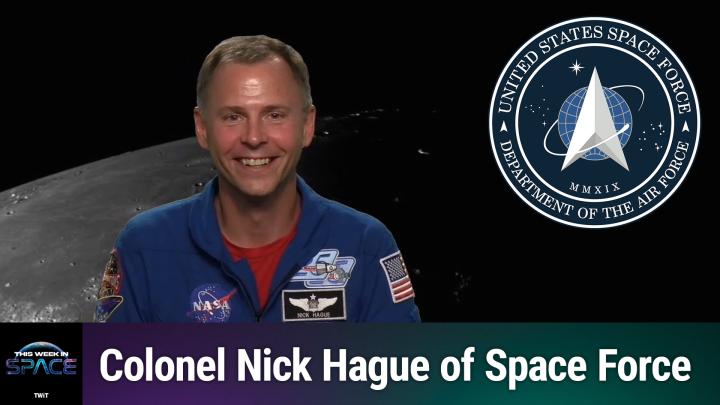
All TWiT.tv Shows (Audio)
This Week in Space 165: Guardians of Space
01:08:48
With Astronaut Nick Hague
Loading summary
Transcript246 lines
- [00:00]
Rod Pyle
Coming up on this week in space. NASA's budget request has ripples for space missions around the world. The search goes on for the next NASA chief, and Colonel Nick Hague tells us what it takes to have the right stuff, to become a Space Force Guardian and a NASA astronaut. So tune in, you don't want to miss it.
- [00:19]
Unknown
Podcasts you love from people you trust.
- [00:24]
This is trit.
- [00:27]
Tarek Malik
This is this Week in space, episode number 165, recorded on June 13, 2025. Guardians of Space. Hello and welcome to another edition of this Week in Space, the Guardians of Space edition. I'm Rod Pyle, Editor chief, Badass magazine. I'm joined by my fellow Space Guard, Tarek Malik, editor chiefofspace.com. hello, Space Guard.
- [00:51]
Rod Pyle
Hello, Space Guard. Can I be. Can I be a. Like a. Like a Captain Cosmos? How about that?
- [00:59]
Nick Hague
No.
- [01:00]
Rod Pyle
Space Captain? No.
- [01:02]
Tarek Malik
Sure, we'll just call you Twizzler, but in a few minutes, we'll be joined by a real Space Guardian, the Space Force kind. Astronaut and Space Force Colonel Nick Hague recently returned from the International Space Station. So that's going to be a real treat. Now, before we start, I know you're thinking it, please don't forget to do us a solid. Make sure to like, subscribe and the other podcast buttons you can push to keep us on the air and make us feel special. And now, a Space Force joke.
- [01:31]
Rod Pyle
Space Force. Wait, should we be joking?
- [01:33]
Tarek Malik
If that's our guess from Reddit, it's actually not the Space Force joke.
- [01:38]
Unknown
Really.
- [01:38]
Tarek Malik
It's actually kind of a rerun from I think our single digit episodes, but it's. It's different. Hey, Tarek.
- [01:44]
Rod Pyle
Yes, Rod?
- [01:45]
Tarek Malik
Two astronauts are chilling on the space station. When one turns to another and says, I can't find any milk for my coffee, the second astronaut replies, in space, no one can. Here, use cream.
- [02:02]
Unknown
I love it.
- [02:03]
Tarek Malik
Or wow, you got it on the first pass. I actually, I was a little worried about that one.
- [02:09]
Nick Hague
Or.
- [02:09]
Rod Pyle
Okay, first of all, if you don't get it, then clearly you're not a sci fi movie fan, so let's put it there. Should we explain it to people in.
- [02:18]
Tarek Malik
In space, John.
- [02:20]
Rod Pyle
John is saying he doesn't get it.
- [02:22]
Tarek Malik
Yeah, as opposed to in space, no one can hear you scream, which was.
- [02:25]
Rod Pyle
A tag for the aliens movies. Yes, yes.
- [02:28]
Tarek Malik
Okay.
- [02:28]
Rod Pyle
Or jokes are funnier.
- [02:31]
Tarek Malik
Hey, Tari.
- [02:32]
Rod Pyle
Yes, Rod?
- [02:33]
Tarek Malik
Why did the Space Force recruit wear a red shirt on his first day at work?
- [02:37]
Rod Pyle
Oh, I don't know. Why?
- [02:38]
Tarek Malik
To get it over with.
- [02:42]
Rod Pyle
That's a Star Trek Aliens to Star Trek. I get it.
- [02:44]
Tarek Malik
Yeah. Okay.
- [02:45]
Rod Pyle
By the way, everyone should read John Scalzi's Red Shirt. It's quite good. It's a very good book.
- [02:48]
Tarek Malik
So now I've heard that some people want to return us to basic training when it's time to do a joke on this show. But you can help by sending us your best worst or most indifferent space joke joke at TwistWit TV. Until then, you're gonna have to deal with it. Speaking of dealing with it, let's deal with some headlines.
- [03:09]
Rod Pyle
Headline news. I got that down.
- [03:12]
Tarek Malik
You see, not according to your fans. I guess there's a sink issue or something, but who knows. European Space Agency reveals three key space missions are threatened by Trump's budget cuts.
- [03:27]
Rod Pyle
Oh yeah, yeah. So, so the, the European Union, like the, the esa, they had like a big, their big kind of state of the space agency group with all their, their member nations this week. And our writer Rob Lee listened in to kind of hear what their big concerns were and surprising maybe no one. They're going to have to change a lot of their tax because of what the NASA proposed budget from the Trump administration to that is that there's, there's three big missions. The, the Gravitational Wave observatory, Lisa, the Venus Orbiter and Vision and, and this giant X ray observatory, new new Athena, which require like dramatic, they call them recovery actions to try to figure out a way to make them, to make them work. But chief among I think the more urgent worries, and this is really frustrating, is that they've been like, like twice burned now with their Rosalind Franklin Mars rover. Now this is a Mars rover that they had partnered with Russia initially on under the ExoMars project to launch to Mars. And then of course the Russia innovated Ukraine, they dissolved that partnership and eventually NASA and you know, stepped up to say we will launch a rover on a SpaceX Falcon 9 rocket. Well that's not included in the current administration budget which means now they need another ride for the rocket. When we told them that we would take it for them, that's like if I told like my neighbors I take their kids to taekwondo and then just ghosted them. Except on a multi million dollar scale. Anyway, anyway, interplanetary as well suffice to.
- [05:05]
Tarek Malik
Say a little bit more like for those who might remember the Charlie Brown comic strips, when Lucy holds the football.
- [05:11]
Rod Pyle
For him, she keeps taking it away.
- [05:13]
Tarek Malik
Yeah, I mean, you know, we burned them actually. I mean you mentioned two of them, but we burned them probably. I don't know. In the last, since the beginning, 21st century, I'd say four times, maybe five.
- [05:24]
Rod Pyle
Yeah.
- [05:24]
Tarek Malik
In one way or another.
- [05:25]
Rod Pyle
Yeah, we, we scaled back, right. The, the, the scope of that mission because we were going to have, I think, something else on it, on that mission, and we said, nope, we're gonna pull out of that. I think it was another orbiter. Is that right? Something like that. We were having another spacecraft that was going to go, yeah. And, and so, so it's just, it's just, it's really in flux and it's a, it's a reminder that the budget stuff that is affecting the rest of us here in the US does have repercussions to our international partner science partners, which we talked about. Right. With Casey Dreyer and the planetary study in our last episode about the budget. So this is almost a direct line from that discussion to impacts. In fact, there's a Earth observing mission, Sentinel 6C2, that's going to be affected too. It's a lot of things going on.
- [06:14]
Tarek Malik
I guess we'd be called an unreliable.
- [06:16]
Unknown
Partner at best, a. I suppose.
- [06:20]
Tarek Malik
And you also have an item here about the National Solar Observatory. Is that under the ax as well?
- [06:25]
Rod Pyle
Exactly. You know, while this meeting in, in Europe was going on this, another meeting, the, the summer kind of spring meeting of the American Astronomical Society was going on in Anchorage. And we had our writer and editor, Monisha Revisetti there and she found out that the people that run the. Daniel K. I hope I don't pronounce this wrong. You know, Inouye Solar Telescope, that's the National Solar Observatory, have found that, you know, it's, it's the most powerful instrument solar observatory, you know, on Earth right now. And they won't be able to operate like the funding cuts are so drastic to their program that they will not be actually able to run the science campaign. Overall, I think it basically budgets them something like 13 million for the year. And this is an observatory that has been funded at 30 million, so twice that on the, on, on the facility. So it's, they're saying that there's no way for them to operate the complexities of this advanced solar observatory at like, peanuts of a cost right now.
- [07:30]
Tarek Malik
So not just peanuts, but about, let's see, a little over a quarter of the cost of the birthday parade coming tomorrow.
- [07:37]
Rod Pyle
Yeah.
- [07:38]
Tarek Malik
Not that we're getting political as, as.
- [07:40]
Rod Pyle
For people who are listening after the fact. We are recording this one day before a big military parade in the U.S. first in many, many, many years in Washington, D.C. on the president's birthday. Well, the army celebrated Army's 250th birthday.
- [07:55]
Tarek Malik
Yeah, yeah. All right.
- [07:57]
Rod Pyle
Celebrate the army.
- [07:59]
Tarek Malik
Yes. And we have taken our first look at the sun's poles.
- [08:04]
Rod Pyle
This is a fun one though. So these, these first two were kind of down and dire, but the solar orbiter, I believe this was. Where are my notes? I had notes here. I had notes. And this is another one from, from space.com and I didn't. But yeah, so, so the, they, they, these scientists reported that they've got their first really close looks at the sun's poles from the solar orbiter. That's the, that's a European space.
- [08:32]
Tarek Malik
Okay, so Parker is Equatorial Park.
- [08:35]
Rod Pyle
Yeah, well, Parker, Parker is flying like through the atmosphere, really close, you know, and whatnot. And. But this one is in a polar orbit, really looking down. And I thought that NASA's Ulysses spacecraft or Europe, you know, that that partnership one had done this before, but I guess I was wrong. And no, it can't be. Okay, you don't have to act so shocked, Rod. I'm allowed, I'm allowed a.
- [09:03]
Unknown
You're allowed one imperfection, a mulligan, like.
- [09:06]
Rod Pyle
Once every 150 episodes.
- [09:09]
Tarek Malik
Get Jasmine on the line here. What? Ask her.
- [09:12]
Rod Pyle
Anyway, but this is, this was just like a fun announcement to say that they've got their first ever like direct images of, of the sun's poles from the solar orbiter. Obviously they won't be the last because it isn't a longer lasting orbit, a big sweeping orbit to understand the sun. And it's, it's at this viewing angle. It's like a, it's the, it's the most extreme. It's going to be Solar orbiter. It's got like a 17 degree tilt over the sun to be able to see the poles from where it is because it's been kind of getting into this orbit over the last few years. And it's very interesting just to kind of follow what we can observe because you're seeing what happens up there. It would be very interesting to see how the star's solar cycle works, how its weather works, how its magnetic field works. I asked, was there a hexagon? Because there's that weird hexagon at Saturn, Saturn's poles there is not a surprise hexagon. So it's probably not aliens for everybody else.
- [10:10]
Tarek Malik
No solar hex. So this is interesting, I guess, in light of the fact that. Excuse me. That NASA is cutting heliophysics. It's good that somebody's looking at it because we'd like to learn more about solar weather because it could basically take out the 21st century if we got a sufficiently bad coronal discharge or plasma wave. Right?
- [10:36]
Rod Pyle
Yeah. Yeah. And it's funny you mentioned that because there actually is a coronal mass ejection like plasma wave buffeting the earth this weekend coming up. That's right. Can you feel it now? Can you feel it, Rod?
- [10:48]
Unknown
Ow.
- [10:49]
Rod Pyle
Ow. In fact, last night where I am in New Jersey, there was a. What?
- [10:56]
Tarek Malik
It's the timer. It's trying to tell us it's time for a commercial break. So stand by, everybody. We'll be right back. Don't go anywhere. We'll finish our headlines.
- [11:06]
Unknown
This episode brought to you by Red Canary. When cybersecurity threats hit fast, you need an MDR partner that moves faster. Red Canary delivers 24.7expert MDR support, total visibility and actionable insights. Plus it helps you detect four times more threats so you can stay ahead without burning out. Red Canary clears the noise and has your back every hour, every incident. Get the backup you deserve. Visit redcanary.com difference to learn more.
- [11:36]
Drivers who switch and save with Progressive could save hundreds. With that kind of money, you could go big time on a fancy water bottle with ultra titanium alloy metal. You're not sure why you need all that. I mean, it just holds water. But you're getting it anyway. Because if you're hiking near an active volcano and you accidentally drop the bottle into molten lava, your water will still be icy. Switch to Progressive and you could save big time for water bottles. Progressive Casualty Insurance Company and affiliates not available in all states. Potential savings will vary.
- [12:06]
Richard Karn
Hi, I'm Richard Karn and you may have seen me on TV talking about the world's number one expandable garden hose. Well, the brand new pocket hose Copperhead with Pocket Pivot is here and it's a total game changer. Old fashioned hoses get kinks and creases at the spigot, but the Copperhead's pocket pivot swivels 360 degrees for full water flow and freedom to water with ease all around your home. When you're all done, this rust proof anti burst hose shrinks back down to pocket size for effortless handling and tidy storage. Plus your super light and ultra durable pocket hose. Copperhead is backed with a 10 year warranty. What could be better than that? I'll tell you what an exciting exclusive offer just for you for a limited time. You can get a free Pocket Pivot and their 10 pattern sprayer with the purchase of any size Copperhead hose. Just text water to 64,000. That's water to 64,000 for your two free gifts with purchase. W A T E R to 64,000 by texting.
- [13:00]
Unknown
64,000. You agree to receive recurring automated marketing messages from Pocket hosts. Message and data rates may apply. No purchase required. Terms apply. Available@pockethost.com terms.
- [13:07]
Rod Pyle
Did John just give me the hook? Because that sounded like the hook.
- [13:10]
Tarek Malik
No.
- [13:10]
Rod Pyle
Right.
- [13:11]
Tarek Malik
That, that's, that's demerit number two. All right. Did you have more about that or.
- [13:17]
Rod Pyle
I was going to say that your comments about the sun are very appropriate because we are in the middle of a solar, like a geomagnetic storm. I got an alert on my phone that said, hey, you can go outside in an hour and see Aurora is in New Jersey, which is a bit of a preview because as we're recording it, it's June 13th and on the 14th is when everything is supposed to peak this weekend. So we could be looking at Father's Day auroras around the globe. It'd be very exciting.
- [13:45]
Tarek Malik
And John just mentioned that the little tune that you heard will not be in the recording. So people will be wondering what the heck we're reacting to it' I'll put.
- [13:54]
Rod Pyle
Something in the record.
- [13:55]
Tarek Malik
Yeah. Lay it in. So that we don't look like it.
- [13:57]
Unknown
Won'T be exactly what we. What y' all heard.
- [13:59]
Rod Pyle
This is raw, John. Right. This is. I react. I'm a method actor. Like what happens here, it's got to stay in.
- [14:05]
Unknown
Leave it in this week.
- [14:08]
Tarek Malik
Okay. Politico Space just came out with what I think was their first issue of their new space newsletter.
- [14:15]
Rod Pyle
Yeah.
- [14:16]
Tarek Malik
Shockingly, they didn't contact either Tarek or myself to run it for them. And they had an article about one of their lead articles, lead off articles about who will lead NASA. Now I had already gotten from some other sources a couple of names. Steve Kwast, who is a recently retired three star lieutenant general from the Air Force. And now they're adding to that possibly Kevin Coggins, a former military official who currently serves as the head of NASA Space communications and navigation program. Okay. Or Mike Hopkins, a former NASA astronaut who joined the Space Force. And there are two other military guys whose names I don't have in front of me that were also mentioned, but.
- [15:02]
Rod Pyle
I didn't know anything about retired Space Force Major General John Olson and Lieutenant General John Shaw.
- [15:09]
Tarek Malik
Okay, thank you. Now this kind of, you know, if you look at the military side, this kind of harkens back to like pre NASA before the civilian agency came in, when both the army and The Air Force thought, hey, we should be running space. And then the Navy said, no, we should be because there'll be ships and blah, blah, blah, blah, blah. And then it became a civilian agency. And this is kind of a weird. And there, there, there are instances of military officials high up in NASA in the past, but never as the administrator, to my knowledge. There was Sam Phillips during the Apollo era who came in to help, to help form and mold how they did their management, because you're talking about half a million people between NASA and all the contractor teams and so forth. So Sam Phillips had been on the Minuteman program. He came in and really helped pull NASA together when they were getting really, really busy, like in the early 60s. But, you know, for today, it's a whole different look. So it's a bit of a head scratcher. Quasta is an interesting guy. I think I talked about him a little bit the other week, didn't I?
- [16:16]
Rod Pyle
Yeah, a little bit. You know, I'm a little surprised that another full week has gone by and we haven't gotten any signaling at all about what direction NASA might be headed, aside from a statement from Acting Administrator Janet Petro saying that, you know, she is fully committed to her position as like an interim leader and, you know, will hand off control to whomever the President selects. You would have thought that there would have been some kind of this is who we're going to go to next type of thing to get that machine going.
- [16:46]
Tarek Malik
NASA's press releases were beginning to feel like they're done by a big rubber stamp. Like they have three of them, you know. Yeah, just kind of go thunk. It's like I'm committed to stay the course. Okay, thank you. I'll pull out the other rubber stamp that says you'll, you'll have a peaceful transition of power. So I don't know much about Kevin Coggins or Mike Hopkins.
- [17:07]
Rod Pyle
My coffin is great. I've, I've met him, I think at least once during, during the shuttle, the shuttle days. He transitioned to the Space Force mid mission while on his last International Space Station flight. So he, he technically was the first Space Force astronaut, I guess, to fly in space. But Nick Hagg, our guest in today's episode, an expert, was the first to.
- [17:32]
Unknown
Actually launch Space Force Guardian.
- [17:35]
Tarek Malik
To launch. So, yeah, to launch as guess you know, my concern and the, the larger concern that article is, you know, what kind of person do you want running the agency? And for my money, not just because I'm a boomer, John Ashley, but because I was around to watch NASA at its functional best. Admittedly a lot more funding than it's got now. When you had a guy like James Webb, who was a politician, he ran the budget of the Bureau or the Bureau of the Budget, excuse me, before he joined NASA. So he knew about money and he was also, you know, he was a politician. So he knew where the skeletons were, were buried and what clauses they were hanging and so forth. And you know, you kind of, you want someone who's a fighter, not literally, but I mean who will fight for the agency of what it needs in politics a little bit like Bill Nelson did, who knows when to put on the brass knuckles if they're necessary, but who also knows how to, how to schmooze people, which somebody like Von Braun was very good, like good at. And you know, I think arguably I give you a lot of those characteristics, but so may the other two.
- [18:39]
Rod Pyle
I think arguably you could say the same for Jim Bridenstine. Right. When he was appointed by Trump in the first administration, there was a lot of concern that it would be extremely partisan. And I think what we got out of that was a very clear commitment to what is now the Artemis program and a lot of focus to get things done in a program that ended up with the first. Right. We were talking about in last episode that actually sort of survive through a presidential transition into the, the Biden administration. So you know, I, I, you know, say, say what you will, that that worked out better than I think a lot of people expected. And I think that's why a lot of people were really excited about Jared Isaacman. Because there was the, there's the perception, okay, I've only met him in person like once or once and that was through a digital, you know, interview. But I know that there seems to be a perception that there was a very level approach to space policy, you know, a very business minded approach, which I think that the, the, the fiscal folks that are focused on that would, would appreciate. And in fact there's an interview with him by our friend of the show and our Seneca writer, Eric Berger, where he spoke with Jared about what he would have done and there was a lot of discussions there about if he felt that some sort of space mission that was on the, the canceling act, you know, on the, on the, on the, on the axe list currently of which there are many, like 41 we talked about. And he felt that there was really a lot of science merit and he was told the same confirmed by experts he would consider financing that themselves. Now that's not a great business plan for your national space agency. But the fact that. That. That kind of personal responsibility and investment, well, that's very encouraging. And it makes you wonder about the NASA that could have been if done that.
- [20:27]
Tarek Malik
So, yeah, it's a huge level of commitment. And I was doing a little thumbnailing the other day, and I think, just for inspiration, for. If I recall Properly, he gave St. Jude Medical Center $100 million of his own money, which is something like 7% of his net worth, I think.
- [20:46]
Rod Pyle
Yeah.
- [20:46]
Tarek Malik
So that's commitment. You know, if. If Mr. Musk gave 7 or 10% of his net worth, we could have be on Mars right now and Venus beyond that. So, yeah, that's a serious commitment. And it's interesting because people on both sides of the aisle and throughout the space industry and throughout the retired NASA Corps largely supported Isaacman, which is not something you see very often. So clearly there was something at work there that will not be missed. Now, there have been some rumblings about maybe he'd be reconsidered, but I haven't heard anything from the administration. It's all been people around the administration or talking. The administration. Before we go too far here, I have. Hey, John, do you have any announcement sound effects? Like a announcement?
- [21:37]
Rod Pyle
He just made that for everyone. That's like not watching. He made that with his face. That's like. That's not an actual.
- [21:43]
Tarek Malik
I think they might have gathered that. So the announcement. Next week, Tarek and I will be doing this show live, we hope, from the International Space Development Conference in Orlando, Florida, which runs from the 19th to the 22nd. On the 22nd, Tarek will be getting his paper plate with a gold star in the middle, saying, thanks for all your space journalism, you handsome man.
- [22:11]
Rod Pyle
Do I have to do a speech?
- [22:13]
Tarek Malik
And then I'll. Then I'll chisel on him a bit? No, we're doing a fireside chat, remember?
- [22:18]
Unknown
Okay.
- [22:18]
Rod Pyle
All right.
- [22:18]
Tarek Malik
Because I have to have a chance to sit and belittle you for 20 minutes. But for our episode, we're counting on you devoted space fans. I'm looking at you, Tanya. To send in your questions or comments or suggested topics, and we'll do kind of a potpourri next week in front of our live studio audience. And I have one more thing. Put this in the Boomer complaint column, okay? Just before John starts beating on me. Oh, you old man. I am old enough. Actually, I'm old enough to be Tarek's father. Probably be John's grandfather. But anyway, I heard a new Term this week. Oh, you know you love it. I heard something this week that really rankled the older me. A new term being used called virtual analog astronaut.
- [23:10]
Rod Pyle
Oh, no.
- [23:11]
Tarek Malik
There are astronauts and those are people that train to go to space, do daring and scary things. There are commercial astronauts, there are space passengers, there's self loading cargo, whatever you want to call people at various degrees of space activity. Then there's the analog astronaut, which is a person that goes to the Mojave Desert or out in Utah or maybe to Hawaii in one of these analog stations. And you simulate, slash pretend a Mars mission for a week.
- [23:44]
Rod Pyle
And you, which you have done, you have done this?
- [23:47]
Tarek Malik
No, no, I have not. I went to the Arctic as a research assistant. We did not wear spacesuits, we did not do simulated countdowns in the, in the airlock, and we did not have simulated communications delays. We just had bad communications on sat phones. No, this is very different. So this is what groups like the Mars Society do. And you know, at a certain level there is some value to simulated analog missions. The analog mission I was on is, okay, let's test analogs for transit, let's test an analog for surf, for sampling from a biologically protected zone kind of stuff. These analogs are where you say in your mind, I am an astronaut and you know, we go into pretend mode for a week or whatever. Now there's some value to that, mostly for the individual, but virtual analog astronauts. So I do remember as a child.
- [24:42]
Rod Pyle
Is this that story that was circulating where there was someone claiming to be an astronaut, like some famous person and people were criticizing them?
- [24:50]
Tarek Malik
No, this is something I saw on a resume that said I'm a virtual analog astronaut. It was something submitted to me. And you know, I remember as a kid looking at the dryer and thinking if I got in there, that, and hit, hit go, you know, that kind of like being in space. So that would be a virtual analog astronaut. But I suspect this means somebody put on some VR goggles and did, you know, space hero or something? I mean, have you even heard of this before?
- [25:19]
Rod Pyle
No. Well, you know, there was, there was a time when I was vetting applications for internships@space.com and I was really struck by how one of the applicants was Time magazine's person of the year in 2006. And then I realized that that year it was everyone, you, you all were. And I wonder if this is the kind of the same thing that you're thinking about there. I mean, I, I, I don't get it, Rod. I mean, I know you got a chip on your shoulder about the analog thing, but me? Yeah.
- [25:48]
Tarek Malik
Well, let's get rid of that chip and move on because we have Colonel Nick Hague in the house, and it's time to talk to him. So we're going to go to a quick break, and we'll be right back.
- [25:58]
Unknown
This episode brought to you by Red Canary. When cybersecurity threats hit fast, you need an MDR partner that moves faster. Red Canary delivers 24.7expert MDR support, total visibility and actionable insights. Plus, it helps you detect four times more threats so you can stay ahead without burning out. Red Canary clears the noise and has your back every hour, every incident. Get the backup you deserve. Visit redcanary.com difference to learn more.
- [26:28]
Zoe Saldana
Hi, Zoe Saldana. Welcome to T Mobile. Here's your new iPhone 16 Pro on us.
- [26:32]
Unknown
Thanks. And here's my old phone to trade in.
- [26:34]
Zoe Saldana
You don't need a trade in. When you switch to T Mobile, we'll give you a new iPhone 16 Pro plus we'll help you pay off your old Phone up to 800 bucks and you still get to keep it.
- [26:43]
Unknown
There's always a trade in.
- [26:45]
Zoe Saldana
Not right now. @ T Mobile.
- [26:46]
Unknown
I feel like I have to give you something in return for karma.
- [26:48]
Zoe Saldana
That's okay.
- [26:49]
Unknown
I don't really have much in my purse. Oh, let's see. Hand sanitizer. It's lavender.
- [26:54]
I'm good. Seriously.
- [26:55]
Let me check this pocket. Oh, mints.
- [26:58]
Zoe Saldana
Really, I'm fine.
- [26:59]
Unknown
Oh, I have raisins. I'm a mom. Wait, wait one sec. I've got cupcakes in the car.
- [27:03]
It's our best iPhone offer ever. Switch to T Mobile. Get a new iPhone 16 Pro with Apple intelligence on us. No trade in needed. We'll even pay off your Phone up to 800 bucks with 24 monthly bill credits. New line, $100 plus a month on experience beyond finance agreement. $999.99 and qualifying corded for well qualified plus tax and $10 connection charge. Payout via virtual prepaid card. Allow 15 days credits end in balance due if you pay off early or cancel CT mobile.com drivers who switch and save with progressive could save hundreds. With that kind of money, you could go big time on a fancy water bottle with ultra titanium alloy metal. You're not sure why you need all that. I mean it. But you're getting it anyway. Because if you're hiking near an active volcano and you accidentally drop the bottle into molten lava, your water will still be icy cold. Switch to progressive and you could save Big time for water bottles. Progressive Casualty Insurance Company and affiliates not available in all states. Potential savings will vary.
- [27:59]
Tarek Malik
And we are back and we are honored to be spending time today with Nick Hague, who is a Space Force Guardian and an astronaut. And there's a resume here, but it's really, really long. So, Nick, if you don't mind, I'll turn it over to you to just let us know what you do and where you came from.
- [28:17]
Nick Hague
Yeah, no, absolutely. Pleasure to be with you guys today. Yeah. Space Force Guardian. So I grew up in the Air Force as a flight test engineer, graduate from the Air Force Academy and found my way to NASA in 2013 and have been operating down here as part of the active duty, the active astronaut corps and been doing that for most of the last 12 years. Flown a couple missions to the International Space Station, long duration missions. Just most recently returned a few months ago. And I'm here to talk with you guys and answer questions and share a little bit about that experience.
- [29:01]
Tarek Malik
Well, I appreciate the way you put that. Makes it sound like we're almost on a similar level of existence and that ain't true. I appreciate you including us into the club, but I think Tarek has a question that he always asks.
- [29:16]
Rod Pyle
I have a traditional question. Colonel, or do you prefer Nick? I don't know. How would you like us to call you?
- [29:23]
Nick Hague
How formal do you want to be? Let's just go with Nick.
- [29:25]
Rod Pyle
All right, great, great. Well, I usually ask folks, you know, about their first brush with space, like what got them inspired, what was their path to space. And I feel like with you we get a bit of a twofer, right, because you've got two kind of paths of service. There's your military career and then your NASA career. So I'm very curious. First, how you, how you found your path from Belleville in Kansas to, to the, to the military. And then where that kind of combined with either an interest in space or if it came out of that service that you found an opportunity and, and then ran for it.
- [30:03]
Unknown
There's.
- [30:04]
Nick Hague
Yeah. So if I was going to think back to the first times that I was like, I caught the space bug, if you will, growing up in Kansas, One of the real nice benefits of living in rural Kansas is there's a lack of light pollution. And so the night skies are fabulous. And I would look up at the stars, as cheesy as that might sound, and just wonder what, what is out there? And that got me interested. So there's always been this like childhood, childhood dream of exploration and trying to Go and discover the things that are unknown. Just so happens that the photograph behind me, taken while I was most recently on the International Space Station, it's kind of a full circle moment because this is, this is Kansas at night. So I got to look down on Kansas at night as opposed to looking up at space. And it's, it's a, it's a spectacular view, but that's what kind of got me hooked, you know, from a childhood dream aspiration perspective. But like you said, it is this interwoven path of an interest in space, but then also an interest in service to my country and military service. And it was in that service that I started to realize that, hey, the thing that I really like to do professionally, work in small teams handling complex equipment and making that equipment, aircraft, spacecraft, do things that they hadn't done before, that's very similar to the human exploration of space. That's very similar to what astronauts do. And then that's where it turned into, you know, a professional ambition. And, and then it took, you know, a decade and a couple rejections and multiple tries of getting selected before I finally got my foot in the door.
- [32:05]
Rod Pyle
We should let people know that, that, Nick, you, you joined, you were commissioned as the. In the air force in 98, right? And then, and then through that career, you, you joined NASA in 2013, and then you became a Space Force Guardian in. Was it 20, 20, 21, is that right? 2020 or no, before?
- [32:23]
Nick Hague
Yeah, early 2021. Transferred over into the Space Force because, you know, for the most part, everything that I'd done in the Air Force was related to space. It just made sense and, and have, you know, at that point, I was on a developmental rotation back in the Space Force, helping, helping the new service stand up its test and evaluation enterprise.
- [32:48]
Tarek Malik
So I have a question that I've been dying to ask somebody of your stature for a long time. And I'm sorry to ask it this way because it always seems goofy. Somebody says, what is X like? But what is it like to go through test pilot training school? And I guess, as importantly as that, how does that prepare you and help vet you for NASA in terms of what an astronaut's capabilities might be?
- [33:12]
Nick Hague
Yeah, you know, and I'll start with there's no, there's no requirement to have test expertise. There's no, there's no quota that NASA selects to bring in test professionals as part of its astronaut corps. But, but I think to get to your point, there's, there's this experience and approach that you end up, you Know the skill set that you develop as part of going through that, that is, that is very applicable down here. And so if I think back to the point of test pilot school, so I'm an engineer, not a pilot. The first little known fact, the first aircraft spacecraft that I was in command of on behalf of the federal government was Dragon Freedom, that I was the commander for just most recently. So I'm an engineer. So I go to test pilot school as an engineer so that I can learn operations just like pilots go through test pilot school to learn acquisition and engineering so that we can talk each other's language, but then also have that hands on practical understanding and build a depth of knowledge about sophisticated complex machinery. Then work together as a team in order to make it, in my case, an aircraft, go do something that it hadn't done before. Expand the envelope of performance. And that is that special skill set that I think is applicable down here at NASA. You may not know, but there is now a space test course that is a companion to the flight test course out at the Air Force Test pilot school that guardians go through to complete Test pilot school and they're learning those same sets of skills. How do I take complex machinery, how do I take a satellite, how do I do on orbit operations and then conduct it in a way that is novel and adapt the way that we have been doing things to the way we need to be doing things in order to meet the challenges of the domain as it continues to evolve. So those skill sets are super important.
- [35:28]
Tarek Malik
So Tarek, I think we ought to ask to audit the Space Force course so we can give them a new benchmark for low achievement. Yeah, right.
- [35:35]
Rod Pyle
For, for. Yeah, so they can, they can see what failure.
- [35:40]
Nick Hague
I don't know, maybe you, maybe you'd find yourself in space if you're a part of the course. I don't know.
- [35:43]
Tarek Malik
Well, he took Space Camp. Where did you go? Seven times.
- [35:48]
Rod Pyle
Five times. Five times. So that means that I'm trained, right? I know everything.
- [35:52]
Unknown
Yes.
- [35:53]
Tarek Malik
The question is, can you still fit in your jumpsuit? Because I can.
- [35:57]
Rod Pyle
I can actually. Probably better now than before. You know, I have a lot of Space Force questions, Nick, but you just mentioned that you got back from space. And for folks who don't remember, that was back on March 18th. You came back on that Dragon with some astronauts. We were all waiting to find out to come home with Asanya Williams and Butcher Mulmar. And I'm just curious because I mean it's June now as we're recording this, not that long from Your return, and you were up there for about six months or so. How has that readaptation gone? I have a lot more questions about that later. But I do want to get to Space Force.
- [36:32]
Nick Hague
Yeah, Readaptation. The body is an amazing thing. It just wants to adapt to the environment it's in. And so adapting to zero G happens pretty fast. The second time, I think my body really remembered what it was like to live in weightlessness. And so the adaptation on orbit went quick, and then the readaptation process the second time around went quick as well. I think the biggest challenge is getting your balance back. That takes a few days. And then after you've got that, then the next biggest thing is all of the little muscles in your body that we don't necessarily exercise on orbit. We do a lot of big lifting for the larger muscles, but the little ones that help you balance that as I'm sitting here, that keep me upright, all those little core muscles, all the little muscles that stabilize my joints need time to readapt. And that takes about a month and a half to two months and a couple hours a day, seven days a week, working with a strength and reconditioning coach and working through some physical therapy. So it's not all land and celebrations and going to your favorite amusement park. There's a lot of hard work that happens the first couple months right after a landing.
- [37:48]
Rod Pyle
Man, I'm tired just thinking about it.
- [37:51]
Tarek Malik
I would think after Soyuz aboard, I'd never want to go to an amusement park again. Did you have that moment where you were holding a mug of coffee or something and you let it go to turn around and were surprised that it hit the ground? Or did that not happen to you?
- [38:04]
Nick Hague
I haven't had that. The thing that I'd say is that your mind, subconsciously, you're constantly predicting what's happening in the environment around you. And after a while on orbit, your mind is predicting everything should float and how it should behave when it floats, and then when you get back down on the ground. And the trick that it plays on you is your subconscious for a little while still predicts things are going to float. And so then when they don't, it looks strange, and it looks strange, like everything is heavier than it should be. So you. You take off a shirt and you throw it onto the bed and it falls and it falls, and it looks to you like it weighs like 50 pounds, even though it's just a regular T shirt. After a few days, it kind of all snaps back and the world's behaving like it should be.
- [38:51]
Rod Pyle
Oh, that's so weird.
- [38:52]
Tarek Malik
That's so weird because it's back in charge.
- [38:55]
Rod Pyle
You know, that readaptation is kind of like the capstone of what was, at least for the Space Force, a bit of an historic flight. Because while there was a Guardian in space prior to you, that was, I think it was Mike Hopkins. Right. Who became a Guardian. You're actually the first. Oh, go ahead, go ahead. Sorry.
- [39:13]
Unknown
No, I was going to say Mike.
- [39:14]
Nick Hague
Transferred shortly before I transferred. He transferred while he was on the International Space Station.
- [39:20]
Rod Pyle
But you were the first Space Force Guardian to launch an entire mission. Soup the nuts from start to finish there. And I'm curious because, I mean, when I change roles at my job, it's like not a big deal because maybe I get a new computer or something. But you change like military branches, but you're still like an astronaut. And I'm just wondering like, what kind of transition that was. Like that decision to say, I've been with the Air Force, but I really believe in what the Space Force is doing. And I'm going to make that switch because that feels like a really big decision to make while you're training to fly in space.
- [40:02]
Nick Hague
Yeah, ultimately, I think it's a personal decision for most everybody that transferred over. And for me, it just made sense. I had started my days as a lieutenant working in the research lab, building satellites. I taught at the Air Force Academy, teaching in the astro department. I'd just been connected to space throughout my career, and it just made sense for me. But yeah, you know, while you're down at NASA, we have active duty military that are assigned to the astronaut corps down here. I'm one of maybe a couple dozen, you know, we're working for the civil agency at the direction of NASA doing the civil space mission. But it was special for me to also represent Guardians around the globe and the Space Force and kind of highlight what they do on a daily basis in order to allow NASA to do the things that it does. And so launching into space as the first Guardian to launch into space for me was a real honor. It was a privilege. It was made doubly special because I launched off a SLC 40 over at Cape Canaveral Space Force Station. And you know, we were the first, first humans to launch off that launch pad. And it was on a Space Force station. So it just made the connections to, to, to guardians a little closer and more personal for me. But like I said, the Space Force does so many things that create this stability and, and, and, and access to space for everyone else, commercial as well as NASA, to be able to do the things that it does. And it's fun for me to be able to highlight that stuff as I do outreach from the beginning of my mission all the way through to the end.
- [41:49]
Tarek Malik
Well, you're darn good at it. And we're going to do a little more of that outreach because we're going to talk about some of Space Force's activities as soon as we get back from this next break. So stand by.
- [41:57]
Unknown
This episode brought to you by Red Canary when cybersecurity threats hit fast, you need an MDR partner that moves faster. Red Canary delivers 24.7expert MDR support, total visibility and actionable insights. Plus it helps you detect four times more threats so you can stay ahead without burning out. Red Canary clears the noise and has your back every hour, every incident. Get the backup you deserve. Visit redcanary.com difference to learn more.
- [42:27]
Drivers who switch and save with progressive could save hundreds. With that kind of money, you could go big time on a fancy water bottle with ultra titanium alloy metal. You're not sure why you need all that. I mean, it just holds water. But you're getting it anyway. Because if you're hiking near an active volcano and you accidentally drop the bottle into molten lava, your water will still be icy cold. Switch to progressive and you could save big time for water bottles. Progressive Casualty Insurance Company and affiliates not available in all states. Potential savings will vary. Drivers who switch and save with Progressive could save hundreds. With that kind of money, you could go big time on a fancy water bottle with ultra titanium alloy metal. You're not sure why you need all that. I mean, it just holds water, but you're getting it anyway. Because if you're hiking near an active volcano and you accidentally drop the bottle into molten lava, your water will still be icy cold. Switch to progressive and you could save big time for water bottles. Progressive Casualty Insurance Company and affiliates not available in all states. Potential savings will vary.
- [43:28]
Rod Pyle
Well, I mean I feel, Nick, that we've got a good picture of your path to the space force, but you just mentioned earlier that you started in satellites. But also that kind of the astronaut part isn't the only thing that guardians do that there's lots of other roles and I'm very curious if you could give us an idea of like just in the work that you've done, both on the training and whatnot, what types of roles do you think that folks may be surprised to learn are guardian rules or things that fall under the Space force.
- [44:01]
Nick Hague
Yeah, the thing that affects everybody. So I'll start there and then I'll kind of bring it back to what affects me when I'm trying to do the NASA mission. But the thing that affects everybody that's easiest to point to is the Global Positioning System gps. Everybody uses that on their smartphones. They use it to guide themselves around so you know where you're at. But more, probably more important is the timing signal that comes off of that. It underpins our entire financial system. And so, so when I tap my little phone and do a, you know, whether it's an Apple Pay or some type of wireless transmission electronic payment, all of that is synchronized with that GPS signal. And so it underpins, you know, our daily way of life and impacts people in ways that they don't even realize. Now I take that back and focus now on the NASA mission. We also use GPS on the space station. We've got four GPS receivers on the outside of the space station that are way far apart from each other. It tells us where we're at as we're going around the Earth. But because we've got these four GPS signals on this plane that are far apart from each other, we can also see our orientation of the space station. We're able to do that because the station is just gigantic. It's a football field sized satellite up there that weighs a million pounds and, and has a wingspan the size of a 747. It's just, it's gigantic. And so while you're up there, you know you're gigantic. There's also other stuff that's up there as well. And one of the critical things that the Space Force does that guardians across the globe do is they track all the things that are in space. And so you've got 10,000 plus satellites, they track about 50,000 different objects up there. Some of that is debris. And they make sure that from my perspective while I'm living on this station, they make sure that other stuff doesn't hit it. At least the stuff that we can track. And so if there's something that's going to come too close to us, they give mission control in Houston a call. Hey NASA, we're tracking this object. And then NASA can move the space station out of the way. And that's critical. And if I compare my last flight up there in 2019 to this flight in 2024, 2025, one of the biggest things I've seen different is just how congested space is. And so I've got a video that is, it kind of demonstrates that. And it's a nighttime video of the. The. The Internet view out of the International Space Station. Actually, that's a nice birthday cake that we made.
- [46:56]
Tarek Malik
Sorry, not quite.
- [46:58]
Nick Hague
But we're getting there. And so you look out the window and there's going to be a nighttime screen that we're going to go to here. And it's going to be this beautiful aurora in the sky full of stars. And what I want you to do is, you know, if you can see it in the lower right hand corner of the sky, you're going to start to see what look like fireflies flying around in. Moving in strange ways. They're not stars. They're actually satellites that are crossing in front of us and they're glinting the sun's light over the horizon back toward us. And so as we come up toward, you know, a sunrise, we can see this every time, and there's hundreds of them. And I didn't see that before. You know, these are Starlink satellites because they're kind of at the same altitude that the International Space Station's at. And so all of this congestion is up there. And, you know, we depend on guardians around the globe to make sure that we don't end up, you know, accidentally colliding in with some of that stuff, you know, so that's, that's another example of what guardians do every day that allows us to explore space.
- [48:10]
Tarek Malik
So when the Space Force was announced and. Thank you. That was a really good demonstration of how Space Force is keeping us from reenacting the movie Gravity, which was, yes, rather upsetting to watch, I have to say. When, when stuff started banging into the shuttle, it was a bit of a heart wrencher. But as when we first heard Space.
- [48:32]
Unknown
Force announced, that's where you and I.
- [48:34]
Rod Pyle
Are different, because for me, it was the space station Rock.
- [48:37]
Tarek Malik
Okay, well, I'm older. When Space Force was announced, there was kind of a notion in the general press, in the wider media of guys in viper fighters whizzing through space, shooting at things, you know, and that wasn't necessarily discouraged right away, depending on, you know, who the source was. But clearly that's not primarily what Space Force is about. It's about tracking. It's about, I think, about orbital defense and protection of our orbital assets and so forth, which really control so much of our lives. But Space Force is commissioning astronauts. So what will the primary role of a Guardian be moving ahead, say, over the next 10 years?
- [49:20]
Nick Hague
Yeah, you know, and I think that the service is young and the mission area is constantly evolving, but ultimately a guardian is responsible for, you know, guarding the American way of life. You know, I mentioned that some of these fundamental things that, that Space Force provides underpin how our society operates. And so they're guarding the American way of life, but they also are guarding the, you know, the, the, the asymmetric advantage for the entire Joint Force. And so the other services depend on space. And we need to make sure that we have those capabilities available to help connect and orchestrate the Joint Force. And so they're instrumental to that.
- [50:11]
Rod Pyle
I'd imagine too, I think, that there's funding proposed to have just a bigger budget. I mean, Space Force is just barely more than five years old at this point. So it seems like there's a lot of opportunity to shape both its reach and its impact in, when it comes to like, national security and whatnot for the United States.
- [50:32]
Nick Hague
Yeah, I think we're just at the beginning and, you know, we're just over five years old. We're just at the beginning. If you're, if you're interested in space and having an impact on that, you know, becoming a guardian is a, is a great way to do that. There's, you know, it's, it's difficult to get in the Space Force because it's small. We've only got about 10,000 people in the military wearing uniform in the space Force. So 10,000 guardians compared to like the, the Marine Corps, which is over 100,000 people. So the, the Space Force is small. And with that small number, we do a lot. So the ability to have an impact, I think you can have an outsized impact because we're a small force.
- [51:19]
Tarek Malik
Gosh, I wonder if the Marines got rankled when they realized there was going to be a smaller, more elite force out there.
- [51:25]
Rod Pyle
In space, no less.
- [51:26]
Tarek Malik
In space, no less. We've got a break coming up. Before we go there, I'm wondering if you could talk a little bit about the broader sphere in terms of cis. Lunar, you know, what Space Force's activities and influence might be out to lunar orbit.
- [51:42]
Nick Hague
Yeah, absolutely. The goal of. And so I'm going to take this Back to. So NASA's mission. NASA's got a laser focus right now on getting back to the moon and how do we do that sustainably. And so there's a lot of excitement on our end and there's a lot of programs in work in order to get us back to the Moon so we can figure out how to work on another planetary surface and then get to Mars. And you know, in the same way that the Space Force has enabled us to thrive in the low Earth orbit environment, performing scientific research by bringing stability and maintaining stability in the domain, it's going to be necessary to continue to make sure that we have that stability as NASA goes forward. You know, I'm down here, I'm kind of on an island working for NASA. So my direct connectivity back to what Space Force is doing isn't. Isn't. Isn't there. But I can tell you that I don't see that natural. I'm not going to say interdependency, but that. That necessary support and dependency on Space Force to make sure that things stay stable.
- [53:00]
Tarek Malik
Tarek, maybe it's just me, but doesn't he look like a guy who should be standing on the moon as an Artemis astronaut?
- [53:05]
Rod Pyle
I think so, yeah.
- [53:07]
Tarek Malik
Yeah, he's got that kind of glow. It may be because of all that.
- [53:10]
Nick Hague
Go to a commercial break. We'll back and I'll change the green screen.
- [53:13]
Unknown
There we go.
- [53:15]
Tarek Malik
It kind of has a vague resemblance to Major Matt Mason from my childhood. Okay, we'll be right back after this break. Stand by.
- [53:22]
Unknown
This episode brought to you by Red Canary. When cybersecurity threats hit fast, you need an MDR partner that moves faster. Red Canary delivers 24.7expert MDR support, total visibility and actionable insights. Plus it helps you detect four times more threats so you can stay ahead without burning out. Red Canary clears the noise and has your back every hour, every incident. Get the backup you deserve. Visit redcanary.com difference to learn more.
- [53:51]
Zoe Saldana
Hi, Zoe Saldana. Welcome to T Mobile. Here's your new iPhone 16 Pro on us.
- [53:56]
Unknown
Thanks. And here's my old phone to trade in.
- [53:58]
Zoe Saldana
You don't need a trade in when you switch to T Mobile. We'll give you a new iPhone 16 Pro. Plus we'll help you pay off your old phone. Up to 800 bucks and you still get to keep it.
- [54:07]
Unknown
There's always a trade in.
- [54:08]
Zoe Saldana
Not right now. @ T Mobile.
- [54:10]
Unknown
I feel like I have to give you something in return for karma.
- [54:12]
Zoe Saldana
That's okay.
- [54:13]
Unknown
I don't really have much in my purse. Oh, let's see. Hand sanitizer. It's lavender.
- [54:17]
I'm good.
- [54:18]
Seriously, Let me check this pocket. Oh, mints.
- [54:21]
Zoe Saldana
Really, I'm fine.
- [54:23]
Unknown
Oh, I have raisins. I'm a mom. Wait, wait one sec. I've got cupcakes in the car.
- [54:27]
It's our best iPhone offer ever. Switch to T Mobile. Get a new iPhone 16 Pro. With the Apple intelligence on us. No trade in needed. We'll even pay off your Phone up to 800 bucks with 24 monthly bill credits. New line $100 plus a month on experience beyond Finance Agreement $999.99 and qualify. Imported for well qualified plus tax and $10 connection charge. Payout via virtual prepaid card. Allow 15 days credits and balance due if you pay off early or cancel CT mobile.com drivers who switch and save with Progressive could save hundreds. With that kind of money, you could go big time on a fancy water bottle with ultra titanium alloy metal. You're not sure why you need all that. I mean, it just holds water, but you're getting it anyway because if you're hiking near an active volcano and you accidentally drop the bottle into molten lava, your water will still be icy cold. Switch to Progressive and you could save big time for water bottles. Progressive Casualty Insurance company and affiliates not available in all states. Potential savings will vary.
- [55:23]
Rod Pyle
You know, Nick, I was curious. You know, one of the things I think that a lot of, of students that I see who speak with astronauts think it's like, what should I do? I want to be an astronaut. I want to fly in space. And like, what, you know, what should I study? And I'm curious what, what advice you might have for, for students, you know, today who are looking not just to be an astronaut, but who want to, to join the Space Force. Is there a pathway that they should follow classes, they should take, that kind of thing if they're interested in.
- [55:54]
Unknown
Interesting.
- [55:55]
Nick Hague
Yeah. You know, I, I ultimately, I think that the, the, you know, there is no one pathway. If I, I get to ask that question a lot from a, from a, from a, like a, you know, hey, what's it take to become an astronaut? There's, if you look at who we select, it's so everybody comes from such a different background and brings such a wealth of experience. That's different. And so collectively astronaut class, we, we have this, you know, so many different perspectives that ultimately our team is stronger because of the, the differences we bring to the, to the team. So there is no one, you know, one way to get there. Education underpins it all. And whether it's on the NASA side or the Space Force side, you've got to have a strong education. And it's hard to avoid the need, you know, to say that, hey, it needs to be a STEM education because the stuff that we're dealing with is so technically challenging, so you need to understand the things that you're dealing with. And so a strong STEM based Education is going to take you a long ways beyond that. My message is that there's so much activity, whether it's on the NASA side with new lunar suits and rovers and landers and rockets, and then all the Artemis going to the moon or, or if it's in commercial space or where we're looking at commercial, you know, LEO stations, or all the commercial activity that's going on in launch as well as Constellation, you know, the different constellations are going up. Or you look at the Space Force and this idea that, you know, we've got this existing mission we're doing right now, and then there's this whole other mission set that's got to grow and evolve and how, how do we ensure that we, you know, make sure that we maintain our advantage in space? There's so much that if you want to find a place, you're going to be able to find a place. So just strong education and then find what you're passionate about and, and, and don't look back. Just keep working hard.
- [58:20]
Tarek Malik
So, so if I may jump in, Tarek. When I was a kid reading comic books, there was always this ad insider on the back cover, black and white, showed this big muscular guy flexing towards the camera. And it said, I think it was a Charles Atlas ad. Send me $12 and I'll make you astronaut tough. And I bought the program and I never got astronaut tough. But it does lead me to think of. This is a very tortured segue, by the way. You gotta be astronaut tough to survive an abort. And you're one of the few people.
- [58:50]
Rod Pyle
Oh, I see what you did there.
- [58:54]
Tarek Malik
And I think the Soyuz has only actually activated that system three times in total. Right?
- [58:59]
Nick Hague
Yeah, there's, you know, that particular system, we were the. There's different phases. There's the launch escape tower. They've had one aboard that went off of the launch pad. They have one very late stage, a few seconds from getting to orbit. And we had the privilege of getting to exercise the middle part that hadn't been used before. And right in, you know, just after max Q and first stage separation. Getting to experience that aboard, you know, astronaut tough. I don't know exactly what that means. I can tell you that there is a team of thousands around the globe that train us and they train us. We spend 95% of our time training for things that could go wrong. And so you get used to this mentality of always thinking about what's the next, next worst failure and being ready to respond to that. So I had seen you Know, Alexei and I had done a simulator run where we had a launch abort, you know, eight months before launch. We did it once. It's a short simulation, as you can imagine. The actual flight was only 20 minutes. I think the sim run was half of that. So you rely on that training to just kind of, that fall back to in the moment. The thing that I need to do is focus on the procedures and my training because that's going to maximize my chances of survival and, and protecting my crewmate. And, and so you fall back on that training and it kicks right in. And you know, this wasn't my first in flight emergency. I, I'd been on aircraft that had emergencies before. This wasn't my first, you know, stressful situation that I'd been in. And so I think the accumulation of my lifetime's activities prepared me to, in the moment, be able to compartmentalize all the emotions, set that aside, focus on what do I need to do in order to make sure that we get back down to the ground safely. And then, you know, after the search and rescue forces opened the hatch, when we were on the ground and pulled us out and had us on their parachutes, that's when, you know, the wave of shock settles in and the emotions that you can't hold off forever finally catch up to you. And then I think the astronaut tough part is the processing of all of that, leading up to all of that personally as well as with my family, leading up to me launching again five months later.
- [61:38]
Tarek Malik
Well, and I would just add, I think part of being perhaps astronaut tough, if that's such a thing, is if I understood correctly, throughout that abort, you were still speaking Russian.
- [61:50]
Rod Pyle
Yeah.
- [61:50]
Tarek Malik
So which takes to be collected to.
- [61:53]
Nick Hague
Do that, you know, So I had spent more than a year, it's a two year training flow before launch. I had spent more than a year of the two years living in Star City, taking technical classes on Soyuz design and how it operates. And all of that had been in Russia. There are things that, that happen inside of Soyuz that I can only describe in Russian because that's how I learned it. And so, yeah, you know, I never thought about trying to speak English during the middle of the emergency. The radio transmissions are all in Russian, the displays are all in Russians. Procedures, all in Russian. That's just what, you know, for our.
- [62:36]
Rod Pyle
Listeners who may not be aware, that was a, that was a very rare launch abort in October on a Soyuz rocket and capsule in October of 2018. And then you flew, like you said, five months later in 2019 to fly UN Alexei. I'm sure I'm going to pronounce it wrong. Ovichinin is there. You go on that. On that flight there. But I had a, you know, just to wrap us up, a bunch of questions that came up during a recent campout. I took my Girl Scouts troop camping and. And they were asking all sorts of questions that I didn't know the answers to, Nick. And I thought that I might ask you about it. First of all, because they had their sleeping bags and they were asking how you sleep in space and is it weird to be floating in the phone booth that you all have there and what it's like when you got back and I guess had to lie down to sleep?
- [63:30]
Nick Hague
Yeah. So sleeping in space, the phone booth, our crew quarters, it is like a phone booth booth, though depending on what age of a person you're talking to, people may not know what a phone booth is. So then I divert to. It's more like Harry Potter's. His little room under the stairs. You have no room. So if I stand up inside my crew quarters, fully extended, my heels hit the ground and my head just hits the top of the crew quarters. And if I hold my elbows, my. Out to the side, my elbows will touch wall to wall. So it's kind of a small confined closet and it's got some doors. So to sleep, I'll close those doors, I'll turn out the lights, put on a little music to kind of give myself something to listen to. And I get in my sleeping bag, and my sleeping bag keeps me nice and cozy, warm. And I have it. It not tied down to anything. It just floats inside of. Of the crew quarters. And it floats so gently that as. As I start to float and touch a wall, the sleeping bag, the. Just the. The force of the sleeping bag touching the wall will push me back in the other direction. So I don't actually ever touch a wall. And I just kind of float back and forth. And my body goes into a natural resting position, which is. Is, you know, it. It's, you know, not quite fetal, but, you know, everything's kind of bent and relaxed. And it's the best sleep ever because you don't toss and turn. You don't have a sore neck or an arm that you've laid on, and it's fallen asleep and it's. You just sleep and it's wonderful. I just fall asleep and my body goes into the natural position that it wants to be in. And then eight hours later, my alarm goes off. Off and I wake up and I, and I feel great. So if, if I could bring that back down to the ground, I would in a heartbeat.
- [65:35]
Tarek Malik
But, but speaking of phone booths, I would say between that and what I've seen of the Soyuz capsule, claustrophobia is probably not a good trait for an astronaut to have. Correct.
- [65:45]
Nick Hague
It is. It is not. You work a lot in tight spaces, though. I never felt like the inside of the space station was very tight. It's the size of a five, six bedroom home. On the inside the Soyuz, by the time when I first got into it, two years before launch, it felt like we were squeezed in like sardines. And then by the time you get to the launch pad, it just feels comfortable, like it's home because you're so used to it. So you kind of get used to it.
- [66:15]
Rod Pyle
How about the Dragon though, right? Because then, then, so you flew on Soyuz and then you have these new Dragon capsules and yours was particularly, I suppose, spacious because that was the quote unquote rescue flight to go get Butch and Sonny.
- [66:31]
Tarek Malik
Okay. That quote unquote is important, by the way.
- [66:34]
Rod Pyle
Yeah.
- [66:34]
Tarek Malik
Because we were pushing back, carrying a lot of eight. This was simply a rescheduled recovery flight.
- [66:39]
Unknown
But.
- [66:39]
Tarek Malik
Sorry, go ahead.
- [66:40]
Nick Hague
Yeah, no, Dragon was spacious. It's a completely complete. But what's amazing, it's an, it's engineering approach. Two different engineering approaches and they do exactly the same thing. So the Dragon you launch, it's, it's highly automated and if everything's going right, I have to do hardly anything for it to go from the launch pad to docking with the International Space Station. Same for the Soyuz. But then when you look at how it is achieved, it's dramatically different. Which is, is, which is the fun of engineering. There's no right or there's a lot of wrong answers, but there's no one right answer. And so it was fun to compare those two. And like you said on the uphill, we had a little bit of extra room. So Alex and I stretched out and enjoyed it. We each had, you know, there's two windows, so we each had our own window we didn't even have to share.
- [67:34]
Rod Pyle
Oh, wow, that's great. That's great. Okay, so I've got, I've got like a few, like I got three short more and then, and then I swear.
- [67:41]
Tarek Malik
All right, lightning round very, very quick.
- [67:44]
Rod Pyle
What did you miss the most on this last mission that you were most excited to get back to when you came back home?
- [67:51]
Nick Hague
Well, it's family. It's the people you can't take along with you the friends, the family, the loved ones, my wife and kids. That's what you miss the most. If you can, if you want to take it down another level and say, well, what's the creature comfort that I miss the most? The food item I miss the most. The first thing I ate, it's fresh bread. Because we just don't have loaves of bread up there. It's all tortillas or shelf stable bread, and it's just not the same.
- [68:17]
Rod Pyle
That was my next question. What was the first meal that you had coming back? And I guess the last question that I had because I'm in my home office. Rod is in his home office. Mine is a disaster area and yours was super high tech. But also I can leave my windows open and not worry about it. It you clearly, as an astronaut cannot on the space station. So I'm just curious what the space station is like as a both living place that is also your workplace where you have to just make sure everything is working perfectly, but then you also want to have a little bit of time off.
- [68:52]
Nick Hague
Yeah. It's this mix of living and working in the same space and just the complexity of everything that's going on. It makes me thankful that there's a huge team on the ground that's constantly scheduling everything that needs to happen. There's. There's. So the complexity of our schedule is too much for a crew to fully engage with and just kind of do their own thing. So we've got teams of hundreds on the ground that are managing every five minute segment. And so really the focus up there is, okay, I need to make sure I'm getting all this stuff done so they don't have to reschedule it. And so I'm chasing that red line all day long to make sure I finish by the end of the day. Day. And then when you get done, it's, it's okay, I'm off the clock. Let's go float around the dinner table and, and play some music and just chat and see what's going on in everybody's life, how everything is going on with their friends and family and loved ones that they're trying to take, trying to stay connected with.
- [69:52]
Tarek Malik
Tark, did you have another or was that all of it?
- [69:54]
Rod Pyle
No, that was the last one. That's.
- [69:56]
Tarek Malik
Oh, that was the last one. Okay, so I have a couple.
- [69:58]
Rod Pyle
I could always ask more. I got.
- [69:59]
Tarek Malik
No, no. But hey, speaking of phone booths, I understand you're a Doctor who fan.
- [70:09]
Nick Hague
So everybody goes, which do you like better? Doctor, you know, do you like Star wars or Star Trek? And I was like, you know, I also watch Doctor who a lot as, so don't exclude them. But yeah, I enjoy Doctor who.
- [70:23]
Tarek Malik
Which doctor was your favorite?
- [70:25]
Nick Hague
Oh, geez, you're gonna put me on the spot. Sorry, that's a no win. That's a no win.
- [70:32]
Tarek Malik
That's a Kobayashi Maru scenario.
- [70:34]
Unknown
Okay.
- [70:34]
Nick Hague
Offend so many other fans, but yeah, can't do it.
- [70:38]
Tarek Malik
Okay, well, that's fair. Now, I understand you're going to be over at my old stomping grounds, KFI next week, is that right?
- [70:46]
Unknown
Yeah, yeah.
- [70:48]
Nick Hague
So making a trip out to, out to Los Angeles, actually going to visit Los Angeles Air Force Base and talk to guardians there that do the acquisition mission. Help us, you know, purchase all the systems that we need in order to do the Space Force missions. And I want to thank them for, for doing what they do that ultimately helps protect my friends on the International Space Station and protected me for six months up there. And then we're going to go up to Vandenberg Air Force Base and do the same thing. And yeah, no, it's, it's, it's going to be fun to get out there and be able to say thanks, but then also continue to kind of spread the word about, you know, what, what is NASA doing? Where are we going with that? Why is, what the Space Force doing? Why is it important? You know, I can't, can't share the information enough. I don't ever do it justice. I guess if, if anybody was interested, they could go to spaceforce.com astronick and, and they'd find out more about what the Space Force missions are.
- [71:45]
Tarek Malik
Oh, see, we were just going to.
- [71:46]
Unknown
Tout that, tell people.
- [71:48]
Tarek Malik
Thank you for beating us to it. Well, when you are at kfi, I bet you a dollar this that that Bill handle will be wearing his Hawaiian shirt with lunar module blueprints all over it. And you know, normally Bill can be a little irascible, but when he's got guys like you on, he becomes very respectful. So you'll have the floor. Tell him I said hi and pinch him on the arm for me. And yeah, my, my last question for you is, do you have any closing message for the rest of us?
- [72:19]
Nick Hague
The message is, is I think simple. And it's the thing that I've taken away from my time on the International Space Station and being part of, of, you know, the astronaut corps down here and doing the mission, the full mission of the International Space Station. It's, it's the power of when we work together, the things that we can accomplish and, you know, two and a half decades of doing scientific research in low Earth orbit and, and for the, the, for the purpose of trying to gain more knowledge and, and for the benefit of humanity. It's a noble mission and it's something that I'm, you know, thrilled to be a part of. But it doesn't happen because one person decides to make it happen. It doesn't happen because one country decides to make it happen. It happens because we, you know, we bring a huge, very diverse team together from around the globe with all of these different perspectives and backgrounds and experiences and cultures, and we work together, and that's how we make something magical like the space station happen.
- [73:28]
Tarek Malik
Well, I want to thank everybody, and especially you, Nick, for joining us today for episode 165 of this Week in Space that we like to call Guardians of Space. Just a reminder, the best place to follow nick is@Spaceforce.com astronick. Is that right? Right.
- [73:45]
Nick Hague
You got it.
- [73:46]
Tarek Malik
Okay. And also thanks to Angel Orozco, who's been writing his co pilot to set this up. Really appreciate it. Tarik, where can we find you being a virtual analog astronaut these days?
- [73:58]
Rod Pyle
Well, you know, it is Father's Day weekend as we're recording this. Happy Father's Day early. Rod and Nick, right? You've got two boys.
- [74:05]
Nick Hague
Thank you. You too.
- [74:07]
Rod Pyle
And so this weekend, hopefully we'll take my daughter to a video game orchestra concert and maybe her first air show. Show, which her first air show at 16 feels like a little old for her first air show. So we really wanted to check that off the box. So.
- [74:22]
Tarek Malik
All right. And don't forget, if you wish, you can join Tarek and me at the International Space Development Conference in just about a week, actually, exactly a week where we record a live episode of this show answering your questions for your heckling delight. It's in Orlando from June 19th to the 22nd. Second. For more information on that, go to isdc.nss.org and of course, you can find me at pilebooks.com or@esther magazine.com Always remember, you could drop us a line at Twist Twit TV. That's Twis Twit TV. We love your comments, suggestions, and your space jokes. New episodes. This podcast publish every Friday on your favorite podcaster. So make sure to subscribe, tell your friends, give us reviews, and do it for us. And do it for Nick, because he's more important than we are. Five stars or a thumbs up will do it. Finally, we're counting on you to join club twit in 2025. Besides supporting this show, you'll be supporting the network in general and it's a great bargain. Nothing better you can get for I think 10 bucks a month now. So sign up and and join our force. Nick, thank you very much. It has been a great pleasure speaking to you and as I said, thank you and I don't say an honor very often, so you're special and we'll see you all next week. Take care everybody.
- [75:37]
Unknown
No matter how much spare time you have, TWiT TV has the perfect tech news format for your schedule. Stay up to date with everything happening in tech and get tech news your way with TWiT TV. Start your week with this Week in Tech for an in depth, comprehensive dive into the top stories every week. And for a midweek boost, Tech News Weekly brings you concise quick updates with the journalists breaking the news. Whether you need need just the nuts and bolts or want the full analysis, stay informed. With TWiT TV's perfect pairing of tech news programs.