← All TWiT.tv Shows (Audio)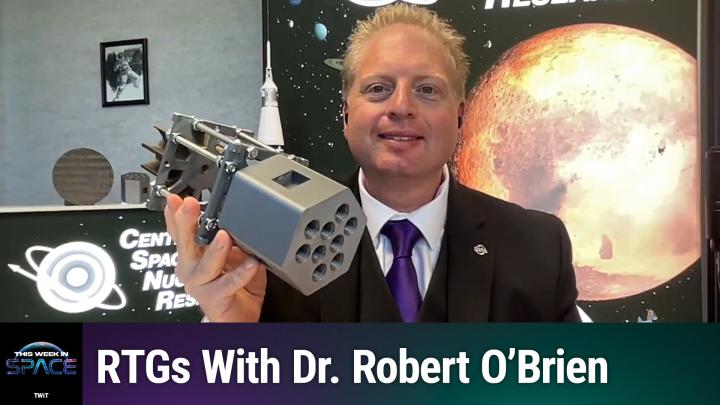
All TWiT.tv Shows (Audio)
This Week in Space 170: Atomic Space Batteries!
01:08:23
Dr. Robert O'Brien of USRA
Loading summary
Transcript221 lines
- [00:00]
Rod Pyle
Coming up on this Week in Space, the end of the universe is happening sooner than you might think. There's something happening on August 2nd, but it's not what you think. And Dr. Robert O' Brien of the center for Space Nuclear Research at USRA tells us what to think when it comes to radio, rtg, nuclear generators on NASA spacecraft. Check it out.
- [00:21]
Tarek Malik
Podcasts you love from people you trust.
- [00:25]
Lisa Z.
This is truth.
- [00:28]
Dr. Robert O'Brien
This is this Week in space, episode number 170, recorded on July 25, 2025. Atomic space batteries. Hello, and welcome to another episode of this Week in Space, the Atomic Space Batteries edition. I love saying that. Editor Chief, Badasser magazine. I'm joined by my fellow nuclear wannabe, Tarek Malik, Editor in chief@space.com.
- [00:53]
Rod Pyle
Hey.
- [00:55]
Dr. Robert O'Brien
And today we have the good fortune of being rejoined by Dr. Rob O', Brien, the Director of the University Space Research Association's center for Space Nuclear Research. You know, I've always wanted to title something better than hey you or Bonehead or whatever. And that's a pretty cool title. I don't know if it'll ever fit on a lower third for television, but it's a pretty cool title, I think. So before we start, please don't forget to do a solid and make sure to like and subscribe and the other podcast and other viewing options things, whether it's on YouTube or Apple Podcasts or Google podcasts, wherever it is you, you access us listening or watching or both. Because we need the love and we, we live and die by your support. So give us a thumbs up or a poke in the eye or whatever. Now I have from Scott Ulrich Scott modified space joke because I changed what he sent us. Hey, Tarek.
- [01:51]
Rod Pyle
Yes, Rod?
- [01:52]
Dr. Robert O'Brien
Why did Elon Musk fall into a wormhole during his first flight on Starship?
- [01:57]
Rod Pyle
I don't know. Why?
- [01:59]
Dr. Robert O'Brien
Because he failed the Doge on time.
- [02:03]
Rod Pyle
Oh, I get it. I get it.
- [02:06]
Dr. Robert O'Brien
Okay, that's like that laugh was the last version of a golf clap. Now, I've heard that some people want to stuff us into a black hole with his joke time of the show. But you can help send us your best, worst, or mostly different space joke at TwistedTwit TV. I haven't gotten one for three weeks.
- [02:24]
Rod Pyle
Come on, people.
- [02:25]
Dr. Robert O'Brien
Shame on people not sending us their space jokes. And just an admonition, you know, if you look up 101 funniest space jokes on the web, we've seen those already. We kind of need original stuff or at least something in print, because that way it hasn't been accessed A gajillion times. All right, onward to headline news.
- [02:48]
Rod Pyle
Headline news.
- [02:50]
Scott Ulrich
Headline news, Headline news.
- [02:56]
Dr. Robert O'Brien
You like Jeff Jarvis on the other podcast. Craig, Craig. Craig newmark. Okay. From space.com the this may happen after I'm dead.
- [03:07]
Rod Pyle
Actually, I think they're all from space.com this week.
- [03:10]
Dr. Robert O'Brien
Except for the last. The last two aren't. But the end is nigh in 33 billion years. So new discoveries and dark matter show that it may end up crunching the universe sooner than we thought.
- [03:23]
Rod Pyle
Yeah.
- [03:24]
Dr. Robert O'Brien
So I'm going to start drawing down my 401k. What about you?
- [03:27]
Rod Pyle
Yeah, yeah, you know, it's time to go actually get that tattoo and do the skydiving, you know, to get, get all the bucket list things checked. So no, this is, this is, it's basically, it's a new estimate for when the universe is going to die in the big crunch. You know, so we had the Big Bang, whatever, there's a singularity 13.7 billion years ago, explodes, creates everything and like everyone around us. And scientists basically used new results from surveys by the Dark Energy Survey, the Dark Energy Spectrograph Spectroscopic instrument, sorry, where they, they're tracking kind of the extent of, of dark energy. That's the, the force that we can't see, that we can't measure, but we, we can see through the indirect gravity effects that it's accelerating the expansion of the universe so that everything is just, you know, flinging itself away. So when does all of that energy dissipate? You know, when, when, when, when does it all go? So they, they have basically used all of those observations. And this is, by the way, we should point out, this is not, it's not a peer reviewed piece of research. And that means that scientists have not vetted the whole thing. Other scientists just. Yeah, other scientists. This is a paper that, that came, that is just kind of getting some traction on archive, that's a preprint server. So it still has to be vetted to ensure that everything is copacetic. But they're saying that there's a new model of dark energy behavior that they can pull from these surveys that would suggest that crunch, that end of the universe when it all kind of peters out is going to happen a bit faster than we thought. So 33 billion years is the new expiration date for our universe. Hopefully not. Hopefully that, you know, we'll find out that we're wrong because that seems kind of sad to know that there's an end date. But I mean, that's a long time from now. Like, completely.
- [05:21]
Dr. Robert O'Brien
I guess it's like downloading that app called Death Clock where it tells you how old you are when you're going to die. Mine said 76, so I decided to make.
- [05:30]
Rod Pyle
Oh, no.
- [05:31]
Dr. Robert O'Brien
You know, science can be very depressing. And I have a. I have an idea. Are you ready?
- [05:36]
Rod Pyle
I'm ready.
- [05:37]
Dr. Robert O'Brien
Let's just stop paying for science and then these bad things won't happen.
- [05:41]
Rod Pyle
I don't know about that.
- [05:42]
Dr. Robert O'Brien
If you don't get climate change data, you don't have climate change as a problem. If they stop telling us that smoking is bad for you, it's okay. We'll go back to the days where the doctors used to do commercials saying, I choose Chesterfields. All right, enough of that. Also from Space.com, nothing's happening on August 2nd.
- [06:01]
Rod Pyle
Yeah, this is a fast one, but I just want to remind people that you may be seeing a lot of headlines that say that August 2nd, the whole world will go dark. And they're talking about a solar eclipse. Except the only hitches that on August 2nd of 2025, there is no solar eclipse.
- [06:17]
Dr. Robert O'Brien
Oops.
- [06:17]
Rod Pyle
In fact, in August 2nd of 2026, there also is no solar eclipse.
- [06:21]
Lisa Z.
Oops.
- [06:22]
Rod Pyle
In fact, there isn't a solar eclipse, a total solar eclipse, on August 2nd until 2027. And even then, the whole world will not go dark. Just the part that's in the shadow of the moon. And so. And yet this was, like, gaining traction all week. And so we had to weigh in to let everyone know that this, this August 2nd, which is a Saturday, Sunday, I believe nothing untoward is going to happen. The sky is still going to be.
- [06:50]
Dr. Robert O'Brien
There, except Mars will be four times the diameter of the full moon. Right.
- [06:53]
Rod Pyle
I can. I know. I can guarantee that for half the world, the world will go dark because it will be nighttime. So there is that.
- [07:01]
Dr. Robert O'Brien
There is that.
- [07:02]
Rod Pyle
But. But, you know, we took it as an opportunity to let people know that on August 2nd of 2027, that's going to be like, the longest total solar eclipse in ages. Like, like, like this century, for sure. And so far. And. And so that is one to miss. Not. Not to miss. It's going to cross over Egypt. It's going to be really, really great. Also in September, there's a total lunar eclipse. That's going to be really exciting as well as a partial solar eclipse. But August 2, 2025, nothing's happening.
- [07:33]
Dr. Robert O'Brien
So if we go to Egypt, can we have our Raiders of the Lost Ark moment with a gem and a staff and. Yeah, yeah, maybe that laser beam okay.
- [07:43]
Rod Pyle
Can you imagine what a, what a, what a circus it's going to be? Because it's going to happen over the pyramids and everything. So it's like so many people are gonna.
- [07:50]
Dr. Robert O'Brien
Yeah. So then it's gonna be like sheer lunacy. That would be a cool place to see it though.
- [07:55]
Rod Pyle
Sure. Lunacy. Or she. Oh yeah. It's like that's a moon pun. Because it's the moon. Right, I get it. I see.
- [08:00]
Dr. Robert O'Brien
Okay, moving on. Also from Space.comMother Earth 2.
- [08:05]
Rod Pyle
Oh yeah.
- [08:06]
Dr. Robert O'Brien
35 light years from Earth, L98, 59 is a cool, dim red dwarf star already known to host a compact system of small rocky planets. Sorry, that's the name of the planet. I think L has an F name of the star.
- [08:22]
Rod Pyle
9859 is the star planet F. All right, but. So this is my grades in high school.
- [08:29]
Dr. Robert O'Brien
So called Earth, like in the habitable zone because it's. But because it's a red dwarf. The habitable, habitable zone is about 10ft from the star.
- [08:39]
Rod Pyle
That's right.
- [08:40]
Dr. Robert O'Brien
So its whole year is 23 days. They do note that it has low mass, which may indicate that it's got lots of water. But they need to investigate for an atmosphere and check for tidal locking. Now the other problem is red dwarfs aren't terribly stable in terms of radiation and so forth. So isn't this kind of a low probability for a place for critters?
- [09:00]
Rod Pyle
Well, you know, there was a time where they thought that it would be too inhospitable. But I think that that thinking has eased a bit because they're realizing that there's much more variation in what these conditions can be around the planets. Now this is, it's a, this is technically a super Earth. It's 2.8 times the mass of Earth. So. So it is bigger, it does spin, you know, faster. It does move faster. 23 days, like you said, for their year. But it really remains to be seen. A lot of the scholarship that I've read says yes, the radiation environment extremely high, extremely active around these red dwarfs. But you know, I saw that BBC TV show way back when and that was hilarious. So I think that red dwarfs have a lot to that they can give. Is that a different red dwarf?
- [09:46]
Dr. Robert O'Brien
Well, and if the planet is tidally locked, I mean there's also a lot of discussion and disagreement about tidally locked worlds. Yeah, a planet is tidally locked and you're in a high radiation regime, but you're around the terminator slightly on the dark side of it. Where it stays like that all the time. That could be a whole nother story, you know.
- [10:05]
Rod Pyle
Exactly.
- [10:05]
Dr. Robert O'Brien
Rock outcropping you can turn into a, a bigger amoeba or something. All right, and before we jump off of this NASA budget, what's happening with the NASA budget?
- [10:17]
Rod Pyle
Tarek, I wish I knew. I know that you picked this space news story about the Senate, folks, but I can't read it because it's behind a paywall and I missed it. However. However.
- [10:27]
Dr. Robert O'Brien
Well, but, but the Senate is pushing back, which is what we care about.
- [10:30]
Rod Pyle
The Senate, Yeah. The Senate's been this, this, this has happened in, in a few different committees that we've been following, but the Senate as well as the House, I should point out, have both flagged science missions that they're worried about in the current 2026 fiscal year. Budget request from the Trump administration, and they're saying, no, we need to preserve this science. We need to do this, you know, don't cancel this mission, et cetera. And in fact, the Senate Appropriations Committee has actually flagged a bit of an increase of a budget for NASA compared to what we're seeing in the, the Trump administration's request. Now, the Senate version and the House version, both of them have been created, at least at the committee level. They still have to go all the way up through their levels, and then they have to be reconciled. Right. And so there's still a long way to go to see if they're going to buck the administrator, the administration's request for NASA science. Overall. I should point out that all of this comes on the heels of a Moon Day quote, unquote, protest that dozens of of NASA employees, contractors, and their supporters staged outside the Smithsonian Air and Space museum in Washington, D.C. on July 20, the anniversary of the Apollo 11 moon landing. Really demanding some sort of attention from congressional leadership towards the science and the budgeting process, because they feel that all of these cuts are extremely damaging to both the science capabilities of NASA now and the future for years to come because people are leaving, either being forced out through layoffs, forced out through cuts, forced out through the, you know, deferred resignations that they're being pushed to take. And then they're gonna go somewhere else, somewhere like some other space agency.
- [12:18]
Dr. Robert O'Brien
Well, or to private industry or to retirement or to academia, at which point, so there's a last story from political space, but it was saying at least one in five NASA senior staff, mostly top scientists, engineers, and senior managers, have either left or plan to announce their departure by today, according to documents obtained which Brings us closer to 3,000, not 2,000. You know, the oldest guys aren't always the smartest ones in the room, but they are critical in terms of experience and the brain trust and so forth. So the damage may already be done, a lot of it.
- [12:54]
Rod Pyle
We don't know if we can get.
- [12:55]
Dr. Robert O'Brien
These people back or not.
- [12:55]
Rod Pyle
I mean, we talked about Laurie Leshin leaving, you know, resigning from JPL amidst the cuts that were. That were happening there. And actually just, you know, since that political report that you cited, we actually found out that the director of the Goddard Space Flight center also stepped down. Mackenzie Lystrup. So, you know, this is still all very dynamic and happening, like, right now. Meanwhile, these people that are on the ground floor that make the space agency work, you know, everyone from the scientists to the engineers to the administrative folks are saying that, like, the agency is on fire and they need, like, support from the government to put it out.
- [13:36]
Dr. Robert O'Brien
Well, and you. And you wonder at the rate that the women in senior positions in the military are being pushed out, you got to wonder if. If there's that same paranoia at NASA of, you know, feel like you're walking with a target in your back. All right, before we. We go on to Dr. Rob O', Brien, who's coming up in just a moment, we got a question yesterday from Lisa Z. Lisa, this says, I was just curious, if either of you have the opportunity to go to the Karman Line or the space station for free, would you go? Elon Musk could go to space, but he doesn't seem to want to. So I responded by saying, yes, I thought we would. But in my case, I'd rather do it on Blue Origin's New shepherd, if it's suborbital than the Virgin Galactic. Although I wouldn't turn either down. I just like the idea because I'm old school, you know, going up the rocket and coming down. If it's to the space station, which would require a little more prep and weight loss and so forth, I would much prefer to go up on a crew dragon because, well, starliner on the one hand, and on the other hand, if you've ever seen what the inside of a. So whose capsule looks like when there's three astronauts or cosmonauts in it, there's barely room to move your urine box.
- [14:48]
Rod Pyle
You're, like, in a fetal position.
- [14:50]
Dr. Robert O'Brien
Oh, my God. And then there's. I don't know what the. What are those packages? They're, like, right up against their helmets.
- [14:55]
Rod Pyle
That's, like, the supplies and the gear and stuff.
- [14:58]
Dr. Robert O'Brien
Okay. Because they look like parasites. Parachute packing. But you shouldn't put the parachutes inside the cabin.
- [15:02]
Rod Pyle
No, it's all the supplies. It's all crammed in there.
- [15:04]
Dr. Robert O'Brien
But it's a real small capsule.
- [15:06]
Rod Pyle
Yeah. They made the orbital module bigger on the Shenzhou. That was informed that.
- [15:10]
Dr. Robert O'Brien
Yeah.
- [15:11]
Rod Pyle
That's why the Shenzhou's look so clean.
- [15:12]
Dr. Robert O'Brien
It's lengthened. But, but if you look at. Did you, I don't think. Did you go to the, the Dragon, the crew dragon unveiling at SpaceX years ago?
- [15:21]
Rod Pyle
No. You were the one that was there.
- [15:22]
Dr. Robert O'Brien
Yeah.
- [15:22]
Tarek Malik
Okay.
- [15:23]
Dr. Robert O'Brien
I guess that's why I didn't see you there because I was supposed to be doing it. You know, it wasn't fully kitted out yet, but it was like stepping into somebody's.
- [15:33]
Rod Pyle
I've seen the mock up at the closet that they had at building. Yeah, it's, it's large. I've also seen the mock up at Building 9 of the, of the Soyuz, but I didn't get to go inside because Miles o' Brien was filming a segment there. And this is like in the early 2000s.
- [15:46]
Dr. Robert O'Brien
What an insider that you could say building building nine. Like we're all supposed to know what that means.
- [15:50]
Rod Pyle
Building 9 is the building at the Johnson Space center that has all of the mockups in it and everything.
- [15:55]
Tarek Malik
Okay.
- [15:55]
Rod Pyle
That the astronauts use.
- [15:57]
Dr. Robert O'Brien
All right, well, let's, let's get on to the good stuff. We'll be right back after this short message with Rob o' Brien to talk about atomic space batteries don't go anywhere.
- [16:06]
Lisa Z.
Let's map out this week's amazing destinations and travel tips.
- [16:10]
Scott Ulrich
Honestly, Will, I didn't plan any trips, but I did switch to T Mobile with their new Family Freedom offer.
- [16:18]
Dr. Robert O'Brien
That's not the itinerary we're following.
- [16:21]
Scott Ulrich
Well, I'm departing from AT&T and embarking on a new journey with T Mob Mobile. They paid off my family's four phones up to $3200 and gave us four new phones on the house.
- [16:34]
Dr. Robert O'Brien
Bon voyage.
- [16:36]
Will
Introducing Family Freedom. Our lowest cost will switch our biggest family savings all on America's largest 5G network. Visit your local T Mobile location or learn more@t mobile.com familyfreedom.
- [16:49]
Craig Newmark
Up to $800 per line via virtual prepaid card. Typically takes 15 days. Free phones via 24 monthly bill credits with finance agreement eg Apple iPhone 16128 gigabyte. $829.99 eligible trade in eg IPH for well qualified credits end and balance due if you Pay off earlier.
- [17:01]
Will
Cancel Contact T Mobile this episode is.
- [17:02]
Lisa Z.
Brought to you by the Electronic Frontier Foundation. I love hearing those words. For 35 years the electronic frontier foundation has been fighting to make sure when you go online, your rights go with you. I'm a proud member. You should too. I also listen to their great podcast how to Fix the Internet. I don't know how I would sum up what the EFF does. It does so much. They're lawyers protect security researchers from companies that don't want them to do the research. EFS technologists develop open source software to combat surveillance. If you use privacy badger, you oughta and their activists push companies to build tools that work for you, not against you. The EFF's podcast How to Fix the Internet has some of the best guests ever. People from like minded groups including the Digital Defense Fund, the Tor Project, the Freedom of Press foundation, leading thinkers in post quantum crypto, AI neurotechnology. And with every guest they ask the question, what does the world look like if we get this right? Visit eff.org podcast and listen to how to Fix the Internet. And by the way, join the eff. I'm a member. You should be too. Thank you eff.
- [18:08]
Scott Ulrich
Ever notice how ads always pop up at the worst moments? When the killer's identity is about to be revealed during that perfect meditation flow on Amazon Music. We believe in keeping you in the moment. That's why we've got millions of ad free podcast episodes. So you can stay completely immersed in every story, every reveal, every breath. Download the Amazon Music app and start listening to your favorite podcasts. Ad free included with Prime.
- [18:42]
Dr. Robert O'Brien
And we are back with Dr. Robert O' Brien, who is the director of the center for Space Nuclear Research for usra. Thank you for joining us today.
- [18:49]
Tarek Malik
Rob, thanks for having me back. It's great to see you.
- [18:53]
Dr. Robert O'Brien
Well, it's really fun to have you back. We had a great time last time. Could you give us just a refresher on USRA and your specific center?
- [19:03]
Tarek Malik
Happy to, yeah. So I am the director of the center for Space Nuclear Research. We're a center for excellence for nuclear propulsion and power for space. And we have been in this field for about 20 years. This is our 20th year of operation and we've been really pushing the envelope and challenging the bounds of status quo, thinking outside the box, encouraging the next generation of nuclear scientists and engineers into the aerospace crossroads with nuclear energy for that 20 year period. And yeah, we're doing a lot of fun thinking and development of technology and systems and strategy.
- [19:45]
Dr. Robert O'Brien
Well, that, that is great. And. And of course, today we're here to talk about RTGs, or radioisotopic thermoelectric generators. I think I got that right, which I first heard about, I think, when I was young during the Apollo years. And I became aware of it because on Apollo, the Apollo 12 landing was the first one where they had an RTG to power the ALSEP surface experiments. And of course, the camera burned out, so we weren't able to see this. We were just basically, it became a radio show once they lost their camera after the landing. But there was a.
- [20:20]
Rod Pyle
Are we going to skip my question, Rod? I know that we had Rob on that.
- [20:23]
Dr. Robert O'Brien
Not yet, not yet, not yet. But there was kind of a Laurel and Hardy audio show between Pete Conrad and Al Bean while they were trying to get that fuel element out of the cask, to the point that Pete Conrad says, get me the universal tool, which is a hammer, and starts beating on this task with this radioactive core in it that they had to go put in the. In the outset package. So that certainly got me interested once I realized that that was a chunk of. Was it plutonium?
- [20:54]
Tarek Malik
Yeah, plutonium 238. Fuel? Yeah, absolutely.
- [20:57]
Dr. Robert O'Brien
Generally something you don't want to be hitting with a hammer. So that got me fascinated with RTGs. So they are a great way to power deep space probes anywhere from Mars and beyond, is Walt Disney used to say. But before we go forward with that, I believe my partner has a question for you.
- [21:13]
Rod Pyle
Yeah, I was like, why. Why are we jumping straight into it? You know, there are, there are people, our listeners, who, you know, might have missed Rob's first episode. So I just wanted to make sure that we gave them a chance to. And by the way, we didn't say that USRA stands for University Space Research Association. So just for folks who don't know, that's, that's, that's, that's the group. But, Rob, you know, just a quick, A quick reminder. You know, you talked about your expertise there at the center, but how did you fall into the space black hol like Rod and I did, you know, just to give people that reminder, that refresher course.
- [21:45]
Tarek Malik
Yeah, yeah, happy to go back on that. I think, like all of us, there's a lot of influence from what we watch, the environment that we live in, watch on tv, people around us, family, they all inspire us to do things and find our passion area. I worked in the. Into the space arena purely from that childhood set of experiences in terms of what I watched on tv, watching Star Wars Movies, you know, a little bit of Star Trek, you know, got boldly going. But, you know, I think that the things that we can do. It just seemed like there was an immense amount of energy quite literally involved in some of those old TV shows. And then when I started my professional career in space technology development, I transitioned to look at some of the technologies I think we're going to talk about today. But nuclear technologies in general as a focal area for my career, because there really is a huge challenge of how you power missions in space, how you propel missions in space, and doing that efficiently is challenging. Solar power works to a degree, but sometimes there's a need for just more energy density, whether you're going into deep space or really difficult environments, if you're working in eclipse, in craters on the moon. And I was working in development of systems at the University of Leicester in the UK for initially Arctic exploration and then to move on and deploy those technologies we develop here on Earth for exploration of icy moons like Europa. And I think some of the challenges there that I learned early on what was a bad thing was scope creep, where a mission wanted to go from one week to two weeks and then two years under ice or on another planet or on an icy moon. That's really challenging. You've got to take all that juice, all that energy to the surface. And it wasn't going to happen with lithium polymer batteries that we power most of our missions with today. And so I sort of moved on to look at nuclear energy and started scouring the chart of the nucleides back in 2006. And I kind of discovered that americium 241 was a European solution for powering missions in space. And that's kind of a parallel to the US strategy. But I think it's starting to have its own gravity here stateside as well. So love to chat more about that.
- [24:29]
Rod Pyle
So you hear that, Rod? He said Star Trek in there and nuclear science, which means that.
- [24:35]
Dr. Robert O'Brien
He said some Star Trek.
- [24:37]
Rod Pyle
That means that Rob can tell us where the nuclear wessels are.
- [24:40]
Dr. Robert O'Brien
I think you were just waiting for that, weren't you? He also. You were a little generous, Tarek, with comparing us to him. We said how he joins into space like we did, it's kind of different, you know. Rob, can you hold up your PhD thesis for. For us to see?
- [24:58]
Rod Pyle
This is what we say, this is.
- [25:00]
Dr. Robert O'Brien
The difference between him and us?
- [25:01]
Rod Pyle
Yes, he wrote the book.
- [25:04]
Dr. Robert O'Brien
My master's thesis was about a sixteenth of an inch thick and light reading at that.
- [25:08]
Rod Pyle
So I chose my program Because I did not have to write a master's thesis.
- [25:12]
Dr. Robert O'Brien
Well, there you go. So I come from an era where, because I'm. I got 20 plus years on you guys, maybe, maybe more than that case. But I come from an era where I grew up seeing black and white Saturday morning movies where the tagline was things like it's atomic and the atomic monster and atomic spaceships to Pluto and that kind of thing. Everything was going to be atomic. Of course, this is all fission because, you know, how dangerous can fish and be, it's no big deal. And we kind of found out that's not the case. But then come RTGs, which I guess were actually deployed terrestrially in the 50s, right. And then in space starting in the 60s. But before we get too, too carried away with that now, I called this episode Atomic Space Batteries. But these really aren't batteries, they're. They're power generators. So if you could give us the layman's my Labrador can understand an explanation of what an RTG is and how it works, that would be, that would be great.
- [26:12]
Tarek Malik
Absolutely. Happy to. Yeah. So an RTG stands for Radioisotope Thermoelectric Generator. And in that name it suggests that what we're converting is thermal energy heat to electrical power. And so the power conversion technologies, the converters work using a physics phenomena called the Seebeck effect, where if you have a temperature differential between to materials, they can generate electricity, electrical power can flow. And it's really a matter of engineering of those physics devices. So it's a cascade or an insulation system with a cascade of these devices that convert the heat to electricity and the waste heat that passes through that material composite then radiates to space. So we use a fin or a radiator panel, just like we would for rejecting heat from any other spacecraft or even our cars, where we have radiators to reject the heat from the internal combustion engine, we have to waste some of that heat. So Carnot efficiency drives us. So at best we could convert around 60% of heat to power. In reality, we're stuck around 30% thereabouts.
- [27:38]
Dr. Robert O'Brien
And we'll be going through some of these missions. But just for people who have listened to the show before, we have talked a lot about Voyager. Voyager is working with RTGS and has been since its launch in the 70s, late 70s. So that's how long these things are effective. They do diminish over time and, and we'll talk about that later. But basically, as I understand what you just said, it's a warm piece of nuclear material surrounded by thermocouples that generate power.
- [28:07]
Tarek Malik
As long as you let's it's that nuclear decay that generates the heat. And there's some isotopes that are our favorites, our best choices from an engineering perspective. We want good high power density, but there's also a big trade space. That's the type of radiation that isotopes make or produce. So you have to fight both heat generation and radiation damage. So there's lots of things that you have to think about. And then toxicity, how you encapsulate materials, that's a serious consideration. When we look at fabrication and launch safety. These are all really important areas that the engineering solution has to develop. But yeah, it's just that conversion of decay heat of a radioisotope to electricity through thermoelectric There are other methods as well to convert radiation to electricity and we can, we can certainly talk in more detail about later. But that would be direct energy conversion, but with the name rtg. That's the heat to electric conversion.
- [29:12]
Dr. Robert O'Brien
Okay, Tarek, I know you're next, but a break. So standby. We'll be right back. Hold on to your atomic elements.
- [29:19]
Lisa Z.
Let's map out this week's amazing destinations and travel tips.
- [29:23]
Scott Ulrich
Honestly, Will, I didn't plan any trips, but I did switch to T Mobile with their new Family Freedom offer.
- [29:31]
Dr. Robert O'Brien
That's not the itinerary we're following.
- [29:34]
Scott Ulrich
Well, I'm departing from ATT and embarking on a new journey with T Mobile. They paid off my family's four phones up to $3200 and gave us four new phones on the house.
- [29:47]
Dr. Robert O'Brien
Bon voyage.
- [29:49]
Will
Introducing Family Freedom. Our lowest cost will switch our biggest family savings all on America's largest 5G network. Visit your local T Mobile location or learn more@t mobile.com FamilyFreedom up to $800.
- [30:03]
Craig Newmark
Per line via virtual prepaid card typically takes 15 days. Free phones via 24 monthly bill credits with finance agreement eg Apple iPhone 16128 gigabyte $829.99 Eligible trade in eg iPhone 11 Pro for well qualified credits end and balance due if you pay off early or cancel contact T Mobile this.
- [30:15]
Lisa Z.
Episode is brought to you by the Electronic Frontier Foundation. I love hearing those words. For 35 years, the electronic Frontier foundation has been fighting to make sure when you go online, your rights go with you. I'm a proud member. You should too. I also listen to their great podcast how to Fix the Internet. I don't know how I would sum up what the eff does it does so much. Their lawyers protect security researchers from companies that don't want them to do the research. EFS technologists develop open source software to combat surveillance. Have you used privacy? Badger, you oughta. And their activists push companies to build tools that work for you, not against you. The EFF's podcast How to Fix the Internet has some of the best guests ever. People from like minded groups including the Digital Defense Fund, the Tor Project, the Freedom of Press foundation, leading thinkers in post quantum crypto, AI neurotechnology. And with every guest they ask the question, what does the world look like if we get this right? Visit eff.org podcast and listen to how to Fix the Internet. And by the way, join the eff. I'm a member. You should be too. Thank you eff.
- [31:21]
H
Whether you're into comedians roasting each other's life choices or turning yesterday's bad decisions into today's funny stories, Amazon Music's got the most ad free top podcasts included with Prime. Download the Amazon Music app and get in on the joke or go to Amazon.com ad free comedy that's Amazon.com ad free comedy to catch up on the latest episodes without the ads.
- [31:48]
Rod Pyle
You know, Rod mentioned Voyager. I think that's probably for the layperson, probably like the easiest example or the clearest example of where these types of systems had been used. But I was really surprised just in when we were talking offline before the show started that, that the use of these in space was, you know, much, much earlier. I mean I think that it's kind of with the start of the, the space age. Right? I mean like when was the first time we started using these in space? And was it. I guess. And why, why did we choose that? I suppose opposed to solar or something like that.
- [32:26]
Tarek Malik
Yeah, so I mean the first, the first use of rtgs in the US and public demonstration actually was under President Eisenhower. So we put a Polonium 210 powered RTG on the President's desk in the White House. I think that's incredible. But it's a demonstration toxic. As I reflect it, yes, it's a little toxic. And we endeavor not to expose anybody as we're engineering the materials, engineering the systems. And that's exactly why safety is every part of the consideration of the engineering solution. But we demonstrated that. I think that shows trust in engineering and chemistry and physics that we could bring this to the highest office in government here in the US And I think that's an important milestone. And from there we saw a lot of demonstrations there's been around 44 missions flying RTGs or using RTGs over history, 38 to 40 US RTG missions. I think that there's a long history there and pushing the envelope of what can be done in space. Like you say it was since the dawn of the space age, we wanted to do challenging things, go to challenging places and orbits that might eclipse significantly or have an extended period of time in darkness. And that's really hard to do with, with solar power or you have to have a very large solar array and a significant amount of energy storage battery to power the mission itself. So I think that's, that's the why is it's to go to the places that aren't easy. And you know, there's a term that, that I've started using, you know, it's mission enabling value. And I think that's, that's why we use RTGs and fission systems is because we can't do a mission without nuclear energy. And so if you've got mission enabling value, it offsets the cost of executing the mission with nuclear energy and really allows us to do the other things.
- [34:41]
Dr. Robert O'Brien
So before we came on, we were talking briefly about the first RTG powered satellite that I found on the US side anyway, which was the US Navy's Transit 4A in 1961. And you said it created 1.7 watts of power, is that right?
- [34:57]
Tarek Malik
I think it was like 2.7 watts of electric. Yeah, there's pretty, pretty small.
- [35:02]
Dr. Robert O'Brien
So was that actually running the satellite and the transmitter or was it just a demonstration?
- [35:07]
Tarek Malik
So that can be used to charge batteries and, and then from, from the batteries you can periodically discharge with burst power applications like radio transmission when you're over a ground station or collecting data using a sensor. So yeah, nothing has changed to some of those use cases. And as, as we look to the future, I think we're going to see more and more agile systems built with flexible use of power. Not just peak power being the, the approach like we take today with flagship type systems, but actually looking at energy storage hybridized with radioisotope systems.
- [35:44]
Dr. Robert O'Brien
So we're, I think generally people listening to the show are used to the idea of rtgs being used in deep solar system missions because as you get further and further out, of course there's less solar energy and the solar panel systems get immensely large. But one thing at least that I don't hear discussed a lot is the uses on Mars. So Both Viking Landers 1976 had RTGS on them and could have lasted a lot longer. Than they did, but for various reasons they fell out of contact within a few years. I think the longest was before six years and that was Viking 1 in 1982. But the Voyagers are of course the classic example because they're still talking to us and they've been out there since 77, 78. How many watts are they generating at this point and what percentage their original capacity was that?
- [36:37]
Tarek Malik
Yes. So you have an isotope as the fuel source, as plutonium 238, that has a 88 year half life. And so, you know, you produce roughly half of that thermal power every 88 years. That's what we're looking at as a decay scheme. There are other material problems that start to arise with radiation damage, Neutron exposure, gamma exposure starts to degrade the thermoelectrics. But yeah, we're, we've still got, still got plenty of life left in the fuel and, and certainly the, the degradation mechanisms happen over a long period of time.
- [37:20]
Rod Pyle
Can I interrupt? Does that mean that even though we lost contact with like the Vikings, that the RTG is still like pumping out heat and stuff like that? Like, could we go exactly, tart, like plug stuff? I mean, like, that's so sad.
- [37:34]
Dr. Robert O'Brien
Well, to your point, I was at jpl, I don't know, six years ago, I was talking about Viking to somebody in the hallway and an engineer walked out of one of the offices and he said, you know, we're, we're thinking about that again, right? So what are you talking about? And he had actually worked up a study or a paper on the idea of sending a tremendously powerful radio signal towards the Viking 1 landing site to see if it would bounce off the surface and hit the dish. Because the whole reason we lost contact is the dish rotated off axis because of a bad command string and suddenly it couldn't see Earth anymore and it went silent. So for all we know, it's sitting there waiting for its last message, like, oh man, what do I do now, daddy? But that, that didn't go anywhere. But that's not what we're here to talk about. So Galileo and Cassini were both also RTG powered. And then of course the Curiosity and Perseverance rovers are as well. And we had, prior to that, of course, we had Spirit and Opportunity, which were solar panel powered. But as doesn't get discussed enough in public forums anyway, you know, when you have solar panels in space, that's one thing, when you have them on Mars, they tend to get covered in dust and they're usually perpendicular to this or parallel to the surface. So they're flat and they, they pick up a lot of dust. And you know, there's been talks about having air blowers on them or vibrating mechanisms or something. It turns out there are enough windstorms that they generally get cleared off. But, you know, it would seem that you'd want to power everything in space with rtgs.
- [39:07]
Rod Pyle
Dragonfly.
- [39:08]
Dr. Robert O'Brien
But there are problems with that, right?
- [39:11]
Tarek Malik
Yes. So we want as much power as we can get. As a mission designer, you want to maximize the power budget that's available. And you know, that's not always as easy, especially with environmental conditions. So if you, if we're turning attention to Mars, specifically in this example, if we're looking at putting a human expedition to Mars in the next few years, we need lots of power for life support and even propellant manufacturing for Earth return. So if you're factoring in a solar plant to do all of that, you need to think about degradation due to windstorms, dust deposition. There are clever technologies like ultrasonics that can shake the dust loose. But you, you can't fix broken panels on Mars. You've got to have excess capacity. So let's say, for example, you need 3 megawatts of power to generate propellant to come home over a one to three month mission lifetime on the margin surface. With solar, you really ought to put 5 megawatt plant just in case you have a seasonal upset. You get weather systems that damage some of those generation sites. So with nuclear, you can make it really compact. And actually we've already started demonstrating the ability to make breathable oxygen on Mars and some of the precursors for liquid fuels like syngas. So splitting the margin, CO2 in the presence of water, you can make syngas, which is hydrogen and carbon monoxide. And they're building blocks to some really interesting chemistry. But yeah, if you're going to go to another planet, you really need that redundancy and resilience that nuclear energy can bring us.
- [41:00]
Rod Pyle
So we were just talking offline. That reminded me that the Titan rotocopter, the Titan helicopter drone that NASA's planning is also going to be RTG Dragonfly. So I was just mentioning it to Rod, but we don't know if they're going to survive.
- [41:14]
Dr. Robert O'Brien
Yeah, right.
- [41:15]
Tarek Malik
Well, so far, yeah. Yeah, I hope so. Yeah.
- [41:19]
Dr. Robert O'Brien
All right, we're gonna go to one more break and we'll be right back. Stand by.
- [41:23]
Lisa Z.
Let's map out this week's amazing destinations and travel tips.
- [41:27]
Scott Ulrich
Honestly, Will, I didn't plan any trips, but I did switch to T Mobile with their new Family Freedom offer.
- [41:35]
Dr. Robert O'Brien
That's not the itinerary we're following.
- [41:38]
Scott Ulrich
Well, I'm departing from AT&T and embarking on a new journey with T Mobile. They paid off my family's four phones up to $3200 and gave us four new phones on the house.
- [41:51]
Dr. Robert O'Brien
Bon voyage.
- [41:53]
Will
Introducing Family Freedom Our lowest cost will switch our biggest family savings all on America's largest 5G network. Visit your local T Mobile location or learn more@t mobile.com FamilyFreedom up to $800.
- [42:07]
Craig Newmark
Per line via virtual prepaid card typically takes 15 days. Free phones via 24 monthly bill credits with finance agreement eg Apple iPhone 16128 gigabyte $8229.99 Eligible trade in eg IPH for well qualified credits end and balance due if you pay off early or.
- [42:18]
Will
Cancel contact T Mobile this episode is.
- [42:19]
Lisa Z.
Brought to you by the Electronic Frontier Foundation. I love hearing those words. For 35 years the electronic frontier foundation has been fighting to make sure when you go online, your rights go with you. I'm a proud member. You should too. I also listen to their great podcast how to Fix the Internet. I don't know how I would sum up what the EFF does. It does so much Their lawyers protect security researchers from companies that don't want them to do the research. EFF technologists develop open source software to combat surveillance. Have you used Privacy Badger? You oughta and their activists push companies to build tools that work for you, not against you. The EFF's podcast How to Fix the Internet has some of the best guests ever. People from like minded groups including the Digital Defense Fund, the Tor Project, the Freedom of Press foundation, leading thinkers in post quantum crypto, AI neurotechnology. And with every guest they ask the question, what does the world look like? If we get this right, visit eff.org podcast and listen to how to Fix the Internet. And by the way, join the eff. I'm a member. You should be too. Thank you eff.
- [43:25]
Rod Pyle
Hey prime members, Are you tired of ads interfering with your favorite podcasts? Good news. With Amazon Music you have access to the largest catalog of ad free top podcasts included with your prime membership. To start listening, download the Amazon Music app for free or go to Amazon.com ad freepodcasts that's Amazon.com ad freeppodcasts to catch up on the latest episodes without the ads.
- [43:51]
Dr. Robert O'Brien
So when you're talking about mass trades, I guess, or however that's addressed Is there a point, you know, for the kind of power you're talking about in the megawatts, is there a point at which you really need to go to something like a fission reactor as opposed to an RTG? Or can you just keep scaling RTGs?
- [44:10]
Tarek Malik
Well, if the world had an abundance of the isotope materials of choice, isotopic materials like americium, plutonium, and we had an abundance of it or even curium, then we could build systems that are in the multi kilowatts. It starts to break even from a power density perspective though, in that kilowatt range. So that's where reactors start to become a really favorable system when you need kilowatts. So when we're talking about human expeditions, you could think of an RTG as a really essential lifeline or a backup battery that's always going to be on, it's always going to be there, ready. But you need fission to generate the high power use cases for those high power budgets. But for small systems, this is where isotope power really opens up. What can be done. In fact, I got a little desk toy here. This is our Ambus system that we're developing. This is a cubesat scale. So this is a mock up of our americium powered cubesat system. It kind of turns everything upside down. So this is the scale that really can be enabled for the outer planets if you use rtgs. And this is the scale that it really opens up because you can start to look at commercial and semi commercial isotope supply chains that give us access to these missions and then will enable science to be done in the darkest and coolest places of the solar system and beyond. And I think that's really where it's.
- [45:48]
Rod Pyle
Interesting for people who are just listening. Rob was holding a little mock up of a cubesat that is about the size of a Rubik's cube from what I can tell. A little bit bigger than a rubber.
- [45:59]
Dr. Robert O'Brien
Yeah, but that's, that's one to one, right? One, one scale.
- [46:02]
Tarek Malik
This is one to one. Yeah. So this is what we would consider a three. A three cube set.
- [46:07]
Rod Pyle
Yeah, it looks like a big coffee mug with like a bit of a space in between. And then the RTG looks like a, the size of a duck. Roll tape. Like a great big jumbo one on the back. That's, that's pretty cool. That's pretty slick. Well, well, I guess just to add to that, you know, I recall several years back a whole big hullabaloo with why NASA didn't have any missions planned to use rtgs. Going out because, because we didn't have any nuclear material to make them out of. And then the Department of Energy, they worked together, they were able to restart a pipeline to make, to make that stuff. So, so it sounds like the reason that you and I don't have RTG refrigerators or, or, or, or like the, the house, like, like the world of fallout or the atomic age promised us is because this stuff is just so hard to come by. And, and I'm just kind of curious, I mean, are we out of it, of the plutonium and all that stuff already, or do we have to just keep making them in the reactors? Is there not a factory that can make this stuff for space exploration that then we can build probes to our heart's content?
- [47:18]
Tarek Malik
You know, that's a complex question, Tarek. I'll try and explain an answer to it. We became internationally dependent on our supply chain through the 90s. After the fall of the Soviet Union, we worked closely with the Russian Federation. The supply chain that we became comfortable with came from the Russian Federation for plutonium 238. Now that is an isotope of choice because it's about a half watt per gram. So not only is it a long, long enough life to actually build a battery, you can put it in the vault, you can store it until the mission's ready. If you scrub a mission window, you can wait for the next one to open up for Mars or other launch windows. So it's a great isotope. It's actually one of those isotopes that we moved away from. Polonium210, that was an isotope that was looked at, that was what was taken to Eisenhower's desk in the 50s. And that has its challenges because that's only 110 day half life. So plutonium 238 is in the sweet spot of isotopes. It's a decent power density, half watt per gram and it has an 88 year lifetime or half life. And so that is a great isotope. The challenge with it is it has to be produced in nuclear reactors. We had a moratorium on separation technology and reprocessing of spent fuel. And what I would say is lightly used fuel where you go to 3%, maybe 6% burn up in some cases of nuclear fuel. There's a lot of unused fuel there that if we could reprocess it, we could put that back into the commercial fuel cycle. And by the way, you can take parts of that waste stream and use it to power cubesats like this or systems like we do on the flagship scale with plutonium 238. One of the other challenges, why this is complex is in the 90s, we shuttered five production reactors at Savannah River National Lab and the five production reactors up in Hanford. And we did that because the world was changing from a geopolitical perspective. And you know, we have a need for medical isotopes, we have a need for isotopes for RTGs and deep space. But we quite frankly don't have production reactors anymore. We have test reactors. These are great to make what the name would suggest research quantities. And so some of the challenges that the Department of Energy has faced over the last few years is to address the mission and the need of the nation to make plutonium 238, but without the tools in the pouch to do it. So you really need a production reactor or you need to be able to produce material in reactors that have the neutron economy, the fuel cycle length that actually matches the best place and the sweet spot in the production curves. Actually at the center for Space Nuclear Research, we started looking at this problem probably about 15 years ago when the crisis started to percolate where supply chain from the Russian Federation started to be challenged. From their perspective changes. And so we have to look at other solutions today that are outside the box thinking and use the tools that we have access today. But the resistance to change is really tough. And so because of that, we've seen a few grams per year prod after tens and tens of millions of dollars are spent on production, Only a few grams is very, very short of a 1 1/2 kilogram a year production rate target. So there are capabilities on the full life cycle. We've got supply of target material in the nation, we can do that. But what we're missing is that one tool. So as we look at advanced reactor developers that are working today, there's certainly an outlet there for their technologies to align with isotope production. And some of the IP that we looked at as very novel target technology. So looking at not just the traditional approach to putting solid material into a core and irradiating it, but looking at optimizing the number of days that that material stays resident in the reactor and pulling it out at the right moment in time so that we don't burn more material than we produce, it's a really real tough neutron economy physics, chemistry problem set that we have. And I think there's paths forward if we can think outside the box, change the status quo and align with new technologies in reactors as well as new target technologies.
- [52:16]
Dr. Robert O'Brien
I never realized that making plutonium was so much like baking cookies or croissants. That's kind of interesting that you have to know when to pull them out of the oven. We're going to jump to one more break and then I'm going to come back with my next question. So stay with us.
- [52:28]
Lisa Z.
Let's map out this week's amazing destinations and travel tips.
- [52:33]
Scott Ulrich
Honestly, Will, I didn't plan any trips, but I did switch to T Mobile with their new Family Freedom offer.
- [52:40]
Dr. Robert O'Brien
That's not the itinerary we're following.
- [52:43]
Scott Ulrich
Well, I'm departing from AT&T and embarking on a new journey with T Mobile. They paid off my family's four phones up to $3200 and gave us four new phones on the house.
- [52:56]
Dr. Robert O'Brien
Bon voyage.
- [52:58]
Will
Introducing Family Freedom. Our lowest cost. To switch our biggest family savings all on America's largest 5G network. Visit your local T Mobile location or learn more@t mobile.com FamilyFreedom up to $800.
- [53:12]
Craig Newmark
Per line via virtual prepaid card typically takes 15 days. Free phones via 24 monthly bill credits with finance agreement eg Apple iPhone16128 gigabyte $829.99 Eligible trade in eg IPH for well qualified credits end and balance due if you pay off earlier, cancel contact.
- [53:23]
Lisa Z.
T Mobile this episode is brought to you by the Electronic Frontier Foundation. I love hearing those words. For 35 years, the Electronic Frontier foundation has been fighting to make sure when you go online, your rights go with you. I'm a proud member. You should too. I also listen to their great podcast, how to Fix the Internet. I don't know how I would sum up what the EFF does. It does so much. Their lawyers protect security researchers from companies that don't want them to do the research. EFS technologists develop open source software to combat surveillance. Have you used privacy Badger? You oughta. And their activists push companies to build tools that work for you, not against you. The EFF's podcast How to Fix the Internet has some of the best guests ever. People from like minded groups including the Digital Defense Fund, the Tor Project, the Freedom of Press foundation, leading thinkers in post quantum crypto, AI neurotechnology. And with every guest they ask the question, what does the world look like if we get this right? Visit eff.org podcast and listen to how to Fix the Internet. And by the way, join the eff. I'm a member. You should be too. Thank you eff.
- [54:30]
H
All right, quick break. Knock knock. Who's there? Amazon Music. Amazon Music who? Amazon Music where prime members can listen to top comedy podcasts ad free. No awkward interruptions, just non stop laughs from your favorite shows. It's free, it's funny, and hey, it's better than my knock knock jokes. Download the Amazon music app and let the good times roll. Or go to Amazon.com adfreecomedy that's Amazon.com adfreecomediDy to catch up on the latest episodes without the ads.
- [55:01]
Dr. Robert O'Brien
So you mentioned plutonium 238 being the kind of the sweet spot, but if you're going for really extended missions, if I got my, my research notes correct, americium has a half life of 432 years. Which is it just lower energy density per unit of mass or something?
- [55:24]
Tarek Malik
Yes, it's about one fifth the energy density of plutonium 238. And that's that trade space that you've got to look at from an engineering perspective. Can you tolerate less heat generation but know that you have much more resilience and lifetime because of it? And I became a believer in americium as a PhD student when I was scouring the chart of the nuclides. And you know, half of my thesis is the discovery of americium for rtgs being a good option certainly for Europe. And as we face this crisis for plutonium production here in the US I think it presents a very, very a sensible approach to powering commercial missions and also powering US Government missions.
- [56:14]
Dr. Robert O'Brien
Is americium easier to make in some way?
- [56:17]
Tarek Malik
There's an abundance of americium in the fuel cycle. That's what's different. It is a fission product from the fuel cycle. So it doesn't require new irradiations. It requires just separation. And while that was verboten up until this year, what's very exciting about the new executive orders that were just signed just a month ago, it opens the door, lifts the moratorium on reprocessing. This has been a, you know, it's been a pair of handcuffs for the nation that we needed to remove because, you know, we need to power this nation, we need to power our missions in space. And the only way to do that is, is to free the material that is locked up in dry storage across the nation and let's get it out and start using.
- [57:04]
Rod Pyle
Doesn't hurt that its name is americium. Right? It doesn't. Am I pronouncing that Amer. Amerisium.
- [57:13]
Tarek Malik
Yeah.
- [57:16]
Rod Pyle
Which is, it's named after the Americas. Right. So it's like. Right. That's my, that's My eagle sound.
- [57:22]
Dr. Robert O'Brien
So I guess my question is separating americium from other nuclear products, something I can get a contract to do in my backyard, or do you have to have a somewhat more sophisticated setup?
- [57:33]
Rod Pyle
Can I ask a follow up for the same? Because it seems like you can just build this into a commercial reactor business model and say we're going to give you guys some power. And by the way, we've got this extra stuff that we can sell back to the government to launch missions to, you know, Neptune. Right. So I guess that's a two part question.
- [57:53]
Tarek Malik
Yeah, I think the important thing to remember about americium is it's been in all of our homes for the last few decades. If you've got a smoke detector, some of the early smoke detectors had americium foils in them. And the way they worked was they fired their little alpha particle from one side of the foil to a detector or a collector. And if smoke got in the way, it disrupted the flow of those alpha particles and the sensor would trip and then you had that piercing sound. So we're all used to using our Marisium sensibly and it can be safely operated even in the home. And so, yeah, we know how to do it, we know how to use it. The supply chain is there. There's a lot of americium in spent fuel stores. And absolutely, there is a commercial supply chain that exists today that can be brought to bear and accelerated. I think that's what's exciting is that we're on the cusp of a demand signal driving a commercial boom, no pun intended. Because we absolutely want to avoid a boom, but we want to see a business boom. And that's where the commercial world can now come and help the US Government help commercial missions in space really solve some of the toughest challenges for the environments we operate in.
- [59:14]
Rod Pyle
So we don't want to send some Boy Scouts house to house trying to collect old fire detectors. Right? Old fire.
- [59:19]
Tarek Malik
Of course, you probably know about the atomic Boy Scout, right, Tarek? So, yeah, so that poor soul did indeed try and separate dissolve smoke detector foils. And yeah, it's that simple. He crudely dissolves.
- [59:36]
Rod Pyle
I was making a joke that really happened. Is that what you're saying?
- [59:40]
Tarek Malik
Yes.
- [59:40]
Rod Pyle
So.
- [59:41]
Tarek Malik
So go Google the. The Atomic Boy Scout. Poor gentleman, you know, learned the hard way about the hazards with working with nuclear materials. So americium is, you know, it deserves the respect. Absolutely. It deserves, deserves the respect that it needs because, you know, it does produce a soft gamma ray. It produces neutrons. It's an alpha particle. So if it's on the skin in the lungs, it has to be, you know, it can cause damage. So we have to mitigate the health, health hazards of operating that material, working with that material, reforming it. But yeah, the atomic Boy Scout discovered that you could dissolve the smoke detector foils and he was using precipitation techniques to make americium oxide in coffee filters. And. Oh yeah, it's, yeah.
- [60:31]
Rod Pyle
So, so for people who, I mean this is news to me and I'm an Eagle Scout, you think I would know about this story, but this was, this was a, an Eagle Scout. Oh man. He was my age. Oh my gosh. David Hahn. Wow, that is crazy.
- [60:47]
Tarek Malik
Smart guy.
- [60:48]
Rod Pyle
Yeah, very smart. And his mom shed to make a breeder reactor. Wow, that's.
- [60:53]
Tarek Malik
And that's, that's, that's why I think what we're doing with the workforce development at the center. And as we're looking at the future, if people are curious, give people the center or the place to be curious, but be curious safely so that they can make discovery and they've got expertise around them to guide them on that journey. I think that's what's exciting right now is seeing the demand there.
- [61:18]
Dr. Robert O'Brien
Well, and it's so interesting when you look at public perception. So as I mentioned earlier, when I was a kid, it was the Adams for Peace era and all that. In 1954, Gilbert Toys, Science Toys, put out the Gilbert U238 Atomic Energy Laboratory kit, which is a little briefcase sized thing, had a cloud chamber. It had various other little experiments with, with chemistry you could do. But it also had radioactive elements and that included, I was just looking at it here, plutonium 210, Ruth Ruthenium, Ruthenium 106 and zinc 65. So I presume these aren't like hold it in your hand and you know, it burns through it kind of elements, but they're probably still not the best thing to give kids who are going to eat them and inhale them and things like that. So, you know, here's the beginning of kind of a, a bad name in the public eye for, for atomic toys, if you will. But then as you mentioned when we were talking before the show, you get into the 60s with Earth Day and into the 70s with more environmental concerns and suddenly this idea of wait a minute, you're going to put nuclear material on a spaceship that might crash or blow up. And I think the public got very worked up about that when in reality, at least on the NASA side, there were tons of, there was tons of work put into these. I think they were ceramic casks that they put the elements in and so forth. And at least once on our side and a number of times on the Soviet side, things did re enter and crash in the ocean, so forth. But so far as I know, there hasn't been any recorded fallout, if you will, from that. Is that correct?
- [63:10]
Tarek Malik
That's right. So when we talk about the engineering solution, I'll show this widget again. But a lot of the packaging for isotopes we design so that they can survive even the worst case scenarios for launch related accidents. So that often relates to using a ablative structure, an impact shell so that it can hit the surface tension of water, hit the land and we can retrieve those sources. Back in the early days when we were discovering the health effects of radionuclides, some of the early strategy for launch accident involved dispersion in the upper atmosphere. And the theory was the solution to pollution was dilution. That's probably not a good strategy for everything, especially long lived isotopes like americine 241, plutonium. Yeah, it's, it's something that we have to engineer and provide protection. So the design of these systems is such that everything, the cladding around the fuel itself, even the pellet itself can be engineered to be more resistant. At the center and with our industry partners, we're working on some new compounds that are even safer than the oxides that were used before. These are borides, these are materials that are water resistant, providers protection if seawater is around it. They're impact resistant, you can't cut them easily, they're very hard materials. We're building the design and now we're getting ready to develop the materials, properties, libraries of how to use them and complete the design life cycle. So I think this is using what we know is the right strategy for protection and thinking through the next generation.
- [64:58]
Rod Pyle
Do we? You know, there doesn't seem to be a lot of missions on the drawing board that are official for that that would require larger RTGs in the future. But aside from the cubesat concept that you're developing, what would be, I guess your dream mission that would be powered by rtgs either in our solar system or or beyond, Given, I guess the half life, I mean, 88 years doesn't sound like enough to get to Alpha Centauri, but I'm just curious how far they could go.
- [65:29]
Tarek Malik
Well, I think seeing a cubesat this size go out of the solar system, that would be a dream mission. Being able to get data from The Kuiper Belt and beyond. An interstellar fleet of cubesats I think would be pretty cool. But even closer to home exploring Shackleton Crater. I was part of the Lunar Beagle team back in the early 2000s in the UK and we were looking at an americium powered system then to power a mission to get in the dark depths of Shackleton Crater on the Moon.
- [66:03]
Rod Pyle
Well, I'm still sad I don't have my atomic car, but I guess I will err on the side of safety after the cautionary tale that I just learned about for the first time today.
- [66:15]
Dr. Robert O'Brien
Well, if you've got a couple thousand dollars, you're could buy one of those Gilbert Atomic Labs. I just want to touch one more time on the safety question because I think, at least if you've read much about this kind of thing, another black eye that, that both fission reactors and RTGs have gotten is from the Soviet Union who deployed like over a thousand of these things all over the world. So if they were the Arctic or the Antarctic or undersea or something, somewhere where it's difficult to change batteries or refuel things, they just stuck some plutonium there with some thermocouples wrapped around it and said have a good life and walked off. And then when the Soviet Union fell, I guess a lot of them got left behind. Some were actually pried apart by people trying to salvage the metals and so forth with predictably poor results. So that was not handled well. And as far as I know, a number of them are still, if not unaccounted for, at least not scavenged on the American side. In the west in general, it's been a much more careful process instead of deployment, recovery and curation. Right?
- [67:23]
Tarek Malik
Absolutely, yeah. Source recovery is an important mission for the Department of Energy, NNSA specifically, and industry partners that go around the country and around the world retrieving everything from medical sources to old sources like, like you're talking about. And you know, that's really important that we do that.
- [67:43]
Rod Pyle
What about ones in space though? Because I recall that they were used for a lot of orbital stuff too with the military and whatnot. That, I mean those would be up in a graveyard orbit still doing their thing. We couldn't salvage those. Maybe. Or we could.
- [67:58]
Tarek Malik
I think the dawn of service missions, service retrieval missions is going to change everything we saw. Last week China successfully did a propellant transfer demonstration. I think we're going to see more demonstrations like that, that talk about going and restarting graveyard based assets. So watch the space.
- [68:26]
Dr. Robert O'Brien
So can we Foresee a book from you sometime in the future about nukes in space or something.
- [68:32]
Rod Pyle
Another book. It's gotta be one.
- [68:34]
Dr. Robert O'Brien
Yeah, it's gotta be a catchy title because publishers love catchy titles. I wrote one years ago called Amazing Stories of Space Age. And the subtitle started with Nazis in Orbit. And the publisher actually called me when we were about to go to Prestis or no, after it had been on sale for six months. He said, okay, from now on, all your books have to have Nazis in the subtitles that sold really well. Or Nazis in space or something, which I wouldn't recommend for you. But is there a book in this, you think?
- [69:01]
Tarek Malik
I think there's a book inside everybody that works in this field. That's what I will say. I have an idea for a book right now. I've been working on fueling the nuclear rocket for the last 15, 20 years, working on RTG technologies like Americium. I think there's probably a book titled something like that. Fueling the Nuclear Rocket may be a cool title, but we're looking at everything from solids state to different states of matter that we can cover in that book. So I think it could be interesting. Yeah. Yeah.
- [69:38]
Dr. Robert O'Brien
I guess my last question, if I may, is a little bit of a departure. But I just was reading the other day that DARPA has shut down the nuclear thermal propulsion program they were going to be working on. I think it was called Draco. Am I remembering correctly?
- [69:55]
Rod Pyle
Yeah, that's correct, the Draco.
- [69:57]
Dr. Robert O'Brien
So is that to focus instead on nuclear electric, or are we just backing away again?
- [70:04]
Tarek Malik
I think it's really important to address that elephant in the room. That was not a technical decision to cancel the DARPA part of the partnership with NASA. It was purely program management. There was some challenges on program management, project management, and I think from the perspective that I have, I think there's no technical showstoppers for nuclear thermal propulsion. In fact, we must continue to invest and invest our time and efforts in developing nuclear thermal propulsion if we're going to stay a preeminent nation in space exploration. But most important, space operations, when we think about national security, we need propulsion and power. The two go hand in hand. And advanced technologies that we're working on with our industry partners are looking at hybrid systems. So it doesn't have to be one or the other. The parochialism needs to stop. We need to work in our great swim lanes that we all have and start pulling together for our nation, or we're going to start and see more Sputnik moments. Like on orbit refueling, which is a serious deal. We've still got to demonstrate that for starship to be successful from a commercial perspective and for us to go to Mars. So, you know, we've got to. This is not the time to give up. This is the time to invest. There are great minds in lots of really unique and capable places, both in commercial and in government. We need to keep the alignment, keep the progress moving forward. And it's great to see that there's a glimmer of hope with the Senate and House working to keep the momentum moving forward on propulsion. They recognize the importance of propulsion with nuclear power and it's all three nuclear electric, nuclear thermal and high power that is needed for us to enable our national missions.
- [72:02]
Dr. Robert O'Brien
Very well said. And as you kind of alluded to at the end there, it's not just getting these places, but it's surviving and powering something meaningful once again. Were there and I'm kind of the raging nationalist on the show, I guess not really, but compared to Tariq, I am. But you know, China's not slowing down. And although we've kind of kissed up to and backed away from nuclear propulsion numerous times after kind of, you know, proving at least that nuclear thermal could work back in the 60s and 70s, China's working on it full speed ahead. They don't have budget shifts every year. They don't have these short falls, at least from not from what I've read. And you know, we're very soon going to be seeing our lunch being eaten by this other power. And you know, maybe that's okay. I mean, maybe it's all right if they become dominant in space, we kind of move down to second round because we feel like we've done it already. But personally, I don't think it's okay. And I like the fact that NASA's been a leader in this and the DARPA's been a leader in this, that the west has done so safely and responsibly. And I'd kind of like to see it continue to move ahead. And it's really a head scratcher sitting in the peanut gallery as to. Because I, you know, I read about the politics from a distance but, but I certainly am don't have the inside view you do as to how these things keep torquing and twisting and up and down and maybe we will, maybe we won't. I don't want to do it this year. Maybe we'll do it next year. They won't wait forever. We, we now have a competitor, a very Keen competitor.
- [73:29]
Tarek Malik
Not just one either, Rod. We, we've got a coalition, a global coalition that's growing. Russia and China are cooperating on nuclear power for space. This week we see that the Zeus concept has been apparently tested probably in a ground test configuration in the Russian Federation. So we know that Russia and China are cooperating on a lunar solution as well. So Luna power, fission surface power.
- [73:59]
Rod Pyle
So International Lunar Research Park.
- [74:01]
Tarek Malik
That's right, that's right, exactly. So now is not the time to give up as a nation. We must keep pushing forward. Yeah, I think this is an enabling technology in more ways than one. And the ramifications of giving up and complacency of historical capabilities I think is a very dangerous one. We must keep pushing forward on the research, the technology development and the commercial side of development and deployment.
- [74:32]
Dr. Robert O'Brien
Okay, Tarek, we got to figure out a way to digest that. Onto a T shirt.
- [74:37]
Rod Pyle
I know. I was going to say just wait for the congressional hearing. Someone's going to say something and start poking some wasp nests to get some stuff going.
- [74:46]
Dr. Robert O'Brien
Well, hopefully they'll ask Rob instead of us. I want to thank everybody very much for joining us today for episode number 170 that we like to call Atomic Space Batteries. And thanks once again to the University Space Research association who has kindly provided us a number of guests, all of whom have been superior. And you're right there at the top, Rob. So thanks very much. Is csnr, usra. Edu still the best place to keep track of the advance?
- [75:15]
Tarek Malik
Good place to keep of track. Doing keep keep track and watch us on LinkedIn. We, we like to share what we can on LinkedIn and yeah, happy to engage anybody that's interested, reach out. Happy to work with you. Thank you.
- [75:28]
Dr. Robert O'Brien
Fantastic. Tarek, where can we find you recharging your atomic batteries?
- [75:32]
Rod Pyle
Well, you can find me@space.com as always on the Twitter and the blue sky and Instagram, all that stuff at tarikj. Malik, this weekend you'll see me at the rocket launch on Saturday the 26th in Fortnite. It's very exciting. And then, and then going to go see Fantastic Four because I heard there's a rocket launch in there too. Spoiler alert. I've seen it. It's amazing. So everyone should, should check it out.
- [75:56]
Dr. Robert O'Brien
Okay, Just a reminder, stuff that happens at Fortnite isn't real. You know that, right?
- [76:01]
Rod Pyle
Hey, I'm not going to space anytime soon, Rod. This is like the next best thing I can do.
- [76:07]
Dr. Robert O'Brien
Well, good point. Neither am I. And of course you can find me at pilebooks.com or at astermagazine.com the soon to be revamped at astermagazine.com because we've got things in the work there to expand our footprint dramatically. And remember, you can always drop us a line at TwistWit TV. That's TwisWit TV. We welcome your comments, suggestions and ideas and one of us, usually me, will answer everything that we get New episodes this podcast publish every Friday on your favorite podcatcher and elsewhere. So make sure to subscribe. Subscribe, tell your friends and give us lots of good reviews. I mean, it's not like you can't give us bad reviews, but we'd rather you didn't because we need the love. You can also head to our website at TWiT TV TWiS and please don't forget we are counting on you. No, we're dropping to our knees and begging you. Join Club Twit in 2025. As you know, if you listen to the other shows, this network advertising revenue doesn't cover the costs and God knows if there's too much of a shortfall. I don't know Tarek, maybe we're first on the chopping block. I wouldn't want to be. No, no, because we really enjoy doing this. So join Club twit. It's only $10 a month. You get access to all the shows in both audio and video material that you can't find anywhere else. You get to join us on Discord and leave snarky comments that we respond to on the air and all kinds of other stuff. And it's just a great bargain for a great network. So sign up. Finally, you can follow the Twittech podcast, network it on Twitter and on Facebook @Twit TV on Instagram. Thank you very much Rob and thanks everybody for listening and we'll see you soon next week.
- [77:45]
Lisa Z.
No matter how much spare time you have, TWiT TV has the perfect tech news format for your schedule. Stay up to date with everything happening in tech and get tech news your way with TWiT TV. Start your week with this Week in Tech for an in depth, comprehensive dive into the top stories every week. And for a midweek boost, Tech News Weekly brings you concise, quick updates with the journalists breaking the news. Whether you need just the nuts and bolts or want the full analysis, stay informed with TWiT TV's perfect pairing of Tech News Programs.
- [78:21]
Rod Pyle
SA.